WELCOME
SCIENTIFIC
(RESEARCH)
MISCONDUCT
What is Research?
Research” is defined as an undertaking intended to extend
knowledge through a disciplined inquiry or systematic
investigation.
 Systematic methodological scientific approach for basic
facts around a certain problem in order to find solutions
based on these facts.
REASEARCHMISCONDUCT
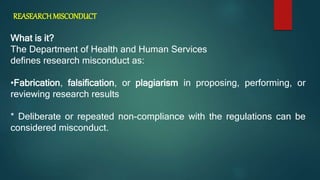
What is it?
The Department of Health and Human Services
defines research misconduct as:
•Fabrication, falsification, or plagiarism in proposing, performing, or
reviewing research results
* Deliberate or repeated non-compliance with the regulations can be
considered misconduct.
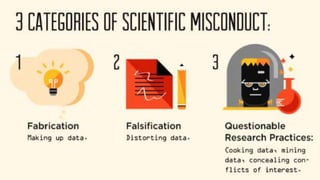
Fabrication: making up results and recording or reporting
them
Falsification: manipulation of research materials,
equipment, or processes, or changing or omitting results
such that the research is not accurately represented in the
record
Plagiarism: the appropriation of another’s ideas, processes,
results, or words without giving proper credit
Criteria for Research Misconduct
• Represents a significant departure from accepted practices
• Has been committed intentionally, or knowingly, or recklessly;
and
• Can be proven by a preponderance of evidence
• What is NOT misconduct: honest, unintentional error or honest
differences of opinion
Top Ten “Poor” Behaviors:
1. Falsifying or ‘cooking’ research data
2. Ignoring major aspects of human-subject requirements
3. Not properly disclosing involvement in firms whose products are based on one‘s own
research
4. Relationships with students, research subjects or clients that may be interpreted as
questionable
5. Using another’s ideas without obtaining permission or giving due credit (plagiarism)
6. Unauthorized use of confidential information in connection with one’s own research
7. Failing to present data that contradict one’s own previous research
8. Circumventing certain minor aspects of human-subject requirements
9. Overlooking others' use of flawed data or questionable interpretation of data
10. Changing the design, methodology or results of a study in response to pressure
from a funding source (falsification).
Other Behaviours
•Publishing the same data or results in two or more publications
•Inappropriately assigning authorship credit
•Withholding details of methodology or results in papers or
proposals
•Using inadequate or inappropriate research designs
•Dropping observations or data points from analyses based on a
gut feeling that they were inaccurate
•Inadequate record keeping related to research projects
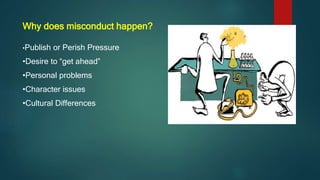
Why does misconduct happen?
•Publish or Perish Pressure
•Desire to “get ahead”
•Personal problems
•Character issues
•Cultural Differences
How is misconduct identified :
•Suspected and reported by a colleague
•Failure to confirm research results by own lab or others
Recommendations :
•Adopt zero tolerance
•Protect whistleblowers
•Clarify how to report
•Train the mentors
•Model ethical behavior
Consequences of Misconduct
•If misconduct takes place in a clinical trial, it places all subjects in that trial at possible safety risk
•Withdrawal or correction of all pending and published papers and abstracts affected by the
misconduct
•Reprimand, removal from project, rank and salary reduction, dismissal
•Restitution of funds to the granting agency
•Ineligibility to apply for grants for years
The end of your research career!
Dealing with Misconduct
•Prevention
–Identify and eliminate/minimize risk factors for misconduct
•Detection
–Monitor and recognize signs of fraud
•Correction
–Promptly investigate and report fraud
Institutional Requirements
•Establish policies and procedures for investigating and reporting
instances of alleged research misconduct
•Provide training and education
•Promote responsible conduct of research
•Provide support to assist with correcting incidences of misconduct
•Provide annual report
•Promote Professionalism!
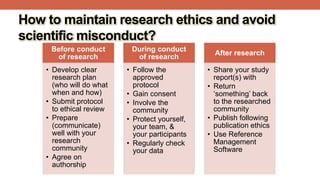
How to maintain research ethics and avoid
scientific misconduct?
Before conduct
of research
• Develop clear
research plan
(who will do what
when and how)
• Submit protocol
to ethical review
• Prepare
(communicate)
well with your
research
community
• Agree on
authorship
During conduct
of research
• Follow the
approved
protocol
• Gain consent
• Involve the
community
• Protect yourself,
your team, &
your participants
• Regularly check
your data
After research
• Share your study
report(s) with
• Return
‘something’ back
to the researched
community
• Publish following
publication ethics
• Use Reference
Management
Software
Responsible Research Conduct :
•The Office of Research Integrity (ORI) defines research integrity as “adherence
to rules, regulations, guidelines, and commonly accepted professional codes or
norms.”
•Research integrity is essential to ensure the reliability of research results and
to preserve public support for research.
scientific misconduct

scientific misconduct

  • 1.
  • 2.
  • 3.
    What is Research? Research”is defined as an undertaking intended to extend knowledge through a disciplined inquiry or systematic investigation.  Systematic methodological scientific approach for basic facts around a certain problem in order to find solutions based on these facts.
  • 4.
    REASEARCHMISCONDUCT What is it? TheDepartment of Health and Human Services defines research misconduct as: •Fabrication, falsification, or plagiarism in proposing, performing, or reviewing research results * Deliberate or repeated non-compliance with the regulations can be considered misconduct.
  • 6.
    Fabrication: making upresults and recording or reporting them Falsification: manipulation of research materials, equipment, or processes, or changing or omitting results such that the research is not accurately represented in the record Plagiarism: the appropriation of another’s ideas, processes, results, or words without giving proper credit
  • 7.
    Criteria for ResearchMisconduct • Represents a significant departure from accepted practices • Has been committed intentionally, or knowingly, or recklessly; and • Can be proven by a preponderance of evidence • What is NOT misconduct: honest, unintentional error or honest differences of opinion
  • 8.
    Top Ten “Poor”Behaviors: 1. Falsifying or ‘cooking’ research data 2. Ignoring major aspects of human-subject requirements 3. Not properly disclosing involvement in firms whose products are based on one‘s own research 4. Relationships with students, research subjects or clients that may be interpreted as questionable 5. Using another’s ideas without obtaining permission or giving due credit (plagiarism) 6. Unauthorized use of confidential information in connection with one’s own research 7. Failing to present data that contradict one’s own previous research 8. Circumventing certain minor aspects of human-subject requirements 9. Overlooking others' use of flawed data or questionable interpretation of data 10. Changing the design, methodology or results of a study in response to pressure from a funding source (falsification).
  • 9.
    Other Behaviours •Publishing thesame data or results in two or more publications •Inappropriately assigning authorship credit •Withholding details of methodology or results in papers or proposals •Using inadequate or inappropriate research designs •Dropping observations or data points from analyses based on a gut feeling that they were inaccurate •Inadequate record keeping related to research projects
  • 10.
    Why does misconducthappen? •Publish or Perish Pressure •Desire to “get ahead” •Personal problems •Character issues •Cultural Differences
  • 11.
    How is misconductidentified : •Suspected and reported by a colleague •Failure to confirm research results by own lab or others
  • 12.
    Recommendations : •Adopt zerotolerance •Protect whistleblowers •Clarify how to report •Train the mentors •Model ethical behavior
  • 13.
    Consequences of Misconduct •Ifmisconduct takes place in a clinical trial, it places all subjects in that trial at possible safety risk •Withdrawal or correction of all pending and published papers and abstracts affected by the misconduct •Reprimand, removal from project, rank and salary reduction, dismissal •Restitution of funds to the granting agency •Ineligibility to apply for grants for years The end of your research career!
  • 14.
    Dealing with Misconduct •Prevention –Identifyand eliminate/minimize risk factors for misconduct •Detection –Monitor and recognize signs of fraud •Correction –Promptly investigate and report fraud
  • 15.
    Institutional Requirements •Establish policiesand procedures for investigating and reporting instances of alleged research misconduct •Provide training and education •Promote responsible conduct of research •Provide support to assist with correcting incidences of misconduct •Provide annual report •Promote Professionalism!
  • 16.
    How to maintainresearch ethics and avoid scientific misconduct? Before conduct of research • Develop clear research plan (who will do what when and how) • Submit protocol to ethical review • Prepare (communicate) well with your research community • Agree on authorship During conduct of research • Follow the approved protocol • Gain consent • Involve the community • Protect yourself, your team, & your participants • Regularly check your data After research • Share your study report(s) with • Return ‘something’ back to the researched community • Publish following publication ethics • Use Reference Management Software
  • 17.
    Responsible Research Conduct: •The Office of Research Integrity (ORI) defines research integrity as “adherence to rules, regulations, guidelines, and commonly accepted professional codes or norms.” •Research integrity is essential to ensure the reliability of research results and to preserve public support for research.