Academic Corruption and
Misconduct
December 2012
Wayne Poggenpoel
2
INTRODUCTION
• Purpose
– List behaviours on academic dishonesty leading to positive
publication bias
– Other forms of misconduct
– Trends in misconduct
– Characteristics of those who engage in misconduct
– Examples of potential misconduct
– Conclusion
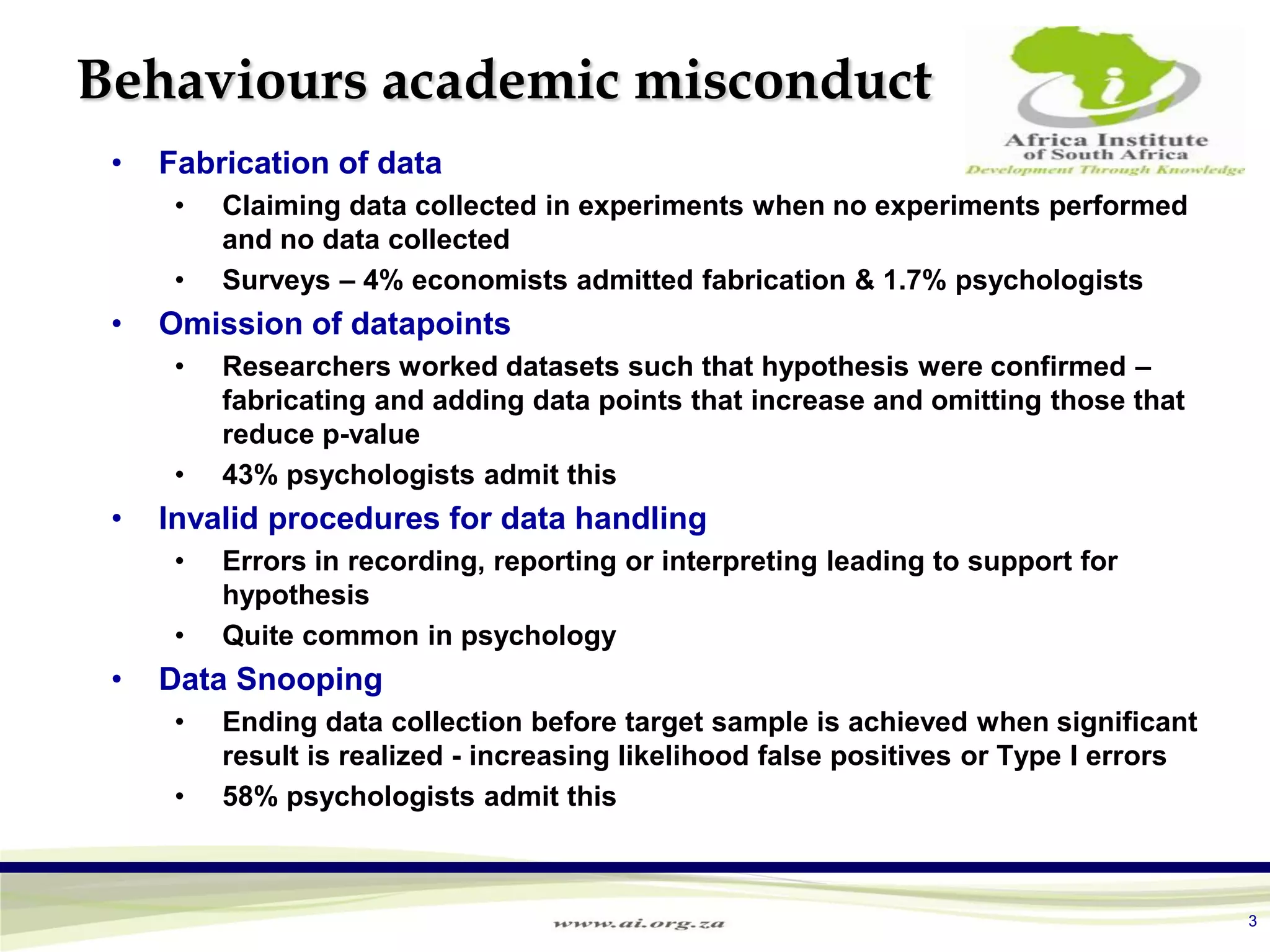
Behaviours academic misconduct
3
• Fabrication of data
• Claiming data collected in experiments when no experiments performed
and no data collected
• Surveys – 4% economists admitted fabrication & 1.7% psychologists
• Omission of datapoints
• Researchers worked datasets such that hypothesis were confirmed –
fabricating and adding data points that increase and omitting those that
reduce p-value
• 43% psychologists admit this
• Invalid procedures for data handling
• Errors in recording, reporting or interpreting leading to support for
hypothesis
• Quite common in psychology
• Data Snooping
• Ending data collection before target sample is achieved when significant
result is realized - increasing likelihood false positives or Type I errors
• 58% psychologists admit this
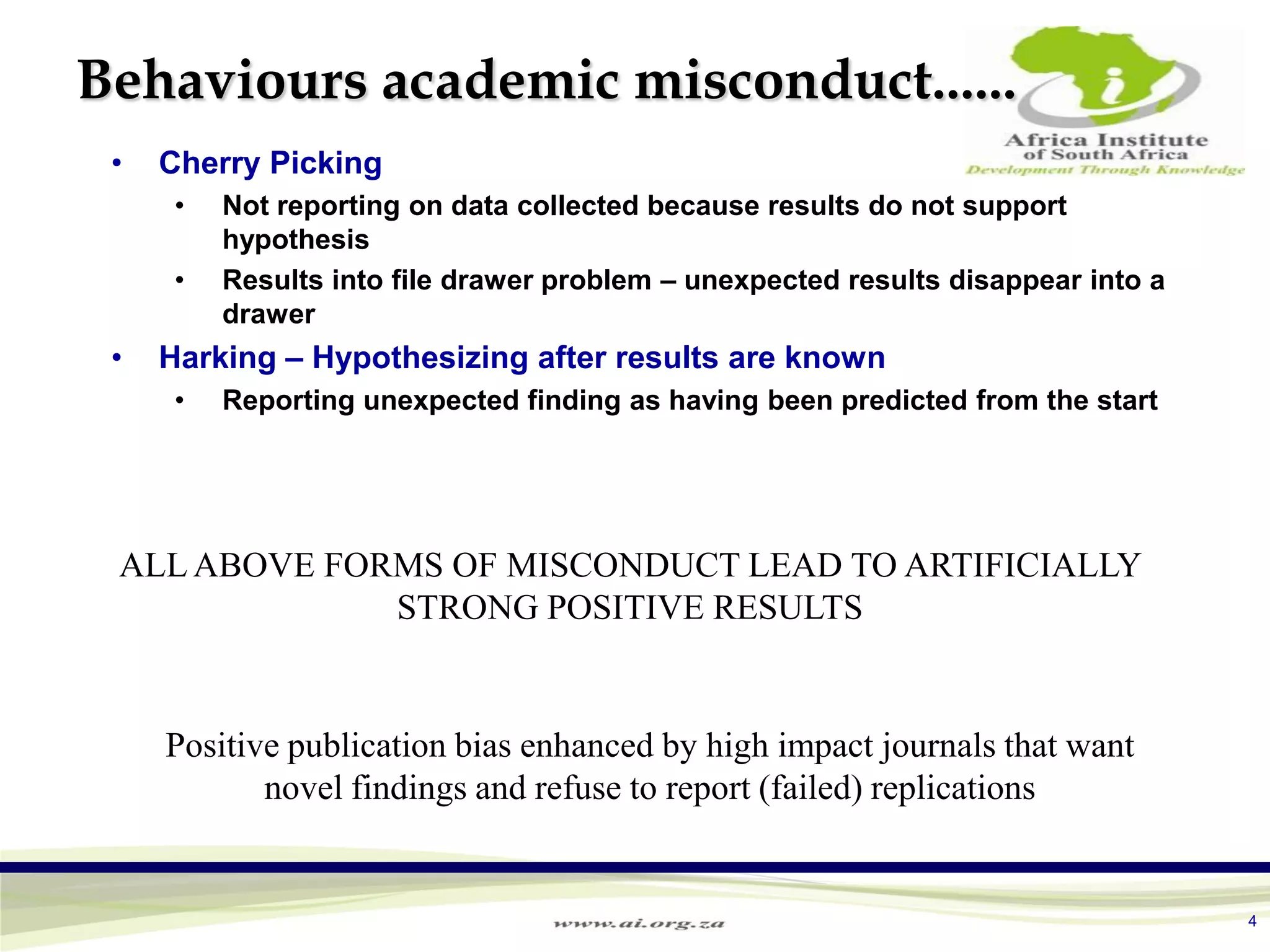
Behaviours academic misconduct......
4
• Cherry Picking
• Not reporting on data collected because results do not support
hypothesis
• Results into file drawer problem – unexpected results disappear into a
drawer
• Harking – Hypothesizing after results are known
• Reporting unexpected finding as having been predicted from the start
ALL ABOVE FORMS OF MISCONDUCT LEAD TO ARTIFICIALLY
STRONG POSITIVE RESULTS
Positive publication bias enhanced by high impact journals that want
novel findings and refuse to report (failed) replications
Other forms of misconduct
5
• Plagiarism
• Cut and paste of text without proper references
• Double publication
• Sending same manuscript to different journals without informing
• Undeserved authorship
• Putting name of co-author on paper who did not contribute to paper
• Not disclosing conflicts of interest
• E.g. Reviewing own paper; reviewing paper by a close colleague;
sponsorship of research by party with interests in certain outcome
• Not observing professional codes of conduct
Trends in misconduct
6
• Evidence suggests misconduct in academia is increasing
• Steen (2011) - retraction papers from academic journals in PubMed
increased over years
• Could be tip of iceberg cause editors found evidence misconduct
so convincing
• Fanelli (2012) shows negative results disappearing from most
disciplines published in ISI journal articles
• Most troubling proportion of positive results in journal articles is higher
in the Social Sciences
Characteristics of those engaged in
misconduct
7
• Little is known about characteristics of those engaged in
misconduct
• Stroebe, Postmes and Spears (2012) compared cases academics
caught for fraud and identified set common characteristics
• Highly respected researchers
• Publish journal articles proficiently
• Were very quick in making their career
• Had perfect datasets
• More frequently publishes with co-authors who also has fraudulent
publications
Examples Potential Misconduct
8
Condition Potential
Misconduct
Detection
Method
Researcher worked alone. Nobody else was has access to data. Co-
authors not involved in data collection or analysis
Data fabrication Ask co-authors
The research only finds support for the hypothesis Cherry picking and harking Count proportion of
hypotheses supported
The research appeared in high impact journals Misconduct with higher
benefits
Check impact factor
The author is early in his/her career Misconduct with higher
benefits
Check career stage
The raw data (documents, fieldwork notes, questionnaires etc.) not
available
Data fabrication Ask co-authors and co-
workers
No fieldwork report available Data fabrication Check data archive, ask
author
Data provided but description of procedures followed not available or is
unclear
Data fabrication, cherry
picking, harking
Ask author
Conclusion
9
• Generally academic misconduct likely more prevalent & severe as
benefits of misconduct higher, costs lower and detection risk is
lower
• Factors increasing benefit of misconduct
• Increasing publication pressure
• Overburdened reviewers
• Co-authors who are happy to score additional publication
• Possible remedies against misconduct
• Good mentoring
• Appropriately trained support staff
• Blinded assessment of data
• Data review
• Effective internal and external committees
• Strong departmental leadership

Academic Corruption and Misconduct

  • 1.
  • 2.
    2 INTRODUCTION • Purpose – Listbehaviours on academic dishonesty leading to positive publication bias – Other forms of misconduct – Trends in misconduct – Characteristics of those who engage in misconduct – Examples of potential misconduct – Conclusion
  • 3.
    Behaviours academic misconduct 3 •Fabrication of data • Claiming data collected in experiments when no experiments performed and no data collected • Surveys – 4% economists admitted fabrication & 1.7% psychologists • Omission of datapoints • Researchers worked datasets such that hypothesis were confirmed – fabricating and adding data points that increase and omitting those that reduce p-value • 43% psychologists admit this • Invalid procedures for data handling • Errors in recording, reporting or interpreting leading to support for hypothesis • Quite common in psychology • Data Snooping • Ending data collection before target sample is achieved when significant result is realized - increasing likelihood false positives or Type I errors • 58% psychologists admit this
  • 4.
    Behaviours academic misconduct...... 4 •Cherry Picking • Not reporting on data collected because results do not support hypothesis • Results into file drawer problem – unexpected results disappear into a drawer • Harking – Hypothesizing after results are known • Reporting unexpected finding as having been predicted from the start ALL ABOVE FORMS OF MISCONDUCT LEAD TO ARTIFICIALLY STRONG POSITIVE RESULTS Positive publication bias enhanced by high impact journals that want novel findings and refuse to report (failed) replications
  • 5.
    Other forms ofmisconduct 5 • Plagiarism • Cut and paste of text without proper references • Double publication • Sending same manuscript to different journals without informing • Undeserved authorship • Putting name of co-author on paper who did not contribute to paper • Not disclosing conflicts of interest • E.g. Reviewing own paper; reviewing paper by a close colleague; sponsorship of research by party with interests in certain outcome • Not observing professional codes of conduct
  • 6.
    Trends in misconduct 6 •Evidence suggests misconduct in academia is increasing • Steen (2011) - retraction papers from academic journals in PubMed increased over years • Could be tip of iceberg cause editors found evidence misconduct so convincing • Fanelli (2012) shows negative results disappearing from most disciplines published in ISI journal articles • Most troubling proportion of positive results in journal articles is higher in the Social Sciences
  • 7.
    Characteristics of thoseengaged in misconduct 7 • Little is known about characteristics of those engaged in misconduct • Stroebe, Postmes and Spears (2012) compared cases academics caught for fraud and identified set common characteristics • Highly respected researchers • Publish journal articles proficiently • Were very quick in making their career • Had perfect datasets • More frequently publishes with co-authors who also has fraudulent publications
  • 8.
    Examples Potential Misconduct 8 ConditionPotential Misconduct Detection Method Researcher worked alone. Nobody else was has access to data. Co- authors not involved in data collection or analysis Data fabrication Ask co-authors The research only finds support for the hypothesis Cherry picking and harking Count proportion of hypotheses supported The research appeared in high impact journals Misconduct with higher benefits Check impact factor The author is early in his/her career Misconduct with higher benefits Check career stage The raw data (documents, fieldwork notes, questionnaires etc.) not available Data fabrication Ask co-authors and co- workers No fieldwork report available Data fabrication Check data archive, ask author Data provided but description of procedures followed not available or is unclear Data fabrication, cherry picking, harking Ask author
  • 9.
    Conclusion 9 • Generally academicmisconduct likely more prevalent & severe as benefits of misconduct higher, costs lower and detection risk is lower • Factors increasing benefit of misconduct • Increasing publication pressure • Overburdened reviewers • Co-authors who are happy to score additional publication • Possible remedies against misconduct • Good mentoring • Appropriately trained support staff • Blinded assessment of data • Data review • Effective internal and external committees • Strong departmental leadership