Komal Ambedika
Hrishabh Raj
 Introduction
 Applications of Tachometer
 Working Principle
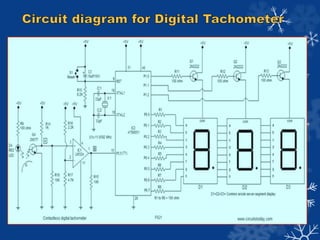
 Circuit diagram of Tachometer
 Technique of heartbeat measurement
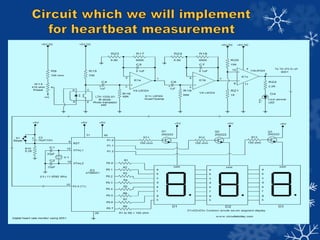
 Relevant circuitry for heartbeat measurement
 Circuit description
 Application areas of our project
 Future scopes
 Conclusion
 References
The word tachometer is derived from two Greek words: tachos means “speed”
and metron means “to measure”.A tachometer is a sensor device for measuring
the rotation speed of an object such as engine shaft in a car . It indicates the
number of revolutions per minute(RPM) performed by an object.
Types of tachometer commonly available:-
 Analog Tachometer :- Comprises needle and dial type interface.
 Digital Tachometer :- Comprises LCD or LED readout and a memory.
 Contact/Non-Contact tachometer :- Sensor is in directly contact with
rotating shaft in case of contact type.
 Time/Frequency measuring tachometer :-Time measuring device calculates
speed by measuring time b/w incoming pulses whereas frequency
measuring devices measures the frequency of incoming pulses.
 Electric tachometers are utilized in machinery and automobiles.
 Tachometers are used in aircraft , rails,automobiles and other vehicles
for indicating the rotation rate of the crankshaft of the engine.
 Used in traffic engineering to estimate traffic speed and volume.
 Used in stationary engines
 Used for measuring heart rate , arterial blood flow rate , respiratory gas
flow rate in medical.
Analog Tachometer
 Has a needle and dial type
interface.
 No provision for storage of
reading.
 Can not compute average ,
deviation , etc.
Digital Tachometer
 Has a LCD & LED layout.
 Memory is provided for
storage.
 Can perform statistical
functions like averaging etc.
The basic principle involves a system with a sensor, a controller and a
display unit . The sensor comprises IR diode and a phototransistor, the
controller used is the microcontroller loaded with a compiled code and the
seven segment display is being interfaced with it , displaying the speed of
the motor. The sensor senses the speed of the motor without actually being
in contact with it by the principle of IR reflection technique and generates
a signal. This signal is converted into an electric signal and fed to the
microcontroller, which is programmed to calculate the speed in terms of
number of motor revolutions in one minute. This speed is displayed on the
interfaced display unit.
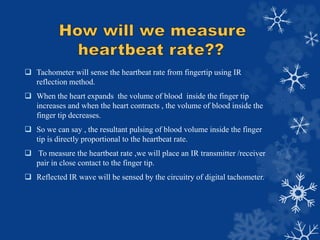
 Tachometer will sense the heartbeat rate from fingertip using IR
reflection method.
 When the heart expands the volume of blood inside the finger tip
increases and when the heart contracts , the volume of blood inside the
finger tip decreases.
 So we can say , the resultant pulsing of blood volume inside the finger
tip is directly proportional to the heartbeat rate.
 To measure the heartbeat rate ,we will place an IR transmitter /receiver
pair in close contact to the finger tip.
 Reflected IR wave will be sensed by the circuitry of digital tachometer.
IR SENSOR
ACTIVE
FILTER
Comp
arator
Microcon
troller
7 Segment
Display
1.SENSOR
 Sensor comprises IR diode and phototransistor
in a single package.
 When the finger tip is placed over the sensor
,volumetric pulsing of the blood volume inside
the finger tip due to heart beat varies the
intensity of the reflected beam .
 According to the intensity of reflected IR
wave , collector current in phototransistor
varies.
 Variation in collector voltage is directly
proportional to heart beat rate.
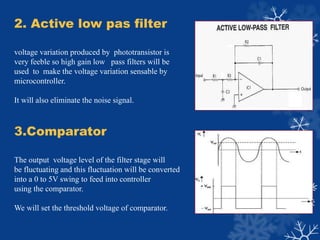
2. Active low pas filter
voltage variation produced by phototransistor is
very feeble so high gain low pass filters will be
used to make the voltage variation sensable by
microcontroller.
It will also eliminate the noise signal.
3.Comparator
The output voltage level of the filter stage will
be fluctuating and this fluctuation will be converted
into a 0 to 5V swing to feed into controller
using the comparator.
We will set the threshold voltage of comparator.
4. 8051 Microcontroller
Microcontroller is used to count the pulses which is directly proportional to
heartbeat rate.
For counting purpose both the timers of 8051 (Timer0 and Timer1) will be used.
Timer 1 will be configured as counter for registering the number of incoming
pulses and Timer0 will be configured as timer which will generate the necessary
time span for the Timer1 to count.
5. Seven segment display
Seven segment display will be interfaced with microcontroller so that it may
display the counting result which will be proportional to heartbeat rate.
6.Low power LED
when we’ll put fingertip on sensor , LED will start blinking indicating that
circuit is working. we’ll turn off the power and according to our program we
will have to wait for sometime to get heart rate in display unit.
 Can be widely used as a training aid for a variety of sports.
 Can be used in Hospitals / Dispensaries
 Better and accurate method of measuring heart beat at homes.
 Quite useful for people staying at villages.
 Bio medical signals like breathing rate measurement & pulse oximetry.
 It can be configured for choice operations such as security lock against
unauthorized access.
 Integrated alarm system may be configured for showing unhealthy heart
condition.
 We can use the inbuilt memory for data storage for a comparative
examination.
We have not implemented the circuit yet but made a thorough study
regarding the generation and measurement of the signal. We made an
in-depth review of the major functional blocks required for
implementation , examined various circuit components as per the need
and requirements and will implement the circuit in the next semester .
Main aim is to design a tachometer which could be affordable by all for
measuring pulse rate and thereby prevent cardiac issues . If time
permits, we will try to extend the functionality of our tachometer .
 en.wikipedia.org/wiki/Tachometer
 www.xdesignlabs.com/digi_tach.php
 www.researchgate.net
 www.pyroelectro.com
 Embedded Systems- Lyla B.Das
Tachometer

Tachometer

  • 1.
  • 2.
     Introduction  Applicationsof Tachometer  Working Principle  Circuit diagram of Tachometer  Technique of heartbeat measurement  Relevant circuitry for heartbeat measurement  Circuit description  Application areas of our project  Future scopes  Conclusion  References
  • 3.
    The word tachometeris derived from two Greek words: tachos means “speed” and metron means “to measure”.A tachometer is a sensor device for measuring the rotation speed of an object such as engine shaft in a car . It indicates the number of revolutions per minute(RPM) performed by an object. Types of tachometer commonly available:-  Analog Tachometer :- Comprises needle and dial type interface.  Digital Tachometer :- Comprises LCD or LED readout and a memory.  Contact/Non-Contact tachometer :- Sensor is in directly contact with rotating shaft in case of contact type.  Time/Frequency measuring tachometer :-Time measuring device calculates speed by measuring time b/w incoming pulses whereas frequency measuring devices measures the frequency of incoming pulses.
  • 4.
     Electric tachometersare utilized in machinery and automobiles.  Tachometers are used in aircraft , rails,automobiles and other vehicles for indicating the rotation rate of the crankshaft of the engine.  Used in traffic engineering to estimate traffic speed and volume.  Used in stationary engines  Used for measuring heart rate , arterial blood flow rate , respiratory gas flow rate in medical.
  • 5.
    Analog Tachometer  Hasa needle and dial type interface.  No provision for storage of reading.  Can not compute average , deviation , etc. Digital Tachometer  Has a LCD & LED layout.  Memory is provided for storage.  Can perform statistical functions like averaging etc.
  • 6.
    The basic principleinvolves a system with a sensor, a controller and a display unit . The sensor comprises IR diode and a phototransistor, the controller used is the microcontroller loaded with a compiled code and the seven segment display is being interfaced with it , displaying the speed of the motor. The sensor senses the speed of the motor without actually being in contact with it by the principle of IR reflection technique and generates a signal. This signal is converted into an electric signal and fed to the microcontroller, which is programmed to calculate the speed in terms of number of motor revolutions in one minute. This speed is displayed on the interfaced display unit.
  • 8.
     Tachometer willsense the heartbeat rate from fingertip using IR reflection method.  When the heart expands the volume of blood inside the finger tip increases and when the heart contracts , the volume of blood inside the finger tip decreases.  So we can say , the resultant pulsing of blood volume inside the finger tip is directly proportional to the heartbeat rate.  To measure the heartbeat rate ,we will place an IR transmitter /receiver pair in close contact to the finger tip.  Reflected IR wave will be sensed by the circuitry of digital tachometer.
  • 9.
  • 11.
    1.SENSOR  Sensor comprisesIR diode and phototransistor in a single package.  When the finger tip is placed over the sensor ,volumetric pulsing of the blood volume inside the finger tip due to heart beat varies the intensity of the reflected beam .  According to the intensity of reflected IR wave , collector current in phototransistor varies.  Variation in collector voltage is directly proportional to heart beat rate.
  • 12.
    2. Active lowpas filter voltage variation produced by phototransistor is very feeble so high gain low pass filters will be used to make the voltage variation sensable by microcontroller. It will also eliminate the noise signal. 3.Comparator The output voltage level of the filter stage will be fluctuating and this fluctuation will be converted into a 0 to 5V swing to feed into controller using the comparator. We will set the threshold voltage of comparator.
  • 13.
    4. 8051 Microcontroller Microcontrolleris used to count the pulses which is directly proportional to heartbeat rate. For counting purpose both the timers of 8051 (Timer0 and Timer1) will be used. Timer 1 will be configured as counter for registering the number of incoming pulses and Timer0 will be configured as timer which will generate the necessary time span for the Timer1 to count. 5. Seven segment display Seven segment display will be interfaced with microcontroller so that it may display the counting result which will be proportional to heartbeat rate. 6.Low power LED when we’ll put fingertip on sensor , LED will start blinking indicating that circuit is working. we’ll turn off the power and according to our program we will have to wait for sometime to get heart rate in display unit.
  • 14.
     Can bewidely used as a training aid for a variety of sports.  Can be used in Hospitals / Dispensaries  Better and accurate method of measuring heart beat at homes.  Quite useful for people staying at villages.
  • 15.
     Bio medicalsignals like breathing rate measurement & pulse oximetry.  It can be configured for choice operations such as security lock against unauthorized access.  Integrated alarm system may be configured for showing unhealthy heart condition.  We can use the inbuilt memory for data storage for a comparative examination.
  • 16.
    We have notimplemented the circuit yet but made a thorough study regarding the generation and measurement of the signal. We made an in-depth review of the major functional blocks required for implementation , examined various circuit components as per the need and requirements and will implement the circuit in the next semester . Main aim is to design a tachometer which could be affordable by all for measuring pulse rate and thereby prevent cardiac issues . If time permits, we will try to extend the functionality of our tachometer .
  • 17.
     en.wikipedia.org/wiki/Tachometer  www.xdesignlabs.com/digi_tach.php www.researchgate.net  www.pyroelectro.com  Embedded Systems- Lyla B.Das