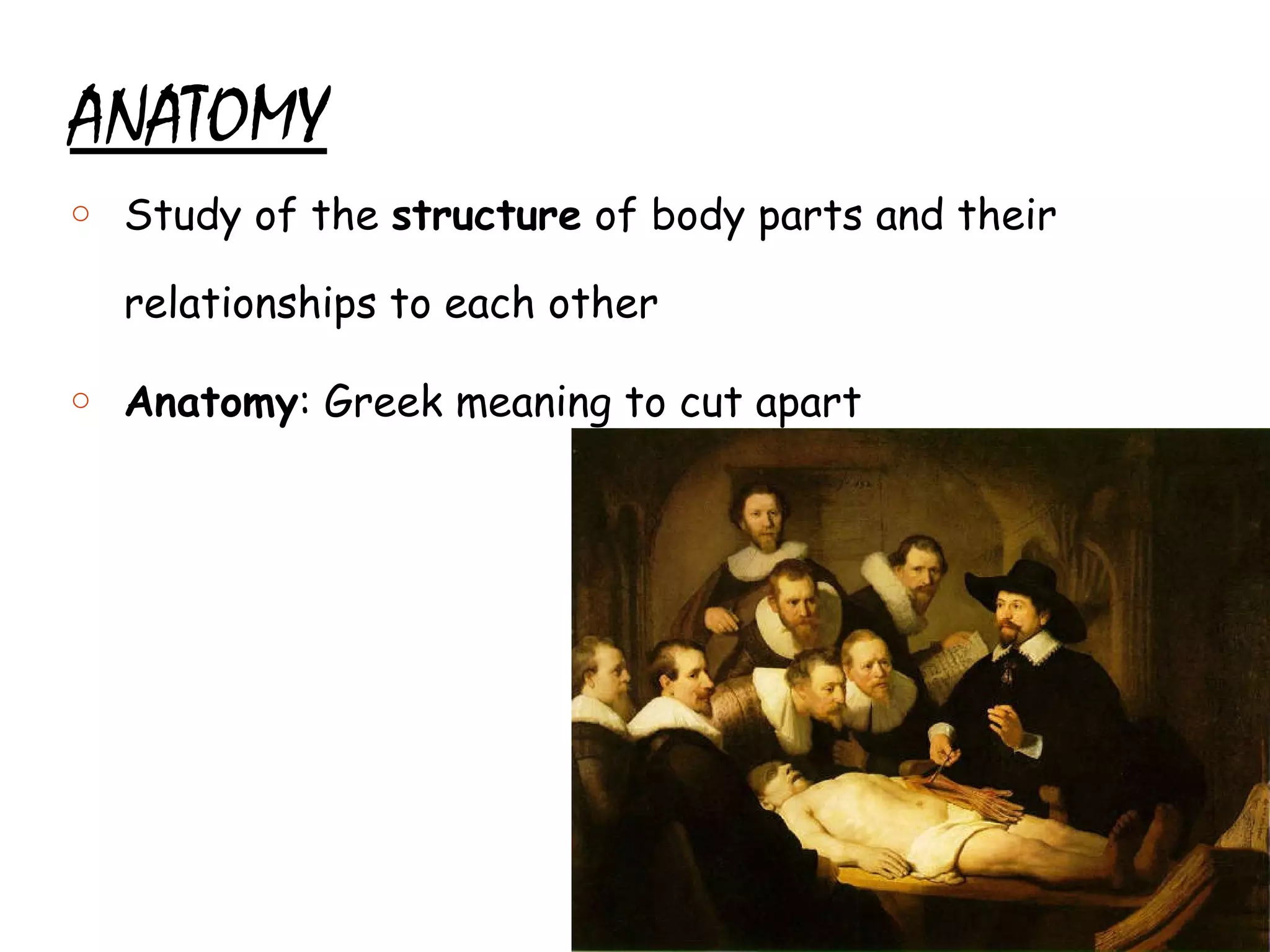
ANATOMY Study of the  structure  of body parts and their relationships to each other Anatomy : Greek meaning to cut apart
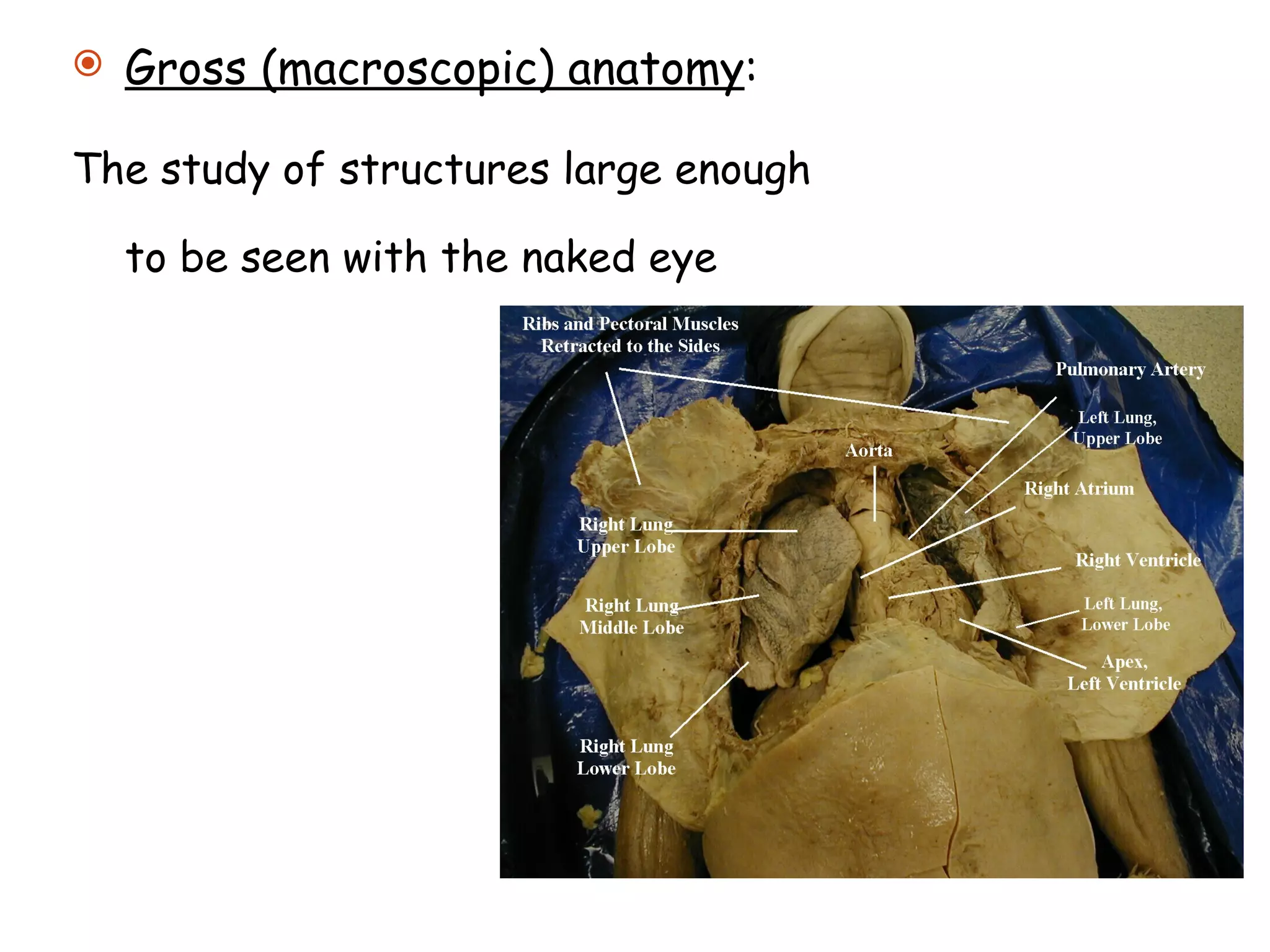
Gross (macroscopic) anatomy : The study of structures large enough to be seen with the naked eye
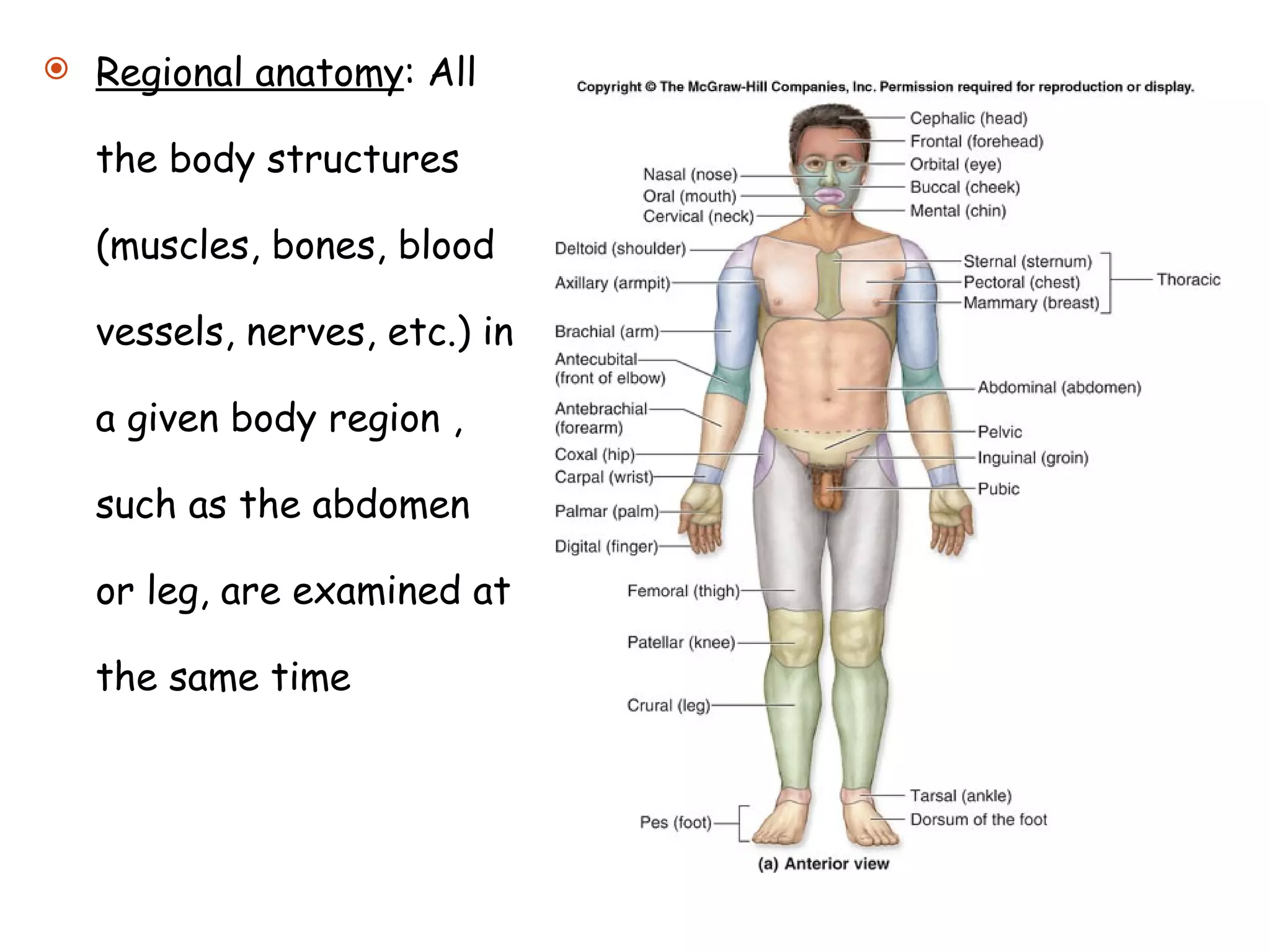
Regional anatomy : All the body structures (muscles, bones, blood vessels, nerves, etc.) in a given body region , such as the abdomen or leg, are examined at the same time
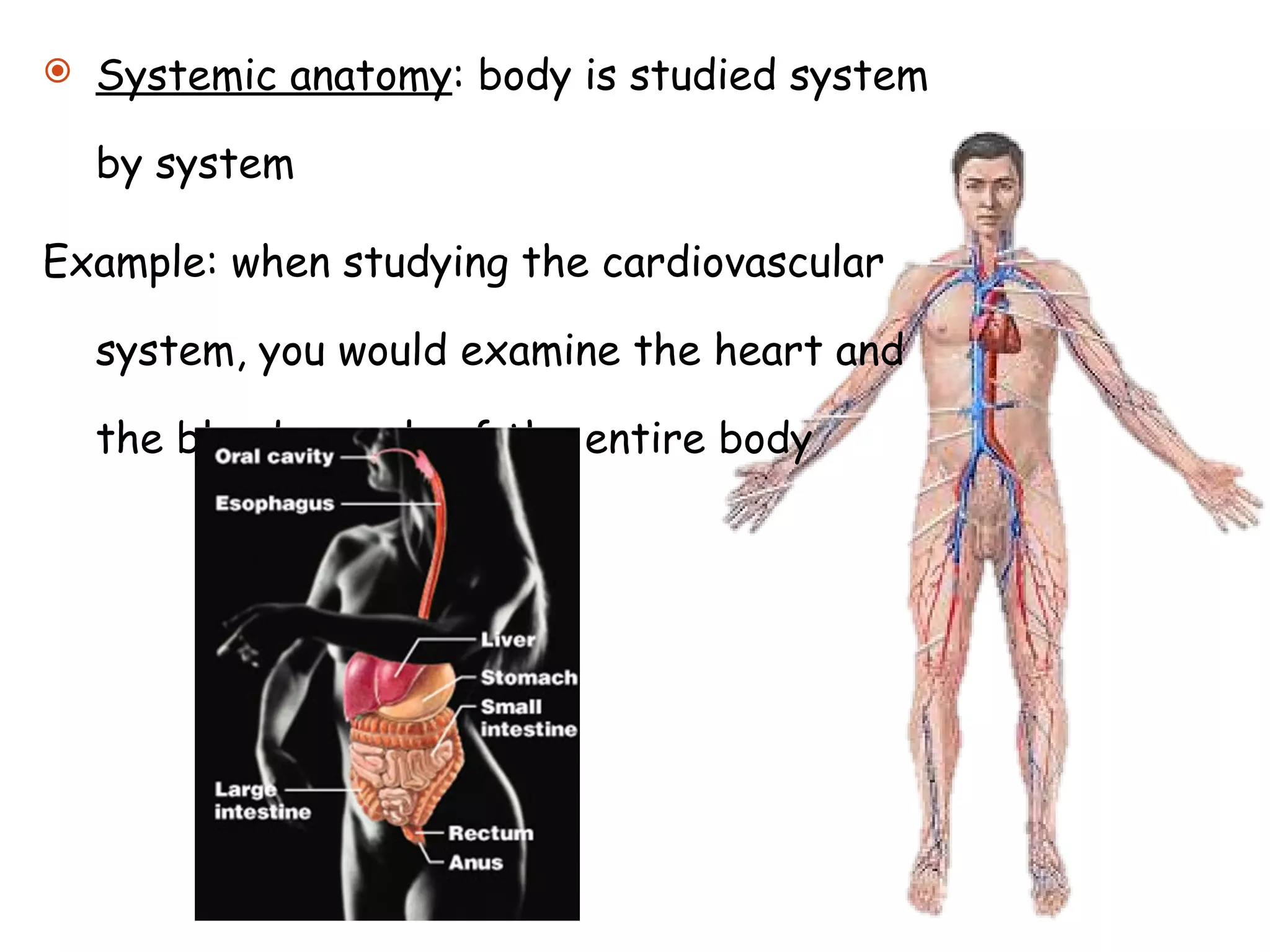
Systemic anatomy : body is studied system by system Example: when studying the cardiovascular system, you would examine the heart and the blood vessels of the entire body
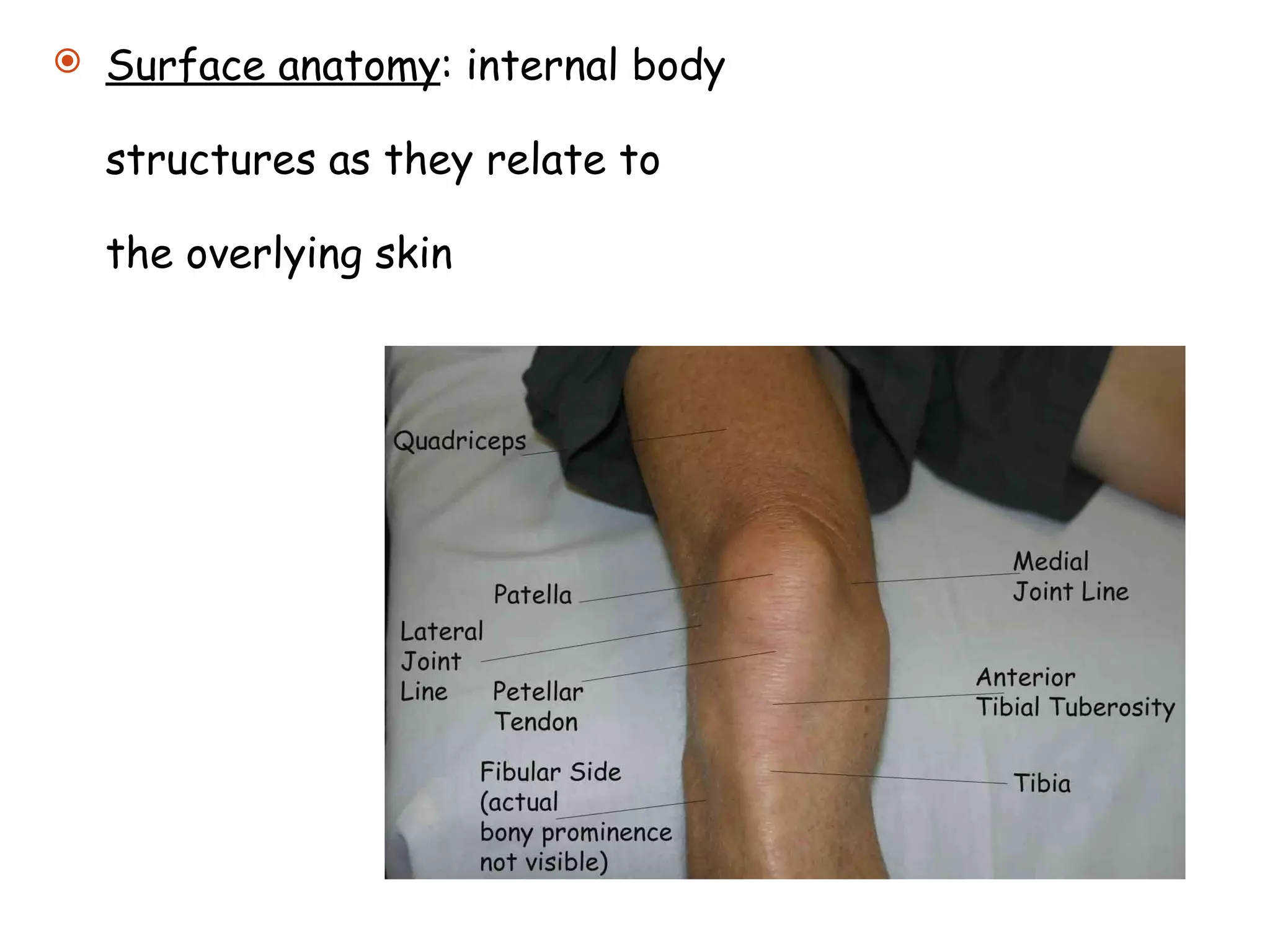
Surface anatomy : internal body structures as they relate to the overlying skin
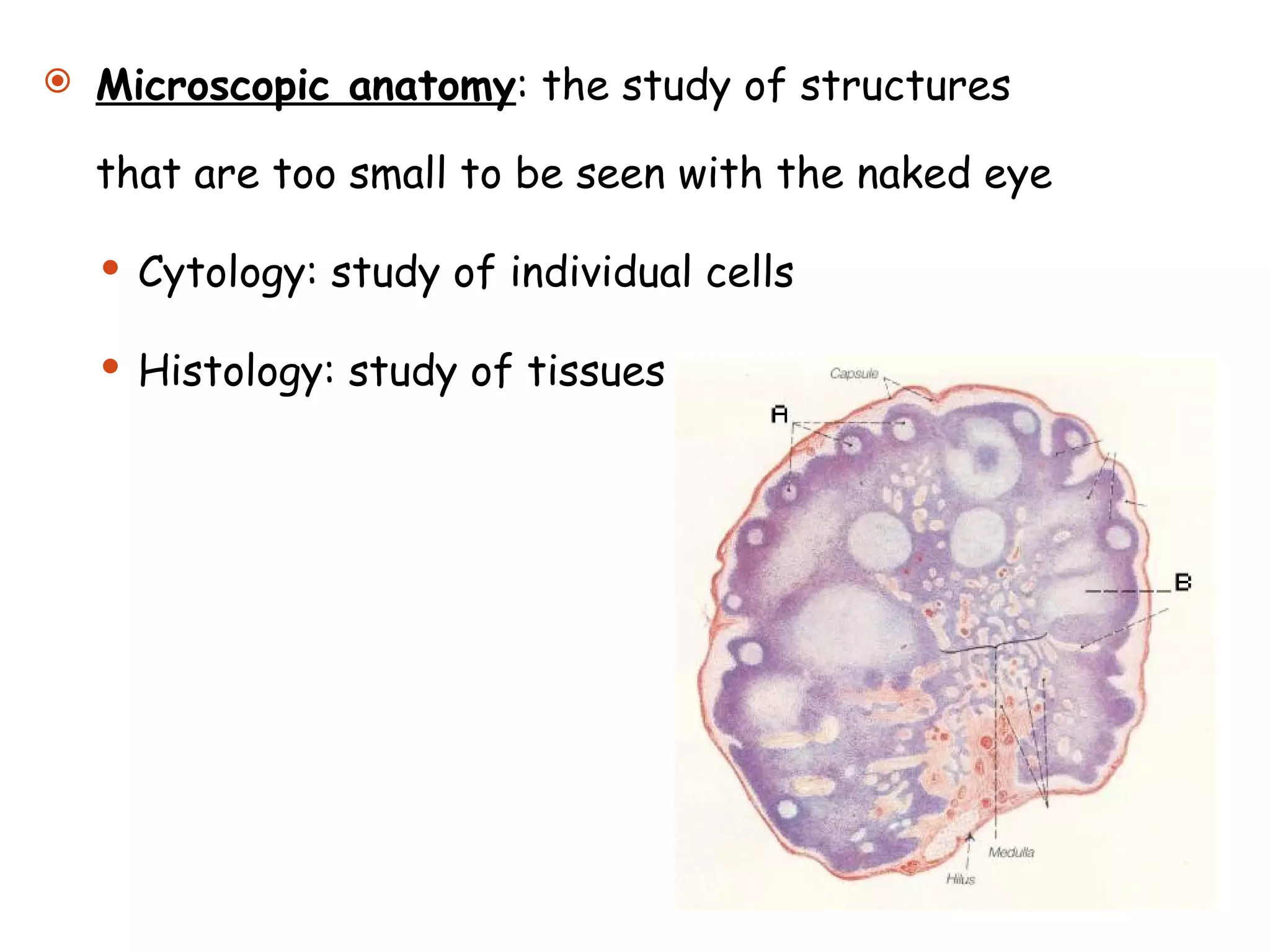
Microscopic anatomy : the study of structures that are too small to be seen with the naked eye Cytology: study of individual cells Histology: study of tissues
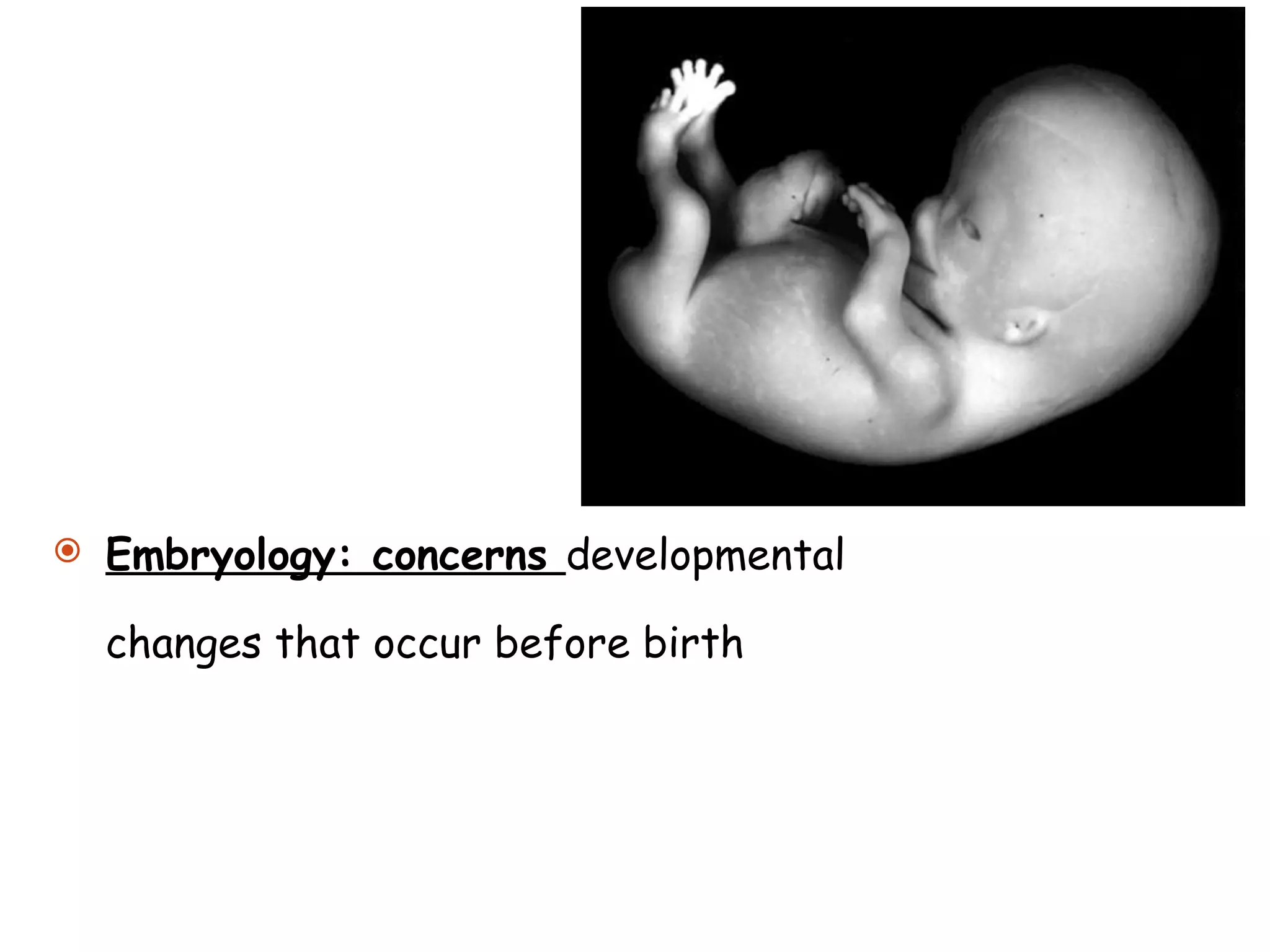
Embryology: concerns  developmental changes that occur before birth
Specialized Branches of Anatomy Pathological anatomy : study of structural changes associated with disease Radiographic anatomy : study of internal structures using specialized visualization techniques (X-rays or special scanning devices)
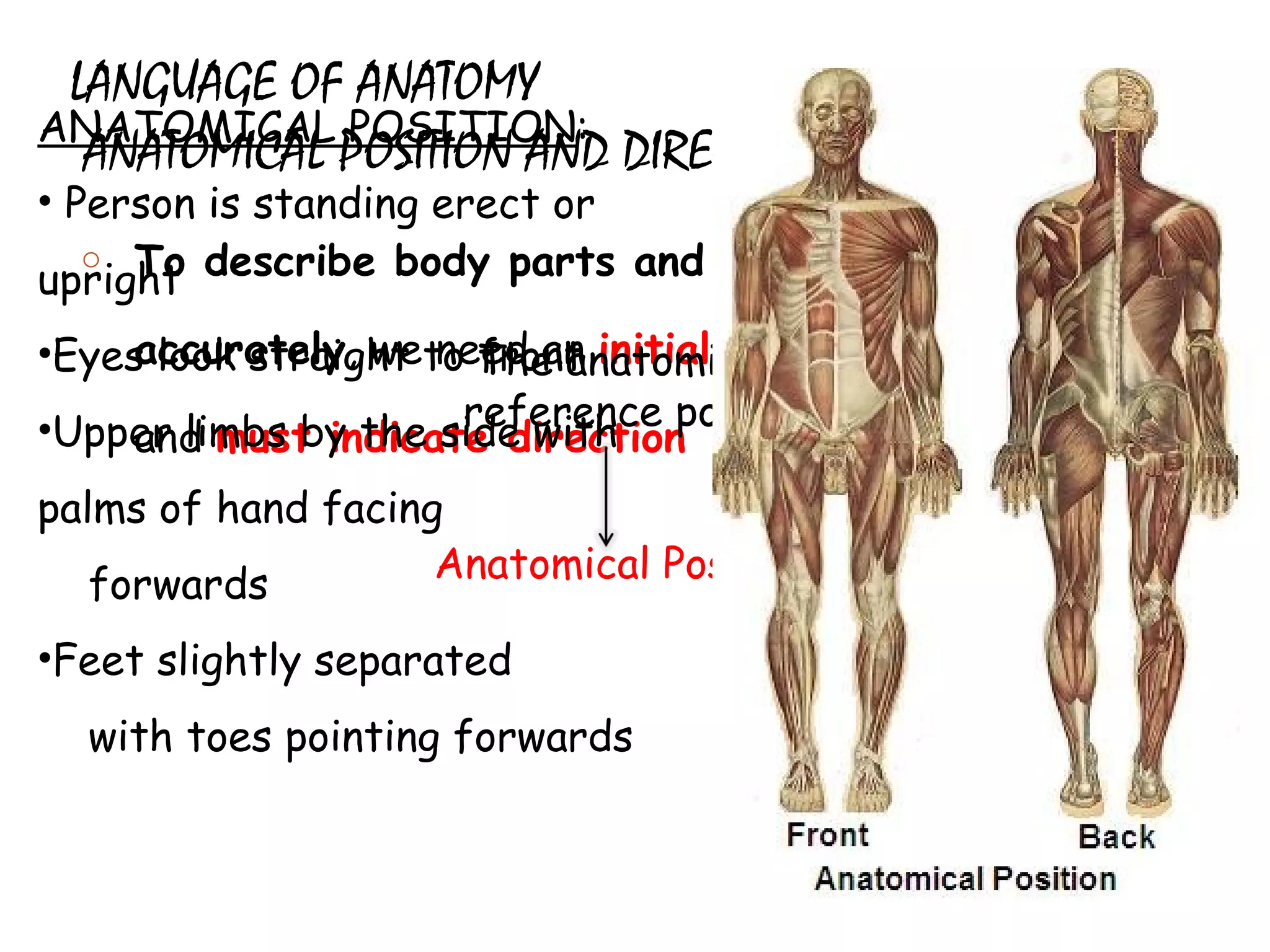
LANGUAGE OF ANATOMY  ANATOMICAL POSITION AND DIRECTIONAL TERMS To describe body parts and position accurately , we need an  initial reference point  and  must indicate direction ANATOMICAL POSITION : Person is standing erect or upright Eyes look straight to front Upper limbs by the side with palms of hand facing  forwards Feet slightly separated  with toes pointing forwards  The anatomical reference point  Anatomical Position
NOTE  In anatomical position, right and left  refer to the right and left sides of the person  viewed—NOT those of the observer   In anatomy, anatomical position is always assumed, regardless of the actual position of the body
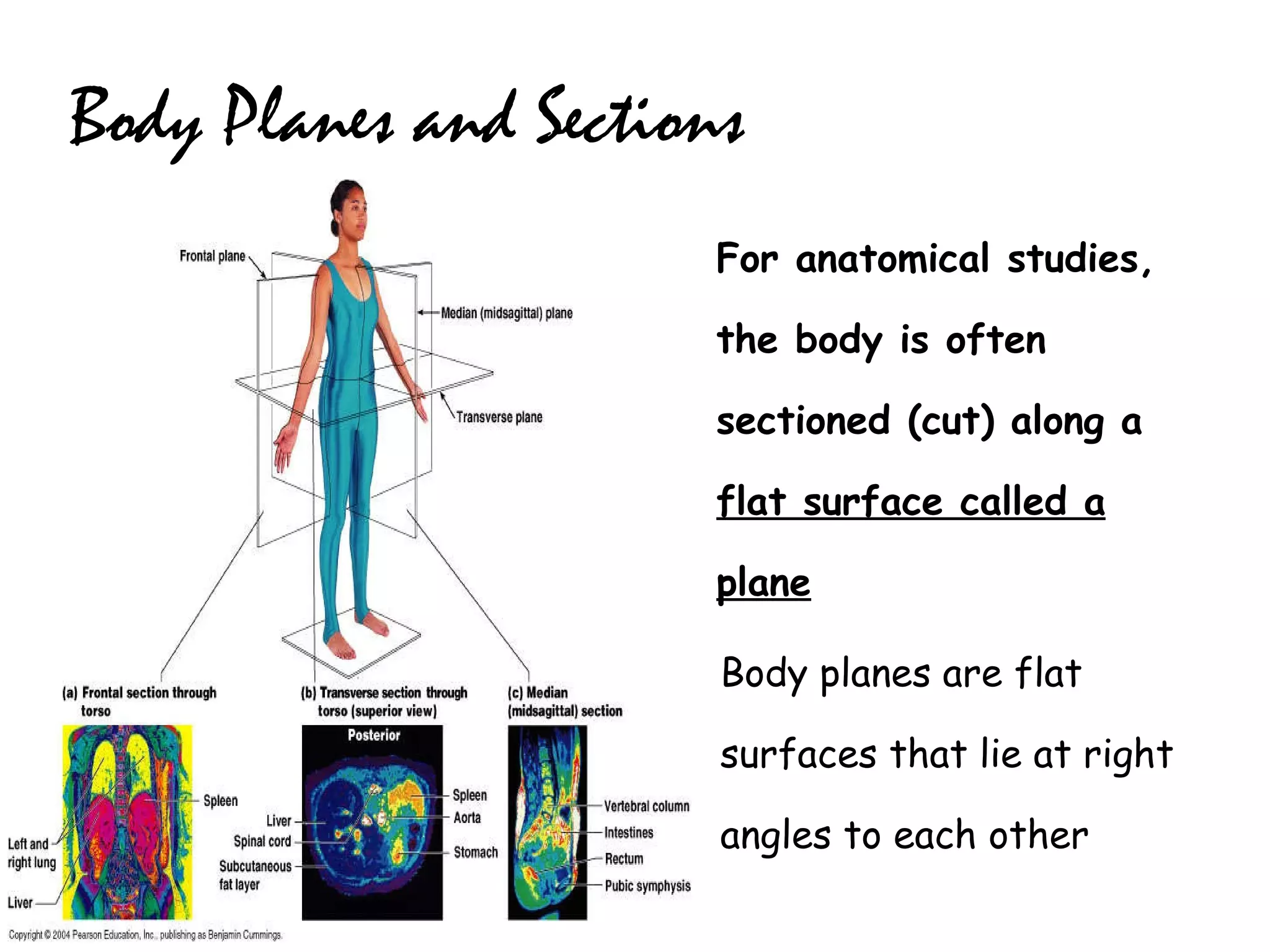
Body Planes and Sections For anatomical studies, the body is often sectioned (cut) along a  flat surface called a plane Body planes are flat surfaces that lie at right angles to each other
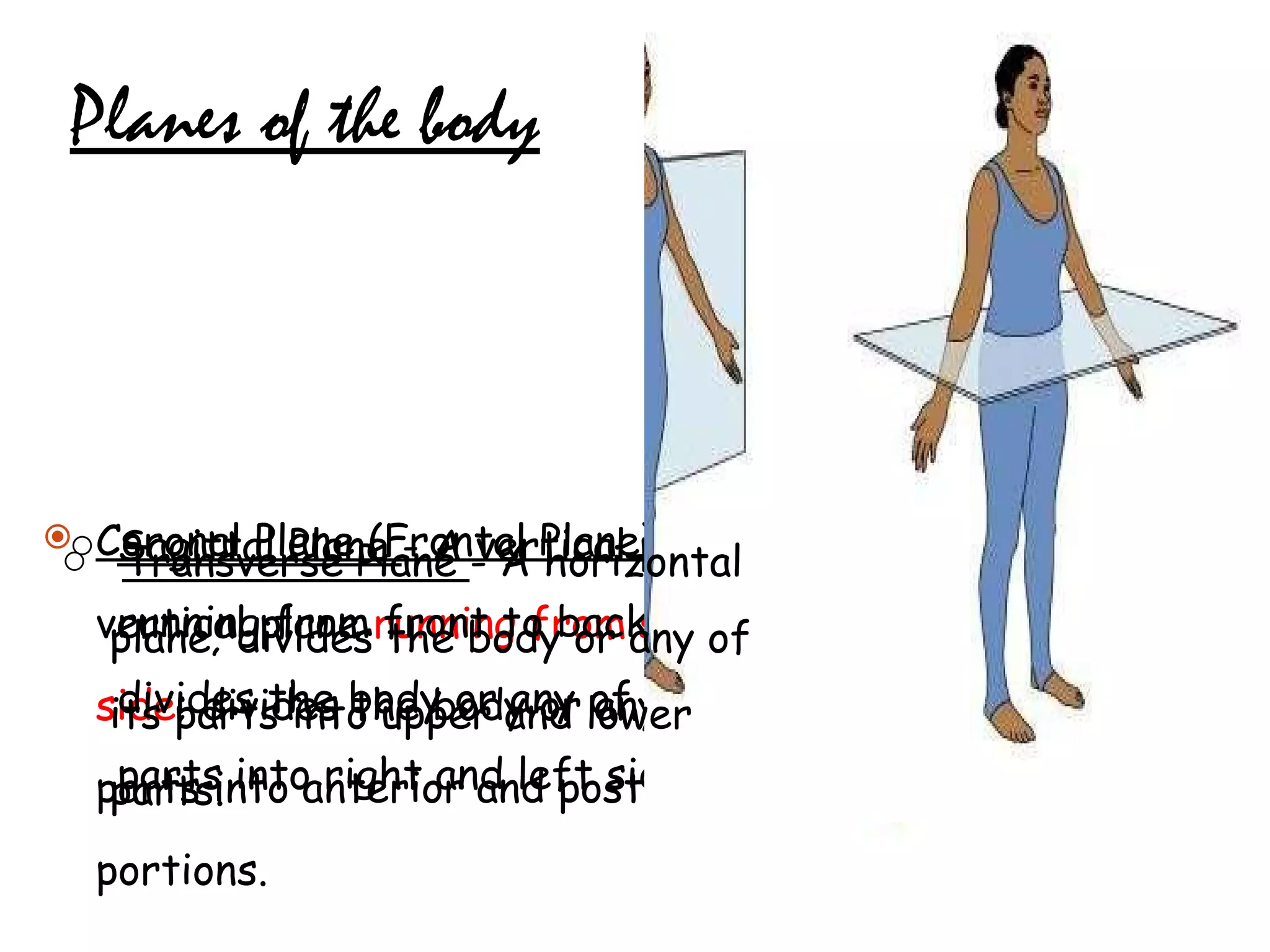
Planes of the body Coronal Plane (Frontal Plane)  - A vertical plane  running from side to side ; divides the body or any of its parts into anterior and posterior portions. Sagittal Plane  - A vertical plane running from front to back; divides the body or any of its parts into right and left sides. Transverse Plane  - A horizontal plane; divides the body or any of its parts into upper and lower parts.
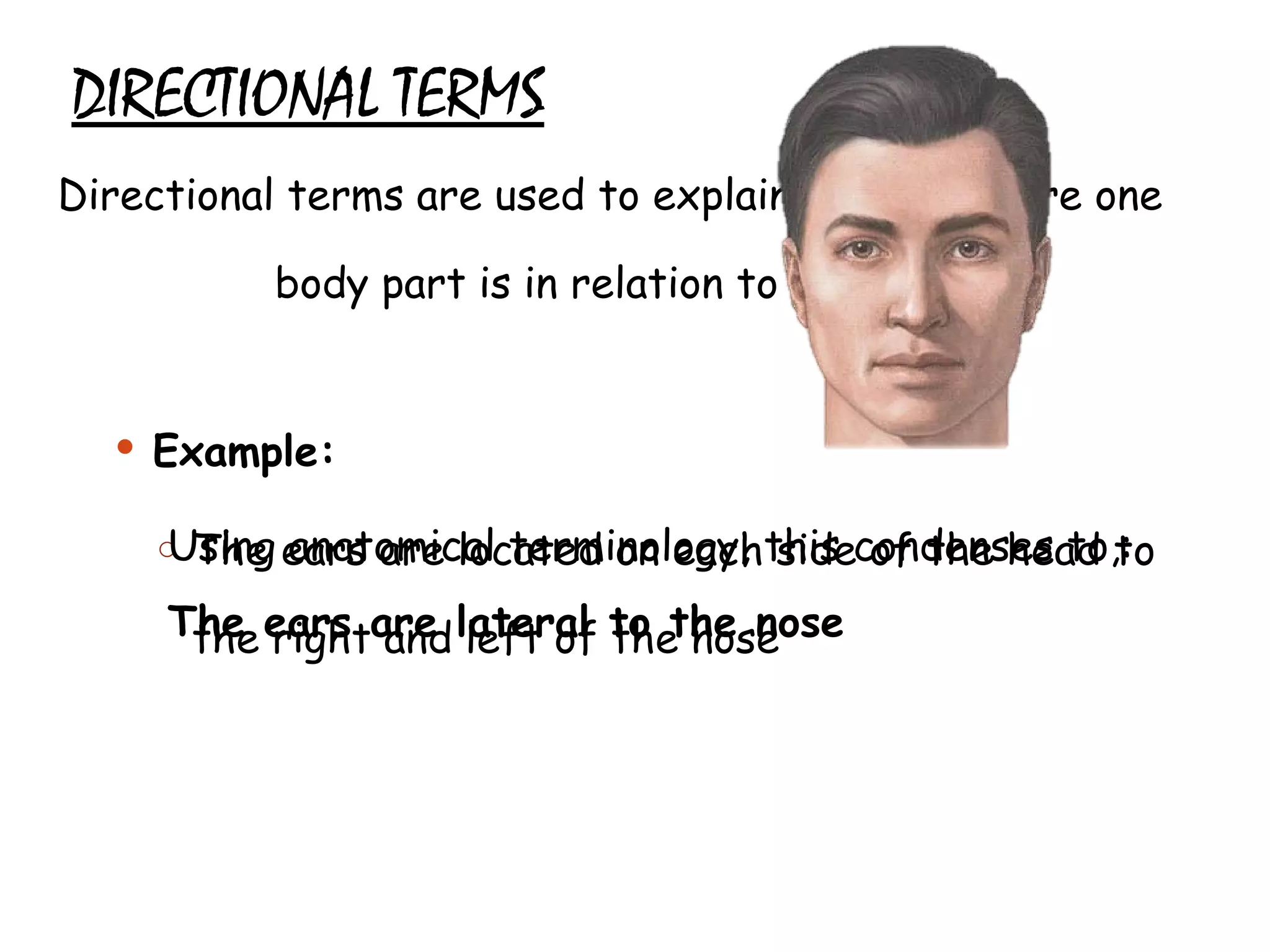
DIRECTIONAL TERMS Directional terms are used to explain exactly where one body part is in relation to another Example: The ears are located on each side of the head to the right and left of the nose Using anatomical terminology, this condenses to,: The ears are lateral to the nose
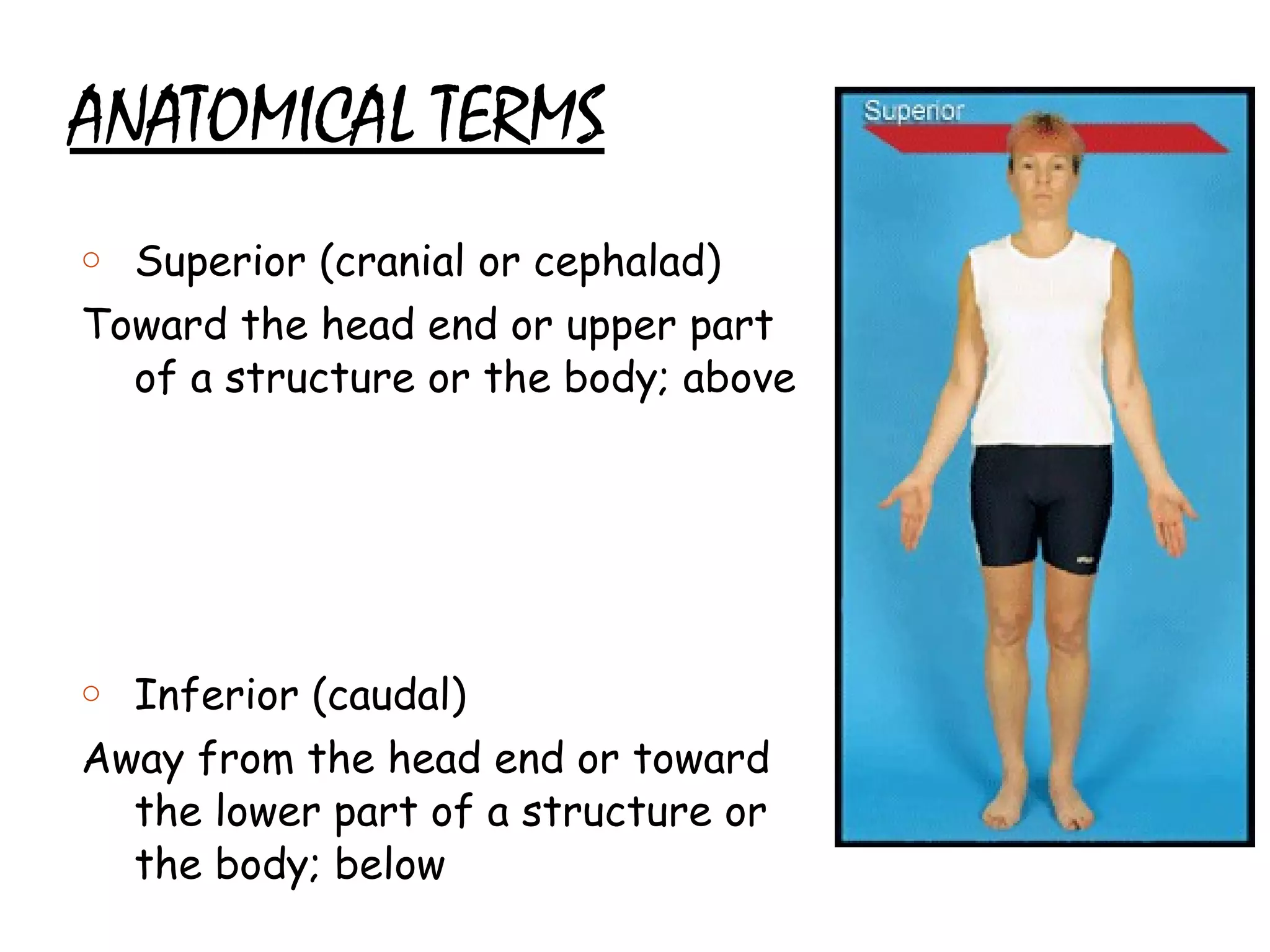
ANATOMICAL TERMS Superior (cranial or cephalad) Toward the head end or upper part of a structure or the body; above Inferior (caudal) Away from the head end or toward the lower part of a structure or the body; below
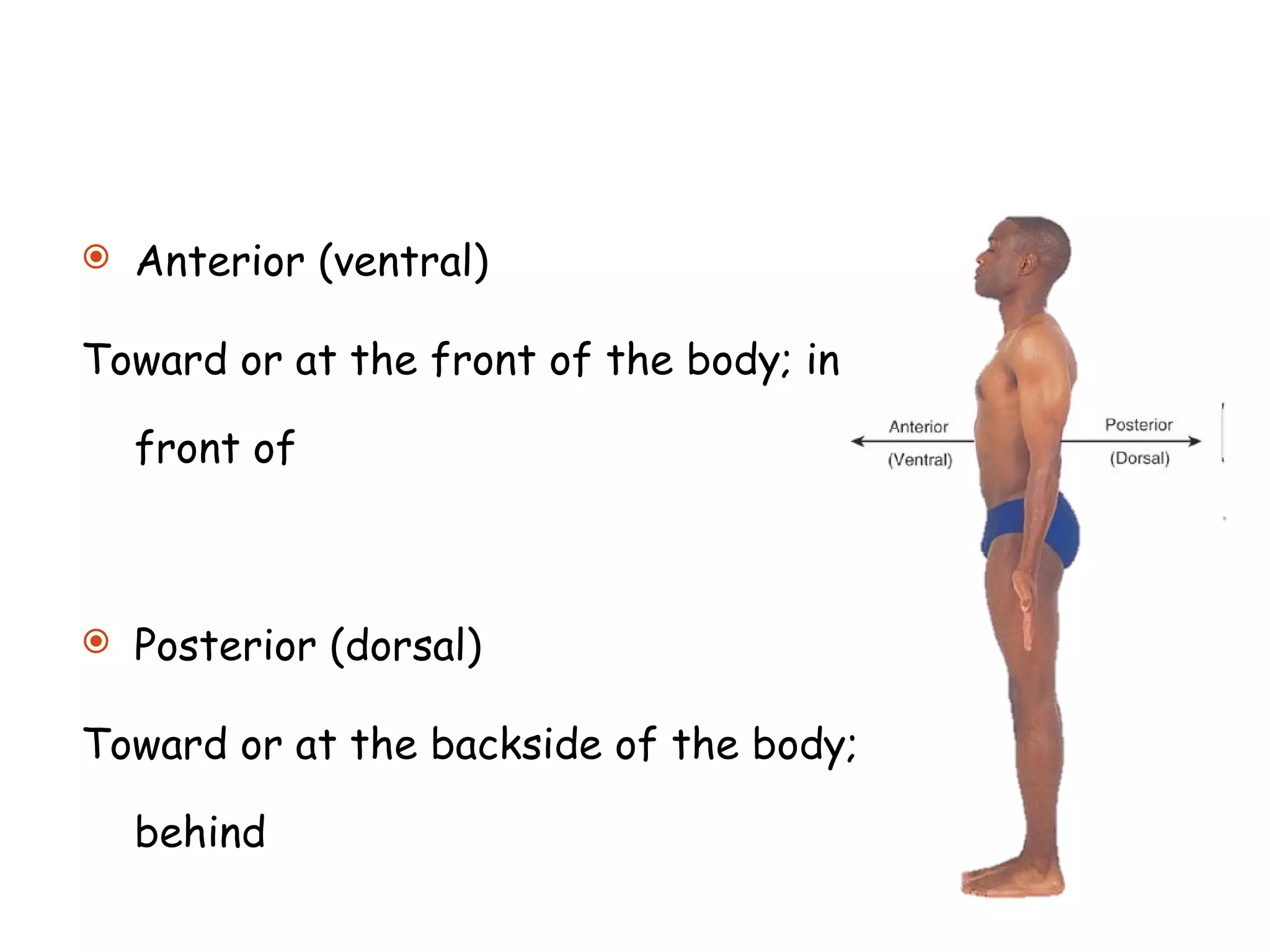
Anterior (ventral) Toward or at the front of the body; in front of Posterior (dorsal)  Toward or at the backside of the body; behind
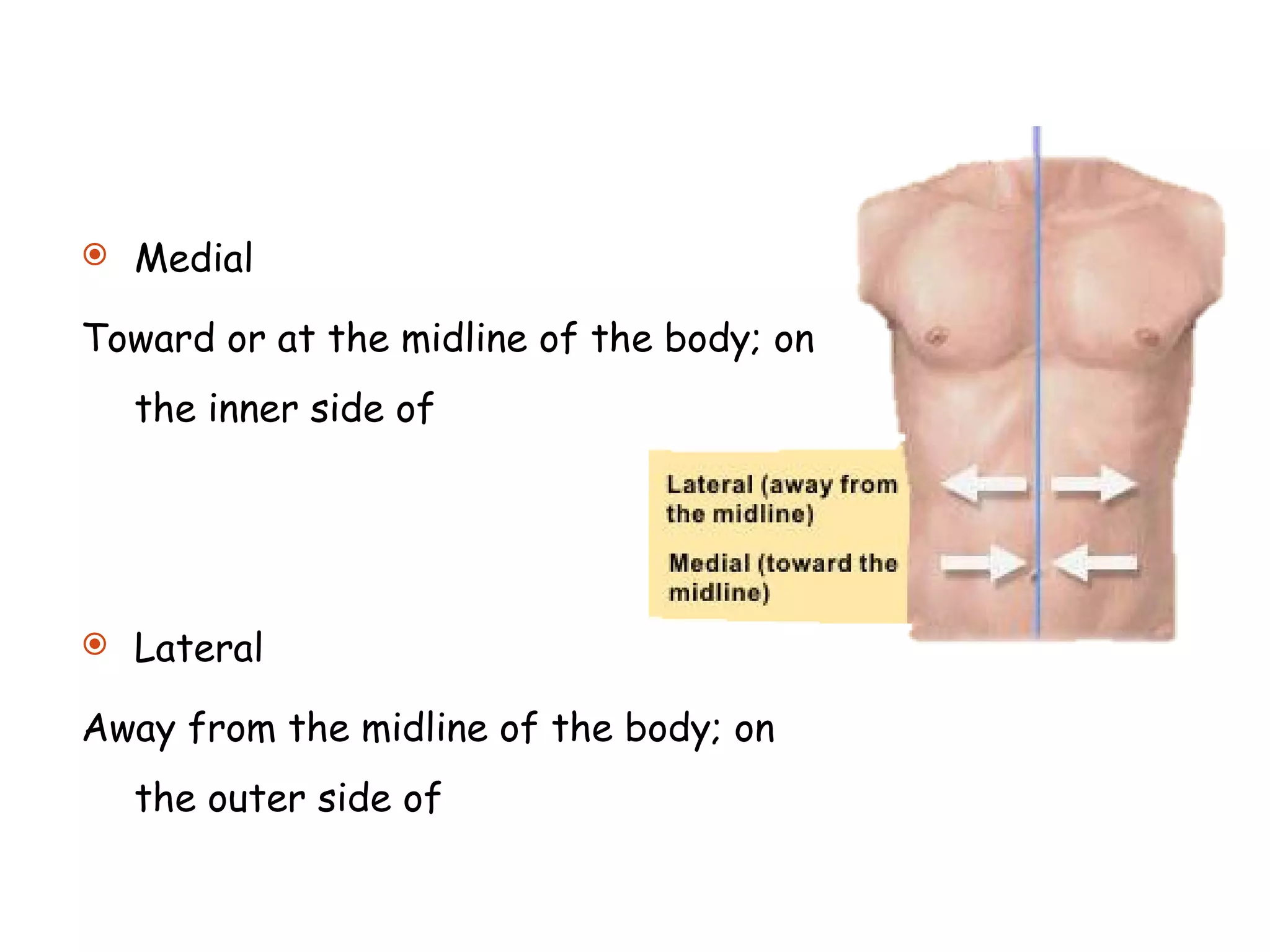
Medial  Toward or at the midline of the body; on the inner side of  Lateral Away from the midline of the body; on the outer side of
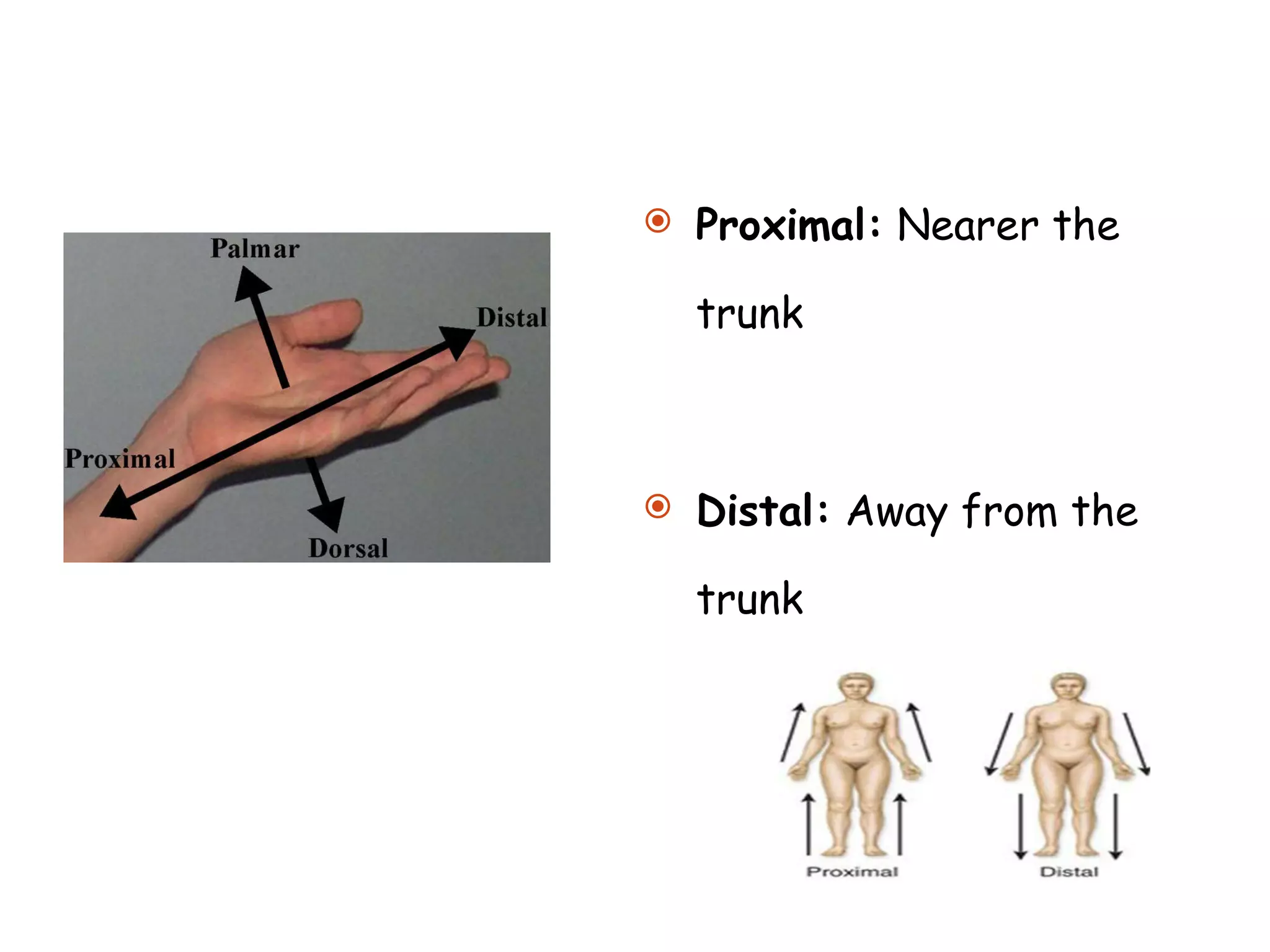
Proximal:  Nearer the trunk Distal:  Away from the trunk
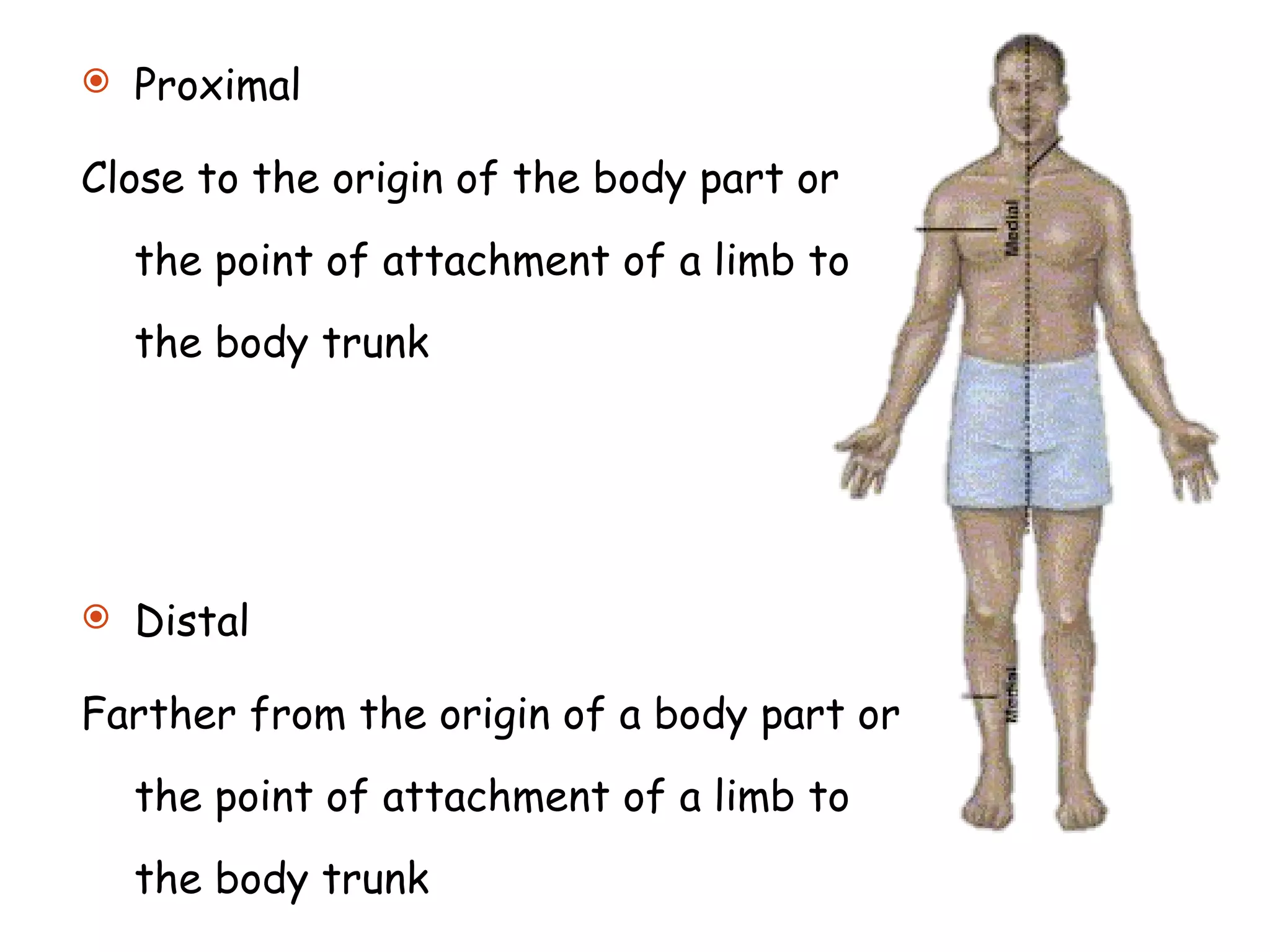
Proximal  Close to the origin of the body part or the point of attachment of a limb to the body trunk  Distal  Farther from the origin of a body part or the point of attachment of a limb to the body trunk
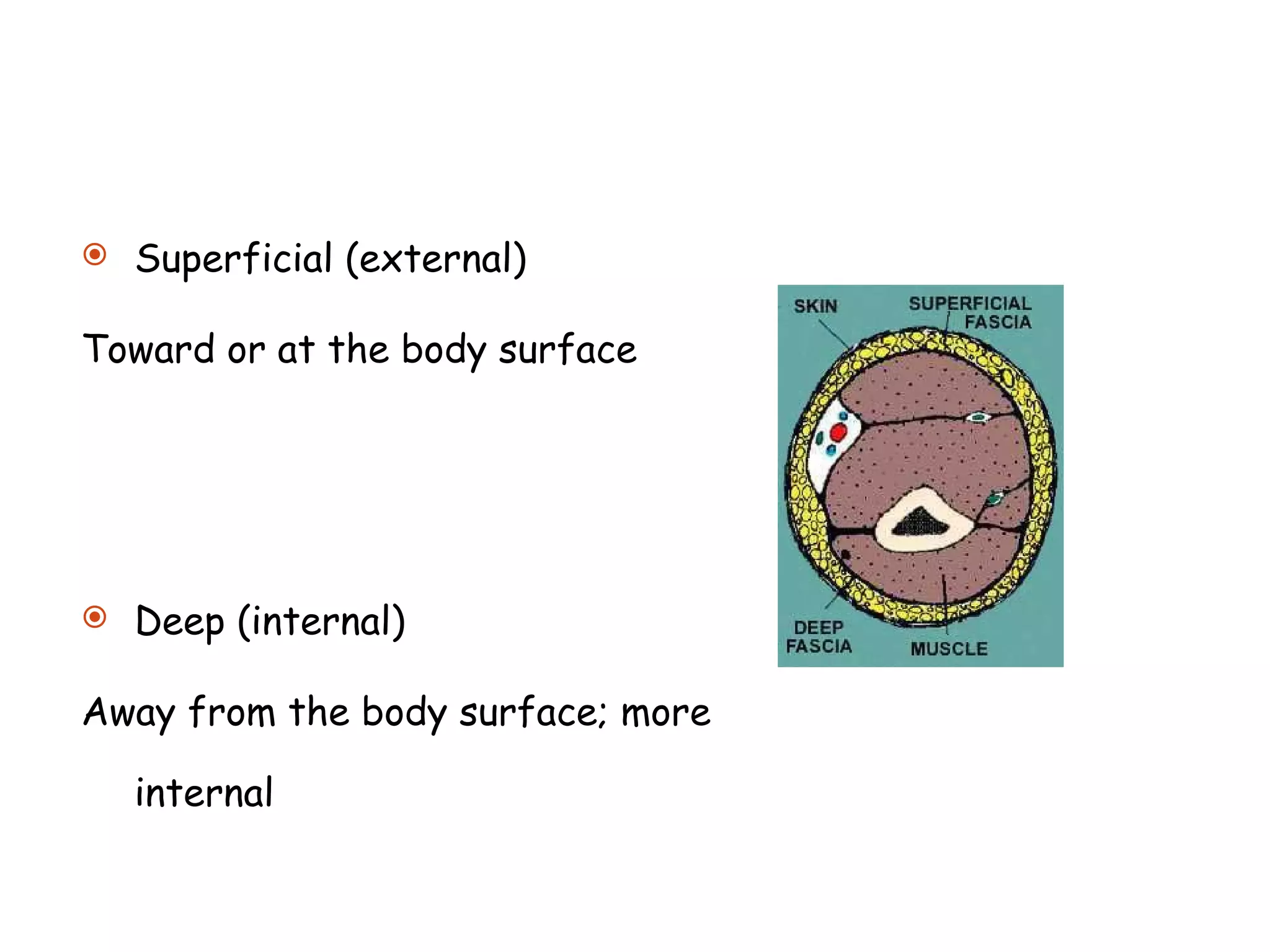
Superficial (external)  Toward or at the body surface  Deep (internal)  Away from the body surface; more internal
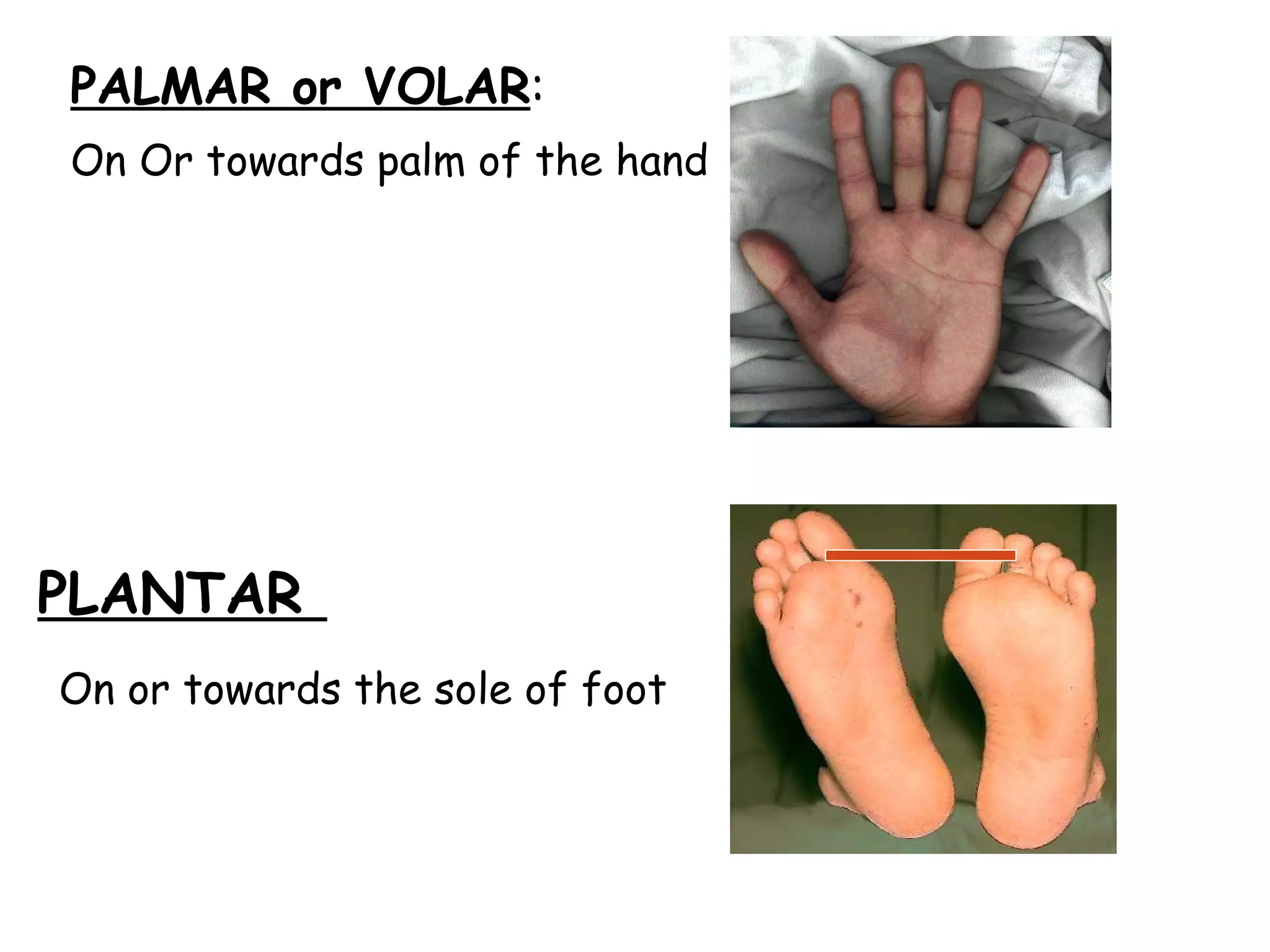
PALMAR or VOLAR : On Or towards palm of the hand PLANTAR  On or towards the sole of foot
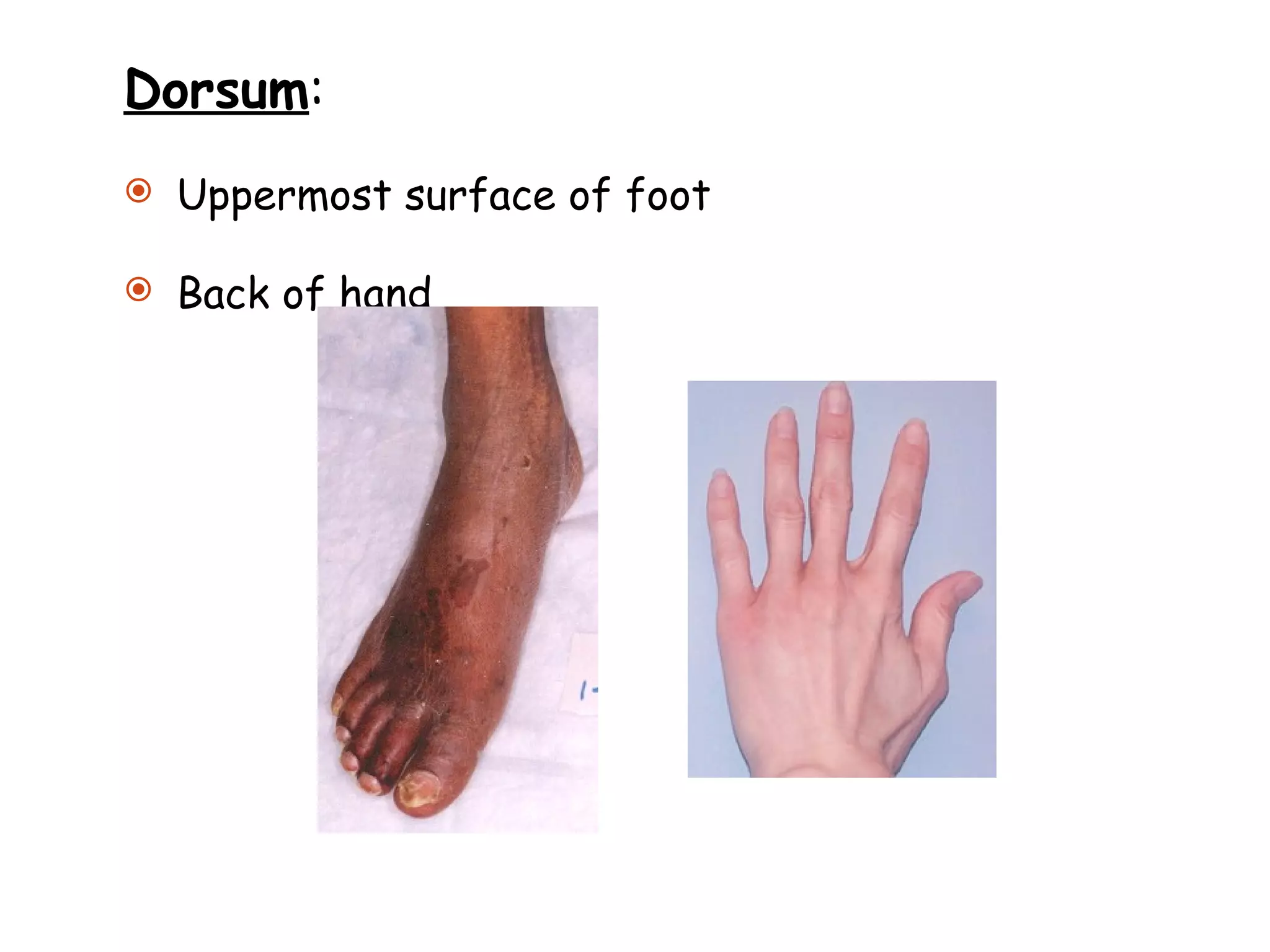
Dorsum : Uppermost surface of foot Back of hand
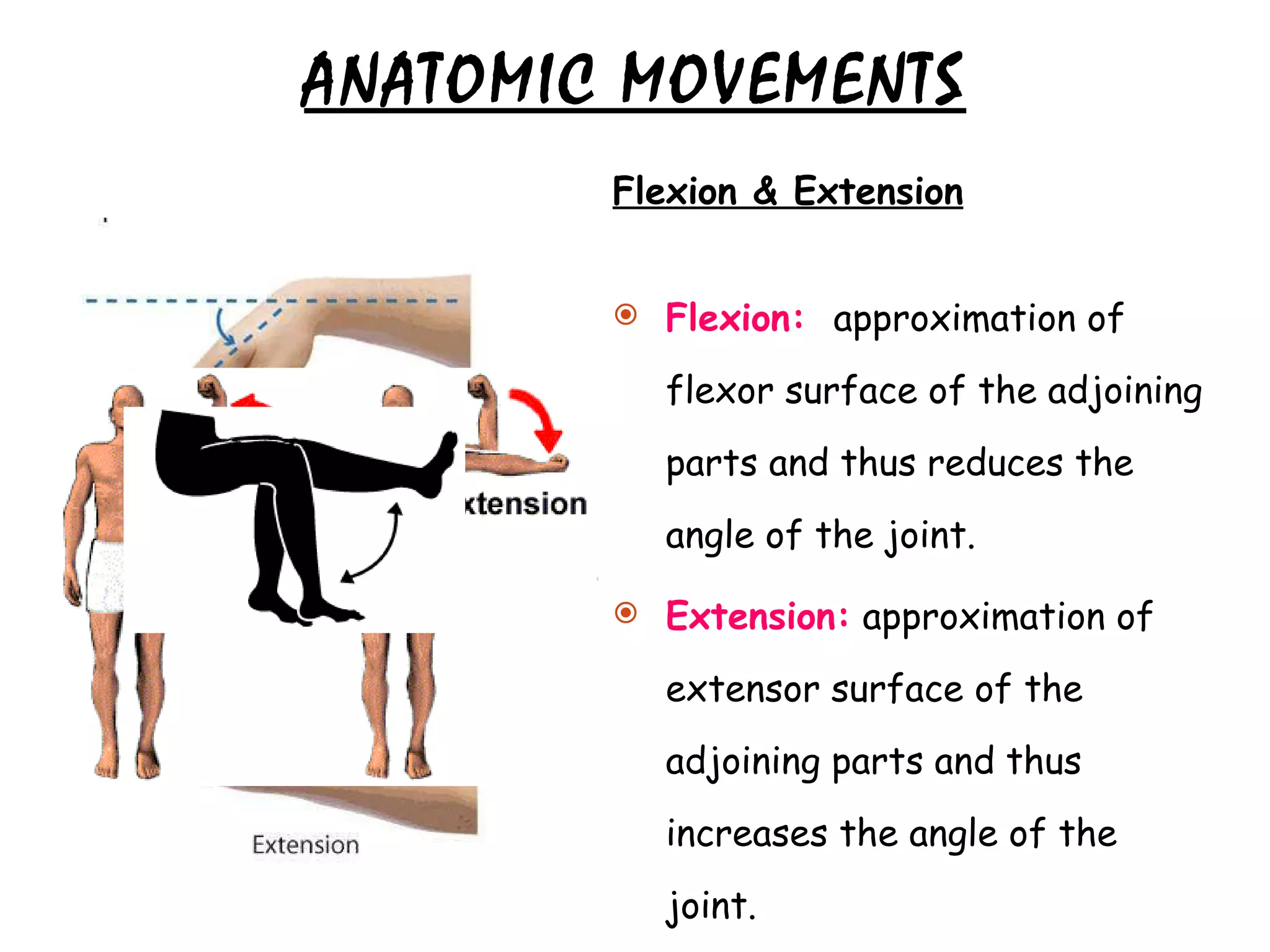
ANATOMIC MOVEMENTS Flexion & Extension Flexion:  approximation of flexor surface of the adjoining parts and thus reduces the angle of the joint. Extension:  approximation of extensor surface of the adjoining parts and thus increases the angle of the joint.
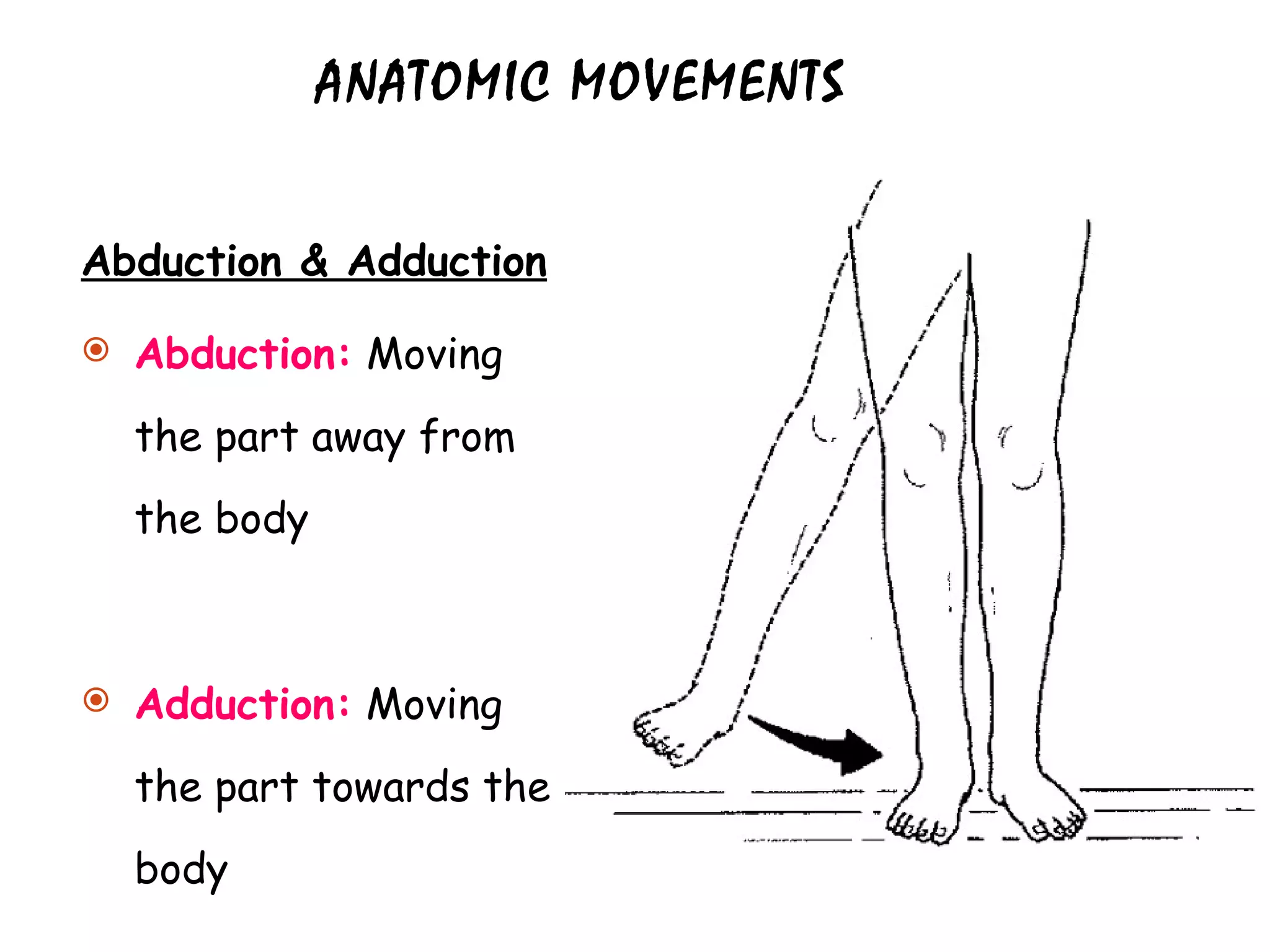
ANATOMIC MOVEMENTS Abduction & Adduction Abduction:  Moving the part away from the body Adduction:  Moving the part towards the body
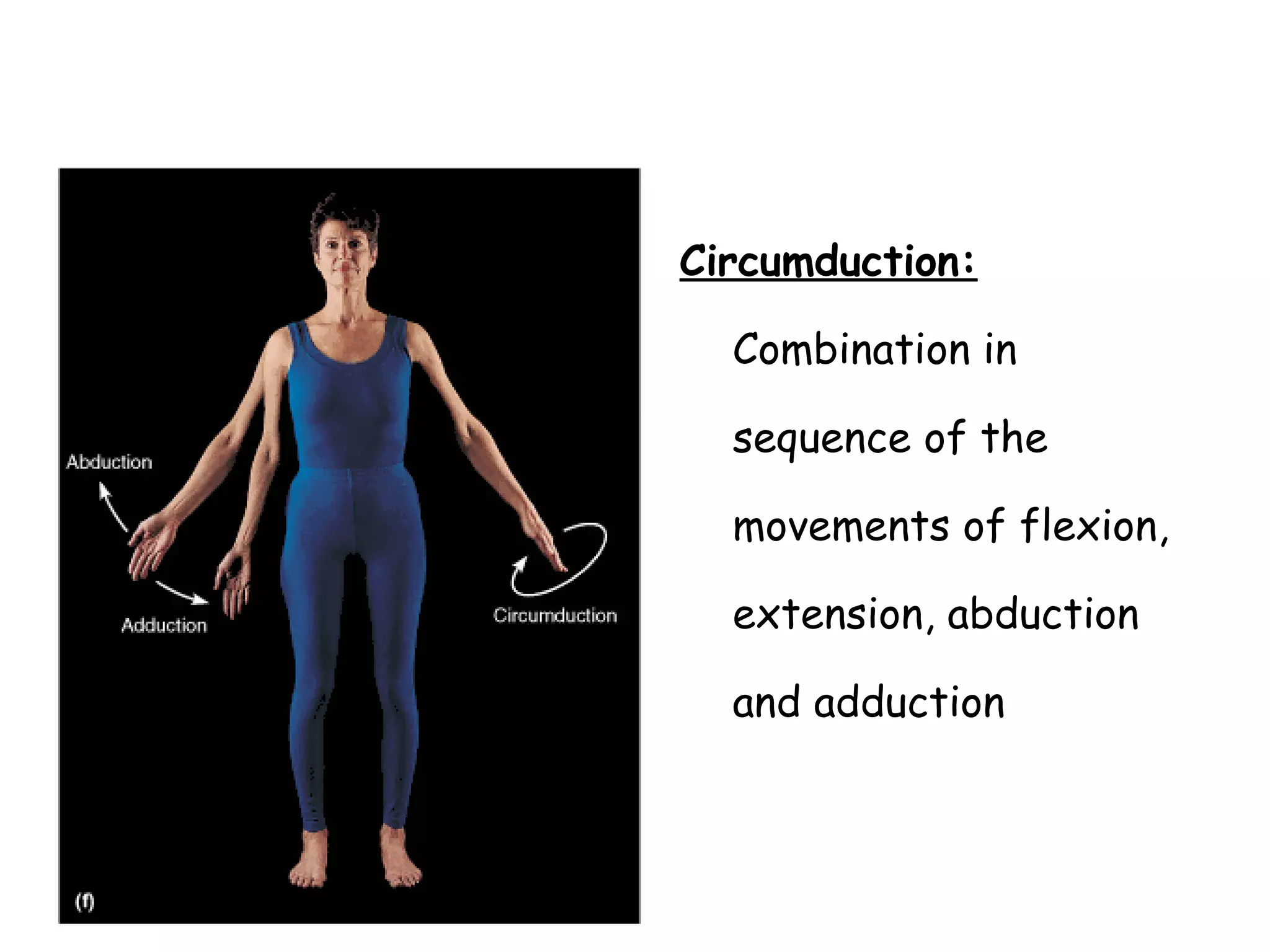
Circumduction:   Combination in sequence of the movements of flexion, extension, abduction and adduction
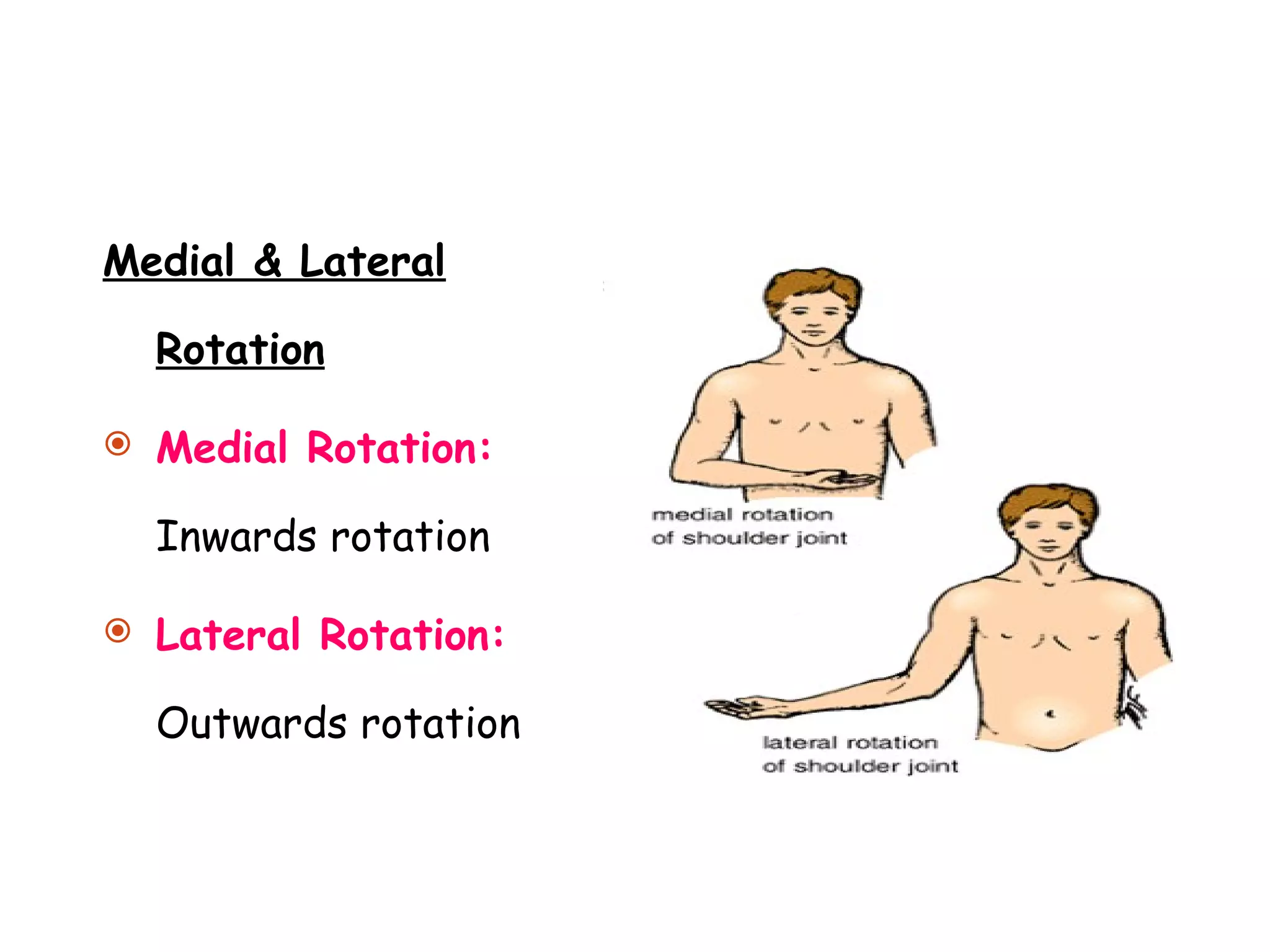
Medial & Lateral Rotation Medial Rotation:  Inwards rotation  Lateral Rotation:  Outwards rotation
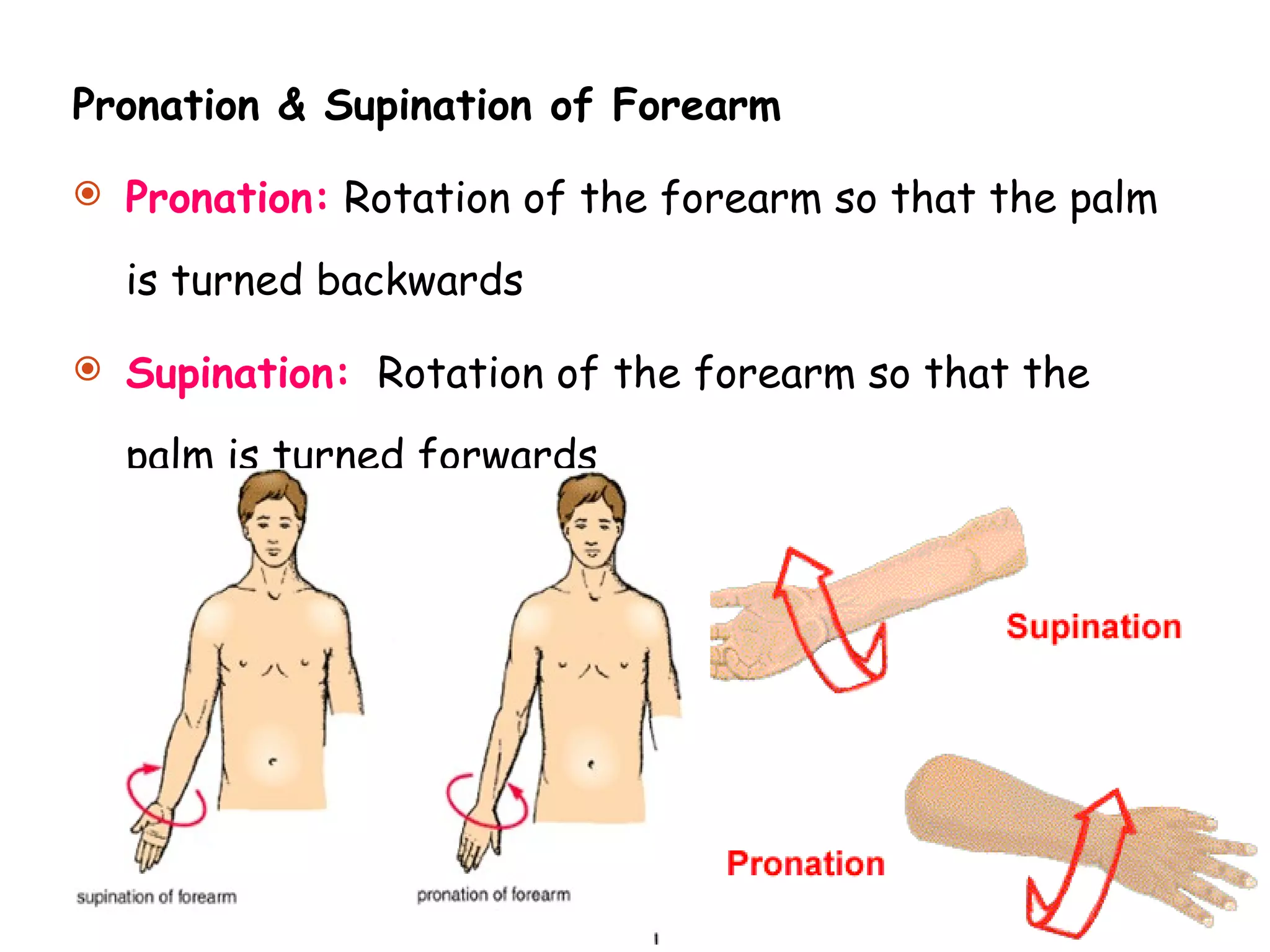
Pronation & Supination of Forearm Pronation:  Rotation of the forearm so that the palm is turned backwards Supination:   Rotation of the forearm so that the palm is turned forwards
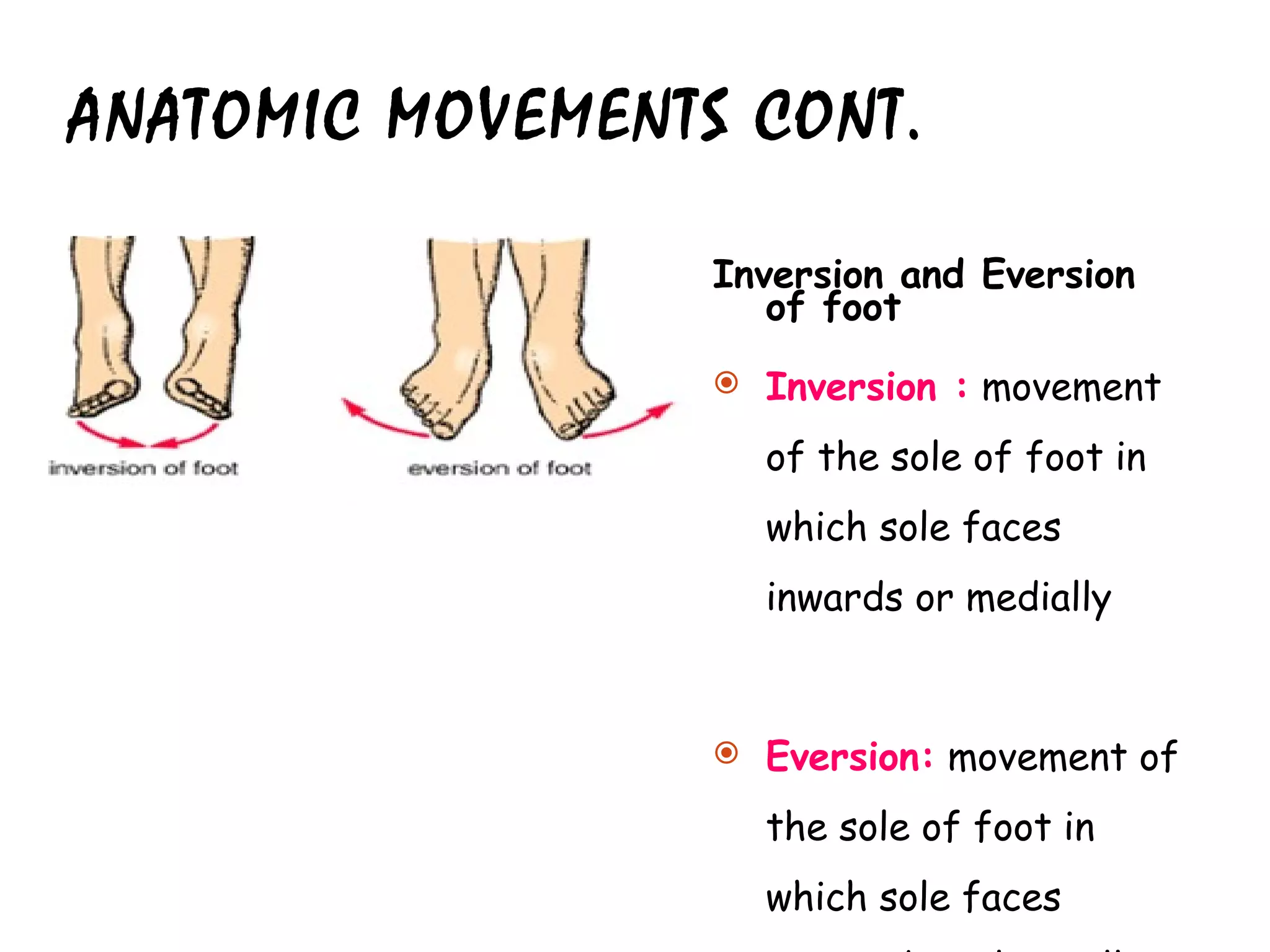
ANATOMIC MOVEMENTS CONT. Inversion and Eversion of foot  Inversion :  movement of the sole of foot in which sole faces inwards or medially Eversion:  movement of the sole of foot in which sole faces outwards or laterally
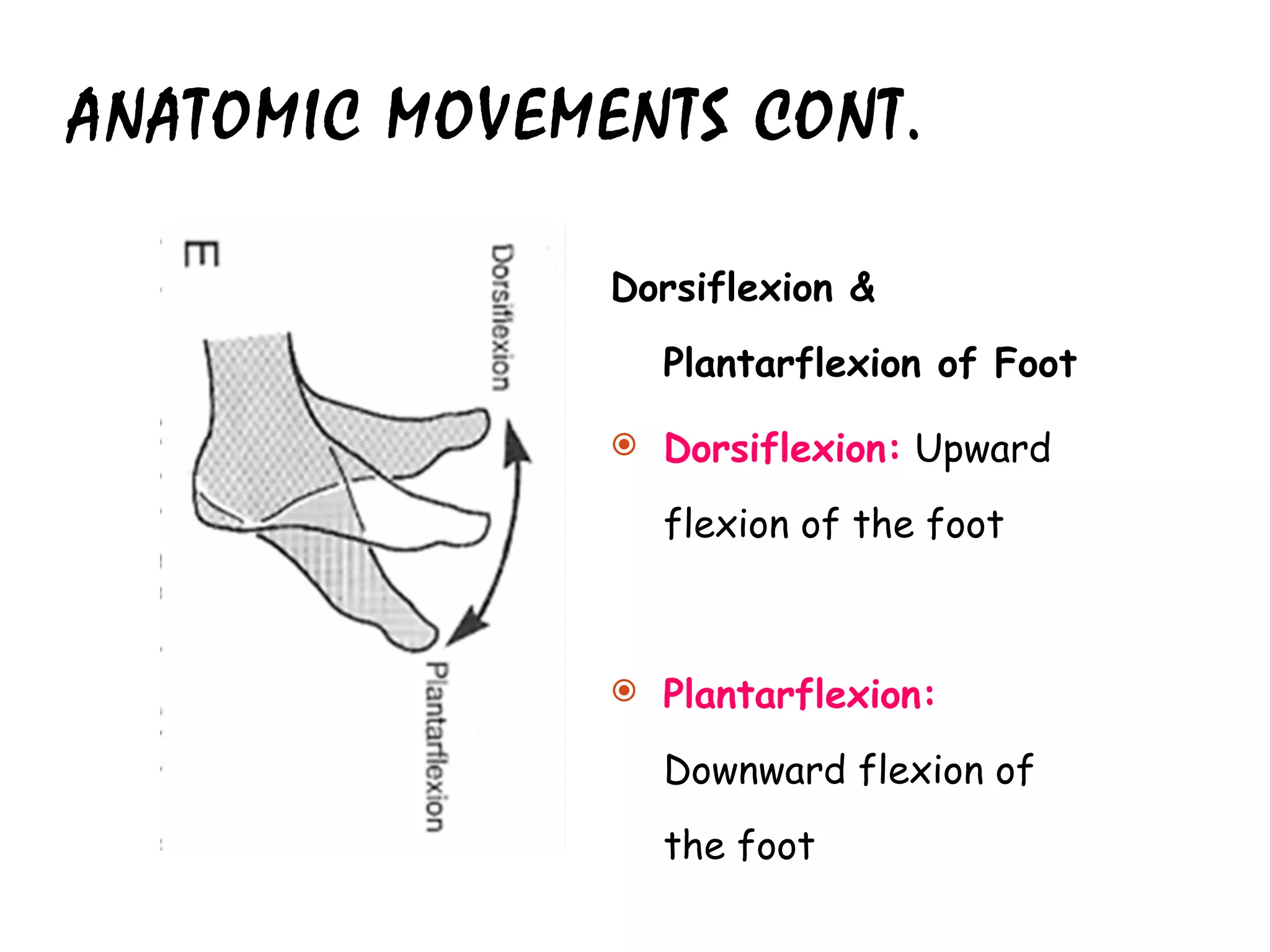
ANATOMIC MOVEMENTS CONT. Dorsiflexion & Plantarflexion of Foot Dorsiflexion:  Upward flexion of the foot Plantarflexion:  Downward flexion of the foot

1.ANAT introduction

  • 1.
  • 2.
    ANATOMY Study ofthe structure of body parts and their relationships to each other Anatomy : Greek meaning to cut apart
  • 3.
    Gross (macroscopic) anatomy: The study of structures large enough to be seen with the naked eye
  • 4.
    Regional anatomy :All the body structures (muscles, bones, blood vessels, nerves, etc.) in a given body region , such as the abdomen or leg, are examined at the same time
  • 5.
    Systemic anatomy :body is studied system by system Example: when studying the cardiovascular system, you would examine the heart and the blood vessels of the entire body
  • 6.
    Surface anatomy :internal body structures as they relate to the overlying skin
  • 7.
    Microscopic anatomy :the study of structures that are too small to be seen with the naked eye Cytology: study of individual cells Histology: study of tissues
  • 8.
    Embryology: concerns developmental changes that occur before birth
  • 9.
    Specialized Branches ofAnatomy Pathological anatomy : study of structural changes associated with disease Radiographic anatomy : study of internal structures using specialized visualization techniques (X-rays or special scanning devices)
  • 10.
    LANGUAGE OF ANATOMY ANATOMICAL POSITION AND DIRECTIONAL TERMS To describe body parts and position accurately , we need an initial reference point and must indicate direction ANATOMICAL POSITION : Person is standing erect or upright Eyes look straight to front Upper limbs by the side with palms of hand facing forwards Feet slightly separated with toes pointing forwards The anatomical reference point Anatomical Position
  • 11.
    NOTE Inanatomical position, right and left refer to the right and left sides of the person viewed—NOT those of the observer In anatomy, anatomical position is always assumed, regardless of the actual position of the body
  • 12.
    Body Planes andSections For anatomical studies, the body is often sectioned (cut) along a flat surface called a plane Body planes are flat surfaces that lie at right angles to each other
  • 13.
    Planes of thebody Coronal Plane (Frontal Plane) - A vertical plane running from side to side ; divides the body or any of its parts into anterior and posterior portions. Sagittal Plane - A vertical plane running from front to back; divides the body or any of its parts into right and left sides. Transverse Plane - A horizontal plane; divides the body or any of its parts into upper and lower parts.
  • 14.
    DIRECTIONAL TERMS Directionalterms are used to explain exactly where one body part is in relation to another Example: The ears are located on each side of the head to the right and left of the nose Using anatomical terminology, this condenses to,: The ears are lateral to the nose
  • 15.
    ANATOMICAL TERMS Superior(cranial or cephalad) Toward the head end or upper part of a structure or the body; above Inferior (caudal) Away from the head end or toward the lower part of a structure or the body; below
  • 16.
    Anterior (ventral) Towardor at the front of the body; in front of Posterior (dorsal) Toward or at the backside of the body; behind
  • 17.
    Medial Towardor at the midline of the body; on the inner side of Lateral Away from the midline of the body; on the outer side of
  • 18.
    Proximal: Nearerthe trunk Distal: Away from the trunk
  • 19.
    Proximal Closeto the origin of the body part or the point of attachment of a limb to the body trunk Distal Farther from the origin of a body part or the point of attachment of a limb to the body trunk
  • 20.
    Superficial (external) Toward or at the body surface Deep (internal) Away from the body surface; more internal
  • 21.
    PALMAR or VOLAR: On Or towards palm of the hand PLANTAR On or towards the sole of foot
  • 22.
    Dorsum : Uppermostsurface of foot Back of hand
  • 23.
    ANATOMIC MOVEMENTS Flexion& Extension Flexion: approximation of flexor surface of the adjoining parts and thus reduces the angle of the joint. Extension: approximation of extensor surface of the adjoining parts and thus increases the angle of the joint.
  • 24.
    ANATOMIC MOVEMENTS Abduction& Adduction Abduction: Moving the part away from the body Adduction: Moving the part towards the body
  • 25.
    Circumduction: Combination in sequence of the movements of flexion, extension, abduction and adduction
  • 26.
    Medial & LateralRotation Medial Rotation: Inwards rotation Lateral Rotation: Outwards rotation
  • 27.
    Pronation & Supinationof Forearm Pronation: Rotation of the forearm so that the palm is turned backwards Supination: Rotation of the forearm so that the palm is turned forwards
  • 28.
    ANATOMIC MOVEMENTS CONT.Inversion and Eversion of foot Inversion : movement of the sole of foot in which sole faces inwards or medially Eversion: movement of the sole of foot in which sole faces outwards or laterally
  • 29.
    ANATOMIC MOVEMENTS CONT.Dorsiflexion & Plantarflexion of Foot Dorsiflexion: Upward flexion of the foot Plantarflexion: Downward flexion of the foot

Editor's Notes

  • #19 Median. L. medianus , in the middle., Lateral. L. lateralis ( latus ), pertaining to a side.
  • #24 Flexor. L. flexus , bent Extension. L. extendo , extend
  • #25 Flexor. L. flexus , bent Extension. L. extendo , extend