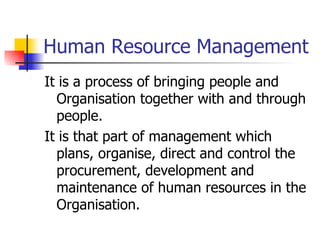
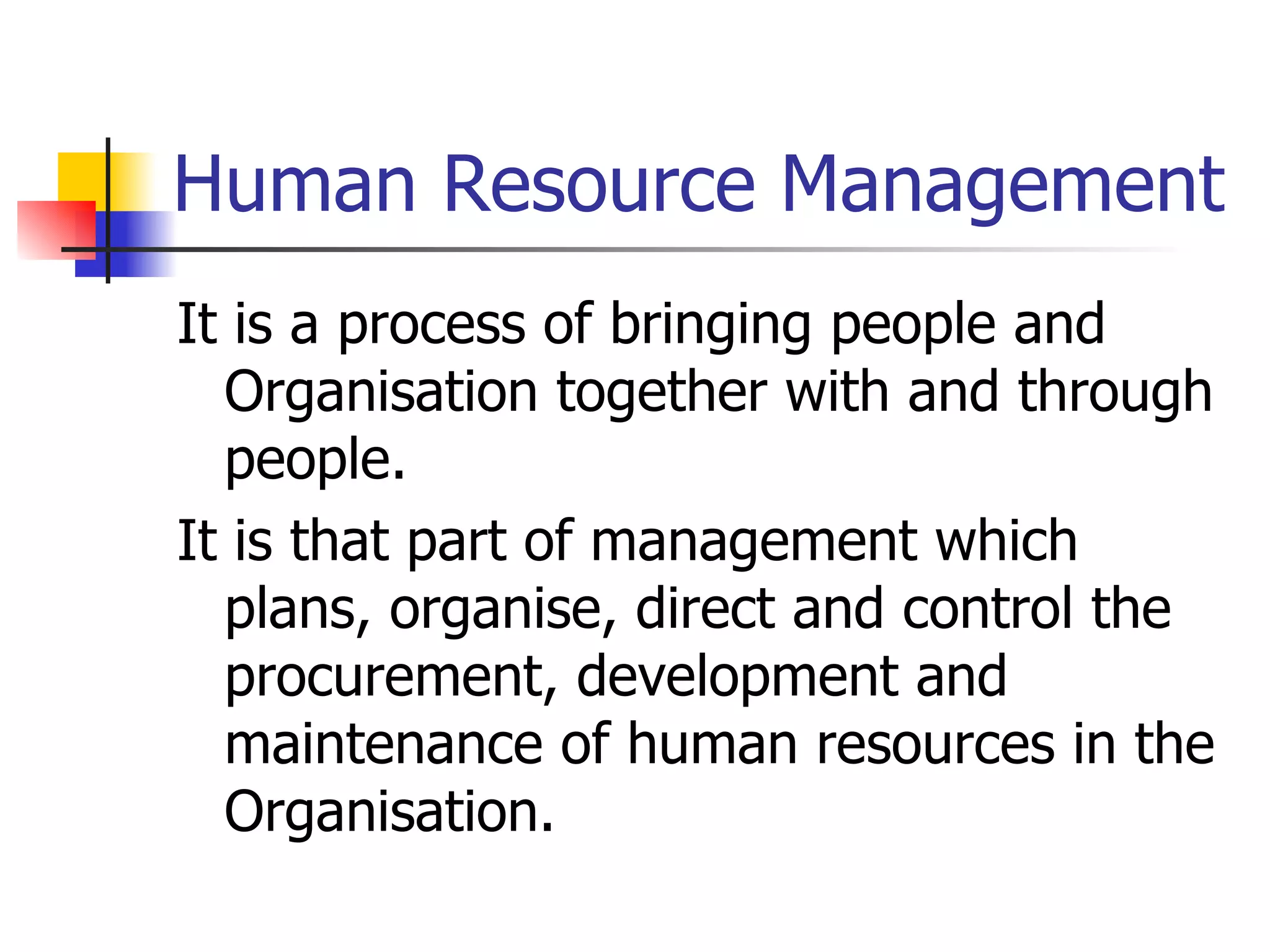
Human Resource Management It is a process of bringing people and Organisation together with and through people. It is that part of management which plans, organise, direct and control the procurement, development and maintenance of human resources in the Organisation.
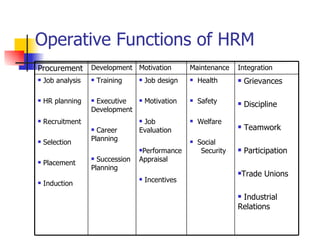
Operative Functions of HRM Grievances Discipline Teamwork Participation Trade Unions Industrial Relations Health Safety Welfare Social  Security Job design Motivation Job Evaluation Performance Appraisal Incentives Training Executive  Development Career  Planning Succession  Planning Job analysis HR planning Recruitment Selection Placement Induction Integration Maintenance Motivation Development Procurement
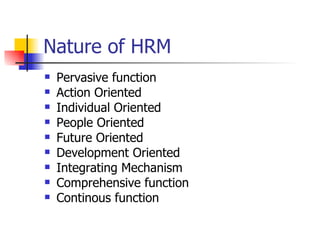
Nature of HRM Pervasive function Action Oriented Individual Oriented People Oriented Future Oriented Development Oriented Integrating Mechanism Comprehensive function Continous function
Scope of HRM The scope of HRM is very wide. It is thus divided into three categories:  Personnel aspect Welfare aspect Industrial Relation Aspect
Personnel aspect includes HR Planning Recruitment Selection Placement Transfer Promotion Training and Development Remuneration Incentives
Welfare Aspect includes Working Conditions Amenities such as Canteens, Creches, Rest rooms, Lunch rooms. Housing Transport Medical Assistance Education Health and Safety Recreation facilities
Industrial Relation Aspect includes Union Management Relations Joint Consultation Collective Bargaining Grievance Redressal
Importance of HRM HRM helps an Organisation and its people to realise their respective goals in various ways.the same is categorised in the following levels  :  At the Enterprise level At the Individual level At the Society level At the National level
At the Enterprise level Attracting and retaining the best people in the Organisation Training people for for challenging roles Developing the right attitudes towards the job and the Company Promoting team spirit among employees  Developing loyality and commitment through appropriate reward schemes. Increase productivity and profits
2.  At the Individual level It promotes teamwork and team spirit among employees It offers excellent growth opportunities to people who have the potential to rise It allows people to work with diligence and commitment Develop skills  Job Satisfaction
3.  At the Society level Employment opportunities multiply Enhance standard of living Scarce talents are put to best use.
4 .  At the National level Effective use of human resources helps in exploitation of natural, physical and financial resources. People with right skills and proper attitudes help the nation to get ahead. Compete with the best in the world leading to better standard of living and better employment Industrial development.
Objectives of HRM Objectives of HRM are categorised as follows: Organisational Objectives Functional Objectives Personal Objectives Social Objectives
Social Objectives Union Management Relations Benefits Legal Compliance
Organisational Objectives HR Planning Employee Relations Selection Training and Development Appraisal Placement Assessment
Functional Objectives Performance appraisal Assessment
Personal Objectives Training and Development Apraisal Placement Compensation Assessment

Hrm concept

  • 1.
    Human Resource ManagementIt is a process of bringing people and Organisation together with and through people. It is that part of management which plans, organise, direct and control the procurement, development and maintenance of human resources in the Organisation.
  • 2.
    Operative Functions ofHRM Grievances Discipline Teamwork Participation Trade Unions Industrial Relations Health Safety Welfare Social Security Job design Motivation Job Evaluation Performance Appraisal Incentives Training Executive Development Career Planning Succession Planning Job analysis HR planning Recruitment Selection Placement Induction Integration Maintenance Motivation Development Procurement
  • 3.
    Nature of HRMPervasive function Action Oriented Individual Oriented People Oriented Future Oriented Development Oriented Integrating Mechanism Comprehensive function Continous function
  • 4.
    Scope of HRMThe scope of HRM is very wide. It is thus divided into three categories:  Personnel aspect Welfare aspect Industrial Relation Aspect
  • 5.
    Personnel aspect includesHR Planning Recruitment Selection Placement Transfer Promotion Training and Development Remuneration Incentives
  • 6.
    Welfare Aspect includesWorking Conditions Amenities such as Canteens, Creches, Rest rooms, Lunch rooms. Housing Transport Medical Assistance Education Health and Safety Recreation facilities
  • 7.
    Industrial Relation Aspectincludes Union Management Relations Joint Consultation Collective Bargaining Grievance Redressal
  • 8.
    Importance of HRMHRM helps an Organisation and its people to realise their respective goals in various ways.the same is categorised in the following levels :  At the Enterprise level At the Individual level At the Society level At the National level
  • 9.
    At the Enterpriselevel Attracting and retaining the best people in the Organisation Training people for for challenging roles Developing the right attitudes towards the job and the Company Promoting team spirit among employees Developing loyality and commitment through appropriate reward schemes. Increase productivity and profits
  • 10.
    2. Atthe Individual level It promotes teamwork and team spirit among employees It offers excellent growth opportunities to people who have the potential to rise It allows people to work with diligence and commitment Develop skills Job Satisfaction
  • 11.
    3. Atthe Society level Employment opportunities multiply Enhance standard of living Scarce talents are put to best use.
  • 12.
    4 . At the National level Effective use of human resources helps in exploitation of natural, physical and financial resources. People with right skills and proper attitudes help the nation to get ahead. Compete with the best in the world leading to better standard of living and better employment Industrial development.
  • 13.
    Objectives of HRMObjectives of HRM are categorised as follows: Organisational Objectives Functional Objectives Personal Objectives Social Objectives
  • 14.
    Social Objectives UnionManagement Relations Benefits Legal Compliance
  • 15.
    Organisational Objectives HRPlanning Employee Relations Selection Training and Development Appraisal Placement Assessment
  • 16.
  • 17.
    Personal Objectives Trainingand Development Apraisal Placement Compensation Assessment