HUMAN RESOURCE
MANAGEMENT
Unit-1
Topics to be covered
• Introduction to Human Resource Management
• Nature of HRM
• Scope of HRM
• Objectives of HRM
• Functions of HRM
• Strategic Human Resource Management
• Skills and Proficiency of HR Managers
What is Human Resource Management?
• HRM is the study of activities regarding people working in an organization. It is a
managerial function that tries to match an organization’s needs to the skills and
abilities of its employees
• Definitions of HRM
Human resources management (HRM) is a management function concerned with
hiring, motivating and maintaining people in an organization. It focuses on people
in organizations.
Human resource management is designing management systems to ensure that
human talent is used effectively and efficiently to accomplish organizational goals.
What is Human Resource Management?
• According to the Invancevich and Glueck, “HRM is concerned with the
most effective use of people to achieve organizational and individual goals. It
is the way of managing people at work, so that they give their best to the
organization”.
• According to Dessler (2008) the policies and practices involved in carrying
out the “people” or human resource aspects of a management position,
including recruiting, screening, training, rewarding, and appraising comprises
of HRM.
Nature of HRM
• HRM is a management function that helps manager’s to recruit, select, train and develop members for an
organization. HRM is concerned with people’s dimension in organizations.
• The following constitute the core of HRM
• 1. HRM Involves the Application of Management Functions and Principles. The functions and principles are applied to
acquiring, developing, maintaining and providing remuneration to employees in organization.
• 2. Decision Relating to Employees must be Integrated. Decisions on different aspects of employees must be consistent with
other human resource (HR) decisions.
• 3. Decisions Made Influence the Effectiveness of an Organization. Effectiveness of an organization will result in betterment
of services to customers in the form of high quality products supplied at reasonable costs.
• 4. HRM Functions are not Confined to Business Establishments Only but applicable to nonbusiness organizations such as
education, health care, recreation and like. HRM refers to a set of programmes, functions and activities designed and carried
out in order to maximize both employee as well as organizational effectiveness
Scope of HRM
• The scope of HRM is indeed vast. All major activities in the working life of
a worker – from the time of his or her entry into an organization until he or
she leaves the organizations comes under the purview of HRM. The major
HRM activities include HR planning, job analysis, job design, employee
hiring, employee and executive remuneration, employee motivation,
employee maintenance, industrial relations and prospects of HRM.
Scope of HRM
• The scope of Human Resources Management extends to:
• All the decisions, strategies, factors, principles, operations, practices, functions, activities and
methods related to the management of people as employees in any type of organization.
• All the dimensions related to people in their employment relationships, and all the dynamics
that flow from it
The scope of HRM is really vast. All major activities n the working life of a worker – from the
time of his or her entry into an organization until he or she leaves it comes under the purview
of HRM. American Society for Training and Development (ASTD) conducted fairly an
exhaustive study in this field and identified nine broad areas of activities of HRM
Scope of HRM
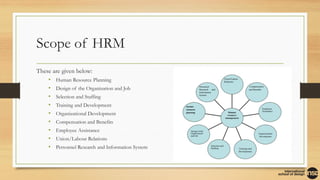
These are given below:
• Human Resource Planning
• Design of the Organization and Job
• Selection and Staffing
• Training and Development
• Organizational Development
• Compensation and Benefits
• Employee Assistance
• Union/Labour Relations
• Personnel Research and Information System
Scope of HRM
• Human Resource Planning:
The objective of HR Planning is to ensure that the organization has the right types of persons at
the right time at the right place. It prepares human resources inventory with a view to assess
present and future needs, availability and possible shortages in human resource. Thereupon, HR
Planning forecast demand and supplies and identify sources of selection. HR Planning develops
strategies both long-term and short-term, to meet the man-power requirement.
• Design of Organization and Job:
This is the task of laying down organization structure, authority, relationship and responsibilities.
This will also mean definition of work contents for each position in the organization. This is
done by “job description”. Another important step is “Job specification”. Job specification
identifies the attributes of persons who will be most suitable for each job which is defined by job
description.
Scope of HRM
• Selection and Staffing:
This is the process of recruitment and selection of staff. This involves matching people and their
expectations with which the job specifications and career path available within the organization.
• Training and Development:
This involves an organized attempt to find out training needs of the individuals to meet the knowledge and
skill which is needed not only to perform current job but also to fulfil the future needs of the organization.
• Organizational Development:
This is an important aspect whereby “Synergetic effect” is generated in an organization i.e. healthy
interpersonal and inter-group relationship within the organization.
• Compensation and Benefits:
This is the area of wages and salaries administration where wages and compensations are fixed scientifically
to meet fairness and equity criteria. In addition labour welfare measures are involved which include benefits
and services.
Scope of HRM
• Employee Assistance:
Each employee is unique in character, personality, expectation and temperament. By and large each one of them faces
problems everyday. Some are personal some are official. In their case he or she remains worried. Such worries must be
removed to make him or her more productive and happy.
• Union-Labour Relations:
Healthy Industrial and Labour relations are very important for enhancing peace and productivity in an organization. This is
one of the areas of HRM.
• Personnel Research and Information System:
Knowledge on behavioral science and industrial psychology throws better insight into the workers expectations, aspirations
and behaviour. Advancement of technology of product and production methods have created working environment which
are much different from the past. Globalization of economy has increased competition many fold. Science of ergonomics
gives better ideas of doing a work more conveniently by an employee. Thus, continuous research in HR areas is an
unavoidable requirement. It must also take special care for improving exchange of information through effective
communication systems on a continuous basis especially on moral and motivation
Objectives of HRM
• The primary objective of HRM is to ensure the availability of competent and willing
workforce to an organization. The specific objectives include the following:
1) Human capital : assisting the organization in obtaining the right number and types of employees to
fulfill its strategic and operational goals
2) Developing organizational climate: helping to create a climate in which employees are encouraged to
develop and utilize their skills to the fullest and to employ the skills and abilities of the workforce
efficiently
3) Helping to maintain performance standards and increase productivity through effective job design;
providing adequate orientation, training and development; providing performance-related feedback;
and ensuring effective two-way communication.
4) Helping to establish and maintain a harmonious employer/employee relationship
5) Helping to create and maintain a safe and healthy work environmen
Objectives of HRM
6) Developing programs to meet the economic, psychological, and social needs of the employees and helping
the organization to retain the productive employees
7) Ensuring that the organization is in compliance with provincial/territorial and federal laws affecting the
workplace (such as human rights, employment equity, occupational health and safety, employment
standards, and labour relations legislation). To help the organization to reach its goals
8) To provide organization with well-trained and well-motivated employees
9) To increase the employees satisfaction and self-actualization
10) To develop and maintain the quality of work life
11) To communicate HR policies to all employees.
12) To help maintain ethical polices and behavior
Objectives of HRM
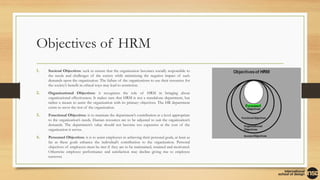
1. Societal Objectives: seek to ensure that the organization becomes socially responsible to
the needs and challenges of the society while minimizing the negative impact of such
demands upon the organization. The failure of the organizations to use their resources for
the society’s benefit in ethical ways may lead to restriction.
2. Organizational Objectives: it recognizes the role of HRM in bringing about
organizational effectiveness. It makes sure that HRM is not a standalone department, but
rather a means to assist the organization with its primary objectives. The HR department
exists to serve the rest of the organization.
3. Functional Objectives: is to maintain the department’s contribution at a level appropriate
to the organization’s needs. Human resources are to be adjusted to suit the organization’s
demands. The department’s value should not become too expensive at the cost of the
organization it serves.
4. Personnel Objectives: it is to assist employees in achieving their personal goals, at least as
far as these goals enhance the individual’s contribution to the organization. Personal
objectives of employees must be met if they are to be maintained, retained and motivated.
Otherwise employee performance and satisfaction may decline giving rise to employee
turnover.
Functions of HRM
1. Strategic HR Management
2. Equal Employment Opportunity
3. Staffing
4. Talent Management and Development
5. Total Rewards
6. Risk Management and Worker Protection
7. Employee and Labour Relations:
Functions of HRM
• Strategic HR Management: As a part of maintaining organizational competitiveness, strategic planning for
HR effectiveness can be increased through the use of HR metrics and HR technology. Human resource
planning (HRP) function determine the number and type of employees needed to accomplish organizational
goals. HRP includes creating venture teams with a balanced skill-mix, recruiting the right people, and
voluntary team assignment. This function analyzes and determines personnel needs in order to create
effective innovation teams. The basic HRP strategy is staffing and employee development.
• Equal Employment Opportunity: Compliance with equal employment opportunity (EEO) laws and
regulations affects all other HR activities.
• Staffing: The aim of staffing is to provide a sufficient supply of qualified individuals to fill jobs in an
organization. Job analysis, recruitment and selection are the main functions under staffing. Workers job
design and job analysis laid the foundation for staffing by identifying what diverse people do in their jobs and
how they are affected by them
Functions of HRM
• Talent Management and Development: Beginning with the orientation of new employees, talent management and development
includes different types of training. Orientation is the first step towards helping a new employee to adjust himself to the new job
and the employer. It is a method to acquaint new employees with particular aspects of their new job, including pay and benefit
programmes, working hours and company rules and expectations.
• Total Rewards: Compensation in the form of pay, incentives and benefits are the rewards given to the employees for performing
organizational work. Compensation management is the method for determining how much employees should be paid for
performing certain jobs. Compensation affects staffing in that people are generally attracted to organizations offering a higher level
of pay in exchange for the work performed.
• Risk Management and Worker Protection: HRM addresses various workplace risks to ensure protection of workers by meeting legal
requirements and being more responsive to concerns for workplace health and safety along with disaster and recovery planning
• Employee and Labor Relations: The relationship between managers and their employees must be handled legally and effectively.
Employer and employee rights must be addressed. It is important to develop, communicate, and update HR policies and procedures
so that managers and employees alike know what is expected. In some organizations, union/management relations must be
addressed as well. The term labour relation refers to the interaction with employees who are represented by a trade union.
Strategic Human Resource Management
1. Defining Organizational Goal : The first step in the strategic management starts with evaluating the company’s mission, vision, goal and
values. While doing so the organization aligns a collection of HR practices, programs and policies to facilitate the achievement of the
organization’s strategic objectives.
2. Analyzing the environment : SWOT (Strengths, Weaknesses, Opportunities, Threat) analysis is an important tool used in strategic
management. It looks into the strength and weakness of the organization, the opportunities available outside the organization and the
threats faced from the competition. While doing so it not only focuses on the employee relations but also on their relations with the internal
and external customers.
3. Formulation of strategies : Management evaluates all the factors and formulates strategies on the corporate, business and specific functional
levels. While doing so strategies are framed from a long term perspective which requires HR to be proactive and align HR strategies to
various time frames in a flexible manner.
4. Implementation of Strategies : Once the strategies are formulated activities need to be performed to implement them. It deals with the
leadership style, structure of the organization and the management of human resources. Unlike the traditional bureaucratic roles and
policies, strategic HR replaces specialization by cross training, teamwork is encouraged, permits employees to carry out job responsibilities
in a free flowing way by encouraging autonomy at various levels.
5. Strategy evaluation : This is the final phase where it is measured whether the strategies implemented has led to achieve the desired results.
HR aims at increased performance, enhancing employee satisfaction etc. To achieve this they ensure effective management of staffing,
selection, development, training and retention to fit with the organization strategy and culture.
Skills and Proficiency of HR Managers
• Multi- knowledgeable : HR managers should possess knowledge of all the diverse fields that
collectively run a business. Since HR management is required in all the departments and at all
levels, it is important that HR managers should be competent in all the diverse areas of finance,
sales, marketing, operations etc
• Personal attributes : HR managers should possess the mental ability to communicate, articulate
and handle people and situations with intelligence He should have the learning skills as he needs
to continuously upgrade himself to stay abreast with the outside world. Coaching and teaching is
a continuous process that a HR professional undertakes to develop the employee’s skills and
personality. They should possess the discretion to discriminate between right and wrong and use
ethical attitude while dealing with people and situations. HR managers should have both the
leadership and executive skills. They should be able to lead a large group of people towards a
course of action that is in the best interest of the individual as well as the organization. They
should also accurately and quickly execute the management’s decision regarding personal issues.
Skills and Proficiency of HR Managers
• Professional attitude : HR manager’s job is getting professionalized. He should be organized
as there is no margin of error when dealing with the lives and careers of people. He should
have comprehensive understanding of HR policies, principles, programs, practices and laws.
• Ethical attitude : For healthy and successful running of a business, it is very important that
the HR managers comply to the code of moral principles and values with respect to what is
right or wrong. Employees should be coached from time to time and their ethical dilemmas
should be cleared. In case of any violation the company should not hesitate to punish the
unethical behavior of the employees. HR professionals should communicate clearly and
fairly and aim to promote equity. HR professionals are company conscience and keepers of
confidential information. They should respect and maintain privacy always
THANK YOU

HUMAN RESOURCE MANAGEMENT_Unit 1 Res.pdf

  • 1.
  • 2.
    Topics to becovered • Introduction to Human Resource Management • Nature of HRM • Scope of HRM • Objectives of HRM • Functions of HRM • Strategic Human Resource Management • Skills and Proficiency of HR Managers
  • 3.
    What is HumanResource Management? • HRM is the study of activities regarding people working in an organization. It is a managerial function that tries to match an organization’s needs to the skills and abilities of its employees • Definitions of HRM Human resources management (HRM) is a management function concerned with hiring, motivating and maintaining people in an organization. It focuses on people in organizations. Human resource management is designing management systems to ensure that human talent is used effectively and efficiently to accomplish organizational goals.
  • 4.
    What is HumanResource Management? • According to the Invancevich and Glueck, “HRM is concerned with the most effective use of people to achieve organizational and individual goals. It is the way of managing people at work, so that they give their best to the organization”. • According to Dessler (2008) the policies and practices involved in carrying out the “people” or human resource aspects of a management position, including recruiting, screening, training, rewarding, and appraising comprises of HRM.
  • 5.
    Nature of HRM •HRM is a management function that helps manager’s to recruit, select, train and develop members for an organization. HRM is concerned with people’s dimension in organizations. • The following constitute the core of HRM • 1. HRM Involves the Application of Management Functions and Principles. The functions and principles are applied to acquiring, developing, maintaining and providing remuneration to employees in organization. • 2. Decision Relating to Employees must be Integrated. Decisions on different aspects of employees must be consistent with other human resource (HR) decisions. • 3. Decisions Made Influence the Effectiveness of an Organization. Effectiveness of an organization will result in betterment of services to customers in the form of high quality products supplied at reasonable costs. • 4. HRM Functions are not Confined to Business Establishments Only but applicable to nonbusiness organizations such as education, health care, recreation and like. HRM refers to a set of programmes, functions and activities designed and carried out in order to maximize both employee as well as organizational effectiveness
  • 6.
    Scope of HRM •The scope of HRM is indeed vast. All major activities in the working life of a worker – from the time of his or her entry into an organization until he or she leaves the organizations comes under the purview of HRM. The major HRM activities include HR planning, job analysis, job design, employee hiring, employee and executive remuneration, employee motivation, employee maintenance, industrial relations and prospects of HRM.
  • 7.
    Scope of HRM •The scope of Human Resources Management extends to: • All the decisions, strategies, factors, principles, operations, practices, functions, activities and methods related to the management of people as employees in any type of organization. • All the dimensions related to people in their employment relationships, and all the dynamics that flow from it The scope of HRM is really vast. All major activities n the working life of a worker – from the time of his or her entry into an organization until he or she leaves it comes under the purview of HRM. American Society for Training and Development (ASTD) conducted fairly an exhaustive study in this field and identified nine broad areas of activities of HRM
  • 8.
    Scope of HRM Theseare given below: • Human Resource Planning • Design of the Organization and Job • Selection and Staffing • Training and Development • Organizational Development • Compensation and Benefits • Employee Assistance • Union/Labour Relations • Personnel Research and Information System
  • 9.
    Scope of HRM •Human Resource Planning: The objective of HR Planning is to ensure that the organization has the right types of persons at the right time at the right place. It prepares human resources inventory with a view to assess present and future needs, availability and possible shortages in human resource. Thereupon, HR Planning forecast demand and supplies and identify sources of selection. HR Planning develops strategies both long-term and short-term, to meet the man-power requirement. • Design of Organization and Job: This is the task of laying down organization structure, authority, relationship and responsibilities. This will also mean definition of work contents for each position in the organization. This is done by “job description”. Another important step is “Job specification”. Job specification identifies the attributes of persons who will be most suitable for each job which is defined by job description.
  • 10.
    Scope of HRM •Selection and Staffing: This is the process of recruitment and selection of staff. This involves matching people and their expectations with which the job specifications and career path available within the organization. • Training and Development: This involves an organized attempt to find out training needs of the individuals to meet the knowledge and skill which is needed not only to perform current job but also to fulfil the future needs of the organization. • Organizational Development: This is an important aspect whereby “Synergetic effect” is generated in an organization i.e. healthy interpersonal and inter-group relationship within the organization. • Compensation and Benefits: This is the area of wages and salaries administration where wages and compensations are fixed scientifically to meet fairness and equity criteria. In addition labour welfare measures are involved which include benefits and services.
  • 11.
    Scope of HRM •Employee Assistance: Each employee is unique in character, personality, expectation and temperament. By and large each one of them faces problems everyday. Some are personal some are official. In their case he or she remains worried. Such worries must be removed to make him or her more productive and happy. • Union-Labour Relations: Healthy Industrial and Labour relations are very important for enhancing peace and productivity in an organization. This is one of the areas of HRM. • Personnel Research and Information System: Knowledge on behavioral science and industrial psychology throws better insight into the workers expectations, aspirations and behaviour. Advancement of technology of product and production methods have created working environment which are much different from the past. Globalization of economy has increased competition many fold. Science of ergonomics gives better ideas of doing a work more conveniently by an employee. Thus, continuous research in HR areas is an unavoidable requirement. It must also take special care for improving exchange of information through effective communication systems on a continuous basis especially on moral and motivation
  • 12.
    Objectives of HRM •The primary objective of HRM is to ensure the availability of competent and willing workforce to an organization. The specific objectives include the following: 1) Human capital : assisting the organization in obtaining the right number and types of employees to fulfill its strategic and operational goals 2) Developing organizational climate: helping to create a climate in which employees are encouraged to develop and utilize their skills to the fullest and to employ the skills and abilities of the workforce efficiently 3) Helping to maintain performance standards and increase productivity through effective job design; providing adequate orientation, training and development; providing performance-related feedback; and ensuring effective two-way communication. 4) Helping to establish and maintain a harmonious employer/employee relationship 5) Helping to create and maintain a safe and healthy work environmen
  • 13.
    Objectives of HRM 6)Developing programs to meet the economic, psychological, and social needs of the employees and helping the organization to retain the productive employees 7) Ensuring that the organization is in compliance with provincial/territorial and federal laws affecting the workplace (such as human rights, employment equity, occupational health and safety, employment standards, and labour relations legislation). To help the organization to reach its goals 8) To provide organization with well-trained and well-motivated employees 9) To increase the employees satisfaction and self-actualization 10) To develop and maintain the quality of work life 11) To communicate HR policies to all employees. 12) To help maintain ethical polices and behavior
  • 14.
    Objectives of HRM 1.Societal Objectives: seek to ensure that the organization becomes socially responsible to the needs and challenges of the society while minimizing the negative impact of such demands upon the organization. The failure of the organizations to use their resources for the society’s benefit in ethical ways may lead to restriction. 2. Organizational Objectives: it recognizes the role of HRM in bringing about organizational effectiveness. It makes sure that HRM is not a standalone department, but rather a means to assist the organization with its primary objectives. The HR department exists to serve the rest of the organization. 3. Functional Objectives: is to maintain the department’s contribution at a level appropriate to the organization’s needs. Human resources are to be adjusted to suit the organization’s demands. The department’s value should not become too expensive at the cost of the organization it serves. 4. Personnel Objectives: it is to assist employees in achieving their personal goals, at least as far as these goals enhance the individual’s contribution to the organization. Personal objectives of employees must be met if they are to be maintained, retained and motivated. Otherwise employee performance and satisfaction may decline giving rise to employee turnover.
  • 15.
    Functions of HRM 1.Strategic HR Management 2. Equal Employment Opportunity 3. Staffing 4. Talent Management and Development 5. Total Rewards 6. Risk Management and Worker Protection 7. Employee and Labour Relations:
  • 16.
    Functions of HRM •Strategic HR Management: As a part of maintaining organizational competitiveness, strategic planning for HR effectiveness can be increased through the use of HR metrics and HR technology. Human resource planning (HRP) function determine the number and type of employees needed to accomplish organizational goals. HRP includes creating venture teams with a balanced skill-mix, recruiting the right people, and voluntary team assignment. This function analyzes and determines personnel needs in order to create effective innovation teams. The basic HRP strategy is staffing and employee development. • Equal Employment Opportunity: Compliance with equal employment opportunity (EEO) laws and regulations affects all other HR activities. • Staffing: The aim of staffing is to provide a sufficient supply of qualified individuals to fill jobs in an organization. Job analysis, recruitment and selection are the main functions under staffing. Workers job design and job analysis laid the foundation for staffing by identifying what diverse people do in their jobs and how they are affected by them
  • 17.
    Functions of HRM •Talent Management and Development: Beginning with the orientation of new employees, talent management and development includes different types of training. Orientation is the first step towards helping a new employee to adjust himself to the new job and the employer. It is a method to acquaint new employees with particular aspects of their new job, including pay and benefit programmes, working hours and company rules and expectations. • Total Rewards: Compensation in the form of pay, incentives and benefits are the rewards given to the employees for performing organizational work. Compensation management is the method for determining how much employees should be paid for performing certain jobs. Compensation affects staffing in that people are generally attracted to organizations offering a higher level of pay in exchange for the work performed. • Risk Management and Worker Protection: HRM addresses various workplace risks to ensure protection of workers by meeting legal requirements and being more responsive to concerns for workplace health and safety along with disaster and recovery planning • Employee and Labor Relations: The relationship between managers and their employees must be handled legally and effectively. Employer and employee rights must be addressed. It is important to develop, communicate, and update HR policies and procedures so that managers and employees alike know what is expected. In some organizations, union/management relations must be addressed as well. The term labour relation refers to the interaction with employees who are represented by a trade union.
  • 18.
    Strategic Human ResourceManagement 1. Defining Organizational Goal : The first step in the strategic management starts with evaluating the company’s mission, vision, goal and values. While doing so the organization aligns a collection of HR practices, programs and policies to facilitate the achievement of the organization’s strategic objectives. 2. Analyzing the environment : SWOT (Strengths, Weaknesses, Opportunities, Threat) analysis is an important tool used in strategic management. It looks into the strength and weakness of the organization, the opportunities available outside the organization and the threats faced from the competition. While doing so it not only focuses on the employee relations but also on their relations with the internal and external customers. 3. Formulation of strategies : Management evaluates all the factors and formulates strategies on the corporate, business and specific functional levels. While doing so strategies are framed from a long term perspective which requires HR to be proactive and align HR strategies to various time frames in a flexible manner. 4. Implementation of Strategies : Once the strategies are formulated activities need to be performed to implement them. It deals with the leadership style, structure of the organization and the management of human resources. Unlike the traditional bureaucratic roles and policies, strategic HR replaces specialization by cross training, teamwork is encouraged, permits employees to carry out job responsibilities in a free flowing way by encouraging autonomy at various levels. 5. Strategy evaluation : This is the final phase where it is measured whether the strategies implemented has led to achieve the desired results. HR aims at increased performance, enhancing employee satisfaction etc. To achieve this they ensure effective management of staffing, selection, development, training and retention to fit with the organization strategy and culture.
  • 19.
    Skills and Proficiencyof HR Managers • Multi- knowledgeable : HR managers should possess knowledge of all the diverse fields that collectively run a business. Since HR management is required in all the departments and at all levels, it is important that HR managers should be competent in all the diverse areas of finance, sales, marketing, operations etc • Personal attributes : HR managers should possess the mental ability to communicate, articulate and handle people and situations with intelligence He should have the learning skills as he needs to continuously upgrade himself to stay abreast with the outside world. Coaching and teaching is a continuous process that a HR professional undertakes to develop the employee’s skills and personality. They should possess the discretion to discriminate between right and wrong and use ethical attitude while dealing with people and situations. HR managers should have both the leadership and executive skills. They should be able to lead a large group of people towards a course of action that is in the best interest of the individual as well as the organization. They should also accurately and quickly execute the management’s decision regarding personal issues.
  • 20.
    Skills and Proficiencyof HR Managers • Professional attitude : HR manager’s job is getting professionalized. He should be organized as there is no margin of error when dealing with the lives and careers of people. He should have comprehensive understanding of HR policies, principles, programs, practices and laws. • Ethical attitude : For healthy and successful running of a business, it is very important that the HR managers comply to the code of moral principles and values with respect to what is right or wrong. Employees should be coached from time to time and their ethical dilemmas should be cleared. In case of any violation the company should not hesitate to punish the unethical behavior of the employees. HR professionals should communicate clearly and fairly and aim to promote equity. HR professionals are company conscience and keepers of confidential information. They should respect and maintain privacy always
  • 21.