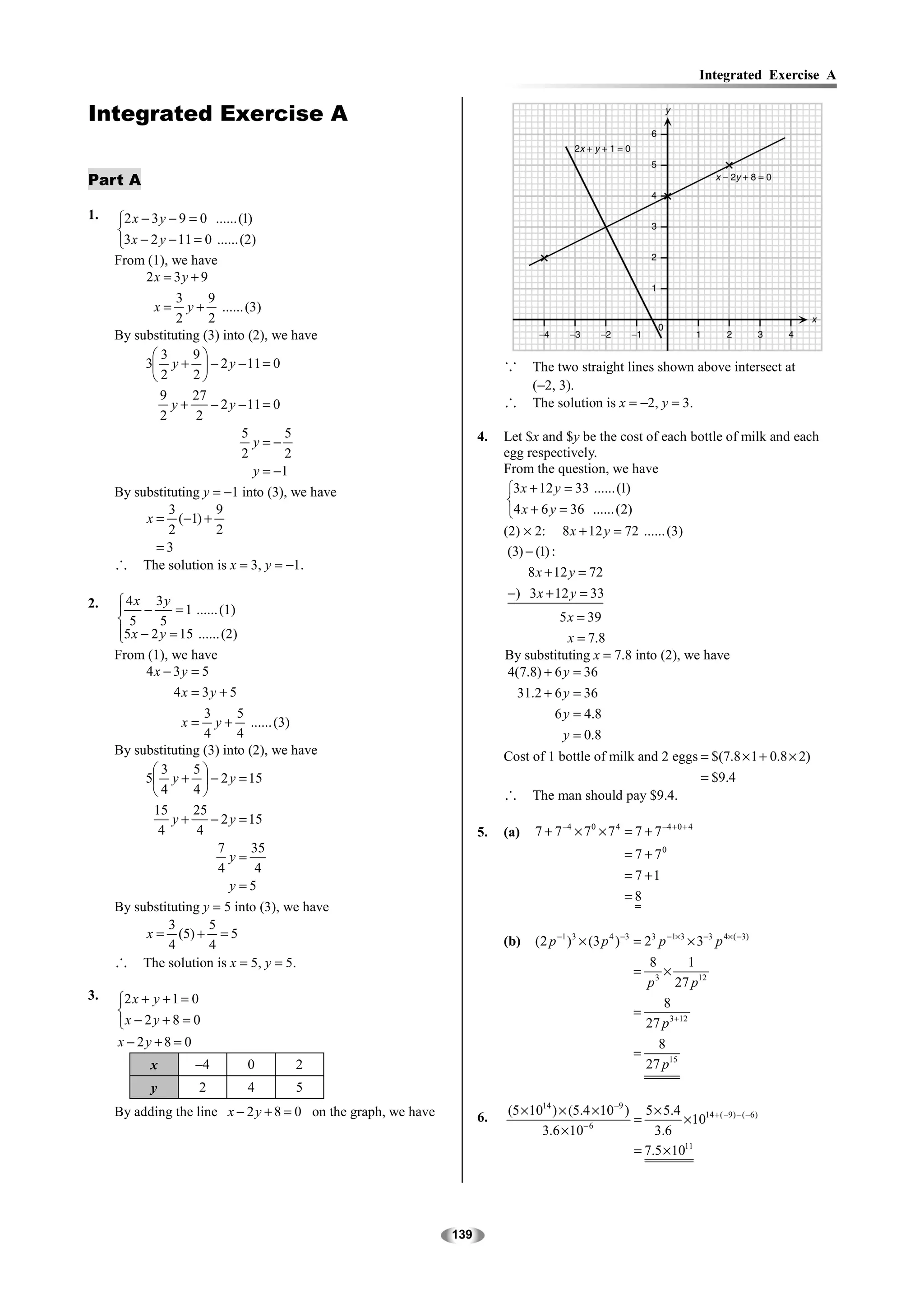
Integrated Exercise A

Integrated Exercise A

Part A

1.   2 x − 3 y − 9 = 0 ...... (1)
     
     3 x − 2 y − 11 = 0 ...... (2)
     From (1), we have
           2x = 3y + 9
                3     9
             x=   y + ...... (3)
                2     2
     By substituting (3) into (2), we have
           3      9
          3 y +  − 2 y − 11 = 0                                          ∵     The two straight lines shown above intersect at
            2     2
                                                                                 (−2, 3).
             9     27
               y+     − 2 y − 11 = 0                                       ∴     The solution is x = −2, y = 3.
             2      2
                             5       5                                4.   Let $x and $y be the cost of each bottle of milk and each
                               y=−
                             2       2                                     egg respectively.
                               y = −1                                      From the question, we have
     By substituting y = −1 into (3), we have                               3 x + 12 y = 33 ...... (1)
                                                                            
              3
          x = (−1) +
                       9                                                    4 x + 6 y = 36 ...... (2)
              2        2                                                   (2) × 2: 8 x + 12 y = 72 ...... (3)
            =3                                                              (3) − (1) :
     ∴ The solution is x = 3, y = −1.
                                                                                8 x + 12 y = 72
                                                                           −) 3 x + 12 y = 33
2.    4x 3y
      −         = 1 ...... (1)
     5       5                                                                      5 x = 39
     5 x − 2 y = 15 ...... (2)
                                                                                      x = 7.8
     From (1), we have                                                     By substituting x = 7.8 into (2), we have
           4x − 3y = 5                                                     4(7.8) + 6 y = 36
                 4x = 3y + 5                                                 31.2 + 6 y = 36
                      3     5                                                       6 y = 4.8
                 x = y + ...... (3)
                      4     4                                                          y = 0.8
     By substituting (3) into (2), we have                                 Cost of 1 bottle of milk and 2 eggs = $(7.8 × 1 + 0.8 × 2)
           3      5
          5 y +  − 2 y = 15                                                                                              = $9.4
            4     4                                                      ∴     The man should pay $9.4.
           15      25
               y+      − 2 y = 15
             4      4                                                 5.   (a)   7 + 7 −4 × 7 0 × 7 4 = 7 + 7 −4 + 0 + 4
                        7      35                                                                      = 7 + 70
                           y=
                        4       4
                                                                                                       = 7 +1
                           y=5
                                                                                                       =8
     By substituting y = 5 into (3), we have
              3       5
          x = (5) + = 5
              4       4                                                    (b)   (2 p −1 )3 × (3 p 4 ) −3 = 23 p −1×3 × 3−3 p 4× ( −3)
     ∴ The solution is x = 5, y = 5.                                                                        8         1
                                                                                                         =     ×
                                                                                                           p 3 27 p12
3.   2 x + y + 1 = 0                                                                                          8
                                                                                                        =
     x − 2 y + 8 = 0                                                                                      27 p 3 +12
     x − 2y + 8 = 0                                                                                           8
                                                                                                         =
            x         –4          0   2                                                                    27 p15
            y         2           4   5
     By adding the line x − 2 y + 8 = 0 on the graph, we have              (5 × 10¹⁴ ) × (5.4 ×10 −9 ) 5 × 5.4
                                                                      6.                              =         ×1014 + ( −9) − ( −6)
                                                                                  3.6 × 10− 6             3.6
                                                                                                      = 7.5 × 10¹¹


                                                                139
Math in Action (2nd Edition) 2B        Full Solutions

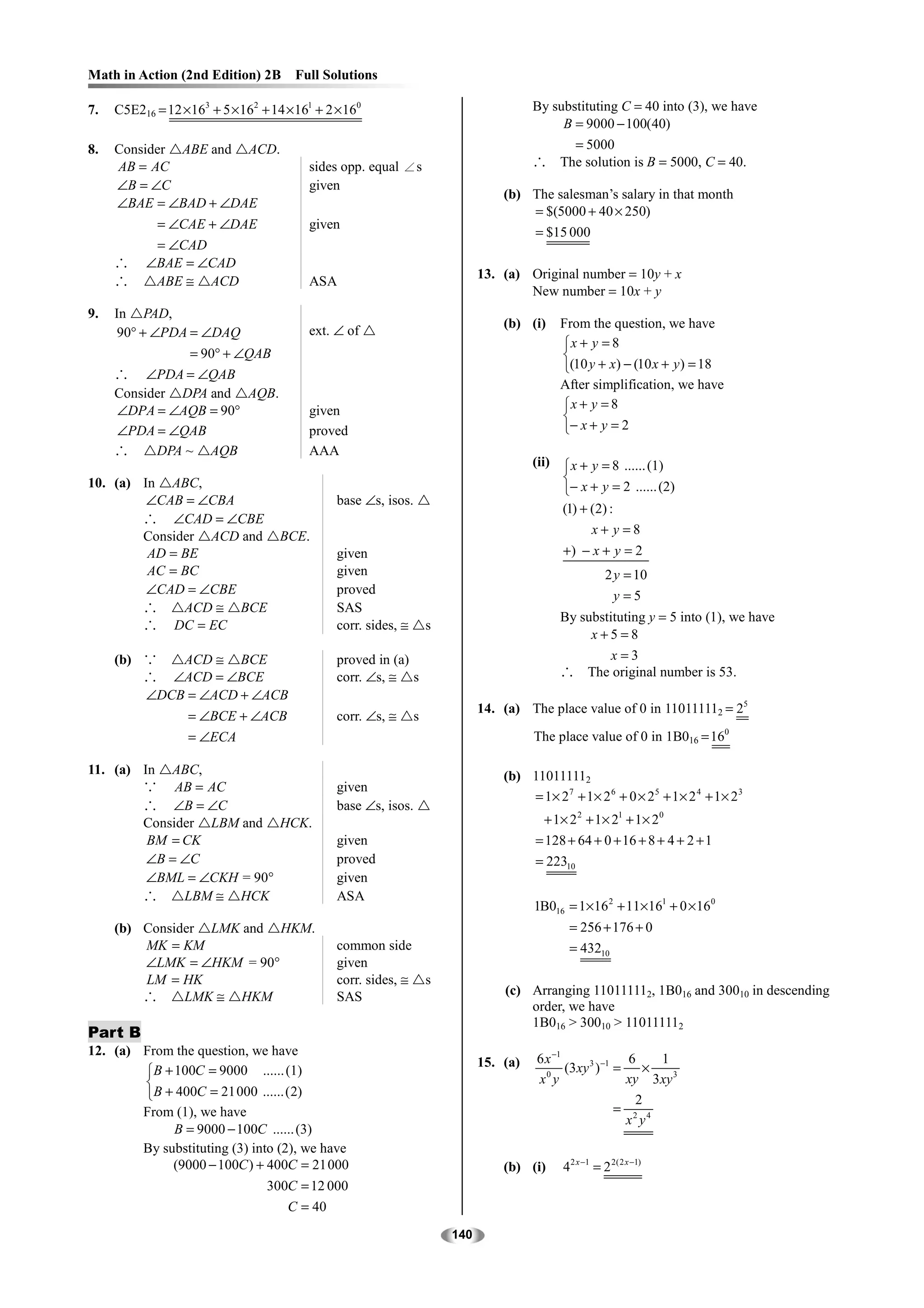
7.   C5E216 = 12 ×163 + 5 × 162 + 14 × 161 + 2 × 160                                    By substituting C = 40 into (3), we have
                                                                                             B = 9000 − 100(40)
8.   Consider ABE and ACD.                                                                     = 5000
     AB = AC                              sides opp. equal ∠s                           ∴ The solution is B = 5000, C = 40.
     ∠B = ∠C                              given
                                                                                  (b) The salesman’s salary in that month
     ∠BAE = ∠BAD + ∠DAE
                                                                                      = $(5000 + 40 × 250)
            = ∠CAE + ∠DAE                 given
                                                                                      = $15 000
            = ∠CAD
     ∴     ∠BAE = ∠CAD
                                                                              13. (a) Original number = 10y + x
     ∴      ABE ≅ ACD                     ASA
                                                                                      New number = 10x + y
9.   In PAD,
                                                                                  (b) (i)    From the question, we have
      90° + ∠PDA = ∠DAQ                   ext. ∠ of
                                                                                             x + y = 8
                = 90° + ∠QAB                                                                 
     ∴ ∠PDA = ∠QAB                                                                           (10 y + x) − (10 x + y ) = 18
                                                                                             After simplification, we have
     Consider DPA and AQB.
     ∠DPA = ∠AQB = 90°                    given                                              x + y = 8
                                                                                             
     ∠PDA = ∠QAB                          proved                                             − x + y = 2
     ∴     DPA ~ AQB                      AAA
                                                                                        (ii)  x + y = 8 ...... (1)
                                                                                             
                                                                                             − x + y = 2 ...... (2)
10. (a) In ABC,
         ∠CAB = ∠CBA                           base ∠s, isos.
                                                                                              (1) + (2) :
        ∴ ∠CAD = ∠CBE
        Consider ACD and BCE.                                                                       x+ y =8
         AD = BE                               given                                          +) − x + y = 2
         AC = BC                               given                                                      2 y = 10
         ∠CAD = ∠CBE                           proved                                                       y =5
        ∴     ACD ≅ BCE                        SAS
                                                                                             By substituting y = 5 into (1), we have
        ∴ DC = EC                              corr. sides, ≅       s
                                                                                                  x+5=8
     (b) ∵   ACD ≅ BCE                         proved in (a)                                          x=3
         ∴ ∠ACD = ∠BCE                         corr. ∠s, ≅ s                                 ∴ The original number is 53.
         ∠DCB = ∠ACD + ∠ACB
                                                                              14. (a) The place value of 0 in 110111112 = 25
                   = ∠BCE + ∠ACB               corr. ∠s, ≅      s
                   = ∠ECA                                                               The place value of 0 in 1B016 = 160

11. (a) In ABC,                                                                   (b) 110111112
        ∵ AB = AC                              given
                                                                                      = 1× 2 7 + 1× 2 6 + 0 × 2 5 + 1 × 2 4 + 1× 2 3
        ∴ ∠B = ∠C                              base ∠s, isos.
        Consider LBM and HCK.                                                             + 1× 2 2 + 1× 21 + 1× 2 0
         BM = CK                               given                                    = 128 + 64 + 0 + 16 + 8 + 4 + 2 + 1
         ∠B = ∠C                               proved                                   = 22310
         ∠BML = ∠CKH = 90°                     given
        ∴     LBM ≅ HCK                        ASA
                                                                                        1B016 = 1×16 2 + 11×161 + 0 × 16 0
     (b) Consider LMK and HKM.                                                                 = 256 + 176 + 0
         MK = KM                               common side                                     = 43210
         ∠LMK = ∠HKM = 90°                     given
         LM = HK                               corr. sides, ≅ s
         ∴     LMK ≅ HKM                       SAS                                (c) Arranging 110111112, 1B016 and 30010 in descending
                                                                                      order, we have
                                                                                      1B016 > 30010 > 110111112
Part B
12. (a) From the question, we have
                                                                              15. (a)   6 x −1                6    1
        B + 100C = 9000 ...... (1)                                                            (3 xy 3 ) −1 =    ×
                                                                                       x0 y                  xy 3 xy 3
        B + 400C = 21 000 ...... ( 2)                                                                          2
        From (1), we have                                                                                   = 2 4
                                                                                                              x y
             B = 9000 − 100C ...... (3)
        By substituting (3) into (2), we have
             (9000 − 100C ) + 400C = 21 000                                       (b) (i)     4 2 x −1 = 2 2( 2 x −1)
                                  300C = 12 000
                                     C = 40
                                                                        140
Integrated Exercise A

                 8−2 = ( 23 ) −2                                                            (c) ∵         ACD ~ ABC                    proved in (a)
                                                                                                          CBD ~ ACD                    proved in (b)
                     = 2− 6                                                                       ∴       ABC ~ CBD
                  1    1                                                                                 AB BC
                    =                                                                             ∴          =                         corr. sides, ~ △s
                 16 2 4                                                                                  CB BD
                    = 2− 4                                                                              BC 2 = BD × AB

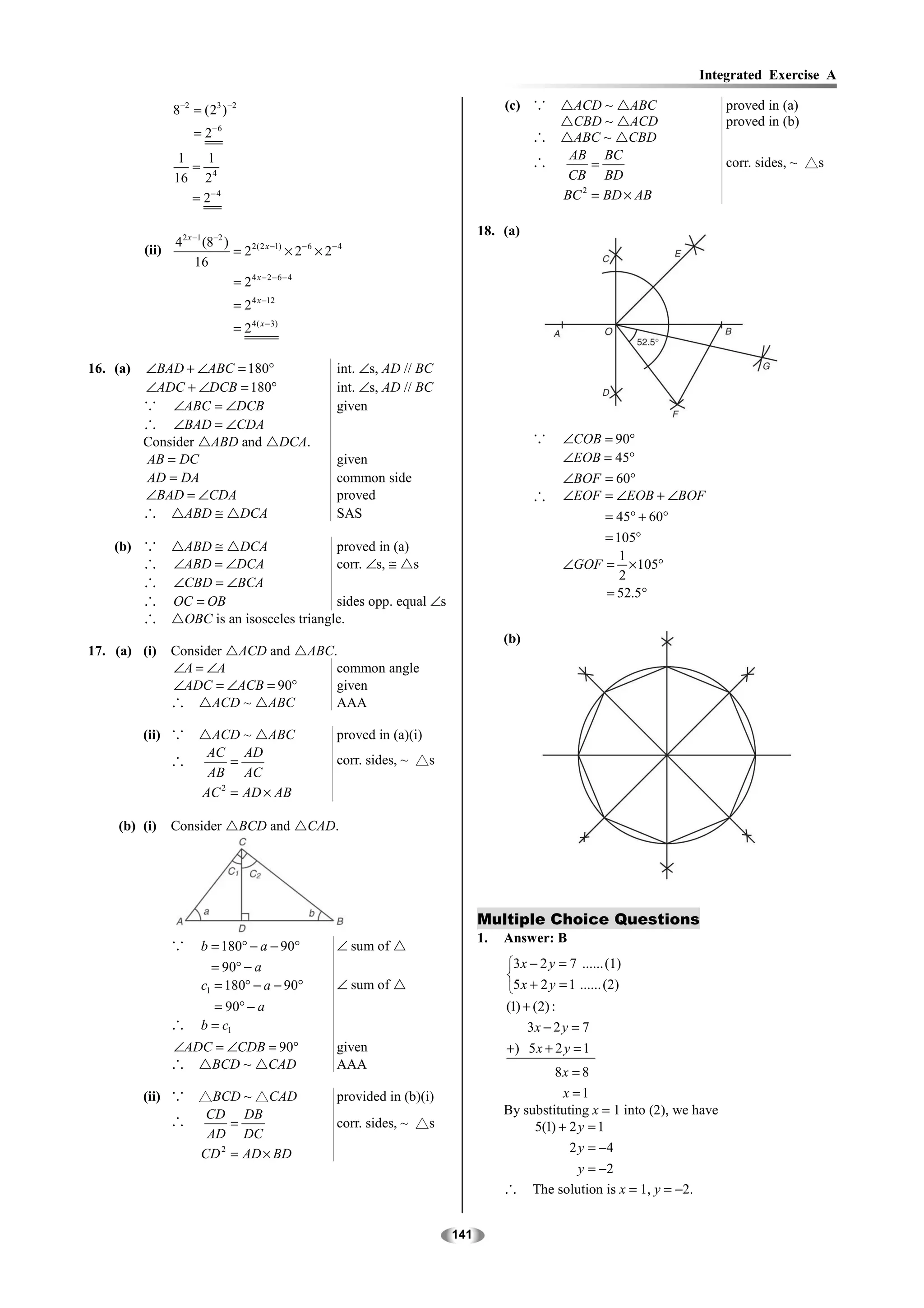
                                                                                       18. (a)
                 4 2 x −1 (8−2 )
          (ii)                   = 2 2( 2 x −1) × 2− 6 × 2 − 4
                       16
                                 = 24 x − 2− 6− 4
                                = 2 4 x −12
                                = 2 4 ( x − 3)

16. (a)   ∠BAD + ∠ABC = 180°                                int. ∠s, AD // BC
          ∠ADC + ∠DCB = 180°                                int. ∠s, AD // BC
          ∵ ∠ABC = ∠DCB                                     given
          ∴ ∠BAD = ∠CDA
          Consider ABD and DCA.                                                                   ∵     ∠COB = 90°
          AB = DC                                           given                                       ∠EOB = 45°
          AD = DA                                           common side                                 ∠BOF = 60°
          ∠BAD = ∠CDA                                       proved                                ∴     ∠EOF = ∠EOB + ∠BOF
          ∴     ABD ≅ DCA                                   SAS                                              = 45° + 60°
                                                                                                             = 105°
    (b) ∵         ABD ≅ DCA                  proved in (a)
                                                                                                                1
        ∴        ∠ABD = ∠DCA                 corr. ∠s, ≅ s                                              ∠GOF = × 105°
                                                                                                                2
        ∴        ∠CBD = ∠BCA
                                                                                                             = 52.5°
        ∴        OC = OB                     sides opp. equal ∠s
        ∴         OBC is an isosceles triangle.
                                                                                            (b)
17. (a) (i)      Consider ACD and ABC.
                 ∠A = ∠A              common angle
                 ∠ADC = ∠ACB = 90°    given
                 ∴     ACD ~ ABC      AAA

          (ii) ∵          ACD ~ ABC                         proved in (a)(i)
                         AC AD
                 ∴           =                              corr. sides, ~ △s
                         AB AC
                        AC 2 = AD × AB

     (b) (i)     Consider          BCD and          CAD.


                                                                                       Multiple Choice Questions
                                                                                       1.   Answer: B
                 ∵     b = 180° − a − 90°                   ∠ sum of
                         = 90° − a                                                          3 x − 2 y = 7 ...... (1)
                                                                                            
                       c1 = 180° − a − 90°                  ∠ sum of                        5 x + 2 y = 1 ...... (2)
                         = 90° − a                                                          (1) + (2) :
                 ∴     b = c1                                                                    3x − 2 y = 7
                 ∠ADC = ∠CDB = 90°                          given                           +) 5 x + 2 y = 1
                 ∴   BCD ~ CAD                              AAA
                                                                                                     8x = 8
          (ii) ∵ △BCD ~ △CAD                                provided in (b)(i)                         x =1
                  CD DB                                                                     By substituting x = 1 into (2), we have
               ∴      =                                     corr. sides, ~ △s                    5(1) + 2 y = 1
                  AD DC
                 CD 2 = AD × BD                                                                         2 y = −4
                                                                                                          y = −2
                                                                                            ∴     The solution is x = 1, y = −2.


                                                                                 141
Math in Action (2nd Edition) 2B            Full Solutions

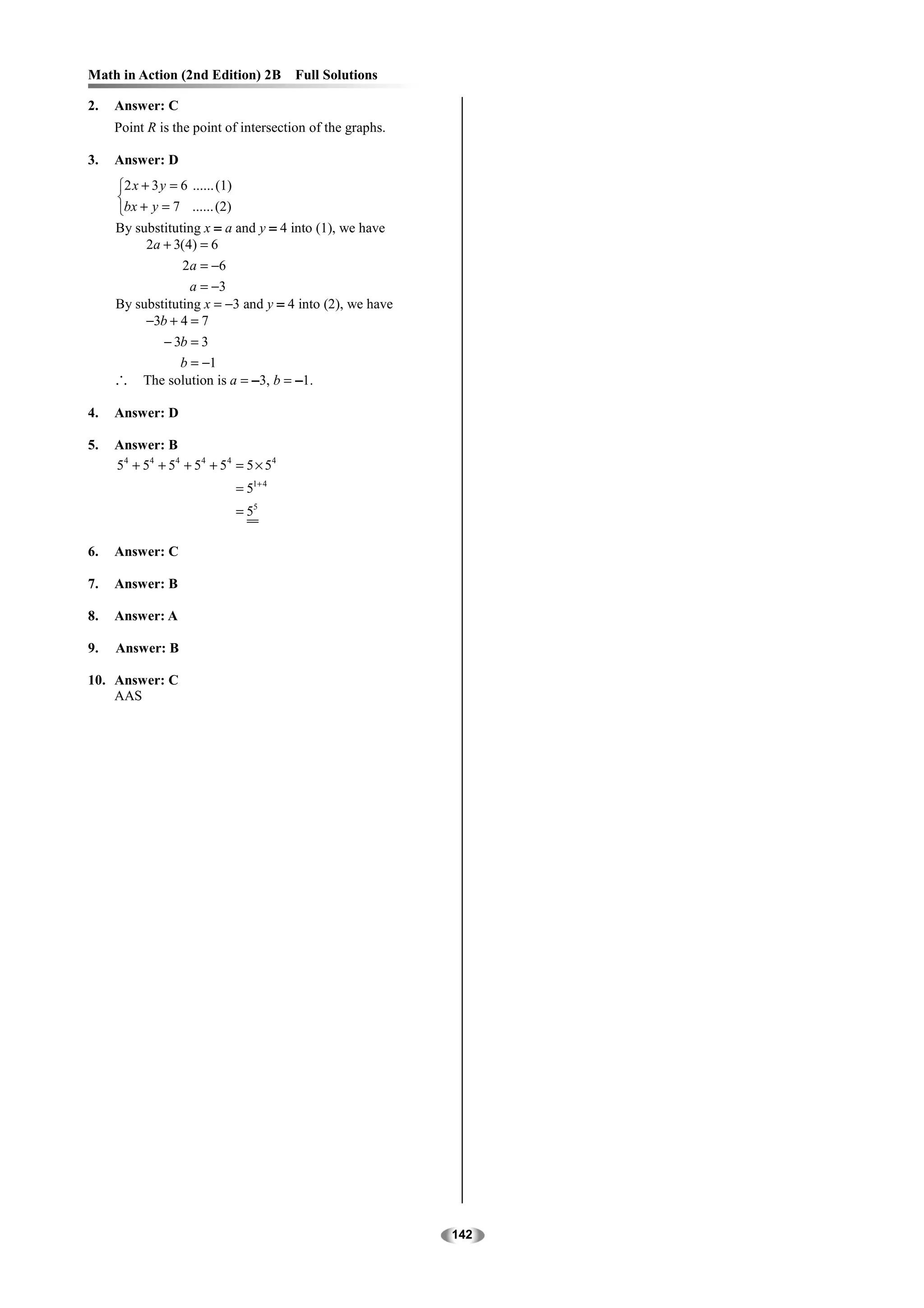
2.   Answer: C
     Point R is the point of intersection of the graphs.

3.   Answer: D
     2 x + 3 y = 6 ...... (1)
     
     bx + y = 7 ...... (2)
     By substituting x = a and y = 4 into (1), we have
          2a + 3(4) = 6
                 2a = −6
                  a = −3
     By substituting x = −3 and y = 4 into (2), we have
          −3b + 4 = 7
              − 3b = 3
                 b = −1
     ∴     The solution is a = −3, b = −1.

4.   Answer: D

5.   Answer: B
     5 4 + 54 + 54 + 5 4 + 5 4 = 5 × 54
                                 = 51+ 4
                                 = 55

6.   Answer: C

7.   Answer: B

8.   Answer: A

9.   Answer: B

10. Answer: C
    AAS


                                                            142

Integrated exercise a_(book_2_B)_Ans

  • 1.
    Integrated Exercise A IntegratedExercise A Part A 1. 2 x − 3 y − 9 = 0 ...... (1)  3 x − 2 y − 11 = 0 ...... (2) From (1), we have 2x = 3y + 9 3 9 x= y + ...... (3) 2 2 By substituting (3) into (2), we have 3 9 3 y +  − 2 y − 11 = 0 ∵ The two straight lines shown above intersect at  2 2 (−2, 3). 9 27 y+ − 2 y − 11 = 0 ∴ The solution is x = −2, y = 3. 2 2 5 5 4. Let $x and $y be the cost of each bottle of milk and each y=− 2 2 egg respectively. y = −1 From the question, we have By substituting y = −1 into (3), we have 3 x + 12 y = 33 ...... (1)  3 x = (−1) + 9 4 x + 6 y = 36 ...... (2) 2 2 (2) × 2: 8 x + 12 y = 72 ...... (3) =3 (3) − (1) : ∴ The solution is x = 3, y = −1. 8 x + 12 y = 72 −) 3 x + 12 y = 33 2.  4x 3y  − = 1 ...... (1) 5 5 5 x = 39 5 x − 2 y = 15 ...... (2)  x = 7.8 From (1), we have By substituting x = 7.8 into (2), we have 4x − 3y = 5 4(7.8) + 6 y = 36 4x = 3y + 5 31.2 + 6 y = 36 3 5 6 y = 4.8 x = y + ...... (3) 4 4 y = 0.8 By substituting (3) into (2), we have Cost of 1 bottle of milk and 2 eggs = $(7.8 × 1 + 0.8 × 2) 3 5 5 y +  − 2 y = 15 = $9.4  4 4 ∴ The man should pay $9.4. 15 25 y+ − 2 y = 15 4 4 5. (a) 7 + 7 −4 × 7 0 × 7 4 = 7 + 7 −4 + 0 + 4 7 35 = 7 + 70 y= 4 4 = 7 +1 y=5 =8 By substituting y = 5 into (3), we have 3 5 x = (5) + = 5 4 4 (b) (2 p −1 )3 × (3 p 4 ) −3 = 23 p −1×3 × 3−3 p 4× ( −3) ∴ The solution is x = 5, y = 5. 8 1 = × p 3 27 p12 3. 2 x + y + 1 = 0 8  = x − 2 y + 8 = 0 27 p 3 +12 x − 2y + 8 = 0 8 = x –4 0 2 27 p15 y 2 4 5 By adding the line x − 2 y + 8 = 0 on the graph, we have (5 × 10¹⁴ ) × (5.4 ×10 −9 ) 5 × 5.4 6. = ×1014 + ( −9) − ( −6) 3.6 × 10− 6 3.6 = 7.5 × 10¹¹ 139
  • 2.
    Math in Action(2nd Edition) 2B Full Solutions 7. C5E216 = 12 ×163 + 5 × 162 + 14 × 161 + 2 × 160 By substituting C = 40 into (3), we have B = 9000 − 100(40) 8. Consider ABE and ACD. = 5000 AB = AC sides opp. equal ∠s ∴ The solution is B = 5000, C = 40. ∠B = ∠C given (b) The salesman’s salary in that month ∠BAE = ∠BAD + ∠DAE = $(5000 + 40 × 250) = ∠CAE + ∠DAE given = $15 000 = ∠CAD ∴ ∠BAE = ∠CAD 13. (a) Original number = 10y + x ∴ ABE ≅ ACD ASA New number = 10x + y 9. In PAD, (b) (i) From the question, we have 90° + ∠PDA = ∠DAQ ext. ∠ of x + y = 8 = 90° + ∠QAB  ∴ ∠PDA = ∠QAB (10 y + x) − (10 x + y ) = 18 After simplification, we have Consider DPA and AQB. ∠DPA = ∠AQB = 90° given x + y = 8  ∠PDA = ∠QAB proved − x + y = 2 ∴ DPA ~ AQB AAA (ii)  x + y = 8 ...... (1)  − x + y = 2 ...... (2) 10. (a) In ABC, ∠CAB = ∠CBA base ∠s, isos. (1) + (2) : ∴ ∠CAD = ∠CBE Consider ACD and BCE. x+ y =8 AD = BE given +) − x + y = 2 AC = BC given 2 y = 10 ∠CAD = ∠CBE proved y =5 ∴ ACD ≅ BCE SAS By substituting y = 5 into (1), we have ∴ DC = EC corr. sides, ≅ s x+5=8 (b) ∵ ACD ≅ BCE proved in (a) x=3 ∴ ∠ACD = ∠BCE corr. ∠s, ≅ s ∴ The original number is 53. ∠DCB = ∠ACD + ∠ACB 14. (a) The place value of 0 in 110111112 = 25 = ∠BCE + ∠ACB corr. ∠s, ≅ s = ∠ECA The place value of 0 in 1B016 = 160 11. (a) In ABC, (b) 110111112 ∵ AB = AC given = 1× 2 7 + 1× 2 6 + 0 × 2 5 + 1 × 2 4 + 1× 2 3 ∴ ∠B = ∠C base ∠s, isos. Consider LBM and HCK. + 1× 2 2 + 1× 21 + 1× 2 0 BM = CK given = 128 + 64 + 0 + 16 + 8 + 4 + 2 + 1 ∠B = ∠C proved = 22310 ∠BML = ∠CKH = 90° given ∴ LBM ≅ HCK ASA 1B016 = 1×16 2 + 11×161 + 0 × 16 0 (b) Consider LMK and HKM. = 256 + 176 + 0 MK = KM common side = 43210 ∠LMK = ∠HKM = 90° given LM = HK corr. sides, ≅ s ∴ LMK ≅ HKM SAS (c) Arranging 110111112, 1B016 and 30010 in descending order, we have 1B016 > 30010 > 110111112 Part B 12. (a) From the question, we have 15. (a) 6 x −1 6 1 B + 100C = 9000 ...... (1) (3 xy 3 ) −1 = ×  x0 y xy 3 xy 3 B + 400C = 21 000 ...... ( 2) 2 From (1), we have = 2 4 x y B = 9000 − 100C ...... (3) By substituting (3) into (2), we have (9000 − 100C ) + 400C = 21 000 (b) (i) 4 2 x −1 = 2 2( 2 x −1) 300C = 12 000 C = 40 140
  • 3.
    Integrated Exercise A 8−2 = ( 23 ) −2 (c) ∵ ACD ~ ABC proved in (a) CBD ~ ACD proved in (b) = 2− 6 ∴ ABC ~ CBD 1 1 AB BC = ∴ = corr. sides, ~ △s 16 2 4 CB BD = 2− 4 BC 2 = BD × AB 18. (a) 4 2 x −1 (8−2 ) (ii) = 2 2( 2 x −1) × 2− 6 × 2 − 4 16 = 24 x − 2− 6− 4 = 2 4 x −12 = 2 4 ( x − 3) 16. (a) ∠BAD + ∠ABC = 180° int. ∠s, AD // BC ∠ADC + ∠DCB = 180° int. ∠s, AD // BC ∵ ∠ABC = ∠DCB given ∴ ∠BAD = ∠CDA Consider ABD and DCA. ∵ ∠COB = 90° AB = DC given ∠EOB = 45° AD = DA common side ∠BOF = 60° ∠BAD = ∠CDA proved ∴ ∠EOF = ∠EOB + ∠BOF ∴ ABD ≅ DCA SAS = 45° + 60° = 105° (b) ∵ ABD ≅ DCA proved in (a) 1 ∴ ∠ABD = ∠DCA corr. ∠s, ≅ s ∠GOF = × 105° 2 ∴ ∠CBD = ∠BCA = 52.5° ∴ OC = OB sides opp. equal ∠s ∴ OBC is an isosceles triangle. (b) 17. (a) (i) Consider ACD and ABC. ∠A = ∠A common angle ∠ADC = ∠ACB = 90° given ∴ ACD ~ ABC AAA (ii) ∵ ACD ~ ABC proved in (a)(i) AC AD ∴ = corr. sides, ~ △s AB AC AC 2 = AD × AB (b) (i) Consider BCD and CAD. Multiple Choice Questions 1. Answer: B ∵ b = 180° − a − 90° ∠ sum of = 90° − a 3 x − 2 y = 7 ...... (1)  c1 = 180° − a − 90° ∠ sum of 5 x + 2 y = 1 ...... (2) = 90° − a (1) + (2) : ∴ b = c1 3x − 2 y = 7 ∠ADC = ∠CDB = 90° given +) 5 x + 2 y = 1 ∴ BCD ~ CAD AAA 8x = 8 (ii) ∵ △BCD ~ △CAD provided in (b)(i) x =1 CD DB By substituting x = 1 into (2), we have ∴ = corr. sides, ~ △s 5(1) + 2 y = 1 AD DC CD 2 = AD × BD 2 y = −4 y = −2 ∴ The solution is x = 1, y = −2. 141
  • 4.
    Math in Action(2nd Edition) 2B Full Solutions 2. Answer: C Point R is the point of intersection of the graphs. 3. Answer: D 2 x + 3 y = 6 ...... (1)  bx + y = 7 ...... (2) By substituting x = a and y = 4 into (1), we have 2a + 3(4) = 6 2a = −6 a = −3 By substituting x = −3 and y = 4 into (2), we have −3b + 4 = 7 − 3b = 3 b = −1 ∴ The solution is a = −3, b = −1. 4. Answer: D 5. Answer: B 5 4 + 54 + 54 + 5 4 + 5 4 = 5 × 54 = 51+ 4 = 55 6. Answer: C 7. Answer: B 8. Answer: A 9. Answer: B 10. Answer: C AAS 142