TUMKUR UNIVERSITY
DEPARTMENT OF STUDIES AND RESEARCH IN CHEMISTRYUNIVERSITY COLLEGE OF SCIENCE, TUMKUR.
2021-2022
SEMINAR TOPIC : Mechanism and synthetic use of Dinone-Phenol rearrangement
(CPT 3.1 Reaction, Rearrangement and Heterocyclic chemistry)
sUBMITTEDBY SuBMITTEDto guidEDBY
KEERTHIKUMAR C Dr .RAMESH T.N Dr .SHIVANANDHA M.K
II MSc , III Semester Co- Ordinator ASSSTANT PROFESSOR
DOS&R IN CHEMISTRY UNIVERSITY COLLEGE OF SCIENCE, DOS&R IN CHEMISTRY
UNIVERSITY COLLEGE OF SCIENCE TUMKUR UNIVERSITY COLLEGE OF SCIENCE
TUMKUR TUMKUR
1
INTRODUCTION
• Rearrangement reactions involve the migration of a group or an
atom from one center (migration origin) to another(migration
terminus) in within a molecule or between the two molicule
• Rearrangements roughly classified on the basis of the nature of the
migrating group/atom
1.Nucleophilic :- migrating group migrates with electron pair
2.Electrophilic :- migrating group migrates without electron pair
3.Free radical :- migrating group migrates with only one electron
2
Dienone–phenol Rearrangement
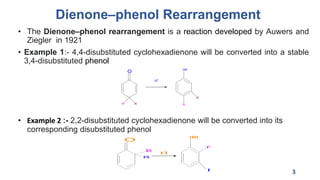
• The Dienone–phenol rearrangement is a reaction developed by Auwers and
Ziegler in 1921
• Example 1:- 4,4-disubstituted cyclohexadienone will be converted into a stable
3,4-disubstituted phenol
• Example 2 :- 2,2-disubstituted cyclohexadienone will be converted into its
corresponding disubstituted phenol
3
O
R R
OH
R
R
H+
O
O
H
R
R
H
+
R
R
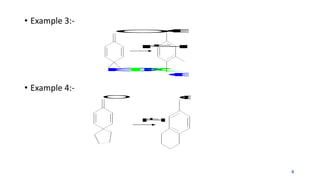
• Example 3:-
• Example 4:-
4
O
H
O
R
H
+
O
H
O
H
R
O
H
+
O
H
MECHANISM:-
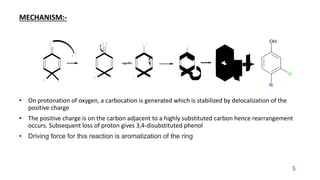
• On protonation of oxygen, a carbocation is generated which is stabilized by delocalization of the
positive charge
• The positive charge is on the carbon adjacent to a highly substituted carbon hence rearrangement
occurs. Subsequent loss of proton gives 3,4-disubstituted phenol
• Driving force for this reaction is aromatization of the ring
5
O
R R
H +
R R
+
O H
R R
O H
+
O H
+
R
R
H
H +
OH
R
R
R R
O H
+
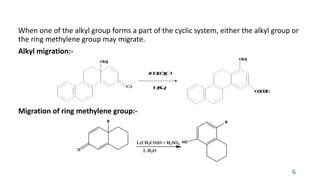
When one of the alkyl group forms a part of the cyclic system, either the alkyl group or
the ring methylene group may migrate.
Alkyl migration:-
Migration of ring methylene group:-
6
R
O
R
HO
1.(CH3CO)O + H2SO4
2. H2O
C
H
3
C
H
3
O
C
O
C
H
3
O
(
C
H
3
C
O
)
2
O
H
2
S
O
4
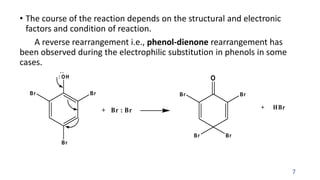
• The course of the reaction depends on the structural and electronic
factors and condition of reaction.
A reverse rearrangement i.e., phenol-dienone rearrangement has
been observed during the electrophilic substitution in phenols in some
cases.
7
Br Br
Br
Br Br
Br Br
O
+ Br : Br
OH
+ HBr
APPLICATIONS:-
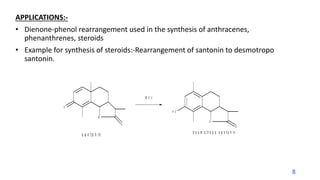
• Dienone-phenol rearrangement used in the synthesis of anthracenes,
phenanthrenes, steroids
• Example for synthesis of steroids:-Rearrangement of santonin to desmotropo
santonin.
8
O
H O
O
O
H C l
O
O
s a n t o n in d e s m o t r o p o s a n t o n in
•References:-
1. Reaction rearrangement and reagents
By Sanyal
Bharati bhavan publishers
2. Organic reaction mechanisms
By V.K Ahluwalia, Rakesh Kumar Parashar
Narosa Publishing house New Delhi
9
10

Dienone-phenol_rearrangement FINAL2.pptx

  • 1.
    TUMKUR UNIVERSITY DEPARTMENT OFSTUDIES AND RESEARCH IN CHEMISTRYUNIVERSITY COLLEGE OF SCIENCE, TUMKUR. 2021-2022 SEMINAR TOPIC : Mechanism and synthetic use of Dinone-Phenol rearrangement (CPT 3.1 Reaction, Rearrangement and Heterocyclic chemistry) sUBMITTEDBY SuBMITTEDto guidEDBY KEERTHIKUMAR C Dr .RAMESH T.N Dr .SHIVANANDHA M.K II MSc , III Semester Co- Ordinator ASSSTANT PROFESSOR DOS&R IN CHEMISTRY UNIVERSITY COLLEGE OF SCIENCE, DOS&R IN CHEMISTRY UNIVERSITY COLLEGE OF SCIENCE TUMKUR UNIVERSITY COLLEGE OF SCIENCE TUMKUR TUMKUR 1
  • 2.
    INTRODUCTION • Rearrangement reactionsinvolve the migration of a group or an atom from one center (migration origin) to another(migration terminus) in within a molecule or between the two molicule • Rearrangements roughly classified on the basis of the nature of the migrating group/atom 1.Nucleophilic :- migrating group migrates with electron pair 2.Electrophilic :- migrating group migrates without electron pair 3.Free radical :- migrating group migrates with only one electron 2
  • 3.
    Dienone–phenol Rearrangement • TheDienone–phenol rearrangement is a reaction developed by Auwers and Ziegler in 1921 • Example 1:- 4,4-disubstituted cyclohexadienone will be converted into a stable 3,4-disubstituted phenol • Example 2 :- 2,2-disubstituted cyclohexadienone will be converted into its corresponding disubstituted phenol 3 O R R OH R R H+ O O H R R H + R R
  • 4.
    • Example 3:- •Example 4:- 4 O H O R H + O H O H R O H + O H
  • 5.
    MECHANISM:- • On protonationof oxygen, a carbocation is generated which is stabilized by delocalization of the positive charge • The positive charge is on the carbon adjacent to a highly substituted carbon hence rearrangement occurs. Subsequent loss of proton gives 3,4-disubstituted phenol • Driving force for this reaction is aromatization of the ring 5 O R R H + R R + O H R R O H + O H + R R H H + OH R R R R O H +
  • 6.
    When one ofthe alkyl group forms a part of the cyclic system, either the alkyl group or the ring methylene group may migrate. Alkyl migration:- Migration of ring methylene group:- 6 R O R HO 1.(CH3CO)O + H2SO4 2. H2O C H 3 C H 3 O C O C H 3 O ( C H 3 C O ) 2 O H 2 S O 4
  • 7.
    • The courseof the reaction depends on the structural and electronic factors and condition of reaction. A reverse rearrangement i.e., phenol-dienone rearrangement has been observed during the electrophilic substitution in phenols in some cases. 7 Br Br Br Br Br Br Br O + Br : Br OH + HBr
  • 8.
    APPLICATIONS:- • Dienone-phenol rearrangementused in the synthesis of anthracenes, phenanthrenes, steroids • Example for synthesis of steroids:-Rearrangement of santonin to desmotropo santonin. 8 O H O O O H C l O O s a n t o n in d e s m o t r o p o s a n t o n in
  • 9.
    •References:- 1. Reaction rearrangementand reagents By Sanyal Bharati bhavan publishers 2. Organic reaction mechanisms By V.K Ahluwalia, Rakesh Kumar Parashar Narosa Publishing house New Delhi 9
  • 10.