INDUSTRIAL FERMENTATION BIOTECHNOLOGY
Dr.Kalaiselvigovindan
Animal Biotechnology
TANUVAS, INDIA
Fermentation technology
• Food safety is a global issue
• Soil microbes can spoil food
• Contamination by unsanitary handling of
food
• Improper storage and preparation
procedures can lead to contamination by
pathogens
• Imports of fruits and vegetables from 3rd
World countries can bring in diseases and
parasites
• *Hands washed properly??
Bread Production
• Sourdough culture- yeast Candida milleri and
Lactobacillus sanfrancisco 1:100 ratio
• German sour rye bread has 4 different yeast
species and 13 species of Lactobacilli
• Yeast feed on the sugars except maltose,
Lactobacilli need maltose, then produce ethyl
alcohol and CO2
• Lactobacilli produce lactic and acetic acids
giving the sour flavor, pH 3.6 - 4.0 inhibits
microbial growth
GRAINS
• Rye and wheat are harvested dry
• If they get wet, molds and other microbes will grow
• Insect, birds and rodent vectors also transmit
microbes
• Raw grain with mold Claviceps purpurea cause
ergotism, mold is halucinogenic and deadly
• Aspergillus produce aflatoxins
• Rhizopus nigricans is most common bread mold,
also Aspergillus, Penicillium and Monila (pink mold)
• Rye bread likely infected by Bacillus sp (w/spores)
FRUITS AND VEGETABLES
• Pseudomonas fluorescens are found on surface of
fruits and vegetables
• Pathogens: Salmonella, Shigella, Entameoba,
Ascaris can be transmitted on surfaces
• Leafy vegetables more susceptible to rot by Erwinia
carotovora, Penicillium mold on citrus fruits and
apples
• Fungus Phytophthora infestans caused potato blight
• Now using GMO to make plants resistant
• Tomato rot- Fusarium fungus, Rhizopus injected by
insects. Peach rot - Monilia fruiticola
MEATS AND POULTRY
• 70 different types pathogens found at
slaughterhouses, inspected by vet
• Dec 2003 -1st
case of Mad Cow in US, stricter laws
• Carcasses are hung in refrigerated rooms to age,
some mold: Rhizopus and Mucor , Pseudomonas
release H2S and green coloration
• Clostridium cause bone stink deep in carcass
• Ground meat- may have helminths-Trichinella,
lactobacilli, salmonella, E.coli
• Should be cooked to kill pathogens
FISH AND SHELLFISH
• Fresh fish have microbes: enteric bacteria,
worms, & viruses which survive even
shipped in ice
• Shellfish- oysters & clams –Salmonella and
Vibrio
• Clams filter feeder can pick up red tides
toxins, sewage
• Shrimp (breaded) have high bacterial counts
• Lobster and crabs - enteric pathogens
• Crabs carry Clostridium, Cryptococcus and
Candida
MILK
• Breeding cattle for high milk production have
large udders and easily admit bacteria- get
rid of 1st
few squirts which can have 15,000
bacteria /ml
• Mostly Staphylococcus, Micrococcus,
Pseudomonas
• Hand milking- E. coli, Acinetobacter
• Diseased cattle can transmit Mycobacterium
bovis Brucella, TB
• Milk is Soured by Streptococcus lactis,
Lactobacillus
OTHER EDIBLE
SUBSTANCES
• Sugar- raw cane supports fungi: Aspergillus,
Saccharomyces, Candida. Bacteria: Bacillus
and Micrococcus
• Clostridium causes the bulge in cans
• High sugar concentration acys as
preservative
• Maple trees are tapped in spring
-Leuconostoc , and Enterobacter
• Honey toxins for Clostridium spores-floppy
baby syndrome botulism
PREVENTING DISEASE TRANSMISSION
AND FOOD SPOILAGE
• More contamination in large processing plants
• Klebsiella found in human digestive tract is also a
respiratory pathogen, but can cause diarrhea
• TB can be transmitted from unpasteurized
milk/cheese
• Virus are transferred through food
• Milk is ideal medium for growth of
pathogens/microbes
• Crucial factor to prevent spoilage and disease is
cleanliness in handling, use fresh foods, refrigerate,
• Process quickly and store properly
Methods of preservation of food
• Drying of grain
• Osmotic pressure (salt or sugar)- Dried and
salted meats and other foods
• Fermentation - milk allowed to sour was
made into cheese
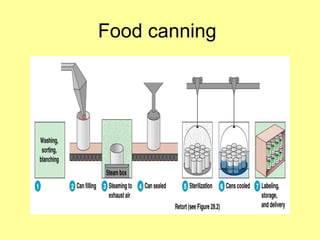
• Canning - use of moist heat under pressure,
used to preserve fruits, vegetables, meats in
glass jars and metal cans.
Destroys microbes, endospores, prevents
spoilage
CANNING
• Some thermophiles (Bacillus
stearothermophilus) may remain alive
even after canning, spores can
germinate and grow, can will bulge in
heat (thermophilic anaerobic spoilage)
• Flat sour spoilage
• Mesophilic spoilage- improper canning
at room temp
• Sugars
Food canning
Commercial Sterilization to Destroy
C. botulinum Endospores
• 12D treatment kills 1012
endospores
• Surviving endospores of thermophilic
anaerobes cause spoilage with gas
or flat-sour spoilage
DRYING AND LYOPHILIZATION
• Drying- desication or dehydration is oldest
method
• Remove 90% of water
• Stops growth but does not kill microbes
• Can be sun dried, heated in ovens etc
• Addition of slat, sugar or chemicals also
used
• Lyophilization- freeze drying is used for
instant coffee and dry yeast for bread making
Food Preservation- Irradiation
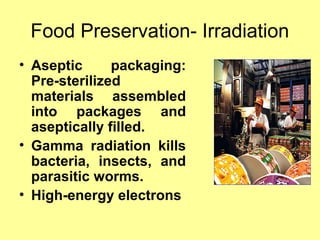
• Aseptic packaging:
Pre-sterilized
materials assembled
into packages and
aseptically filled.
• Gamma radiation kills
bacteria, insects, and
parasitic worms.
• High-energy electrons
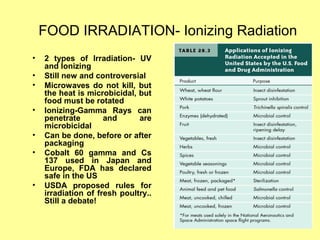
FOOD IRRADIATION- Ionizing Radiation
• 2 types of Irradiation- UV
and Ionizing
• Still new and controversial
• Microwaves do not kill, but
the heat is microbicidal, but
food must be rotated
• Ionizing-Gamma Rays can
penetrate and are
microbicidal
• Can be done, before or after
packaging
• Cobalt 60 gamma and Cs
137 used in Japan and
Europe, FDA has declared
safe in the US
• USDA proposed rules for
irradiation of fresh poultry..
Still a debate!
CHEMICAL ADDITIVES
• Benzoic, sorbic and propionic acids used in
margarine, juice, bread, other baked goods
• Alkylating agents- ethylene oxide used on
nuts/spices
• Ozone used on shellfish
• NaCl- salt to cure meats, dehydrates bacteria
• Halogen, chloride for processing equipment
• Nitrates on sausage, hot dogs
• QUATS- sanitize udders, fresh vegetables,
eggshell surfaces
ANTIBIOTICS
• In US only nisin - bacteriocin produced by
milk fermentation by Streptococcus lactis
• Antibiotics are prohibited because: (p 790)
• Antibiotic resistance
PASTUERIZATION OF MILK -
STANDARDS
• 2 methods :
• High temp short time
• Low temp long time
• Ultra high temperature- UHT treatment
• Some chemical additives
• Milk and Food in US carefully regulated by
FDA
• Animals inspected and soon stricter methods
by microscope
• Quality control has many tests for purity and
guarantees high quality milk to consumers
MICROORGANISMS AS FOOD
AND IN FOOD PRODUCTION
• Algae, Fungi, and Bacteria as Food:
• Yeasts are good source of protein
• 1 kg yeast = 100 kg protein, but human
digestive tract can only handle small
amounts of it
• Algal cultures: Cyanobacteria- Spirulina and
red algae grown in aquaculture (in Kona)
• Algae- ingredient of ice cream
• Yeast, algae and bacteria could increase
World Food Supply!
FOOD PRODUCTION: BREAD &
DAIRY
• BREAD- previous slide on sour dough
• Yeast Saccharomyces is a leavening agent, produce
gas ato make bread rise and alcohol by fermentation
• Alcohol and CO2 driven off during baking- holes
• DAIRY- cultured buttermilk- Streptococcus cremoris
is added to skim milk and allowed to ferment, also
Leuconostoc sp
• Sour cream- add one of above microbes to cream
• Yogurt- Streptococcus and Lactobacillus added to
milk
FOOD PRODUCTION: DAIRY
• Fermented Milk beverages- Mongolia- Arak drink
from Mare’s milk produces alcohol
• Acidophilus milk- add Lactibacillus acidophilus
• Bulgarian milk- add L. bulgaricus, makes it more
acidic
• Kefir- Balkan goats milk stored in goatskin bags
• Koumiss- Russian drink from Mare’s milk
• Streptococcus lactis, L. bulgaricus, and yeasts are
responsible for lactic acid, alcohol and other
products
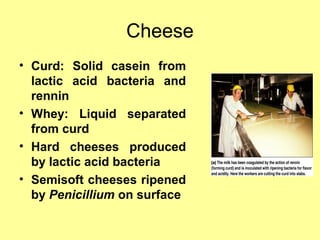
Cheese
• Curd: Solid casein from
lactic acid bacteria and
rennin
• Whey: Liquid separated
from curd
• Hard cheeses produced
by lactic acid bacteria
• Semisoft cheeses ripened
by Penicillium on surface
OTHER PRODUCTS
• Vinegar: ethyl alcohol by Acetobacter aceti
• Sauerkraut: cabbage with salt and microbes
Lactobacillus and Leuconostoc ferment under
anaerobic conditions
• Pickles: add brine to cucumbers and ferment
• Olives: ferment in Salt and Leuconostoc
• Poi: ferment taro paste, yeast adds alcohol
• Soy Sauce: soybeans, salt and Aspergillus-ferment
• Soy Products: Miso, Tofu soft curd
• Fermented Meats: salami, bologna, summer sausage
Alcoholic Beverages-Beer, Wine
and Spirits
• Distillation-
• Beer and ale are fermented starch.
• Malting: Germinating barley converts
starch to maltose and glucose.
• Yeast ferment sugars to ethyl alcohol +
CO2
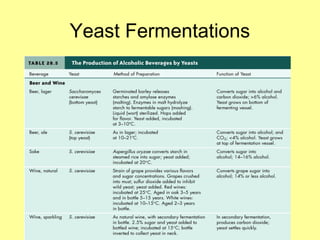
Yeast Fermentations
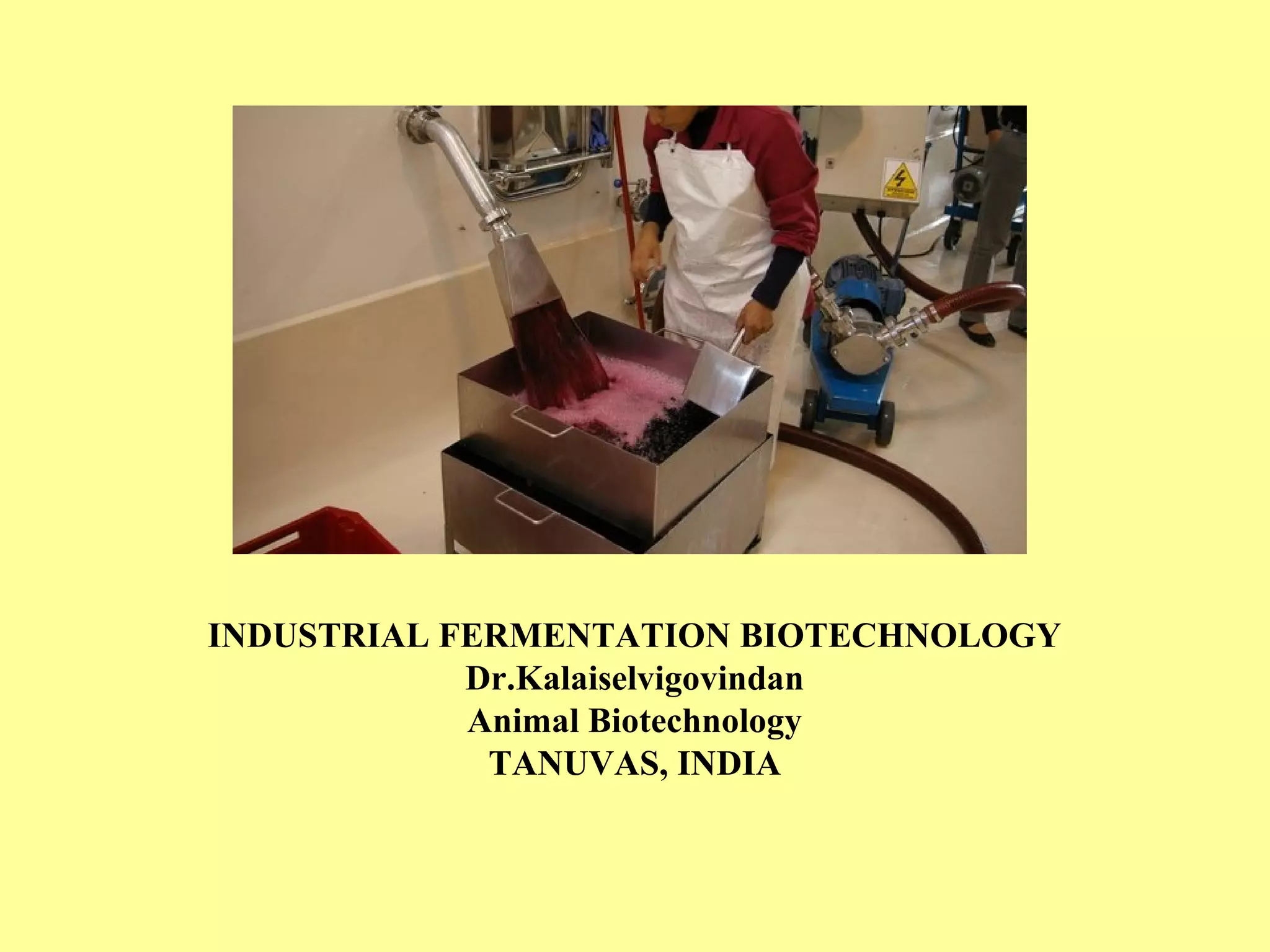
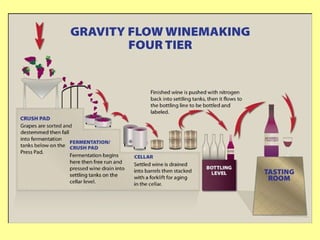
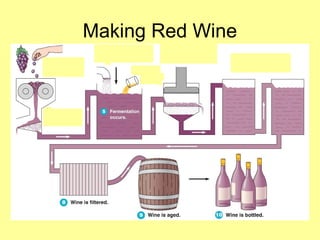
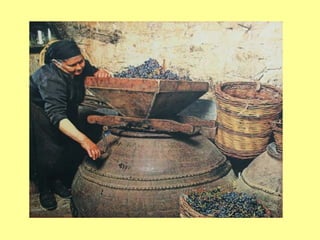
Making Red Wine
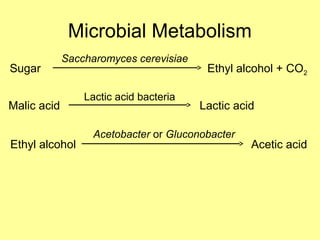
Microbial Metabolism
Sugar Ethyl alcohol + CO2
Saccharomyces cerevisiae
Malic acid Lactic acid
Lactic acid bacteria
Ethyl alcohol Acetic acid
Acetobacter or Gluconobacter
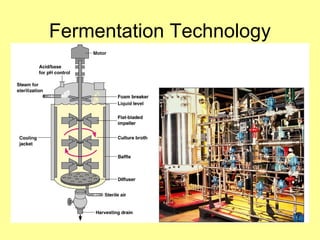
Fermentation Technology
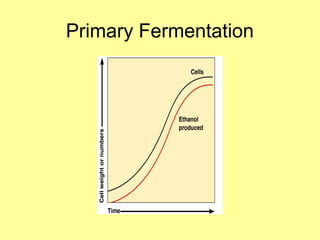
Primary Fermentation
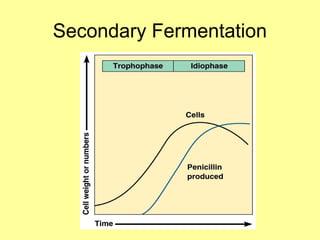
Secondary Fermentation
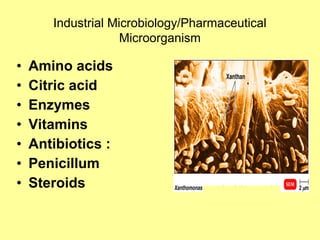
• Amino acids
• Citric acid
• Enzymes
• Vitamins
• Antibiotics :
• Penicillum
• Steroids
Industrial Microbiology/Pharmaceutical
Microorganism
Useful Organic Products
• Simple Organic Compounds-
• Antibiotics-1940’s penicillin, 2% are marketed, others are too
toxic, semi-synthetic antibiotics - augmentin
• Enzymes-used in industrial processes
• Proteolytic enzymes in coated granules are added to
detergents
• Enzymes in paper production-lignin digested by fungi
• Amino acids-8 of 20 essential aa not synthesized by us
• Need lysine, glutamic acid etc
• Bioconversion-steroids, insulin, cortisone, progesterone
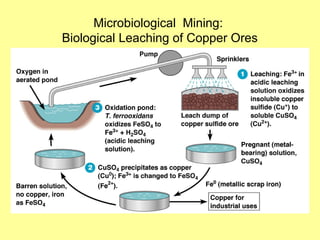
Microbiological Mining:
Biological Leaching of Copper Ores
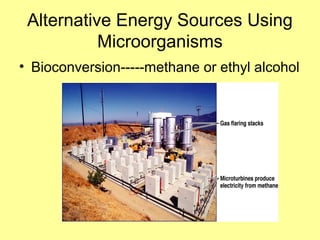
Alternative Energy Sources Using
Microorganisms
• Bioconversion-----methane or ethyl alcohol
Microbiological Waste Disposal
• Sewage treatment plants
• Bioremediation- use of microbes to
dispose of chemical wastes
• 3 strains of microbes can Deactivate
Aroclor 1260- a toxic PCB
• Others detoxify cyanide and dioxin
• Use GMO microbes
Fermentation biotechnology

Fermentation biotechnology

  • 1.
  • 2.
    Fermentation technology • Foodsafety is a global issue • Soil microbes can spoil food • Contamination by unsanitary handling of food • Improper storage and preparation procedures can lead to contamination by pathogens • Imports of fruits and vegetables from 3rd World countries can bring in diseases and parasites • *Hands washed properly??
  • 3.
    Bread Production • Sourdoughculture- yeast Candida milleri and Lactobacillus sanfrancisco 1:100 ratio • German sour rye bread has 4 different yeast species and 13 species of Lactobacilli • Yeast feed on the sugars except maltose, Lactobacilli need maltose, then produce ethyl alcohol and CO2 • Lactobacilli produce lactic and acetic acids giving the sour flavor, pH 3.6 - 4.0 inhibits microbial growth
  • 4.
    GRAINS • Rye andwheat are harvested dry • If they get wet, molds and other microbes will grow • Insect, birds and rodent vectors also transmit microbes • Raw grain with mold Claviceps purpurea cause ergotism, mold is halucinogenic and deadly • Aspergillus produce aflatoxins • Rhizopus nigricans is most common bread mold, also Aspergillus, Penicillium and Monila (pink mold) • Rye bread likely infected by Bacillus sp (w/spores)
  • 5.
    FRUITS AND VEGETABLES •Pseudomonas fluorescens are found on surface of fruits and vegetables • Pathogens: Salmonella, Shigella, Entameoba, Ascaris can be transmitted on surfaces • Leafy vegetables more susceptible to rot by Erwinia carotovora, Penicillium mold on citrus fruits and apples • Fungus Phytophthora infestans caused potato blight • Now using GMO to make plants resistant • Tomato rot- Fusarium fungus, Rhizopus injected by insects. Peach rot - Monilia fruiticola
  • 6.
    MEATS AND POULTRY •70 different types pathogens found at slaughterhouses, inspected by vet • Dec 2003 -1st case of Mad Cow in US, stricter laws • Carcasses are hung in refrigerated rooms to age, some mold: Rhizopus and Mucor , Pseudomonas release H2S and green coloration • Clostridium cause bone stink deep in carcass • Ground meat- may have helminths-Trichinella, lactobacilli, salmonella, E.coli • Should be cooked to kill pathogens
  • 7.
    FISH AND SHELLFISH •Fresh fish have microbes: enteric bacteria, worms, & viruses which survive even shipped in ice • Shellfish- oysters & clams –Salmonella and Vibrio • Clams filter feeder can pick up red tides toxins, sewage • Shrimp (breaded) have high bacterial counts • Lobster and crabs - enteric pathogens • Crabs carry Clostridium, Cryptococcus and Candida
  • 8.
    MILK • Breeding cattlefor high milk production have large udders and easily admit bacteria- get rid of 1st few squirts which can have 15,000 bacteria /ml • Mostly Staphylococcus, Micrococcus, Pseudomonas • Hand milking- E. coli, Acinetobacter • Diseased cattle can transmit Mycobacterium bovis Brucella, TB • Milk is Soured by Streptococcus lactis, Lactobacillus
  • 9.
    OTHER EDIBLE SUBSTANCES • Sugar-raw cane supports fungi: Aspergillus, Saccharomyces, Candida. Bacteria: Bacillus and Micrococcus • Clostridium causes the bulge in cans • High sugar concentration acys as preservative • Maple trees are tapped in spring -Leuconostoc , and Enterobacter • Honey toxins for Clostridium spores-floppy baby syndrome botulism
  • 10.
    PREVENTING DISEASE TRANSMISSION ANDFOOD SPOILAGE • More contamination in large processing plants • Klebsiella found in human digestive tract is also a respiratory pathogen, but can cause diarrhea • TB can be transmitted from unpasteurized milk/cheese • Virus are transferred through food • Milk is ideal medium for growth of pathogens/microbes • Crucial factor to prevent spoilage and disease is cleanliness in handling, use fresh foods, refrigerate, • Process quickly and store properly
  • 11.
    Methods of preservationof food • Drying of grain • Osmotic pressure (salt or sugar)- Dried and salted meats and other foods • Fermentation - milk allowed to sour was made into cheese • Canning - use of moist heat under pressure, used to preserve fruits, vegetables, meats in glass jars and metal cans. Destroys microbes, endospores, prevents spoilage
  • 12.
    CANNING • Some thermophiles(Bacillus stearothermophilus) may remain alive even after canning, spores can germinate and grow, can will bulge in heat (thermophilic anaerobic spoilage) • Flat sour spoilage • Mesophilic spoilage- improper canning at room temp • Sugars
  • 13.
  • 14.
    Commercial Sterilization toDestroy C. botulinum Endospores • 12D treatment kills 1012 endospores • Surviving endospores of thermophilic anaerobes cause spoilage with gas or flat-sour spoilage
  • 15.
    DRYING AND LYOPHILIZATION •Drying- desication or dehydration is oldest method • Remove 90% of water • Stops growth but does not kill microbes • Can be sun dried, heated in ovens etc • Addition of slat, sugar or chemicals also used • Lyophilization- freeze drying is used for instant coffee and dry yeast for bread making
  • 16.
    Food Preservation- Irradiation •Aseptic packaging: Pre-sterilized materials assembled into packages and aseptically filled. • Gamma radiation kills bacteria, insects, and parasitic worms. • High-energy electrons
  • 17.
    FOOD IRRADIATION- IonizingRadiation • 2 types of Irradiation- UV and Ionizing • Still new and controversial • Microwaves do not kill, but the heat is microbicidal, but food must be rotated • Ionizing-Gamma Rays can penetrate and are microbicidal • Can be done, before or after packaging • Cobalt 60 gamma and Cs 137 used in Japan and Europe, FDA has declared safe in the US • USDA proposed rules for irradiation of fresh poultry.. Still a debate!
  • 18.
    CHEMICAL ADDITIVES • Benzoic,sorbic and propionic acids used in margarine, juice, bread, other baked goods • Alkylating agents- ethylene oxide used on nuts/spices • Ozone used on shellfish • NaCl- salt to cure meats, dehydrates bacteria • Halogen, chloride for processing equipment • Nitrates on sausage, hot dogs • QUATS- sanitize udders, fresh vegetables, eggshell surfaces
  • 19.
    ANTIBIOTICS • In USonly nisin - bacteriocin produced by milk fermentation by Streptococcus lactis • Antibiotics are prohibited because: (p 790) • Antibiotic resistance
  • 20.
    PASTUERIZATION OF MILK- STANDARDS • 2 methods : • High temp short time • Low temp long time • Ultra high temperature- UHT treatment • Some chemical additives • Milk and Food in US carefully regulated by FDA • Animals inspected and soon stricter methods by microscope • Quality control has many tests for purity and guarantees high quality milk to consumers
  • 21.
    MICROORGANISMS AS FOOD ANDIN FOOD PRODUCTION • Algae, Fungi, and Bacteria as Food: • Yeasts are good source of protein • 1 kg yeast = 100 kg protein, but human digestive tract can only handle small amounts of it • Algal cultures: Cyanobacteria- Spirulina and red algae grown in aquaculture (in Kona) • Algae- ingredient of ice cream • Yeast, algae and bacteria could increase World Food Supply!
  • 22.
    FOOD PRODUCTION: BREAD& DAIRY • BREAD- previous slide on sour dough • Yeast Saccharomyces is a leavening agent, produce gas ato make bread rise and alcohol by fermentation • Alcohol and CO2 driven off during baking- holes • DAIRY- cultured buttermilk- Streptococcus cremoris is added to skim milk and allowed to ferment, also Leuconostoc sp • Sour cream- add one of above microbes to cream • Yogurt- Streptococcus and Lactobacillus added to milk
  • 23.
    FOOD PRODUCTION: DAIRY •Fermented Milk beverages- Mongolia- Arak drink from Mare’s milk produces alcohol • Acidophilus milk- add Lactibacillus acidophilus • Bulgarian milk- add L. bulgaricus, makes it more acidic • Kefir- Balkan goats milk stored in goatskin bags • Koumiss- Russian drink from Mare’s milk • Streptococcus lactis, L. bulgaricus, and yeasts are responsible for lactic acid, alcohol and other products
  • 24.
    Cheese • Curd: Solidcasein from lactic acid bacteria and rennin • Whey: Liquid separated from curd • Hard cheeses produced by lactic acid bacteria • Semisoft cheeses ripened by Penicillium on surface
  • 25.
    OTHER PRODUCTS • Vinegar:ethyl alcohol by Acetobacter aceti • Sauerkraut: cabbage with salt and microbes Lactobacillus and Leuconostoc ferment under anaerobic conditions • Pickles: add brine to cucumbers and ferment • Olives: ferment in Salt and Leuconostoc • Poi: ferment taro paste, yeast adds alcohol • Soy Sauce: soybeans, salt and Aspergillus-ferment • Soy Products: Miso, Tofu soft curd • Fermented Meats: salami, bologna, summer sausage
  • 26.
    Alcoholic Beverages-Beer, Wine andSpirits • Distillation- • Beer and ale are fermented starch. • Malting: Germinating barley converts starch to maltose and glucose. • Yeast ferment sugars to ethyl alcohol + CO2
  • 28.
  • 29.
  • 30.
    Microbial Metabolism Sugar Ethylalcohol + CO2 Saccharomyces cerevisiae Malic acid Lactic acid Lactic acid bacteria Ethyl alcohol Acetic acid Acetobacter or Gluconobacter
  • 31.
  • 32.
  • 33.
  • 34.
    • Amino acids •Citric acid • Enzymes • Vitamins • Antibiotics : • Penicillum • Steroids Industrial Microbiology/Pharmaceutical Microorganism
  • 35.
    Useful Organic Products •Simple Organic Compounds- • Antibiotics-1940’s penicillin, 2% are marketed, others are too toxic, semi-synthetic antibiotics - augmentin • Enzymes-used in industrial processes • Proteolytic enzymes in coated granules are added to detergents • Enzymes in paper production-lignin digested by fungi • Amino acids-8 of 20 essential aa not synthesized by us • Need lysine, glutamic acid etc • Bioconversion-steroids, insulin, cortisone, progesterone
  • 36.
  • 37.
    Alternative Energy SourcesUsing Microorganisms • Bioconversion-----methane or ethyl alcohol
  • 38.
    Microbiological Waste Disposal •Sewage treatment plants • Bioremediation- use of microbes to dispose of chemical wastes • 3 strains of microbes can Deactivate Aroclor 1260- a toxic PCB • Others detoxify cyanide and dioxin • Use GMO microbes