


Hamstring Injury
By
Amir Junaid Shah (20)
Student: M. Phil (SS&PE)
SESSION: 2016-2018
DEPARTMENT OF SPORTS SCIENCES AND PHYSICAL EDUCATION,
GOMAL UNIVERSITY, DERA ISMAIL KHAN
HAMSTRING INJURIES
 Grades
 Causes
 Risk
 Prevention
 Management
 Treatment
THE HAMSTRINGS
• The term 'hamstring' also refers to the group of three muscles
that run along the back of your thigh, from your hip to just
below your knee.
• The hamstring muscles aren't used much while standing or
walking, but they're very active during activities that involve
bending the knee, such as running, jumping and climbing
Cont..
• Hamstring injury is a common athletic injury
• Hamstring injuries occur
in all sports and effect elite and non elite populations”
(Brooks et al 2006)
Athletic Population
Non Athletic population
QUADRICEPS
• Vastus Lateralis
• Vastus Medialis
• Vastus Intermedius
• Rectus Femoris
HAMSTRING ANATOMY
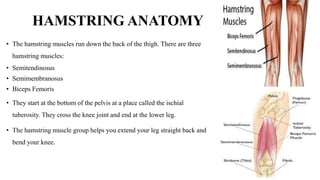
• The hamstring muscles run down the back of the thigh. There are three
hamstring muscles:
• Semitendinosus
• Semimembranosus
• Biceps Femoris
• They start at the bottom of the pelvis at a place called the ischial
tuberosity. They cross the knee joint and end at the lower leg.
• The hamstring muscle group helps you extend your leg straight back and
bend your knee.
DESCRIPTION OF HAMSTRING
ACCORDING TO GRADES
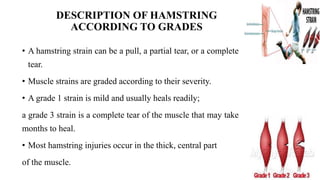
• A hamstring strain can be a pull, a partial tear, or a complete
tear.
• Muscle strains are graded according to their severity.
• A grade 1 strain is mild and usually heals readily;
a grade 3 strain is a complete tear of the muscle that may take
months to heal.
• Most hamstring injuries occur in the thick, central part
of the muscle.
SIGNS AND SYMPTOMS
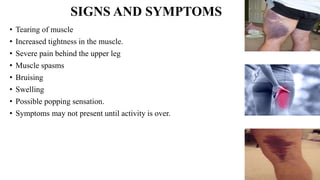
• Tearing of muscle
• Increased tightness in the muscle.
• Severe pain behind the upper leg
• Muscle spasms
• Bruising
• Swelling
• Possible popping sensation.
• Symptoms may not present until activity is over.
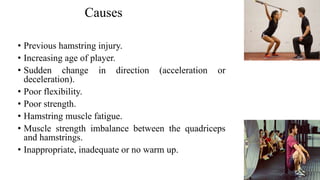
Causes Cont..
Proven risk factors:
• Previous hamstring injury.
• Increasing age of player.
• Sudden change in direction (acceleration or
deceleration).risk factors:
• Poor flexibility.
• Poor strength.
• Hamstring muscle fatigue.
• Muscle strength imbalance between the quadriceps
and hamstrings.
• Inappropriate, inadequate or no warm up.
CAUSES
Several factors can make it more likely you will have a
muscle strain, including:
• When one muscle group is much stronger than its
opposing muscle group, the imbalance can lead to a strain.
This frequently happens with the hamstring muscles. The
quadriceps muscles at the front of the thigh are usually
more powerful. During high-speed activities, the
hamstring may become fatigued faster than the quadriceps.
This fatigue can lead to a strain.
• If your muscles are weak, they are less able to
cope with the stress of exercise and are more likely
to be injured.
• Fatigue reduces the energy-absorbing capabilities
of muscle, making them more susceptible to injury.
PREVENTION
• Completing a general body warm up, which includes sport-specific muscle
stretching as well as sport specific skill drills.
• Including appropriate speed work in training programs so the hamstring muscles
are capable of sustaining high acceleration forces.
• Maintaining high levels of cardiovascular fitness and muscular endurance to
prevent fatigue.
• Stretching and cooling down after every training session and competition.
• Including stretching and strengthening exercises in weekly training programs.
• Undertaking training prior to competition to ensure readiness to play.
PREVENTION
• Gradually increasing the intensity and duration of training.
• Allowing adequate recovery time between workouts or training
sessions.
• Wearing the right protective equipment including footwear.
• Checking the sporting environment for hazards.
• Drinking water before, during and after play.
• Avoiding activities that cause pain. If pain does occur, discontinuing
the activity immediately and commencing RICE.
IMMEDIATE MANAGEMENT
• The immediate treatment of any soft tissue injury
consists of the RICER protocol – rest, ice, compression,
elevation and referral. RICE protocol should be followed
for 48–72 hours. The aim is to reduce the bleeding and
damage in the muscle. The muscle should be rested in an
elevated position with an ice pack applied for 20 minutes
every two hours (never apply ice directly to the skin).
A correctly sized compression bandage should be applied
to limit bleeding and swelling in the injured area.
• The No HARM protocol should also be applied – no heat,
no alcohol, no running or activity, and no massage. This
will ensure decreased bleeding and swelling in the
injured area.
TREATMENT
• Treatment of hamstring strains will vary depending on the type
of injury you have, its severity, and your own needs and
expectations.
• The goal of any treatment — nonsurgical or surgical — is to
help you return to all the activities you enjoy. Following your
doctor's treatment plan will restore your abilities faster, and
help you prevent further problems in the future.
• Most hamstring strains heal very well with simple, nonsurgical
treatment.
Nonsurgical
Treatment• The RICE protocol is effective for most sports-related
injuries. RICE stands for Rest, Ice, Compression, and
Elevation.
• Take a break from the activity that caused the strain.
Your doctor may recommend that you use crutches to
avoid putting weight on your leg.
• Use cold packs for 20 minutes at a time, several times a
day. Do not apply ice directly to the skin.
• To prevent additional swelling and blood loss, wear an
elastic compression bandage.
• To reduce swelling, recline and put your leg up higher
than your heart while resting.
SURGICAL TREATMENT
• Surgery is most often performed for tendon avulsion injuries, where
the tendon has pulled completely away from the bone.
• Surgery may also be needed to repair a complete tear within the
muscle.
• To repair a tendon avulsion, your surgeon must pull the hamstring
muscle back into place and remove any scar tissue. Then the tendon is
reattached to the bone using large stitches or staples.
• After surgery, you will need to keep weight off of your leg to protect
the repair. In addition to using crutches, you may need a brace that
keeps your hamstring in a relaxed position. How long you will need
these aids will depend on the type of injury you have.
• Rehabilitation for a proximal hamstring reattachment typically takes at
least 6 months, due to the severity of the injury. Distal hamstring
reattachments require approximately 3 months of rehabilitation before
returning to athletic activities. Your doctor will tell you when it is safe
to return to sports.
RECOVERY
• Most athletes who injure their hamstrings muscles will recover full function
after completing a rehabilitation plan. Early treatment with a plan that includes
the RICE protocol and physical therapy has been shown to result in better
function and quicker return to sports.
• To prevent reinjuring your hamstring, be sure to follow your doctor's treatment
plan. Return to sports only after your doctor has given you the go-ahead.
Reinjuring your hamstring increases your risk of permanent damage. This can
result in a chronic condition.
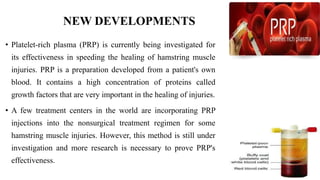
NEW DEVELOPMENTS
• Platelet-rich plasma (PRP) is currently being investigated for
its effectiveness in speeding the healing of hamstring muscle
injuries. PRP is a preparation developed from a patient's own
blood. It contains a high concentration of proteins called
growth factors that are very important in the healing of injuries.
• A few treatment centers in the world are incorporating PRP
injections into the nonsurgical treatment regimen for some
hamstring muscle injuries. However, this method is still under
investigation and more research is necessary to prove PRP's
effectiveness.
REHABILITATION AND RETURN TO
PLAY• Timeframes for rehabilitation and return to sport vary depending on the
nature and severity of the strain. As a general rule, Grade 1 hamstring
strains should be rested from sporting activity for about three weeks and
Grade 2 injuries for a minimum of four to eight weeks. In the case of a
complete rupture (Grade 3 strain), the muscle may have to be repaired
surgically and the rehabilitation to follow will take about six months.
• Premature return to sport and inadequate rehabilitation will increase the
risk of re-injury. Full stretch and strength should be achieved in addition
to the ability to perform full speed training.
DOCTOR EXAMINATION
• Patient History and Physical Examination
• People with hamstring strains often see a doctor because of a sudden pain
in the back of the thigh that occurred when exercising.
• During the physical examination, your doctor will ask about the injury and
check your thigh for tenderness or bruising. He or she will palpate, or
press, the back of your thigh to see if there is pain, weakness, swelling, or a
more severe muscle injury. Tests
• Imaging tests that may help your doctor confirm your diagnosis include:
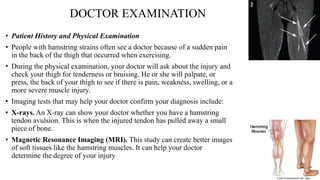
• X-rays. An X-ray can show your doctor whether you have a hamstring
tendon avulsion. This is when the injured tendon has pulled away a small
piece of bone.
• Magnetic Resonance Imaging (MRI). This study can create better images
of soft tissues like the hamstring muscles. It can help your doctor
determine the degree of your injury
REFERENCES
1. M. Ramin Modabber, MD, Santa Monica Orthopaedic and Sports Medicine
Group, Santa Monica, California
2. Sue Falsone PT, MS, SCS, ATC, CSCS, Director of Performance Physical
Therapy, Athletes’ Performance & Core Performance
3. American Academy of Orthopaedic Surgeons
4. Journal of the American Academy of Orthopaedic Surgeons
5. Medicine & Science in Sports & Exercise
6. http://www.medicinenet.com/hamstring_injury/article.htm
7. http://patient.info/health/hamstring-injuries
8. http://sma.org.au/resources-advice/injury-fact-sheets/hamstring-strain/
9. http://www.coreperformance.com/knowledge/injury-pain/hamstring-strain.html

Hamstring injury

  • 3.
    Hamstring Injury By Amir JunaidShah (20) Student: M. Phil (SS&PE) SESSION: 2016-2018 DEPARTMENT OF SPORTS SCIENCES AND PHYSICAL EDUCATION, GOMAL UNIVERSITY, DERA ISMAIL KHAN
  • 4.
    HAMSTRING INJURIES  Grades Causes  Risk  Prevention  Management  Treatment
  • 5.
    THE HAMSTRINGS • Theterm 'hamstring' also refers to the group of three muscles that run along the back of your thigh, from your hip to just below your knee. • The hamstring muscles aren't used much while standing or walking, but they're very active during activities that involve bending the knee, such as running, jumping and climbing
  • 6.
    Cont.. • Hamstring injuryis a common athletic injury • Hamstring injuries occur in all sports and effect elite and non elite populations” (Brooks et al 2006) Athletic Population Non Athletic population
  • 7.
    QUADRICEPS • Vastus Lateralis •Vastus Medialis • Vastus Intermedius • Rectus Femoris
  • 8.
    HAMSTRING ANATOMY • Thehamstring muscles run down the back of the thigh. There are three hamstring muscles: • Semitendinosus • Semimembranosus • Biceps Femoris • They start at the bottom of the pelvis at a place called the ischial tuberosity. They cross the knee joint and end at the lower leg. • The hamstring muscle group helps you extend your leg straight back and bend your knee.
  • 9.
    DESCRIPTION OF HAMSTRING ACCORDINGTO GRADES • A hamstring strain can be a pull, a partial tear, or a complete tear. • Muscle strains are graded according to their severity. • A grade 1 strain is mild and usually heals readily; a grade 3 strain is a complete tear of the muscle that may take months to heal. • Most hamstring injuries occur in the thick, central part of the muscle.
  • 10.
    SIGNS AND SYMPTOMS •Tearing of muscle • Increased tightness in the muscle. • Severe pain behind the upper leg • Muscle spasms • Bruising • Swelling • Possible popping sensation. • Symptoms may not present until activity is over.
  • 11.
    Causes Cont.. Proven riskfactors: • Previous hamstring injury. • Increasing age of player. • Sudden change in direction (acceleration or deceleration).risk factors: • Poor flexibility. • Poor strength. • Hamstring muscle fatigue. • Muscle strength imbalance between the quadriceps and hamstrings. • Inappropriate, inadequate or no warm up.
  • 12.
    CAUSES Several factors canmake it more likely you will have a muscle strain, including: • When one muscle group is much stronger than its opposing muscle group, the imbalance can lead to a strain. This frequently happens with the hamstring muscles. The quadriceps muscles at the front of the thigh are usually more powerful. During high-speed activities, the hamstring may become fatigued faster than the quadriceps. This fatigue can lead to a strain. • If your muscles are weak, they are less able to cope with the stress of exercise and are more likely to be injured. • Fatigue reduces the energy-absorbing capabilities of muscle, making them more susceptible to injury.
  • 13.
    PREVENTION • Completing ageneral body warm up, which includes sport-specific muscle stretching as well as sport specific skill drills. • Including appropriate speed work in training programs so the hamstring muscles are capable of sustaining high acceleration forces. • Maintaining high levels of cardiovascular fitness and muscular endurance to prevent fatigue. • Stretching and cooling down after every training session and competition. • Including stretching and strengthening exercises in weekly training programs. • Undertaking training prior to competition to ensure readiness to play.
  • 14.
    PREVENTION • Gradually increasingthe intensity and duration of training. • Allowing adequate recovery time between workouts or training sessions. • Wearing the right protective equipment including footwear. • Checking the sporting environment for hazards. • Drinking water before, during and after play. • Avoiding activities that cause pain. If pain does occur, discontinuing the activity immediately and commencing RICE.
  • 15.
    IMMEDIATE MANAGEMENT • Theimmediate treatment of any soft tissue injury consists of the RICER protocol – rest, ice, compression, elevation and referral. RICE protocol should be followed for 48–72 hours. The aim is to reduce the bleeding and damage in the muscle. The muscle should be rested in an elevated position with an ice pack applied for 20 minutes every two hours (never apply ice directly to the skin). A correctly sized compression bandage should be applied to limit bleeding and swelling in the injured area. • The No HARM protocol should also be applied – no heat, no alcohol, no running or activity, and no massage. This will ensure decreased bleeding and swelling in the injured area.
  • 16.
    TREATMENT • Treatment ofhamstring strains will vary depending on the type of injury you have, its severity, and your own needs and expectations. • The goal of any treatment — nonsurgical or surgical — is to help you return to all the activities you enjoy. Following your doctor's treatment plan will restore your abilities faster, and help you prevent further problems in the future. • Most hamstring strains heal very well with simple, nonsurgical treatment.
  • 17.
    Nonsurgical Treatment• The RICEprotocol is effective for most sports-related injuries. RICE stands for Rest, Ice, Compression, and Elevation. • Take a break from the activity that caused the strain. Your doctor may recommend that you use crutches to avoid putting weight on your leg. • Use cold packs for 20 minutes at a time, several times a day. Do not apply ice directly to the skin. • To prevent additional swelling and blood loss, wear an elastic compression bandage. • To reduce swelling, recline and put your leg up higher than your heart while resting.
  • 18.
    SURGICAL TREATMENT • Surgeryis most often performed for tendon avulsion injuries, where the tendon has pulled completely away from the bone. • Surgery may also be needed to repair a complete tear within the muscle. • To repair a tendon avulsion, your surgeon must pull the hamstring muscle back into place and remove any scar tissue. Then the tendon is reattached to the bone using large stitches or staples. • After surgery, you will need to keep weight off of your leg to protect the repair. In addition to using crutches, you may need a brace that keeps your hamstring in a relaxed position. How long you will need these aids will depend on the type of injury you have. • Rehabilitation for a proximal hamstring reattachment typically takes at least 6 months, due to the severity of the injury. Distal hamstring reattachments require approximately 3 months of rehabilitation before returning to athletic activities. Your doctor will tell you when it is safe to return to sports.
  • 19.
    RECOVERY • Most athleteswho injure their hamstrings muscles will recover full function after completing a rehabilitation plan. Early treatment with a plan that includes the RICE protocol and physical therapy has been shown to result in better function and quicker return to sports. • To prevent reinjuring your hamstring, be sure to follow your doctor's treatment plan. Return to sports only after your doctor has given you the go-ahead. Reinjuring your hamstring increases your risk of permanent damage. This can result in a chronic condition.
  • 20.
    NEW DEVELOPMENTS • Platelet-richplasma (PRP) is currently being investigated for its effectiveness in speeding the healing of hamstring muscle injuries. PRP is a preparation developed from a patient's own blood. It contains a high concentration of proteins called growth factors that are very important in the healing of injuries. • A few treatment centers in the world are incorporating PRP injections into the nonsurgical treatment regimen for some hamstring muscle injuries. However, this method is still under investigation and more research is necessary to prove PRP's effectiveness.
  • 21.
    REHABILITATION AND RETURNTO PLAY• Timeframes for rehabilitation and return to sport vary depending on the nature and severity of the strain. As a general rule, Grade 1 hamstring strains should be rested from sporting activity for about three weeks and Grade 2 injuries for a minimum of four to eight weeks. In the case of a complete rupture (Grade 3 strain), the muscle may have to be repaired surgically and the rehabilitation to follow will take about six months. • Premature return to sport and inadequate rehabilitation will increase the risk of re-injury. Full stretch and strength should be achieved in addition to the ability to perform full speed training.
  • 22.
    DOCTOR EXAMINATION • PatientHistory and Physical Examination • People with hamstring strains often see a doctor because of a sudden pain in the back of the thigh that occurred when exercising. • During the physical examination, your doctor will ask about the injury and check your thigh for tenderness or bruising. He or she will palpate, or press, the back of your thigh to see if there is pain, weakness, swelling, or a more severe muscle injury. Tests • Imaging tests that may help your doctor confirm your diagnosis include: • X-rays. An X-ray can show your doctor whether you have a hamstring tendon avulsion. This is when the injured tendon has pulled away a small piece of bone. • Magnetic Resonance Imaging (MRI). This study can create better images of soft tissues like the hamstring muscles. It can help your doctor determine the degree of your injury
  • 23.
    REFERENCES 1. M. RaminModabber, MD, Santa Monica Orthopaedic and Sports Medicine Group, Santa Monica, California 2. Sue Falsone PT, MS, SCS, ATC, CSCS, Director of Performance Physical Therapy, Athletes’ Performance & Core Performance 3. American Academy of Orthopaedic Surgeons 4. Journal of the American Academy of Orthopaedic Surgeons 5. Medicine & Science in Sports & Exercise 6. http://www.medicinenet.com/hamstring_injury/article.htm 7. http://patient.info/health/hamstring-injuries 8. http://sma.org.au/resources-advice/injury-fact-sheets/hamstring-strain/ 9. http://www.coreperformance.com/knowledge/injury-pain/hamstring-strain.html