






Return to Sport Decision Making After Acute Hamstring Strain 
Marc Sherry PT, DPT, LAT, CSCS, PES
Disclosures 
† 
Consultant and scientific advisor for kiio, inc.
PATS vs SS JOSPT 2004 
† 
Return to Play Criteria 
„ 
5/5 MMT in prone 
† 
at 90° 
† 
at 30° 
„ 
No TTP 
„ 
“Subjective Readiness”to sprint 
„ 
Completion functional testing
Sherry MA, Best TM. A comparison of 2 rehabilitation programs in the treatment of acute hamstring strains. J Orthop Sports Phys Ther. Mar 2004;34(3):116-125. 
Performance on “functional testing” 
No significant difference (p<0.05) between experimental groups or between re-injury and no re-injury comparisons 
(40 yd dash time, hop for height, hop for distance and 4 hop cross-over test)
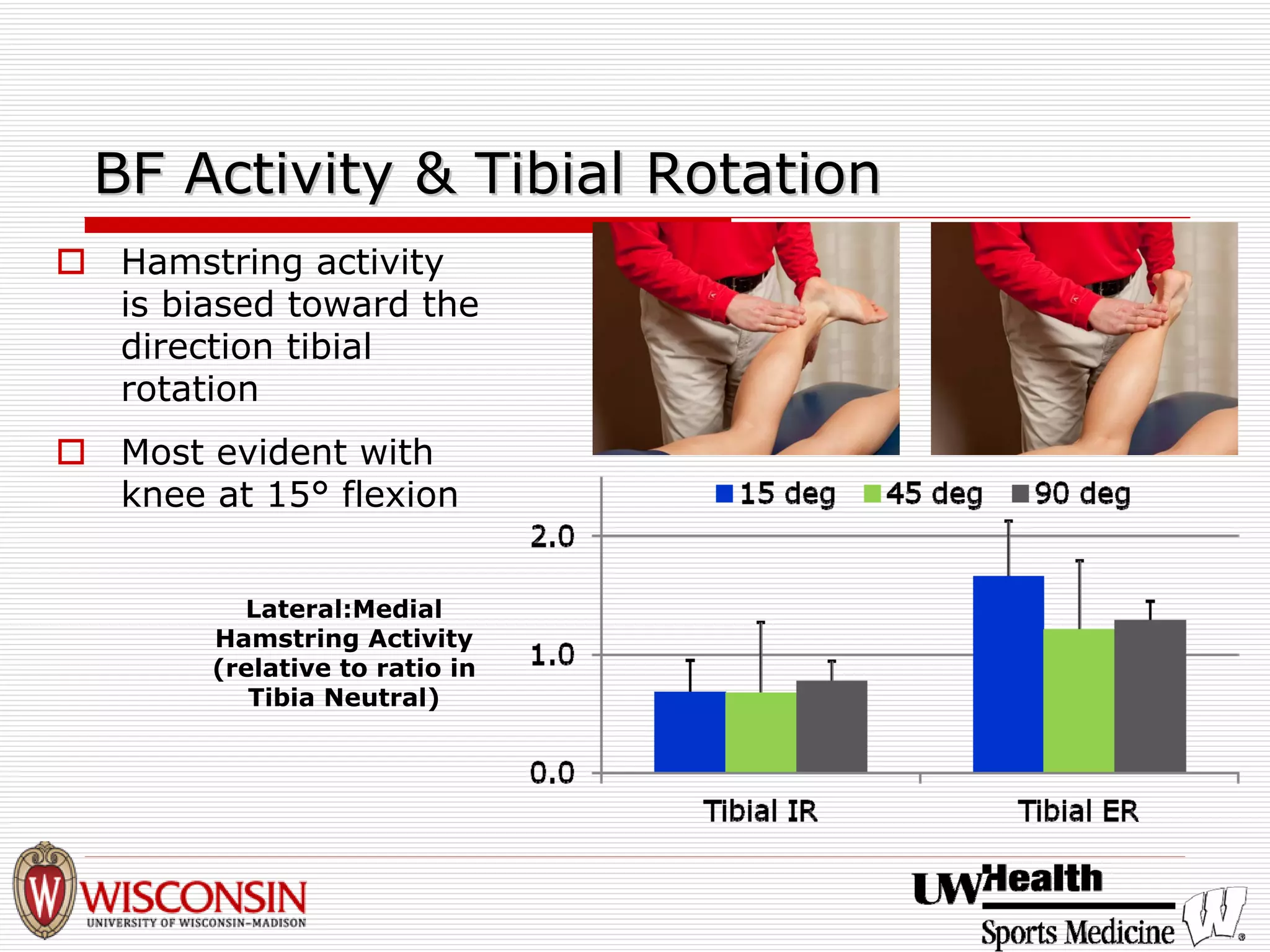
BF Activity & 
Tibial Rotation 
† 
Hamstring activity is biased toward the direction tibialrotation 
† 
Most evident with knee at 15°flexion 
Lateral:Medial Hamstring Activity (relative to ratio in Tibia Neutral)
PATS vs PRES JOSPT 2013 
† 
Return to Play Criteria 
„ 
5/5 on 4 repetition medial and lateral hamstring mmtin prone 
† 
at 90° 
† 
at 15° 
„ 
Completion of the running program/ or repeated 40 yard dash without pain or “apprehension”
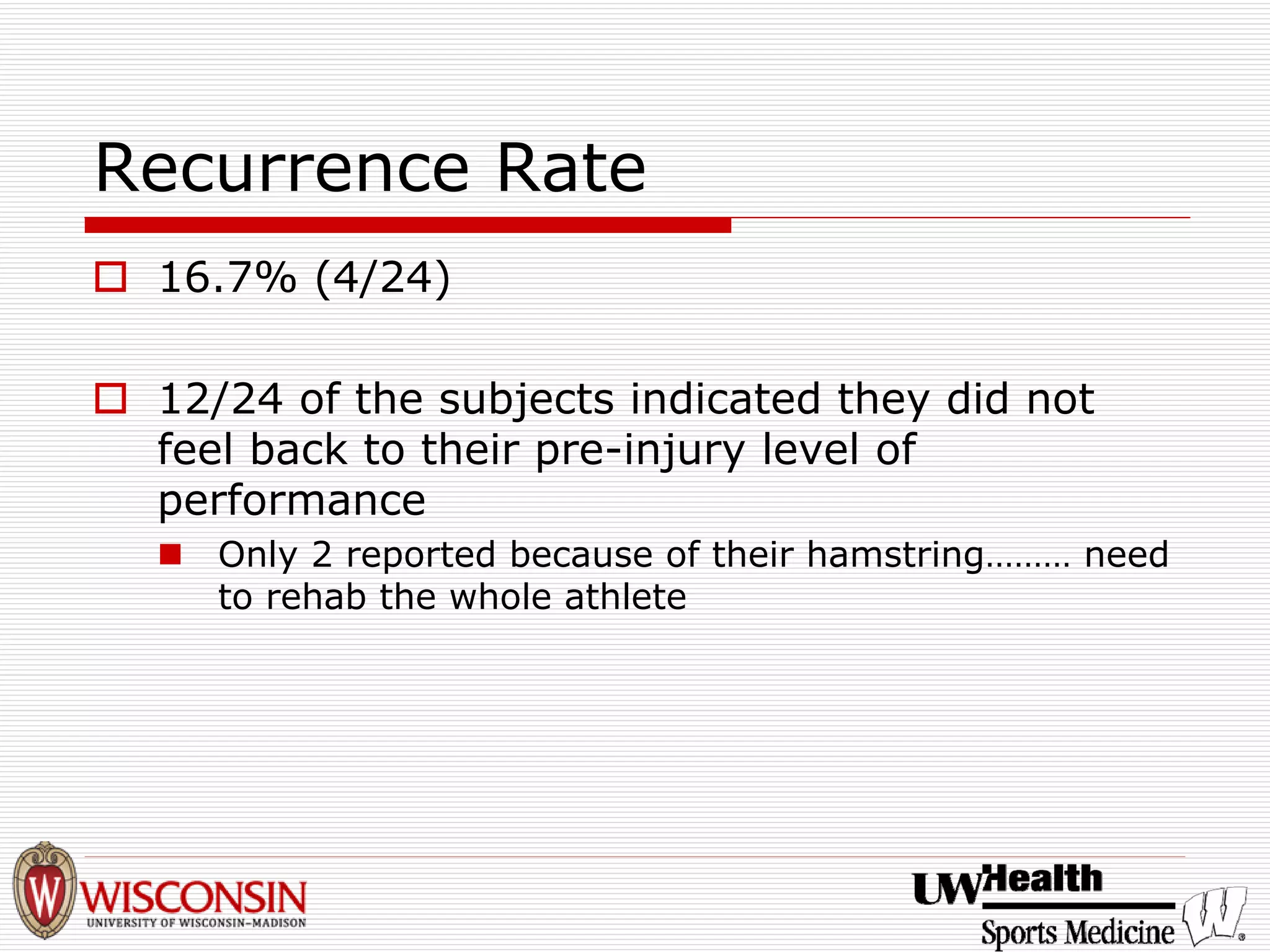
Recurrence Rate 
† 
16.7% (4/24) 
† 
12/24 of the subjects indicated they did not feel back to their pre-injury level of performance 
„ 
Only 2 reported because of their hamstring………need to rehab the whole athlete
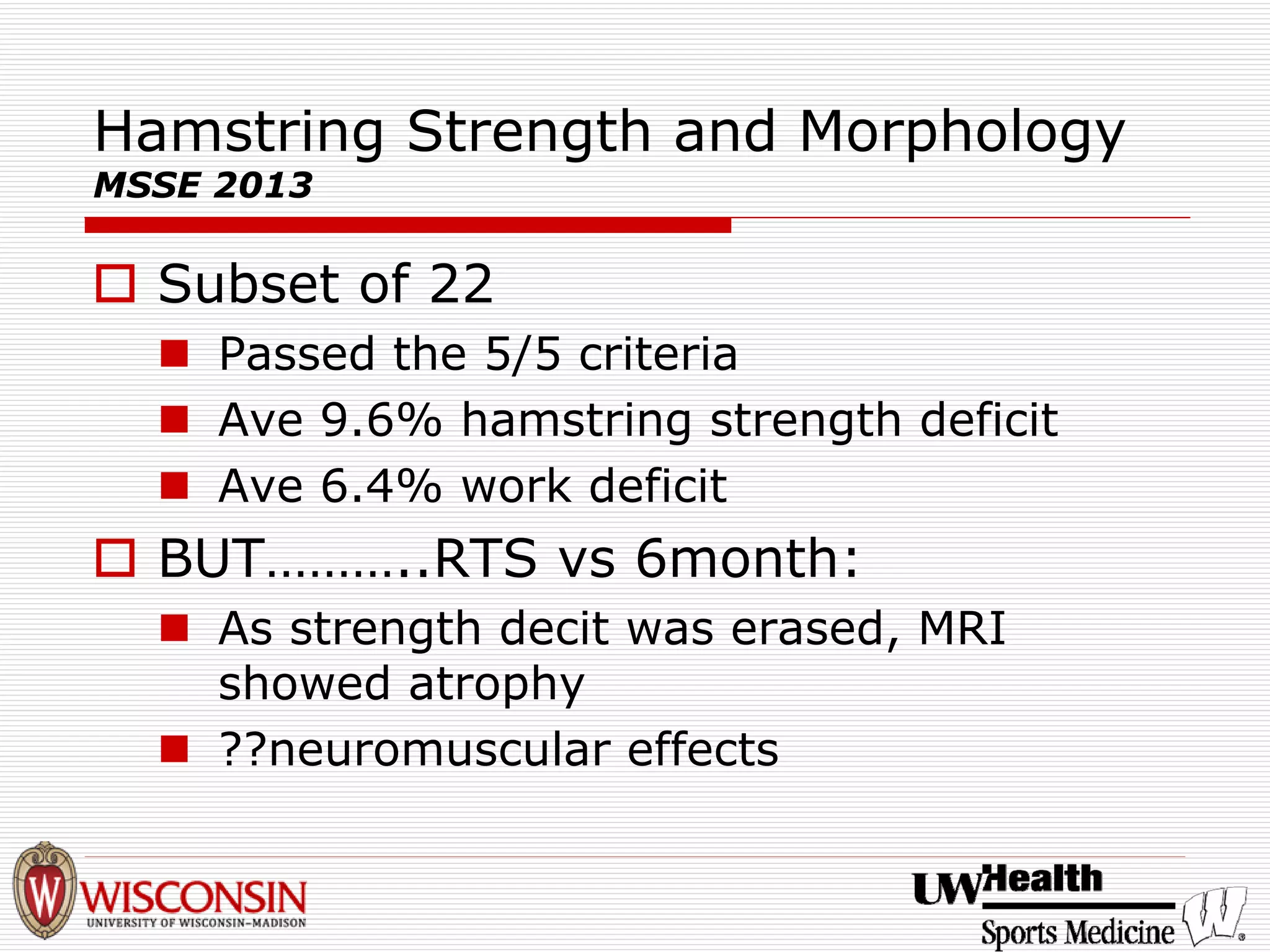
Hamstring Strength and Morphology MSSE 2013 
† 
Subset of 22 
„ 
Passed the 5/5 criteria 
„ 
Ave 9.6% hamstring strength deficit 
„ 
Ave 6.4% work deficit 
† 
BUT………..RTS vs6month: 
„ 
As strength decitwas erased, MRI showed atrophy 
„ 
??neuromuscular effects
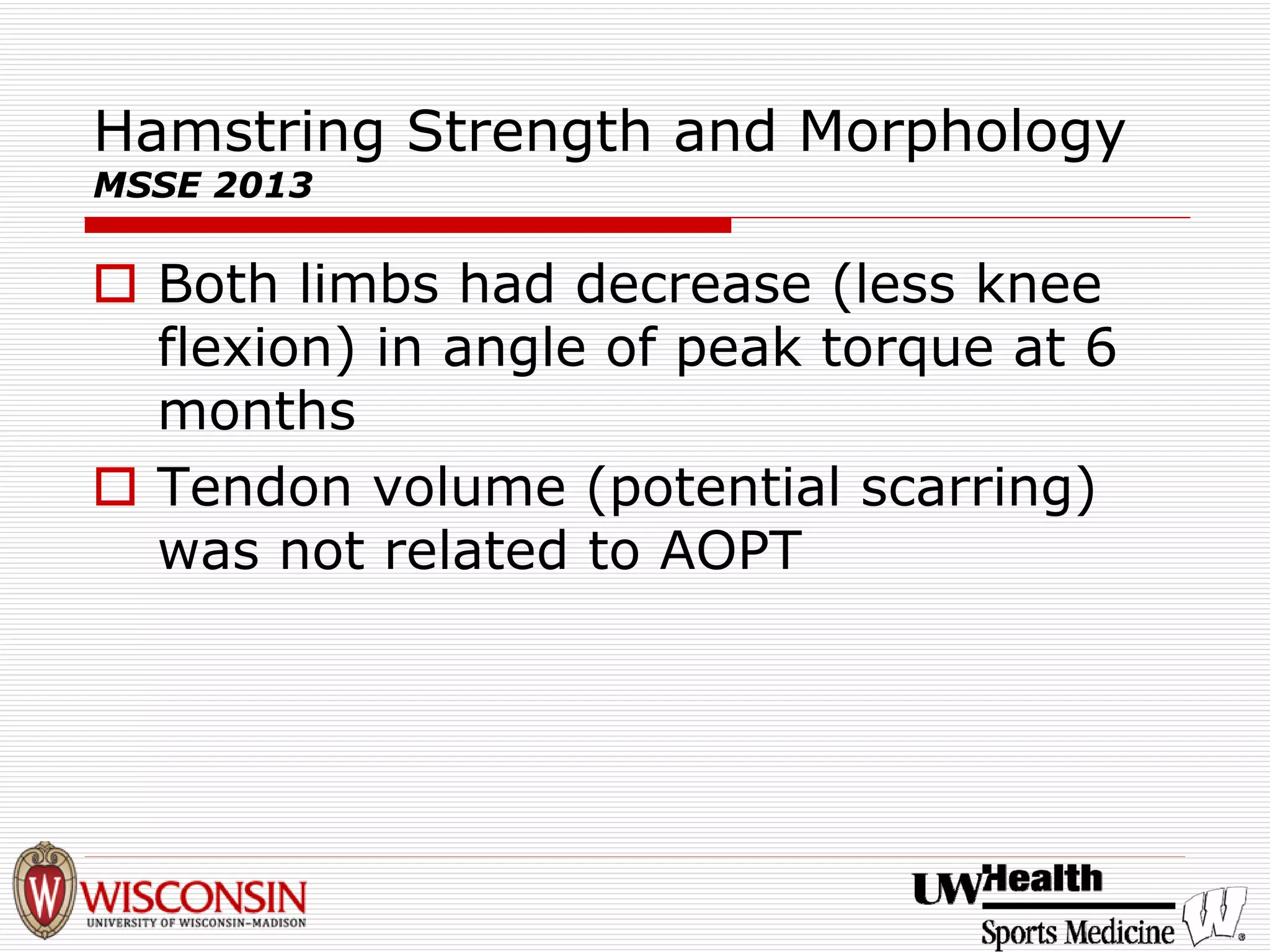
Hamstring Strength and Morphology MSSE 2013 
† 
Both limbs had decrease (less knee flexion) in angle of peak torque at 6 months 
† 
Tendon volume (potential scarring) was not related to AOPT
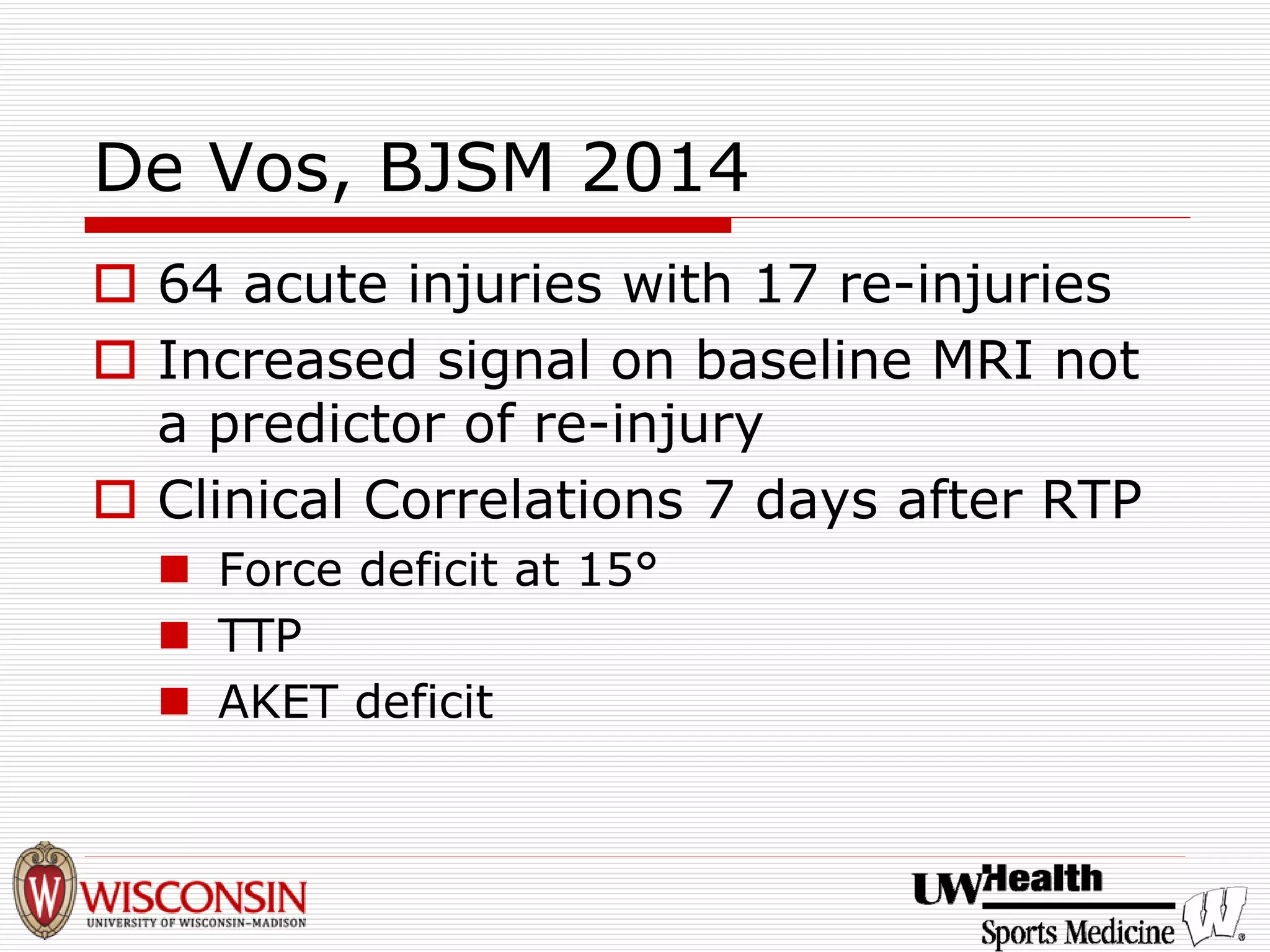
De Vos, BJSM 2014 
† 
64 acute injuries with 17 re-injuries 
† 
Increased signal on baseline MRI not a predictor of re-injury 
† 
Clinical Correlations 7 days after RTP 
„ 
Force deficit at 15° 
„ 
TTP 
„ 
AKET deficit
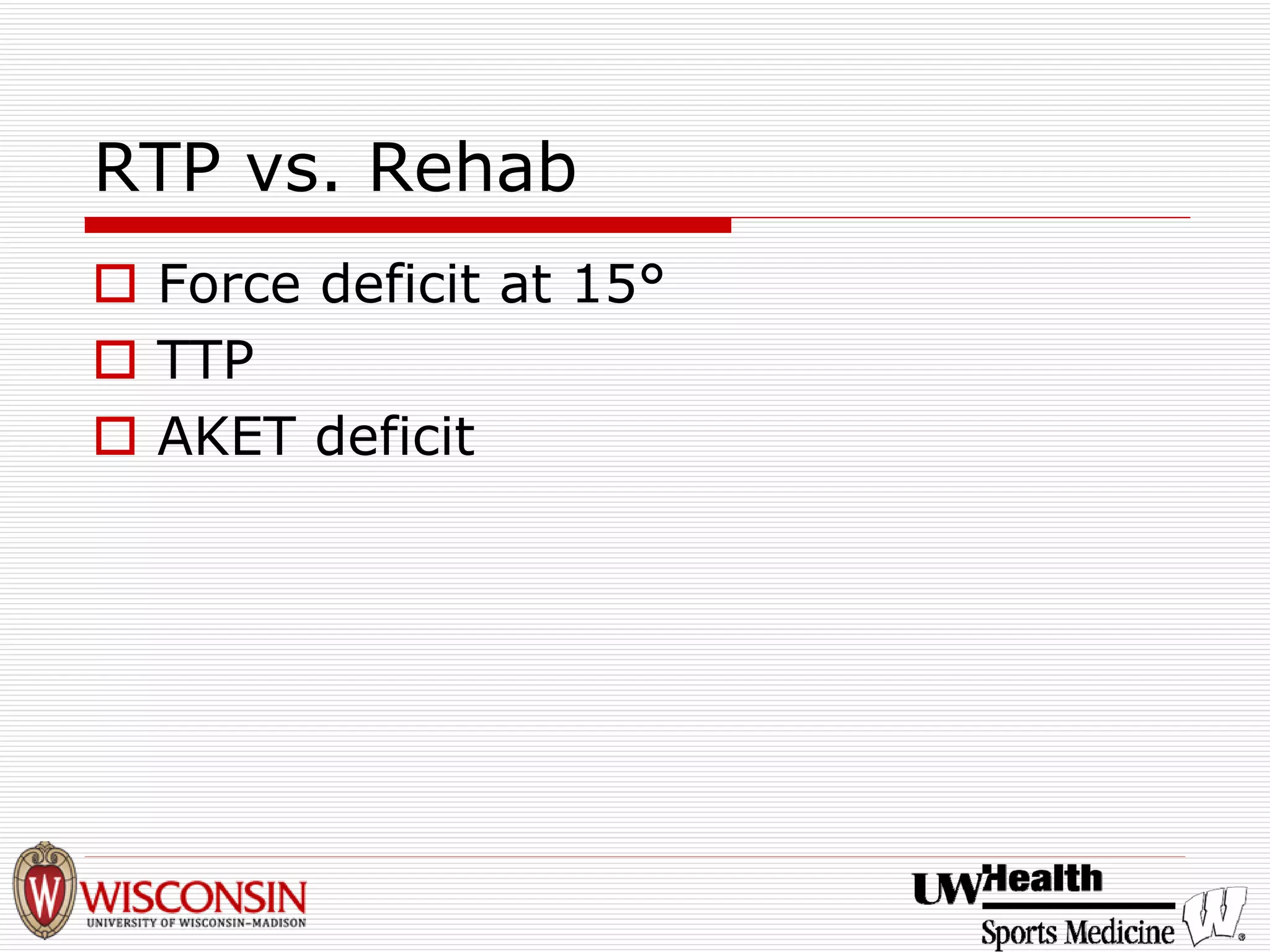
RTP vs. Rehab 
† 
Force deficit at 15° 
† 
TTP 
† 
AKET deficit
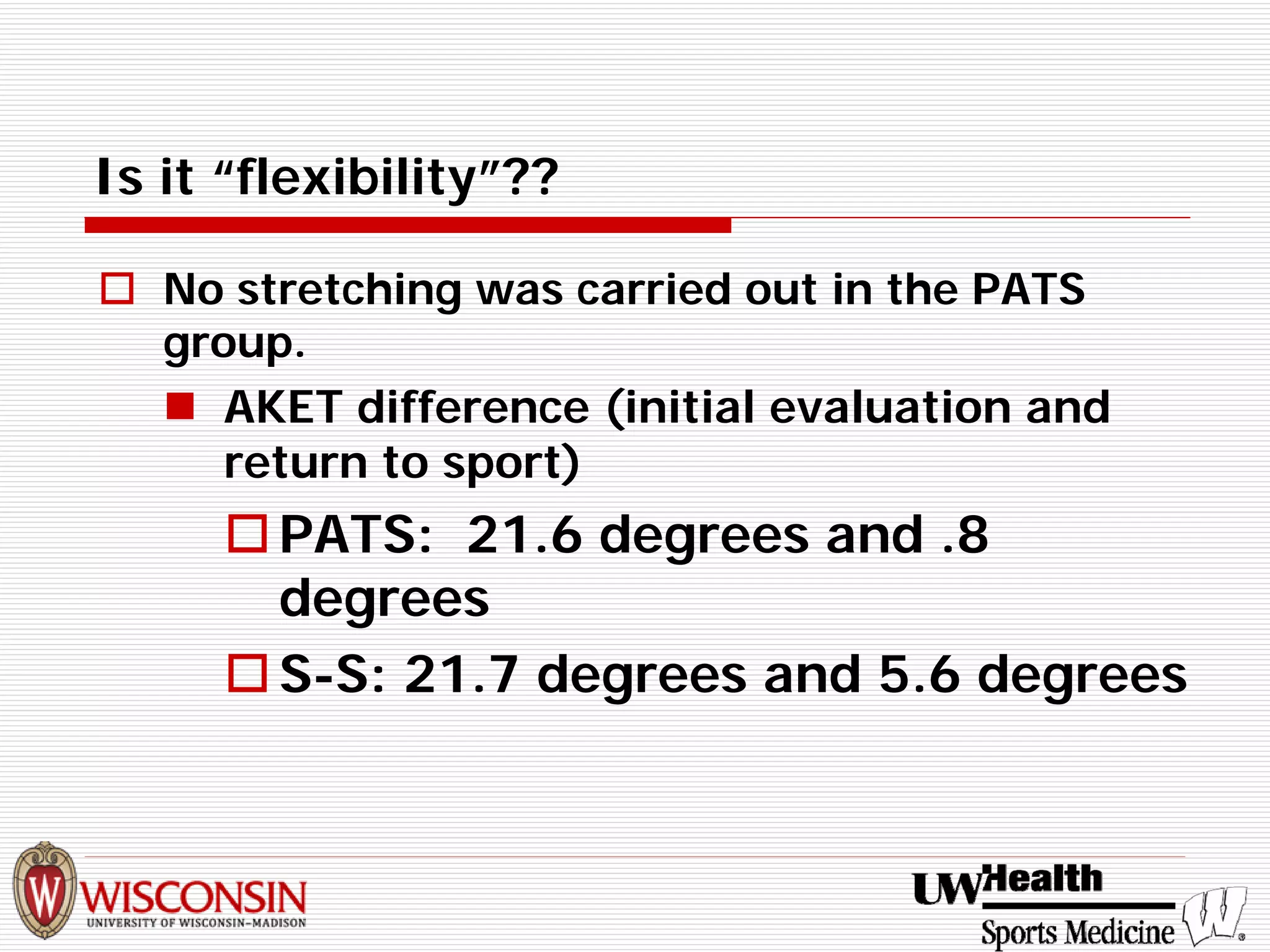
Is it “flexibility”?? 
† 
No stretching was carried out in the PATS group. 
„ 
AKET difference (initial evaluation and return to sport) 
† 
PATS: 21.6 degrees and .8 degrees 
† 
S-S: 21.7 degrees and 5.6 degrees
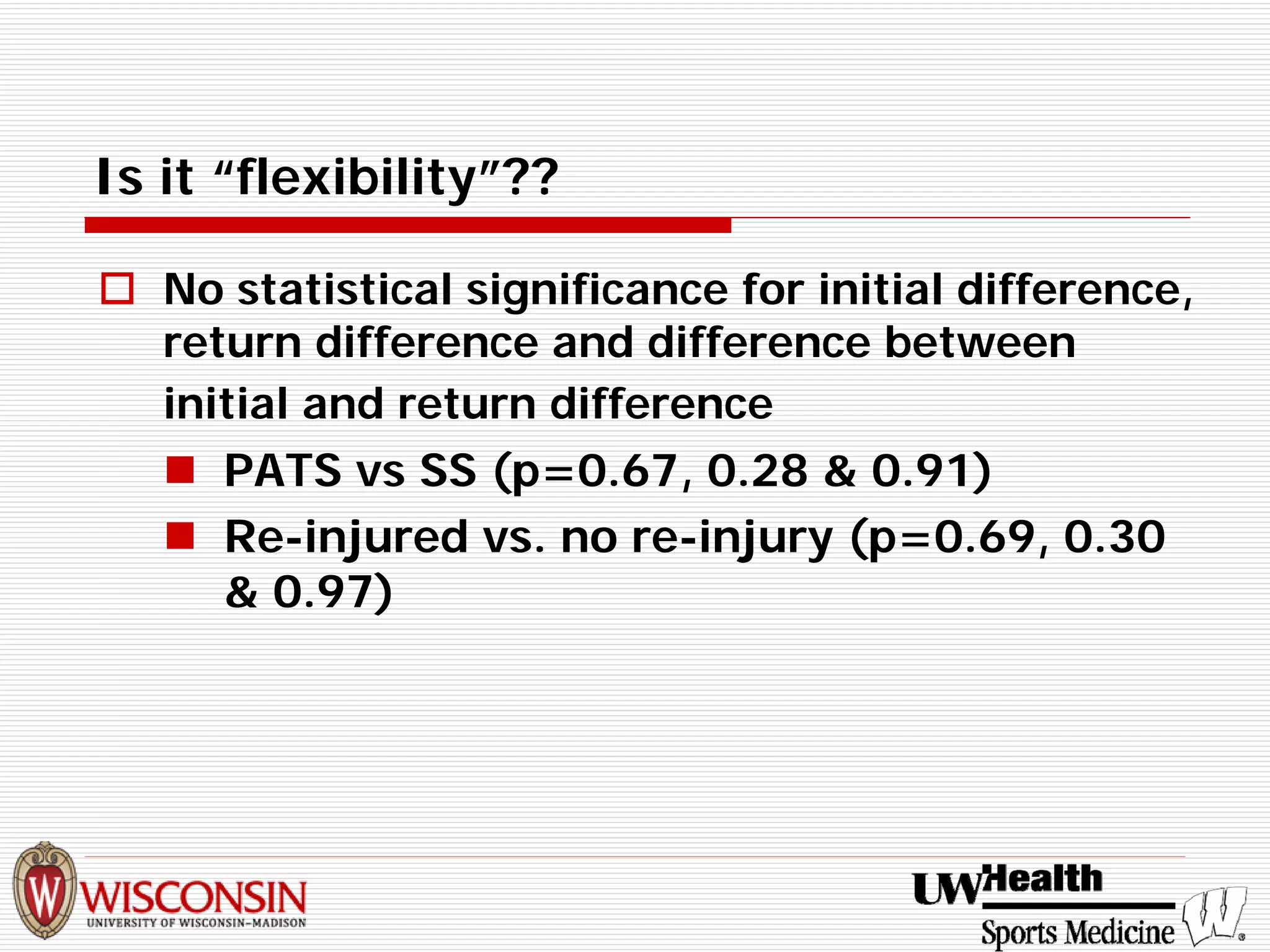
Is it “flexibility”?? 
† 
No statistical significance for initial difference, return difference and difference between initial and return difference 
„ 
PATS vsSS (p=0.67, 0.28 & 0.91) 
„ 
Re-injured vs. no re-injury (p=0.69, 0.30 & 0.97)
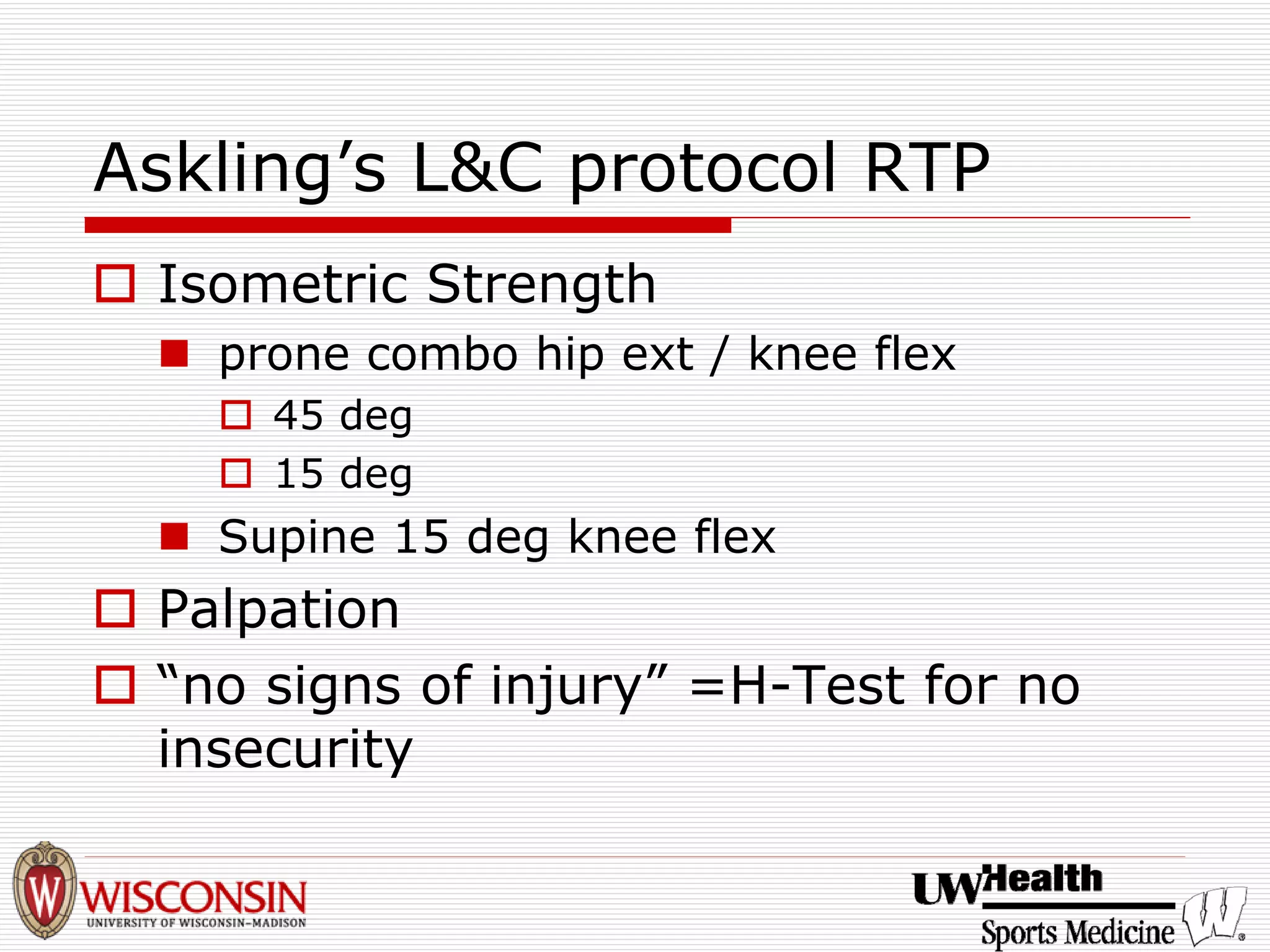
Askling’s L&C protocol RTP 
† 
Isometric Strength 
„ 
prone combo hip ext / knee flex 
† 
45 deg 
† 
15 deg 
„ 
Supine 15 deg knee flex 
† 
Palpation 
† 
“no signs of injury”=H-Test for no insecurity
Askling’s L&C protocol RTP 
† 
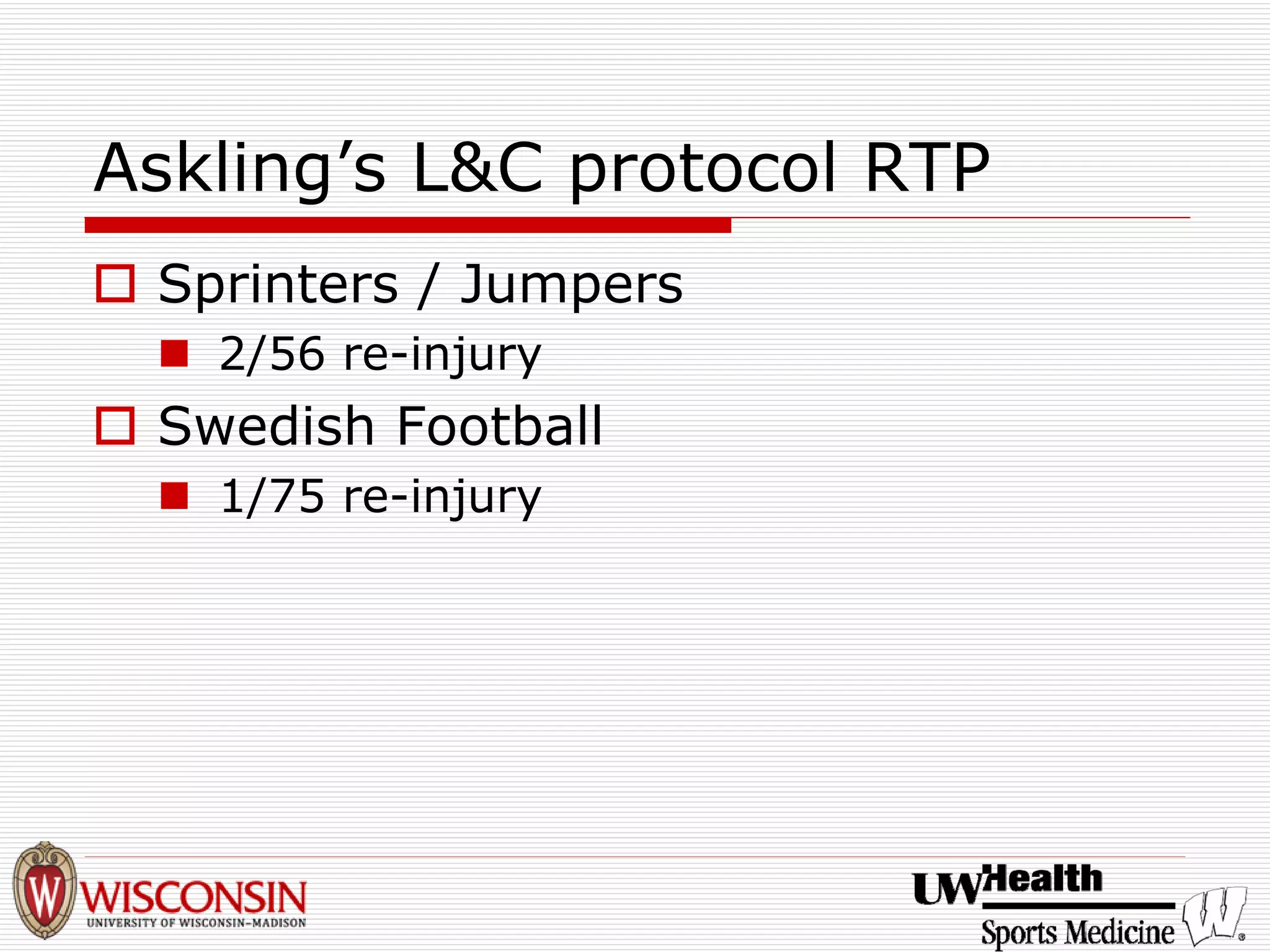
Sprinters / Jumpers 
„ 
2/56 re-injury 
† 
Swedish Football 
„ 
1/75 re-injury
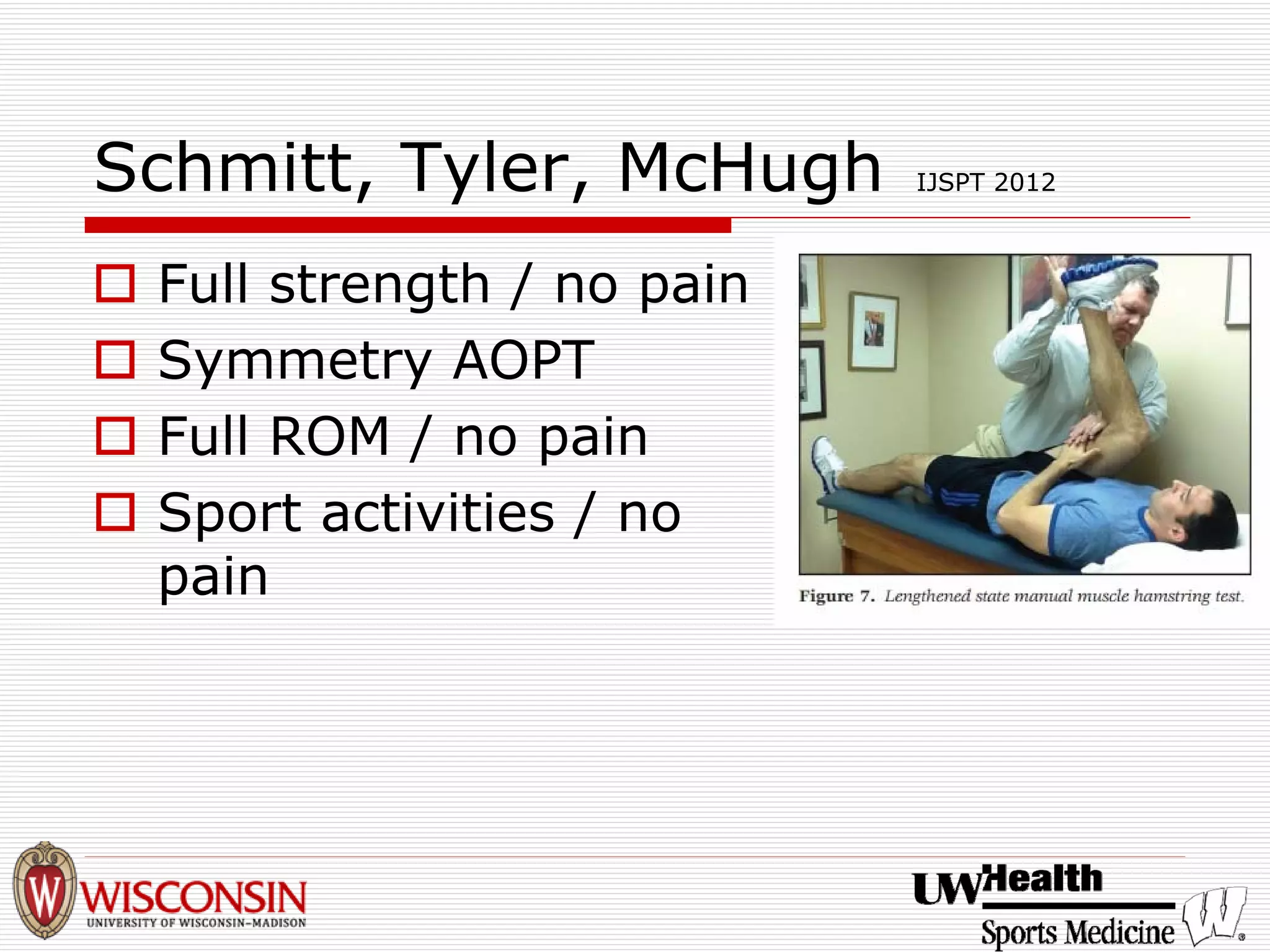
Schmitt, Tyler, McHugh IJSPT 2012 
† 
Full strength / no pain 
† 
Symmetry AOPT 
† 
Full ROM / no pain 
† 
Sport activities / no pain
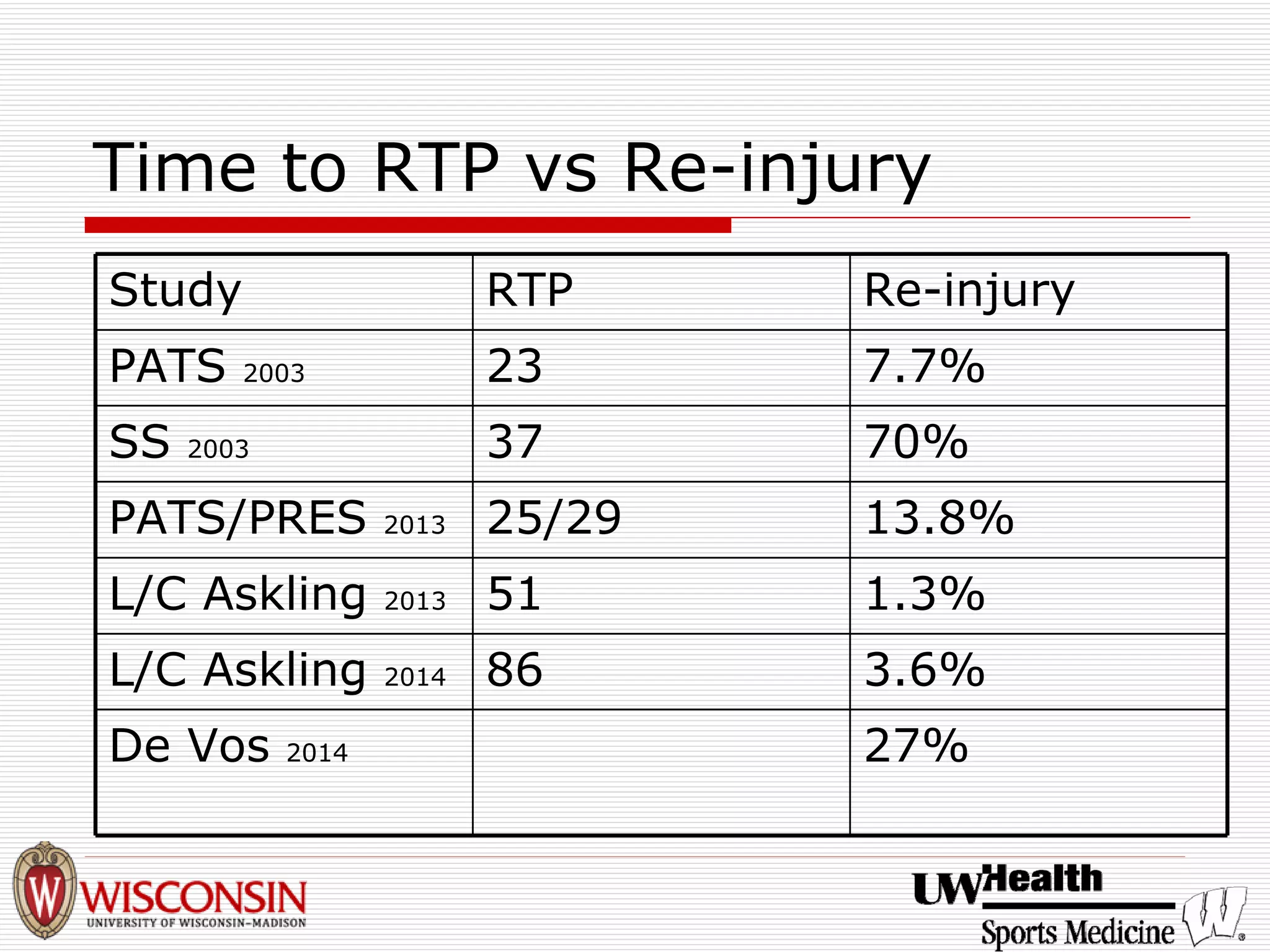
Time to RTP vs Re-injury 
Study 
RTP 
Re-injury 
PATS 2003 
23 
7.7% 
SS 2003 
37 
70% 
PATS/PRES 2013 
25/29 
13.8% 
L/C Askling 2013 
51 
1.3% 
L/C Askling 2014 
86 
3.6% 
De Vos 2014 
27%
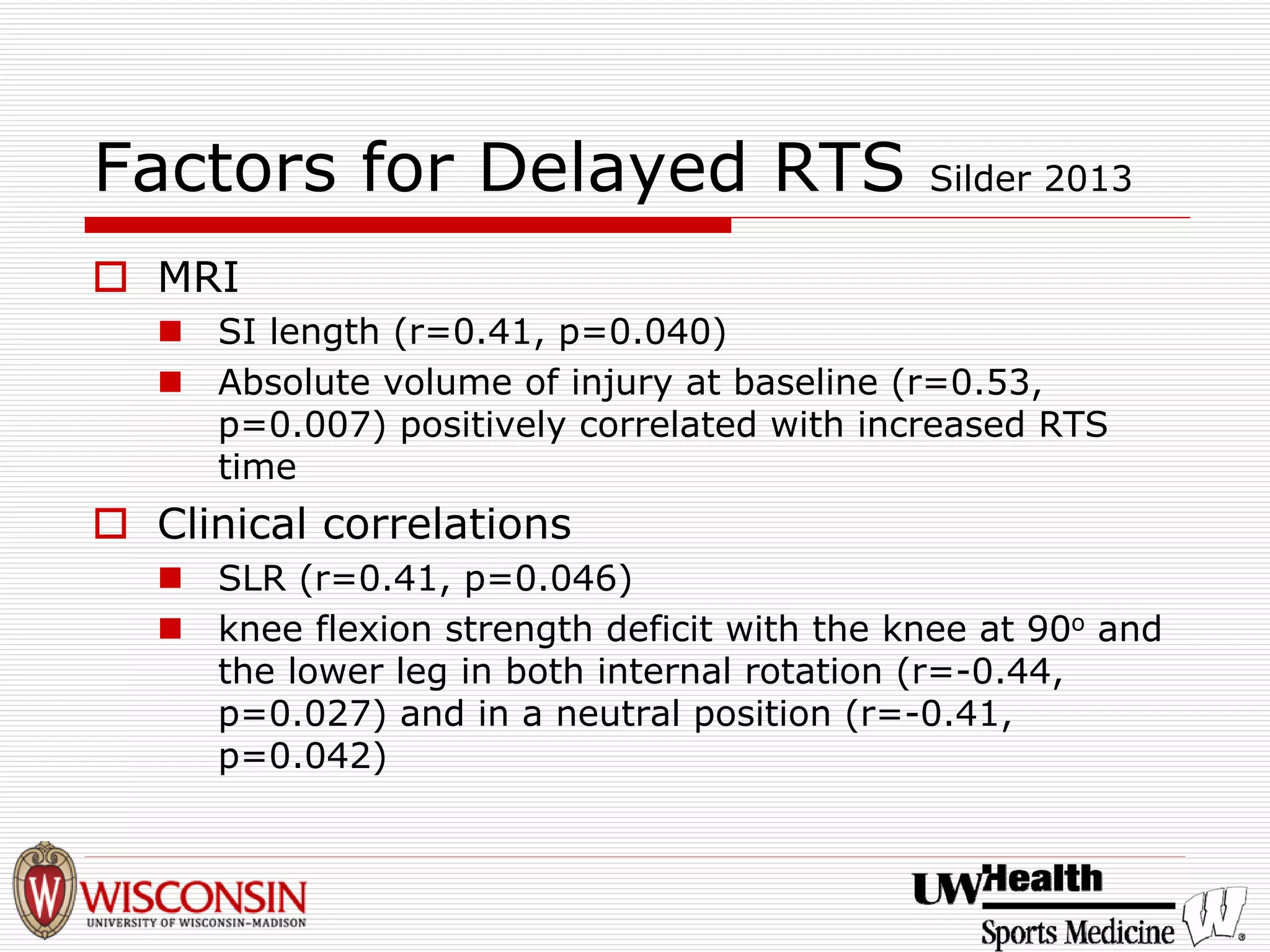
Factors for Delayed RTS Silder 2013 
† 
MRI 
„ 
SI length (r=0.41, p=0.040) 
„ 
Absolute volume of injury at baseline (r=0.53, p=0.007) positively correlated with increased RTS time 
† 
Clinical correlations 
„ 
SLR (r=0.41, p=0.046) 
„ 
knee flexion strength deficit with the knee at 90oand the lower leg in both internal rotation (r=-0.44, p=0.027) and in a neutral position (r=-0.41, p=0.042)
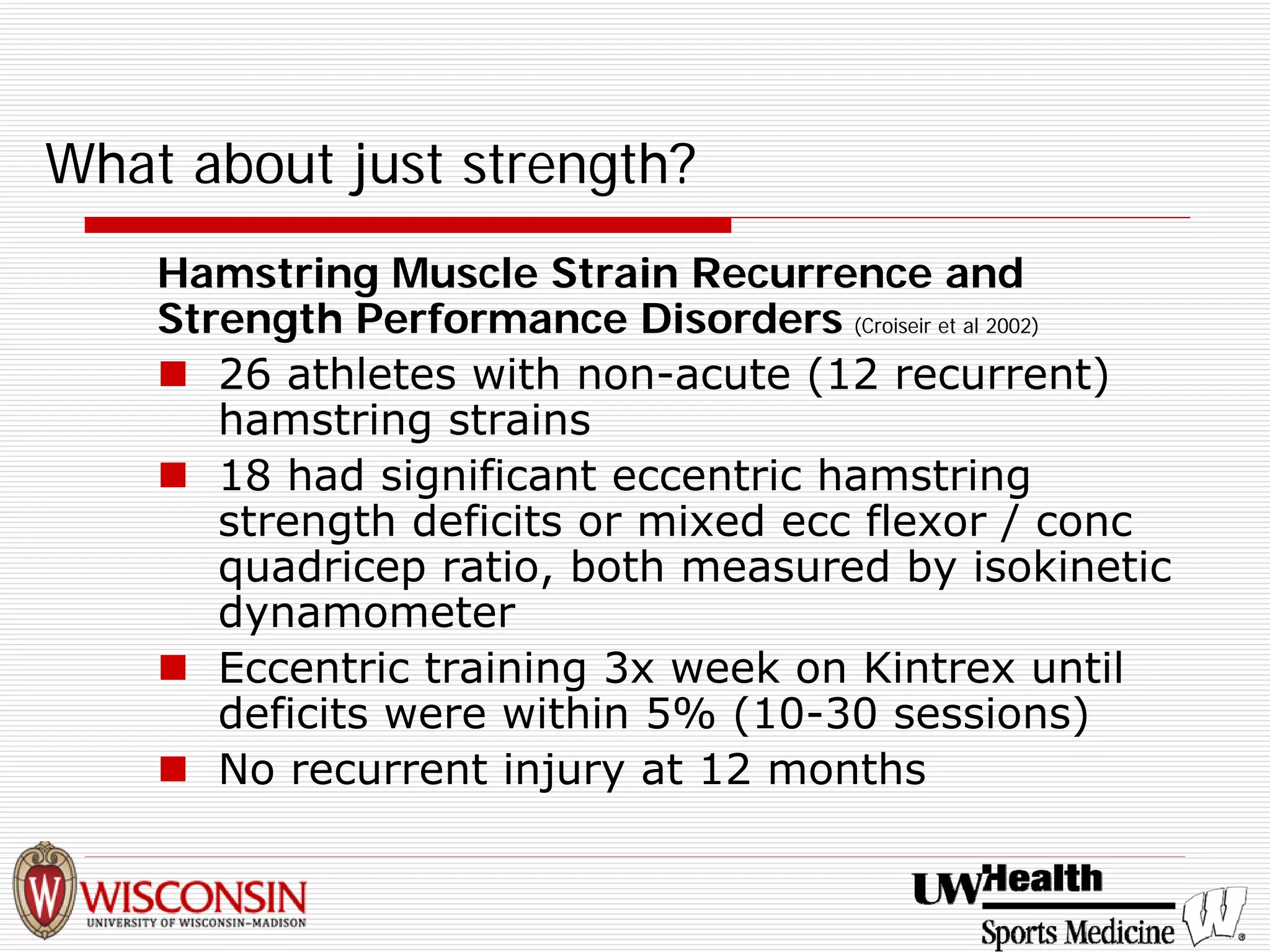
What about just strength? 
Hamstring Muscle Strain Recurrence and Strength Performance Disorders (Croiseir et al 2002) 
„ 
26 athletes with non-acute (12 recurrent) hamstring strains 
„ 
18 had significant eccentric hamstring strength deficits or mixed ecc flexor / conc quadricep ratio, both measured by isokinetic dynamometer 
„ 
Eccentric training 3x week on Kintrex until deficits were within 5% (10-30 sessions) 
„ 
No recurrent injury at 12 months
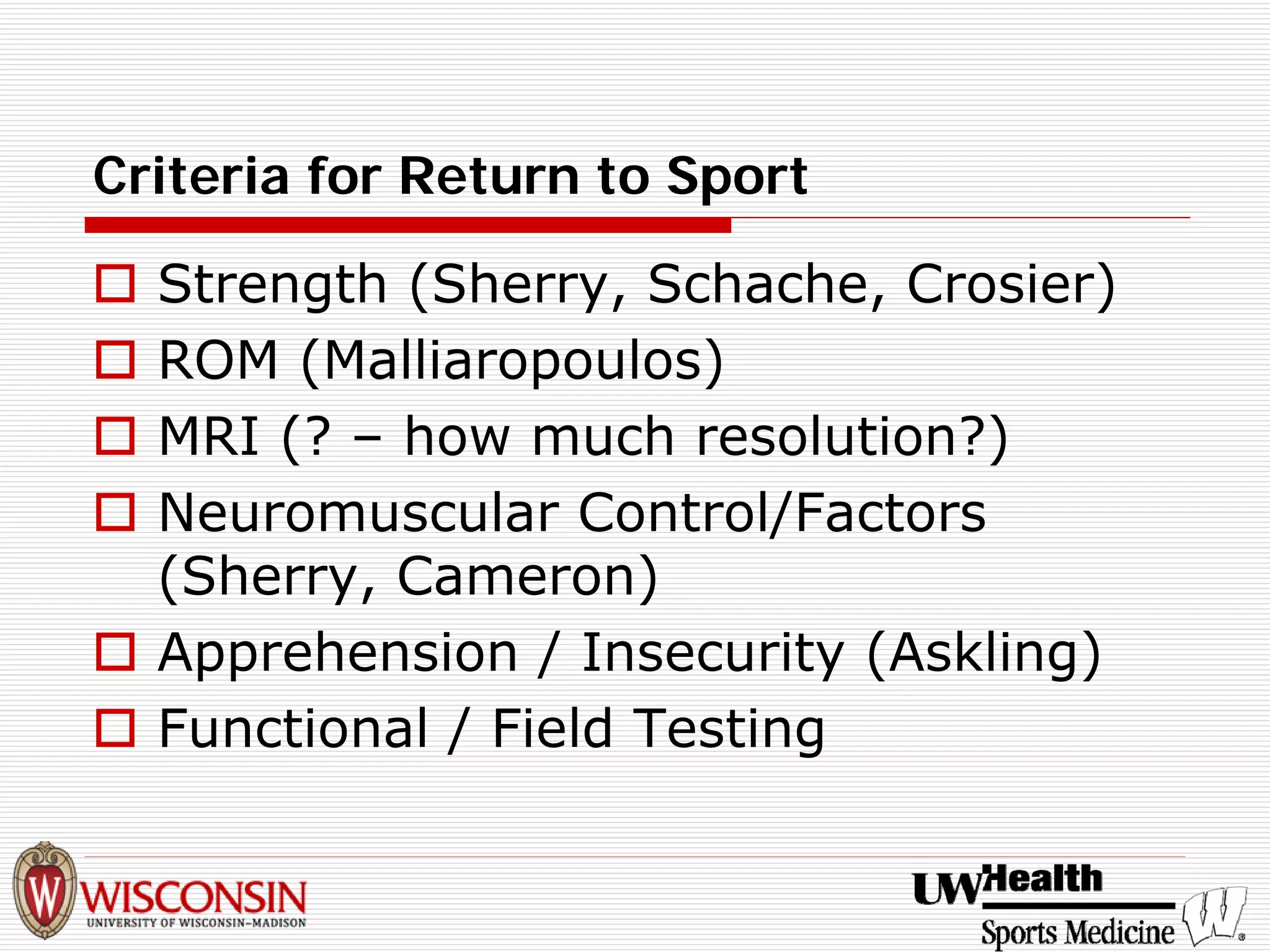
Criteria for Return to Sport 
† 
Strength (Sherry, Schache, Crosier) 
† 
ROM (Malliaropoulos) 
† 
MRI (? –how much resolution?) 
† 
Neuromuscular Control/Factors (Sherry, Cameron) 
† 
Apprehension / Insecurity (Askling) 
† 
Functional / Field Testing
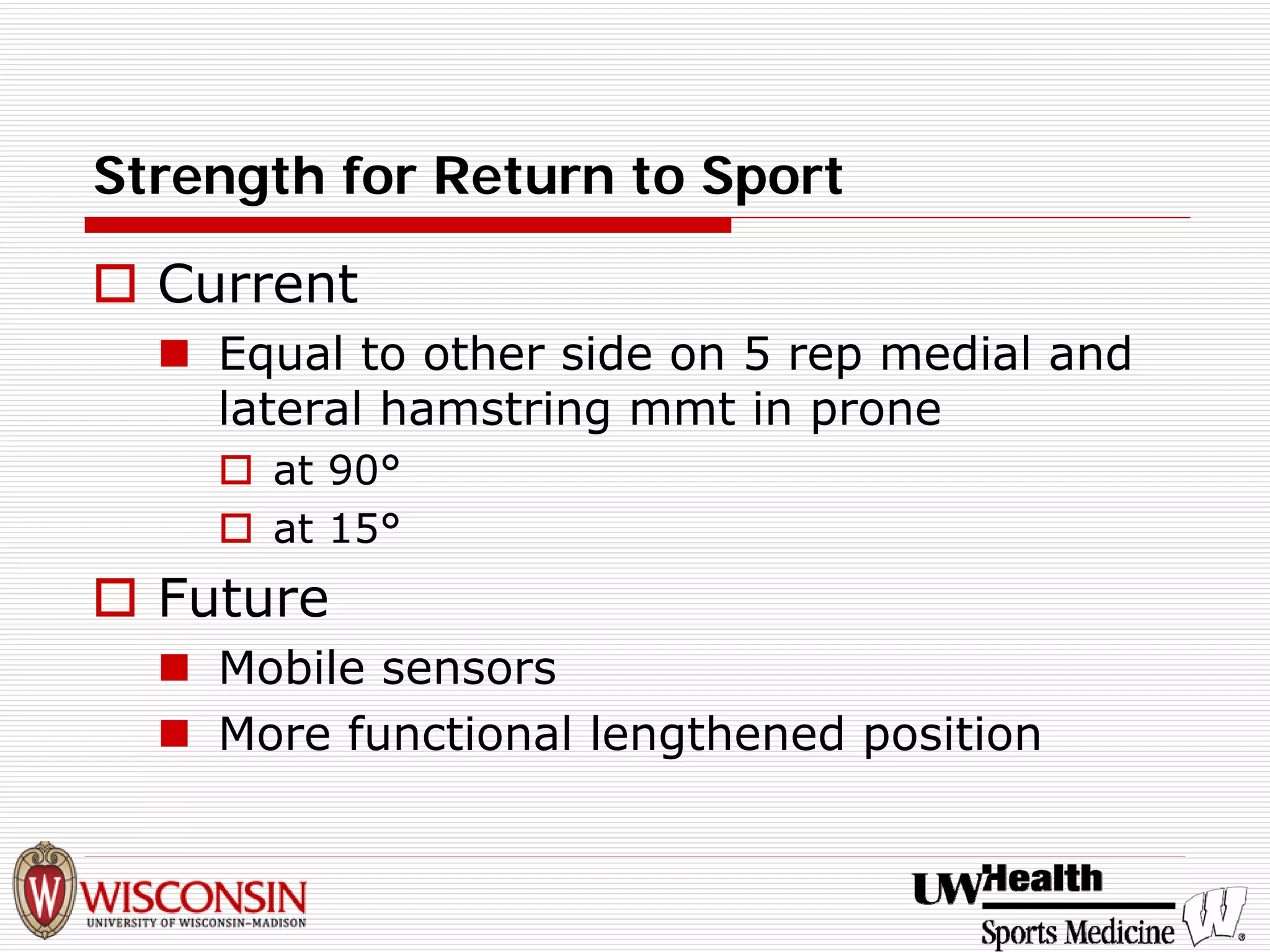
Strength for Return to Sport 
† 
Current 
„ 
Equal to other side on 5 rep medial and lateral hamstring mmt in prone 
† 
at 90° 
† 
at 15° 
† 
Future 
„ 
Mobile sensors 
„ 
More functional lengthened position
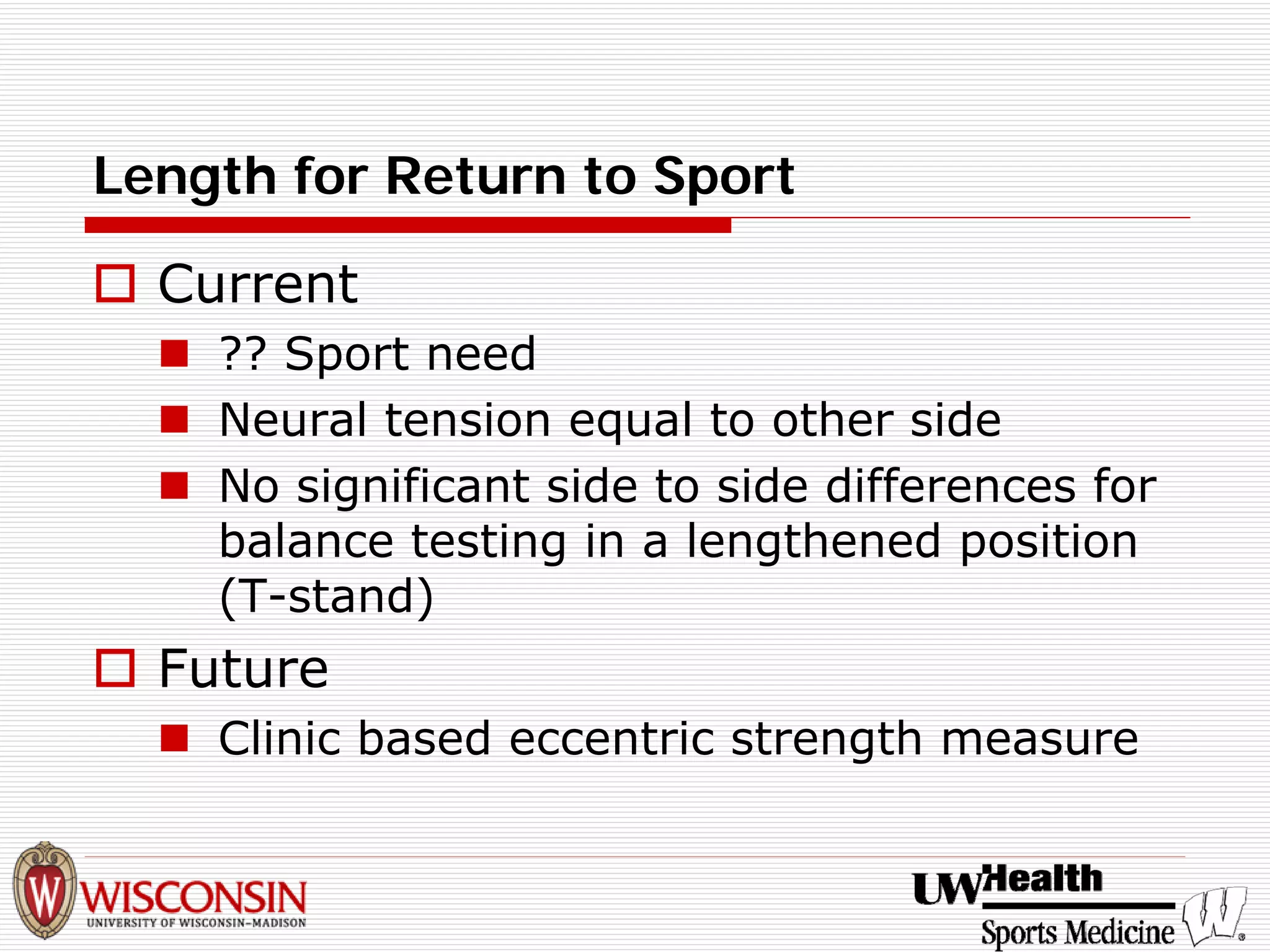
Length for Return to Sport 
† 
Current 
„ 
?? Sport need 
„ 
Neural tension equal to other side 
„ 
No significant side to side differences for balance testing in a lengthened position (T-stand) 
† 
Future 
„ 
Clinic based eccentric strength measure
Neuromuscular Readiness for Return to Sport 
† 
Current 
„ 
Marc modified H-Test 
„ 
AKET 
„ 
Free of apprehension for sport 
† 
Future 
„ 
Repeatability of AKET 
„ 
A measure of central motor output 
„ 
A measure of reaction time 
„ 
Patient reported readiness tool
Questions? 
Recent Improvements 
Recent Improvements 
Recent www.uwsportsmedicine.org 
MSherry@UWHealth.org
THANK YOU!
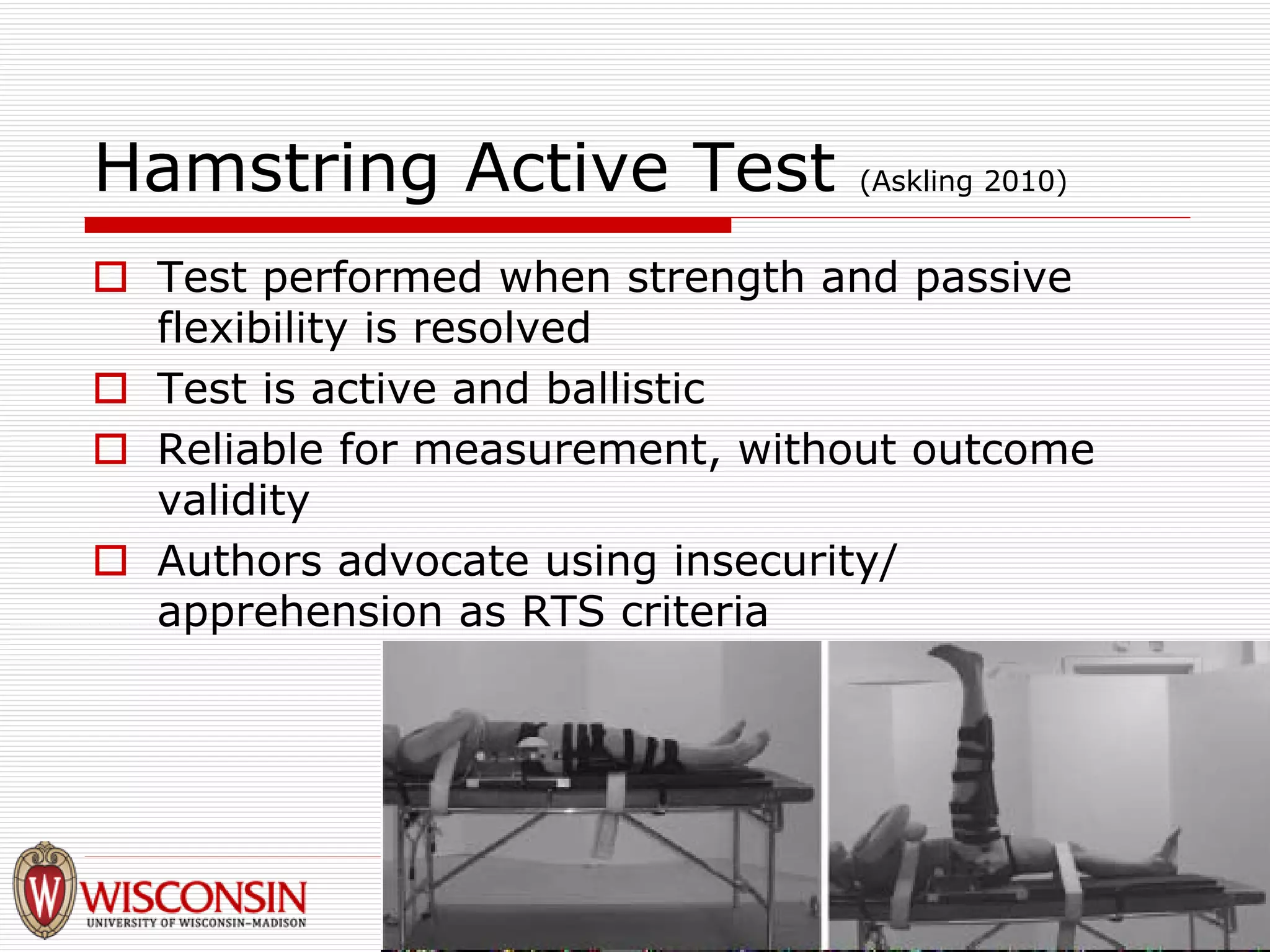
Hamstring Active Test (Askling 2010) 
† 
Test performed when strength and passive flexibility is resolved 
† 
Test is active and ballistic 
† 
Reliable for measurement, without outcome validity 
† 
Authors advocate using insecurity/ apprehension as RTS criteria
So what do I do now ……. 
† 
Acute hamstring strains 
„ 
PATS program 
„ 
Don’t stretch them, don’t allow themselves or anyone else to stretch them 
„ 
Manual therapy 
† 
normalize spinal mechanics 
† 
normalize talar glide 
† 
indirect STM 
„ 
Vit. C and E, avoid NSAIDS 
„ 
Initial compression and ice for pain and swelling
So what do I do now ……. 
† 
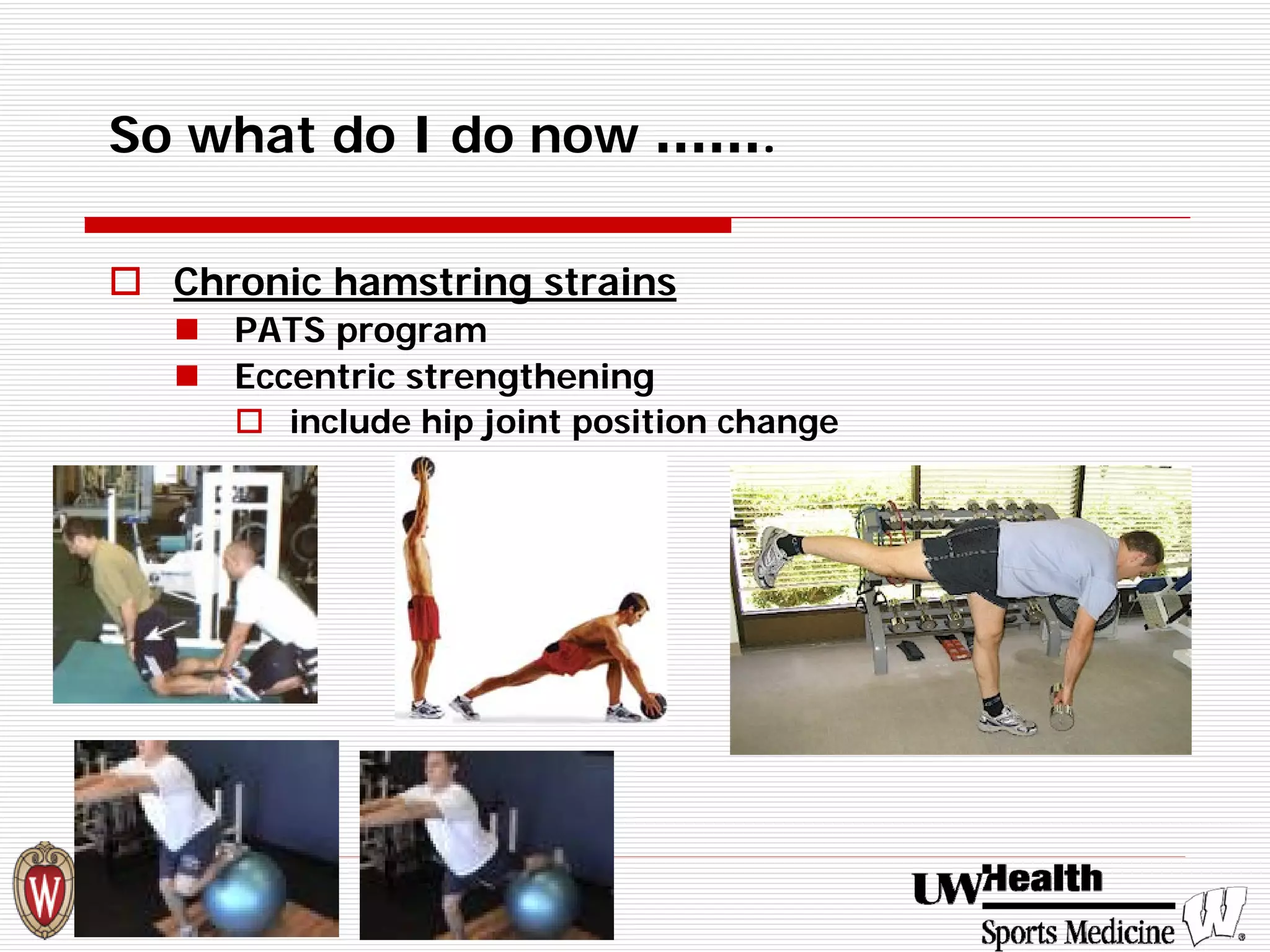
Chronic hamstring strains 
„ 
PATS program 
„ 
Eccentric strengthening 
† 
include hip joint position change
So what do I do now ……. 
„ 
Manual therapy 
† 
normalize spinal and ankle mechanics 
† 
direct STM 
† 
neural mobility
The Email After Effect 
“One of our young international winger has been troubled all season by different hamstring injuries in both legs. Although he was worked hard to recover with adequate time and intense stretching programmes he has suffered 4 strains in eight months, thus keeping him most of the season on the sidelines. I am very frustrated with his evolution and have a personal challenge to recover him properly in order to join our national side that will play the World Cup in Hong Kong in March.”
Mark Sherry - hamstring

Mark Sherry - hamstring

  • 1.
    Return to SportDecision Making After Acute Hamstring Strain Marc Sherry PT, DPT, LAT, CSCS, PES
  • 2.
    Disclosures † Consultantand scientific advisor for kiio, inc.
  • 4.
    PATS vs SSJOSPT 2004 † Return to Play Criteria „ 5/5 MMT in prone † at 90° † at 30° „ No TTP „ “Subjective Readiness”to sprint „ Completion functional testing
  • 5.
    Sherry MA, BestTM. A comparison of 2 rehabilitation programs in the treatment of acute hamstring strains. J Orthop Sports Phys Ther. Mar 2004;34(3):116-125. Performance on “functional testing” No significant difference (p<0.05) between experimental groups or between re-injury and no re-injury comparisons (40 yd dash time, hop for height, hop for distance and 4 hop cross-over test)
  • 7.
    BF Activity & Tibial Rotation † Hamstring activity is biased toward the direction tibialrotation † Most evident with knee at 15°flexion Lateral:Medial Hamstring Activity (relative to ratio in Tibia Neutral)
  • 8.
    PATS vs PRESJOSPT 2013 † Return to Play Criteria „ 5/5 on 4 repetition medial and lateral hamstring mmtin prone † at 90° † at 15° „ Completion of the running program/ or repeated 40 yard dash without pain or “apprehension”
  • 9.
    Recurrence Rate † 16.7% (4/24) † 12/24 of the subjects indicated they did not feel back to their pre-injury level of performance „ Only 2 reported because of their hamstring………need to rehab the whole athlete
  • 10.
    Hamstring Strength andMorphology MSSE 2013 † Subset of 22 „ Passed the 5/5 criteria „ Ave 9.6% hamstring strength deficit „ Ave 6.4% work deficit † BUT………..RTS vs6month: „ As strength decitwas erased, MRI showed atrophy „ ??neuromuscular effects
  • 11.
    Hamstring Strength andMorphology MSSE 2013 † Both limbs had decrease (less knee flexion) in angle of peak torque at 6 months † Tendon volume (potential scarring) was not related to AOPT
  • 12.
    De Vos, BJSM2014 † 64 acute injuries with 17 re-injuries † Increased signal on baseline MRI not a predictor of re-injury † Clinical Correlations 7 days after RTP „ Force deficit at 15° „ TTP „ AKET deficit
  • 13.
    RTP vs. Rehab † Force deficit at 15° † TTP † AKET deficit
  • 14.
    Is it “flexibility”?? † No stretching was carried out in the PATS group. „ AKET difference (initial evaluation and return to sport) † PATS: 21.6 degrees and .8 degrees † S-S: 21.7 degrees and 5.6 degrees
  • 15.
    Is it “flexibility”?? † No statistical significance for initial difference, return difference and difference between initial and return difference „ PATS vsSS (p=0.67, 0.28 & 0.91) „ Re-injured vs. no re-injury (p=0.69, 0.30 & 0.97)
  • 16.
    Askling’s L&C protocolRTP † Isometric Strength „ prone combo hip ext / knee flex † 45 deg † 15 deg „ Supine 15 deg knee flex † Palpation † “no signs of injury”=H-Test for no insecurity
  • 17.
    Askling’s L&C protocolRTP † Sprinters / Jumpers „ 2/56 re-injury † Swedish Football „ 1/75 re-injury
  • 18.
    Schmitt, Tyler, McHughIJSPT 2012 † Full strength / no pain † Symmetry AOPT † Full ROM / no pain † Sport activities / no pain
  • 19.
    Time to RTPvs Re-injury Study RTP Re-injury PATS 2003 23 7.7% SS 2003 37 70% PATS/PRES 2013 25/29 13.8% L/C Askling 2013 51 1.3% L/C Askling 2014 86 3.6% De Vos 2014 27%
  • 20.
    Factors for DelayedRTS Silder 2013 † MRI „ SI length (r=0.41, p=0.040) „ Absolute volume of injury at baseline (r=0.53, p=0.007) positively correlated with increased RTS time † Clinical correlations „ SLR (r=0.41, p=0.046) „ knee flexion strength deficit with the knee at 90oand the lower leg in both internal rotation (r=-0.44, p=0.027) and in a neutral position (r=-0.41, p=0.042)
  • 21.
    What about juststrength? Hamstring Muscle Strain Recurrence and Strength Performance Disorders (Croiseir et al 2002) „ 26 athletes with non-acute (12 recurrent) hamstring strains „ 18 had significant eccentric hamstring strength deficits or mixed ecc flexor / conc quadricep ratio, both measured by isokinetic dynamometer „ Eccentric training 3x week on Kintrex until deficits were within 5% (10-30 sessions) „ No recurrent injury at 12 months
  • 22.
    Criteria for Returnto Sport † Strength (Sherry, Schache, Crosier) † ROM (Malliaropoulos) † MRI (? –how much resolution?) † Neuromuscular Control/Factors (Sherry, Cameron) † Apprehension / Insecurity (Askling) † Functional / Field Testing
  • 23.
    Strength for Returnto Sport † Current „ Equal to other side on 5 rep medial and lateral hamstring mmt in prone † at 90° † at 15° † Future „ Mobile sensors „ More functional lengthened position
  • 24.
    Length for Returnto Sport † Current „ ?? Sport need „ Neural tension equal to other side „ No significant side to side differences for balance testing in a lengthened position (T-stand) † Future „ Clinic based eccentric strength measure
  • 25.
    Neuromuscular Readiness forReturn to Sport † Current „ Marc modified H-Test „ AKET „ Free of apprehension for sport † Future „ Repeatability of AKET „ A measure of central motor output „ A measure of reaction time „ Patient reported readiness tool
  • 26.
    Questions? Recent Improvements Recent Improvements Recent www.uwsportsmedicine.org MSherry@UWHealth.org
  • 27.
  • 28.
    Hamstring Active Test(Askling 2010) † Test performed when strength and passive flexibility is resolved † Test is active and ballistic † Reliable for measurement, without outcome validity † Authors advocate using insecurity/ apprehension as RTS criteria
  • 29.
    So what doI do now ……. † Acute hamstring strains „ PATS program „ Don’t stretch them, don’t allow themselves or anyone else to stretch them „ Manual therapy † normalize spinal mechanics † normalize talar glide † indirect STM „ Vit. C and E, avoid NSAIDS „ Initial compression and ice for pain and swelling
  • 30.
    So what doI do now ……. † Chronic hamstring strains „ PATS program „ Eccentric strengthening † include hip joint position change
  • 31.
    So what doI do now ……. „ Manual therapy † normalize spinal and ankle mechanics † direct STM † neural mobility
  • 32.
    The Email AfterEffect “One of our young international winger has been troubled all season by different hamstring injuries in both legs. Although he was worked hard to recover with adequate time and intense stretching programmes he has suffered 4 strains in eight months, thus keeping him most of the season on the sidelines. I am very frustrated with his evolution and have a personal challenge to recover him properly in order to join our national side that will play the World Cup in Hong Kong in March.”