Kenny Julita
Silvia Eka Putri
SEMANTICS
What is Semantics?
Semantics is a sub discipline of linguistics
which focuses on the study of meaning.
Semantics tries to understand what
meaning is as an element of language by
speakers and listeners of language.
It focuses on the relation between signifiers,
like words, phrases, signs, and symbols
study of meaning that is used for
understanding human expression through
language.
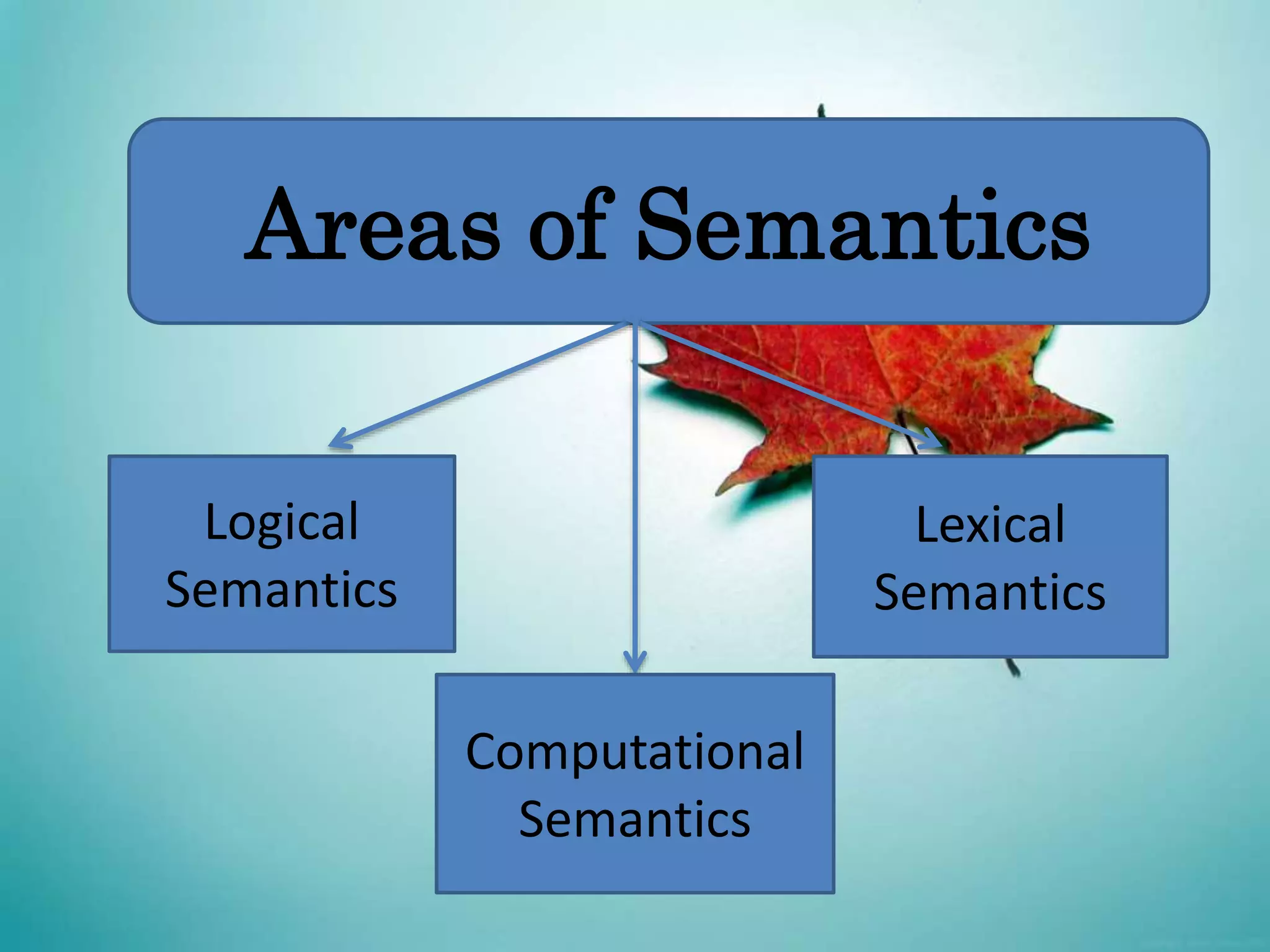
Areas of Semantics
Logical
Semantics
Lexical
Semantics
Computational
Semantics
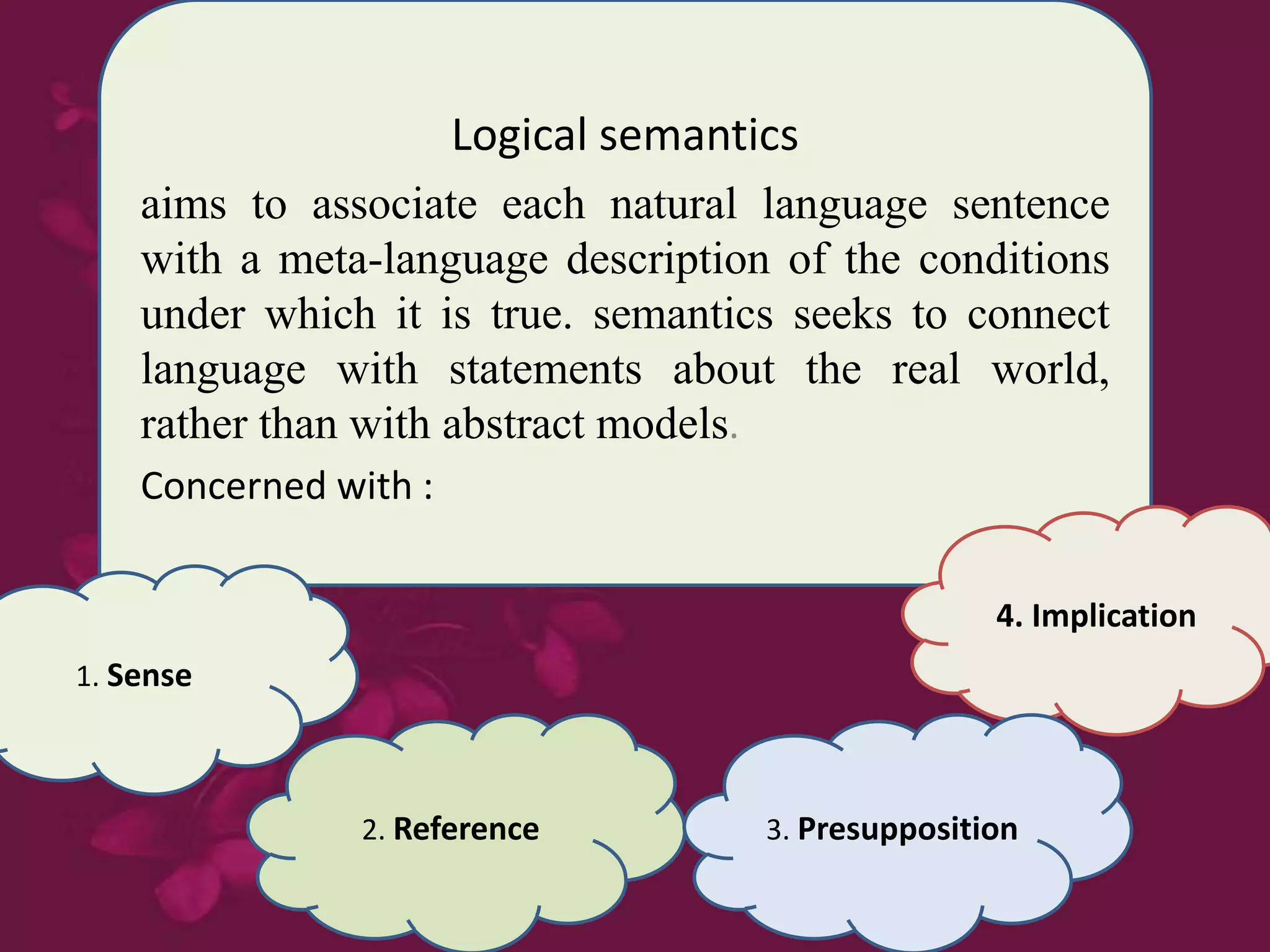
Logical semantics
aims to associate each natural language sentence
with a meta-language description of the conditions
under which it is true. semantics seeks to connect
language with statements about the real world,
rather than with abstract models.
Concerned with :
2. Reference
4. Implication
3. Presupposition
1. Sense
Lexical Semantics
Lexical semantics can be defined as 'the study of
meaning', therefore semanticists are interested in the
lexical meaning of words rather than grammatical
meaning. It is about studying language in isolation and not
language in use.
Some types of lexical semantics :
1. Synonymy
2. Antonyms
3. Polysemy
4. Hyponymy
Computational Semantics
Computational semantics is the study of how to
automate the process of constructing and reasoning
with meaning representations of natural language
expressions. It consequently plays an important role
in natural language processing and computational
linguistics.
EXPERT OF SEMANTICS
the field of Semantics as it is such a vast topic in the area
of Linguistics. This section will inform you of some of the
key researchers in the field and what they studied in their
work.
Donald Davidson (1917-2003)
Was an American philosopher born in Springfield, Massachusetts.
Served as Professor of Philosophy at The University ofCalifornia from 1981-
2003.
Developed an inspired approach to truth-conditional semantics
Famously said "there is no such thing as a language, not if a language is
anything like what many philosophers and linguists have supposed. There is
therefore no such thing tobe learned, mastered.
Why is semantics studied?
 To futher our understanding of how the relationship
between the words and structure of a sentence can affect
meaning.
To try and find a more comprehinsive definition of
"meaning" which truly cover the concept.
Studying semantics will allow us to explain what it is
exactly about the headline which is confusing and why
readers could be lead to believe. Semantics offer a
definition for "meaning" however it is a difficult concept
to explain
THANK YOU

Introduction to Linguistics: Semantics

  • 1.
    Kenny Julita Silvia EkaPutri SEMANTICS
  • 2.
    What is Semantics? Semanticsis a sub discipline of linguistics which focuses on the study of meaning. Semantics tries to understand what meaning is as an element of language by speakers and listeners of language. It focuses on the relation between signifiers, like words, phrases, signs, and symbols study of meaning that is used for understanding human expression through language.
  • 3.
  • 4.
    Logical semantics aims toassociate each natural language sentence with a meta-language description of the conditions under which it is true. semantics seeks to connect language with statements about the real world, rather than with abstract models. Concerned with : 2. Reference 4. Implication 3. Presupposition 1. Sense
  • 5.
    Lexical Semantics Lexical semanticscan be defined as 'the study of meaning', therefore semanticists are interested in the lexical meaning of words rather than grammatical meaning. It is about studying language in isolation and not language in use. Some types of lexical semantics : 1. Synonymy 2. Antonyms 3. Polysemy 4. Hyponymy
  • 6.
    Computational Semantics Computational semanticsis the study of how to automate the process of constructing and reasoning with meaning representations of natural language expressions. It consequently plays an important role in natural language processing and computational linguistics.
  • 7.
    EXPERT OF SEMANTICS thefield of Semantics as it is such a vast topic in the area of Linguistics. This section will inform you of some of the key researchers in the field and what they studied in their work.
  • 8.
    Donald Davidson (1917-2003) Wasan American philosopher born in Springfield, Massachusetts. Served as Professor of Philosophy at The University ofCalifornia from 1981- 2003. Developed an inspired approach to truth-conditional semantics Famously said "there is no such thing as a language, not if a language is anything like what many philosophers and linguists have supposed. There is therefore no such thing tobe learned, mastered.
  • 9.
    Why is semanticsstudied?  To futher our understanding of how the relationship between the words and structure of a sentence can affect meaning. To try and find a more comprehinsive definition of "meaning" which truly cover the concept. Studying semantics will allow us to explain what it is exactly about the headline which is confusing and why readers could be lead to believe. Semantics offer a definition for "meaning" however it is a difficult concept to explain
  • 10.