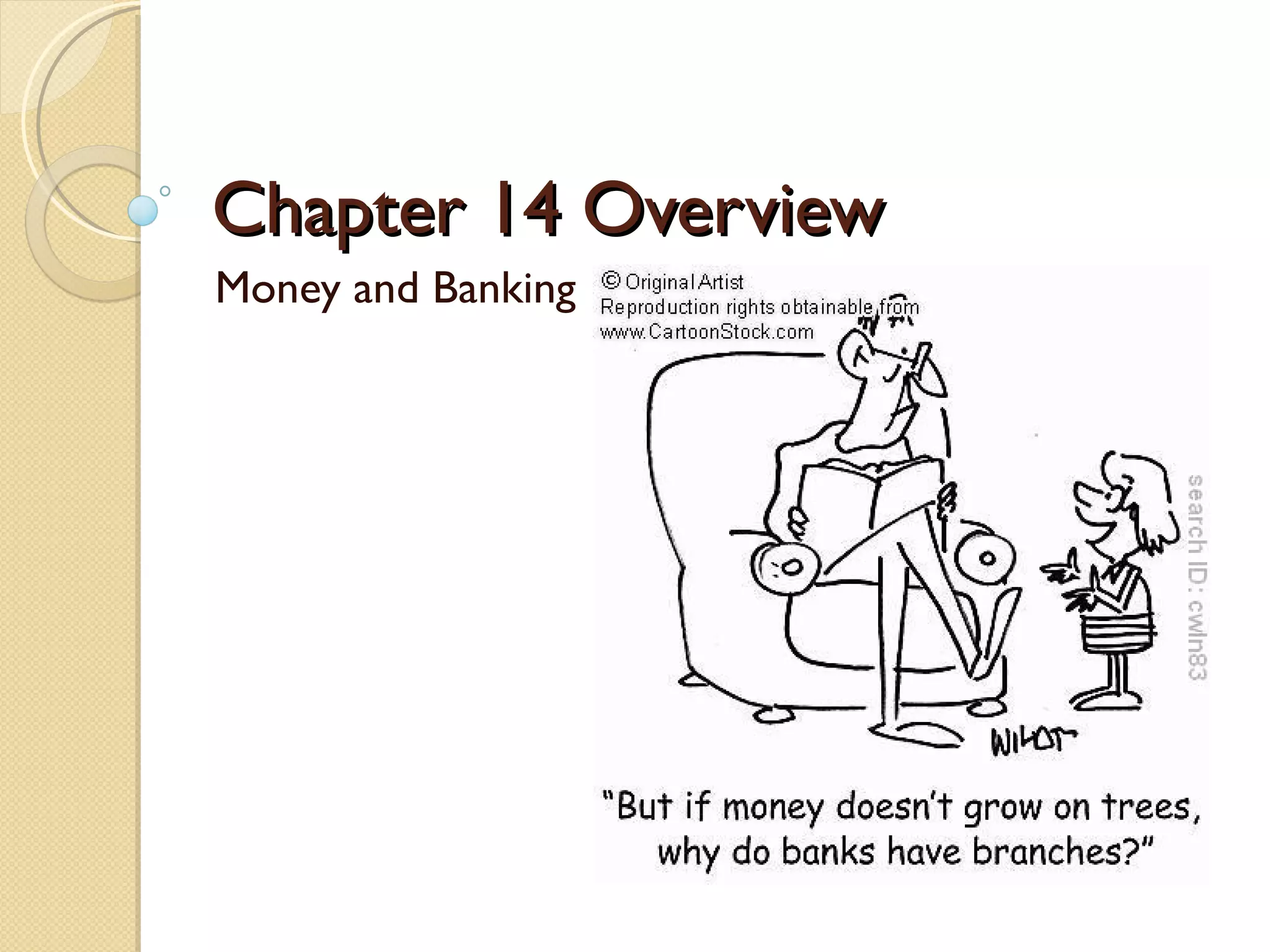
Chapter 14 Overview
Money and Banking
Learning Goal
   Define the fundamental functions
    of money
Did You Know That …

   Money
    ◦ Any medium that is universally
      accepted in an economy both by
      sellers of goods and services as
      payment for those goods and
      services and by creditors as
      payment for debts
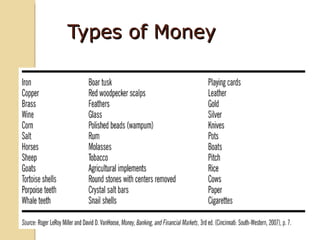
Types of Money
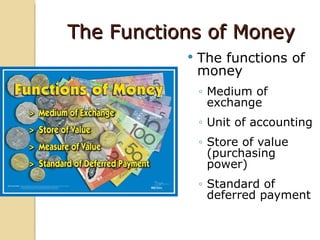
The Functions of Money
              The functions of
               money
               ◦ Medium of
                 exchange
               ◦ Unit of accounting
               ◦ Store of value
                 (purchasing
                 power)
               ◦ Standard of
                 deferred payment
The Functions of Money
(cont'd)
   Medium of Exchange
    ◦ Any item that sellers will accept as
      payment
    ◦ Money facilitates exchange by
      reducing transaction costs associated
      with means-of-payment uncertainty
      Permits specialization, facilitates efficiencies
      Avoids need for Barter!
      Keeps Fenick from teaching to trade for
       Donuts!
The Functions of Money
(cont'd)
   Barter
    ◦ The direct exchange of goods and
      services for other goods and
      services without the use of money
    ◦ Simply a direct exchange requires a
      double coincidence of wants
    ◦ I want a sandwich, I need to find
      someone that wants to learn
      Economics!
The Functions of Money
(cont'd)
   Unit of Accounting
    ◦ A measure by which prices are
      expressed
    ◦ The common denominator of the
      price system
    ◦ A central property of money
The Functions of Money
(cont'd)
   Store of Value
    ◦ The ability to hold value over time
    ◦ A necessary property of money
    ◦ Money allows you to transfer value
      (wealth) into the future
The Functions of Money
(cont'd)
   Standard of Deferred Payment
    ◦ A property of an item that makes it
      desirable for use as a means of
      settling debts maturing in the
      future
    ◦ An essential property of money
Properties of Money
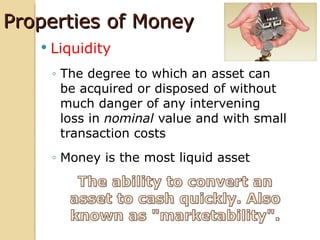
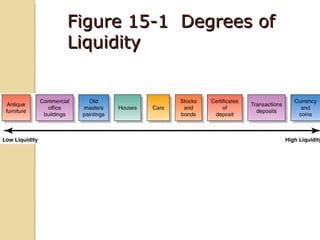
      Liquidity
       ◦ The degree to which an asset can
         be acquired or disposed of without
         much danger of any intervening
         loss in nominal value and with small
         transaction costs
       ◦ Money is the most liquid asset
Figure 15-1 Degrees of
Liquidity
Properties of Money (cont’d)

   Question
    ◦ What is the cost of holding money
      (its opportunity cost)?

   Answer
    ◦ It is the alternative interest yield
      obtainable by holding some other
      asset
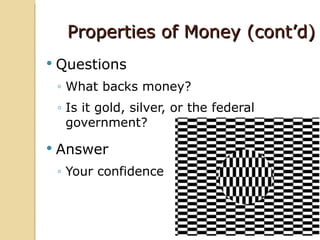
Properties of Money (cont’d)
   Questions
    ◦ What backs money?
    ◦ Is it gold, silver, or the federal
      government?

   Answer
    ◦ Your confidence
Properties of Money (cont’d)

   Transactions Deposits
    ◦ Checkable and debitable account
      balances in commercial banks and
      other types of financial institutions,
      such as credit unions and mutual
      savings banks
    ◦ Any accounts in financial institutions
      on which you can easily transmit
      debit-card and check payments
      without many restrictions
Properties of Money (cont’d)

   Fiduciary Monetary System
    ◦ A system in which currency is
      issued by the government and its
      value rests on the public’s
      confidence that it can be exchanged
      for goods and services
    ◦ The Latin fiducia means “trust” or
      “confidence”
Properties of Money (cont’d)

   Currency and transactions
    deposits are money because of
    their
    ◦ Acceptability
    ◦ Predictability of value
Defining Money
   Money is important
    ◦ Changes in the rate at which the
      money supply increases or decreases
      affect important economic variables
      (at least in the short run) such as
      inflation, interest rates, employment,
      and the level of real GDP
   Money Supply
    ◦ The amount of money in circulation
Financial Intermediation and
Banks
   Most nations have a banking
    system that encompasses two
    types of institutions
    1. One type consists of private
       banking institutions
    2. The other type of institution is a
       central bank
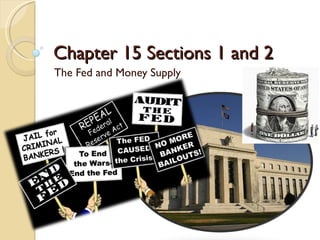
Chapter 15 Sections 1 and 2
The Fed and Money Supply
Learning Goal
   Describe the basic structure and
    functions of the Federal Reserve
    System
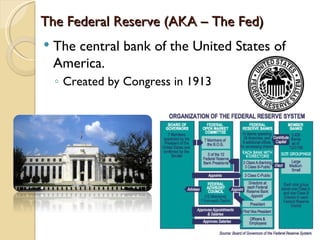
The Federal Reserve (AKA – The Fed)
   The central bank of the United States of
    America.
    ◦ Created by Congress in 1913
Mission Statement & The Dual
Mandate
  The Federal Reserve System is the
 central bank of the United States. It was
 founded by Congress in 1913 to provide
 the nation with a safer, more flexible, and
 more stable monetary and financial
 system. Written into the Federal Reserve
 Act, is the mission “To create a healthy
 growing economy with high employment and
 price stability.”
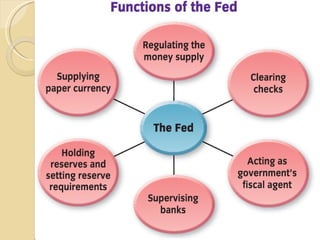
The Fed
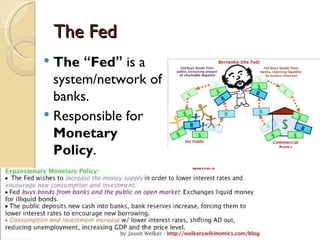
 The “Fed” is a
  system/network of
  banks.
 Responsible for
  Monetary
  Policy.
Cont.
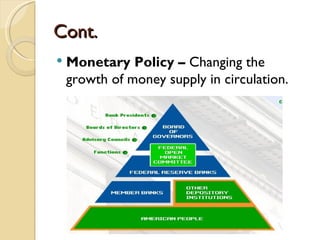
   Monetary Policy – Changing the
    growth of money supply in circulation.
Federal Open Market Committee
   Board of Governors, head of NY Fed Bank,
    and 4 rotating heads of the other 11 district
    banks.
    ◦ Meet 8 times a year to set MONETARY
      POLICY
    ◦ Extremely important decision making body.
Banking System
   12 District Banks – 25 branch banks
    underneath it.
    ◦ All national banks must become members of the
      Federal Reserve System.
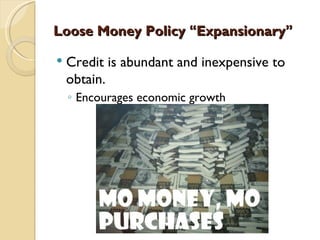
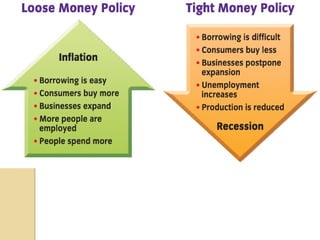
Loose Money Policy “Expansionary”

   Credit is abundant and inexpensive to
    obtain.
    ◦ Encourages economic growth
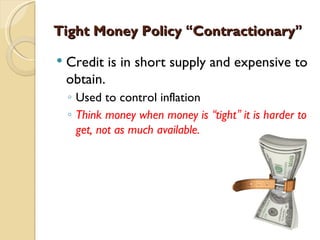
Tight Money Policy “Contractionary”

   Credit is in short supply and expensive to
    obtain.
    ◦ Used to control inflation
    ◦ Think money when money is “tight” it is harder to
      get, not as much available.
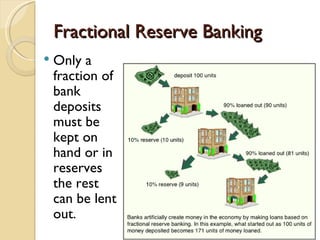
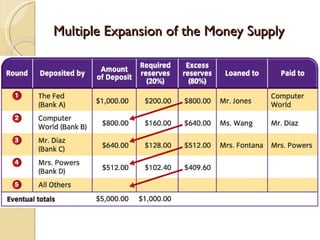
Fractional Reserve Banking
   Only a
    fraction of
    bank
    deposits
    must be
    kept on
    hand or in
    reserves
    the rest
    can be lent
    out.
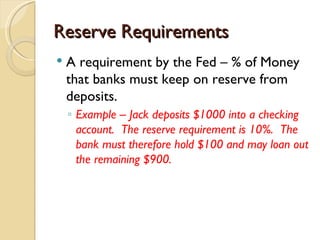
Reserve Requirements
   A requirement by the Fed – % of Money
    that banks must keep on reserve from
    deposits.
    ◦ Example – Jack deposits $1000 into a checking
      account. The reserve requirement is 10%. The
      bank must therefore hold $100 and may loan out
      the remaining $900.
Multiple Expansion of the Money Supply
Chapter 15 Section 3
Regulating the Money Supply
Learning Goal
   Describe what tools the Federal Reserve
    uses to run a smooth economy.
The Federal Reserve
   The main goal of the Federal Reserve is to
    keep the money supply growing steadily and
    the economy running smoothly
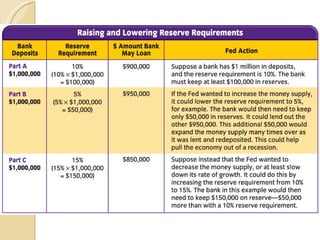
Tool #1 – Changing Reserve
Requirements
   Reserve Requirements – The % of money
    that banks must hold from a deposit.
    ◦ Increase Requirements – Less money available
      to lend out
    ◦ Decrease Requirements – More money
      available to lend out
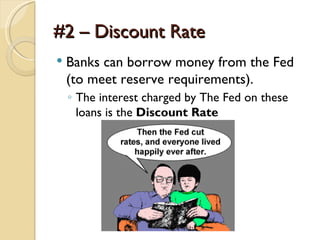
#2 – Discount Rate
   Banks can borrow money from the Fed
    (to meet reserve requirements).
    ◦ The interest charged by The Fed on these
      loans is the Discount Rate
Cont.
   Prime Rate – Interest rate banks charge
    its best business customers. Banks pass
    on discount rate changes to customers.
Cont.
   Decrease Interest Rate = Loans become
    cheaper to obtain = Loans INCREASE in
    Quantity Demanded

   Increase interest rates – Loans become
    more expensive – discourages borrowing
#3 – Open Market Operations
   Buying and selling government securities
    (Most common tool Fed uses to control
    money supply
    ◦ Fed buys securities it is increasing money
      supply
    ◦ Fed sells securities it is decreasing money
      supply
Federal Funds Rate
 Interest rate that banks charge each
  other for short-term loans.
 Banks that cannot meet reserve
  requirements must borrow or pay a
  penalty.
Cont.
   Fed tries to indirectly change this rate
    through open market operations.
Delays in Effects of Monetary
Supply
   Full effects can take months, sometimes
    up to a year
Criticisms of Fed Policies
 Fed has increased money supply during times
  of inflation (creating worse inflation)
 Fed has decreased money supply during
  recessions (thereby making the recession
  worse)
Cont.
 Some Recommend – Money supply increased
  at same rate each year (no monetary policy)
 Gov’t (spending and taxation) also has a
  dramatic affect on the economy.

14 & 15_money_&_the_fed

  • 1.
  • 2.
    Learning Goal  Define the fundamental functions of money
  • 3.
    Did You KnowThat …  Money ◦ Any medium that is universally accepted in an economy both by sellers of goods and services as payment for those goods and services and by creditors as payment for debts
  • 4.
  • 5.
    The Functions ofMoney  The functions of money ◦ Medium of exchange ◦ Unit of accounting ◦ Store of value (purchasing power) ◦ Standard of deferred payment
  • 6.
    The Functions ofMoney (cont'd)  Medium of Exchange ◦ Any item that sellers will accept as payment ◦ Money facilitates exchange by reducing transaction costs associated with means-of-payment uncertainty  Permits specialization, facilitates efficiencies  Avoids need for Barter!  Keeps Fenick from teaching to trade for Donuts!
  • 7.
    The Functions ofMoney (cont'd)  Barter ◦ The direct exchange of goods and services for other goods and services without the use of money ◦ Simply a direct exchange requires a double coincidence of wants ◦ I want a sandwich, I need to find someone that wants to learn Economics!
  • 8.
    The Functions ofMoney (cont'd)  Unit of Accounting ◦ A measure by which prices are expressed ◦ The common denominator of the price system ◦ A central property of money
  • 9.
    The Functions ofMoney (cont'd)  Store of Value ◦ The ability to hold value over time ◦ A necessary property of money ◦ Money allows you to transfer value (wealth) into the future
  • 10.
    The Functions ofMoney (cont'd)  Standard of Deferred Payment ◦ A property of an item that makes it desirable for use as a means of settling debts maturing in the future ◦ An essential property of money
  • 11.
    Properties of Money  Liquidity ◦ The degree to which an asset can be acquired or disposed of without much danger of any intervening loss in nominal value and with small transaction costs ◦ Money is the most liquid asset
  • 12.
    Figure 15-1 Degreesof Liquidity
  • 13.
    Properties of Money(cont’d)  Question ◦ What is the cost of holding money (its opportunity cost)?  Answer ◦ It is the alternative interest yield obtainable by holding some other asset
  • 14.
    Properties of Money(cont’d)  Questions ◦ What backs money? ◦ Is it gold, silver, or the federal government?  Answer ◦ Your confidence
  • 15.
    Properties of Money(cont’d)  Transactions Deposits ◦ Checkable and debitable account balances in commercial banks and other types of financial institutions, such as credit unions and mutual savings banks ◦ Any accounts in financial institutions on which you can easily transmit debit-card and check payments without many restrictions
  • 16.
    Properties of Money(cont’d)  Fiduciary Monetary System ◦ A system in which currency is issued by the government and its value rests on the public’s confidence that it can be exchanged for goods and services ◦ The Latin fiducia means “trust” or “confidence”
  • 17.
    Properties of Money(cont’d)  Currency and transactions deposits are money because of their ◦ Acceptability ◦ Predictability of value
  • 18.
    Defining Money  Money is important ◦ Changes in the rate at which the money supply increases or decreases affect important economic variables (at least in the short run) such as inflation, interest rates, employment, and the level of real GDP  Money Supply ◦ The amount of money in circulation
  • 19.
    Financial Intermediation and Banks  Most nations have a banking system that encompasses two types of institutions 1. One type consists of private banking institutions 2. The other type of institution is a central bank
  • 20.
    Chapter 15 Sections1 and 2 The Fed and Money Supply
  • 21.
    Learning Goal  Describe the basic structure and functions of the Federal Reserve System
  • 22.
    The Federal Reserve(AKA – The Fed)  The central bank of the United States of America. ◦ Created by Congress in 1913
  • 23.
    Mission Statement &The Dual Mandate The Federal Reserve System is the central bank of the United States. It was founded by Congress in 1913 to provide the nation with a safer, more flexible, and more stable monetary and financial system. Written into the Federal Reserve Act, is the mission “To create a healthy growing economy with high employment and price stability.”
  • 24.
    The Fed  The“Fed” is a system/network of banks.  Responsible for Monetary Policy.
  • 25.
    Cont.  Monetary Policy – Changing the growth of money supply in circulation.
  • 26.
    Federal Open MarketCommittee  Board of Governors, head of NY Fed Bank, and 4 rotating heads of the other 11 district banks. ◦ Meet 8 times a year to set MONETARY POLICY ◦ Extremely important decision making body.
  • 27.
    Banking System  12 District Banks – 25 branch banks underneath it. ◦ All national banks must become members of the Federal Reserve System.
  • 29.
    Loose Money Policy“Expansionary”  Credit is abundant and inexpensive to obtain. ◦ Encourages economic growth
  • 30.
    Tight Money Policy“Contractionary”  Credit is in short supply and expensive to obtain. ◦ Used to control inflation ◦ Think money when money is “tight” it is harder to get, not as much available.
  • 32.
    Fractional Reserve Banking  Only a fraction of bank deposits must be kept on hand or in reserves the rest can be lent out.
  • 33.
    Reserve Requirements  A requirement by the Fed – % of Money that banks must keep on reserve from deposits. ◦ Example – Jack deposits $1000 into a checking account. The reserve requirement is 10%. The bank must therefore hold $100 and may loan out the remaining $900.
  • 34.
    Multiple Expansion ofthe Money Supply
  • 35.
    Chapter 15 Section3 Regulating the Money Supply
  • 36.
    Learning Goal  Describe what tools the Federal Reserve uses to run a smooth economy.
  • 37.
    The Federal Reserve  The main goal of the Federal Reserve is to keep the money supply growing steadily and the economy running smoothly
  • 38.
    Tool #1 –Changing Reserve Requirements  Reserve Requirements – The % of money that banks must hold from a deposit. ◦ Increase Requirements – Less money available to lend out ◦ Decrease Requirements – More money available to lend out
  • 40.
    #2 – DiscountRate  Banks can borrow money from the Fed (to meet reserve requirements). ◦ The interest charged by The Fed on these loans is the Discount Rate
  • 41.
    Cont.  Prime Rate – Interest rate banks charge its best business customers. Banks pass on discount rate changes to customers.
  • 42.
    Cont.  Decrease Interest Rate = Loans become cheaper to obtain = Loans INCREASE in Quantity Demanded  Increase interest rates – Loans become more expensive – discourages borrowing
  • 43.
    #3 – OpenMarket Operations  Buying and selling government securities (Most common tool Fed uses to control money supply ◦ Fed buys securities it is increasing money supply ◦ Fed sells securities it is decreasing money supply
  • 44.
    Federal Funds Rate Interest rate that banks charge each other for short-term loans.  Banks that cannot meet reserve requirements must borrow or pay a penalty.
  • 45.
    Cont.  Fed tries to indirectly change this rate through open market operations.
  • 46.
    Delays in Effectsof Monetary Supply  Full effects can take months, sometimes up to a year
  • 47.
    Criticisms of FedPolicies  Fed has increased money supply during times of inflation (creating worse inflation)  Fed has decreased money supply during recessions (thereby making the recession worse)
  • 48.
    Cont.  Some Recommend– Money supply increased at same rate each year (no monetary policy)  Gov’t (spending and taxation) also has a dramatic affect on the economy.