Chapter 1
Why Study Money,
Banking, and
Financial Markets?
By:
Saeed ur Rehman Khattak,
MPA
Quaid-i-Azam University
Copyright © 2007 Pearson Addison-Wesley. All rights reserved. 1-2
Why Study Money, Banking, and
Financial Markets
• To examine:
how financial markets work (bond,
stock and foreign exchange markets)
how financial institutions work (banks
and insurance companies
the role of money in the economy
Copyright © 2007 Pearson Addison-Wesley. All rights reserved. 1-3
Financial Markets
• What is a financial market?
These are markets in which funds are
transferred from people who have an
excess of available funds to people who
have a shortage of funds
Copyright © 2007 Pearson Addison-Wesley. All rights reserved. 1-4
Debt and Equity
• Differences between debt and equity
instruments and their markets
Copyright © 2007 Pearson Addison-Wesley. All rights reserved. 1-5
The Bond Market and Interest Rates
• Securities or Financial Instruments: A
security (financial instrument) is a claim
on the issuer’s future income or assets
• A bond is a debt security that promises
to make payments periodically for a
specified period of time
• An interest rate is the cost of borrowing
or the price paid for the rental of funds
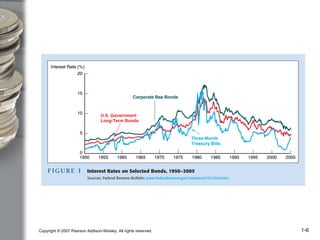
Copyright © 2007 Pearson Addison-Wesley. All rights reserved. 1-6
Copyright © 2007 Pearson Addison-Wesley. All rights reserved. 1-7
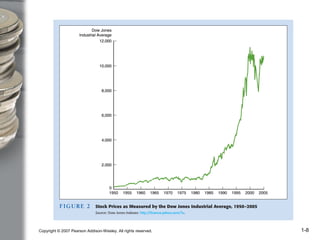
The Stock Market
• Common stock represents a share of
ownership in a corporation
• A share of stock is a claim on the
earnings and assets of the corporation
Copyright © 2007 Pearson Addison-Wesley. All rights reserved. 1-8
Copyright © 2007 Pearson Addison-Wesley. All rights reserved. 1-9
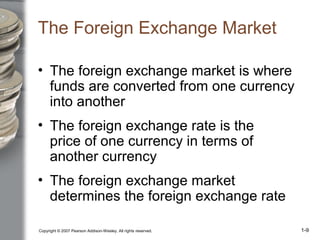
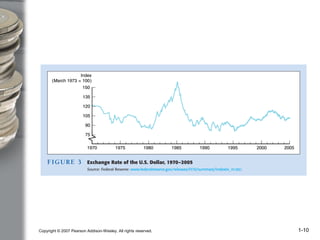
The Foreign Exchange Market
• The foreign exchange market is where
funds are converted from one currency
into another
• The foreign exchange rate is the
price of one currency in terms of
another currency
• The foreign exchange market
determines the foreign exchange rate
Copyright © 2007 Pearson Addison-Wesley. All rights reserved. 1-10
Copyright © 2007 Pearson Addison-Wesley. All rights reserved. 1-11
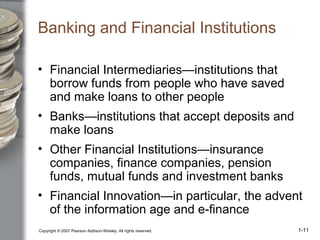
Banking and Financial Institutions
• Financial Intermediaries—institutions that
borrow funds from people who have saved
and make loans to other people
• Banks—institutions that accept deposits and
make loans
• Other Financial Institutions—insurance
companies, finance companies, pension
funds, mutual funds and investment banks
• Financial Innovation—in particular, the advent
of the information age and e-finance
Copyright © 2007 Pearson Addison-Wesley. All rights reserved. 1-12
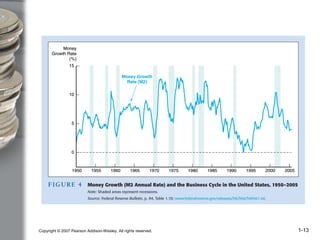
Money and Business Cycles
• Evidence suggests that money
plays an important role in generating
business cycles
• Recessions (unemployment) and booms
(inflation) affect all of us
• Monetary Theory ties changes in the
money supply to changes in aggregate
economic activity and the price level
Copyright © 2007 Pearson Addison-Wesley. All rights reserved. 1-13
Copyright © 2007 Pearson Addison-Wesley. All rights reserved. 1-14
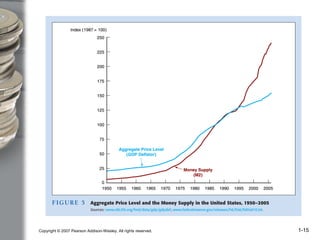
Money and Inflation
• The aggregate price level is the
average price of goods and services in
an economy
• A continual rise in the price level
(inflation) affects all economic players
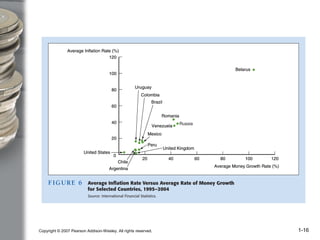
• Data shows a connection between the
money supply and the price level
Copyright © 2007 Pearson Addison-Wesley. All rights reserved. 1-15
Copyright © 2007 Pearson Addison-Wesley. All rights reserved. 1-16
Copyright © 2007 Pearson Addison-Wesley. All rights reserved. 1-17
Money and Interest Rates
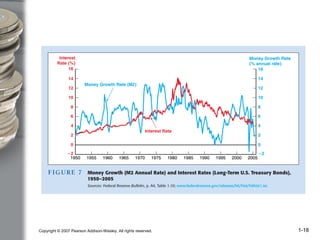
• Interest rates are the price of money
• Prior to 1980, the rate of money growth
and the interest rate on long-term
Treasure bonds were closely tied
• Since then, the relationship is less clear
but still an important determinant of
interest rates
Copyright © 2007 Pearson Addison-Wesley. All rights reserved. 1-18
Copyright © 2007 Pearson Addison-Wesley. All rights reserved. 1-19
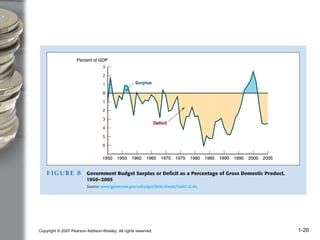
Monetary and Fiscal Policy
• Monetary policy is the management of the
money supply and interest rates
 Conducted in the U.S. by the Federal Reserve
Bank (Fed)
• Fiscal policy is government spending
and taxation
 Budget deficit is the excess of expenditures over
revenues for a particular year
 Budget surplus is the excess of revenues over
expenditures for a particular year
 Any deficit must be financed by borrowing
Copyright © 2007 Pearson Addison-Wesley. All rights reserved. 1-20
Copyright © 2007 Pearson Addison-Wesley. All rights reserved. 1-21
How We Will Study Money, Banking,
and Financial Markets
• A simplified approach to the demand
for assets
• The concept of equilibrium
• Basic supply and demand to explain behavior
in financial markets
• The search for profits
• An approach to financial structure based on
transaction costs and asymmetric information
• Aggregate supply and demand analysis

Why study Money, Banking and Finance

  • 1.
    Chapter 1 Why StudyMoney, Banking, and Financial Markets? By: Saeed ur Rehman Khattak, MPA Quaid-i-Azam University
  • 2.
    Copyright © 2007Pearson Addison-Wesley. All rights reserved. 1-2 Why Study Money, Banking, and Financial Markets • To examine: how financial markets work (bond, stock and foreign exchange markets) how financial institutions work (banks and insurance companies the role of money in the economy
  • 3.
    Copyright © 2007Pearson Addison-Wesley. All rights reserved. 1-3 Financial Markets • What is a financial market? These are markets in which funds are transferred from people who have an excess of available funds to people who have a shortage of funds
  • 4.
    Copyright © 2007Pearson Addison-Wesley. All rights reserved. 1-4 Debt and Equity • Differences between debt and equity instruments and their markets
  • 5.
    Copyright © 2007Pearson Addison-Wesley. All rights reserved. 1-5 The Bond Market and Interest Rates • Securities or Financial Instruments: A security (financial instrument) is a claim on the issuer’s future income or assets • A bond is a debt security that promises to make payments periodically for a specified period of time • An interest rate is the cost of borrowing or the price paid for the rental of funds
  • 6.
    Copyright © 2007Pearson Addison-Wesley. All rights reserved. 1-6
  • 7.
    Copyright © 2007Pearson Addison-Wesley. All rights reserved. 1-7 The Stock Market • Common stock represents a share of ownership in a corporation • A share of stock is a claim on the earnings and assets of the corporation
  • 8.
    Copyright © 2007Pearson Addison-Wesley. All rights reserved. 1-8
  • 9.
    Copyright © 2007Pearson Addison-Wesley. All rights reserved. 1-9 The Foreign Exchange Market • The foreign exchange market is where funds are converted from one currency into another • The foreign exchange rate is the price of one currency in terms of another currency • The foreign exchange market determines the foreign exchange rate
  • 10.
    Copyright © 2007Pearson Addison-Wesley. All rights reserved. 1-10
  • 11.
    Copyright © 2007Pearson Addison-Wesley. All rights reserved. 1-11 Banking and Financial Institutions • Financial Intermediaries—institutions that borrow funds from people who have saved and make loans to other people • Banks—institutions that accept deposits and make loans • Other Financial Institutions—insurance companies, finance companies, pension funds, mutual funds and investment banks • Financial Innovation—in particular, the advent of the information age and e-finance
  • 12.
    Copyright © 2007Pearson Addison-Wesley. All rights reserved. 1-12 Money and Business Cycles • Evidence suggests that money plays an important role in generating business cycles • Recessions (unemployment) and booms (inflation) affect all of us • Monetary Theory ties changes in the money supply to changes in aggregate economic activity and the price level
  • 13.
    Copyright © 2007Pearson Addison-Wesley. All rights reserved. 1-13
  • 14.
    Copyright © 2007Pearson Addison-Wesley. All rights reserved. 1-14 Money and Inflation • The aggregate price level is the average price of goods and services in an economy • A continual rise in the price level (inflation) affects all economic players • Data shows a connection between the money supply and the price level
  • 15.
    Copyright © 2007Pearson Addison-Wesley. All rights reserved. 1-15
  • 16.
    Copyright © 2007Pearson Addison-Wesley. All rights reserved. 1-16
  • 17.
    Copyright © 2007Pearson Addison-Wesley. All rights reserved. 1-17 Money and Interest Rates • Interest rates are the price of money • Prior to 1980, the rate of money growth and the interest rate on long-term Treasure bonds were closely tied • Since then, the relationship is less clear but still an important determinant of interest rates
  • 18.
    Copyright © 2007Pearson Addison-Wesley. All rights reserved. 1-18
  • 19.
    Copyright © 2007Pearson Addison-Wesley. All rights reserved. 1-19 Monetary and Fiscal Policy • Monetary policy is the management of the money supply and interest rates  Conducted in the U.S. by the Federal Reserve Bank (Fed) • Fiscal policy is government spending and taxation  Budget deficit is the excess of expenditures over revenues for a particular year  Budget surplus is the excess of revenues over expenditures for a particular year  Any deficit must be financed by borrowing
  • 20.
    Copyright © 2007Pearson Addison-Wesley. All rights reserved. 1-20
  • 21.
    Copyright © 2007Pearson Addison-Wesley. All rights reserved. 1-21 How We Will Study Money, Banking, and Financial Markets • A simplified approach to the demand for assets • The concept of equilibrium • Basic supply and demand to explain behavior in financial markets • The search for profits • An approach to financial structure based on transaction costs and asymmetric information • Aggregate supply and demand analysis