Jonathan Fosdick, Instructor
This course will familiarize you with robotics. You will learn how robots work and
how to build your own robots. You will discover how robots are used in everyday
life, and how they are used in manufacturing, search and rescue, medicine, space
exploration, and in the home. Robots are soon becoming smarter, better and
cheaper to make. Very soon you will see more of them helping us live, work, and
enjoy life. During the next few weeks, you will learn the principles behind how
robots work, how they are designed, assembled, and how they function. You will
learn how they are controlled and programmed, and how they sense and move to
perform tasks.
At the end of this course you will work in small teams to design and build a mobile
robot to play a sport-like game. At the culmination of this class, you will compete
head-to-head against others in the classroom.
This course will not only be fun but also will be rewarding to you and the future.
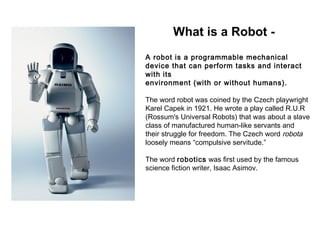
A robot is a programmable mechanical
device that can perform tasks and interact
with its
environment (with or without humans).
The word robot was coined by the Czech playwright
Karel Capek in 1921. He wrote a play called R.U.R
(Rossum's Universal Robots) that was about a slave
class of manufactured human-like servants and
their struggle for freedom. The Czech word robota
loosely means “compulsive servitude.”
The word robotics was first used by the famous
science fiction writer, Isaac Asimov.
What is a Robot -
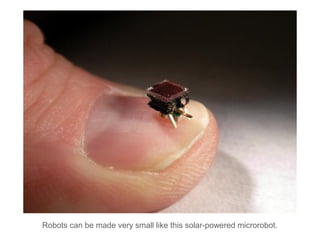
Robots can be made very small like this solar-powered microrobot.
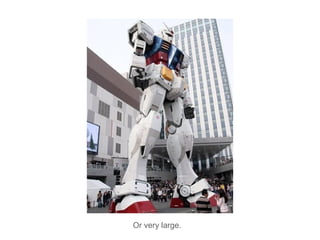
Or very large.
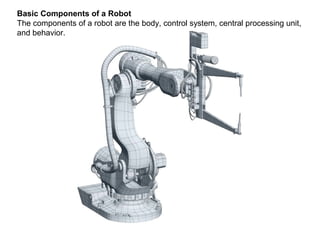
Basic Components of a Robot
The components of a robot are the body, control system, central processing unit,
and behavior.
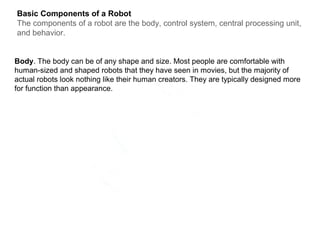
Body. The body can be of any shape and size. Most people are comfortable with
human-sized and shaped robots that they have seen in movies, but the majority of
actual robots look nothing like their human creators. They are typically designed more
for function than appearance.
Basic Components of a Robot
The components of a robot are the body, control system, central processing unit,
and behavior.
Body. The body can be of any shape and size. Most people are comfortable with
human-sized and shaped robots that they have seen in movies, but the majority of
actual robots look nothing like their human creators. They are typically designed more
for function than appearance.
Control System. The control system is a program that tells the robot how to act in
different circumstances and the electronics that process the information. This
programming can be very simple or extraordinarily complex, but it is designed to allow
the machine to react to its environment through code or sensory input (touch,
temperature, and light sensors). The program is the robot's set of
instructions.
Basic Components of a Robot
The components of a robot are the body, control system, central processing unit,
and behavior.
Body. The body can be of any shape and size. Most people are comfortable with
human-sized and shaped robots that they have seen in movies, but the majority of
actual robots look nothing like their human creators. They are typically designed more
for function than appearance.
Control System. The control system is a program that tells the robot how to act in
different circumstances and the electronics that process the information. This
programming can be very simple or extraordinarily complex, but it is designed to allow
the machine to react to its environment through code or sensory input (touch,
temperature, and light sensors). The program is the robot's set of
instructions.
Central Processing Unit. The Central Processing Unit (CPU) of a robot directs its
behavior in response to different circumstances or inputs. If not autonomous, the robot
must be able to receive human instructions that define its tasks. It must also receive
input from sensors that provide information on its position and environment.
Basic Components of a Robot
The components of a robot are the body, control system, central processing unit,
and behavior.
Body. The body can be of any shape and size. Most people are comfortable with
human-sized and shaped robots that they have seen in movies, but the majority of
actual robots look nothing like their human creators. They are typically designed more
for function than appearance.
Control System. The control system is a program that tells the robot how to act in
different circumstances and the electronics that process the information. This
programming can be very simple or extraordinarily complex, but it is designed to allow
the machine to react to its environment through code or sensory input (touch,
temperature, and light sensors). The program is the robot's set of
instructions.
Central Processing Unit. The Central Processing Unit (CPU) of a robot directs its
behavior in response to different circumstances or inputs. If not autonomous, the robot
must be able to receive human instructions that define its tasks. It must also receive
input from sensors that provide information on its position and environment.
Behavior. Behavior is exhibited in response to different inputs. The output devices of
a robot are how the robot exhibits its behavior.
Basic Components of a Robot
The components of a robot are the body, control system, central processing unit,
and behavior.
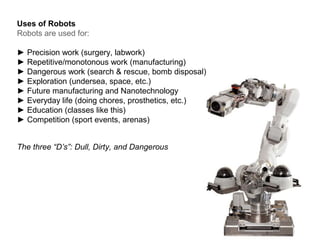
Uses of Robots
Robots are used for:
► Precision work (surgery, labwork)
► Repetitive/monotonous work (manufacturing)
► Dangerous work (search & rescue, bomb disposal)
► Exploration (undersea, space, etc.)
► Future manufacturing and Nanotechnology
► Everyday life (doing chores, prosthetics, etc.)
► Education (classes like this)
► Competition (sport events, arenas)
The three “D’s”: Dull, Dirty, and Dangerous
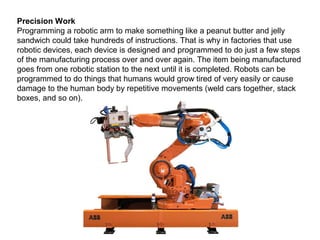
Precision Work
Programming a robotic arm to make something like a peanut butter and jelly
sandwich could take hundreds of instructions. That is why in factories that use
robotic devices, each device is designed and programmed to do just a few steps
of the manufacturing process over and over again. The item being manufactured
goes from one robotic station to the next until it is completed. Robots can be
programmed to do things that humans would grow tired of very easily or cause
damage to the human body by repetitive movements (weld cars together, stack
boxes, and so on).
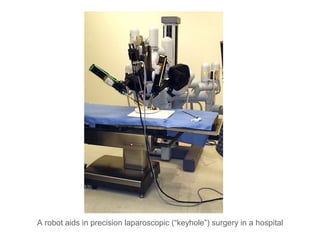
A robot aids in precision laparoscopic (“keyhole”) surgery in a hospital
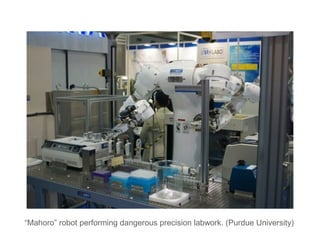
“Mahoro” robot performing dangerous precision labwork. (Purdue University)
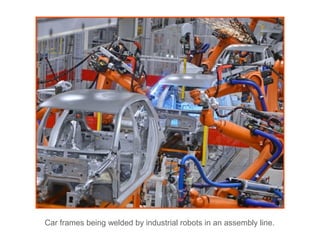
Car frames being welded by industrial robots in an assembly line.
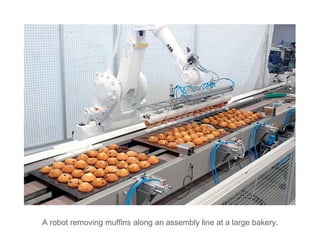
A robot removing muffins along an assembly line at a large bakery.
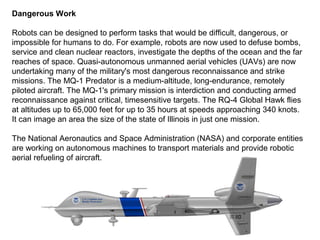
Dangerous Work
Robots can be designed to perform tasks that would be difficult, dangerous, or
impossible for humans to do. For example, robots are now used to defuse bombs,
service and clean nuclear reactors, investigate the depths of the ocean and the far
reaches of space. Quasi-autonomous unmanned aerial vehicles (UAVs) are now
undertaking many of the military's most dangerous reconnaissance and strike
missions. The MQ-1 Predator is a medium-altitude, long-endurance, remotely
piloted aircraft. The MQ-1's primary mission is interdiction and conducting armed
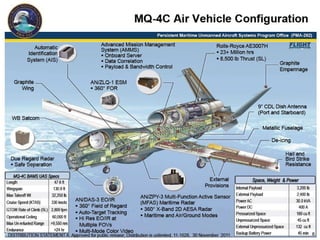
reconnaissance against critical, timesensitive targets. The RQ-4 Global Hawk flies
at altitudes up to 65,000 feet for up to 35 hours at speeds approaching 340 knots.
It can image an area the size of the state of Illinois in just one mission.
The National Aeronautics and Space Administration (NASA) and corporate entities
are working on autonomous machines to transport materials and provide robotic
aerial refueling of aircraft.
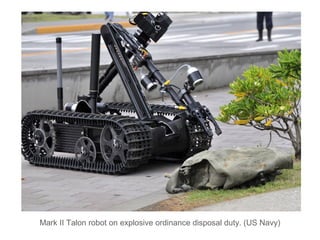
Mark II Talon robot on explosive ordinance disposal duty. (US Navy)
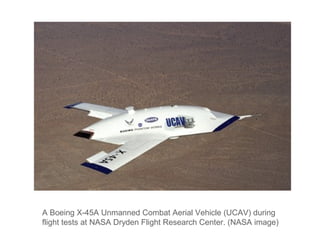
A Boeing X-45A Unmanned Combat Aerial Vehicle (UCAV) during
flight tests at NASA Dryden Flight Research Center. (NASA image)
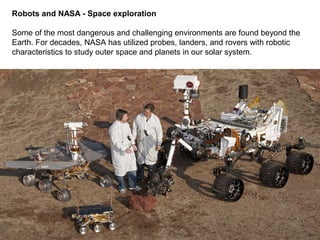
Robots and NASA - Space exploration
Some of the most dangerous and challenging environments are found beyond the
Earth. For decades, NASA has utilized probes, landers, and rovers with robotic
characteristics to study outer space and planets in our solar system.
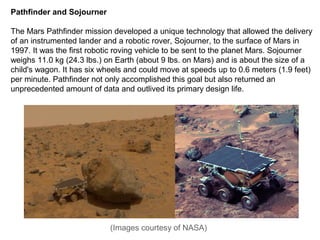
Pathfinder and Sojourner
The Mars Pathfinder mission developed a unique technology that allowed the delivery
of an instrumented lander and a robotic rover, Sojourner, to the surface of Mars in
1997. It was the first robotic roving vehicle to be sent to the planet Mars. Sojourner
weighs 11.0 kg (24.3 lbs.) on Earth (about 9 lbs. on Mars) and is about the size of a
child's wagon. It has six wheels and could move at speeds up to 0.6 meters (1.9 feet)
per minute. Pathfinder not only accomplished this goal but also returned an
unprecedented amount of data and outlived its primary design life.
(Images courtesy of NASA)
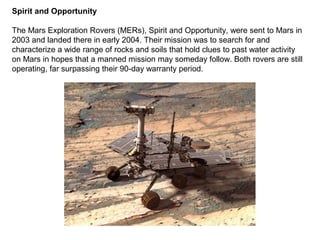
Spirit and Opportunity
The Mars Exploration Rovers (MERs), Spirit and Opportunity, were sent to Mars in
2003 and landed there in early 2004. Their mission was to search for and
characterize a wide range of rocks and soils that hold clues to past water activity
on Mars in hopes that a manned mission may someday follow. Both rovers are still
operating, far surpassing their 90-day warranty period.
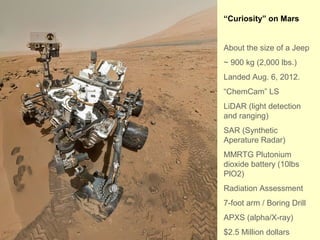
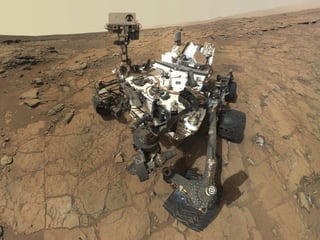
“Curiosity” on Mars
About the size of a Jeep
~ 900 kg (2,000 lbs.)
Landed Aug. 6, 2012.
“ChemCam” LS
LiDAR (light detection
and ranging)
SAR (Synthetic
Aperature Radar)
MMRTG Plutonium
dioxide battery (10lbs
PlO2)
Radiation Assessment
7-foot arm / Boring Drill
APXS (alpha/X-ray)
$2.5 Million dollars
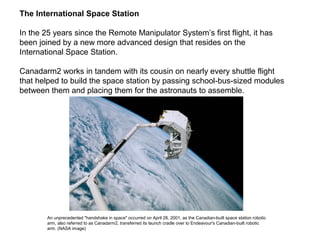
The International Space Station
In the 25 years since the Remote Manipulator System’s first flight, it has
been joined by a new more advanced design that resides on the
International Space Station.
Canadarm2 works in tandem with its cousin on nearly every shuttle flight
that helped to build the space station by passing school-bus-sized modules
between them and placing them for the astronauts to assemble.
An unprecedented "handshake in space" occurred on April 28, 2001, as the Canadian-built space station robotic
arm, also referred to as Canadarm2, transferred its launch cradle over to Endeavour's Canadian-built robotic
arm. (NASA image)
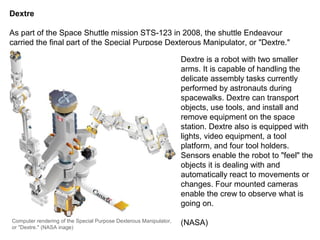
Dextre
As part of the Space Shuttle mission STS-123 in 2008, the shuttle Endeavour
carried the final part of the Special Purpose Dexterous Manipulator, or "Dextre."
Dextre is a robot with two smaller
arms. It is capable of handling the
delicate assembly tasks currently
performed by astronauts during
spacewalks. Dextre can transport
objects, use tools, and install and
remove equipment on the space
station. Dextre also is equipped with
lights, video equipment, a tool
platform, and four tool holders.
Sensors enable the robot to "feel" the
objects it is dealing with and
automatically react to movements or
changes. Four mounted cameras
enable the crew to observe what is
going on.
(NASA)Computer rendering of the Special Purpose Dexterous Manipulator,
or "Dextre." (NASA inage)
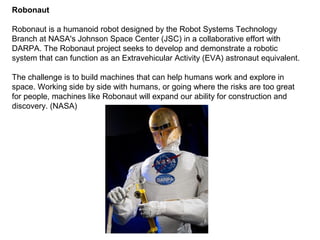
Robonaut
Robonaut is a humanoid robot designed by the Robot Systems Technology
Branch at NASA's Johnson Space Center (JSC) in a collaborative effort with
DARPA. The Robonaut project seeks to develop and demonstrate a robotic
system that can function as an Extravehicular Activity (EVA) astronaut equivalent.
The challenge is to build machines that can help humans work and explore in
space. Working side by side with humans, or going where the risks are too great
for people, machines like Robonaut will expand our ability for construction and
discovery. (NASA)
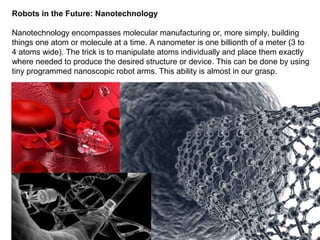
Robots in the Future: Nanotechnology
Nanotechnology encompasses molecular manufacturing or, more simply, building
things one atom or molecule at a time. A nanometer is one billionth of a meter (3 to
4 atoms wide). The trick is to manipulate atoms individually and place them exactly
where needed to produce the desired structure or device. This can be done by using
tiny programmed nanoscopic robot arms. This ability is almost in our grasp.
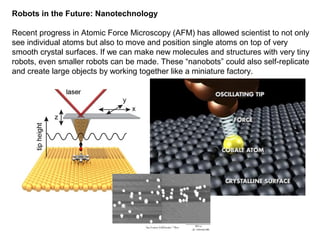
Robots in the Future: Nanotechnology
Recent progress in Atomic Force Microscopy (AFM) has allowed scientist to not only
see individual atoms but also to move and position single atoms on top of very
smooth crystal surfaces. If we can make new molecules and structures with very tiny
robots, even smaller robots can be made. These “nanobots” could also self-replicate
and create large objects by working together like a miniature factory.
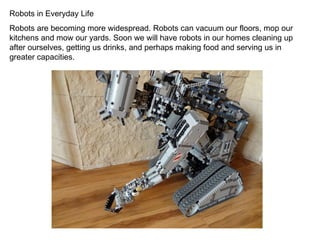
Robots in Everyday Life
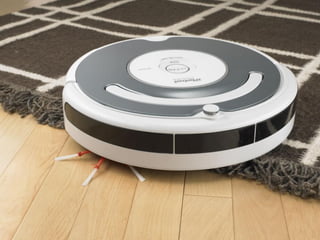
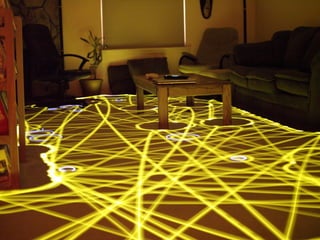
Robots are becoming more widespread. Robots can vacuum our floors, mop our
kitchens and mow our yards. Soon we will have robots in our homes cleaning up
after ourselves, getting us drinks, and perhaps making food and serving us in
greater capacities.
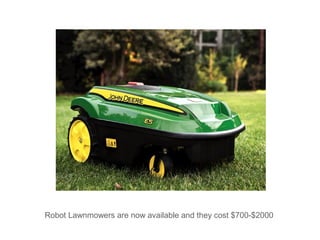
Robot Lawnmowers are now available and they cost $700-$2000
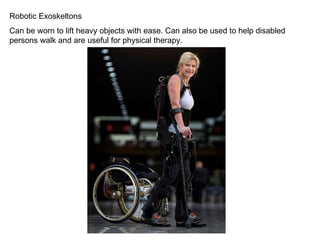
Robotic Exoskeltons
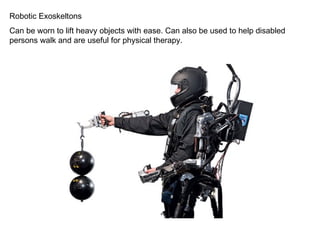
Can be worn to lift heavy objects with ease. Can also be used to help disabled
persons walk and are useful for physical therapy.
Robotic Exoskeltons
Can be worn to lift heavy objects with ease. Can also be used to help disabled
persons walk and are useful for physical therapy.
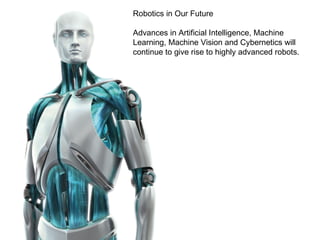
Robotics in Our Future
Advances in Artificial Intelligence, Machine
Learning, Machine Vision and Cybernetics will
continue to give rise to highly advanced robots.
Robotics in Our Future
Advances in Artificial Intelligence, Machine
Learning, Machine Vision and Cybernetics will
continue to give rise to highly advanced robots.
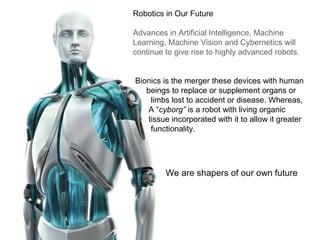
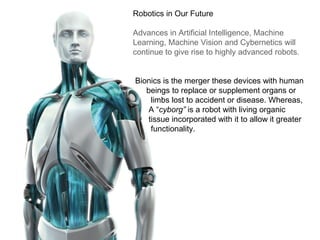
Bionics is the merger these devices with human
beings to replace or supplement organs or
limbs lost to accident or disease. Whereas,
A “cyborg” is a robot with living organic
tissue incorporated with it to allow it greater
functionality.
Robotics in Our Future
Advances in Artificial Intelligence, Machine
Learning, Machine Vision and Cybernetics will
continue to give rise to highly advanced robots.
Bionics is the merger these devices with human
beings to replace or supplement organs or
limbs lost to accident or disease. Whereas,
A “cyborg” is a robot with living organic
tissue incorporated with it to allow it greater
functionality.
We are shapers of our own future
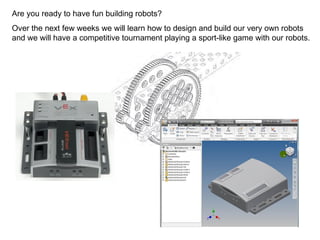
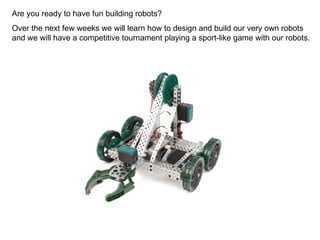
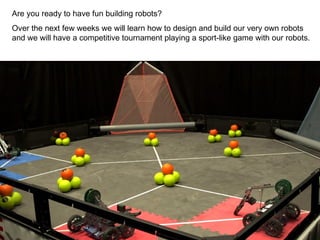
Are you ready to have fun building robots?
Over the next few weeks we will learn how to design and build our very own robots
and we will have a competitive tournament playing a sport-like game with our robots.
Are you ready to have fun building robots?
Over the next few weeks we will learn how to design and build our very own robots
and we will have a competitive tournament playing a sport-like game with our robots.
Are you ready to have fun building robots?
Over the next few weeks we will learn how to design and build our very own robots
and we will have a competitive tournament playing a sport-like game with our robots.

Unit 1 - Introduction to robotics

  • 2.
    Jonathan Fosdick, Instructor Thiscourse will familiarize you with robotics. You will learn how robots work and how to build your own robots. You will discover how robots are used in everyday life, and how they are used in manufacturing, search and rescue, medicine, space exploration, and in the home. Robots are soon becoming smarter, better and cheaper to make. Very soon you will see more of them helping us live, work, and enjoy life. During the next few weeks, you will learn the principles behind how robots work, how they are designed, assembled, and how they function. You will learn how they are controlled and programmed, and how they sense and move to perform tasks. At the end of this course you will work in small teams to design and build a mobile robot to play a sport-like game. At the culmination of this class, you will compete head-to-head against others in the classroom. This course will not only be fun but also will be rewarding to you and the future.
  • 3.
    A robot isa programmable mechanical device that can perform tasks and interact with its environment (with or without humans). The word robot was coined by the Czech playwright Karel Capek in 1921. He wrote a play called R.U.R (Rossum's Universal Robots) that was about a slave class of manufactured human-like servants and their struggle for freedom. The Czech word robota loosely means “compulsive servitude.” The word robotics was first used by the famous science fiction writer, Isaac Asimov. What is a Robot -
  • 4.
    Robots can bemade very small like this solar-powered microrobot.
  • 5.
  • 6.
    Basic Components ofa Robot The components of a robot are the body, control system, central processing unit, and behavior.
  • 7.
    Body. The bodycan be of any shape and size. Most people are comfortable with human-sized and shaped robots that they have seen in movies, but the majority of actual robots look nothing like their human creators. They are typically designed more for function than appearance. Basic Components of a Robot The components of a robot are the body, control system, central processing unit, and behavior.
  • 8.
    Body. The bodycan be of any shape and size. Most people are comfortable with human-sized and shaped robots that they have seen in movies, but the majority of actual robots look nothing like their human creators. They are typically designed more for function than appearance. Control System. The control system is a program that tells the robot how to act in different circumstances and the electronics that process the information. This programming can be very simple or extraordinarily complex, but it is designed to allow the machine to react to its environment through code or sensory input (touch, temperature, and light sensors). The program is the robot's set of instructions. Basic Components of a Robot The components of a robot are the body, control system, central processing unit, and behavior.
  • 9.
    Body. The bodycan be of any shape and size. Most people are comfortable with human-sized and shaped robots that they have seen in movies, but the majority of actual robots look nothing like their human creators. They are typically designed more for function than appearance. Control System. The control system is a program that tells the robot how to act in different circumstances and the electronics that process the information. This programming can be very simple or extraordinarily complex, but it is designed to allow the machine to react to its environment through code or sensory input (touch, temperature, and light sensors). The program is the robot's set of instructions. Central Processing Unit. The Central Processing Unit (CPU) of a robot directs its behavior in response to different circumstances or inputs. If not autonomous, the robot must be able to receive human instructions that define its tasks. It must also receive input from sensors that provide information on its position and environment. Basic Components of a Robot The components of a robot are the body, control system, central processing unit, and behavior.
  • 10.
    Body. The bodycan be of any shape and size. Most people are comfortable with human-sized and shaped robots that they have seen in movies, but the majority of actual robots look nothing like their human creators. They are typically designed more for function than appearance. Control System. The control system is a program that tells the robot how to act in different circumstances and the electronics that process the information. This programming can be very simple or extraordinarily complex, but it is designed to allow the machine to react to its environment through code or sensory input (touch, temperature, and light sensors). The program is the robot's set of instructions. Central Processing Unit. The Central Processing Unit (CPU) of a robot directs its behavior in response to different circumstances or inputs. If not autonomous, the robot must be able to receive human instructions that define its tasks. It must also receive input from sensors that provide information on its position and environment. Behavior. Behavior is exhibited in response to different inputs. The output devices of a robot are how the robot exhibits its behavior. Basic Components of a Robot The components of a robot are the body, control system, central processing unit, and behavior.
  • 11.
    Uses of Robots Robotsare used for: ► Precision work (surgery, labwork) ► Repetitive/monotonous work (manufacturing) ► Dangerous work (search & rescue, bomb disposal) ► Exploration (undersea, space, etc.) ► Future manufacturing and Nanotechnology ► Everyday life (doing chores, prosthetics, etc.) ► Education (classes like this) ► Competition (sport events, arenas) The three “D’s”: Dull, Dirty, and Dangerous
  • 12.
    Precision Work Programming arobotic arm to make something like a peanut butter and jelly sandwich could take hundreds of instructions. That is why in factories that use robotic devices, each device is designed and programmed to do just a few steps of the manufacturing process over and over again. The item being manufactured goes from one robotic station to the next until it is completed. Robots can be programmed to do things that humans would grow tired of very easily or cause damage to the human body by repetitive movements (weld cars together, stack boxes, and so on).
  • 13.
    A robot aidsin precision laparoscopic (“keyhole”) surgery in a hospital
  • 14.
    “Mahoro” robot performingdangerous precision labwork. (Purdue University)
  • 15.
    Car frames beingwelded by industrial robots in an assembly line.
  • 16.
    A robot removingmuffins along an assembly line at a large bakery.
  • 17.
    Dangerous Work Robots canbe designed to perform tasks that would be difficult, dangerous, or impossible for humans to do. For example, robots are now used to defuse bombs, service and clean nuclear reactors, investigate the depths of the ocean and the far reaches of space. Quasi-autonomous unmanned aerial vehicles (UAVs) are now undertaking many of the military's most dangerous reconnaissance and strike missions. The MQ-1 Predator is a medium-altitude, long-endurance, remotely piloted aircraft. The MQ-1's primary mission is interdiction and conducting armed reconnaissance against critical, timesensitive targets. The RQ-4 Global Hawk flies at altitudes up to 65,000 feet for up to 35 hours at speeds approaching 340 knots. It can image an area the size of the state of Illinois in just one mission. The National Aeronautics and Space Administration (NASA) and corporate entities are working on autonomous machines to transport materials and provide robotic aerial refueling of aircraft.
  • 18.
    Mark II Talonrobot on explosive ordinance disposal duty. (US Navy)
  • 20.
    A Boeing X-45AUnmanned Combat Aerial Vehicle (UCAV) during flight tests at NASA Dryden Flight Research Center. (NASA image)
  • 21.
    Robots and NASA- Space exploration Some of the most dangerous and challenging environments are found beyond the Earth. For decades, NASA has utilized probes, landers, and rovers with robotic characteristics to study outer space and planets in our solar system.
  • 22.
    Pathfinder and Sojourner TheMars Pathfinder mission developed a unique technology that allowed the delivery of an instrumented lander and a robotic rover, Sojourner, to the surface of Mars in 1997. It was the first robotic roving vehicle to be sent to the planet Mars. Sojourner weighs 11.0 kg (24.3 lbs.) on Earth (about 9 lbs. on Mars) and is about the size of a child's wagon. It has six wheels and could move at speeds up to 0.6 meters (1.9 feet) per minute. Pathfinder not only accomplished this goal but also returned an unprecedented amount of data and outlived its primary design life. (Images courtesy of NASA)
  • 23.
    Spirit and Opportunity TheMars Exploration Rovers (MERs), Spirit and Opportunity, were sent to Mars in 2003 and landed there in early 2004. Their mission was to search for and characterize a wide range of rocks and soils that hold clues to past water activity on Mars in hopes that a manned mission may someday follow. Both rovers are still operating, far surpassing their 90-day warranty period.
  • 24.
    “Curiosity” on Mars Aboutthe size of a Jeep ~ 900 kg (2,000 lbs.) Landed Aug. 6, 2012. “ChemCam” LS LiDAR (light detection and ranging) SAR (Synthetic Aperature Radar) MMRTG Plutonium dioxide battery (10lbs PlO2) Radiation Assessment 7-foot arm / Boring Drill APXS (alpha/X-ray) $2.5 Million dollars
  • 26.
    The International SpaceStation In the 25 years since the Remote Manipulator System’s first flight, it has been joined by a new more advanced design that resides on the International Space Station. Canadarm2 works in tandem with its cousin on nearly every shuttle flight that helped to build the space station by passing school-bus-sized modules between them and placing them for the astronauts to assemble. An unprecedented "handshake in space" occurred on April 28, 2001, as the Canadian-built space station robotic arm, also referred to as Canadarm2, transferred its launch cradle over to Endeavour's Canadian-built robotic arm. (NASA image)
  • 27.
    Dextre As part ofthe Space Shuttle mission STS-123 in 2008, the shuttle Endeavour carried the final part of the Special Purpose Dexterous Manipulator, or "Dextre." Dextre is a robot with two smaller arms. It is capable of handling the delicate assembly tasks currently performed by astronauts during spacewalks. Dextre can transport objects, use tools, and install and remove equipment on the space station. Dextre also is equipped with lights, video equipment, a tool platform, and four tool holders. Sensors enable the robot to "feel" the objects it is dealing with and automatically react to movements or changes. Four mounted cameras enable the crew to observe what is going on. (NASA)Computer rendering of the Special Purpose Dexterous Manipulator, or "Dextre." (NASA inage)
  • 28.
    Robonaut Robonaut is ahumanoid robot designed by the Robot Systems Technology Branch at NASA's Johnson Space Center (JSC) in a collaborative effort with DARPA. The Robonaut project seeks to develop and demonstrate a robotic system that can function as an Extravehicular Activity (EVA) astronaut equivalent. The challenge is to build machines that can help humans work and explore in space. Working side by side with humans, or going where the risks are too great for people, machines like Robonaut will expand our ability for construction and discovery. (NASA)
  • 29.
    Robots in theFuture: Nanotechnology Nanotechnology encompasses molecular manufacturing or, more simply, building things one atom or molecule at a time. A nanometer is one billionth of a meter (3 to 4 atoms wide). The trick is to manipulate atoms individually and place them exactly where needed to produce the desired structure or device. This can be done by using tiny programmed nanoscopic robot arms. This ability is almost in our grasp.
  • 30.
    Robots in theFuture: Nanotechnology Recent progress in Atomic Force Microscopy (AFM) has allowed scientist to not only see individual atoms but also to move and position single atoms on top of very smooth crystal surfaces. If we can make new molecules and structures with very tiny robots, even smaller robots can be made. These “nanobots” could also self-replicate and create large objects by working together like a miniature factory.
  • 31.
    Robots in EverydayLife Robots are becoming more widespread. Robots can vacuum our floors, mop our kitchens and mow our yards. Soon we will have robots in our homes cleaning up after ourselves, getting us drinks, and perhaps making food and serving us in greater capacities.
  • 34.
    Robot Lawnmowers arenow available and they cost $700-$2000
  • 35.
    Robotic Exoskeltons Can beworn to lift heavy objects with ease. Can also be used to help disabled persons walk and are useful for physical therapy.
  • 36.
    Robotic Exoskeltons Can beworn to lift heavy objects with ease. Can also be used to help disabled persons walk and are useful for physical therapy.
  • 37.
    Robotics in OurFuture Advances in Artificial Intelligence, Machine Learning, Machine Vision and Cybernetics will continue to give rise to highly advanced robots.
  • 38.
    Robotics in OurFuture Advances in Artificial Intelligence, Machine Learning, Machine Vision and Cybernetics will continue to give rise to highly advanced robots. Bionics is the merger these devices with human beings to replace or supplement organs or limbs lost to accident or disease. Whereas, A “cyborg” is a robot with living organic tissue incorporated with it to allow it greater functionality.
  • 39.
    Robotics in OurFuture Advances in Artificial Intelligence, Machine Learning, Machine Vision and Cybernetics will continue to give rise to highly advanced robots. Bionics is the merger these devices with human beings to replace or supplement organs or limbs lost to accident or disease. Whereas, A “cyborg” is a robot with living organic tissue incorporated with it to allow it greater functionality. We are shapers of our own future
  • 40.
    Are you readyto have fun building robots? Over the next few weeks we will learn how to design and build our very own robots and we will have a competitive tournament playing a sport-like game with our robots.
  • 41.
    Are you readyto have fun building robots? Over the next few weeks we will learn how to design and build our very own robots and we will have a competitive tournament playing a sport-like game with our robots.
  • 42.
    Are you readyto have fun building robots? Over the next few weeks we will learn how to design and build our very own robots and we will have a competitive tournament playing a sport-like game with our robots.