Flat Roofer Safety
August 2016
2
June 2015
3
• Whelan was on the scene of a
Dumpster fire that broke out
near an abandoned building at
3860 Blake Street, DFD Lt.
Mike Pylar said.
• He was on the roof to see if the
damage extended beyond the
outside of the building when the
skylight collapsed, Pylar said.
May 2015
• The anchor is safe to use on wet surfaces
but NOT shiny or slippery surfaces
• 8 feet back from edge
• Eco Anchor
4
May 2015
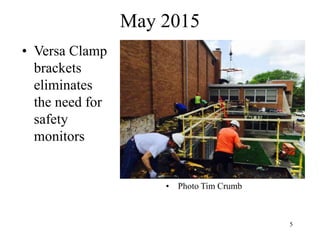
• Versa Clamp
brackets
eliminates
the need for
safety
monitors
• Photo Tim Crumb
5
February 2015
• Canton MA
• The victim and another worker
were on the roof assessing snow
removal operations.
• They separated and one person
walked across a skylight that
had been covered by the snow.
• The light gave way and he fell
40 feet to his death.
6
A Company 2014
• A contractor was hired to
review all potential fall hazards
at the site.
• In response to this review, the
site has installed fall protection
on the roof to protect HVAC,
and other contract employees,
from falls.
• Guardrails were installed at
edges and designated walkways
to the HVAC units were
delineated.
• Guardrails were also installed
around skylights.
Roof Safe Distance
• A warning line is used 15 feet
or more from the edge;
• The warning line meets or
exceeds the requirements in
§1926.502(f)(2);
• No work or work-related
activity is to take place in the
area between the warning line
and the edge;
• The employer effectively
implements a work rule
prohibiting the employees from
going past the warning line.
https://www.osha.gov/pls/oshaweb/owadisp.s
how_document?p_table=INTERPRETATION
S&p_id=24682
8
Work on low-
slope roofs
• When work is performed
less than 6 feet (1.6 m)
from the roof edge, the
employer must ensure
each employee is
protected from falling by a
guardrail system, safety
net system, travel
restraint system, or
personal fall arrest
system.
1910.28(b)(13)(i)
Low Sloped Roofs
• When work is performed
at least 6 feet (1.6 m) but
less than 15 feet (4.6 m)
from the roof edge, the
employer must ensure
each employee is
protected from falling by
using a guardrail system,
safety net system, travel
restraint system, or
personal fall arrest
system.
1910.28(b)(13)(ii)
Flat Roofs
• When work is performed 15 feet (4.6
m) or more from the roof edge, the
employer must:
• (A) Protect each employee from
falling by a guardrail system, safety
net system, travel restraint system, or
personal fall arrest system or a
designated area. The employer is not
required to provide any fall
protection, provided the work is both
infrequent and temporary; and
• (B) Implement and enforce a work
rule prohibiting employees from
going within 15 feet (4.6 m) of the
roof edge without using fall
protection in accordance with
paragraphs (b)(13)(i) and (ii) of this
section.
1910.28(b)(13)(iii)
Travel Restraint
• 5000 lbs anchorage
• Cannot free fall to
lower level
• Travel restraint
systems are only
permitted on a
walking/working
surface with a slope of
between 0 and 18.4
degrees.
12
May 2016
• “1700 pages of discovery
later and they folded like a
cheap suit.”
• “The issue is that 2
employees were wearing
orange jackets. When the
CSHO was taking photos at
915am there was an
employee signaling the
crane.
• When the CSHO came back
at 1pm - Foreman was
monitoring and also wearing
an orange jacket.”
Roofs
• Shoveling snow
presents a serious
slipping and fall
hazard.
14
Skylights
• Skylights need to be
covered with a barrier if
employees are allowed onto
the roof.
15
July 2014
• Henderson NV Police and Fire
Department officials responded
at about 10:30 a.m. Saturday to
reports that a man had fallen
through a skylight at the Ocean
Spray facility
16
He was my dad, thank you everybody, I am McKenzie Lane Lentz, 16.
Harry's youngest daughter . I hold them 1OO% responsible . I miss him
with all my heart . I can never see his face again . He was my everything .
Roof Anchorages
• Two lives saved
through roofs
• One skylight
• Another through a
bad roof.
17
Parapet Fall Protection
• Several types are
available.
18
Fall Protection In Chicagoland
• 635 inspections 3 offices
• 2000 violations
• $2.3M penalties
• Roofs and scaffolds
• Fallpro, training, ladders
View from the Street
Roofer at Edge of Roof
Employee at Edge
Placing Cap on Parapet
Roofers at Edge
Hazard Recognition
25
View from the Roof
No Safety Monitor
No Warning Line
Safety Monitor- No Warning Flags
No Flags/Safety Monitor
Employee at Edge
Warning Lines
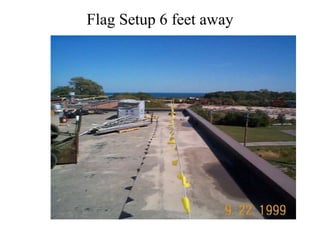
Flag Setup 6 feet away
Perimeter Flags Used
Safety Monitor
Monitor Used
Outside of Warning Lines
Monitor With Flags Too Close
Employee at Edge
Impact Point
Hoist Areas
Roof Hoist with No Guardrails
Crane Used to Load Roofing Material
Hoist Area Guarded
No Guardrail Hoist Area
Hoist Area
Crane Material Handling
Hot Pipe Protection
Guardrail Hot Pipe (JF 20-3)
Improper Guardrail
Employee Outside Guardrail
Hot Pipe Inside Flags
Debris Protection
Guardrail Provided
Guardrails Around Chute
Trash Chute
No Chute for Debris
Guardrail at Chute
Debris Guardrails Provided
Parapets
Parapet Wall > 19”
Parapet Wall Guardrail Height
Guardrail Setup
Guardrail at Hopper
Guardrails
Guardrails at Edge
Roof Openings
Passive Fall Protection
• Portable Guardrails
can be used to
protect against
falls.
68
Roof Opening Covering
Roof Opening
Guarded Roof Opening
Improper Guardrail
Roof Opening Not Guarded
Unguarded Roof Opening
Employees on Roof
Skylight Guarded
Unprotected Skylights
Skylights Not guarded
Open Skylight
Fall Arrest
Debris
Lanyard
Ladder Access Designation
Poor Ladder Setup
No Ladder Designation
Ladder Access Too Low
Ladder- No designation
Ladder Too Short
Material Storage
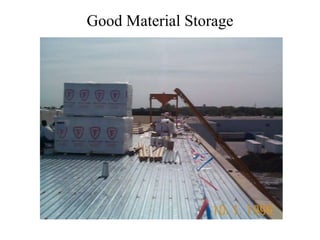
Good Material Storage
Improper Material Storage
Poor Material Storage
Roof Damage
Roof Marking
Hole in Roof
Roof Equipment
Roof Kettles
• Provide Containment
• Working temperature
guages
• LPG 10 feet away
• 2 Fire Extinguishers
• Spigot turnout in event
of fire
• Training and Fire
Prevention

Flat roof 2017