John Segota, CAE
Associate Executive Director for Public Policy & Professional Relations

TESOL International Association

Washington State University
7 January 2014

1


1/7/14
TESOL International Association
•  More than 12,000
members 
•  Representing 156
countries
•  100+ affiliates worldwide
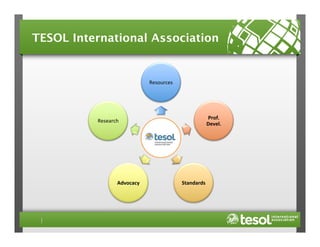
TESOL International Association

Resources	
  

Research	
  

Prof.	
  
Devel.	


Advocacy	
  

Standards	
  
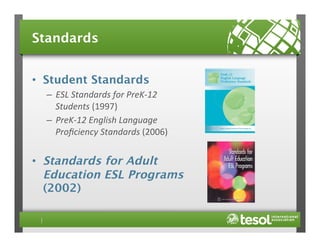
Standards
•  Student Standards
–  ESL	
  Standards	
  for	
  PreK-­‐12	
  
Students	
  (1997)	
  
–  PreK-­‐12	
  English	
  Language	
  
Proficiency	
  Standards	
  (2006)	
  

•  Standards for Adult

Education ESL Programs

(2002)
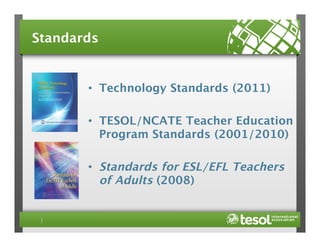
Standards

•  Technology Standards (2011)
•  TESOL/NCATE Teacher Education
Program Standards (2001/2010)

•  Standards for ESL/EFL Teachers
of Adults (2008)
Standards for Teachers of Adults
•  Performance-based


•  Support and sustain
student learning


•  Applicable to a
variety of settings
Andragogy
1.  Need to Know
2.  Foundation
3.  Self-concept
4.  Readiness
5.  Orientation
6.  Motivation
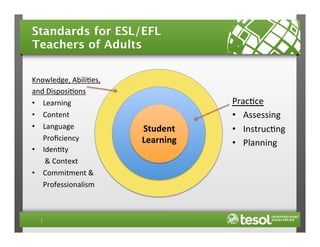
Standards for ESL/EFL 

Teachers of Adults
Knowledge,	
  Abili4es,	
  
and	
  Disposi4ons	
  
•  Learning	
  
•  Content	
  
•  Language	
  
Proficiency	
  
•  Iden4ty	
  
	
  &	
  Context	
  
•  Commitment	
  &	
  
Professionalism	


Student	
  
Learning	
  

Prac4ce	
  
•  Assessing	
  
•  Instruc4ng	
  
•  Planning	
  
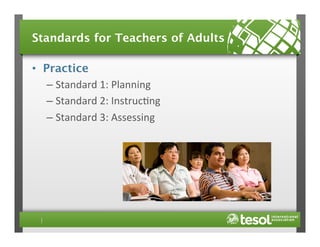
Standards for Teachers of Adults
•  Practice
–  Standard	
  1:	
  Planning	
  
–  Standard	
  2:	
  Instruc4ng	
  
–  Standard	
  3:	
  Assessing	
  
Standard 1
Planning
Teachers	
  plan	
  instruc4on	
  to	
  promote	
  learning	
  
and	
  meet	
  learner	
  goals,	
  and	
  modify	
  plans	
  to	
  
assure	
  learner	
  engagement	
  and	
  achievement.	
  
Standard 1
Planning
–  1.1	
  Overall	
  Planning	
  
–  1.2	
  Learner	
  Considera4ons	
  
–  1.3	
  Lesson	
  Planning	
  
–  1.4	
  Ac4vi4es	
  and	
  Strategies	
  
–  1.5	
  Resources	
  
Planning
1.2 Learner Considerations
–  Iden4fies	
  learners’	
  interest	
  and	
  integrates	
  
into	
  planning	
  
–  Iden4fies	
  learners’	
  needs	
  and	
  integrates	
  into	
  
planning	
  
–  Iden4fies	
  learners’	
  prior	
  learning	
  and	
  
background	
  knowledge	
  and	
  integrates	
  into	
  
planning	
  
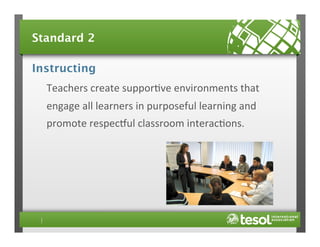
Standard 2
Instructing
Teachers	
  create	
  suppor4ve	
  environments	
  that	
  
engage	
  all	
  learners	
  in	
  purposeful	
  learning	
  and	
  
promote	
  respecVul	
  classroom	
  interac4ons.	
  
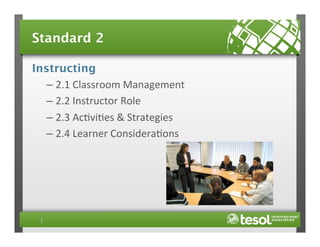
Standard 2
Instructing
–  2.1	
  Classroom	
  Management	
  
–  2.2	
  Instructor	
  Role	
  
–  2.3	
  Ac4vi4es	
  &	
  Strategies	
  
–  2.4	
  Learner	
  Considera4ons	
  
Instructing
2.1 Classroom Management
–  Organizes	
  and	
  manages	
  construc4ve	
  
interac4ons	
  
–  Creates	
  an	
  environment	
  that	
  engages	
  all	
  
learners	
  
–  Makes	
  effec4ve	
  use	
  of	
  classroom	
  4me	
  
–  Manages	
  ac4vi4es	
  
–  Adjusts	
  instruc4ons	
  when	
  necessary	
  
–  Uses	
  unexpected	
  events	
  to	
  extend	
  learning	
  
Standard 3
Assessing
Teachers	
  recognize	
  the	
  importance	
  of	
  and	
  are	
  able	
  
to	
  gather	
  and	
  interpret	
  informa4on	
  about	
  learning	
  
and	
  performance	
  to	
  promote	
  the	
  con4nuous	
  
intellectual	
  and	
  linguis4c	
  development	
  of	
  each	
  
learner.	
  Teachers	
  use	
  knowledge	
  of	
  student	
  
performance	
  to	
  make	
  decisions	
  about	
  planning	
  
and	
  instruc4on	
  “on	
  the	
  spot”	
  and	
  for	
  the	
  future.	
  
Teachers	
  involve	
  learners	
  in	
  determining	
  what	
  will	
  
be	
  assessed	
  and	
  provide	
  construc4ve	
  feedback	
  to	
  
learners,	
  based	
  on	
  assessments	
  of	
  their	
  learning.	
  
Standard 3
Assessing
–  3.1	
  Need	
  for	
  Assessment	
  
–  3.2	
  Types	
  of	
  Assessment	
  
–  3.3	
  Evalua4on	
  of	
  Results	
  
–  3.4	
  Learner	
  Considera4ons	
  
–  3.5	
  Development	
  and	
  Changes	
  
Assessing
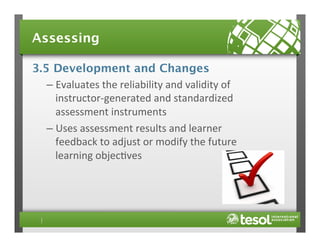
3.5 Development and Changes
–  Evaluates	
  the	
  reliability	
  and	
  validity	
  of	
  
instructor-­‐generated	
  and	
  standardized	
  
assessment	
  instruments	
  
–  Uses	
  assessment	
  results	
  and	
  learner	
  
feedback	
  to	
  adjust	
  or	
  modify	
  the	
  future	
  
learning	
  objec4ves	
  
Standards for Teachers of Adults
Knowledge, Abilities, and Dispositions
–  Standard	
  4:	
  Iden4ty	
  &	
  Context	
  
–  Standard	
  5:	
  Language	
  Proficiency	
  
–  Standard	
  6:	
  Learning	
  
–  Standard	
  7:	
  Content	
  
–  Standard	
  8:	
  Commitment	
  &	
  Professionalism	
  
Standard 4
Identity & Context
Teachers	
  understand	
  the	
  importance	
  of	
  who	
  
learner	
  are	
  and	
  how	
  their	
  communi4es,	
  
backgrounds,	
  and	
  goals	
  shape	
  learning	
  and	
  
expecta4ons	
  of	
  learning.	
  Teachers	
  recognize	
  
how	
  context	
  contributes	
  to	
  iden4ty	
  forma4on	
  
and	
  therefore	
  influences	
  learning.	
  Teacher	
  use	
  
this	
  knowledge	
  of	
  iden4ty	
  and	
  secngs	
  in	
  
planning,	
  instruc4ng,	
  and	
  assessing.	
  	
  
Standard 4
Identity & Context
–  4.1	
  Classroom	
  Environment	
  
–  4.2	
  Learner	
  Iden44es	
  
–  4.3	
  Instructor	
  Interac4on	
  
–  4.4	
  Learner	
  Communi4es	
  
Identity & Context
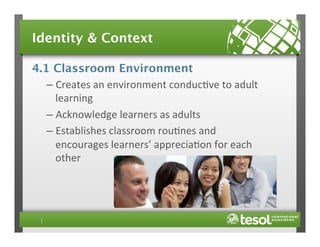
4.1 Classroom Environment
–  Creates	
  an	
  environment	
  conduc4ve	
  to	
  adult	
  
learning	
  
–  Acknowledge	
  learners	
  as	
  adults	
  
–  Establishes	
  classroom	
  rou4nes	
  and	
  
encourages	
  learners’	
  apprecia4on	
  for	
  each	
  
other	
  
Standard 5
Language Proficiency
Teachers	
  demonstrate	
  proficiency	
  in	
  social,	
  
business/workplace,	
  and	
  academic	
  English.	
  
Proficiency	
  is	
  speaking,	
  listening,	
  reading,	
  and	
  
wri4ng	
  means	
  that	
  a	
  teacher	
  is	
  func4onally	
  
equivalent	
  to	
  a	
  na4ve	
  speaker	
  with	
  some	
  
higher	
  educa4on.	
  
Standard 5
Language Proficiency
–  5.1	
  General	
  Proficiency	
  
–  5.2	
  Other	
  Contexts	
  
–  5.3	
  Classroom	
  Performance	
  
–  5.4	
  Nonna4ve	
  Advocate	
  
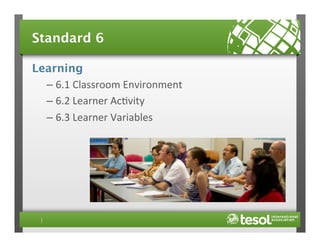
Standard 6
Learning
Teachers	
  draw	
  on	
  their	
  knowledge	
  of	
  language	
  
and	
  adult	
  language	
  learning	
  to	
  understand	
  the	
  
processes	
  by	
  which	
  learners	
  acquire	
  a	
  new	
  
language	
  in	
  and	
  out	
  of	
  classroom	
  secngs.	
  They	
  
use	
  this	
  knowledge	
  to	
  support	
  adult	
  language	
  
learning.	
  	
  
Standard 6
Learning
–  6.1	
  Classroom	
  Environment	
  
–  6.2	
  Learner	
  Ac4vity	
  
–  6.3	
  Learner	
  Variables	
  
Learning
•  6.2 Learner Activity
–  Provides	
  learning	
  experiences	
  that	
  promote	
  
autonomy	
  and	
  choice	
  
–  Provides	
  learning	
  experiences	
  that	
  promotes	
  
coopera4on	
  and	
  collabora4on	
  
–  Creates	
  classroom	
  context	
  in	
  which	
  learners	
  
can	
  nego4ate	
  meaning	
  through	
  interac4ons	
  
with	
  the	
  teach	
  and	
  one	
  another	
  
–  Creates	
  situa4ons	
  where	
  meaningful	
  
messages	
  are	
  exchanged	
  
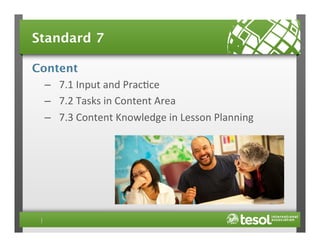
Standard 7
Content
Teachers	
  understand	
  that	
  language	
  learning	
  is	
  most	
  
likely	
  to	
  occur	
  when	
  learners	
  are	
  trying	
  to	
  use	
  the	
  
language	
  for	
  genuine	
  communica4ve	
  purposes.	
  
Teachers	
  understand	
  that	
  the	
  content	
  of	
  the	
  language	
  
course	
  is	
  the	
  language	
  that	
  learners	
  need	
  in	
  order	
  to	
  
discuss,	
  listen	
  to,	
  read,	
  and	
  write	
  about	
  a	
  subject	
  or	
  
content	
  area.	
  Teachers	
  design	
  their	
  lessons	
  to	
  help	
  
learners	
  acquire	
  the	
  language	
  they	
  need	
  to	
  successfully	
  
communicate	
  in	
  the	
  subject	
  or	
  content	
  areas	
  about	
  
which	
  they	
  want	
  or	
  need	
  to	
  learn.	
  
Standard 7
Content
–  7.1	
  Input	
  and	
  Prac4ce	
  
–  7.2	
  Tasks	
  in	
  Content	
  Area	
  
–  7.3	
  Content	
  Knowledge	
  in	
  Lesson	
  Planning	
  
Standard 8
Commitment and Professionalism
Teachers	
  con4nue	
  to	
  nuance	
  their	
  
understanding	
  of	
  the	
  rela4onships	
  between	
  
second	
  language	
  teaching	
  and	
  learning	
  through	
  
the	
  community	
  of	
  English	
  language	
  teaching	
  
professionals,	
  the	
  broader	
  teaching	
  
community,	
  and	
  the	
  community	
  at	
  large.	
  This	
  
knowledge,	
  in	
  turn,	
  informs	
  and	
  changes	
  both	
  
the	
  teachers	
  and	
  the	
  communi4es.	
  	
  
Standard 8
Commitment and Professionalism
–  8.1	
  Gaining	
  and	
  Using	
  Knowledge	
  
–  8.2	
  Skill	
  Development	
  
–  8.3	
  Advoca4ng	
  
Commitment & Professionalism
•  8.1 Gaining and Using Knowledge
–  Seeks	
  out,	
  interacts,	
  and	
  reflects	
  on	
  learning	
  
in	
  teaching	
  and	
  learning	
  communi4es	
  and	
  
shares	
  informa4on	
  with	
  the	
  teaching	
  
profession	
  
–  Seeks	
  out,	
  interacts,	
  and	
  reflects	
  on	
  students	
  
learning	
  and	
  shares	
  with	
  teaching	
  and	
  
learning	
  communi4es	
  
Commitment & Professionalism
•  8.1 Gaining and Using Knowledge
–  Seeks	
  out,	
  interacts,	
  and	
  reflects	
  on	
  
knowledge	
  about	
  learners’	
  communi4es	
  and	
  
shares	
  with	
  teaching	
  and	
  learning	
  
communi4es	
  
–  Pursues	
  other	
  opportuni4es	
  to	
  grow	
  
professionally	
  
Commitment & Professionalism
8.2 Skill Development
–  Is	
  developing	
  his	
  or	
  her	
  professional	
  voice	
  
–  Is	
  developing	
  personal	
  professional	
  
development	
  plan	
  
–  Con4nually	
  develops	
  his	
  or	
  her	
  knowledge	
  
and	
  skills	
  to	
  improve	
  instruc4onal	
  prac4ces	
  
–  Balances	
  professional	
  responsibili4es	
  with	
  
personal	
  needs	
  
John Segota, CAE
jsegota@tesol.org

http://www.SlideShare.net

Standards for ESL/EFL Teachers of Adults

  • 1.
    John Segota, CAE AssociateExecutive Director for Public Policy & Professional Relations TESOL International Association Washington State University 7 January 2014 1 1/7/14
  • 2.
    TESOL International Association • More than 12,000 members •  Representing 156 countries •  100+ affiliates worldwide
  • 3.
    TESOL International Association Resources   Research   Prof.   Devel.   Advocacy   Standards  
  • 4.
    Standards •  Student Standards – ESL  Standards  for  PreK-­‐12   Students  (1997)   –  PreK-­‐12  English  Language   Proficiency  Standards  (2006)   •  Standards for Adult
 Education ESL Programs
 (2002)
  • 5.
    Standards •  Technology Standards(2011) •  TESOL/NCATE Teacher Education Program Standards (2001/2010) •  Standards for ESL/EFL Teachers of Adults (2008)
  • 6.
    Standards for Teachersof Adults •  Performance-based
 •  Support and sustain student learning
 •  Applicable to a variety of settings
  • 7.
    Andragogy 1.  Need toKnow 2.  Foundation 3.  Self-concept 4.  Readiness 5.  Orientation 6.  Motivation
  • 8.
    Standards for ESL/EFL
 Teachers of Adults Knowledge,  Abili4es,   and  Disposi4ons   •  Learning   •  Content   •  Language   Proficiency   •  Iden4ty    &  Context   •  Commitment  &   Professionalism     Student   Learning   Prac4ce   •  Assessing   •  Instruc4ng   •  Planning  
  • 9.
    Standards for Teachersof Adults •  Practice –  Standard  1:  Planning   –  Standard  2:  Instruc4ng   –  Standard  3:  Assessing  
  • 10.
    Standard 1 Planning Teachers  plan  instruc4on  to  promote  learning   and  meet  learner  goals,  and  modify  plans  to   assure  learner  engagement  and  achievement.  
  • 11.
    Standard 1 Planning –  1.1  Overall  Planning   –  1.2  Learner  Considera4ons   –  1.3  Lesson  Planning   –  1.4  Ac4vi4es  and  Strategies   –  1.5  Resources  
  • 12.
    Planning 1.2 Learner Considerations – Iden4fies  learners’  interest  and  integrates   into  planning   –  Iden4fies  learners’  needs  and  integrates  into   planning   –  Iden4fies  learners’  prior  learning  and   background  knowledge  and  integrates  into   planning  
  • 13.
    Standard 2 Instructing Teachers  create  suppor4ve  environments  that   engage  all  learners  in  purposeful  learning  and   promote  respecVul  classroom  interac4ons.  
  • 14.
    Standard 2 Instructing –  2.1  Classroom  Management   –  2.2  Instructor  Role   –  2.3  Ac4vi4es  &  Strategies   –  2.4  Learner  Considera4ons  
  • 15.
    Instructing 2.1 Classroom Management – Organizes  and  manages  construc4ve   interac4ons   –  Creates  an  environment  that  engages  all   learners   –  Makes  effec4ve  use  of  classroom  4me   –  Manages  ac4vi4es   –  Adjusts  instruc4ons  when  necessary   –  Uses  unexpected  events  to  extend  learning  
  • 16.
    Standard 3 Assessing Teachers  recognize  the  importance  of  and  are  able   to  gather  and  interpret  informa4on  about  learning   and  performance  to  promote  the  con4nuous   intellectual  and  linguis4c  development  of  each   learner.  Teachers  use  knowledge  of  student   performance  to  make  decisions  about  planning   and  instruc4on  “on  the  spot”  and  for  the  future.   Teachers  involve  learners  in  determining  what  will   be  assessed  and  provide  construc4ve  feedback  to   learners,  based  on  assessments  of  their  learning.  
  • 17.
    Standard 3 Assessing –  3.1  Need  for  Assessment   –  3.2  Types  of  Assessment   –  3.3  Evalua4on  of  Results   –  3.4  Learner  Considera4ons   –  3.5  Development  and  Changes  
  • 18.
    Assessing 3.5 Development andChanges –  Evaluates  the  reliability  and  validity  of   instructor-­‐generated  and  standardized   assessment  instruments   –  Uses  assessment  results  and  learner   feedback  to  adjust  or  modify  the  future   learning  objec4ves  
  • 19.
    Standards for Teachersof Adults Knowledge, Abilities, and Dispositions –  Standard  4:  Iden4ty  &  Context   –  Standard  5:  Language  Proficiency   –  Standard  6:  Learning   –  Standard  7:  Content   –  Standard  8:  Commitment  &  Professionalism  
  • 20.
    Standard 4 Identity &Context Teachers  understand  the  importance  of  who   learner  are  and  how  their  communi4es,   backgrounds,  and  goals  shape  learning  and   expecta4ons  of  learning.  Teachers  recognize   how  context  contributes  to  iden4ty  forma4on   and  therefore  influences  learning.  Teacher  use   this  knowledge  of  iden4ty  and  secngs  in   planning,  instruc4ng,  and  assessing.    
  • 21.
    Standard 4 Identity &Context –  4.1  Classroom  Environment   –  4.2  Learner  Iden44es   –  4.3  Instructor  Interac4on   –  4.4  Learner  Communi4es  
  • 22.
    Identity & Context 4.1Classroom Environment –  Creates  an  environment  conduc4ve  to  adult   learning   –  Acknowledge  learners  as  adults   –  Establishes  classroom  rou4nes  and   encourages  learners’  apprecia4on  for  each   other  
  • 23.
    Standard 5 Language Proficiency Teachers  demonstrate  proficiency  in  social,   business/workplace,  and  academic  English.   Proficiency  is  speaking,  listening,  reading,  and   wri4ng  means  that  a  teacher  is  func4onally   equivalent  to  a  na4ve  speaker  with  some   higher  educa4on.  
  • 24.
    Standard 5 Language Proficiency – 5.1  General  Proficiency   –  5.2  Other  Contexts   –  5.3  Classroom  Performance   –  5.4  Nonna4ve  Advocate  
  • 25.
    Standard 6 Learning Teachers  draw  on  their  knowledge  of  language   and  adult  language  learning  to  understand  the   processes  by  which  learners  acquire  a  new   language  in  and  out  of  classroom  secngs.  They   use  this  knowledge  to  support  adult  language   learning.    
  • 26.
    Standard 6 Learning –  6.1  Classroom  Environment   –  6.2  Learner  Ac4vity   –  6.3  Learner  Variables  
  • 27.
    Learning •  6.2 LearnerActivity –  Provides  learning  experiences  that  promote   autonomy  and  choice   –  Provides  learning  experiences  that  promotes   coopera4on  and  collabora4on   –  Creates  classroom  context  in  which  learners   can  nego4ate  meaning  through  interac4ons   with  the  teach  and  one  another   –  Creates  situa4ons  where  meaningful   messages  are  exchanged  
  • 28.
    Standard 7 Content Teachers  understand  that  language  learning  is  most   likely  to  occur  when  learners  are  trying  to  use  the   language  for  genuine  communica4ve  purposes.   Teachers  understand  that  the  content  of  the  language   course  is  the  language  that  learners  need  in  order  to   discuss,  listen  to,  read,  and  write  about  a  subject  or   content  area.  Teachers  design  their  lessons  to  help   learners  acquire  the  language  they  need  to  successfully   communicate  in  the  subject  or  content  areas  about   which  they  want  or  need  to  learn.  
  • 29.
    Standard 7 Content –  7.1  Input  and  Prac4ce   –  7.2  Tasks  in  Content  Area   –  7.3  Content  Knowledge  in  Lesson  Planning  
  • 30.
    Standard 8 Commitment andProfessionalism Teachers  con4nue  to  nuance  their   understanding  of  the  rela4onships  between   second  language  teaching  and  learning  through   the  community  of  English  language  teaching   professionals,  the  broader  teaching   community,  and  the  community  at  large.  This   knowledge,  in  turn,  informs  and  changes  both   the  teachers  and  the  communi4es.    
  • 31.
    Standard 8 Commitment andProfessionalism –  8.1  Gaining  and  Using  Knowledge   –  8.2  Skill  Development   –  8.3  Advoca4ng  
  • 32.
    Commitment & Professionalism • 8.1 Gaining and Using Knowledge –  Seeks  out,  interacts,  and  reflects  on  learning   in  teaching  and  learning  communi4es  and   shares  informa4on  with  the  teaching   profession   –  Seeks  out,  interacts,  and  reflects  on  students   learning  and  shares  with  teaching  and   learning  communi4es  
  • 33.
    Commitment & Professionalism • 8.1 Gaining and Using Knowledge –  Seeks  out,  interacts,  and  reflects  on   knowledge  about  learners’  communi4es  and   shares  with  teaching  and  learning   communi4es   –  Pursues  other  opportuni4es  to  grow   professionally  
  • 34.
    Commitment & Professionalism 8.2Skill Development –  Is  developing  his  or  her  professional  voice   –  Is  developing  personal  professional   development  plan   –  Con4nually  develops  his  or  her  knowledge   and  skills  to  improve  instruc4onal  prac4ces   –  Balances  professional  responsibili4es  with   personal  needs  
  • 35.