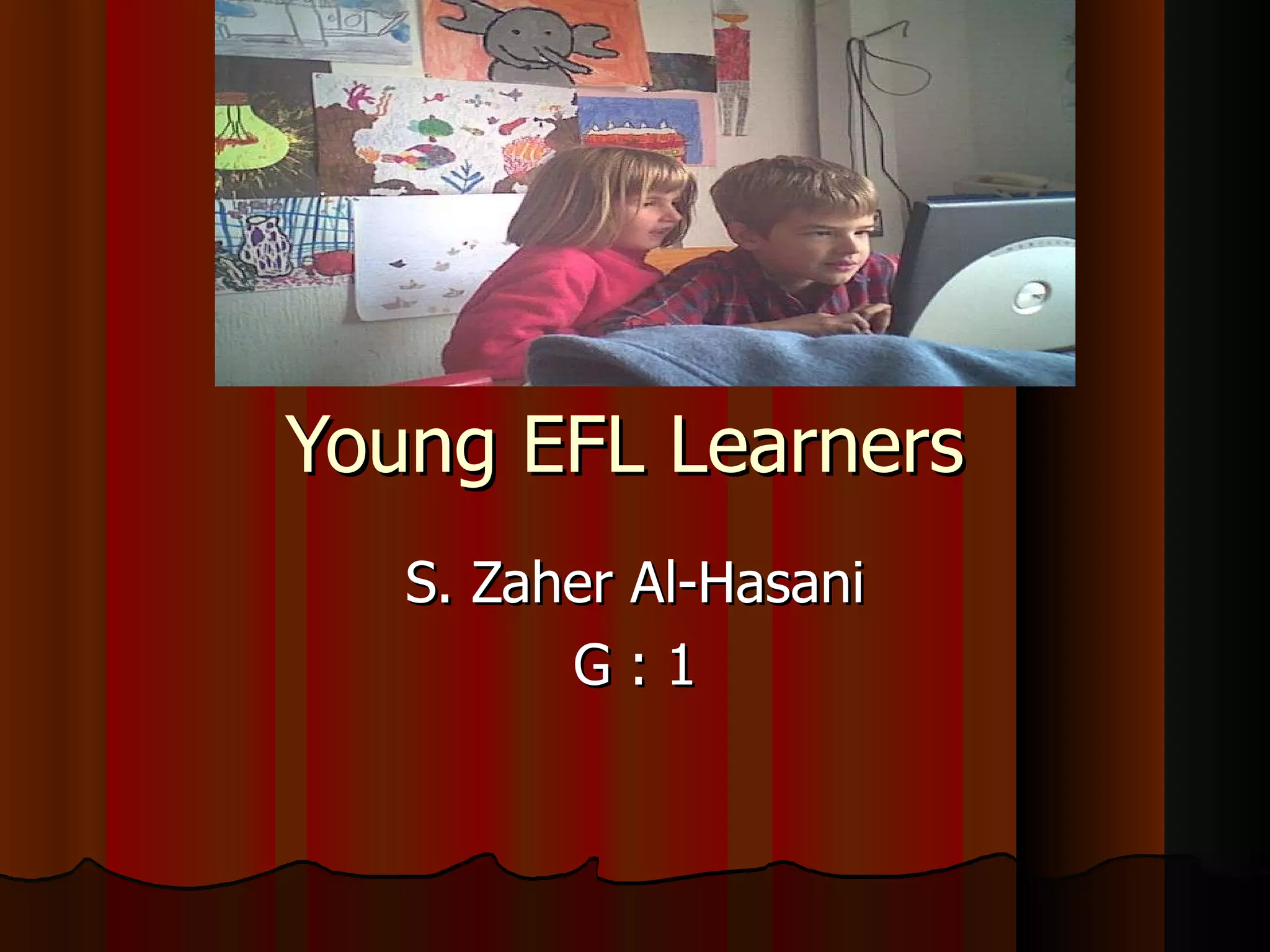
Young EFL Learners S. Zaher Al-Hasani G : 1
The content of the talk Language learning at a young age The spread of English Learning English as a Foreign Language (EFL) at a young age Knowledge-Base for teaching EFL to young learners  Research in-progress: Home Room teachers teaching English in grade One
Should a language be introduced at a young age? Informal (home) environment vs. formal school setting Home (natural) environment:   Caretaker’s fluency and comfort in the language Recognition of the advantages of bilingualism – contribution to complex cognitive skills (Baker,1998; Bialystock, 2002; Hornberger, 2003)
Formal Schooling:  2 schools of thought Against   Interference with L1 Research shows efficient learning takes place at older ages- ability to utilize and transfer skills from L1 (Cenzos, 2005; Mclaughlin, 1992 Singleton, 2001) Learning Fatigue Early exposure and more teaching hours: not enough to ensure success
For  Affective factors: less inhibited; greater motivation Oral ability, particularly pronunciation enhanced at a young age (Johnstone, 1994; Marinova-Todd et al, 2000)  Confidence as a language speaker Need to know language(s): Multilingualism is a key to success
But: Beliefs regarding language learning at school Depend on: Purpose, setting, frequency, teacher, resources, language Discussion: Somewhat Passé Especially with regard to English   Why?
English as a Lingua Franca Emergence of English as a World Language due to British colonialism US power Advent technology About a billion people engaged in studying English as a Second (ESL) or Foreign (EFL) Language: Only about 300,000 million L1 English speakers (British Council, 2004; Crystal, 2000)
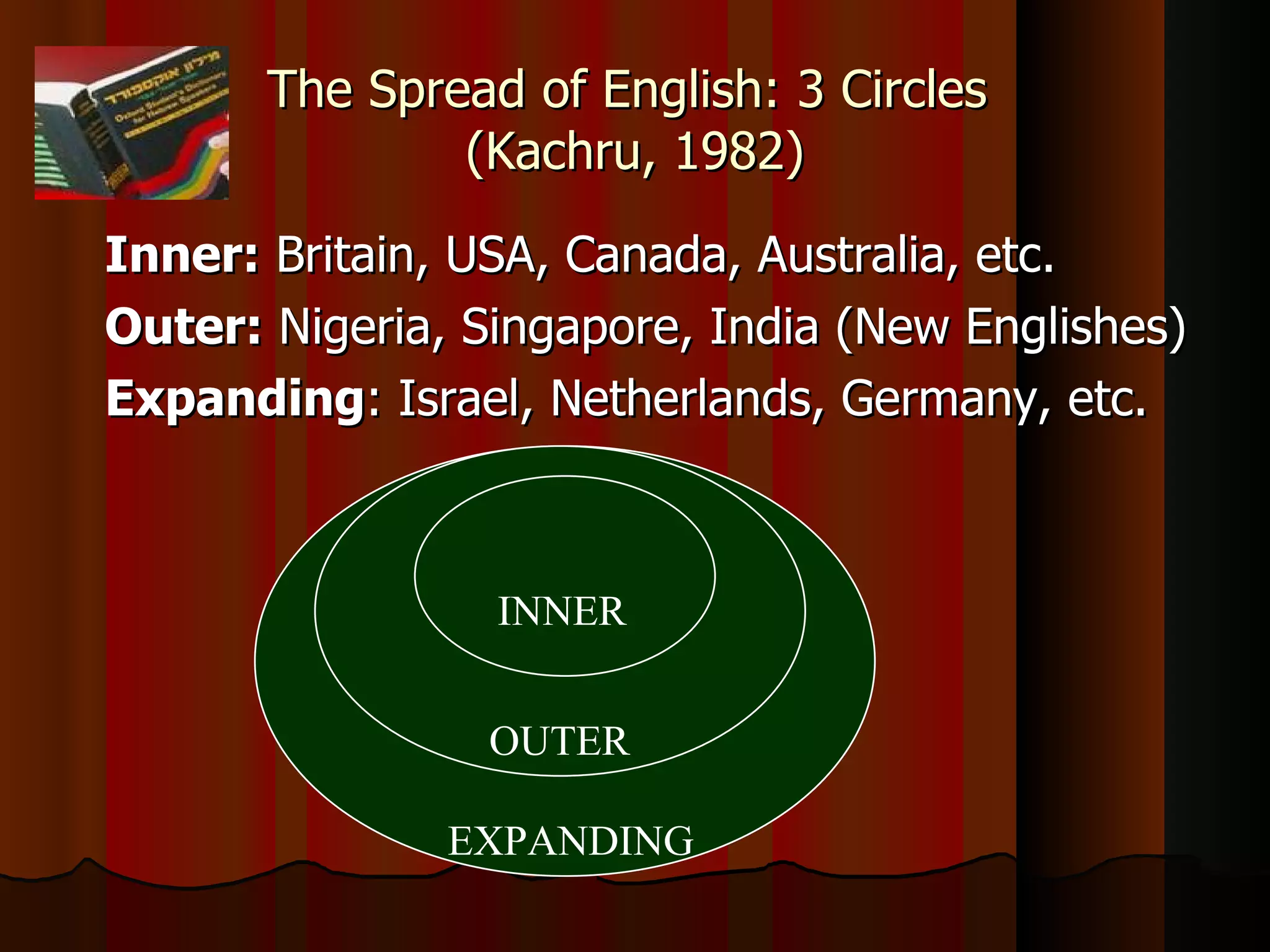
The Spread of English: 3 Circles  (Kachru, 1982) Inner:  Britain, USA, Canada, Australia, etc. Outer:  Nigeria, Singapore, India (New Englishes) Expanding : Israel, Netherlands, Germany, etc.  EXPANDING EXPANDING OUTER INNER
Currently: Distinction Blurred New Englishes in Outer Circles (Periphery) asserting their rights:  Singlish in Singapore Japanese English Indian English Expanding Circle countries (like Israel and Germany) embracing English as a semi-official language
Native and Non-Native English speakers Who is a native speaker? Central or Periphery? Who is the best English teacher: Native of standard (inner Circle) English or bilingual, non-native English speaker? Criteria for material selection and for assessment: Central? Local? English as a Lingua Franca?
Young Learners of English Wide spread Language prestige Parental pressure: social mobility The younger the better regardless of research findings
How Young is Young? Home environment: birth School:  Foreign language teaching in the US- 12 Europe: varies: often 9-10 (or earlier) Cambridge Young Learners’ test: 7-12 Israel and other “expanding countries” The younger the better move to lower age. Currently: grade one  Sometimes kindergarten
What Knowledge-Base is required for teaching EFL to young learners  Knowledge of the language Knowledge about the language  Knowledge how to teach he language  Knowledge about teaching young children Knowledge about teaching the language to young children
Home Room Teachers  Teaching English A common phenomenon in some European and Asian countries In Israel: Began 5 years ago in the town of Ra’anana Reasons:   Rooted in educational philosophical thought Availability, convenience Economically viable
Knowledge on how to teach English to young learners Till recently: Lack of training in EFL teacher education programs  (Program component in Beit Berl since 2001) Who has the advantage
Programs for teaching EFL to young learners: Pertinent issues Goals: exposure, fun, or academic? Listening/speaking or literate skills? Use of target language (English) vs. local language (Hebrew; German), and for what purpose? Integration with in-going topics (taught in the local language) Literacy? Assessment? Coordination with programs for the older learners?
Relevance to Israel The Younger the better: move to introduce English at younger ages  One of the flagships of the current Ministry of Education policy Vast spread of first grade English initiatives
In-Progress Research: Home Room teachers teaching English in Grade One Headed by Prof. Elana Shohamy,  Tel-Aviv University  Initiated and  Funded by the Israeli Ministry of Education
Pertinent Issues Programs  (3 programs are being examined) Teacher’s Knowledge-Base  (English teachers vs. home room teachers) Attitudes of the public  (high level administrators, principals, parents) Students:  achievements, attitudes, self-assessment
Research Tools Large Sample Teachers’ questionnaires (home room and English) Principals’ questionnaire Interviews (administrators, program developers) Sample of 7 schools: Parents’ questionnaire Classroom observations Teacher interviews Students’ research tools
Students’ Research Tools Listening comprehension quiz (N=250) Individual oral interaction interviews (N=54) Attitude questionnaires (N=250) Self-Assessment questionnaires (N=250)
Some initial observations Teaching of English in grade 1 in Israel is extremely common Both teaching models exist (home room and English teachers)  Programs: different objectives and modes of implementation (one program – home room teachers only)
Student Research Tools Specific age appropriate and language level considerations  format (whether individual, group or class) choice of item and task types choice of contexualized, age-relevant stimuli
Comparative Research Study? Similar phenomena in Germany? Possibilities for joint and comparative research? Contact us : [email_address]

C:\Users\2007161145\Desktop\Y L

  • 1.
    Young EFL LearnersS. Zaher Al-Hasani G : 1
  • 2.
    The content ofthe talk Language learning at a young age The spread of English Learning English as a Foreign Language (EFL) at a young age Knowledge-Base for teaching EFL to young learners Research in-progress: Home Room teachers teaching English in grade One
  • 3.
    Should a languagebe introduced at a young age? Informal (home) environment vs. formal school setting Home (natural) environment: Caretaker’s fluency and comfort in the language Recognition of the advantages of bilingualism – contribution to complex cognitive skills (Baker,1998; Bialystock, 2002; Hornberger, 2003)
  • 4.
    Formal Schooling: 2 schools of thought Against Interference with L1 Research shows efficient learning takes place at older ages- ability to utilize and transfer skills from L1 (Cenzos, 2005; Mclaughlin, 1992 Singleton, 2001) Learning Fatigue Early exposure and more teaching hours: not enough to ensure success
  • 5.
    For Affectivefactors: less inhibited; greater motivation Oral ability, particularly pronunciation enhanced at a young age (Johnstone, 1994; Marinova-Todd et al, 2000) Confidence as a language speaker Need to know language(s): Multilingualism is a key to success
  • 6.
    But: Beliefs regardinglanguage learning at school Depend on: Purpose, setting, frequency, teacher, resources, language Discussion: Somewhat Passé Especially with regard to English Why?
  • 7.
    English as aLingua Franca Emergence of English as a World Language due to British colonialism US power Advent technology About a billion people engaged in studying English as a Second (ESL) or Foreign (EFL) Language: Only about 300,000 million L1 English speakers (British Council, 2004; Crystal, 2000)
  • 8.
    The Spread ofEnglish: 3 Circles (Kachru, 1982) Inner: Britain, USA, Canada, Australia, etc. Outer: Nigeria, Singapore, India (New Englishes) Expanding : Israel, Netherlands, Germany, etc. EXPANDING EXPANDING OUTER INNER
  • 9.
    Currently: Distinction BlurredNew Englishes in Outer Circles (Periphery) asserting their rights: Singlish in Singapore Japanese English Indian English Expanding Circle countries (like Israel and Germany) embracing English as a semi-official language
  • 10.
    Native and Non-NativeEnglish speakers Who is a native speaker? Central or Periphery? Who is the best English teacher: Native of standard (inner Circle) English or bilingual, non-native English speaker? Criteria for material selection and for assessment: Central? Local? English as a Lingua Franca?
  • 11.
    Young Learners ofEnglish Wide spread Language prestige Parental pressure: social mobility The younger the better regardless of research findings
  • 12.
    How Young isYoung? Home environment: birth School: Foreign language teaching in the US- 12 Europe: varies: often 9-10 (or earlier) Cambridge Young Learners’ test: 7-12 Israel and other “expanding countries” The younger the better move to lower age. Currently: grade one Sometimes kindergarten
  • 13.
    What Knowledge-Base isrequired for teaching EFL to young learners Knowledge of the language Knowledge about the language Knowledge how to teach he language Knowledge about teaching young children Knowledge about teaching the language to young children
  • 14.
    Home Room Teachers Teaching English A common phenomenon in some European and Asian countries In Israel: Began 5 years ago in the town of Ra’anana Reasons: Rooted in educational philosophical thought Availability, convenience Economically viable
  • 15.
    Knowledge on howto teach English to young learners Till recently: Lack of training in EFL teacher education programs (Program component in Beit Berl since 2001) Who has the advantage
  • 16.
    Programs for teachingEFL to young learners: Pertinent issues Goals: exposure, fun, or academic? Listening/speaking or literate skills? Use of target language (English) vs. local language (Hebrew; German), and for what purpose? Integration with in-going topics (taught in the local language) Literacy? Assessment? Coordination with programs for the older learners?
  • 17.
    Relevance to IsraelThe Younger the better: move to introduce English at younger ages One of the flagships of the current Ministry of Education policy Vast spread of first grade English initiatives
  • 18.
    In-Progress Research: HomeRoom teachers teaching English in Grade One Headed by Prof. Elana Shohamy, Tel-Aviv University Initiated and Funded by the Israeli Ministry of Education
  • 19.
    Pertinent Issues Programs (3 programs are being examined) Teacher’s Knowledge-Base (English teachers vs. home room teachers) Attitudes of the public (high level administrators, principals, parents) Students: achievements, attitudes, self-assessment
  • 20.
    Research Tools LargeSample Teachers’ questionnaires (home room and English) Principals’ questionnaire Interviews (administrators, program developers) Sample of 7 schools: Parents’ questionnaire Classroom observations Teacher interviews Students’ research tools
  • 21.
    Students’ Research ToolsListening comprehension quiz (N=250) Individual oral interaction interviews (N=54) Attitude questionnaires (N=250) Self-Assessment questionnaires (N=250)
  • 22.
    Some initial observationsTeaching of English in grade 1 in Israel is extremely common Both teaching models exist (home room and English teachers) Programs: different objectives and modes of implementation (one program – home room teachers only)
  • 23.
    Student Research ToolsSpecific age appropriate and language level considerations format (whether individual, group or class) choice of item and task types choice of contexualized, age-relevant stimuli
  • 24.
    Comparative Research Study?Similar phenomena in Germany? Possibilities for joint and comparative research? Contact us : [email_address]