Self-Assessment:
“Navigating your own path through
           realization”
                &
“Career Preparedness as a strategic
            process”
Self-Assessment

Today’s Agenda
• Identify the Key Components of “Self-Assessment”
    •Self Reflection, Six Intrinsic Measures, Personality/Type Association
• Self-Assessment in your personal life
• Self-Assessment and Career Preparedness
• Illustrate the Four strategic steps to Decision Making and Career
Planning
• Quick Exercise and closing
Self-Assessment

What is Self-Assessment?


“Self-Assessment is a process by which you learn
more about yourself—what you like, what you don’t
like, and how you tend to react to certain situations.
Knowing these things can help you determine which
occupations and work situations could be a better fit
for you.”
      -The Riley Guide: Before you Search, 2006
Self-Assessment

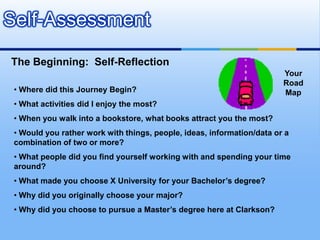
The Beginning: Self-Reflection
                                                                        Your
                                                                        Road
 • Where did this Journey Begin?                                        Map
 • What activities did I enjoy the most?
 • When you walk into a bookstore, what books attract you the most?
 • Would you rather work with things, people, ideas, information/data or a
 combination of two or more?
 • What people did you find yourself working with and spending your time
 around?
 • What made you choose X University for your Bachelor’s degree?
 • Why did you originally choose your major?
 • Why did you choose to pursue a Master’s degree here at Clarkson?
Self-Assessment


 The Six Intrinsic Attributes in
      Self-Assessment
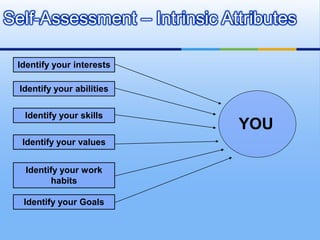
Self-Assessment – Intrinsic Attributes

 Identify your interests

  Identify your abilities

   Identify your skills
                              YOU
  Identify your values


   Identify your work
         habits

   Identify your Goals
Self-Assessment – Intrinsic Attributes

 Identify your Interests

     Interest (n): A state of curiosity or concern about or attention to
                                  something.


   • What do you like to do for hobbies?
   • Do you like to travel?
   • Do you like Community Service?
   • Why did you select your undergraduate major?
   • Think about what interests or interested you in the past, and think about
   how that contributed to where you are today.
Self-Assessment – Intrinsic Attributes

 Identify your Abilities

               Ability (n): A natural or acquired skill or talent.


   • What things have always been somewhat natural for you?
   • Do you remember numbers?
   • Are you quick with math?
   • Do you have the natural ability to talk to anybody?
   • Are you naturally athletic?
   • Think about what abilities you’ve utilized throughout your life up to today.
Self-Assessment – Intrinsic Attributes

 Identify your Skills

  Skill (n): Proficiency, facility, or dexterity that is acquired or developed
                        through training or experience


   • Interests as the motivating factor
   • What you’re good at and what you like are not always the same thing
   • Think about the skills you have developed through education, work
   experience, and how these skills have got you to where you are today
Self-Assessment – Intrinsic Attributes

 Identify your Values
   Values (n): A principle, standard, or quality considered worthwhile or
                                  desirable


       • What matters most to you in your work?
       • What is important to you? Knowledge? Money? Social Status?
       • What do you want from your education?
       • What you do, how you do it, and who you do it with indicates
       values
Self-Assessment – Intrinsic Attributes

 Identify your Work Habits
   Habit (n): A recurrent, often unconscious pattern of behavior that is
                     acquired through frequent repetition.


    • How hard are you willing to work for what you want?
    • Are you a team oriented person or do you prefer more autonomy?
    • Are you always striving to perform your best?
    • What work habits or things you find yourself doing repeatedly fit in
    the things you have done so far in your life?
Self-Assessment – Intrinsic Attributes

 Identify your Goals
    Goals (n): The purpose toward which an endeavor is directed; an
                              objective.


    • Where do you want to be in five years? Ten years? Short term? Long
    term?
    • Driven by your abilities, interests, skills, preferences, etc.
    • Do your goals reflect a true combination of the attributes discussed?
    • Are your goals concrete?
    • Where do your goals cross with the road your life has been down?
Self-Assessment – Intrinsic Attributes


          Personality/Type
            Association
Self-Assessment – Intrinsic Attributes

 Personality/Type Association

  • Whatdo we mean when we say your “type” or
  “personality”?
  • What does your “type” have to do with self-assessment?
  • Does it have an effect on your school work? Your job
  search? Both?
  • How can this be measured?
Self-Assessment – Intrinsic Attributes

 Personality/Type Association

 • Do I think I am introverted or extroverted?
 • Do I process/make meaning of new information with my 5
 senses or with my 6th sense?
 • Do I make decisions based on my principles or based on my
 personal values?
 • Do I like my life organized or to be more open and
 spontaneous?
Self-Assessment – Intrinsic Attributes

 Personality/Type Association

 “Psychological type” describes the different ways people:
 • prefer to take in information,
 • prefer to make decisions,
 • are energized by the outside world or by the inner world,
 and
 • prefer to keep things open or to move towards closure.
                                      - Myers-Briggs Foundation
Self-Assessment – Intrinsic Attributes

 Personality/Type Association

  Theory says….


  People with different preferences naturally have different interests,
  perspectives, behaviors and motivations. Awareness of preferences
  helps people understand and value others who think and act quite
  differently.
Self-Assessment – Intrinsic Attributes

Self-Assessment in your personal lives

 • Be honest with yourself

 • Utilization of others for your own assessment (in the form of feedback)
 • What do I want people to see in me?
 • Describe yourself (seen a lot in interviews and/or application essays)
 • Identify areas of interest that you may be weak in – what can you do to
 further develop those skills?
 • Keeping yourself accountable for results
 • Think about how you handle yourself in certain situations
Self-Assessment


    Self-Assessment and Career
           Preparedness
          Decision Making and Strategy
Self-Assessment – Career Preparedness

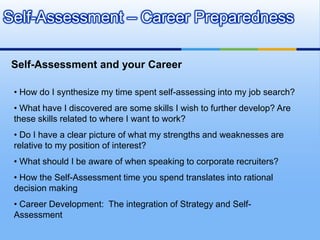
 Self-Assessment and your Career

 • How do I synthesize my time spent self-assessing into my job search?
 • What have I discovered are some skills I wish to further develop? Are
 these skills related to where I want to work?
 • Do I have a clear picture of what my strengths and weaknesses are
 relative to my position of interest?
 • What should I be aware of when speaking to corporate recruiters?
 • How the Self-Assessment time you spend translates into rational
 decision making
 • Career Development: The integration of Strategy and Self-
 Assessment
Self-Assessment – Career Preparedness

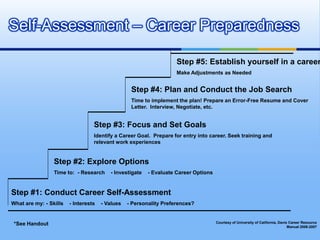
                                                                    Step #5: Establish yourself in a career
                                                                    Make Adjustments as Needed


                                                  Step #4: Plan and Conduct the Job Search
                                                  Time to implement the plan! Prepare an Error-Free Resume and Cover
                                                  Letter. Interview, Negotiate, etc.


                                  Step #3: Focus and Set Goals
                                  Identify a Career Goal. Prepare for entry into career. Seek training and
                                  relevant work experiences


                 Step #2: Explore Options
                 Time to: - Research     - Investigate   - Evaluate Career Options


Step #1: Conduct Career Self-Assessment
What are my: - Skills   - Interests   - Values   - Personality Preferences?


 *See Handout                                                                        Courtesy of University of California, Davis Career Resource
                                                                                                                                Manual 2006-2007
Self-Assessment – Career Preparedness


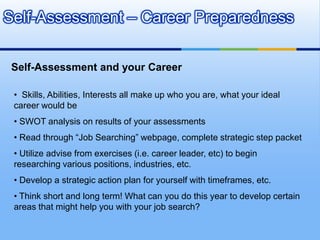
 Self-Assessment and your Career

 • Skills, Abilities, Interests all make up who you are, what your ideal
 career would be
 • SWOT analysis on results of your assessments
 • Read through “Job Searching” webpage, complete strategic step packet
 • Utilize advise from exercises (i.e. career leader, etc) to begin
 researching various positions, industries, etc.
 • Develop a strategic action plan for yourself with timeframes, etc.
 • Think short and long term! What can you do this year to develop certain
 areas that might help you with your job search?
Self-Assessment – Career Preparedness

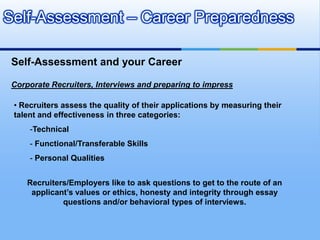
 Self-Assessment and your Career

 Corporate Recruiters, Interviews and preparing to impress

 • Recruiters assess the quality of their applications by measuring their
 talent and effectiveness in three categories:
     -Technical
     - Functional/Transferable Skills
     - Personal Qualities


     Recruiters/Employers like to ask questions to get to the route of an
      applicant’s values or ethics, honesty and integrity through essay
              questions and/or behavioral types of interviews.
Self-Assessment – Career Preparedness

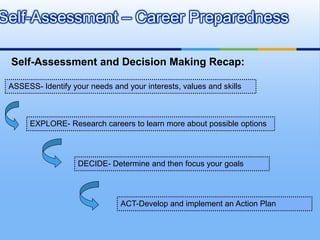
 Self-Assessment and Decision Making Recap:

 ASSESS- Identify your needs and your interests, values and skills


      EXPLORE- Research careers to learn more about possible options


                    DECIDE- Determine and then focus your goals


                                ACT-Develop and implement an Action Plan
Self-Assessment

Throughout the process of self-assessment, remember
these…..

 Self-Assessment is the beginning to a lengthy career
 development process. Career and Personal Development…
 • Is a process that takes time
 • Requires Action
 • Is YOUR responsibility
 • Is Lifelong
Self-Assessment

 In Closing…

  • Make the time to prepare for your future!
  • Utilize your resources
  • Read through handouts and spend time with some other
  assessments
  • Ask questions, seek advice from as many people as possible!
      • Seek out the Career Center, myself, Alumni (Mentor Program),
      Faculty, and others!
Self-Assessment


   Brief Exercise on Occupational
               Themes
Self-Assessment

Remember: When it comes to your future, use your SMARTS!


   S- Strategic Searching
   M- Masterfully
   A- Always
   R- Reaps
   T- Tremendous
   S- Success
Marketing My Skills Exercise


Life Achievement
•   Small Groups of 4-5
    •   Share one life achievement with member of your
        group
    •   Select one life achievement for the group
    •   Write this achievement into a short narrative
    •   Now, we will mine the stories for skills
Marketing My Skills Exercise

• What skills do we get from our narratives?
  Be specific
• How would we categorized these skills?
• What skills are transferable and what are
  technical?
Marketing My Skills Exercise


• Create your own Master List of Skills
  – Top five you enjoy using most
  – Top five you are best at using
  – What skills are most marketable or relevant to
    what interests you?
  – What do you think would be in your “top five”?
Marketing My Skills Exercise

• Document your list of skills (provide proof)
• PSR, CAR, STAR techniques
• Marketing Plan Discussion
Marketing My Skills Exercise

•   SWOT Analysis
•   Top Five Skills on the Marketing Plan
•   Transferable Skills
•   Strategies and Action Items
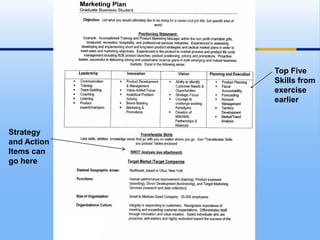
Top Five
             Skills from
             exercise
             earlier


Strategy
and Action
Items can
go here
Marketing My Skills Exercise

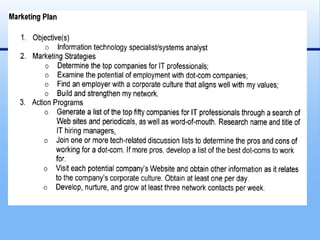
• How does all of this fit in my job search? My
  resume? My interview?
• The Marketing Plan as a map, reference
  point, etc.
Questions?

Self Assesment and Career Planning

  • 1.
    Self-Assessment: “Navigating your ownpath through realization” & “Career Preparedness as a strategic process”
  • 2.
    Self-Assessment Today’s Agenda • Identifythe Key Components of “Self-Assessment” •Self Reflection, Six Intrinsic Measures, Personality/Type Association • Self-Assessment in your personal life • Self-Assessment and Career Preparedness • Illustrate the Four strategic steps to Decision Making and Career Planning • Quick Exercise and closing
  • 3.
    Self-Assessment What is Self-Assessment? “Self-Assessmentis a process by which you learn more about yourself—what you like, what you don’t like, and how you tend to react to certain situations. Knowing these things can help you determine which occupations and work situations could be a better fit for you.” -The Riley Guide: Before you Search, 2006
  • 4.
    Self-Assessment The Beginning: Self-Reflection Your Road • Where did this Journey Begin? Map • What activities did I enjoy the most? • When you walk into a bookstore, what books attract you the most? • Would you rather work with things, people, ideas, information/data or a combination of two or more? • What people did you find yourself working with and spending your time around? • What made you choose X University for your Bachelor’s degree? • Why did you originally choose your major? • Why did you choose to pursue a Master’s degree here at Clarkson?
  • 5.
    Self-Assessment The SixIntrinsic Attributes in Self-Assessment
  • 6.
    Self-Assessment – IntrinsicAttributes Identify your interests Identify your abilities Identify your skills YOU Identify your values Identify your work habits Identify your Goals
  • 7.
    Self-Assessment – IntrinsicAttributes Identify your Interests Interest (n): A state of curiosity or concern about or attention to something. • What do you like to do for hobbies? • Do you like to travel? • Do you like Community Service? • Why did you select your undergraduate major? • Think about what interests or interested you in the past, and think about how that contributed to where you are today.
  • 8.
    Self-Assessment – IntrinsicAttributes Identify your Abilities Ability (n): A natural or acquired skill or talent. • What things have always been somewhat natural for you? • Do you remember numbers? • Are you quick with math? • Do you have the natural ability to talk to anybody? • Are you naturally athletic? • Think about what abilities you’ve utilized throughout your life up to today.
  • 9.
    Self-Assessment – IntrinsicAttributes Identify your Skills Skill (n): Proficiency, facility, or dexterity that is acquired or developed through training or experience • Interests as the motivating factor • What you’re good at and what you like are not always the same thing • Think about the skills you have developed through education, work experience, and how these skills have got you to where you are today
  • 10.
    Self-Assessment – IntrinsicAttributes Identify your Values Values (n): A principle, standard, or quality considered worthwhile or desirable • What matters most to you in your work? • What is important to you? Knowledge? Money? Social Status? • What do you want from your education? • What you do, how you do it, and who you do it with indicates values
  • 11.
    Self-Assessment – IntrinsicAttributes Identify your Work Habits Habit (n): A recurrent, often unconscious pattern of behavior that is acquired through frequent repetition. • How hard are you willing to work for what you want? • Are you a team oriented person or do you prefer more autonomy? • Are you always striving to perform your best? • What work habits or things you find yourself doing repeatedly fit in the things you have done so far in your life?
  • 12.
    Self-Assessment – IntrinsicAttributes Identify your Goals Goals (n): The purpose toward which an endeavor is directed; an objective. • Where do you want to be in five years? Ten years? Short term? Long term? • Driven by your abilities, interests, skills, preferences, etc. • Do your goals reflect a true combination of the attributes discussed? • Are your goals concrete? • Where do your goals cross with the road your life has been down?
  • 13.
    Self-Assessment – IntrinsicAttributes Personality/Type Association
  • 14.
    Self-Assessment – IntrinsicAttributes Personality/Type Association • Whatdo we mean when we say your “type” or “personality”? • What does your “type” have to do with self-assessment? • Does it have an effect on your school work? Your job search? Both? • How can this be measured?
  • 15.
    Self-Assessment – IntrinsicAttributes Personality/Type Association • Do I think I am introverted or extroverted? • Do I process/make meaning of new information with my 5 senses or with my 6th sense? • Do I make decisions based on my principles or based on my personal values? • Do I like my life organized or to be more open and spontaneous?
  • 16.
    Self-Assessment – IntrinsicAttributes Personality/Type Association “Psychological type” describes the different ways people: • prefer to take in information, • prefer to make decisions, • are energized by the outside world or by the inner world, and • prefer to keep things open or to move towards closure. - Myers-Briggs Foundation
  • 17.
    Self-Assessment – IntrinsicAttributes Personality/Type Association Theory says…. People with different preferences naturally have different interests, perspectives, behaviors and motivations. Awareness of preferences helps people understand and value others who think and act quite differently.
  • 18.
    Self-Assessment – IntrinsicAttributes Self-Assessment in your personal lives • Be honest with yourself • Utilization of others for your own assessment (in the form of feedback) • What do I want people to see in me? • Describe yourself (seen a lot in interviews and/or application essays) • Identify areas of interest that you may be weak in – what can you do to further develop those skills? • Keeping yourself accountable for results • Think about how you handle yourself in certain situations
  • 19.
    Self-Assessment Self-Assessment and Career Preparedness Decision Making and Strategy
  • 20.
    Self-Assessment – CareerPreparedness Self-Assessment and your Career • How do I synthesize my time spent self-assessing into my job search? • What have I discovered are some skills I wish to further develop? Are these skills related to where I want to work? • Do I have a clear picture of what my strengths and weaknesses are relative to my position of interest? • What should I be aware of when speaking to corporate recruiters? • How the Self-Assessment time you spend translates into rational decision making • Career Development: The integration of Strategy and Self- Assessment
  • 21.
    Self-Assessment – CareerPreparedness Step #5: Establish yourself in a career Make Adjustments as Needed Step #4: Plan and Conduct the Job Search Time to implement the plan! Prepare an Error-Free Resume and Cover Letter. Interview, Negotiate, etc. Step #3: Focus and Set Goals Identify a Career Goal. Prepare for entry into career. Seek training and relevant work experiences Step #2: Explore Options Time to: - Research - Investigate - Evaluate Career Options Step #1: Conduct Career Self-Assessment What are my: - Skills - Interests - Values - Personality Preferences? *See Handout Courtesy of University of California, Davis Career Resource Manual 2006-2007
  • 22.
    Self-Assessment – CareerPreparedness Self-Assessment and your Career • Skills, Abilities, Interests all make up who you are, what your ideal career would be • SWOT analysis on results of your assessments • Read through “Job Searching” webpage, complete strategic step packet • Utilize advise from exercises (i.e. career leader, etc) to begin researching various positions, industries, etc. • Develop a strategic action plan for yourself with timeframes, etc. • Think short and long term! What can you do this year to develop certain areas that might help you with your job search?
  • 23.
    Self-Assessment – CareerPreparedness Self-Assessment and your Career Corporate Recruiters, Interviews and preparing to impress • Recruiters assess the quality of their applications by measuring their talent and effectiveness in three categories: -Technical - Functional/Transferable Skills - Personal Qualities Recruiters/Employers like to ask questions to get to the route of an applicant’s values or ethics, honesty and integrity through essay questions and/or behavioral types of interviews.
  • 24.
    Self-Assessment – CareerPreparedness Self-Assessment and Decision Making Recap: ASSESS- Identify your needs and your interests, values and skills EXPLORE- Research careers to learn more about possible options DECIDE- Determine and then focus your goals ACT-Develop and implement an Action Plan
  • 25.
    Self-Assessment Throughout the processof self-assessment, remember these….. Self-Assessment is the beginning to a lengthy career development process. Career and Personal Development… • Is a process that takes time • Requires Action • Is YOUR responsibility • Is Lifelong
  • 26.
    Self-Assessment In Closing… • Make the time to prepare for your future! • Utilize your resources • Read through handouts and spend time with some other assessments • Ask questions, seek advice from as many people as possible! • Seek out the Career Center, myself, Alumni (Mentor Program), Faculty, and others!
  • 27.
    Self-Assessment Brief Exercise on Occupational Themes
  • 28.
    Self-Assessment Remember: When itcomes to your future, use your SMARTS! S- Strategic Searching M- Masterfully A- Always R- Reaps T- Tremendous S- Success
  • 29.
    Marketing My SkillsExercise Life Achievement • Small Groups of 4-5 • Share one life achievement with member of your group • Select one life achievement for the group • Write this achievement into a short narrative • Now, we will mine the stories for skills
  • 30.
    Marketing My SkillsExercise • What skills do we get from our narratives? Be specific • How would we categorized these skills? • What skills are transferable and what are technical?
  • 31.
    Marketing My SkillsExercise • Create your own Master List of Skills – Top five you enjoy using most – Top five you are best at using – What skills are most marketable or relevant to what interests you? – What do you think would be in your “top five”?
  • 32.
    Marketing My SkillsExercise • Document your list of skills (provide proof) • PSR, CAR, STAR techniques • Marketing Plan Discussion
  • 33.
    Marketing My SkillsExercise • SWOT Analysis • Top Five Skills on the Marketing Plan • Transferable Skills • Strategies and Action Items
  • 35.
    Top Five Skills from exercise earlier Strategy and Action Items can go here
  • 36.
    Marketing My SkillsExercise • How does all of this fit in my job search? My resume? My interview? • The Marketing Plan as a map, reference point, etc.
  • 37.