What is TOPOGRAPHY?
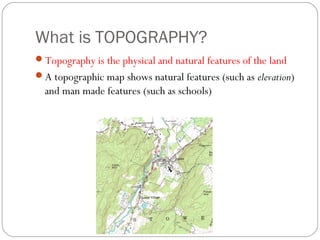
Topography is the physical and natural features of the land
A topographic map shows natural features (such as elevation)
and man made features (such as schools)
Contour Lines
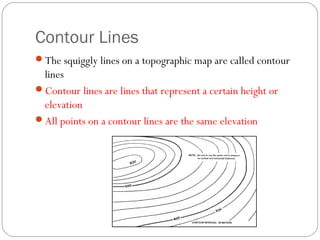
The squiggly lines on a topographic map are called contour
lines
Contour lines are lines that represent a certain height or
elevation
All points on a contour lines are the same elevation
Contour Lines and Elevation
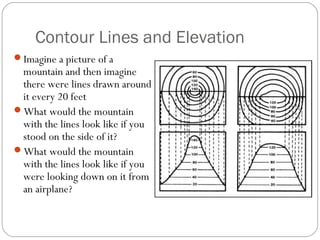
Imagine a picture of a
mountain and then imagine
there were lines drawn around
it every 20 feet
What would the mountain
with the lines look like if you
stood on the side of it?
What would the mountain
with the lines look like if you
were looking down on it from
an airplane?
Contour Lines and Elevation
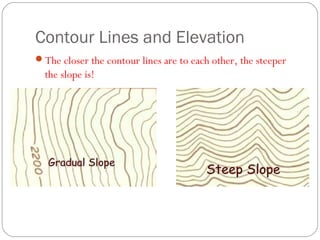
The closer the contour lines are to each other, the steeper
the slope is!
Other Topographic Terms
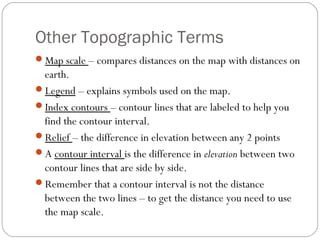
Map scale – compares distances on the map with distances on
earth.
Legend – explains symbols used on the map.
Index contours – contour lines that are labeled to help you
find the contour interval.
Relief – the difference in elevation between any 2 points
A contour interval is the difference in elevation between two
contour lines that are side by side.
Remember that a contour interval is not the distance
between the two lines – to get the distance you need to use
the map scale.
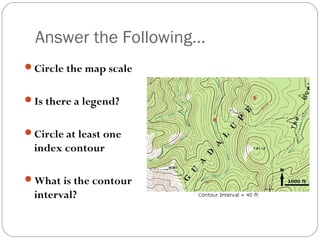
Answer the Following…
Circle the map scale
Is there a legend?
Circle at least one
index contour
What is the contour
interval?
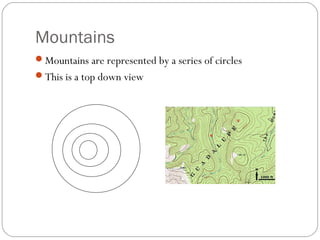
Mountains
Mountains are represented by a series of circles
This is a top down view
Depressions
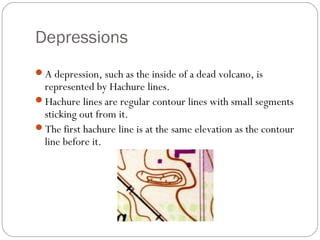
A depression, such as the inside of a dead volcano, is
represented by Hachure lines.
Hachure lines are regular contour lines with small segments
sticking out from it.
The first hachure line is at the same elevation as the contour
line before it.
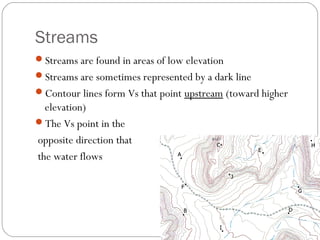
Streams
Streams are found in areas of low elevation
Streams are sometimes represented by a dark line
Contour lines form Vs that point upstream (toward higher
elevation)
The Vs point in the
opposite direction that
the water flows
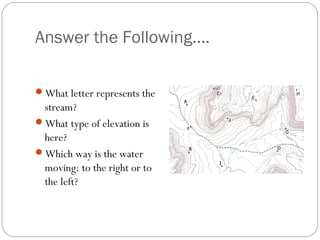
Answer the Following….
What letter represents the
stream?
What type of elevation is
here?
Which way is the water
moving: to the right or to
the left?
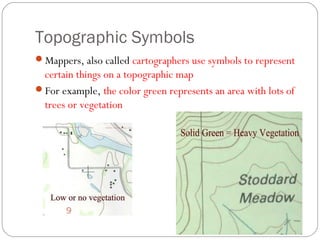
Topographic Symbols
Mappers, also called cartographers use symbols to represent
certain things on a topographic map
For example, the color green represents an area with lots of
trees or vegetation
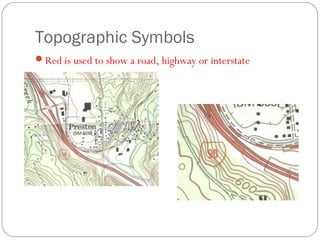
Topographic Symbols
Red is used to show a road, highway or interstate
Topographic Symbols
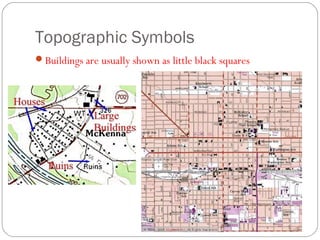
Buildings are usually shown as little black squares
What landforms can be shown on a
topographic map?
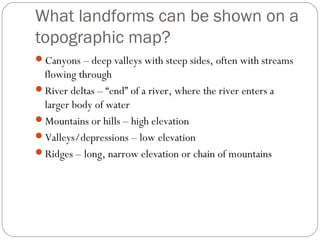
Canyons – deep valleys with steep sides, often with streams
flowing through
River deltas – “end” of a river, where the river enters a
larger body of water
Mountains or hills – high elevation
Valleys/depressions – low elevation
Ridges – long, narrow elevation or chain of mountains
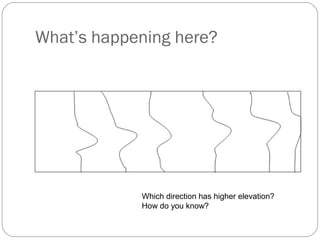
What’s happening here?
Which direction has higher elevation?
How do you know?
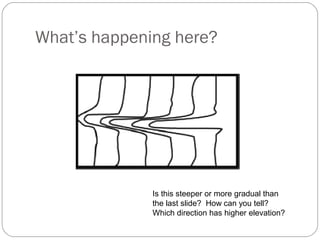
What’s happening here?
Is this steeper or more gradual than
the last slide? How can you tell?
Which direction has higher elevation?
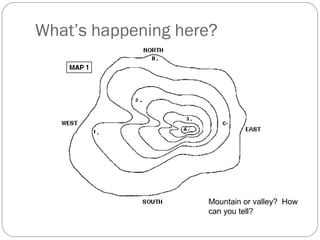
What’s happening here?
Mountain or valley? How
can you tell?

Topography powerpoint

  • 1.
    What is TOPOGRAPHY? Topographyis the physical and natural features of the land A topographic map shows natural features (such as elevation) and man made features (such as schools)
  • 2.
    Contour Lines The squigglylines on a topographic map are called contour lines Contour lines are lines that represent a certain height or elevation All points on a contour lines are the same elevation
  • 3.
    Contour Lines andElevation Imagine a picture of a mountain and then imagine there were lines drawn around it every 20 feet What would the mountain with the lines look like if you stood on the side of it? What would the mountain with the lines look like if you were looking down on it from an airplane?
  • 4.
    Contour Lines andElevation The closer the contour lines are to each other, the steeper the slope is!
  • 5.
    Other Topographic Terms Mapscale – compares distances on the map with distances on earth. Legend – explains symbols used on the map. Index contours – contour lines that are labeled to help you find the contour interval. Relief – the difference in elevation between any 2 points A contour interval is the difference in elevation between two contour lines that are side by side. Remember that a contour interval is not the distance between the two lines – to get the distance you need to use the map scale.
  • 6.
    Answer the Following… Circlethe map scale Is there a legend? Circle at least one index contour What is the contour interval?
  • 7.
    Mountains Mountains are representedby a series of circles This is a top down view
  • 8.
    Depressions A depression, suchas the inside of a dead volcano, is represented by Hachure lines. Hachure lines are regular contour lines with small segments sticking out from it. The first hachure line is at the same elevation as the contour line before it.
  • 9.
    Streams Streams are foundin areas of low elevation Streams are sometimes represented by a dark line Contour lines form Vs that point upstream (toward higher elevation) The Vs point in the opposite direction that the water flows
  • 10.
    Answer the Following…. Whatletter represents the stream? What type of elevation is here? Which way is the water moving: to the right or to the left?
  • 11.
    Topographic Symbols Mappers, alsocalled cartographers use symbols to represent certain things on a topographic map For example, the color green represents an area with lots of trees or vegetation
  • 12.
    Topographic Symbols Red isused to show a road, highway or interstate
  • 13.
    Topographic Symbols Buildings areusually shown as little black squares
  • 14.
    What landforms canbe shown on a topographic map? Canyons – deep valleys with steep sides, often with streams flowing through River deltas – “end” of a river, where the river enters a larger body of water Mountains or hills – high elevation Valleys/depressions – low elevation Ridges – long, narrow elevation or chain of mountains
  • 15.
    What’s happening here? Whichdirection has higher elevation? How do you know?
  • 16.
    What’s happening here? Isthis steeper or more gradual than the last slide? How can you tell? Which direction has higher elevation?
  • 17.
    What’s happening here? Mountainor valley? How can you tell?

Editor's Notes

  • #16 Contour lines are spaced far apart, so we know the elevation change is gradual. The “V” shapes suggest the formation of a river, which would be flowing FROM RIGHT TO LEFT. Upstream is to the east, downstream is to the west
  • #17 Some of the lines are very close, indicating a steep incline. This is likely a canyon, formed by a river that is flowing FROM LEFT TO RIGHT.
  • #18 This is a mountain – the highest elevation is in the middle (no hachure lines to indicate this is a depression). Likely there is a river flowing westward along the Vs, which seems to be creating a canyon. The southeastern slope is steeper than the northwestern slope.