Distribution
Strategy
-the path through which goods & services travel from the vendor to
the consumer or payments for those products travel from the
consumer to the vendor.
- A distribution channel may include several
interconnected intermediaries along the way such as wholesalers,
distributers, agents and retailers.
Channel of distribution
1. Middleman – independent link between producers and consumers
2. Merchant middleman – actually buys goods and takes title/ownership
3. Agent – business unit that negotiates purchases & sales but does not take ownership
4. Wholesaler – a merchant who primarily stores and handles goods in large quantities
5. Retailer – merchant middleman who sells to final consumers
6. Broker – middleman who serves as a go-between for the buyer and seller
7. Manufacturer’s agent – an agent who operates by contract serving a geographic territory
8. Distributor – wholesale middleman in lines with selective or exclusive distribution
9. Jobber – a middleman who buys from manufacturers and sells to retailers
10. Facilitating agent – a firm that performs distribution tasks other than buying, selling and
transferring
Major types of Marketing Intermediaries
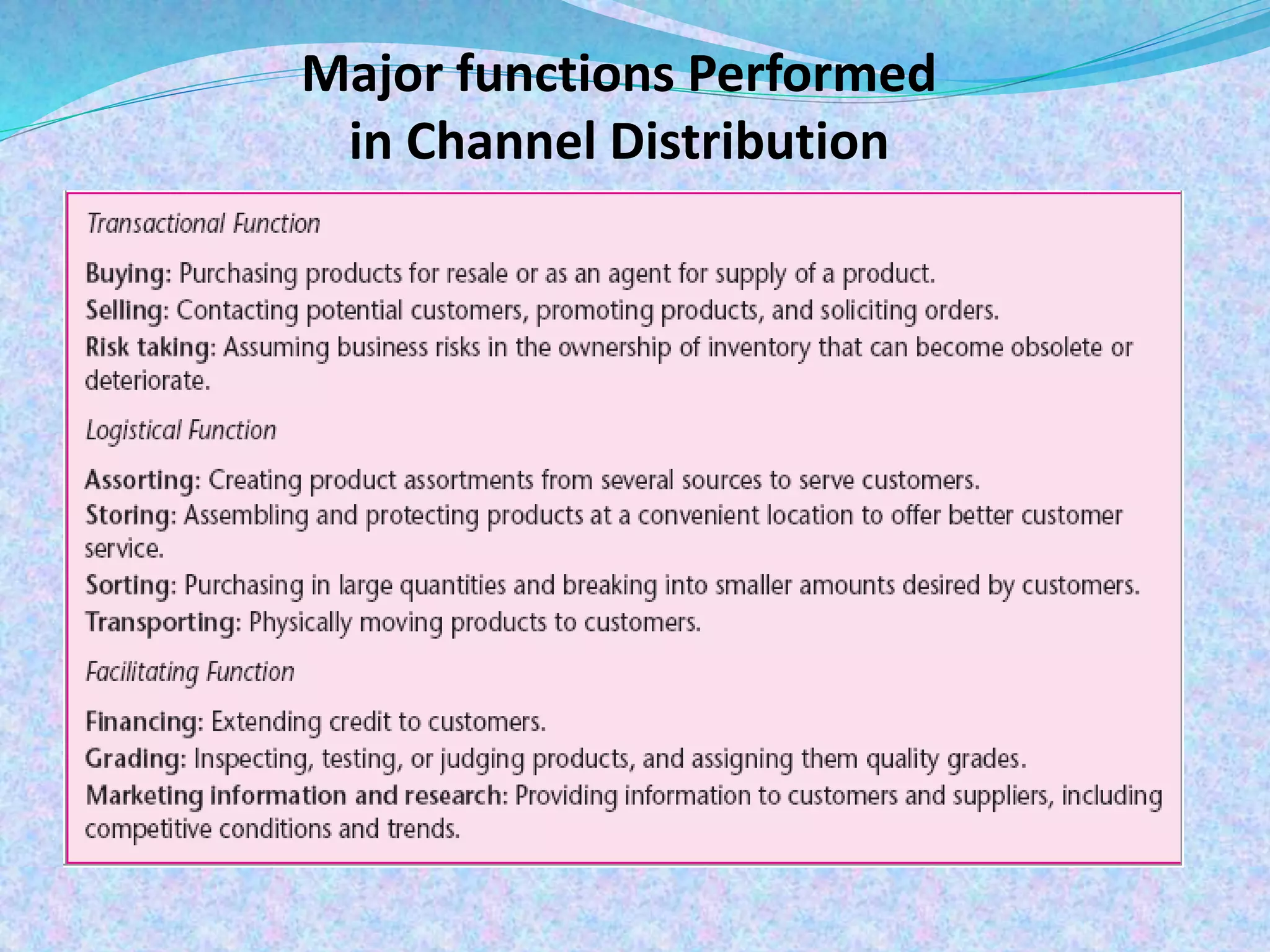
Major functions Performed
in Channel Distribution
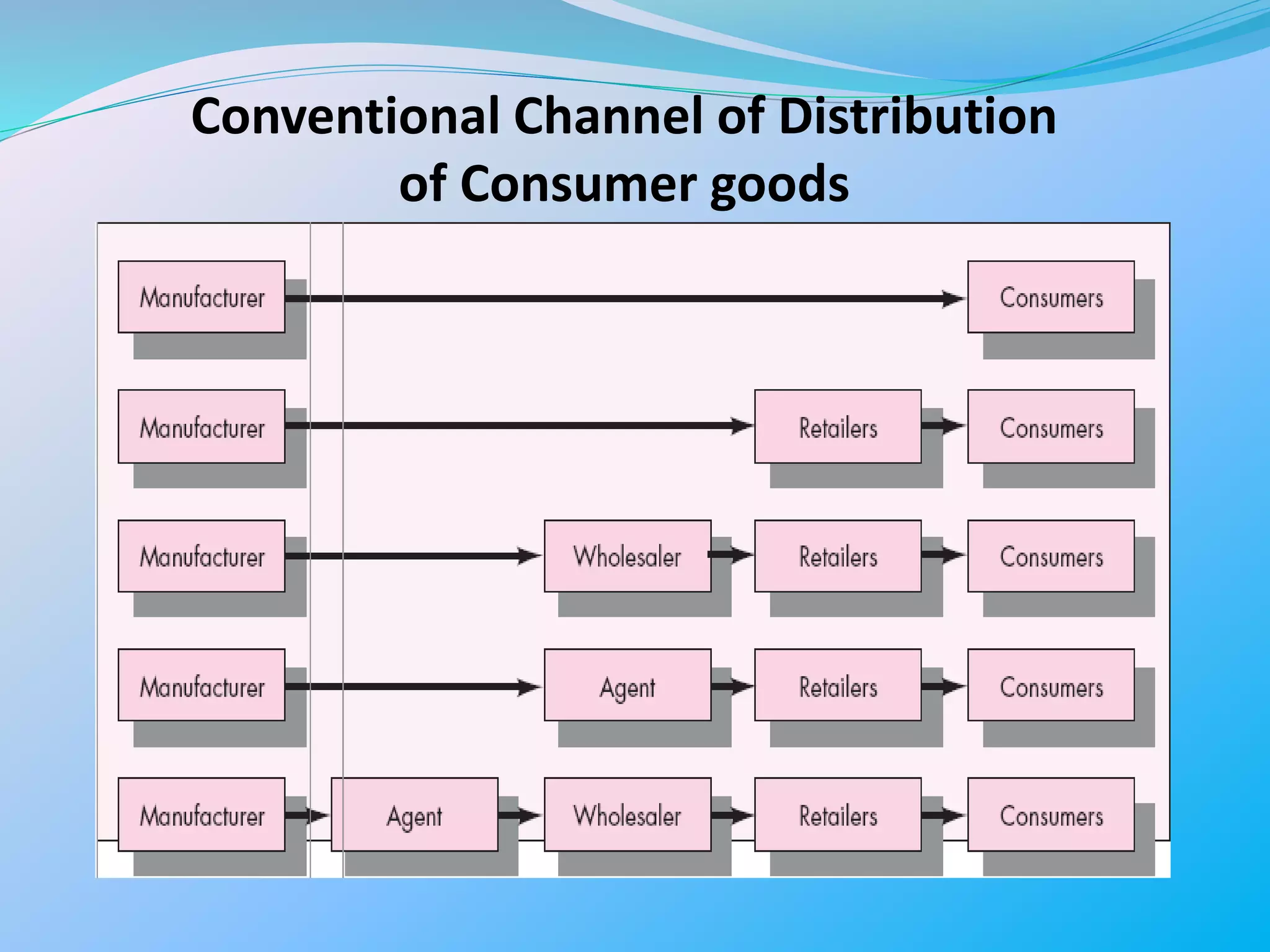
Conventional Channel of Distribution
of Consumer goods
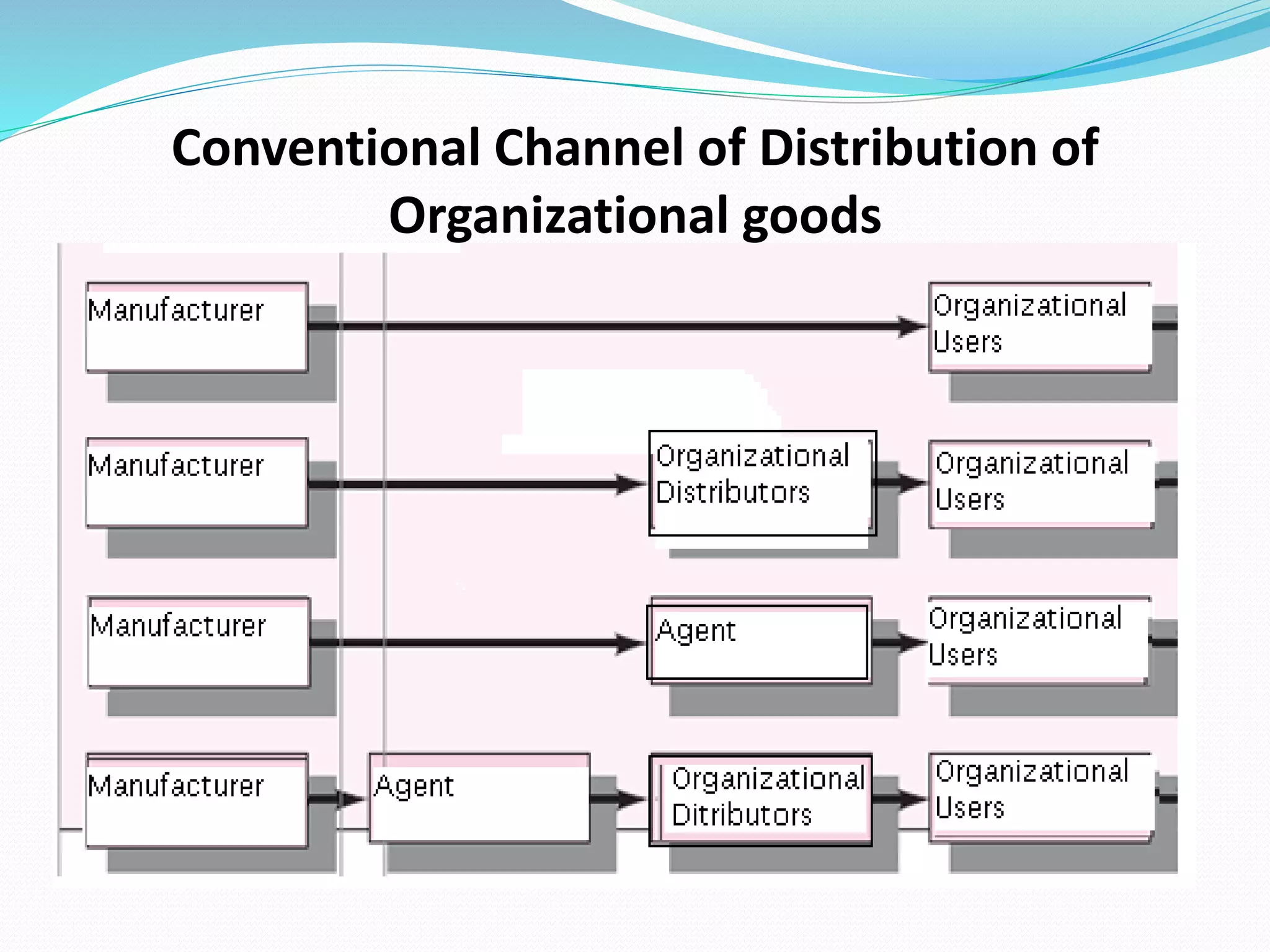
Conventional Channel of Distribution of
Organizational goods
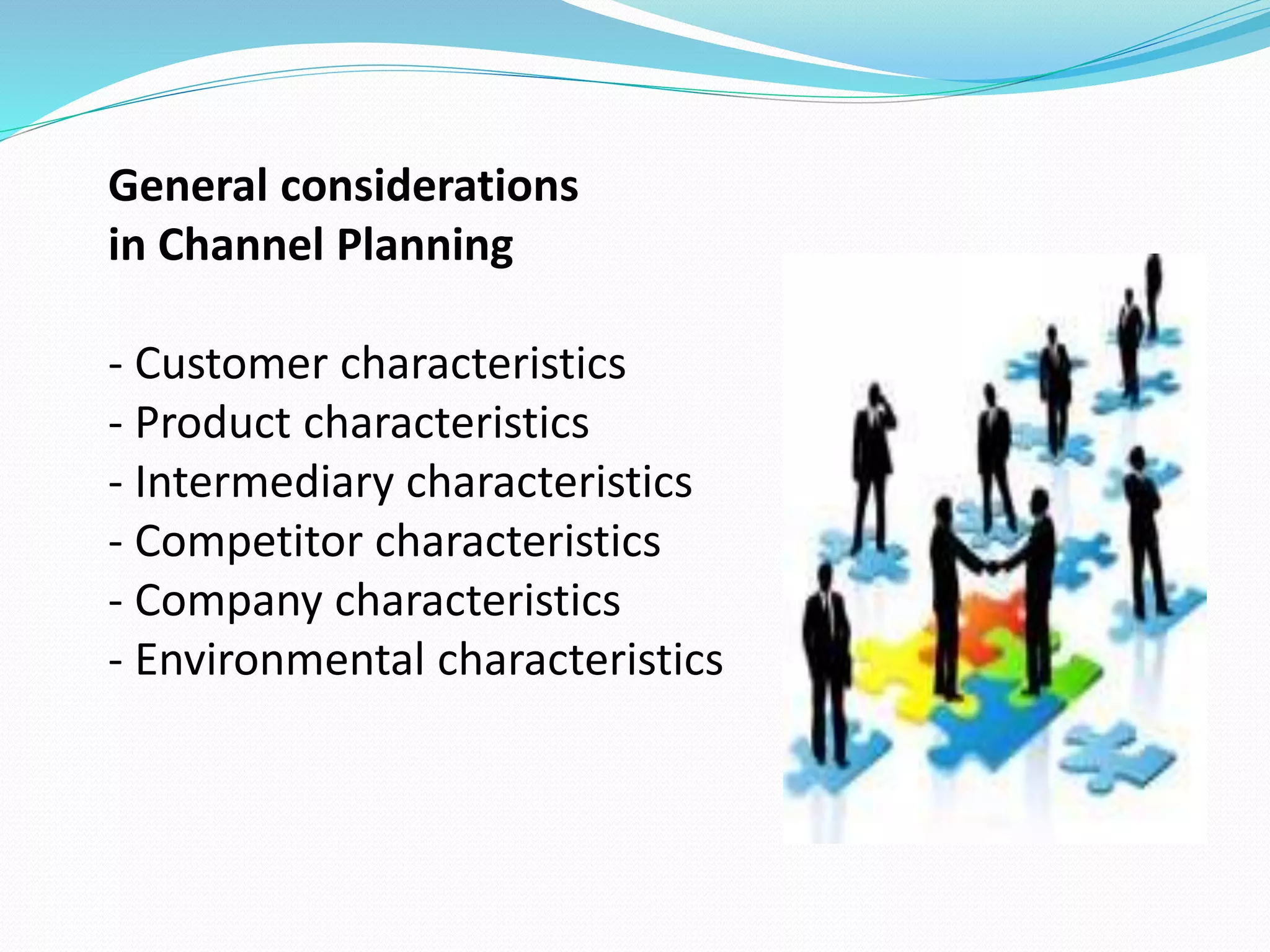
General considerations
in Channel Planning
- Customer characteristics
- Product characteristics
- Intermediary characteristics
- Competitor characteristics
- Company characteristics
- Environmental characteristics
Distribution Coverage required
Channel selection may depend upon the nature of market coverage desired
Intensive distribution – Using as many wholesalers and retailers as possible
Selective distribution – Using only the best available per geographic area
Exclusive distribution – Selected intermediaries are given exclusive rights within a
particular territory
Degree of control desired
- Achieved by the seller is proportionate to the directness of channel
Total distribution cost
- Channel should be viewed as a total system composed of interdependent subsystems
Objective should be to optimize total system performance
Generally assumed that the total system should be designed to minimize costs,
other things being equal
Channel flexibility – Ability of the manufacturer to adapt to changing conditions
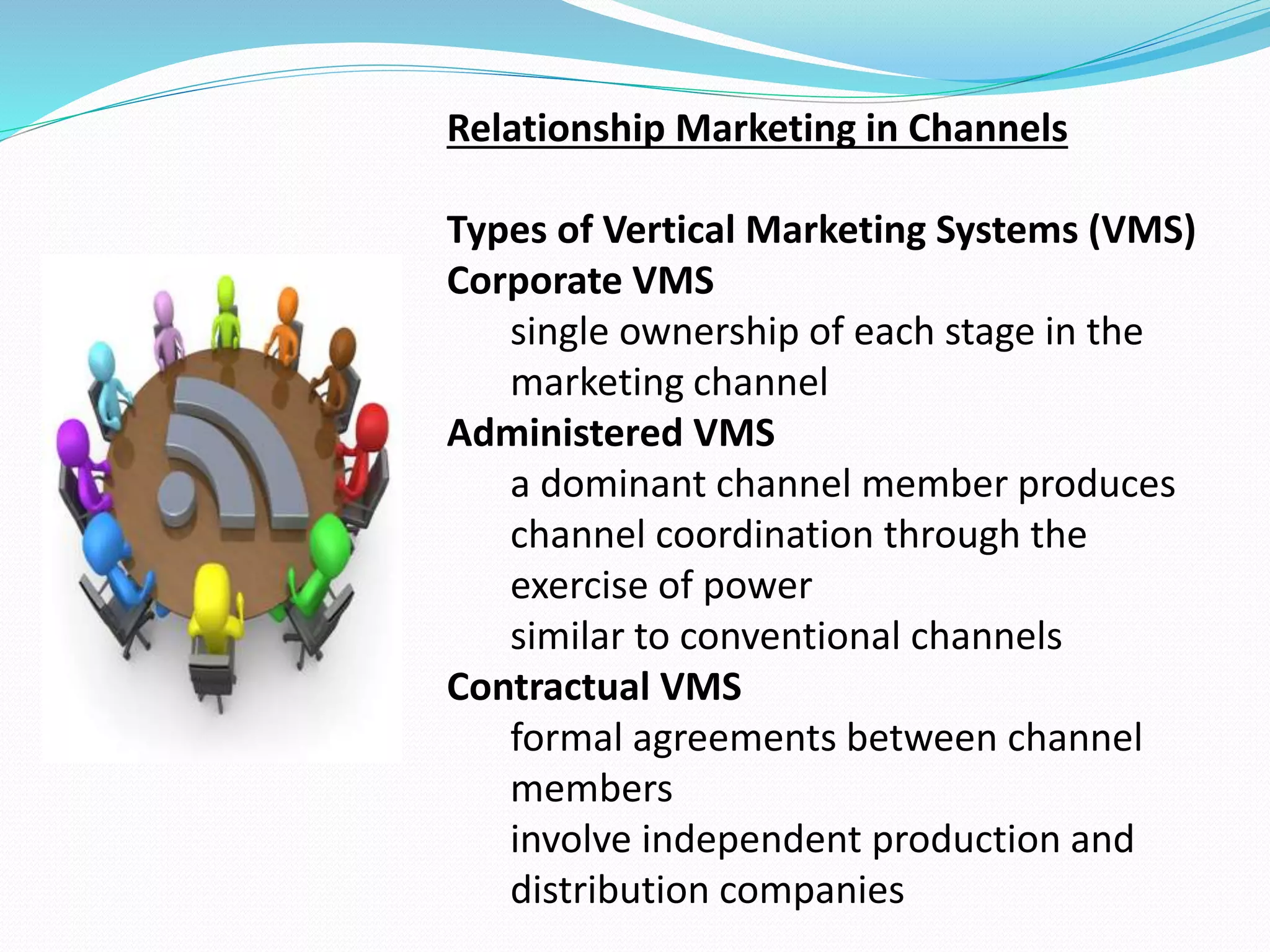
Relationship Marketing in Channels
Types of Vertical Marketing Systems (VMS)
Corporate VMS
single ownership of each stage in the
marketing channel
Administered VMS
a dominant channel member produces
channel coordination through the
exercise of power
similar to conventional channels
Contractual VMS
formal agreements between channel
members
involve independent production and
distribution companies
WHOLESALING- Wholesaling is the process of selling goods and services to a
client who will in turn resell those products to other consumers. Wholesalers
can include retailers, organizations who market services to members, and
companies that sell the purchased products under their own brand.
Generally, wholesaling involves providing the customer with a discounted rate
per item in exchange for buying the item in large amounts.
Specialty stores sell just one category of merchandise, although that category
may be further divided into particular departments
Department stores- They are organized by divisions that include several
clothing categories, cosmetics and accessories, jewelry, household goods,
furniture, kitchenware. Each department has a manager, and there are store
designers and decorators, plant maintenance and cleaning divisions, store
security and more.
Warehouse Store-. Products include clothing, automotive parts, sports
equipment, nursery plants, toys, bedding, electronics--and even groceries. Some
stores require annual memberships that offer discounts. Others are just huge
discount operations. Warehouse stores may train employees for multiple
departments and shift you from one area to another as needed.
Grocery Stores- Mom 'n' pop groceries, national chains, organic specialists,
corner delis--grocery stores come in all flavors. Departments may include a
bakery, deli, produce, meat and floral. Resale Stores
Resale or second-hand stores might be considered charity shops, antique stores
or consignment. Items found in these stores vary from donated clothing to
valuable antiques. Resale store employees accept and sort donations, stock racks
and shelves, assist customers and answer questions about the items on display.
Online Stores- They sometimes have real stores as well as virtual ones. But, even
if they exist only online, the stores need a fulfillment division to take orders, find
and pack purchased items from the warehouse, manage billing and shipping and
deal with customer service questions and complaints.
Non store retailing
1. Catalogs and direct mail
- consumers can be targeted effectively and reached home & work.
2. Vending Machines
- sales are beverages/food. Its available 24 hours & placed in variety of places.
3. Television Home shopping
- includes cable channels.
4. Direct sales
- from salesperson to consumers to their homes and offices.
5. Electronic exchange or Internet marketing
- involves collecting information, shopping, and purchasing from internet.
END
OF
REPORT

Distribution Strategy & Channels

  • 1.
  • 2.
    -the path throughwhich goods & services travel from the vendor to the consumer or payments for those products travel from the consumer to the vendor. - A distribution channel may include several interconnected intermediaries along the way such as wholesalers, distributers, agents and retailers. Channel of distribution
  • 3.
    1. Middleman –independent link between producers and consumers 2. Merchant middleman – actually buys goods and takes title/ownership 3. Agent – business unit that negotiates purchases & sales but does not take ownership 4. Wholesaler – a merchant who primarily stores and handles goods in large quantities 5. Retailer – merchant middleman who sells to final consumers 6. Broker – middleman who serves as a go-between for the buyer and seller 7. Manufacturer’s agent – an agent who operates by contract serving a geographic territory 8. Distributor – wholesale middleman in lines with selective or exclusive distribution 9. Jobber – a middleman who buys from manufacturers and sells to retailers 10. Facilitating agent – a firm that performs distribution tasks other than buying, selling and transferring Major types of Marketing Intermediaries
  • 4.
    Major functions Performed inChannel Distribution
  • 5.
    Conventional Channel ofDistribution of Consumer goods
  • 6.
    Conventional Channel ofDistribution of Organizational goods
  • 7.
    General considerations in ChannelPlanning - Customer characteristics - Product characteristics - Intermediary characteristics - Competitor characteristics - Company characteristics - Environmental characteristics
  • 8.
    Distribution Coverage required Channelselection may depend upon the nature of market coverage desired Intensive distribution – Using as many wholesalers and retailers as possible Selective distribution – Using only the best available per geographic area Exclusive distribution – Selected intermediaries are given exclusive rights within a particular territory Degree of control desired - Achieved by the seller is proportionate to the directness of channel Total distribution cost - Channel should be viewed as a total system composed of interdependent subsystems Objective should be to optimize total system performance Generally assumed that the total system should be designed to minimize costs, other things being equal Channel flexibility – Ability of the manufacturer to adapt to changing conditions
  • 9.
    Relationship Marketing inChannels Types of Vertical Marketing Systems (VMS) Corporate VMS single ownership of each stage in the marketing channel Administered VMS a dominant channel member produces channel coordination through the exercise of power similar to conventional channels Contractual VMS formal agreements between channel members involve independent production and distribution companies
  • 10.
    WHOLESALING- Wholesaling isthe process of selling goods and services to a client who will in turn resell those products to other consumers. Wholesalers can include retailers, organizations who market services to members, and companies that sell the purchased products under their own brand. Generally, wholesaling involves providing the customer with a discounted rate per item in exchange for buying the item in large amounts. Specialty stores sell just one category of merchandise, although that category may be further divided into particular departments Department stores- They are organized by divisions that include several clothing categories, cosmetics and accessories, jewelry, household goods, furniture, kitchenware. Each department has a manager, and there are store designers and decorators, plant maintenance and cleaning divisions, store security and more.
  • 11.
    Warehouse Store-. Productsinclude clothing, automotive parts, sports equipment, nursery plants, toys, bedding, electronics--and even groceries. Some stores require annual memberships that offer discounts. Others are just huge discount operations. Warehouse stores may train employees for multiple departments and shift you from one area to another as needed. Grocery Stores- Mom 'n' pop groceries, national chains, organic specialists, corner delis--grocery stores come in all flavors. Departments may include a bakery, deli, produce, meat and floral. Resale Stores Resale or second-hand stores might be considered charity shops, antique stores or consignment. Items found in these stores vary from donated clothing to valuable antiques. Resale store employees accept and sort donations, stock racks and shelves, assist customers and answer questions about the items on display. Online Stores- They sometimes have real stores as well as virtual ones. But, even if they exist only online, the stores need a fulfillment division to take orders, find and pack purchased items from the warehouse, manage billing and shipping and deal with customer service questions and complaints.
  • 12.
    Non store retailing 1.Catalogs and direct mail - consumers can be targeted effectively and reached home & work. 2. Vending Machines - sales are beverages/food. Its available 24 hours & placed in variety of places. 3. Television Home shopping - includes cable channels. 4. Direct sales - from salesperson to consumers to their homes and offices. 5. Electronic exchange or Internet marketing - involves collecting information, shopping, and purchasing from internet.
  • 13.