MARKETING CHANNELS PRESENTED TO: PROF.AYESHA ZAHID  PRESENTED BY: “ JAB WE MET” FAHEEM SHAHZAD 8372 ADNAN SALEEM  8336 M.HASEEB BUTT  8316 M.HUSSAIN  8361
This case study deals with Hewlett-Packard (HP), a famous manufacturer of computers and peripherals. In the early 1990s, HP faced a so-called “Inventory/Service-Crisis” concerning one of their high volume products, the DeskJet printer. Despite growing inventory levels at the distribution centers in Europe and Asia-Pacific, customer service levels were unsatisfactory. Affected by growing competition this problem had to be handled quickly. EXECTIVE SUMMARY
EXECTIVE SUMMARY Brent Cartier, Manager for Special Projects in the Materials Department of HP Company’s Vancouver Division, had tried his best to find the possible solutions of the issues related with inventory of DeskJet printers that were arisen at world level especially, at Europe. He had short time for these tasks because preparation was needed to be done for Monday’s meeting with Group Management on worldwide inventory levels for the DeskJet Printer product line. Finally opinions and reactions of different company divisions concerning the implementation of DC localization are analyzed. The solution of problems is the reconfiguration of key strategies related with channel’s management.
  Improvement during the early 1980s Manufacturing cycle time reduced 8-12 weeks  ==>  1 weeks Average inventory reduced 3.5 months ==> 0.9 months All finished goods inventory eliminated Importance of response time and transportation time increased Further improvements should be made on supply chain
  Improvement during the early 1980s Manufacturing cycle time reduced 8-12 weeks  ==>  1 weeks Average inventory reduced 3.5 months ==> 0.9 months All finished goods inventory eliminated Importance of response time and transportation time increased Further improvements should be made on supply chain
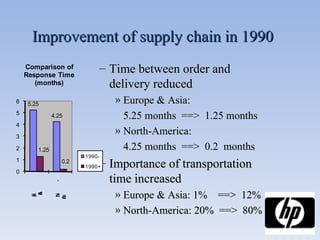
  Improvement of supply chain in 1990 Time between order and delivery reduced Europe & Asia:  5.25 months  ==>  1.25 months  North-America:  4.25 months  ==>  0.2  months  Importance of transportation time increased Europe & Asia: 1%  ==>  12%  North-America: 20%  ==>  80%
ANSWERING THE QUESTIONS No.1 (a)  Types of consumers to whom HP sells printers Business Personal Computer users in Offices Personal Computer users in Homes No.1 (b)  Consumer’s Need:  The primary need of all consumers is to print something in the form of images or text. Three option are available for the customers of HP. Dot Matrix Printer Inkjet Printer Laser Printer Prior to 1989, most customers were not aware of inkjet technology. However, customers were discovering that inkjet print quality was almost as good as laser print quality at a much affordable price. Laser printer and other printer related products of HP don’t necessary require the online selling. Because customer were discovering that inkjet print quality was almost as good as laser print quality at a much affordable price.
ANSWERING THE QUESTIONS Q No.1 (c)Consumer’s needs met with channel structure or not:   HP led the inkjet market in US. Means in USA, HP facilitate its customers and consumer’s needs are met by current channel structure. But in other areas of the world especially in Japan and in Europe HP faces certain issues while satisfying customers needs. the problem is only in terms of product availability. Channel structure is poorly designed especially, in Europe there is no information flow between channel members and lack of commitment. There is no product availability in some countries while others have access inventory (in terms of finished goods; printers). Between 80s and 90s HP was the market leader of Inkjet printer but now days HP’s DeskJet printer in on sixth position in ranking. Waiting time is high in Europe and Asia and availability is low in Europe. Physical possession and information flow don’t function properly.
ANSWERING THE QUESTIONS No.3  If HP were to sell direct, should they sell both printers and supplies? What printers should be sold online? What should not? Now days every company tries to sell their products directly as well as through third party distributors.  Selling online is also important factor and DELL is the example (most successful) of direct selling. There are many advantages of selling online included:  quick transactions, no physical space required for inventory, higher product availability,  no waiting time no intermediaries required.   So what should needed to do in case of HP? So HP should sells both printers and supplies direct (online).  There is no such need of selling directly in US because of high product availability because of functioning as a local company here.  But in Europe and Asia, HP must go direct.  HP already has an online system for other product lines like PCs and Laptops.  DeskJet printer is most successful brand or product of HP and generates high volume of sales. So HP should sell DeskJet printer online.
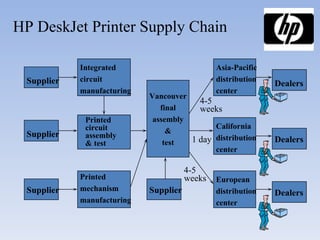
ANSWERING THE QUESTIONS No.4  Key components of HP’s channel management strategy Formulating marketing channel strategy Designing marketing channels Selecting channel members Motivating channel members Coordination channel strategy with members Evaluating channel member performance Managing conflict in the channels HP formulates its channel strategy in a better way and choosing channel members properly. In its channel members include: suppliers, manufacturer site (Vancouver Division), DCs, resellers, end users.  While designing channels HP focused on right level and right kind of channel members. Basically HP’s Vancouver division, products shipped to three DCs (distribution centers particularly located in US, Europe and Asia Pacific) then from DCs to resellers and retailers and finally to consumers. HP motivates its channel members and accepts the decisions from their side but there do not do too much effort on motivating. There is no coordination with channel members at low end. Means resellers and end users don’t know what is HP’s channel strategy.  There is no evaluation or feedback and finally HP sometimes fails to resolve issues. As we know from the case study that representatives conflicting goals prevented them from reaching consensus on the issues.
ANSWERING THE QUESTIONS No.5 How are channel members likely to react if HP goes direct? How should they react? Channel members might be turn towards competitors of HP They might be take illegal actions, called against HP in market It is possible that react in positive way and make alliances with HP They might be adopt negative policy and start to spoil the HP’s market It is possible that they would started misguiding HP’s loyal customers
RECOMMENDATIONS HP should do work on value constellation rather than value chain. R&D staff should visit all the market especially in Europe and Asia to better knowing the customer needs and for demand analysis. There is no coordination in channel members so HP must improve this deficiency through information flow Provide downstream members some extra benefits for their better performance Improve forecasting through different strategies  DC localizations Manufacturing site as Vancouver is also built in Europe and Asia. HP should sell printers direct (online) as well as through the current channel members Air transportation mean is also used to reduce lead time Channel manager should perform its functions properly and resolve the conflicts among channel members Special bar codes are applied to inventory (products) according to specific regions. VMS should be introduced
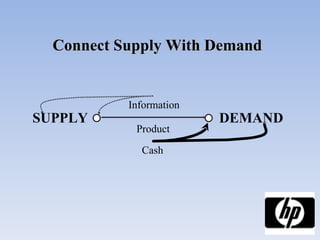
Connect Supply With Demand SUPPLY DEMAND Information Product Cash
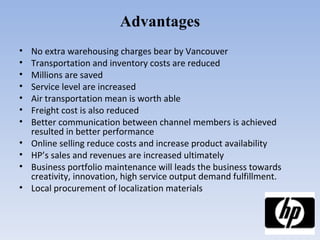
Advantages No extra warehousing charges bear by Vancouver Transportation and inventory costs are reduced Millions are saved Service level are increased Air transportation mean is worth able Freight cost is also reduced Better communication between channel members is achieved resulted in better performance Online selling reduce costs and increase product availability  HP’s sales and revenues are increased ultimately Business portfolio maintenance will leads the business towards creativity, innovation, high service output demand fulfillment. Local procurement of localization materials
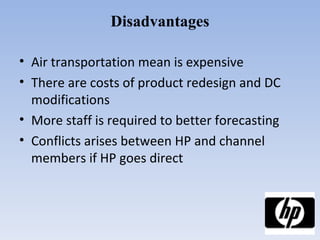
Disadvantages Air transportation mean is expensive There are costs of product redesign and DC modifications More staff is required to better forecasting Conflicts arises between HP and channel members if HP goes direct
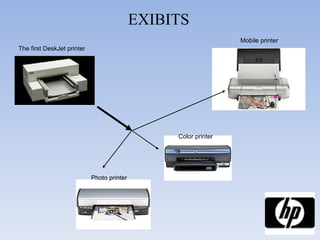
EXIBITS Photo printer Color printer Mobile printer The first DeskJet printer
HP DeskJet Printer Supply Chain Printed circuit assembly & test Printed  mechanism manufacturing Supplier Supplier Supplier Vancouver final assembly & test Asia-Pacific distribution  center Integrated circuit manufacturing Dealers Supplier 4-5 weeks 1 day California distribution center European distribution center 4-5 weeks Dealers Dealers
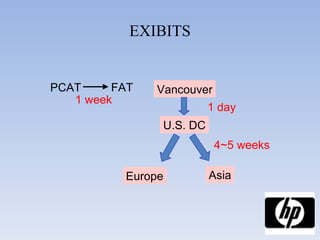
EXIBITS PCAT FAT 1 week Vancouver U.S. DC 1 day Europe Asia 4~5 weeks
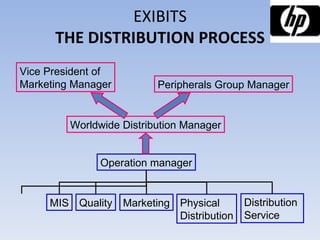
EXIBITS THE DISTRIBUTION PROCESS Operation manager MIS Quality Marketing Physical  Distribution Distribution  Service Vice President of  Marketing Manager Worldwide Distribution Manager Peripherals Group Manager
JAB WE MET

HP channel analysis

  • 1.
    MARKETING CHANNELS PRESENTEDTO: PROF.AYESHA ZAHID PRESENTED BY: “ JAB WE MET” FAHEEM SHAHZAD 8372 ADNAN SALEEM 8336 M.HASEEB BUTT 8316 M.HUSSAIN 8361
  • 2.
    This case studydeals with Hewlett-Packard (HP), a famous manufacturer of computers and peripherals. In the early 1990s, HP faced a so-called “Inventory/Service-Crisis” concerning one of their high volume products, the DeskJet printer. Despite growing inventory levels at the distribution centers in Europe and Asia-Pacific, customer service levels were unsatisfactory. Affected by growing competition this problem had to be handled quickly. EXECTIVE SUMMARY
  • 3.
    EXECTIVE SUMMARY BrentCartier, Manager for Special Projects in the Materials Department of HP Company’s Vancouver Division, had tried his best to find the possible solutions of the issues related with inventory of DeskJet printers that were arisen at world level especially, at Europe. He had short time for these tasks because preparation was needed to be done for Monday’s meeting with Group Management on worldwide inventory levels for the DeskJet Printer product line. Finally opinions and reactions of different company divisions concerning the implementation of DC localization are analyzed. The solution of problems is the reconfiguration of key strategies related with channel’s management.
  • 4.
    Improvementduring the early 1980s Manufacturing cycle time reduced 8-12 weeks ==> 1 weeks Average inventory reduced 3.5 months ==> 0.9 months All finished goods inventory eliminated Importance of response time and transportation time increased Further improvements should be made on supply chain
  • 5.
    Improvementduring the early 1980s Manufacturing cycle time reduced 8-12 weeks ==> 1 weeks Average inventory reduced 3.5 months ==> 0.9 months All finished goods inventory eliminated Importance of response time and transportation time increased Further improvements should be made on supply chain
  • 6.
    Improvementof supply chain in 1990 Time between order and delivery reduced Europe & Asia: 5.25 months ==> 1.25 months North-America: 4.25 months ==> 0.2 months Importance of transportation time increased Europe & Asia: 1% ==> 12% North-America: 20% ==> 80%
  • 7.
    ANSWERING THE QUESTIONSNo.1 (a) Types of consumers to whom HP sells printers Business Personal Computer users in Offices Personal Computer users in Homes No.1 (b) Consumer’s Need: The primary need of all consumers is to print something in the form of images or text. Three option are available for the customers of HP. Dot Matrix Printer Inkjet Printer Laser Printer Prior to 1989, most customers were not aware of inkjet technology. However, customers were discovering that inkjet print quality was almost as good as laser print quality at a much affordable price. Laser printer and other printer related products of HP don’t necessary require the online selling. Because customer were discovering that inkjet print quality was almost as good as laser print quality at a much affordable price.
  • 8.
    ANSWERING THE QUESTIONSQ No.1 (c)Consumer’s needs met with channel structure or not: HP led the inkjet market in US. Means in USA, HP facilitate its customers and consumer’s needs are met by current channel structure. But in other areas of the world especially in Japan and in Europe HP faces certain issues while satisfying customers needs. the problem is only in terms of product availability. Channel structure is poorly designed especially, in Europe there is no information flow between channel members and lack of commitment. There is no product availability in some countries while others have access inventory (in terms of finished goods; printers). Between 80s and 90s HP was the market leader of Inkjet printer but now days HP’s DeskJet printer in on sixth position in ranking. Waiting time is high in Europe and Asia and availability is low in Europe. Physical possession and information flow don’t function properly.
  • 9.
    ANSWERING THE QUESTIONSNo.3 If HP were to sell direct, should they sell both printers and supplies? What printers should be sold online? What should not? Now days every company tries to sell their products directly as well as through third party distributors. Selling online is also important factor and DELL is the example (most successful) of direct selling. There are many advantages of selling online included: quick transactions, no physical space required for inventory, higher product availability, no waiting time no intermediaries required. So what should needed to do in case of HP? So HP should sells both printers and supplies direct (online). There is no such need of selling directly in US because of high product availability because of functioning as a local company here. But in Europe and Asia, HP must go direct. HP already has an online system for other product lines like PCs and Laptops. DeskJet printer is most successful brand or product of HP and generates high volume of sales. So HP should sell DeskJet printer online.
  • 10.
    ANSWERING THE QUESTIONSNo.4 Key components of HP’s channel management strategy Formulating marketing channel strategy Designing marketing channels Selecting channel members Motivating channel members Coordination channel strategy with members Evaluating channel member performance Managing conflict in the channels HP formulates its channel strategy in a better way and choosing channel members properly. In its channel members include: suppliers, manufacturer site (Vancouver Division), DCs, resellers, end users. While designing channels HP focused on right level and right kind of channel members. Basically HP’s Vancouver division, products shipped to three DCs (distribution centers particularly located in US, Europe and Asia Pacific) then from DCs to resellers and retailers and finally to consumers. HP motivates its channel members and accepts the decisions from their side but there do not do too much effort on motivating. There is no coordination with channel members at low end. Means resellers and end users don’t know what is HP’s channel strategy. There is no evaluation or feedback and finally HP sometimes fails to resolve issues. As we know from the case study that representatives conflicting goals prevented them from reaching consensus on the issues.
  • 11.
    ANSWERING THE QUESTIONSNo.5 How are channel members likely to react if HP goes direct? How should they react? Channel members might be turn towards competitors of HP They might be take illegal actions, called against HP in market It is possible that react in positive way and make alliances with HP They might be adopt negative policy and start to spoil the HP’s market It is possible that they would started misguiding HP’s loyal customers
  • 12.
    RECOMMENDATIONS HP shoulddo work on value constellation rather than value chain. R&D staff should visit all the market especially in Europe and Asia to better knowing the customer needs and for demand analysis. There is no coordination in channel members so HP must improve this deficiency through information flow Provide downstream members some extra benefits for their better performance Improve forecasting through different strategies DC localizations Manufacturing site as Vancouver is also built in Europe and Asia. HP should sell printers direct (online) as well as through the current channel members Air transportation mean is also used to reduce lead time Channel manager should perform its functions properly and resolve the conflicts among channel members Special bar codes are applied to inventory (products) according to specific regions. VMS should be introduced
  • 13.
    Connect Supply WithDemand SUPPLY DEMAND Information Product Cash
  • 14.
    Advantages No extrawarehousing charges bear by Vancouver Transportation and inventory costs are reduced Millions are saved Service level are increased Air transportation mean is worth able Freight cost is also reduced Better communication between channel members is achieved resulted in better performance Online selling reduce costs and increase product availability HP’s sales and revenues are increased ultimately Business portfolio maintenance will leads the business towards creativity, innovation, high service output demand fulfillment. Local procurement of localization materials
  • 15.
    Disadvantages Air transportationmean is expensive There are costs of product redesign and DC modifications More staff is required to better forecasting Conflicts arises between HP and channel members if HP goes direct
  • 16.
    EXIBITS Photo printerColor printer Mobile printer The first DeskJet printer
  • 17.
    HP DeskJet PrinterSupply Chain Printed circuit assembly & test Printed mechanism manufacturing Supplier Supplier Supplier Vancouver final assembly & test Asia-Pacific distribution center Integrated circuit manufacturing Dealers Supplier 4-5 weeks 1 day California distribution center European distribution center 4-5 weeks Dealers Dealers
  • 18.
    EXIBITS PCAT FAT1 week Vancouver U.S. DC 1 day Europe Asia 4~5 weeks
  • 19.
    EXIBITS THE DISTRIBUTIONPROCESS Operation manager MIS Quality Marketing Physical Distribution Distribution Service Vice President of Marketing Manager Worldwide Distribution Manager Peripherals Group Manager
  • 20.