
retrospective
Retrospectives are a crucial part of Scrum.
But... running the standard ‘3 questions’* setup can
                 get boring.


* what went well, what went bad, what should we improve
There are books about how to
do retrospectives.
Here is a retrospective form I designed myself. I call
it the “Facebook” retrospective.
Setup
My retrospectives are always timeboxed to one
hour.
I always start with an energizer/ice breaker, to get
everyone active and set the mood.
After the energizer, I start with the actual
retrospective.
Like or Dislike
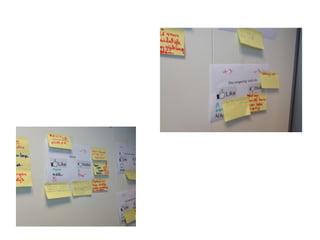
For the Facebook retrospective, I printed out
different elements of our Scrum process on A4
paper.
Examples of these elements are: standup, demo,
sprint planning, JIRA, team communication etc. There
were 12 different topics.
Each of the pieces of paper
had the topic written on it and
         two columns:
      Like and Dislike.
I introduced each of these topics briefly, so everyone
understood what I meant with them.
Next, I asked everyone to get up and walk over to
wall with the cards on it. Everyone had to decide if
they ‘liked’ or disliked the topic on each card by
putting their name in one of the columns.
After everyone was done, I added up the likes and
the dislikes seperately.

There turned to be two groups of cards:
Group 1
Those where the team
  seemed to agree.
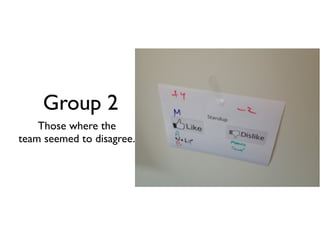
Group 2
    Those where the
team seemed to disagree.
Define actions
After discussing the results, we focused on those
where we disagreed.
Everyone took some post-its and wrote down
actions for each of the topics where the team
‘disagreed’.
A lot of the actions overlapped, so the total amount
of actions turned out to be limited. We decided to
take them all into the next sprint.
Retro o’ retro
As always, we closed the retrospective with a small
retrospective on the retrospective itself.
Suggestions for improvement coming out of the
retrospective on the retrospective:
1. People found having only Like and Dislike quite
limited. They suggested to add up a ‘neutral’ field.
(Allowing people not to pick any option would be
another solution.)
2. The team suggested to add a number of cards
without predefined topics, so they add their own.
Time planning
Energizer                5 min


Explanation              5 min


Choose Like or Dislike   10 min


Discuss outcome          10 min


Write down actions       10 min


Discuss actions          10 min


Retro                    5 min


End session              5 min
Did you like this retrospective setup? Try it out for
yourself and let me know how it went!
I am Jasper Verdooren,
founder of Sygmoid.
Find me at


             www.sygmoid.nl


             about.me/jasperverdooren


             www.slideshare.com/jasperverdooren


             www.linkedin.com/in/jasperverdooren


             jasper.verdooren@sygmoid.nl
‣Scrum Master                      Founded Sygmoid
                 ‣Team lead PO     ‣Consultancy
‣Product Owner   ‣ Scrum trainer
‣Team lead PO                      ‣Training & coaching
‣Scrum trainer                     ‣Software development


2007-2010        2010-2011         2011
Thank you for your attention!

Questions? Comments? Let me know!

Facebook retrospective

  • 1.
  • 2.
    Retrospectives are acrucial part of Scrum.
  • 3.
    But... running thestandard ‘3 questions’* setup can get boring. * what went well, what went bad, what should we improve
  • 4.
    There are booksabout how to do retrospectives.
  • 5.
    Here is aretrospective form I designed myself. I call it the “Facebook” retrospective.
  • 6.
  • 7.
    My retrospectives arealways timeboxed to one hour.
  • 8.
    I always startwith an energizer/ice breaker, to get everyone active and set the mood.
  • 9.
    After the energizer,I start with the actual retrospective.
  • 10.
  • 11.
    For the Facebookretrospective, I printed out different elements of our Scrum process on A4 paper.
  • 12.
    Examples of theseelements are: standup, demo, sprint planning, JIRA, team communication etc. There were 12 different topics.
  • 13.
    Each of thepieces of paper had the topic written on it and two columns: Like and Dislike.
  • 14.
    I introduced eachof these topics briefly, so everyone understood what I meant with them.
  • 15.
    Next, I askedeveryone to get up and walk over to wall with the cards on it. Everyone had to decide if they ‘liked’ or disliked the topic on each card by putting their name in one of the columns.
  • 17.
    After everyone wasdone, I added up the likes and the dislikes seperately. There turned to be two groups of cards:
  • 18.
    Group 1 Those wherethe team seemed to agree.
  • 19.
    Group 2 Those where the team seemed to disagree.
  • 20.
  • 21.
    After discussing theresults, we focused on those where we disagreed.
  • 22.
    Everyone took somepost-its and wrote down actions for each of the topics where the team ‘disagreed’.
  • 24.
    A lot ofthe actions overlapped, so the total amount of actions turned out to be limited. We decided to take them all into the next sprint.
  • 25.
  • 26.
    As always, weclosed the retrospective with a small retrospective on the retrospective itself.
  • 27.
    Suggestions for improvementcoming out of the retrospective on the retrospective:
  • 28.
    1. People foundhaving only Like and Dislike quite limited. They suggested to add up a ‘neutral’ field. (Allowing people not to pick any option would be another solution.)
  • 29.
    2. The teamsuggested to add a number of cards without predefined topics, so they add their own.
  • 30.
    Time planning Energizer 5 min Explanation 5 min Choose Like or Dislike 10 min Discuss outcome 10 min Write down actions 10 min Discuss actions 10 min Retro 5 min End session 5 min
  • 31.
    Did you likethis retrospective setup? Try it out for yourself and let me know how it went!
  • 32.
    I am JasperVerdooren, founder of Sygmoid. Find me at www.sygmoid.nl about.me/jasperverdooren www.slideshare.com/jasperverdooren www.linkedin.com/in/jasperverdooren jasper.verdooren@sygmoid.nl
  • 33.
    ‣Scrum Master Founded Sygmoid ‣Team lead PO ‣Consultancy ‣Product Owner ‣ Scrum trainer ‣Team lead PO ‣Training & coaching ‣Scrum trainer ‣Software development 2007-2010 2010-2011 2011
  • 34.
    Thank you foryour attention! Questions? Comments? Let me know!