How to spice up your 
retrospective 
Bringing back the fun to 
change
Why 
What if the team is bored by retrospectives? 
What if the changes you detect are the same 
over and over again? 
What if that changes are not be followed up?
What if 
Restrospectives are fun and are the main 
source for small or big changes and 
improvement?
Ideal 
Retrospective is the most important meeting 
during the scrum process. 
It brings with every meeting small or big 
changes to improve the process continuously.
How 
boring, useless happy, fun, yeah!
Well 
1. Ask the team 
2. Try it out 
3. Listen to the team
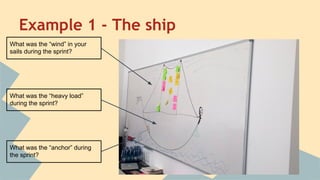
Example 1 - The ship 
What was the “wind” in your 
sails during the sprint? 
What was the “heavy load” 
during the sprint? 
What was the “anchor” during 
the sprint?
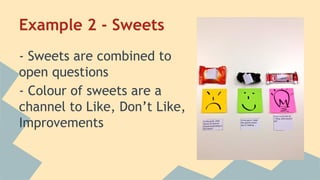
Example 2 - Sweets 
- Sweets are combined to 
open questions 
- Colour of sweets are a 
channel to Like, Don’t Like, 
Improvements
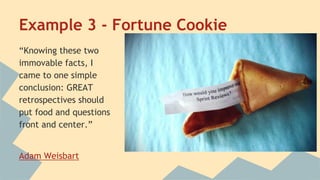
Example 3 - Fortune Cookie 
“Knowing these two 
immovable facts, I 
came to one simple 
conclusion: GREAT 
retrospectives should 
put food and questions 
front and center.” 
Adam Weisbart
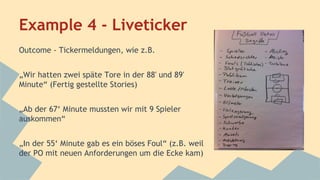
Example 4 - Liveticker 
Outcome - Tickermeldungen, wie z.B. 
„Wir hatten zwei späte Tore in der 88′ und 89′ 
Minute“ (Fertig gestellte Stories) 
„Ab der 67‘ Minute mussten wir mit 9 Spieler 
auskommen“ 
„In der 55‘ Minute gab es ein böses Foul“ (z.B. weil 
der PO mit neuen Anforderungen um die Ecke kam)
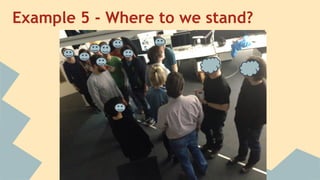
Example 5 - Where to we stand?
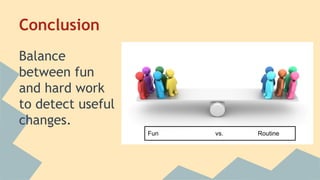
Conclusion 
Balance 
between fun 
and hard work 
to detect useful 
changes. 
Fun vs. Routine
Links 
Fußball-Retro: 
http://spoonique.de/2012/04/27/die-fusball-retrospektive/ 
Beispiele für Retros: http://blog.sybit.de/2012/06/agile-breakfast-retrospective/ 
Fortune Cookies Retro: 
http://weisbart.com/cookies

Spice up the retro

  • 1.
    How to spiceup your retrospective Bringing back the fun to change
  • 2.
    Why What ifthe team is bored by retrospectives? What if the changes you detect are the same over and over again? What if that changes are not be followed up?
  • 3.
    What if Restrospectivesare fun and are the main source for small or big changes and improvement?
  • 4.
    Ideal Retrospective isthe most important meeting during the scrum process. It brings with every meeting small or big changes to improve the process continuously.
  • 5.
    How boring, uselesshappy, fun, yeah!
  • 6.
    Well 1. Askthe team 2. Try it out 3. Listen to the team
  • 7.
    Example 1 -The ship What was the “wind” in your sails during the sprint? What was the “heavy load” during the sprint? What was the “anchor” during the sprint?
  • 8.
    Example 2 -Sweets - Sweets are combined to open questions - Colour of sweets are a channel to Like, Don’t Like, Improvements
  • 9.
    Example 3 -Fortune Cookie “Knowing these two immovable facts, I came to one simple conclusion: GREAT retrospectives should put food and questions front and center.” Adam Weisbart
  • 10.
    Example 4 -Liveticker Outcome - Tickermeldungen, wie z.B. „Wir hatten zwei späte Tore in der 88′ und 89′ Minute“ (Fertig gestellte Stories) „Ab der 67‘ Minute mussten wir mit 9 Spieler auskommen“ „In der 55‘ Minute gab es ein böses Foul“ (z.B. weil der PO mit neuen Anforderungen um die Ecke kam)
  • 11.
    Example 5 -Where to we stand?
  • 12.
    Conclusion Balance betweenfun and hard work to detect useful changes. Fun vs. Routine
  • 13.
    Links Fußball-Retro: http://spoonique.de/2012/04/27/die-fusball-retrospektive/ Beispiele für Retros: http://blog.sybit.de/2012/06/agile-breakfast-retrospective/ Fortune Cookies Retro: http://weisbart.com/cookies