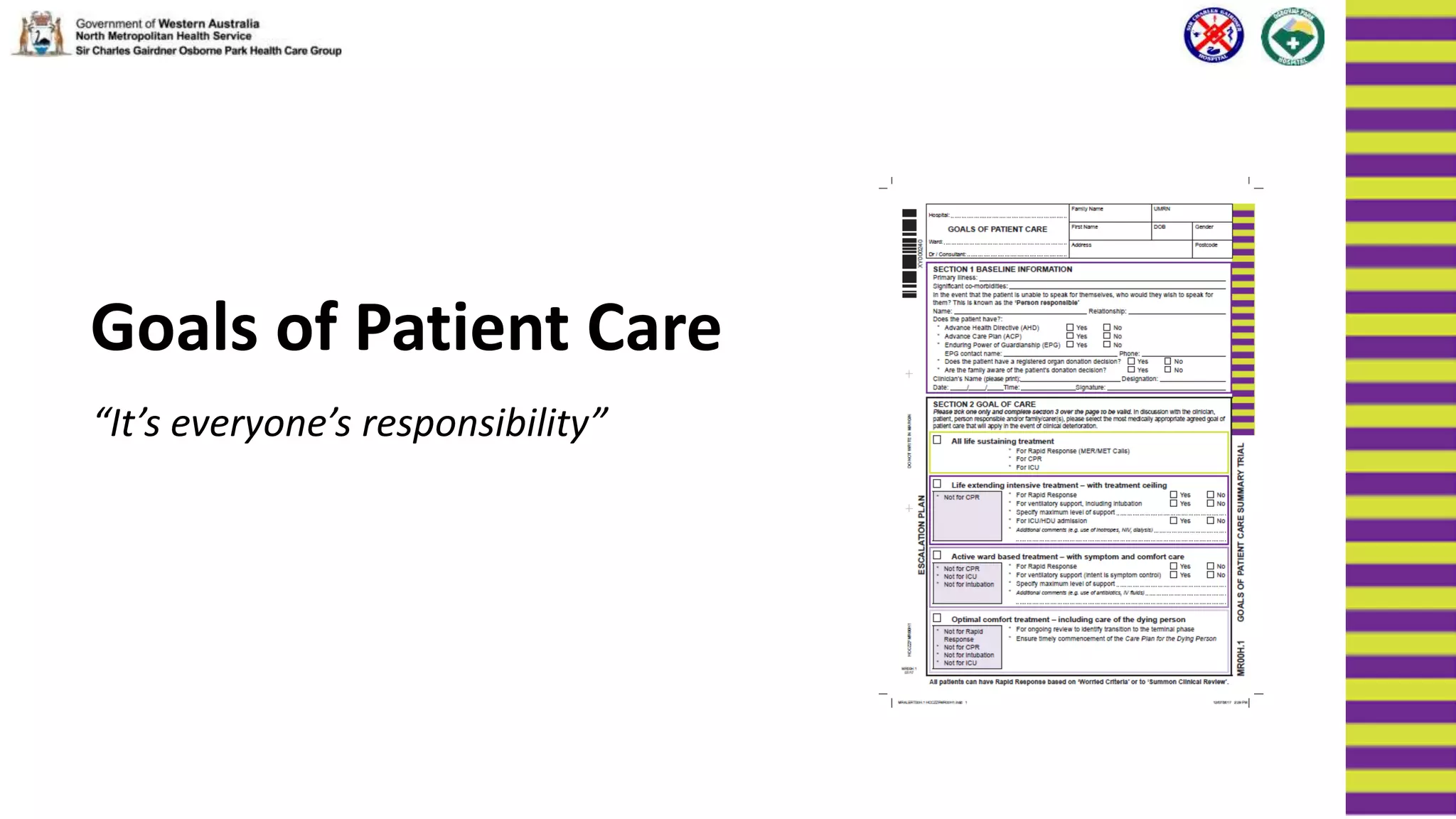
Goals of Patient Care
“It’s everyone’s responsibility”
Outline
• Brief background about Goals of patient care
(GOPC)
• Some tools
• Patient identification
• Communication
• The new form structure
• Timelines
• Resources
Background
• The GOPC form is still in it’s trial state
•14 sites across WA now using the GOPC trial form
instead of a Not For Resuscitation Form (blue form)
• Previous pilot of the trial form in 2017
• Wards G53, G63, C17 (SCGH)
• Ward 4 (OPH)
Current situation
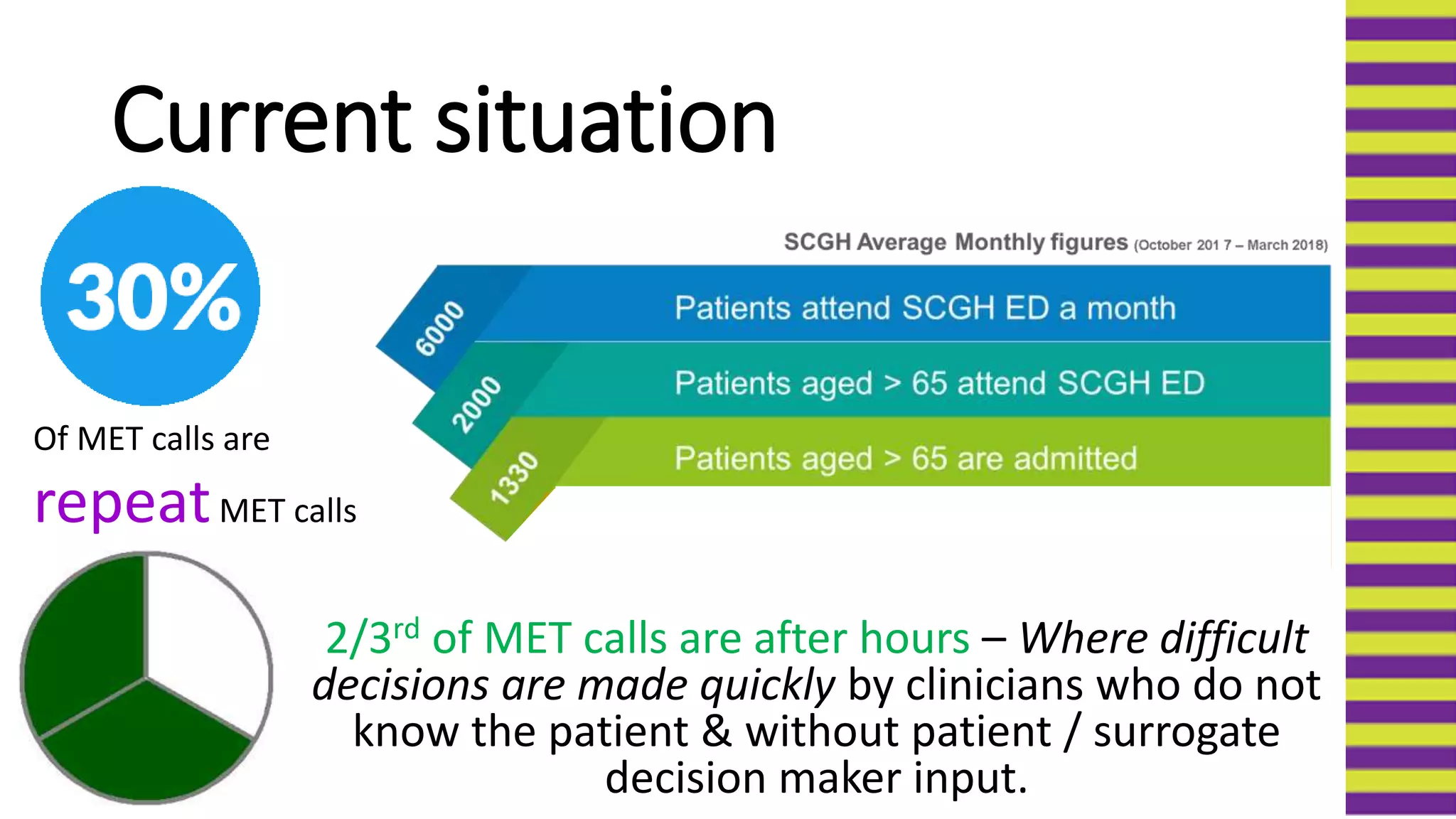
2/3rd of MET calls are after hours – Where difficult
decisions are made quickly by clinicians who do not
know the patient & without patient / surrogate
decision maker input.
Of MET calls are
repeatMET calls
Synergies
•Fits in with Choosing
Wisely initiatives
•Part of Sustainable
Health care is providing
appropriate the goal of
care to patients
•Links in with advanced
health care directives
Considerations
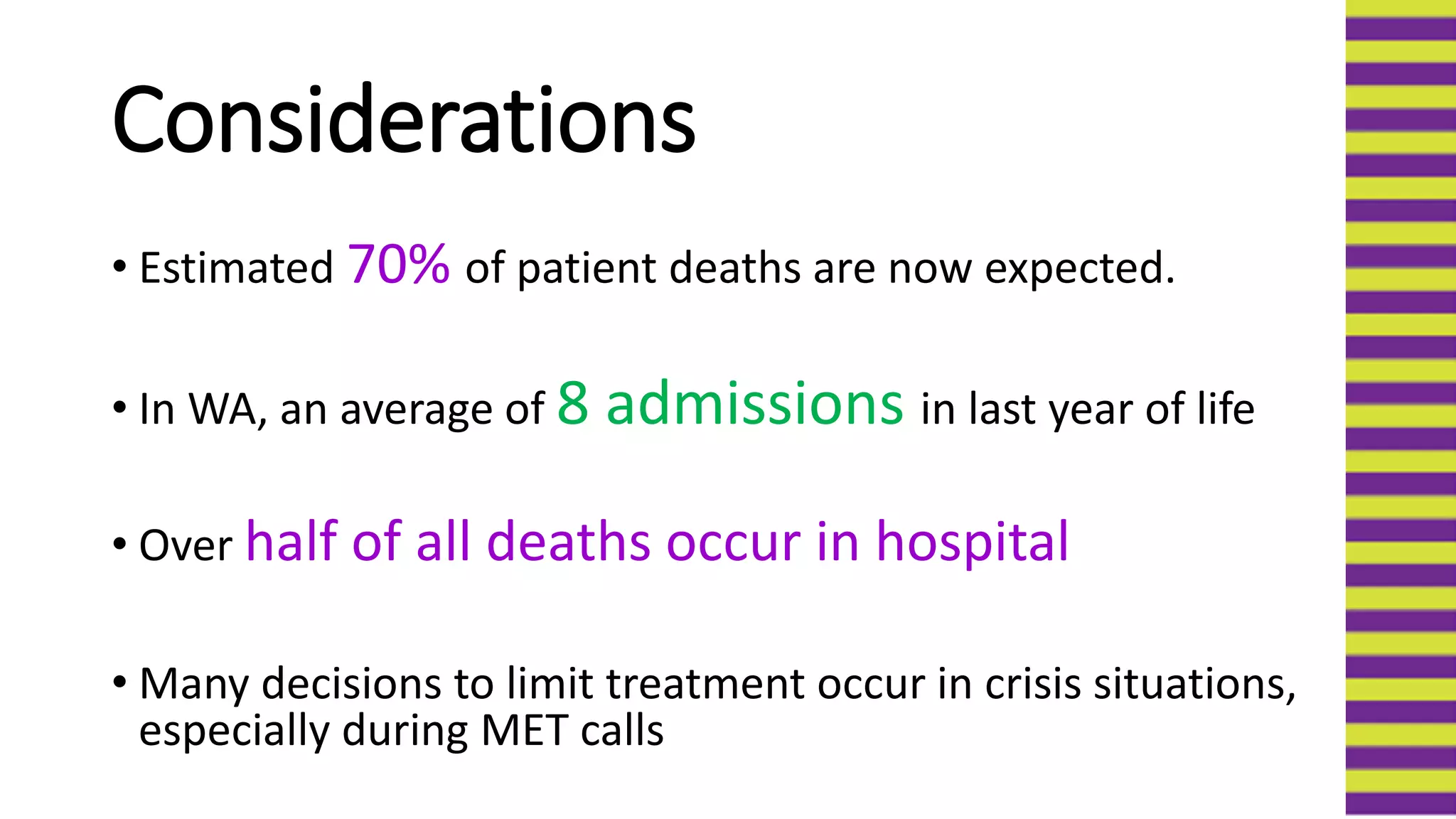
• Estimated 70% of patient deaths are now expected.
• In WA, an average of 8 admissions in last year of life
• Over half of all deaths occur in hospital
• Many decisions to limit treatment occur in crisis situations,
especially during MET calls
Pathways to death
-- Multiple co-
morbidities, each hosp
adm leads to poorer new
baseline
-- Frail – not expected to
survive even single organ
failure
MOST ADMITTED
PATIENTS AND THOSE
SEEN FREQUENTLY IN
OUTPATEINTS FALL INTO
THE ABOVE CATEGORIES!
GOPC rationale
• A medical decision making based on determining
the patient’s goals of care.
• Assigned according to realistic assessment of
probable outcomes
•Not the same as Advance Health Directive –
which is made by the person in their own voice and
utilised when capacity is lost
•Conversation is shared with the patient or their
surrogate decision maker
GOPC – patient identification tools
Does your patient have two or more of the following?
1. Reducing function
2. Two or more hospital admissions in 6 months
3. Weight loss of 5-10%
4. Refractory symptoms
5. Dependent on others for care needs
The surprise question
Would you be surprised if
this person died in the next 6
– 12 months?
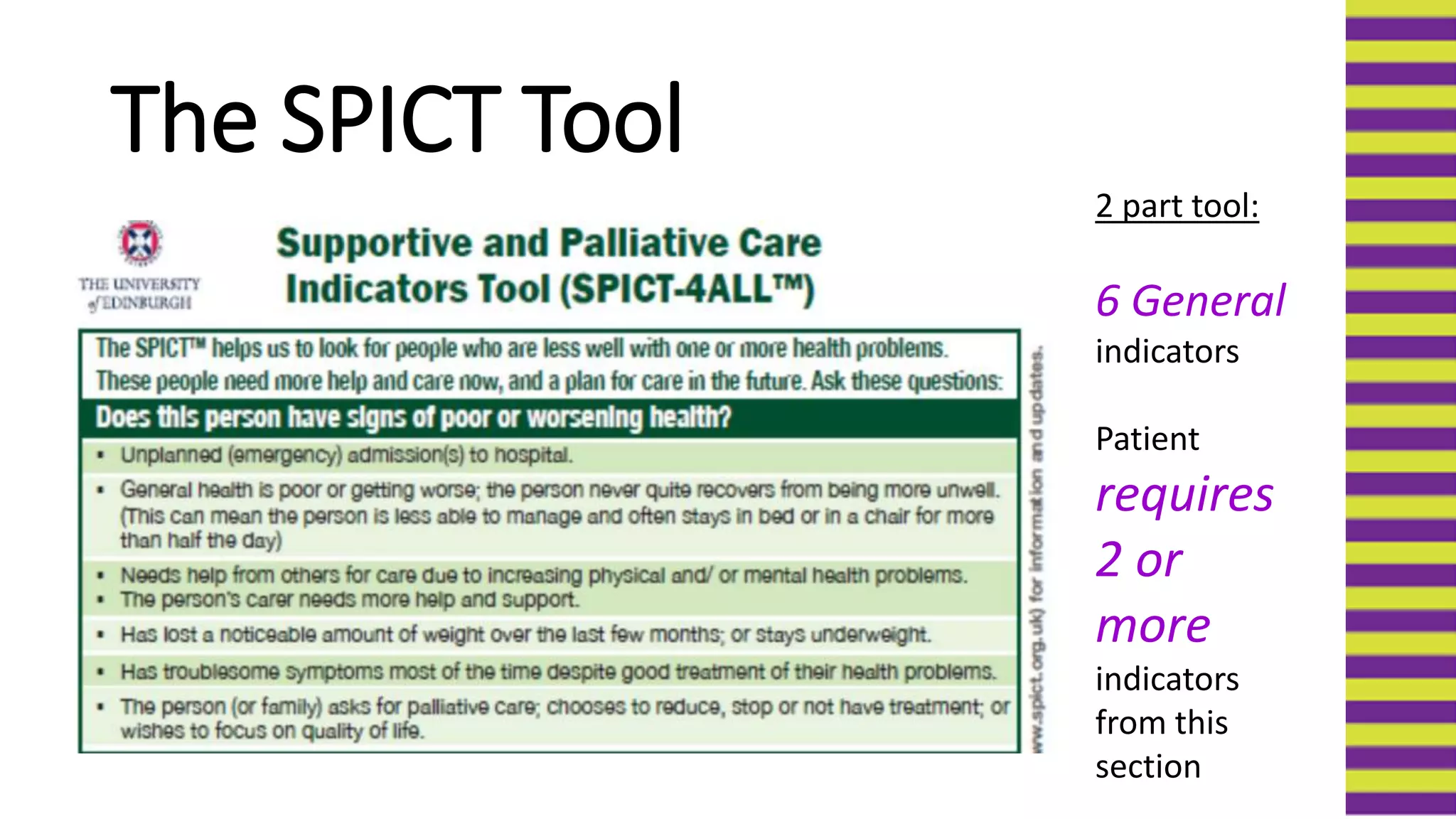
The SPICT Tool
2 part tool:
6 General
indicators
Patient
requires
2 or
more
indicators
from this
section
Change in forms
4 main sections
(1)Baseline information
(2)Goal of care
- All life sustaining tx
- Life extending tx
- Active ward based mx
- Comfort care
(3)Goal of care summary discussion
(4)Extended use of form
Section 1 – intern & above
Section 2 – Registrar or Consultant
LHS –
what is
NOT
being
done
RHS –
tailoring
what IS
to be
done
All life sustaining treatment
• Aim is cure
• Is there reasonable chance the patient will leave hospital
with a similar life span?
• Probably the quickest discussion / decision.
• No limitations on interventions / treatments
FOR
CPR
MET calls
ICU
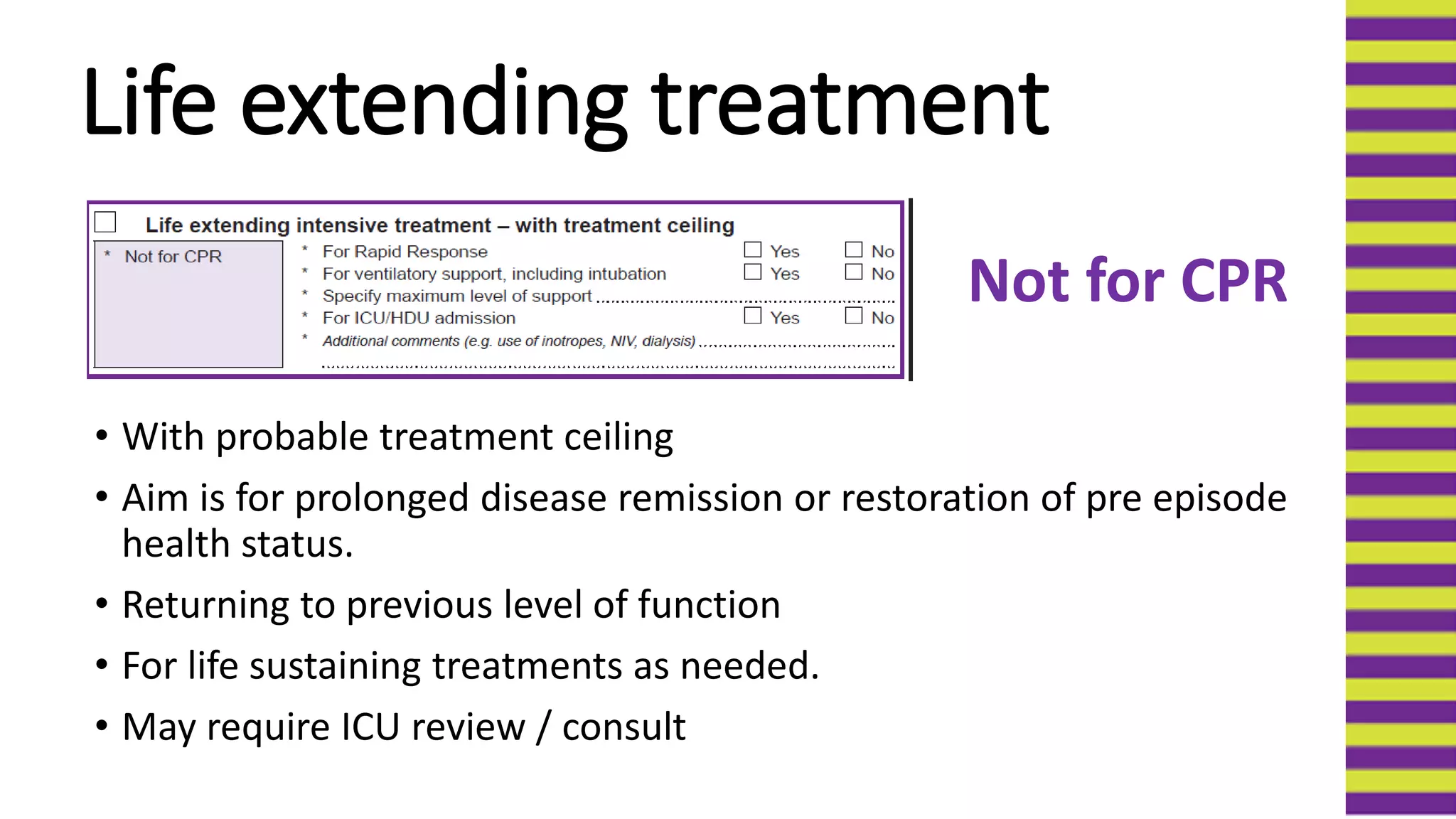
Life extending treatment
• With probable treatment ceiling
• Aim is for prolonged disease remission or restoration of pre episode
health status.
• Returning to previous level of function
• For life sustaining treatments as needed.
• May require ICU review / consult
Not for CPR
Active Ward based care
Consider in patients who may have:
• Incurable and progressive disease
• Advancing disease: anticipating death
• Life expectancy months, possibly years  Remember the “surprise
question”
• Aim of treatment:
• Length of survival not sole determinant
• Comfort, quality and dignity
• Treatment underlying disease still appropriate
Not for CPR
Symptom /
comfort care
Optimal comfort treatment
•Including care of the dying person
•Death imminent
•Would you be surprised if they died during this
admission.
•Should be on Care Plan for the Dying Person
Aim is comfort,
quality of life and
dignity
NOTE! To make the form valid P.T.O
None of what’s been
completed in section 2 is valid
unless section 3 is signed
overleaf.
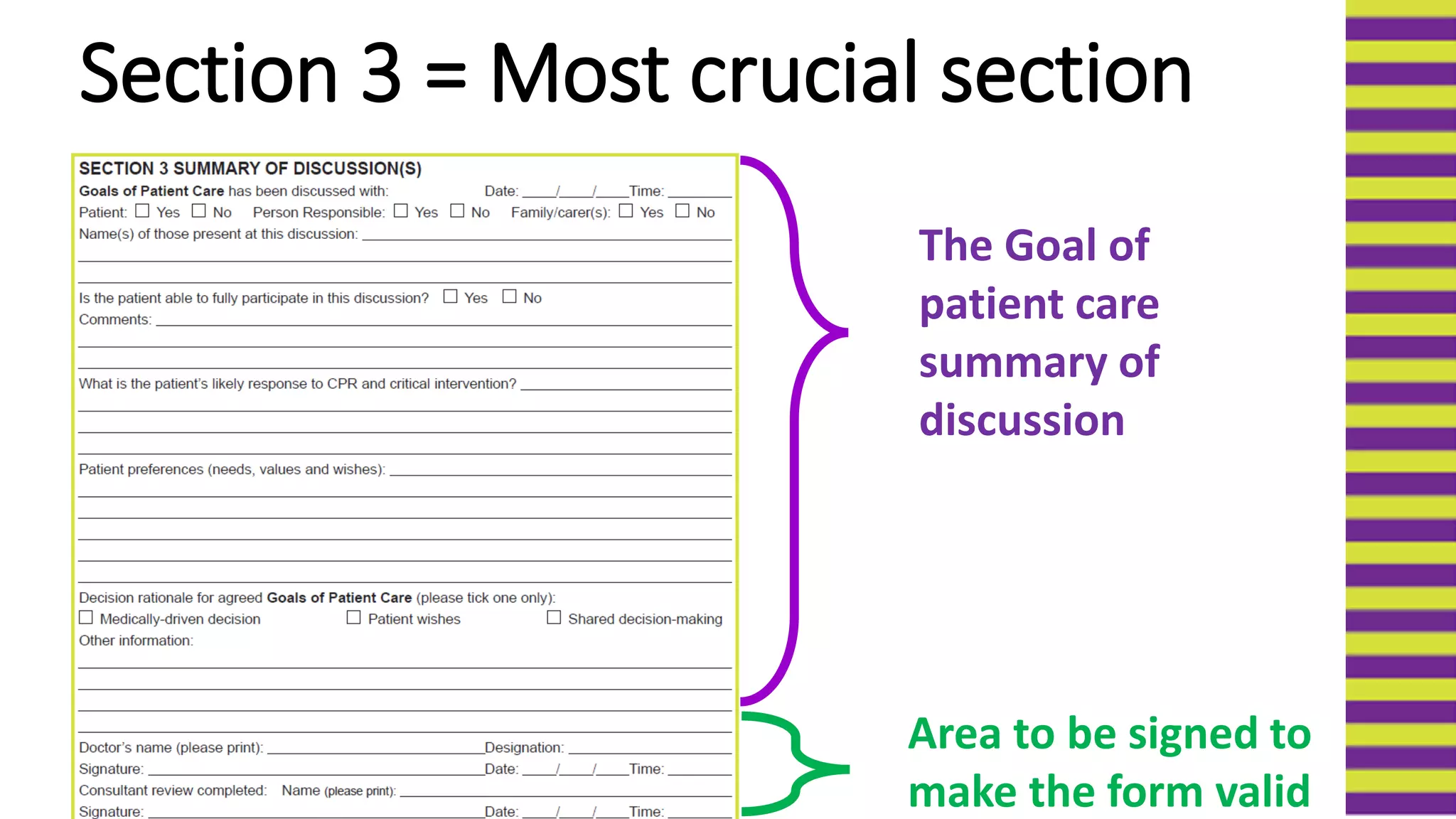
Section 3 = Most crucial section
The Goal of
patient care
summary of
discussion
Area to be signed to
make the form valid
Section 4 = Extended use of form
This section can be completed in outpatients
and valid if the patient is then subsequently
admitted to hospital for example
If signed, then
the form is valid
for 12 months*
* Team are working with HIMS on
how a valid form can be pulled
from the medical record in to the
medical notes
GOPC narrative
• It’s all about communication
• It’s also a clinical decision tool
• Understand what’s important to the patient
• Understand what lifestyle limitations / treatments would
be unacceptable to them
• Do you want us to do everything?
• Resuscitation is futile
• The medical team have decided
•There is nothing more we can do
Importance of use of languageWe might say
• Do you want us to do everything?
• Resuscitation is futile
• The medical team have decided
•There is nothing more we can do
What the patient/family hears….
• Do you want us to try?
• Your loved one is worthless
•We don’t care what you think… we’ll decide for you
•We are going to abandon treatment and care
• Do you want us to do everything?
• Resuscitation is futile
• The medical team have decided
•There is nothing more we can do
Reframing the discussion
• Do you want us to try?
• Your loved one is worthless
•We don’t care what you think… we’ll decide for you
•We are going to abandon treatment and care
• We want to work out what is the right thing to do….
•Treatment that is ineffective and distressing
•The treatment is not working
• We will do everything possible to ensure comfort
and dignity…
GOPC narrative
2 x videos
Video 1 = NFR
CPR decision – first step
Done just before death
Emphasis is on
what “won’t be done”
Sub-optimal care
Misses patient preferences
Treating team perform
Emphases what “will be
done”
Consensus care
Seeks patients preferences
Breaks the ICE
Video2 = “Goals of
care”
Ask  Tell  Ask Framework
• Ask For opinions and thoughts – open questions / Fears
• Tell  “To make sure we are on the same page, can you tell
me what is your understanding of your illness?”
• Ask  Can we talk about what we should do if things don’t
go as well as we hope?
• If your illness gets worse, what things would be most
important to you?
• Who are you going to tell about this conversation?
Timelines
Tues June
26th Inpatients
Early
September
Outpatients
On change over day
Patients who have
a current “blue”
form will require
the details of the
form updated on
to the GOPC form
and the “blue”
form to be
cancelled.
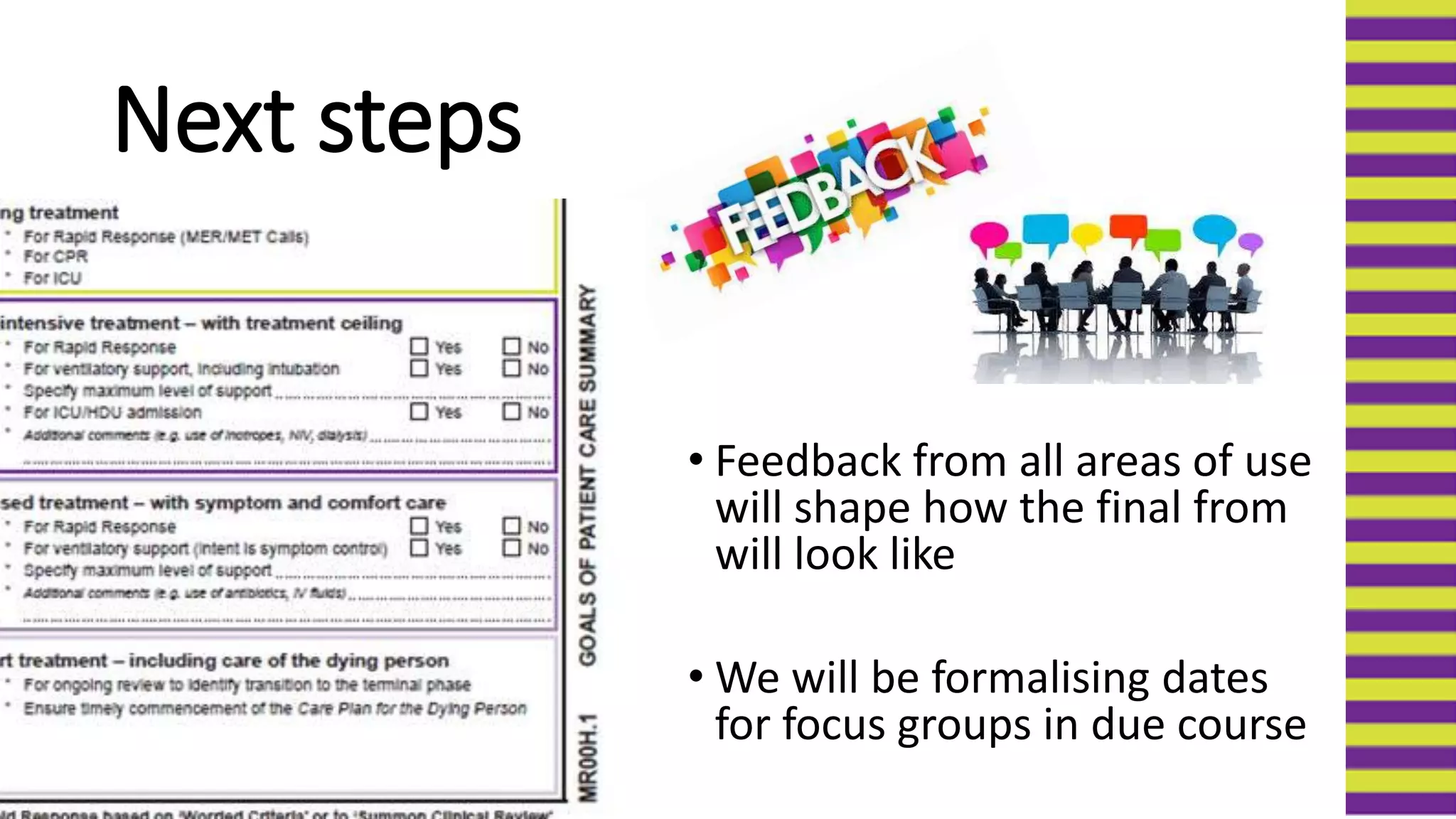
Next steps
• Feedback from all areas of use
will shape how the final from
will look like
• We will be formalising dates
for focus groups in due course
Overall aim
• One form across the
whole of WA
• Linked form with the
community
GOPC resources
• GOPC.SCGH@Health.Wa.Gov.Au
SCGH:
• Annie Brinkworth – MET Co-Ordinator
• Anil Tandon – Palliative Care Physician
OPH
• Brendan Foo – Rehab and Aged Care
https://ww2.health.wa.gov.au/Articles/F_I/Goals-of-
patient-care
http://www.spict.org.uk/using-spict/
Any Questions?
Take home messages
•Consider for all admitted patients
•End of life = last 12 months
•You are NOT saving time by avoiding these
conversations but may be increasing
suffering.
•Communication is key!
•Make a home team decision

Goals of patient care introduction

  • 1.
    Goals of PatientCare “It’s everyone’s responsibility”
  • 2.
    Outline • Brief backgroundabout Goals of patient care (GOPC) • Some tools • Patient identification • Communication • The new form structure • Timelines • Resources
  • 3.
    Background • The GOPCform is still in it’s trial state •14 sites across WA now using the GOPC trial form instead of a Not For Resuscitation Form (blue form) • Previous pilot of the trial form in 2017 • Wards G53, G63, C17 (SCGH) • Ward 4 (OPH)
  • 4.
    Current situation 2/3rd ofMET calls are after hours – Where difficult decisions are made quickly by clinicians who do not know the patient & without patient / surrogate decision maker input. Of MET calls are repeatMET calls
  • 5.
    Synergies •Fits in withChoosing Wisely initiatives •Part of Sustainable Health care is providing appropriate the goal of care to patients •Links in with advanced health care directives
  • 6.
    Considerations • Estimated 70%of patient deaths are now expected. • In WA, an average of 8 admissions in last year of life • Over half of all deaths occur in hospital • Many decisions to limit treatment occur in crisis situations, especially during MET calls
  • 7.
    Pathways to death --Multiple co- morbidities, each hosp adm leads to poorer new baseline -- Frail – not expected to survive even single organ failure MOST ADMITTED PATIENTS AND THOSE SEEN FREQUENTLY IN OUTPATEINTS FALL INTO THE ABOVE CATEGORIES!
  • 8.
    GOPC rationale • Amedical decision making based on determining the patient’s goals of care. • Assigned according to realistic assessment of probable outcomes •Not the same as Advance Health Directive – which is made by the person in their own voice and utilised when capacity is lost •Conversation is shared with the patient or their surrogate decision maker
  • 9.
    GOPC – patientidentification tools Does your patient have two or more of the following? 1. Reducing function 2. Two or more hospital admissions in 6 months 3. Weight loss of 5-10% 4. Refractory symptoms 5. Dependent on others for care needs
  • 10.
    The surprise question Wouldyou be surprised if this person died in the next 6 – 12 months?
  • 11.
    The SPICT Tool 2part tool: 6 General indicators Patient requires 2 or more indicators from this section
  • 13.
    Change in forms 4main sections (1)Baseline information (2)Goal of care - All life sustaining tx - Life extending tx - Active ward based mx - Comfort care (3)Goal of care summary discussion (4)Extended use of form
  • 14.
    Section 1 –intern & above
  • 15.
    Section 2 –Registrar or Consultant LHS – what is NOT being done RHS – tailoring what IS to be done
  • 16.
    All life sustainingtreatment • Aim is cure • Is there reasonable chance the patient will leave hospital with a similar life span? • Probably the quickest discussion / decision. • No limitations on interventions / treatments FOR CPR MET calls ICU
  • 17.
    Life extending treatment •With probable treatment ceiling • Aim is for prolonged disease remission or restoration of pre episode health status. • Returning to previous level of function • For life sustaining treatments as needed. • May require ICU review / consult Not for CPR
  • 18.
    Active Ward basedcare Consider in patients who may have: • Incurable and progressive disease • Advancing disease: anticipating death • Life expectancy months, possibly years  Remember the “surprise question” • Aim of treatment: • Length of survival not sole determinant • Comfort, quality and dignity • Treatment underlying disease still appropriate Not for CPR Symptom / comfort care
  • 19.
    Optimal comfort treatment •Includingcare of the dying person •Death imminent •Would you be surprised if they died during this admission. •Should be on Care Plan for the Dying Person Aim is comfort, quality of life and dignity
  • 20.
    NOTE! To makethe form valid P.T.O None of what’s been completed in section 2 is valid unless section 3 is signed overleaf.
  • 21.
    Section 3 =Most crucial section The Goal of patient care summary of discussion Area to be signed to make the form valid
  • 22.
    Section 4 =Extended use of form This section can be completed in outpatients and valid if the patient is then subsequently admitted to hospital for example If signed, then the form is valid for 12 months* * Team are working with HIMS on how a valid form can be pulled from the medical record in to the medical notes
  • 23.
    GOPC narrative • It’sall about communication • It’s also a clinical decision tool • Understand what’s important to the patient • Understand what lifestyle limitations / treatments would be unacceptable to them
  • 24.
    • Do youwant us to do everything? • Resuscitation is futile • The medical team have decided •There is nothing more we can do Importance of use of languageWe might say
  • 25.
    • Do youwant us to do everything? • Resuscitation is futile • The medical team have decided •There is nothing more we can do What the patient/family hears…. • Do you want us to try? • Your loved one is worthless •We don’t care what you think… we’ll decide for you •We are going to abandon treatment and care
  • 26.
    • Do youwant us to do everything? • Resuscitation is futile • The medical team have decided •There is nothing more we can do Reframing the discussion • Do you want us to try? • Your loved one is worthless •We don’t care what you think… we’ll decide for you •We are going to abandon treatment and care • We want to work out what is the right thing to do…. •Treatment that is ineffective and distressing •The treatment is not working • We will do everything possible to ensure comfort and dignity…
  • 27.
  • 28.
    Video 1 =NFR CPR decision – first step Done just before death Emphasis is on what “won’t be done” Sub-optimal care Misses patient preferences Treating team perform Emphases what “will be done” Consensus care Seeks patients preferences Breaks the ICE Video2 = “Goals of care”
  • 29.
    Ask  Tell Ask Framework • Ask For opinions and thoughts – open questions / Fears • Tell  “To make sure we are on the same page, can you tell me what is your understanding of your illness?” • Ask  Can we talk about what we should do if things don’t go as well as we hope? • If your illness gets worse, what things would be most important to you? • Who are you going to tell about this conversation?
  • 30.
  • 31.
    On change overday Patients who have a current “blue” form will require the details of the form updated on to the GOPC form and the “blue” form to be cancelled.
  • 32.
    Next steps • Feedbackfrom all areas of use will shape how the final from will look like • We will be formalising dates for focus groups in due course
  • 33.
    Overall aim • Oneform across the whole of WA • Linked form with the community
  • 34.
    GOPC resources • GOPC.SCGH@Health.Wa.Gov.Au SCGH: •Annie Brinkworth – MET Co-Ordinator • Anil Tandon – Palliative Care Physician OPH • Brendan Foo – Rehab and Aged Care https://ww2.health.wa.gov.au/Articles/F_I/Goals-of- patient-care http://www.spict.org.uk/using-spict/
  • 35.
  • 36.
    Take home messages •Considerfor all admitted patients •End of life = last 12 months •You are NOT saving time by avoiding these conversations but may be increasing suffering. •Communication is key! •Make a home team decision