Dan’s Soapbox 2
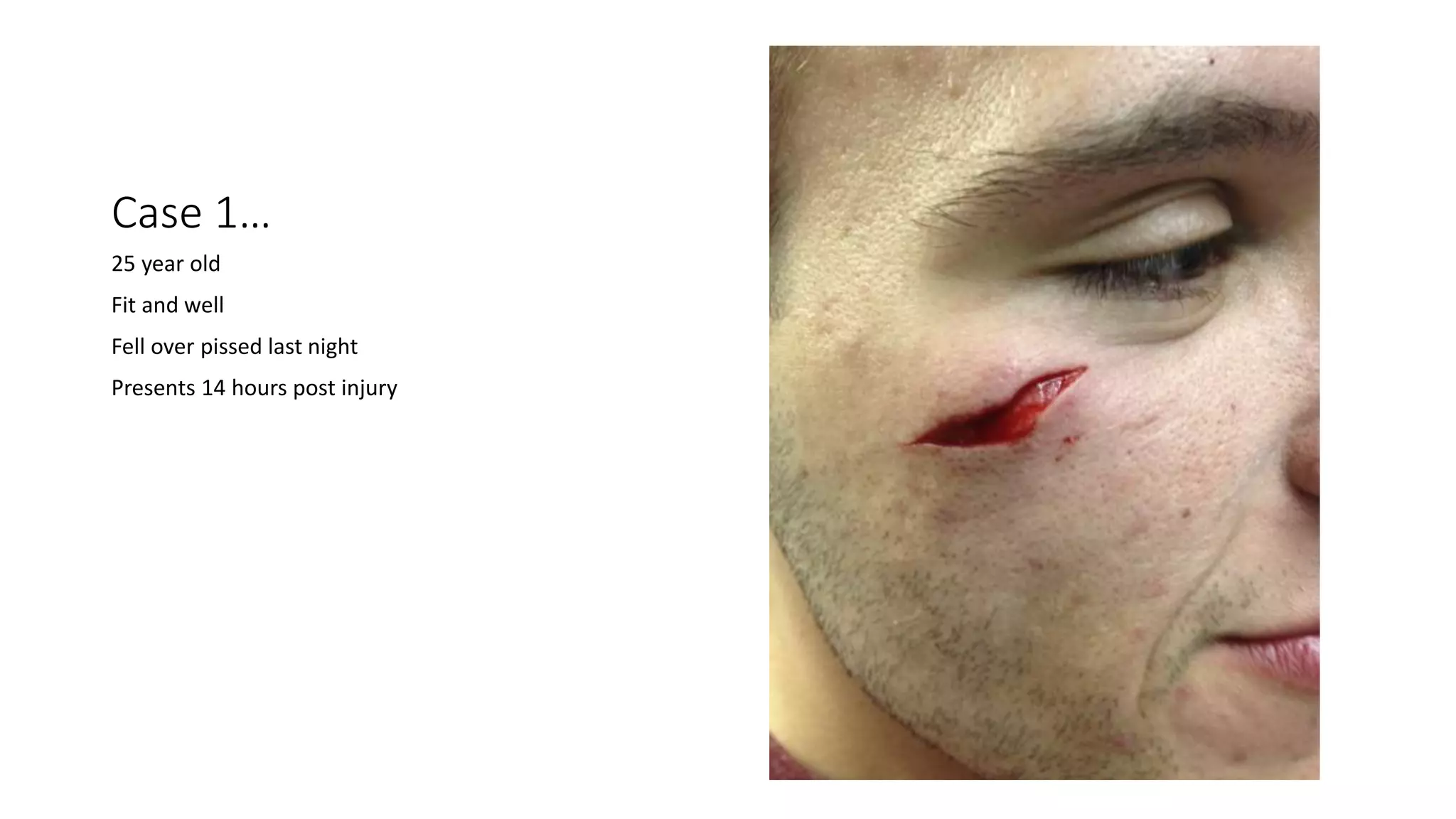
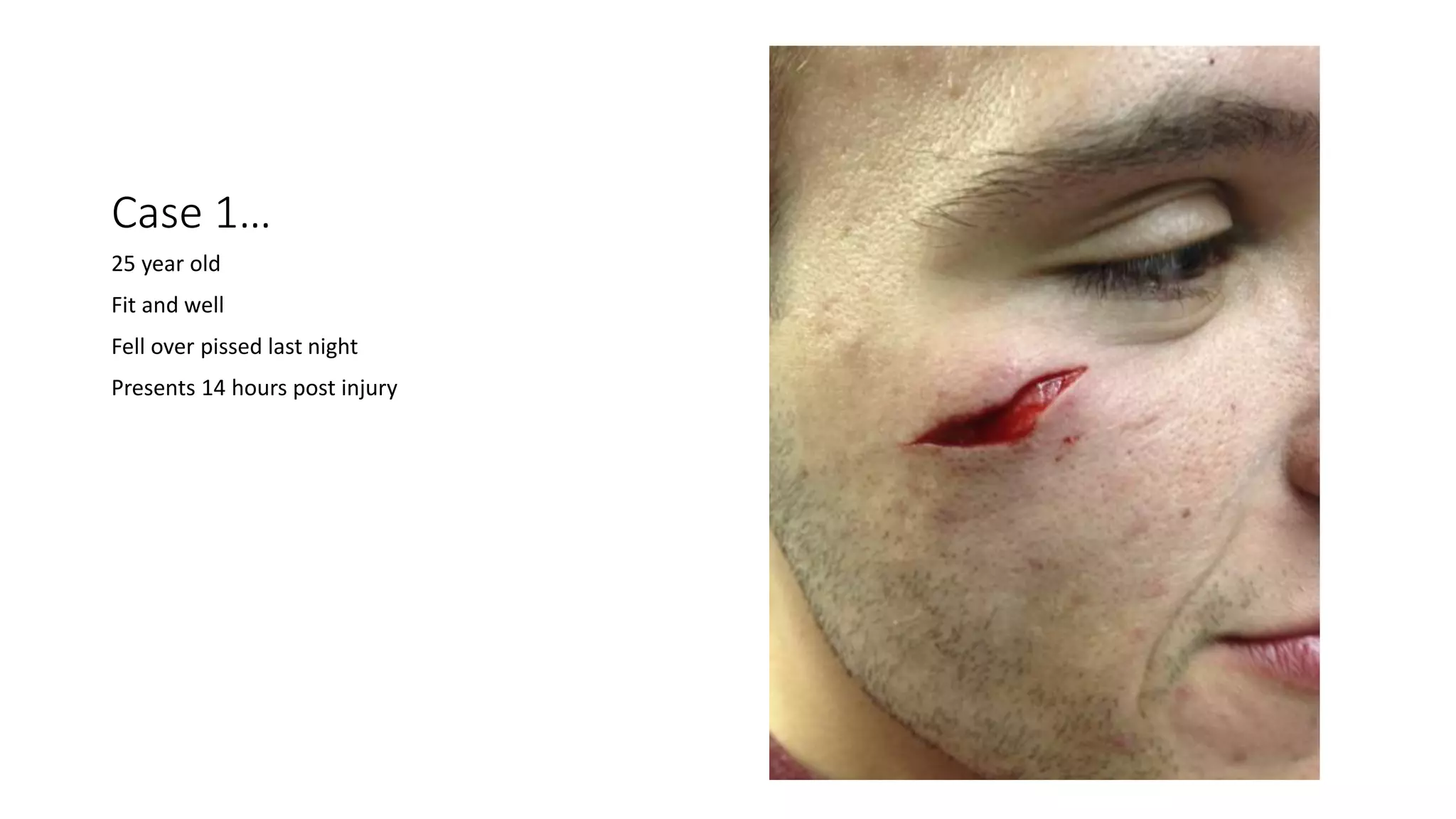
Case 1…
25 year old
Fit and well
Fell over pissed last night
Presents 14 hours post injury
Treatment options……
• Primary Repair
• Delayed Primary Repair
• Closure by secondary intent
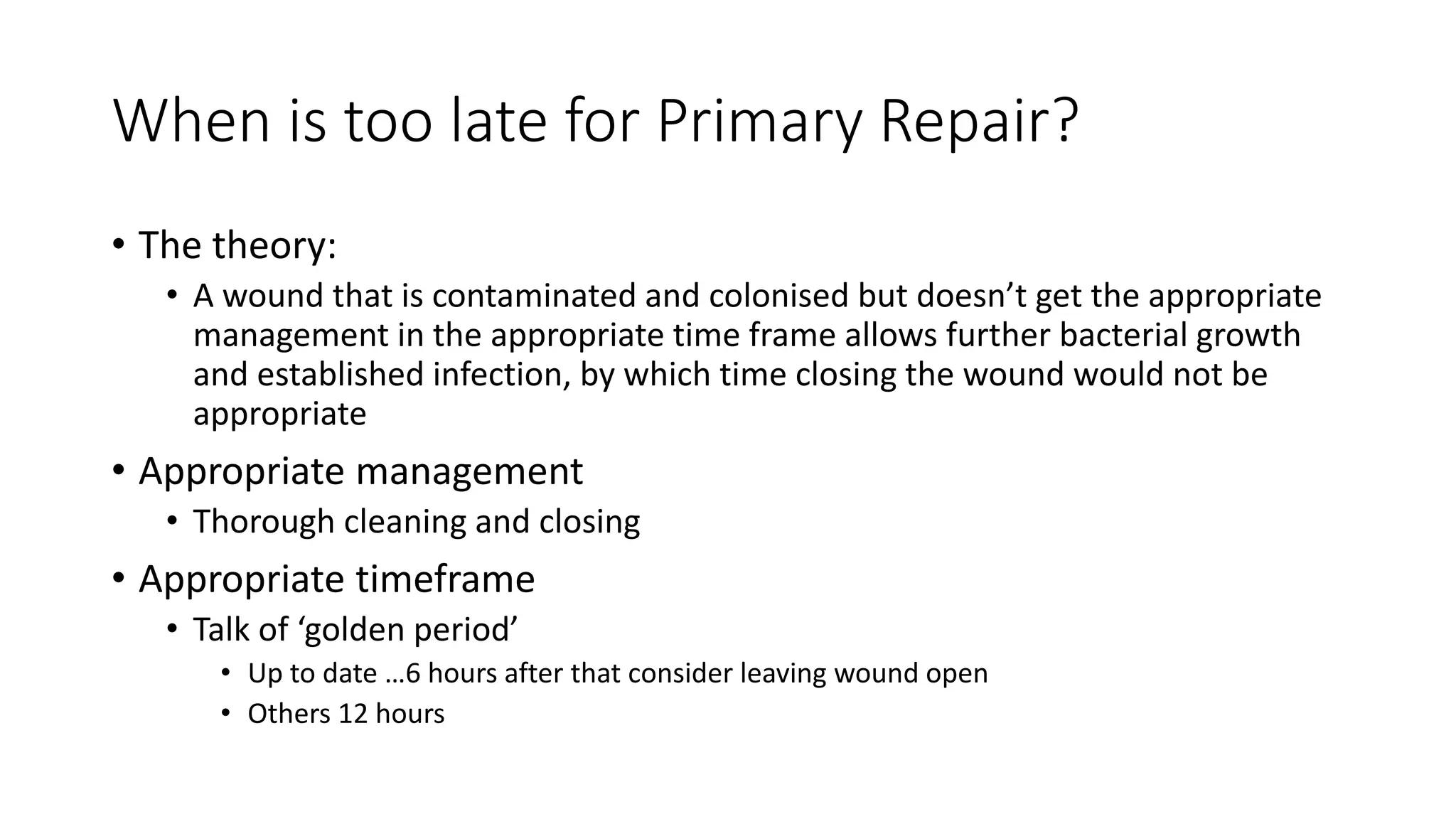
When is too late for Primary Repair?
• The theory:
• A wound that is contaminated and colonised but doesn’t get the appropriate
management in the appropriate time frame allows further bacterial growth
and established infection, by which time closing the wound would not be
appropriate
• Appropriate management
• Thorough cleaning and closing
• Appropriate timeframe
• Talk of ‘golden period’
• Up to date …6 hours after that consider leaving wound open
• Others 12 hours
Delayed Primary repair
• The Theory
• Overtime (as part of the heeling process) there is increased wound blood flow,
recruitment of phagocytes, and therefore fighting of infection
• If on reviewing wound at a later date (?72 hours) if the wound doesn’t appear
infected then it would be suitable for closure
• The Reality
• Lack of evidence
• All evidence comes from infected surgical wounds (not studied in the ED setting)
• Organisation difficulties
• When
• Free of infection Vs already heeled
• Where
• Who
• Review of 418 studies
• One small study (19 delayed hand wounds) showed increased risk of
infection when > 12 hours to intervention
Conclusion: The existing evidence does not support the theory of a
golden period nor does it support the role of wound age on infection
rate in simple lacerations
Factors that increase risk of infection
• Age of patient
• Immunosupression – DM, renal failure etc
• Site (Face Vs Feet)
• Size and width
• Etiology (dog bites, foreign body, contamination, crush injuries)
• ?Time from injury
Case 1…
25 year old
Fit and well
Fell over pissed last night
Presents 14 hours post injury
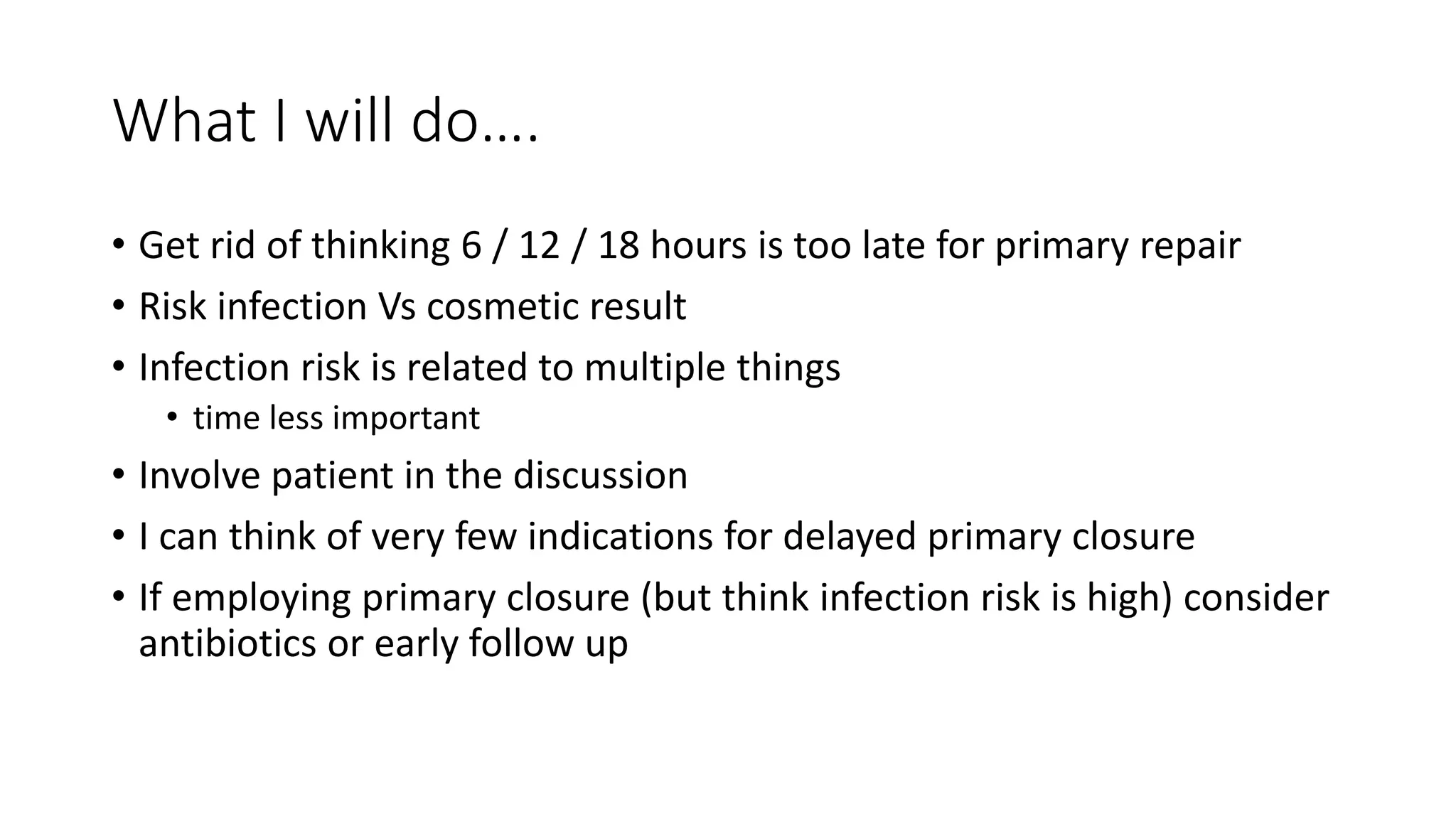
What I will do….
• Get rid of thinking 6 / 12 / 18 hours is too late for primary repair
• Risk infection Vs cosmetic result
• Infection risk is related to multiple things
• time less important
• Involve patient in the discussion
• I can think of very few indications for delayed primary closure
• If employing primary closure (but think infection risk is high) consider
antibiotics or early follow up
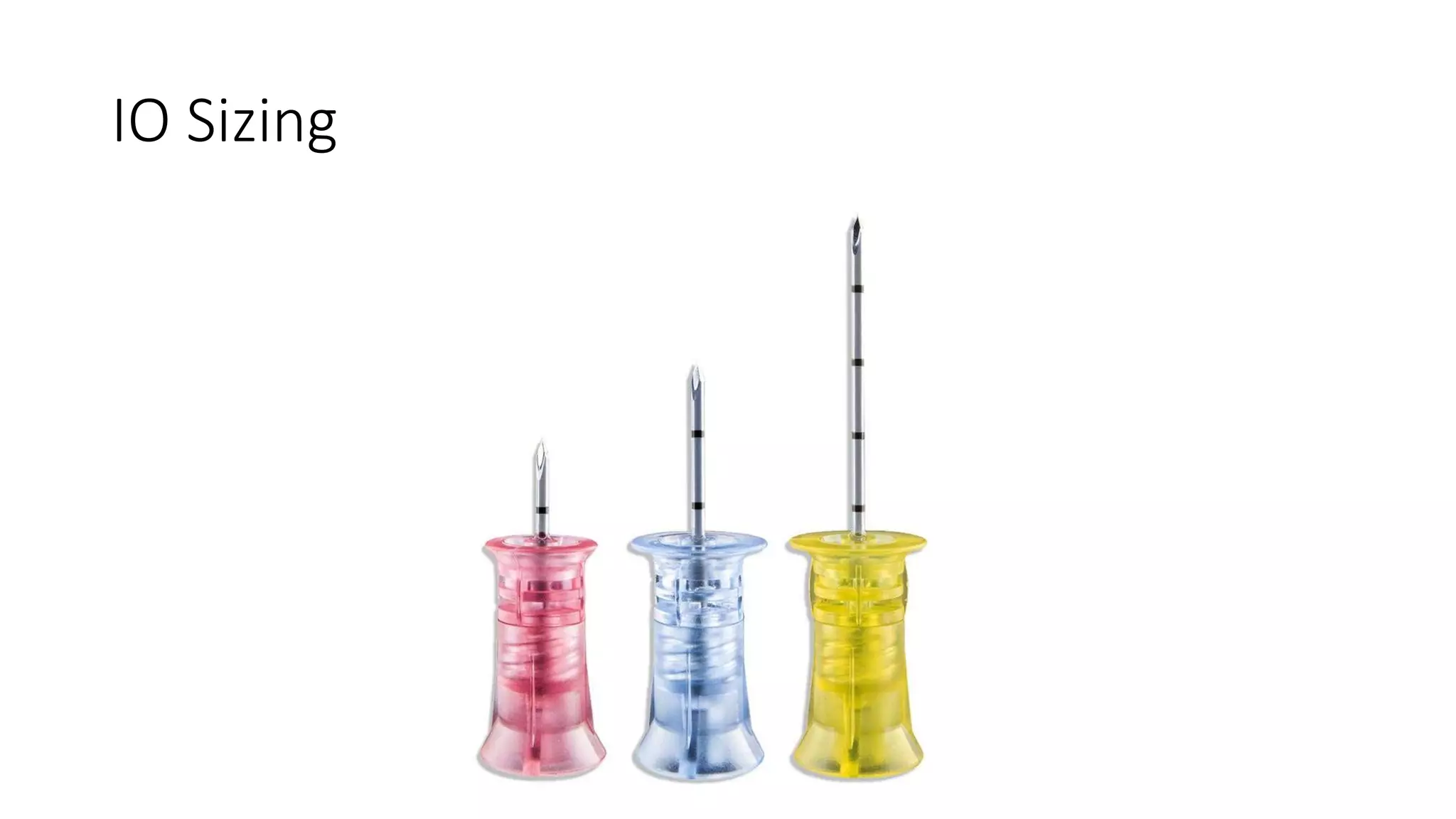
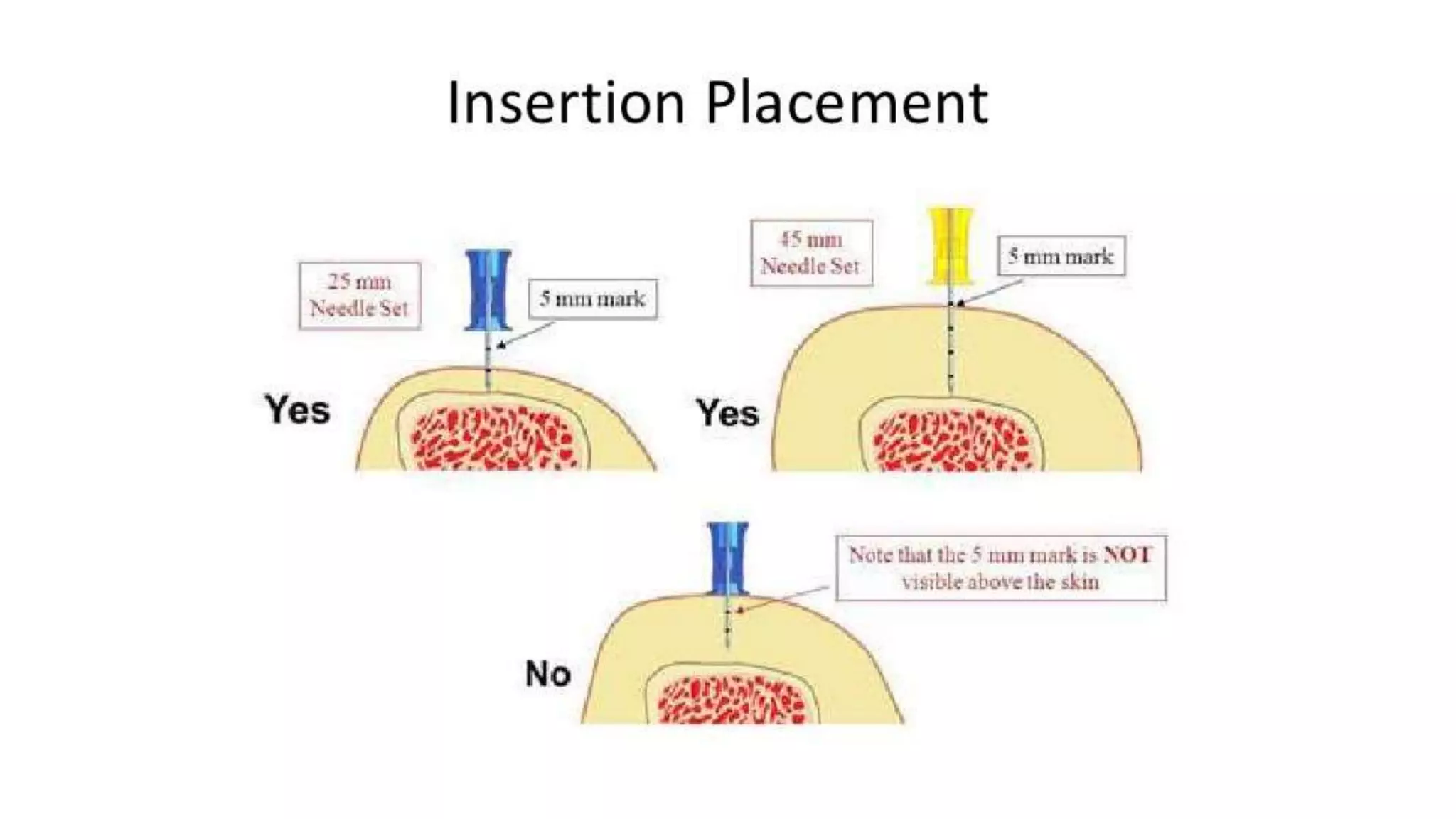
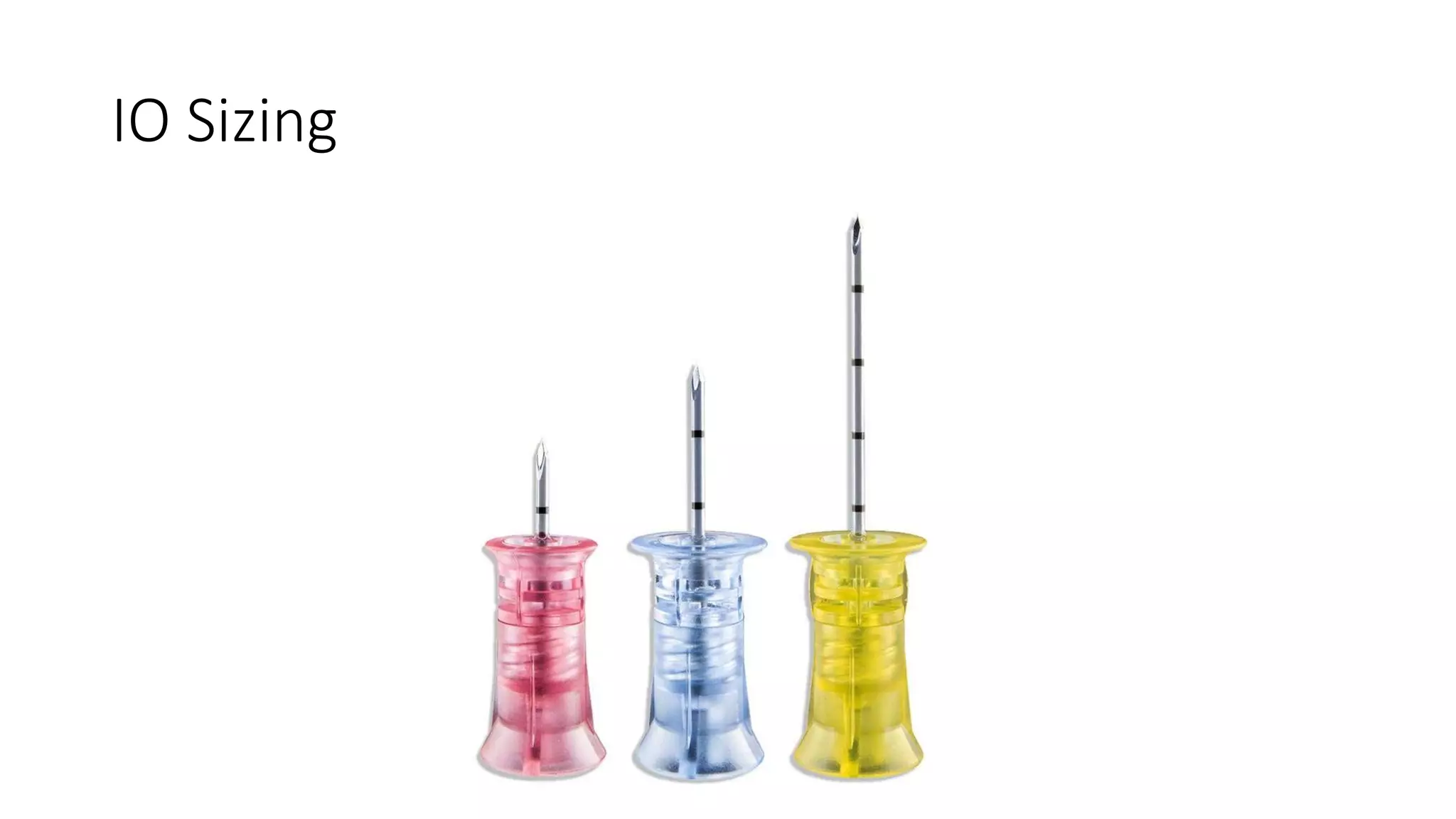
IO Sizing
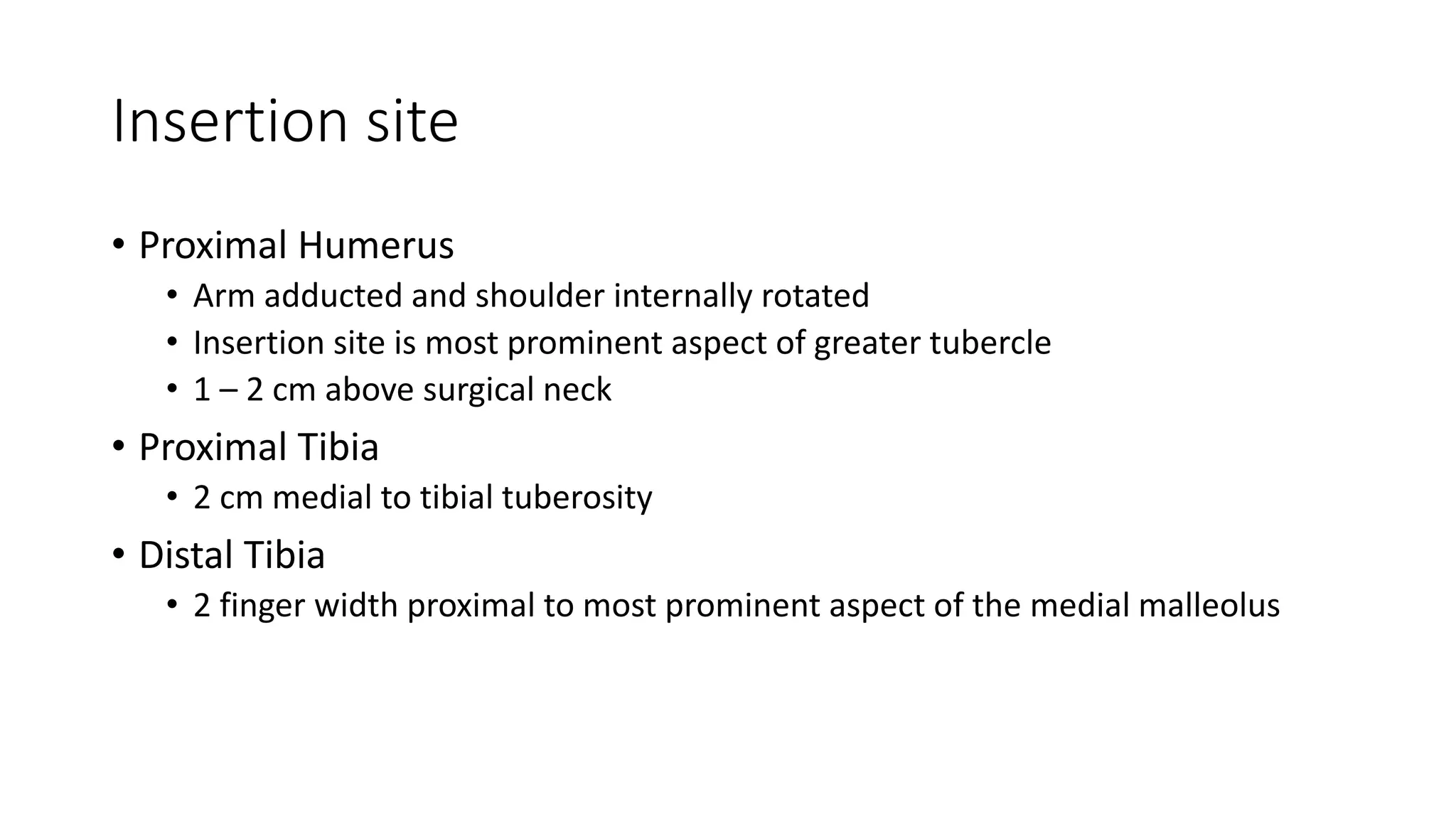
Insertion site
• Proximal Humerus
• Arm adducted and shoulder internally rotated
• Insertion site is most prominent aspect of greater tubercle
• 1 – 2 cm above surgical neck
• Proximal Tibia
• 2 cm medial to tibial tuberosity
• Distal Tibia
• 2 finger width proximal to most prominent aspect of the medial malleolus
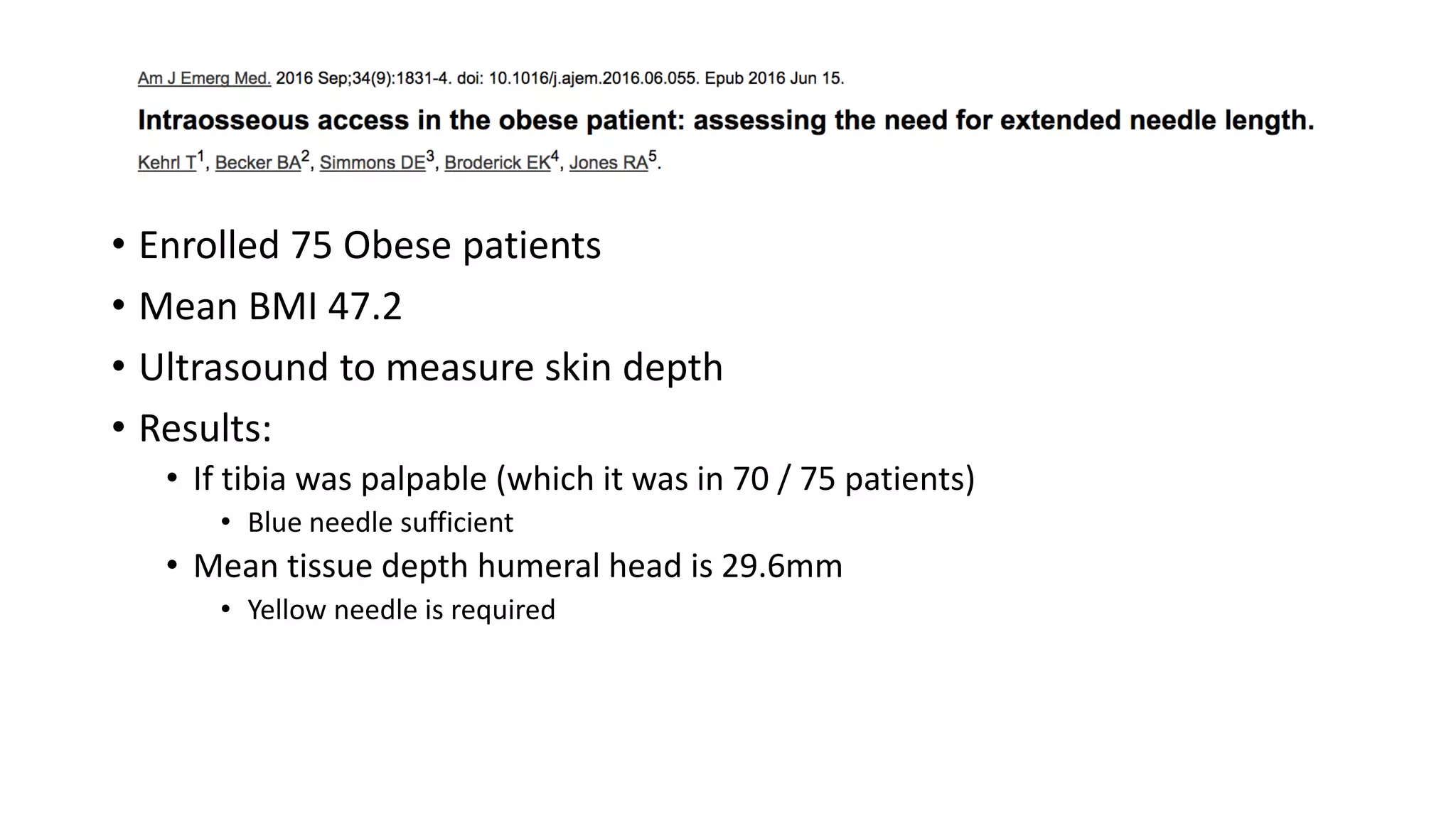
• Enrolled 75 Obese patients
• Mean BMI 47.2
• Ultrasound to measure skin depth
• Results:
• If tibia was palpable (which it was in 70 / 75 patients)
• Blue needle sufficient
• Mean tissue depth humeral head is 29.6mm
• Yellow needle is required
IO Sizing
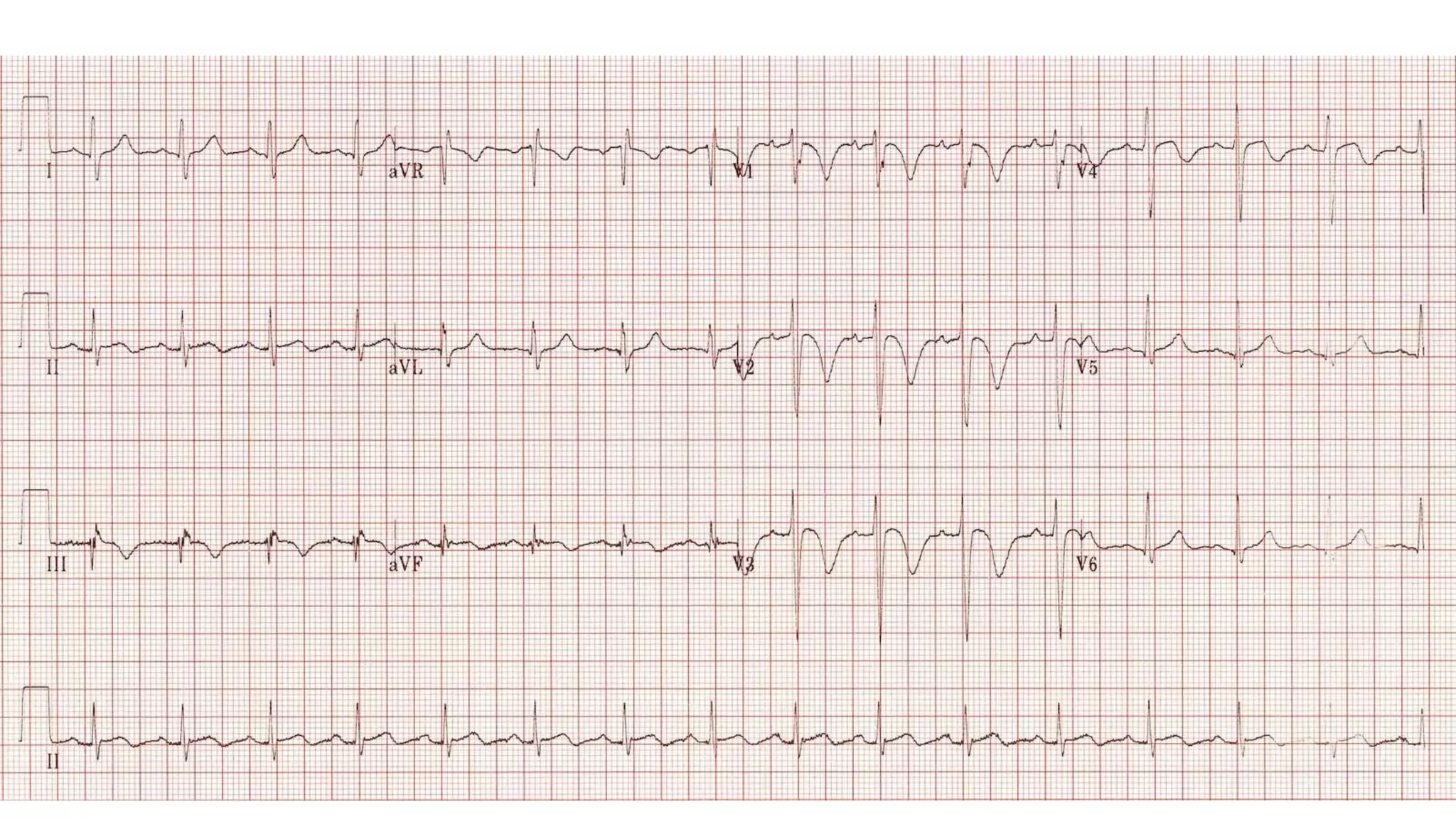
Case 2
• 48 year old women
• Fit and well
• Brought to ED with Chest pain and SOB by family members
• ECG
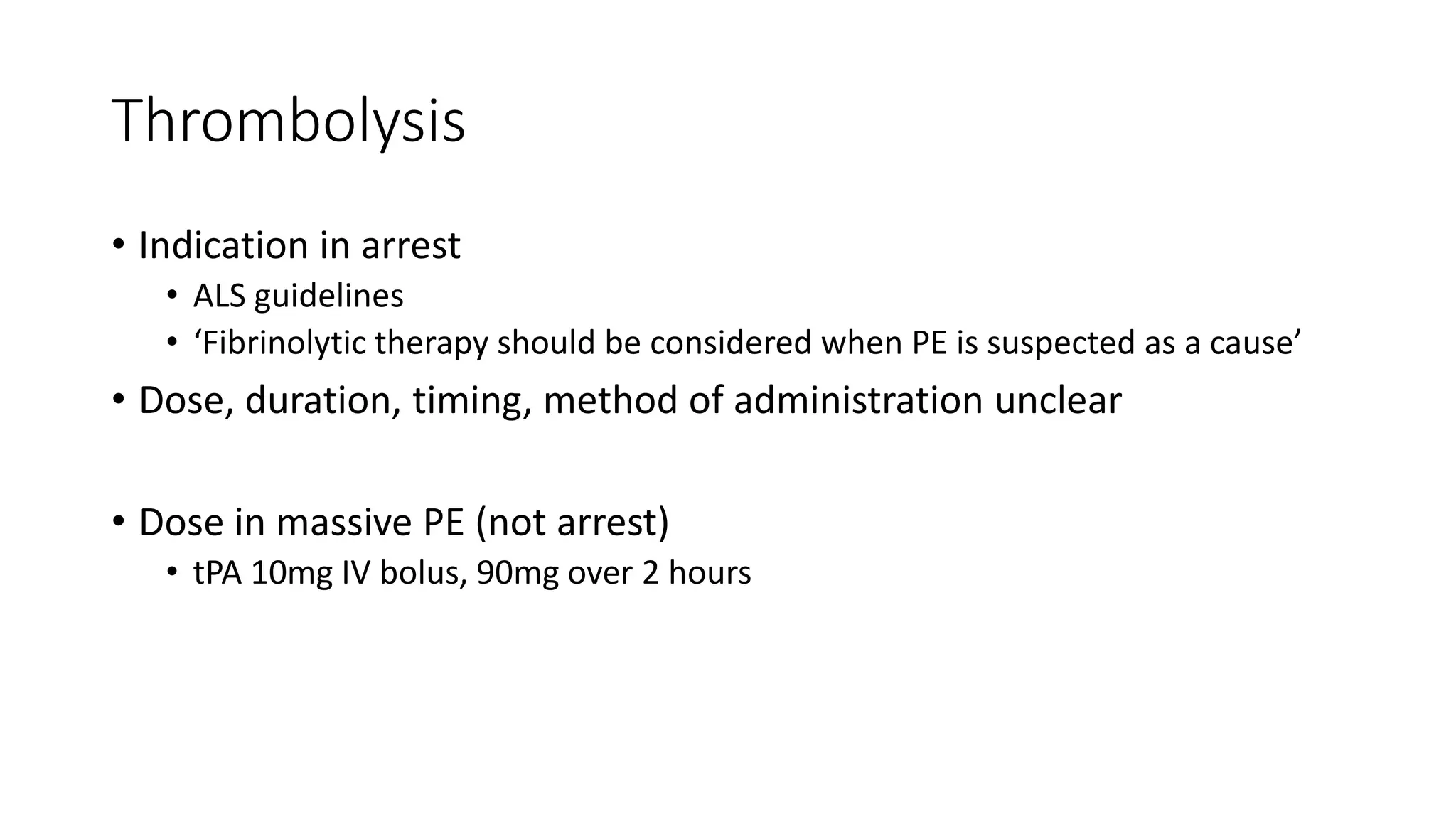
Thrombolysis
• Indication in arrest
• ALS guidelines
• ‘Fibrinolytic therapy should be considered when PE is suspected as a cause’
• Dose, duration, timing, method of administration unclear
• Dose in massive PE (not arrest)
• tPA 10mg IV bolus, 90mg over 2 hours
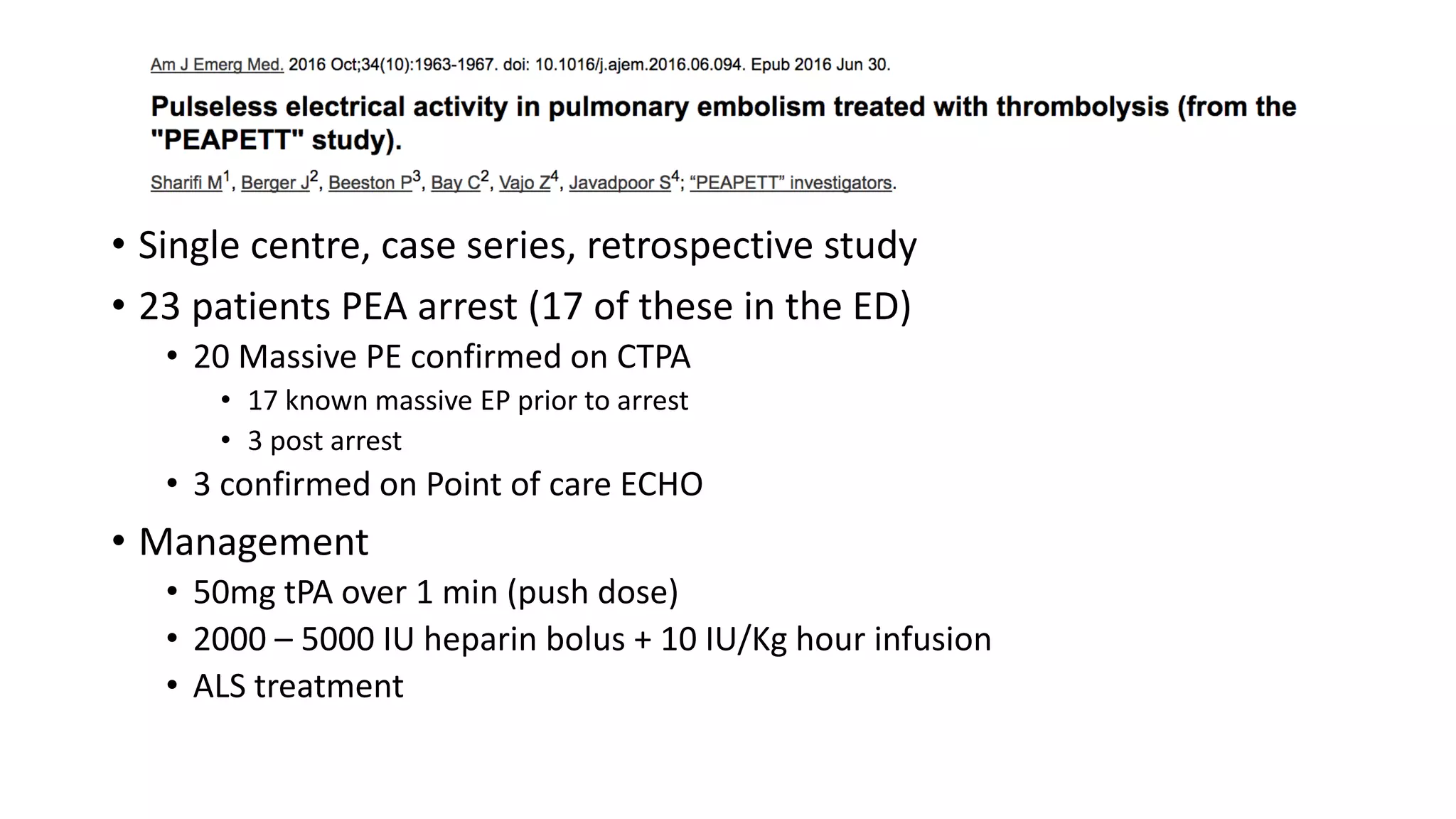
• Single centre, case series, retrospective study
• 23 patients PEA arrest (17 of these in the ED)
• 20 Massive PE confirmed on CTPA
• 17 known massive EP prior to arrest
• 3 post arrest
• 3 confirmed on Point of care ECHO
• Management
• 50mg tPA over 1 min (push dose)
• 2000 – 5000 IU heparin bolus + 10 IU/Kg hour infusion
• ALS treatment
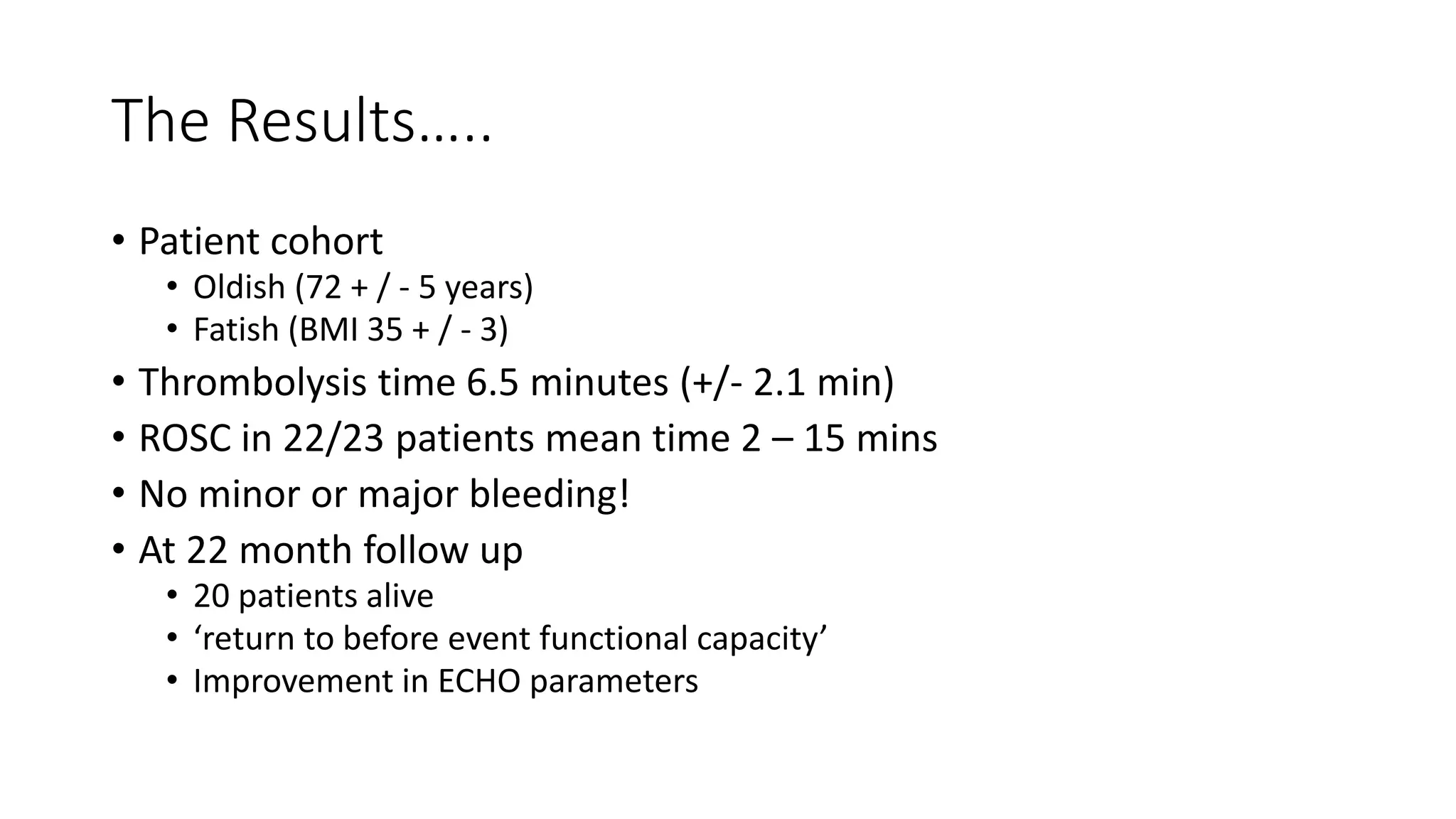
The Results…..
• Patient cohort
• Oldish (72 + / - 5 years)
• Fatish (BMI 35 + / - 3)
• Thrombolysis time 6.5 minutes (+/- 2.1 min)
• ROSC in 22/23 patients mean time 2 – 15 mins
• No minor or major bleeding!
• At 22 month follow up
• 20 patients alive
• ‘return to before event functional capacity’
• Improvement in ECHO parameters
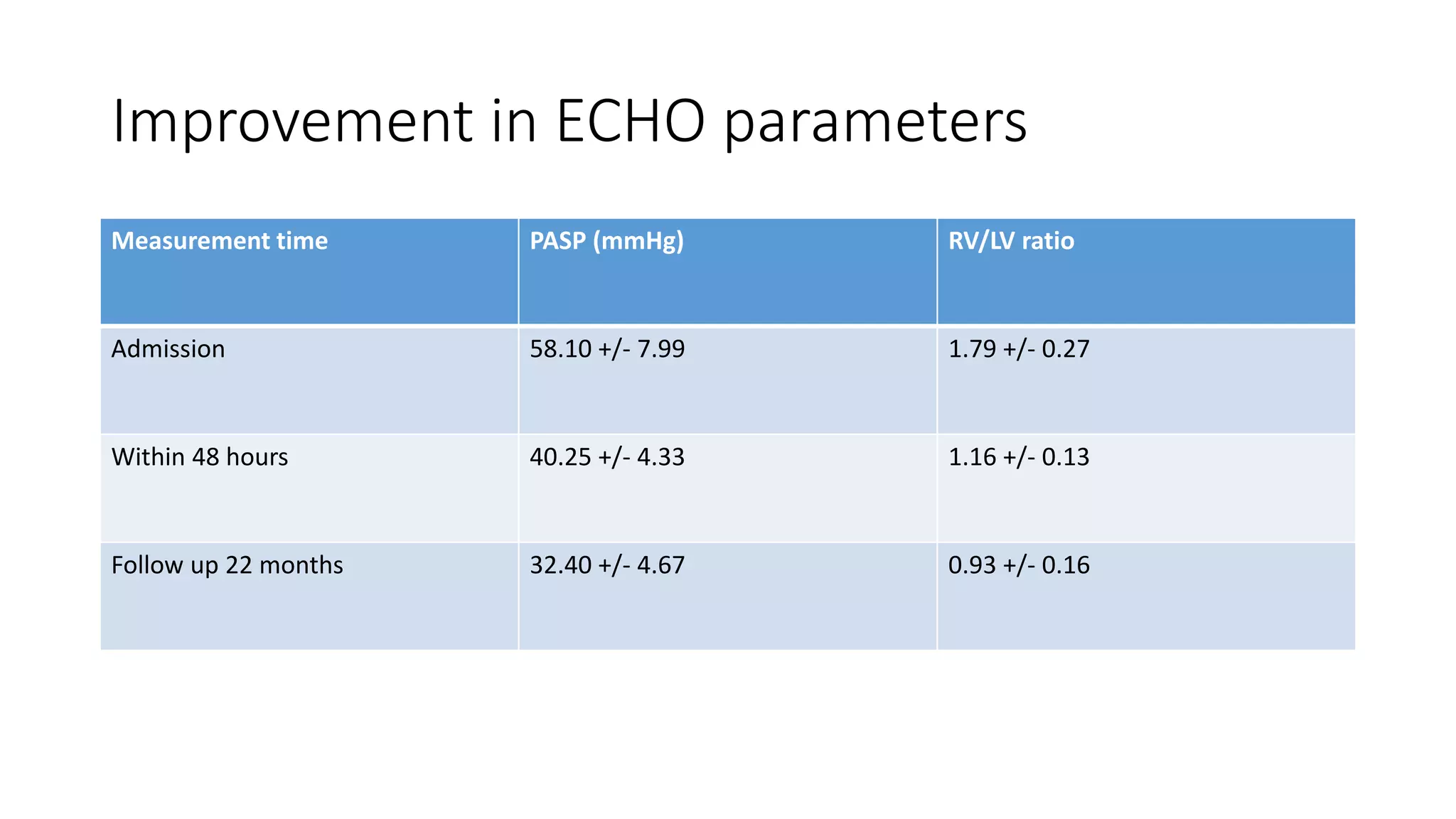
Improvement in ECHO parameters
Measurement time PASP (mmHg) RV/LV ratio
Admission 58.10 +/- 7.99 1.79 +/- 0.27
Within 48 hours 40.25 +/- 4.33 1.16 +/- 0.13
Follow up 22 months 32.40 +/- 4.67 0.93 +/- 0.16
What this adds…
• Small, single centre study with no control group / comparison
• Excellent outcomes (but time from arrest to thrombolysis is very
short)
• 50mg tPA push dose seems safe and effective and in an evidence
sparse area this should be our ‘go to’ in suspected / confirmed PE +
arrest
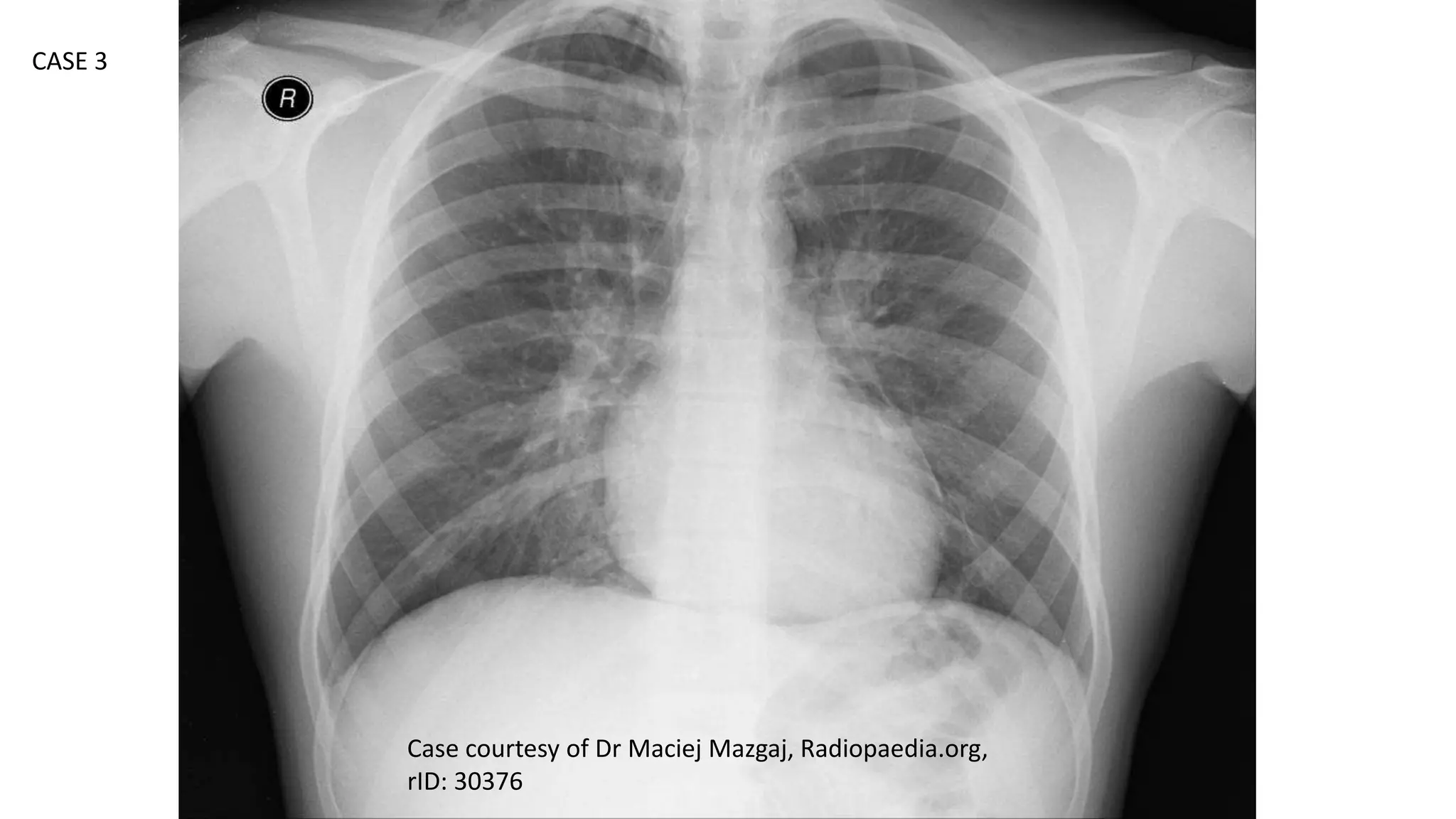
Case courtesy of Dr Maciej Mazgaj, Radiopaedia.org,
rID: 30376
CASE 3
Boerhaave Syndrome
• Classical features: retrosternal chest pain, recent vomiting, subcutaneous
emphysema
• High mortality (increases as diagnosis missed)
• Diagnosis
• CT
• Oesophagram
• Management
• NBM, IV abx, IV PPI
• Medical
• watch and wait. Abx, NBM
• Surgical
• Open repair is gold standard
• Oesohageal stents (if surgery contraindicated)

Dan's soapbox 2

  • 1.
  • 3.
    Case 1… 25 yearold Fit and well Fell over pissed last night Presents 14 hours post injury
  • 4.
    Treatment options…… • PrimaryRepair • Delayed Primary Repair • Closure by secondary intent
  • 5.
    When is toolate for Primary Repair? • The theory: • A wound that is contaminated and colonised but doesn’t get the appropriate management in the appropriate time frame allows further bacterial growth and established infection, by which time closing the wound would not be appropriate • Appropriate management • Thorough cleaning and closing • Appropriate timeframe • Talk of ‘golden period’ • Up to date …6 hours after that consider leaving wound open • Others 12 hours
  • 6.
    Delayed Primary repair •The Theory • Overtime (as part of the heeling process) there is increased wound blood flow, recruitment of phagocytes, and therefore fighting of infection • If on reviewing wound at a later date (?72 hours) if the wound doesn’t appear infected then it would be suitable for closure • The Reality • Lack of evidence • All evidence comes from infected surgical wounds (not studied in the ED setting) • Organisation difficulties • When • Free of infection Vs already heeled • Where • Who
  • 7.
    • Review of418 studies • One small study (19 delayed hand wounds) showed increased risk of infection when > 12 hours to intervention Conclusion: The existing evidence does not support the theory of a golden period nor does it support the role of wound age on infection rate in simple lacerations
  • 8.
    Factors that increaserisk of infection • Age of patient • Immunosupression – DM, renal failure etc • Site (Face Vs Feet) • Size and width • Etiology (dog bites, foreign body, contamination, crush injuries) • ?Time from injury
  • 9.
    Case 1… 25 yearold Fit and well Fell over pissed last night Presents 14 hours post injury
  • 10.
    What I willdo…. • Get rid of thinking 6 / 12 / 18 hours is too late for primary repair • Risk infection Vs cosmetic result • Infection risk is related to multiple things • time less important • Involve patient in the discussion • I can think of very few indications for delayed primary closure • If employing primary closure (but think infection risk is high) consider antibiotics or early follow up
  • 11.
  • 13.
    Insertion site • ProximalHumerus • Arm adducted and shoulder internally rotated • Insertion site is most prominent aspect of greater tubercle • 1 – 2 cm above surgical neck • Proximal Tibia • 2 cm medial to tibial tuberosity • Distal Tibia • 2 finger width proximal to most prominent aspect of the medial malleolus
  • 14.
    • Enrolled 75Obese patients • Mean BMI 47.2 • Ultrasound to measure skin depth • Results: • If tibia was palpable (which it was in 70 / 75 patients) • Blue needle sufficient • Mean tissue depth humeral head is 29.6mm • Yellow needle is required
  • 15.
  • 16.
    Case 2 • 48year old women • Fit and well • Brought to ED with Chest pain and SOB by family members • ECG
  • 18.
    Thrombolysis • Indication inarrest • ALS guidelines • ‘Fibrinolytic therapy should be considered when PE is suspected as a cause’ • Dose, duration, timing, method of administration unclear • Dose in massive PE (not arrest) • tPA 10mg IV bolus, 90mg over 2 hours
  • 19.
    • Single centre,case series, retrospective study • 23 patients PEA arrest (17 of these in the ED) • 20 Massive PE confirmed on CTPA • 17 known massive EP prior to arrest • 3 post arrest • 3 confirmed on Point of care ECHO • Management • 50mg tPA over 1 min (push dose) • 2000 – 5000 IU heparin bolus + 10 IU/Kg hour infusion • ALS treatment
  • 20.
    The Results….. • Patientcohort • Oldish (72 + / - 5 years) • Fatish (BMI 35 + / - 3) • Thrombolysis time 6.5 minutes (+/- 2.1 min) • ROSC in 22/23 patients mean time 2 – 15 mins • No minor or major bleeding! • At 22 month follow up • 20 patients alive • ‘return to before event functional capacity’ • Improvement in ECHO parameters
  • 21.
    Improvement in ECHOparameters Measurement time PASP (mmHg) RV/LV ratio Admission 58.10 +/- 7.99 1.79 +/- 0.27 Within 48 hours 40.25 +/- 4.33 1.16 +/- 0.13 Follow up 22 months 32.40 +/- 4.67 0.93 +/- 0.16
  • 22.
    What this adds… •Small, single centre study with no control group / comparison • Excellent outcomes (but time from arrest to thrombolysis is very short) • 50mg tPA push dose seems safe and effective and in an evidence sparse area this should be our ‘go to’ in suspected / confirmed PE + arrest
  • 23.
    Case courtesy ofDr Maciej Mazgaj, Radiopaedia.org, rID: 30376 CASE 3
  • 24.
    Boerhaave Syndrome • Classicalfeatures: retrosternal chest pain, recent vomiting, subcutaneous emphysema • High mortality (increases as diagnosis missed) • Diagnosis • CT • Oesophagram • Management • NBM, IV abx, IV PPI • Medical • watch and wait. Abx, NBM • Surgical • Open repair is gold standard • Oesohageal stents (if surgery contraindicated)