CASE STUDY RESEARCH METHOD
BY
JAHANGIR KHAN
(RESEARCH SCHOLAR)
UNDER THE GUIDANCE OF
DR. NIMIT CHOWDHARY
(PROFESSOR AND HEAD)
Department of Tourism & Hospitality
Management.
Jamia Millia Islamia (Central University),
Jamia Nagar New Delhi-110025
CASE STUDY RESEARCH
• Qualitative research method.
• Case study means an in-depth investigation of a social
unit or event.
• Case study points out a deep perceptions and clear
insight into it life.
• Complete analysis of particular phases of total
personality or event.
DEFINITIONS BY RENOWNED
SCHOLARS
• Groode and Hatt (1953): It is a method of exploring and analyzing the life
of a social unit.
• Young P.V. (1984): Case study is comprehensive study of a social unit, be
it a person , a group of persons, an institute, a community or a family.
• Robson C. (1993) : A strategy of doing research which involves an
empirical investigation of particular contemporary phenomenon within it
real life context using multiple source of evidence.
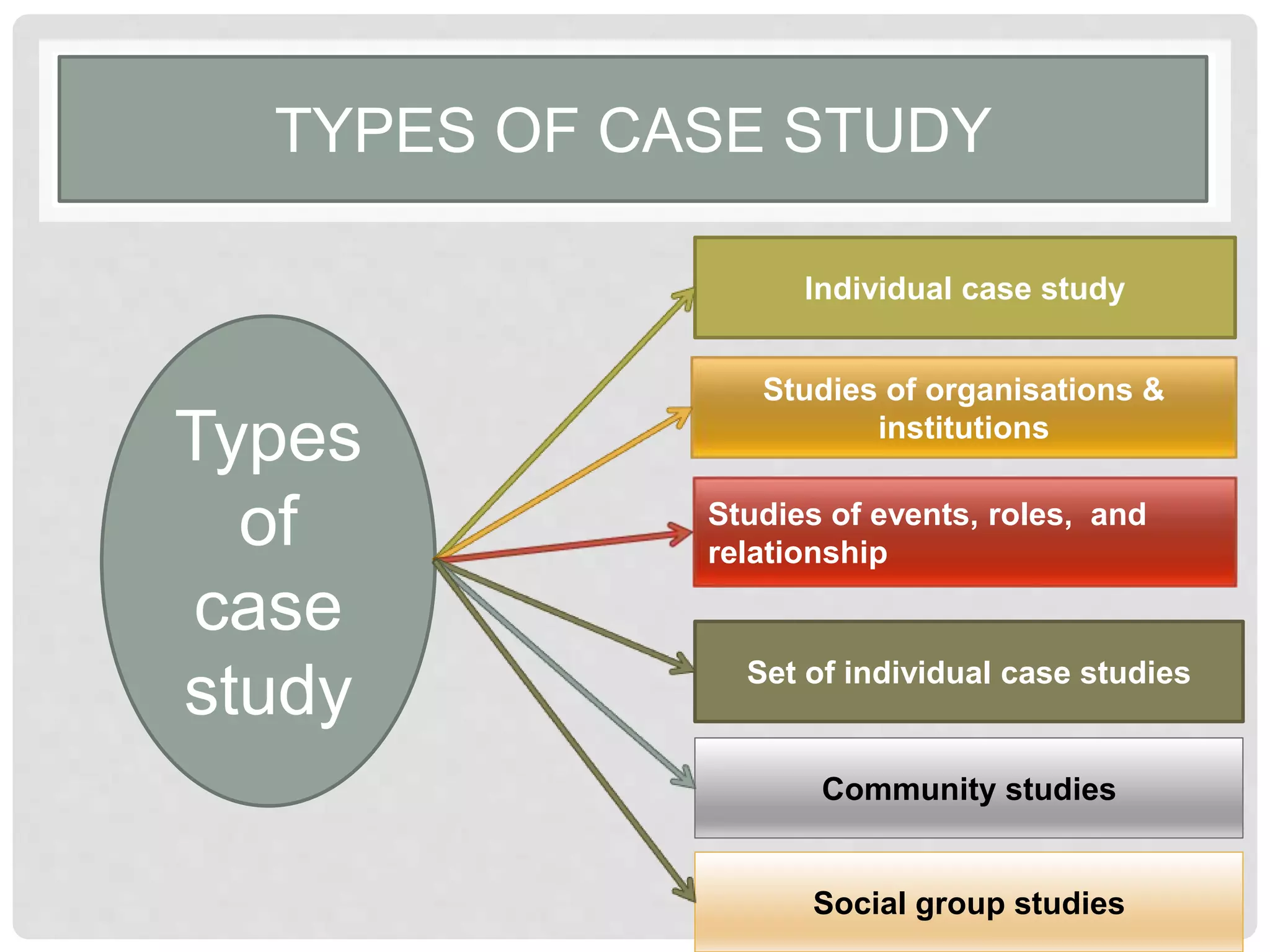
TYPES OF CASE STUDY
Individual case study
Set of individual case studies
Community studies
Social group studies
Studies of events, roles, and
relationship
Studies of organisations &
institutions
Types
of
case
study
TYPE OF CASE STUDY METHODS
1) Collective case study method
2) Descriptive case study method
4) Multiple case study method
5) Instrumental case study method
6) Intrinsic case study Method
3) Explanatory case study method
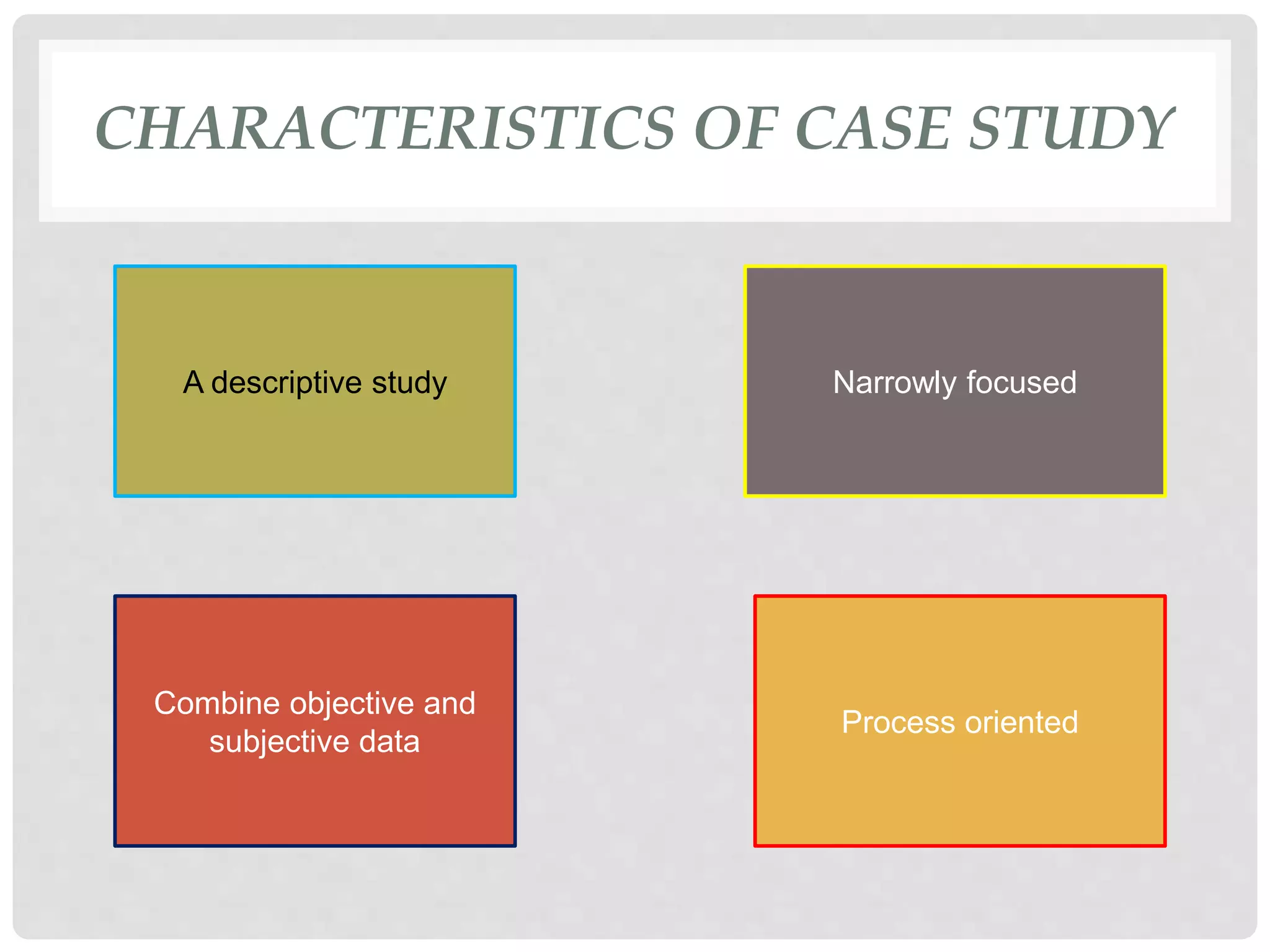
CHARACTERISTICS OF CASE STUDY
A descriptive study Narrowly focused
Combine objective and
subjective data
Process oriented
TECHNIQUES USED FOR CASE STUDY
Techniques
Observation Interview
Secondary
data
Documents Records
• Preliminary theory & blueprint of the study
⇋ Initial theory & understanding of what is being studied is necessary
before any field contacts; the complete research design embodies a
―theory‖of what is beingstudied.
• Deciding between explanatory, exploratory and
descriptive designs
– Search for theoretical propositions that can be elaborated to cover study
questions, propositions, units of analysis, data-proposition links & criteria of
interpretation
– Reviewing literature, discussing with investigators, asking challenging
questions, thinking what is to be learned from the study
– -Being aware of the range of theories & selecting the required level
(individual, organization, societal)
– Construction of the design / conceptual framework takes time & can be
difficult, but is a crucial step for the success of the study
ADVANTAGES
• Gain an in depth understanding of a particular
phenomenon.
• Develop an initial hypothesis.
• Establish a basis for future research.
• Develop new theories.
• Extend existing theories.
• Test existing theory.
DISADVANTAGES
1. Lack of generalization
2. Lack of clearly defined methods
3. Some critics suggest case study research is useful only as
an exploratory tool or for establishing a hypothesis;
3. Time-consuming
4. Costs
5. Bias in data collection and analysis
THANK YOU!
Any questions!

Case study method

  • 1.
    CASE STUDY RESEARCHMETHOD BY JAHANGIR KHAN (RESEARCH SCHOLAR) UNDER THE GUIDANCE OF DR. NIMIT CHOWDHARY (PROFESSOR AND HEAD) Department of Tourism & Hospitality Management. Jamia Millia Islamia (Central University), Jamia Nagar New Delhi-110025
  • 2.
    CASE STUDY RESEARCH •Qualitative research method. • Case study means an in-depth investigation of a social unit or event. • Case study points out a deep perceptions and clear insight into it life. • Complete analysis of particular phases of total personality or event.
  • 3.
    DEFINITIONS BY RENOWNED SCHOLARS •Groode and Hatt (1953): It is a method of exploring and analyzing the life of a social unit. • Young P.V. (1984): Case study is comprehensive study of a social unit, be it a person , a group of persons, an institute, a community or a family. • Robson C. (1993) : A strategy of doing research which involves an empirical investigation of particular contemporary phenomenon within it real life context using multiple source of evidence.
  • 4.
    TYPES OF CASESTUDY Individual case study Set of individual case studies Community studies Social group studies Studies of events, roles, and relationship Studies of organisations & institutions Types of case study
  • 5.
    TYPE OF CASESTUDY METHODS 1) Collective case study method 2) Descriptive case study method 4) Multiple case study method 5) Instrumental case study method 6) Intrinsic case study Method 3) Explanatory case study method
  • 6.
    CHARACTERISTICS OF CASESTUDY A descriptive study Narrowly focused Combine objective and subjective data Process oriented
  • 7.
    TECHNIQUES USED FORCASE STUDY Techniques Observation Interview Secondary data Documents Records
  • 8.
    • Preliminary theory& blueprint of the study ⇋ Initial theory & understanding of what is being studied is necessary before any field contacts; the complete research design embodies a ―theory‖of what is beingstudied. • Deciding between explanatory, exploratory and descriptive designs – Search for theoretical propositions that can be elaborated to cover study questions, propositions, units of analysis, data-proposition links & criteria of interpretation – Reviewing literature, discussing with investigators, asking challenging questions, thinking what is to be learned from the study – -Being aware of the range of theories & selecting the required level (individual, organization, societal) – Construction of the design / conceptual framework takes time & can be difficult, but is a crucial step for the success of the study
  • 9.
    ADVANTAGES • Gain anin depth understanding of a particular phenomenon. • Develop an initial hypothesis. • Establish a basis for future research. • Develop new theories. • Extend existing theories. • Test existing theory.
  • 10.
    DISADVANTAGES 1. Lack ofgeneralization 2. Lack of clearly defined methods 3. Some critics suggest case study research is useful only as an exploratory tool or for establishing a hypothesis; 3. Time-consuming 4. Costs 5. Bias in data collection and analysis
  • 11.