MSST 2017, Santa Clara University, May 15-19, 2017
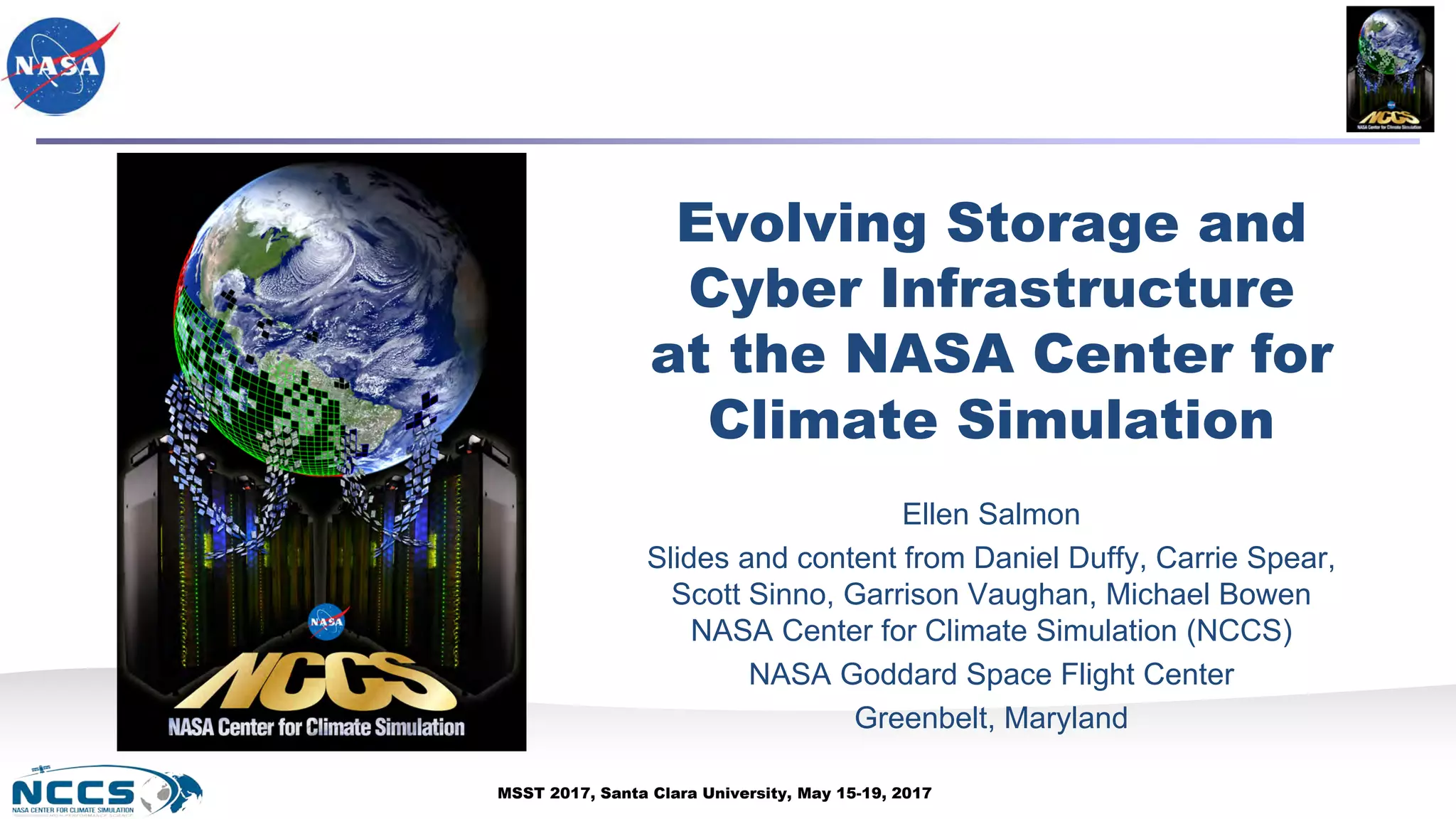
Evolving Storage and
Cyber Infrastructure
at the NASA Center for
Climate Simulation
Ellen Salmon
Slides and content from Daniel Duffy, Carrie Spear,
Scott Sinno, Garrison Vaughan, Michael Bowen
NASA Center for Climate Simulation (NCCS)
NASA Goddard Space Flight Center
Greenbelt, Maryland
MSST 2017, Santa Clara University, May 15-19, 2017
Standard Disclaimers and Legalese Eye Chart
• All Trademarks, logos, or otherwise registered identification markers are owned by their
respective parties.
• Disclaimer of Liability: With respect to this presentation, neither the United States Government
nor any of its employees, makes any warranty, express or implied, including the warranties of
merchantability and fitness for a particular purpose, or assumes any legal liability or responsibility
for the accuracy, completeness, or usefulness of any information, apparatus, product, or process
disclosed, or represents that its use would not infringe privately owned rights.
• Disclaimer of Endorsement: Reference herein to any specific commercial products, process, or
service by trade name, trademark, manufacturer, or otherwise, does not necessarily constitute or
imply its endorsement, recommendation, or favoring by the United States Government. In
addition, NASA does not endorse or sponsor any commercial product, service, or activity.
• The views and opinions of author(s) expressed herein do not necessarily state or reflect those of
the United States Government and shall not be used for advertising or product endorsement
purposes.
• All errors in this presentation are inadvertent and are the responsibility of the primary author.
MSST 2017, Santa Clara University, May 15-19, 2017
AGENDA:
• About the NASA Center for Climate Simulation (NCCS)
• Recent History & Today
• Science Drivers
• Recent Developments
– Advanced Data Analytics Platform (ADAPT)
– Data Analytics Storage System (DASS)
– Cloud-Bursting Project: Semi-Arid Carbon Sink
• Looking Toward Exascale
3
MSST 2017, Santa Clara University, May 15-19, 2017
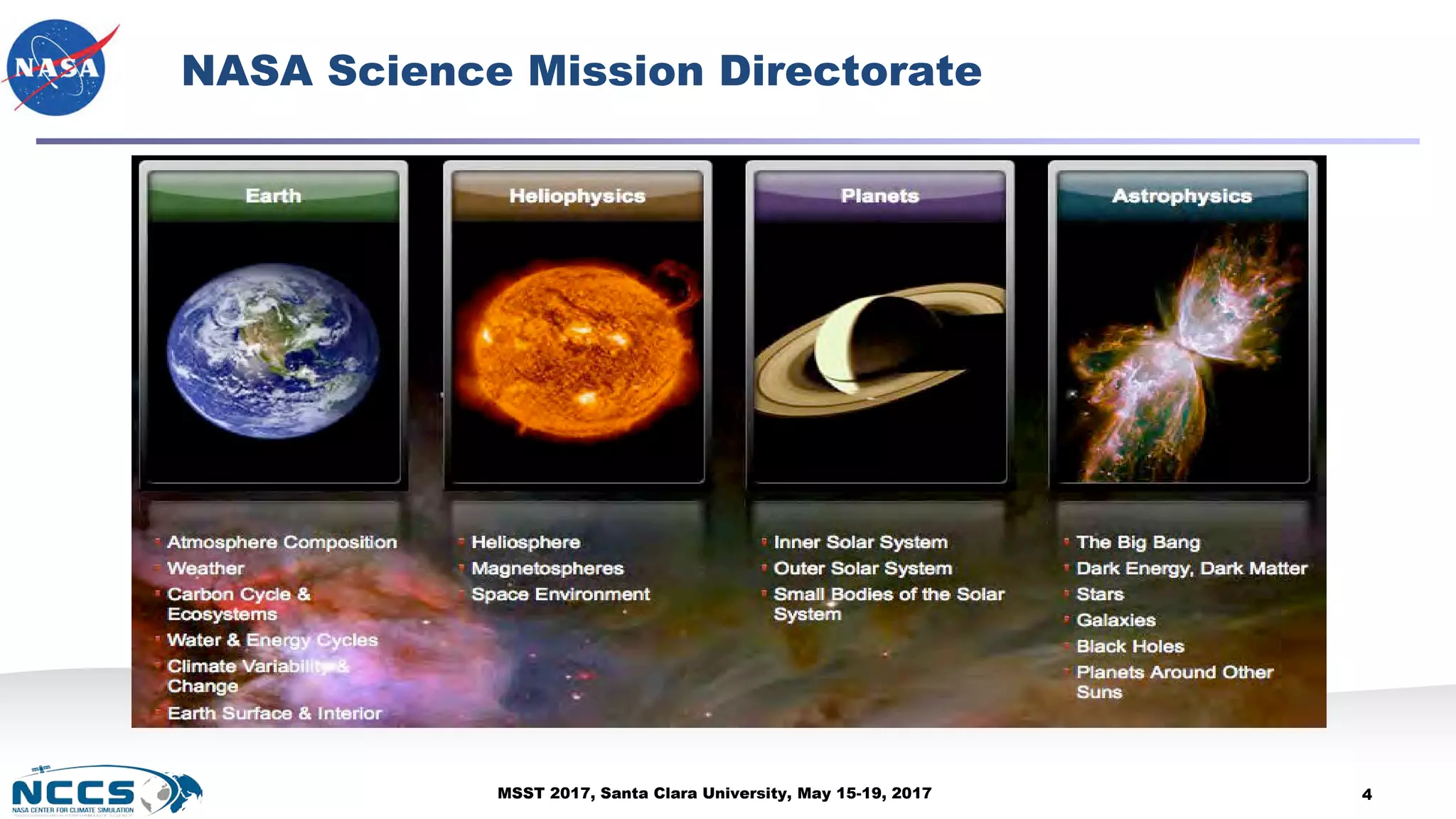
NASA Science Mission Directorate
4
MSST 2017, Santa Clara University, May 15-19, 2017
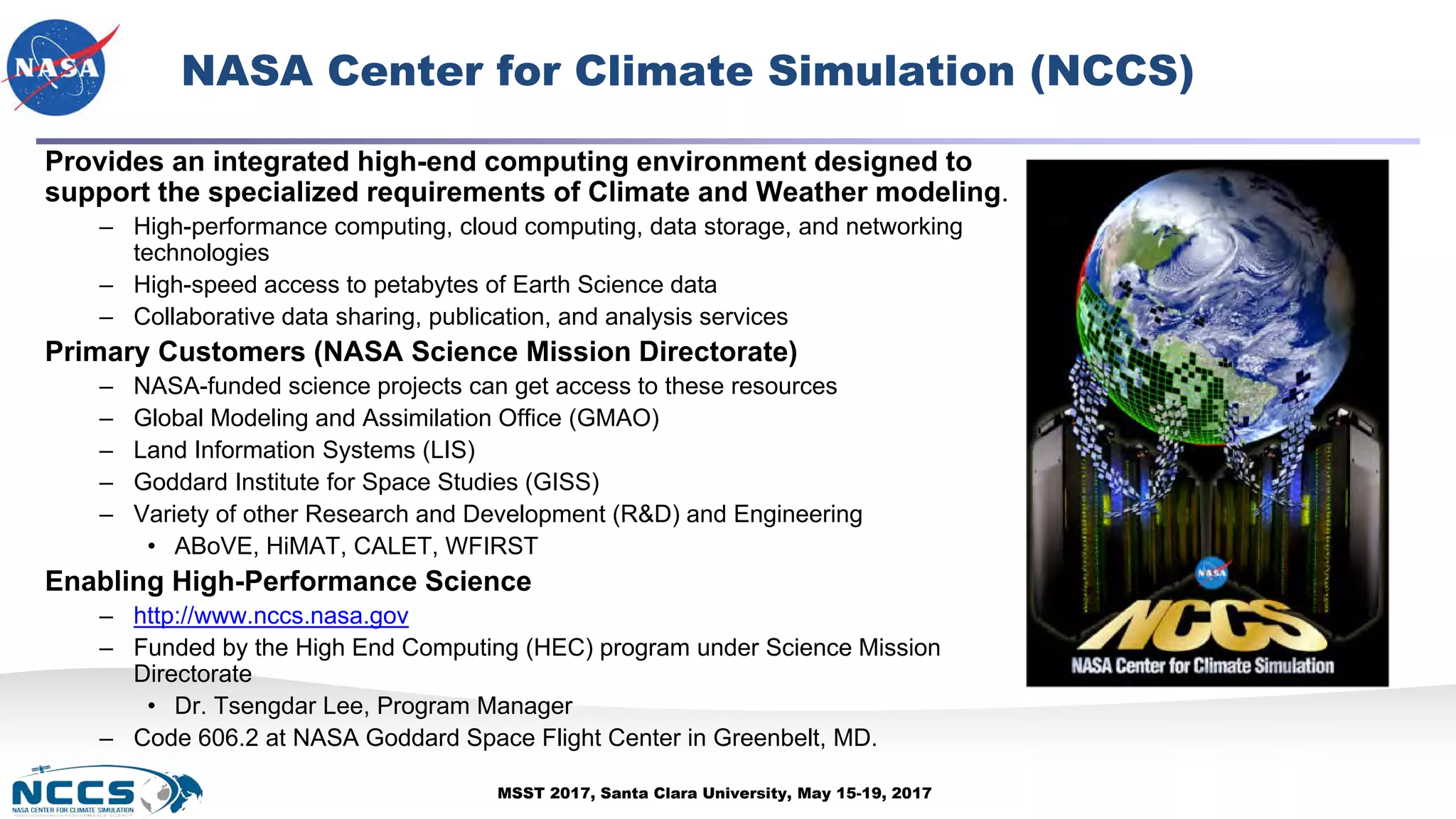
Provides an integrated high-end computing environment designed to
support the specialized requirements of Climate and Weather modeling.
– High-performance computing, cloud computing, data storage, and networking
technologies
– High-speed access to petabytes of Earth Science data
– Collaborative data sharing, publication, and analysis services
Primary Customers (NASA Science Mission Directorate)
– NASA-funded science projects can get access to these resources
– Global Modeling and Assimilation Office (GMAO)
– Land Information Systems (LIS)
– Goddard Institute for Space Studies (GISS)
– Variety of other Research and Development (R&D) and Engineering
• ABoVE, HiMAT, CALET, WFIRST
Enabling High-Performance Science
– http://www.nccs.nasa.gov
– Funded by the High End Computing (HEC) program under Science Mission
Directorate
• Dr. Tsengdar Lee, Program Manager
– Code 606.2 at NASA Goddard Space Flight Center in Greenbelt, MD.
NASA Center for Climate Simulation (NCCS)
MSST 2017, Santa Clara University, May 15-19, 2017
NCCS: Weather, Ocean Climate Simulation
Research Supported
• Global Modeling and Assimilation Office
– Goddard Earth Observing System (GEOS) model
• Goddard Institute for Space Studies research
includes:
– Climate forcings, climate model development,
Earth observations, atmospheric radiation,
atmospheric chemistry, climate impacts,
planetary atmospheres and astrobiology,
paleoclimate, …
• Land Information System (LIS)
6
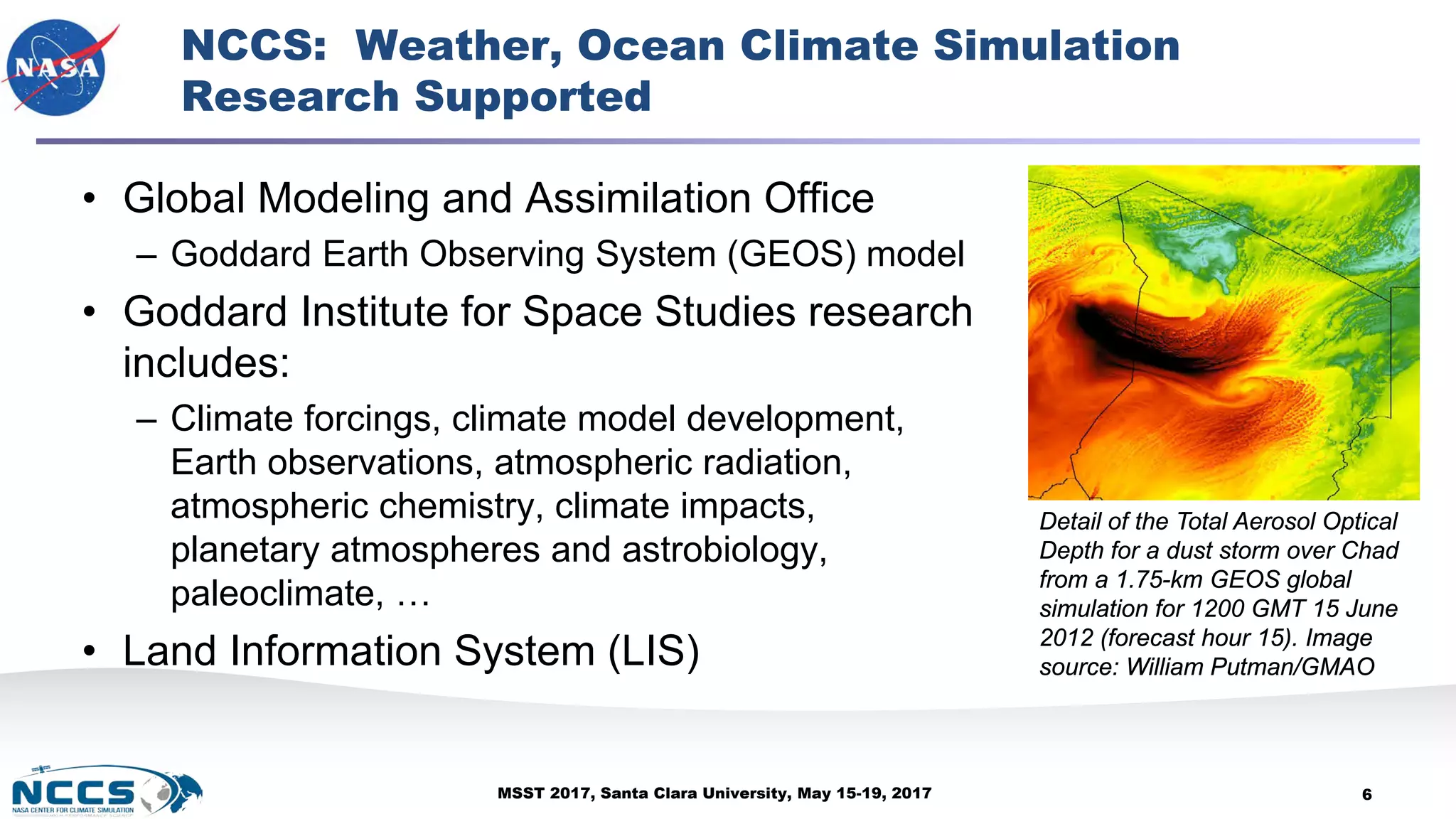
Detail of the Total Aerosol Optical
Depth for a dust storm over Chad
from a 1.75-km GEOS global
simulation for 1200 GMT 15 June
2012 (forecast hour 15). Image
source: William Putman/GMAO
MSST 2017, Santa Clara University, May 15-19, 2017
NCCS: Support for NASA Carbon Research
Both on Discover (HPC), increasingly
on ADAPT (virtualization environment)
• ABoVE – Arctic Boreal Vulnerability Experiment
• HiMAT – High Mountain Asia Team
• Semi-Arid Carbon Sink Study (some via Amazon
Web Services & “cloud bursting”)
Many data sets & new services
• ArcGIS geospatial information system
• High-res imagery from National Geospatial-
Intelligence Agency (NGA) & other sources
• Connection to MODIS data in B32 via Lightweight
Virtualized File System (LVFS)
7
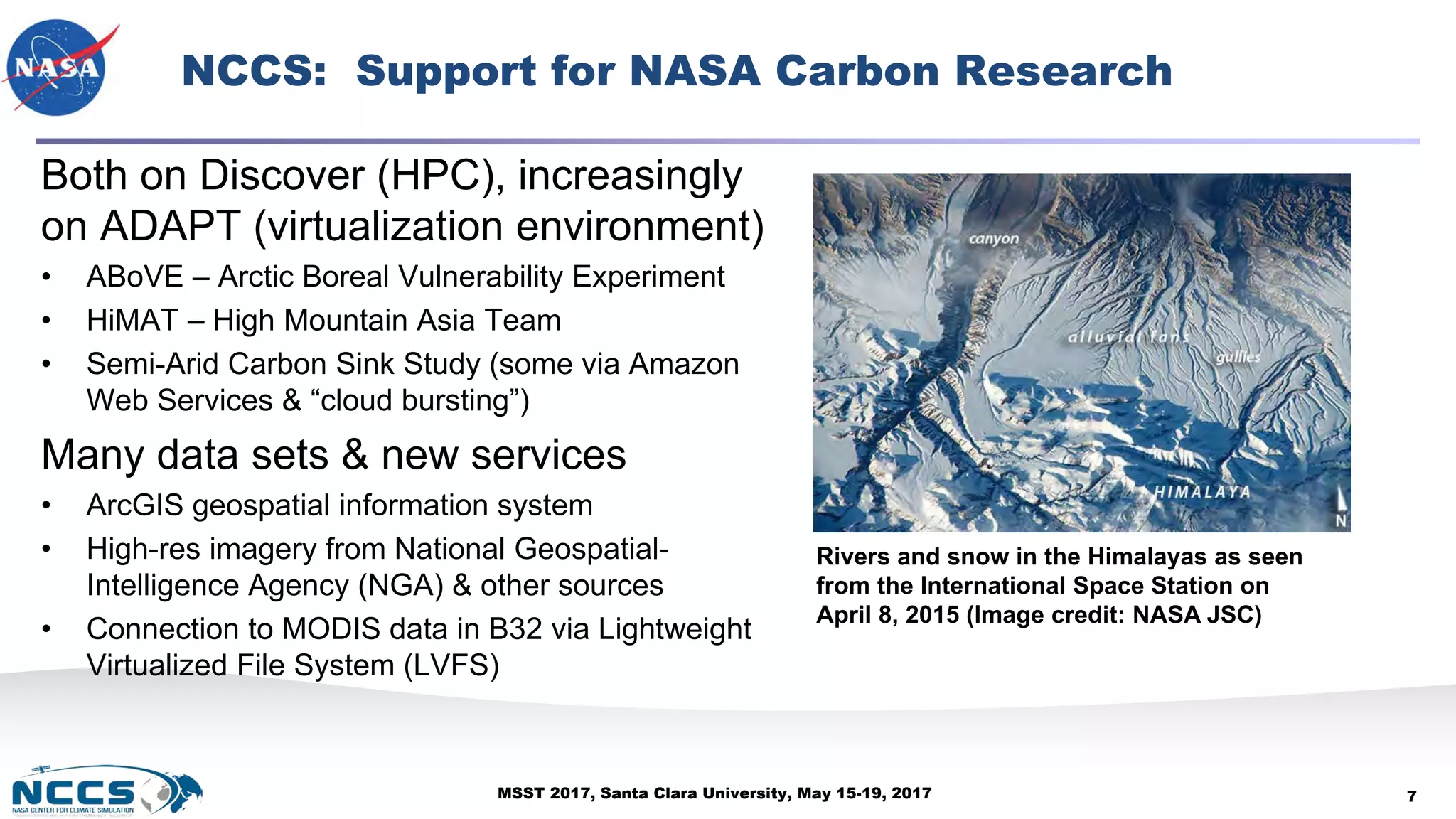
Rivers and snow in the Himalayas as seen
from the International Space Station on
April 8, 2015 (Image credit: NASA JSC)
MSST 2017, Santa Clara University, May 15-19, 2017
NCCS: Some Additional Projects Supported on ADAPT
• Planetary Defense (near-Earth
asteroids)
• CALET (CALorimetric Electron
Telescope)
– On International Space Station
(ISS); searches for signatures of
dark matter and makes direct
measurements of the cosmic ray
electron spectrum in our local
region of the Galaxy.
8
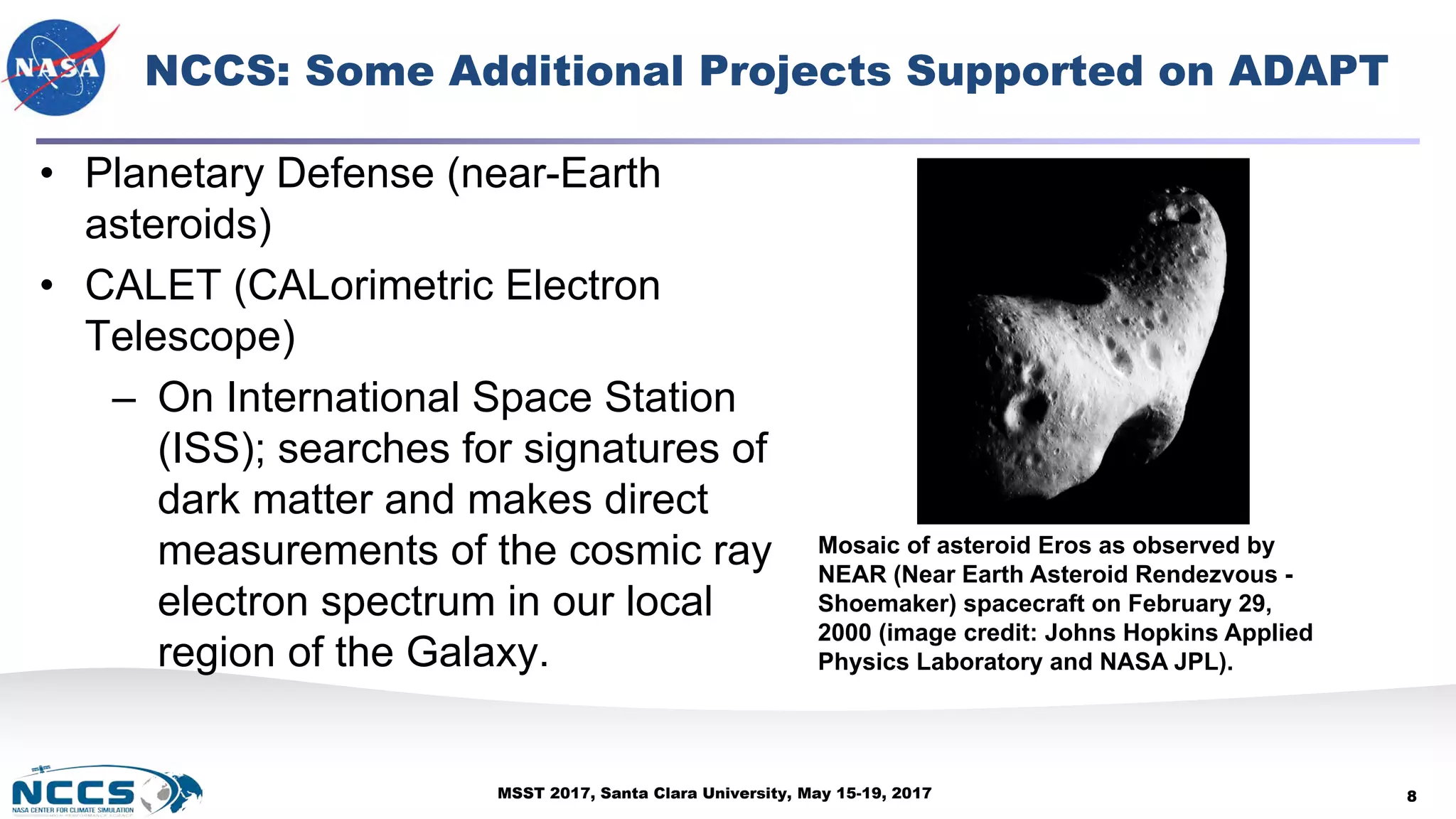
Mosaic of asteroid Eros as observed by
NEAR (Near Earth Asteroid Rendezvous -
Shoemaker) spacecraft on February 29,
2000 (image credit: Johns Hopkins Applied
Physics Laboratory and NASA JPL).
MSST 2017, Santa Clara University, May 15-19, 2017
NCCS Recent Evolution of Major Systems
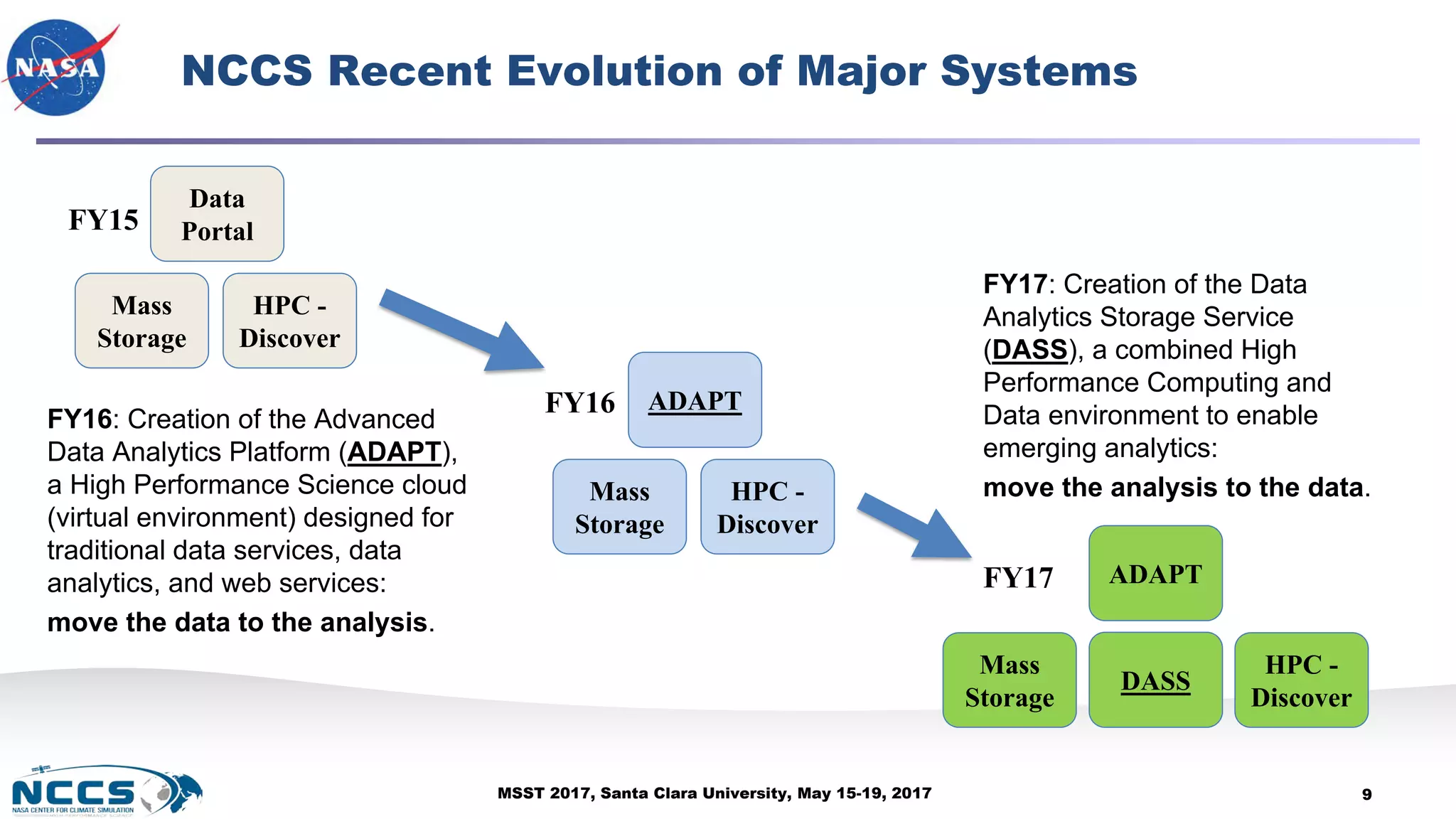
FY16: Creation of the Advanced
Data Analytics Platform (ADAPT),
a High Performance Science cloud
(virtual environment) designed for
traditional data services, data
analytics, and web services:
move the data to the analysis.
9
FY17: Creation of the Data
Analytics Storage Service
(DASS), a combined High
Performance Computing and
Data environment to enable
emerging analytics:
move the analysis to the data.
Data
Portal
HPC -
Discover
Mass
Storage
FY15
ADAPT
HPC -
Discover
Mass
Storage
FY16
ADAPT
HPC -
Discover
Mass
Storage
DASS
FY17
MSST 2017, Santa Clara University, May 15-19, 2017
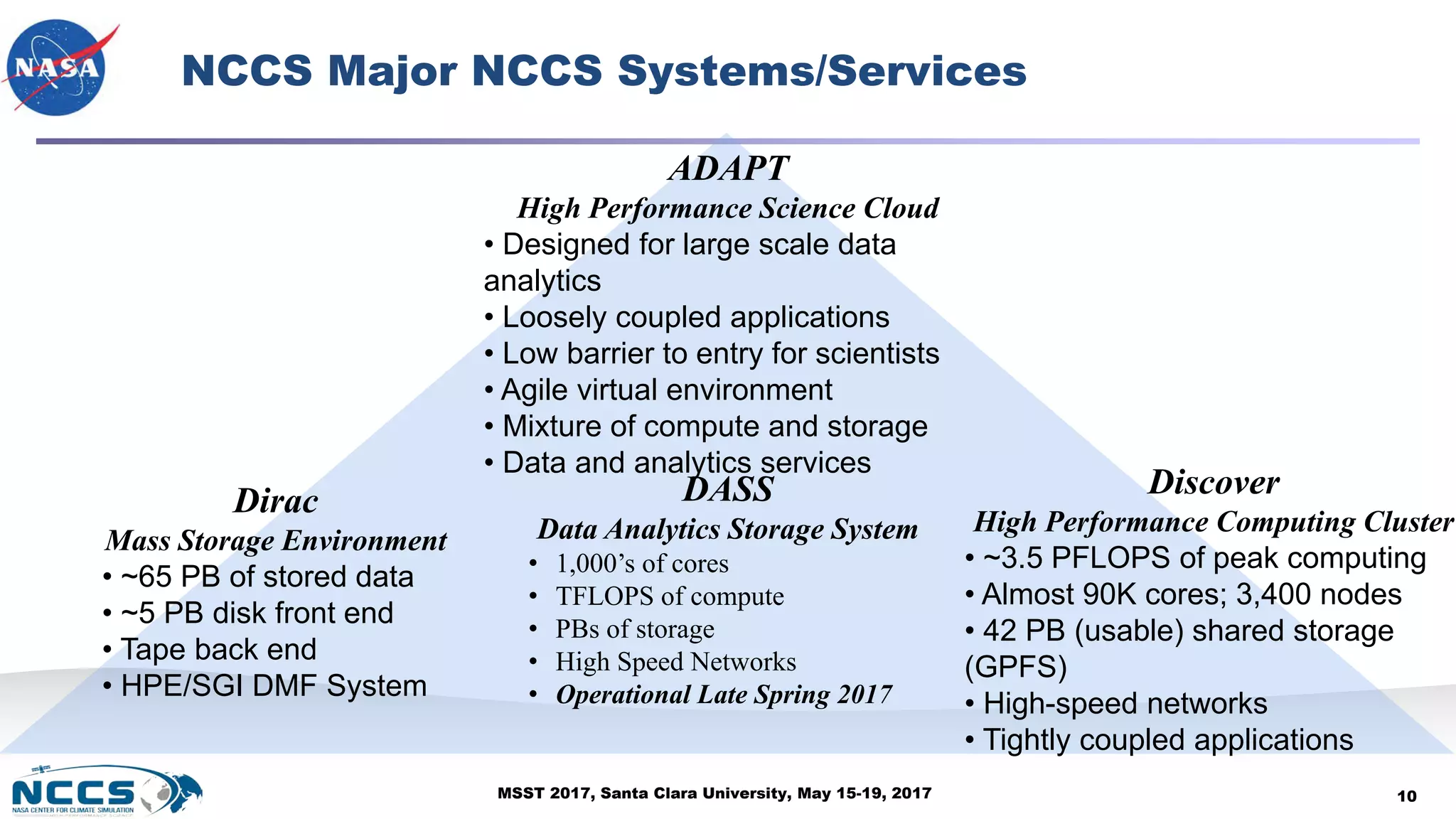
NCCS Major NCCS Systems/Services
10
ADAPT
High Performance Science Cloud
• Designed for large scale data
analytics
• Loosely coupled applications
• Low barrier to entry for scientists
• Agile virtual environment
• Mixture of compute and storage
• Data and analytics services
Dirac
Mass Storage Environment
• ~65 PB of stored data
• ~5 PB disk front end
• Tape back end
• HPE/SGI DMF System
Discover
High Performance Computing Cluster
• ~3.5 PFLOPS of peak computing
• Almost 90K cores; 3,400 nodes
• 42 PB (usable) shared storage
(GPFS)
• High-speed networks
• Tightly coupled applications
DASS
Data Analytics Storage System
• 1,000’s of cores
• TFLOPS of compute
• PBs of storage
• High Speed Networks
• Operational Late Spring 2017
MSST 2017, Santa Clara University, May 15-19, 2017
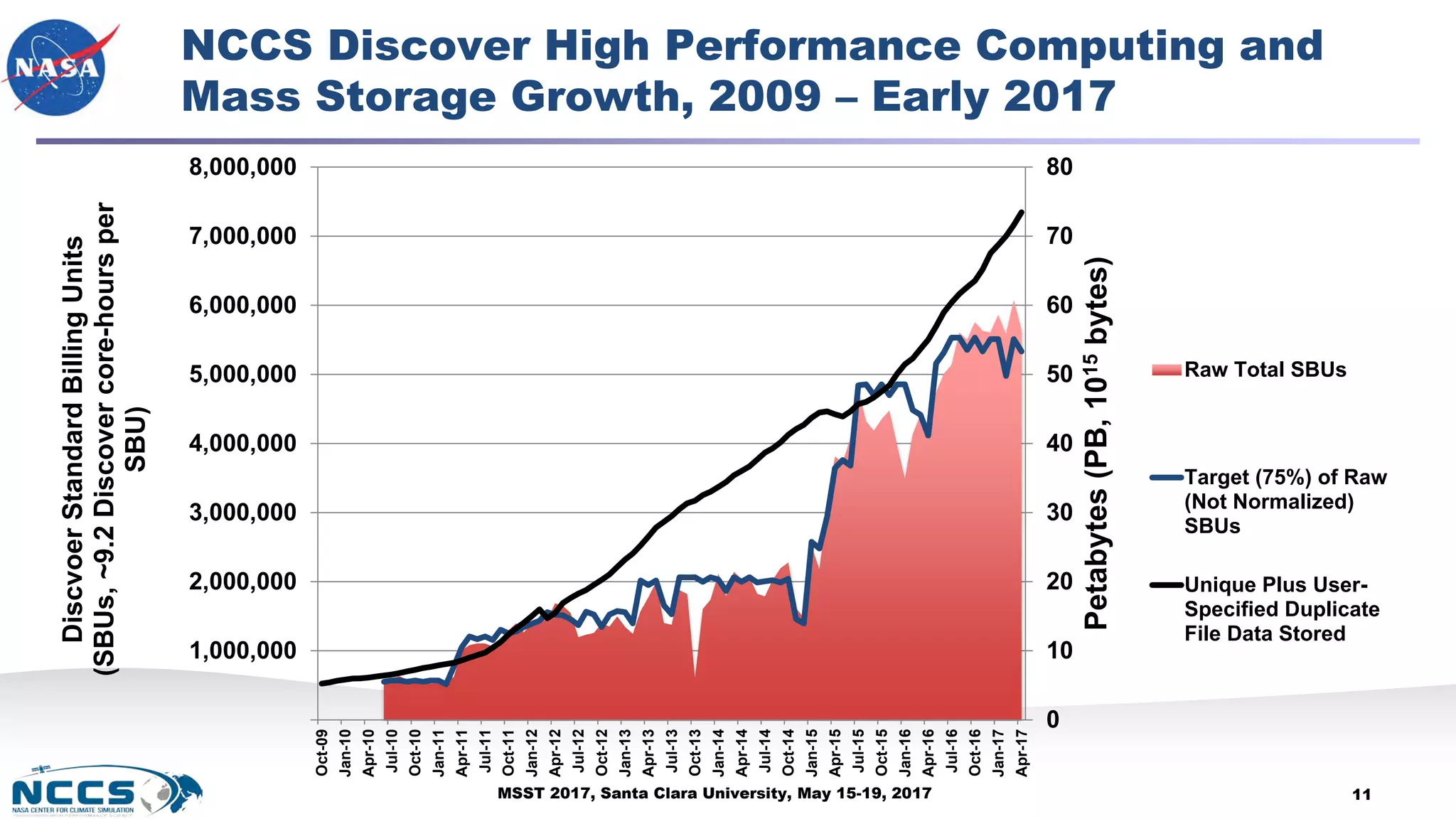
NCCS Discover High Performance Computing and
Mass Storage Growth, 2009 – Early 2017
11
0
10
20
30
40
50
60
70
80
1,000,000
2,000,000
3,000,000
4,000,000
5,000,000
6,000,000
7,000,000
8,000,000
Oct-09
Jan-10
Apr-10
Jul-10
Oct-10
Jan-11
Apr-11
Jul-11
Oct-11
Jan-12
Apr-12
Jul-12
Oct-12
Jan-13
Apr-13
Jul-13
Oct-13
Jan-14
Apr-14
Jul-14
Oct-14
Jan-15
Apr-15
Jul-15
Oct-15
Jan-16
Apr-16
Jul-16
Oct-16
Jan-17
Apr-17
Petabytes(PB,1015bytes)
DiscvoerStandardBillingUnits
(SBUs,~9.2Discovercore-hoursper
SBU)
Raw Total SBUs
Target (75%) of Raw
(Not Normalized)
SBUs
Unique Plus User-
Specified Duplicate
File Data Stored
MSST 2017, Santa Clara University, May 15-19, 2017
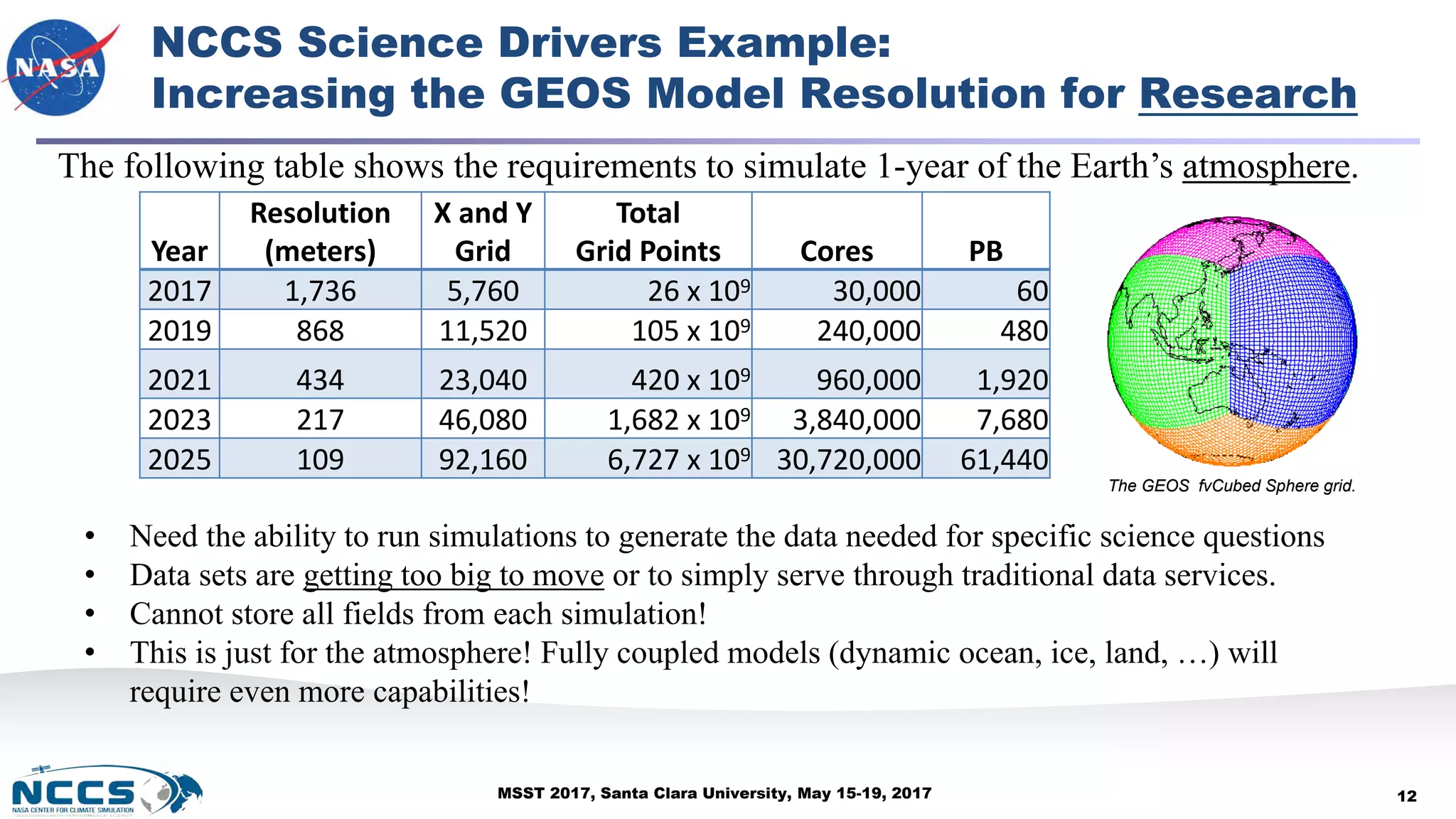
NCCS Science Drivers Example:
Increasing the GEOS Model Resolution for Research
12
Year
Resolution
(meters)
X and Y
Grid
Total
Grid Points Cores PB
2017 1,736 5,760 26 x 109 30,000 60
2019 868 11,520 105 x 109 240,000 480
2021 434 23,040 420 x 109 960,000 1,920
2023 217 46,080 1,682 x 109 3,840,000 7,680
2025 109 92,160 6,727 x 109 30,720,000 61,440
• Need the ability to run simulations to generate the data needed for specific science questions
• Data sets are getting too big to move or to simply serve through traditional data services.
• Cannot store all fields from each simulation!
• This is just for the atmosphere! Fully coupled models (dynamic ocean, ice, land, …) will
require even more capabilities!
The following table shows the requirements to simulate 1-year of the Earth’s atmosphere.
The GEOS fvCubed Sphere grid.
MSST 2017, Santa Clara University, May 15-19, 2017
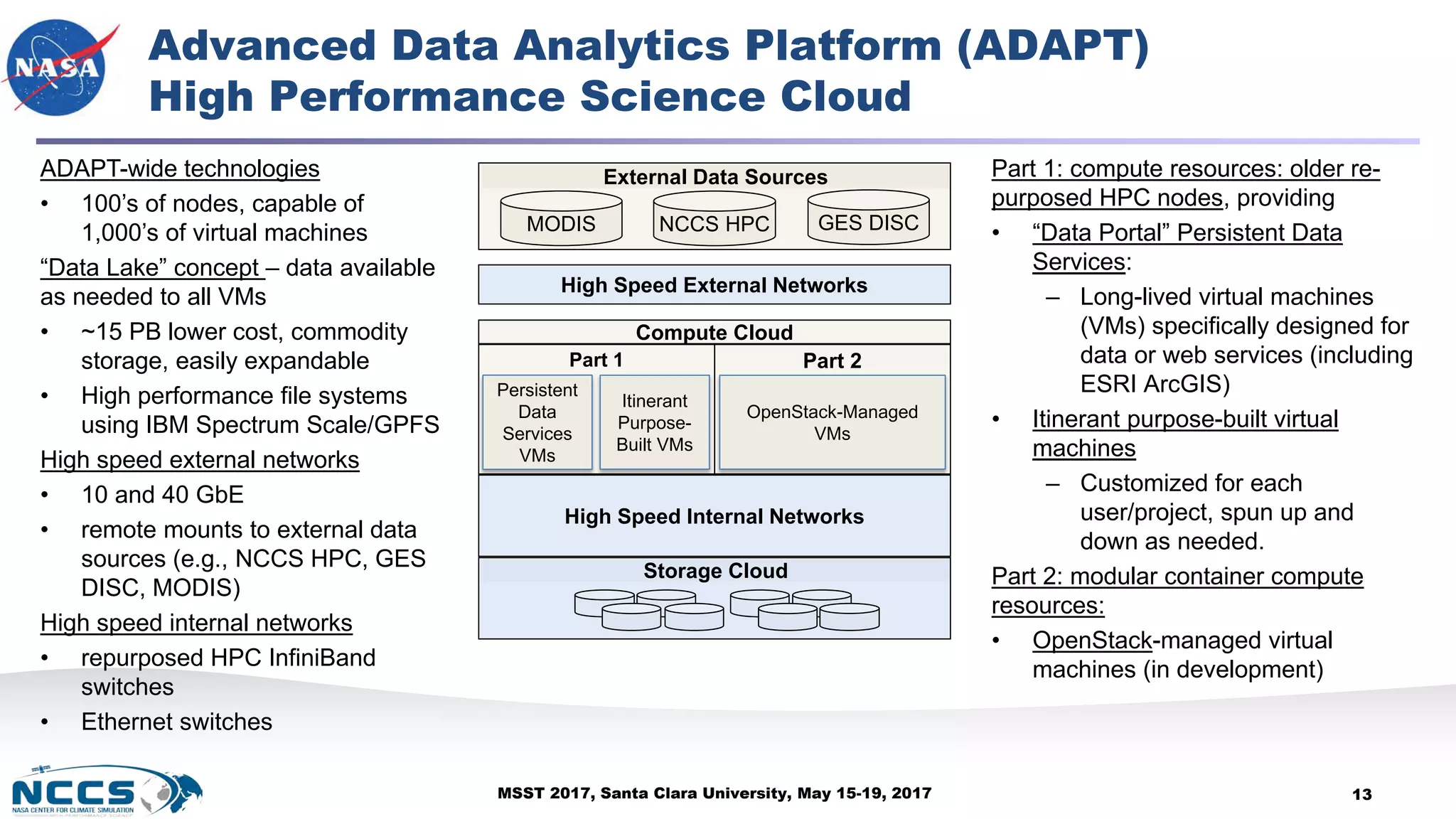
Advanced Data Analytics Platform (ADAPT)
High Performance Science Cloud
Part 1: compute resources: older re-
purposed HPC nodes, providing
• “Data Portal” Persistent Data
Services:
– Long-lived virtual machines
(VMs) specifically designed for
data or web services (including
ESRI ArcGIS)
• Itinerant purpose-built virtual
machines
– Customized for each
user/project, spun up and
down as needed.
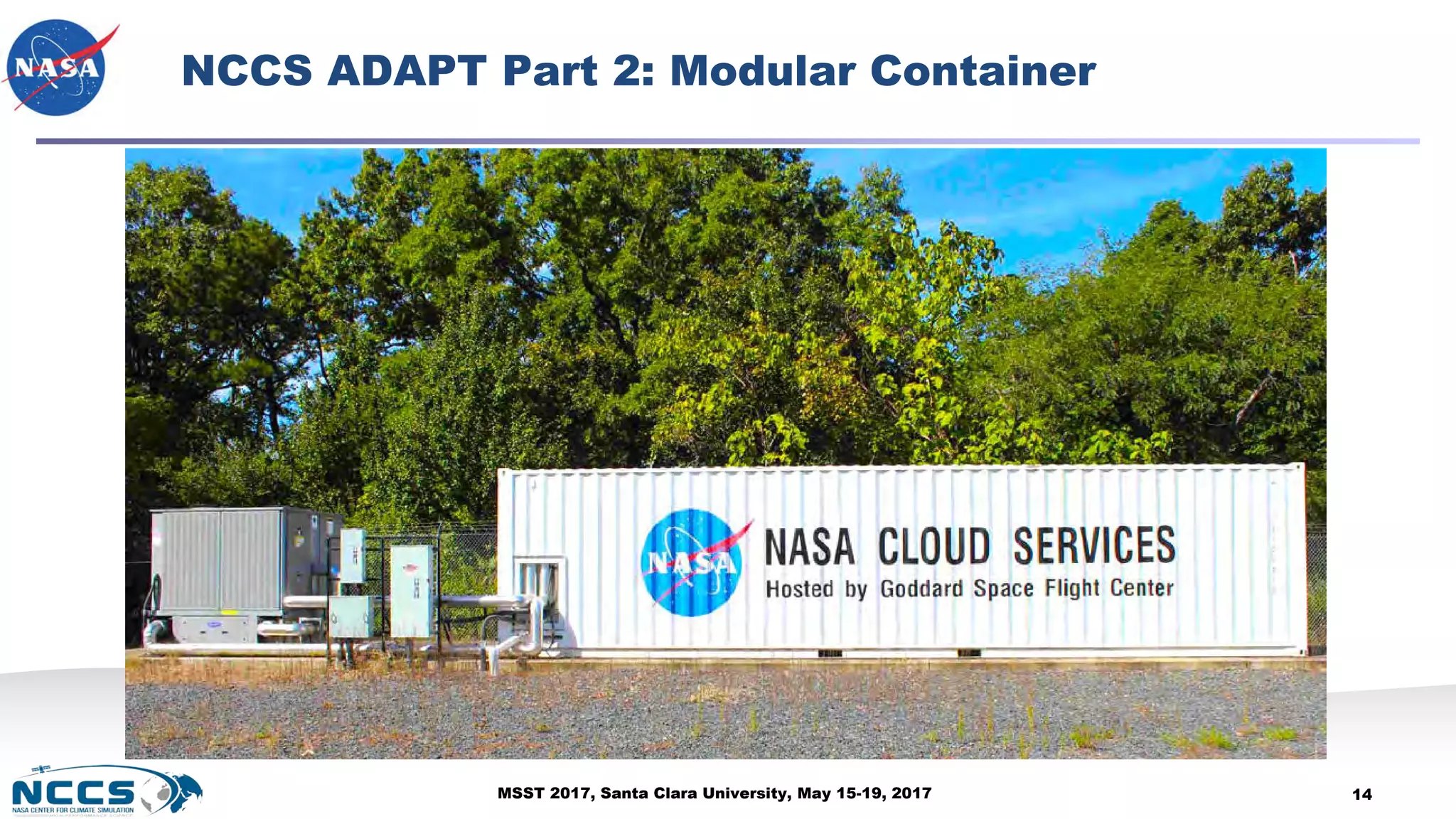
Part 2: modular container compute
resources:
• OpenStack-managed virtual
machines (in development)
13
ADAPT-wide technologies
• 100’s of nodes, capable of
1,000’s of virtual machines
“Data Lake” concept – data available
as needed to all VMs
• ~15 PB lower cost, commodity
storage, easily expandable
• High performance file systems
using IBM Spectrum Scale/GPFS
High speed external networks
• 10 and 40 GbE
• remote mounts to external data
sources (e.g., NCCS HPC, GES
DISC, MODIS)
High speed internal networks
• repurposed HPC InfiniBand
switches
• Ethernet switches
External Data Sources
MODIS NCCS HPC GES DISC
High Speed External Networks
Storage Cloud
High Speed Internal Networks
Compute Cloud
Part 2Part 1
Persistent
Data
Services
VMs
Itinerant
Purpose-
Built VMs
OpenStack-Managed
VMs
MSST 2017, Santa Clara University, May 15-19, 2017
NCCS ADAPT Part 2: Modular Container
14
MSST 2017, Santa Clara University, May 15-19, 2017
Data Analytics Storage System (DASS) - Motivation
15
• Data movement and sharing of data across services within the NCCS is a
continuing challenge
• Large data sets created on Discover (HPC)
– On which users perform many analyses
– And much of this data is not stored in a NASA Distributed Active Archive Center (DAAC)
• Approach: create a true centralized combination of storage & compute capability
– Capacity to store many PBs of data for long periods of time
– Architected to be able to scale both horizontally (compute and bandwidth) and vertically
(storage capacity)
– Can easily share data to different services within the NCCS
– Free up high speed disk capacity within Discover
– Enable both traditional and emerging analytics
– No need to modify data; use native scientific formats
MSST 2017, Santa Clara University, May 15-19, 2017
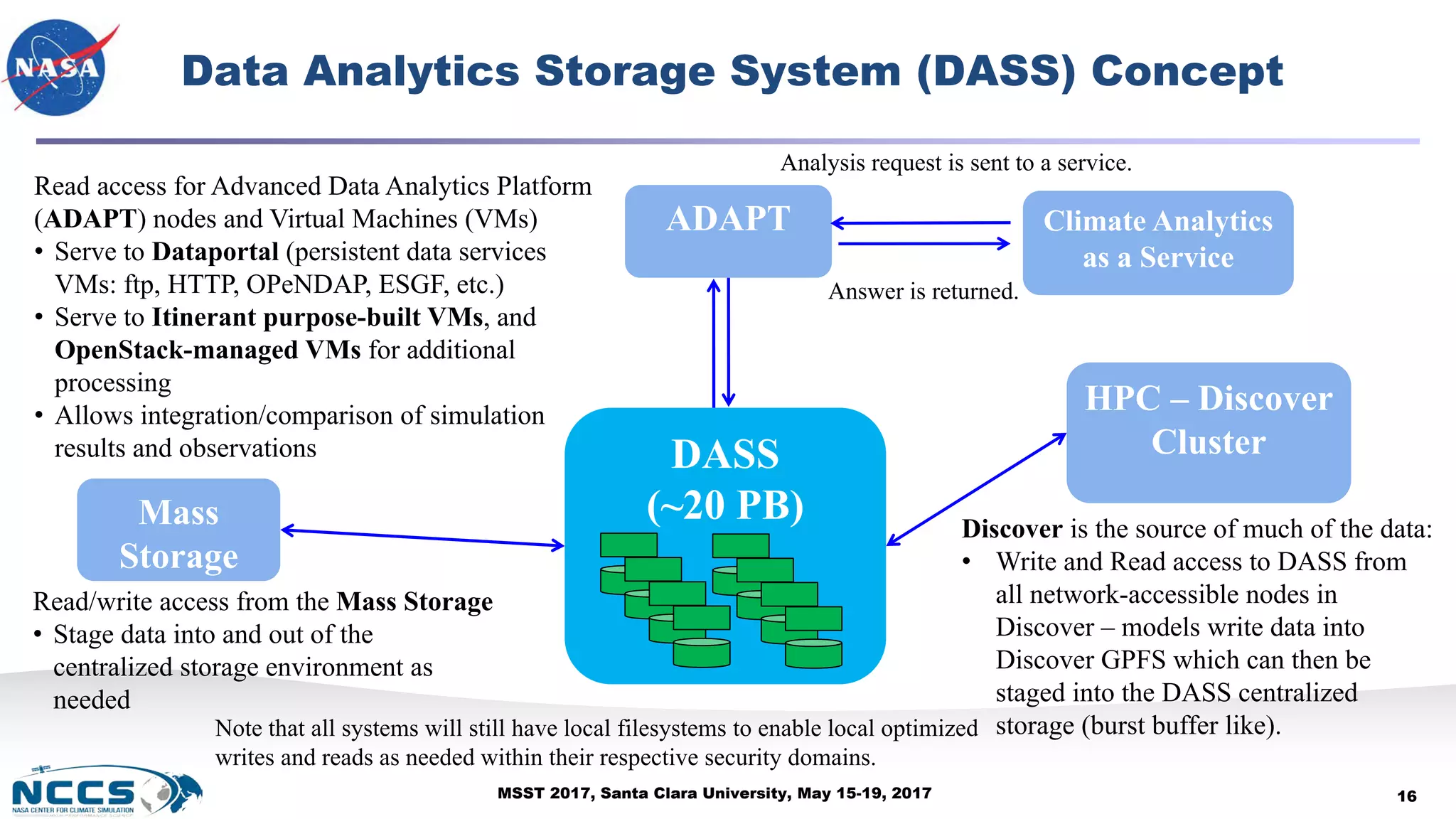
Data Analytics Storage System (DASS) Concept
16
Mass
Storage
ADAPT
HPC – Discover
Cluster
Discover is the source of much of the data:
• Write and Read access to DASS from
all network-accessible nodes in
Discover – models write data into
Discover GPFS which can then be
staged into the DASS centralized
storage (burst buffer like).
Read access for Advanced Data Analytics Platform
(ADAPT) nodes and Virtual Machines (VMs)
• Serve to Dataportal (persistent data services
VMs: ftp, HTTP, OPeNDAP, ESGF, etc.)
• Serve to Itinerant purpose-built VMs, and
OpenStack-managed VMs for additional
processing
• Allows integration/comparison of simulation
results and observations
Read/write access from the Mass Storage
• Stage data into and out of the
centralized storage environment as
needed
Climate Analytics
as a Service
Analysis request is sent to a service.
Answer is returned.
Note that all systems will still have local filesystems to enable local optimized
writes and reads as needed within their respective security domains.
DASS
(~20 PB)
MSST 2017, Santa Clara University, May 15-19, 2017
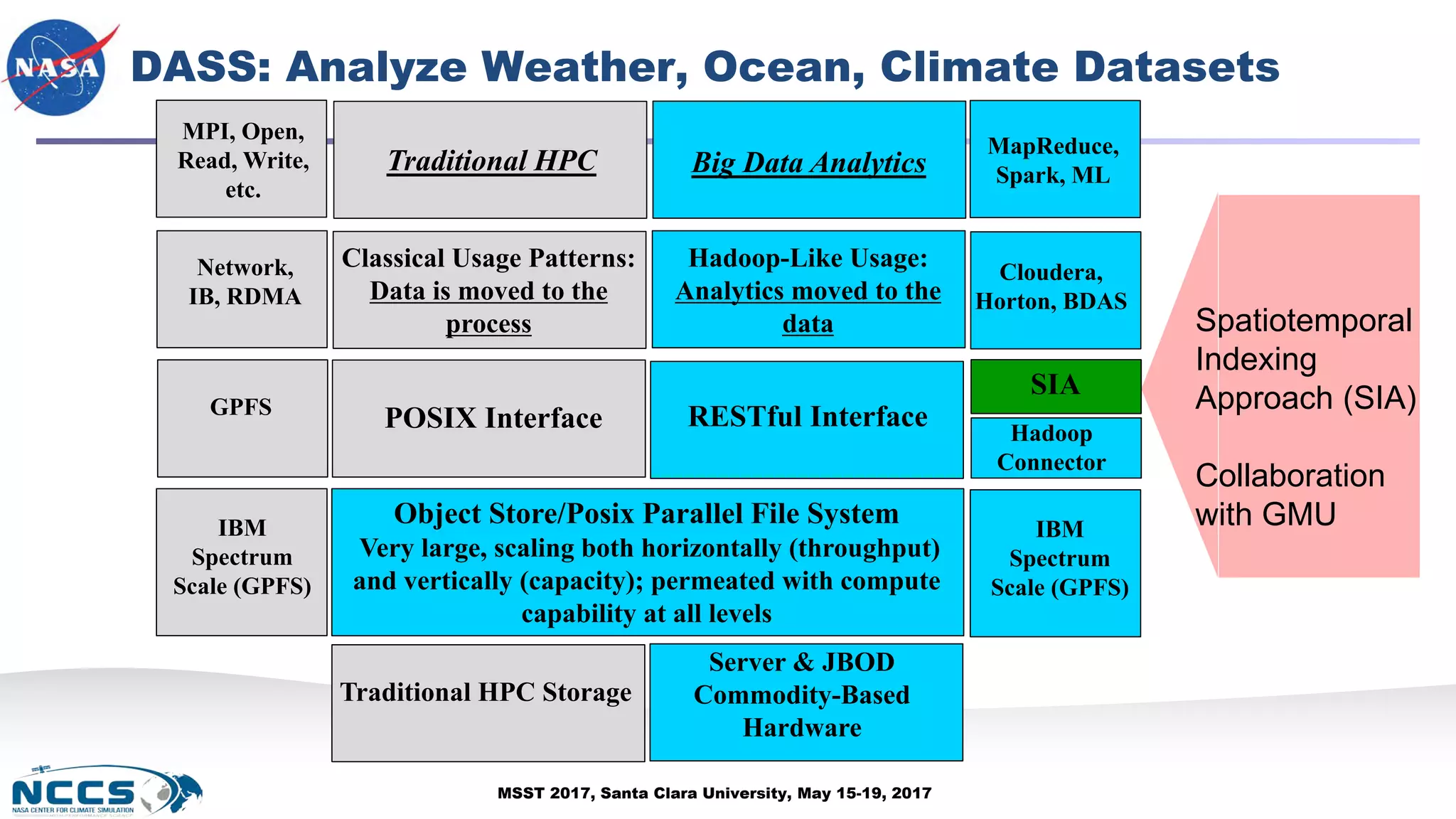
DASS: Analyze Weather, Ocean, Climate Datasets
Classical Usage Patterns:
Data is moved to the
process
Hadoop-Like Usage:
Analytics moved to the
data
Network,
IB, RDMA
GPFS
IBM
Spectrum
Scale (GPFS)
Traditional HPC Storage
Server & JBOD
Commodity-Based
Hardware
Object Store/Posix Parallel File System
Very large, scaling both horizontally (throughput)
and vertically (capacity); permeated with compute
capability at all levels
POSIX Interface
Traditional HPC Big Data Analytics
RESTful Interface
MapReduce,
Spark, ML
Cloudera,
Horton, BDAS
IBM
Spectrum
Scale (GPFS)
Hadoop
Connector
SIA
Spatiotemporal
Indexing
Approach (SIA)
Collaboration
with GMU
MPI, Open,
Read, Write,
etc.
MSST 2017, Santa Clara University, May 15-19, 2017
Spatiotemporal Index Approach (SIA)
and Hadoop
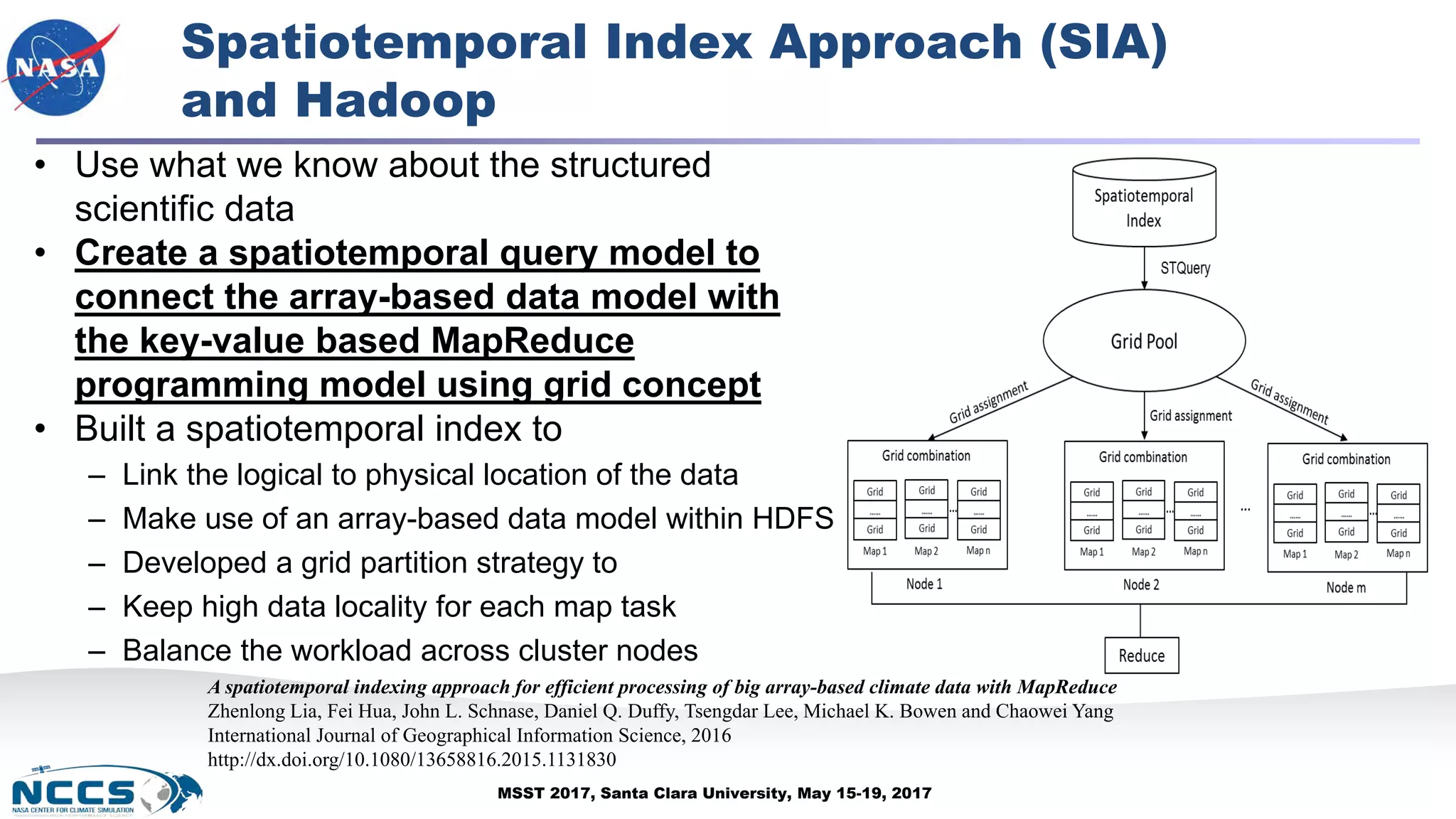
• Use what we know about the structured
scientific data
• Create a spatiotemporal query model to
connect the array-based data model with
the key-value based MapReduce
programming model using grid concept
• Built a spatiotemporal index to
– Link the logical to physical location of the data
– Make use of an array-based data model within HDFS
– Developed a grid partition strategy to
– Keep high data locality for each map task
– Balance the workload across cluster nodes
A spatiotemporal indexing approach for efficient processing of big array-based climate data with MapReduce
Zhenlong Lia, Fei Hua, John L. Schnase, Daniel Q. Duffy, Tsengdar Lee, Michael K. Bowen and Chaowei Yang
International Journal of Geographical Information Science, 2016
http://dx.doi.org/10.1080/13658816.2015.1131830
MSST 2017, Santa Clara University, May 15-19, 2017
Estimating Woody Biomass on South Side of the Sahara at the
40-50 cm Scale Using Cloud Bursting to Amazon Web Services
Project Science Goal – Using high-resolution satellite imagery data,
estimate tree and bush biomass over the entire arid and semi-arid zone on
the south side of the Sahara to:
• Estimate carbon stored in trees and bushes.
• Establish carbon baseline for later research on expected CO2 uptake.
Cloud Bursting into Amazon Web Services (AWS) Cloud
• Satellite imagery preprocessed to remove distortions on NCCS ADAPT.
• Batch system (with Cycle Computing) in ADAPT communicates with
elastic twin in AWS to move data and initiate processing.
• Biomass calculations run on AWS virtual machines (VMs) for 6-7 hours
each, via low-cost AWS spot instances; work scales linearly.
• AWS returns results (~25% size of input) to an ADAPT file system.
• Easily scale up the number of virtual machines using the Cycle
Computing software and the AWS resources.
Principal Investigators
• Dr. Compton J. Tucker, Goddard Space Flight Center (Code 610)
• Dr. Paul Morin, University of Minnesota
19
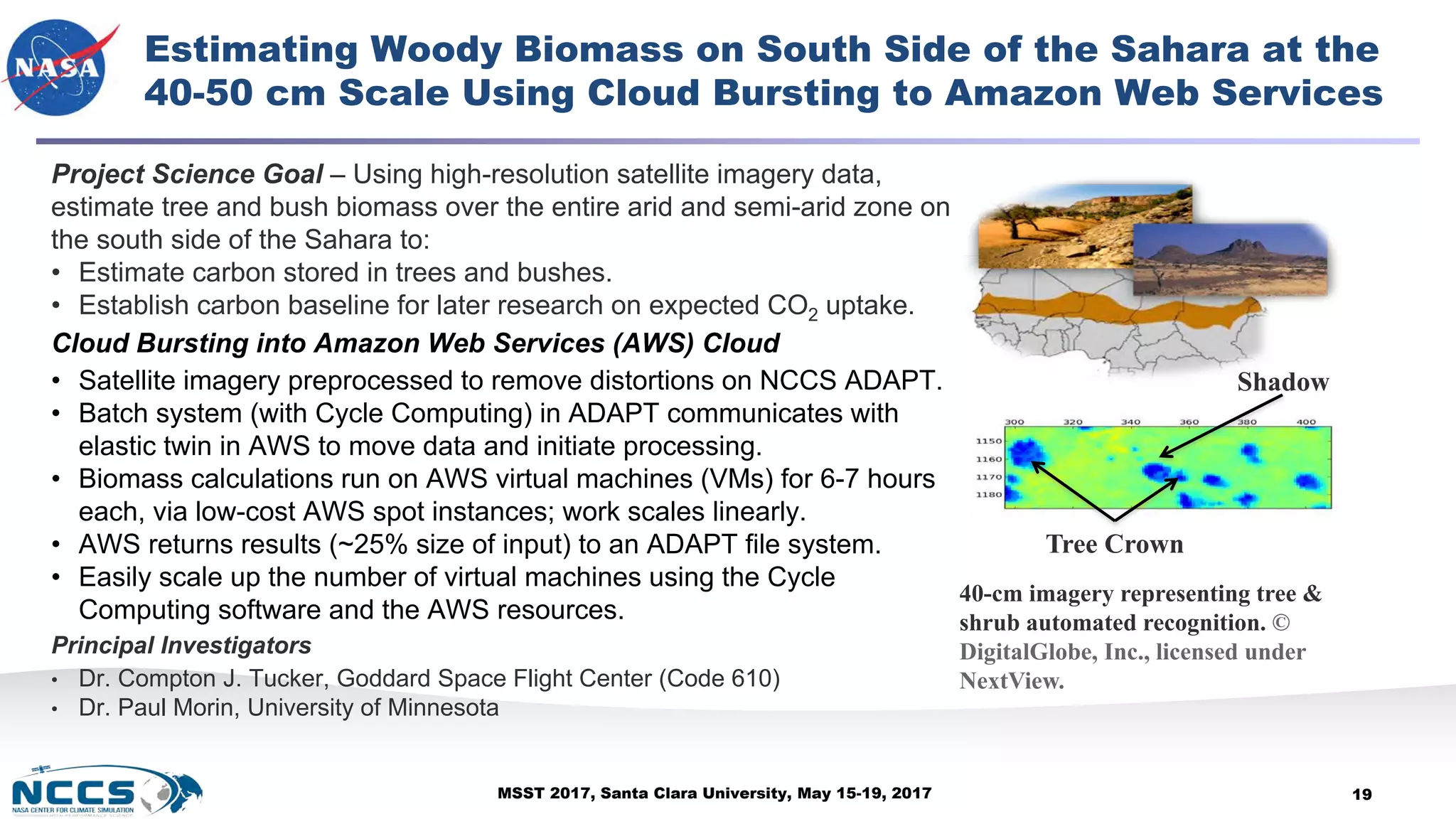
Tree Crown
Shadow
40-cm imagery representing tree &
shrub automated recognition. ©
DigitalGlobe, Inc., licensed under
NextView.
MSST 2017, Santa Clara University, May 15-19, 2017
Looking Toward Exascale
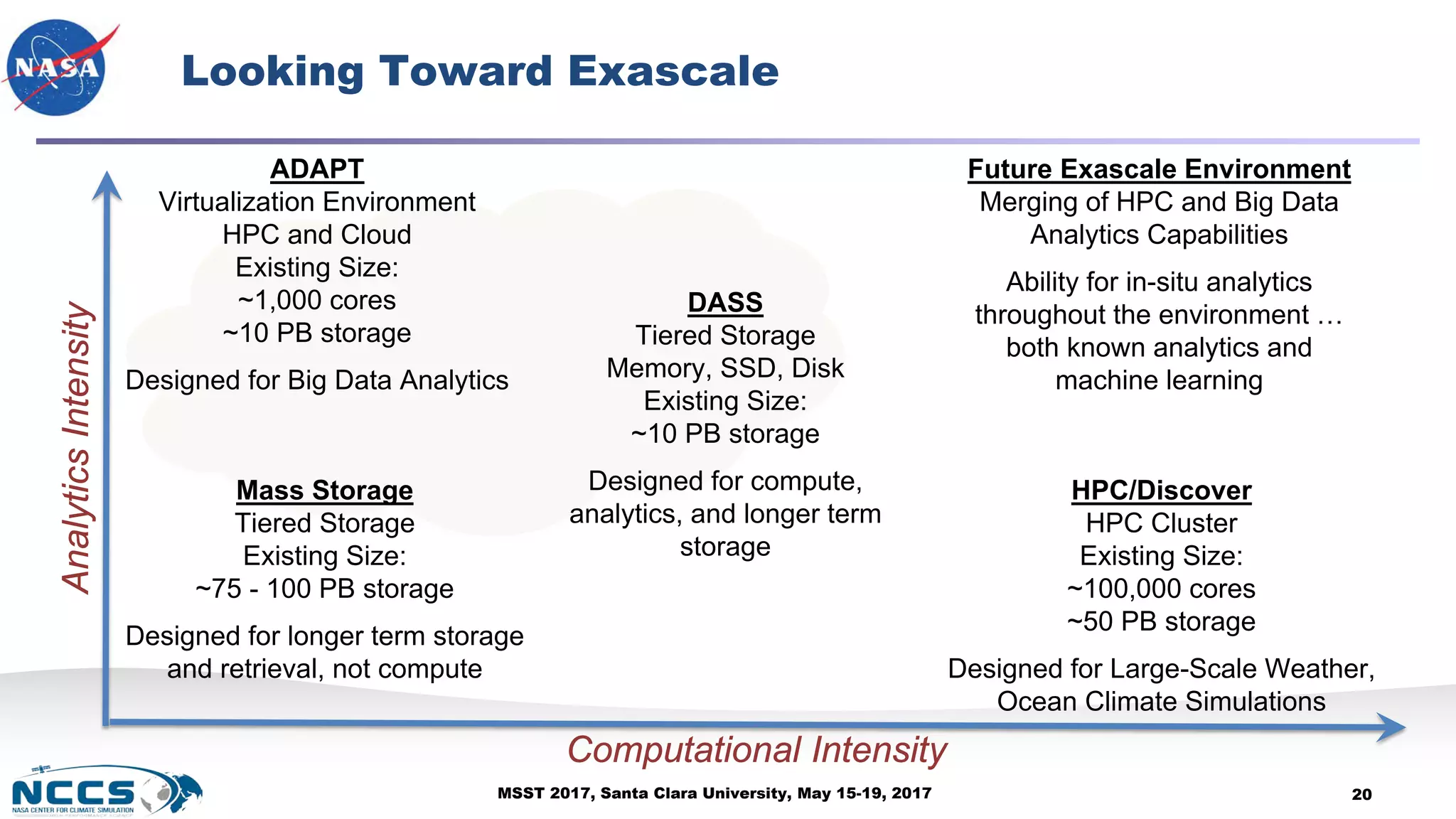
ADAPT
Virtualization Environment
HPC and Cloud
Existing Size:
~1,000 cores
~10 PB storage
Designed for Big Data Analytics
20
Mass Storage
Tiered Storage
Existing Size:
~75 - 100 PB storage
Designed for longer term storage
and retrieval, not compute
DASS
Tiered Storage
Memory, SSD, Disk
Existing Size:
~10 PB storage
Designed for compute,
analytics, and longer term
storage
Future Exascale Environment
Merging of HPC and Big Data
Analytics Capabilities
Ability for in-situ analytics
throughout the environment …
both known analytics and
machine learning
HPC/Discover
HPC Cluster
Existing Size:
~100,000 cores
~50 PB storage
Designed for Large-Scale Weather,
Ocean Climate Simulations
AnalyticsIntensity
Computational Intensity
MSST 2017, Santa Clara University, May 15-19, 2017 21
Thank You

Evolving Storage and Cyber Infrastructure at the NASA Center for Climate Simulation

  • 1.
    MSST 2017, SantaClara University, May 15-19, 2017 Evolving Storage and Cyber Infrastructure at the NASA Center for Climate Simulation Ellen Salmon Slides and content from Daniel Duffy, Carrie Spear, Scott Sinno, Garrison Vaughan, Michael Bowen NASA Center for Climate Simulation (NCCS) NASA Goddard Space Flight Center Greenbelt, Maryland
  • 2.
    MSST 2017, SantaClara University, May 15-19, 2017 Standard Disclaimers and Legalese Eye Chart • All Trademarks, logos, or otherwise registered identification markers are owned by their respective parties. • Disclaimer of Liability: With respect to this presentation, neither the United States Government nor any of its employees, makes any warranty, express or implied, including the warranties of merchantability and fitness for a particular purpose, or assumes any legal liability or responsibility for the accuracy, completeness, or usefulness of any information, apparatus, product, or process disclosed, or represents that its use would not infringe privately owned rights. • Disclaimer of Endorsement: Reference herein to any specific commercial products, process, or service by trade name, trademark, manufacturer, or otherwise, does not necessarily constitute or imply its endorsement, recommendation, or favoring by the United States Government. In addition, NASA does not endorse or sponsor any commercial product, service, or activity. • The views and opinions of author(s) expressed herein do not necessarily state or reflect those of the United States Government and shall not be used for advertising or product endorsement purposes. • All errors in this presentation are inadvertent and are the responsibility of the primary author.
  • 3.
    MSST 2017, SantaClara University, May 15-19, 2017 AGENDA: • About the NASA Center for Climate Simulation (NCCS) • Recent History & Today • Science Drivers • Recent Developments – Advanced Data Analytics Platform (ADAPT) – Data Analytics Storage System (DASS) – Cloud-Bursting Project: Semi-Arid Carbon Sink • Looking Toward Exascale 3
  • 4.
    MSST 2017, SantaClara University, May 15-19, 2017 NASA Science Mission Directorate 4
  • 5.
    MSST 2017, SantaClara University, May 15-19, 2017 Provides an integrated high-end computing environment designed to support the specialized requirements of Climate and Weather modeling. – High-performance computing, cloud computing, data storage, and networking technologies – High-speed access to petabytes of Earth Science data – Collaborative data sharing, publication, and analysis services Primary Customers (NASA Science Mission Directorate) – NASA-funded science projects can get access to these resources – Global Modeling and Assimilation Office (GMAO) – Land Information Systems (LIS) – Goddard Institute for Space Studies (GISS) – Variety of other Research and Development (R&D) and Engineering • ABoVE, HiMAT, CALET, WFIRST Enabling High-Performance Science – http://www.nccs.nasa.gov – Funded by the High End Computing (HEC) program under Science Mission Directorate • Dr. Tsengdar Lee, Program Manager – Code 606.2 at NASA Goddard Space Flight Center in Greenbelt, MD. NASA Center for Climate Simulation (NCCS)
  • 6.
    MSST 2017, SantaClara University, May 15-19, 2017 NCCS: Weather, Ocean Climate Simulation Research Supported • Global Modeling and Assimilation Office – Goddard Earth Observing System (GEOS) model • Goddard Institute for Space Studies research includes: – Climate forcings, climate model development, Earth observations, atmospheric radiation, atmospheric chemistry, climate impacts, planetary atmospheres and astrobiology, paleoclimate, … • Land Information System (LIS) 6 Detail of the Total Aerosol Optical Depth for a dust storm over Chad from a 1.75-km GEOS global simulation for 1200 GMT 15 June 2012 (forecast hour 15). Image source: William Putman/GMAO
  • 7.
    MSST 2017, SantaClara University, May 15-19, 2017 NCCS: Support for NASA Carbon Research Both on Discover (HPC), increasingly on ADAPT (virtualization environment) • ABoVE – Arctic Boreal Vulnerability Experiment • HiMAT – High Mountain Asia Team • Semi-Arid Carbon Sink Study (some via Amazon Web Services & “cloud bursting”) Many data sets & new services • ArcGIS geospatial information system • High-res imagery from National Geospatial- Intelligence Agency (NGA) & other sources • Connection to MODIS data in B32 via Lightweight Virtualized File System (LVFS) 7 Rivers and snow in the Himalayas as seen from the International Space Station on April 8, 2015 (Image credit: NASA JSC)
  • 8.
    MSST 2017, SantaClara University, May 15-19, 2017 NCCS: Some Additional Projects Supported on ADAPT • Planetary Defense (near-Earth asteroids) • CALET (CALorimetric Electron Telescope) – On International Space Station (ISS); searches for signatures of dark matter and makes direct measurements of the cosmic ray electron spectrum in our local region of the Galaxy. 8 Mosaic of asteroid Eros as observed by NEAR (Near Earth Asteroid Rendezvous - Shoemaker) spacecraft on February 29, 2000 (image credit: Johns Hopkins Applied Physics Laboratory and NASA JPL).
  • 9.
    MSST 2017, SantaClara University, May 15-19, 2017 NCCS Recent Evolution of Major Systems FY16: Creation of the Advanced Data Analytics Platform (ADAPT), a High Performance Science cloud (virtual environment) designed for traditional data services, data analytics, and web services: move the data to the analysis. 9 FY17: Creation of the Data Analytics Storage Service (DASS), a combined High Performance Computing and Data environment to enable emerging analytics: move the analysis to the data. Data Portal HPC - Discover Mass Storage FY15 ADAPT HPC - Discover Mass Storage FY16 ADAPT HPC - Discover Mass Storage DASS FY17
  • 10.
    MSST 2017, SantaClara University, May 15-19, 2017 NCCS Major NCCS Systems/Services 10 ADAPT High Performance Science Cloud • Designed for large scale data analytics • Loosely coupled applications • Low barrier to entry for scientists • Agile virtual environment • Mixture of compute and storage • Data and analytics services Dirac Mass Storage Environment • ~65 PB of stored data • ~5 PB disk front end • Tape back end • HPE/SGI DMF System Discover High Performance Computing Cluster • ~3.5 PFLOPS of peak computing • Almost 90K cores; 3,400 nodes • 42 PB (usable) shared storage (GPFS) • High-speed networks • Tightly coupled applications DASS Data Analytics Storage System • 1,000’s of cores • TFLOPS of compute • PBs of storage • High Speed Networks • Operational Late Spring 2017
  • 11.
    MSST 2017, SantaClara University, May 15-19, 2017 NCCS Discover High Performance Computing and Mass Storage Growth, 2009 – Early 2017 11 0 10 20 30 40 50 60 70 80 1,000,000 2,000,000 3,000,000 4,000,000 5,000,000 6,000,000 7,000,000 8,000,000 Oct-09 Jan-10 Apr-10 Jul-10 Oct-10 Jan-11 Apr-11 Jul-11 Oct-11 Jan-12 Apr-12 Jul-12 Oct-12 Jan-13 Apr-13 Jul-13 Oct-13 Jan-14 Apr-14 Jul-14 Oct-14 Jan-15 Apr-15 Jul-15 Oct-15 Jan-16 Apr-16 Jul-16 Oct-16 Jan-17 Apr-17 Petabytes(PB,1015bytes) DiscvoerStandardBillingUnits (SBUs,~9.2Discovercore-hoursper SBU) Raw Total SBUs Target (75%) of Raw (Not Normalized) SBUs Unique Plus User- Specified Duplicate File Data Stored
  • 12.
    MSST 2017, SantaClara University, May 15-19, 2017 NCCS Science Drivers Example: Increasing the GEOS Model Resolution for Research 12 Year Resolution (meters) X and Y Grid Total Grid Points Cores PB 2017 1,736 5,760 26 x 109 30,000 60 2019 868 11,520 105 x 109 240,000 480 2021 434 23,040 420 x 109 960,000 1,920 2023 217 46,080 1,682 x 109 3,840,000 7,680 2025 109 92,160 6,727 x 109 30,720,000 61,440 • Need the ability to run simulations to generate the data needed for specific science questions • Data sets are getting too big to move or to simply serve through traditional data services. • Cannot store all fields from each simulation! • This is just for the atmosphere! Fully coupled models (dynamic ocean, ice, land, …) will require even more capabilities! The following table shows the requirements to simulate 1-year of the Earth’s atmosphere. The GEOS fvCubed Sphere grid.
  • 13.
    MSST 2017, SantaClara University, May 15-19, 2017 Advanced Data Analytics Platform (ADAPT) High Performance Science Cloud Part 1: compute resources: older re- purposed HPC nodes, providing • “Data Portal” Persistent Data Services: – Long-lived virtual machines (VMs) specifically designed for data or web services (including ESRI ArcGIS) • Itinerant purpose-built virtual machines – Customized for each user/project, spun up and down as needed. Part 2: modular container compute resources: • OpenStack-managed virtual machines (in development) 13 ADAPT-wide technologies • 100’s of nodes, capable of 1,000’s of virtual machines “Data Lake” concept – data available as needed to all VMs • ~15 PB lower cost, commodity storage, easily expandable • High performance file systems using IBM Spectrum Scale/GPFS High speed external networks • 10 and 40 GbE • remote mounts to external data sources (e.g., NCCS HPC, GES DISC, MODIS) High speed internal networks • repurposed HPC InfiniBand switches • Ethernet switches External Data Sources MODIS NCCS HPC GES DISC High Speed External Networks Storage Cloud High Speed Internal Networks Compute Cloud Part 2Part 1 Persistent Data Services VMs Itinerant Purpose- Built VMs OpenStack-Managed VMs
  • 14.
    MSST 2017, SantaClara University, May 15-19, 2017 NCCS ADAPT Part 2: Modular Container 14
  • 15.
    MSST 2017, SantaClara University, May 15-19, 2017 Data Analytics Storage System (DASS) - Motivation 15 • Data movement and sharing of data across services within the NCCS is a continuing challenge • Large data sets created on Discover (HPC) – On which users perform many analyses – And much of this data is not stored in a NASA Distributed Active Archive Center (DAAC) • Approach: create a true centralized combination of storage & compute capability – Capacity to store many PBs of data for long periods of time – Architected to be able to scale both horizontally (compute and bandwidth) and vertically (storage capacity) – Can easily share data to different services within the NCCS – Free up high speed disk capacity within Discover – Enable both traditional and emerging analytics – No need to modify data; use native scientific formats
  • 16.
    MSST 2017, SantaClara University, May 15-19, 2017 Data Analytics Storage System (DASS) Concept 16 Mass Storage ADAPT HPC – Discover Cluster Discover is the source of much of the data: • Write and Read access to DASS from all network-accessible nodes in Discover – models write data into Discover GPFS which can then be staged into the DASS centralized storage (burst buffer like). Read access for Advanced Data Analytics Platform (ADAPT) nodes and Virtual Machines (VMs) • Serve to Dataportal (persistent data services VMs: ftp, HTTP, OPeNDAP, ESGF, etc.) • Serve to Itinerant purpose-built VMs, and OpenStack-managed VMs for additional processing • Allows integration/comparison of simulation results and observations Read/write access from the Mass Storage • Stage data into and out of the centralized storage environment as needed Climate Analytics as a Service Analysis request is sent to a service. Answer is returned. Note that all systems will still have local filesystems to enable local optimized writes and reads as needed within their respective security domains. DASS (~20 PB)
  • 17.
    MSST 2017, SantaClara University, May 15-19, 2017 DASS: Analyze Weather, Ocean, Climate Datasets Classical Usage Patterns: Data is moved to the process Hadoop-Like Usage: Analytics moved to the data Network, IB, RDMA GPFS IBM Spectrum Scale (GPFS) Traditional HPC Storage Server & JBOD Commodity-Based Hardware Object Store/Posix Parallel File System Very large, scaling both horizontally (throughput) and vertically (capacity); permeated with compute capability at all levels POSIX Interface Traditional HPC Big Data Analytics RESTful Interface MapReduce, Spark, ML Cloudera, Horton, BDAS IBM Spectrum Scale (GPFS) Hadoop Connector SIA Spatiotemporal Indexing Approach (SIA) Collaboration with GMU MPI, Open, Read, Write, etc.
  • 18.
    MSST 2017, SantaClara University, May 15-19, 2017 Spatiotemporal Index Approach (SIA) and Hadoop • Use what we know about the structured scientific data • Create a spatiotemporal query model to connect the array-based data model with the key-value based MapReduce programming model using grid concept • Built a spatiotemporal index to – Link the logical to physical location of the data – Make use of an array-based data model within HDFS – Developed a grid partition strategy to – Keep high data locality for each map task – Balance the workload across cluster nodes A spatiotemporal indexing approach for efficient processing of big array-based climate data with MapReduce Zhenlong Lia, Fei Hua, John L. Schnase, Daniel Q. Duffy, Tsengdar Lee, Michael K. Bowen and Chaowei Yang International Journal of Geographical Information Science, 2016 http://dx.doi.org/10.1080/13658816.2015.1131830
  • 19.
    MSST 2017, SantaClara University, May 15-19, 2017 Estimating Woody Biomass on South Side of the Sahara at the 40-50 cm Scale Using Cloud Bursting to Amazon Web Services Project Science Goal – Using high-resolution satellite imagery data, estimate tree and bush biomass over the entire arid and semi-arid zone on the south side of the Sahara to: • Estimate carbon stored in trees and bushes. • Establish carbon baseline for later research on expected CO2 uptake. Cloud Bursting into Amazon Web Services (AWS) Cloud • Satellite imagery preprocessed to remove distortions on NCCS ADAPT. • Batch system (with Cycle Computing) in ADAPT communicates with elastic twin in AWS to move data and initiate processing. • Biomass calculations run on AWS virtual machines (VMs) for 6-7 hours each, via low-cost AWS spot instances; work scales linearly. • AWS returns results (~25% size of input) to an ADAPT file system. • Easily scale up the number of virtual machines using the Cycle Computing software and the AWS resources. Principal Investigators • Dr. Compton J. Tucker, Goddard Space Flight Center (Code 610) • Dr. Paul Morin, University of Minnesota 19 Tree Crown Shadow 40-cm imagery representing tree & shrub automated recognition. © DigitalGlobe, Inc., licensed under NextView.
  • 20.
    MSST 2017, SantaClara University, May 15-19, 2017 Looking Toward Exascale ADAPT Virtualization Environment HPC and Cloud Existing Size: ~1,000 cores ~10 PB storage Designed for Big Data Analytics 20 Mass Storage Tiered Storage Existing Size: ~75 - 100 PB storage Designed for longer term storage and retrieval, not compute DASS Tiered Storage Memory, SSD, Disk Existing Size: ~10 PB storage Designed for compute, analytics, and longer term storage Future Exascale Environment Merging of HPC and Big Data Analytics Capabilities Ability for in-situ analytics throughout the environment … both known analytics and machine learning HPC/Discover HPC Cluster Existing Size: ~100,000 cores ~50 PB storage Designed for Large-Scale Weather, Ocean Climate Simulations AnalyticsIntensity Computational Intensity
  • 21.
    MSST 2017, SantaClara University, May 15-19, 2017 21 Thank You