Science as a Service
Ian Foster, The University of Chicago and Argonne National Laboratory
November 14, 2013
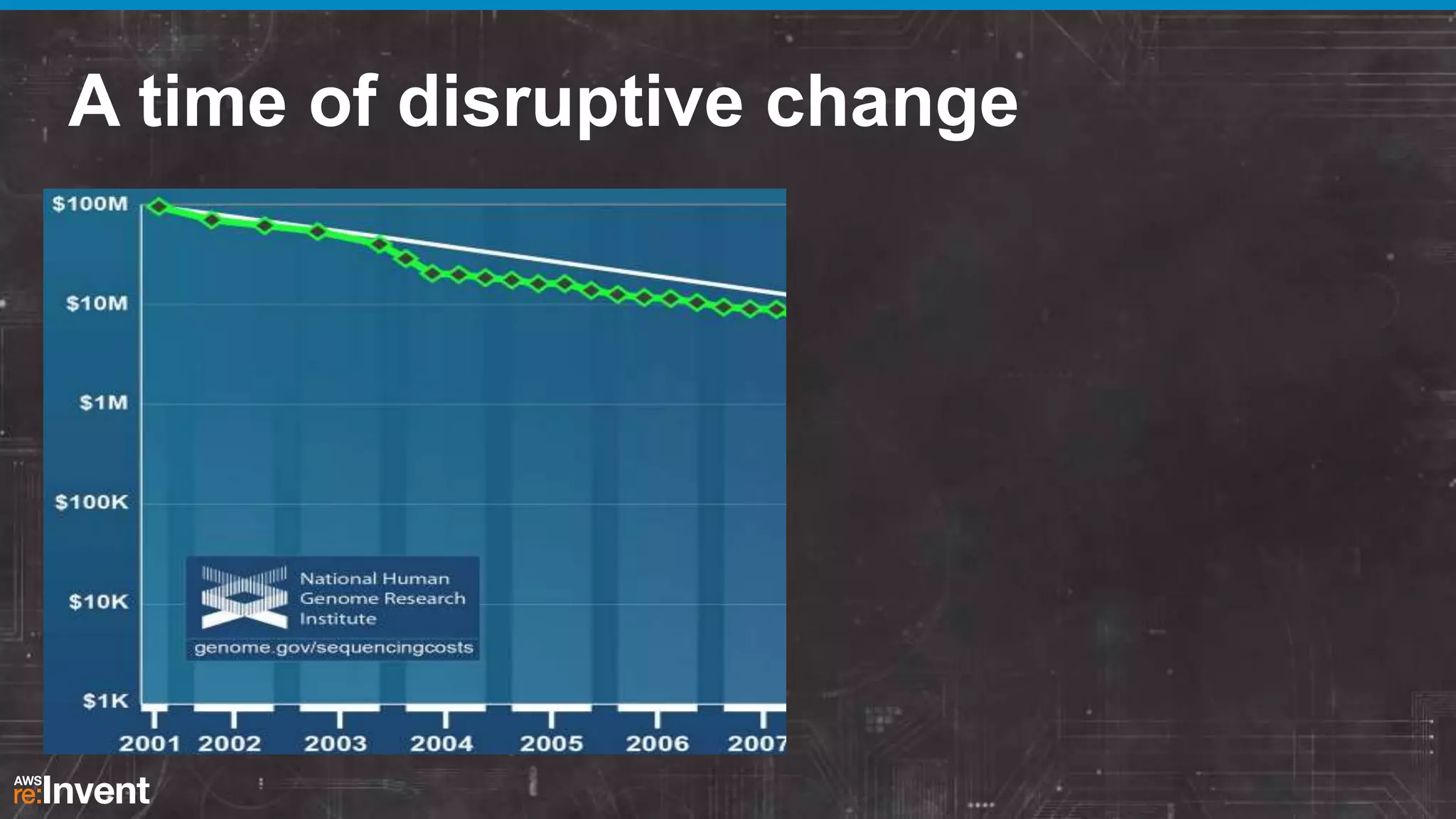
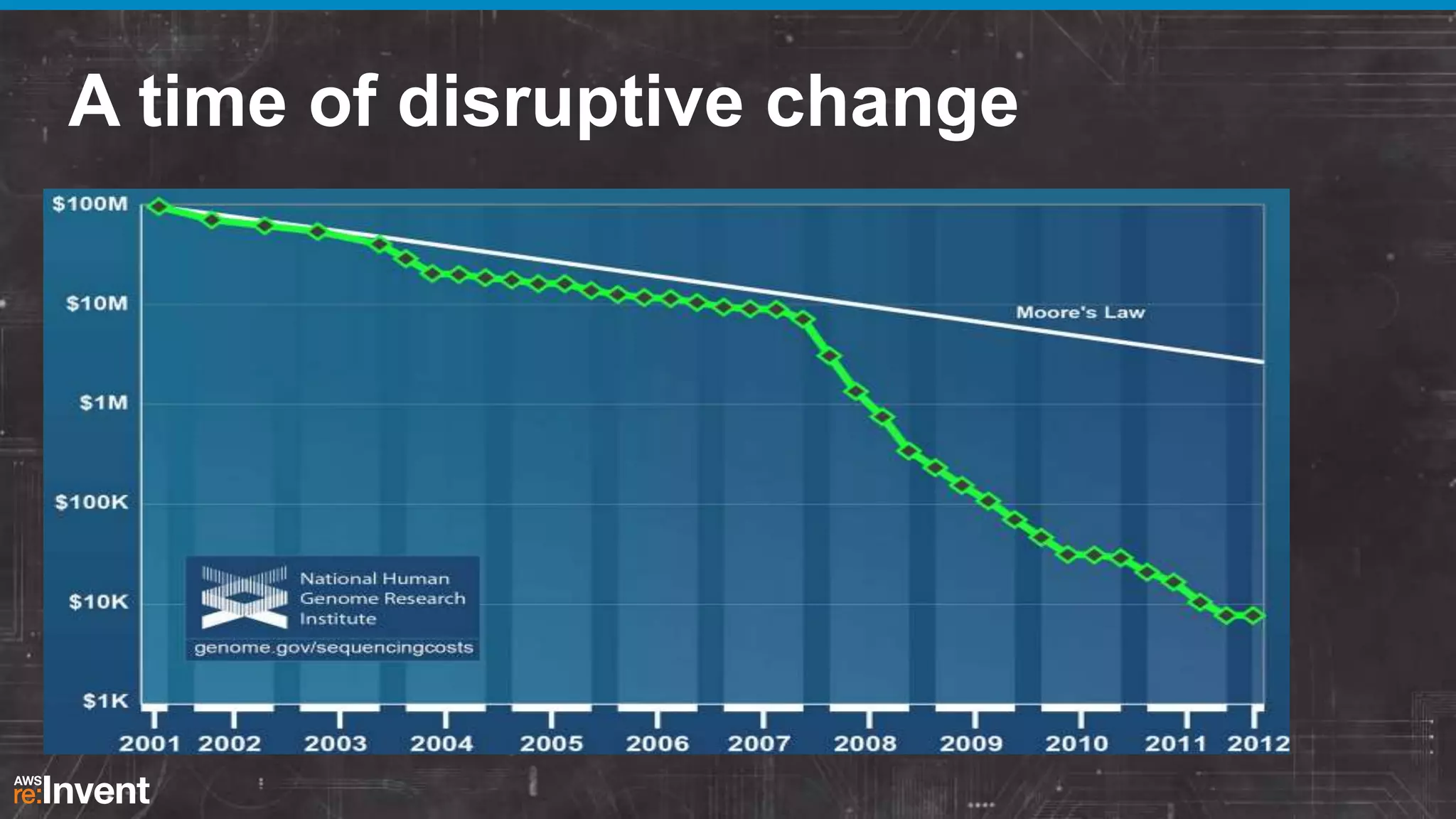
A time of disruptive change
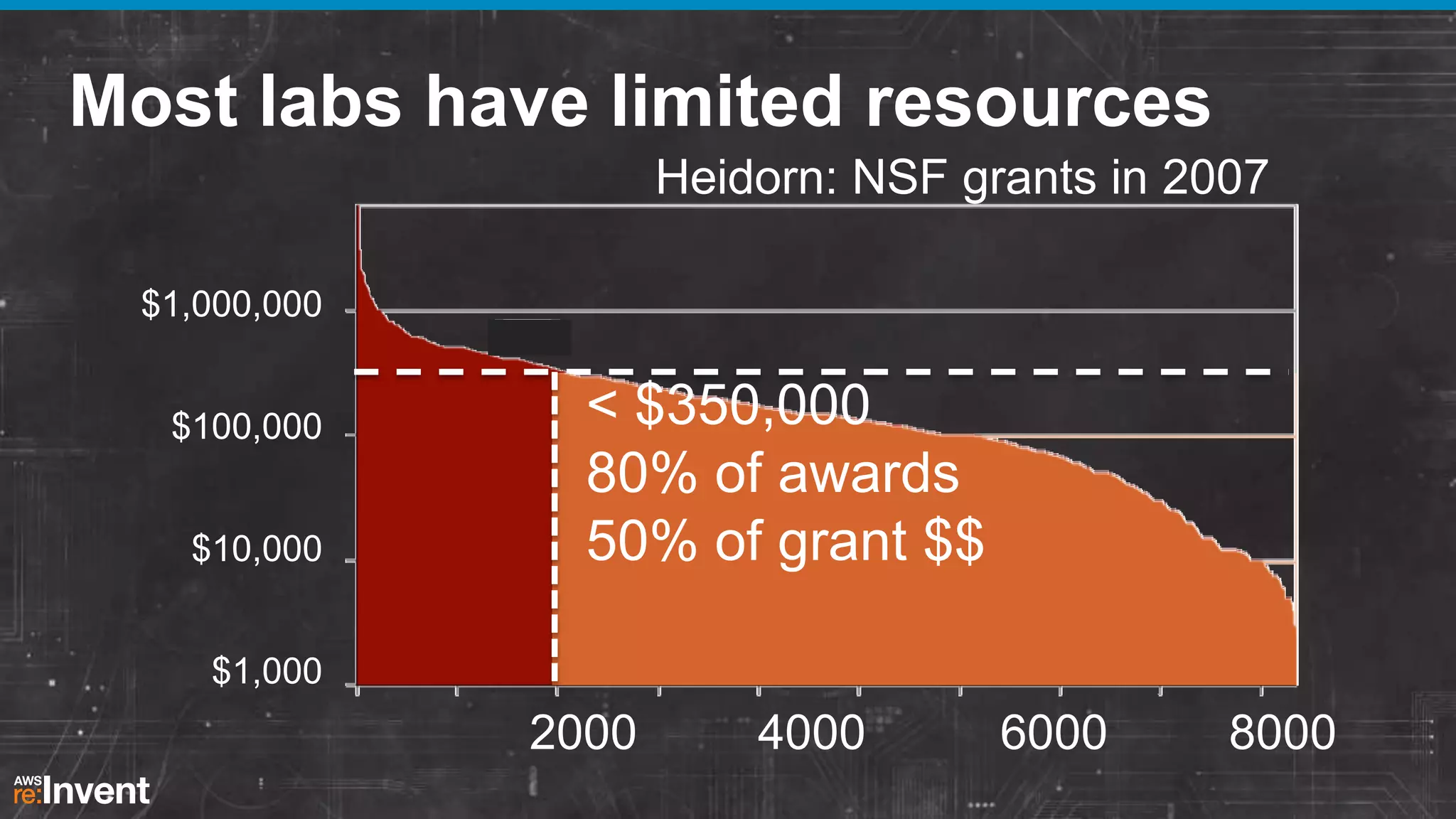
Most labs have limited resources
Heidorn: NSF grants in 2007
$1,000,000
$100,000
$10,000

< $350,000
80% of awards
50% of grant $$

$1,000

2000

4000

6000

8000
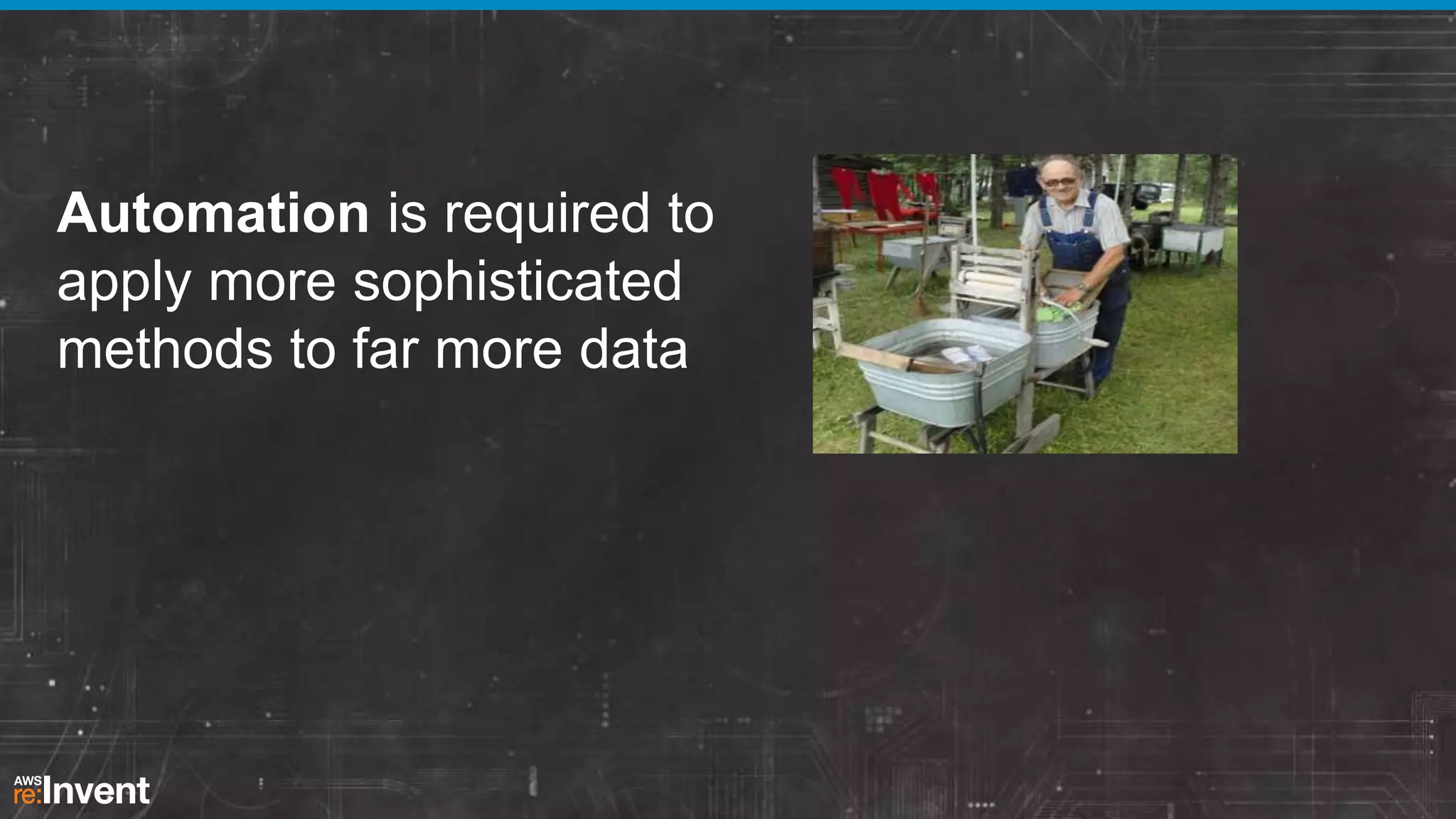
Automation is required to
apply more sophisticated
methods to far more data
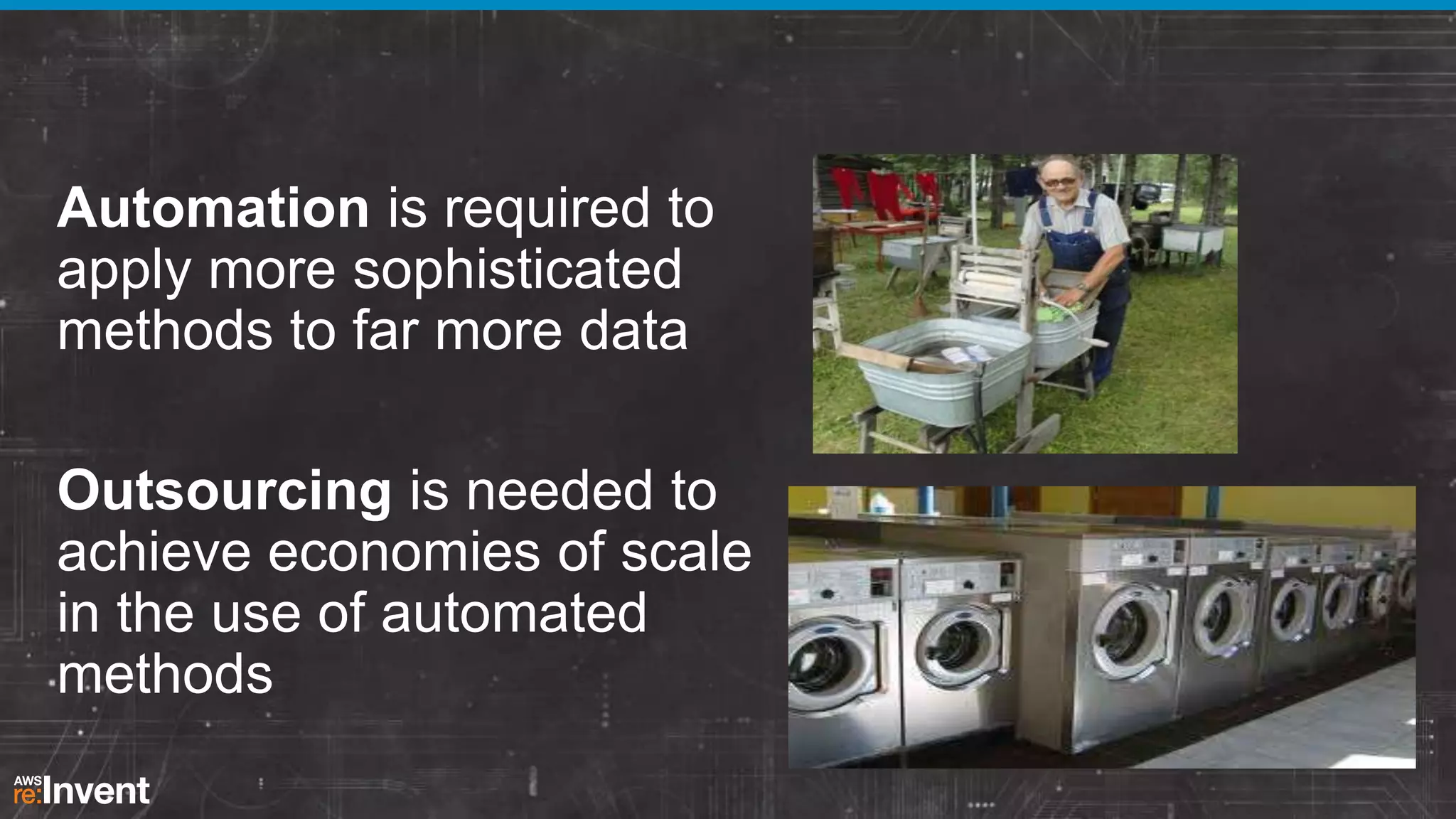
Automation is required to
apply more sophisticated
methods to far more data
Outsourcing is needed to
achieve economies of scale
in the use of automated
methods
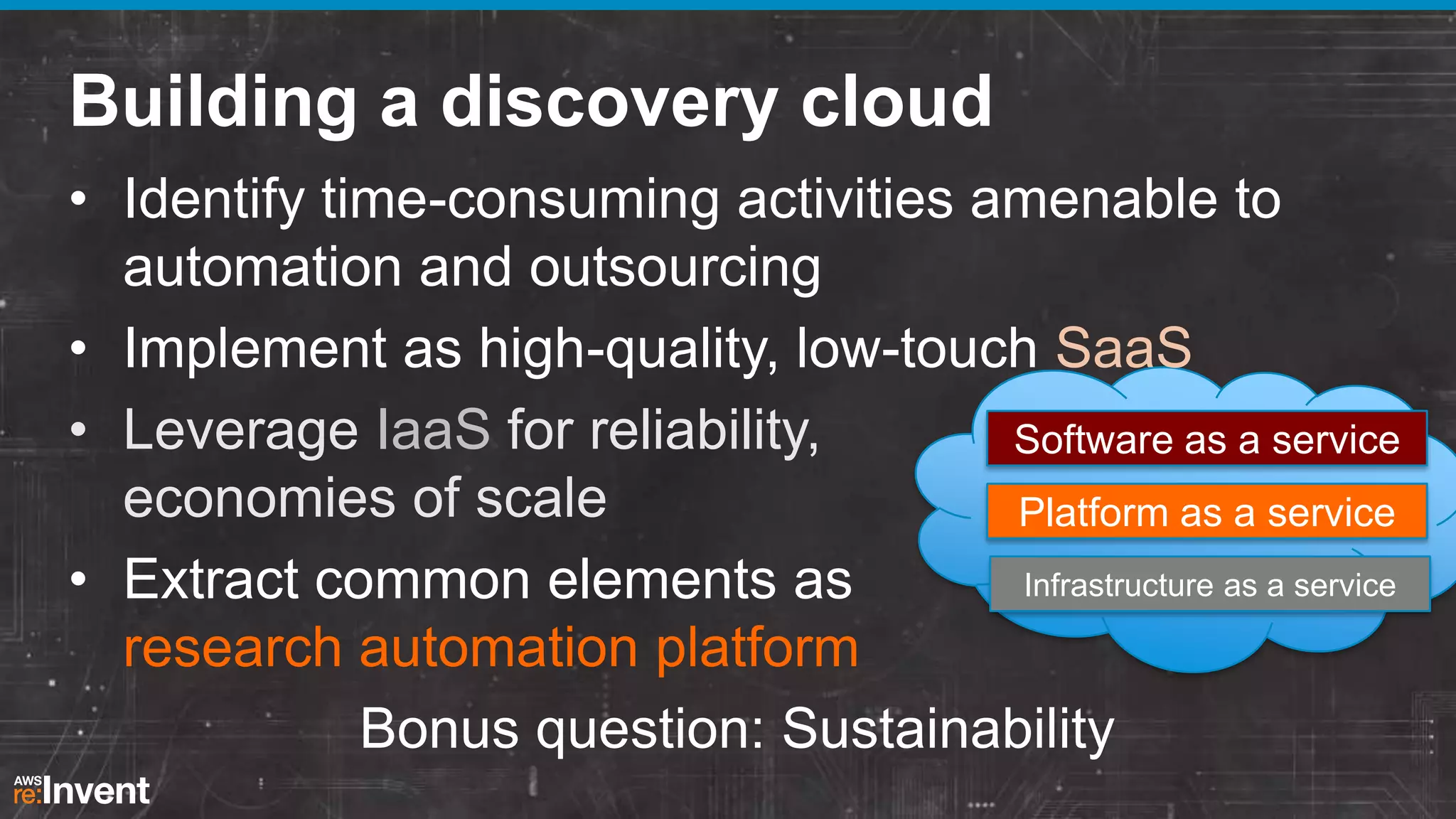
Building a discovery cloud
• Identify time-consuming activities amenable to
automation and outsourcing
• Implement as high-quality, low-touch SaaS
• Leverage IaaS for reliability,
Software as a service
economies of scale
Platform as a service
Infrastructure as a service
• Extract common elements as
research automation platform
Bonus question: Sustainability
We aspire (initially) to create a
great user experience for
research data management
What would a “dropbox for
science” look like?
• Collect
• Move
• Sync
• Share
• Analyze

• Annotate
• Publish
• Search
• Backup
• Archive

BIG DATA
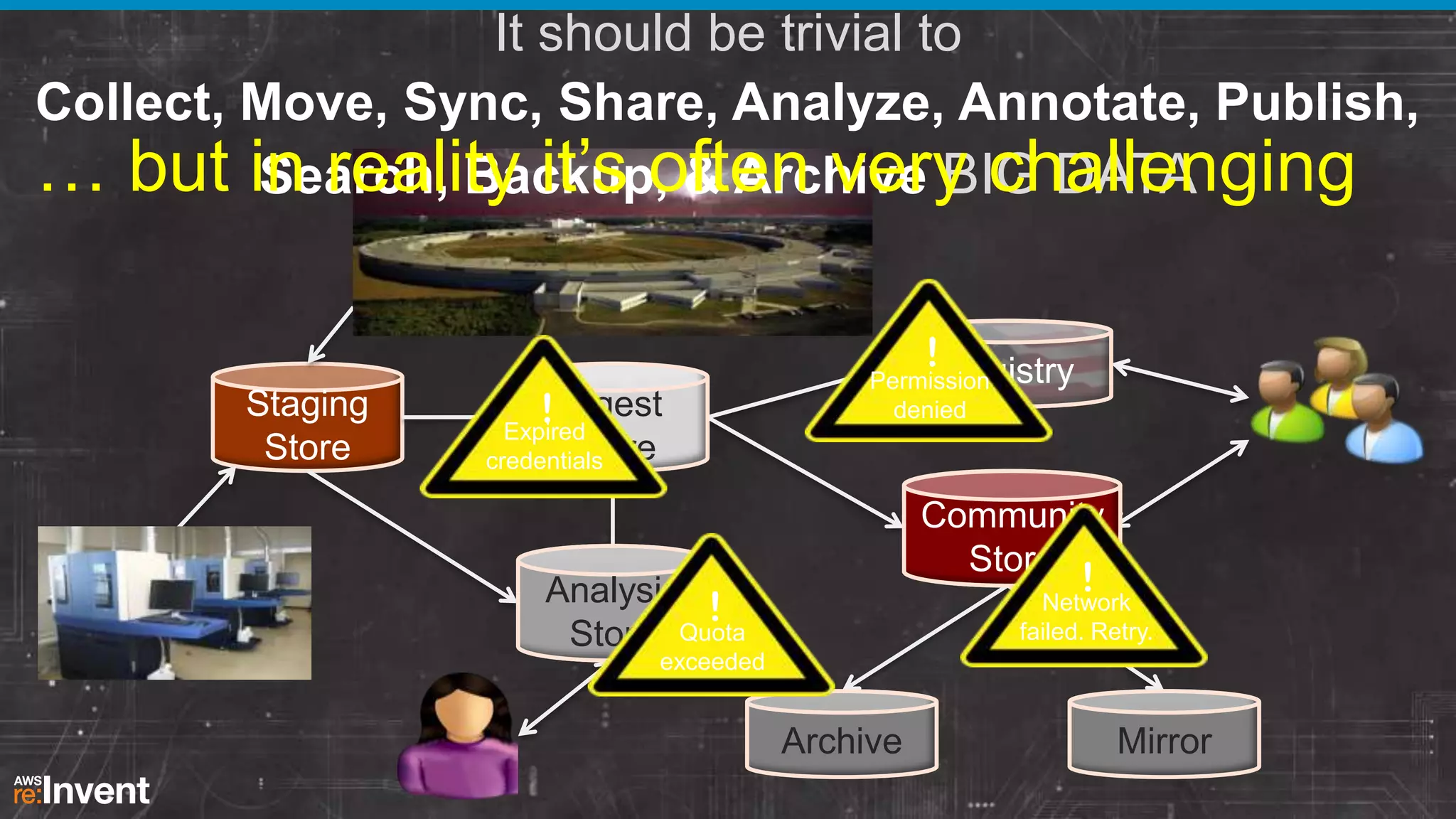
It should be trivial to
Collect, Move, Sync, Share, Analyze, Annotate, Publish,
… but in reality it’s often very challenging
Search, Backup, & Archive BIG DATA
!

Staging
Store

! Ingest

Expired
Store
credentials

Registry
Permission
denied
Communit
Community
yStore
Store

!

Analysis
!
Store Quota

Network
failed. Retry.

exceeded

Archive

Mirror
• Collect
• Move
• Sync
• Share
• Analyze

• Annotate
• Publish
• Search
• Backup
• Archive

BIG DATA
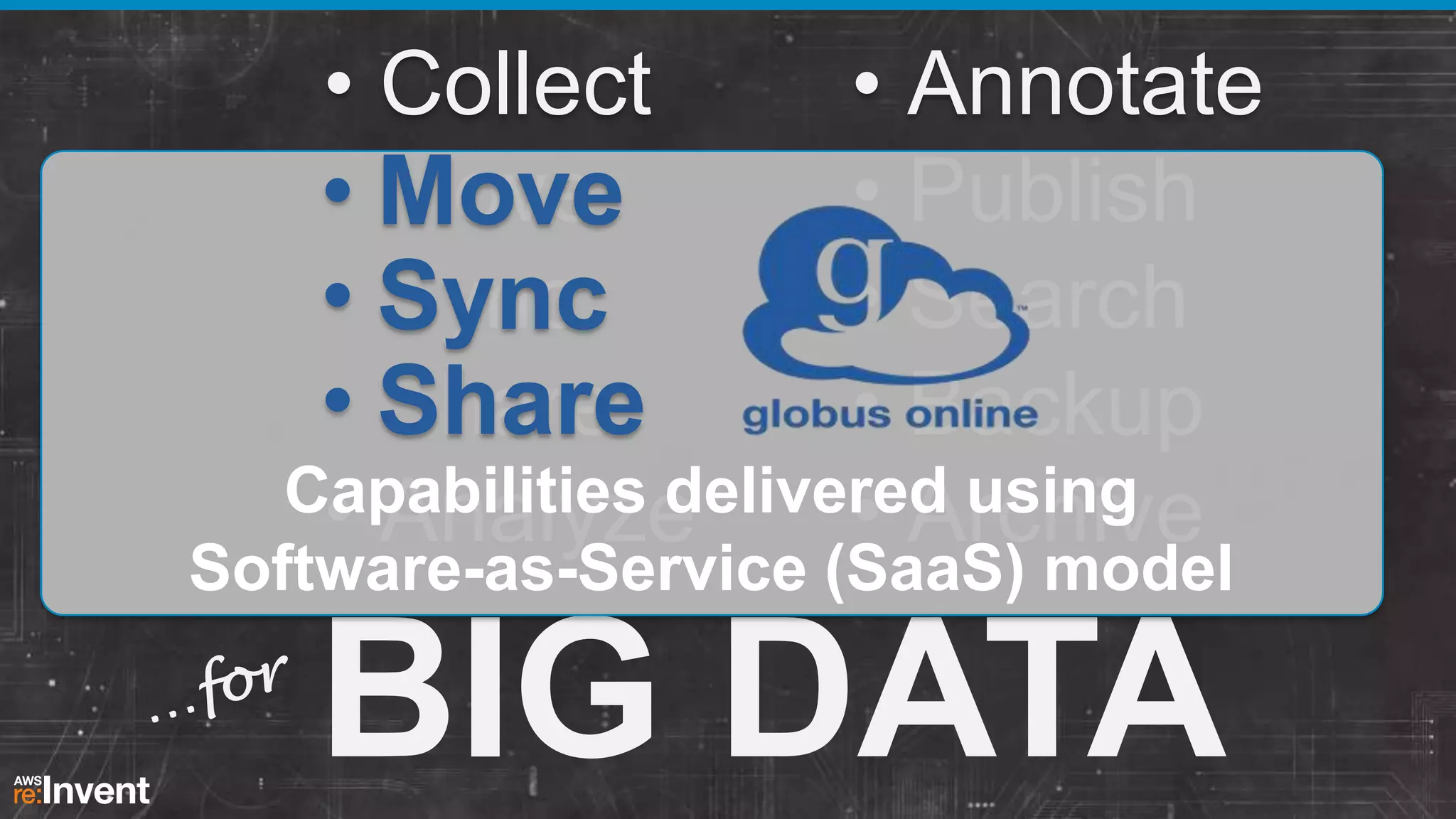
• Collect
• Annotate
Move
• Publish
• Move
Sync
• Search
• Sync
• Share
Share
• Backup
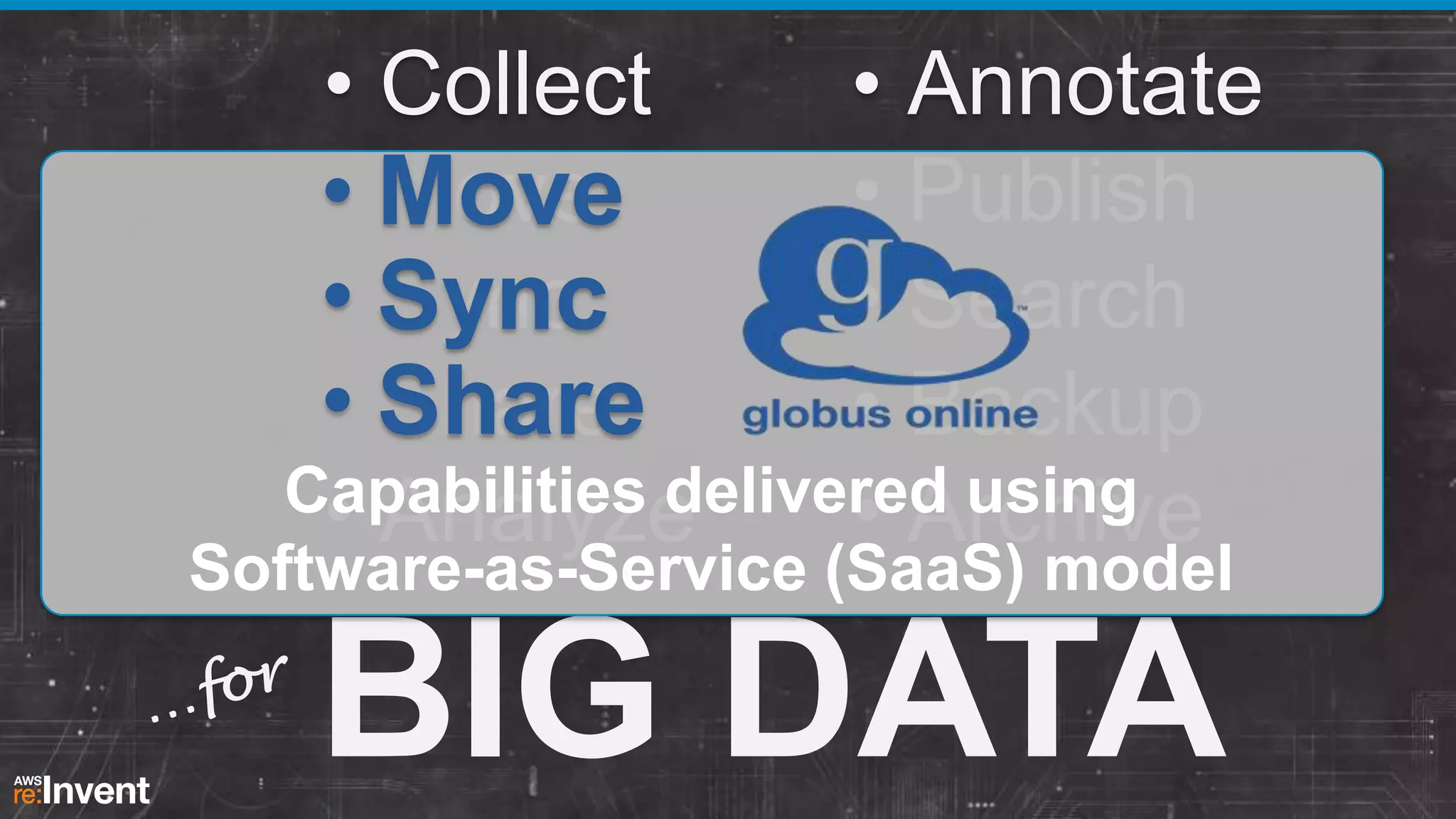
Capabilities delivered using
• Analyze
• Archive

Software-as-Service (SaaS) model

BIG DATA
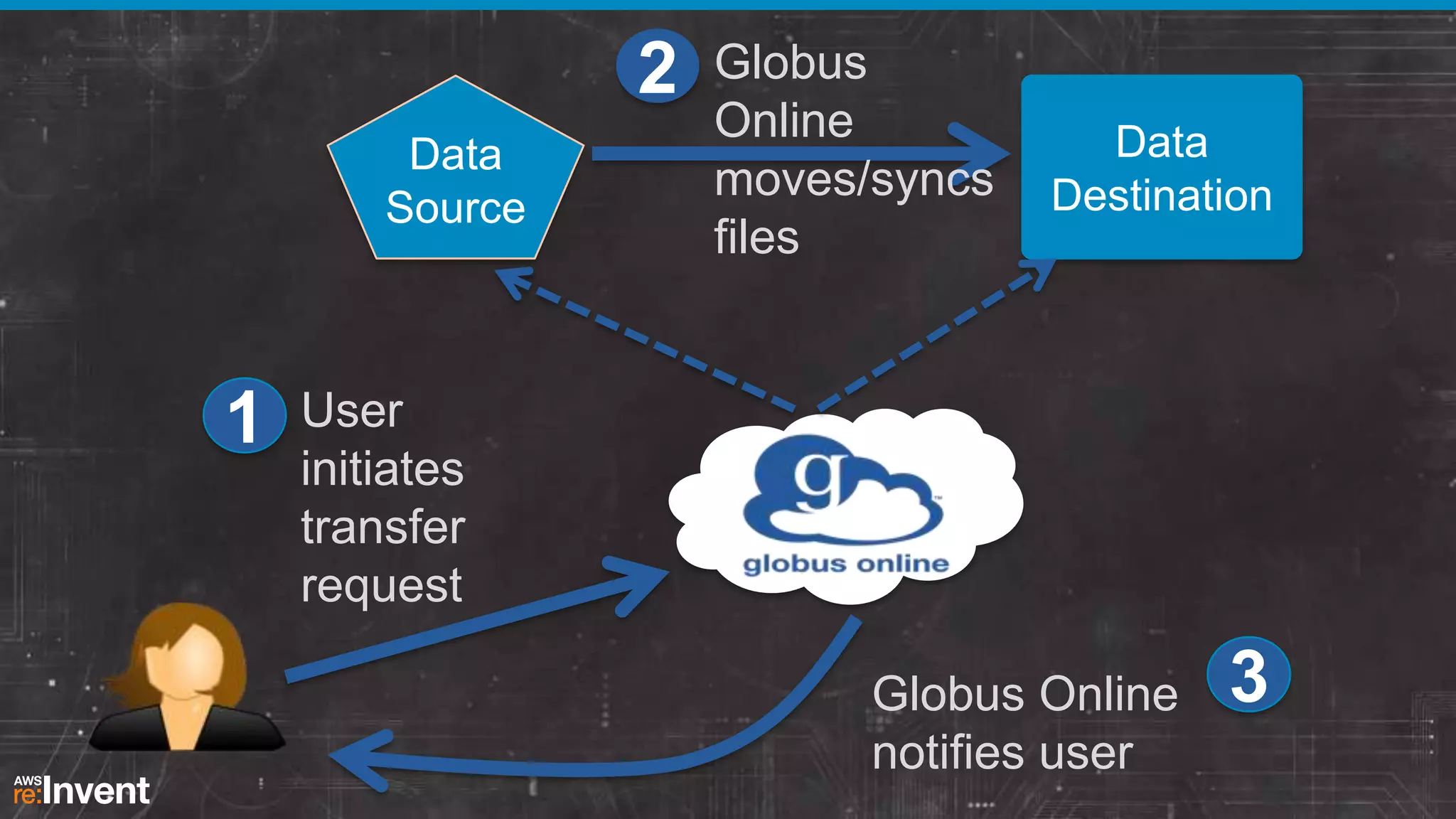
2
Data
Source

1

Globus
Online
moves/syncs
files

Data
Destination

User
initiates
transfer
request

Globus Online
notifies user

3
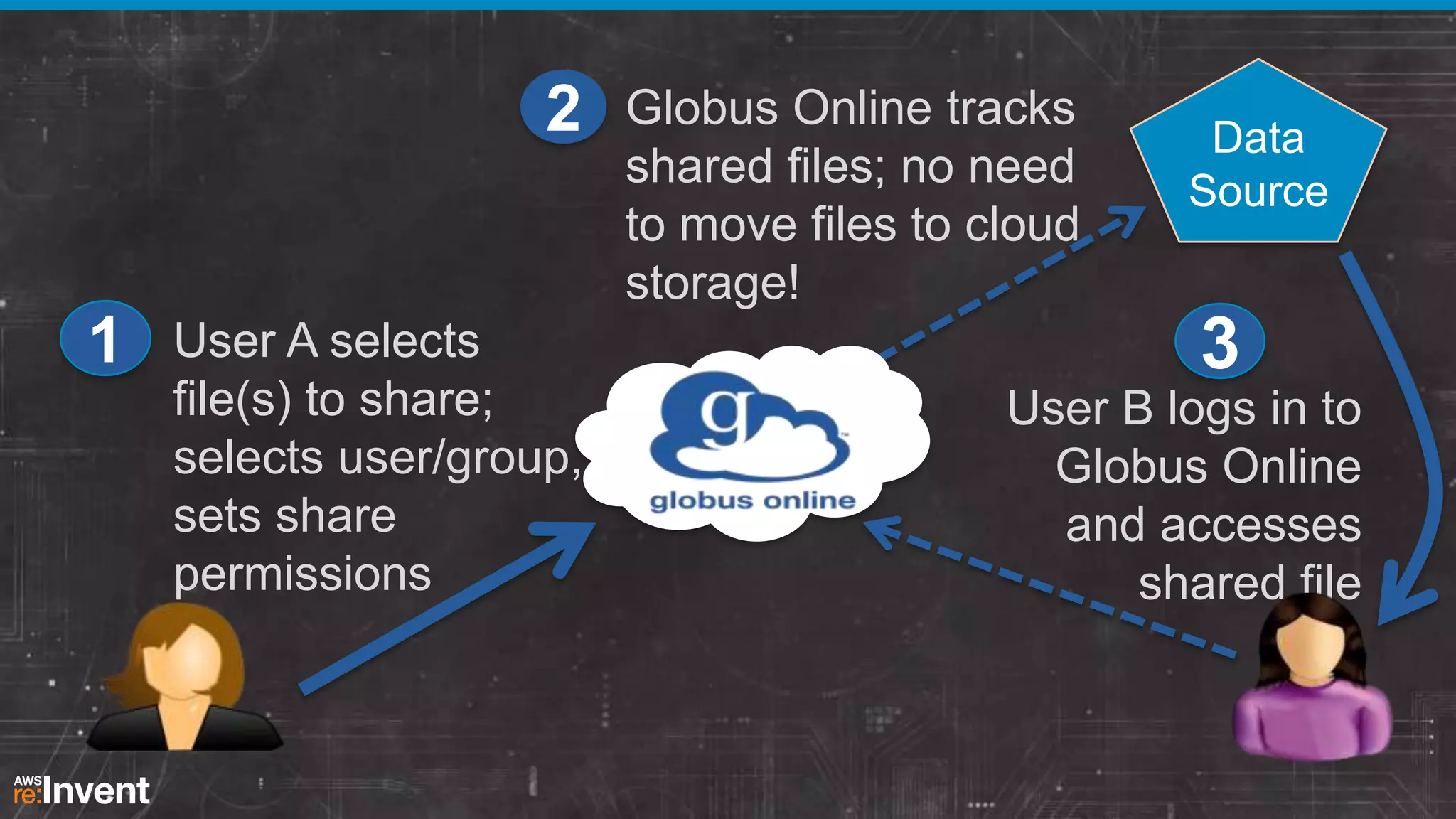
2

1

User A selects
file(s) to share;
selects user/group,
sets share
permissions

Globus Online tracks
shared files; no need
to move files to cloud
storage!

Data
Source

3
User B logs in to
Globus Online
and accesses
shared file
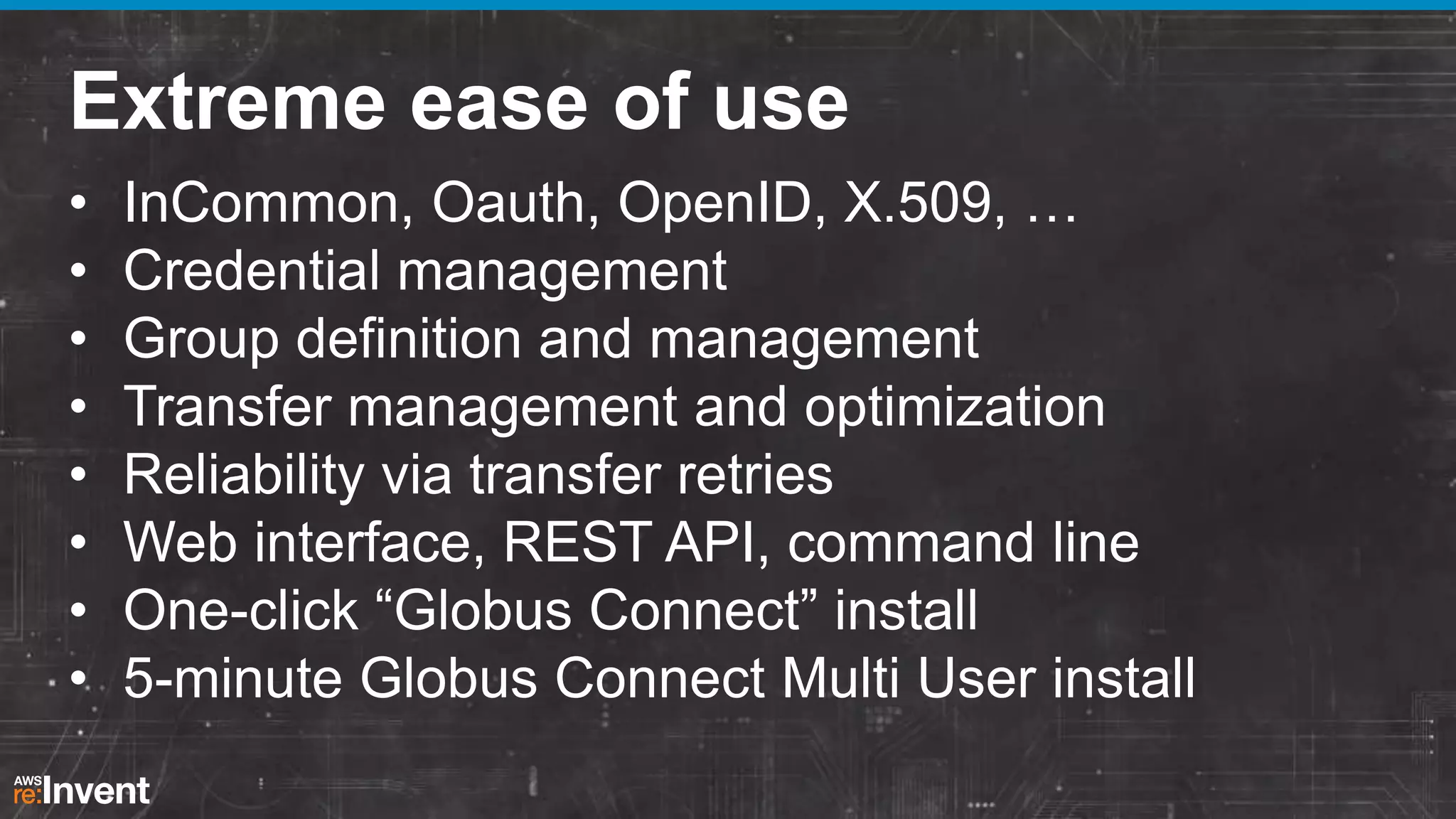
Extreme ease of use
•
•
•
•
•
•
•
•

InCommon, Oauth, OpenID, X.509, …
Credential management
Group definition and management
Transfer management and optimization
Reliability via transfer retries
Web interface, REST API, command line
One-click “Globus Connect” install
5-minute Globus Connect Multi User install
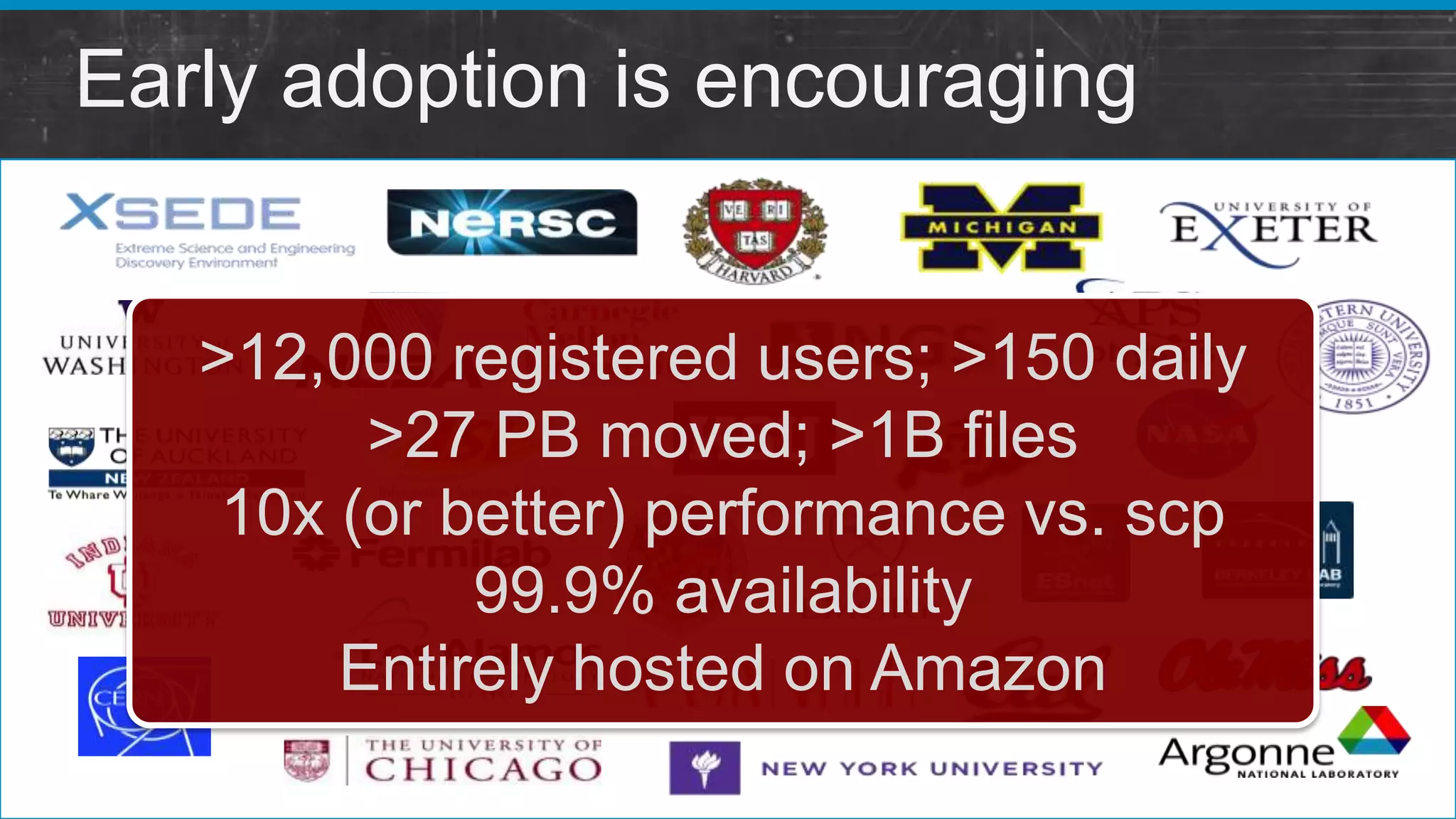
Early adoption is encouraging

>12,000 registered users; >150 daily
>27 PB moved; >1B files
10x (or better) performance vs. scp
99.9% availability
Entirely hosted on Amazon
Amazon web services used
• EC2 for hosting Globus services
• ELB to use multiple availability zones for
reliability and uptime
• SES and SNS to send notifications of transfer
status
• S3 to store historical state
• PostgreSQL for active state
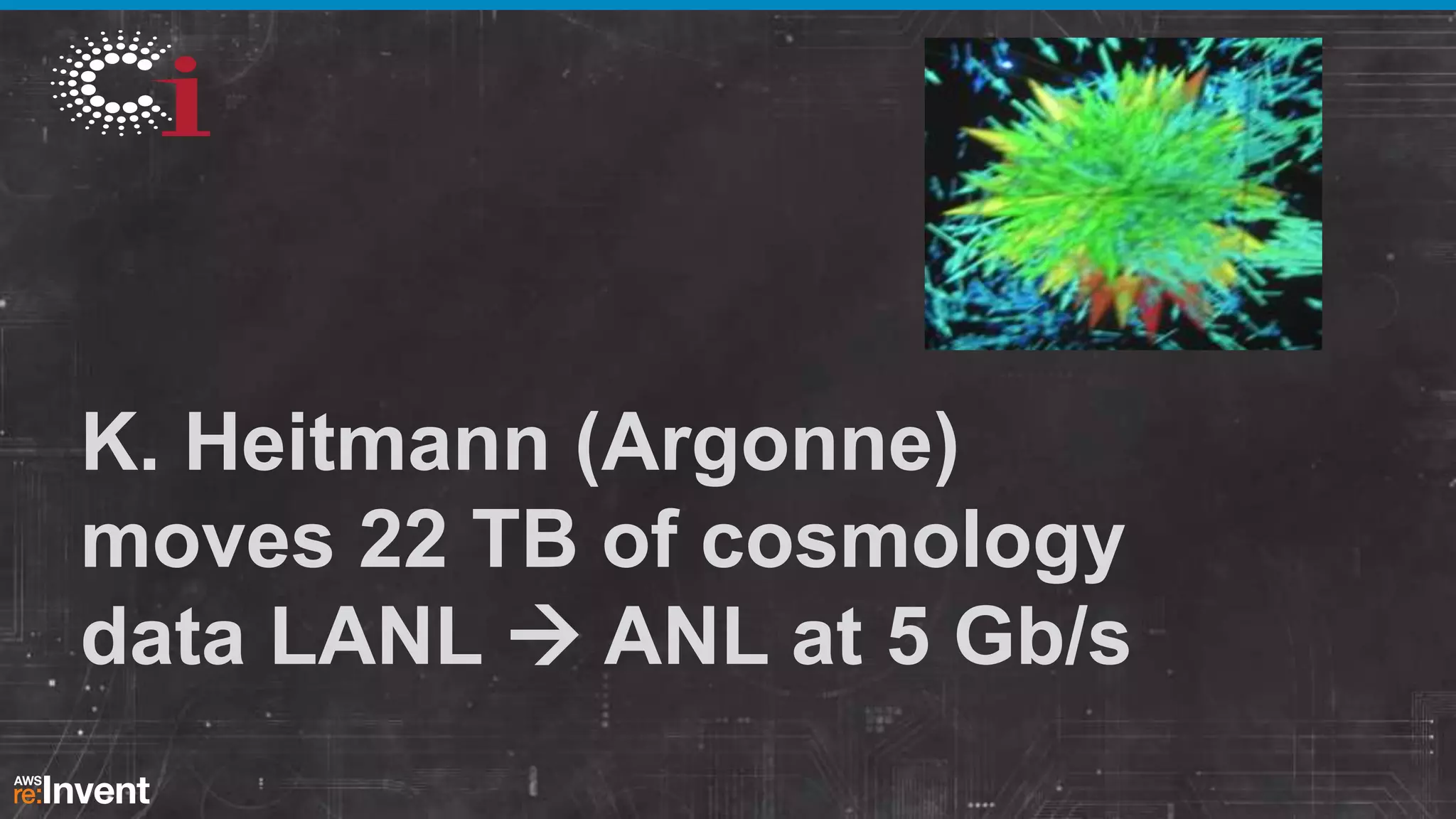
K. Heitmann (Argonne)
moves 22 TB of cosmology
data LANL  ANL at 5 Gb/s
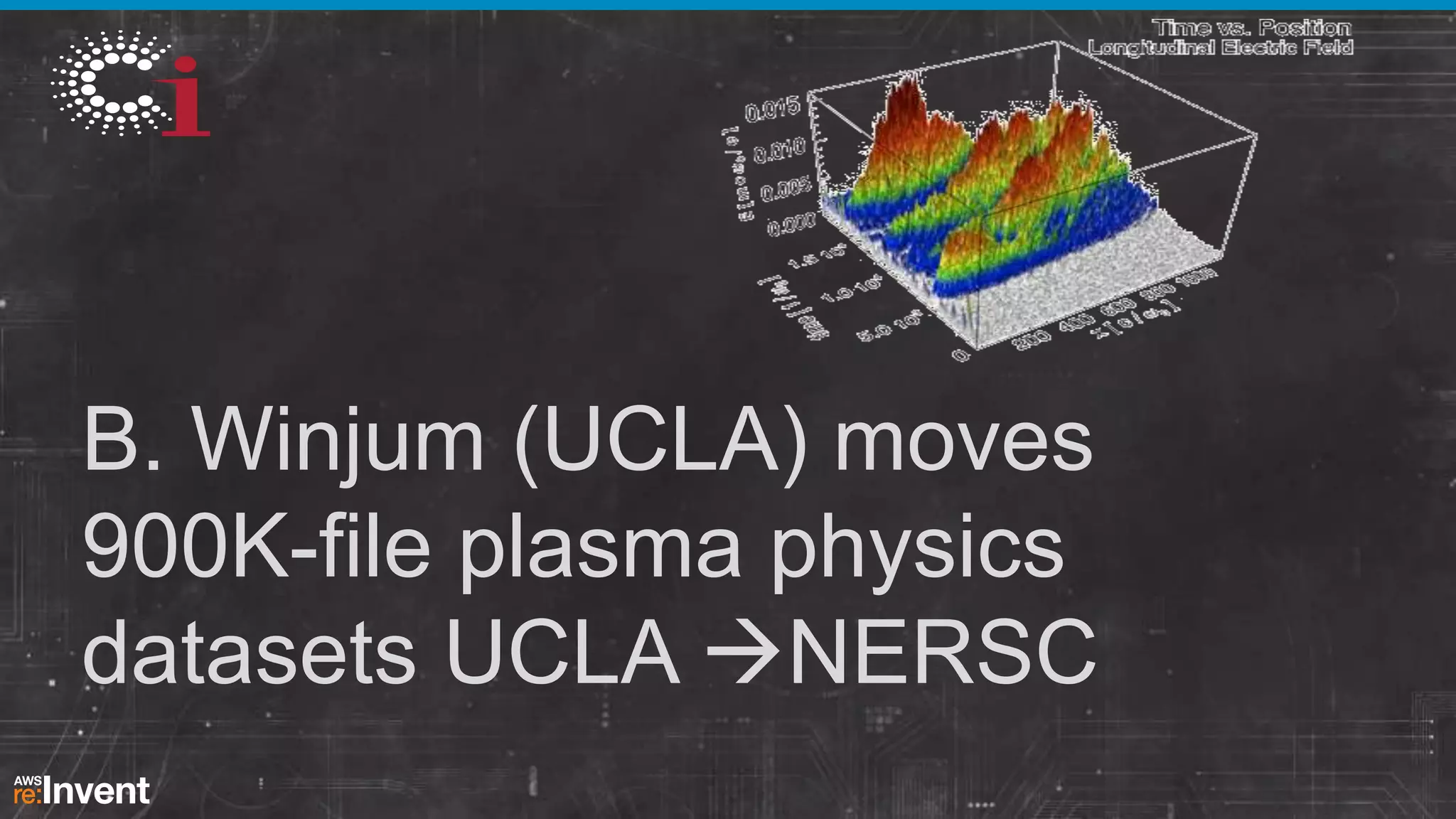
B. Winjum (UCLA) moves
900K-file plasma physics
datasets UCLA NERSC
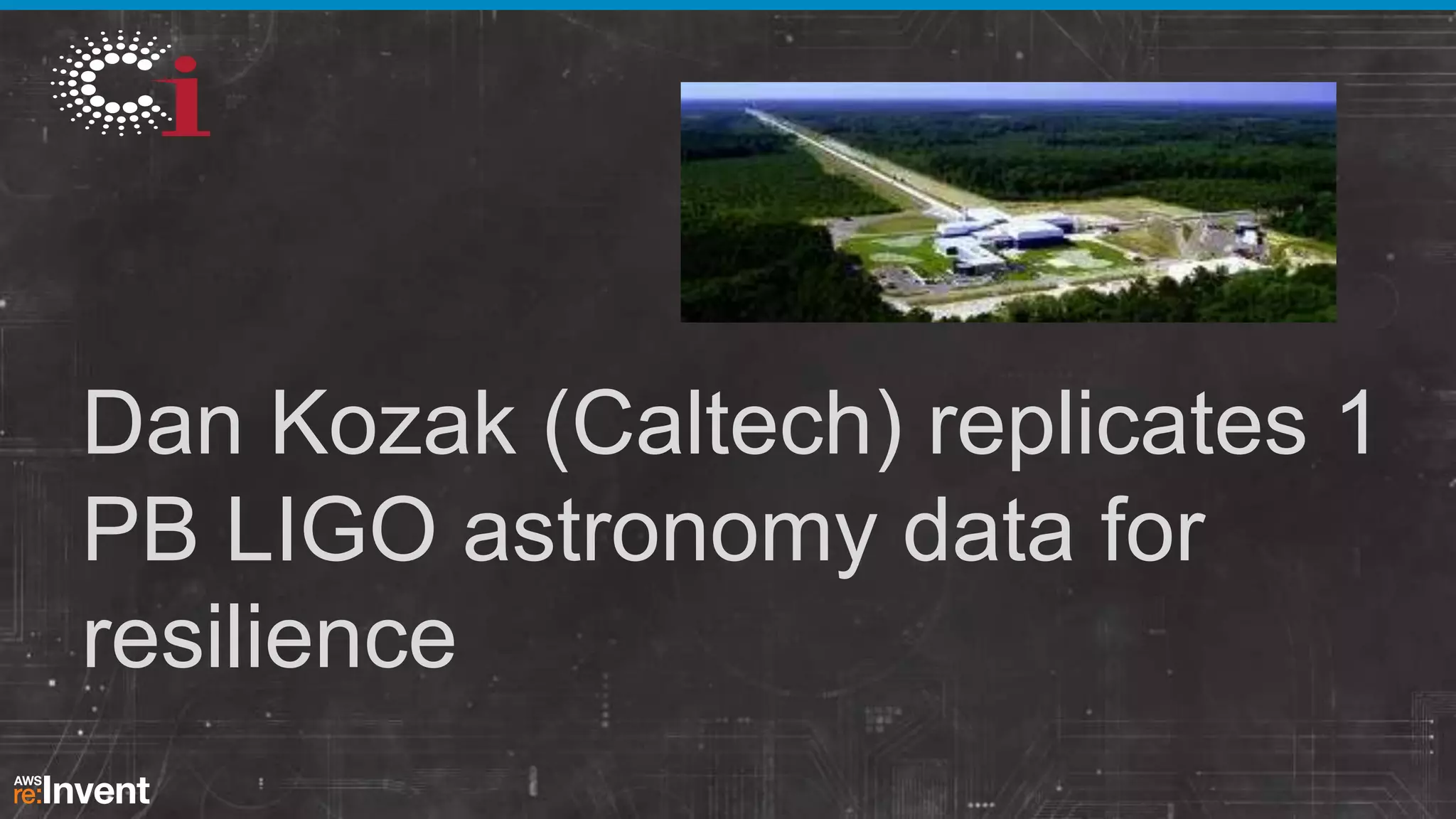
Dan Kozak (Caltech) replicates 1
PB LIGO astronomy data for
resilience
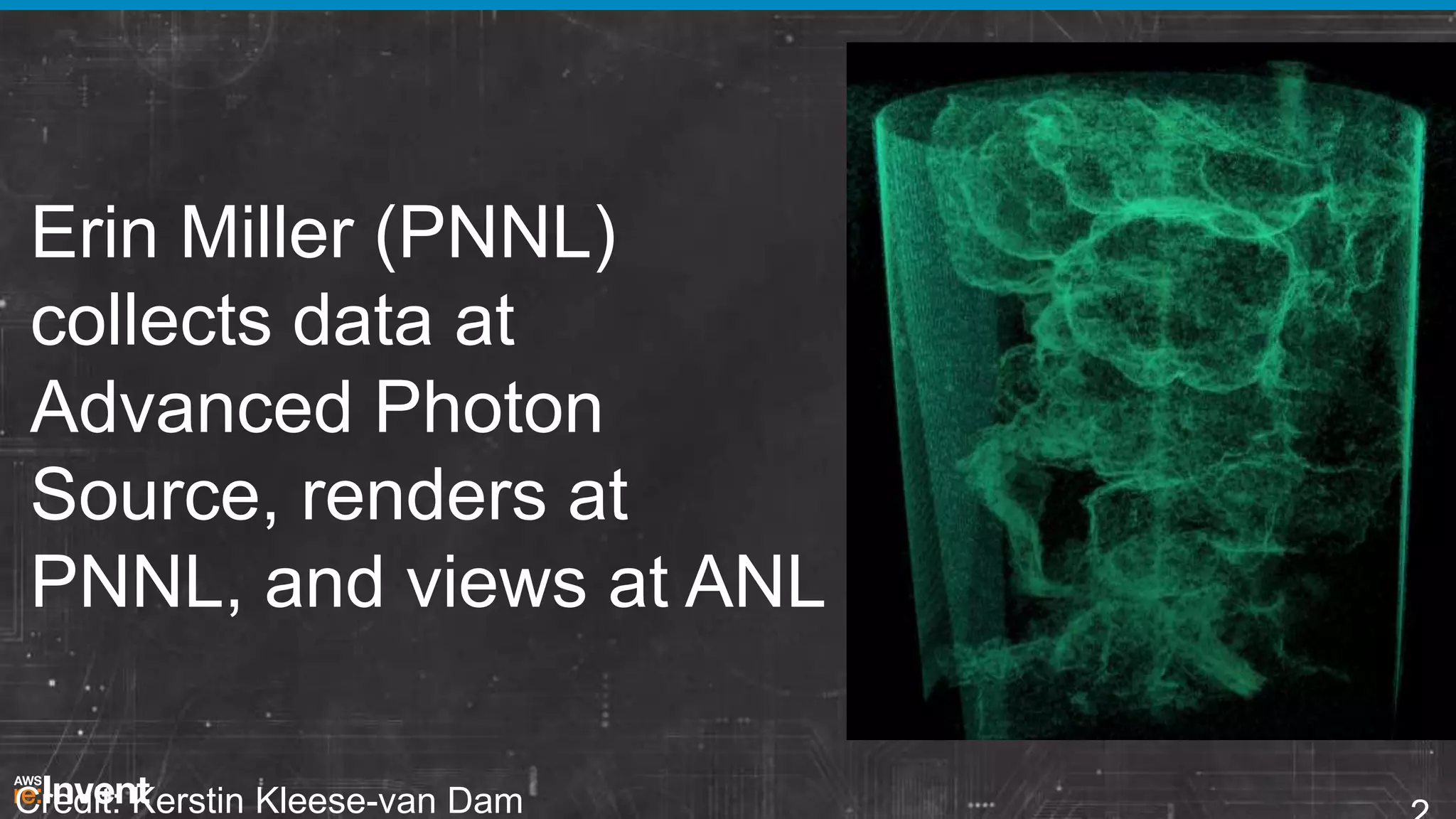
Erin Miller (PNNL)
collects data at
Advanced Photon
Source, renders at
PNNL, and views at ANL
Credit: Kerstin Kleese-van Dam
• Collect
• Annotate
Move
• Publish
• Move
Sync
• Search
• Sync
• Share
Share
• Backup
Capabilities delivered using
• Analyze
• Archive

Software-as-Service (SaaS) model

BIG DATA
• Collect
• Move
• Sync
• Share
• Analyze

• Annotate
• Publish
• Search
• Backup
• Archive

BIG DATA
Sharing Service
Transfer Service
Globus Nexus
(Identity, Group, Profile)

Globus Toolkit

Globus Connect

Globus Online
APIs

Globus Online already does a lot
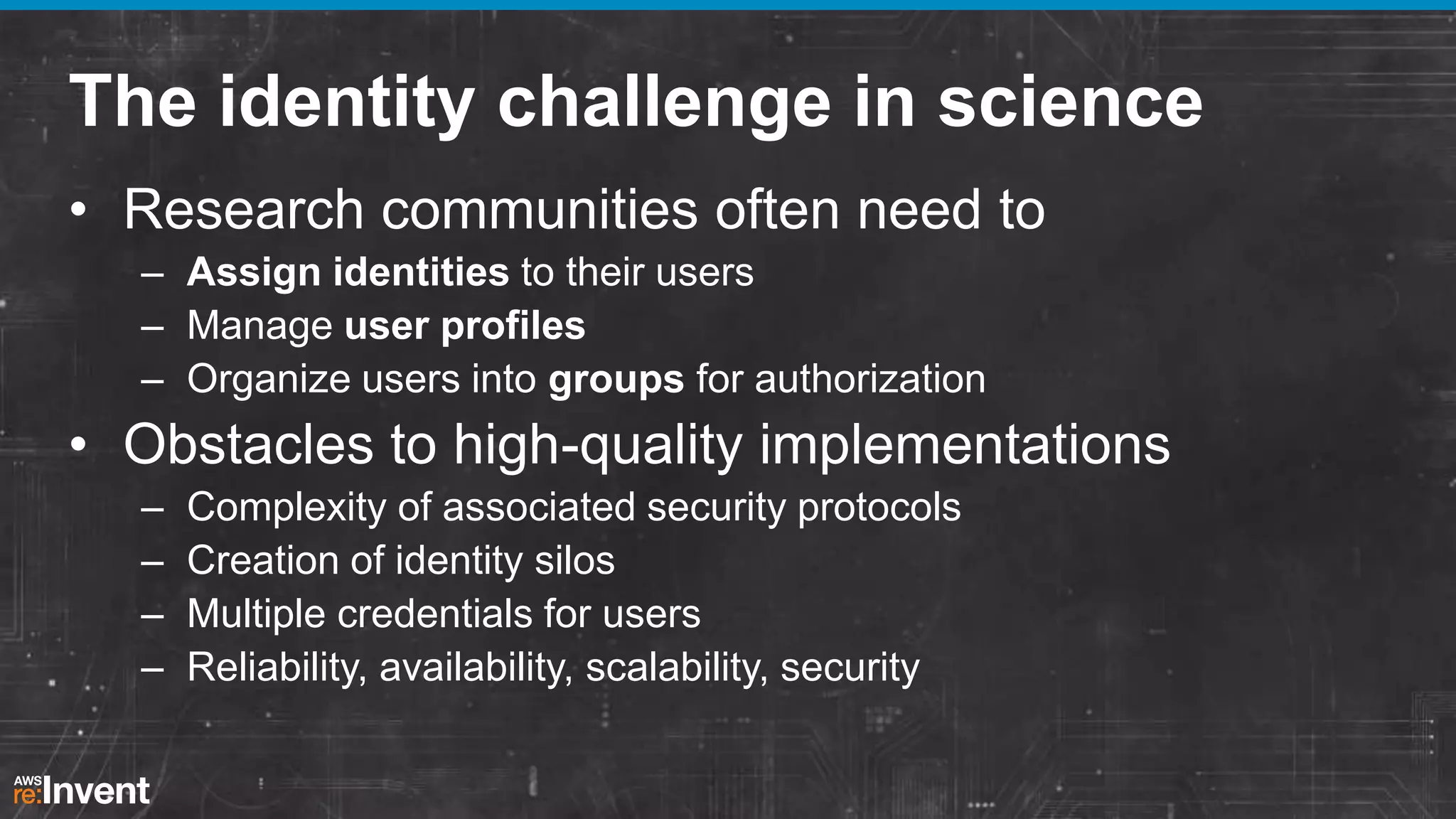
The identity challenge in science
• Research communities often need to
– Assign identities to their users
– Manage user profiles
– Organize users into groups for authorization

• Obstacles to high-quality implementations
–
–
–
–

Complexity of associated security protocols
Creation of identity silos
Multiple credentials for users
Reliability, availability, scalability, security
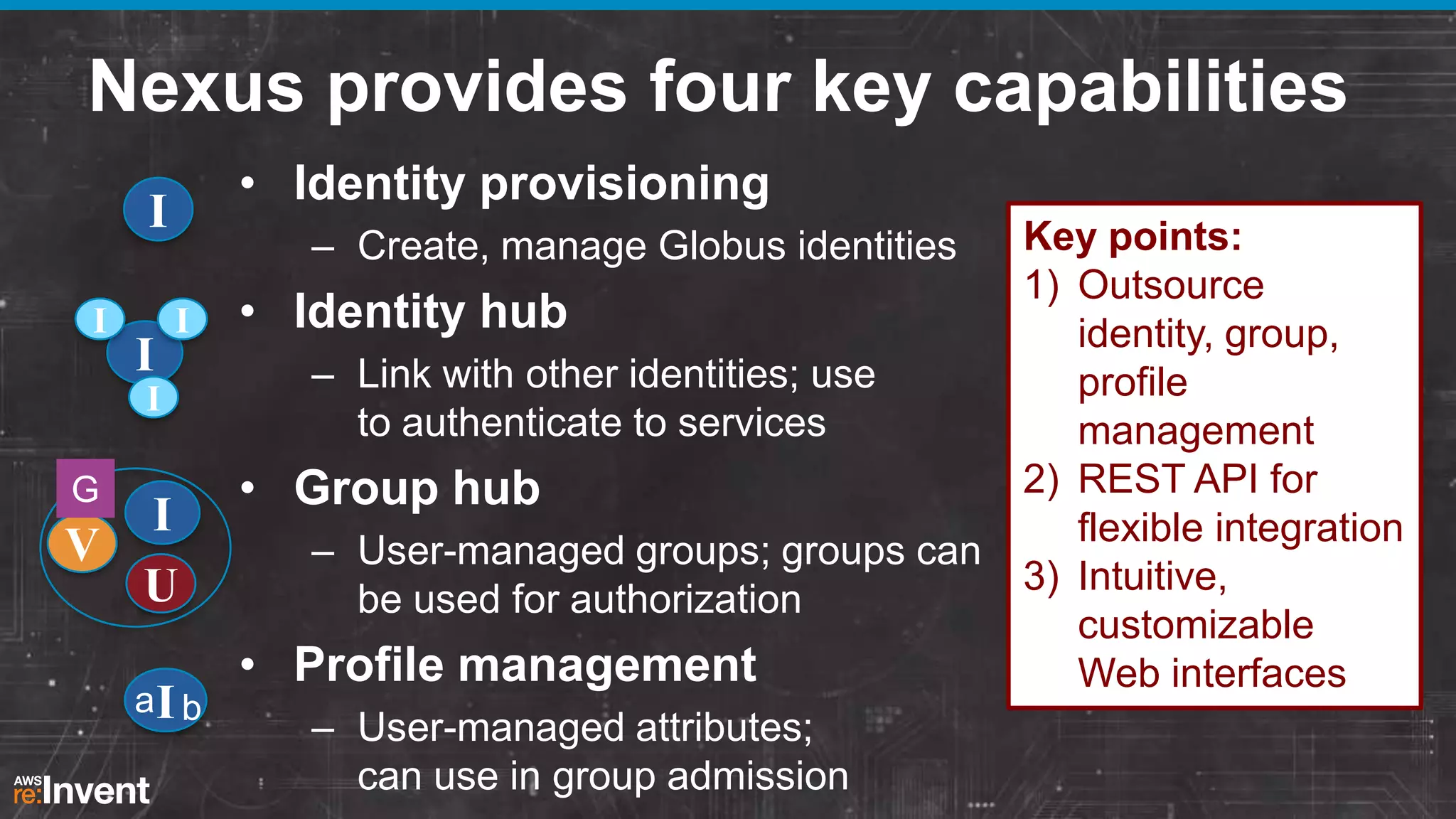
Nexus provides four key capabilities
• Identity provisioning

I
I

I

– Create, manage Globus identities
I

I
G

I
V
U
aI b

• Identity hub
– Link with other identities; use
to authenticate to services

• Group hub
– User-managed groups; groups can
be used for authorization

• Profile management
– User-managed attributes;
can use in group admission

Key points:
1) Outsource
identity, group,
profile
management
2) REST API for
flexible integration
3) Intuitive,
customizable
Web interfaces
Branded sites
XSEDE

Open Science Grid

University of Chicago

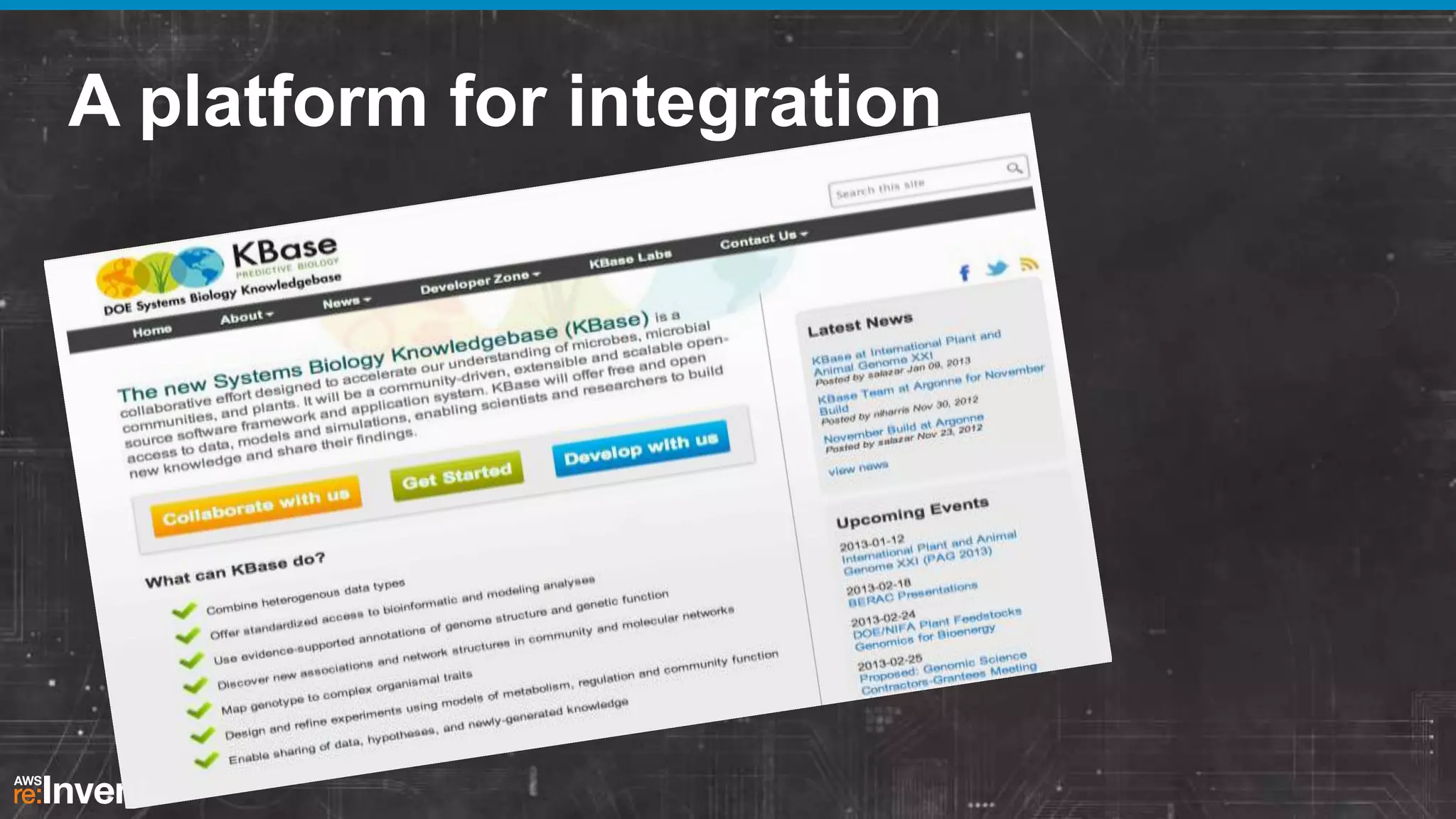
DOE kBase

Indiana University

University of Exeter

Globus Online

NERSC

NIH BIRN
A platform for integration
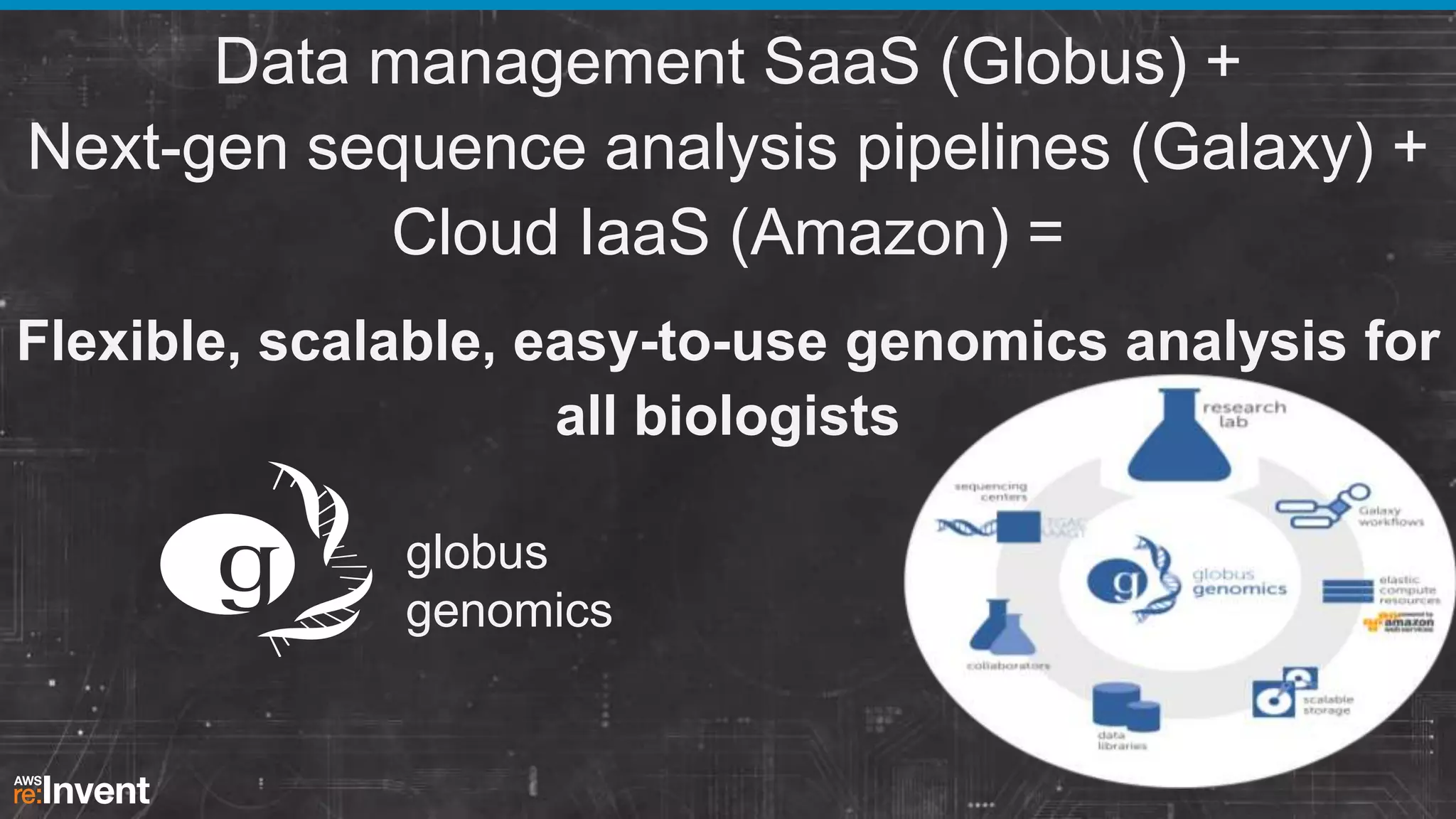
Data management SaaS (Globus) +
Next-gen sequence analysis pipelines (Galaxy) +
Cloud IaaS (Amazon) =
Flexible, scalable, easy-to-use genomics analysis for
all biologists
globus
genomics
Sharing Service
Transfer Service
Globus Nexus
(Identity, Group, Profile)

Globus Toolkit

Globus Connect

Globus Online
APIs

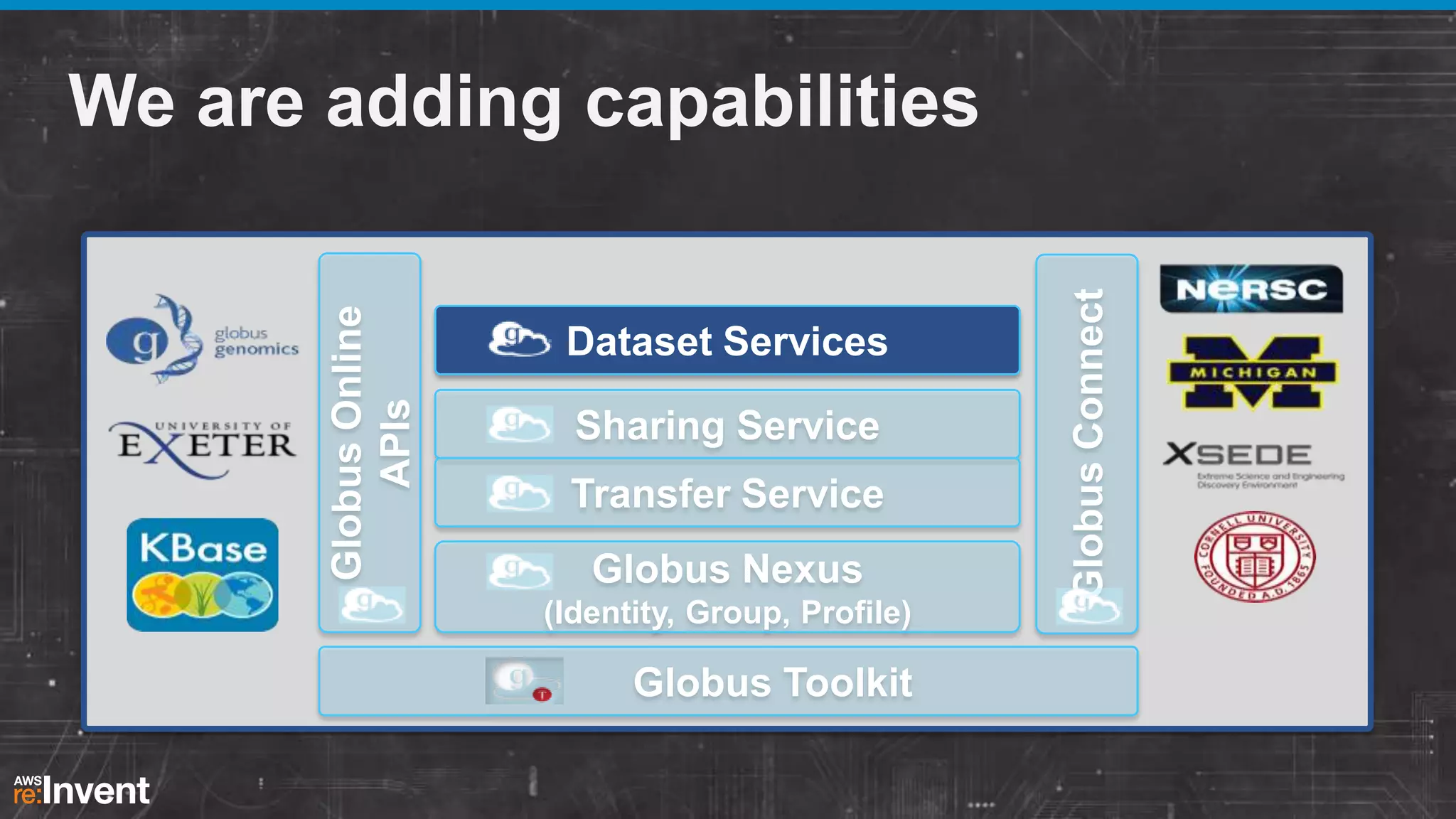
We are adding capabilities
Dataset Services
Sharing Service
Transfer Service
Globus Nexus
(Identity, Group, Profile)

Globus Toolkit

Globus Connect

Globus Online
APIs

We are adding capabilities
• Ingest and publication
– Imagine a DropBox that not only replicates, but also extracts
metadata, catalogs, converts

• Cataloging
– Virtual views of data based on user-defined and/or automatically
extracted metadata

• Computation
– Associate computational procedures, orchestrate application,
catalog results, record provenance
Next Gen Sequencing Analysis for Everyone –
No IT Required
Ravi K Madduri, The University of Chicago and Argonne National Laboratory

November 14, 2013
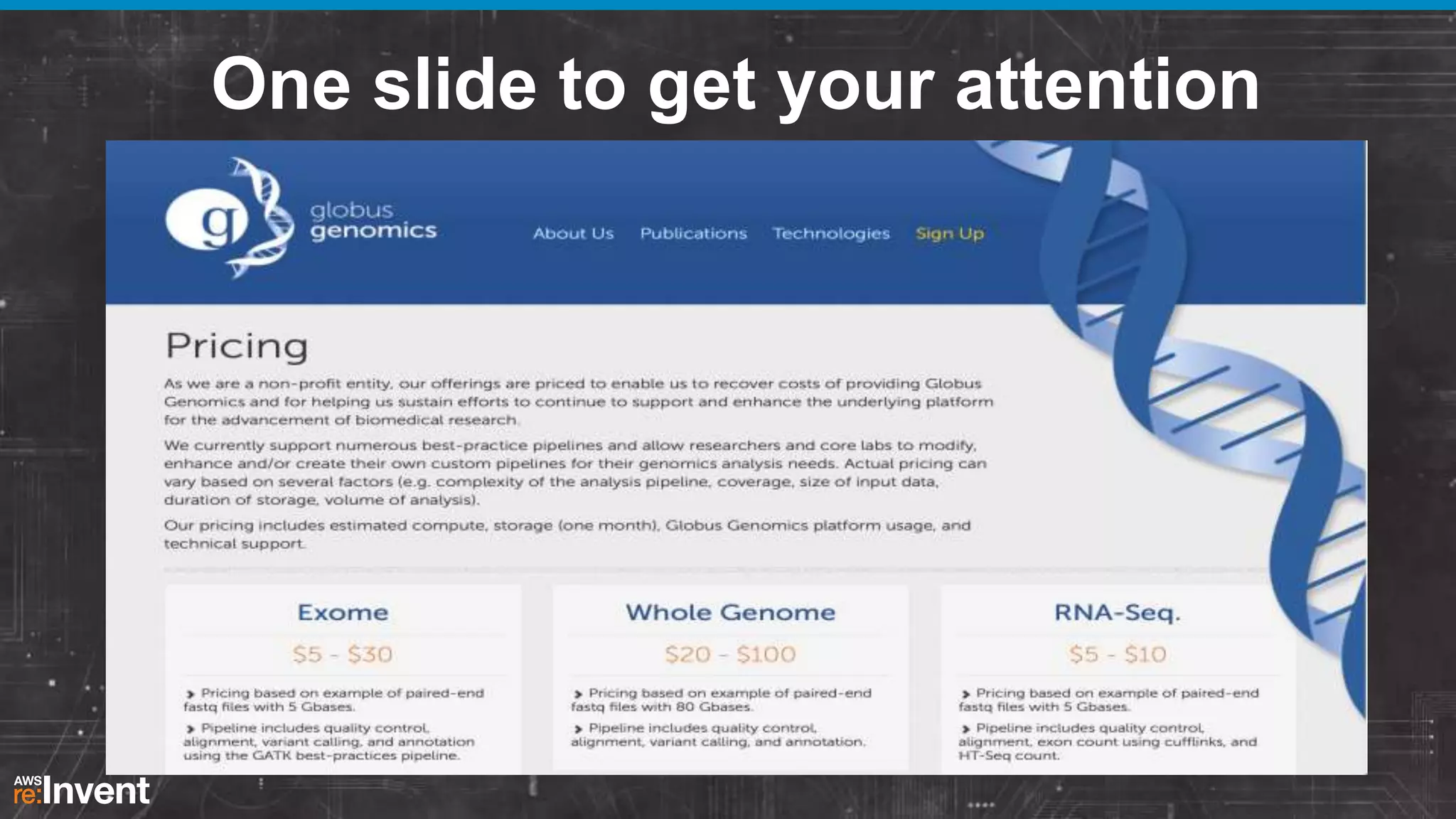
One slide to get your attention
Outline
• Globus Vision
• Challenges in Sequencing Analysis
– Big Data Management
– Analysis at Scale
– Reproducibility

• Proposed Approach Using Globus Genomics
• Example Collaborations
• Q&A
Globus Vision
Goal: Accelerate discovery and innovation worldwide
by providing research IT as a service
Leverage software-as-a-service to:
– provide millions of researchers with unprecedented access to
powerful tools for managing Big Data
– reduce research IT costs dramatically via economies of scale

“Civilization advances by extending the number of important
operations which we can perform without thinking of them”
—Alfred North Whitehead , 1911
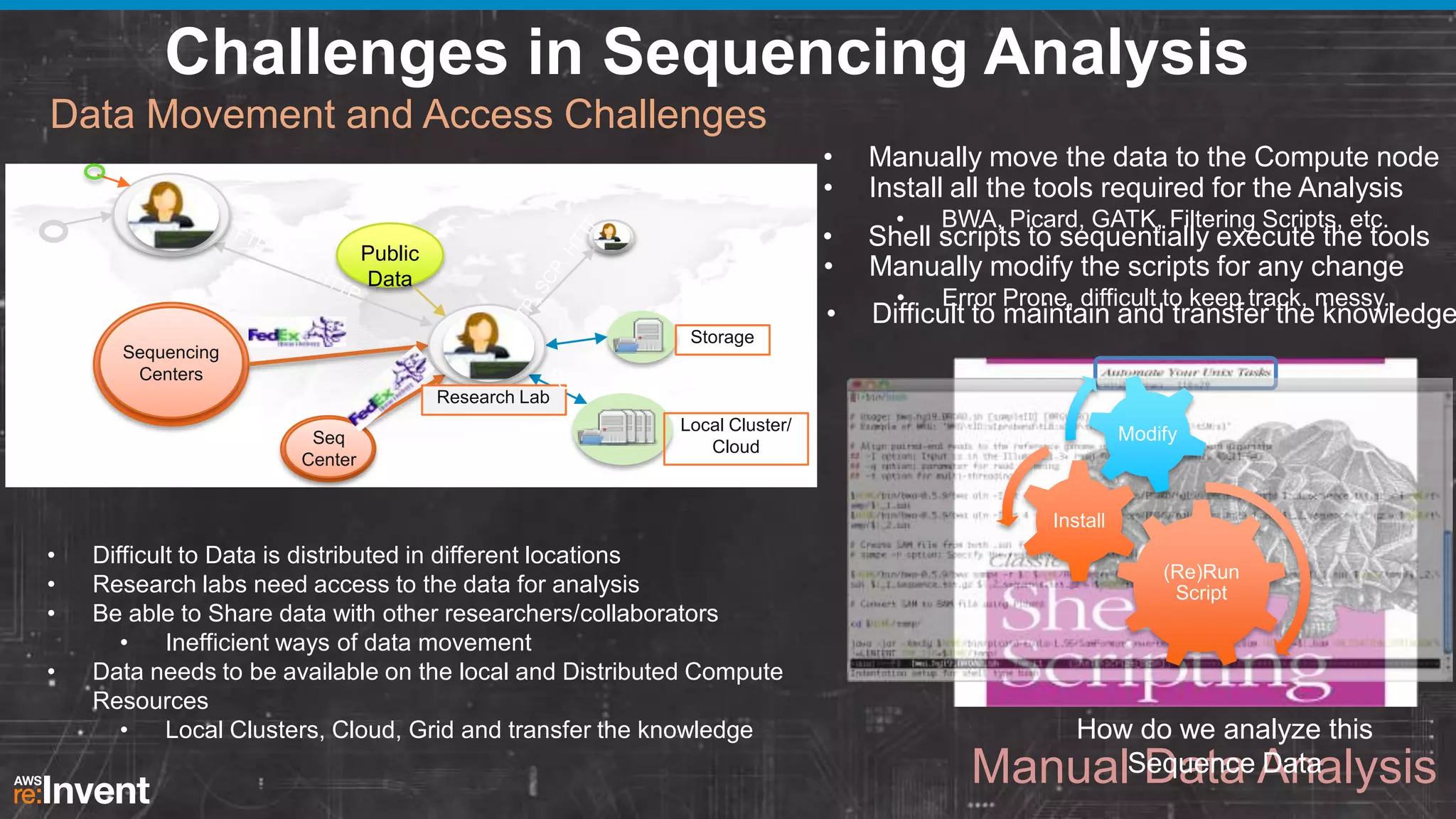
Challenges in Sequencing Analysis
Data Movement and Access Challenges
•
•
•
•

Shell scripts to sequentially execute the tools
Manually modify the scripts for any change

•

Public
Data

Manually move the data to the Compute node
Install all the tools required for the Analysis

Difficult to maintain and transfer the knowledge

•

BWA, Picard, GATK, Filtering Scripts, etc.

•

Error Prone, difficult to keep track, messy..

Storage

Sequencing
Centers

Fastq

Ref Genome

Research Lab
Seq
Center

Local Cluster/
Cloud

Modify

Picard
Install

•
•
•
•

Difficult to Data is distributed in different locations
Research labs need access to the data for analysis
Be able to Share data with other researchers/collaborators
•
Inefficient ways of data movement
Data needs to be available on the local and Distributed Compute
Resources
•
Local Clusters, Cloud, Grid and transfer the knowledge

Alignment
(Re)Run
GATK

Script
Variant
Calling

How do we analyze this
Sequence Data

Manual Data Analysis
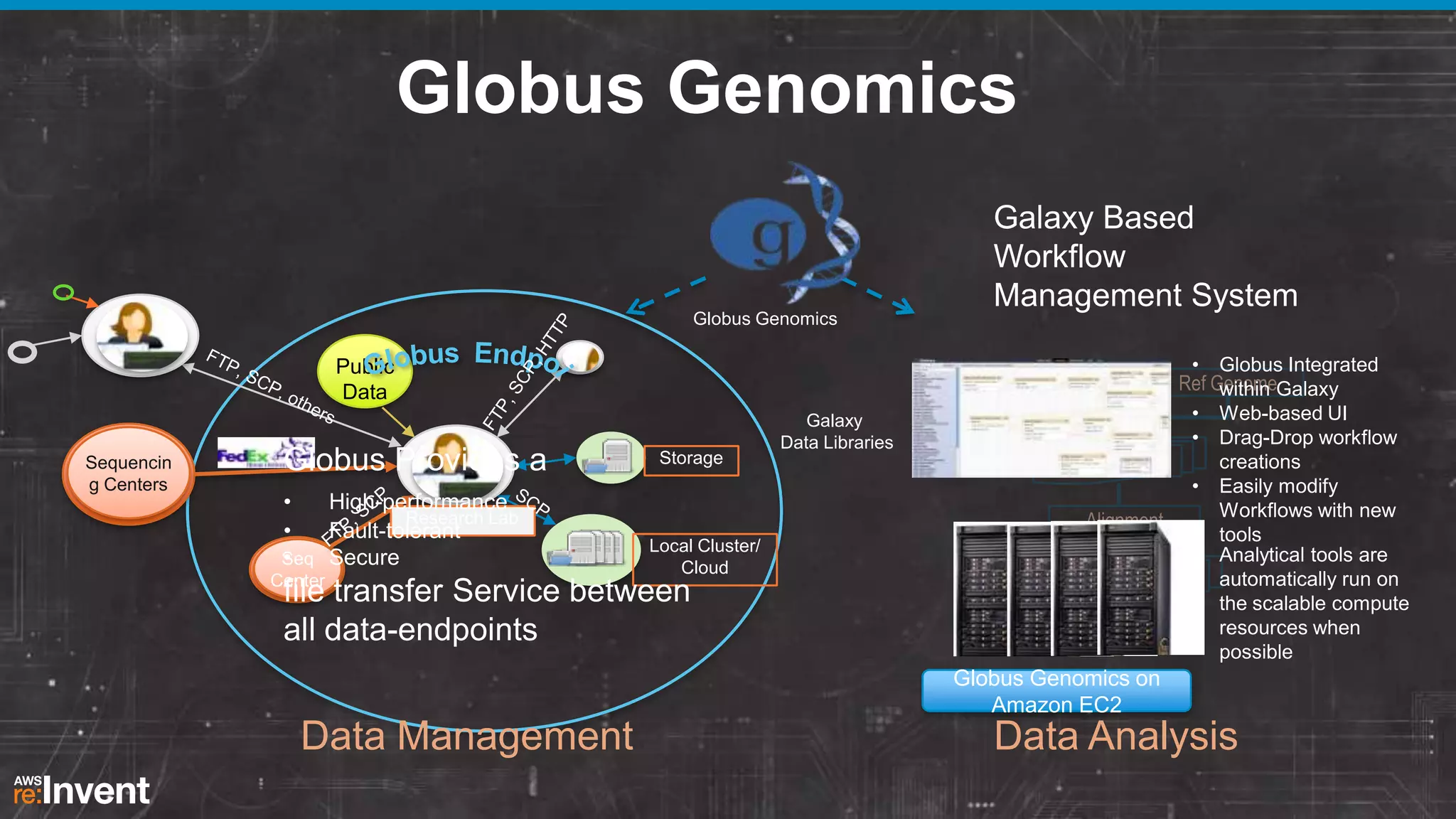
Globus Genomics

Globus Genomics

Galaxy Based
Workflow
Management System
•

Public
Data
Sequencin
g Centers

Globus Provides a
•
High-performance
Research Lab
•
Fault-tolerant
Seq Secure
•
Center

Storage

•
•

Galaxy
Data Libraries

•
Local Cluster/
Cloud

•

file transfer Service between
all data-endpoints

Globus Integrated
within Galaxy
Web-based UI
Drag-Drop workflow
creations
Easily modify
Workflows with new
tools
Analytical tools are
automatically run on
the scalable compute
resources when
possible

Globus Genomics on
Amazon EC2

Data Management

Data Analysis
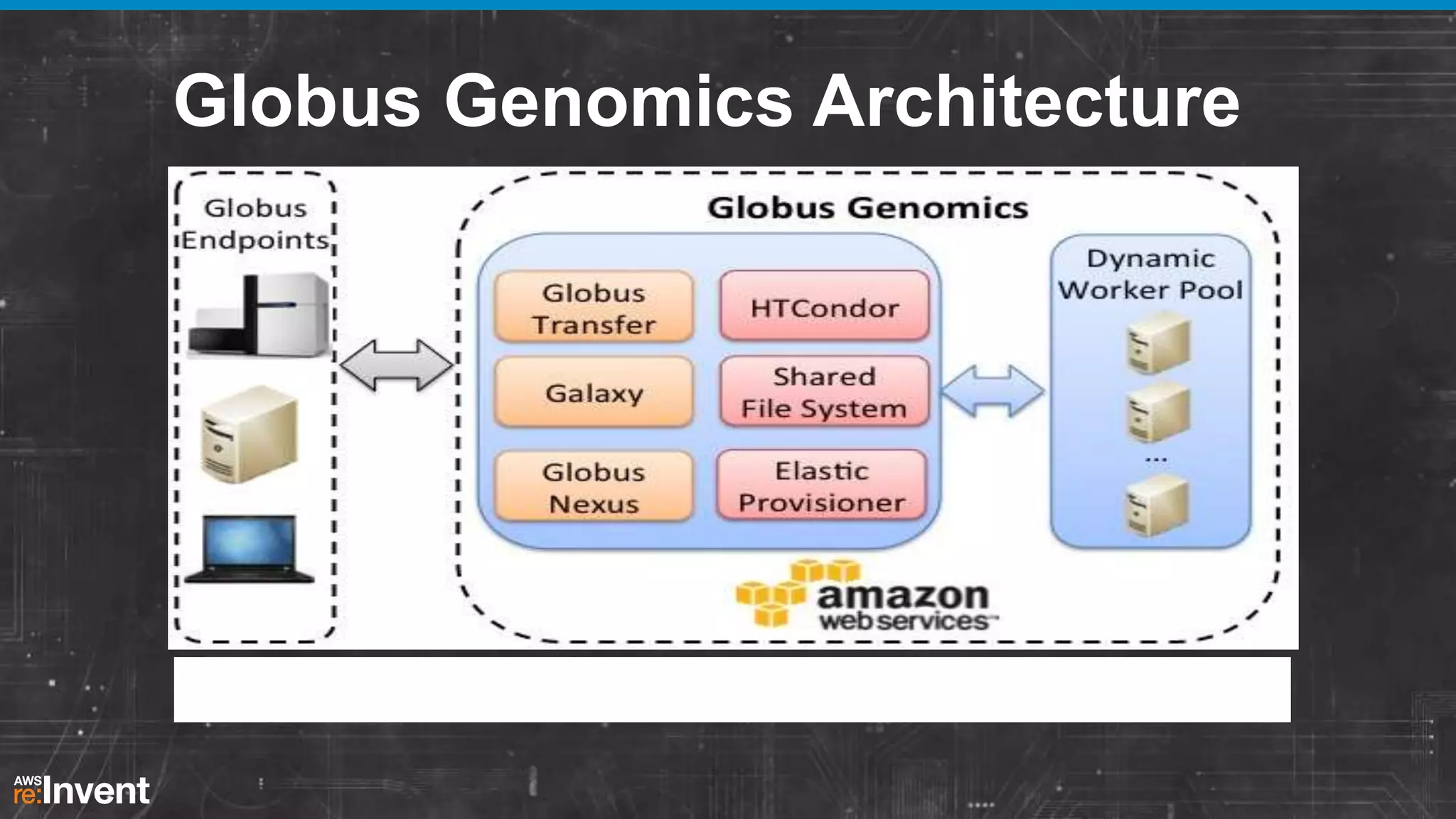
Globus Genomics Architecture

Figure 2: Globus Genomics Architecture
Globus Genomics Usage
mputation Institute, University of Chicago, Chicago, IL, USA. 2Mathematics and Computer Science Division, Argonne National Laboratory, Argonne, IL, U
3 Section Genetic Medicine, University of Chicago, Chicago, IL.

Challenges in Next-Gen Sequencing Analysis

Parallel Workflows on Globus Genomics

High Performance, Reusable Consensus
Calling Pipeline
Globus Genomics
• Computational profiles for
various analysis tools
• Resources can be
provisioned on-demand with
Amazon Web Services cloud
based infrastructure
• Glusterfs as a shared file
system between head nodes
and compute nodes
• Provisioned I/O on EBS
Coming soon!
• Integration with Globus Catalog
– Better data discovery and metadata management

• Integration with Globus Sharing
– Easy and secure method to share large datasets with collaborators

• Integration with Amazon Glacier for data archiving
• Support for high throughput computational
modalities through Apache Mesos
– MapReduce and MPI clusters

• Dynamic Storage Strategies using S3 and/or LVMbased shared file system
Our vision for a 21st century
discovery infrastructure
Provide more capability for
more people at lower cost by
building a “Discovery Cloud”
Delivering “Science as a service”
Thank you to our sponsors
For more information
• More information on Globus Genomics and to
sign up: www.globus.org/genomics
• More information on Globus:
www.globusonline.org
• Follow us on Twitter:
@ianfoster, @madduri, @globusgenomics, @gl
obusonline
Thank you!
Please give us your feedback on this
presentation

BDT 310
As a thank you, we will select prize
winners daily for completed surveys!

re:Invent 2013-foster-madduri

  • 1.
    Science as aService Ian Foster, The University of Chicago and Argonne National Laboratory November 14, 2013
  • 2.
    A time ofdisruptive change
  • 3.
    A time ofdisruptive change
  • 4.
    Most labs havelimited resources Heidorn: NSF grants in 2007 $1,000,000 $100,000 $10,000 < $350,000 80% of awards 50% of grant $$ $1,000 2000 4000 6000 8000
  • 5.
    Automation is requiredto apply more sophisticated methods to far more data
  • 6.
    Automation is requiredto apply more sophisticated methods to far more data Outsourcing is needed to achieve economies of scale in the use of automated methods
  • 7.
    Building a discoverycloud • Identify time-consuming activities amenable to automation and outsourcing • Implement as high-quality, low-touch SaaS • Leverage IaaS for reliability, Software as a service economies of scale Platform as a service Infrastructure as a service • Extract common elements as research automation platform Bonus question: Sustainability
  • 8.
    We aspire (initially)to create a great user experience for research data management What would a “dropbox for science” look like?
  • 9.
    • Collect • Move •Sync • Share • Analyze • Annotate • Publish • Search • Backup • Archive BIG DATA
  • 10.
    It should betrivial to Collect, Move, Sync, Share, Analyze, Annotate, Publish, … but in reality it’s often very challenging Search, Backup, & Archive BIG DATA ! Staging Store ! Ingest Expired Store credentials Registry Permission denied Communit Community yStore Store ! Analysis ! Store Quota Network failed. Retry. exceeded Archive Mirror
  • 11.
    • Collect • Move •Sync • Share • Analyze • Annotate • Publish • Search • Backup • Archive BIG DATA
  • 12.
    • Collect • Annotate Move •Publish • Move Sync • Search • Sync • Share Share • Backup Capabilities delivered using • Analyze • Archive Software-as-Service (SaaS) model BIG DATA
  • 13.
  • 14.
    2 1 User A selects file(s)to share; selects user/group, sets share permissions Globus Online tracks shared files; no need to move files to cloud storage! Data Source 3 User B logs in to Globus Online and accesses shared file
  • 15.
    Extreme ease ofuse • • • • • • • • InCommon, Oauth, OpenID, X.509, … Credential management Group definition and management Transfer management and optimization Reliability via transfer retries Web interface, REST API, command line One-click “Globus Connect” install 5-minute Globus Connect Multi User install
  • 16.
    Early adoption isencouraging
  • 17.
    Early adoption isencouraging >12,000 registered users; >150 daily >27 PB moved; >1B files 10x (or better) performance vs. scp 99.9% availability Entirely hosted on Amazon
  • 18.
    Amazon web servicesused • EC2 for hosting Globus services • ELB to use multiple availability zones for reliability and uptime • SES and SNS to send notifications of transfer status • S3 to store historical state • PostgreSQL for active state
  • 19.
    K. Heitmann (Argonne) moves22 TB of cosmology data LANL  ANL at 5 Gb/s
  • 20.
    B. Winjum (UCLA)moves 900K-file plasma physics datasets UCLA NERSC
  • 21.
    Dan Kozak (Caltech)replicates 1 PB LIGO astronomy data for resilience
  • 22.
    Erin Miller (PNNL) collectsdata at Advanced Photon Source, renders at PNNL, and views at ANL Credit: Kerstin Kleese-van Dam
  • 23.
    • Collect • Annotate Move •Publish • Move Sync • Search • Sync • Share Share • Backup Capabilities delivered using • Analyze • Archive Software-as-Service (SaaS) model BIG DATA
  • 24.
    • Collect • Move •Sync • Share • Analyze • Annotate • Publish • Search • Backup • Archive BIG DATA
  • 25.
    Sharing Service Transfer Service GlobusNexus (Identity, Group, Profile) Globus Toolkit Globus Connect Globus Online APIs Globus Online already does a lot
  • 26.
    The identity challengein science • Research communities often need to – Assign identities to their users – Manage user profiles – Organize users into groups for authorization • Obstacles to high-quality implementations – – – – Complexity of associated security protocols Creation of identity silos Multiple credentials for users Reliability, availability, scalability, security
  • 27.
    Nexus provides fourkey capabilities • Identity provisioning I I I – Create, manage Globus identities I I G I V U aI b • Identity hub – Link with other identities; use to authenticate to services • Group hub – User-managed groups; groups can be used for authorization • Profile management – User-managed attributes; can use in group admission Key points: 1) Outsource identity, group, profile management 2) REST API for flexible integration 3) Intuitive, customizable Web interfaces
  • 28.
    Branded sites XSEDE Open ScienceGrid University of Chicago DOE kBase Indiana University University of Exeter Globus Online NERSC NIH BIRN
  • 29.
    A platform forintegration
  • 30.
    A platform forintegration
  • 31.
    A platform forintegration
  • 32.
    Data management SaaS(Globus) + Next-gen sequence analysis pipelines (Galaxy) + Cloud IaaS (Amazon) = Flexible, scalable, easy-to-use genomics analysis for all biologists globus genomics
  • 33.
    Sharing Service Transfer Service GlobusNexus (Identity, Group, Profile) Globus Toolkit Globus Connect Globus Online APIs We are adding capabilities
  • 34.
    Dataset Services Sharing Service TransferService Globus Nexus (Identity, Group, Profile) Globus Toolkit Globus Connect Globus Online APIs We are adding capabilities
  • 35.
    We are addingcapabilities • Ingest and publication – Imagine a DropBox that not only replicates, but also extracts metadata, catalogs, converts • Cataloging – Virtual views of data based on user-defined and/or automatically extracted metadata • Computation – Associate computational procedures, orchestrate application, catalog results, record provenance
  • 36.
    Next Gen SequencingAnalysis for Everyone – No IT Required Ravi K Madduri, The University of Chicago and Argonne National Laboratory November 14, 2013
  • 37.
    One slide toget your attention
  • 38.
    Outline • Globus Vision •Challenges in Sequencing Analysis – Big Data Management – Analysis at Scale – Reproducibility • Proposed Approach Using Globus Genomics • Example Collaborations • Q&A
  • 39.
    Globus Vision Goal: Acceleratediscovery and innovation worldwide by providing research IT as a service Leverage software-as-a-service to: – provide millions of researchers with unprecedented access to powerful tools for managing Big Data – reduce research IT costs dramatically via economies of scale “Civilization advances by extending the number of important operations which we can perform without thinking of them” —Alfred North Whitehead , 1911
  • 40.
    Challenges in SequencingAnalysis Data Movement and Access Challenges • • • • Shell scripts to sequentially execute the tools Manually modify the scripts for any change • Public Data Manually move the data to the Compute node Install all the tools required for the Analysis Difficult to maintain and transfer the knowledge • BWA, Picard, GATK, Filtering Scripts, etc. • Error Prone, difficult to keep track, messy.. Storage Sequencing Centers Fastq Ref Genome Research Lab Seq Center Local Cluster/ Cloud Modify Picard Install • • • • Difficult to Data is distributed in different locations Research labs need access to the data for analysis Be able to Share data with other researchers/collaborators • Inefficient ways of data movement Data needs to be available on the local and Distributed Compute Resources • Local Clusters, Cloud, Grid and transfer the knowledge Alignment (Re)Run GATK Script Variant Calling How do we analyze this Sequence Data Manual Data Analysis
  • 41.
    Globus Genomics Globus Genomics GalaxyBased Workflow Management System • Public Data Sequencin g Centers Globus Provides a • High-performance Research Lab • Fault-tolerant Seq Secure • Center Storage • • Galaxy Data Libraries • Local Cluster/ Cloud • file transfer Service between all data-endpoints Globus Integrated within Galaxy Web-based UI Drag-Drop workflow creations Easily modify Workflows with new tools Analytical tools are automatically run on the scalable compute resources when possible Globus Genomics on Amazon EC2 Data Management Data Analysis
  • 42.
    Globus Genomics Architecture Figure2: Globus Genomics Architecture
  • 43.
  • 44.
    mputation Institute, Universityof Chicago, Chicago, IL, USA. 2Mathematics and Computer Science Division, Argonne National Laboratory, Argonne, IL, U 3 Section Genetic Medicine, University of Chicago, Chicago, IL. Challenges in Next-Gen Sequencing Analysis Parallel Workflows on Globus Genomics High Performance, Reusable Consensus Calling Pipeline
  • 45.
    Globus Genomics • Computationalprofiles for various analysis tools • Resources can be provisioned on-demand with Amazon Web Services cloud based infrastructure • Glusterfs as a shared file system between head nodes and compute nodes • Provisioned I/O on EBS
  • 46.
    Coming soon! • Integrationwith Globus Catalog – Better data discovery and metadata management • Integration with Globus Sharing – Easy and secure method to share large datasets with collaborators • Integration with Amazon Glacier for data archiving • Support for high throughput computational modalities through Apache Mesos – MapReduce and MPI clusters • Dynamic Storage Strategies using S3 and/or LVMbased shared file system
  • 48.
    Our vision fora 21st century discovery infrastructure Provide more capability for more people at lower cost by building a “Discovery Cloud” Delivering “Science as a service”
  • 49.
    Thank you toour sponsors
  • 50.
    For more information •More information on Globus Genomics and to sign up: www.globus.org/genomics • More information on Globus: www.globusonline.org • Follow us on Twitter: @ianfoster, @madduri, @globusgenomics, @gl obusonline
  • 51.
  • 52.
    Please give usyour feedback on this presentation BDT 310 As a thank you, we will select prize winners daily for completed surveys!

Editor's Notes

  • #3 For example in genomics
  • #4 For example in genomics
  • #5 10,000 80% of awards and 50% of grant $$ are &lt; $350K
  • #6 Concern:
  • #9 Many in this room are probably users of Dropbox or similar services for keeping their files synced across multiple machinesWell, the scientific research equivalent is a little different
  • #10 We figured it needs to allow a group of collaborating researchers to do many or all of these things with their data ……and not just the 2GB of powerpoints…or the 100GB of family photos and videos….but the petabytes and exabytes of data that will soon be the norm for many
  • #11 So how would such a drop box for science be used? Let’s look at a very typical scientific data work flow . . .Data is generated by some instrument (a sequencer at JGI or a light source like APS/ALS)…since these instruments are in high demand, users have to get their data off the instrument to make way for the next userSo the data is typically moved from a staging area to some type of ingest storeEtcetera for analysis, sharing of results with collaborators, annotation with metadata for future search, backup/sync/archival, …
  • #12 We figured it needs to allow a group of collaborating researchers to do many or all of these things with their data ……and not just the 2GB of powerpoints…or the 100GB of family photos and videos….but the petabytes and exabytes of data that will soon be the norm for many
  • #13 We figured it needs to allow a group of collaborating researchers to do many or all of these things with their data ……and not just the 2GB of powerpoints…or the 100GB of family photos and videos….but the petabytes and exabytes of data that will soon be the norm for many
  • #20 And when we spoke with IT folks at various research communities they insisted that some things were not up for negotiation
  • #21 And when we spoke with IT folks at various research communities they insisted that some things were not up for negotiation
  • #22 And when we spoke with IT folks at various research communities they insisted that some things were not up for negotiation
  • #23 This image shows a 3D rendering of a Shewanella biofilm grown on a flat plastic substrate in a Constant Depth bioFilm Fermenter (CDFF).  The image was generated using x-ray microtomography at the Advanced Photon Source, Argonne National Laboratory.   
  • #24 We figured it needs to allow a group of collaborating researchers to do many or all of these things with their data ……and not just the 2GB of powerpoints…or the 100GB of family photos and videos….but the petabytes and exabytes of data that will soon be the norm for many
  • #25 We figured it needs to allow a group of collaborating researchers to do many or all of these things with their data ……and not just the 2GB of powerpoints…or the 100GB of family photos and videos….but the petabytes and exabytes of data that will soon be the norm for many
  • #28 Four obstacles to collaborative application developmentBuild collaborative applications– Outsource identity, group and profilemanagement– REST API for flexible integration– Intuitive, customizable interfaces
  • #44 Total: over 350K Core hours in last 6months
  • #49 Questions remain:-- What capabilities? Where does time go?-- How do we turn them into usable solutions?-- How do we scale from thousands to millions?-- How do we incentivize contributions? Long tail.