TREATMENT OF
CLASS III MALOCCLUSION
www.indiandentalacademy.com
“Class III malocclusion occurred when
the lower teeth occluded mesial to their
normal relationship the width of one
premolar or even more in extreme
cases”.
- Angle (1899)
www.indiandentalacademy.com
CLASSIFICATION
• TWEED (1966)
CLASS III MALOCCLUSION
PSEUDO CLASS III
Normal Mandible
Underdeveloped
Maxillae
SKELETAL CLASS III
Large Mandible
Underdeveloped or
Normal Maxillae
www.indiandentalacademy.com
•MOYERS
Osseous
Muscular
Dental
ACCORDING TO THE CAUSE :
Anterior Positioning : Tooth contact relationship which
force the mandible into a forward position.(Pseudo Class III)
www.indiandentalacademy.com
• FREQUENCY OF CLASS III MALOCCLUSION
1) Caucasians 1 to 4 %
7 to 13 Years 4.2%
14 to 18 Years 9.4%
2) African – Americans 5 to 8%
3) Asian Maxillary deficiency
4) Japanese 4 % Younger / 14 % Older
5) Chinese 3 % Younger / 13 % Older
www.indiandentalacademy.com
ETIOLOGY
 McGuigan (1966) – Inheritance of class III
malocclusion in Hapsburg Family, having the
distinct characteristics of prognathic lower jaw.
 Litton et al (1970) – Dental characteristics of class
III are related to genetic inheritance.
 Functional factors – Anteriorly positioned tongue
believed to be a local epigenetic factor.
 Mental diseases – Compulsive habits of
protruding the mandible.www.indiandentalacademy.com
Enlarged tonsils and naso-respiratory diseases – Results in
anterior tongue posturing.
Premature loss of decidious molars – Results in anterior
mandibular displacement.
Tongue thrusting habit – Prevents eruption of buccal
segments, thus causing auto-rotation of mandible into
excessive intra occlusal space.
www.indiandentalacademy.com
COMPONENTS OF CLASS III MALOCCLUSION
• Vertical components :
• Vertical Deficient
• Vertical Normal
• Vertically excess
•Anterio Posterior components :
• Maxillary Deficient
• Mandibular excess
• Combined Maxillary deficient and
mandibular excess
www.indiandentalacademy.com
DENTAL ASSESSMENT FOR DIAGNOSING CLASS III MALOCCLUSION
www.indiandentalacademy.com
Class III Skeletal Growth Pattern
1) Cranial Base
 Angle – More Acute
 Middle Cranial Fossa  Posterior and Superior
Alignment
2) Maxilla
 Decreased horizontal maxillary growth when
compared with the patients with class I
malocclusion.
3) Mandible
 Gonial Angle  Obtuse
 Anteriorly placed
 Dentoalveolar compensation  Proclination of
upper incisors, Retroclination of lower incisors.www.indiandentalacademy.com
Indication and Contraindication for
Early Class III treatment
TURPIN et al (1981)
Positive Factors : Good Facial esthetics
Mild skeletal disharmony
No familial prognathism
Ant-Post functional shift
Convergent facial types
Negative Factors : Poor facial esthetics
Severe skeletal disharmony
Growth complete
www.indiandentalacademy.com
Treatment of Pseudo class III
Malocclusion
Clinical Features :
 Anterior cross bite with premature tooth
contact with CO-CR discrepancy
Treatment :
1) Reverse SS crown
2) Tongue Blade
3) Fixed Appliance
www.indiandentalacademy.com
Treatment of Skeletal class III malocclusion
1) Pre-Adolescence (Growth Remaining)
a) Functional Appliance Therapy
 Frankel III regulator
Two separate studies concluded ;
1) Dento alveolar effect
2) Downward and Backward rotation of
Mandible
www.indiandentalacademy.com
 Indication  Normal maxilla and prognathic
mandible
 Effect of Mandibular growth
• Redirection of Mandibular growth vertically
• Backward repositioning of mandible
• Remodeling of mandible with closure of
gonial angle.
 Effect of Maxillary Growth
CHIN CUP THERAPY
www.indiandentalacademy.com
Force magnitude and Direction
TYPES
• Occipital Pull
• Vertical Pull
Orthopaedics force of 300-400 grams / 14 hours a day.
Treatment Timing
Primary to early mixed dentition
Stability
Sugarwara et al :- Though skeletal changes were greatly
improved initially they were however not maintained.
www.indiandentalacademy.com
FACE MASK THERAPY
Delaire et al , (1960) : Revived interest in using
face mask for Maxillary protraction
Petite : Later modified Delaire’s concept by
increasing the force and thus decreasing the
treatment time.
www.indiandentalacademy.com
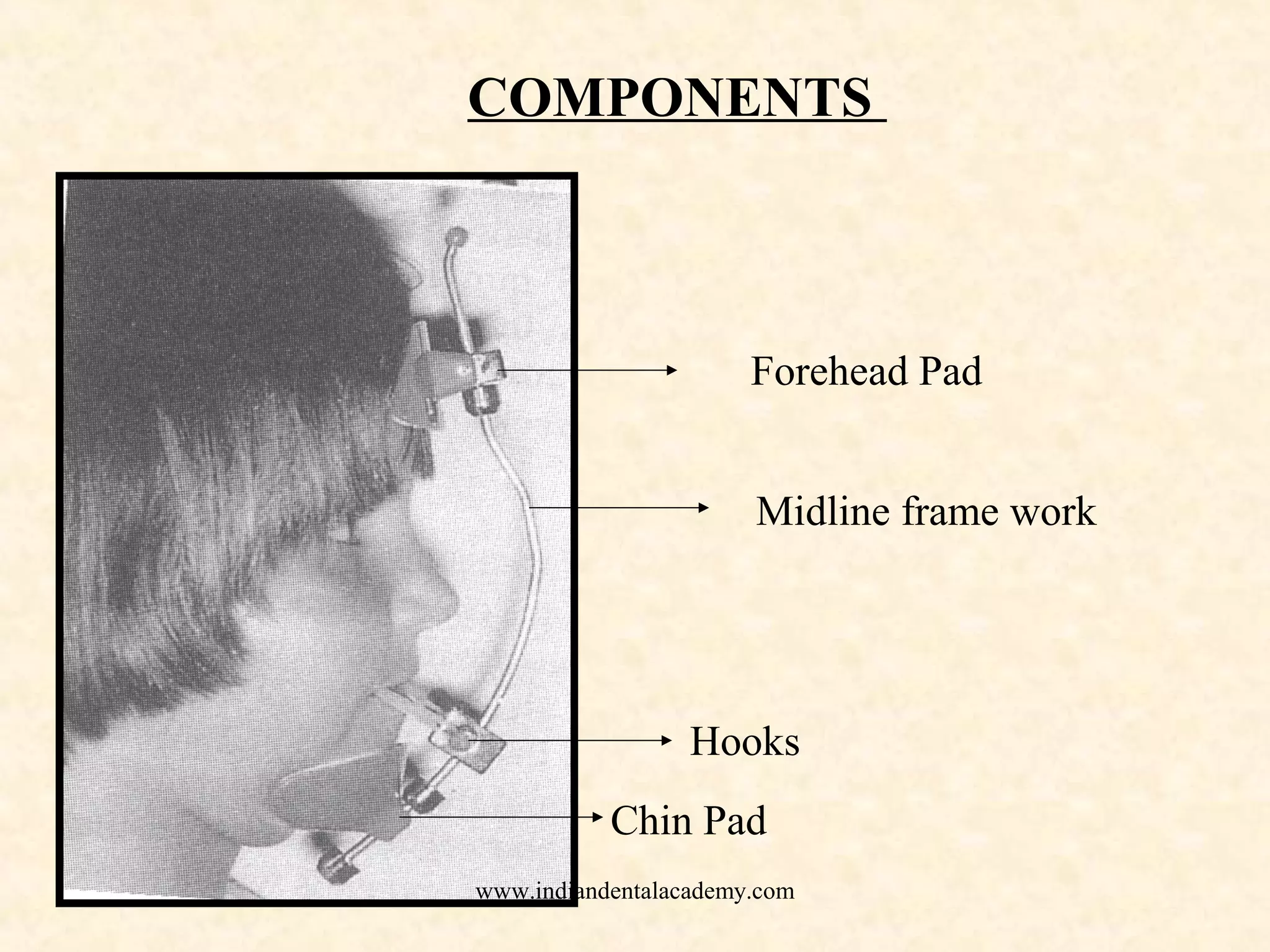
COMPONENTS
Forehead Pad
Midline frame work
Chin Pad
Hooks
www.indiandentalacademy.com
Maxillary protraction below centre of
resistance produces anticlockwise
rotation of the maxilla
Protraction elastics attached near the
maxillary canine with a downward and
forward pull of 30 degrees to the
occlusal plane minimize bite opening.
Force : 300 to 600 grams per side depending on age.
Time : 10 to 12 Hrs / Day
Duration : 3 to 6 months www.indiandentalacademy.com
CONSTRUCTION OF ANCHORAGE SYSTEM
1) Metallic banded palatal expansion appliance
2) Acrylic bonded palatal expansion appliance
Skeletal Effect of Maxillary Protraction
Fronto maxillary Naso Maxillary
Zygomatico maxillary Zygomatico Temporal
Pterygo palatine
Intermaxillary
Ethmomaxillary
Lacrimo Maxillary
www.indiandentalacademy.com
Cokish and Shapio ( 1979) :-
- Anticlockwise maxilla
- Clockwise rotation of mandible
Kambala et al (1977) : Maxilla displaced anteriorly with
changes in the circum maxillary sutures with forward and
downward movement of maxilla
Does it make a different if protraction was initiated during
expansion or after expansion ?
Beik (1984) : Found that greater forward movement of maxilla
was initiated during maxillary expansion
STABILITY :
- Effects on maxilla remain stable for 1 – 2 years after treatment
- In some studies maxilla and mandible reverted back to original
position. www.indiandentalacademy.com

Treatment of class 3 malocclusion

  • 1.
    TREATMENT OF CLASS IIIMALOCCLUSION www.indiandentalacademy.com
  • 2.
    “Class III malocclusionoccurred when the lower teeth occluded mesial to their normal relationship the width of one premolar or even more in extreme cases”. - Angle (1899) www.indiandentalacademy.com
  • 3.
    CLASSIFICATION • TWEED (1966) CLASSIII MALOCCLUSION PSEUDO CLASS III Normal Mandible Underdeveloped Maxillae SKELETAL CLASS III Large Mandible Underdeveloped or Normal Maxillae www.indiandentalacademy.com
  • 4.
    •MOYERS Osseous Muscular Dental ACCORDING TO THECAUSE : Anterior Positioning : Tooth contact relationship which force the mandible into a forward position.(Pseudo Class III) www.indiandentalacademy.com
  • 5.
    • FREQUENCY OFCLASS III MALOCCLUSION 1) Caucasians 1 to 4 % 7 to 13 Years 4.2% 14 to 18 Years 9.4% 2) African – Americans 5 to 8% 3) Asian Maxillary deficiency 4) Japanese 4 % Younger / 14 % Older 5) Chinese 3 % Younger / 13 % Older www.indiandentalacademy.com
  • 6.
    ETIOLOGY  McGuigan (1966)– Inheritance of class III malocclusion in Hapsburg Family, having the distinct characteristics of prognathic lower jaw.  Litton et al (1970) – Dental characteristics of class III are related to genetic inheritance.  Functional factors – Anteriorly positioned tongue believed to be a local epigenetic factor.  Mental diseases – Compulsive habits of protruding the mandible.www.indiandentalacademy.com
  • 7.
    Enlarged tonsils andnaso-respiratory diseases – Results in anterior tongue posturing. Premature loss of decidious molars – Results in anterior mandibular displacement. Tongue thrusting habit – Prevents eruption of buccal segments, thus causing auto-rotation of mandible into excessive intra occlusal space. www.indiandentalacademy.com
  • 8.
    COMPONENTS OF CLASSIII MALOCCLUSION • Vertical components : • Vertical Deficient • Vertical Normal • Vertically excess •Anterio Posterior components : • Maxillary Deficient • Mandibular excess • Combined Maxillary deficient and mandibular excess www.indiandentalacademy.com
  • 9.
    DENTAL ASSESSMENT FORDIAGNOSING CLASS III MALOCCLUSION www.indiandentalacademy.com
  • 10.
    Class III SkeletalGrowth Pattern 1) Cranial Base  Angle – More Acute  Middle Cranial Fossa  Posterior and Superior Alignment 2) Maxilla  Decreased horizontal maxillary growth when compared with the patients with class I malocclusion. 3) Mandible  Gonial Angle  Obtuse  Anteriorly placed  Dentoalveolar compensation  Proclination of upper incisors, Retroclination of lower incisors.www.indiandentalacademy.com
  • 11.
    Indication and Contraindicationfor Early Class III treatment TURPIN et al (1981) Positive Factors : Good Facial esthetics Mild skeletal disharmony No familial prognathism Ant-Post functional shift Convergent facial types Negative Factors : Poor facial esthetics Severe skeletal disharmony Growth complete www.indiandentalacademy.com
  • 12.
    Treatment of Pseudoclass III Malocclusion Clinical Features :  Anterior cross bite with premature tooth contact with CO-CR discrepancy Treatment : 1) Reverse SS crown 2) Tongue Blade 3) Fixed Appliance www.indiandentalacademy.com
  • 13.
    Treatment of Skeletalclass III malocclusion 1) Pre-Adolescence (Growth Remaining) a) Functional Appliance Therapy  Frankel III regulator Two separate studies concluded ; 1) Dento alveolar effect 2) Downward and Backward rotation of Mandible www.indiandentalacademy.com
  • 14.
     Indication Normal maxilla and prognathic mandible  Effect of Mandibular growth • Redirection of Mandibular growth vertically • Backward repositioning of mandible • Remodeling of mandible with closure of gonial angle.  Effect of Maxillary Growth CHIN CUP THERAPY www.indiandentalacademy.com
  • 15.
    Force magnitude andDirection TYPES • Occipital Pull • Vertical Pull Orthopaedics force of 300-400 grams / 14 hours a day. Treatment Timing Primary to early mixed dentition Stability Sugarwara et al :- Though skeletal changes were greatly improved initially they were however not maintained. www.indiandentalacademy.com
  • 16.
    FACE MASK THERAPY Delaireet al , (1960) : Revived interest in using face mask for Maxillary protraction Petite : Later modified Delaire’s concept by increasing the force and thus decreasing the treatment time. www.indiandentalacademy.com
  • 17.
    COMPONENTS Forehead Pad Midline framework Chin Pad Hooks www.indiandentalacademy.com
  • 18.
    Maxillary protraction belowcentre of resistance produces anticlockwise rotation of the maxilla Protraction elastics attached near the maxillary canine with a downward and forward pull of 30 degrees to the occlusal plane minimize bite opening. Force : 300 to 600 grams per side depending on age. Time : 10 to 12 Hrs / Day Duration : 3 to 6 months www.indiandentalacademy.com
  • 19.
    CONSTRUCTION OF ANCHORAGESYSTEM 1) Metallic banded palatal expansion appliance 2) Acrylic bonded palatal expansion appliance Skeletal Effect of Maxillary Protraction Fronto maxillary Naso Maxillary Zygomatico maxillary Zygomatico Temporal Pterygo palatine Intermaxillary Ethmomaxillary Lacrimo Maxillary www.indiandentalacademy.com
  • 20.
    Cokish and Shapio( 1979) :- - Anticlockwise maxilla - Clockwise rotation of mandible Kambala et al (1977) : Maxilla displaced anteriorly with changes in the circum maxillary sutures with forward and downward movement of maxilla Does it make a different if protraction was initiated during expansion or after expansion ? Beik (1984) : Found that greater forward movement of maxilla was initiated during maxillary expansion STABILITY : - Effects on maxilla remain stable for 1 – 2 years after treatment - In some studies maxilla and mandible reverted back to original position. www.indiandentalacademy.com