Class III Malocclusion
Presented By Sajjad Haghi
Introduction
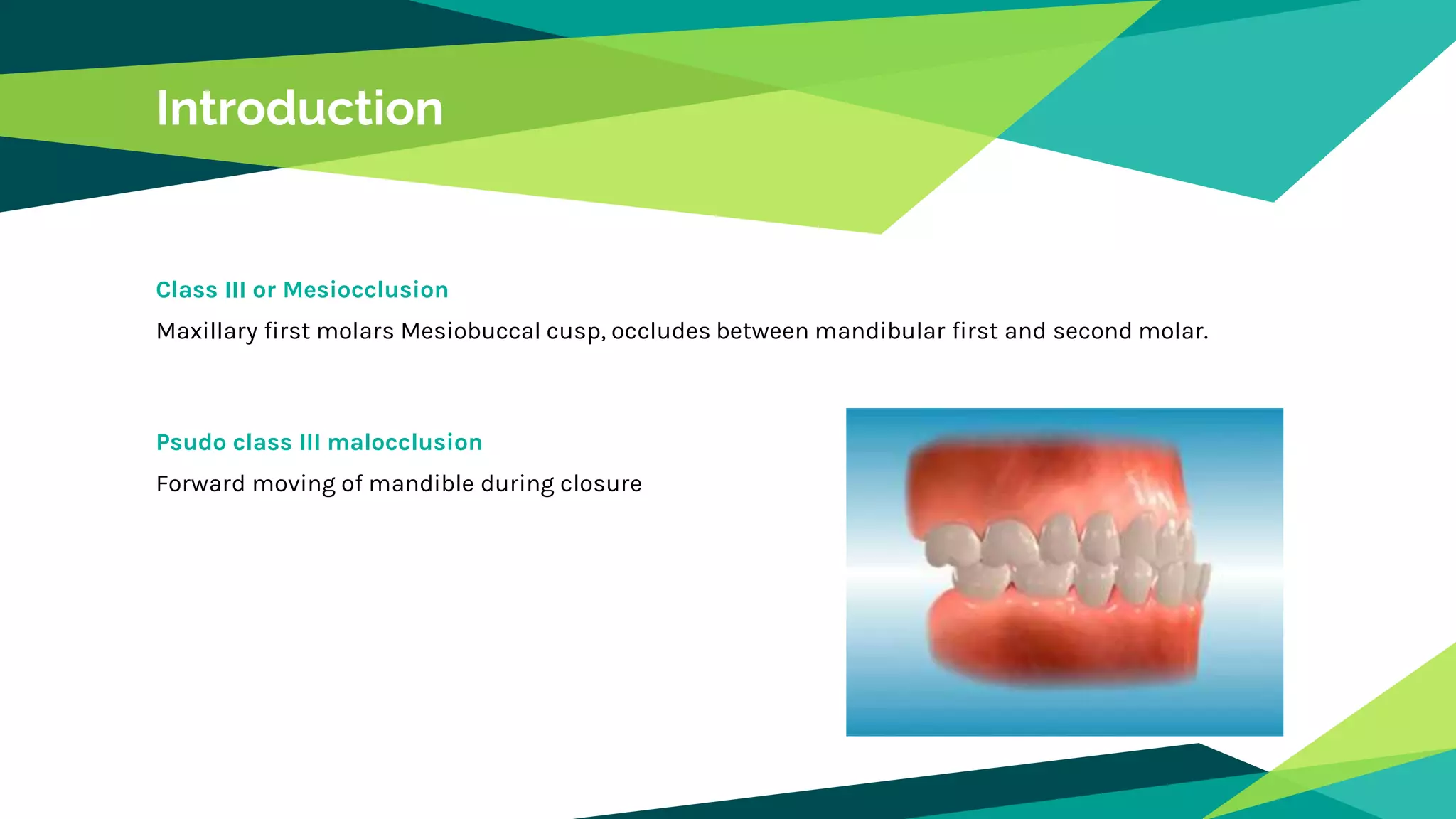
Class III or Mesiocclusion
Maxillary first molars Mesiobuccal cusp, occludes between mandibular first and second molar.
Psudo class III malocclusion
Forward moving of mandible during closure
Definition
• A sagittal difference between maxillary and mandibular bases
ANB< 1 & Wits’ appraisal < -1
• A sagittal difference between maxillary and mandibular arch size.
• The relation between maxillary and mandibular canines and
molars.
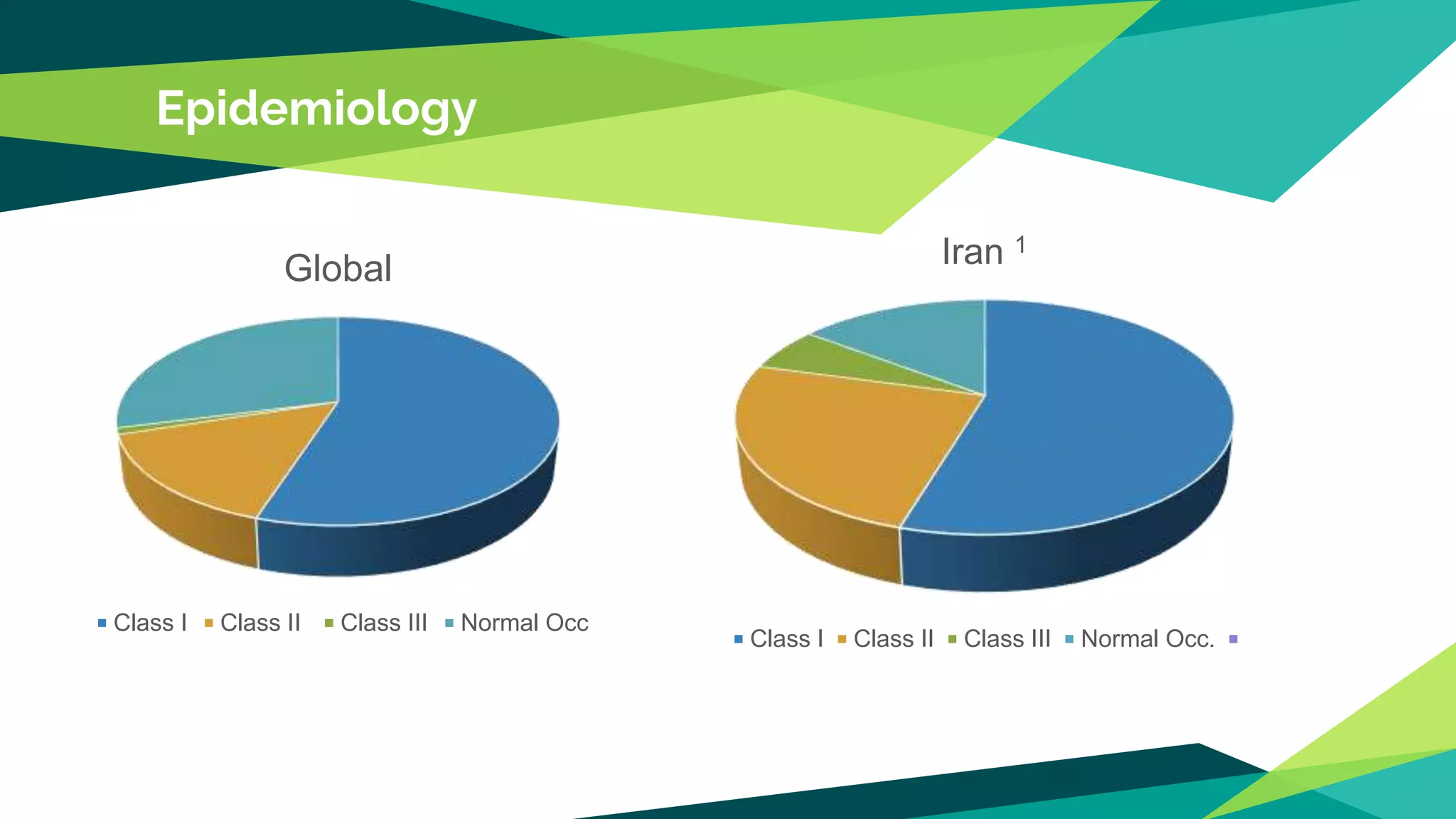
Epidemiology
Global
Class I Class II Class III Normal Occ
Iran 1
Class I Class II Class III Normal Occ.
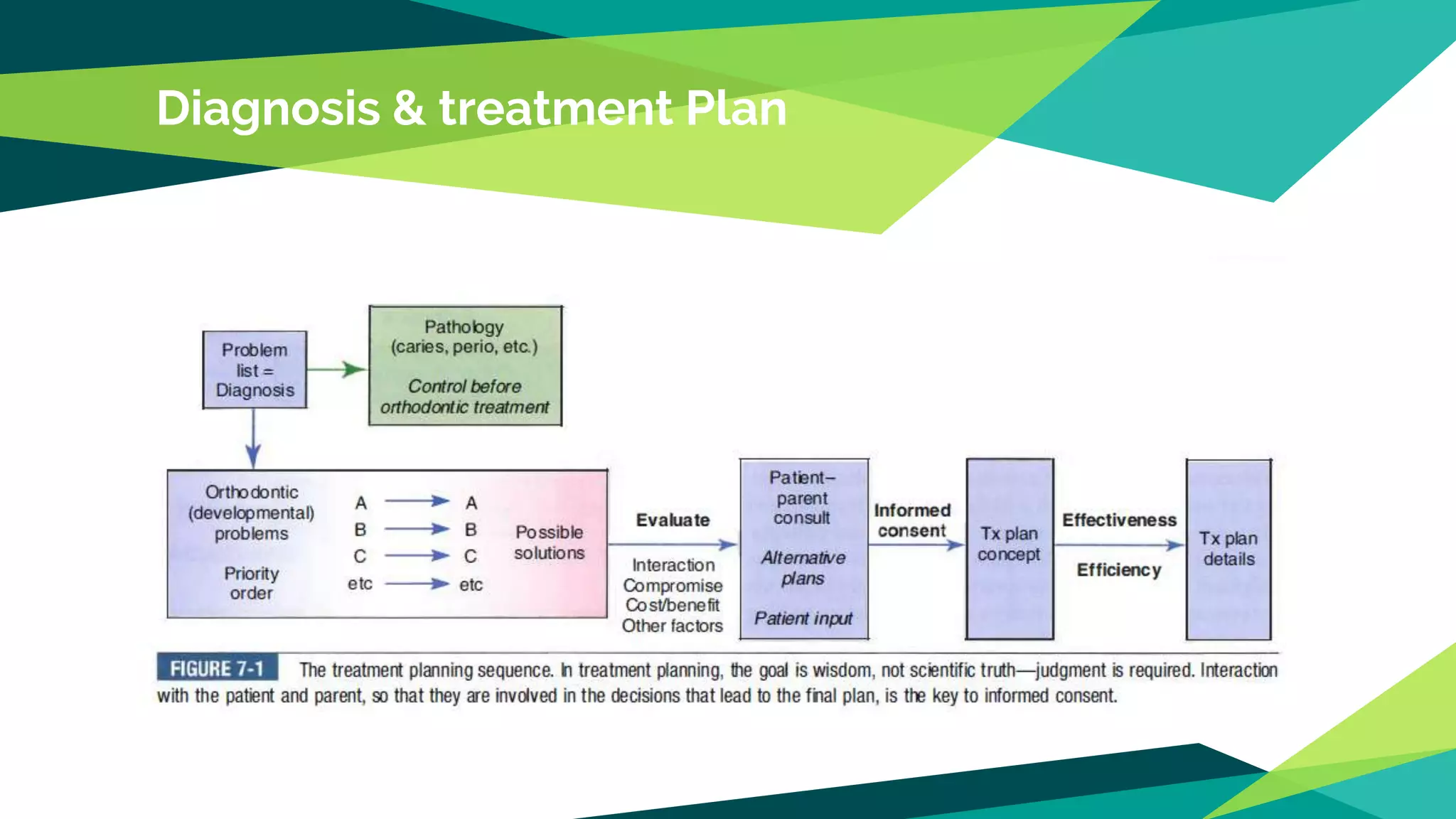
Diagnosis & treatment Plan
Etiology
Genetics
Polygenic pattern
Environment
Functional matrix
Habits
Neuromuscular system
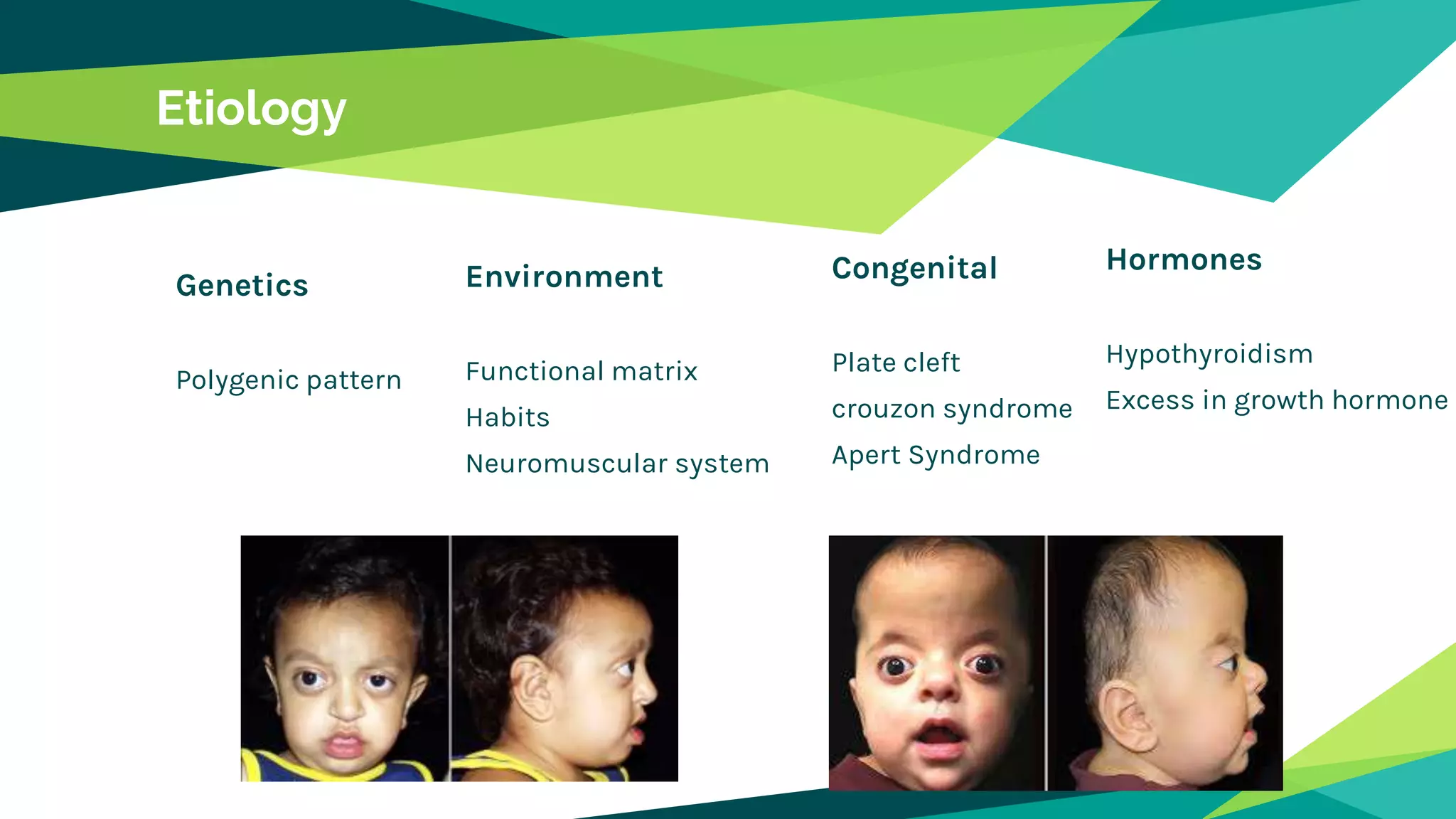
Congenital
Plate cleft
crouzon syndrome
Apert Syndrome
Hormones
Hypothyroidism
Excess in growth hormone
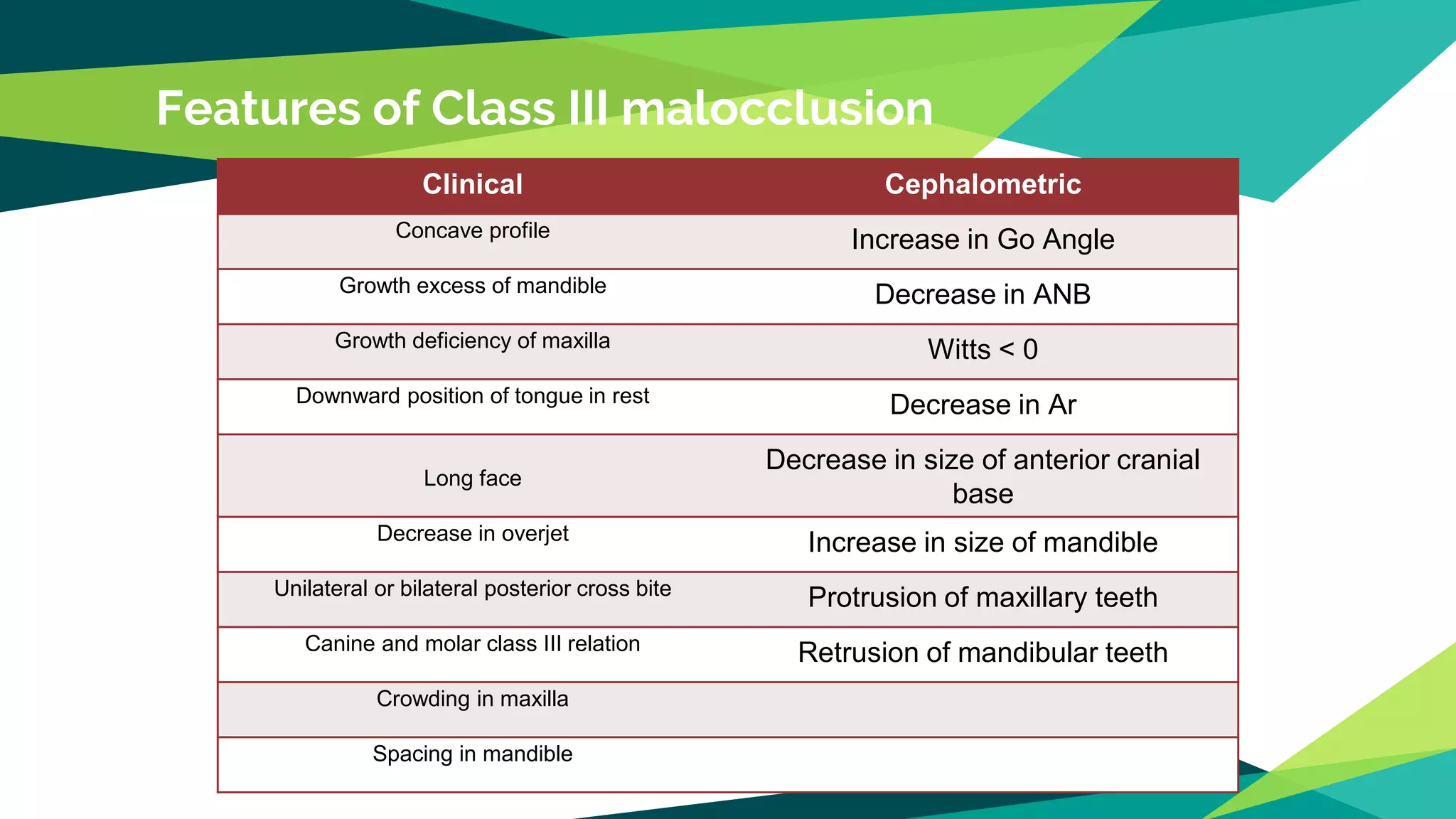
Features of Class III malocclusion
Clinical Cephalometric
Concave profile Increase in Go Angle
Growth excess of mandible Decrease in ANB
Growth deficiency of maxilla Witts < 0
Downward position of tongue in rest Decrease in Ar
Long face
Decrease in size of anterior cranial
base
Decrease in overjet Increase in size of mandible
Unilateral or bilateral posterior cross bite Protrusion of maxillary teeth
Canine and molar class III relation Retrusion of mandibular teeth
Crowding in maxilla
Spacing in mandible
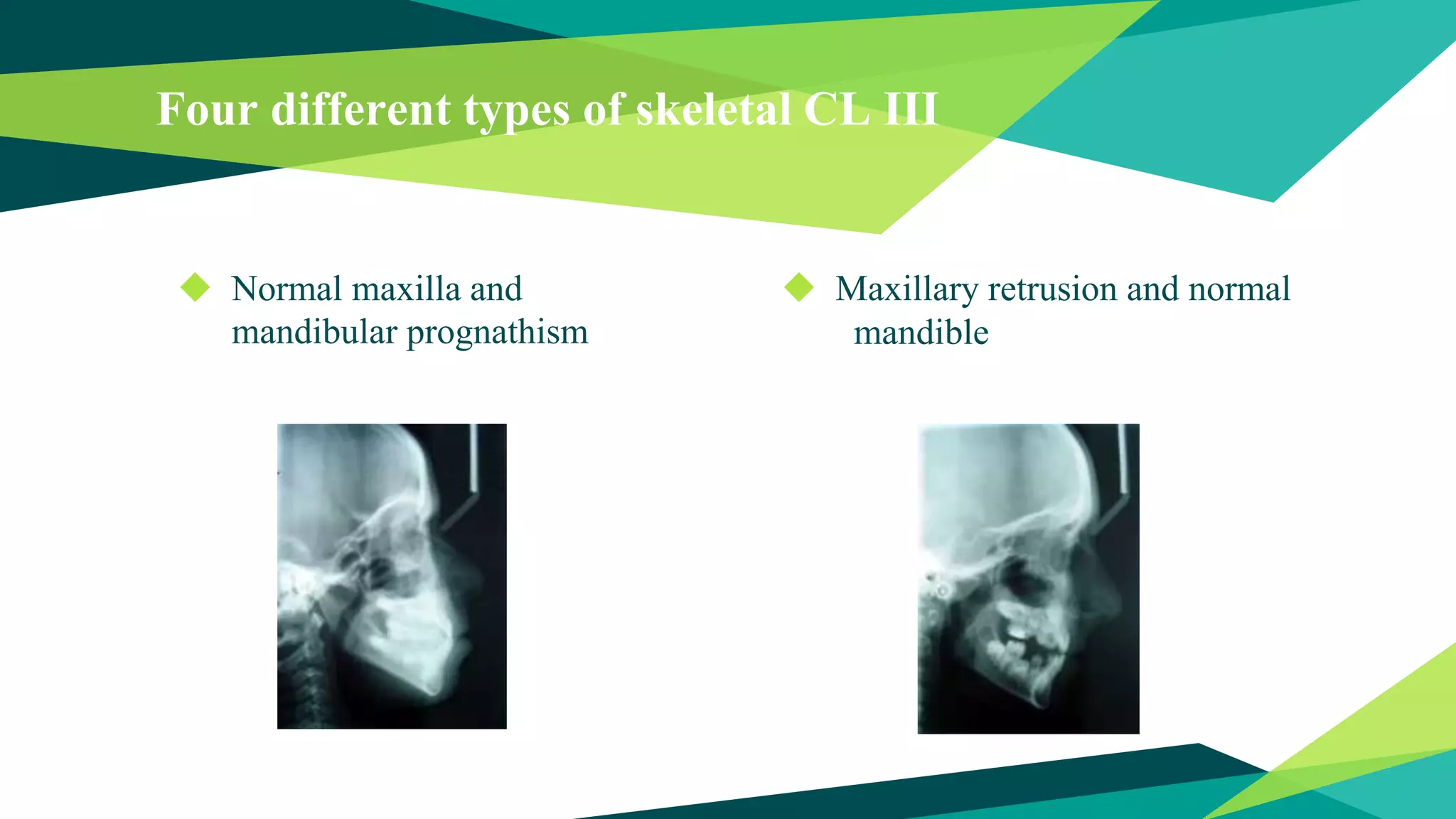
Four different types of skeletal CL III
◆ Normal maxilla and
mandibular prognathism
◆ Maxillary retrusion and normal
mandible
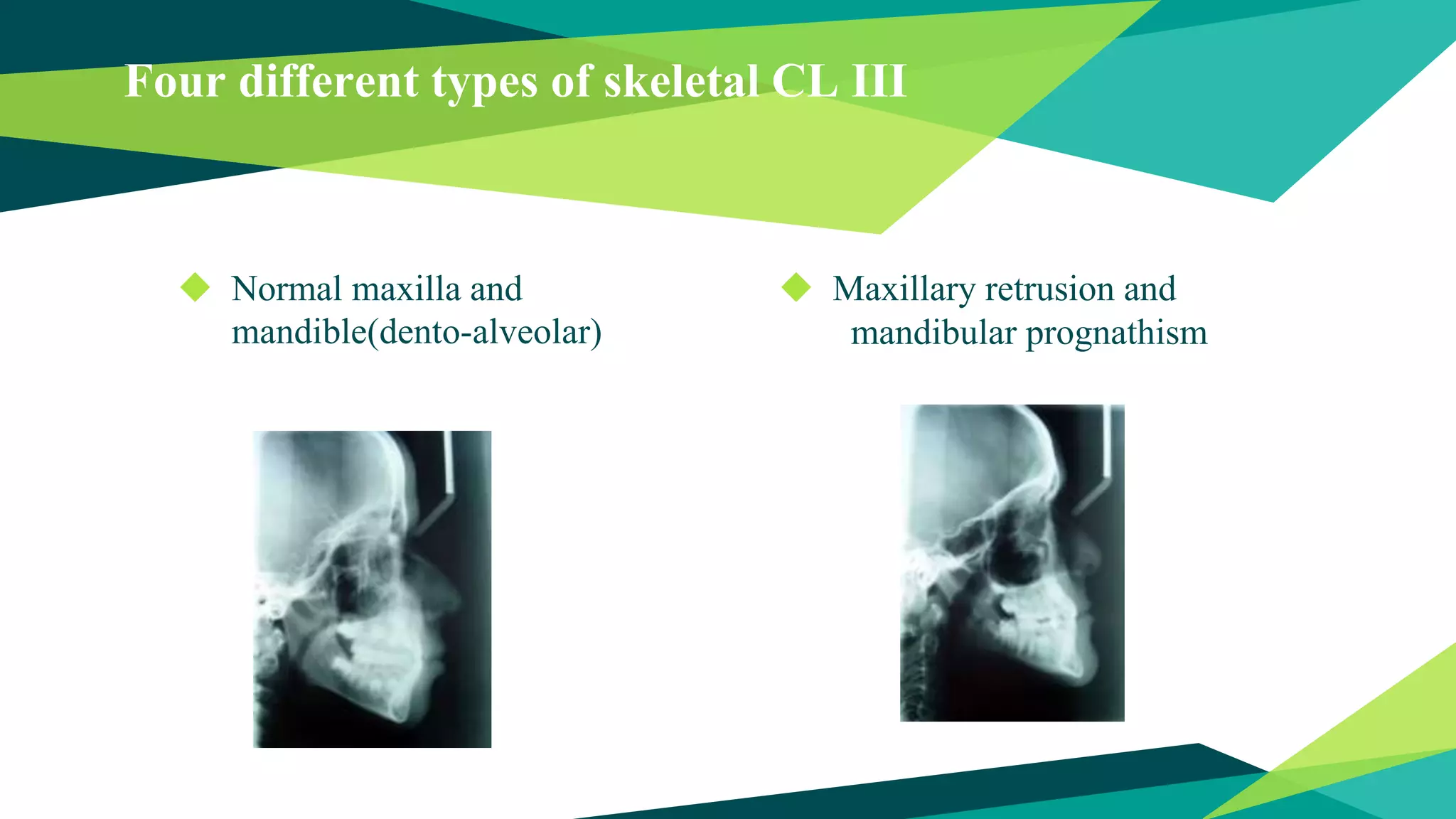
Four different types of skeletal CL III
◆ Normal maxilla and
mandible(dento-alveolar)
◆ Maxillary retrusion and
mandibular prognathism
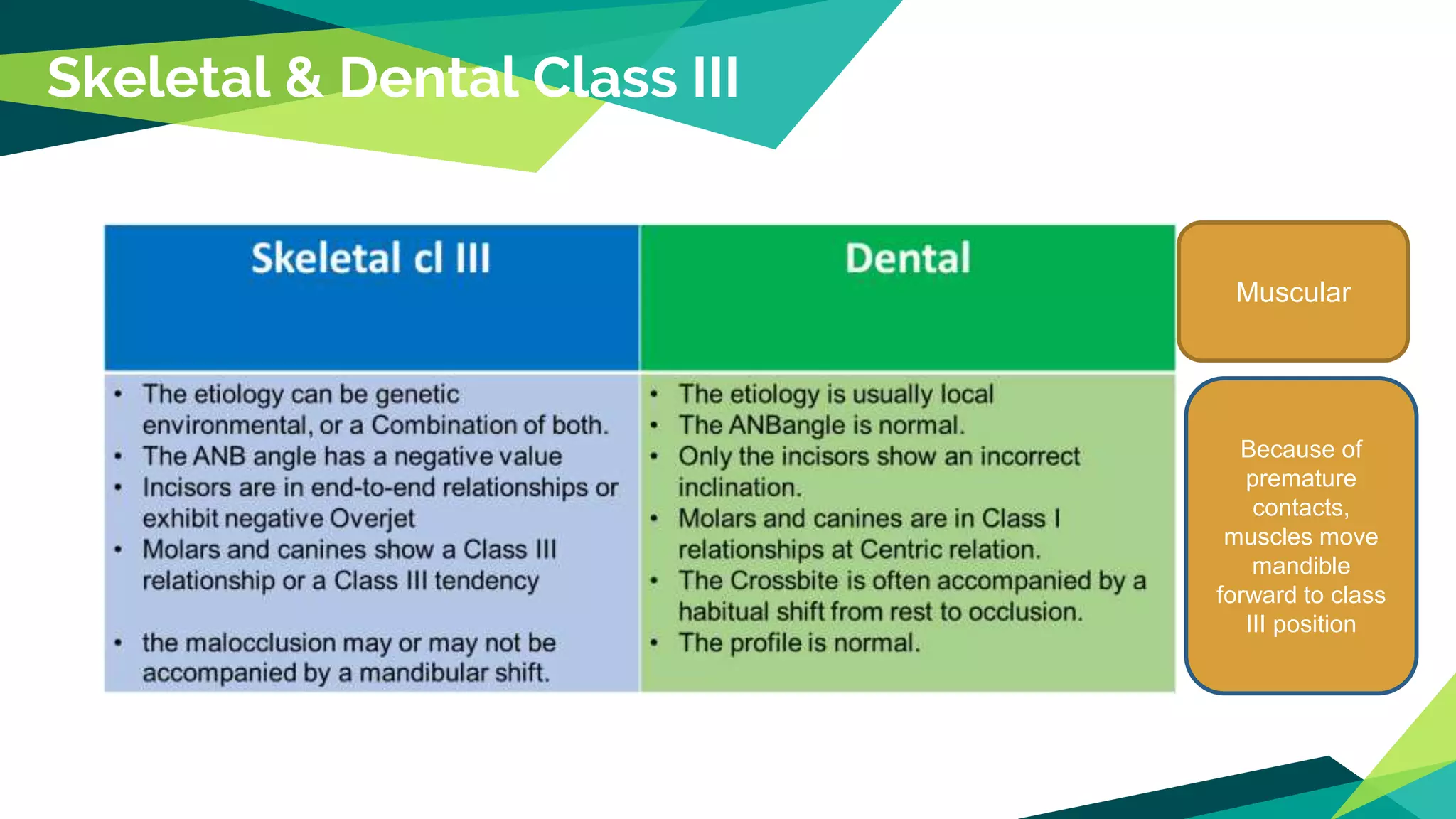
Skeletal & Dental Class III
Muscular
Because of
premature
contacts,
muscles move
mandible
forward to class
III position
“
Treatment Of Class III Malocclusion
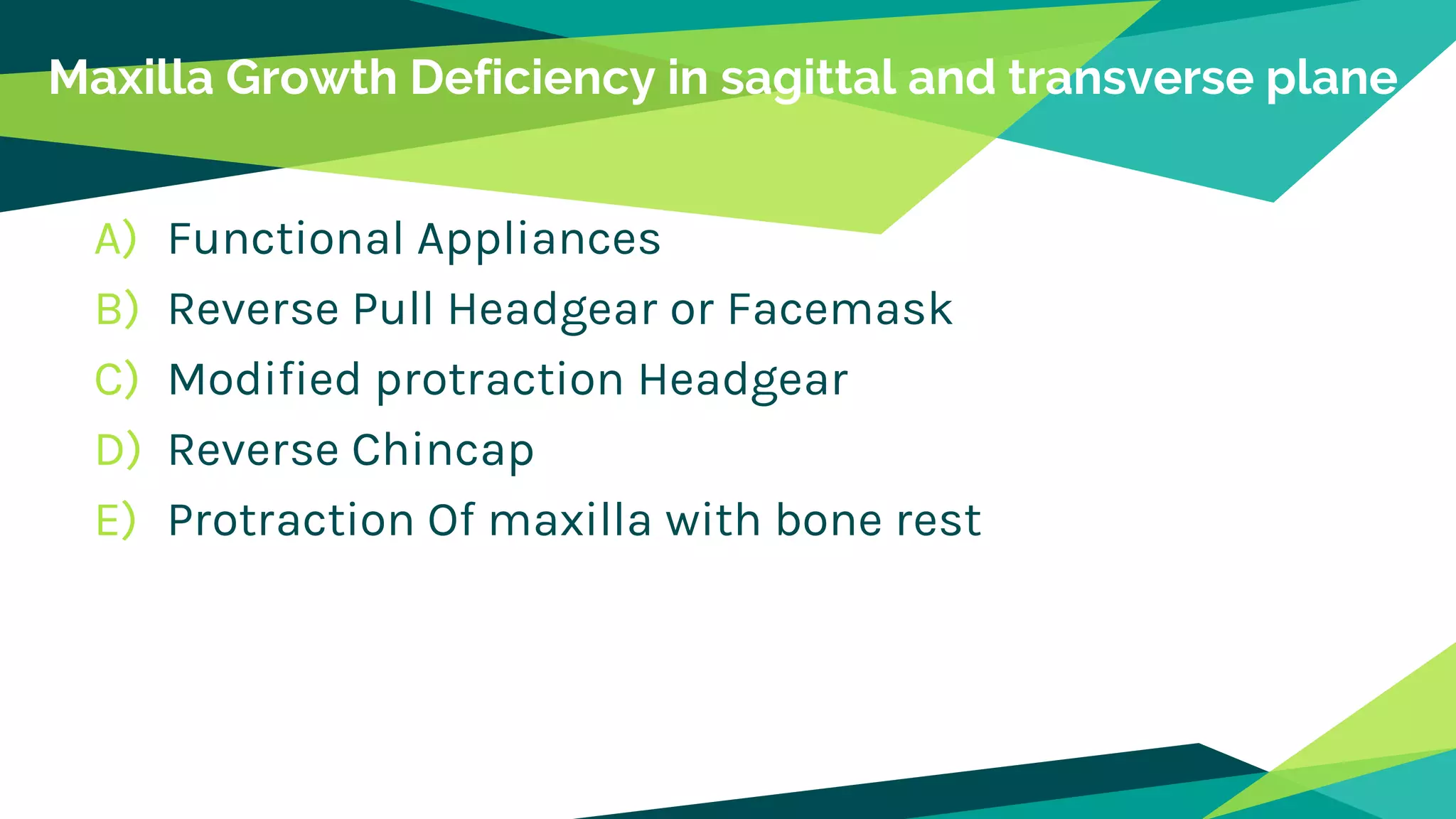
Maxilla Growth Deficiency in sagittal and transverse plane
A) Functional Appliances
B) Reverse Pull Headgear or Facemask
C) Modified protraction Headgear
D) Reverse Chincap
E) Protraction Of maxilla with bone rest
Functional Appliances
These appliances preserve mandible in its posterior position and turn it
clockwise.
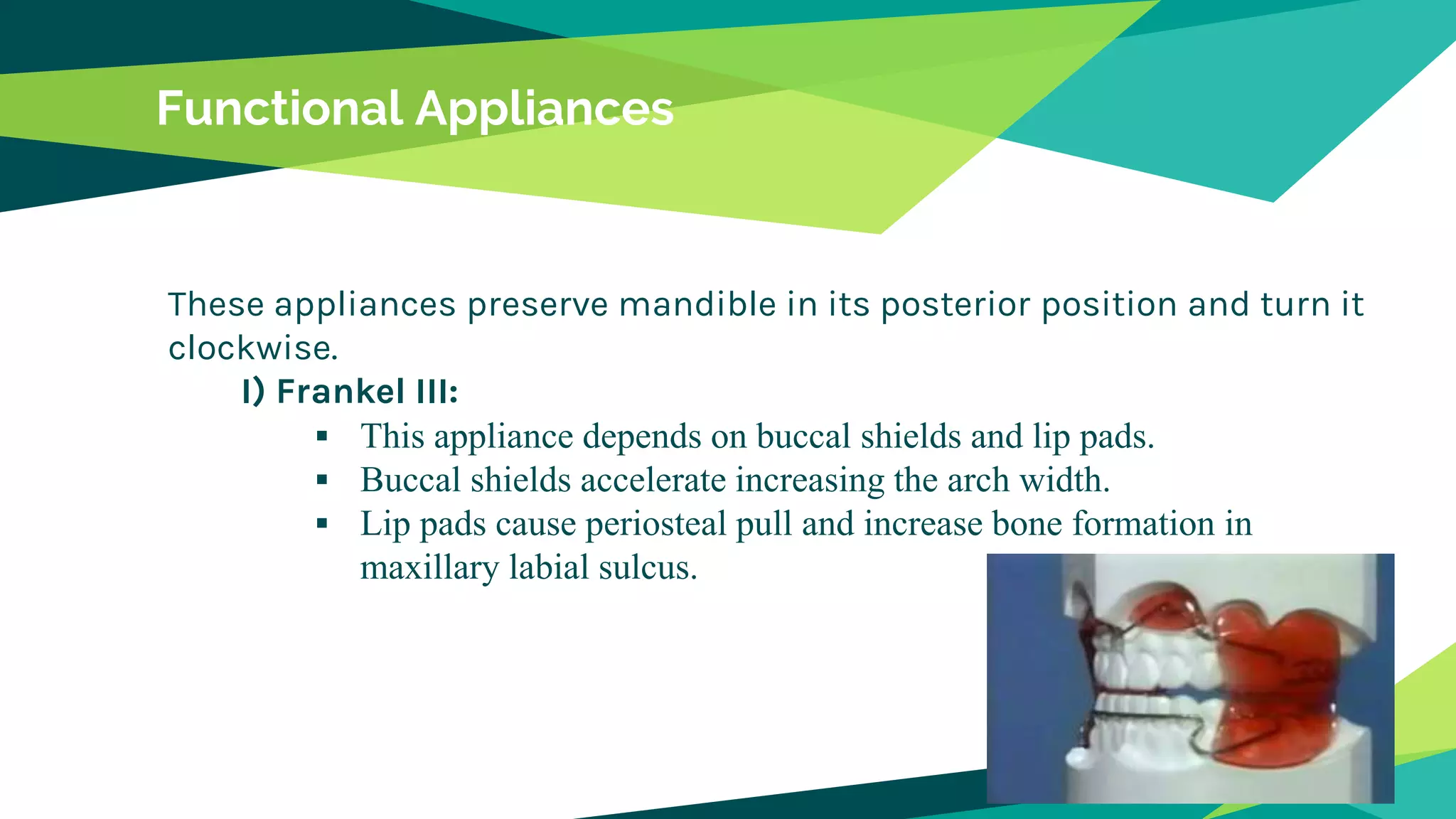
I) Frankel III:
 This appliance depends on buccal shields and lip pads.
 Buccal shields accelerate increasing the arch width.
 Lip pads cause periosteal pull and increase bone formation in
maxillary labial sulcus.
Functional Appliances
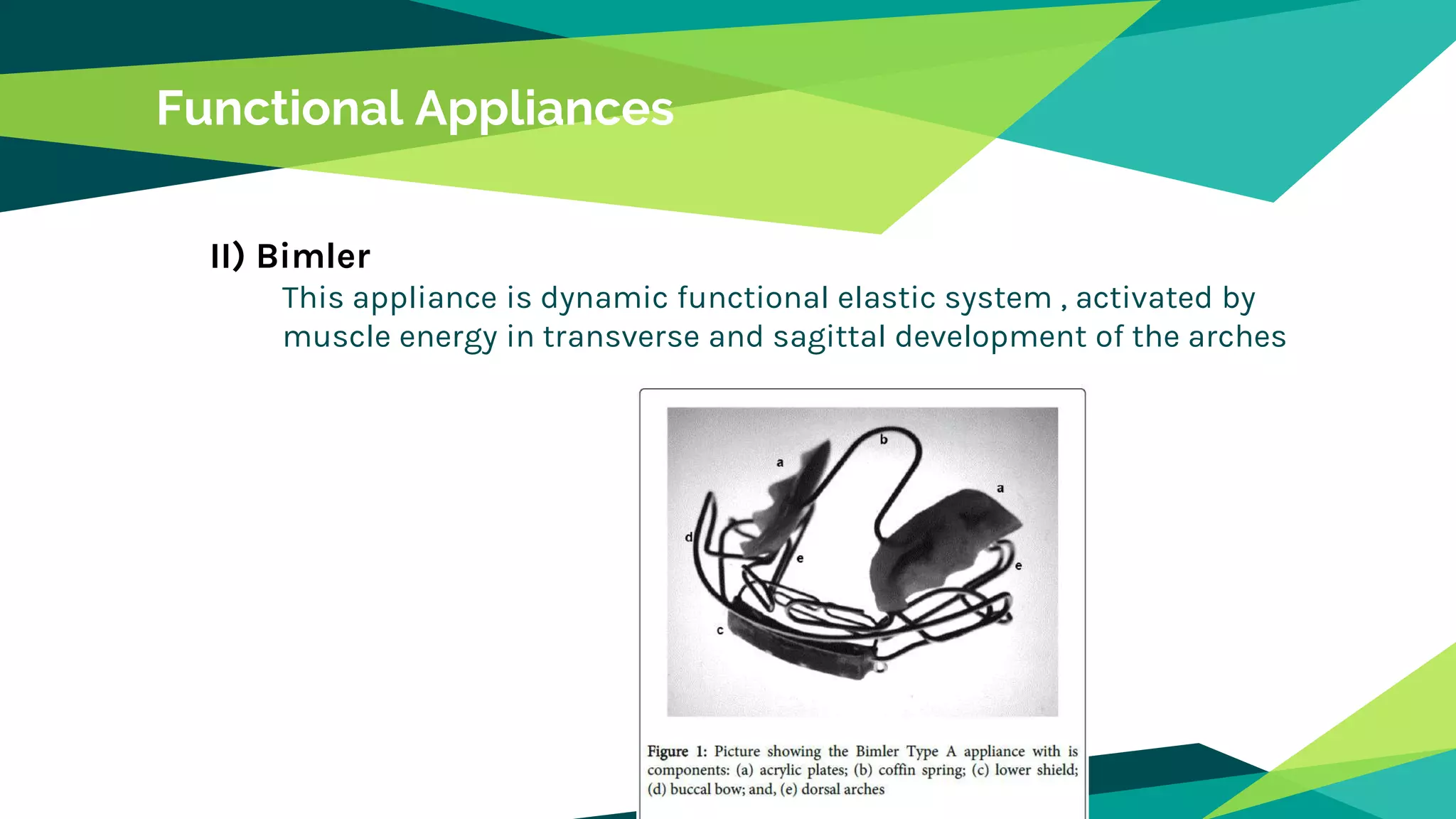
II) Bimler
This appliance is dynamic functional elastic system , activated by
muscle energy in transverse and sagittal development of the arches
Functional Appliances
III) Herren
Functional Appliances
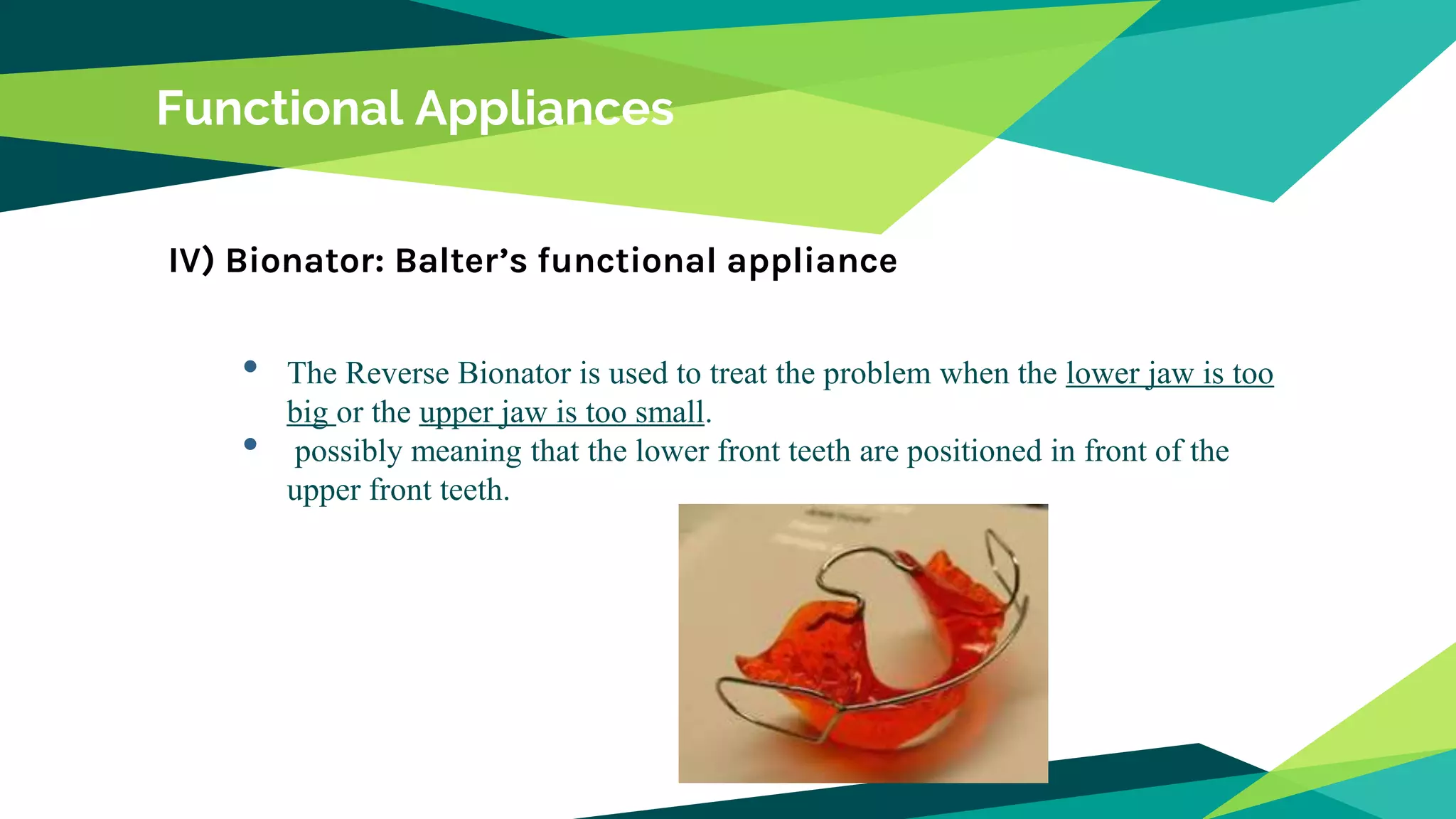
IV) Bionator: Balter’s functional appliance
• The Reverse Bionator is used to treat the problem when the lower jaw is too
big or the upper jaw is too small.
• possibly meaning that the lower front teeth are positioned in front of the
upper front teeth.
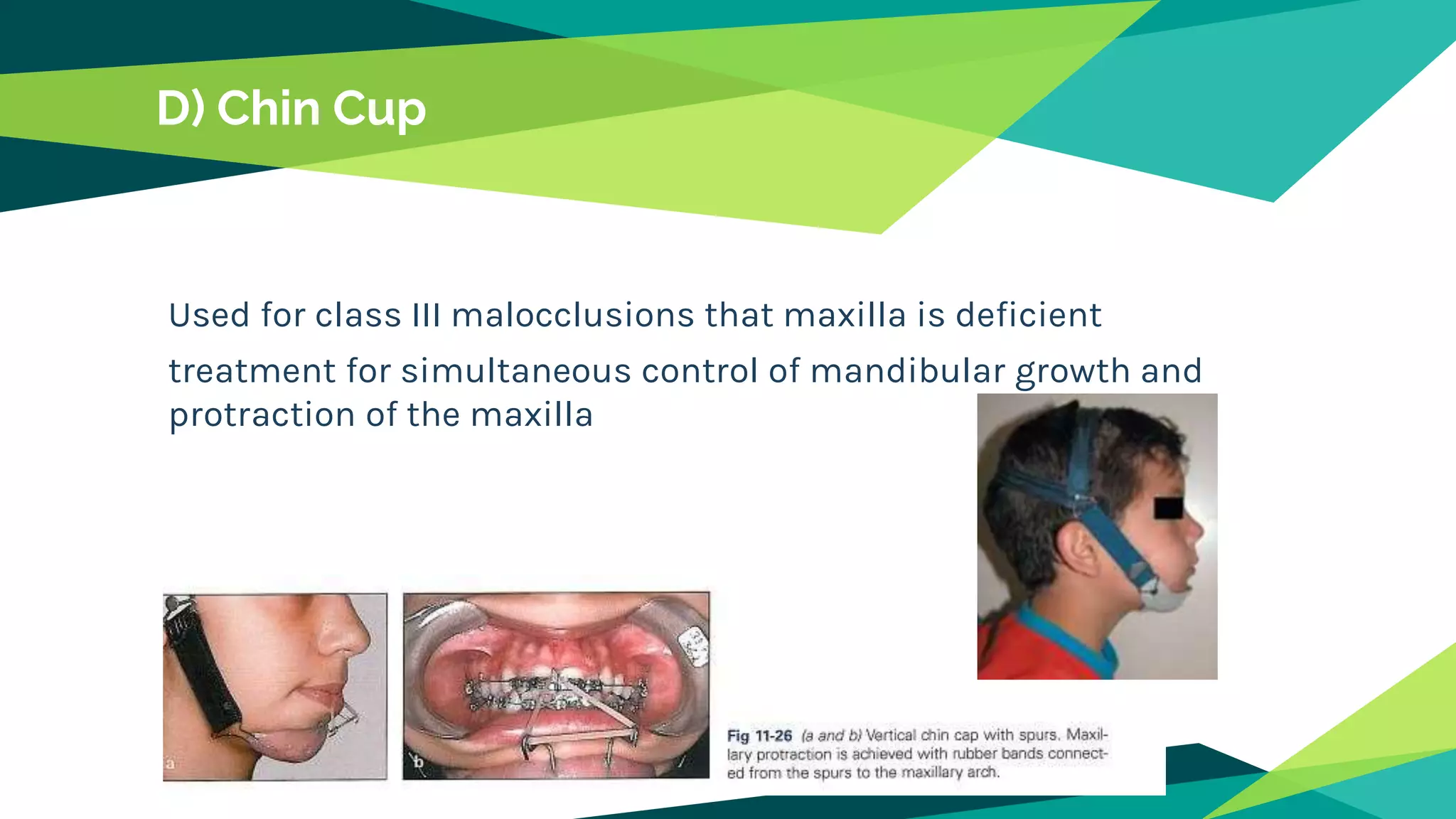
D) Chin Cup
Used for class III malocclusions that maxilla is deficient
treatment for simultaneous control of mandibular growth and
protraction of the maxilla
D) Chin Cup
• Because of backward mandibular rotation,control of vertical growth is
difficult to manage.
• This effect has advantages in horizontal grower patients and worsens
the vertical grower individuals.
D) Chin Cup
• 300-500gr. force per side
• 14 hours a day
• The orthopedic force is usually directed through the condyle or below the
condyle
• Duration of Tx: 1-4 years
• (at the 1st year 14 hours daily and after the 1st year 8 hours is sufficient.)
• More successful when is started in the primary or early mixed dentition
Face mask-chin cap combination
• The face mask-chin cap combination (FCC) is a special
orthopedic device the dr.bahreman originally designed
• This device can be used in early treatment of all kinds of skeletal
Class III, whether they result from maxillary deficiency, mandibular
prognathism, or a combination of both.
• With some minor modifications, the FCC can also be applied in
Class III with a horizontal or vertical growth pattern
Face mask-chin cap combination
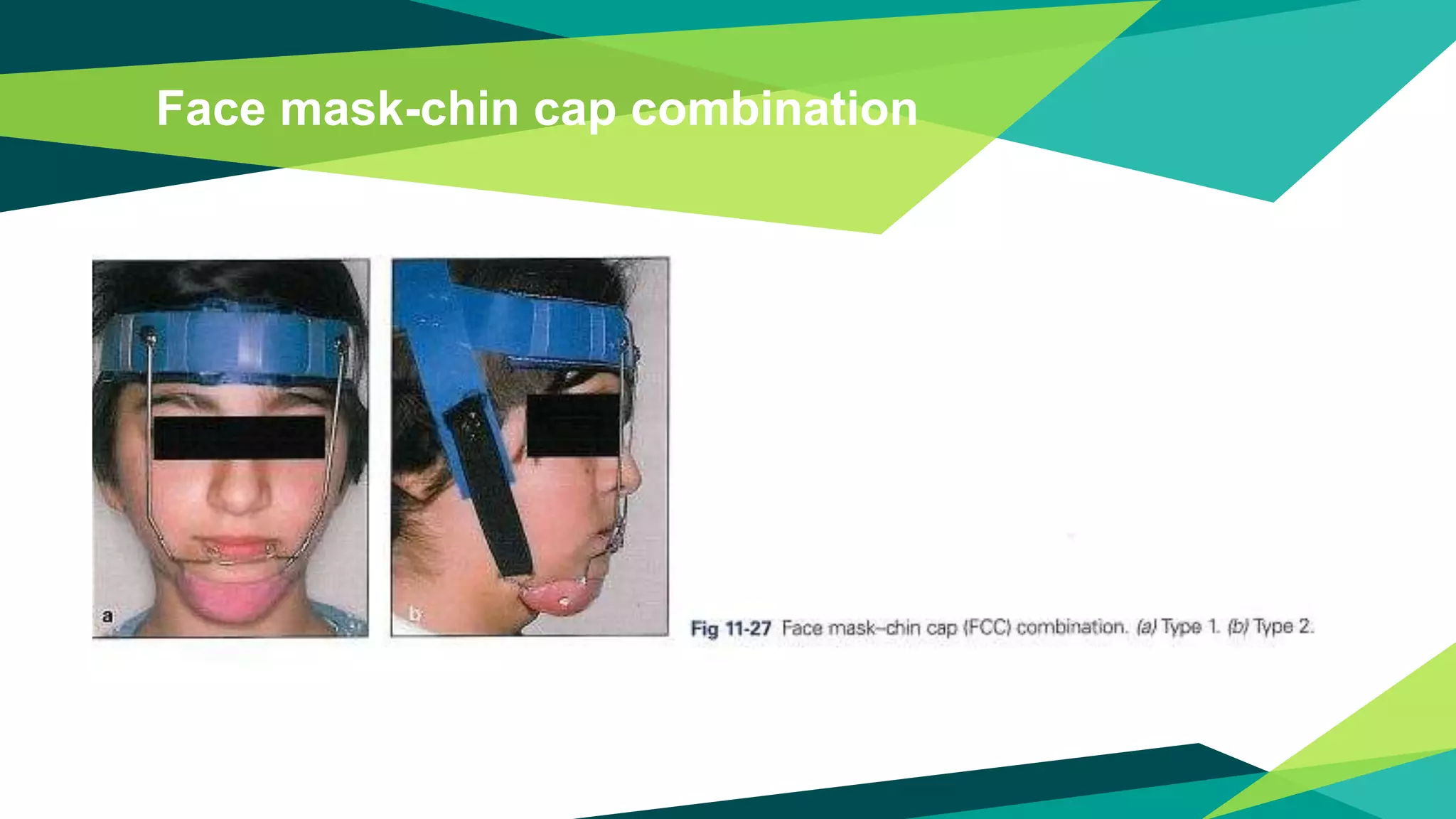
• FCC has two types . Both types have a soft head holder pad that
can be adjusted to each patient's head size and shape. The
advantage of the head holder is that the appliance can be firmly
held to the face all night without any slipping
• The type 1. FCC has a chin cap without traction and use in Class
III patients with maxillary deficiency and a normal mandible.
• type 2 FCC, besides the head holder pad and acrylic resin chin
cap, has a traction elastic connected to the cap on each side of
the face.
• Use in Class III patients with maxillary and mandibular deficiency
Face mask-chin cap combination
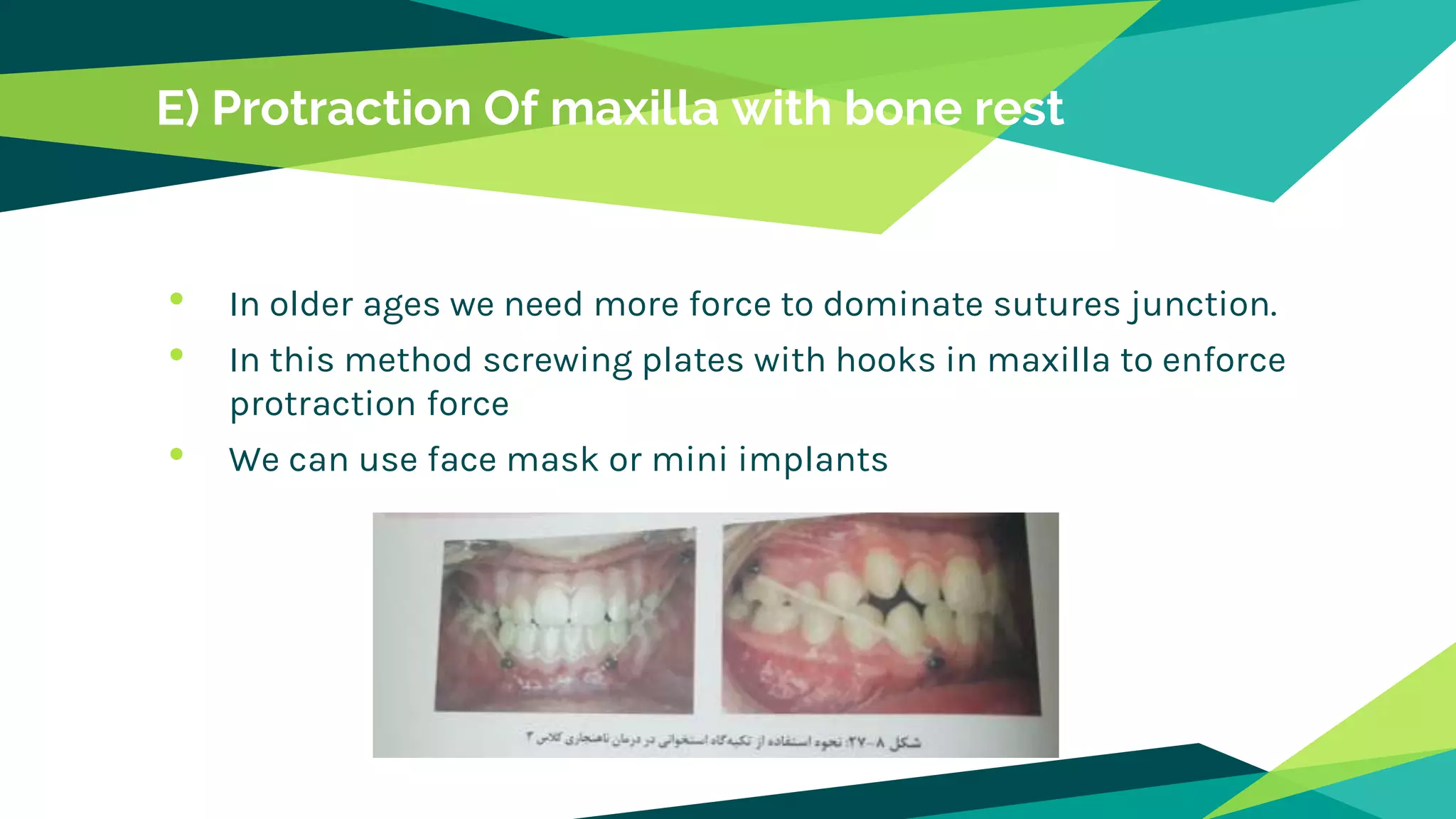
E) Protraction Of maxilla with bone rest
• In older ages we need more force to dominate sutures junction.
• In this method screwing plates with hooks in maxilla to enforce
protraction force
• We can use face mask or mini implants
Mandibular excess in sagittal plane
A) Functional Appliances
a) Mandible is positioned downward and backward
b) Correction of molar cl III Relation
c) For patients with lower facial height normal or lower
d) Camouflage with lingual tipping of lower incisors and labial tipping of
upper incisors
B) Chin Cap
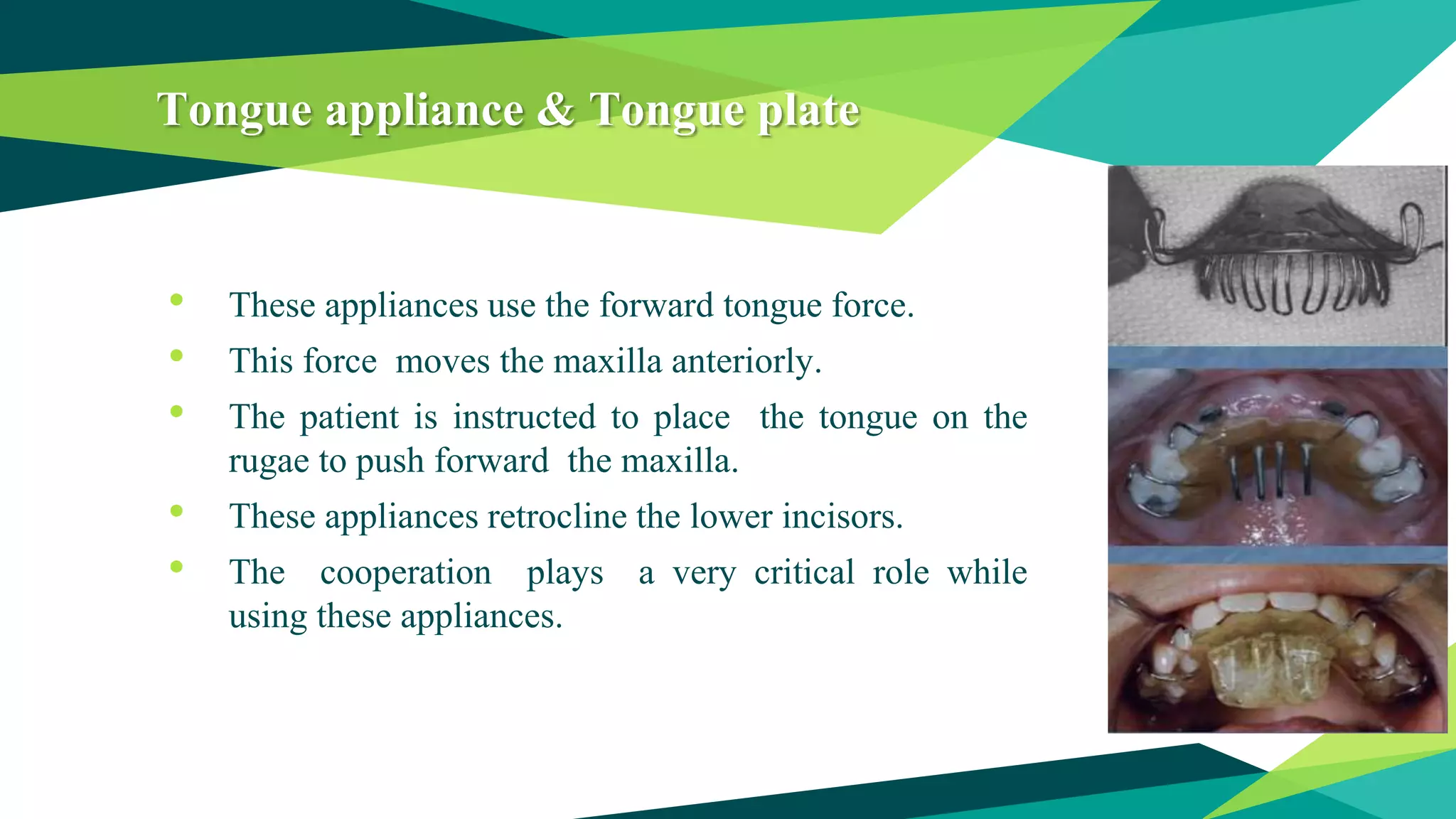
Tongue appliance & Tongue plate
• These appliances use the forward tongue force.
• This force moves the maxilla anteriorly.
• The patient is instructed to place the tongue on the
rugae to push forward the maxilla.
• These appliances retrocline the lower incisors.
• The cooperation plays a very critical role while
using these appliances.
Camouflage treatments
Class III camouflage would be based on a combination of retraction
of lower incisors and forward movement of maxillar incisors and, of
course, would be successful only if the malocclusion was corrected
without harming the facial appearance.
Patients should:
1. After growth sprut
2. Mild malocclusion
3. Alignment of teeth are correct
4. Normal vertical grow
Camouflage treatments
Approaches:
• extraction of mandibular first and maxillary second premolars
with use of Class III elastics
• Extraction of one lower incisor, which prevents major retraction
of the lower teeth, while the maxillary incisors are moved
facially with some tipping allowed.
• using skeletal anchorage to move the whole lower arch
posteriorly
Retention After Class III Correction
• Retaining a patient after correcting a Class III malocclusion
early in the permanent dentition can be frustrating, because
relapse from continuing mandibular growth is very likely to
occur and such growth is extremely difficult to control
• Chin cup, is not nearly as effective in controlling growth in a
Class III patient as applying a restraining force to the maxilla is
in Class 11 problems. As we have noted in previous chapters, a
chin cup tends to rotate the mandible downward, causing
growth to be expressed more vertically and less horizontally,
Advantages of early treatment
• Prevent structural damage and adverse effect on maxilla
• eliminates the mandibular shift
• unlocks the maxillary incisors and the incisive bone to enhance
maxillary growth for better function and esthetics,
• preserves and facilitates eruption of the canines by increasing
anterior arch length
Consequences of delayed treatment
• A-B discrepancy and maxillary retrusion  require full bonding
and facemask
• Structural damage to involved teeth and supporting structure
• Crowding in anterior
• Adverse effect on jaw growth
Thank U For Ur Attention!

Class III malocclusion

  • 1.
  • 2.
    Introduction Class III orMesiocclusion Maxillary first molars Mesiobuccal cusp, occludes between mandibular first and second molar. Psudo class III malocclusion Forward moving of mandible during closure
  • 3.
    Definition • A sagittaldifference between maxillary and mandibular bases ANB< 1 & Wits’ appraisal < -1 • A sagittal difference between maxillary and mandibular arch size. • The relation between maxillary and mandibular canines and molars.
  • 4.
    Epidemiology Global Class I ClassII Class III Normal Occ Iran 1 Class I Class II Class III Normal Occ.
  • 5.
  • 6.
    Etiology Genetics Polygenic pattern Environment Functional matrix Habits Neuromuscularsystem Congenital Plate cleft crouzon syndrome Apert Syndrome Hormones Hypothyroidism Excess in growth hormone
  • 7.
    Features of ClassIII malocclusion Clinical Cephalometric Concave profile Increase in Go Angle Growth excess of mandible Decrease in ANB Growth deficiency of maxilla Witts < 0 Downward position of tongue in rest Decrease in Ar Long face Decrease in size of anterior cranial base Decrease in overjet Increase in size of mandible Unilateral or bilateral posterior cross bite Protrusion of maxillary teeth Canine and molar class III relation Retrusion of mandibular teeth Crowding in maxilla Spacing in mandible
  • 8.
    Four different typesof skeletal CL III ◆ Normal maxilla and mandibular prognathism ◆ Maxillary retrusion and normal mandible
  • 9.
    Four different typesof skeletal CL III ◆ Normal maxilla and mandible(dento-alveolar) ◆ Maxillary retrusion and mandibular prognathism
  • 10.
    Skeletal & DentalClass III Muscular Because of premature contacts, muscles move mandible forward to class III position
  • 11.
    “ Treatment Of ClassIII Malocclusion
  • 12.
    Maxilla Growth Deficiencyin sagittal and transverse plane A) Functional Appliances B) Reverse Pull Headgear or Facemask C) Modified protraction Headgear D) Reverse Chincap E) Protraction Of maxilla with bone rest
  • 13.
    Functional Appliances These appliancespreserve mandible in its posterior position and turn it clockwise. I) Frankel III:  This appliance depends on buccal shields and lip pads.  Buccal shields accelerate increasing the arch width.  Lip pads cause periosteal pull and increase bone formation in maxillary labial sulcus.
  • 14.
    Functional Appliances II) Bimler Thisappliance is dynamic functional elastic system , activated by muscle energy in transverse and sagittal development of the arches
  • 15.
  • 16.
    Functional Appliances IV) Bionator:Balter’s functional appliance • The Reverse Bionator is used to treat the problem when the lower jaw is too big or the upper jaw is too small. • possibly meaning that the lower front teeth are positioned in front of the upper front teeth.
  • 17.
    D) Chin Cup Usedfor class III malocclusions that maxilla is deficient treatment for simultaneous control of mandibular growth and protraction of the maxilla
  • 18.
    D) Chin Cup •Because of backward mandibular rotation,control of vertical growth is difficult to manage. • This effect has advantages in horizontal grower patients and worsens the vertical grower individuals.
  • 19.
    D) Chin Cup •300-500gr. force per side • 14 hours a day • The orthopedic force is usually directed through the condyle or below the condyle • Duration of Tx: 1-4 years • (at the 1st year 14 hours daily and after the 1st year 8 hours is sufficient.) • More successful when is started in the primary or early mixed dentition
  • 20.
    Face mask-chin capcombination • The face mask-chin cap combination (FCC) is a special orthopedic device the dr.bahreman originally designed • This device can be used in early treatment of all kinds of skeletal Class III, whether they result from maxillary deficiency, mandibular prognathism, or a combination of both. • With some minor modifications, the FCC can also be applied in Class III with a horizontal or vertical growth pattern
  • 21.
    Face mask-chin capcombination • FCC has two types . Both types have a soft head holder pad that can be adjusted to each patient's head size and shape. The advantage of the head holder is that the appliance can be firmly held to the face all night without any slipping • The type 1. FCC has a chin cap without traction and use in Class III patients with maxillary deficiency and a normal mandible. • type 2 FCC, besides the head holder pad and acrylic resin chin cap, has a traction elastic connected to the cap on each side of the face. • Use in Class III patients with maxillary and mandibular deficiency
  • 22.
    Face mask-chin capcombination
  • 23.
    E) Protraction Ofmaxilla with bone rest • In older ages we need more force to dominate sutures junction. • In this method screwing plates with hooks in maxilla to enforce protraction force • We can use face mask or mini implants
  • 24.
    Mandibular excess insagittal plane A) Functional Appliances a) Mandible is positioned downward and backward b) Correction of molar cl III Relation c) For patients with lower facial height normal or lower d) Camouflage with lingual tipping of lower incisors and labial tipping of upper incisors B) Chin Cap
  • 25.
    Tongue appliance &Tongue plate • These appliances use the forward tongue force. • This force moves the maxilla anteriorly. • The patient is instructed to place the tongue on the rugae to push forward the maxilla. • These appliances retrocline the lower incisors. • The cooperation plays a very critical role while using these appliances.
  • 26.
    Camouflage treatments Class IIIcamouflage would be based on a combination of retraction of lower incisors and forward movement of maxillar incisors and, of course, would be successful only if the malocclusion was corrected without harming the facial appearance. Patients should: 1. After growth sprut 2. Mild malocclusion 3. Alignment of teeth are correct 4. Normal vertical grow
  • 27.
    Camouflage treatments Approaches: • extractionof mandibular first and maxillary second premolars with use of Class III elastics • Extraction of one lower incisor, which prevents major retraction of the lower teeth, while the maxillary incisors are moved facially with some tipping allowed. • using skeletal anchorage to move the whole lower arch posteriorly
  • 28.
    Retention After ClassIII Correction • Retaining a patient after correcting a Class III malocclusion early in the permanent dentition can be frustrating, because relapse from continuing mandibular growth is very likely to occur and such growth is extremely difficult to control • Chin cup, is not nearly as effective in controlling growth in a Class III patient as applying a restraining force to the maxilla is in Class 11 problems. As we have noted in previous chapters, a chin cup tends to rotate the mandible downward, causing growth to be expressed more vertically and less horizontally,
  • 29.
    Advantages of earlytreatment • Prevent structural damage and adverse effect on maxilla • eliminates the mandibular shift • unlocks the maxillary incisors and the incisive bone to enhance maxillary growth for better function and esthetics, • preserves and facilitates eruption of the canines by increasing anterior arch length
  • 30.
    Consequences of delayedtreatment • A-B discrepancy and maxillary retrusion  require full bonding and facemask • Structural damage to involved teeth and supporting structure • Crowding in anterior • Adverse effect on jaw growth
  • 31.
    Thank U ForUr Attention!