CONTENTS
 INTRODUCTION
 DEFINITION
 ETIOLOGY
 FREQUENCY
 CLASSIFICATION
 CLINICAL EXAMINATION
 GROWTH COSIDERATION
 GOALS OF EARLY INTERCEPTIVE TREATMENT
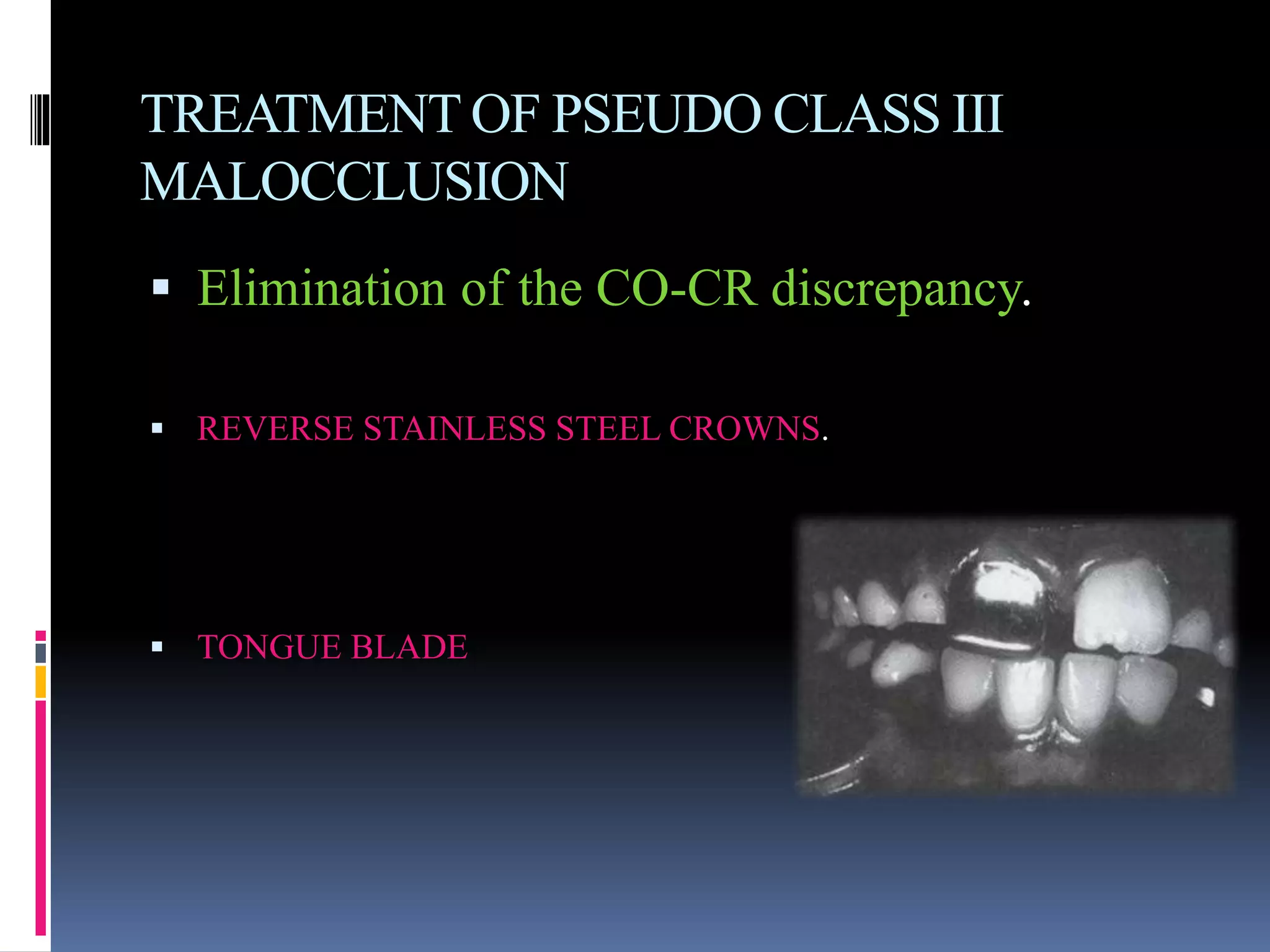
 TREATMENT OF PSEUDO CLASS III MALOCCLUSION
 TREATMENT OF SKELETAL CLASS III MALOCCLUSION
 CONCLUSION
 REFERENCE
INTRODUCTION
 Orthodontic treatment not only involves
establishment of physiologically and
anatomically functional occlusion but also
includes correction of the relationship of the
maxilla and mandible to each other and to the
rest of the craniofacial complex.
DEFINITION
 According to Angle (1899): Class III
malocclusion occurred when the lower
teeth occluded mesial to their normal
relationship by the width of one premolar
or even more in extreme cases. (mesio-
occlusion)
ETIOLOGY
 GENITIC
 McGuigan (1966) – Inheritance of class III
malocclusion in Hapsburg Family, having
the distinct characteristics of prognathic
lower jaw.
 Litton et al (1970) – Dental characteristics
of class III are related to genetic
inheritance.
 Rakosi & Schilli (1981) environmental
factors: Habits and mouth Breathing
 Enlarged tonsils and naso-respiratory
diseases.
 Premature loss of deciduous molars:
Results in anterior mandibular
displacement.
 TERATOGENS:
 Cleft lip and palate result in maxillary deficiency in most occasions a
class III malocclusion is established. Teratogens causing cleft lip and
palate are aspirin, cigarette smoke (hypoxia), Dilantin, 6-
Mercaptopurine, valium etc
 Vitamin D excess causes premature closure of sutures and
might lead to class III malocclusion
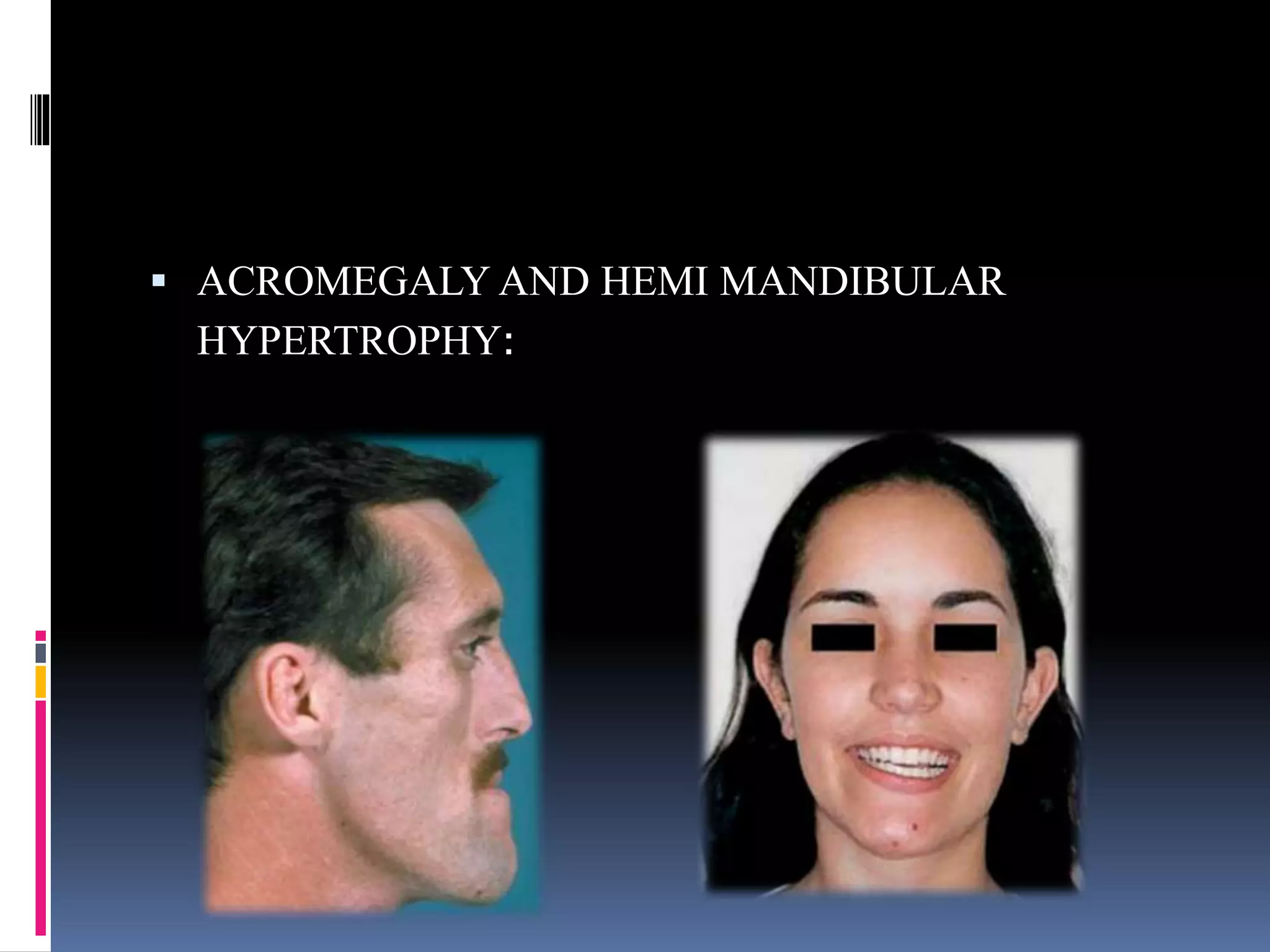
 ACROMEGALY AND HEMI MANDIBULAR
HYPERTROPHY:
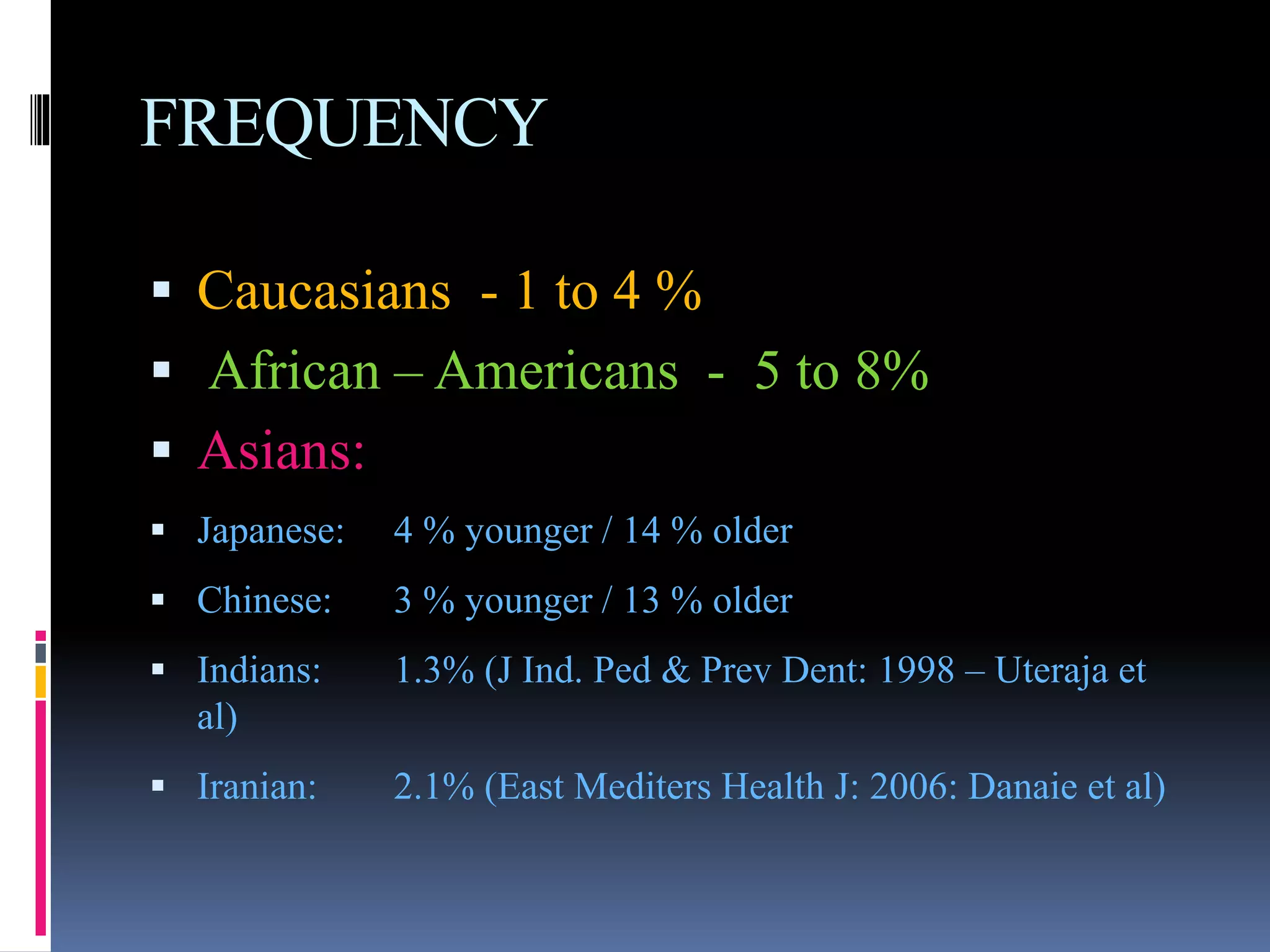
FREQUENCY
 Caucasians - 1 to 4 %
 African – Americans - 5 to 8%
 Asians:
 Japanese: 4 % younger / 14 % older
 Chinese: 3 % younger / 13 % older
 Indians: 1.3% (J Ind. Ped & Prev Dent: 1998 – Uteraja et
al)
 Iranian: 2.1% (East Mediters Health J: 2006: Danaie et al)
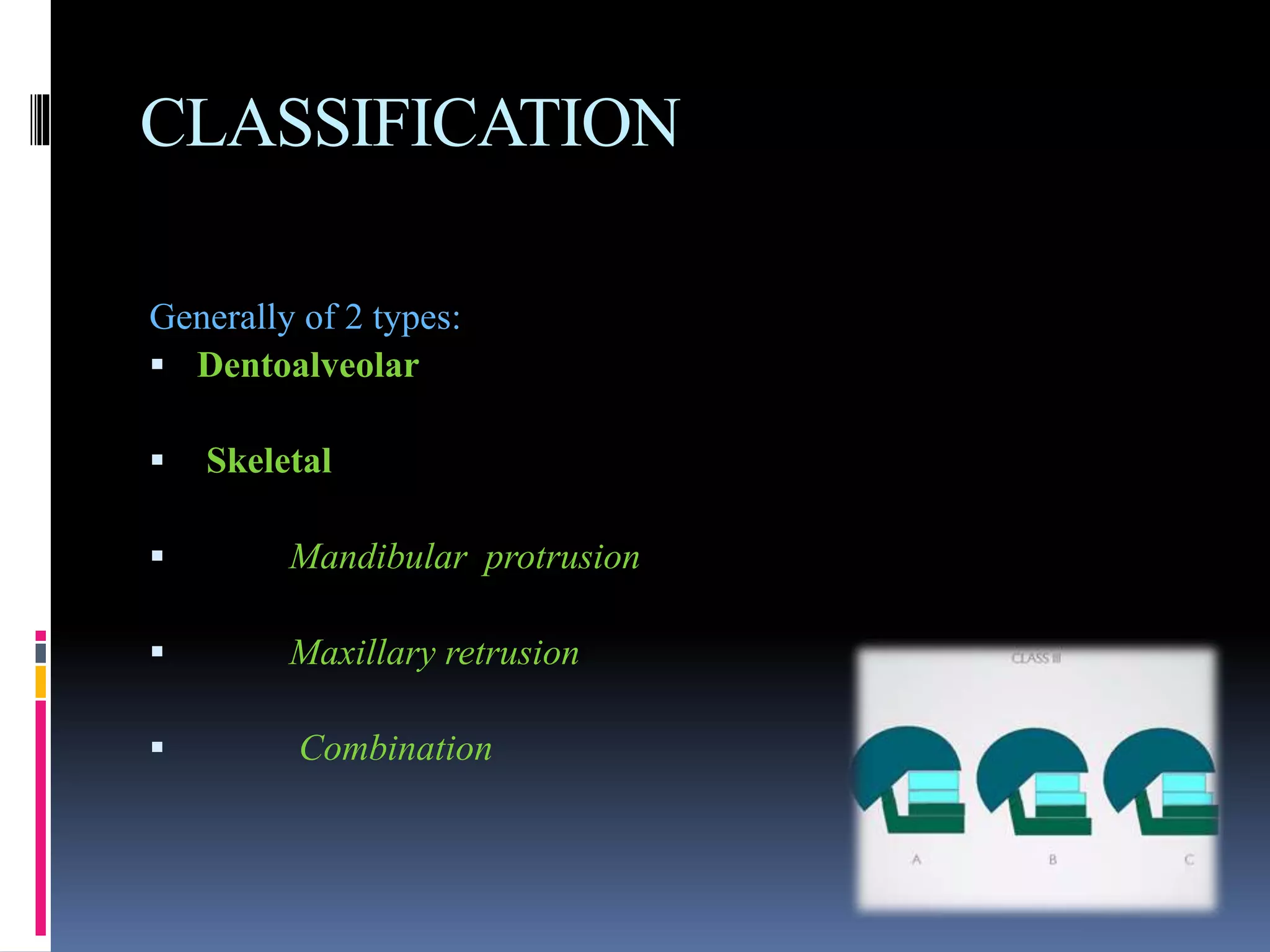
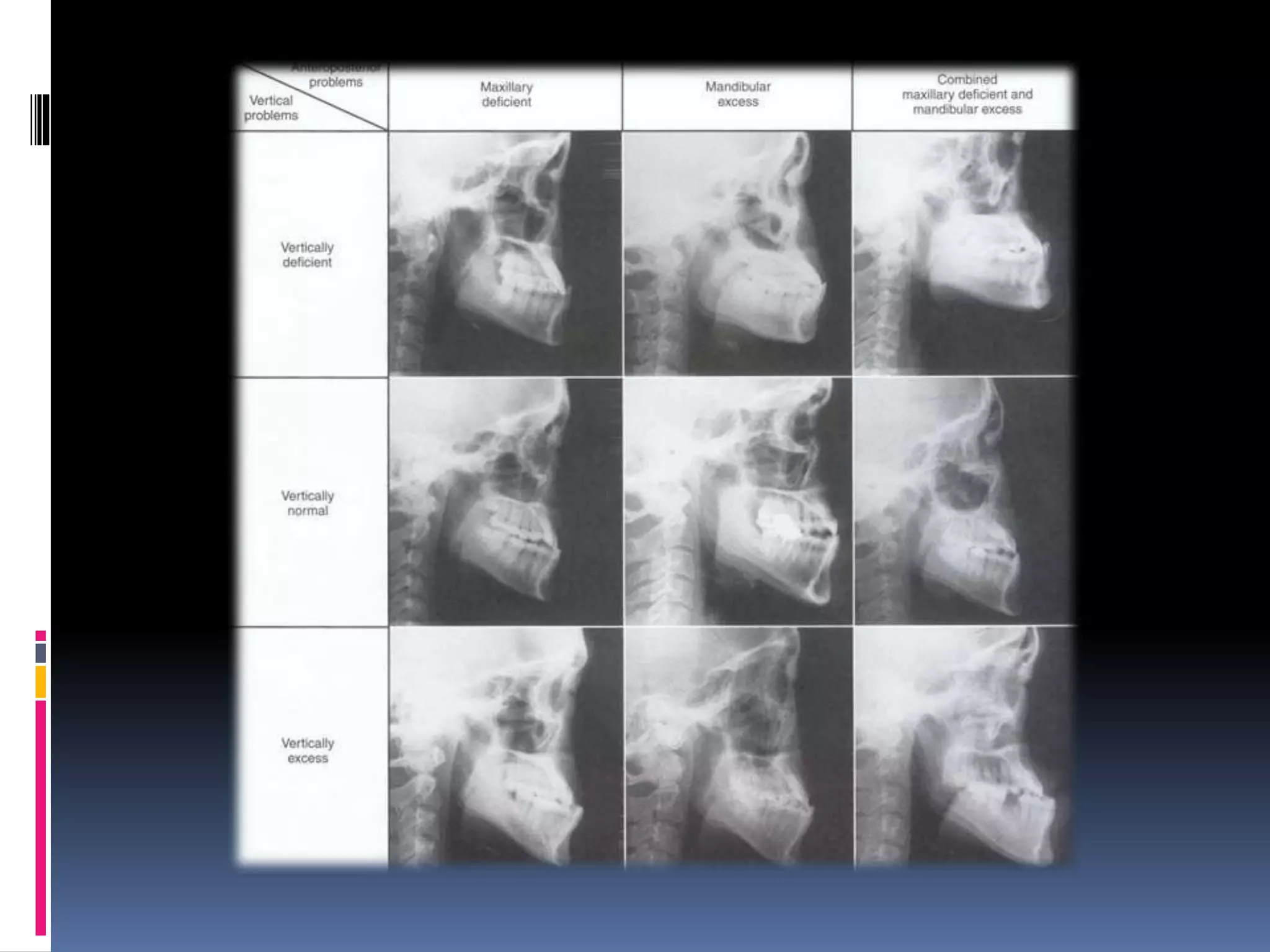
CLASSIFICATION
Generally of 2 types:
 Dentoalveolar
 Skeletal
 Mandibular protrusion
 Maxillary retrusion
 Combination
 PSEDUO CLASS III
Malocclusion is produced by a forward movement of
mandible during jaw closure.
Also known as habitual or postural class III malocclusion.
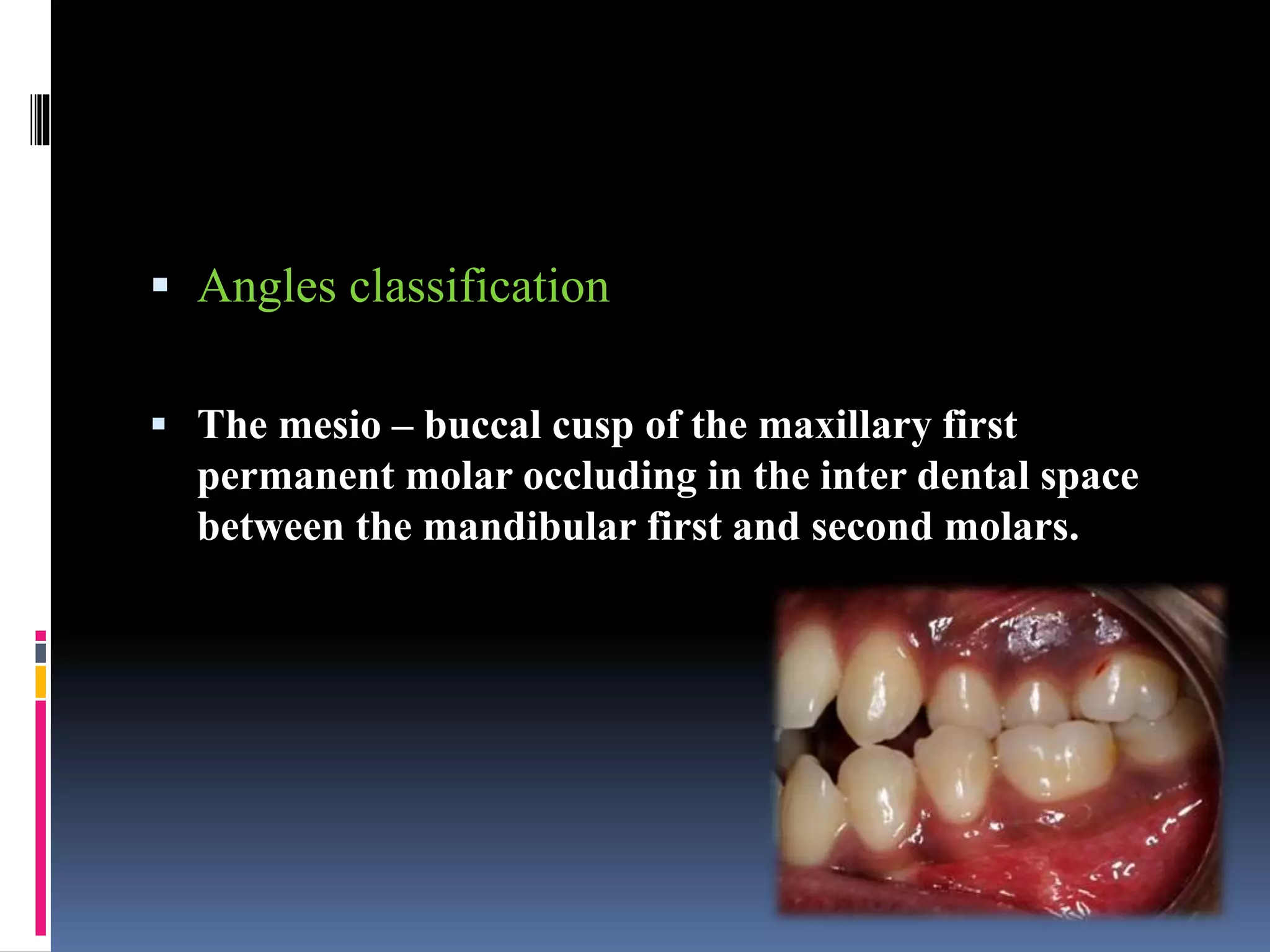
 Angles classification
 The mesio – buccal cusp of the maxillary first
permanent molar occluding in the inter dental space
between the mandibular first and second molars.
 Class III Modification of Dewey
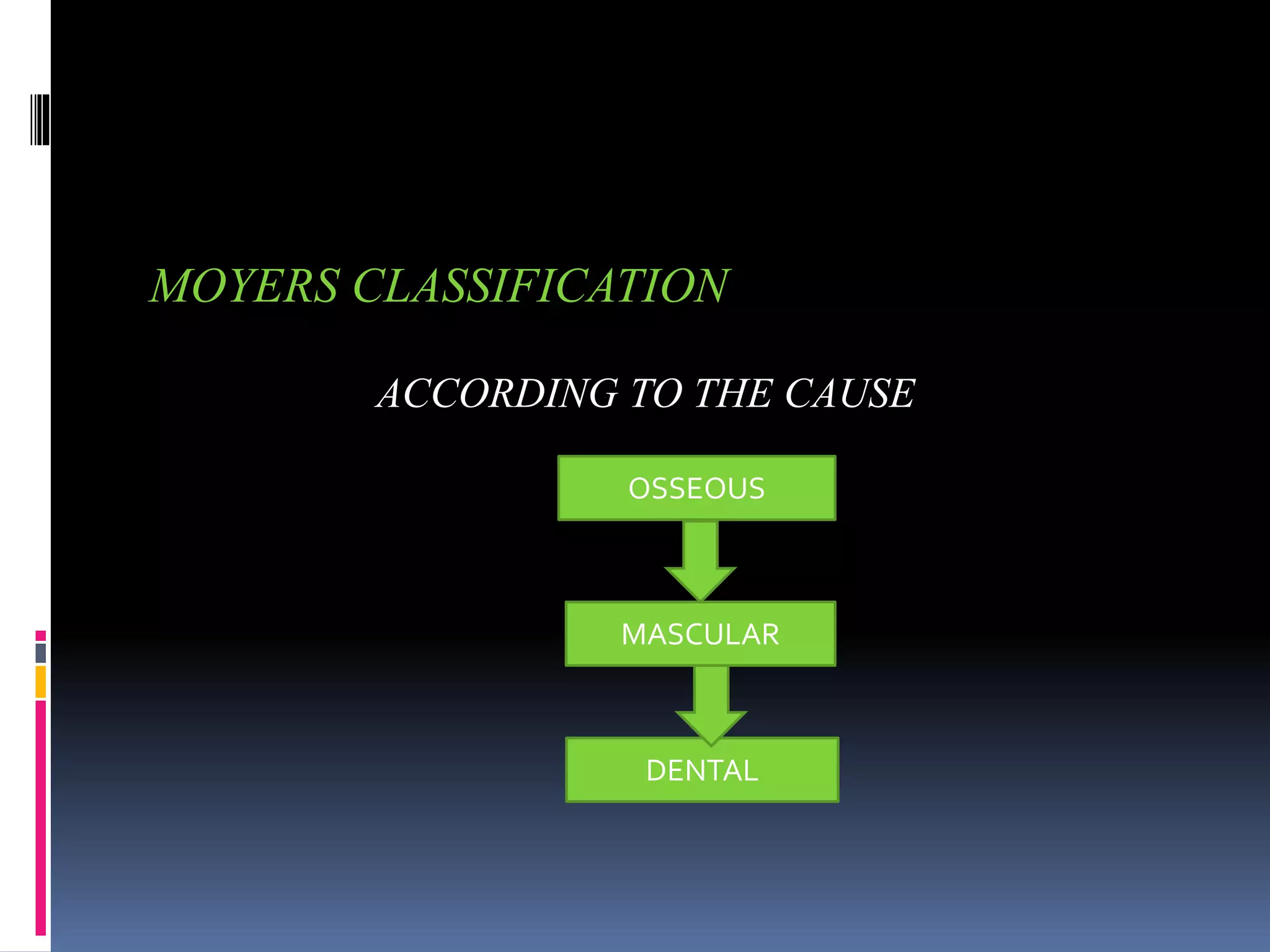
MOYERS CLASSIFICATION
ACCORDING TO THE CAUSE
OSSEOUS
MASCULAR
DENTAL
CLINICAL EXAMINATION
 EXRAORAL FEATURES:
 A CONCAVE FACE,DEFICIENT MAXILLA OR PROMINENT CHIN.
 MALAR DEFICIENCY RESULTING INTO FLAT FACE
 INCREASED LOWER ANTERIOR FACIAL HEIGHT
 ANATOMICALLY LARGE LOWER LIP LENGTH
 INTRAORAL FEATURES
 ZERO OR –VE OVERJET
 NARROW MAXILLARYARCH WITH CROWDING
 UNILATERAL OR BILATERAL POSTERIOR CROSSBITE
 PROCLINED MAXILLARY INCISORS
 RETROCLINED MANDIBULAR INCISORS
 LOW TONGE POSTURE

 FLAT CURVE OF SPEE.
GROWTH COSIDERATIONS
 Sugawara and Mitani :Reported similar increments
between patients with Class III and Class I malocclusions
during the prepubertal pubertal and postpubertal growth
periods.
 Battagel :found that the largest increment of facial
growth for males occurred between the ages of 14 and 16
years.
 whereas in female patients the maximum increment of
facial growth occurred between the ages of 9.5 to12 years,
although active growth continued in the nasal area and
both jaws after the age of 15 years.
Goals of early interceptive treatment
 (1) preventing progressive, irreversible soft tissue, or
bony changes.
 (2) improving skeletal discrepancies and providing a more
favourable environment for future growth.
 (3) improving occlusal function;
 (4) simplifying phase II comprehensive treatment
 and minimizing the need for orthognathic surgery
 (5) providing more pleasing facial esthetics
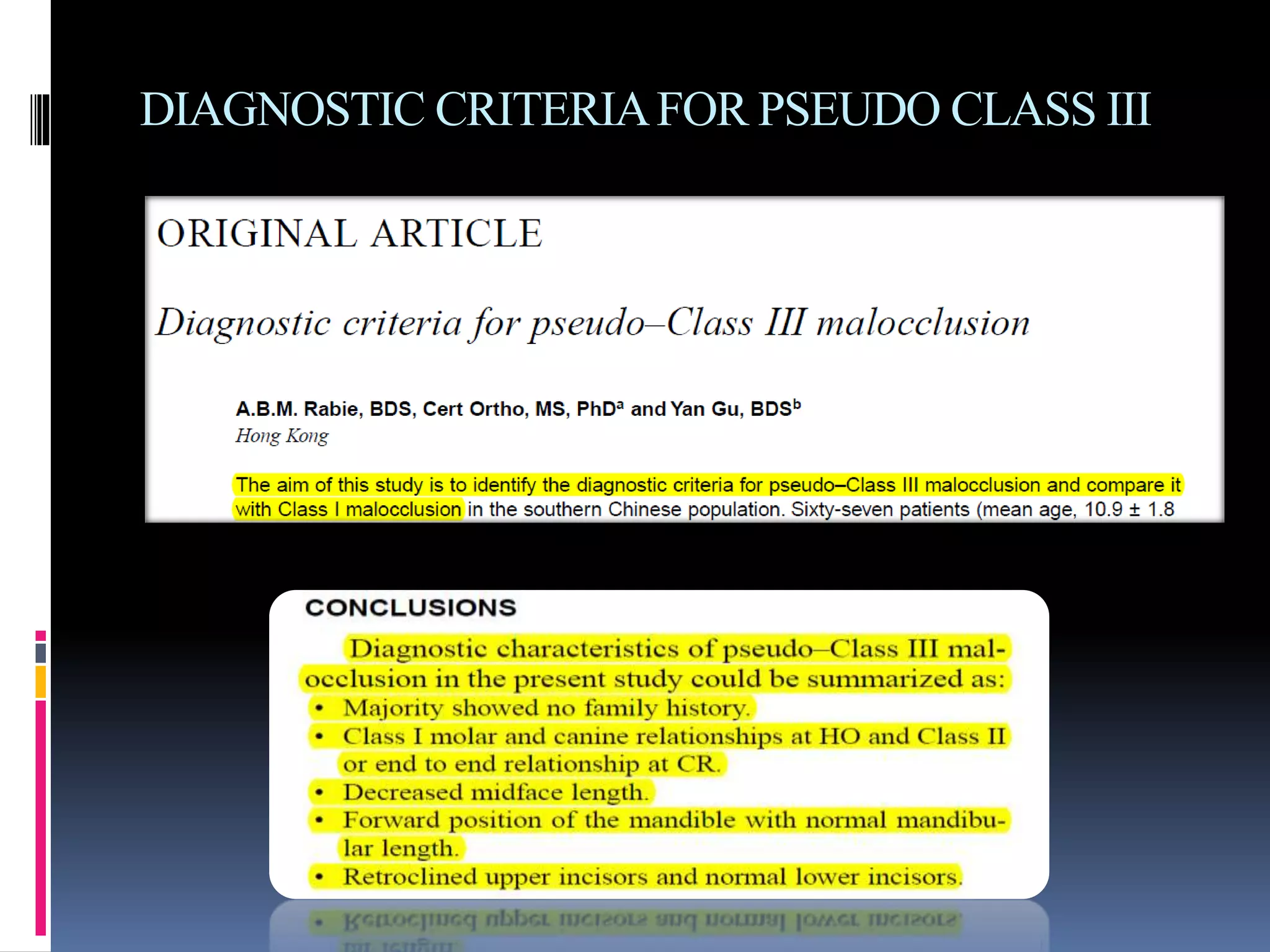
DIAGNOSTIC CRITERIAFOR PSEUDO CLASS III
TREATMENT OF PSEUDO CLASS III
MALOCCLUSION
 Elimination of the CO-CR discrepancy.
 REVERSE STAINLESS STEEL CROWNS.
 TONGUE BLADE
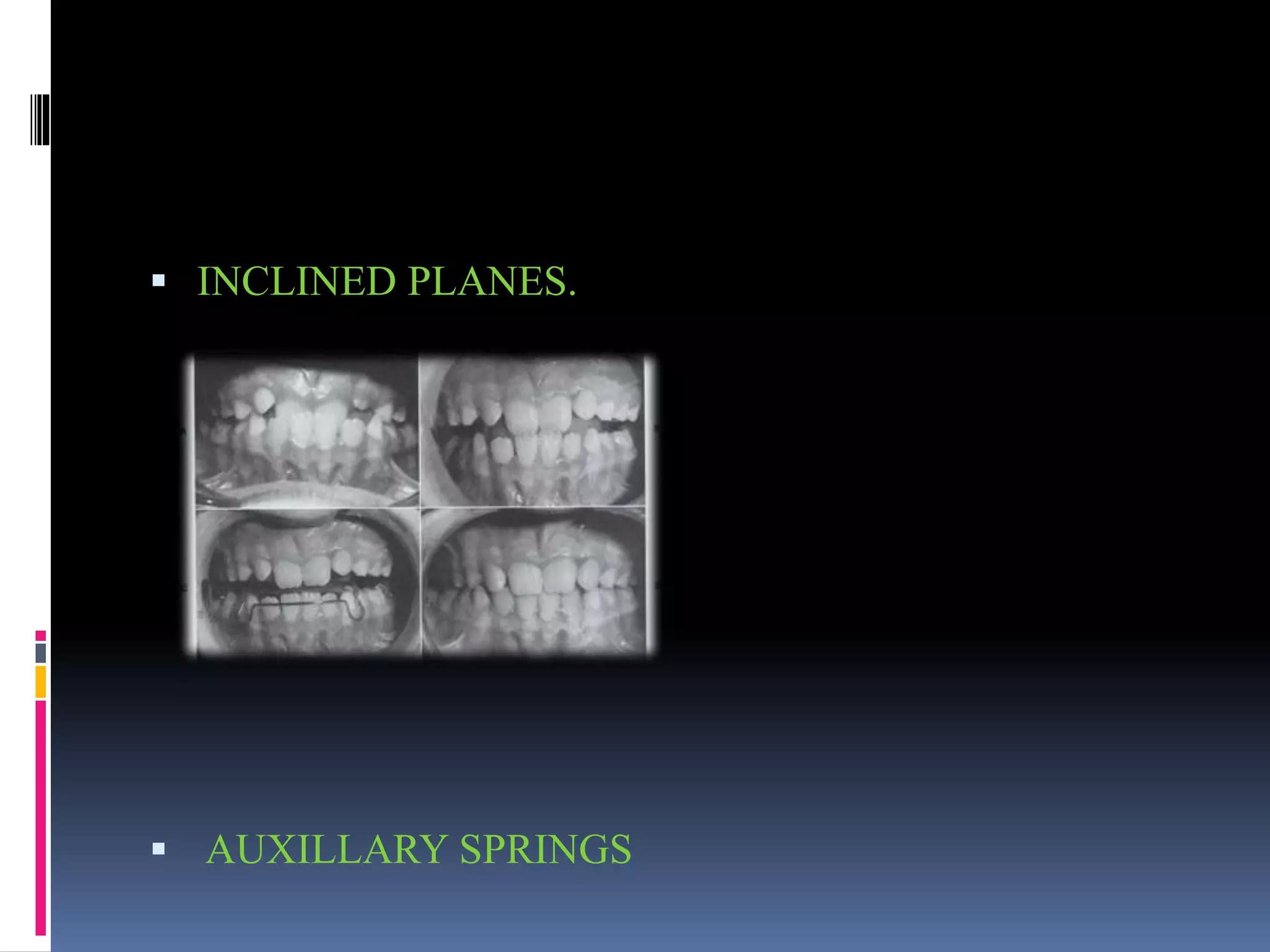
 INCLINED PLANES.
 AUXILLARY SPRINGS
TREATMENTOF SKELETALCLASS III MALOCCLUSION.
FUNCTIONAL APPLIANCE THERAPY
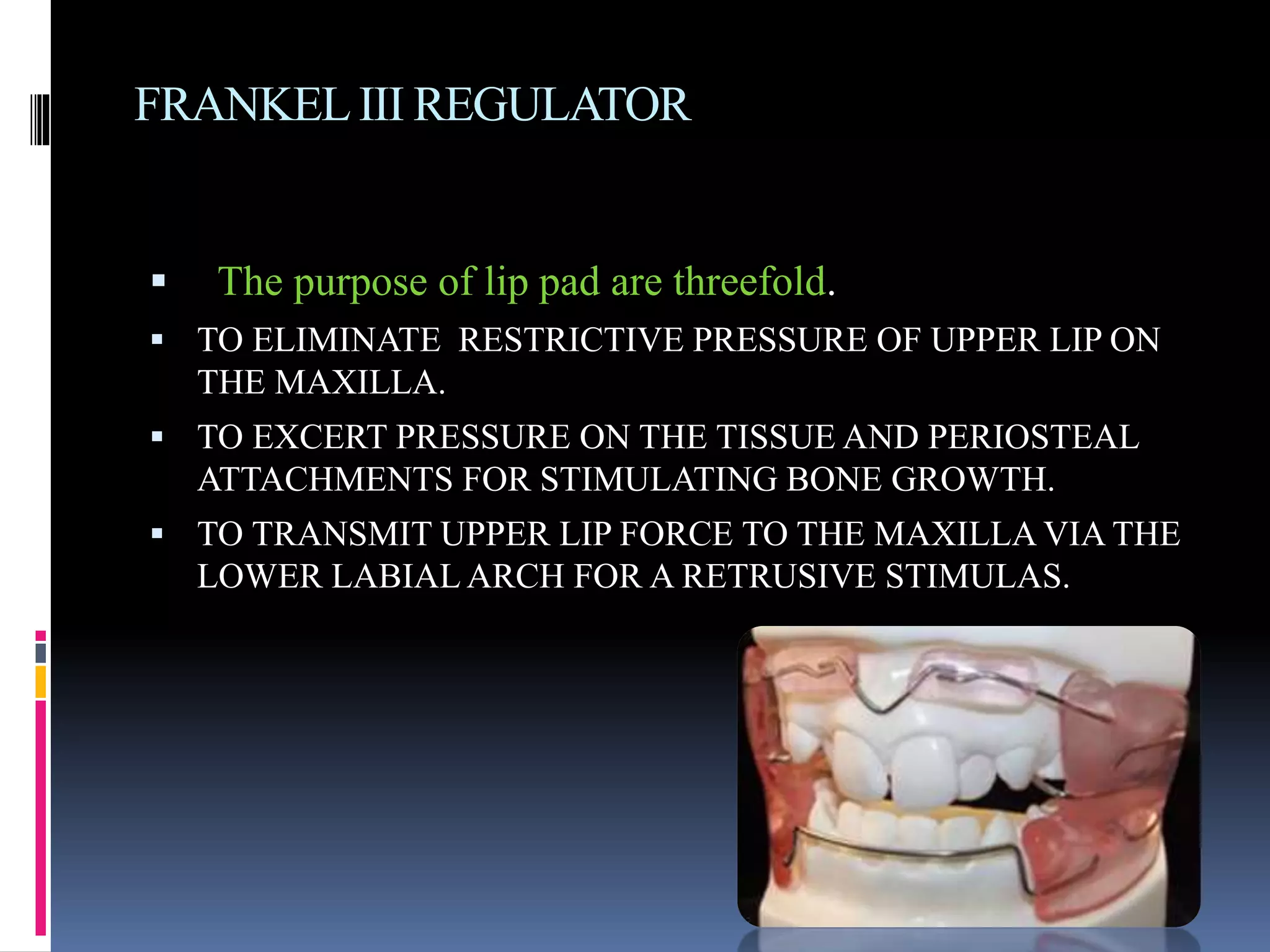
FRANKELIII REGULATOR
 The purpose of lip pad are threefold.
 TO ELIMINATE RESTRICTIVE PRESSURE OF UPPER LIP ON
THE MAXILLA.
 TO EXCERT PRESSURE ON THE TISSUE AND PERIOSTEAL
ATTACHMENTS FOR STIMULATING BONE GROWTH.
 TO TRANSMIT UPPER LIP FORCE TO THE MAXILLA VIA THE
LOWER LABIAL ARCH FOR A RETRUSIVE STIMULAS.
 The FRIII appliance can also be used as a retentive device
following maxillary protraction treatment.
 FRIII appliance was constructed to maintain the antero-
posterior and transverse corrections until the maxillary
incisors were fully erupted with sufficient overbite to
maintain the Class III correction.
CLASS III OR REVERSED BIONATOR.
 Encourage development of maxilla Bite opened
2mm for this purpose
 Acrylic portion Extends incisally from canine to
canine behind the upper incisors
 Acrylic is trimmed away by 1mm behind the
lower incisors to prevent the tipping
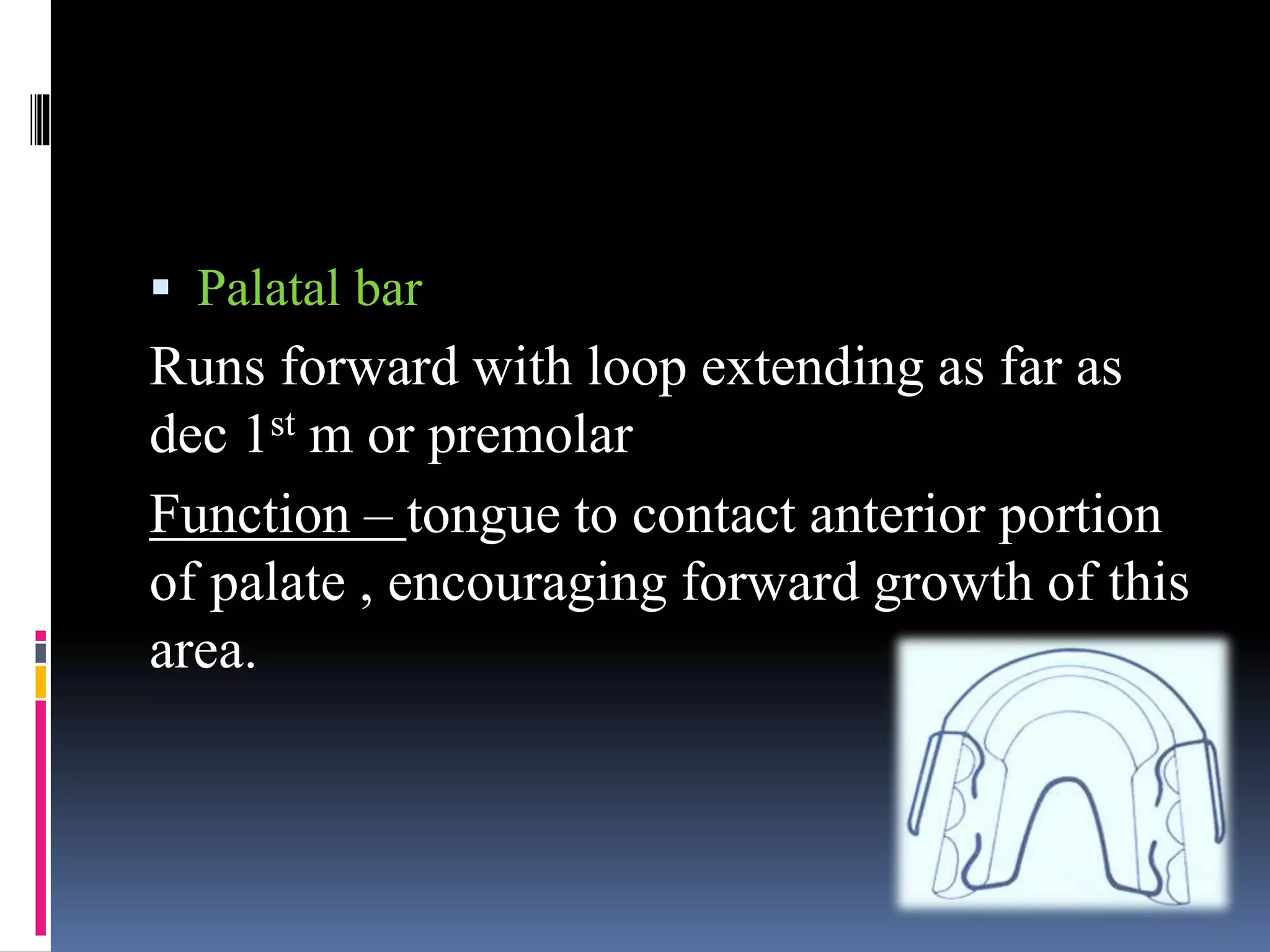
 Palatal bar
Runs forward with loop extending as far as
dec 1st m or premolar
Function – tongue to contact anterior portion
of palate , encouraging forward growth of this
area.
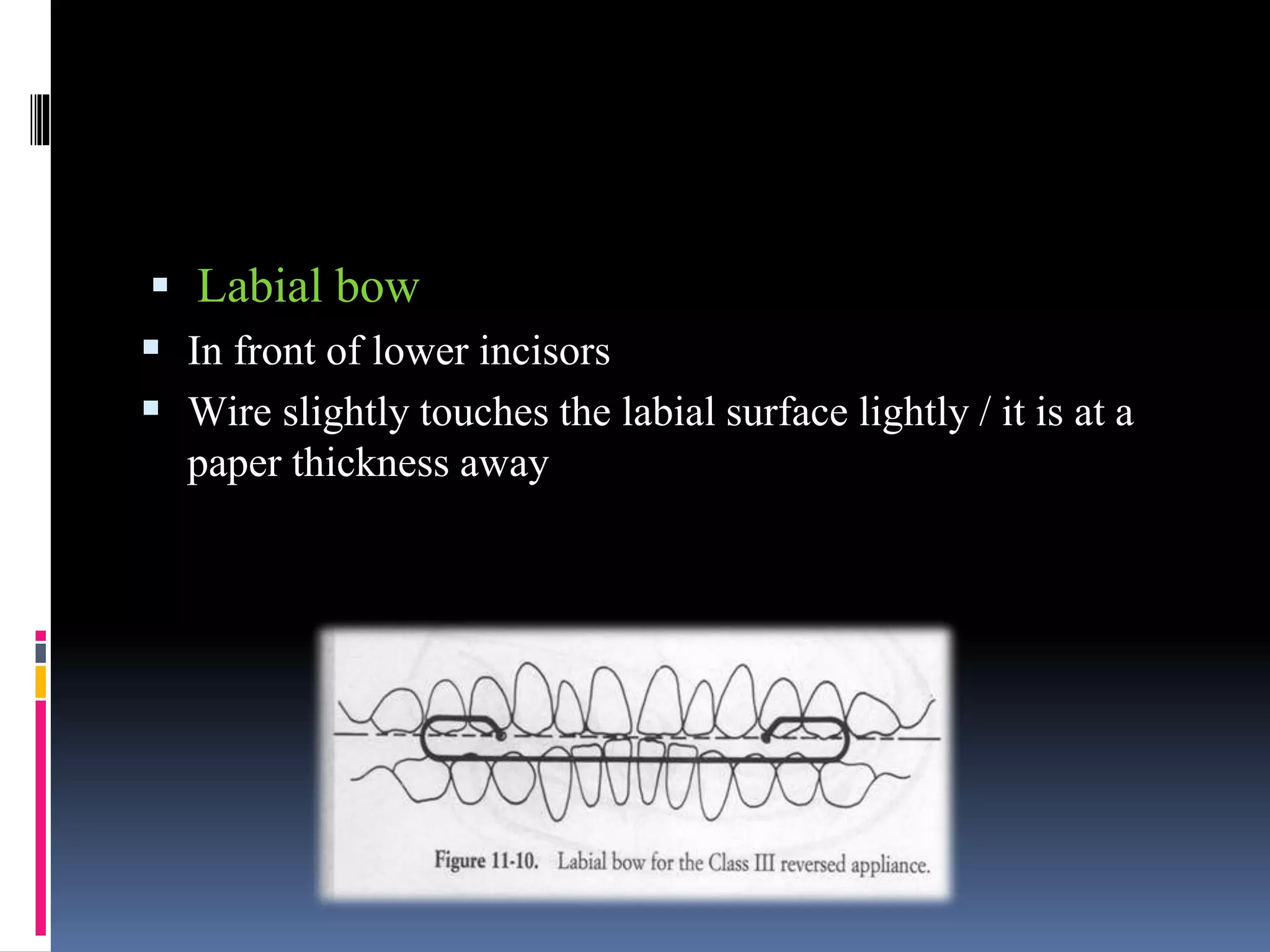
 Labial bow
 In front of lower incisors
 Wire slightly touches the labial surface lightly / it is at a
paper thickness away
 Construction bite
 Construction bite- taken in more retruded position so as to
allow labial movement of maxillary incisors &also to
exert restrictive force on lower arch.
CHIN CUP
 Skeletal Class III malocclusion with a relatively normal
maxilla and a moderately protrusive mandible can be
treated with the use of a chin cup.
 The objective of early treatment with the use of a chin cup
is to provide growth inhibition or redirection and
posterior positioning of the mandible.
Effects on Mandibular Growth
 Redirection of mandibular growth vertically.
 Backward repositioning (rotation) of the
mandible.
 Remodelling of the mandible with closure of the
gonial angle
 EFFECT ON MAXILLA
 Uner,Yuksel,and Ucuncu (Eur J Orthod 17:135-141, 1995)
 Showed that early correction of an anterior crossbite with
a chin cup appliance prevents retardation of antero-
posterior maxillary growth.
 Sugawara et a1 (Am JOrthod Dentofacial Orthop 98:127-133, 1990.)
 Compared the growth changes of patients after chin cup
treatment with control subjects and reported that, at age
17, the midface is more deficient in patients of the control
groups than in those of the treatment groups.
 Force Magnitude.
 CHIN CUP 2 TYPES
 OCCIPITAL PULL CHIN CUP.
 VERTICAL PULL CHIN CUP.
 300-500g PER SIDE
 14hr/day
PROTRACTION FACE MASK THERAPY
 Extraoral appliance that utilizes rests on the
chin and forehead(and occasionally the cheek
bones) as anchorage for elastic traction, with
the purpose of orthopaedically protracting the
maxilla.
 Glossary of Orthodontic Terms
 The use of a protraction face mask was first
described more than 100yrs ago in 1875 by
Johnson et al.
 1944, Oppenheim: reported that it is impossible
to move the mandible backward, but that it is
possible to bring the maxilla forward to
compensate for mandibular overgrowth when
treating Class III malocclusions.
 Although the facial mask was developed over 100
years ago, this approach was used infrequently
until reintroduced by Delaire in early 1970’s
 Petit 1983: modified the basic concept of Delaire
by increasing the amount of force generated by
the appliance and decreasing the total treatment
time
 1987 McNamara: introduced the use of a
bonded expansion appliance with acrylic
occlusal coverage for maxillary protraction.
ANATOMICAL CONSIDERATIONS
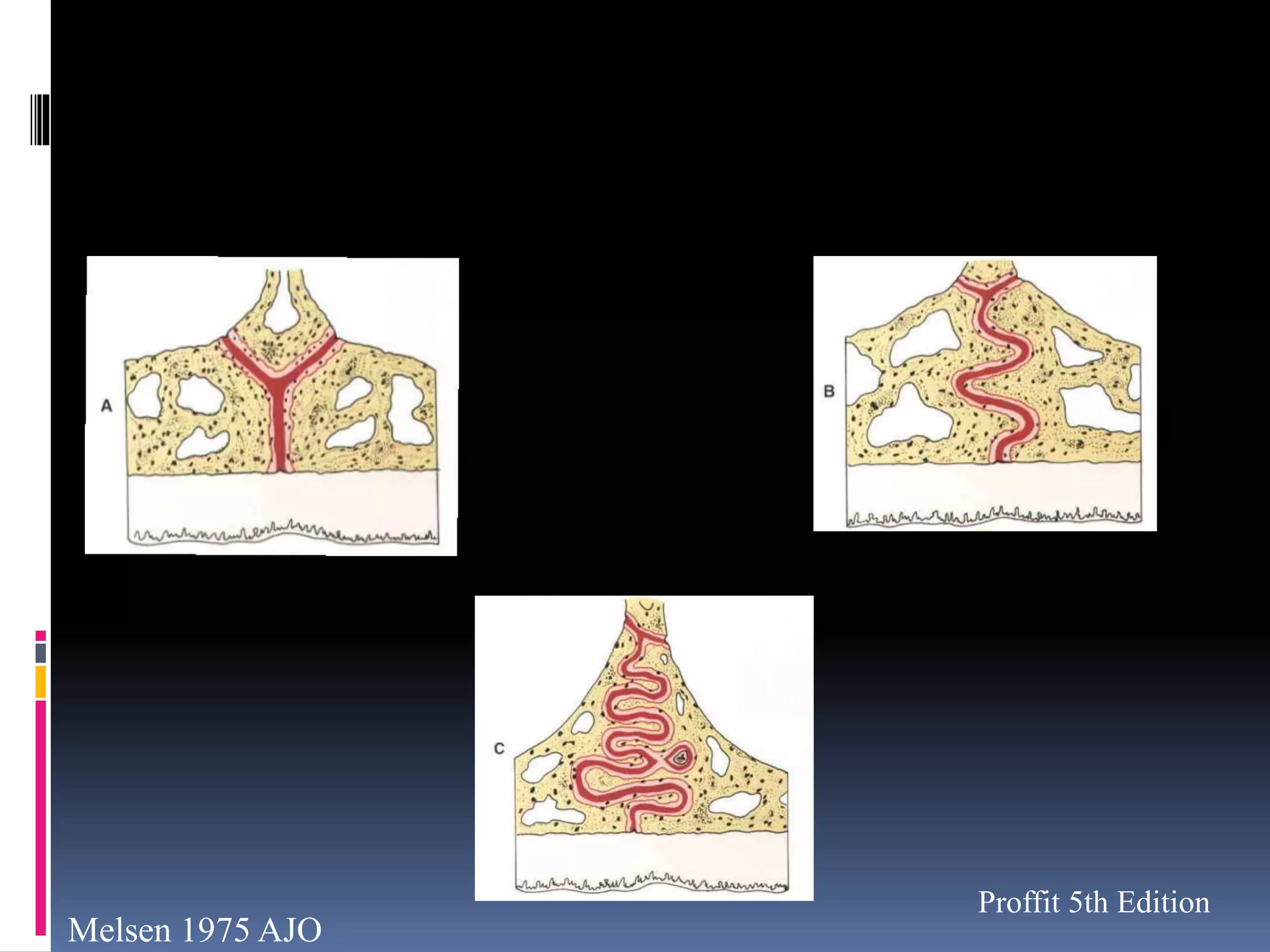
 Circum-maxillary Sutures
A. Frontomaxillary
B. Nasomaxillary
C. Zygomaticomaxillary
D. Zygomaticotemporal
E. Pterygopalatine
F. Intermaxillary
G. Ethmomaxillary
H. Lacrimomaxillary
Melsen 1975 AJO
Proffit 5th Edition
BIOMECHANICALCONSIDERATION
 The orthodontist must first decide, whether to protract with a
clockwise moment on the maxilla, a counter clockwise
moment, or no moment
.
 If the patient has normal overbite and normal vertical
proportions, protraction without any moment is indicated.
 If the patient has an anterior open bite in addition to the
maxillary deficiency, a clockwise moment should be used.
 If the patient has a deep bite, a counter clockwise moment
should be chosen.
Staggers JCO 1992
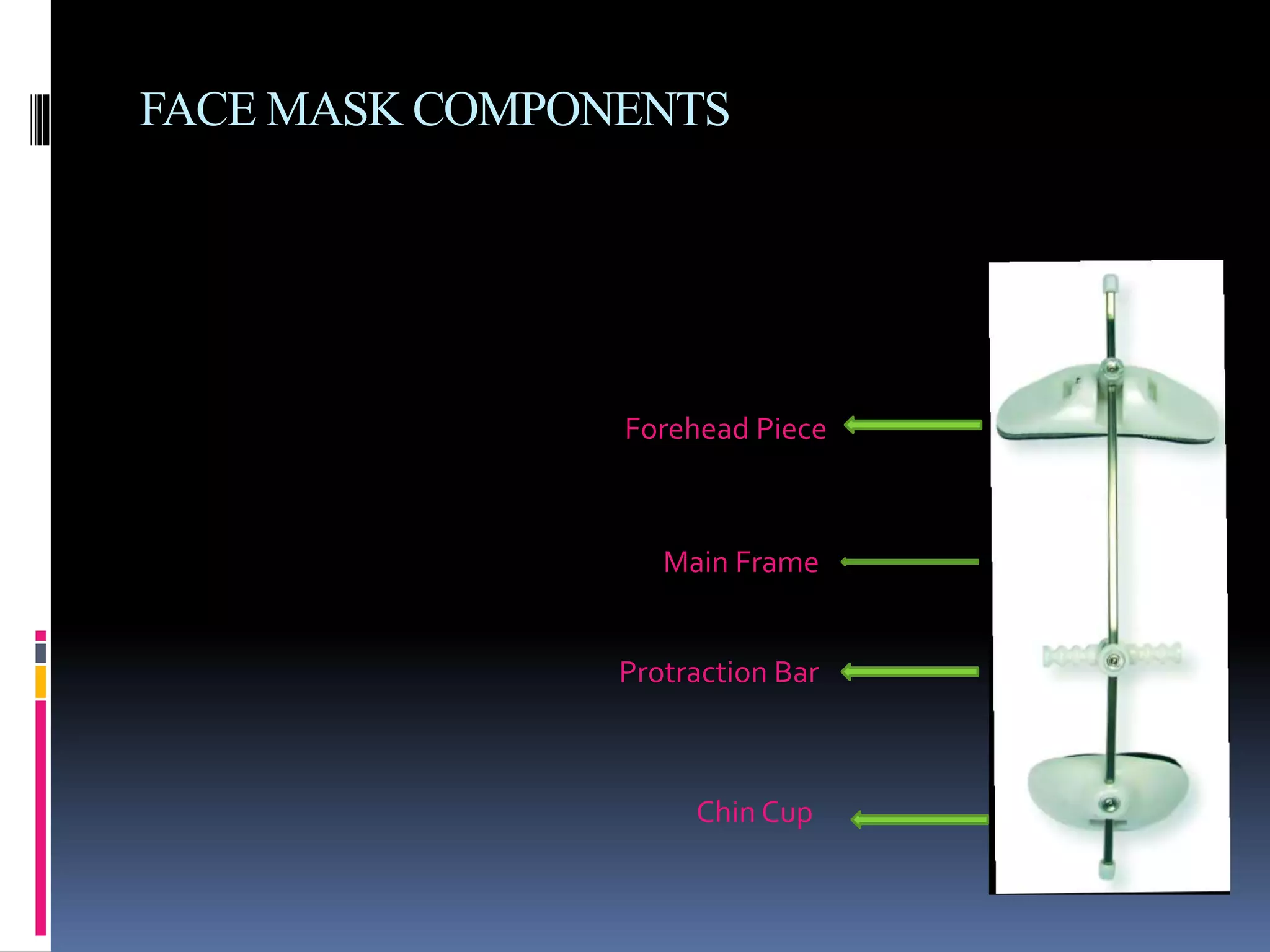
FACE MASK COMPONENTS
Forehead Piece
Main Frame
Protraction Bar
Chin Cup
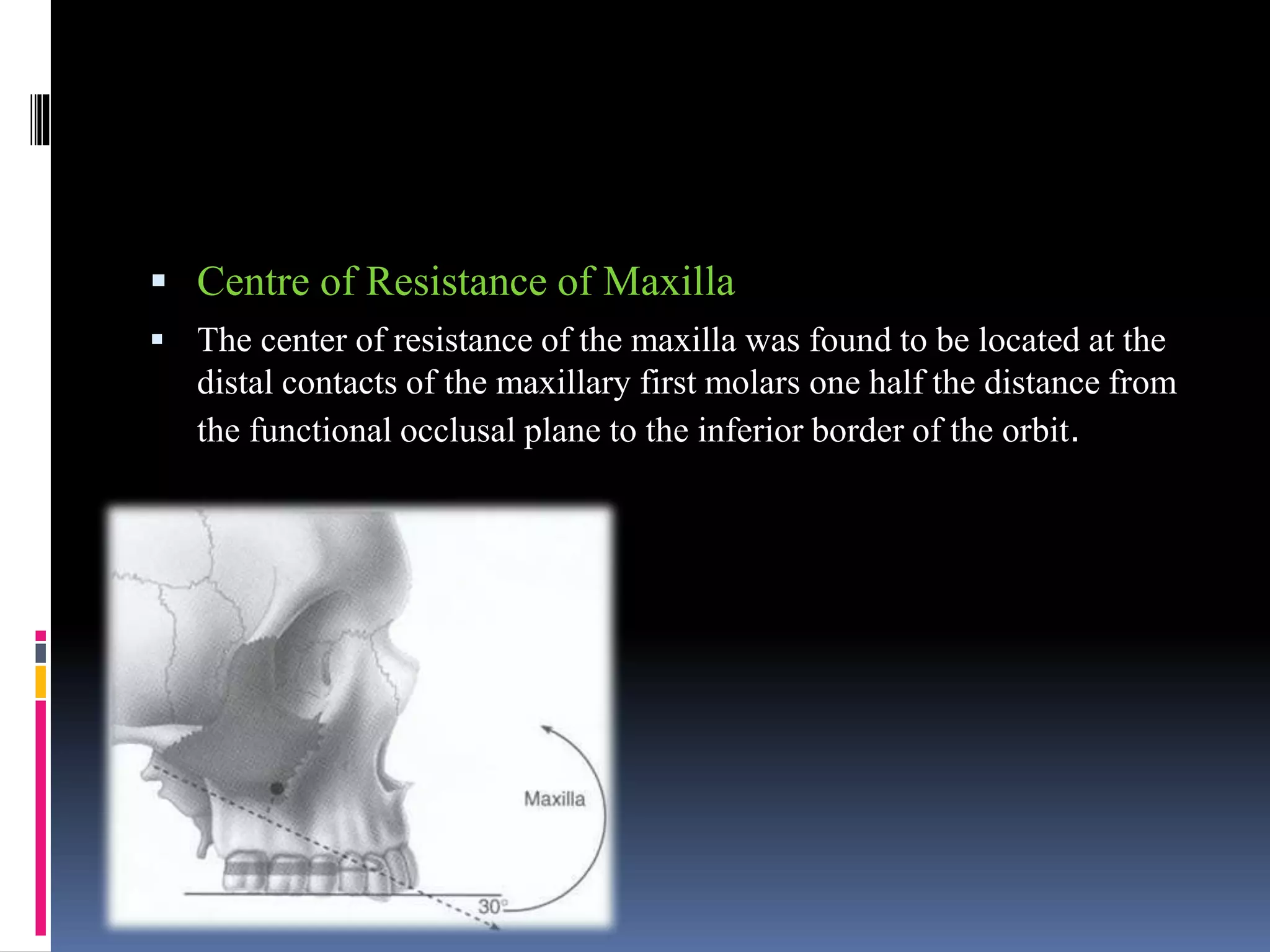
 Centre of Resistance of Maxilla
 The center of resistance of the maxilla was found to be located at the
distal contacts of the maxillary first molars one half the distance from
the functional occlusal plane to the inferior border of the orbit.
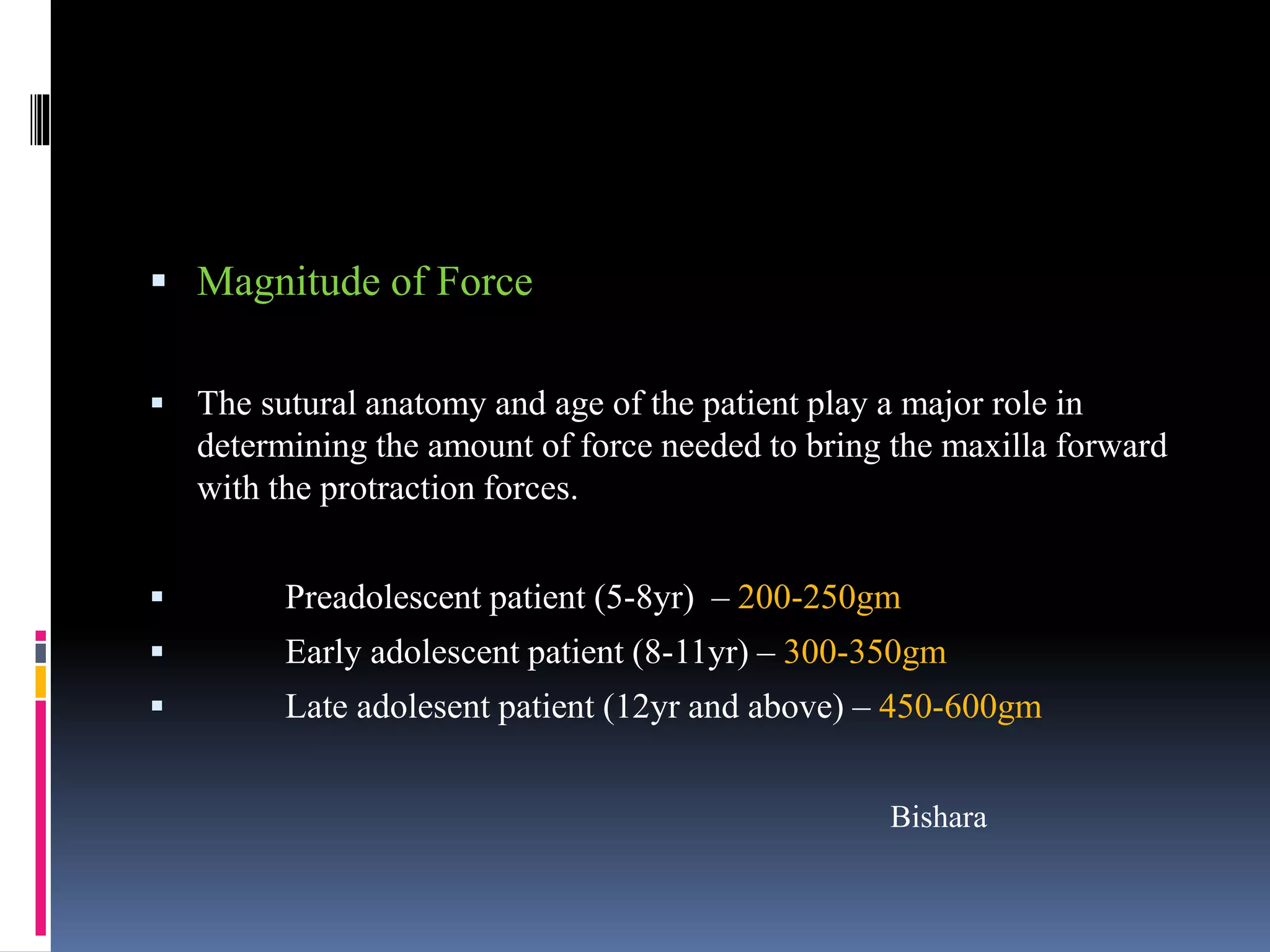
 Magnitude of Force
 The sutural anatomy and age of the patient play a major role in
determining the amount of force needed to bring the maxilla forward
with the protraction forces.
 Preadolescent patient (5-8yr) – 200-250gm
 Early adolescent patient (8-11yr) – 300-350gm
 Late adolesent patient (12yr and above) – 450-600gm
Bishara
 Duration of Force
 Most of the studies done recommend a minimum of
10-12 hours/day preadolescents
12-16 hours/day adolescents
McNamara Brudon
 Treatment Timing
 Takada et al EJO 1993 : Reported that face mask treatment is most
effective in prepubertal patients (mean age, 7.8 years) and pubertal
patients (mean age, 10.3 years) and becomes less effective after late
puberty.
 Baccetti 1998: Showed that treatment of class III malocclusion with
bonded maxillary expander and face mask in the early mixed dentition
results in a more favourable craniofacial changes than treatment in
late mixed dentition
 Turley 1998 AJODO: Cephalometric effects of face
mask/expansion therapy in Class III children: a
comparison of three age groups (4-7 years, 7-10 years, 10-
14 years)Most effective in younger age groups but
significant change in older groups too.
 Franchi AJODO2004: it was shown that significant
maxillary advancement could be achieved orthopedically
only by treating Class III patients during the deciduous or
early mixed dentition phases.
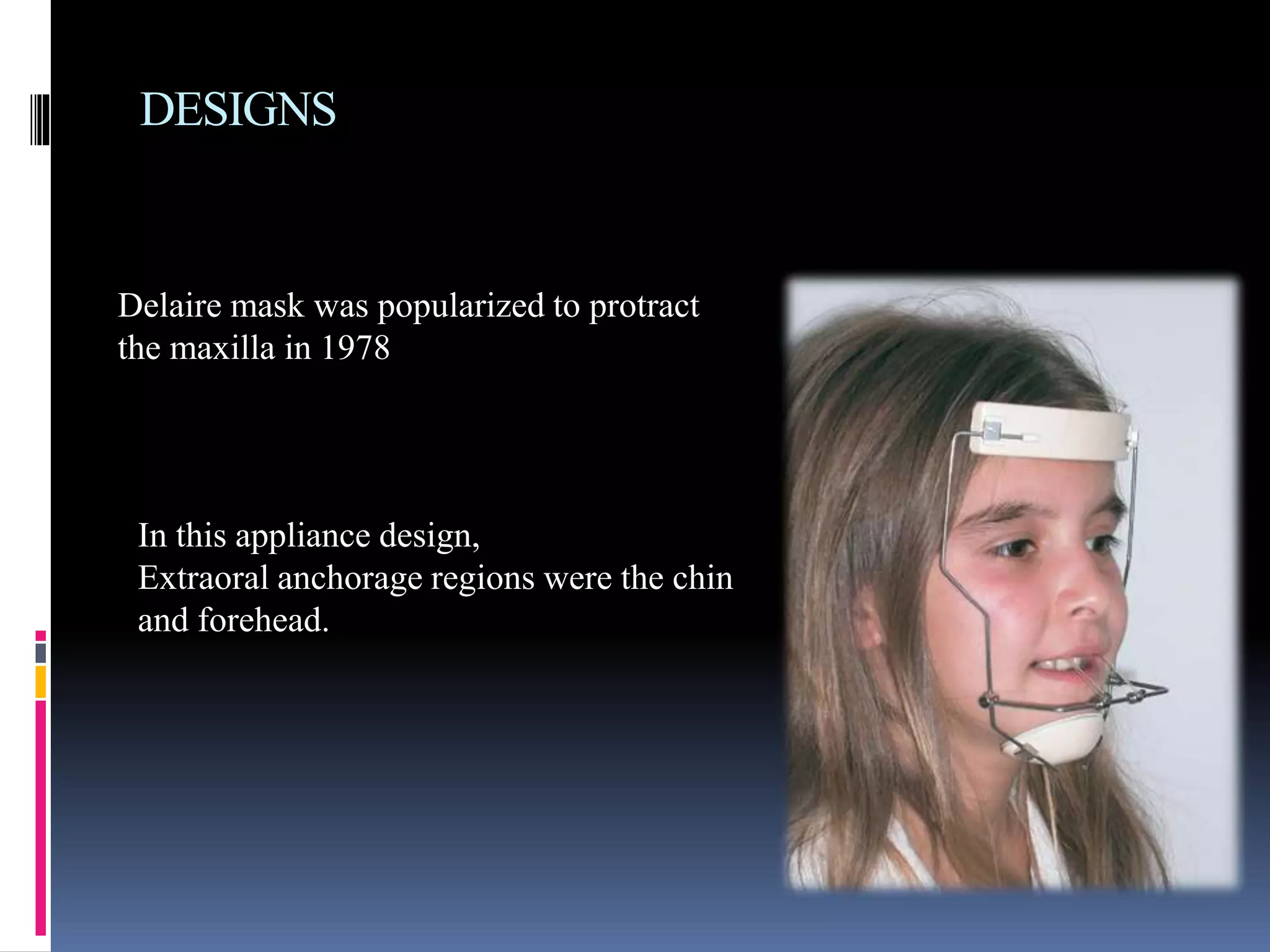
DESIGNS
Delaire mask was popularized to protract
the maxilla in 1978
In this appliance design,
Extraoral anchorage regions were the chin
and forehead.
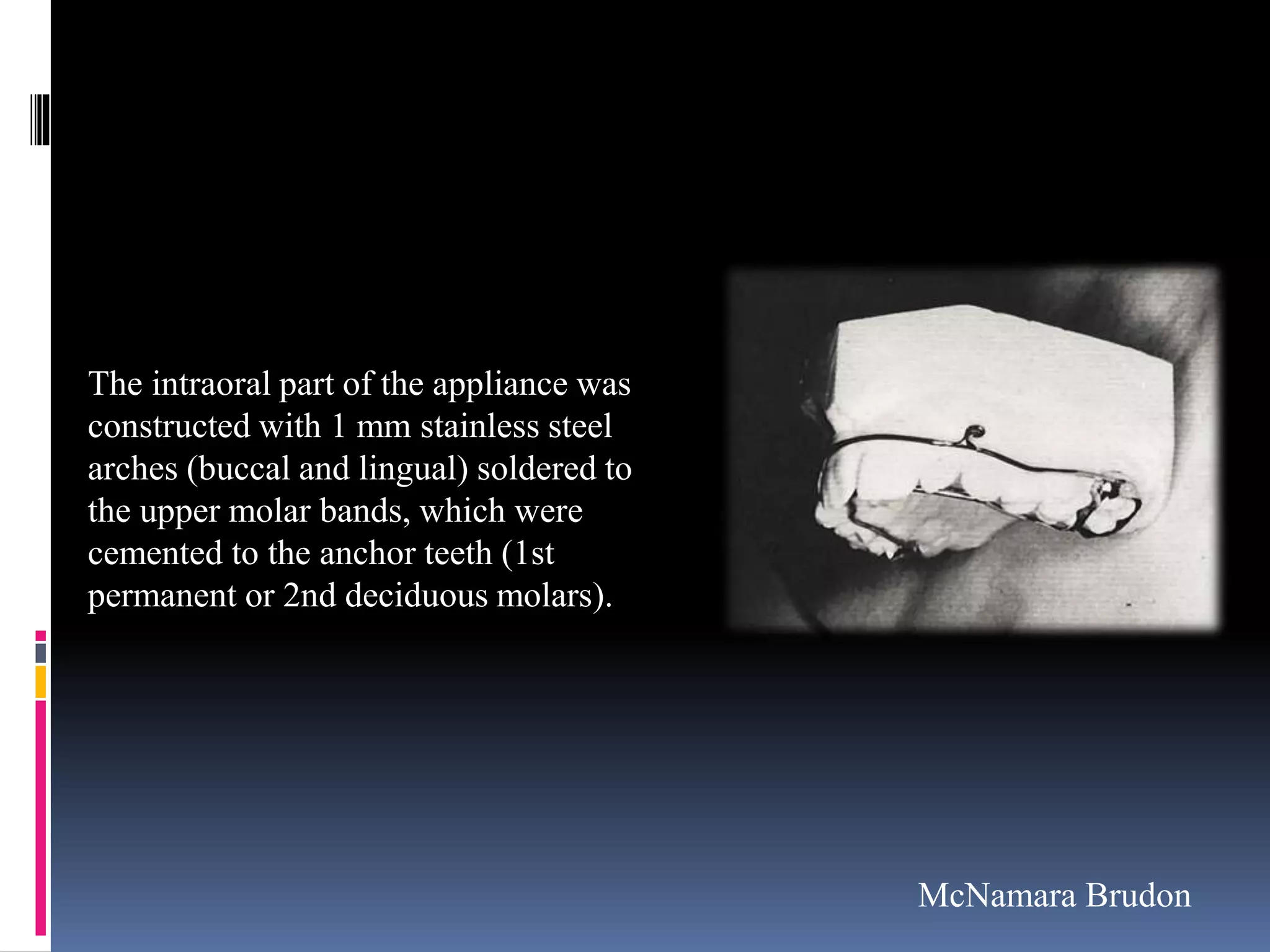
The intraoral part of the appliance was
constructed with 1 mm stainless steel
arches (buccal and lingual) soldered to
the upper molar bands, which were
cemented to the anchor teeth (1st
permanent or 2nd deciduous molars).
McNamara Brudon
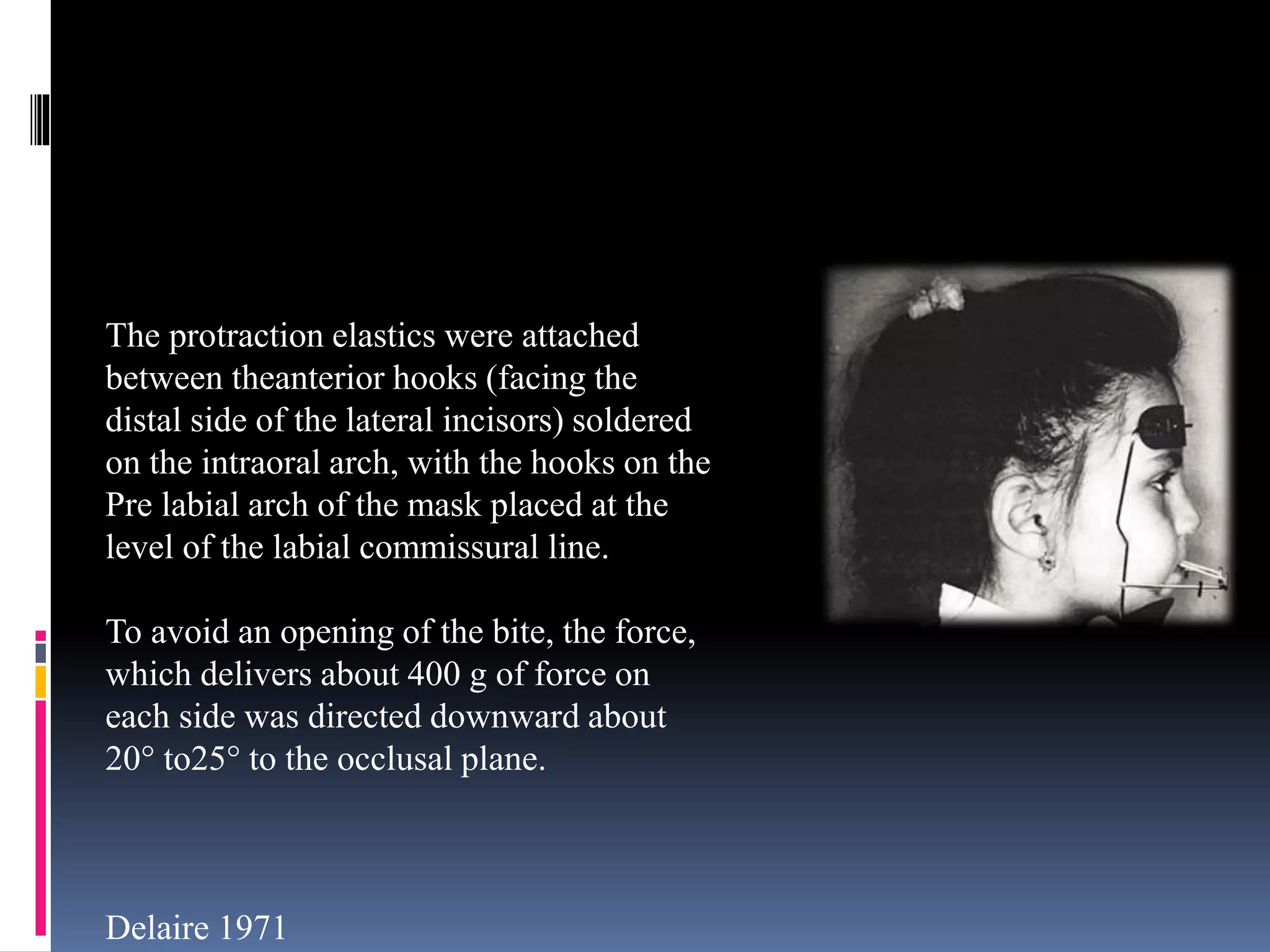
The protraction elastics were attached
between theanterior hooks (facing the
distal side of the lateral incisors) soldered
on the intraoral arch, with the hooks on the
Pre labial arch of the mask placed at the
level of the labial commissural line.
To avoid an opening of the bite, the force,
which delivers about 400 g of force on
each side was directed downward about
20° to25° to the occlusal plane.
Delaire 1971
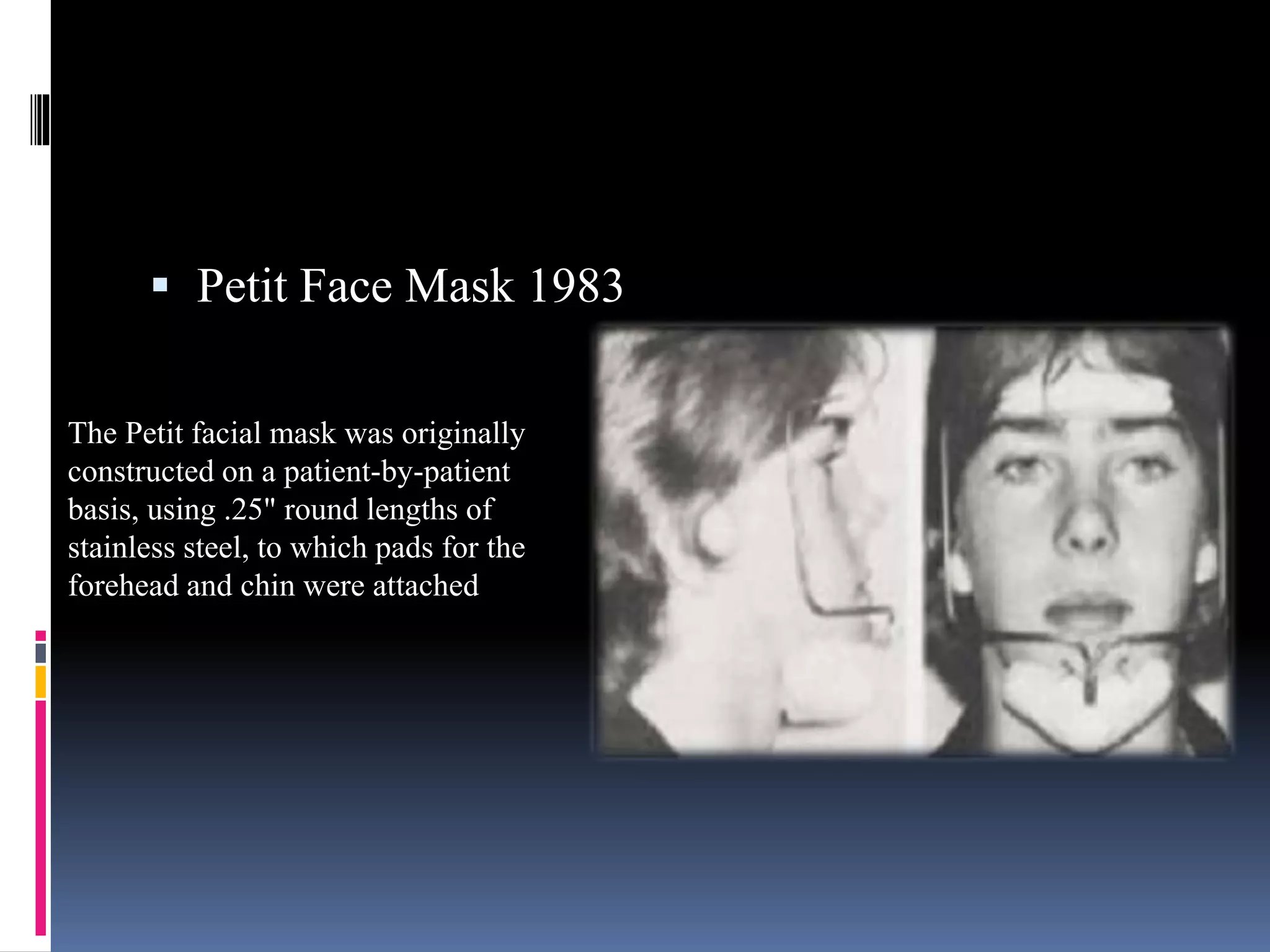
 Petit Face Mask 1983
The Petit facial mask was originally
constructed on a patient-by-patient
basis, using .25" round lengths of
stainless steel, to which pads for the
forehead and chin were attached
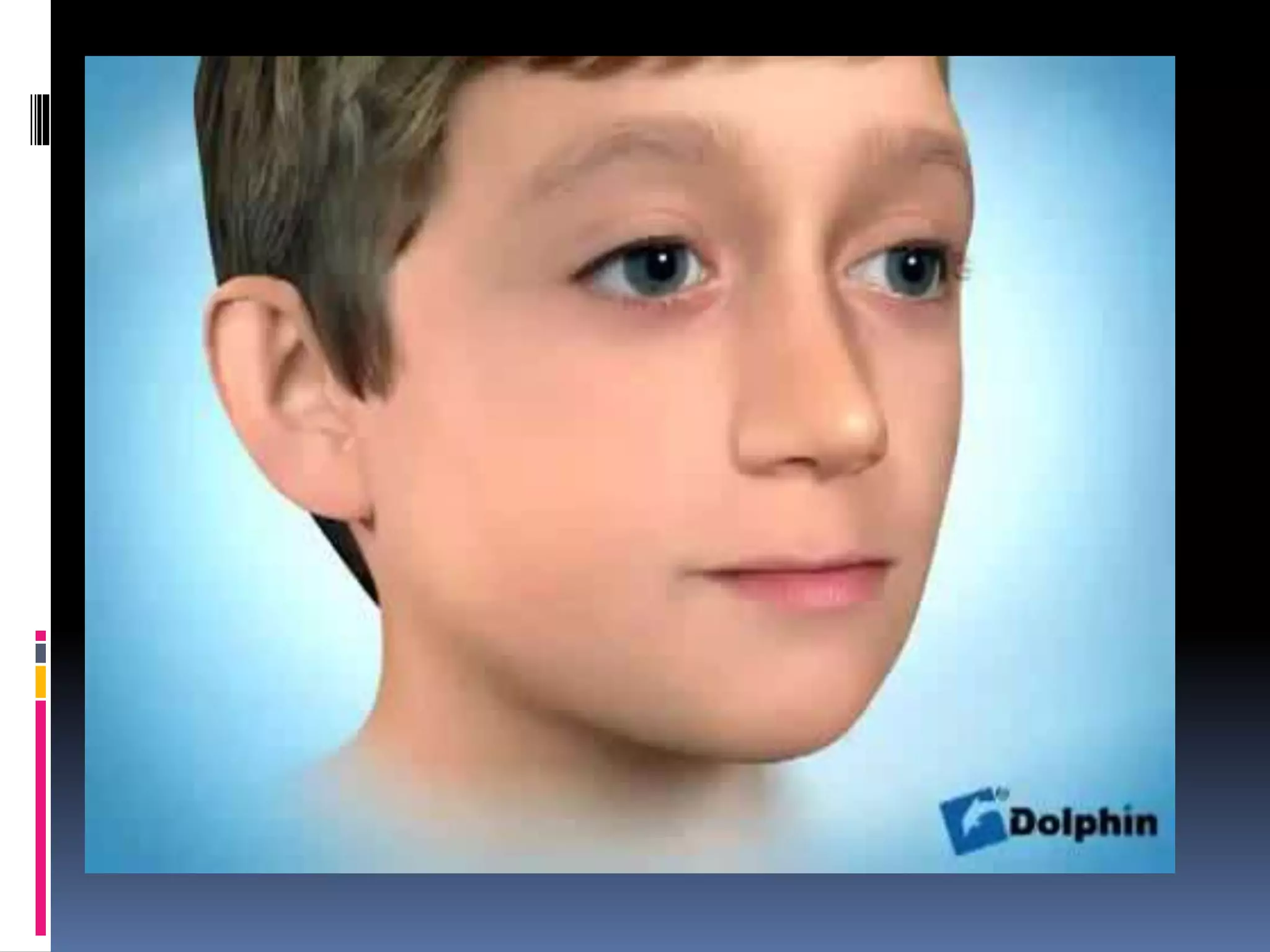
video
CLASS III CAMOUFLAGE TREATMENT
 Treatment approach were the underlying skeletal
deformity is left untreated but teeth are moved to such
positions to create an acceptable occlusion with out
violating the norms of aesthetics and stability is
categorised as camouflage treatment.
Treatment approaches
2 Approaches.
NON EXTRACTION
EXTRACTION
 NON EXTRACTION APPROACH
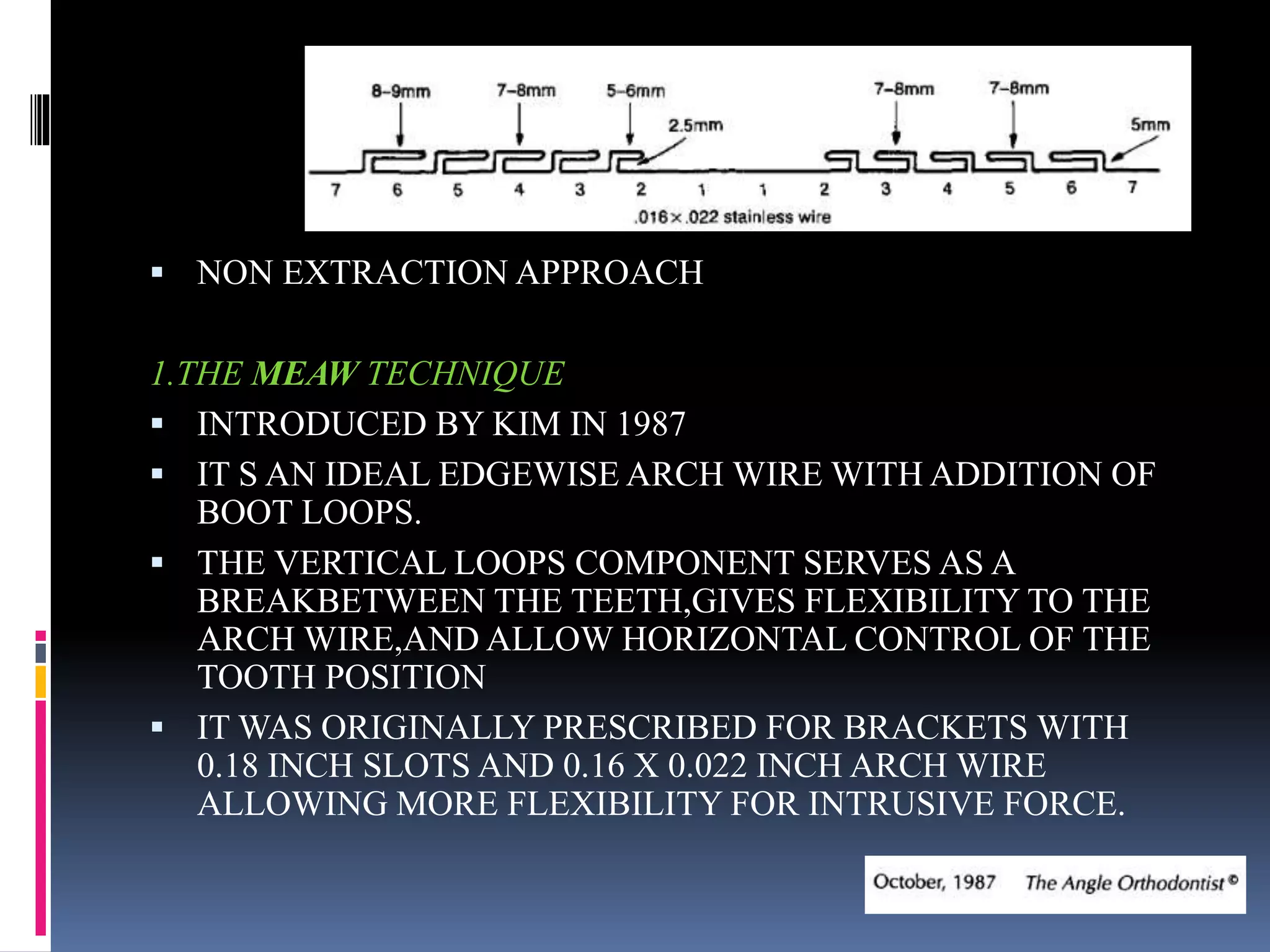
1.THE MEAW TECHNIQUE
 INTRODUCED BY KIM IN 1987
 IT S AN IDEAL EDGEWISE ARCH WIRE WITH ADDITION OF
BOOT LOOPS.
 THE VERTICAL LOOPS COMPONENT SERVES AS A
BREAKBETWEEN THE TEETH,GIVES FLEXIBILITY TO THE
ARCH WIRE,AND ALLOW HORIZONTAL CONTROL OF THE
TOOTH POSITION
 IT WAS ORIGINALLY PRESCRIBED FOR BRACKETS WITH
0.18 INCH SLOTS AND 0.16 X 0.022 INCH ARCH WIRE
ALLOWING MORE FLEXIBILITY FOR INTRUSIVE FORCE.
 USE OF DISTALIZATION OF LOWER ARCH USING
ANCHORAGE DERIVED FROM MINI IMPLANT
 THE TADS HAVE PROVED USEFUL IN PROVIDING ANCHORAGE
REQUIRED TO DISTALIZE THE WHOLE MANDIBULAR ARCH
INCLUDING SECOND MOLAR.
 THE PRESENCE OF THIRD MOLARWILL HAVE TO BE EVALUATED
AND IF NEEDED BE,IT MAY REQUIRE SURGICAL CORRECTION.
 EXTRACTION APPROACH.
 DEPENDING ON THE REQUIREMENT OF THE CASE
EXTRACTION CHOICES COULD BE.
MANDIBULAR INCISOR
UPPER SECOND AND LOWER FIRST BICUSPIDS
LOWER FIRST BICUSPIDS
MANDIBULAR SECOND MOLARS
MANDIBULAR INCISOR EXRACTION
 SITUATIONS WHERE CROWDING IS NOT LARGE OR
SITUATIONS OF BOLTONS DICCREPANCY.
 UPPER/LOWER MIDLINE MISMATCH
 LONGTERM RIGID LINGUAL RETAINER AS MANDIBULAR
ARCH WITH THREE INCISORS HAS A TENDENCY FOR
LINGUAL COLLAPSE.
 UPPER SECOND AND LOWER FIRST BICUSPIDS.
 TO RESOLVE LARGE MANDIBULAR CROWDING,AND
INDUSE SIGNIFICANT TIPPING OF MANDIBULAR ARCH.
 MAXILLARY ARCH WHICH HAS LESSER CROWDING,
CONSIDERD FOR SECOND PRE MOLAR EXTRACTION.
 LOWER FIRST BICUSPIDS
 WHEN UPPERARCH ISWELL ALIGNED OR CAN BEWELL
ALIGNEDWITH DENTAL EXPANSIONOFTHE ARHES.
 LOWER ARCH NEEDS SPACE TO RESOLVE CROWDING AND
LINGUAL TIPPING OF MANDIBULAR INCISORS
 MANDIBULAR SECOND MOLARS
 FOR SIGNIFICANT DISTALIZATION OF ENTIRE LOWER
DENTAL ARCH
 THE LOWER DENTAL ARCH CAN BE DISTALIZED EITHER
WITH CERVICAL HEADGEAR OR ANCHORAGE DERIVED
FROM INTRORAL IMPLANTS.
CONCLUSION
 Early orthopedic treatment using face mask or chin cup
therapy improve skeletal relations which in turn minimizes
excessive dental de compensation.
 Early treatment provides more pleasing facial profile,
thus improves psyco-social development of child.
 It eliminates orthognathic surgery, maximizing growth
potential of maxilla may minimize the extent of surgical
procedures in cases of severe Class III malocclusion.
References
 Contemporary orthodontics; william R. profit
 Text of orthodontics, samier bishara
 In clinical orthodontics, Ravindra nanda
 Orthodontics current priciplesand techniques, T.M Graberand
vanarsdal
 DENTOFACIAL ORTHOPEDICS WITH FUNCTIONAL APPLIANCES
Class III malocclusion by sooraj s pillai

Class III malocclusion by sooraj s pillai

  • 2.
    CONTENTS  INTRODUCTION  DEFINITION ETIOLOGY  FREQUENCY  CLASSIFICATION  CLINICAL EXAMINATION  GROWTH COSIDERATION  GOALS OF EARLY INTERCEPTIVE TREATMENT  TREATMENT OF PSEUDO CLASS III MALOCCLUSION  TREATMENT OF SKELETAL CLASS III MALOCCLUSION  CONCLUSION  REFERENCE
  • 3.
    INTRODUCTION  Orthodontic treatmentnot only involves establishment of physiologically and anatomically functional occlusion but also includes correction of the relationship of the maxilla and mandible to each other and to the rest of the craniofacial complex.
  • 4.
    DEFINITION  According toAngle (1899): Class III malocclusion occurred when the lower teeth occluded mesial to their normal relationship by the width of one premolar or even more in extreme cases. (mesio- occlusion)
  • 5.
    ETIOLOGY  GENITIC  McGuigan(1966) – Inheritance of class III malocclusion in Hapsburg Family, having the distinct characteristics of prognathic lower jaw.  Litton et al (1970) – Dental characteristics of class III are related to genetic inheritance.
  • 6.
     Rakosi &Schilli (1981) environmental factors: Habits and mouth Breathing  Enlarged tonsils and naso-respiratory diseases.  Premature loss of deciduous molars: Results in anterior mandibular displacement.
  • 7.
     TERATOGENS:  Cleftlip and palate result in maxillary deficiency in most occasions a class III malocclusion is established. Teratogens causing cleft lip and palate are aspirin, cigarette smoke (hypoxia), Dilantin, 6- Mercaptopurine, valium etc  Vitamin D excess causes premature closure of sutures and might lead to class III malocclusion
  • 8.
     ACROMEGALY ANDHEMI MANDIBULAR HYPERTROPHY:
  • 9.
    FREQUENCY  Caucasians -1 to 4 %  African – Americans - 5 to 8%  Asians:  Japanese: 4 % younger / 14 % older  Chinese: 3 % younger / 13 % older  Indians: 1.3% (J Ind. Ped & Prev Dent: 1998 – Uteraja et al)  Iranian: 2.1% (East Mediters Health J: 2006: Danaie et al)
  • 10.
    CLASSIFICATION Generally of 2types:  Dentoalveolar  Skeletal  Mandibular protrusion  Maxillary retrusion  Combination
  • 12.
     PSEDUO CLASSIII Malocclusion is produced by a forward movement of mandible during jaw closure. Also known as habitual or postural class III malocclusion.
  • 13.
     Angles classification The mesio – buccal cusp of the maxillary first permanent molar occluding in the inter dental space between the mandibular first and second molars.
  • 14.
     Class IIIModification of Dewey
  • 15.
    MOYERS CLASSIFICATION ACCORDING TOTHE CAUSE OSSEOUS MASCULAR DENTAL
  • 16.
    CLINICAL EXAMINATION  EXRAORALFEATURES:  A CONCAVE FACE,DEFICIENT MAXILLA OR PROMINENT CHIN.  MALAR DEFICIENCY RESULTING INTO FLAT FACE  INCREASED LOWER ANTERIOR FACIAL HEIGHT  ANATOMICALLY LARGE LOWER LIP LENGTH
  • 17.
     INTRAORAL FEATURES ZERO OR –VE OVERJET  NARROW MAXILLARYARCH WITH CROWDING  UNILATERAL OR BILATERAL POSTERIOR CROSSBITE  PROCLINED MAXILLARY INCISORS  RETROCLINED MANDIBULAR INCISORS  LOW TONGE POSTURE   FLAT CURVE OF SPEE.
  • 18.
    GROWTH COSIDERATIONS  Sugawaraand Mitani :Reported similar increments between patients with Class III and Class I malocclusions during the prepubertal pubertal and postpubertal growth periods.  Battagel :found that the largest increment of facial growth for males occurred between the ages of 14 and 16 years.  whereas in female patients the maximum increment of facial growth occurred between the ages of 9.5 to12 years, although active growth continued in the nasal area and both jaws after the age of 15 years.
  • 19.
    Goals of earlyinterceptive treatment  (1) preventing progressive, irreversible soft tissue, or bony changes.  (2) improving skeletal discrepancies and providing a more favourable environment for future growth.  (3) improving occlusal function;  (4) simplifying phase II comprehensive treatment  and minimizing the need for orthognathic surgery  (5) providing more pleasing facial esthetics
  • 20.
  • 21.
    TREATMENT OF PSEUDOCLASS III MALOCCLUSION  Elimination of the CO-CR discrepancy.  REVERSE STAINLESS STEEL CROWNS.  TONGUE BLADE
  • 22.
     INCLINED PLANES. AUXILLARY SPRINGS
  • 23.
    TREATMENTOF SKELETALCLASS IIIMALOCCLUSION. FUNCTIONAL APPLIANCE THERAPY
  • 24.
    FRANKELIII REGULATOR  Thepurpose of lip pad are threefold.  TO ELIMINATE RESTRICTIVE PRESSURE OF UPPER LIP ON THE MAXILLA.  TO EXCERT PRESSURE ON THE TISSUE AND PERIOSTEAL ATTACHMENTS FOR STIMULATING BONE GROWTH.  TO TRANSMIT UPPER LIP FORCE TO THE MAXILLA VIA THE LOWER LABIAL ARCH FOR A RETRUSIVE STIMULAS.
  • 25.
     The FRIIIappliance can also be used as a retentive device following maxillary protraction treatment.  FRIII appliance was constructed to maintain the antero- posterior and transverse corrections until the maxillary incisors were fully erupted with sufficient overbite to maintain the Class III correction.
  • 26.
    CLASS III ORREVERSED BIONATOR.  Encourage development of maxilla Bite opened 2mm for this purpose  Acrylic portion Extends incisally from canine to canine behind the upper incisors  Acrylic is trimmed away by 1mm behind the lower incisors to prevent the tipping
  • 27.
     Palatal bar Runsforward with loop extending as far as dec 1st m or premolar Function – tongue to contact anterior portion of palate , encouraging forward growth of this area.
  • 28.
     Labial bow In front of lower incisors  Wire slightly touches the labial surface lightly / it is at a paper thickness away
  • 29.
     Construction bite Construction bite- taken in more retruded position so as to allow labial movement of maxillary incisors &also to exert restrictive force on lower arch.
  • 30.
    CHIN CUP  SkeletalClass III malocclusion with a relatively normal maxilla and a moderately protrusive mandible can be treated with the use of a chin cup.  The objective of early treatment with the use of a chin cup is to provide growth inhibition or redirection and posterior positioning of the mandible.
  • 31.
    Effects on MandibularGrowth  Redirection of mandibular growth vertically.  Backward repositioning (rotation) of the mandible.  Remodelling of the mandible with closure of the gonial angle
  • 32.
     EFFECT ONMAXILLA  Uner,Yuksel,and Ucuncu (Eur J Orthod 17:135-141, 1995)  Showed that early correction of an anterior crossbite with a chin cup appliance prevents retardation of antero- posterior maxillary growth.  Sugawara et a1 (Am JOrthod Dentofacial Orthop 98:127-133, 1990.)  Compared the growth changes of patients after chin cup treatment with control subjects and reported that, at age 17, the midface is more deficient in patients of the control groups than in those of the treatment groups.
  • 33.
     Force Magnitude. CHIN CUP 2 TYPES  OCCIPITAL PULL CHIN CUP.  VERTICAL PULL CHIN CUP.  300-500g PER SIDE  14hr/day
  • 34.
    PROTRACTION FACE MASKTHERAPY  Extraoral appliance that utilizes rests on the chin and forehead(and occasionally the cheek bones) as anchorage for elastic traction, with the purpose of orthopaedically protracting the maxilla.  Glossary of Orthodontic Terms
  • 35.
     The useof a protraction face mask was first described more than 100yrs ago in 1875 by Johnson et al.  1944, Oppenheim: reported that it is impossible to move the mandible backward, but that it is possible to bring the maxilla forward to compensate for mandibular overgrowth when treating Class III malocclusions.
  • 36.
     Although thefacial mask was developed over 100 years ago, this approach was used infrequently until reintroduced by Delaire in early 1970’s  Petit 1983: modified the basic concept of Delaire by increasing the amount of force generated by the appliance and decreasing the total treatment time
  • 37.
     1987 McNamara:introduced the use of a bonded expansion appliance with acrylic occlusal coverage for maxillary protraction.
  • 38.
    ANATOMICAL CONSIDERATIONS  Circum-maxillarySutures A. Frontomaxillary B. Nasomaxillary C. Zygomaticomaxillary D. Zygomaticotemporal E. Pterygopalatine F. Intermaxillary G. Ethmomaxillary H. Lacrimomaxillary
  • 39.
  • 40.
    BIOMECHANICALCONSIDERATION  The orthodontistmust first decide, whether to protract with a clockwise moment on the maxilla, a counter clockwise moment, or no moment .  If the patient has normal overbite and normal vertical proportions, protraction without any moment is indicated.  If the patient has an anterior open bite in addition to the maxillary deficiency, a clockwise moment should be used.  If the patient has a deep bite, a counter clockwise moment should be chosen. Staggers JCO 1992
  • 41.
    FACE MASK COMPONENTS ForeheadPiece Main Frame Protraction Bar Chin Cup
  • 42.
     Centre ofResistance of Maxilla  The center of resistance of the maxilla was found to be located at the distal contacts of the maxillary first molars one half the distance from the functional occlusal plane to the inferior border of the orbit.
  • 43.
     Magnitude ofForce  The sutural anatomy and age of the patient play a major role in determining the amount of force needed to bring the maxilla forward with the protraction forces.  Preadolescent patient (5-8yr) – 200-250gm  Early adolescent patient (8-11yr) – 300-350gm  Late adolesent patient (12yr and above) – 450-600gm Bishara
  • 44.
     Duration ofForce  Most of the studies done recommend a minimum of 10-12 hours/day preadolescents 12-16 hours/day adolescents McNamara Brudon
  • 45.
     Treatment Timing Takada et al EJO 1993 : Reported that face mask treatment is most effective in prepubertal patients (mean age, 7.8 years) and pubertal patients (mean age, 10.3 years) and becomes less effective after late puberty.  Baccetti 1998: Showed that treatment of class III malocclusion with bonded maxillary expander and face mask in the early mixed dentition results in a more favourable craniofacial changes than treatment in late mixed dentition
  • 46.
     Turley 1998AJODO: Cephalometric effects of face mask/expansion therapy in Class III children: a comparison of three age groups (4-7 years, 7-10 years, 10- 14 years)Most effective in younger age groups but significant change in older groups too.  Franchi AJODO2004: it was shown that significant maxillary advancement could be achieved orthopedically only by treating Class III patients during the deciduous or early mixed dentition phases.
  • 47.
    DESIGNS Delaire mask waspopularized to protract the maxilla in 1978 In this appliance design, Extraoral anchorage regions were the chin and forehead.
  • 48.
    The intraoral partof the appliance was constructed with 1 mm stainless steel arches (buccal and lingual) soldered to the upper molar bands, which were cemented to the anchor teeth (1st permanent or 2nd deciduous molars). McNamara Brudon
  • 49.
    The protraction elasticswere attached between theanterior hooks (facing the distal side of the lateral incisors) soldered on the intraoral arch, with the hooks on the Pre labial arch of the mask placed at the level of the labial commissural line. To avoid an opening of the bite, the force, which delivers about 400 g of force on each side was directed downward about 20° to25° to the occlusal plane. Delaire 1971
  • 50.
     Petit FaceMask 1983 The Petit facial mask was originally constructed on a patient-by-patient basis, using .25" round lengths of stainless steel, to which pads for the forehead and chin were attached
  • 51.
  • 52.
    CLASS III CAMOUFLAGETREATMENT  Treatment approach were the underlying skeletal deformity is left untreated but teeth are moved to such positions to create an acceptable occlusion with out violating the norms of aesthetics and stability is categorised as camouflage treatment.
  • 53.
  • 54.
     NON EXTRACTIONAPPROACH 1.THE MEAW TECHNIQUE  INTRODUCED BY KIM IN 1987  IT S AN IDEAL EDGEWISE ARCH WIRE WITH ADDITION OF BOOT LOOPS.  THE VERTICAL LOOPS COMPONENT SERVES AS A BREAKBETWEEN THE TEETH,GIVES FLEXIBILITY TO THE ARCH WIRE,AND ALLOW HORIZONTAL CONTROL OF THE TOOTH POSITION  IT WAS ORIGINALLY PRESCRIBED FOR BRACKETS WITH 0.18 INCH SLOTS AND 0.16 X 0.022 INCH ARCH WIRE ALLOWING MORE FLEXIBILITY FOR INTRUSIVE FORCE.
  • 55.
     USE OFDISTALIZATION OF LOWER ARCH USING ANCHORAGE DERIVED FROM MINI IMPLANT  THE TADS HAVE PROVED USEFUL IN PROVIDING ANCHORAGE REQUIRED TO DISTALIZE THE WHOLE MANDIBULAR ARCH INCLUDING SECOND MOLAR.  THE PRESENCE OF THIRD MOLARWILL HAVE TO BE EVALUATED AND IF NEEDED BE,IT MAY REQUIRE SURGICAL CORRECTION.
  • 56.
     EXTRACTION APPROACH. DEPENDING ON THE REQUIREMENT OF THE CASE EXTRACTION CHOICES COULD BE. MANDIBULAR INCISOR UPPER SECOND AND LOWER FIRST BICUSPIDS LOWER FIRST BICUSPIDS MANDIBULAR SECOND MOLARS
  • 57.
    MANDIBULAR INCISOR EXRACTION SITUATIONS WHERE CROWDING IS NOT LARGE OR SITUATIONS OF BOLTONS DICCREPANCY.  UPPER/LOWER MIDLINE MISMATCH  LONGTERM RIGID LINGUAL RETAINER AS MANDIBULAR ARCH WITH THREE INCISORS HAS A TENDENCY FOR LINGUAL COLLAPSE.
  • 58.
     UPPER SECONDAND LOWER FIRST BICUSPIDS.  TO RESOLVE LARGE MANDIBULAR CROWDING,AND INDUSE SIGNIFICANT TIPPING OF MANDIBULAR ARCH.  MAXILLARY ARCH WHICH HAS LESSER CROWDING, CONSIDERD FOR SECOND PRE MOLAR EXTRACTION.
  • 59.
     LOWER FIRSTBICUSPIDS  WHEN UPPERARCH ISWELL ALIGNED OR CAN BEWELL ALIGNEDWITH DENTAL EXPANSIONOFTHE ARHES.  LOWER ARCH NEEDS SPACE TO RESOLVE CROWDING AND LINGUAL TIPPING OF MANDIBULAR INCISORS
  • 60.
     MANDIBULAR SECONDMOLARS  FOR SIGNIFICANT DISTALIZATION OF ENTIRE LOWER DENTAL ARCH  THE LOWER DENTAL ARCH CAN BE DISTALIZED EITHER WITH CERVICAL HEADGEAR OR ANCHORAGE DERIVED FROM INTRORAL IMPLANTS.
  • 61.
    CONCLUSION  Early orthopedictreatment using face mask or chin cup therapy improve skeletal relations which in turn minimizes excessive dental de compensation.  Early treatment provides more pleasing facial profile, thus improves psyco-social development of child.  It eliminates orthognathic surgery, maximizing growth potential of maxilla may minimize the extent of surgical procedures in cases of severe Class III malocclusion.
  • 62.
    References  Contemporary orthodontics;william R. profit  Text of orthodontics, samier bishara  In clinical orthodontics, Ravindra nanda  Orthodontics current priciplesand techniques, T.M Graberand vanarsdal  DENTOFACIAL ORTHOPEDICS WITH FUNCTIONAL APPLIANCES

Editor's Notes

  • #6 1.OF THE 40 MEMBERS OF FAMILY WHOES RECORDS WERE AVAILABLE 33 SHOWED PROGNANTHIC MANDIBLE. 2
  • #7 THEY HYPOTHESIZED THAT EXCESSIVE MANDIBULAR GROWTH COULD ARISE AS A RESULT OF ABNORMAL MANDIBULAR POSTURE BECAUSECONSTANT DISTRACTION OF MANDIBULAR CONDYLE FROM THE FOSSA MAY BE A GROWTH STIMULUS.
  • #9 Acromegaly is caused by anterior pituitary tumour that secretes excessive amount of growth harmone. Here excessive mandibular growth occurs creating a skeletal class III malocclusion 2. it is know called a hemi mandibular hypertrophy as a body of mandible is affected. This condition leads to a class III with asymmetry
  • #15 Class III Modification of Dewey TYPE I - The upper and lower arch when viewed separately are in normal alignment. But when the arches are made to occlude the patient shoes an edge to edge incisor alignment. TYPE II -
  • #20 The objective of early Class III treatment is to create an environment in which a more favourable dentofacial development can occurs
  • #21 1. That 72% showed no family history indicates that local environmental factors could be the reason fro Pseudo class III. The factors can be retained deciduous teeth, Odontomas, trauma which can change the path of eruption, allowing them to erupt palatally. This could cause premature contacts during normal path of closure leading to anterior displacement of mandible
  • #22 1.Patients with pseudo Class III malocclusion often present with anterior cross bites that are caused by a premature tooth contact. 2. improper positioning of the maxillary and mandibular incisors and the temporomandibular joint. 3.THIS may avoid abnormal wear and traumatic occlusal forces to the affected teeth, avoid potential adverse growth influences in the maxilla and mandible, improve maxillary lip posture and facial appearance, and avoid abnormal posterior occlusion, which may develop as a result of habitual posturing of the mandible to accommodate the abnormal anterior occlusal contacts.
  • #23 1. Thisappliance can correct the malocclusion rapidly with little patient compliance when the inclined plane is cemented.
  • #25 1. The Frankel III (FRIII) regulator is a functional appliance designed to counteract the muscle forces acting on the maxillary complex. 2.Like other fr appliance this is also a deficiency appliance that deals with deficiency of maxillary arch. 3. PROTRACTION BOW PASSES BEHIND THE UPPAER INCISOR FOR SLIGHT FORWARD MOVEMENT OF THE TEETH.
  • #32 1. Because of the backward mandibular rotation, control of the vertical growth during chin cup treatment is difficult to manage.
  • #34 that is used for patients with mandibular protrusion 2. the vertical-pull chin cup that is used in patients presenting with a steep mandibular plane angle and excessive anterior facial height.
  • #39 1. Several circummaxillary sutures play an important role in the development of the nasomaxillary complex. 2. studies have shown that the maxillary complex can be displaced anteriorly with significant changes in the circummaxillary sutures and the maxillary tuberosity.
  • #40 LIKE OTHER SUTURES THE MID PALATAL SUTURES ALSO BECOME INCRESINGLY TORTOUS AND INERDIGITED WITH INCREASING AGE 2.HISTOLOGICAL APPEARANCE OF SUTURE.
  • #43 1. Maxillary protraction below the center of resistance produces anticlockwise rotation of the maxilla
  • #57 EXTRACTIONS ARE PLANNED ONLY FOR RELIEVING THE CROWDING AND FOR CORRECTION OF –VE OVERJET AND OVERBITE