Late mandibular incisor
crowding
Under supervision of :
Prof. Dr. Maher Fouda
Late lower incisor crowding
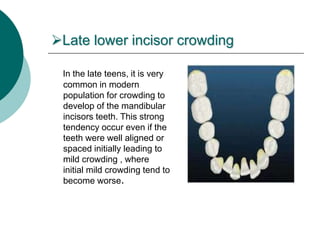
In the late teens, it is very
common in modern
population for crowding to
develop of the mandibular
incisors teeth. This strong
tendency occur even if the
teeth were well aligned or
spaced initially leading to
mild crowding , where
initial mild crowding tend to
become worse.
Causes of late lower incisor crowding
1. Late mandibular growth:
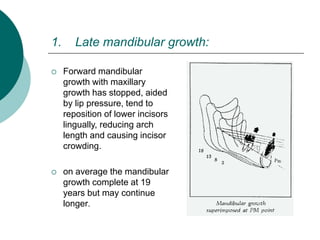
 Forward mandibular
growth with maxillary
growth has stopped, aided
by lip pressure, tend to
reposition of lower incisors
lingually, reducing arch
length and causing incisor
crowding.
 on average the mandibular
growth complete at 19
years but may continue
longer.
2. Increased muscle tone:
 It is conceivable that subtle changes in the tonicity of
orbicularis oris alter the resting but persistent muscle
pressures on the anterior dentition; this may contribute to
increased imbrication, which may be observed even in
individuals with edge-to-edge or anterior open bite, where
development of the lower anterior arch is not restricted
3. Gingival and /or occlusal forces :
 Pressure from transseptal fibers and /or the anteriorly
directed component of occlusal forces lead to mesial
migration of dentition
4. Lake of approximal attrition in modern
diet :
 This was though explain absence of labial segment
crowding in Australian.
5. Reduction in intercanine width :
 After the age of 9 years
mandibular intercanine
width reduce gradually
during teenage years and
these progresses into
reduced rate into adult life.
 These result in increase
lower labial segment
crowding , most marked
during late teens
6. Pressure of third molars :
 They may exert mesial
pressure in lower dentition
during eruption tending to
produce lower labial
crowding in anterior
segment or prevent lower
teeth from moving distally
in response to forces
generated by mandibular
growth or soft tissue.
 However late lower incisor
crowding develop even
when third molar is absent
so their presence is not
critical factor in the
etiology of problem
Management options for late lower
incisor crowding
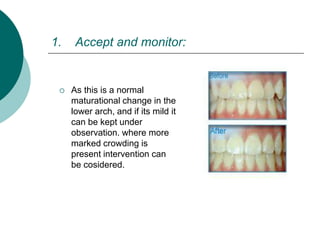
1. Accept and monitor:
 As this is a normal
maturational change in the
lower arch, and if its mild it
can be kept under
observation. where more
marked crowding is
present intervention can
be cosidered.
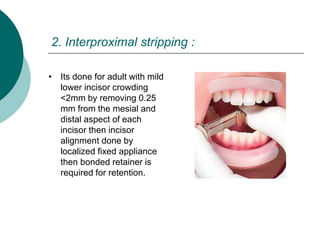
2. Interproximal stripping :
• Its done for adult with mild
lower incisor crowding
<2mm by removing 0.25
mm from the mesial and
distal aspect of each
incisor then incisor
alignment done by
localized fixed appliance
then bonded retainer is
required for retention.
3. Extraction of the lower incisor:
 This is done when the lower labial crowding is marked , but
the patient should be warned of the possibility of the upper
labial segment moving palataly with resultant misalignment
in response to the lower labial segment being aligned
slightly lingually.
 Fixed appliance is indicated for alignment of the remaining
labial segment teeth then bonded lingual retention is
required
4. Extraction of the lower premolars:
 where the buccal segment occlusion is well interdigitated
and crowding is confined to the lower labial segment, its
preferable to avoid lower premolar extraction and instead
the extraction of the lower incisor is indicated
 Case report
Case history
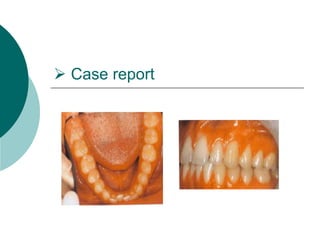
 Complain: Gerham is concerned about the crowding of his
lower front teeth and wonders if it will get worse.
 History of complain: his lower front teeth was straight
until 18 months ago . He found difficulty in keeping his lower
incisor clean and the calculus is build up. He is also aware
of two lower wisdom teeth erupting for the past 18 months
without causing problem.
 Dental history: two years ago previously, he had a course
of fixed appliance therapy to close diastema between upper
centrals followed by composite build up of upper laterals
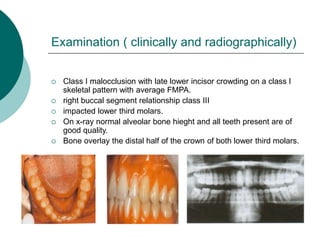
Examination ( clinically and radiographically)
 Class I malocclusion with late lower incisor crowding on a class I
skeletal pattern with average FMPA.
 right buccal segment relationship class III
 impacted lower third molars.
 On x-ray normal alveolar bone hieght and all teeth present are of
good quality.
 Bone overlay the distal half of the crown of both lower third molars.
Management of these case
 Monitor the eruption of lower third molars.
 As lower labial segment crowding is mild to
moderate advise Gerham to accept it for the
present.
 It should kept under review and if the crowding
increases, consideration could be given to
treatment.
Late mandibular incisor crowding

Late mandibular incisor crowding

  • 1.
    Late mandibular incisor crowding Undersupervision of : Prof. Dr. Maher Fouda
  • 2.
    Late lower incisorcrowding In the late teens, it is very common in modern population for crowding to develop of the mandibular incisors teeth. This strong tendency occur even if the teeth were well aligned or spaced initially leading to mild crowding , where initial mild crowding tend to become worse.
  • 3.
    Causes of latelower incisor crowding
  • 4.
    1. Late mandibulargrowth:  Forward mandibular growth with maxillary growth has stopped, aided by lip pressure, tend to reposition of lower incisors lingually, reducing arch length and causing incisor crowding.  on average the mandibular growth complete at 19 years but may continue longer.
  • 5.
    2. Increased muscletone:  It is conceivable that subtle changes in the tonicity of orbicularis oris alter the resting but persistent muscle pressures on the anterior dentition; this may contribute to increased imbrication, which may be observed even in individuals with edge-to-edge or anterior open bite, where development of the lower anterior arch is not restricted
  • 6.
    3. Gingival and/or occlusal forces :  Pressure from transseptal fibers and /or the anteriorly directed component of occlusal forces lead to mesial migration of dentition
  • 7.
    4. Lake ofapproximal attrition in modern diet :  This was though explain absence of labial segment crowding in Australian.
  • 8.
    5. Reduction inintercanine width :  After the age of 9 years mandibular intercanine width reduce gradually during teenage years and these progresses into reduced rate into adult life.  These result in increase lower labial segment crowding , most marked during late teens
  • 9.
    6. Pressure ofthird molars :  They may exert mesial pressure in lower dentition during eruption tending to produce lower labial crowding in anterior segment or prevent lower teeth from moving distally in response to forces generated by mandibular growth or soft tissue.  However late lower incisor crowding develop even when third molar is absent so their presence is not critical factor in the etiology of problem
  • 10.
    Management options forlate lower incisor crowding
  • 11.
    1. Accept andmonitor:  As this is a normal maturational change in the lower arch, and if its mild it can be kept under observation. where more marked crowding is present intervention can be cosidered.
  • 12.
    2. Interproximal stripping: • Its done for adult with mild lower incisor crowding <2mm by removing 0.25 mm from the mesial and distal aspect of each incisor then incisor alignment done by localized fixed appliance then bonded retainer is required for retention.
  • 13.
    3. Extraction ofthe lower incisor:  This is done when the lower labial crowding is marked , but the patient should be warned of the possibility of the upper labial segment moving palataly with resultant misalignment in response to the lower labial segment being aligned slightly lingually.  Fixed appliance is indicated for alignment of the remaining labial segment teeth then bonded lingual retention is required
  • 14.
    4. Extraction ofthe lower premolars:  where the buccal segment occlusion is well interdigitated and crowding is confined to the lower labial segment, its preferable to avoid lower premolar extraction and instead the extraction of the lower incisor is indicated
  • 15.
  • 16.
    Case history  Complain:Gerham is concerned about the crowding of his lower front teeth and wonders if it will get worse.  History of complain: his lower front teeth was straight until 18 months ago . He found difficulty in keeping his lower incisor clean and the calculus is build up. He is also aware of two lower wisdom teeth erupting for the past 18 months without causing problem.  Dental history: two years ago previously, he had a course of fixed appliance therapy to close diastema between upper centrals followed by composite build up of upper laterals
  • 17.
    Examination ( clinicallyand radiographically)  Class I malocclusion with late lower incisor crowding on a class I skeletal pattern with average FMPA.  right buccal segment relationship class III  impacted lower third molars.  On x-ray normal alveolar bone hieght and all teeth present are of good quality.  Bone overlay the distal half of the crown of both lower third molars.
  • 18.
    Management of thesecase  Monitor the eruption of lower third molars.  As lower labial segment crowding is mild to moderate advise Gerham to accept it for the present.  It should kept under review and if the crowding increases, consideration could be given to treatment.