Twisted Pair CableDepartment of CE/IT
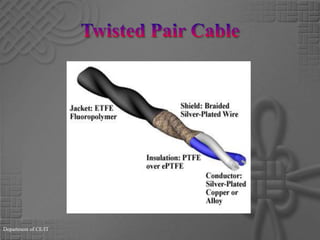
Introduction Twisted pair is the simples, oldest and low priced cable medium.It is made up of two insulated copper wires, typically, twisted around each other in a continuous spiral.The purpose of twisting the wires is to reduce electrical interference (or noise) from similar pairs close by.The most common application of twisted pair is the telephone system. Department of CE/IT
IntroductionTwisted pairs can run several kilometers without amplification, but for longer distances repeaters are needed. The twisted pair cable can be broadly categorized into the following two types:Unshielded Twisted Pair (UTP) CableShielded Twisted Pair (STP) CableDepartment of CE/IT
Twisted Pair CableDepartment of CE/IT
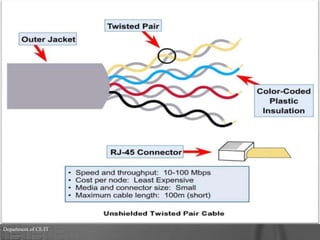
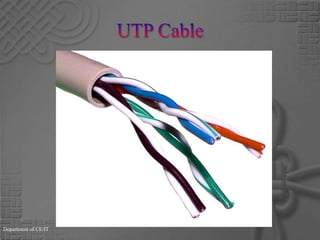
Unshielded Twisted Pair (UTP) CableUnshielded Twisted Pair (UTP) is the most common type of twisted pair cable used in telecommunication networks.The UTP consists of two copper conductors, each having their own insulating material (e.g. plastic), intertwined with each other to cancel induced current. The reason for placing twist in the pair of wires is to minimize the vulnerability of the twisted pair cable to external electrical noise. Its frequency range is suitable for data transmission as well as voice transmission (100 Hz-5 MHz).Department of CE/IT
Department of CE/IT
UTP CableDepartment of CE/IT
Advantages The advantages of UTP are its low cost,It is easy to installation procedure.It is basically used in LAN implementations.Department of CE/IT
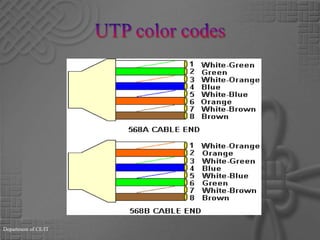
UTP color codesDepartment of CE/IT
EIA category The Electronic Industries Association (EIA) has developed five standards or categories for UTP :Category -1Category - 2Category - 3Category - 4Category - 5Department of CE/IT
Category -1This category is used for voice transmission and it is basically used in telephone systems. It is efficient only for low speed data transmission.Department of CE/IT
Category - 2This category is used for voice transmission, but it is equally preferred for data transmission of upto 4 mbps.Department of CE/IT
Category - 3This category is used for data transmission because it provides high bandwidth to achieve high data transfer rates.It is standard cable for most telephone systems.Department of CE/IT
Category - 4Provides much higher data transfer rate of 16 mbps.Department of CE/IT
Category - 5Provides a maximum data transfer rate of 100 mbps.For unshielded twisted pair generally RJ45 connectors are used.Department of CE/IT
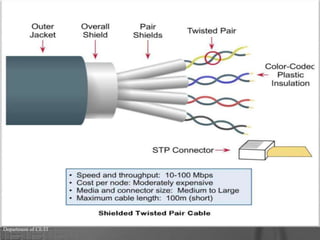
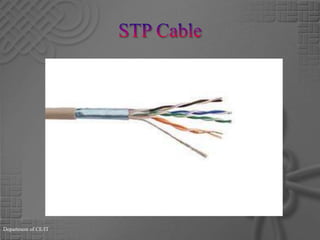
Shielded Twisted Pair (STP) CableIn Shielded Twisted Pair cable, each pair of insulated conductors is encased in a metal shield to prevent Crosstalk.The quality aspect of shielded twisted pair is same as the unshielded twisted pair but the shield must be connected to ground.Department of CE/IT
Department of CE/IT
STP CableDepartment of CE/IT
Uses STP cables use same connectors as UTP, and are more expensive than UTP cable.It is used for both analog and digital transmission.It is said to be a “balanced transmission mediumDepartment of CE/IT
The End…Thank u …. Department of CE/IT

Twisted pair cable

  • 1.
  • 2.
    Introduction Twisted pairis the simples, oldest and low priced cable medium.It is made up of two insulated copper wires, typically, twisted around each other in a continuous spiral.The purpose of twisting the wires is to reduce electrical interference (or noise) from similar pairs close by.The most common application of twisted pair is the telephone system. Department of CE/IT
  • 3.
    IntroductionTwisted pairs canrun several kilometers without amplification, but for longer distances repeaters are needed. The twisted pair cable can be broadly categorized into the following two types:Unshielded Twisted Pair (UTP) CableShielded Twisted Pair (STP) CableDepartment of CE/IT
  • 4.
  • 5.
    Unshielded Twisted Pair(UTP) CableUnshielded Twisted Pair (UTP) is the most common type of twisted pair cable used in telecommunication networks.The UTP consists of two copper conductors, each having their own insulating material (e.g. plastic), intertwined with each other to cancel induced current. The reason for placing twist in the pair of wires is to minimize the vulnerability of the twisted pair cable to external electrical noise. Its frequency range is suitable for data transmission as well as voice transmission (100 Hz-5 MHz).Department of CE/IT
  • 6.
  • 7.
  • 8.
    Advantages The advantagesof UTP are its low cost,It is easy to installation procedure.It is basically used in LAN implementations.Department of CE/IT
  • 9.
  • 10.
    EIA category TheElectronic Industries Association (EIA) has developed five standards or categories for UTP :Category -1Category - 2Category - 3Category - 4Category - 5Department of CE/IT
  • 11.
    Category -1This categoryis used for voice transmission and it is basically used in telephone systems. It is efficient only for low speed data transmission.Department of CE/IT
  • 12.
    Category - 2Thiscategory is used for voice transmission, but it is equally preferred for data transmission of upto 4 mbps.Department of CE/IT
  • 13.
    Category - 3Thiscategory is used for data transmission because it provides high bandwidth to achieve high data transfer rates.It is standard cable for most telephone systems.Department of CE/IT
  • 14.
    Category - 4Providesmuch higher data transfer rate of 16 mbps.Department of CE/IT
  • 15.
    Category - 5Providesa maximum data transfer rate of 100 mbps.For unshielded twisted pair generally RJ45 connectors are used.Department of CE/IT
  • 16.
    Shielded Twisted Pair(STP) CableIn Shielded Twisted Pair cable, each pair of insulated conductors is encased in a metal shield to prevent Crosstalk.The quality aspect of shielded twisted pair is same as the unshielded twisted pair but the shield must be connected to ground.Department of CE/IT
  • 17.
  • 18.
  • 19.
    Uses STP cablesuse same connectors as UTP, and are more expensive than UTP cable.It is used for both analog and digital transmission.It is said to be a “balanced transmission mediumDepartment of CE/IT
  • 20.
    The End…Thank u…. Department of CE/IT