7/23/2013 1
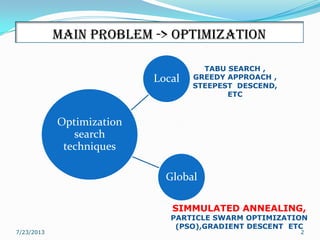
MAIN PROBLEM -> OPTIMIZATION
Local
Global
Optimization
search
techniques
7/23/2013 2
TABU SEARCH ,
GREEDY APPROACH ,
STEEPEST DESCEND,
ETC
SIMMULATED ANNEALING,
PARTICLE SWARM OPTIMIZATION
(PSO),GRADIENT DESCENT ETC
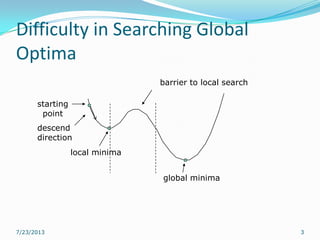
Difficulty in Searching Global
Optima
7/23/2013 3
starting
point
descend
direction
local minima
global minima
barrier to local search
Simulated Annealing(SA)
• SA is a global optimization technique.
• SA distinguishes between different local optima.
 SA is a memory less algorithm, the algorithm does not use
any information gathered during the search
 SA is motivated by an analogy to annealing in solids.
 Simulated Annealing – an iterative improvement
algorithm.
7/23/2013 4
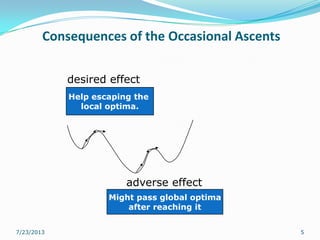
Consequences of the Occasional Ascents
7/23/2013 5
Help escaping the
local optima.
desired effect
Might pass global optima
after reaching it
adverse effect
Background: Annealing
 Simulated annealing is so named because of its analogy to the process
of physical annealing with solids,.
 A crystalline solid is heated and then allowed to cool very slowly
 until it achieves its most regular possible crystal lattice configuration
(i.e., its minimum lattice energy state), and thus is free of crystal
defects.
 If the cooling schedule is sufficiently slow, the final configuration
results in a solid with such superior structural integrity.
 Simulated annealing establishes the connection between this type of
thermodynamic behaviour and the search for global minima for a
discrete optimization problem.
7/23/2013 6
Background (cont..)
 Solid is heated to melting point
 High-energy, high-entropy state
 Removes defects/irregularities
 Temp is very slowly reduced
 Recrystallization occurs (regular structure)
 New internal state of diffused atoms
 Fast cooling induces fragile structure
7/23/2013 7
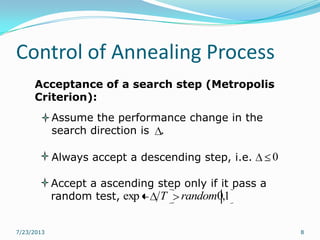
Control of Annealing Process
7/23/2013 8
Acceptance of a search step (Metropolis
Criterion):
Assume the performance change in the
search direction is .
Accept a ascending step only if it pass a
random test,
Always accept a descending step, i.e. 0
1,0exp randomT
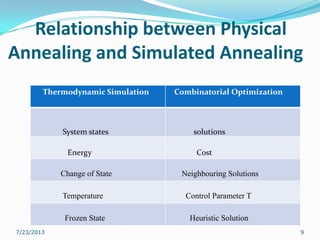
Relationship between Physical
Annealing and Simulated Annealing
Thermodynamic Simulation Combinatorial Optimization
System states solutions
Energy Cost
Change of State Neighbouring Solutions
Temperature Control Parameter T
Frozen State Heuristic Solution
7/23/2013 9
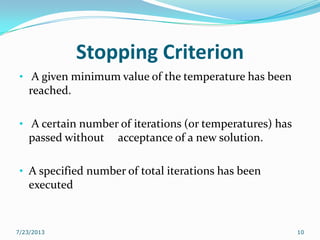
Stopping Criterion
• A given minimum value of the temperature has been
reached.
• A certain number of iterations (or temperatures) has
passed without acceptance of a new solution.
• A specified number of total iterations has been
executed
7/23/2013 10
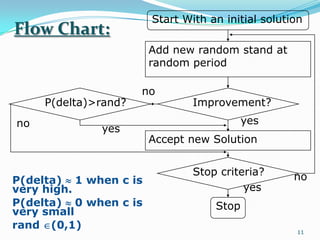
11
Flow Chart:
Start With an initial solution
Add new random stand at
random period
Improvement?
Accept new Solution
Stop criteria?
Stop
P(delta)>rand?
yes
yes
yes
no
no
noP(delta) 1 when c is
very high.
P(delta) 0 when c is
very small
rand (0,1)
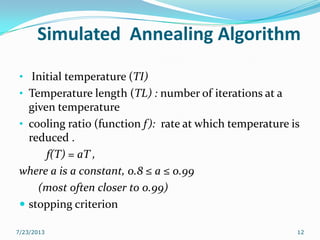
Simulated Annealing Algorithm
• Initial temperature (TI)
• Temperature length (TL) : number of iterations at a
given temperature
• cooling ratio (function f): rate at which temperature is
reduced .
f(T) = aT ,
where a is a constant, 0.8 ≤ a ≤ 0.99
(most often closer to 0.99)
 stopping criterion
7/23/2013 12
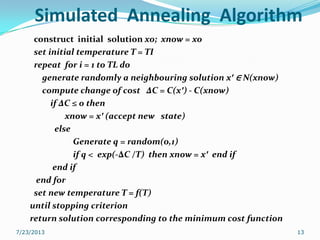
Simulated Annealing Algorithm
construct initial solution x0; xnow = x0
set initial temperature T = TI
repeat for i = 1 to TL do
generate randomly a neighbouring solution x′ ∈ N(xnow)
compute change of cost ΔC = C(x′) - C(xnow)
if ΔC ≤ 0 then
xnow = x′ (accept new state)
else
Generate q = random(0,1)
if q < exp(-ΔC /T) then xnow = x′ end if
end if
end for
set new temperature T = f(T)
until stopping criterion
return solution corresponding to the minimum cost function
7/23/2013 13
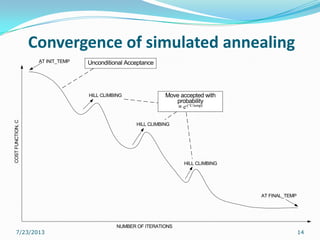
Convergence of simulated annealing
HILL CLIMBING
HILL CLIMBING
HILL CLIMBING
COSTFUNCTION,C
NUMBER OF ITERATIONS
AT INIT_TEMP
AT FINAL_TEMP
Move accepted with
probability
= e-(^C/temp)
Unconditional Acceptance
7/23/2013 14
Implementation of Simulated
Annealing
7/23/2013 15
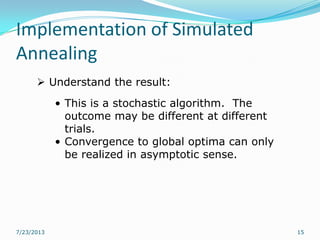
 Understand the result:
• This is a stochastic algorithm. The
outcome may be different at different
trials.
• Convergence to global optima can only
be realized in asymptotic sense.
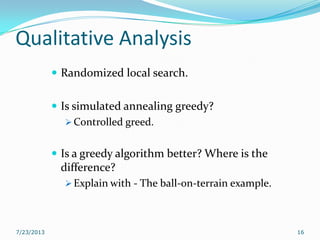
Qualitative Analysis
 Randomized local search.
 Is simulated annealing greedy?
 Controlled greed.
 Is a greedy algorithm better? Where is the
difference?
 Explain with - The ball-on-terrain example.
7/23/2013 16
Ball on terrain example – Simulated
Annealing vs Greedy Algorithms
• The ball is initially placed at a random
position on the terrain. From the current
position, the ball should be fired such that
it can only move one step left or right.
What algorithm should we follow for the
ball to finally settle at the lowest point on
the terrain?
7/23/2013 17
Ball on terrain example – SA vs. Greedy
Algorithms
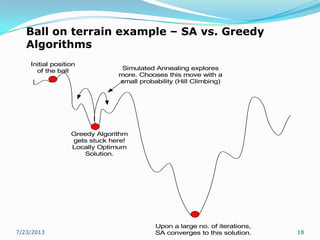
Greedy Algorithm
gets stuck here!
Locally Optimum
Solution.
Simulated Annealing explores
more. Chooses this move with a
small probability (Hill Climbing)
Upon a large no. of iterations,
SA converges to this solution.
Initial position
of the ball
7/23/2013 18
Jigsaw puzzles – Intuitive usage of
Simulated Annealing
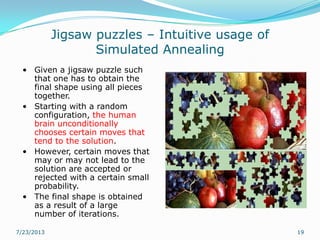
• Given a jigsaw puzzle such
that one has to obtain the
final shape using all pieces
together.
• Starting with a random
configuration, the human
brain unconditionally
chooses certain moves that
tend to the solution.
• However, certain moves that
may or may not lead to the
solution are accepted or
rejected with a certain small
probability.
• The final shape is obtained
as a result of a large
number of iterations.
7/23/2013 19
Applications
 Circuit partitioning and placement.
 Hardware/Software Partitioning
 Graph partitioning
 VLSI: Placement, routing.
 Image processing
 Strategy scheduling for capital products with complex
product structure.
 Umpire scheduling in US Open Tennis tournament!
 Event-based learning situations.
 etc
7/23/2013 20
7/23/2013 21
Advantages:
• can deal with arbitrary systems and cost functions
• statistically guarantees finding an optimal solution
• is relatively easy to code, even for complex
problems.
• generally gives a ``good'' solution
This makes annealing an attractive option for
optimization problems where heuristic (specialized
or problem specific) methods are not available.
7/23/2013 22
•Repeatedly annealing with a 1/log k schedule is very slow,
especially if the cost function is expensive to compute.
•For problems where the energy landscape is smooth, or there are
few local minima, SA is overkill - simpler, faster methods (e.g.,
gradient descent) will work better. But generally don't know what
the energy landscape is for a particular problem.
•Heuristic methods, which are problem-specific or take advantage of
extra information about the system, will often be better than general
methods, although SA is often comparable to heuristics.
•The method cannot tell whether it has found an optimal solution.
Some other complimentary method (e.g. branch and bound) is
required to do this.
Conclusions
 Simulated Annealing algorithms are usually better
than greedy algorithms, when it comes to
problems that have numerous locally optimum
solutions.
 Simulated Annealing is not the best solution to
circuit partitioning or placement. Network flow
approach to solving these problems functions
much faster.
 Simulated Annealing guarantees a convergence
upon running sufficiently large number of
iterations.
7/23/2013 23
Reference:
7/23/2013 24
• P.J.M. van Laarhoven, E.H.L. Aarts, Simulated Annealing:
Theory and Applications, Kluwer Academic Publisher,
1987.
• A. A. Zhigljavsky, Theory of Global Random Search,
Kluwer Academic Publishers, 1991.
Simulated Annealing

Simulated Annealing

  • 1.
  • 2.
    MAIN PROBLEM ->OPTIMIZATION Local Global Optimization search techniques 7/23/2013 2 TABU SEARCH , GREEDY APPROACH , STEEPEST DESCEND, ETC SIMMULATED ANNEALING, PARTICLE SWARM OPTIMIZATION (PSO),GRADIENT DESCENT ETC
  • 3.
    Difficulty in SearchingGlobal Optima 7/23/2013 3 starting point descend direction local minima global minima barrier to local search
  • 4.
    Simulated Annealing(SA) • SAis a global optimization technique. • SA distinguishes between different local optima.  SA is a memory less algorithm, the algorithm does not use any information gathered during the search  SA is motivated by an analogy to annealing in solids.  Simulated Annealing – an iterative improvement algorithm. 7/23/2013 4
  • 5.
    Consequences of theOccasional Ascents 7/23/2013 5 Help escaping the local optima. desired effect Might pass global optima after reaching it adverse effect
  • 6.
    Background: Annealing  Simulatedannealing is so named because of its analogy to the process of physical annealing with solids,.  A crystalline solid is heated and then allowed to cool very slowly  until it achieves its most regular possible crystal lattice configuration (i.e., its minimum lattice energy state), and thus is free of crystal defects.  If the cooling schedule is sufficiently slow, the final configuration results in a solid with such superior structural integrity.  Simulated annealing establishes the connection between this type of thermodynamic behaviour and the search for global minima for a discrete optimization problem. 7/23/2013 6
  • 7.
    Background (cont..)  Solidis heated to melting point  High-energy, high-entropy state  Removes defects/irregularities  Temp is very slowly reduced  Recrystallization occurs (regular structure)  New internal state of diffused atoms  Fast cooling induces fragile structure 7/23/2013 7
  • 8.
    Control of AnnealingProcess 7/23/2013 8 Acceptance of a search step (Metropolis Criterion): Assume the performance change in the search direction is . Accept a ascending step only if it pass a random test, Always accept a descending step, i.e. 0 1,0exp randomT
  • 9.
    Relationship between Physical Annealingand Simulated Annealing Thermodynamic Simulation Combinatorial Optimization System states solutions Energy Cost Change of State Neighbouring Solutions Temperature Control Parameter T Frozen State Heuristic Solution 7/23/2013 9
  • 10.
    Stopping Criterion • Agiven minimum value of the temperature has been reached. • A certain number of iterations (or temperatures) has passed without acceptance of a new solution. • A specified number of total iterations has been executed 7/23/2013 10
  • 11.
    11 Flow Chart: Start Withan initial solution Add new random stand at random period Improvement? Accept new Solution Stop criteria? Stop P(delta)>rand? yes yes yes no no noP(delta) 1 when c is very high. P(delta) 0 when c is very small rand (0,1)
  • 12.
    Simulated Annealing Algorithm •Initial temperature (TI) • Temperature length (TL) : number of iterations at a given temperature • cooling ratio (function f): rate at which temperature is reduced . f(T) = aT , where a is a constant, 0.8 ≤ a ≤ 0.99 (most often closer to 0.99)  stopping criterion 7/23/2013 12
  • 13.
    Simulated Annealing Algorithm constructinitial solution x0; xnow = x0 set initial temperature T = TI repeat for i = 1 to TL do generate randomly a neighbouring solution x′ ∈ N(xnow) compute change of cost ΔC = C(x′) - C(xnow) if ΔC ≤ 0 then xnow = x′ (accept new state) else Generate q = random(0,1) if q < exp(-ΔC /T) then xnow = x′ end if end if end for set new temperature T = f(T) until stopping criterion return solution corresponding to the minimum cost function 7/23/2013 13
  • 14.
    Convergence of simulatedannealing HILL CLIMBING HILL CLIMBING HILL CLIMBING COSTFUNCTION,C NUMBER OF ITERATIONS AT INIT_TEMP AT FINAL_TEMP Move accepted with probability = e-(^C/temp) Unconditional Acceptance 7/23/2013 14
  • 15.
    Implementation of Simulated Annealing 7/23/201315  Understand the result: • This is a stochastic algorithm. The outcome may be different at different trials. • Convergence to global optima can only be realized in asymptotic sense.
  • 16.
    Qualitative Analysis  Randomizedlocal search.  Is simulated annealing greedy?  Controlled greed.  Is a greedy algorithm better? Where is the difference?  Explain with - The ball-on-terrain example. 7/23/2013 16
  • 17.
    Ball on terrainexample – Simulated Annealing vs Greedy Algorithms • The ball is initially placed at a random position on the terrain. From the current position, the ball should be fired such that it can only move one step left or right. What algorithm should we follow for the ball to finally settle at the lowest point on the terrain? 7/23/2013 17
  • 18.
    Ball on terrainexample – SA vs. Greedy Algorithms Greedy Algorithm gets stuck here! Locally Optimum Solution. Simulated Annealing explores more. Chooses this move with a small probability (Hill Climbing) Upon a large no. of iterations, SA converges to this solution. Initial position of the ball 7/23/2013 18
  • 19.
    Jigsaw puzzles –Intuitive usage of Simulated Annealing • Given a jigsaw puzzle such that one has to obtain the final shape using all pieces together. • Starting with a random configuration, the human brain unconditionally chooses certain moves that tend to the solution. • However, certain moves that may or may not lead to the solution are accepted or rejected with a certain small probability. • The final shape is obtained as a result of a large number of iterations. 7/23/2013 19
  • 20.
    Applications  Circuit partitioningand placement.  Hardware/Software Partitioning  Graph partitioning  VLSI: Placement, routing.  Image processing  Strategy scheduling for capital products with complex product structure.  Umpire scheduling in US Open Tennis tournament!  Event-based learning situations.  etc 7/23/2013 20
  • 21.
    7/23/2013 21 Advantages: • candeal with arbitrary systems and cost functions • statistically guarantees finding an optimal solution • is relatively easy to code, even for complex problems. • generally gives a ``good'' solution This makes annealing an attractive option for optimization problems where heuristic (specialized or problem specific) methods are not available.
  • 22.
    7/23/2013 22 •Repeatedly annealingwith a 1/log k schedule is very slow, especially if the cost function is expensive to compute. •For problems where the energy landscape is smooth, or there are few local minima, SA is overkill - simpler, faster methods (e.g., gradient descent) will work better. But generally don't know what the energy landscape is for a particular problem. •Heuristic methods, which are problem-specific or take advantage of extra information about the system, will often be better than general methods, although SA is often comparable to heuristics. •The method cannot tell whether it has found an optimal solution. Some other complimentary method (e.g. branch and bound) is required to do this.
  • 23.
    Conclusions  Simulated Annealingalgorithms are usually better than greedy algorithms, when it comes to problems that have numerous locally optimum solutions.  Simulated Annealing is not the best solution to circuit partitioning or placement. Network flow approach to solving these problems functions much faster.  Simulated Annealing guarantees a convergence upon running sufficiently large number of iterations. 7/23/2013 23
  • 24.
    Reference: 7/23/2013 24 • P.J.M.van Laarhoven, E.H.L. Aarts, Simulated Annealing: Theory and Applications, Kluwer Academic Publisher, 1987. • A. A. Zhigljavsky, Theory of Global Random Search, Kluwer Academic Publishers, 1991.

Editor's Notes

  • #2 Soft computing is a term applied to computer science which is characterized whether use of inexact solutions to computationally hard task such as np complete problems for which there is no known algorithm that can compute an exact solns in polynomial time.
  • #3 In the simplest case, an optimization problem consists of maximizing or minimizing a real function by systematically choosing input values from within an allowed set and computing the value of the function.
  • #7 Discrete optimization is a branch of optimization in applied mathematics and computer science.As opposed to continuous optimization, the variables used in the mathematical program (or some of them) are restricted to assume only discrete values, such as the integers.Two notable branches of discrete optimization are:combinatorial optimization, which refers to problems on graphs, matroids and other discrete structuresinteger programming