Simulated
Annealing
Dr L.Srinivasan
Associate Professor/CSE
Dr N.G.P IT
CS3491 –AI & ML
UNIT-1
01
Simulated Annealing
 A variation of hill climbing in which, at the beginning of the process, some
downhill moves may be made.
 Idea is to do enough exploration of the whole space early on , so that the
final solution is relatively insensitive to the starting state.
 Lowering the chances of getting caught at a local maximum, or plateau,
or a ridge.
2
Simulated Annealing
Hill climbing with a twist:
 allow some moves downhill (to worse states)
 start out allowing large downhill moves (to much worse states)and
gradually allow, only small downhill moves
 Based on physical process of annealing a metal to get the best (minimal
energy) state
3
Simulated Annealing
Physical Annealing
 Physical substances are melted and then gradually cooled until some
solid state is reached.
 The goal is to produce a minimal-energy final state.
 This process is one of valley descending where the objective function is
the energy level
4
Simulated Annealing
The rate at which the system is cooled is called annealing schedule
 Annealing schedule: if the temperature is lowered sufficiently slowly,
then the goal will be attained(global minimum).
 If cooled rapidly local minimum but not global minimum is reached
 If too slow time is wasted
 Nevertheless, there is some probability for a transition to a higher energy
state: 𝒆−∆𝑬/𝑻
5
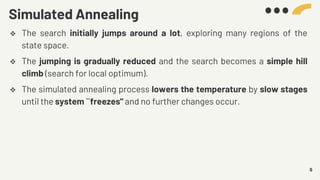
Simulated Annealing
 The search initially jumps around a lot, exploring many regions of the
state space.
 The jumping is gradually reduced and the search becomes a simple hill
climb (search for local optimum).
 The simulated annealing process lowers the temperature by slow stages
until the system ``freezes" and no further changes occur.
6
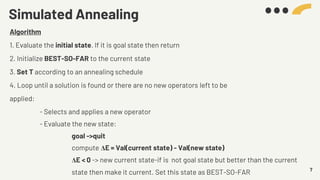
Simulated Annealing
Algorithm
1. Evaluate the initial state. If it is goal state then return
2. Initialize BEST-SO-FAR to the current state
3. Set T according to an annealing schedule
4. Loop until a solution is found or there are no new operators left to be
applied:
- Selects and applies a new operator
- Evaluate the new state:
goal ->quit
compute ΔE = Val(current state) - Val(new state)
ΔE < 0 -> new current state-if is not goal state but better than the current
state then make it current. Set this state as BEST-SO-FAR 7
Simulated Annealing
Algorithm
else -> If it is not better than the current state make it the
current state with probability p= 𝒆−∆𝑬/𝑻
.
Randomly generate number between [0 1], if
p>number generated, move is accepted else do nothing
- Revise T as necessary according to annealing schedule
5. Return BEST-SO-FAR as answer
8

CS3491-Unit-1 Simulated Annealing.pptx

  • 1.
  • 2.
    Simulated Annealing  Avariation of hill climbing in which, at the beginning of the process, some downhill moves may be made.  Idea is to do enough exploration of the whole space early on , so that the final solution is relatively insensitive to the starting state.  Lowering the chances of getting caught at a local maximum, or plateau, or a ridge. 2
  • 3.
    Simulated Annealing Hill climbingwith a twist:  allow some moves downhill (to worse states)  start out allowing large downhill moves (to much worse states)and gradually allow, only small downhill moves  Based on physical process of annealing a metal to get the best (minimal energy) state 3
  • 4.
    Simulated Annealing Physical Annealing Physical substances are melted and then gradually cooled until some solid state is reached.  The goal is to produce a minimal-energy final state.  This process is one of valley descending where the objective function is the energy level 4
  • 5.
    Simulated Annealing The rateat which the system is cooled is called annealing schedule  Annealing schedule: if the temperature is lowered sufficiently slowly, then the goal will be attained(global minimum).  If cooled rapidly local minimum but not global minimum is reached  If too slow time is wasted  Nevertheless, there is some probability for a transition to a higher energy state: 𝒆−∆𝑬/𝑻 5
  • 6.
    Simulated Annealing  Thesearch initially jumps around a lot, exploring many regions of the state space.  The jumping is gradually reduced and the search becomes a simple hill climb (search for local optimum).  The simulated annealing process lowers the temperature by slow stages until the system ``freezes" and no further changes occur. 6
  • 7.
    Simulated Annealing Algorithm 1. Evaluatethe initial state. If it is goal state then return 2. Initialize BEST-SO-FAR to the current state 3. Set T according to an annealing schedule 4. Loop until a solution is found or there are no new operators left to be applied: - Selects and applies a new operator - Evaluate the new state: goal ->quit compute ΔE = Val(current state) - Val(new state) ΔE < 0 -> new current state-if is not goal state but better than the current state then make it current. Set this state as BEST-SO-FAR 7
  • 8.
    Simulated Annealing Algorithm else ->If it is not better than the current state make it the current state with probability p= 𝒆−∆𝑬/𝑻 . Randomly generate number between [0 1], if p>number generated, move is accepted else do nothing - Revise T as necessary according to annealing schedule 5. Return BEST-SO-FAR as answer 8