Review of Solar Cities activities: CO 2  balances in cities Chiel Boonstra
EU-Solar Cities project Data collection from projects on CO2 reduction through city initiatives.  An inventory and analysis of CO2 balances from cities has been made.
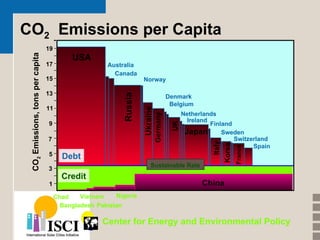
CO 2   Emissions per Capita 1 3 5 7 9 11 13 15 17 19 USA Russia Canada Australia Bangladesh Pakistan Chad Nigeria Debt Credit Norway Denmark Vietnam China CO 2  Emissions, tons per capita Germany UK Netherlands Belgium Japan France Switzerland Italy Sweden Spain Finland Korea Ukraine Ireland Center for Energy and Environmental Policy Sustainable  Rate Sustainable Rate
City involvement in CO2 reduction The targets and the potential for CO2 reduction are high.  CO2 reduction is an issue, which typically requires strong locally based action.   An integrated approach is necessary to coordinate efforts in different fields.  Cities are an appropriate level to help implement CO2 reduction, and achieve competitive and efficient societies at the same time.
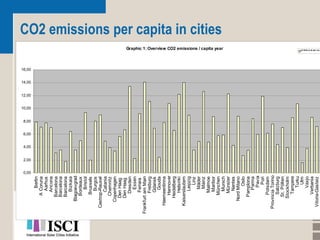
Analysis CO2 per capita emissions are not very frequently used as an indicator in cities.  Ambitions and progress on CO2 reduction and more generally on sustainability are often formulated in a rather vague way and miss precise indicators. Achieved results are not monitored in terms of CO2 equivalent emissions.
CO2 assessment methods CO2 calculation method at a local level by Expert Group Urban Environment (European Sustainable Cities and towns Campaign) Software Program Emission - Cities Climate Campaign (Torrie Smith)  Climate Alliance Methodology / indicators RESETnet CO2 assessment method
CO2 emissions per capita in cities
Problems Only few of the city networks on sustainability are monitoring the CO2 emissions of their member cities.  Many cities find the effort of preparing emissions inventories at regular intervals too great.  Poor date on energy sources not tied to mains or pipelines, and in the transport sector.
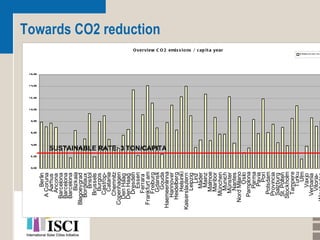
Relevance Despite many city efforts to draw up CO2 balances, these results cannot be compared, because of differences in system limits and allocations.  The relevance of CO2 balances for cities in this stage is to achieve measurable benchmarks for the cities over time.
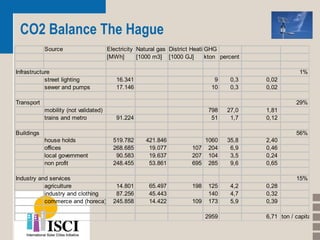
CO2 Balance The Hague
Towards CO2 reduction SUSTAINABLE RATE: 3 TON/CAPITA
Need for practical method for CO2 assessment Methodologies are present and sufficiently developed to enable monitoring of CO2 emissions.  There is a strong need for a CO2 assessment mechanism which is consistent with national and international CO2 assessment methods,  and which is meaningful for cities to include in their decision making policies .
Integration of  CO2 in urban management Optimisation of energy demand and supply, integration of CO2 in urban planning issues and industrial processes, development of low CO2 communities, belong to the agenda of cities aiming at sustainable future.   Source: R.Pagani

Co2 Balances in Cities | Chiel Boonstra

  • 1.
    Review of SolarCities activities: CO 2 balances in cities Chiel Boonstra
  • 2.
    EU-Solar Cities projectData collection from projects on CO2 reduction through city initiatives. An inventory and analysis of CO2 balances from cities has been made.
  • 3.
    CO 2 Emissions per Capita 1 3 5 7 9 11 13 15 17 19 USA Russia Canada Australia Bangladesh Pakistan Chad Nigeria Debt Credit Norway Denmark Vietnam China CO 2 Emissions, tons per capita Germany UK Netherlands Belgium Japan France Switzerland Italy Sweden Spain Finland Korea Ukraine Ireland Center for Energy and Environmental Policy Sustainable Rate Sustainable Rate
  • 4.
    City involvement inCO2 reduction The targets and the potential for CO2 reduction are high. CO2 reduction is an issue, which typically requires strong locally based action. An integrated approach is necessary to coordinate efforts in different fields. Cities are an appropriate level to help implement CO2 reduction, and achieve competitive and efficient societies at the same time.
  • 5.
    Analysis CO2 percapita emissions are not very frequently used as an indicator in cities. Ambitions and progress on CO2 reduction and more generally on sustainability are often formulated in a rather vague way and miss precise indicators. Achieved results are not monitored in terms of CO2 equivalent emissions.
  • 6.
    CO2 assessment methodsCO2 calculation method at a local level by Expert Group Urban Environment (European Sustainable Cities and towns Campaign) Software Program Emission - Cities Climate Campaign (Torrie Smith) Climate Alliance Methodology / indicators RESETnet CO2 assessment method
  • 7.
    CO2 emissions percapita in cities
  • 8.
    Problems Only fewof the city networks on sustainability are monitoring the CO2 emissions of their member cities. Many cities find the effort of preparing emissions inventories at regular intervals too great. Poor date on energy sources not tied to mains or pipelines, and in the transport sector.
  • 9.
    Relevance Despite manycity efforts to draw up CO2 balances, these results cannot be compared, because of differences in system limits and allocations. The relevance of CO2 balances for cities in this stage is to achieve measurable benchmarks for the cities over time.
  • 10.
  • 11.
    Towards CO2 reductionSUSTAINABLE RATE: 3 TON/CAPITA
  • 12.
    Need for practicalmethod for CO2 assessment Methodologies are present and sufficiently developed to enable monitoring of CO2 emissions. There is a strong need for a CO2 assessment mechanism which is consistent with national and international CO2 assessment methods, and which is meaningful for cities to include in their decision making policies .
  • 13.
    Integration of CO2 in urban management Optimisation of energy demand and supply, integration of CO2 in urban planning issues and industrial processes, development of low CO2 communities, belong to the agenda of cities aiming at sustainable future. Source: R.Pagani

Editor's Notes

  • #11 Figures: CO2 balance City of The Hague, 2002