Autarkic – localised energy systems
Definitions:
“We define a region to be energy autarkic when it relies on its own
energy resources for generating the useful energy required to sustain
the society within that region” Muller et al., Energy Policy 39 (2011) 5800-5810
“… a situation in which a region does not import substantial
amounts of energy resources” Schmidt et al., Energy Policy 47 (2012) 211-221
“… a framework for local action towards the development of a
region’s viability, based on the transformation of the energy
subsystem” Muller et al., Energy Policy 39 (2011) 5800-5810
Autarkic – localised energy systems
Definitions:
“We define a region to be energy autarkic when it relies on its own
energy resources for generating the useful energy required to sustain
the society within that region” Muller et al., Energy Policy 39 (2011) 5800-5810
“… a situation in which a region does not import substantial
amounts of energy resources” Schmidt et al., Energy Policy 47 (2012) 211-221
“… a framework for local action towards the development of a
region’s viability, based on the transformation of the energy
subsystem” Muller et al., Energy Policy 39 (2011) 5800-5810
Motivations
• Loss of faith in conventional approaches to dealing with geo-
political shocks
• Desire for more local/regional solutions
• Creation of entrants into the energy space (local utility companies
formed, Consumer Co-ops, HA’s, LA’s)
• The main dynamism therefore is cultural
• Centralised approach is a function of its age (1950-80)
• Efficiency gains at large scale are exhausted
• Developments in generation and communications technology
creating economic opportunities at a different scale
Lovins A, Rocky Mountain institute, 2007; Awerbuch S., Tyndall Centre, 2004, Verbong & Geels, Tech Fore & Soc Chng,
77 (2010) 1214-1221
Transition vs. Behaviour
Technology optimism has to be fused with social factors
Current social policy champions individualism
It suggests that societal factors are associated with personal
attitudes, behaviours and choices (Shove, Environment and Planning, 2010, 42, 1273-1285)
Treating change as a series of purchasing and consumption
behaviours over simplifies the scale of the challenge
Transition is required and move towards Autarkic entities provides
that stimulus to change
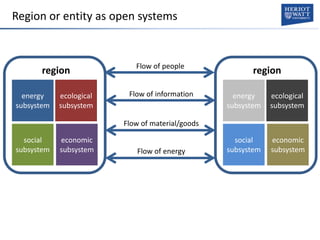
energy
subsystem
economic
subsystem
social
subsystem
ecological
subsystem
region
energy
subsystem
economic
subsystem
social
subsystem
ecological
subsystem
region
Flow of information
Flow of material/goods
Flow of energy
Flow of people
Region or entity as open systems
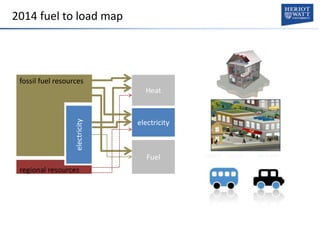
2014 fuel to load map
electricityfossil fuel resources
Fuel
electricity
Heat
regional resources
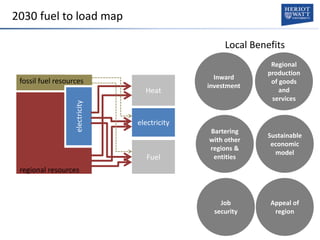
2030 fuel to load map
electricityfossil fuel resources
Fuel
electricity
Heat
regional resources
Regional
production
of goods
and
services
Bartering
with other
regions &
entities
Inward
investment
Appeal of
region
Sustainable
economic
model
Job
security
Local Benefits
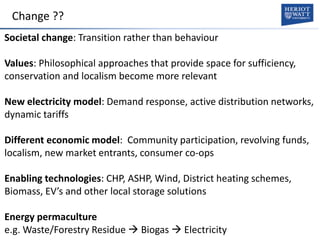
Change ??
Societal change: Transition rather than behaviour
Values: Philosophical approaches that provide space for sufficiency,
conservation and localism become more relevant
New electricity model: Demand response, active distribution networks,
dynamic tariffs
Different economic model: Community participation, revolving funds,
localism, new market entrants, consumer co-ops
Enabling technologies: CHP, ASHP, Wind, District heating schemes,
Biomass, EV’s and other local storage solutions
Energy permaculture
e.g. Waste/Forestry Residue  Biogas  Electricity
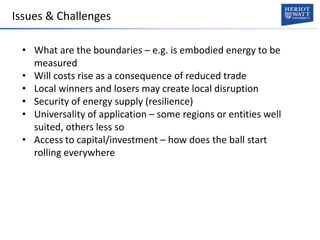
Issues & Challenges
• What are the boundaries – e.g. is embodied energy to be
measured
• Will costs rise as a consequence of reduced trade
• Local winners and losers may create local disruption
• Security of energy supply (resilience)
• Universality of application – some regions or entities well
suited, others less so
• Access to capital/investment – how does the ball start
rolling everywhere
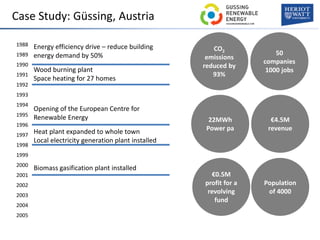
Case Study: Güssing, Austria
1988
1989
1990
1991
1992
1993
1994
1995
1996
1997
1998
1999
2000
2001
2002
2003
2004
2005
Energy efficiency drive – reduce building
energy demand by 50%
Wood burning plant
Space heating for 27 homes
Opening of the European Centre for
Renewable Energy
Heat plant expanded to whole town
Local electricity generation plant installed
Biomass gasification plant installed
50
companies
1000 jobs
22MWh
Power pa
CO2
emissions
reduced by
93%
Population
of 4000
€4.5M
revenue
€0.5M
profit for a
revolving
fund
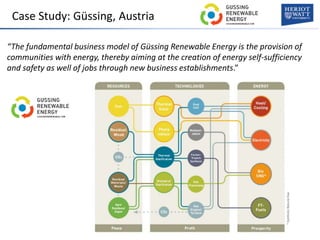
Case Study: Güssing, Austria
“The fundamental business model of Güssing Renewable Energy is the provision of
communities with energy, thereby aiming at the creation of energy self-sufficiency
and safety as well of jobs through new business establishments.”
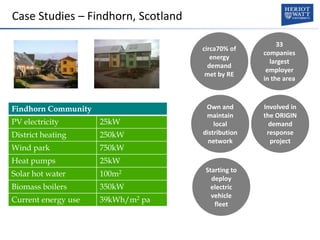
Case Studies – Findhorn, Scotland
Findhorn Community
PV electricity 25kW
District heating 250kW
Wind park 750kW
Heat pumps 25kW
Solar hot water 100m2
Biomass boilers 350kW
Current energy use 39kWh/m2 pa
33
companies
largest
employer
in the area
Own and
maintain
local
distribution
network
circa70% of
energy
demand
met by RE
Involved in
the ORIGIN
demand
response
project
Starting to
deploy
electric
vehicle
fleet
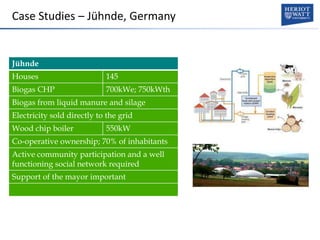
Case Studies – Jühnde, Germany
Jühnde
Houses 145
Biogas CHP 700kWe; 750kWth
Biogas from liquid manure and silage
Electricity sold directly to the grid
Wood chip boiler 550kW
Co-operative ownership; 70% of inhabitants
Active community participation and a well
functioning social network required
Support of the mayor important
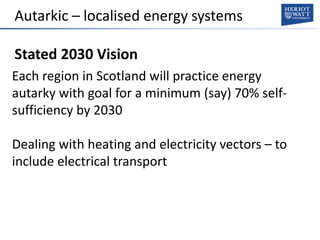
Each region in Scotland will practice energy
autarky with goal for a minimum (say) 70% self-
sufficiency by 2030
Dealing with heating and electricity vectors – to
include electrical transport
Autarkic – localised energy systems
Stated 2030 Vision

Scotland's Autarkic Vision

  • 1.
    Autarkic – localisedenergy systems Definitions: “We define a region to be energy autarkic when it relies on its own energy resources for generating the useful energy required to sustain the society within that region” Muller et al., Energy Policy 39 (2011) 5800-5810 “… a situation in which a region does not import substantial amounts of energy resources” Schmidt et al., Energy Policy 47 (2012) 211-221 “… a framework for local action towards the development of a region’s viability, based on the transformation of the energy subsystem” Muller et al., Energy Policy 39 (2011) 5800-5810
  • 2.
    Autarkic – localisedenergy systems Definitions: “We define a region to be energy autarkic when it relies on its own energy resources for generating the useful energy required to sustain the society within that region” Muller et al., Energy Policy 39 (2011) 5800-5810 “… a situation in which a region does not import substantial amounts of energy resources” Schmidt et al., Energy Policy 47 (2012) 211-221 “… a framework for local action towards the development of a region’s viability, based on the transformation of the energy subsystem” Muller et al., Energy Policy 39 (2011) 5800-5810
  • 3.
    Motivations • Loss offaith in conventional approaches to dealing with geo- political shocks • Desire for more local/regional solutions • Creation of entrants into the energy space (local utility companies formed, Consumer Co-ops, HA’s, LA’s) • The main dynamism therefore is cultural • Centralised approach is a function of its age (1950-80) • Efficiency gains at large scale are exhausted • Developments in generation and communications technology creating economic opportunities at a different scale Lovins A, Rocky Mountain institute, 2007; Awerbuch S., Tyndall Centre, 2004, Verbong & Geels, Tech Fore & Soc Chng, 77 (2010) 1214-1221
  • 4.
    Transition vs. Behaviour Technologyoptimism has to be fused with social factors Current social policy champions individualism It suggests that societal factors are associated with personal attitudes, behaviours and choices (Shove, Environment and Planning, 2010, 42, 1273-1285) Treating change as a series of purchasing and consumption behaviours over simplifies the scale of the challenge Transition is required and move towards Autarkic entities provides that stimulus to change
  • 5.
  • 6.
    2014 fuel toload map electricityfossil fuel resources Fuel electricity Heat regional resources
  • 7.
    2030 fuel toload map electricityfossil fuel resources Fuel electricity Heat regional resources Regional production of goods and services Bartering with other regions & entities Inward investment Appeal of region Sustainable economic model Job security Local Benefits
  • 8.
    Change ?? Societal change:Transition rather than behaviour Values: Philosophical approaches that provide space for sufficiency, conservation and localism become more relevant New electricity model: Demand response, active distribution networks, dynamic tariffs Different economic model: Community participation, revolving funds, localism, new market entrants, consumer co-ops Enabling technologies: CHP, ASHP, Wind, District heating schemes, Biomass, EV’s and other local storage solutions Energy permaculture e.g. Waste/Forestry Residue  Biogas  Electricity
  • 9.
    Issues & Challenges •What are the boundaries – e.g. is embodied energy to be measured • Will costs rise as a consequence of reduced trade • Local winners and losers may create local disruption • Security of energy supply (resilience) • Universality of application – some regions or entities well suited, others less so • Access to capital/investment – how does the ball start rolling everywhere
  • 10.
    Case Study: Güssing,Austria 1988 1989 1990 1991 1992 1993 1994 1995 1996 1997 1998 1999 2000 2001 2002 2003 2004 2005 Energy efficiency drive – reduce building energy demand by 50% Wood burning plant Space heating for 27 homes Opening of the European Centre for Renewable Energy Heat plant expanded to whole town Local electricity generation plant installed Biomass gasification plant installed 50 companies 1000 jobs 22MWh Power pa CO2 emissions reduced by 93% Population of 4000 €4.5M revenue €0.5M profit for a revolving fund
  • 11.
    Case Study: Güssing,Austria “The fundamental business model of Güssing Renewable Energy is the provision of communities with energy, thereby aiming at the creation of energy self-sufficiency and safety as well of jobs through new business establishments.”
  • 12.
    Case Studies –Findhorn, Scotland Findhorn Community PV electricity 25kW District heating 250kW Wind park 750kW Heat pumps 25kW Solar hot water 100m2 Biomass boilers 350kW Current energy use 39kWh/m2 pa 33 companies largest employer in the area Own and maintain local distribution network circa70% of energy demand met by RE Involved in the ORIGIN demand response project Starting to deploy electric vehicle fleet
  • 13.
    Case Studies –Jühnde, Germany Jühnde Houses 145 Biogas CHP 700kWe; 750kWth Biogas from liquid manure and silage Electricity sold directly to the grid Wood chip boiler 550kW Co-operative ownership; 70% of inhabitants Active community participation and a well functioning social network required Support of the mayor important
  • 14.
    Each region inScotland will practice energy autarky with goal for a minimum (say) 70% self- sufficiency by 2030 Dealing with heating and electricity vectors – to include electrical transport Autarkic – localised energy systems Stated 2030 Vision