Source: http://www.wholebrainteaching.com
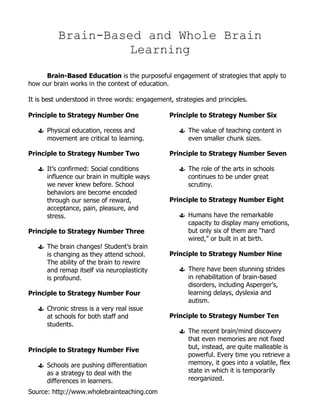
Brain-Based and Whole Brain
Learning
Brain-Based Education is the purposeful engagement of strategies that apply to
how our brain works in the context of education.
It is best understood in three words: engagement, strategies and principles.
Principle to Strategy Number One
 Physical education, recess and
movement are critical to learning.
Principle to Strategy Number Two
 It’s confirmed: Social conditions
influence our brain in multiple ways
we never knew before. School
behaviors are become encoded
through our sense of reward,
acceptance, pain, pleasure, and
stress.
Principle to Strategy Number Three
 The brain changes! Student’s brain
is changing as they attend school.
The ability of the brain to rewire
and remap itself via neuroplasticity
is profound.
Principle to Strategy Number Four
 Chronic stress is a very real issue
at schools for both staff and
students.
Principle to Strategy Number Five
 Schools are pushing differentiation
as a strategy to deal with the
differences in learners.
Principle to Strategy Number Six
 The value of teaching content in
even smaller chunk sizes.
Principle to Strategy Number Seven
 The role of the arts in schools
continues to be under great
scrutiny.
Principle to Strategy Number Eight
 Humans have the remarkable
capacity to display many emotions,
but only six of them are “hard
wired,” or built in at birth.
Principle to Strategy Number Nine
 There have been stunning strides
in rehabilitation of brain-based
disorders, including Asperger’s,
learning delays, dyslexia and
autism.
Principle to Strategy Number Ten
 The recent brain/mind discovery
that even memories are not fixed
but, instead, are quite malleable is
powerful. Every time you retrieve a
memory, it goes into a volatile, flex
state in which it is temporarily
reorganized.
Source: http://www.wholebrainteaching.com
Brain-Based and Whole Brain
Learning
Brain-Based Education is the
purposeful engagement of strategies that
apply to how our brain works in the
context of education.
It is best understood in three words:
engagement, strategies and principles.
Principle to Strategy Number One
 Physical education, recess and
movement are critical to learning.
Principle to Strategy Number Two
 It’s confirmed: Social conditions
influence our brain in multiple ways
we never knew before. School
behaviors are become encoded
through our sense of reward,
acceptance, pain, pleasure, and
stress.
Principle to Strategy Number Three
 The brain changes! Student’s brain
is changing as they attend school.
The ability of the brain to rewire
and remap itself via neuroplasticity
is profound.
Principle to Strategy Number Four
 Chronic stress is a very real issue
at schools for both staff and
students.
Principle to Strategy Number Five
 Schools are pushing differentiation
as a strategy to deal with the
differences in learners.
Principle to Strategy Number Six
 The value of teaching content in
even smaller chunk sizes.
Principle to Strategy Number Seven
 The role of the arts in schools
continues to be under great
scrutiny.
Principle to Strategy Number Eight
 Humans have the remarkable
capacity to display many emotions,
but only six of them are “hard
wired,” or built in at birth.
Principle to Strategy Number Nine
 There have been stunning strides
in rehabilitation of brain-based
disorders, including Asperger’s,
learning delays, dyslexia and
autism.
Principle to Strategy Number Ten
 The recent brain/mind discovery
that even memories are not fixed
but, instead, are quite malleable is
powerful. Every time you retrieve a
Source: http://www.wholebrainteaching.com
memory, it goes into a volatile, flex
state in which it is temporarily
reorganized.
Whole Brain Teaching
 It is a new "radical" idea to some;
however it is nothing more than tried
and true teaching practices,
combined into a new approach.
 It combines the direct instruction,
sharing and immediate feedback to
become a new style of teaching.
Whole brain teaching surmounts to
seven steps that a teacher
incorporates into their everyday
classroom.
Whole Brain Literacy (WBL) can be
described as the circulation the human
thinking system through brain quadrants
described by Lynch in his Brain Map
model:
I-Control: What I know now?
I-Explore: What I want to try?
I-Pursue: How to do it?
I-Preserve: How do I feel?
Step 1: Class-Yes
Step 2: Classroom Rules
Step 3: Teach-OK
Step 4: Scoreboard Game
Step 5: Hands and Eyes
Step 6: Mirror
Step 7: Switch
Main Goal of Each Day
٥ Rotate and made to best
accommodate the lesson and what
is to be achieve for that day.
٥ It simply an approach to teaching,
which integrates movement,
gestures, songs, chants and dances
into teaching.
٥ It addresses the use of project
assessments versus formative and
summative formal tests as well as
teaching that in general breaks
away from the standard "lecture"
model.
٥ Seeks to actively engage every
student in the lesson by
incorporating many different
teaching techniques into one
lesson.
Why is Whole Brain Teaching a Best
Practice?
It is considered a best practice because
this method of teaching seeks to
empower students as learners. In most
classrooms nation and worldwide,
teaching remains direct instruction by a
teacher who is "more knowledgeable"
transferring knowledge through lectures
and worksheets all leading to a test.
However, whole brain teaching attempts
to break away from this norm and allow
students to become the "more
knowledgeable ones" in control of
teaching, while also taking attention away
from tests and focusing on daily activities.
Reported by:
Group 1
STC 2 T 3:00-4:00PM

Whole brain teaching ho.edited

  • 1.
    Source: http://www.wholebrainteaching.com Brain-Based andWhole Brain Learning Brain-Based Education is the purposeful engagement of strategies that apply to how our brain works in the context of education. It is best understood in three words: engagement, strategies and principles. Principle to Strategy Number One  Physical education, recess and movement are critical to learning. Principle to Strategy Number Two  It’s confirmed: Social conditions influence our brain in multiple ways we never knew before. School behaviors are become encoded through our sense of reward, acceptance, pain, pleasure, and stress. Principle to Strategy Number Three  The brain changes! Student’s brain is changing as they attend school. The ability of the brain to rewire and remap itself via neuroplasticity is profound. Principle to Strategy Number Four  Chronic stress is a very real issue at schools for both staff and students. Principle to Strategy Number Five  Schools are pushing differentiation as a strategy to deal with the differences in learners. Principle to Strategy Number Six  The value of teaching content in even smaller chunk sizes. Principle to Strategy Number Seven  The role of the arts in schools continues to be under great scrutiny. Principle to Strategy Number Eight  Humans have the remarkable capacity to display many emotions, but only six of them are “hard wired,” or built in at birth. Principle to Strategy Number Nine  There have been stunning strides in rehabilitation of brain-based disorders, including Asperger’s, learning delays, dyslexia and autism. Principle to Strategy Number Ten  The recent brain/mind discovery that even memories are not fixed but, instead, are quite malleable is powerful. Every time you retrieve a memory, it goes into a volatile, flex state in which it is temporarily reorganized.
  • 2.
    Source: http://www.wholebrainteaching.com Brain-Based andWhole Brain Learning Brain-Based Education is the purposeful engagement of strategies that apply to how our brain works in the context of education. It is best understood in three words: engagement, strategies and principles. Principle to Strategy Number One  Physical education, recess and movement are critical to learning. Principle to Strategy Number Two  It’s confirmed: Social conditions influence our brain in multiple ways we never knew before. School behaviors are become encoded through our sense of reward, acceptance, pain, pleasure, and stress. Principle to Strategy Number Three  The brain changes! Student’s brain is changing as they attend school. The ability of the brain to rewire and remap itself via neuroplasticity is profound. Principle to Strategy Number Four  Chronic stress is a very real issue at schools for both staff and students. Principle to Strategy Number Five  Schools are pushing differentiation as a strategy to deal with the differences in learners. Principle to Strategy Number Six  The value of teaching content in even smaller chunk sizes. Principle to Strategy Number Seven  The role of the arts in schools continues to be under great scrutiny. Principle to Strategy Number Eight  Humans have the remarkable capacity to display many emotions, but only six of them are “hard wired,” or built in at birth. Principle to Strategy Number Nine  There have been stunning strides in rehabilitation of brain-based disorders, including Asperger’s, learning delays, dyslexia and autism. Principle to Strategy Number Ten  The recent brain/mind discovery that even memories are not fixed but, instead, are quite malleable is powerful. Every time you retrieve a
  • 3.
    Source: http://www.wholebrainteaching.com memory, itgoes into a volatile, flex state in which it is temporarily reorganized. Whole Brain Teaching  It is a new "radical" idea to some; however it is nothing more than tried and true teaching practices, combined into a new approach.  It combines the direct instruction, sharing and immediate feedback to become a new style of teaching. Whole brain teaching surmounts to seven steps that a teacher incorporates into their everyday classroom. Whole Brain Literacy (WBL) can be described as the circulation the human thinking system through brain quadrants described by Lynch in his Brain Map model: I-Control: What I know now? I-Explore: What I want to try? I-Pursue: How to do it? I-Preserve: How do I feel? Step 1: Class-Yes Step 2: Classroom Rules Step 3: Teach-OK Step 4: Scoreboard Game Step 5: Hands and Eyes Step 6: Mirror Step 7: Switch Main Goal of Each Day ٥ Rotate and made to best accommodate the lesson and what is to be achieve for that day. ٥ It simply an approach to teaching, which integrates movement, gestures, songs, chants and dances into teaching. ٥ It addresses the use of project assessments versus formative and summative formal tests as well as teaching that in general breaks away from the standard "lecture" model. ٥ Seeks to actively engage every student in the lesson by incorporating many different teaching techniques into one lesson. Why is Whole Brain Teaching a Best Practice? It is considered a best practice because this method of teaching seeks to empower students as learners. In most classrooms nation and worldwide, teaching remains direct instruction by a teacher who is "more knowledgeable" transferring knowledge through lectures and worksheets all leading to a test. However, whole brain teaching attempts to break away from this norm and allow students to become the "more knowledgeable ones" in control of teaching, while also taking attention away from tests and focusing on daily activities. Reported by: Group 1 STC 2 T 3:00-4:00PM