Dr H.Comerasamy
University of Brighton
                   UK
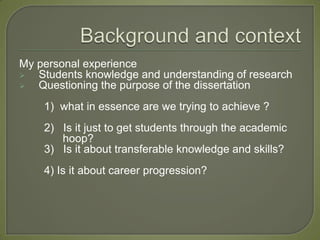
My personal experience
  Students knowledge and understanding of research
  Questioning the purpose of the dissertation
    1) what in essence are we trying to achieve ?
    2) Is it just to get students through the academic
       hoop?
    3) Is it about transferable knowledge and skills?
    4) Is it about career progression?
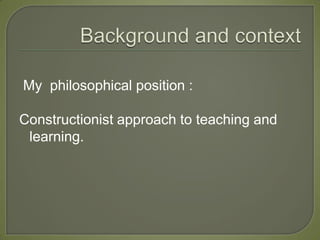
My philosophical position :

Constructionist approach to teaching and
 learning.
The theory rests on several assumptions

 knowledge   is socially constructed rather
  than truth or fact.
 Learning is an active, rather than passive,
  process of knowledge construction.
Research informed teaching

Particular focus- developing students as
 researchers
In constructionist classroom students are
  encouraged to:
 pose questions
 pose statements
 explore ways to find the answers to
  questions & statements
Development of:

   Analytical/ critical skills and skills that
    can be applied to other problems.
    Enquiring mind.
    Research mindedness ,
    knowledgeable and skilled.
Tool – the dissertation
Research based
Literature based research methodology
Getting students to engage in the process
Importance of language
 Engaging them as researchers rather than
   students
 Changing a mindset & inculcating a
   different form of thinking
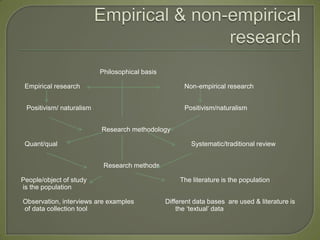
Philosophical basis

 Empirical research                                   Non-empirical research


 Positivism/ naturalism                               Positivism/naturalism


                          Research methodology

 Quant/qual                                              Systematic/traditional review


                           Research methods

People/object of study                               The literature is the population
is the population

Observation, interviews are examples            Different data bases are used & literature is
of data collection tool                             the „textual‟ data
Literature based research methodology has
often been referred to in many texts as :

                literature review

To some extent this is true but the problem is that
  as such it has blurred the understanding
  between literature review as a methodology in its
  own right and its utilisation in the process of
  empirical research. So we need to differentiate
  between the two purposes.
Literature based methodology – designing a
  research project where existing literature is
  the population where the researcher
  needs to go for:

   Sampling
   Data collection
   Data analysis
   Ethics
Constitutes two types
1. Systematic literature review [also known
  as systematic overview]
2. Traditional literature review [also known
  as narrative or comprehensive
Definition:
 “ A scientific tool which can be used to summarise,
  appraise and communicate the results and implications
  of otherwise unmanageable quantities of research”
                         [ CRD Report 4: 2001]
Philosophical basis:
Positivism – Quantitative methodology
Purpose:
To synthesise the results of a number of small studies
Rationale:
   Small studies- design may be rigorous but
     may lack Statistical power to show significant
     effect.

Methodology:
  Quantitative approach
  May include meta-analysis [the specific statistical
 method to combine results from different studies
 into single summary estimate
  for quick reference].
The research process
 Research problem
 Research question[s]
 carrying out the review- searching the data
                        - critical analysis of the data
                        - combining and synthesising the data
Basically it is a:
 Reanalysis of results
 Reanalysis of findings


Method of data analysis
 Descriptive
 Data extraction tool
A methodology in its own right
 Epistemological basis:
Interpretivism: Comprehensive review

May combine positivist elements
The criticism here is:
 Methodological- not based on explicit
  specified method
 No clear cut steps in design
The key issue:

 To ensure that the quality and rigour of the
 research is demonstrated and the link is
 made apparent from beginning to end.
What are the students required to do?
Engaging students in the process.
Pedagogical issues
The process should be the same as empirical design
Four main considerations:
1) Defining the research problem and posing the
   research question
2) Overview of the literature to support the study

3) Methodology – Design of the study

4) Ethics and ethical approval
1 .Defining the research problem [ may come from
  practice ]

Examples may be as issue with:
 domestic violence
  patient experience with obesity
  transition to motherhood
  postnatal depression
  attending to patients spiritual needs
  effective communication with patients
Posing the research question:
 May start with reflecting on a particular issue from
  practice that the student has observed.

   May involve talking the issue with others- obtaining as
    wide a perspective as possible.

   Questioning- what is going on here?
       1) policies
       2) protocols
       3) guidelines
   Working research question
2.Overview of the literature:

Purpose
 What exists on the subject if enquiry
 Identify gaps in knowledge
 Confirms the research question
 Reformulation of the research question
 Support feasibility of the study
3. Methodology:

[Note that in secondary ,methodology the literature
  is the Population –i.e all sources where data are
  found]
Method of data collection:
Methods
 Sampling and sampling strategy
 Inclusion & exclusion criteria
 Data collection tool- where and how will data be
  collected?
Search strategy
 Which data bases ?
 Search terms
 Reviewing the search terms, data bases
Inclusion criteria- defines the boundaries of the
                    study
 Type of data – research papers to include both qualitative
   and quantitative methodology
 Language and context
 Time frame- e.g. 1990 – 2011
 A variety of studies- research as well as grey literature


Exclusion criteria
 Papers that are not current
 Research conducted externally
 Any other methodology – i.e. mixed methodology
Data analysis
Includes two analytical phases
 1) Appraising the data
 2) Synthesis of the data


How to go about doing the analysis ?
Needs a structured approach

Employs the principles of systematic review.
 Data extraction tool + a theoretical framework
The data extraction tool
Can be constructed by using:
 a combination of research critique frameworks


   Precise identification of the information to
    be extracted.

What can it do?
 Enables a schematic presentation of findings
 Enables development of student own thinking and
  position.
Appraising the data
 Appraising how the authors have arrived at their
  findings, themes and conclusions
 Background of the authors
 Have they been true to their chosen methodology?
 Theoretical frameworks
 Epistemological orientation
 Findings and relationship to the research question
 Contribution to existing evidence
Synthesis of the data :
May calls for the examination of the findings in the
  following Contexts

Disciplinary context
Professional education
Professional acculturation
How has these contexts shaped the
 essence the research findings and the
 contribution to evidence ?
Findings :
Can be organised in themes
Address how the primary researchers arrived at
 themes
Discussion and implications for practice
 Can the evidence be trusted?
 Has the research question been answered
 What are the challenges for the area of practice?
 Can the findings be applied to the area of practice?
           direct day to day care
            policy
   What is the student‟s own position?
   Conclusion and recommendations
Completing the research cycle
What are the issues:
 quality of evidence
 understanding of knowledge
 utilisation of knowledge
 protocols and policies
 barriers to implementation of research
 political issues
 economical issues
 ethical issues


Recommendations
Moving from secondary to primary
 methodology


Ideally students should be advised to raise
  future research question
Aveyard.H ( 2010) Doing a literature review
 in health and social care – A practical
 guide, London: Sage publication

Hart. C.(2001) Doing a literature review - a
 comprehensive guide for the social
 sciences. London: Sage publications

Literature Based Research Methodology

  • 1.
  • 2.
    My personal experience  Students knowledge and understanding of research  Questioning the purpose of the dissertation 1) what in essence are we trying to achieve ? 2) Is it just to get students through the academic hoop? 3) Is it about transferable knowledge and skills? 4) Is it about career progression?
  • 3.
    My philosophical position: Constructionist approach to teaching and learning.
  • 4.
    The theory restson several assumptions  knowledge is socially constructed rather than truth or fact.  Learning is an active, rather than passive, process of knowledge construction.
  • 5.
    Research informed teaching Particularfocus- developing students as researchers
  • 6.
    In constructionist classroomstudents are encouraged to:  pose questions  pose statements  explore ways to find the answers to questions & statements
  • 7.
    Development of:  Analytical/ critical skills and skills that can be applied to other problems.  Enquiring mind.  Research mindedness ,  knowledgeable and skilled.
  • 8.
    Tool – thedissertation Research based Literature based research methodology Getting students to engage in the process Importance of language  Engaging them as researchers rather than students  Changing a mindset & inculcating a different form of thinking
  • 9.
    Philosophical basis Empiricalresearch Non-empirical research Positivism/ naturalism Positivism/naturalism Research methodology Quant/qual Systematic/traditional review Research methods People/object of study The literature is the population is the population Observation, interviews are examples Different data bases are used & literature is of data collection tool the „textual‟ data
  • 10.
    Literature based researchmethodology has often been referred to in many texts as : literature review To some extent this is true but the problem is that as such it has blurred the understanding between literature review as a methodology in its own right and its utilisation in the process of empirical research. So we need to differentiate between the two purposes.
  • 11.
    Literature based methodology– designing a research project where existing literature is the population where the researcher needs to go for:  Sampling  Data collection  Data analysis  Ethics
  • 12.
    Constitutes two types 1.Systematic literature review [also known as systematic overview] 2. Traditional literature review [also known as narrative or comprehensive
  • 13.
    Definition: “ Ascientific tool which can be used to summarise, appraise and communicate the results and implications of otherwise unmanageable quantities of research” [ CRD Report 4: 2001] Philosophical basis: Positivism – Quantitative methodology Purpose: To synthesise the results of a number of small studies
  • 14.
    Rationale:  Small studies- design may be rigorous but may lack Statistical power to show significant effect. Methodology: Quantitative approach May include meta-analysis [the specific statistical method to combine results from different studies into single summary estimate for quick reference].
  • 15.
    The research process Research problem  Research question[s]  carrying out the review- searching the data - critical analysis of the data - combining and synthesising the data Basically it is a:  Reanalysis of results  Reanalysis of findings Method of data analysis  Descriptive  Data extraction tool
  • 16.
    A methodology inits own right Epistemological basis: Interpretivism: Comprehensive review May combine positivist elements
  • 17.
    The criticism hereis:  Methodological- not based on explicit specified method  No clear cut steps in design
  • 18.
    The key issue: To ensure that the quality and rigour of the research is demonstrated and the link is made apparent from beginning to end.
  • 19.
    What are thestudents required to do? Engaging students in the process. Pedagogical issues The process should be the same as empirical design Four main considerations: 1) Defining the research problem and posing the research question 2) Overview of the literature to support the study 3) Methodology – Design of the study 4) Ethics and ethical approval
  • 20.
    1 .Defining theresearch problem [ may come from practice ] Examples may be as issue with:  domestic violence  patient experience with obesity  transition to motherhood  postnatal depression  attending to patients spiritual needs  effective communication with patients
  • 21.
    Posing the researchquestion:  May start with reflecting on a particular issue from practice that the student has observed.  May involve talking the issue with others- obtaining as wide a perspective as possible.  Questioning- what is going on here? 1) policies 2) protocols 3) guidelines  Working research question
  • 22.
    2.Overview of theliterature: Purpose  What exists on the subject if enquiry  Identify gaps in knowledge  Confirms the research question  Reformulation of the research question  Support feasibility of the study
  • 23.
    3. Methodology: [Note thatin secondary ,methodology the literature is the Population –i.e all sources where data are found]
  • 24.
    Method of datacollection: Methods  Sampling and sampling strategy  Inclusion & exclusion criteria  Data collection tool- where and how will data be collected? Search strategy  Which data bases ?  Search terms  Reviewing the search terms, data bases
  • 25.
    Inclusion criteria- definesthe boundaries of the study  Type of data – research papers to include both qualitative and quantitative methodology  Language and context  Time frame- e.g. 1990 – 2011  A variety of studies- research as well as grey literature Exclusion criteria  Papers that are not current  Research conducted externally  Any other methodology – i.e. mixed methodology
  • 26.
    Data analysis Includes twoanalytical phases 1) Appraising the data 2) Synthesis of the data How to go about doing the analysis ? Needs a structured approach Employs the principles of systematic review. Data extraction tool + a theoretical framework
  • 27.
    The data extractiontool Can be constructed by using:  a combination of research critique frameworks  Precise identification of the information to be extracted. What can it do?  Enables a schematic presentation of findings  Enables development of student own thinking and position.
  • 28.
    Appraising the data Appraising how the authors have arrived at their findings, themes and conclusions  Background of the authors  Have they been true to their chosen methodology?  Theoretical frameworks  Epistemological orientation  Findings and relationship to the research question  Contribution to existing evidence
  • 29.
    Synthesis of thedata : May calls for the examination of the findings in the following Contexts Disciplinary context Professional education Professional acculturation
  • 30.
    How has thesecontexts shaped the essence the research findings and the contribution to evidence ?
  • 31.
    Findings : Can beorganised in themes Address how the primary researchers arrived at themes Discussion and implications for practice  Can the evidence be trusted?  Has the research question been answered  What are the challenges for the area of practice?  Can the findings be applied to the area of practice? direct day to day care policy  What is the student‟s own position?  Conclusion and recommendations
  • 32.
    Completing the researchcycle What are the issues:  quality of evidence  understanding of knowledge  utilisation of knowledge  protocols and policies  barriers to implementation of research  political issues  economical issues  ethical issues Recommendations
  • 33.
    Moving from secondaryto primary methodology Ideally students should be advised to raise future research question
  • 34.
    Aveyard.H ( 2010)Doing a literature review in health and social care – A practical guide, London: Sage publication Hart. C.(2001) Doing a literature review - a comprehensive guide for the social sciences. London: Sage publications