SpecterOps Webinar Week
Monday – Hunting from Home
Tuesday – Everything You Always Wanted To Know About BloodHound* (*But were afraid to ask)
Wednesday – Kerberoasting Revisited
Thursday – Capability Abstraction: Dumping LSASS
Friday – Remote Team Project Management and Reporting Construction
Introduction
• Job: Technical Architect at SpecterOps
• Code: Veil-Framework, Empire, PowerView/PowerUp, BloodHound,
GhostPack
• Cons: DerbyCon, BlackHat, DEF CON, Troopers, ShmooCon
• Training: Adversary Tactics: Red Team Operations, Adversary Tactics:
PowerShell (now open source!), veteran BlackHat trainer
-2-
Overview
• Exactly how Kerberoasting works
• msDS-SupportedEncryptionTypes
• Previous Kerberoasting Approaches
• Building a Better Kerberoast With Rubeus
• Defenses (and Kerberoasting OPSEC)
-3-
Kerberoasting: The Beginning
Thanks
@timmeddin!
-4-
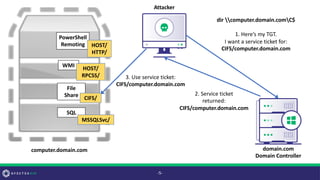
-5-
WMI
computer.domain.com
PowerShell
Remoting
File
Share
SQL
HOST/
HTTP/
HOST/
RPCSS/
CIFS/
MSSQLSvc/
dir computer.domain.comC$
1. Here’s my TGT.
I want a service ticket for:
CIFS/computer.domain.com
2. Service ticket
returned:
CIFS/computer.domain.com
3. Use service ticket:
CIFS/computer.domain.com
domain.com
Domain Controller
Attacker
-6-
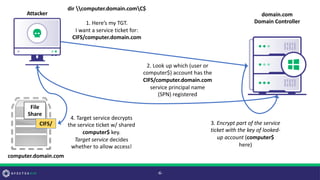
dir computer.domain.comC$
1. Here’s my TGT.
I want a service ticket for:
CIFS/computer.domain.com
2. Look up which (user or
computer$) account has the
CIFS/computer.domain.com
service principal name
(SPN) registered
3. Encrypt part of the service
ticket with the key of looked-
up account (computer$
here)
4. Target service decrypts
the service ticket w/ shared
computer$ key.
Target service decides
whether to allow access!
computer.domain.com
File
Share
CIFS/
domain.com
Domain Controller
Attacker
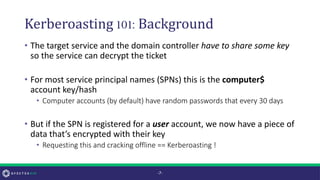
Kerberoasting 101:Background
• The target service and the domain controller have to share some key
so the service can decrypt the ticket
• For most service principal names (SPNs) this is the computer$
account key/hash
• Computer accounts (by default) have random passwords that every 30 days
• But if the SPN is registered for a user account, we now have a piece of
data that’s encrypted with their key
• Requesting this and cracking offline == Kerberoasting !
-7-
Kerberoasting 101: Using the Goods
• If a user account has an SPN registered, the user often:
• has admin privileges on the machine specified in the SPN
• and/or is in other privileged domain groups
• Even if they don’t/aren’t, with the key cracked, we can forge service
tickets as ANY user to the specific service principal name
• This is what “silver tickets” are!
-8-
Kerberoasting 101: Why Care
• ANY user can request a service ticket for ANY SPN (by design!)
• This service ticket give us a piece of information encrypted with the
key/hash of the (user) account that backs that SPN
• We only communicate with the DC - no packets are sent to the service
target unless we try to use the requested ticket!
• Translation: if a user has a non-null servicePrincipalName property,
we can crack their password offline (with GPU-accelerated software!)
-9-
Kerberoasting 201: Key Encryption Types
• Service tickets (just like TGTs) generally use either
AES256_CTS_HMAC_SHA1_96 (AES256) or RC4_HMAC_MD5
(RC4/NTLM) keys for ticket encryption
• AES encryption was introduced with domain functional level 2008, but RC4 has
been kept for backwards compatibility reasons
• From an offensive perspective, we really want responses encrypted
with RC4, since it’s orders of magnitude faster to crack than AES
-10-
Sidenote:Kerberoasting Defenses
• Modern (2008+ functional level) Active Directory domains are
supposed to use AES keys by default for Kerberos exchanges
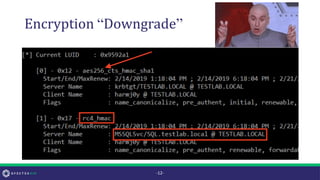
• So requesting a RC4 service ticket should result in “encryption
downgrade activity”
• But built-in request methods for user-backed SPNs nearly always
return RC4-encrypted service tickets 🤔
-11-
Encryption “Downgrade”
-12-
msDS-SupportedEncryptionTypes
• Active Directory user/computer account property touched on by Jim
Shaver and Mitchell Hennigan in their DerbyCon 7.0 “Return From
The Underworld” talk
• According to Microsoft’s [MS-ADA2], “The Key Distribution Center
(KDC) uses this information [msDS-SupportedEncryptionTypes] while
generating a service ticket for this account.”
• Translation: this property (on an account with a non-null SPN)
determines the encryption used for service tickets requested for that
account’s SPN(s)
-13-
msDS-SupportedEncryptionTypes
• According to MS-KILE 3.1.1.5 the default value for this field is 0x1C
(RC4 | AES128 | AES256 = 28) for Windows 7+ and Server 2008R2+
• However, this property is only set by default on computer accounts
(not user or trust accounts!)
• If this property is not defined (or is set to 0) [MS-KILE] 3.3.5.7 says default
behavior is to use a value of 0x7 (RC4)
-14-
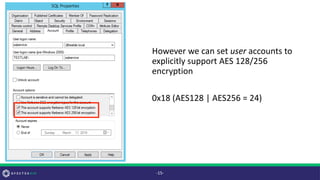
However we can set user accounts to
explicitly support AES 128/256
encryption
0x18 (AES128 | AES256 = 24)
-15-
-16-
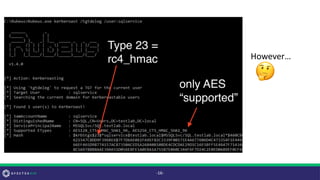
However…
🤔
So What?
• There doesn’t seem to be an easy way to disable RC4_HMAC service
ticket requests on user accounts, meaning we can’t “stop” RC4
Kerberoasting
• The reason for this behavior is in case accounts were created in a 2003
functional level domain and haven’t had their passwords changed since
• We can disable RC4 for the entire domain, but this also kills RC4 TGTs, which
isn’t feasible for most environments
• However setting AES support for user accounts at least gives us the
“encryption downgrade” detection back
-17-
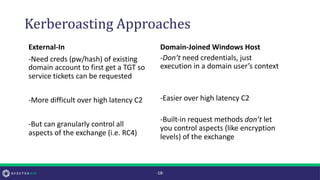
Kerberoasting Approaches
-18-
External-In
-Need creds (pw/hash) of existing
domain account to first get a TGT so
service tickets can be requested
-More difficult over high latency C2
-But can granularly control all
aspects of the exchange (i.e. RC4)
Domain-Joined Windows Host
-Don’t need credentials, just
execution in a domain user’s context
-Easier over high latency C2
-Built-in request methods don’t let
you control aspects (like encryption
levels) of the exchange
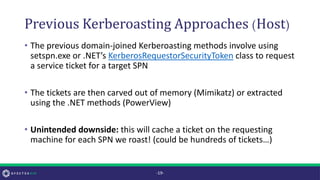
Previous Kerberoasting Approaches (Host)
• The previous domain-joined Kerberoasting methods involve using
setspn.exe or .NET’s KerberosRequestorSecurityToken class to request
a service ticket for a target SPN
• The tickets are then carved out of memory (Mimikatz) or extracted
using the .NET methods (PowerView)
• Unintended downside: this will cache a ticket on the requesting
machine for each SPN we roast! (could be hundreds of tickets…)
-19-
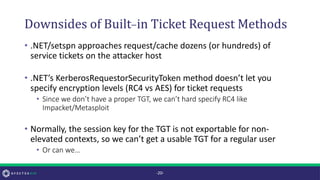
Downsides of Built-in Ticket Request Methods
• .NET/setspn approaches request/cache dozens (or hundreds) of
service tickets on the attacker host
• .NET’s KerberosRequestorSecurityToken method doesn’t let you
specify encryption levels (RC4 vs AES) for ticket requests
• Since we don’t have a proper TGT, we can’t hard specify RC4 like
Impacket/Metasploit
• Normally, the session key for the TGT is not exportable for non-
elevated contexts, so we can’t get a usable TGT for a regular user
• Or can we…
-20-
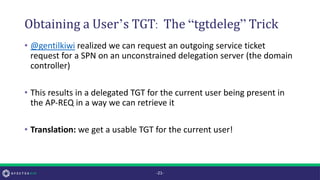
Obtaining a User’s TGT: The “tgtdeleg” Trick
• @gentilkiwi realized we can request an outgoing service ticket
request for a SPN on an unconstrained delegation server (the domain
controller)
• This results in a delegated TGT for the current user being present in
the AP-REQ in a way we can retrieve it
• Translation: we get a usable TGT for the current user!
-21-
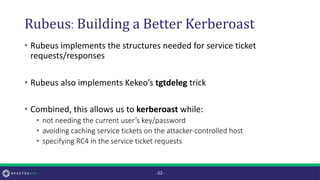
Rubeus:Building a Better Kerberoast
• Rubeus implements the structures needed for service ticket
requests/responses
• Rubeus also implements Kekeo’s tgtdeleg trick
• Combined, this allows us to kerberoast while:
• not needing the current user’s key/password
• avoiding caching service tickets on the attacker-controlled host
• specifying RC4 in the service ticket requests
-22-
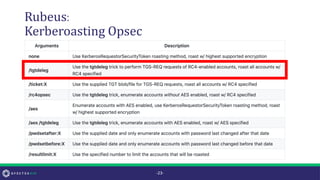
Rubeus:
Kerberoasting Opsec
-23-
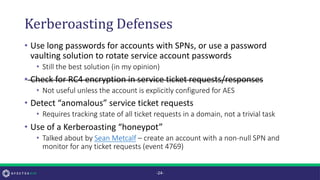
Kerberoasting Defenses
• Use long passwords for accounts with SPNs, or use a password
vaulting solution to rotate service account passwords
• Still the best solution (in my opinion)
• Check for RC4 encryption in service ticket requests/responses
• Not useful unless the account is explicitly configured for AES
• Detect “anomalous” service ticket requests
• Requires tracking state of all ticket requests in a domain, not a trivial task
• Use of a Kerberoasting “honeypot”
• Talked about by Sean Metcalf – create an account with a non-null SPN and
monitor for any ticket requests (event 4769)
-24-
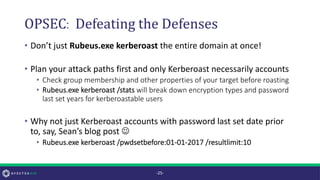
OPSEC: Defeating the Defenses
• Don’t just Rubeus.exe kerberoast the entire domain at once!
• Plan your attack paths first and only Kerberoast necessarily accounts
• Check group membership and other properties of your target before roasting
• Rubeus.exe kerberoast /stats will break down encryption types and password
last set years for kerberoastable users
• Why not just Kerberoast accounts with password last set date prior
to, say, Sean’s blog post J
• Rubeus.exe kerberoast /pwdsetbefore:01-01-2017 /resultlimit:10
-25-
Thank you!
• Any Questions?
• https://twitter.com/harmj0y
• Get Rubeus
• https://github.com/GhostPack/Rubeus
• Read More:
• https://posts.specterops.io/kerberoasting-revisited-d434351bd4d1
-26-
Monday – Hunting from Home
Tuesday – Everything You Always Wanted To Know About BloodHound* (*But were afraid to ask)
Wednesday – Kerberoasting Revisited
Thursday – Capability Abstraction: Dumping LSASS
Friday – Remote Team Project Management and Reporting Construction
www.specterops.io
@specterops
info@specterops.io

SpecterOps Webinar Week - Kerberoasting Revisisted

  • 1.
    SpecterOps Webinar Week Monday– Hunting from Home Tuesday – Everything You Always Wanted To Know About BloodHound* (*But were afraid to ask) Wednesday – Kerberoasting Revisited Thursday – Capability Abstraction: Dumping LSASS Friday – Remote Team Project Management and Reporting Construction
  • 2.
    Introduction • Job: TechnicalArchitect at SpecterOps • Code: Veil-Framework, Empire, PowerView/PowerUp, BloodHound, GhostPack • Cons: DerbyCon, BlackHat, DEF CON, Troopers, ShmooCon • Training: Adversary Tactics: Red Team Operations, Adversary Tactics: PowerShell (now open source!), veteran BlackHat trainer -2-
  • 3.
    Overview • Exactly howKerberoasting works • msDS-SupportedEncryptionTypes • Previous Kerberoasting Approaches • Building a Better Kerberoast With Rubeus • Defenses (and Kerberoasting OPSEC) -3-
  • 4.
  • 5.
    -5- WMI computer.domain.com PowerShell Remoting File Share SQL HOST/ HTTP/ HOST/ RPCSS/ CIFS/ MSSQLSvc/ dir computer.domain.comC$ 1. Here’smy TGT. I want a service ticket for: CIFS/computer.domain.com 2. Service ticket returned: CIFS/computer.domain.com 3. Use service ticket: CIFS/computer.domain.com domain.com Domain Controller Attacker
  • 6.
    -6- dir computer.domain.comC$ 1. Here’smy TGT. I want a service ticket for: CIFS/computer.domain.com 2. Look up which (user or computer$) account has the CIFS/computer.domain.com service principal name (SPN) registered 3. Encrypt part of the service ticket with the key of looked- up account (computer$ here) 4. Target service decrypts the service ticket w/ shared computer$ key. Target service decides whether to allow access! computer.domain.com File Share CIFS/ domain.com Domain Controller Attacker
  • 7.
    Kerberoasting 101:Background • Thetarget service and the domain controller have to share some key so the service can decrypt the ticket • For most service principal names (SPNs) this is the computer$ account key/hash • Computer accounts (by default) have random passwords that every 30 days • But if the SPN is registered for a user account, we now have a piece of data that’s encrypted with their key • Requesting this and cracking offline == Kerberoasting ! -7-
  • 8.
    Kerberoasting 101: Usingthe Goods • If a user account has an SPN registered, the user often: • has admin privileges on the machine specified in the SPN • and/or is in other privileged domain groups • Even if they don’t/aren’t, with the key cracked, we can forge service tickets as ANY user to the specific service principal name • This is what “silver tickets” are! -8-
  • 9.
    Kerberoasting 101: WhyCare • ANY user can request a service ticket for ANY SPN (by design!) • This service ticket give us a piece of information encrypted with the key/hash of the (user) account that backs that SPN • We only communicate with the DC - no packets are sent to the service target unless we try to use the requested ticket! • Translation: if a user has a non-null servicePrincipalName property, we can crack their password offline (with GPU-accelerated software!) -9-
  • 10.
    Kerberoasting 201: KeyEncryption Types • Service tickets (just like TGTs) generally use either AES256_CTS_HMAC_SHA1_96 (AES256) or RC4_HMAC_MD5 (RC4/NTLM) keys for ticket encryption • AES encryption was introduced with domain functional level 2008, but RC4 has been kept for backwards compatibility reasons • From an offensive perspective, we really want responses encrypted with RC4, since it’s orders of magnitude faster to crack than AES -10-
  • 11.
    Sidenote:Kerberoasting Defenses • Modern(2008+ functional level) Active Directory domains are supposed to use AES keys by default for Kerberos exchanges • So requesting a RC4 service ticket should result in “encryption downgrade activity” • But built-in request methods for user-backed SPNs nearly always return RC4-encrypted service tickets 🤔 -11-
  • 12.
  • 13.
    msDS-SupportedEncryptionTypes • Active Directoryuser/computer account property touched on by Jim Shaver and Mitchell Hennigan in their DerbyCon 7.0 “Return From The Underworld” talk • According to Microsoft’s [MS-ADA2], “The Key Distribution Center (KDC) uses this information [msDS-SupportedEncryptionTypes] while generating a service ticket for this account.” • Translation: this property (on an account with a non-null SPN) determines the encryption used for service tickets requested for that account’s SPN(s) -13-
  • 14.
    msDS-SupportedEncryptionTypes • According toMS-KILE 3.1.1.5 the default value for this field is 0x1C (RC4 | AES128 | AES256 = 28) for Windows 7+ and Server 2008R2+ • However, this property is only set by default on computer accounts (not user or trust accounts!) • If this property is not defined (or is set to 0) [MS-KILE] 3.3.5.7 says default behavior is to use a value of 0x7 (RC4) -14-
  • 15.
    However we canset user accounts to explicitly support AES 128/256 encryption 0x18 (AES128 | AES256 = 24) -15-
  • 16.
  • 17.
    So What? • Theredoesn’t seem to be an easy way to disable RC4_HMAC service ticket requests on user accounts, meaning we can’t “stop” RC4 Kerberoasting • The reason for this behavior is in case accounts were created in a 2003 functional level domain and haven’t had their passwords changed since • We can disable RC4 for the entire domain, but this also kills RC4 TGTs, which isn’t feasible for most environments • However setting AES support for user accounts at least gives us the “encryption downgrade” detection back -17-
  • 18.
    Kerberoasting Approaches -18- External-In -Need creds(pw/hash) of existing domain account to first get a TGT so service tickets can be requested -More difficult over high latency C2 -But can granularly control all aspects of the exchange (i.e. RC4) Domain-Joined Windows Host -Don’t need credentials, just execution in a domain user’s context -Easier over high latency C2 -Built-in request methods don’t let you control aspects (like encryption levels) of the exchange
  • 19.
    Previous Kerberoasting Approaches(Host) • The previous domain-joined Kerberoasting methods involve using setspn.exe or .NET’s KerberosRequestorSecurityToken class to request a service ticket for a target SPN • The tickets are then carved out of memory (Mimikatz) or extracted using the .NET methods (PowerView) • Unintended downside: this will cache a ticket on the requesting machine for each SPN we roast! (could be hundreds of tickets…) -19-
  • 20.
    Downsides of Built-inTicket Request Methods • .NET/setspn approaches request/cache dozens (or hundreds) of service tickets on the attacker host • .NET’s KerberosRequestorSecurityToken method doesn’t let you specify encryption levels (RC4 vs AES) for ticket requests • Since we don’t have a proper TGT, we can’t hard specify RC4 like Impacket/Metasploit • Normally, the session key for the TGT is not exportable for non- elevated contexts, so we can’t get a usable TGT for a regular user • Or can we… -20-
  • 21.
    Obtaining a User’sTGT: The “tgtdeleg” Trick • @gentilkiwi realized we can request an outgoing service ticket request for a SPN on an unconstrained delegation server (the domain controller) • This results in a delegated TGT for the current user being present in the AP-REQ in a way we can retrieve it • Translation: we get a usable TGT for the current user! -21-
  • 22.
    Rubeus:Building a BetterKerberoast • Rubeus implements the structures needed for service ticket requests/responses • Rubeus also implements Kekeo’s tgtdeleg trick • Combined, this allows us to kerberoast while: • not needing the current user’s key/password • avoiding caching service tickets on the attacker-controlled host • specifying RC4 in the service ticket requests -22-
  • 23.
  • 24.
    Kerberoasting Defenses • Uselong passwords for accounts with SPNs, or use a password vaulting solution to rotate service account passwords • Still the best solution (in my opinion) • Check for RC4 encryption in service ticket requests/responses • Not useful unless the account is explicitly configured for AES • Detect “anomalous” service ticket requests • Requires tracking state of all ticket requests in a domain, not a trivial task • Use of a Kerberoasting “honeypot” • Talked about by Sean Metcalf – create an account with a non-null SPN and monitor for any ticket requests (event 4769) -24-
  • 25.
    OPSEC: Defeating theDefenses • Don’t just Rubeus.exe kerberoast the entire domain at once! • Plan your attack paths first and only Kerberoast necessarily accounts • Check group membership and other properties of your target before roasting • Rubeus.exe kerberoast /stats will break down encryption types and password last set years for kerberoastable users • Why not just Kerberoast accounts with password last set date prior to, say, Sean’s blog post J • Rubeus.exe kerberoast /pwdsetbefore:01-01-2017 /resultlimit:10 -25-
  • 26.
    Thank you! • AnyQuestions? • https://twitter.com/harmj0y • Get Rubeus • https://github.com/GhostPack/Rubeus • Read More: • https://posts.specterops.io/kerberoasting-revisited-d434351bd4d1 -26-
  • 27.
    Monday – Huntingfrom Home Tuesday – Everything You Always Wanted To Know About BloodHound* (*But were afraid to ask) Wednesday – Kerberoasting Revisited Thursday – Capability Abstraction: Dumping LSASS Friday – Remote Team Project Management and Reporting Construction www.specterops.io @specterops info@specterops.io