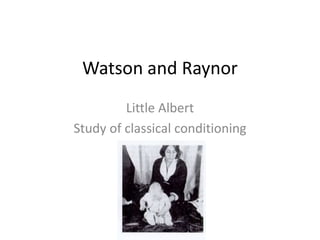
Watson and RaynorLittle AlbertStudy of classical conditioning
Aims...To see if it is possible to induce a fear of a previously unfeared object, through classical conditioning.
To see if the fear will be transferred to other, similar objects.
To see what effect will time have on the fear response.
To see how it is possible to remove the fear response in the laboratory. Methodology...	A case study undertaken on one child (Little Albert) in controlled laboratory conditions.
Participant...	Little albert was a child of a wet nurse (someone who breastfeeds babies when the mother cannot.) and so lived in a hospital environment. He was, according to Watson and Raynor, stolid and unemotional. Albert had no fearful reactions to a rat, a rabbit, a dog, a monkey, a mask with hair, or cotton wool. A test when Albert was 8 months old showed that he reacted violently when a suspended steel bar was hit by a hammer. He was startled, held his breath, and then began to cry. The response was used to condition Albert to fear rats and other stimuli.
Design...	A single-subject design. The behaviours measured were Albert’s reactions to various stimuli before and after the conditioning.
Watson and raynor
Watson and raynor
Watson and raynor

Watson and raynor

  • 1.
    Watson and RaynorLittleAlbertStudy of classical conditioning
  • 2.
    Aims...To see ifit is possible to induce a fear of a previously unfeared object, through classical conditioning.
  • 3.
    To see ifthe fear will be transferred to other, similar objects.
  • 4.
    To see whateffect will time have on the fear response.
  • 5.
    To see howit is possible to remove the fear response in the laboratory. Methodology... A case study undertaken on one child (Little Albert) in controlled laboratory conditions.
  • 6.
    Participant... Little albert wasa child of a wet nurse (someone who breastfeeds babies when the mother cannot.) and so lived in a hospital environment. He was, according to Watson and Raynor, stolid and unemotional. Albert had no fearful reactions to a rat, a rabbit, a dog, a monkey, a mask with hair, or cotton wool. A test when Albert was 8 months old showed that he reacted violently when a suspended steel bar was hit by a hammer. He was startled, held his breath, and then began to cry. The response was used to condition Albert to fear rats and other stimuli.
  • 7.
    Design... A single-subject design.The behaviours measured were Albert’s reactions to various stimuli before and after the conditioning.