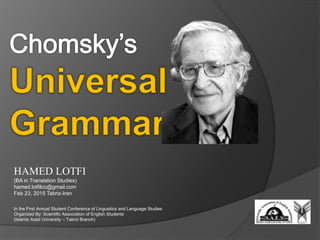
HAMED LOTFI
(BA in Translation Studies)
hamed.lotfilco@gmail.com
Feb 23, 2015 Tabriz-Iran
In the First Annual Student Conference of Linguistics and Language Studies
Organized By: Scientific Association of English Students
(Islamic Azad University – Tabriz Branch)
Definition:
Universal Grammar (UG) or Mental
Grammar
Is a theory in Linguistics proposing that
the ability to learn grammar is hard-wired
into the brain.
and as opposed to other 'grammars‘ e.g.
1. Prescriptive
2. Descriptive
3. Pedagogical
Definition:
The theory suggests that linguistic ability
manifests itself without being taught and
that there are properties that all
natural human languages share.
It is a matter of observation and
experimentation to determine precisely
what abilities are innate and what
properties are shared by all languages.
Argument:
The theory of Universal Grammar
proposes that if human beings are brought
up under normal condition then they will
always develop language with a certain
property X e.g.:
distinguishing nouns from verbs, or
distinguishing function words from lexical
words.
Argument:
As a result, property X is considered to be
a property of universal grammar in the
most general sense.
Using the above examples, Universal
Grammar would be the innate property of
the human brain that causes it to posit a
difference between nouns and verbs
whenever presented with linguistic data.
Argument:
Chomsky: "Evidently, development of
language in the individual must involve
three factors:
1. Genetic endowment, which sets limits
on the attainable languages, thereby
making language acquisition possible;
2. External data, converted to the
experience that selects one or another
language within a narrow range;
3. Principles not specific to FL.“
Argument:
[FL is the faculty of language, whatever properties of
the brain cause it to learn language.]
So
Factor 1 is Universal Grammar in the first
theoretical sense, and
Factor 2 is the linguistic data to which the
child is exposed.
Different Hypotheses:
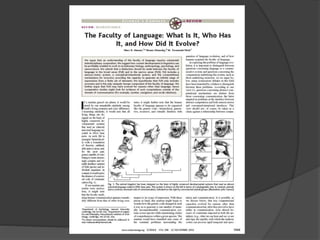
In an article titled,
"The Faculty of Language: What Is It, Who
Has It, and How Did It Evolve?“
Hauser, Chomsky, and Fitch present the
three leading hypotheses for how
language evolved and brought humans to
the point where we have a Universal
Grammar.
Different Hypotheses:
Three Hypotheses :
1. It states that FLB (the Faculty of
Language in the broad sense) is strictly
homologous to animal communication.
This means that homologous aspects of the Faculty of
Language exist in non-human animals.
Different Hypotheses:
Three Hypotheses :
2. It states that FLB "is a derived,
uniquely human adaptation for
language".
This hypothesis believes that individual traits were subject
to natural selection and came to be very specialized for
humans.
Different Hypotheses :
Three Hypotheses :
3. It states that only FLN (the Faculty of
Language in the narrow sense) is
unique to humans.
It believes that while mechanisms of FLB are present in
both humans and non-human animals, that the
computational mechanism of recursion is recently evolved
solely in humans.
This is the hypothesis which most closely aligns to the
typical theory of Universal Grammar championed by
Chomsky.
Chomsky's Theory:
Chomsky argued that the human brain
contains a limited set of rules for
organizing language. This implies in turn
that all languages have a common
structural basis; the set of rules is what is
known as Universal Grammar.
Chomsky's Theory:
Chomsky has stated "I think, yet the world
thinks in me",
exemplifying his belief that since humans
are natural beings and have undergone
evolution,
that Universal Grammar is a biological
evolutionary trait, common to all humans.
Chomsky's Theory:
Speakers proficient in a language know
which expressions are acceptable in their
language and which are unacceptable.
The key puzzle is how speakers come to
know these restrictions of their language,
since expressions that violate those
restrictions are not present in the input,
indicated as such.
Criticisms:
Hinzen summarizes the most common criticisms
of Universal Grammar:
1. Universal Grammar has no coherent
formulation and is indeed unnecessary.
2. Universal Grammar is in conflict with biology:
it cannot have evolved by standardly
accepted Neo-Darwinian evolutionary
principles.
3. There are no linguistic universals: Universal
Grammar is refuted by abundant variation at
all levels of linguistic organization, which lies
at the heart of human faculty of language.
The End

Chomsky’s Universal Grammar

  • 1.
    HAMED LOTFI (BA inTranslation Studies) hamed.lotfilco@gmail.com Feb 23, 2015 Tabriz-Iran In the First Annual Student Conference of Linguistics and Language Studies Organized By: Scientific Association of English Students (Islamic Azad University – Tabriz Branch)
  • 2.
    Definition: Universal Grammar (UG)or Mental Grammar Is a theory in Linguistics proposing that the ability to learn grammar is hard-wired into the brain. and as opposed to other 'grammars‘ e.g. 1. Prescriptive 2. Descriptive 3. Pedagogical
  • 3.
    Definition: The theory suggeststhat linguistic ability manifests itself without being taught and that there are properties that all natural human languages share. It is a matter of observation and experimentation to determine precisely what abilities are innate and what properties are shared by all languages.
  • 4.
    Argument: The theory ofUniversal Grammar proposes that if human beings are brought up under normal condition then they will always develop language with a certain property X e.g.: distinguishing nouns from verbs, or distinguishing function words from lexical words.
  • 5.
    Argument: As a result,property X is considered to be a property of universal grammar in the most general sense. Using the above examples, Universal Grammar would be the innate property of the human brain that causes it to posit a difference between nouns and verbs whenever presented with linguistic data.
  • 6.
    Argument: Chomsky: "Evidently, developmentof language in the individual must involve three factors: 1. Genetic endowment, which sets limits on the attainable languages, thereby making language acquisition possible; 2. External data, converted to the experience that selects one or another language within a narrow range; 3. Principles not specific to FL.“
  • 7.
    Argument: [FL is thefaculty of language, whatever properties of the brain cause it to learn language.] So Factor 1 is Universal Grammar in the first theoretical sense, and Factor 2 is the linguistic data to which the child is exposed.
  • 8.
    Different Hypotheses: In anarticle titled, "The Faculty of Language: What Is It, Who Has It, and How Did It Evolve?“ Hauser, Chomsky, and Fitch present the three leading hypotheses for how language evolved and brought humans to the point where we have a Universal Grammar.
  • 10.
    Different Hypotheses: Three Hypotheses: 1. It states that FLB (the Faculty of Language in the broad sense) is strictly homologous to animal communication. This means that homologous aspects of the Faculty of Language exist in non-human animals.
  • 11.
    Different Hypotheses: Three Hypotheses: 2. It states that FLB "is a derived, uniquely human adaptation for language". This hypothesis believes that individual traits were subject to natural selection and came to be very specialized for humans.
  • 12.
    Different Hypotheses : ThreeHypotheses : 3. It states that only FLN (the Faculty of Language in the narrow sense) is unique to humans. It believes that while mechanisms of FLB are present in both humans and non-human animals, that the computational mechanism of recursion is recently evolved solely in humans. This is the hypothesis which most closely aligns to the typical theory of Universal Grammar championed by Chomsky.
  • 13.
    Chomsky's Theory: Chomsky arguedthat the human brain contains a limited set of rules for organizing language. This implies in turn that all languages have a common structural basis; the set of rules is what is known as Universal Grammar.
  • 14.
    Chomsky's Theory: Chomsky hasstated "I think, yet the world thinks in me", exemplifying his belief that since humans are natural beings and have undergone evolution, that Universal Grammar is a biological evolutionary trait, common to all humans.
  • 15.
    Chomsky's Theory: Speakers proficientin a language know which expressions are acceptable in their language and which are unacceptable. The key puzzle is how speakers come to know these restrictions of their language, since expressions that violate those restrictions are not present in the input, indicated as such.
  • 16.
    Criticisms: Hinzen summarizes themost common criticisms of Universal Grammar: 1. Universal Grammar has no coherent formulation and is indeed unnecessary. 2. Universal Grammar is in conflict with biology: it cannot have evolved by standardly accepted Neo-Darwinian evolutionary principles. 3. There are no linguistic universals: Universal Grammar is refuted by abundant variation at all levels of linguistic organization, which lies at the heart of human faculty of language.
  • 17.