PRESENTATION ON PERFORMANCE MANAGEMENT SYSTEM (BHEL) BY: RANJEET KAUR REG NO.2020070101 ROLL. NO.4
BHEL (BHARAT HEAVY ELECTRI ALS LIMITED) Bharat Heavy Electrical Limited (BHEL) is a public sector company engaged in the engineering and manufacturing businesses.  The company installed its first plant in the year 1956 at Bhopal.  It manufactures and supplies more than 180 products  It owns and operates R&D centre at Hyderabad It is one of the  ‘NAVRATNA’
CONTI………… The BHEL complex is one of the largest manufacturing of power plant equipment in the world.  The greatest strength of BHEL is its highly skilled and committed 42,600 employees.
Performance Management System Performance management describes the processes by which managers improve the performance of their employees by utilizing their power to reward, develop or discipline as appropriate. A performance management system documents these processes as company policy and may form a legally binding contract between the company and one or more employees.
Essential Components of a Performance Management System are:   A performance plan is negotiated between a manager and employee for a given period (usually one year).  During the year the manager gives employees feedback  Performance is appraised at year-end  decisions are made to reward, discipline or develop employees.  The cycle is completed with a new performance plan.
Performance Management System in BHEL e-MAP (Moving Ahead through Performance) is the name of the Performance Management System which is followed in BHEL. This system was introduced in the year 2002-03. e-MAP aims at creating alignment of the goals of executives with those of company  e-MAP covers Frontline Executives and Middle level Executives of BHEL
PERFORMANCE   IN E-MAP Definition of performance in MAP is based upon Key Result Areas (KRAs) and Routine Responsibilities.  KRAs are critical outcomes towards which effort is directed to achieve desired business results. Routine Responsibilities are significant-on-going tasks or outcomes that are undertaken or delivered on a day-to- day basis.
 
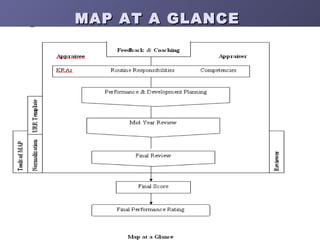
MAP AT A GLANCE
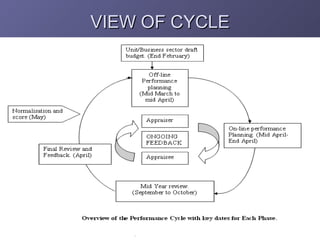
PERFORMANCE CYCLE   The Performance Cycle of MAP is one year coinciding with BHEL’s financial year. consists of three key phases: 1. Performance and Development  Planning 2. Mid Year Review 3. Final Review
VIEW OF CYCLE
Appraisee will identify f KRAs.
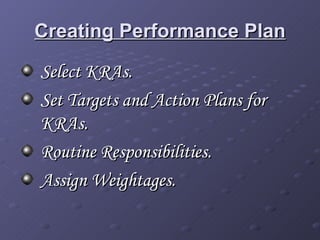
Creating Performance Plan Select KRAs. Set Targets and Action Plans for KRAs. Routine Responsibilities. Assign Weightages.
Creating Development Plan: Development planning in MAP focuses on building individual capability using competencies. Competencies relevant to a role are pre-defined in its URR (Unique Role & Responsibilities) along with the desired proficiency level.
CONTI…………. Obtain appraiser’s and reviewer’s sign-off on performance & development plan Editing the performance and development plan The edited plan will be finalized with appraiser and reviewer’s sign-off.
Mid Year Review Process
Final Review
Normalization In MAP, Normalization is the process of aligning the distribution of individual performance score to the performance level of the company, unit and department in a Performance Cycle. Normalization will ensure that
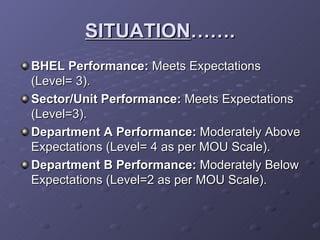
SITUATION ……. BHEL Performance:  Meets Expectations (Level= 3). Sector/Unit Performance:  Meets Expectations (Level=3). Department A Performance:  Moderately Above Expectations (Level= 4 as per MOU Scale). Department B Performance:  Moderately Below Expectations (Level=2 as per MOU Scale).
AFTER NORMALIZTION ….. The percentage of High performers in Department B will be less than the percentage of high performers in Department A. Consequently in Department A, an Appraisee  with a Final Score of 3.92 gets a Final Performance Rating of 4- Moderately above expectation;  and Consequently in Department B, an Appraisee with a Final Score of 3.92 gets a Final Performance Rating of 3- Meets Expectations.
AT THE LAST OVERALL SCORE CARD IS MENTAINED BY DIFERENT DEPARTMENTS AND WILL BE USED TO TAKE RELATED DECISIONS
THANK YOU…………….

performance management system

  • 1.
    PRESENTATION ON PERFORMANCEMANAGEMENT SYSTEM (BHEL) BY: RANJEET KAUR REG NO.2020070101 ROLL. NO.4
  • 2.
    BHEL (BHARAT HEAVYELECTRI ALS LIMITED) Bharat Heavy Electrical Limited (BHEL) is a public sector company engaged in the engineering and manufacturing businesses. The company installed its first plant in the year 1956 at Bhopal. It manufactures and supplies more than 180 products It owns and operates R&D centre at Hyderabad It is one of the ‘NAVRATNA’
  • 3.
    CONTI………… The BHELcomplex is one of the largest manufacturing of power plant equipment in the world. The greatest strength of BHEL is its highly skilled and committed 42,600 employees.
  • 4.
    Performance Management SystemPerformance management describes the processes by which managers improve the performance of their employees by utilizing their power to reward, develop or discipline as appropriate. A performance management system documents these processes as company policy and may form a legally binding contract between the company and one or more employees.
  • 5.
    Essential Components ofa Performance Management System are: A performance plan is negotiated between a manager and employee for a given period (usually one year). During the year the manager gives employees feedback Performance is appraised at year-end decisions are made to reward, discipline or develop employees. The cycle is completed with a new performance plan.
  • 6.
    Performance Management Systemin BHEL e-MAP (Moving Ahead through Performance) is the name of the Performance Management System which is followed in BHEL. This system was introduced in the year 2002-03. e-MAP aims at creating alignment of the goals of executives with those of company e-MAP covers Frontline Executives and Middle level Executives of BHEL
  • 7.
    PERFORMANCE IN E-MAP Definition of performance in MAP is based upon Key Result Areas (KRAs) and Routine Responsibilities. KRAs are critical outcomes towards which effort is directed to achieve desired business results. Routine Responsibilities are significant-on-going tasks or outcomes that are undertaken or delivered on a day-to- day basis.
  • 8.
  • 9.
    MAP AT AGLANCE
  • 10.
    PERFORMANCE CYCLE The Performance Cycle of MAP is one year coinciding with BHEL’s financial year. consists of three key phases: 1. Performance and Development Planning 2. Mid Year Review 3. Final Review
  • 11.
  • 12.
  • 13.
    Creating Performance PlanSelect KRAs. Set Targets and Action Plans for KRAs. Routine Responsibilities. Assign Weightages.
  • 14.
    Creating Development Plan:Development planning in MAP focuses on building individual capability using competencies. Competencies relevant to a role are pre-defined in its URR (Unique Role & Responsibilities) along with the desired proficiency level.
  • 15.
    CONTI…………. Obtain appraiser’sand reviewer’s sign-off on performance & development plan Editing the performance and development plan The edited plan will be finalized with appraiser and reviewer’s sign-off.
  • 16.
  • 17.
  • 18.
    Normalization In MAP,Normalization is the process of aligning the distribution of individual performance score to the performance level of the company, unit and department in a Performance Cycle. Normalization will ensure that
  • 19.
    SITUATION ……. BHELPerformance: Meets Expectations (Level= 3). Sector/Unit Performance: Meets Expectations (Level=3). Department A Performance: Moderately Above Expectations (Level= 4 as per MOU Scale). Department B Performance: Moderately Below Expectations (Level=2 as per MOU Scale).
  • 20.
    AFTER NORMALIZTION …..The percentage of High performers in Department B will be less than the percentage of high performers in Department A. Consequently in Department A, an Appraisee with a Final Score of 3.92 gets a Final Performance Rating of 4- Moderately above expectation; and Consequently in Department B, an Appraisee with a Final Score of 3.92 gets a Final Performance Rating of 3- Meets Expectations.
  • 21.
    AT THE LASTOVERALL SCORE CARD IS MENTAINED BY DIFERENT DEPARTMENTS AND WILL BE USED TO TAKE RELATED DECISIONS
  • 22.