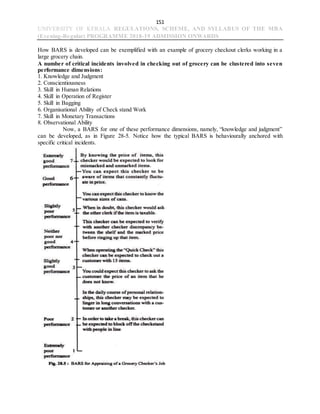
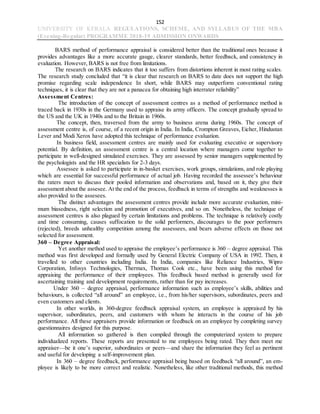
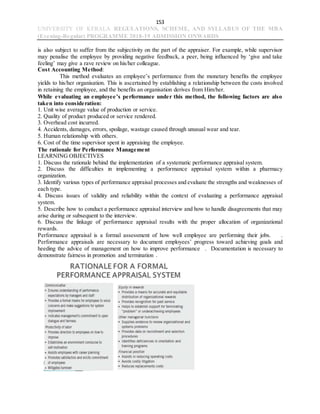
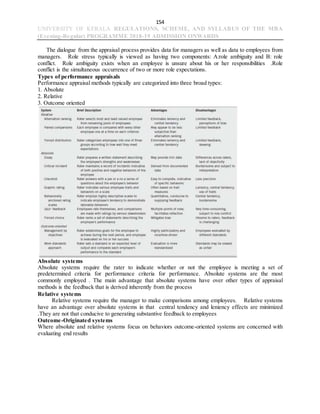
1
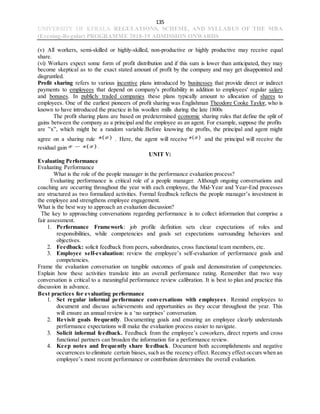
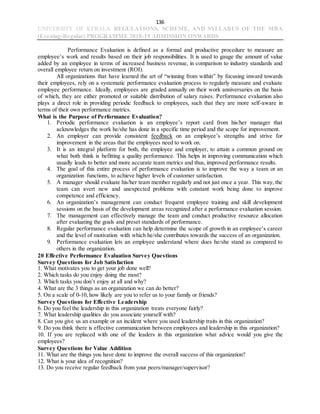
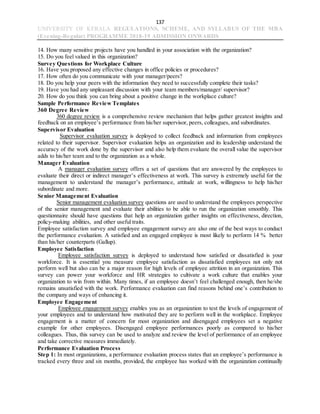
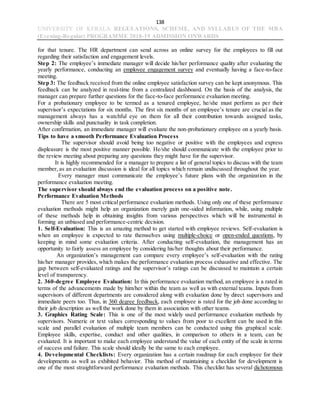
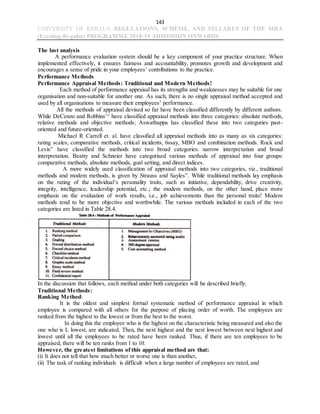
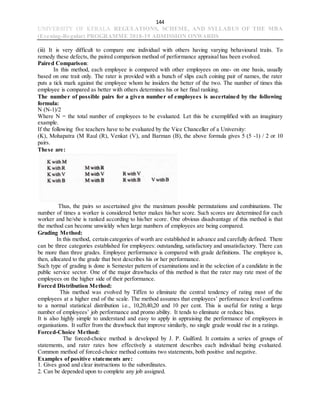
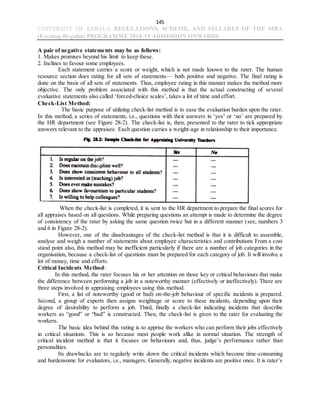
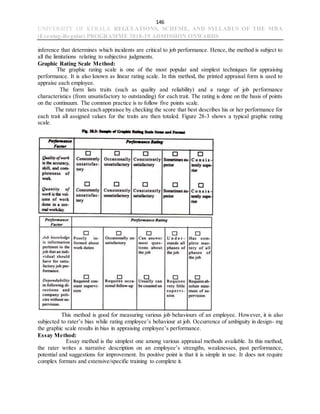
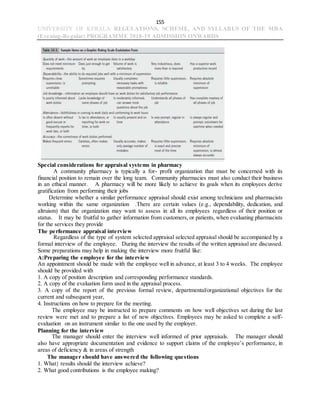
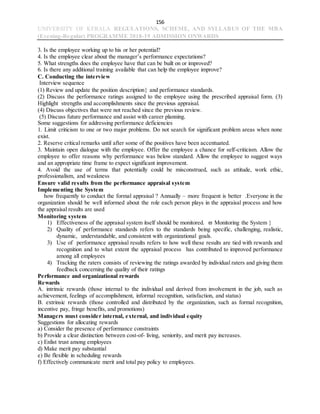
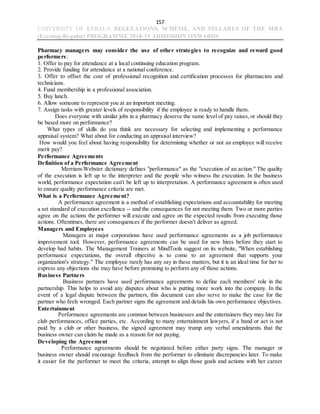
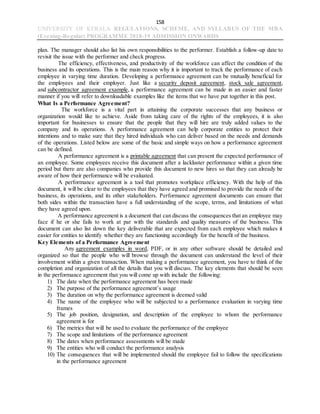
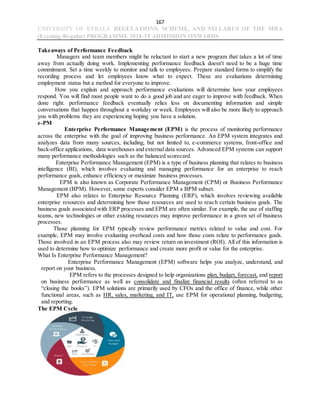
UNIVERSITY OF KERALA REGULATIONS, SCHEME, AND SYLLABUS OF THE MBA
(Evening-Regular) PROGRAMME 2018-19 ADMISSION ONWARDS
MBA 3H7 - PERFORMANCE MANAGEMENT
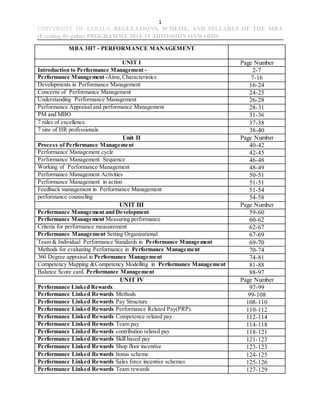
UNIT I Page Number
Introduction to Performance Management - 2-7
Performance Management -Aims,Characteristics 7-16
Developments in Performance Management 16-24
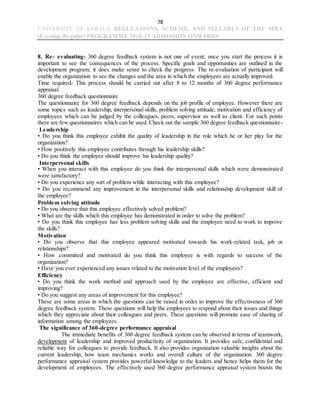
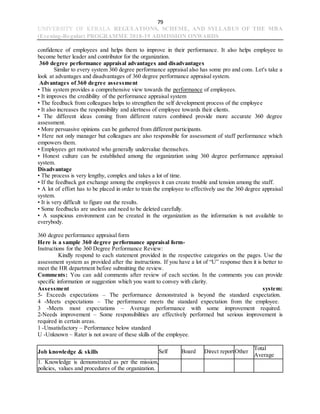
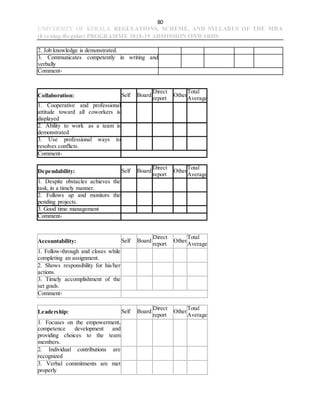
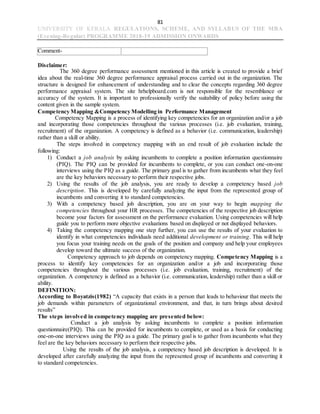
Concerns of Performance Management 24-25
Understanding Performance Management 26-28
Performance Appraisal and performance Management 28-31
PM and MBO 31-36
7 rules of excellence 37-38
7 sins of HR professionals 38-40
Unit II Page Number
Process of Performance Management 40-42
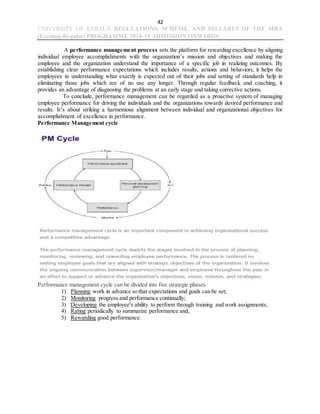
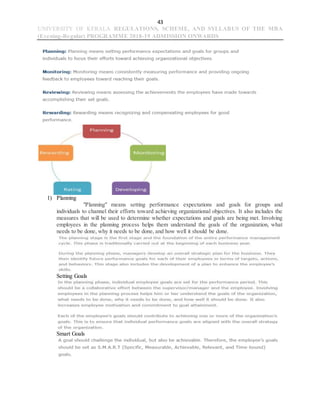
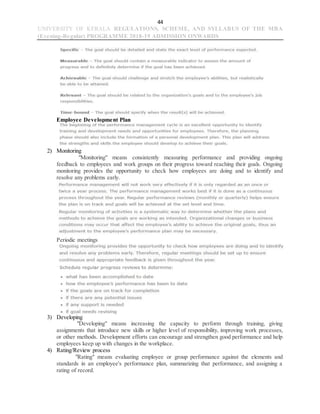
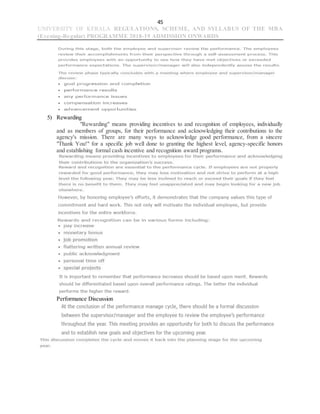
Performance Management cycle 42-45
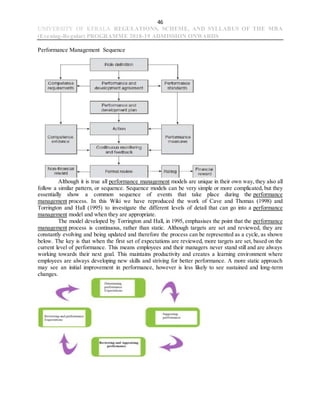
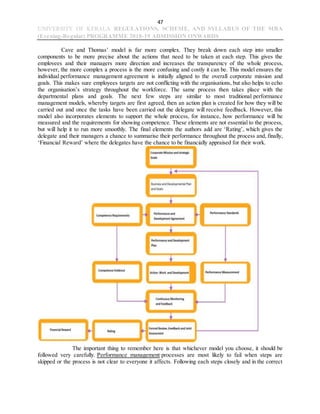
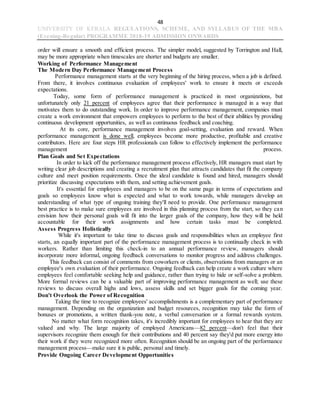
Performance Management Sequence 46-48
Working of Performance Management 48-49
Performance Management Activities 50-51
Performance Management in action 51-51
Feedback management in Performance Management 51-54
performance counseling 54-58
UNIT III Page Number
Performance Management and Development 59-60
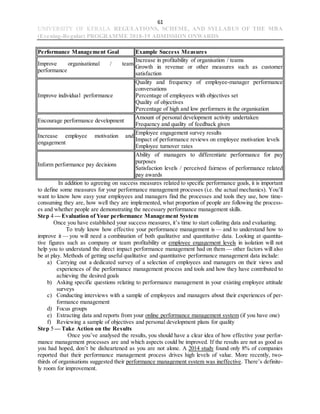
Performance Management Measuring performance 60-62
Criteria for performance measurement 62-67
Performance Management Setting Organizational 67-69
Team & Individual Performance Standards in Performance Management 69-70
Methods for evaluating Performance in Performance Management 70-74
360 Degree appraisal in Performance Management 74-81
Competency Mapping &Competency Modelling in Performance Management 81-88
Balance Score card. Performance Management 88-97
UNIT IV Page Number
Performance Linked Rewards 97-99
Performance Linked Rewards Methods 99-108
Performance Linked Rewards Pay Structure 108-110
Performance Linked Rewards Performance Related Pay(PRP). 110-112
Performance Linked Rewards Competence related pay 112-114
Performance Linked Rewards Team pay 114-118
Performance Linked Rewards contribution related pay 118-121
Performance Linked Rewards Skill based pay 121-123
Performance Linked Rewards Shop floor incentive 123-123
Performance Linked Rewards bonus scheme 124-125
Performance Linked Rewards Sales force incentive schemes 125-126
Performance Linked Rewards Team rewards 127-129
2
UNIVERSITY OF KERALA REGULATIONS, SCHEME, AND SYLLABUS OF THE MBA
(Evening-Regular) PROGRAMME 2018-19 ADMISSION ONWARDS
UNIT I
Introduction to Performance Management
What is Performance Management?
Performance management is the process of creating a work environment or setting in which
people are enabled to perform to the best of their abilities. It is the main vehicle by which managers
communicate what is required from employees and give feedback on how well they are achieving job
goals (CIPD, 2009). It brings together many of the elements that make up the practice of people
management, including in particular learning and development.
Performance management establishes shared understanding of what is to be achieved and
provides an approach to leading and developing people that will ensure it is achieved; as such it is an
essential element of your role and will support your relationship with individuals in your team.
Why manage performance?
As a manager, you need to adopt performance management practices that will facilitate
continuous review and ongoing development of your department/ team in order to deliver
departmental/faculty and University objectives.
The underlying assumption is that by managing the performance of the individual and team,
departmental and organisational performance will follow and by raising individual and team levels of
performance, organisational performance will also improve.
Equally when performance of individuals is not managed, this can lead to frustration and
discontent amongst team members.
The department for Business Innovation and Skills recently calculated that disengaged
employees cost the UK economy between £59.4 and £64.7 billion.
Performance management is a whole work system that begins when a job is defined as needed
and starts from the assumption that most people want to perform well. Performance management is about
helping your team to perform well and removing any obstacles to this.
Key principles Performance management in its broadest sense exists when the following
activities are embedded by managers:
Performance Linked Rewards Gain sharing 129-133
Performance Linked Rewards Profit sharing. 133-135
UNIT V: Page Number
Evaluating Performance - 135-143
Performance Methods 143-153
Typical approach in evaluation of Performance 143-153
The rationale for Performance Management 153-157
Performance Agreements 157-160
Performance Reviews 160-164
Performance feedbacks 164-167
e-PM 167-170
strategic role of HR professionals 170-173
3
UNIVERSITY OF KERALA REGULATIONS, SCHEME, AND SYLLABUS OF THE MBA
(Evening-Regular) PROGRAMME 2018-19 ADMISSION ONWARDS
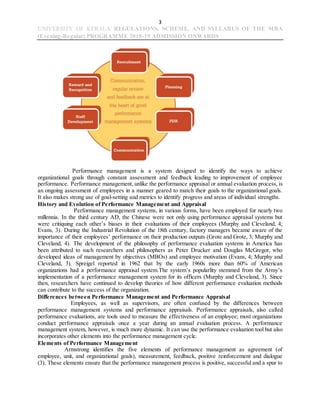
Performance management is a system designed to identify the ways to achieve
organizational goals through constant assessment and feedback leading to improvement of employee
performance. Performance management, unlike the performance appraisal or annual evaluation process, is
an ongoing assessment of employees in a manner geared to match their goals to the organizational goals.
It also makes strong use of goal-setting and metrics to identify progress and areas of individual strengths.
History and Evolution of Performance Management and Appraisal
Performance management systems, in various forms, have been employed for nearly two
millennia. In the third century AD, the Chinese were not only using performance appraisal systems but
were critiquing each other’s biases in their evaluations of their employees (Murphy and Cleveland, 4;
Evans, 3). During the Industrial Revolution of the 18th century, factory managers became aware of the
importance of their employees’ performance on their production outputs (Grote and Grote, 3; Murphy and
Cleveland, 4). The development of the philosophy of performance evaluation systems in America has
been attributed to such researchers and philosophers as Peter Drucker and Douglas McGregor, who
developed ideas of management by objectives (MBOs) and employee motivation (Evans, 4; Murphy and
Cleveland, 3). Spreigel reported in 1962 that by the early 1960s more than 60% of American
organizations had a performance appraisal system.The system’s popularlity stemmed from the Army’s
implementation of a performance management system for its officers (Murphy and Cleveland, 3). Since
then, researchers have continued to develop theories of how different performance evaluation methods
can contribute to the success of the organization.
Differences between Performance Management and Performance Appraisal
Employees, as well as supervisors, are often confused by the differences between
performance management systems and performance appraisals. Performance appraisals, also called
performance evaluations, are tools used to measure the effectiveness of an employee; most organizations
conduct performance appraisals once a year during an annual evaluation process. A performance
management system, however, is much more dynamic. It can use the performance evaluation tool but also
incorporates other elements into the performance management cycle.
Elements of Performance Management
Armstrong identifies the five elements of performance management as agreement (of
employee, unit, and organizational goals), measurement, feedback, positive reinforcement and dialogue
(3). These elements ensure that the performance management process is positive, successful and a spur to
4
UNIVERSITY OF KERALA REGULATIONS, SCHEME, AND SYLLABUS OF THE MBA
(Evening-Regular) PROGRAMME 2018-19 ADMISSION ONWARDS
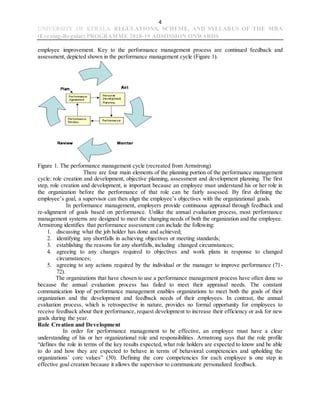
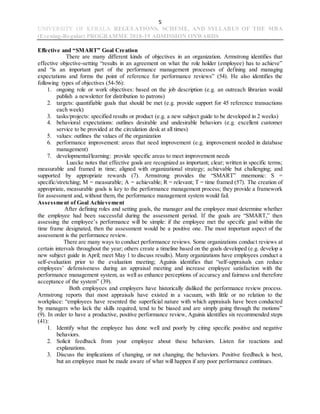
employee improvement. Key to the performance management process are continued feedback and
assessment, depicted shown in the performance management cycle (Figure 1).
Figure 1. The performance management cycle (recreated from Armstrong)
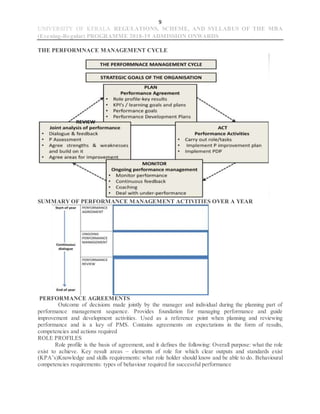
There are four main elements of the planning portion of the performance management
cycle: role creation and development, objective planning, assessment and development planning. The first
step, role creation and development, is important because an employee must understand his or her role in
the organization before the performance of that role can be fairly assessed. By first defining the
employee’s goal, a supervisor can then align the employee’s objectives with the organizational goals.
In performance management, employers provide continuous appraisal through feedback and
re-alignment of goals based on performance. Unlike the annual evaluation process, most performance
management systems are designed to meet the changing needs of both the organization and the employee.
Armstrong identifies that performance assessment can include the following:
1. discussing what the job holder has done and achieved;
2. identifying any shortfalls in achieving objectives or meeting standards;
3. establishing the reasons for any shortfalls, including changed circumstances;
4. agreeing to any changes required to objectives and work plans in response to changed
circumstances;
5. agreeing to any actions required by the individual or the manager to improve performance (71-
72).
The organizations that have chosen to use a performance management process have often done so
because the annual evaluation process has failed to meet their appraisal needs. The constant
communication loop of performance management enables organizations to meet both the goals of their
organization and the development and feedback needs of their employees. In contrast, the annual
evaluation process, which is retrospective in nature, provides no formal opportunity for employees to
receive feedback about their performance, request development to increase their efficiency or ask for new
goals during the year.
Role Creation and Development
In order for performance management to be effective, an employee must have a clear
understanding of his or her organizational role and responsibilities. Armstrong says that the role profile
“defines the role in terms of the key results expected, what role holders are expected to know and be able
to do and how they are expected to behave in terms of behavioral competencies and upholding the
organizations’ core values” (50). Defining the core competencies for each employee is one step in
effective goal creation because it allows the supervisor to communicate personalized feedback.
5
UNIVERSITY OF KERALA REGULATIONS, SCHEME, AND SYLLABUS OF THE MBA
(Evening-Regular) PROGRAMME 2018-19 ADMISSION ONWARDS
Effective and “SMART” Goal Creation
There are many different kinds of objectives in an organization. Armstrong identifies that
effective objective-setting “results in an agreement on what the role holder (employee) has to achieve”
and “is an important part of the performance management processes of defining and managing
expectations and forms the point of reference for performance reviews” (54). He also identifies the
following types of objectives (54-56):
1. ongoing role or work objectives: based on the job description (e.g. an outreach librarian would
publish a newsletter for distribution to patrons)
2. targets: quantifiable goals that should be met (e.g. provide support for 45 reference transactions
each week)
3. tasks/projects: specified results or product (e.g. a new subject guide to be developed in 2 weeks)
4. behavioral expectations: outlines desirable and undesirable behaviors (e.g. excellent customer
service to be provided at the circulation desk at all times)
5. values: outlines the values of the organization
6. performance improvement: areas that need improvement (e.g. improvement needed in database
management)
7. developmental/learning: provide specific areas to meet improvement needs
Luecke notes that effective goals are recognized as important; clear; written in specific terms;
measurable and framed in time; aligned with organizational strategy; achievable but challenging; and
supported by appropriate rewards (7). Armstrong provides the “SMART” mnemonic: S =
specific/stretching; M = measurable; A = achievable; R = relevant; T = time framed (57). The creation of
appropriate, measurable goals is key to the performance management process; they provide a framework
for assessment and, without them, the performance management system would fail.
Assessment of Goal Achievement
After defining roles and setting goals, the manager and the employee must determine whether
the employee had been successful during the assessment period. If the goals are “SMART,” then
assessing the employee’s performance will be simple: if the employee met the specific goal within the
time frame designated, then the assessment would be a positive one. The most important aspect of the
assessment is the performance review.
There are many ways to conduct performance reviews. Some organizations conduct reviews at
certain intervals throughout the year; others create a timeline based on the goals developed (e.g. develop a
new subject guide in April; meet May 1 to discuss results). Many organizations have employees conduct a
self-evaluation prior to the evaluation meeting; Aguinis identifies that “self-appraisals can reduce
employees’ defensiveness during an appraisal meeting and increase employee satisfaction with the
performance management system, as well as enhance perceptions of accuracy and fairness and therefore
acceptance of the system” (39).
Both employees and employers have historically disliked the performance review process.
Armstrong reports that most appraisals have existed in a vacuum, with little or no relation to the
workplace: “employees have resented the superficial nature with which appraisals have been conducted
by managers who lack the skills required, tend to be biased and are simply going through the motions”
(9). In order to have a productive, positive performance review, Aguinis identifies six recommended steps
(41):
1. Identify what the employee has done well and poorly by citing specific positive and negative
behaviors.
2. Solicit feedback from your employee about these behaviors. Listen for reactions and
explanations.
3. Discuss the implications of changing, or not changing, the behaviors. Positive feedback is best,
but an employee must be made aware of what will happen if any poor performance continues.
6
UNIVERSITY OF KERALA REGULATIONS, SCHEME, AND SYLLABUS OF THE MBA
(Evening-Regular) PROGRAMME 2018-19 ADMISSION ONWARDS
4. Explain to the employee how skills used in past achievements can help him overcome any current
performance problems.
5. Agree on an action plan. Encourage the employee to invest in improving his performance by
asking questions such as “What ideas do you have for _____?” and “What suggestions do you
have for _____?”
6. Set up a meeting to follow up and agree on the behaviors, actions, and attitudes to be evaluated.
Development Planning
After creating goals and assessing progress, the employee and employer have identified
areas that can be improved; the action plan for this improvement is called development planning. This
development plan ensures that employees will continue to meet the needs of the organization through the
identification of their weaknesses and the opportunity to address them through workshops, classes, and
other educational channels.
Benefits of Performance Management
Performance management has many benefits that the traditional annual evaluation does not.
Luecke identifies three reasons “why performance management matters:”
1. Shareholders (those with a vested interest in the organization) observe better results, because the
human assets of the organization are top-notch and working in unison toward key goals.
2. Managers are more successful, because their subordinates are doing the right things correctly.
3. Employees experience greater job security, career advancement, and fatter paychecks, thanks to
outstanding performance (xiii).
Problems with Performance Management
The performance management system is designed to benefit the organization, but like any
system it may meet with resistance or be unconstructively applied. Many supervisors resist the change
from a simple annual performance evaluation process or no process at all to the performance management
system for many reasons: a dislike of criticizing employees; lack of skill in the appraisal process; dislike
of new procedures; and mistrust of the validity of the appraisal instrument (67). Other reasons the
performance management system may fail because of lack of support from the supervisors and the
employees, unclear goals or lack of support for professional development.
If performed incorrectly, an unsuccessful performance management system can have negative
consequences on the organization. Aguinis identifies the following dangers of a poorly executed system
(9):
1. Increased turnover
2. Use of misleading information (if performed improperly, an employee’s performance appraisal
can be incorrect)
3. Lowered self-esteem
4. Wasted time and money
5. Damaged relationships
6. Decreased motivation to perform
7. Employee burnout and job dissatisfaction
8. Increased risk of litigation
9. Unjustified demands on managers’ resources
10. Varying and unfair standards and ratings
11. Emerging biases
12. Unclear ratings systems
Because of these incredibly negative effects that an improperly conducted performance management
system can have on an organization, the system must be implemented thoughtfully and executed
consistently.
Performance management, unlike traditional annual evaluation, provides employees with feedback
throughout the year. The system allows constant re-evaluation of goals, progress and performance. This
7
UNIVERSITY OF KERALA REGULATIONS, SCHEME, AND SYLLABUS OF THE MBA
(Evening-Regular) PROGRAMME 2018-19 ADMISSION ONWARDS
process requires more interaction between the supervisor and supervisee and encourages the professional
development of the employee to meet the organization’s changing needs. While this more dynamic
evaluation process is time-consuming, the increased productivity levels resulting from performance
management have proven to be valuable to many organizations.
Performance Management -Aims, Characteristics
PERFORMANCE MANAGEMENT: AN OVERVIEW
DEFINED
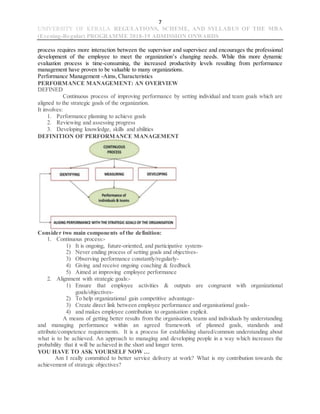
Continuous process of improving performance by setting individual and team goals which are
aligned to the strategic goals of the organization.
It involves:
1. Performance planning to achieve goals
2. Reviewing and assessing progress
3. Developing knowledge, skills and abilities
DEFINITION OF PERFORMANCE MANAGEMENT
Consider two main components of the definition:
1. Continuous process:-
1) It is ongoing, future-oriented, and participative system-
2) Never ending process of setting goals and objectives-
3) Observing performance constantly/regularly-
4) Giving and receive ongoing coaching & feedback
5) Aimed at improving employee performance
2. Alignment with strategic goals:-
1) Ensure that employee activities & outputs are congruent with organizational
goals/objectives-
2) To help organizational gain competitive advantage-
3) Create direct link between employee performance and organisational goals-
4) and makes employee contribution to organisation explicit.
A means of getting better results from the organisation, teams and individuals by understanding
and managing performance within an agreed framework of planned goals, standards and
attribute/competence requirements. It is a process for establishing shared/common understanding about
what is to be achieved. An approach to managing and developing people in a way which increases the
probability that it will be achieved in the short and longer term.
YOU HAVE TO ASK YOURSELF NOW …
Am I really committed to better service delivery at work? What is my contribution towards the
achievement of strategic objectives?
8
UNIVERSITY OF KERALA REGULATIONS, SCHEME, AND SYLLABUS OF THE MBA
(Evening-Regular) PROGRAMME 2018-19 ADMISSION ONWARDS
SIMPLE PROPOSITION
‘When people know and understand what is expected of them, and have been able to take part in
forming those expectations, they can and will perform to meet them’. It seeks to change the attitudes,
values, and approaches of management and employees according to new strategies, processes and plans to
improve productivity and performance.
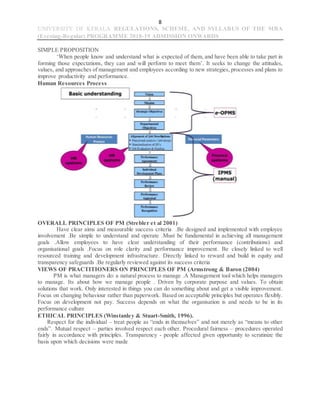
Human Resources Process
OVERALL PRINCIPLES OF PM (Strebler et al 2001)
Have clear aims and measurable success criteria .Be designed and implemented with employee
involvement .Be simple to understand and operate .Must be fundamental in achieving all management
goals .Allow employees to have clear understanding of their performance (contributions) and
organisational goals .Focus on role clarity and performance improvement. Be closely linked to well
resourced training and development infrastructure. Directly linked to reward and build in equity and
transparency safeguards .Be regularly reviewed against its success criteria
VIEWS OF PRACTITIONERS ON PRINCIPLES OF PM (Armstrong & Baron (2004)
PM is what managers do: a natural process to manage .A Management tool which helps managers
to manage. Its about how we manage people . Driven by corporate purpose and values. To obtain
solutions that work. Only interested in things you can do something about and get a visible improvement.
Focus on changing behaviour rather than paperwork. Based on acceptable principles but operates flexibly.
Focus on development not pay. Success depends on what the organisation is and needs to be in its
performance culture
ETHICAL PRINCIPLES (Winstanley & Stuart-Smith, 1996).
Respect for the individual – treat people as “ends in themselves” and not merely as “means to other
ends”. Mutual respect – parties involved respect each other. Procedural fairness – procedures operated
fairly in accordance with principles. Transparency - people affected given opportunity to scrutinize the
basis upon which decisions were made
9
UNIVERSITY OF KERALA REGULATIONS, SCHEME, AND SYLLABUS OF THE MBA
(Evening-Regular) PROGRAMME 2018-19 ADMISSION ONWARDS
THE PERFORMNACE MANAGEMENT CYCLE
SUMMARY OF PERFORMANCE MANAGEMENT ACTIVITIES OVER A YEAR
PERFORMANCE AGREEMENTS
Outcome of decisions made jointly by the manager and individual during the planning part of
performance management sequence. Provides foundation for managing performance and guide
improvement and development activities. Used as a reference point when planning and reviewing
performance and is a key of PMS. Contains agreements on expectations in the form of results,
competencies and actions required
ROLE PROFILES
Role profile is the basis of agreement, and it defines the following: Overall purpose: what the role
exist to achieve. Key result areas – elements of role for which clear outputs and standards exist
(KPA’s)Knowledge and skills requirements: what role holder should know and be able to do. Behavioural
competencies requirements: types of behaviour required for successful performance
10
UNIVERSITY OF KERALA REGULATIONS, SCHEME, AND SYLLABUS OF THE MBA
(Evening-Regular) PROGRAMME 2018-19 ADMISSION ONWARDS
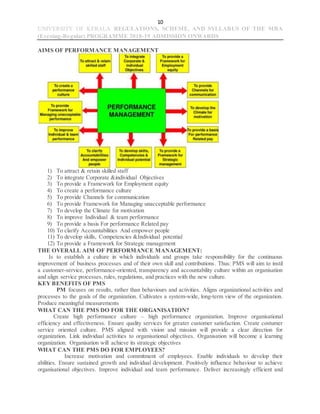
AIMS OF PERFORMANCE MANAGEMENT
1) To attract & retain skilled staff
2) To integrate Corporate &individual Objectives
3) To provide a Framework for Employment equity
4) To create a performance culture
5) To provide Channels for communication
6) To provide Framework for Managing unacceptable performance
7) To develop the Climate for motivation
8) To improve Individual & team performance
9) To provide a basis For performance Related pay
10) To clarify Accountabilities And empower people
11) To develop skills, Competencies &Individual potential
12) To provide a Framework for Strategic management
THE OVERALL AIM OF PERFORMANCE MANAGEMENT:
Is to establish a culture in which individuals and groups take responsibility for the continuous
improvement of business processes and of their own skill and contributions. Thus: PMS will aim to instil
a customer-service, performance-oriented, transparency and accountability culture within an organisation
and align service processes, rules, regulations, and practices with the new culture.
KEY BENEFITS OF PMS
PM focuses on results, rather than behaviours and activities. Aligns organizational activities and
processes to the goals of the organization. Cultivates a system-wide, long-term view of the organization.
Produce meaningful measurements
WHAT CAN THE PMS DO FOR THE ORGANISATION?
Create high performance culture – high performance organization. Improve organisational
efficiency and effectiveness. Ensure quality services for greater customer satisfaction. Create costumer
service oriented culture. PMS aligned with vision and mission will provide a clear direction for
organization. Link individual activities to organisational objectives. Organisation will become a learning
organization. Organisation will achieve its strategic objectives
WHAT CAN THE PMS DO FOR EMPLOYEES?
Increase motivation and commitment of employees. Enable individuals to develop their
abilities. Ensure sustained growth and individual development. Positively influence behaviour to achieve
organisational objectives. Improve individual and team performance. Deliver increasingly efficient and
11
UNIVERSITY OF KERALA REGULATIONS, SCHEME, AND SYLLABUS OF THE MBA
(Evening-Regular) PROGRAMME 2018-19 ADMISSION ONWARDS
effective services. Responsive to the customers’ needs and ensure customer satisfaction. Motivate
employees to achieve their full potential in line with organisational strategic objectives. It supports
knowledge, skills and competency levels. Employees will understand their contribution to the vision and
mission of org. Employees will commit themselves in their jobs. Employees will adapt to new challenges
within the organization. Provide basis for rewarding people. Assists in empowering people and to retain
high quality people. Can lead to performance related salaries
MANAGING THE PMS PROCESS
Leadership, support and commitment to the implementation, enforcement, monitoring and
evaluation of the PMS will ultimately provide the impetus for its implementation. In the absence thereof
the PMS is not likely to succeed. PMS is a process owned and driven by line managers and should be
regarded as an integral part of the continuing process of management. The implementation of the PMS
should be seen as a process and not as an event. Therefore, it is a total company effort and cannot be left
to one person, one division or one Department. Leadership plays a pivotal role to steer, guide and direct
the implementation of the PMS in the organisation. Thus, performance management will become the core
function of all the supervisors, managers, executives etc.
AIMS OF PERFORMANCE MANAGEMENT
The Basic Aims :- Two simple propositions provide the foundation upon which performance
management is built :-
(1)When people (individuals & teams) know and understand what is expected of them, and have taken
part in forming these expectations, they will use their best endeavours to meet them.
(2) The capacity to meet expectations depends on the levels of capability that can be achieved by
individuals and teams, the levels of support they are given by management , and the processes, systems,
and resources made available to them by the organization.
Detailed Aims :-
In more details, the aims of performance management are two :-
(1) Help to achieve sustainable improvements in organizational performance.
(2) Act as a lever for change in developing a more performance oriented culture.
(3) Increase the motivation and commitment of employees.
(4) Enable individuals to develop their abilities, increase their job satisfaction and achieve their full
potential to their own benefit and that of the organization as a whole.
(5) Enhance the development of the team cohesion and performance.
(6) Provide opportunities for individuals to express their aspirations and expectations about their work.
Aims Suggested by other Commentators :-
The American Compensation Association (1996) states that organizations rely on performance
management to :-
(1) Document job responsibilities.
(2) Help define performance expectations.
(3) Provide a framework for supervisors and employees to communicate with each other.
(4) Provide ongoing opportunities for supervisors to coach and encourage personal development.
(5) Align individuals performance expectations with organizational goals.
The Aim of Any Good Performance Management System
There are many different approaches, tools and techniques involved in performance management.
No two performance management systems will look the same. Just like company culture, your perfor-
mance management system will be unique and specific to your values, your goals and your purpose.
However, every good performance management system seeks to work towards the improvement of the
overall organisational performance, while supporting performance, productivity and the wellbeing of its
employees.
12
UNIVERSITY OF KERALA REGULATIONS, SCHEME, AND SYLLABUS OF THE MBA
(Evening-Regular) PROGRAMME 2018-19 ADMISSION ONWARDS
Ultimately, every performance management system should ensure the achievement of overall
organisational goals and ambitions while aligning them with employee goals. In this way, performance
management and business objectives entwine with employee wellness and morale.
Performance management and its characteristics
Performance management Performance management is a continuous process by which
managers and employees work together to plan, monitor and review an employee’s work objectives and
overall contribution to the organization. or
Performance management is the continuous process of setting objectives, assessing progress
and providing on-going coaching and feedback to ensure that employees are meeting their objectives and
career goals.
1) Identifying the barriers to effective performance and resolving those barriers through constant
monitoring, coaching and development interventions.
2) Boosting the performance of the employees by motivation and implementation of an effective
reward mechanism.
3) To help the employees in identifying the knowledge and skills required for performing the job
efficiently as this would drive their focus towards performing the right task in the right way.
4) To enable the employees towards achievement of superior standards of work performance.
5) Identify poor performers
6) Determining promotions
7) Boosting the performance
8) Development
9) Motivation
10) Promoting personal growth and advancement in the career of the employees by helping them in
acquiring the desired knowledge and skills.
11) Creating a basis for several administrative decisions strategic planning, succession planning,
promotions and performance based payment.
Advantages
1) Remunerations or bonus for successful employees
2) The lazy and insincere workers are identified and removed
3) Company has documented performance history of the employees
4) Enhance the performance of both the individual and the organization
5) Helps in successful career planning
Disadvantages
1) Lengthy and complex
2) Become a hindrance in the employee’s progress
3) Employees may suffer from low self-esteem
4) Contradictory and misleading opinions in the performance management file
5) Partialities and favoritism
CHARACTERSTICS
The following is a set of characteristics that is likely to allow a performance management system to be
successful.
1. Strategic congruence
The system should be congruent with the unit’s and organization’s strategy. In other
words, individual goals must be aligned with unit and organizational goals.
2. Thoroughness
The system should be thorough regarding four dimensions. All employees should be
evaluated; all major job responsibilities should be evaluated, the entire review period, and not just
the few weeks/months before the review, on positive aspects as well as those in need of
improvement
13
UNIVERSITY OF KERALA REGULATIONS, SCHEME, AND SYLLABUS OF THE MBA
(Evening-Regular) PROGRAMME 2018-19 ADMISSION ONWARDS
3. Practicality
Systems that are too expensive, time-consuming, and will obviously not be effective. On
the other hand, good systems are available and easy to use (e.g., performance data are entered
using user-friendly software), and are acceptable to those who want to use them for decisions.
4. Meaningfulness
The system must be meaningful in several ways.
1st the standards and evaluations conducted for each job function must be considered important
and relevant.
2nd , performance assessment must emphasis only those functions under the control of the
employee.
3rd , evaluations must take place at regular intervals and at appropriate moments.
4th , the system should provide for continuing skill development of evaluators.
5th , the results should be used for important personnel decisions.
5. Identification of effective and ineffective performance
The performance management system should provide information allowing for the
identification of effective and ineffective performance. That is, the system should allow for
distinguishing between effective and ineffective behaviors and results, thereby also allowing for
the identification of employees displaying various levels of performance effectiveness.
6. Specificity
A good system should be specific, meaning that it should provide detailed and concrete
guidance to employees about what is expected of them and how they can meet these expectations.
7. Reliability
A good system should include measures of performance that are consistent and free of
error. For example, if two supervisors provided ratings of the same employee and performance
dimensions, ratings would be similar.
8. Validity
The measures of performance should also be valid. In this context, measures are
relevant (i.e., include all critical performance facets), are not deficient (i.e., do not leave any
important aspects out), and are not contaminated (i.e., do not include factors outside the control of
the employee).
9. Inclusiveness
Good systems include input from multiple sources on an ongoing basis. First, the
evaluation process must represent the concerns of all the people who will be affected by the
outcome. Consequently, employees must participate in the process of creating the system by
providing input regarding what behaviors and/or results will be measured and how. Second,
employee input about their performance should be gathered from the employees themselves
before the appraisal meeting.
10. Correct ability
The process of assigning ratings should minimize subjective aspects. However, it is
virtually impossible to create a completely objective system because human judgment is an
important component of the evaluation process.
11. Openness
Good systems have no secrets. First, performance is evaluated frequently, and
performance feedback is provided on an ongoing basis. So employees are continually informed of
their performance. Second, the appraisal meeting consists of a two-way communication process,
where information is exchanged and not just delivered from the supervisor to the employee.
Third, standards should be clear and communicated on an ongoing basis. Finally,
communications are factual, open and honest.
14
UNIVERSITY OF KERALA REGULATIONS, SCHEME, AND SYLLABUS OF THE MBA
(Evening-Regular) PROGRAMME 2018-19 ADMISSION ONWARDS
12. Standardization
Good systems are standardized. This means that performance is evaluated consistently
across people and time. To achieve this goal, the ongoing training of the individuals in charge of
appraisals, usually managers, is a must.
13. Acceptability and fairness
A good system is acceptable to and perceived as fair by all participants. Perceptions of
fairness are subjective, and the only way to know whether a system is seen as fair is to ask the
participants.
14. Ethicality
Good systems comply with ethical standards. This means that the supervisor suppresses
her personal self-interest in providing evaluations. In addition, the supervisor evaluates only
performance dimensions for which she has sufficient information, while respecting the privacy of
the employee.
Performance management is the process of identifying, measuring, managing, and
developing the performance of the human resources in an organization.
1) Future oriented for growth.
2) Ongoing or continuous review
3) Flexible process
4) Conducted by manager & supervisors.
5) Linked to business needs
Performance appraisal, on the other hand, is the ongoing process of evaluating employee
performance.
1) Retrospective for correction
2) Typically once or twice per year.
3) Rigid structure/system
4) Usually housed in HR department
5) Not linked to business needs
Characteristics of an Ideal Performance Management System
Performance management is a continuous comprehensive process of communication and
evaluation between a manager and an employee. A performance management system aims to fulfill the
strategic objectives of the organization. Performance management focuses on employee engagement,
development and performance evaluation.
Every performance management system helps to improve the effectiveness of talent
management in an organization by monitoring and improving the performance of the employees, by
engaging them with continuous feedback, appreciation and rewards program. The performance
management includes ensuring organizational buy-in of the employees, creating an open feedback culture
and providing development opportunities to the employees.
We shall discuss the various characteristics of an ideal performance management system:
1) Goal-setting and management
Goals management is an integral part of an effective performance management
system. Goals are important because they challenge the employees and motivate them to perform
better. Setting goals would mean providing direction, priority and time frame for an employee to
achieve the objectives.
Based on the business models, goals are set by the employees and approved by the
managers or set by the managers. However, the key factor is goals must be aligned with the
organization’s objectives. In general, organization set
goals that are challenging yet attainable. Clearly defined goals make employees understand what
is expected of them and proceed with clarity.
15
UNIVERSITY OF KERALA REGULATIONS, SCHEME, AND SYLLABUS OF THE MBA
(Evening-Regular) PROGRAMME 2018-19 ADMISSION ONWARDS
2) Performance Appraisals
Performance appraisals are the heart of the employee performance management
system. Feedback questionnaires are created for employees based on their goals and
competencies. Self-feedback, manager feedback and ratings are sought during the appraisal cycle.
Performance manager software automates the appraisal cycle. The automated reminders and
notifications in the software help reduce the manual follow-up efforts of HR to make the
employees and managers to complete the feedback process. It also helps to drastically reduce the
appraisal duration.
One - on- one appraisal meeting summary is captured in the system and final ratings
and recommendations are published for the employees. These ratings are then used to decide
compensation revisions. From creating appraisal feedback forms and workflows to appraisal letter
distribution the software helps to automate the entire performance appraisal process.
3) 360 Degree Reviews
An ideal performance management system does not only stimulate feedback from the
manager but considers an overarching perspective of everyone who is involved in the
business. This could be the employee, or his colleagues and external stakeholders. So how do we
bring in a system where everyone is involved in the feedback process?
One way of doing this is by creating a survey or a rating mechanism where the
employee can do a self-evaluation, the colleagues can rate him, then the managers, customers,
vendors, and HR can give their feedback. This gives an overall perspective on the employee’s
performance. You can even make this creative by adding emoticons in the rating section.
With a 360-degree review mechanism, there is an upward feature through which
employees can give anonymous feedback to their managers. The managers will then be able to
know how capable they are in terms of their leadership skills and team management. Through
this, employees can identify the perception gaps between the managers and the employees.
4) Employee engagement
Employee engagement is the hallmark of a successful performance management
system. Employee engagement is the process of creating the best work conditions for an
employee to keep him motivated. When employees are engaged, they give their best performance
every day.
In a performance management system, engaging an employee would mean, having a
system where employees are reviewed on an overall basis, they are recognized for good
performance, rewarded for their achievements and are appreciated for their talent. Something as
simple as, “You did well today” can go a long way.
One way of doing this is to have a software, that creates employee engagement
surveys. The survey can have various questions that measure employee engagement either
qualitatively or quantitatively. An example of a qualitative survey question could be, “How well
are you being able to contribute to the goals of the organization?” a quantitative question, on the
other hand, would either use a rating scale or yes or no questions.
5) Continuous Feedback Mechanism
From the beginning, we have been emphasizing one thing that is very significant for a
successful performance management system. It is a feedback mechanism that is continuous.
When you have a continuous feedback mechanism in your performance management system, all
the other processes will become easier. In one way, you could say that the continuous feedback
mechanism is a backbone to any performance management system.
When you have a continuous feedback mechanism in your performance management
system, you could have something like a wall or a portal, that could serve as a platform for
employees and managers to post their comments and feedback for employee performance. In a
way, this digital wall could become an employee performance evaluation tool.
16
UNIVERSITY OF KERALA REGULATIONS, SCHEME, AND SYLLABUS OF THE MBA
(Evening-Regular) PROGRAMME 2018-19 ADMISSION ONWARDS
In a performance management system, continuous feedback promotes healthy
collaboration between all the employees and the managers. The feedback that is provided is
accurate and timely. This process is a lot more convenient than those excel sheets that you send
every year. You can even have a facility in which you can send confidential comments to the
employees by having a mobile app.
6) Performance Analytics
In order to do effective performance management, it is important that your
performance management system has a thorough record of all the performance reports of the
employees. It is important that your PMS has proper records of all the employees' profile reports
and career history so that the managers can come up with strategies for employee’s talent
management.
For a PMS, details such as employees' skills, training programs, and attrition rate are
important because it helps managers understand the various trends in employee performance.
Performance management system is a methodological framework that fosters
collaboration among the employees and aims to improve the performance productivity of the
employees and the organization. With the help of a performance management system, we can
manage goals, conduct performance reviews, give continuous feedback and align everything with
the core values and mission of the organization. This helps in better employee engagement, which
is again the hallmark of an ideal performance system.
Developments in Performance Management
1) Change the Organizational Definition of Performance Management
Performance management must be perceived by managers and employees as an ongoing
process. HR creates this perception through its communications about performance management
and the activities that constitute the performance management process.
2) Introduce Competencies into Performance Management
By listing and defining the competencies needed to excel, managers give employees a set
of clear objectives against which to measure current behaviors. This helps to determine what
development is needed. When integrated across all talent management processes, competencies
are a powerful tool for reinforcing what a company values, as well as driving business impact.
3) Create and Support High-Quality Development Plans for All Employees
Development plans enable employees and managers to bridge employee skills or behavior
gaps that are identified through the performance appraisal process. These plans prioritize the
development needs most critical to achieving desired business results and identify specific action
steps.
4) Enable Managers to Coach
Managers need to support employee development through coaching in addition to
development plans. Managers need to understand the return on the time invested in coaching and
also have the skills to coach effectively.
5) Create Frequent Occasions for Reflecting on Performance
When employees and managers discuss performance frequently, overall performance
improves. HR has a role in making these conversations happen.
Research within the past decade suggests ways organizations can overcome problems with the
traditional performance appraisal. Five issues are addressed:
(1) legal pitfalls;
(2) the appraisal instrument;
(3) who should appraise and coach the employee;
(4) objectivity and fairness; and
(5) the coaching process itself.
17
UNIVERSITY OF KERALA REGULATIONS, SCHEME, AND SYLLABUS OF THE MBA
(Evening-Regular) PROGRAMME 2018-19 ADMISSION ONWARDS
LEGAL ISSUES
Human resource management came under legal scrutiny in 1964 with the passage of Title VII of
the Civil Rights Act in the United States (U.S.). This act makes it illegal to allow sex, age, race, religion,
or ethnicity to influence decisions regarding the recruiting, training, upgrading, compensating, demoting,
or terminating of an employee. Legal issues are increasingly problematic for organizations as people are
becoming more aware of their legal rights. In fact, there has been a 100% increase in the number of
employment discrimination cases filed since 1995, and these cases have usually involved complaints
regarding a performance appraisal. Legal confrontations regarding performance appraisals have led to the
discovery of ways to minimize them. Organizations are most likely to win court challenges when:
(1) the appraisal instrument is based on a written job analysis;
(2) it is behavioral;
(3) there is a written manual for appraising and then coaching an employee;
(4) reliability and validity of the appraisal decisions have been documented;
(5) the results of an appraisal have been reviewed with the employee; and
(6) organizations can show that appraising and coaching of employees is ‘‘fair.’’
THE APPRAISAL INSTRUMENT
The appraisal instrument is the foundation for appraising and coaching employees. It is the basis
for making administrative decisions in a uniform and consistent way. As noted earlier, a primary reason
for the frequent failure of a performance appraisal to bring about a positive change in a person’s behavior
is that many employees view the instrument as measuring the ‘‘wrong things.’’ Designing the ‘‘right’’
performance appraisal instrument improves both the accuracy of the instrument and employee perceptions
of fairness. The most frequently used instruments for assessing employees are bottom-line measures, trait-
based scales, and behavioral scales.
Bottom-line measures often take the form of management by objectives (MBO). This approach
emphasizes issues such as: Were X, Y, and Z goals attained? Were they attained on time? Was the quality
satisfactory? The relevance of such questions is difficult to attack, as they appear to be objective. The
probability that two or more appraisers will independently reach the same conclusion regarding a person’s
performance is relatively high. For example, the person either did or did not decrease costs by 14%.
Nevertheless, MBO leaves much to be desired when used as the primary basis for coaching an
employee, or for making administrative decisions. As Donald Petersen, a former CEO of Ford Motor
Company has noted, the emphasis on goal attainment is ironically a weakness of MBO. When receiving a
‘‘good’’ appraisal is contingent on goal attainment, ingenious ways are often found by employees to make
easy goals appear difficult to administrative decision makers. Moreover, a focus on bottom-line measures
is of little help in planning for and receiving training and development opportunities. They tell the
‘‘score,’’ but not what can be done to improve it. Dissatisfaction with this aspect of MBO can erode the
employees’ belief in the fairness of the appraisal process.
In short, the limitations of economic or bottom-line measures for appraisal purposes are at
least five-fold. First, cost-related measures are often affected by factors beyond a person’s control (e.g.,
lack of resources, situational constraints). Hence people can be promoted or penalized undeservedly. To
the extent that situational factors constrain performance outcomes, the focus needs to be on the person’s
behavior, or their motivation level decreases dramatically. Second, bottom-line measures often do not
take into account factors for which the person should be held accountable (e.g., team playing skills,
creating seamless boundaries within the organization). Credit needs to be given to an individual for
excelling on important non quantitative aspects of his or her job. Third, bottom-line measures can foster a
results-at all-costs mentality, which in turn can lead to unethical, if not illegal, activity. Fourth, bottom-
line measures yield little or no information on what the person must continue doing, start doing, stop
doing, or do differently to impact the bottom-line positively. Telling a middle manager, for example, that
there is a cost overrun is of little value. What the manager needs to know, and what an effective coach
18
UNIVERSITY OF KERALA REGULATIONS, SCHEME, AND SYLLABUS OF THE MBA
(Evening-Regular) PROGRAMME 2018-19 ADMISSION ONWARDS
needs to explain to the manager, are ways to work effectively within budget. Finally, comprehensive
bottom-line measures do not exist for the individual employee in most jobs.
Trait-based scales are often used to assess attitudinal and personality variables such as
commitment, creativity, loyalty, and initiative. However, unless traits are defined behaviorally, they are
too vague, subjective, and ambiguous. The appraisal reflects little more than the caprice of the appraiser.
As is the case with bottom-line measures, trait based assessments provide little insight into what the
employee should start, stop or consider doing differently. For this reason, the courts usually take a dim
view of these types of appraisal instruments. The solution is to measure and coach a person on observable
behaviors required to implement an organization’s strategy, which in turn increases the bottom-line.
Behaviorally based scales reduce ambiguity by setting common expectations that make
explicit what the person should start or stop doing. These types of measures account for more job
complexity, relate directly to what the employee does, and minimize irrelevant factors that are not under
the control of the individual. Behavioral criteria, developed from a job analysis, make clear what one
must do to be productive, and what one must do to implement the strategy. As Colin Powell has argued,
plans do not accomplish anything: strategy is only as good as its execution. All the great ideas and visions
in the world are worthless, argued Powell, if they cannot be implemented effectively and efficiently.
Behavioral measures specify ways to execute an organization’s strategic plan.
The steps to follow in developing an effective appraisal plan for coaching purposes are six-fold.
Employees must be assessed and coached on behaviors that are:
(1) observable;
(2) under their control; and
(3) critical to the implementation of the organization’s strategy. Too often, the results of months of
strategic planning are the strategic document disappearing into a desk drawer to be subsequently ignored
for the remainder of the fiscal year. Of particular importance for perceptions of fairness is that
(4) appraisal accuracy increases when both the coach and employee are informed ahead of time about
what is to be observed. This foresight focuses the attention of both parties on pertinent behaviors, and it
facilitates
recall when making administrative and developmental decisions. In developing a behaviorally based
appraisal instrument,
(5) longer, objective, descriptive behavioral statements on the appraisal instrument are more effective
than short phrases in increasing the appraiser’s accuracy. Finally,
(6) keeping a written record during appraisal periods of the specific behaviors that were observed
improves the appraiser’s recall, and hence contributes to an objective appraisal and working process.
Behavioral observation scales facilitate performance feedback, identification of training needs, and
setting Behavioral measures tied to the organization’s strategy correlate significantly with cost-related
measures such as revenue, repeat business, and customer satisfaction. Hence, they serve as a diagnostic
instrument.
Diagnostic Instrument
Whether it is in the fields of medicine or golf, coaches benefit from having a diagnostic
instrument to assist them in determining what a person is doing well, and spotting what the person can do
to enhance his or her knowledge, skills or ability. A diagnostic instrument also facilitates self-
management. In medicine, a diagnostic instrument enables people to know what to eat and what not to
eat, in order to maximize their quality of life, and minimize the probability of sundry diseases ranging
from heart disease to cancer. It sensitizes people to early warning signs as to when a medical doctor
should be consulted. In golf, a diagnostic instrument allows one to check one’s grip of the club, or
placement of one’s feet to hit the ball long and straight. It facilitates discussion with a golf coach as to
what one needs to do to improve one’s score.
In organizational settings, an effective diagnostic instrument is one that focuses on those
areas that move the strategy from rhetoric to action steps. Hence, the importance of the appraisal
19
UNIVERSITY OF KERALA REGULATIONS, SCHEME, AND SYLLABUS OF THE MBA
(Evening-Regular) PROGRAMME 2018-19 ADMISSION ONWARDS
instrument as a diagnostic tool for coaching and developing an employee, and to an employee’s own self
management. This diagnostic instrument should ensure that people are coaching themselves, and that they
are coaching others on the ‘‘right things.’’
Perceptions of Fairness
Employee acceptance is critical to the implementation and on-going use of appraisals. Trust
(perceptions of whether people adhere to the organization’s rules when making appraisals, whether the
appraisals are accurate, or whether the appraisals reflect favoritism), as well as employee perceptions of
situational constraints on their performance, predicts their motivational level.
Hostility toward performance appraisals and the coaching process often occurs when people
believe that they are being evaluated on the ‘‘wrong things,’’ or on indices over which they have little
control. This hostility is minimized to the extent that people can see that they are being assessed on the
very behaviors that enable the successful implementation of the organization’s strategic plan.
Another reason for employee hostility toward appraisals is improper weighting of the criteria.
This has led to the concept of a ‘‘balanced scorecard’’ that provides a framework for coaching employees
on the ways they can contribute meaningfully to the organization’s strategy. For example, at
PricewaterhouseCoopers (PWC), equal weight is now given to each of three criteria, namely: client,
people, and firm. This is done to shift an overemphasis by some partners on the client, at the expense of
coaching staff on ways to assist the client, as well as to ensure that what is done for the client and staff is
not done at the expense of what is in the overall interest of PWC as an organization.
The attitudes of coaches as well as the people who are being coached is positive if the appraisal
instrument facilitates assessments that are:
(1) perceived as factual, objective and unbiased;
(2) explicitly related to the organization’s strategy;
(3) developmental, in that the assessment specifies what the employee must start doing, stop doing,
continue doing, or do differently to improve performance; and
(4) conducive to setting specific high goals for doing so.
SOURCES OF APPRAISAL: WHO SHOULD COACH?
An appraisal instrument, no matter how carefully developed, is only as good as the people who
use it. Hence the question: Who is the ideal coach? Is the answer the boss? What about one’s peers or
subordinates? How about people coaching themselves?
360-Degree Feedback
Anyone who has children is aware that how they interact with their grandparents is not
necessarily how they interact with their parents, babysitters, or siblings. Moreover, how they behave on
the playground is unlikely to yield clues as to how they behave in the classroom, let alone in the home.
The answer to ‘‘Who is my child?’’ is ‘‘All of the above.’’ For similar reasoning, feedback from multiple
sources, often termed 360- degree or multisource feedback, is blossoming in the workplace.
A perception of an employee’s performance varies among subordinates, peers, and
supervisors. How an employee interacts with the boss is not necessarily an indicator of how that
employee interacts with peers or subordinates. Multisource feedback takes into account the fact that
different populations (e.g., peers, subordinates) have different opportunities to observe different aspects of
a person’s performance. It thus provides an integrated, holistic view of an employee, offsetting the biases
of an appraisal from only a single vantage point (e.g., the boss). Moreover, 360-degree feedback is
consistent with organizational values for teamwork. Upwards of 90% of Fortune 1000 firms now collect
assessments of an employee from multiple sources.
360-Degree feedback is being used in many large companies, such as DuPont, General Electric
Co. (GE), Motorola Inc., Procter & Gamble Co. and United Parcel Service of America Inc. (UPS). For
example, a 360- degree feedback program exists at AT&T Corp.’s business products division. Any
manager supervising three or more people has to go through an evaluation every year and must share the
results with his or her supervisors, as well as with the employees below the manager. Several senior
20
UNIVERSITY OF KERALA REGULATIONS, SCHEME, AND SYLLABUS OF THE MBA
(Evening-Regular) PROGRAMME 2018-19 ADMISSION ONWARDS
managers, at AT&T, Nestle’s and General Motors Corp., have openly admitted that they have been
surprised by the upward feedback within a 360-degree evaluation. The managers were unaware of the
inaccurate perceptions of some of their actions, and the uncertainty amongst employees regarding issues
the managers thought they had communicated.
However, agreement among multiple sources of an appraisal should not be expected. Each
source often observes an employee in different contexts, with supervisor–peer ratings typically exhibiting
the greatest agreement, and subordinate–self ratings showing the least agreement. Hence, multisource
appraisal instruments are often designed to assess those aspects of the job that a specific population (e.g.,
subordinates) is most likely to observe on an ongoing basis. In short, a person’s appraisal often differs
across populations (supervisor vs. subordinates) because of the actual differences in the behaviors that are
observed in different contexts.
Thus, multisource appraisals are taken into account at JP Morgan Chase when determining
developmental goals (teamwork), and/or making an administrative decision (e.g., promotion). Among the
strengths and limitations of each source of an appraisal are the following:
The Boss
The boss often has a limited opportunity to observe his or her subordinates. Thus, a boss
appraisal usually does not provide a complete picture of an employee’s performance. Consequently,
supervisory appraisals frequently fail to improve a person’s performance and may lead to employee
hostility. Such questions as: ‘‘On what basis are you able to evaluate me?’’ undermine the credibility of
the boss. The employee views the appraisal as unfair. The boss should be held accountable primarily for
collecting data for appraising an individual from multiple sources, and then making the final
administrative and developmental decisions based on these multiple sources of information.
Subordinates
Anonymous feedback from subordinates, often called upward feedback, can lead to positive
changes in the behavior of supervisors. Leaders who receive feedback from subordinates that is more
negative than their self-evaluation show the greatest level of subsequent improvement. These positive
behavior changes have been shown to be sustainable over time. This is especially true for managers who
have high self-efficacy, namely, the belief that ‘‘I can change.’’ Upward appraisals are used in such
companies as Pratt and Whitney and AT&T.
Peers
Anonymous peer ratings are among the best predictors of both training success and
performance in subsequent jobs. This is because peers often have more job-relevant information than
other sources, due to their opportunity to closely observe and compare themselves against others on task-
relevant abilities.
Peer appraisals are increasingly popular in self-managing teams. Allowing people who
comprise the teams to be responsible for appraising and coaching one another increases interpersonal
effectiveness, group cohesion, openness of communication, employee motivation, and group satisfaction.
Self-Appraisals
Self-appraisals, not surprisingly, are less accurate than appraisals from other sources. Self-
appraisals have the lowest agreement with other rating sources (peers and super visors), and the lowest
ability to predict the person’s subsequent performance. An intriguing finding is that those whose self-
appraisal is aligned with the appraisals they receive from others are usually high performers. This is
because they score high on ‘‘self-awareness’’ of their abilities. Moreover, employees whose self-
evaluations are in agreement with evaluations from their subordinates have been found to be more
promotable than those whose self-ratings are inflated.
Overall, multisource feedback provides a comprehensive way of appraising employees. It
improves the accuracy of appraisals through the multiple viewpoints that are obtained, and it increases
perceptions of fairness by ensuring that a biased source (e.g., one’s boss) is not over-represented in the
appraisal process.
21
UNIVERSITY OF KERALA REGULATIONS, SCHEME, AND SYLLABUS OF THE MBA
(Evening-Regular) PROGRAMME 2018-19 ADMISSION ONWARDS
TRAINING APPRAISERS/ COACHES
Appraisal Accuracy Appraisals are more often a reflection of the appraiser’s overall biases
than they are of the performance of an employee. Appraisers from different populations (e.g., supervisors
vs. subordinates) attach different weights to the same aspects of performance that they observe as a result
of their different perspectives in the organization. A massive study involving over 4000 managers with
appraisals from at least two supervisors, two peers, two subordinates plus self-appraisals indicated that the
idiosyncrasies of an appraiser affect the appraisals given to an employee.
The U.S. Army showed that one’s knowledge and ability explained only a very small part of an
appraisal from one’s supervisor and peers. The supervisor’s positive regard for a subordinate resulted in
both positive leniency and halo errors, and little inclination to punish poor performance. Other studies
have found that the perceived similarity of the subordinate by the supervisor inflates appraisals in the
private and public sectors. This is especially true with regard to perceived similarities regarding
extraversion, conscientiousness and emotional stability.
Interestingly, in this new millennium, people who smoke are rated lower than nonsmokers on
professional comportment, working with others, and dependability. Smokers are viewed as wasting
valuable production time as a result of leaving for designated smoking areas.
Evaluations are also adversely affected by gender. Men are typically evaluated as more
effective than women. That this finding reflects sex discrimination is suggested by the fact that even when
the males and females demonstrate the same leadership behavior, women are devalued when the
appraisers are male. A subsequent review of leadership perceptions in the military revealed preferential
ratings for men in training groups, primarily where there was a ‘‘token’’ woman; this was not found in
groups where there were several women. This suggests that token status exacerbates negative evaluations
of women, because the token female receives considerable attention, which increases the pressure on her
to perform well.
Another study also points to the importance of gender proportion as a factor affecting rating
accuracy. The respondents, only 27 of whom were female, reported that men possess the motivation and
leadership qualities necessary for effective performance, whereas women possess feminine attitudes that
impair their performance. Yet, there were no performance differences between men and women on any
objective measure. In still another study, the performance of women was rated higher than that of men
when the women constituted a higher proportion than the men. Gender proportion appears to influence the
performance evaluations of women. Increasing the representation of women in mixed groups increases
positive appraisals of them.
To minimize bias and increase the accuracy and objectivity of coaches, training programs should
allow them to evaluate actors presented on videotape, receive feedback as to rating accuracy, and to
practice, practice, practice. Such training minimizes rating errors including leniency, halo, and similar-to-
me biases. This training should teach coaches:
(1) the relevant performance criteria for evaluating people;
(2) the relevant job behaviors to observe; and
(3) and ways to effectively minimize errors in judgment when using the appraisal instrument.
Feedback and Goal-Setting
In many instances, feedback decreases rather than increases performance. Therefore, training
coaches in how to provide feedback and set goals is critical to an effective coaching process. For feedback
to bring about a positive change in behavior, a coach must:
(1) focus on the behavior rather than the person;
(2) be selective as to the ‘‘critical few’’ so as not to overwhelm the person; and
(3) focus on the desired behavior rather than the undesired, as well as ways to demonstrate it. Sensitivity
and tact in giving feedback is critical for bringing about a change in behavior. Thus,
(4) honesty should not be confused with hurtfulness. Feedback in the absence of goal setting has little or
no effect on behavior, because feedback in itself is only information; its effect on action depends on how
22
UNIVERSITY OF KERALA REGULATIONS, SCHEME, AND SYLLABUS OF THE MBA
(Evening-Regular) PROGRAMME 2018-19 ADMISSION ONWARDS
the recipient understands it, and what decisions are made with respect to it. For feedback to improve
behavior,
(5) specific high goals must be set, and the individual must be committed to meeting those goals, because
goal setting affects choice, effort and persistence.
Organizational Justice
Few things demoralize a person faster than feelings of jealousy, perceptions of favoritism, or
beliefs that someone else is getting a ‘‘better deal.’’ Not only does a coach need to be fair; the coach must
be seen as fair. At least four factors contribute to perceptions of fairness of a coach, namely, distributive
justice, procedural justice, interactional justice and the concept of voice.
The following questions are usually asked by employees regarding distributive justice: What was
distributed to whom? Who has the corner office, received the coveted assignment, or was promoted or let
go? Although the answers to these questions certainly affect perceptions of justice, often more important
to employees are answers to questions regarding procedural justice.
Perceptions of procedural justice are affected by answers to the question: Are there
procedures, processes, or systems for deciding ‘‘who gets what?’’ If the answer is no, mistrust throughout
the workforce is likely to be high. If the answer is yes, subsequent questions asked by employees include
the following: Are the procedures representative of the thinking of the unit or that of a ‘‘chosen few?’’
Are they applied consistently? Are the procedures ethical? Is there an appeal system that people can use
without fear of retribution? Do I have a champion? People become highly concerned with answers to
procedural justice questions when they receive a poor appraisal.
Interactional justice refers to the interactions between the coach and the subordinate. To the
extent that the logic of the coach is understood, and the coach is perceived as someone wanting to truly
help the person improve performance, feelings of trust and respect are usually high, even if the employee
disagrees with the coach’s appraisal.
Voice refers to the extent that people believe that their views are taken into account before an
appraisal is made. People are likely to support a decision that they did not initially advocate if they have
‘‘voice,’’ if their answer is yes to the question: ‘‘Was I heard?’’
A ‘‘due process appraisal’’ includes giving an employee adequate notice of the appraisal (e.g.,
explaining standards in advance, seeking self-appraisals, giving feedback on an ongoing basis), fair
hearing (adequate observations of the person’s performance, granting the person an opportunity to explain
self evaluations) and judgment based on evidence (e.g., consistent application of standards, an
opportunity to appeal). Employees whose voice has been heard usually feel that the appraisal system is
fair and accurate. ‘‘Due process’’ increases an employee’s motivation to improve performance, as well as
satisfaction with the appraisal system as a whole. In summary, training programs, in addition to focusing
on ways to increase appraisal accuracy, should stress the principles of organizational justice so that the
performance management process in general, and the coach in particular, are seen as fair.
Regardless of the care that is taken in developing the appraisal instrument and the training that
is given to a coach, appraisal accuracy can be affected adversely by the organization’s politics. In a study
of an Oregon newsprint facility and a Seattle bank, self-confidence in conducting accurate appraisals was
high. In the newsprint facility, however, the performance appraisal did not affect an employee’s status in
any way, regardless of whether the appraisal was positive or negative; moreover, the appraisers
anticipated neither positive nor negative outcomes for themselves for conducting accurate and timely
appraisals. Performance appraisal was viewed by everyone as a ‘‘nonevent.’’ In the bank, appraisers
feared the organizational consequences of ‘‘making waves.’’ The outcome that they expected, as a result
of recording behaviors to document an unfavorable appraisal, was a decrease in the probability of they,
themselves, being promoted. An organizational culture that fosters high self-confidence and low positive
outcome expectancies causes resentment. In these two companies, people who believed that they could
make accurate appraisals stopped doing so.
23
UNIVERSITY OF KERALA REGULATIONS, SCHEME, AND SYLLABUS OF THE MBA
(Evening-Regular) PROGRAMME 2018-19 ADMISSION ONWARDS
For performance management to be taken seriously, people must see the relationship between
the coaching provided and desirable outcomes. They must see a positive relationship between the
coaching process and other human resource systems, including staffing and training, as well the effective
implementation of the team’s, division’s or organization’s strategic plan.
When the outcome expectancies of conducting appraisals are neutral or negative, when there is
no perceived relationship between the performance appraisal one receives and subsequent positive or
negative outcomes, the entire process is seen as meaningless. Therefore, a coach should be formally
evaluated on the accuracy and comprehensiveness of appraisals of others, as well as on the extent to
which organizational justice principles are followed, and specific high goals are set.
ONGOING COACHING
In the past five years, there has been a shift in emphasis within the private and public sectors
from performance appraisal to performance management, from being a performance appraiser to
becoming a performance coach. The shift is from a discrete activity to one that is performed on an
ongoing process. The shift is from being primarily an evaluator to becoming a developer of people.
Cyclical year-round performance management (i.e., feedback, analyzing results, setting goals)
effectively increases organizational performance. Executive coaching in a public-sector municipal agency
increased employee productivity dramatically. This is because coaches can be powerful catalysts for
bringing about relatively permanent improvements in employees’ behavior when they challenge
employees on a daily basis, and when they instill in them the confidence that they can expand their
abilities to attain desired goals. The CEO of Hewlett–Packard was recently quoted as saying ‘‘along the
way, you must remind people of how far they’ve come already and how much closer they are to achieving
the goal.’’
Outcome Expectancy/Self Efficacy
A drawback to setting specific high goals is that people may obtain tangible evidence that
they did not attain them. They learn that they have failed despite their effort and persistence. Through
multiple setbacks or even one severe one, they give up. To help people overcome their sense of
helplessness, to instill optimism in the face of failure, coaches need to focus on two key concepts:
outcome expectations and self-efficacy.
A primary role of a coach is to help people see the relationship between what they do and the
outcome that they can expect. Motorola is known for having an employee development system that
combines performance appraisals, succession planning, and individual career planning into a single,
continuous system, so that employees know what they have done, where they are going, and how exactly
they need to improve. There is a sense of what one is striving for, and goals are set about how to get there.
In addition, conversations take place about how well one has accomplished one’s goals in the past, and
the progress of their current goals. Employees benefit from being able to understand their frequent
(quarterly) appraisals in terms of their own career development, as well their role in meeting
organizational performance targets.
The response ‘‘I don’t get it’’ is symptomatic of a lack of understanding of outcome
expectancies. Thus, the job of the golf pro is to help the player see the relationship between where the left
foot is placed and where the ball goes after being struck by the club. The job of the sales director is to
help the salesperson see the relationship between how the sales-call was made and the amount of revenue
that was generated. This is not a profound concept, yet it is one that many coaches in organizational
settings overlook. The use of the empathy box described earlier in Organizational Dynamics (see Latham,
2003) is a helpful tool for clarifying anticipated outcomes.
A second step to instilling a ‘‘can-do’’ mindset in an employee is for the coach to focus on the
person’s self-efficacy, namely, the conviction that ‘‘I can cause,’’ ‘‘I can bring about,’’ ‘‘I can make
happen.’’ Since self efficacy is task specific, a person may have high self-efficacy in one area—such as
bringing in new business, and low self-efficacy in another, such as managing staff. Task-specific self-
efficacy can be increased through:
24
UNIVERSITY OF KERALA REGULATIONS, SCHEME, AND SYLLABUS OF THE MBA
(Evening-Regular) PROGRAMME 2018-19 ADMISSION ONWARDS
(1) enactive mastery, that is, sequencing a task, giving assignments in such a way that all but guarantees
early successes;
(2) finding models of desired behaviors that the person being coached can identify with and learn from;
and
(3) the appropriate encouragement from others, particularly the coach. For example, at Syncrude, a large
Canadian energy company, those with high appraisals are singled out and written to personally by the
operations manager. This encouragement from the coach reinforces that performance is not only
appraised, but encouraged and valued by corporate leaders.
Peter Drucker noted that in the 20th century, great leaders gave great answers; in the 21st
century, great leaders will ask great questions. In organizational settings, as is the case for their
counterparts in professional sports, leaders may not necessarily be as adept or knowledgeable of the areas
requiring coaching, as is the person who is being coached. Thus, becoming an expert on ‘‘the answers’’ is
now, and will continue to be, all but impossible. The effective coach is one who questions and listens.
Insightful questions lead to reflection; they lead to self-discovery.
The arguable downside of becoming an effective coach is the queue; people seek out those
who listen to them. However, as Colin Powell has observed, the day people stop bringing a person their
problems is the day that person has stopped leading them. People have either lost confidence that the
person can help them, or they have concluded that the person does not care. Either case, argued Powell, is
a failure of leadership. Together, performance appraisals that lead to ongoing coaching ensure a highly
trained, highly motivated workforce. It is the essence of performance management.
Concerns of Performance Management
The following are the main concerns of performance management −
1) Concern with outputs, process and inputs
Performance management is concerned with outputs (the achievement of results) and
outcomes (the impact made on performance). But it is also concerned with the processes required
to achieve these results (competencies) and the inputs in terms of capabilities (knowledge, skill
and competence) expected from the teams and individuals involved.
Performance management is worried about yields (the accomplishment of results) and
results (the effect made on performance). In any case, it is likewise worried about the procedures
required to accomplish these outcomes (abilities) and the contributions to terms of capacities
(learning, expertise and capability) anticipated from the groups and people included.
2) Concern with planning
Performance management is concerned with planning ahead to achieve success in future.
This means defining expectations expressed as objectives and in business plans.
Performance management is worried about preparing to make progress in future. This
implies characterizing desires communicated as targets and in marketable strategies.
3) Concern with measurement and review
If you can’t measure it, you can’t manage it. Performance management is concerned
with the measurement of results and with reviewing progress towards achieving objectives as a
basis for action.
On the off chance that you can't gauge it, you can't oversee it. Performance
management is worried about the estimation of results and with auditing progress towards
accomplishing targets as a reason for activity.
4) Concern with continuous improvement
Concern with continuous improvement is based on the belief that continuously
striving to reach higher standards in every part of the organization will provide a series of
incremental gains that will build superior performance.
This means clarifying what organizational, team and individual effectiveness look like
and taking steps to ensure that those defined levels of effectiveness are achieved. Establishing a
25
UNIVERSITY OF KERALA REGULATIONS, SCHEME, AND SYLLABUS OF THE MBA
(Evening-Regular) PROGRAMME 2018-19 ADMISSION ONWARDS
culture in which managers, individuals and groups take responsibility for the continuous
improvement of business processes and of their own skills, competencies and contribution.
Worry with persistent change depends on the conviction that consistently endeavoring to
achieve higher models in all aspects of the association will give a progression of incremental
additions that will construct unrivaled performance.
This implies illuminating what authoritative, group and individual adequacy look like and
finding a way to guarantee that those characterized levels of viability are accomplished. Building
up a culture in which directors, people and gatherings assume liability for the ceaseless change of
business forms and of their own aptitudes, capabilities and commitment.
5) Concern with continuous development
Performance management is concerned with creating a culture in which
organizational and individual learning and development is a continuous process. It provides
means for the integration of learning and work so that everyone learns from the successes and
challenges inherent in their day-to-day activities.
Performance management is worried about making a culture in which hierarchical and
singular learning and improvement is a ceaseless procedure. It gives intends to the incorporation
of learning and work with the goal that everybody gains from the victories and difficulties inborn
in their everyday exercises.
6) Concern for communication
Performance management is concerned with communication. This is done by
creating a climate in which a continuing dialogue between managers and the members of their
teams takes place to define expectations and share information on the organization’s mission,
values and objectives. It establishes mutual understanding of what is to be achieved and a
framework for managing and developing people to ensure that it will be achieved.
Performance management is worried about correspondence. This is finished by
making an atmosphere in which a proceeding with discourse amongst directors and the
individuals from their groups happens to characterize desires and offer data on the association's
main goal, qualities and destinations. It sets up common comprehension of what is to be
accomplished and a structure for overseeing and creating individuals to guarantee that it will be
accomplished.
7) Concern for stakeholders
Performance management is concerned with satisfying the needs and expectations of all
the organization’s stakeholders, management, employees, customers, suppliers and the general
public. In particular, employees are treated as partners in the enterprise whose interests are
respected, whose opinions are sought and listened to, and who are encouraged to contribute to the
formulation of objectives and plans for their team and for themselves.
Performance management is worried about fulfilling the necessities and desires of all
the association's partners, management, workers, clients, providers and the overall population.
Specifically, representatives are dealt with as accomplices in the undertaking whose interests are
regarded, whose assessments are looked for and tuned in to, and who are urged to add to the
detailing of targets and plans for their group and for themselves.
8) Concern for transparency
Four ethical principles that should govern the operation of the performance management
process. These are −
1) Respect for the individual
2) Mutual respect
3) Procedural fairness
4) Transparency of decision making
26
UNIVERSITY OF KERALA REGULATIONS, SCHEME, AND SYLLABUS OF THE MBA
(Evening-Regular) PROGRAMME 2018-19 ADMISSION ONWARDS
Understanding Performance Management
Performance management often gets confused with a process known as micro-management.
Performance management is the process of analyzing an employee's performance and then offering
training and other necessary resources to improve performance. Micro-management is when a manager
scrutinizes every decision an employee makes and requires an employee to submit all work to the
manager before it is sent out to its designated recipient. With performance management, productive
employees are rewarded and non-productive employees are identified and addressed. Performance
management also helps to strengthen job descriptions and make the company's overall performance more
efficient.
Planning and Setting Expectations
When it comes to planning and setting expectations in performance management, it is critically
important to set goals that can be measured and evaluated. The manager works with the employee on
establishing performance expectations, and then there is a set of metrics created that can make it easier for
the manager to evaluate the employee's work. The manager must get the employee to understand how the
employee's job adds value to the company and why quality work is essential to the success of the
organization.
1) The Performance Management Cycle from the U.S. Office of Personnel Management
2) Performance Management Phase I: Planning from the University of California
3) Performance Planning and Appraisal Sessions - An Outline from Rutgers University
4) A Good Example of a Performance Management Plan from the Federal Highway Administration
5) Manager's Guide to Performance Management from the University of Washington
Monitoring Employee Performance
Once the employee expectations are in place, the manager must maintain a monitoring
program to help track the employee's progress. The biggest mistake some managers make is they only
monitor employee performance close to the annual evaluations. In performance management, the ongoing
monitoring of employee work habits and productivity is an essential part of the company's success. If the
manager detects any kind of unacceptable levels of performance from the employee, then those issues
need to be addressed immediately.
1) Workplace Privacy and Employee Monitoring from the Privacy Rights Clearinghouse
2) Choosing and Employee and Competence Monitoring System from Human Capital Review
3) 16 Ways to Measure Employee Performance from HR World
4) How Can I Track Ongoing Employee Performance? - from Monster.com
5) 3 Tips for Legally and Ethically Monitoring Employees Online from Entrepreneur.com
Nurturing Performance
When a manager is utilizing ongoing performance evaluations, it becomes easier to determine
what kind of resources an employee needs to succeed. The employee may require further classroom
training, or a hands-on training course may be more appropriate. The manager must use all of the
resources at their disposal to nurture the employee's performance and give that employee every possible
chance to improve productivity and offer value to the company. It could be that the employee would excel
in another position within the company. These are determinations the manager makes when nurturing
performance.
1) 10 Tips to Improve Employee Training from ThomasNet
2) ?A Comprehensive Employee Training Guide from Inc.com
3) Unusual Tips for Training Employees for Dummies
4) Ten Employee Training Tips from AllBusiness
5) ?5 Tips for Cyber-Security Training Your Employees from FCW
?Developing a Performance Rating System
It is important to be able to rate an employee's performance because that is one of the primary
ways to determine progress. Performance management is all about getting the most from employees and
27
UNIVERSITY OF KERALA REGULATIONS, SCHEME, AND SYLLABUS OF THE MBA
(Evening-Regular) PROGRAMME 2018-19 ADMISSION ONWARDS
being certain that employees have the resources they need to bring value to the company. Managers must
develop a performance rating system and then use that system to determine if an employee is developing
properly, or if there is an issue with the employee's professional progress. The manager should also share
performance ratings with the employee so that the employee can see their progress, or understand that
there are challenges to be addressed. When the final rating for the year is revealed to the employee, it
should be something that the employee understands and, in many ways, expects.
1) Evaluating Performance: Who, What, and How - from Boundless
2) Legal Guidelines for Associations for Conducting Employee Evaluations and Performance
Appraisals
3) UDSA Advice on Evaluating an Employee's Performance
4) Ten Biggest Mistakes Bosses Make in Performance Reviews from Forbes
5) 10 Ways to Ruin an Employee Evaluation from CBS News
Reward Positive Results
Rewards can be in the form of raises, promotions, or other forms of recognition. A manager
may decide to give an employee more responsibility as a reward for good work to show that the employee
is managerial material. The rewards given must be in line with the departmental policies and they must
also fit the performance. If a manager offers too much reward, then that could extinguish the motivation
for the rewarded employee, who may feel that advancement in the company is easy, and it will also work
to create disgruntled employees as well.
The Four Intrinsic Rewards That Drive Employee Engagement from the Ivey Business Journal
1) Best Ways to Reward Employees Without Promotions or Pay Raises
2) How Companies Reward Their Most Loyal Employees
3) 10 Easy Ways to Reward Employees
4) Motivating Employees from the Wall Street Journal
Implementing FCAT-M Performance Management Competencies:
Understanding Performance Management Process and Practices
In order for the performance management process to be efficient and effective, supervisors must
master the process and apply it consistently. The Federal Competency Assessment Tool - Management
(FCAT- M) assesses whether, and to what degree, supervisors have specific competencies. One of these
competencies is Understanding Performance Management Process and Practices. A supervisor equipped
with this competency will be able to better focus employee efforts on achieving organizational and
individual goals.
What is performance management? According to A Handbook for Measuring Employee
Performance, performance management is the systematic process of
1) planning work and setting expectations
2) continually monitoring performance
3) developing the capacity to perform
4) periodically rating performance in a summary fashion
5) rewarding good performance
1. Planning. The supervisor should meet with employees to create their performance plans. The
supervisor should establish measurable goals that align to the agency's strategic and operational
plans and consult with his/her employees when creating these goals. It is in this planning stage
that the supervisor has an opportunity to explain to employees how their performance directly
impacts how the agency and work unit will achieve their goals.
2. Monitoring. The supervisor should monitor employee progress, not only when there is a progress
review due, but on a continuous basis throughout the appraisal period. Monitoring gives the
supervisor an opportunity to make a course correction or adjust a timeline if it is needed so that
employees will produce the desired outcome of successfully achieving the agency's or work unit's
goals. It also provides the opportunity for the supervisor to make employees aware of their
28
UNIVERSITY OF KERALA REGULATIONS, SCHEME, AND SYLLABUS OF THE MBA
(Evening-Regular) PROGRAMME 2018-19 ADMISSION ONWARDS
progress, whether favorable or unacceptable. Should the supervisor determine the employee has
unacceptable performance on any critical element, monitoring performance enables the
supervisor to identify the problem early and get an opportunity period in place well before the
rating of record is due.
3. Developing. The supervisor should be able to determine from continuous monitoring whether
employees need additional development to achieve their assigned responsibilities. It is important
to remember that employee development includes not only remediation but enhancing good
performance as well. Types of development could include
1) formal training (classroom)
2) informal training (online)
3) coaching or mentoring
4) new work assignments (additional responsibilities)
5) details (within current agency or to an outside agency)
4. Rating. The supervisor will use the knowledge gained from monitoring the employee's
performance during the appraisal period to compare that performance against the employee's
elements and standards and assign a rating of record. The final rating should not be a surprise to
the employee, particularly when the supervisor and the employee have had numerous
performance discussions during the rating period.
5. Rewarding. The supervisor must make meaningful distinctions when granting awards. Award
amounts should be clearly distinguishable between different performance levels that are fully
successful or above. Performance management should support compensation decisions.
Every agency has policies that govern performance management that are unique to the
agency. Supervisors must, in addition to mastering and consistently applying good planning,
monitoring, developing, rating, and rewarding practices, learn and apply those policies as they
relate to the agency-specific practices of performance management. For more guidance on
agency-specific performance management systems, refer to the agency's policy and procedures
manual.
To determine whether they have implemented their agency's performance management
system successfully, supervisors need to answer the following questions:
1) Does my application of the system encourage better performance, and
2) Has performance improved during the appraisal period?
Positive answers reflect effective application of good performance management policies and practices.
Implementing FCAT-M Performance Management Competencies:
1) Performance Coaching and Feedback
2) Facilitating Performance
3) Differentiating Performance
4) Building Performance Culture
Performance Appraisal and performance Management
1) Performance Appraisal implies a rational assessment of the performance of an individual, based
on pre-determined standards. On the other hand,
The process of evaluating employee performance on a regular basis is called as
performance appraisal. Although, unlike performance management, it is restricted to evaluating
past performance and conducted once or twice a year, depending upon the organisation’s policies.
Thus essentially, performance appraisal is an integral part of a comprehensive performance
management approach.
2) performance management alludes to the management of performance of the manpower working
in an organization. While Performance Appraisal is a yearly system while if we talk about
Performance Management, it is a continuous process that does not occur eventually.
29
UNIVERSITY OF KERALA REGULATIONS, SCHEME, AND SYLLABUS OF THE MBA
(Evening-Regular) PROGRAMME 2018-19 ADMISSION ONWARDS
What kind of evaluation process is adopted by the organization is one of the biggest
questions, as the appreciation and development of employees rely on it? Some employees work silently
but does not show himself/herself, while there are also such employees who put up a show but hardly
performs. So, the performance appraisal and management play a crucial role, as the success of the
organization is combined effort of all the employees and the entrepreneur.
It is the process of managing and developing employee performance throughout the organization.
It aims at planning, tracking and assessing employee performance for a specific period. The end result of
performance management is to motivate employees and further increase their efficiency and
effectiveness.
To understand the difference between performance appraisal and performance management system.
BASIS FOR
COMPARISON
PERFORMANCE
APPRAISAL
PERFORMANCE
MANAGEMENT
Meaning Performance Appraisal,
means the analysis of an
employee's performance
and their caliber for
future growth and
development.
Performance
Management is the
management of human
resources in an
organization.
What is it? It is a system. It is a process.
Nature Rigid Supple
Type of tool Operational Tool Strategic Tool
Owned by Human Resource
Department
Managers
Conducted Annually Continuously
Approach Individualistic Holistic
Focused on Quantitative Aspects Qualitative Aspects
Corrections Retrospective Prospective
Definition of Performance Appraisal
Performance Appraisal is defined as an assessment of employees by the manager, in which
he/she evaluates the overall contribution made by the employee to the organization. It is a systematic and
logical review, conducted by the organization annually to judge his potential in performing a task. It helps
to analyze the skills and abilities of an employee for their future growth that increases the productivity of
30
UNIVERSITY OF KERALA REGULATIONS, SCHEME, AND SYLLABUS OF THE MBA
(Evening-Regular) PROGRAMME 2018-19 ADMISSION ONWARDS
employees. It helps to identify, the employee who performs their task well and those who are not, along
with the reasons for the same.
Performance Appraisal is an organized way of evaluating employee performance, for which a
comparison is made between actualperformance and the preset standards. The results of the performance
appraisal are documented. After that reviews are given to the employee about their performance during
the year, to tell them where they require improvements. Employees also wish to know their position in the
organization after a particular period of time.
Definition of Performance Management
Performance Management is a continuous process that aims at planning, monitoring and
evaluating the objectives of an employee and his total contribution to the organization. The basic purpose
of performance management is to encourage and improve employee’s efficiency and effectiveness.
In this process, both the employees and the managers participate in setting the objectives, assessing the
performance or progress, providing training and feedback to the employees at regular intervals for
improvement, implementing development programs for employees and rewarding them for their
achievements.
With the help of this process, both the employee and the employer get a chance to set the
combined goals of the employee that relates to the ultimate goal of the organization by considering the
employee’s performance. In this way, the objectives of the parties became clear that helps to achieve the
overall objectives of the organization and the growth & development of the employee as well.
Key Differences Between Performance Appraisal and Performance Management
The following are the major differences between performance appraisal and performance management:
3) An organized way of evaluating the performance and potential of employees for their future
growth and development is known as Performance Appraisal. The complete process of managing
the human resources of the organization is known as Performance Management.
4) Performance Appraisal is a system while Performance Management is a process.
5) Performance appraisal is inflexible, but performance management is flexible.
6) Performance Appraisal is an operational tool to improve the efficiency of employees. However,
performance management is a strategic tool.
31
UNIVERSITY OF KERALA REGULATIONS, SCHEME, AND SYLLABUS OF THE MBA
(Evening-Regular) PROGRAMME 2018-19 ADMISSION ONWARDS
7) Performance Appraisal is conducted by a human resource department of the organization,
whereas managers are held responsible for performance management.
8) In performance appraisal, corrections are made retrospectively. In contrast to performance
management is forward looking.
9) Performance Appraisal has an individualistic approach which is just opposite in the case of
Performance Management.
10) Performance Appraisal is carried on eventually, but Performance Management is an ongoing
process.
Therefore, we can say that the term performance appraisal and performance management are
completely different. But, it can’t be said that they are contradictory because performance appraisal itself
is a part of performance management. In this way, we can say that performance management is a bigger
term that involves some steps.
PM and MBO
Performance management (PM) is a process of ensuring that set of activities and outputs meets
an organization's goals in an effective and efficient manner. Performance management can focus on the
performance of an organization, a department, an employee, or the processes in place to manage
particular tasks. Performance management standards are generally organized and disseminated by senior
leadership at an organization and by task owners, it can include specifying tasks and outcomes of a job,
providing timely feedback and coaching, comparing employee's actual performance and behaviors with
desired performance and behaviors, instituting rewards, etc
Performance Management - Definition
Performance management is an ongoing process of communication between a supervisor and
an employee that occurs throughout the year, in support of accomplishing the strategic objectives of the
organization. The communication process includes clarifying expectations, setting objectives, identifying
goals, providing feedback, and reviewing results.
Managing Employee Performance – The Cycle
Overseeing performance and providing feedback is not an isolated event, focused in an
annual performance review. It is an ongoing process that takes place throughout the year. The
Performance Management process is a cycle, with discussions varying year-to-year based on changing
objectives.
The cycle includes Planning, Checking-In, and Review.
1) To begin the planning process, you and your employee review overall expectations, which
includes collaborating on the development of performance objectives. Individual development
goals are also updated. You then develop a performance plan that directs the employee's efforts
toward achieving specific results to support organizational excellence and employee success.
2) Goals and objectives are discussed throughout the year, during check-in meetings. This provides
a framework to ensure employees achieve results through coaching and mutual feedback.
3) At the end of the performance period, you review the employee's performance against expected
objectives, as well as the means used and behaviors demonstrated in achieving those objectives.
Together, you establish new objectives for the next performance period.
What Is Management by Objectives (MBO)?
Management by objectives (MBO) is a strategic management model that aims to improve the
performance of an organization by clearly defining objectives that are agreed to by both management and
employees. According to the theory, having a say in goal setting and action plans encourages participation
and commitment among employees, as well as aligning objectives across the organization.
The term was first outlined by management guru Peter Drucker in his 1954 book, The Practice
of Management.
32
UNIVERSITY OF KERALA REGULATIONS, SCHEME, AND SYLLABUS OF THE MBA
(Evening-Regular) PROGRAMME 2018-19 ADMISSION ONWARDS
[Important: Critics of MBO, such as W. Edwards Demming argues that setting particular goals like
production targets leads workers to meet those targets by any means necessary, including short-cuts that
result in poor quality.
Management by Objectives
The Basics of Management by Objectives
Management by objectives (MBO) is the establishment of a management information system to
compare actual performance and achievements to the defined objectives. Practitioners claim that the
major benefits of MBO are that it improves employee motivation and commitment and allows for better
communication between management and employees. However, a cited weakness of MBO is that it
unduly emphasizes the setting of goals to attain objectives, rather than working on a systematic plan to do
so.
In his book that coined the term, Peter Drucker set forth several principles. Objectives are laid
out with the help of employees and are meant to be challenging but achievable. Employees receive daily
feedback, and the focus is on rewards rather than punishment. Personal growth and development are
emphasized, rather than negativity for failing to reach objectives.
Drucker believed MBO was not a cure-all but a tool to be utilized. It gives organizations a
process, with many practitioners claiming that the success of MBO is dependent on the support from top
management, clearly outlined objectives, and trained managers who can implement it.
Key Takeaways
1) Management by objectives (MBO) is a strategic management model that aims to improve the
performance of an organization by clearly defining objectives that are agreed to by both
management and employees.
2) According to the theory, having a say in goal setting and action plans encourages participation
and commitment among employees, as well as aligning objectives across the organization.
3) The strategy was formulated by Peter Drucker in the 1950s, following five steps that
organizations should follow.
Management by Objectives in Practice
Management by objectives outlines five steps that organizations should use to put
the management technique into practice.
1) The first step is to either determine or revise organizational objectives for the entire company.
This broad overview should be derived from the firm's mission and vision.
2) The second step is to translate the organizational objectives to employees. Drucker used the
acronym SMART (specific, measurable, acceptable, realistic, time-bound) to express the concept.
3) Step three is stimulating the participation of employees in setting individual objectives. After the
organization's objectives are shared with employees, from the top to the bottom, employees
should be encouraged to help set their own objectives to achieve these larger organizational
objectives. This gives employees greater motivation since they have greater empowerment.
4) Step four involves monitoring the progress of employees. In step two, a key component of the
objectives was that they are measurable in order for employees and managers to determine how
well they are met.
5) The fifth step is to evaluate and reward employee progress. This step includes honest feedback on
what was achieved and not achieved for each employee.
The Concept Of Management By Objectives (MBO)
The concept of MBO is closely connected with the concept of planning. The process of planning
implies the existence of objectives and is used as a tool/technique for achieving the objectives. Modern
managements are rightly described as 'Management by Objectives' (MBO). This MBO concept was
popularized by Peter Drucker. It suggests that objectives should not be imposed on subordinates but
should be decided collectively by a concerned with the management. This gives popular support to them
and the achievement of such objectives becomes easy and quick.
33
UNIVERSITY OF KERALA REGULATIONS, SCHEME, AND SYLLABUS OF THE MBA
(Evening-Regular) PROGRAMME 2018-19 ADMISSION ONWARDS
Management by Objectives (MBO) is the most widely accepted philosophy of management
today. It is a demanding and rewarding style of management. It concentrates attention on the
accomplishment of objectives through participation of all concerned persons, i.e., through team spirit.
MBO is based on the assumption that people perform better when they know what is expected of them
and can relate their personal goals to organizational objectives. Superior subordinate participation, joint
goal setting and support and encouragement from superior to subordinates are the basic features of MBO.
It is a result-oriented philosophy and offers many advantages such as employee motivation, high morale,
effective and purposeful leadership and clear objectives before all concerned per-sons.
MBO is a participative and democratic style of management. Here, ample a scope is given to
subordinates and is given higher status and positive/participative role. In short, MBO is both a philosophy
and approach to management. MBO concept is different from MBC (Management by Control) and is also
superior in many respects. According to the classical theory of management, top management is
concerned with objectives setting, directing and coordinating the efforts of middle level managers and
lower level staff. However, achievement of organizational objectives is possible not by giving orders and
instructions but by securing cooperation and participation of all persons. For this, they should be
associated with the management process. This is possible in the case of MBO and hence MBO is different
from MBC and also superior to MBC.
MBO is an approach (to planning) that helps to overcome these barriers. MBO involves the
establishment of goals by managers and their subordinates acting together, specifying responsibilities and
assigning authority for achieving the goals and finally constant monitoring of performance. The genesis
of MBO is attributed to Peter Drucker who has explained it in his book 'The Practice of Management'.
Definitions Of Management By Objectives MBO :-
1) According to George Odiome, MBO is "a process whereby superior and subordinate
managers of an Organisation jointly define its common goals, define each individual's
major areas of responsibility in terms Of results expected of him and use these measures as
guides for operating the unit and assessing the contribution of each of its members."
2) According to John Humble, MBO is "a dynamic system which seeks to integrate the
company's needs to clarify and achieve its profits and growth goals with the manager's
need to contribute and develop himself. It is a demanding and rewarding style of managing
a business."
Features Of Management By Objectives MBO :-
1) Superior-subordinate participation: MBO requires the superior and the subordinate to
recognize that the development of objectives is a joint project/activity. They must be jointly agree
and write out their duties and areas of responsibility in their respective jobs.
2) Joint goal-setting: MBO emphasizes joint goal-setting that are tangible, verifiable and
measurable. The subordinate in consultation with his superior sets his own short-term goals.
However, it is examined both by the superior and the subordinate that goals are realistic and
attainable. In brief, the goals are to be decided jointly through the participation of all.
3) Joint decision on methodology: MBO focuses special attention on what must be accomplished
(goals) rather than how it is to be accomplished (methods). The superior and the subordinate
mutually devise methodology to be followed in the attainment of objectives. They also mutually
set standards and establish norms for evaluating performance.
4) Makes way to attain maximum result: MBO is a systematic and rational technique that allows
management to attain maximum results from available resources by focussing on attainable goals.
It permits lot of freedom to subordinate to make creative decisions on his own. This motivates
subordinates and ensures good performance from them.
5) Support from superior: When the subordinate makes efforts to achieve his goals, superior's
helping hand is always available. The superior acts as a coach and provides his valuable advice
34
UNIVERSITY OF KERALA REGULATIONS, SCHEME, AND SYLLABUS OF THE MBA
(Evening-Regular) PROGRAMME 2018-19 ADMISSION ONWARDS
and guidance to the subordinate. This is how MBO facilitates effective communication between
superior and subordinates for achieving the objectives/targets set.
Steps In Management By Objectives Planning :-
1) Goal setting: The first phase in the MBO process is to define the organizational objectives. These
are determined by the top management and usually in consultation with other managers. Once
these goals are established, they should be made known to all the members. In setting objectives,
it is necessary to identify "Key-Result Areas' (KRA).
2) Manager-Subordinate involvement: After the organizational goals are defined, the subordinates
work with the managers to determine their individual goals. In this way, everyone gets involved
in the goal setting.
3) Matching goals and resources: Management must ensure that the subordinates are provided
with necessary tools and materials to achieve these goals. Allocation of resources should also be
done in consultation with the subordinates.
4) Implementation of plan: After objectives are established and resources are allocated, the
subordinates can implement the plan. If any guidance or clarification is required, they can contact
their superiors.
5) Review and appraisal of performance: This step involves periodic review of progress between
manager and the subordinates. Such reviews would determine if the progress is satisfactory or the
subordinate is facing some problems. Performance appraisal at these reviews should be
conducted, based on fair and measurable standards.
Advantages of Management By Objectives MBO :-
1) Develops result-oriented philosophy: MBO is a result-oriented philosophy. It does not
favor management by crisis. Managers are expected to develop specific individual and
group goals, develop appropriate action plans, properly allocate resources and establish
control standards. It provides opportunities and motivation to staff to develop and make
positive contribution in achieving the goals of an Organisation.
2) Formulation of dearer goals: Goal-setting is typically an annual feature. MBO
produces goals that identify desired/expected results. Goals are made verifiable and
measurable which encourage high level of performance. They highlight problem areas
and are limited in number. The meeting is of minds between the superior and the
subordinates. Participation encourages commitment. This facilitates rapid progress of an
Organisation. In brief, formulation of realistic objectives is me benefit of M[BO.
3) Facilitates objective appraisal: NIBO provides a basis for evaluating a person's
performance since goals are jointly set by superior and subordinates. The individual is
given adequate freedom to appraise his own activities. Individuals are trained to exercise
discipline and self control. Management by self-control replaces management by
domination in the MBO process. Appraisal becomes more objective and impartial.
4) Raises employee morale: Participative decision-making and two-way communication
encourage the subordinate to communicate freely and honestly. Participation, clearer
goals and improved communication will go a long way in improving morale of
employees.
5) Facilitates effective planning: MBO programmes sharpen the planning process in an
Organisation. It compels managers to think of planning by results. Developing action
plans, providing resources for goal attainment and discussing and removing obstacles
demand careful planning. In brief, MBO provides better management and better results.
6) Acts as motivational force: MBO gives an individual or group, opportunity to use
imagination and creativity to accomplish the mission. Managers devote time for planning
results. Both appraiser and appraise are committed to the same objective. Since MBO
aims at providing clear targets and their order of priority, employees are motivated.
35
UNIVERSITY OF KERALA REGULATIONS, SCHEME, AND SYLLABUS OF THE MBA
(Evening-Regular) PROGRAMME 2018-19 ADMISSION ONWARDS
7) Facilitates effective control: Continuous monitoring is an essential feature of MBO.
This is useful for achieving better results. Actual performance can be measured against
the standards laid down for measurement of performance and deviations are corrected in
time. A clear set of verifiable goals provides an outstanding guarantee for exercising
better control.
8) Facilitates personal leadership: MBO helps individual manager to develop personal
leadership and skills useful for efficient management of activities of a business unit.
Such a manager enjoys better chances to climb promotional ladder than a non-MBO
type.
Limitations of Management By Objectives MBO :-
1) Time-consuming: MBO is time-consuming process. Objectives, at all levels of the
Organisation, are set carefully after considering pros and cons which consumes lot of
time. The superiors are required to hold frequent meetings in order to acquaint
subordinates with the new system. The formal, periodic progress and final review
sessions also consume time.
2) Reward-punishment approach: MBO is pressure-oriented programme. It is based on
reward-punishment psychology. It tries to indiscriminately force improvement on all
employees. At times, it may penalize the people whose performance remains below the
goal. This puts mental pressure on staff. Reward is provided only for superior
performance.
3) Increases paper-work: MBO programmes introduce ocean of paper-work such as
training manuals, newsletters, instruction booklets, questionnaires, performance data and
report into the Organisation. Managers need information feedback, in order to know
what is exactly going on in the Organisation. The employees are expected to fill in a
number of forms thus increasing paper-work. In the words of Howell, "MBO
effectiveness is inversely related to the number of MBO forms.
4) Creates organizational problems: MBO is far from a panacea for all organizational
problems. Often MBO creates more problems than it can solve. An incident of tug-of-
war is not uncommon. The subordinates try to set the lowest possible targets and
superior the highest. When objectives cannot be restricted in number, it leads to obscure
priorities and creates a sense of fear among subordinates. Added to this, the programme
is used as a 'whip' to control employee performance.
5) Develops conflicting objectives: Sometimes, an individual's goal may come in conflict
with those of another e.g., marketing manager's goal for high sales turnover may find no
support from the production manager's goal for production with least cost. Under such
circumstances, individuals follow paths that are best in their own interest but which are
detrimental to the company.
6) Problem of co-ordination: Considerable difficulties may be encountered while
coordinating objectives of the Organisation with those of the individual and the
department. Managers may face problems of measuring objectives when the objectives
are not clear and realistic.
7) Lacks durability: The first few go-around of MBO are motivating. Later it tends to
become old hat. The marginal benefits often decrease with each cycle. Moreover, the
programme is deceptively simple. New opportunities are lost because individuals adhere
too rigidly to established goals.
8) Problems related to goal-setting: MBO can function successfully provided measurable
objectives are jointly set and it is agreed upon by all. Problems arise when: (a) verifiable
goals are difficult to set (b) goals are inflexible and rigid (c) goals tend to take
precedence over the people who use it (d) greater emphasis on quantifiable and easily
36
UNIVERSITY OF KERALA REGULATIONS, SCHEME, AND SYLLABUS OF THE MBA
(Evening-Regular) PROGRAMME 2018-19 ADMISSION ONWARDS
measurable results instead of important results and (e) over-emphasis on short-term
goals at the cost of long-term goals.
9) Lack of appreciation: Lack of appreciation of MBO is observed at different levels of
the Organisation. This may be due to the failure of the top management to communicate
the philosophy of MBO to entire staff and all departments. Similarly, managers may not
delegate adequately to their subordinates or managers may not motivate their
subordinates properly. This creates new difficulties in the execution of MBO
programme.
Essential Conditions for Successful Execution / Implementation of MBO Or...
Q.How To Make MBO Effective?
1) Support from all: In order that MBO succeeds, it should get support and co-operation
from the management. MBO must be tailored to the executive's style of managing. No
MBO programme can succeed unless it is fully accepted by the managers. The
subordinates should also clearly understand that MBO is the policy of the Organisation
and they have to offer cooperation to make it successful. It should be a programme of
all and not a programme imposed on them.
2) Acceptance of MBO programme by managers: In order to make MBO programme
successful, it is fundamentally important that the managers themselves must mentally
accept it as a good or promising programme. Such acceptances will bring about deep
involvement of managers. If manages are forced to accept NIBO programme, their
involvement will remain superfluous at every stage. The employees will be at the
receiving-end. They would mostly accept the lines of action initiated by the managers.
3) Training of managers: Before the introduction of MBO programme, the managers
should be given adequate training in MBO philosophy. They must be in a position to
integrate the technique with the basic philosophy of the company. It is but important to
arrange practice sessions where performance objectives are evaluated and deviations are
checked. The managers and subordinates are taught to set realistic goals, because they
are going to be held responsible for the results.
4) Organizational commitment: MBO should not be used as a decorative piece. It should
be based on active support, involvement and commitment of managers. MBO presents a
challenging task to managers. They must shift their capabilities from planning for work
to planning for accomplishment of specific goals. Koontz rightly observes, "An
effective programme of managing by objective must be woven into an entire pattern and
style of managing. It cannot work as a separate technique standing alone."
5) Allocation of adequate time and resources: A well-conceived MBO programme
requires three to five years of operation before it provides fruitful results. Managers and
subordinates should be so oriented that they do not look forward to MBO for instant
solutions. Proper time and resources should be allocated and persons are properly
trained in the philosophy of MBO.
6) Provision of uninterrupted information feedback: Superiors and subordinates should
have regular information available to them as to how well subordinate's goal
performance is progressing. Over and above, regular performance appraisal sessions,
counseling and encouragement to subordinates should be given. Superiors who
compliment and encourage subordinates with pay rise and promotions provide enough
motivation for peak performance.
37
UNIVERSITY OF KERALA REGULATIONS, SCHEME, AND SYLLABUS OF THE MBA
(Evening-Regular) PROGRAMME 2018-19 ADMISSION ONWARDS
7 rules of excellence
In today’s competitive business environment where people management has come on priority,
excellence in discharging HR functions is on high demand from HR managers. There cannot be any
magic stick by which any HR manager can be transformed into an excellent one. It is only by proactive
mindset and practice; HR manager can bring excellence in him. No one is born with the excellence value.
Practically it is developed slowly by passage of time.
It is not necessary that only a highly qualified manager from a premier management school
brings with him the guarantee of excellence. I have witnessed many persons with average upbringing,
educational and social back ground proving them to be excellent HR managers. What is required is the
quest of learning and attitude of taking ownership of the problems in the organization by the person.
The following are the rules of excellence for HR managers:
1) Become leader not a manager.
The basic skills of excellence in HR require a manager to build people, bind people
together with hearts minds and souls and for this he has to become a leader and not a mere
manager. Every organization that has maintained it’s excellent over the period of time has been
able to do so because it had a leader and not a manager who was able to transform the culture of
excellence. While a manager does things right, as a leader HR manager should always do right
things. While a manager may be efficient to move in a right direction to achieve excellence, as a
HR manager you should have a vision to choose that direction. While manager may use the
authority to discharge his functions, as a leader you should use your power derived from
employees respect. HR manager has to develop the capability of working well without loosing
balance in times of crisis.
2) Be careful, honest and sincere while selecting a person.
Engage right person at the right job. Don’t try to fit a square in a hole. Discourage
favouritism in recruitment. Don’t compromise with the quality and requirement of the job.
Always prefer attitude in a person. Engage for attitude and train for skills. It is the attitude of the
person which makes a difference while performing his job. Problem starts from this point.
3) Don’t make induction a ritual.
Most of the HR managers do this exercise as a ritual and leave it on subordinates which
ultimately turn out to be an utter failure in achieving purpose of this exercise. This is high time
for HR manager to mould new employee and tune him with the organizational culture. Most of
the new employees leaving organization in a short tenure reveal the startling fact of their
poor/negative induction at the time of joining making their prime cause demotivation.
4) Make the employee clear what is expected from him.
It is for the HR manager to ensure that employees working in the organization are well
aware of what the organization expects from them. In one of the reputed organization when I was
called as an expert to diagnose the problem in people management, after observing the work
culture I commented, ‘In your organization everybody is doing every body’s job and no body
knows what he is doing’. HR Manager has to be cautious about this silent killer of the
organization culture.
5) Be firm and fair.
HR manager has to practice this policy down the line all the time. While dealing
employee relations he has to exhibit and display his firmness and fairness even in sensitive
situations to command respect from all corners. He has to champion the cause of employees and
employer too.
6) Confront Problems.
HR manager who escape from tricky situations and problems can not excel in
discharging his functions. He has to confront the problems as they arise and disseminate them.
Always remember that avoiding problems and keeping the dust under the carpet will not pave the
38
UNIVERSITY OF KERALA REGULATIONS, SCHEME, AND SYLLABUS OF THE MBA
(Evening-Regular) PROGRAMME 2018-19 ADMISSION ONWARDS
way of excellence. In any organization where HR people pass the buck and shift the burden of
problems like shuttle cock are bound to face more complex situations which may explode in a
more aggressive way causing irreparable losses to organization culture.
7) Apply the principle of 20-80.
As a HR professional it is not necessary all the time to use your technical knowledge for
achieving excellence but what is required is skill of dealing with people and this ratio is known as
20-80. 80% is of your people handling skills in all situations with common sense management of
human dignity and 20% is of your technical knowledge. If your reverse this ratio, you may never
achieve excellence.
7 sins ofHR professionals
If the 7 Deadly sins, Lust, Gluttony, Greed, Sloth, Wrath, Envy and Pride, are practices that are
usually best avoided in daily life. There are 7 Deadly HR sins that must be avoided at work for a better
workplace, culture & environment.
Sin # 1: Lack of employee handbook
Because an employee handbook outlines the policies and guidelines of the company, it allows
employees to know what is expected of them and what they can expect in return. By communicating the
policies of the organization, the employee handbook reduces liabilities that may come through
misunderstandings of mutual expectations.
Moreover, employers that can prove that an employee received a handbook may have an advantage in
legal disputes. The employee handbook is the perfect vehicle for establishing the good faith efforts to
inform employees of their rights.
Sin # 2: Inconsistent enforcement of policies
Whether written or unwritten, nearly all employers have workplace rules pertaining to conduct
issues such as attendance, dress codes and many more. The best practice is, of course, to have written
policies. While most companies have something written regarding such issues, the policies are often
vague or convoluted thereby leaving room for misinterpretation. A well-written policy will help in
avoiding confusion and ensure more consistency in application.
Written policies also clearly communicate to employees what is expected of them and remind
management of the rules they are responsible for enforcing. Most importantly, management must be
trained to understand that failure to enforce workplace rules against one employee, but choosing to
enforce it against another, can lead to claims of unequal treatment or discrimination.
Sin # 3: Not having a company Code of Conduct
Employers have a duty to provide a specific Code of Conduct to its employees. Having Code of
Conduct policy is the first line of defense for employers who have been charged with any illegal issue.
Beyond having the policy, it must also be clearly communicated to employees through training.
Employers who can demonstrate these attempts at prevention and remediation are less likely to be found
liable.
Sin # 4: Discrimination at the workplace
All employees want to feel equal and respected. At work there can be direct & indirect kinds of
discrimination. Direct discrimination is when a person treats, or proposes to treat, someone unfavorably
because of a personal characteristic protected by law. Direct discrimination often happens because people
make unfair assumptions about what people with certain personal characteristics can and cannot
do. Indirect discrimination occurs when an unreasonable condition is imposed that disadvantages a person
with a personal characteristic protect by law. Indirect discrimination happens when a workplace policy,
practice or behavior seems to treat all workers the same way, but it actually unfairly disadvantages
someone because of a personal characteristic protected by law.
Sin # 5: Lack of Performance Management & Feedback Culture
If you haven’t had a conversation about poor performance lately, you need to sit down and
think this through… it’s one of the hardest conversations you can have. The main reason to ensure good
39
UNIVERSITY OF KERALA REGULATIONS, SCHEME, AND SYLLABUS OF THE MBA
(Evening-Regular) PROGRAMME 2018-19 ADMISSION ONWARDS
performance management is to tighten the link between the business objectives and day-to-day actions.
Goal setting contributes to success and bottom line results. Regularly tracking progress against
performance goals and objectives also provides the opportunity to recognize and reward employees for
performance and effort, contributing to job satisfaction and productivity. Employees want to feel
successful, to do well at their job and feel they are making a valuable contribution. In order to ensure this
happens, employees need a clear understanding of individual goals and how they fit into the larger
organization.
Failure to manage an employee who is not performing well creates a legal issue when an
employer decides to terminate the employee. The employee may speculate that the employer’s reasons for
termination were illegal and file a lawsuit alleging discrimination or retaliation. Without proper
documentation in the employee’s file evidencing poor performance, the employer is left defenseless.
Sin # 6: Don’t know what a “great” workplace looks like and so lack vision
The problem is, if a company has never been great there is nothing to compare with. Most
businesses have great vision about profitability, levels of service, and external customer services and
products. What they often don’t have is a vision about how their team will be working together. It’s a
little like a workaholic working all the hours he can and paying no attention to his health, eventually he
will collapse
Sin # 7: Recruit based on competence instead of excellence
I know in recruitment circles, competency based recruitment is meant positively.
Competencies have helped job sponsors be specific about the skills, behaviours and knowledge they need
to select an effective candidate. Competencies in themselves though are often not quite right. They often
fail to miss the “x” factor needed for certain jobs and again and again, I have seen people recruited who
meet all the competencies, but interviewers know they aren’t right for the organisation, or a specific
role. The first question a great organisation should ask is: How can we attract excellence to raise the bar
in the organisation?
So what is your salvation in light of these HR deadly sins? In other words, how can you deliver
yourself from the consequences of these evils? Well, unfortunately, as with any other misdeed, if you get
caught, you may not be able to escape the penalties. Therefore, the best practice is to resist the temptation
to engage in the sin in the first place. My advice beyond that? Managing employees in a way that
complies with all applicable laws is a much more cost effective way of doing business.
1) Failing to treat people with re spe ct or e nough care . This prideful manager sin leads to
employees leaving because their manager never comes to view them as anything more than
company assets. People don’t like thinking they’re viewed as just another cog in the machine.
Good managers connect with their teams on a personal level by asking questions about work
needs, home life, interests, etc.
2) Being envious of a job we ll done and not re cognizing employees’ efforts. The manager
who commits this sin may have many reasons for doing so, but each one leads to the
same damage. Unappreciated employees tend to take their talents where they will be recognized.
A dutiful manager will make sure credit is given where it’s due, even if it’s just a quick personal
thank-you for a job well done.
3) Assuming employees are gluttons for punishment. Sinful managers who assume everyone
is a workaholic will lose talent to burn-out. Most employees want to spend time with loved ones
or pursue hobbies. That’s especially true for the influx of Millennial workers who tend, at least
more than other employee groups, to have the “working to live” mentality rather than a “living to
work” mentality. To avoid this sin, make sure managers understand how important breaks are
for e mploye e he alth and productivity levels.
4) Be traying e mploye e s’ trust. A good manager will stand by what they say and own up to
mistakes in a professional manner. Managers who don’t do this are breaking one of the cardinal
rules of the workplace: don’t lie. In doing so, they’re also breaking employees’ trust. When
40
UNIVERSITY OF KERALA REGULATIONS, SCHEME, AND SYLLABUS OF THE MBA
(Evening-Regular) PROGRAMME 2018-19 ADMISSION ONWARDS
managers don’t own up to mistakes or past promises, and instead shift blame to others, it sends a
clear message to everyone working alongside them that there is a lack of accountability. If that
becomes the overwhelming message, you can bet employees will be lining up for exit interviews
in no time.
5) Taking shortcuts on hiring and proce dure s. Not only can this lazy habit come back to bite
you legally when policies aren’t equally enforced, but also hiring the wrong people can lead to
disengagement with the company’s culture. In fact, 36% of employees in a recent LinkedIn
survey reported that a disconnect with their company’s culture was the reason they decided to
move on. This sin can impact every employee, even those not directly working with this
particular manager, so it’s best to make sure managers are following the company’s hiring
procedures to give everyone an equal chance to shine.
6) Having a forceful and tough-love management style. Instilling fear of the manager’s wrath
is not always the most effective management style, unless they’re a coach for a pro-football
team. Trying to motivate the workforce through fear should have gone out of style years ago.
Instead, managers should always be speaking from a place of care — for their team and the work
it does.
7) Failing to help ensure people are paid fairly. Bad managers don’t go to bat for employees
who deserve more than just a cost-of-living increase when it comes time for performance reviews
and raises.
Unit II
Process ofPerformance Management
Performance management process is a systematic process of managing and monitoring the
employee’s performance against their key performance parameters or goals. It is regarded as a process for
driving the individual and organizational performance management.
Preliminary, the process involved six steps which followed one after the. In short, it is termed as
continuous process in organization.
Stage 1: Pre- Requisitesal
Then organization loose its objectivity . Therefore, it is necessitate defining the purpose Cleary for
existing and new employees/ staff, departments in order to make integrate all teams to meet company’s
target. There are three primary stages where the company defines their long term and short term goals.
The first stage is at the organization level, where the management describes the holistic view and defines
overall objective of formulation of the company, what are their long term vision, what are the values
on which they stands for, and what is the mission the company is chasing. The second stage perquisites at
department level, where the management assign targets to each department to achieve overall
organization objective. At this stage, the management strategize the processes and allocate targets to each
department.
The last stage is individual level, where the department further give targets to employees.
The above three stages are the foundation of performance management system of any organization. Basis
on these three levels, the management design, strategize and develop the performance management
system. It describes job descriptions, job specification, and job design at each level and delegate targets to
perform in order to achieve organization objective.
Stage 2: Performance Planning
There are three important attributes of performance planning:
i. Results
ii. Behaviours, &
iii. Development Plan
1) Results: the yardstick of performance management is used to measure employees and
department performance. It provides the information about the performance gaps and
41
UNIVERSITY OF KERALA REGULATIONS, SCHEME, AND SYLLABUS OF THE MBA
(Evening-Regular) PROGRAMME 2018-19 ADMISSION ONWARDS
achievements. Hence, it evaluates how well the individual employee has performance
against his assign targets
2) Behaviour: measuring the employees behaviours are one of the most challenging and
difficult task basis on performance standards. The human behaviour can only be measured
through observation and close monitoring by his supervisors or human resources
department.
It is difficult to qualify the behaviour against his performance standards. There
are lot of subjectivity involved in this category. However, there are lot of phycomateric
tools which supports to define and indicate individual behaviour and attitude, but research
has proven that they are only indicators and not provide absolute answer and authenticate
results. Hence, we can define the expected behaviour in employee’s performance standards
during the performance planning and its measurement but cannot quantify it with data.
3) Development plan: development plan is the third stage of performance planning. At this
stage, we develop the plans to improve employees knowledge, skill and attitude (K, S, A).
It allows employee to take his professional standards to next level which the support of
development tools and plans
Stage 3: Performance Execution
Performance execution is considered as most important stage because the whole exercise of
creating performance management systems and building up standards would rely on it. The primary
responsibility and ownership of performance execution is with employee, which is followed by
department and then organization. Hence, it is considered as a chain or process, in which the performance
of individual employees would result department performance.
Therefore, the role and responsibility of supervisor or manager also increases which comprises
with following focus areas: Provide resources , tools and equipment’s to employees to make out better
results Provide regular feedback to subordinate about their performances and improvement areas
Motivate team members through different channels and tools Integrate individual development plans with
department’s goal Remain focus on development activities to enhance individual knowledge and skills.
Stage 4: Performance Assessment
Performance assessment is the next stage followed by performance execution. In this phase, the
employee and manager both are responsible to measure and assess the performance of employee against
his targets. The process should comprise to the extent of individual targets, behaviours or attitude and
special achievements during the performance appraisal cycle.
Stage 5: Performance Review
The performance review stage is a platform where the subordinate and superior exchange
performance feedbacks and review performances against given targets or goals to individual. To make
the performance review successful, the involvement and exchange of dialogue are equally essential
between employee and his manager. Apart from performance review, they also discuss about the
development plans, trainings to improve skills and knowledge, next year goals and targets and
expectations of employee and manager both. Hence, this stage is considered the base of next
year performance appraisal cycle as well.
Stage 6: Performance Renewal and Reconstructing
The performance management process is an ongoing continuous process. Once the
performance has been reviewed and end, then the cycle starts for the next performance appraisal. It should
be again align with next year organization mission, goals and objective and integrated with departments
goals In facts, it is a process which starts all over again which needs to be discuss, design, develop ,
executed and review again. This is necessitate because the external environment of company like market,
customers , competitors , suppliers etc. also revolved and all subsequent changes has to prerequisites for
performance planning and setting with strategic objectives of organization.
42
UNIVERSITY OF KERALA REGULATIONS, SCHEME, AND SYLLABUS OF THE MBA
(Evening-Regular) PROGRAMME 2018-19 ADMISSION ONWARDS
A performance management process sets the platform for rewarding excellence by aligning
individual employee accomplishments with the organization’s mission and objectives and making the
employee and the organization understand the importance of a specific job in realizing outcomes. By
establishing clear performance expectations which includes results, actions and behaviors, it helps the
employees in understanding what exactly is expected out of their jobs and setting of standards help in
eliminating those jobs which are of no use any longer. Through regular feedback and coaching, it
provides an advantage of diagnosing the problems at an early stage and taking corrective actions.
To conclude, performance management can be regarded as a proactive system of managing
employee performance for driving the individuals and the organizations towards desired performance and
results. It’s about striking a harmonious alignment between individual and organizational objectives for
accomplishment of excellence in performance.
Performance Management cycle
Performance management cycle can be divided into five strategic phases
1) Planning work in advance so that expectations and goals can be set;
2) Monitoring progress and performance continually;
3) Developing the employee's ability to perform through training and work assignments;
4) Rating periodically to summarize performance and,
5) Rewarding good performance.
43
UNIVERSITY OF KERALA REGULATIONS, SCHEME, AND SYLLABUS OF THE MBA
(Evening-Regular) PROGRAMME 2018-19 ADMISSION ONWARDS
1) Planning
"Planning" means setting performance expectations and goals for groups and
individuals to channel their efforts toward achieving organizational objectives. It also includes the
measures that will be used to determine whether expectations and goals are being met. Involving
employees in the planning process helps them understand the goals of the organization, what
needs to be done, why it needs to be done, and how well it should be done.
Setting Goals
Smart Goals
44
UNIVERSITY OF KERALA REGULATIONS, SCHEME, AND SYLLABUS OF THE MBA
(Evening-Regular) PROGRAMME 2018-19 ADMISSION ONWARDS
Employee Development Plan
2) Monitoring
"Monitoring" means consistently measuring performance and providing ongoing
feedback to employees and work groups on their progress toward reaching their goals. Ongoing
monitoring provides the opportunity to check how employees are doing and to identify and
resolve any problems early.
Periodic meetings
3) Developing
"Developing" means increasing the capacity to perform through training, giving
assignments that introduce new skills or higher level of responsibility, improving work processes,
or other methods. Development efforts can encourage and strengthen good performance and help
employees keep up with changes in the workplace.
4) Rating/Review process
"Rating" means evaluating employee or group performance against the elements and
standards in an employee's performance plan, summarizing that performance, and assigning a
rating of record.
45
UNIVERSITY OF KERALA REGULATIONS, SCHEME, AND SYLLABUS OF THE MBA
(Evening-Regular) PROGRAMME 2018-19 ADMISSION ONWARDS
5) Rewarding
"Rewarding" means providing incentives to and recognition of employees, individually
and as members of groups, for their performance and acknowledging their contributions to the
agency's mission. There are many ways to acknowledge good performance, from a sincere
"Thank You!" for a specific job well done to granting the highest level, agency-specific honors
and establishing formal cash incentive and recognition award programs.
Performance Discussion
46
UNIVERSITY OF KERALA REGULATIONS, SCHEME, AND SYLLABUS OF THE MBA
(Evening-Regular) PROGRAMME 2018-19 ADMISSION ONWARDS
Performance Management Sequence
Although it is true all performance management models are unique in their own way, they also all
follow a similar pattern, or sequence. Sequence models can be very simple or more complicated, but they
essentially show a common sequence of events that take place during the performance
management process. In this Wiki we have reproduced the work of Cave and Thomas (1998) and
Torrington and Hall (1995) to investigate the different levels of detail that can go into a performance
management model and when they are appropriate.
The model developed by Torrington and Hall, in 1995, emphasises the point that the performance
management process is continuous, rather than static. Although targets are set and reviewed, they are
constantly evolving and being updated and therefore the process can be represented as a cycle, as shown
below. The key is that when the first set of expectations are reviewed, more targets are set, based on the
current level of performance. This means employees and their managers never stand still and are always
working towards their next goal. This maintains productivity and creates a learning environment where
employees are always developing new skills and striving for better performance. A more static approach
may see an initial improvement in performance, however is less likely to see sustained and long-term
changes.
47
UNIVERSITY OF KERALA REGULATIONS, SCHEME, AND SYLLABUS OF THE MBA
(Evening-Regular) PROGRAMME 2018-19 ADMISSION ONWARDS
Cave and Thomas’ model is far more complex. They break down each step into smaller
components to be more precise about the actions that need to be taken at each step. This gives the
employees and their managers more direction and increases the transparency of the whole process,
however, the more complex a process is the more confusing and costly it can be. This model ensures the
individual performance management agreement is initially aligned to the overall corporate mission and
goals. This makes sure employees targets are not conflicting with the organisations, but also helps to echo
the organisation’s strategy throughout the workforce. The same process then takes place with the
departmental plans and goals. The next few steps are similar to most traditional performance
management models, whereby targets are first agreed, then an action plan is created for how they will be
carried out and once the tasks have been carried out the delegate will receive feedback. However, this
model also incorporates elements to support the whole process, for instance, how performance will be
measured and the requirements for showing competence. These elements are not essential to the process,
but will help it to run more smoothly. The final elements the authors add are ‘Rating’, which gives the
delegate and their managers a chance to summarise their performance throughout the process and, finally,
‘Financial Reward’ where the delegates have the chance to be financially appraised for their work.
The important thing to remember here is that whichever model you choose, it should be
followed very carefully. Performance management processes are most likely to fail when steps are
skipped or the process is not clear to everyone it affects. Following each steps closely and in the correct
48
UNIVERSITY OF KERALA REGULATIONS, SCHEME, AND SYLLABUS OF THE MBA
(Evening-Regular) PROGRAMME 2018-19 ADMISSION ONWARDS
order will ensure a smooth and efficient process. The simpler model, suggested by Torrington and Hall,
may be more appropriate when timescales are shorter and budgets are smaller.
Working of Performance Management
The Modern Day Performance Management Process
Performance management starts at the very beginning of the hiring process, when a job is defined.
From there, it involves continuous evaluation of employees' work to ensure it meets or exceeds
expectations.
Today, some form of performance management is practiced in most organizations, but
unfortunately only 21 percent of employees agree that their performance is managed in a way that
motivates them to do outstanding work. In order to improve performance management, companies must
create a work environment that empowers employees to perform to the best of their abilities by providing
continuous development opportunities, as well as continuous feedback and coaching.
At its core, performance management involves goal-setting, evaluation and reward. When
performance management is done well, employees become more productive, profitable and creative
contributors. Here are four steps HR professionals can follow to effectively implement the performance
management process.
Plan Goals and Set Expectations
In order to kick off the performance management process effectively, HR managers must start by
writing clear job descriptions and creating a recruitment plan that attracts candidates that fit the company
culture and meet position requirements. Once the ideal candidate is found and hired, managers should
prioritize discussing expectations with them, and setting achievement goals.
It's essential for employees and managers to be on the same page in terms of expectations and
goals so employees know what is expected and what to work towards, while managers develop an
understanding of what type of ongoing training they'll need to provide. One performance management
best practice is to make sure employees are involved in this planning process from the start, so they can
envision how their personal goals will fit into the larger goals of the company, how they will be held
accountable for their work assignments and how certain tasks must be completed.
Assess Progress Holistically
While it's important to take time to discuss goals and responsibilities when an employee first
starts, an equally important part of the performance management process is to continually check in with
workers. Rather than limiting this check-in to an annual performance review, managers should
incorporate more informal, ongoing feedback conversations to monitor progress and address challenges.
This feedback can consist of comments from coworkers or clients, observations from managers or an
employee's own evaluation of their performance. Ongoing feedback can help create a work culture where
employees feel comfortable seeking help and guidance, rather than trying to hide or self-solve a problem.
More formal reviews can be a valuable part of improving performance management as well; use these
reviews to discuss overall highs and lows, assess skills and set bigger goals for the coming year.
Don't Overlook the Power of Recognition
Taking the time to recognize employees' accomplishments is a complementary part of performance
management. Depending on the organization and budget resources, recognition may take the form of
bonuses or promotions, a written thank-you note, a verbal conversation or a formal rewards system.
No matter what form recognition takes, it's incredibly important for employees to hear that they are
valued and why. The large majority of employed Americans—82 percent—don't feel that their
supervisors recognize them enough for their contributions and 40 percent say they'd put more energy into
their work if they were recognized more often. Recognition should be an ongoing part of the performance
management process—make sure it is public, personal and timely.
Provide Ongoing Career Development Opportunities
49
UNIVERSITY OF KERALA REGULATIONS, SCHEME, AND SYLLABUS OF THE MBA
(Evening-Regular) PROGRAMME 2018-19 ADMISSION ONWARDS
The final phase of the performance management process is to help employees set and achieve long-
term career and personal development goals. These goals should reflect business needs, but also build on
the specific talents of the employee.
Ongoing career development opportunities may include on- or off-site training, a challenging
assignment or taking on new and bigger responsibilities. Manager and employee communication is a key
part of this process; employees should feel free to experiment and make mistakes, be honest about what
they want to pursue in their career, and know that their manager will advocate for them and help provide
the training they need to achieve their goals.
Good performance management should be a part of day-to-day work life. By routinely meeting
with employees, incorporating ongoing feedback and providing learning and development opportunities,
managers can create a performance management process that empowers employees to set meaningful
goals tied to business strategies.
Here are 5 tips to effectively manage your own performance:
1. Start your development plan early.
Even if you feel like you’re still trying to master your current role, it pays to start
considering other areas you can develop that may benefit a future position (even though you may
not know what that future position is). By the time you figure out that you’re complacent with
your current role and start considering the next one, if you haven’t made a start from a
development perspective, it may be too late. Sometimes development could take at least six to 12
months (or longer) before the next role pops up, and if you’re already sick/bored of your current
one, that’s a long time to stick it out in a role you’re unhappy with. If you’re stuck or lost, speak
to your manager for guidance or find a mentor.
2. Communicate your plans (current or future)
to your manager, your mentor, or any other relevant stakeholder in the business. Have
continual conversations with them so that they can help steer you in the right direction and get
their feedback so you can check on how you’re doing. Managers aren’t mind readers, so they
can’t know what it is you really want to be doing or where you see yourself in the next few years.
How do you expect them to plan for your departure from the team, or even formulate a succession
plan for your move and to backfill your role if you don’t tell them?
3. Communication goes both ways though,
and if a manager has you pegged for future advancement or has a succession plan for you,
it would be useful if they communicated that to you as well. This transparency will motivate you
to work towards something and allow you the opportunity to align your plans with your
manager’s and ensure a common goal.
4. Sit down with the manager of your future role
and develop and agree on a set of criteria that you have to meet in order for them to
consider you for the role. Ask your manager to agree that if you accomplish those tasks and prove
your capability, they will hire you. It will be hard for a manager to say no if you have formulated
that plan together and you tick off all the agreed-upon criteria.
5. Continually seek feedback and pulse check.
Don’t just suck up, or suddenly appear in front of your future manager whenever a
role pops up. Make them play an active role in your development so that they have the confidence
you are creating the right behaviors that would not only make you eligible for the role, but a right
fit for the team. You will not be taken seriously if you only show up when you want something.
Managers also enjoy the bragging rights that come with being involved in the development of
future talent and seeing those people flourish in an organization.
50
UNIVERSITY OF KERALA REGULATIONS, SCHEME, AND SYLLABUS OF THE MBA
(Evening-Regular) PROGRAMME 2018-19 ADMISSION ONWARDS
Performance Management Activities
Building an effective performance management process is no easy task. What works for one
company may or may not work for another. It’s no wonder why so many companies are struggling to get
it right.
While you can’t take a cookie-cutter approach with performance management, there are some
best practices to help you get started with designing a successful process that works for your business:
1: Identify your performance management challenges
Whether you are starting from scratch or are looking to improve your existing performance
management process, you want to first look at your company’s business needs, culture, strengths, and
weaknesses of any existing HR processes,as well as employee feedback on these processes. This exercise
will help you figure out the unique performance management challenges your company is facing, and the
guiding principles and objectives you seek to accomplish with your new performance management
process.
2: Assemble your project team
When pulling together the project team to design and implement your performance management
process, consider recruiting at least one employee from each stakeholder group within your organization.
This diversity ensures your performance management process will meet everyone’s needs and help you
gather support and buy-in across the organization.
3: Define your performance management process
Your project team needs to decide the steps of your performance management process, based on
the business challenges and objectives identified. For example, some key performance management
activities you should consider include:
1) Goal-setting: Managers and employees meet to discuss the goals and deliverables employees are
expected to achieve, and the measurements that will be used to evaluate their performance.
Setting expectations helps employees understand what tasks are expected of them and why these
objectives are critical to the overall success of the company.
2) Check-ins: Managers and employees meet regularly to discuss the progress employees are
making against their performance objectives, as well as any challenges that may be preventing
them from achieving their goals. During these check-ins, managers and employees should also re-
evaluate their goals and measurements to see if they need to be adjusted to reflect changing
business priorities.
3) Ongoing coaching: Managers should engage in ongoing development conversations and work
with their employees to identify areas of strengths and development as well as growth
opportunities to help improve their performance and to advance their career.
4) Real-time feedback & recognition: Specific, relevant positive, and constructive feedback should
be solicited and provided to employees frequently and in a timely manner from their managers,
peers, and stakeholders. Real-time feedback is a powerful tool to recognize excellent work,
engage and motivate employees for success, and help employees get on the right track if they are
not meeting their performance expectations.
5) Performance reviews: Managers and employees review overall feedback and discuss
performance evaluation. Managers and employees sign off on the written performance review
form, with performance ratings if applicable.
6) Review performance results: Key stakeholders, including HR, senior leaders, and managers,
meet to review the results and ensure alignment and appropriate adjustment of performance
reviews, as well as ratings if applicable. You should also review company-wide performance
trends and gaps, with plans of action to address those gaps.
7) Review performance management process: Together with HR, your project team should
review overall findings and stakeholder feedback on your performance management process
51
UNIVERSITY OF KERALA REGULATIONS, SCHEME, AND SYLLABUS OF THE MBA
(Evening-Regular) PROGRAMME 2018-19 ADMISSION ONWARDS
every year to identify trends, areas for improvement, and actions to optimize your current
process.
4: Create a schedule for performance management activities
Regardless of the interval of performance and feedback reviews your project team chooses, you
want to make sure the timing of employee goal-setting and performance planning aligns with your
organizational goal-setting. Your business objectives should be ready and available to managers and
employees when they meet to set their individual goals and performance expectations.
5: Determine your performance management system
Once you have established your performance management process, your project team needs to
decide how it will be implemented and managed. Performance management can be conducted manually
using printed or electronic paper forms, or it can be automated by implementing performance
management software developed in-house or by an external vendor.
To make an informed decision, it is advisable that your project team conducts research and
identifies the pros and cons of each approach, taking into account your company’s resources, existing
processes, and timeline.
Performance Management in action
1) Reaffirmed its strategic priority to focus on the development of an organizational environment
that motivates staff, recognizes good performance, strengthens linkage to career development,
and sanctions poor performance.
2) Confirmed the commitment of member organizations to use the recently devised pilot projects as
reference frameworks in their respective organizations’ efforts to develop performance
management and reward recognition schemes;
3) Welcomed the offers for support by the Legal Network and the Medical Directors Working
Group to the efforts by organizations in this domain, and requested the Working Group on
Performance Management to engage with the Legal Network and with the Medical Directors on
staff health & safety issues in general and their interface with performance management in
particular.
4) Requested the Working group on Performance Management of the HR Network to continue its
work towards supporting the implementation of the HLCM’s strategic objectives in this area.
5) Expressed appreciation to UNOPS and UNFPA for their insightful presentations.
Feedback management in Performance Management
As a small business owner, it is important to provide your employees with thorough feedback
about their performance. You can do this by providing your employees with performance management
feedback on a monthly, quarterly or annual basis, depending on your company's evaluation policies.
There are a variety of ways you can provide substantial feedback, which will help employees grow with
your company.
1) Areas to Improve
A part of performance management feedback is giving employees specific ways they
can improve in their job functions. Whether they need to provide more feedback during meetings
or improve sales, employees need to know the areas where their performance is weak. Examples
may include improving communication with upper management, providing research and
information to co-workers in a timely fashion, improving sales presentations, including more
relevant graphs and visuals with quarterly reports, coming into the office on time or spending less
time on personal calls.
2) Game Plan for Improving
By suggesting a game plan for making improvements, you can provide your employees
with the motivation and direction they need to become better employees, co-workers and service
providers for your customers. You might suggest that the employee who has problems compiling
52
UNIVERSITY OF KERALA REGULATIONS, SCHEME, AND SYLLABUS OF THE MBA
(Evening-Regular) PROGRAMME 2018-19 ADMISSION ONWARDS
data for reports receive mentoring from a seasoned employee who has a proven ability in
gathering and presenting data. An employee who has poor communication with upper
management may improve his communication if you add a weekly meeting to his calendar to
meet with his manager.
In some instances, employees need tools to help them improve in their job functions, so
it's up to the you to cover this while coming up with a plan for improvement. A graphic designer
might need to improve his page layouts, but need a new desktop publishing program to achieve
the desired result, or a second computer screen for easier viewing.
3) Achievements and Accomplishments
Performance management feedback is designed to give employees both positive and
negative feedback, if necessary. You can take a look at the employees' goals from the previous
years to determine which areas they met or exceeded expectations. Your employees may have
separate accomplishments, unrelated to last years' goals, that you can celebrate. Achievements
might include consistently making sales goals, being employee of the month, developing a new
customer service protocol, establishing a social media presence for the company or successfully
orienting new hires. After providing feedback on accomplishments, let your employees know
about any raises or promotions they're going to receive.
4) Attitudes and Behaviors
Employees' attitudes play a role in how they interact with management, co-workers,
vendors and suppliers, and customers, so it's important to address attitude during performance
management reviews. You may let your employee know that you receive praise about the
customer service he provides through the company's call center or let the employee know that his
positive, upbeat attitude keeps the office inspired and thriving. On the other hand, an employee
who steps into the office with a frown each morning and is constantly rude to customers and
fellow employees should be made aware of this behavior, how it's negatively impacting the
company and how to improve it.
5) Goals for Next Year
As employees' roles change and your company advances, you'll likely see a need to set
new goals and objectives for your employees. Part of your performance management feedback
should include discussing goals for the upcoming year and determining what types of
opportunities your employees are interested in pursuing within the company.
The Importance ofOngoing Feedback for Performance Management
Employees can’t reach their full potential on their own. Even someone like Lebron James has a
number of coaches analyzing his approach to the game of basketball to give him pointers to help him
become an even better player.
Similarly, from entry-level workers to employees in senior management, all members of your
team need outside assistance to become the best they can be in their respective roles.
Just like athletes are coached, business professionals can benefit tremendously from their bosses
supporting them, assessing their strengths and weaknesses, and offering feedback and advice to improve
performance and make sure everyone’s on the same page.
But the benefits of ongoing coaching extend far beyond that. Organizations that invest resources in
this quickly find out that it:
1) Improves productivity
There has likely been a time in your life, either personally or professionally, when you’ve
found a better way to do something. Maybe you read a book that gave you a great new idea. You
may have even stumbled across a more efficient approach on accident. For example, someone
splitting wood with an ax for the first time might think it’s a spectacularly difficult task. But after
learning the right technique and letting the tool do most of the work, suddenly splitting wood
becomes that much easier — and maybe even enjoyable.
53
UNIVERSITY OF KERALA REGULATIONS, SCHEME, AND SYLLABUS OF THE MBA
(Evening-Regular) PROGRAMME 2018-19 ADMISSION ONWARDS
Ongoing coaching allows a seasoned lumberjack, to continue the example, to show the
novice how it’s done. As a result, productivity improves because folks learn the most effective
approach to the task at hand.
2) Builds strong relationships
Odds are you’ve had a boss who was standoffish by nature. This person didn’t care much
about how you felt at work or whether you wanted about doing your job better. All that mattered
was whether you got your work done. Suffice it to say, such an approach doesn’t exactly inspire
confidence in employees.
Ongoing coaching, on the other hand, ensures regular interactions between employees and
their managers. They get to know each other better on both a professional and personal basis —
which helps establish strong bonds. This helps improve camaraderie and reinforces company
culture.
3) Keeps employees engaged
Ongoing coaching requires managers to take active roles in their employees' work lives.
Whether workers are coached on a biweekly, monthly, or even quarterly basis, they’ll know that
their managers are invested in making sure they are doing things correctly and learning the tricks
of the trade. This active approach to management should help improve employee engagement. As
a result, the quality of the work your employees turn in will be noticeably stronger.
4) Increases employee retention
According to our Engagement Report, though a majority of workers are interested in
growing, only 25% of them feel as though their employers offer adequate opportunities for career
development. It’s a lot harder for employees to feel motivated at work when management isn’t
invested in their development.
On the other hand, when managers are visibly interested in helping their employees
reach their full potential, workers are inclined to stick around.
Don’t forget that millennials, in particular, are really interested in professional
development opportunities. By coaching your team on an ongoing basis, you’re almost certain to
see your employee retention stats improve.
5) Eliminates surprises during review time
When managers don’t ever coach their employees, it can be difficult for workers to know
for certain how well they are doing their jobs. Ongoing coaching involves bosses meeting with
members of their team on a regular basis. The frequency of these meetings essentially forces
conversations that otherwise might not occur until performance is reviewed.
Instead of waiting months to tell an employee that they’re failing behind, ongoing
coaching lets employees know where they stand and whether they are achieving their goals. This
increases the chances that, come review time, all involved parties are on the same page and
nobody is surprised.
6) Helps introverted employees learn new skills
A lot of workers might be too nervous or shy to speak up and ask questions — that’s
just human nature. When companies make ongoing coaching a top priority, these kinds of
workers are much likelier to ask questions that would otherwise be left unsaid. As a result, they
will learn new skills.
7) Teaches coaches something too
As the Harvard Business Review observes, if you want to become a great manager, you
need to be a great coach. Yes, employees stand to benefit tremendously from ongoing coaching.
But managers potentially have a lot to learn too. Remember, every single worker approaches their
job differently. You never know when an employee might say something that gives their boss a
eureka moment of sorts. On top of that, ongoing coaching helps managers learn how to interact
with a more diverse set of personalities thereby sharpening their management skills.
54
UNIVERSITY OF KERALA REGULATIONS, SCHEME, AND SYLLABUS OF THE MBA
(Evening-Regular) PROGRAMME 2018-19 ADMISSION ONWARDS
8) Encourages new ideas
Ongoing coaching is a great way to facilitate conversations between all members of the
team and their bosses. You never know when a simple statement or observation can get the
creative juices flowing and help everyone see something from a new perspective. By encouraging
regular interactions, your company can increase the chances that an amazing new idea is
discovered. Not only can a new idea help grow your company’s bottom line, it can also help
managers and employees feel more valuable to the organization after such an idea is put into
practice.
Even the smartest and most talented person in the world doesn’t know everything. To
ensure your employees are constantly learning and doing things the right way, stress the
importance of coaching at your organization.
Your employees will become more engaged and more productive — and therefore
likelier to stick around for the long haul. Who knows? You may even unlock an amazing new
game-changing idea unexpectedly.
Performance counseling
Performance Counseling is very important for employees to know the level of their
performance and the area in which they need to improve. Performance counseling is a very useful activity
provided both the counselor and the counselee take it in the right spirit. It helps the employee as well as
the organization to identify weaknesses and then to formulate strategies to improve the performance.
Performance improvement ultimately helps the organization to meet its goals and objectives. It is always
important to evaluate the performance of the employees periodically to find out their level of efficiency.
Some standard methods have been devised to make employees understand how far they are from the
expected standards so that their performance can be improved. Those employees who lag behind in
certain key performance areas must be assisted to analyze and improve their performance levels.
Therefore the process of performance appraisal helps to evaluate and improve the performance of the
employees so that they can give their best to achieve the goals of the organization as well as achieve
better career satisfaction.
What is “Performance Counseling?”
Performance Counseling is a very important activity that helps employees to know themselves
better. Performance Counseling refers to the help provided by a manager to his subordinates in
objectively analyzing their performance. It attempts to help the employee in:
1) Understanding himself - his strengths and weaknesses.
2) Improving his professional and interpersonal competence by giving him feedback about his
behavior.
3) Setting goals and formulating action plans for further improvement.
Features of Performance Counseling
(1) Conditions for effective counseling
1) A climate of trust, confidence and openness is essential for effective counseling. Counseling
cannot be effective if the subordinate does not trust his boss.
2) It is necessary that the subordinate should feel free to participate without fear or inhibition as it is
a dialogue between supervisor and subordinate and hence should be a two way communication.
The main purpose of counseling is employee development.
(2) Performance Counseling Phases
(a) Rapport Building:
In the rapport building phase, a good counselor attempts to establish a climate of acceptance,
warmth, support, openness and mutuality. This phase involves generating confidence in the employee to
open up frankly, share his perceptions, problems, concerns, feelings etc. The subordinate must be made to
feel wanted and that his superior is genuinely interested in his development.
55
UNIVERSITY OF KERALA REGULATIONS, SCHEME, AND SYLLABUS OF THE MBA
(Evening-Regular) PROGRAMME 2018-19 ADMISSION ONWARDS
(b) Exploration:
In this phase, the counselor should attempt to help the employee understand and appreciate
his strengths and weaknesses. He should also understand his own situation, problems and needs.
Questions should be asked which help the employee focus on his problem. For example, if an employee
feels that his problem is that others do not co-operate with him, the counselor may ask questions to
narrow down the problem to the employee’s relationship with a few individuals. Then the superior may
ask questions to help the employee understand what he does (or says) to his colleagues that is making it
difficult for him to win their co-operations. Problem identification is a critical step in planning for
improvement. To help the employee make a correct diagnosis of the problem, open-ended questions may
be asked.
(c) Action Planning:
Counseling interviews should end with specific plans of action for development of the
employee. The main contribution of the superior in this phase is in helping the employee think of
alternative ways of dealing with a problem. For example, in case of an employee whose relationships with
colleagues are poor, the superior may suggest “What three things can you do in the coming week to
improve your relationship with X?” After helping the employee brainstorm, the superior may also add
more alternatives to the solutions already generated.
Finally the superior may render some assistance in helping the employee implement the agreed
upon action plan. Often good counseling sessions fail to produce effective results due to lack of follow
Processes in Performance Counseling:-
(1) Feedback:
It is extremely important that the feedback is communicated in a manner that produces a
constructive response in the subordinate. Given below are some guidelines that could be followed in
giving feedback:
Feedback should be descriptive and non- evaluative. Rather than putting the employee in a
defensive position by telling him” Your coming in late convinces me that you are not serious about your
work”, a manager may say, “I notice that you have been regularly coming late and I am deeply concerned
about this”.
It should be focused on the behavior of the person rather than on the person himself. It is
necessary to distinguish between the individual and his behavior in conveying the negative feedback. It
should be clear to the employee that what is being rejected or criticized is some specific behavior of his.
The intent is not to condemn the employee as an individual.
When conveying feedback, it is generally desirable to back it up with few examples of actual
events. Care must be exercised not to overdo this as the subordinate may misinterpret it that the superior
is systematically building up a well-documented case against him.
Feedback should be given timely. It should be given at the first opportunity when the employee
is in the receptive mood.
Feedback should be continuous. It should become a regular practice so that the subordinate
develops an ability to accept and act upon the feedback.
Feedback should be checked and verified. This will ensure that the subordinate has not misinterpreted the
feedback received from his superior.
(2) Pre-Interview Preparation:
1) Make sure you know what was mutually agreed in terms of job responsibilities
2) Review the employee’s background, education, training and experience.
3) Determine the strengths and development needs to be discussed with the employee.
4) Identify areas that need attention during the next review period.
5) Make sure that the employee has sufficient advance notice for the interview so that he has time to
do his own preparation.
6) It is always useful to note down the key points on a piece of paper.
56
UNIVERSITY OF KERALA REGULATIONS, SCHEME, AND SYLLABUS OF THE MBA
(Evening-Regular) PROGRAMME 2018-19 ADMISSION ONWARDS
(3) Interview
1) Be sincere, informal and friendly. Explain the purpose of the discussion and make it clear to the
subordinate that the interview is a two way communication.
2) Encourage the employee to discuss how he appraises his own performance.
3) Before discussing suggestions you have for his development, encourage the employee to tell his
own plans.
4) Make a record of plans you and the employee have made, points requiring follow-up.
Meaning of Performance Counseling:
Counseling is a dyadic relationship between two persons i.e., a counselor and a counselee. A
counselor offers help to the counselee in related issues like problem solving, target achievement etc.
Counseling may be formal or informal. Formal Counseling is a planned and systematic way of helping the
subordinates by experts.
Informal counseling is concerned with day-to-day relationships with the manager and the
subordinate where the help is offered but is not as per a formal plan.
Performance counseling involves helping an employee to understand his own performance, find
his place in relation to others and identify ways to improve upon. It focuses “on analysis of performance
of the job and identification of training needs for further improvement”.
Sometimes performance counseling is misinterpreted as a process of correcting or controlling the
employees behaviour by giving him negative feedback in a positive manner. People make remarks say “I
called him for counseling and taught him a good lesson.” Due to misuse of this term it carries some
negative connotation in the minds of employees and is called by some jargons like ‘verbal threat’,
‘criticism’, and ‘negative’ feedback.
Performance counseling is done in regular course of time. It focuses on the entire performance
(tasks and behaviors) during a particular period rather than on a specific problem. However, specific
problems may be discussed during counseling as a part of analyzing and understanding performance
patterns. In performance counseling a counselor initiates the discussion as a part of an appraisal system.
Counseling aims at development of the counselee. It involves following objectives:
It helps in reviewing the progress made be an employee in concern with his objectives.
2. It also helps to develop various plans, which are necessary or required to improve the performance.
3. It provides a congenial work climate and healthy working atmosphere.
4. It also helps to realize the actual potential of a manager.
5. It acts as a base to increase the personal and interpersonal effectiveness by giving regular feedback and
judging an individual’s interpersonal competence.
6. It also encourages to generate alternatives for dealing with various problems.
Constituents of Performance Counseling:
The process of counseling involves 3 main sub processes:
i) Communication,
ii) Influencing, and
iii) Helping.
57
UNIVERSITY OF KERALA REGULATIONS, SCHEME, AND SYLLABUS OF THE MBA
(Evening-Regular) PROGRAMME 2018-19 ADMISSION ONWARDS
i) Communication:
It refers to the interaction between the superior and the subordinate. It may be the conversation
in setting the goals of the department or individual goals. It may also include the discussion during
performance review or appraisal feedback.
While communicating to a person or an employee it should be kept in mind that an individual
perceives every problem or an issue differently. So, in order to make communication complete it should
be clearly understood by the recipient. People speak much more from their body gestures than words,
which is a very important part of communication.
Hearing and listening are two different types of communication, which have varying degree of
attentiveness. Listening to feelings and concerns is very important for effective counseling. No process is
complete without feedback. Similarly, a communication process also involves feedback to know what the
other person has understood.
ii) Influencing:
It means to make impact on a person in a relationship. This plays an important role in counseling
too. Flanders (1970) makes distinction between two modes of influences, one called as direct mode of
influence and the other as indirect mode of influence. The direct mode of influence means restricting the
freedom of others like criticism or punishment while indirect mode of influence means to give more
freedom to others like praise or recognition.
Some behavioural scientists say that change in a person can be brought through positive
reinforcement and not negative reinforcement. Influencing would involve providing encouragement and
reinforcing success so that a person can take initiatives and experiment with his new ideas.
iii) Helping:
In order to help or support a person one should know the need of an individual. A boss who
shows concern for his employees can gain their support. The main purpose of performance counseling is
to feel for the subordinate and empathies with him. Without such genuine concern, counseling may only
degenerate into a ritual or fruitless exercise.
Process of Performance Counseling:
Step I – Rapport building
Step-II – Listen with intelligence and understanding
Step-III – Avoid being judgmental
Step IV – Define the problem
Step-V – Plan the action
Step-VI – Stay alert
Step-VII – Conclude the meeting
58
UNIVERSITY OF KERALA REGULATIONS, SCHEME, AND SYLLABUS OF THE MBA
(Evening-Regular) PROGRAMME 2018-19 ADMISSION ONWARDS
(i) Rapport Building:
This is essential to make a counseling period effective, it involves generating confidence in an
employee so that he opens up and shares his perceptions, feelings, experiences and problems. This is like
an initial phase of an interview. Firstly, the counselor should make the person feel comfortable by
offering a chair, asking the secretary not to disturb, asking for the employee’s choice for tea or coffee etc.
This makes the employee relaxed. This is also called as creating an acceptable climate. The employee
starts feeling that he/she is an important person and the counselor is paying attention to understand
him/her.
(ii) Listening with Intelligence and Understanding:
Listening is an important part of counseling. Some special body gestures like maintaining eye
contact during conversation, leaning forward etc., communicate that the person is interested in listening or
willing to participate in the communication process. The counselor listens to the employee problems
patiently. Here the counselor need to revert back and make the employee feel that he has been understood
in the same way as desired.
Eg- A person says, “Efforts carry no worth in this organization.”, “You do but no rewards”. This
shows that the employee is angry. Now the counselor should communicate this back to the employee by
repeating the lines or asking a question like, Do you mean to say that in spite of lot of efforts people do
not get what they deserve? Such a mirroring would help the employee to feel that he has been understood
in the right way.
(iii) Avoid being Judgmental:
A counseling session helps people to understand better but not to criticize them or tell them that
what they have done was literally wrong. This makes people defensive and non receptive. Then the
communication ends up being a wasteful exercise.
(iv) Define the Problem:
It means to identify the actual problem. A counselor should encourage the employee to define the
problem for himself with sympathetic listening and careful questions.
Like:
Is there anything else you think you want to tell me?
Are there other factors which preceded the problem?
(v) Plan the Action:
A counseling session should end up with a specific plan for the development of an employee i.e.,
identification of training need, job rotation, increased responsibility, etc. While planning the future course
of action the counselor should encourage the counselee to generate more ideas by brainstorming. After the
generation of these alternatives the best one should be selected by assessing the advantages and
disadvantages of the various options.
(vi) Stay Alert:
The meeting ought to be planned and it should be decided how to tackle the cases and change the
direction in the light of new ideas and information.
(vii) Conclude the Meeting:
A counselor should help out the employee in deriving a solution to the problem. The solution
should be realistic which has practical feasibility. This can be initiated by raising questions like, “What do
you think is the best way to deal with situation?”
59
UNIVERSITY OF KERALA REGULATIONS, SCHEME, AND SYLLABUS OF THE MBA
(Evening-Regular) PROGRAMME 2018-19 ADMISSION ONWARDS
UNIT III
Performance Management and Development
Performance management involves more than simply providing an annual review for each
employee. It is about working together with that employee to identify strengths and weaknesses in their
performance and how to help them be a more productive and effective worker. Learn how to develop a
performance management system so that you can help everyone in your organization work to their full
potential
1) Evaluate your current performance appraisal process. Look at what type of feedback you are
providing to your employees, and how frequently you are providing feedback. Determine if there
is anything you need to change or add to the evaluation itself. You may decide to build on what
you already have or to develop a new system altogether.
2) Identify organizational goals. Performance management systems help rally staff members
around your organization's goals because they help staff know how they are to be involved in
reaching that goal. Take the time to clarify what your goals are for the next year as a company.
a) Identify processes or procedures that could be simplified or done more effectively.
b) Declare your sales goals for the next year or new products you would like to develop.
c) Share your hope for better communication between departments and staff members.
3) Set performance expectations. As you sit down with each employee, clearly lay out your
expectations for them.
a) Acknowledge what they are already doing well. Use this to encourage them.
b) Share some weaknesses that you have observed in them and in their work habits, and how
overcoming those would help their performance in the company.
c) Identify specific things you would like them to accomplish over the next year, or whatever time
frame works best for you. Prioritize these so the staff member knows which is most important and
make sure to give them a deadline for each task.
4) Monitor and develop their performance throughout the year, one on one feedback is a great
way to do this. As employees begin to work on their performance, keep an eye on how they are
doing. Give praise where performance is strong. If they appear to be struggling to meet
performance expectations, talk with them and see if you can offer any support or coaching.
5) Evaluate their performance. At each performance review, let the employee know how they are
doing. It is often helpful to assign a numeric value on a scale, rating the employee from "not
meeting expectations" to "meets expectations" to "exceeds expectations."
a) Provide feedback on their performance. Be as specific as possible, noting key examples of when
they demonstrated a certain quality.
b) Talk about the consequences or rewards of their performance. Let them know if they are on
probation, are getting a raise in pay, changes in vacation days, or any other relevant action.
c) Discuss any problems they may be having. Listen to their concerns or worries as you talk through
potential solutions.
d) Align feedback with feedback given throughout the year in their one on ones
6) Set newperformance expectations for the next year. Some items may be the same. However,
since these are also based on organizational goals, you will need to re-examine your goals for the
upcoming year.
Tips
a) Reward and celebrate often. If a team exceeds expectations in meeting a specific deadline, take
them out to lunch. If an individual is regularly staying late to make sure things get completed,
find a way to thank them for their effort.
b) Put your performance plans in writing. This provides a record that both the organization and the
employee can return to. It also verifies that both parties saw and agreed to the plan (via their
signatures).
60
UNIVERSITY OF KERALA REGULATIONS, SCHEME, AND SYLLABUS OF THE MBA
(Evening-Regular) PROGRAMME 2018-19 ADMISSION ONWARDS
c) Tell your employees about the new performance management system. Explain why this change
needed to take place and how it will help them as a staff member and the organization as a whole.
Performance Management Measuring performance
Howdo you measure the effectiveness ofyour performance management processes? Below,
we explore howto effectively measure organisational performance to keep your company and your
employees on track.
Organisations invest a significant amount of time (and therefore money) in performance manage-
ment activities. Indeed, before their performance management revamp, Deloitte calculated their 65,000
employees were spending a total of 2 million hours a year completing forms, holding meetings and
assigning and analysing ratings. CEB found managers spent an average of 210 hours per year on perfor-
mance management, finding that a company of 10,000 people spent $35 million a year on performance
reviews alone. Yet so many of us — managers and employees alike — are dissatisfied with the quality and
effectiveness of our performance management systems.
If this sounds familiar, it’s time you took action and began measuring the effectiveness of your per-
formance management system.
Below, we outline five steps that will have you on the road to measuring performance in a meaning-
ful way.
Step 1 — Do Your Research and Benchmark Best Practice
If you are going to assess the quality of your performance management system objectively, an
important first step is to understand what”excellent” looks like for your business.
Spend some time reading the latest research into performance management trends and best prac-
tice. Look at some case studies of organisations who have succeeded after revitalising their performance
management system. To help with this, we’ve created a free eBook on effective performance manage-
ment, which summarises a wide variety of research and case studies into an easily digestible guide.
Step 2 — Be Clear on Your Organisation’s Goals for performance Management
A number of guiding principles have come to light in recent research into performance manage-
ment — such as the importance of having regular future-focused “check-ins”, giving frequent feedback
and decoupling performance measurement from developmental performance discussions. But how effec-
tive your performance management process is will ultimately depend on what you are looking to get
from it.
For this reason, it’s essential to be 100% clear on what your organisation’s goals for performance
management are. This is something that should be discussed and agreed with your senior leadership.
A survey conducted by eReward in 2014 found the most common goals for performance manage-
ment were:
a) to improve organisational performance
b) to align individual and organisational objectives
c) to develop a performance culture
d) to improve individual performance
e) to align individual behaviour to organisational values
f) to provide the basis for personal development
g) to inform performance pay decisions
Step 3 — How to Measure Organisational performance: Establishing Your Success Measures
Once you are clear of the goals of your performance management system, the next step is to
establish what success should look like for each one. Here are some success measures for a selection of
the common performance management goals above, to show you how to measure the effectiveness of
your system against your performance management goals:
61
UNIVERSITY OF KERALA REGULATIONS, SCHEME, AND SYLLABUS OF THE MBA
(Evening-Regular) PROGRAMME 2018-19 ADMISSION ONWARDS
Performance Management Goal Example Success Measures
Improve organisational / team
performance
Increase in profitability of organisation / teams
Growth in revenue or other measures such as customer
satisfaction
Improve individual performance
Quality and frequency of employee-manager performance
conversations
Percentage of employees with objectives set
Quality of objectives
Percentage of high and low performers in the organisation
Encourage performance development
Amount of personal development activity undertaken
Frequency and quality of feedback given
Increase employee motivation and
engagement
Employee engagement survey results
Impact of performance reviews on employee motivation levels
Employee turnover rates
Inform performance pay decisions
Ability of managers to differentiate performance for pay
purposes
Satisfaction levels / perceived fairness of performance related
pay awards
In addition to agreeing on success measures related to specific performance goals, it is important
to define some measures for your performance management processes (i.e. the actual mechanics). You’ll
want to know how easy your employees and managers find the processes and tools they use, how time-
consuming they are, how well they are implemented, what proportion of people are following the process-
es and whether people are demonstrating the necessary performance management skills.
Step 4 — Evaluation of Your performance Management System
Once you have established your success measures, it’s time to start collating data and evaluating.
To truly know how effective your performance management is — and to understand how to
improve it — you will need a combination of both qualitative and quantitative data. Looking at quantita-
tive figures such as company or team profitability or employee engagement levels in isolation will not
help you to understand the direct impact performance management had on them — other factors will also
be at play. Methods of getting useful qualitative and quantitative performance management data include:
a) Carrying out a dedicated survey of a selection of employees and managers on their views and
experiences of the performance management process and tools and how they have contributed to
achieving the desired goals
b) Asking specific questions relating to performance management in your existing employee attitude
surveys
c) Conducting interviews with a sample of employees and managers about their experiences of per-
formance management
d) Focus groups
e) Extracting data and reports from your online performance management system (if you have one)
f) Reviewing a sample of objectives and personal development plans for quality
Step 5 — Take Action on the Results
Once you’ve analysed the results, you should have a clear idea of how effective your perfor-
mance management processes are and which aspects could be improved. If the results are not as good as
you had hoped, don’t be disheartened as you are not alone. A 2014 study found only 8% of companies
reported that their performance management process drives high levels of value. More recently, two-
thirds of organisations suggested their performance management system was ineffective. There’s definite-
ly room for improvement.
62
UNIVERSITY OF KERALA REGULATIONS, SCHEME, AND SYLLABUS OF THE MBA
(Evening-Regular) PROGRAMME 2018-19 ADMISSION ONWARDS
The key to improving your performance management is to involve a variety of senior managers,
managers and employees in discussions on how to make improvements. This will help you to get buy-in
to the improved process and greater ownership from those who have to implement it.
How to Improve Your Performance Management System
Here are five suggested steps to improving your performance management processes:
1) Summarise the results and areas for improvement into a presentation that can be easily digested
by those outside of HR.
2) Consult senior management on the results. Obtain their support for making changes and seek their
ideas for how to make improvements.
3) Run focus groups with a variety of managers and employees from different areas of the organisa-
tion. Discuss the results with them and ask for their suggestions for improvement.
4) Decide on what actions should be taken to address the issues discussed and draw up a proposed
action plan. Discuss this with your senior management and manager/employee focus groups to
get their feedback.
5) Make any required amendments to the action plan based on the feedback received, then imple-
ment the plan.
While involving people in the redesign of your performance management processes is essen-
tial, they probably won’t be able to provide all the answers. Sometimes you’ll need to present them with
options based upon best practice from outside of the organisation. For this reason, you should make it
a priority to remain up-to-date with performance management trends, knowing that the field of HR is
ever-evolving.
Criteria for performance measurement
Criteria of Performance Measures
1) Strategic Congruence
2) Validity
3) Reliability
4) Acceptability
5) Specificity
Strategic congruence is the extent to which the performance management system elicits job
performance that is congruent with the organization's strategy, goals, and culture. Strategic
congruence emphasizes the need for the performance management system to guide employees in
contributing to the organization’s success. This requires systems flexible enough to adapt to changes
in the company’s strategic posture. Validity is the extent to which the performance measure assesses
all the relevant—and only the relevant—aspects of job performance. Validity is concerned with
maximizing the overlap between actual job performance and the measure of job performance.
Reliability refers to the consistency of the performance measure. Acceptability refers to whether the
people who use the performance measure accept it. Acceptability is affected by the extent to which
employees believe the performance management system is fair. Performance management systems
that are perceived as unfair are likely to be legally challenged, be used incorrectly, and decrease
employee motivation to improve. Specificity is the extent to which a performance measure gives
specific guidance to employees about what is expected of them and how they can meet these
expectations. Specificity is relevant to both the strategic and developmental purposes of performance
management. If a measure does not specify what an employee must do to help the company achieve
its strategic goals, it does not achieve its strategic purpose. Additionally, if the measure fails to point
out employees’ performance problems, it is almost impossible for the employees to correct their
performance.
Measuring Performance
1) Comparative approach compares performance with that of others.
63
UNIVERSITY OF KERALA REGULATIONS, SCHEME, AND SYLLABUS OF THE MBA
(Evening-Regular) PROGRAMME 2018-19 ADMISSION ONWARDS
2) Ranking
a) Simple ranking ranks employees from highest to lowest performer.
b) Alternation ranking is crossing off the best and worst employees.
3) Forced distribution is employees ranked in groups.
4) Paired comparison
1) Managers compare every employee with every other employee in work group.
The comparative approach to performance requires the rater to compare an individual’s
performance with that of others.
1. Ranking is one of the techniques that arrive at an overall assessment of the individual's performance. a.
Simple ranking requires managers to rank employees within their departments from highest performer to
poorest performer. b. Alternation ranking consists of a manager looking at a list of employees, deciding
who is the best employee, and crossing that person’s name off the list.
2. Forced Distribution—The forced distribution method requires the managers to put certain percentages
of employees into predetermined categories.
3. Paired Comparison—The paired comparison method requires managers to compare every employee
with every other employee in the work group, giving an employee a score of one every time he or she is
considered the higher performer. Employees are ranked by how many points they receive.
Attribute Approach
Graphic rating scales list of traits evaluated by 5-point rating scale.
1) legally questionable.
Mixed-standard scales
1) define relevant performance dimensions
2) develop statements representing good, average, and poor performance along each dimension.
The attribute approach to performance management focuses on the extent to which individuals have
certain attributes:
1. Graphic Rating Scales can provide a number of different points (a discrete scale) or a continuum along
which the rater simply places a check mark (a continuous scale).
2. Mixed Standard Scales are developed by defining the relevant performance dimensions with statements
representing good, average, and poor performance along each dimension. 8
Behavioral Approach
1) Critical incidents approach requires managers to keep record of specific examples of effective
and ineffective performance.
2) Behaviorally anchored rating scales (BARS)
3) Behavioral observation scales (BOS)
4) Organizational behavior modification is a formal system of behavioral feedback and
reinforcement.
5) Assessment centers are multiple raters who evaluate employees’ performance on a number of
exercises.
The behavioral approach to performance management attempts to define the behaviors an employee
must exhibit to be effective in the job. The various techniques define those behaviors and then require
managers to assess the extent to which employees exhibit them. Critical Incidents—The critical incident
approach requires managers to keep a record of specific examples of effective and ineffective
performance for each employee.
2. Behaviorally anchored rating scales (BARS) specifically define performance dimensions by developing
behavioral anchors associated with different levels of performance. Behavioral observation scales (BOS)
is a variation of a BARS. They are developed from critical incidents but use a larger number of the
behaviors that are necessary for effective performance. Rather than assessing which behavior best reflects
an individual’s performance, a BOS requires managers to rate the frequency with which the employee has
exhibited each behavior during the rating period. These ratings are then averaged to compute an overall
64
UNIVERSITY OF KERALA REGULATIONS, SCHEME, AND SYLLABUS OF THE MBA
(Evening-Regular) PROGRAMME 2018-19 ADMISSION ONWARDS
performance rating . Organizational behavior modification (OBM) entails managing the behavior of
employees through a formal system of behavioral feedback and reinforcement. Assessment centers can be
used for measuring managerial performance. During an assessment, individuals usually perform a number
of simulated tasks, and assessors observe and evaluate the individual's skill or potential as a manager. The
behavioral approach might be best suited to less complex jobs (where the best way to achieve results is
somewhat clear) and least suited to complex jobs (where there are multiple ways, or behaviors, to achieve
success).
Results Approach Goals
Management by Objectives
top management passes down company’s strategic goals to managers to define goals.
Productivity Measurement and Evaluation System (ProMES)
goal is to motivate employees to higher levels of productivity.
The results approach to performance management focuses on managing the objective, measurable
results of a job or work group. This approach assumes that subjectivity can be eliminated from the
measurement process and that results are the closest indicator of one's contribution to organizational
effectiveness. Management by objectives (MBO) is a joint goal-setting process in which goals are agreed
upon between the managers and each subordinate. These goals then become standards used to evaluate
the individual's performance. This goal-setting process cascades down the organization so that all
managers are setting goals that help the company achieve its goals. These goals are used as the standards
by which an individual’s performance is evaluated. MBO systems have three common components. They
require specific, difficult, objective goals. Productivity measurement and evaluation system (ProMES)
The main goal of ProMES is to motivate employees to higher levels of productivity. It consists of four
steps: identify the objectives, the products, or the set of activities or objectives that the organization
expects to accomplish;
(2) the staff defines indicators of the products;
(3) the staff establishes the contingencies between the amount of the indicators and the level of evaluation
associated with the amount;
(4) a feedback system is developed that provides employees and work groups with information about their
specific level of performance on each of the indicators . ProMES is a means of measuring and feeding
back productivity information to personnel.
5 Performance Information Sources
1) Managers
2) Customers
3) Peers
4) Subordinate
Whatever approach to performance management is used, it is necessary to decide whom to use as
the source of the performance measures. Each source has specific strengths and weaknesses. Five primary
sources include managers, peers, subordinates, self, and customers. Managers are the most frequently
used source. Peers, or coworkers, are excellent sources of information when the supervisor does not
always observe the employee. Subordinates are a valuable source of performance information when
managers are evaluated. They often have the best opportunity to evaluate how well a manager treats
employees. Self-ratings can be valuable but are not usually used as the sole source of performance
information. In some instances, the customer is often the only person present to observe the employee's
performance. Subordinates Self
Reducing Rater Errors and Politics
Approaches to Reducing Rater Error:
1) Rater error training
2) Rater accuracy training
Calibration Meetings- attended by managers to discuss employee performance ratings.
65
UNIVERSITY OF KERALA REGULATIONS, SCHEME, AND SYLLABUS OF THE MBA
(Evening-Regular) PROGRAMME 2018-19 ADMISSION ONWARDS
Rater error training attempts to make managers aware of rating errors and helps them develop
strategies for minimizing those errors. These programs consist of having the participants view videotaped
vignettes designed to elicit rating errors such as “contrast.” They then make their ratings and discuss how
the error influenced the rating. Finally, they get tips to avoid committing those errors. This approach has
been shown to be effective for reducing errors, but there is evidence that reducing rating errors can also
reduce accuracy. Rater accuracy training, also called frame-of-reference training, attempts to emphasize
the multidimensional nature of performance and thoroughly familiarize raters with the actual content of
various performance dimensions. This involves providing examples of performance for each dimension
and then discussing the actual or “correct” level of performance that the example represents. Accuracy
training seems to increase accuracy, provided that in addition the raters are held accountable for ratings,
job-related rating scales are used, and raters keep records of the behavior they observe. Calibration
Meetings- attended by managers to discuss employee performance ratings. Evidence supporting the
ratings is provided to reduce the influence of rating errors and politics on performance appraisals.
Typical Rater Errors
1) Similar to Me
2) Contrast
3) Leniency
4) Strictness
5) Central Tendency
6) Halo
7) Horns
Research consistently reveals that humans have tremendous limitations in processing information.
Because we are so limited, we often use “heuristics,” or simplifying mechanisms, to make judgments,
whether about investments or about people. These heuristics, which appear often in subjective measures
of performance, can lead to rater errors. Performance evaluations may also be purposefully distorted to
achieve personal on company goals (appraisal politics). Typical rater errors in performance management
include: “Similar to Me” is the error we make when we judge those who are similar to us more highly
than those who are not. Contrast errors occur when we compare individuals with one another instead of
with an objective standard. Leniency- Rater gives high ratings to all employees regardless of their
performance.
4. Strictness- Rater gives low ratings to all employees regardless of their performance.
5. Central Tendency- Rater gives middle or average ratings to all employees despite their performance.
6. Halo errors occur when one positive performance aspect causes the rater to rate all other aspects of
performance positively.
7. Horns error works in the opposite direction: one negative aspect results in the rater assigning low
ratings to all the other aspects. Halo and horns errors preclude making the necessary distinctions between
strong and weak performance. Halo error leads to employees believing that no aspects of their
performance need improvement. Horns error makes employees frustrated and defensive. Appraisal
politics refer to evaluators purposefully distorting a rating to achieve personal or company goals. Several
factors inherent in the appraisal system and the company culture promote appraisal politics. Appraisal
politics are most likely to occur when raters are accountable to the employee being rated, there are
competing rating goals, a direct link exists between performance appraisal and highly desirable rewards,
if top executives tolerate distortion or are complacent toward it, and if distortion strategies are part of
“company folklore” and are passed down from senior employees to new employees. Appraisal Politics-
evaluations distort ratings to achieve goals.
Improve Performance Feedback
Give feedback frequently, not once a year. Create right context for discussion. Ask employees to
rate performance before the session. Encourage employee to participate. Recognize effective performance
through praise. Focus on solving problems. Focus feedback on behavior or results, not on the person.
66
UNIVERSITY OF KERALA REGULATIONS, SCHEME, AND SYLLABUS OF THE MBA
(Evening-Regular) PROGRAMME 2018-19 ADMISSION ONWARDS
Minimize criticism. Agree to specific goals and set progress review date. If employees are not made
aware of how their performance is not meeting expectations, their performance will almost certainly not
improve. In fact, it may get worse. Effective managers provide specific performance feedback to
employees in a way that elicits positive behavioral responses. To provide effective performance feedback
managers should consider the following recommendations. Performance Feedback is a process that is
complex and provokes anxiety for both the manager and the employee. Feedback should be given
frequently, not once a year. Create the right context for the discussion. Ask employee to rate his or her
performance before the session. Encourage the employee to participate in the session. Focus on solving
problems. Focus feedback on behavior or results, not on the person. Minimize criticism. Agree to specific
goals and set progress review date. 8
5 Factors to Consider When Analyzing Poor Performance
1) Input
2) Employee Characteristics
3) Performance Standards/ Goals
4) Feedback
5) Consequences
Many different reasons can cause an employee’s poor performance. The five categories to
consider include input, employee characteristics, feedback, performance standards/goals, and
consequences.
Ways to Manage Performance
1) Solid performers
High ability and motivation; provide development
2) Misdirected effort
Lack of ability but high motivation; focus on training
3) Underutilizers
High ability but lack motivation; focus on interpersonal abilities
4) Deadwood
Low ability and motivation; managerial action, outplacement, demotion, firing
Marginal employees are those employees who are performing at a bare minimum level because of
a lack of ability and/or motivation to perform well. Managers need to take into account whether
employees lack ability, motivation, or both in considering ways to improve performance. To determine an
employee’s level of ability, a manager should consider if he or she has the knowledge, skills, and abilities
needed to perform effectively. Lack of ability may be an issue if an employee is new or the job has
recently changed. To determine employees’ level of motivation, managers need to consider if employees
are doing a job they want to do and if they feel they are being appropriately paid or rewarded. A sudden
negative change in an employee’s performance may indicate personal problems. Employees with high
ability and motivation are likely good performers (solid performers). Managers should not ignore
employees with high ability and high motivation. Managers should provide development opportunities to
keep them satisfied and effective. Poor performance resulting from lack of ability but not motivation
(misdirected effort) may be improved by skill development activities such as training or temporary
assignments. Managers with employees who have the ability but lack motivation (underutilizers) need to
consider actions that focus on interpersonal problems or incentives. These actions include making sure
that incentives or rewards that the employee values are linked to performance and making counseling
available to help employees deal with personal problems or career or job dissatisfaction. Chronic poor
performance by employees with low ability and motivation (deadwood) indicates that outplacement or
firing may be the best solution.
67
UNIVERSITY OF KERALA REGULATIONS, SCHEME, AND SYLLABUS OF THE MBA
(Evening-Regular) PROGRAMME 2018-19 ADMISSION ONWARDS
Withstand Legal Scrutiny
1) Conduct a valid job analysis related to performance.
2) Base system on specific behaviors or results.
3) Train raters to use system correctly.
4) Review performance ratings and allow for employee appeal.
5) Provide guidance/support for poor performers.
6) Use multiple raters.
7) Document performance evaluations.
In discrimination suits, the plaintiff often claims that the performance ratings were subjective and
that the rater was biased and influenced by gender or racial stereotypes. Because of the potential costs of
discrimination and unjust dismissal suits, an organization needs to determine exactly what the courts
consider a legally defensible performance management system. Base system on specific behaviors or
results rather than questioning on potential underlying reasons for behavior such as physical or mental
disabilities. Based on reviews of such court decisions, these are characteristics of a system that will better
withstand legal scrutiny.
Summary Measuring and managing performance are key to gaining competitive edge.
Performance management systems (PMS) serve strategic, administrative and developmental purposes.
PMS should be evaluated against criteria of strategic congruence, validity, reliability, acceptability and
specificity. Effective managers need to be aware of the issues involved in determining best methods. feed
performance information back to employees take action based on causes for poor performance: ability,
motivation or both be sure that PMS can meet legal scrutiny Measuring and managing performance is a
challenging enterprise and one of the keys to gaining competitive advantage. Performance management
systems serve strategic, administrative, and developmental purposes— their importance cannot be
overestimated. A performance measurement system should be evaluated against the criteria of strategic
congruence, validity, reliability, acceptability, and specificity. Measured against these criteria, the
comparative, attribute, behavioral, results, and quality approaches have different strengths and
weaknesses. Thus, deciding which approach and which source of performance information are best
depends on the job in question. Effective managers need to be aware of the issues involved in determining
the best method or combination of methods for their particular situations. In addition, once performance
has been measured, a major component of a manager’s job is to feed that performance information back
to employees in a way that results in improved performance rather than defensiveness and decreased
motivation. Managers should take action based on the causes for poor performance: ability, motivation, or
both. Managers must be sure that their performance management system can meet legal scrutiny,
especially if it is used to discipline or fire poor performers.
Performance Management Setting Organizational
Key Features Of An Ideal Performance Management System
Employee performance management is one of the most important management tools that influence
employee growth and organizational development significantly.
A performance management system includes various important HR functions like goal-setting,
feedback, rewards and performance review. An effective performance management system helps HR
managers establish clear performance expectations through which employees can easily understand what
is expected of their job. It allows managers to reinforce individual accountability to meet their goals and
evaluate their own performance for employees.
Most organizations use performance management systems suitable to them based on factors like
the industry, the number of employees etc.
Is there an ideal performance management model, suitable for any kind of organization? Yes,
there are a few common characteristics of performance management suitable to organizations of any
industry. These features significantly improve the quality of the performance management process.
68
UNIVERSITY OF KERALA REGULATIONS, SCHEME, AND SYLLABUS OF THE MBA
(Evening-Regular) PROGRAMME 2018-19 ADMISSION ONWARDS
Here’s the list of the key components of an ideal employee performance management system.
Planning – Setting Clear Goals and Objectives
Setting proper goals for employees is one of the initial steps that leads to increased employee
productivity as well as organizational productivity.
It is important to define performance plans and objectives clearly. Having plans that are open
ended and unclear, creates a lack of interest in employees. At the beginning of the year or at the beginning
of the quarter, managers meet with their employees and set clear goals and objectives for them. In this
phase, managers plan on ‘how’ their employees should fulfill their goals and accomplish results. These
goals should be SMART and challenging.
Implementation – Understanding The Bigger Picture
In this phase, managers align employee goals with organizational goals and motivate employees to
achieve them. Over the course of the year, employees focus on achieving the goals that were set by their
managers. They also should be able to understand how their individual contributions help the
organization.
It is easier and more motivating to work towards your goals when you know that they contribute to
a larger goal.
Assessment – Frequent Communication And Real-time Feedback
An effective performance management system helps you create a culture of ongoing
communication about your team goals, training etc. Communicating frequently with direct reports and
giving them real-time feedback not only keeps them motivated to do their best but also gives them an
opportunity to improve themselves constantly without having to wait till the next performance review.
This also helps managers keep track of employee progress from time to time and give them
suggestions to improve their performance over the same quarter instead of waiting till their annual
performance review. Managers also fill in the employee assessment form and evaluate the performance of
their direct reports in this phase.
Review – Performance Review And Suggestions
An ideal performance management system aligns everyone in the organization with the
company’s mission and vision.
The manager and their direct report meet for their performance review where the direct reports
assess their own performance first. Then the manager reviews the performance of their direct reports over
a period and gives them suggestions on where to improve and how.
6 Barriers to Goal Setting in Organization
6 barriers to goal setting in the organization from external and internal factors that hamper the effective
goal setting and plan development.
Goals are critical to organizational effectiveness as they serve as a target for the employees and they work
to hit it.
Whatever the reason maybe they need to be identified quickly and dealt with.
Barriers to goal setting and planning could be external and internal factors.
Internal Barriers
1) Inappropriate Goals.
2) Improper Reward System.
3) Dynamic and Complex Environment.
4) Reluctance to Establish Goals.
5) Resistance to Change.
External Barriers
Let’s know more about these barriers to goal setting and planning.
1. Inappropriate Goals
Goals should be appropriate for the internal factors of the organizations, such as; financial
condition, size, market share and more. Inappropriate goals come in many forms.
69
UNIVERSITY OF KERALA REGULATIONS, SCHEME, AND SYLLABUS OF THE MBA
(Evening-Regular) PROGRAMME 2018-19 ADMISSION ONWARDS
Goals may also be inappropriate if they are unattainable if they place too much emphasis on either
quantitative or qualitative measures of success.
Financial goals are quantifiable, objective, and verifiable.
The organization is headed for trouble is they select goals which are beyond their grasp.
2. Improper Reward System
The improper reward system is a barrier to goal setting and planning.
Inadvertently rewarding for poor goal-setting behavior or not be rewarded or even be punished
for proper goal setting behavior; these certainly have a bad effect on the people in charge of goal setting
and attainment.
If a company puts too much emphasis on Rewarding for short-term performance and results, the
employees may ignore longer-term issues as they set goals and formulate plans for short-term achieve
higher profit gain.
3. Dynamic and Complex Environment
If the nature of an organizations environment is not work-friendly then it is also a barrier to
effective goal setting and planning.
The manager attempting to set goals and plan in this fast-changing environment faces a truly formidable
task and rapid change in the market, technological innovation, and intense competition are the reasons for
it.
So, to tackle this change, companies are not large and have more department and staff. This is now
an avoidable issue. Because of this organizations environment is now more complex and dynamic.
If this complexity and dynamism in the organization structure are not well managed then, surely; the
company’s goal setting process will be hampered.
4. Reluctance to Establish Goals
Some managers are a reluctance to establish goals for themselves.
The reason for this reluctance may be lack of confidence, fear of failure, lack of skill or lack of
responsibility.
If a manager sets a goal that is precise, brief, and time-related, then whether he or she attains it is
obvious.
Managers who consciously or unconsciously try to avoid this degree of accountability are likely to deter
the organizations planning efforts.
5. Resistance to Change
Resistance to change; is a big problem for goal setting and planning is.
Planning principally involves changing something about the organization. And in this fast-changing
business environment, change is essential.
If managers are resisting the change willingly or unwillingly then it could hinder the company’s
attainment of ambitions. It could create problems like; losing market share, increase in debt, loss or low
profit, high operating expense and more.
6. External Barriers
Lack of resources, government restrictions, strong competition, political situation, economic
condition; are some external factors that affect the organization’s goal setting process.
Team & Individual Performance Standards in Performance Management
Performance appraisals, whether team or individual, provide feedback to workers or
organizational teams. Traditionally, performance evaluations provide information to help improve
performance,increase efficiency and define management's expectations. Performance appraisals compare
work performed against measurable objectives that the employee and supervisor agreed to at the
beginning of the appraisal period. As work has become more team oriented, performance appraisals now
measure how a team of workers perform rather than just how an individual performs his job.
70
UNIVERSITY OF KERALA REGULATIONS, SCHEME, AND SYLLABUS OF THE MBA
(Evening-Regular) PROGRAMME 2018-19 ADMISSION ONWARDS
Definition of Team Performance Appraisals
As jobs become more intricate, organizations must rely on teams of people to accomplish tasks.
To evaluate job performance by teams of people, organizations institute team performance appraisals.
Team performance appraisals assess the performance of teamwork on organizational performance. Team
performance appraisals can range from recognition of individual performance and its contribution to
group outcomes to only an assessment of the organization's performance. When only an organization's
performance is evaluated, no individual appraisals are completed and individuals do not receive
performance ratings.
Types of Team Performance Appraisals
The culture and organizational structure of the workplace environment influence the type of team
performance appraisal best suited to evaluate and measure performance. If work teams exist in the
organization, but are used only occasionally to accomplish projects, individual performance
measurements are used to determine a final rating of the employee. When an organization uses teamwork
more frequently, performance appraisals still emphasize individual performance but introduce an
assessment of the worker's contribution to the team effort. If an organization uses a significant amount of
teamwork to accomplish its objectives, team performance appraisals link team productivity measurements
with individual performance measurements. Organization's with only a team approach do not utilize
individual performance appraisals. Team performance measurements determine monetary rewards.
Elements of Individual Performance Appraisals
Individual performance appraisals are the traditional appraisals that measure individual
performance against measurable objectives. Individual performance appraisals provide an opportunity for
employees and supervisors to share ideas and reach mutually agreed upon objectives. Individual
performance appraisals focus on the skills required to perform the current job and skills that must be
acquired for promotion. Individual performance evaluations are tools to determine monetary
compensation. This type of performance appraisal provides feedback and recognition to the individual.
Comparison of Individual and Team Performance Appraisals
Individual performance appraisals measure an employee's work against standard performance
measures. Standard performance measures are derived from individual job descriptions. Often, a direct
link exists between performance and pay based on an employee's job rating from the appraisal. Team
performance appraisals assess an individual's contribution to the team. Team performance appraisals are
appropriate to support an organization's efforts to transition from an individual-based organization to an
team-based organization. Team performance appraisal, for example, assess whether the team met its
goals, produced a quality product and worked well together.
Methods for evaluating Performance in Performance Management
7 Performance Evaluation Methods to Consider Updating Your Employee Review Process
Your employees show up to work every day, but are they really moving the needle?
In today’s data-driven culture, everyone is tracking their bottom line performance metrics. While this is
crucial, it only represents end results, not the process that led to them.
Like any form of data analysis, figuring out what’s going on with employee performance starts by
picking a framework that helps you collect, prioritize, and interpret data.
Performance evaluation methods differ in core assumptions and how they’re applied. Picking one
influences all the steps that follow, so it’s crucial to choose carefully. Most brands end up combining
several methods and may use them at different points in an employee’s career.
There are plenty of performance evaluation methods, some dating all the way back to the 1960s.
However, a handful have gradually risen to the top of the heap.
Let’s dive into the top performance evaluation methods today’s COOs prefer.
Evaluation Methods for Employees: A Quick Primer
Three main elements come together in any employee evaluation:
1) The work someone does – including its quality and quantity.
71
UNIVERSITY OF KERALA REGULATIONS, SCHEME, AND SYLLABUS OF THE MBA
(Evening-Regular) PROGRAMME 2018-19 ADMISSION ONWARDS
2) The time it takes for the employee to perform all that work.
3) The actual value an employee’s work adds to the company.
Ideally, all employees would receive a regular assessment of their strengths and weaknesses based
on the latest projects they’ve been involved in. Employees thrive on detailed, actionable qualitative
feedback – it tells them what they need to improve to go to the next level.
From the COO’s perspective, however, quantitative feedback secured with consistent employee
evaluation methods grounds decision-making. It provides a bird’s-eye view of exactly what’s happening.
Qualitative feedback, on the other hand, fills in the details and context.
By using multiple methods, you can capture a full spectrum of information to inform critical HR
decisions like promotions and talent development plans. The key is understanding exactly what each
method contributes and where its blind spots may lie.
7 Top Employee Evaluation Methods to Move Your Organization Forward
1. Management by Objective (MBO)
This method is a simple one that allows you to close the loop between employee performance and
key strategic objectives. Management sets a metric that represents the expected level of attainment, then
tracks each employee’s outcomes.
Sales quotas are a form of MBO. They’re great because it’s easy to monitor them over time and connect
causes to effects.
2. Critical Incident Method
This method is especially popular in the customer service world and allows managers to generate
more global feedback about how an employee handles issues.
It encourages managers to zoom in on particular events where the person’s behavior was positive or
negative and provide insight on how to get aligned with best practices – for example, handling customer
complaints better.
3. Checklist Method
The checklist method relies on a list of behavioral criteria each worker is expected to meet: For
example, on-time delivery or teamwork. The evaluator indicates items the employee is successful with
and provides targeted feedback for items that are lacking.
In a weighted checklist method, each attribute has its own score value. That helps focus improvement
efforts.
4. 360-Degree Performance Appraisal
360-degree feedback is popular in large, world-class organizations like Google and Microsoft.
It incorporates feedback not only from managers, but from peers, direct reports, and higher-level
supervisors the employee frequently works with. This type of feedback is valuable when preparing team
members to take on responsibilities at a higher level.
5. Self-Evaluation
Written reflection enables employees to uncover ways to improve performance that make sense to
them. Although it’s highly subjective, it provides fuel for a more detailed discussion.
Making note of where employees have high or low opinions of their own work may make it easier for
mentors to meet them where they are and personalize a path of growth.
6. Ratings Scale
Most organizations have used this approach. It specifies goals – behaviors, traits, skills, or project
attainment – on a scale usually running to 5 or 10 points.
While this is a flexible choice, it’s essential everyone have the same understanding of how the scale
works: You might consider 3 out of 5 “good” while an employee understands it to mean “average.”
72
UNIVERSITY OF KERALA REGULATIONS, SCHEME, AND SYLLABUS OF THE MBA
(Evening-Regular) PROGRAMME 2018-19 ADMISSION ONWARDS
7. Performance Test
The right form of testing enhances recall and lets people operationalize new knowledge.
While a written or multiple choice test benefits from greater objectivity, practical presentation
of skills is often a better sign of mastery. It’s vital the evaluator of this test be an expert in the subject
matter and skilled enough to communicate the meaning of the results up the hierarchy.
Collecting the right data and watching the right metrics lets you continuously improve processes:
Effective performance evaluation ensures your employees can do the same. These seven methods will
provide you with a solid toolkit for putting performance in context.
Employee performance evaluation methods are defined as the techniques used to judge a particular
employee's work performance in order to give him or her the benefits of the job. There are many things
which depend on these methods like an employee's appraisal, performance review, and career
development.
An employee is analyzed by recording his successes, failures, strengths and weaknesses, and then
deciding his worth for the organization. The productivity of employees for the work assigned to them is
also observed in the time they are given to prove themselves.
There are three main aspects which are considered while evaluating an employee. They are quality and
quantity of work done, time in which it is done and the value it adds for the company.
1) Common Evaluation Methods
The prime objectives of performance review for employees are to give them feedback for
their work, record their work in order to give them organizational rewards and to provide further
development opportunities for their careers. These methods of employee performance evaluation
help them improve their performance through coaching and training sessions provided by the
management of the organization. No matter which field it is, there are a few common assessment
techniques used by the management to improve work execution of the employees. Good
communication and recreation are also some of the biggest assets of an organization to boost the
performance of employees and increase business revenue. Here are some commonly used
performance evaluation techniques.
2) Management by Objectives (MBO) Method
This is one of the best methods for the judgment of an employee's performance, where the
managers and employees set a particular objective for employees and evaluate their performance
periodically. After the goal is achieved, the employees are also rewarded according to the results.
This performance appraisal method of management by objectives depends on accomplishing the
goal rather than how it is accomplished.
3) Critical Incident Method
In this method, the manager writes down the positive and negative behavioral
performance of the employees. This is done throughout the performance period and the final
report is submitted as the assessment of the employees. This method helps employees in
managing their performance and improves the quality of their work.
4) Behaviorally Anchored Rating Scales (BARS) Method
The BARS method is used to describe a rating of the employee's performance which
focuses on the specific behavior as indicators of effective and ineffective performance. This
method is usually a combination of two other methods namely, the rating scale and critical
incident technique of employee evaluation.
5) Behavioral Observation Scales (BOS) Method
It is defined as the frequency rating of critical incidents which the employee has performed
over a specific duration in the organization. It was developed because methods like graphic rating
scales and behaviorally anchored rating scales (BARS) depend on vague judgments made by the
supervisors about employees.
73
UNIVERSITY OF KERALA REGULATIONS, SCHEME, AND SYLLABUS OF THE MBA
(Evening-Regular) PROGRAMME 2018-19 ADMISSION ONWARDS
6) 360 Degree Performance Appraisal Method
The definition of this performance evaluation method is that, it is a system or process
wherein the employees receive some performance feedback examples, which are anonymous and
confidential from co-workers. This process is conducted by managers and subordinates who,
through 360 degrees, measure certain factors about the employees. These are behavior and
competence, skills such as listening, planning and goal-setting, teamwork, character, and
leadership effectiveness.
7) Checklist and Weighted Checklist Method
The checklist method comprises a list of set objectives and statements about the
employee's behavior. For example, leadership skills, on-time delivery, innovation, etc. If the
appraiser believes that the employee possesses the trait mentioned in the checklist, he puts a tick
in front of it. If he thinks the employee doesn't have a particular trait he will leave it blank and
mentions about it in the improvement column. Weighted checklist is a variation of the checklist
method where a value is allotted to each question. The value of each question can differ based on
its importance. The total score from the checklist is taken into consideration for evaluating the
employee's performance. It poses a strong threat of bias on the appraiser's end. Though this
method is highly time-consuming and complex, it is widely used for performance evaluation.
8) Graphic Rating Scale Method
Graphic rating scale is one of the most frequently used performance evaluation methods.
A simple printed form enlists the traits of the employees required for completing the task
efficiently. They are then rated based on the degree to which an employee represents a particular
trait that affects the quantity and quality of work. A rating scale is adopted and implemented for
judging each trait of the employee. The merit of using this method is that it is easy to calculate the
rating. However, a major drawback of this method is that each characteristic is given equal
weight and the evaluation may be subjective.
9) Comparative Evaluation Method
Two ways are used to make a comparative evaluation, namely, the simple ranking
method and the paired comparison method. In the simple or straight ranking method the
employee is rated by the evaluator on a scale of best to worst. However, the evaluator may be
biased and may not judge the overall performance effectively in the absence of fixed criteria. This
kind of evaluation may be more opinion-based than fact-based.
Under the paired comparison method, the overall performance of one individual is
directly compared with that of the other on the basis of a common criterion. This comparison is
all evasive and not job-specific. While some employees emerge as clear front runners, there are
others who seem to be lagging behind. This is not a popular evaluation system as employers do
not want to encourage discrimination. This is useful in companies which have a limited number
of promotions or funds.
10) Performance Test and Observation Method
This method deals with testing the knowledge or skills of the employees. It can be
implemented in the form of a written test or can be based on the actual presentation of skills. The
test must be conceived by the human resources department and conducted by a reliable evaluator
who has in-depth knowledge about the field of the test. There can be bias if the performance is
evaluated on the presentation of skills. However, a written test can be a reliable yardstick to
measure the knowledge. Tests will also enable the management to check the potential of
employees. However, if the human resources department decides to outsource the compilation of
the test, it may incur additional cost for the organization.
74
UNIVERSITY OF KERALA REGULATIONS, SCHEME, AND SYLLABUS OF THE MBA
(Evening-Regular) PROGRAMME 2018-19 ADMISSION ONWARDS
11) Field Review Method
This type of evaluation is conducted by someone outside the employee's department.
For example, if an employee is working for a manufacturing team, then someone who deals with
him regularly, say a sales personnel will conduct the appraisal. In most cases, the human
resources department undertakes the evaluation. While the bias of the department head is
eliminated in this form of appraisal, there is a risk that it may not be accurate. This is because the
outsiders rarely know about the deliverables of the employee and an honest observation is not
possible.
12) Forced Choice Method
In this method, the appraiser is asked to choose from two pairing statements which
may appear equally positive and negative. However,the statements dictate the performance of the
employee. An excellent example of this can be "works harder" and "works smarter". The
appraiser selects a statement without having knowledge of the favorable or the unfavorable one.
This method works in companies where the appraiser shows a tendency to under-evaluate or
over-evaluate the employees. Also, it is very costly to implement and does not serve the purpose
of developing the employees. It can also frustrate the appraiser as he does not know which is the
right option.
13) Forced Distribution Method
In this method, the appraiser rates employees according to a specific distribution. For
example, out of a set of 5 employees, 2 will get evaluated as high, 2 will get evaluated as average
while 1 will be in the low category. This method has several benefits as it tries to eliminate the
leniency and central tendency of the appraiser. However, its biggest drawback is the fact that it
encourages discrimination among the employees. Another major problem with this method is that
it dictates that there will be forced distribution of grades even when all the employees are doing a
good job.
14) Essay Evaluation Method
In the essay method of evaluation the appraiser writes an elaborate statement about the
employee who is being evaluated. He mentions the employee's strengths and weaknesses. He also
suggests ways to improve his performance and appreciates the good qualities. This essay can be
prepared by the appraiser alone or together with the employee. As the criteria for evaluation is not
defined, it helps the appraiser to focus on the areas that actually need improvement. This open-
ended method accords flexibility and eliminates rigidity which is observed in criteria-driven
evaluations. However, it is a highly time-consuming and subjective method, and may not
necessarily work for the benefit of the organization.
The performance review methods mentioned above are a few of the many that are
commonly used across various organizations. Some of the other performance evaluation methods
are self-evaluation, confidential records, cost accounting method, psychological appraisals, etc.
With these methods, companies today are surely making attempts towards creating a good
working environment as well as building the capacity of their employees. Also, performance
evaluation is very useful for enhancing the employee-employer relationship.
360 Degree appraisal in Performance Management
360 Degree Appraisal System
It is a system in which employees will get feedback from all the people they work with. There are
about 7 to 12 people who will fill out a form which is usually a feedback form. The contents of the form
may vary from broad range competencies to work environment. The employee who receives the feedback
will also be required to fill out a self assessment which again might consist of the same components. This
system is used to get an improved understanding of every one’s strengths and weaknesses.
There are three general reasons as to why an organization would go in for a 360 degree appraisal.
1) To get a better view of the performance and prospective of future leaders.
75
UNIVERSITY OF KERALA REGULATIONS, SCHEME, AND SYLLABUS OF THE MBA
(Evening-Regular) PROGRAMME 2018-19 ADMISSION ONWARDS
2) To have a broad insight of developmental needs of manpower.
3) To collect more feedback so as to ensure justice to the job performed by the employees.
In 360 degree appraisal system, the feedback is collected from managers, peers, subordinates, customers,
team members etc. A survey is conducted to get close understanding of-on the job performance of the
employees. A 360 degree appraisal has four stages in it:
1) Self Appraisal
2) Superior’s Appraisal
3) Sub-ordinates Appraisal
4) Peer Appraisal
It is not an easy task to implement 360 degree appraisal. For this appraisal to be effective one needs to
bear in mind the following:
→ Right skills to be assessed are determined.
→ Appraiser should be selected properly.
→ He should be well aware of the system, if proper training on the appraisal system is not given.
→ Elucidate the intention of this kind of appraisal system.
→ Ensure the process to be simple.
360 Degree Performance Appraisal, Feedback System and its Review
The 360 degree performance appraisalsystemis a w ay to make sure the appraisalis done in a full-fledged w ayconsidering allthe
elements surrounded to the employee. The 360 degree performance appraisalpolicy is very complicated and difficult to implement.
One may ask w hy organization should invest in 360 degree performance appraisalsystem? Here the answ er,is for long term
development of employee and to create a strong leadership front. The 360 degree performance appraisal method provides a holistic
approach tow ards the performance of employee. It includes very important factors such as collaboration, teamw orkand leadership.
Development plan based on the 360 degree performance appraisalsystem, effectively improve the overallperformance of employee
and productivity of organization. There are different steps which we follow in order to implement the 360 degree assessment. Clarity
and effectivenessof the systemis very important for an organization.
What is a 360 degree performance appraisal?
The 360 degree performance appraisal system is advanced kind of appraisal which is used by
many organizations where performance of employee is judged using the review of around 7 to 12 people.
These people are working with the employee and they share some of their work environment. The
feedback is gathered in the form of reviews in terms of competencies of the employee. The employee
himself or herself also takes part in this appraisal with the help of self assessment. The 360 degree
performance appraisal system is a way to improve the understanding of strength and weaknesses of
employee with the help of creative feedback forms.
There exist 3 prime reasons due to which organization prefer to go for a 360 degree performance
appraisal.
1. In order to get a enhance review about performance and prospective of the future leader.
2. To broaden the insight of manpower development and its needs.
3. In order to collect feedback from all the employees and to ensure the organizational justice.
76
UNIVERSITY OF KERALA REGULATIONS, SCHEME, AND SYLLABUS OF THE MBA
(Evening-Regular) PROGRAMME 2018-19 ADMISSION ONWARDS
Usually under 360 degree appraisal system the feedback is collected from peers subordinates
customers managers and the team members of the employee. The feedback is collected using on job
survey based on the performance of employees there exist four stages of a 360 degree appraisal. The first
stages self appraisal followed by superior’s appraisal then subordinates appraisal and lastly the peer
appraisal.
What is a 360 performance review in HR?
The 360 review is a professional opportunity given to the coworkers to provide 360 degree
feedback about the performance of their fellow employee. Traditionally either the HR department or
reporting manager of employee asks the subordinates to provide their feedback.
Many organizations use an online survey method in order to interact with the employee and enable
them to provide performance feedback. The online survey instrument is very useful in collecting the
feedback and providing a clear understanding about employee’s performance.
The 360 performance review is mostly focused on the contribution of employee and their skills
along with the competencies. It is a balance way to view the actual performance of employee in the area
of teamwork, leadership, interaction, interpersonal communication, contribution, management,
accountability, work habits, vision, and other things based on the employee’s job profile.
Here the actual contribution of employee in terms of performance is judge by the manager while
the other aspects of the role are judged by or reviewed by the subordinate, peers and the customer.
The purpose of collecting feedback from all the employees who work together is to analyze about
how the employee affected the work of their fellow employees. Also it focuses on the steps organization
need to carry out in order to enhance teamwork among the employees. Along with the formal feedback
manager can also request for informal or verbal feedback from the subordinates in order to get a clear
view about behavior and work attitude of employee.
How to implement 360 degree performance appraisal system?
The implementation of 360 degree appraisal method is not an easy task. In order to design an
effective 360 degree appraisal system one has to take care of following things.
1. Determine the right skill to be assessed.
2. Proper selection of appraiser.
3. Proper training should be provided to all the employees about how to use the 360 degree review
system.
4. The intention of appraisal system should be elucidate.
5. Design simple and easily understandable process.
6. Ensure that a follow up is taken after appraisal review.
Objectives of 360 degree performance appraisal
The objective of 360 degree feedback process differs from company to company however the
main objective of 360 degree performance review used to evaluate the performance of employee in a
holistic manner expert of this field often claim that a properly and effectively implemented 360 degree
feedback process makes employee more comfortable with the organization and lead to their overall
development along with boosting their performance.
In this Era use of 360 degree feedback system has brought a team oriented meaning to the
organization. Organization is not restricted to bunch of people but it has become a bigger team. In a
traditional way the appraisal was the responsibility of human resource management only, but now the
objective of 360 degree performance appraisal is to collect anonymous feedback about the employee from
their superiors, colleagues and peers also from the customer. This holistic approach helps to evaluate
performance and well-being of employee who is working for the organization.
360 Degree Performance Appraisal Process
The steps of 360 degree feedback process may slightly vary from organization to organization.
However the schedule of the 360 degree feedback process remains quite same. A timeline has been
identified for 360 degree performance review which includes different steps which organization has to
77
UNIVERSITY OF KERALA REGULATIONS, SCHEME, AND SYLLABUS OF THE MBA
(Evening-Regular) PROGRAMME 2018-19 ADMISSION ONWARDS
follow. The step starts with the communication about 360 degree performance appraisal method and it
ends at the re-evaluation of participants.
1. Communicating the 360 degree performance review- It is very crucial to communicate the entire
process to the stakeholders of the organization. The purpose and objective of 360 degree performance
appraisal process should be clearly mentioned and explained to each and every participant. Also the
process through which the feedback will be gathered and how the feedback will be utilized should be
clearly conveyed to the stakeholders.
Time required- This process could take 2-3 weeks to communicate about the appraisal system.
This can be done through in personal meeting with supervisors, managers, leaders and employees. Also it
can be communicated through emails and employees should be encouraged to come forward if they have
any queries related to 360 degree performance appraisal process.
2. Selection of raters- The selection of rater is one of the most important steps in 360 degree
performance appraisal system. We have to choose enough number of participants in order to receive data
which is relevant and comprehensive. The number of raters will depend on the employee’s job profile and
working relationship.
Time required- This process generally takes one to two weeks. The rater will include supervisors,
direct reports, peers and perhaps some customers or clients.
3. Distribution of survey- Organizations can use online 360 degree feedback system which will allow a
quicker distribution of questionnaire among the employees. The participants will receive an email with
the link of questionnaire and notification. They can click on the link, start and complete the 360 degree
review.
Time required- This may take one week in order to distribute survey among all the employees.
4. Submission of questionnaire- Once the survey is distributed, the participant will complete the survey
online. The completed review will be provided to the evaluator. This process can take the longest time.
The time required to submit a questionnaire depends on the number of raters which are involved, the job
profile of employee and organization. It is highly recommended that a particular deadline should be
assigned to the participant in order to quickly finish the process.
Time required- This process should take to 2-4 weeks in order to get completed feedback from the
participant.
5. Completion of report- Once the review is been collected through the questionnaire method a
confidential report is being produced. It depends on the delivery plan of organization sometimes once the
report is ready it is directly sent to the participants or the result is been given through one-one feedback
session.
Time required- if you are using an online system this very quick to produce the report, sometimes it takes
1 to 2 days.
6. Facilitation of feedback- It is recommended that the feedback should be given in a confidential
manner by arranging the meeting with employee’s manager or coach. This meeting will allow a great
understanding about the feedback report and also provides an opportunity to discuss the strength of the
employee and areas which need to be improved.
Time required- It depends on the in depth of the feedback session generally a meeting can last for 1 to 2
hours for each employee.
7. Completion of development plan- Once review is done the development plan should be created for
each of the participant based on the feedback reviews received through 360 degree evaluation. It is
important to develop an actionable plan which will help to improve the employee. The areas where the
improvement is required should be identified as key areas based on which a training programs, workshop,
coaching, conferences or mentoring should be arranged for the employee. The development of such plan
helps employees to improve quickly.
Time required- Generally completion of development program could take one to two weeks
78
UNIVERSITY OF KERALA REGULATIONS, SCHEME, AND SYLLABUS OF THE MBA
(Evening-Regular) PROGRAMME 2018-19 ADMISSION ONWARDS
8. Re- evaluating- 360 degree feedback system is not one of event; once you start the process it is
important to see the consequences of the process. Specific goals and opportunities are outlined in the
development program; it does make sense to check the progress. The re-evaluation of participant will
enable the organization to see the changes and the area in which the employees are actually improved.
Time required- This process should be carried out after 8 to 12 months of 360 degree performance
appraisal.
360 degree feedback questionnaire
The questionnaire for 360 degree feedback depends on the job profile of employee. However there are
some topics such as leadership, interpersonal skills, problem solving attitude, motivation and efficiency of
employees which can be judged by the colleagues, peers, supervisor as well as client. For such points
there are few questionnaires which can be used. Check out the sample 360 degree feedback questionnaire-
Leadership
• Do you think this employee exhibit the quality of leadership in the role which he or her play for the
organization?
• How positively this employee contributes through his leadership skills?
• Do you think the employee should improve his leadership quality?
Interpersonal skills
• When you interact with this employee do you think the interpersonal skills which were demonstrated
were satisfactory?
• Do you experience any sort of problem while interacting with this employee?
• Do you recommend any improvement in the interpersonal skills and relationship development skill of
the employee?
Problem solving attitude
• Do you observe that this employee effectively solved problem?
• What are the skills which this employee has demonstrated in order to solve the problem?
• Do you think this employee has less problem solving skills and the employee need to work to improve
the skills?
Motivation
• Do you observe that this employee appeared motivated towards his work-related task, job or
relationships?
• How committed and motivated do you think this employee is with regards to success of the
organization?
• Have you ever experienced any issues related to the motivation level of the employees?
Efficiency
• Do you think the work method and approach used by the employee are effective, efficient and
improving?
• Do you suggest any areas of improvement for this employee?
These are some areas in which the questions can be raised in order to improve the effectiveness of 360
degree feedback system. These questions will help the employees to respond about their issues and things
which they appreciate about their colleagues and peers. These questions will promote ease of sharing of
information among the employees.
The significance of 360-degree performance appraisal
The immediate benefits of 360 degree feedback system can be observed in terms of teamwork,
development of leadership and improved productivity of organization. It provides safe, confidential and
reliable way for colleagues to provide feedback. It also provides organization valuable insights about the
current leadership, how team mechanics works and overall culture of the organization. 360 degree
performance appraisal system provides powerful knowledge to the leaders and hence helps them for the
development of employees. The effectively used 360 degree performance appraisal system boosts the
79
UNIVERSITY OF KERALA REGULATIONS, SCHEME, AND SYLLABUS OF THE MBA
(Evening-Regular) PROGRAMME 2018-19 ADMISSION ONWARDS
confidence of employees and helps them to improve in their performance. It also helps employee to
become better leader and contributor for the organization.
360 degree performance appraisal advantages and disadvantages
Similar to every system 360 degree performance appraisal also has some pro and cons. Let's take a
look at advantages and disadvantages of 360 degree performance appraisal system.
Advantages of 360 degree assessment
• This system provides a comprehensive view towards the performance of employees.
• It improves the credibility of the performance appraisal system
• The feedback from colleagues helps to strengthen the self development process of the employee
• It also increases the responsibility and alertness of employee towards their clients.
• The different ideas coming from different raters combined provide more accurate 360 degree
assessment.
• More persuasive opinions can be gathered from different participants.
• Here not only manager but colleagues are also responsible for assessment of staff performance which
empowers them.
• Employees get motivated who generally undervalue themselves.
• Honest culture can be established among the organization using 360 degree performance appraisal
system.
Disadvantage
• The process is very lengthy, complex and takes a lot of time.
• If the feedback got exchange among the employees it can create trouble and tension among the staff.
• A lot of effort has to be placed in order to train the employee to effectively use the 360 degree appraisal
system.
• It is very difficult to figure out the results.
• Some feedbacks are useless and need to be deleted carefully.
• A suspicious environment can be created in the organization as the information is not available to
everybody.
360 degree performance appraisal form
Here is a sample 360 degree performance appraisal form-
Instructions for the 360 Degree Performance Review:
Kindly respond to each statement provided in the respective categories on the pages. Use the
assessment system as provided after the instructions. If you have a lot of “U” response then it is better to
meet the HR department before submitting the review.
Comments: You can add comments after review of each section. In the comments you can provide
specific information or suggestion which you want to convey with clarity.
Assessment system:
5- Exceeds expectations – The performance demonstrated is beyond the standard expectation.
4 -Meets expectations – The performance meets the standard expectation from the employee.
3 -Meets most expectations – Average performance with some improvement required.
2-Needs improvement – Some responsibilities are effectively performed but serious improvement is
required in certain areas.
1 -Unsatisfactory – Performance below standard
U -Unknown – Rater is not aware of these skills of the employee.
Job knowledge & skills Self Board Direct reportOther
Total
Average
1. Knowledge is demonstrated as per the mission,
policies, values and procedures of the organization.
80
UNIVERSITY OF KERALA REGULATIONS, SCHEME, AND SYLLABUS OF THE MBA
(Evening-Regular) PROGRAMME 2018-19 ADMISSION ONWARDS
2. Job knowledge is demonstrated.
3. Communicates competently in writing and
verbally
Comment-
Collaboration: Self Board
Direct
report
Other
Total
Average
1. Cooperative and professional
attitude toward all coworkers is
displayed
2. Ability to work as a team is
demonstrated
3. Use professional ways to
resolves conflicts.
Comment-
Dependability: Self Board
Direct
report
Other
Total
Average
1. Despite obstacles achieves the
task, in a timely manner.
2. Follows up and monitors the
pending projects.
3. Good time management
Comment-
Accountability: Self Board
Direct
report
Other
Total
Average
1. Follow-through and closes while
completing an assignment.
2. Shows responsibility for his/her
actions.
3. Timely accomplishment of the
set goals.
Comment-
Leadership: Self Board
Direct
report
Other
Total
Average
1. Focuses on the empowerment,
competence development and
providing choices to the team
members.
2. Individual contributions are
recognized
3. Verbal commitments are met
properly
81
UNIVERSITY OF KERALA REGULATIONS, SCHEME, AND SYLLABUS OF THE MBA
(Evening-Regular) PROGRAMME 2018-19 ADMISSION ONWARDS
Comment-
Disclaimer:
The 360 degree performance assessment mentioned in this article is created to provide a brief
idea about the real-time 360 degree performance appraisal process carried out in the organization. The
structure is designed for enhancement of understanding and to clear the concepts regarding 360 degree
performance appraisal system. The site hrhelpboard.com is not responsible for the resemblance or
accuracy of the system. It is important to professionally verify the suitability of policy before using the
content given in the sample system.
Competency Mapping &Competency Modelling in Performance Management
Competency Mapping is a process of identifying key competencies for an organization and/or a job
and incorporating those competencies throughout the various processes (i.e. job evaluation, training,
recruitment) of the organization. A competency is defined as a behavior (i.e. communication, leadership)
rather than a skill or ability.
The steps involved in competency mapping with an end result of job evaluation include the
following:
1) Conduct a job analysis by asking incumbents to complete a position information questionnaire
(PIQ). The PIQ can be provided for incumbents to complete, or you can conduct one-on-one
interviews using the PIQ as a guide. The primary goal is to gather from incumbents what they feel
are the key behaviors necessary to perform their respective jobs.
2) Using the results of the job analysis, you are ready to develop a competency based job
description. This is developed by carefully analyzing the input from the represented group of
incumbents and converting it to standard competencies.
3) With a competency based job description, you are on your way to begin mapping the
competencies throughout your HR processes. The competencies of the respective job description
become your factors for assessment on the performance evaluation. Using competencies will help
guide you to perform more objective evaluations based on displayed or not displayed behaviors.
4) Taking the competency mapping one step further, you can use the results of your evaluation to
identify in what competencies individuals need additional development or training. This will help
you focus your training needs on the goals of the position and company and help your employees
develop toward the ultimate success of the organization.
Competency approach to job depends on competency mapping. Competency Mapping is a
process to identify key competencies for an organization and/or a job and incorporating those
competencies throughout the various processes (i.e. job evaluation, training, recruitment) of the
organization. A competency is defined as a behavior (i.e. communication, leadership) rather than a skill or
ability.
DEFINITION:
According to Boyatzis(1982) “A capacity that exists in a person that leads to behaviour that meets the
job demands within parameters of organizational environment, and that, in turn brings about desired
results”
The steps involved in competency mapping are presented below:
Conduct a job analysis by asking incumbents to complete a position information
questionnaire(PIQ). This can be provided for incumbents to complete, or used as a basis for conducting
one-on-one interviews using the PIQ as a guide. The primary goal is to gather from incumbents what they
feel are the key behaviors necessary to perform their respective jobs.
Using the results of the job analysis, a competency based job description is developed. It is
developed after carefully analyzing the input from the represented group of incumbents and converting it
to standard competencies.
82
UNIVERSITY OF KERALA REGULATIONS, SCHEME, AND SYLLABUS OF THE MBA
(Evening-Regular) PROGRAMME 2018-19 ADMISSION ONWARDS
With a competency based job description, mapping the competencies can be done. The
competencies of the respective job description become factors for assessment on the performance
evaluation. Using competencies will help to perform more objective evaluations based on displayed or not
displayed behaviors.
Taking the competency mapping one step further, one can use the results of one’s evaluation to
identify in what competencies individuals need additional development or training. This will help in
focusing on training needs required to achieve the goals of the position and company and help the
employees develop toward the ultimate success of the organization.
METHODS OF COMPETENCY MAPPING
It is not easy to identify all the competencies required to fulfill the job requirements. However, a
number of methods and approaches have been developed and successfully tried out. These methods have
helped managers to a large extent, to identify and reinforce and/or develop these competencies both for
the growth of the individual and the growth of the organization. In the following section, some major
approaches of competency mapping have been presented.
1) Assessment Centre
“Assessment Centre” is a mechanism to identify the potential for growth. It is a procedure (not
location) that uses a variety of techniques to evaluate employees for manpower purpose and decisions. It
was initiated by American Telephone and Telegraph Company in 1960 for line personnel being con
Step 1:Gathering facts: The methodology usually employed through an open-ended questionnaire,
gathering retrospective data. The events should have happened fairly recently: the longer the time period
between the events and their gathering, the greater the danger that the users may reply with imagined
stereotypical responses. Interviews can also be used, but these must be handled with extreme care not to
bias the user. sidered for promotion to supervisory positions. An essential feature of the assessment center
is the use of situational test to observe specific job behavior. Since it is with reference to a job, elements
related to the job are simulated through a variety of tests. The assessors observe the behavior and make
independent evaluation of what they have observed, which results in identifying strengths and weaknesses
of the attributes being studied.
It is, however, worth remembering that there is a large body of academic research which
suggests that the assessment centre is probably one of the most valid predictors of performance in a job
and, if correctly structured, is probably one of the fairest and most objective means of gathering
information upon which a selection decision can be based. From the candidate’s perspective it is
important to be natural and to be oneself when faced with an assessment centre, remembering always that
you can only be assessed on what you have done and what the assessors can observe. The International
Personnel Management Association (IPMA) has identified the following elements, essential for a process
to be considered as assessment center:
a) A job analysis of relevant behavior to determine attributes skills, etc. for effective job performance and
what should be evaluated by assessment center.
1) Techniques used must be validated to assess the dimensions of skills and abilities.
2) Multiple assessment techniques must be used.
3) Assessment techniques must include job related simulations.
4) Multiple assessors must be used for each assessed.
5) Assessors must be thoroughly trained.
6) Behavioral observations by assessors must be classified into some meaningful and relevant
categories of attributes, skills and abilities, etc.
7) Systematic procedures should be used to record observations.
8) Assessors must prepare a report.
9) All information thus generated must be integrated either by discussion or application of statistical
techniques.
83
UNIVERSITY OF KERALA REGULATIONS, SCHEME, AND SYLLABUS OF THE MBA
(Evening-Regular) PROGRAMME 2018-19 ADMISSION ONWARDS
Data thus generated can become extremely useful in identifying employees with potential for growth.
Following are some of the benefits of the assessment center:
1) It helps in identifying early the supervisory/ managerial potential and gives sufficient lead time
for training before the person occupies the new position.
2) It helps in identifying the training and development needs.
3) Assessors who are generally senior managers in the organization find the training for assessor as
a relevant experience to know their organization a little better.
4) The assessment center exercise provides an opportunity for the organization to review its HRM
policies.
Assessment Centre is a complex process and requires investment in time. It should safeguard
itself from misunderstandings and deviations in its implementation. For this, the following concerns
should be ensured:
1) Assessment Centre for diagnosis is often converted as Assessment Centre for prediction of long
range potential.
2) The assessors’ judgment may reflect the perception of reality and not the reality itself.
3) One is not sure if the benefits outweigh the cost.
Assessment Centre comprises a number of exercises or simulations which have been designed
to replicate the tasks and demands of the job. These exercises or simulations will have been designed in
such a way that candidates can undertake them both singly and together and they will be observed by
assessors while they are doing the exercises. The main types of exercises are presented below. Most
organizations use a combination of them to assess the strengths, weaknesses and potential of employees.
a) Group Discussions: In these, candidates are brought together as a committee or project team with one
or a number of items to make a recommendation on. Candidates may be assigned specific roles to play in
the group or it may be structured in such a way that all the candidates have the same basic information.
Group discussion allows them to exchange information and ideas and gives them the experience of
working in a team. In the work place, discussions enable management to draw on the ideas and expertise
of staff, and to acknowledge the staff as valued members of a team.
Some advantages of group discussion are:
1) Ideas can be generated.
2) Ideas can be shared.
3) Ideas can be ‘tried out’.
4) Ideas can be responded to by others.
5) When the dynamics are right, groups provide a supportive and nurturing environment for
academic and professional endeavour.
6) Group discussion skills have many professional applications.
7) Working in groups is fun!
A useful strategy for developing an effective group discussion is to identify task and maintenance
roles that members can take up. Following roles, and the dialogue that might accompany them in a group
discussion have been identified.
Positive Task Roles: These roles help in reaching the goals more effectively:
1) Initiator: Recommends novel ideas about the problem at hand, new ways to approach the
problem, or possible solutions not yet considered.
2) Information seeker: Emphasises “getting the facts” by calling for background information from
others.
3) Information giver: Provides data for forming decisions, including facts that derive from expertise.
4) Opinion seeker: Asks for more qualitative types of data, such as attitudes, values, and feelings.
5) Opinion giver: Provides opinions, values, and feelings.
6) Clarifier: Gives additional information- examples, rephrasing, applications about points being
made by others.
84
UNIVERSITY OF KERALA REGULATIONS, SCHEME, AND SYLLABUS OF THE MBA
(Evening-Regular) PROGRAMME 2018-19 ADMISSION ONWARDS
7) Summariser: Provides a secretarial function.
Positive Maintenance Roles : These become particularly important as the discussion develops and
opposing points of view begin to emerge:
1) Social Supporter: Rewards others through agreement, warmth , and praise.
2) Harmonizer: Mediates conflicts among group members.
3) Tension Reliever: Informally points out the positive and negative aspects of the group’s
dynamics and calls for change, if necessary.
4) Energiser: Stimulates the group to continue working when the discussion flags.
5) Compromiser: Shifts her/his own position on an issue in order to reduce conflict in the group.
6) Gatekeeper: Smoothes communication by setting up procedures and ensuring equal participation
from members.
b) In Tray: This type of exercise is normally undertaken by candidates individually. The materials
comprise a bundle of correspondence and the candidate is placed in the role of somebody, generally,
which assumed a new position or replaced their predecessor at short notice and has been asked to deal
with their accumulated correspondence. Generally the only evidence that the assessors have to work with
is the annotations which the candidates have made on the articles of mail. It is important when
undertaking such an exercise to make sure that the items are not just dealt with, but are clearly marked on
the items any thoughts that candidates have about them or any other actions that they would wish to
undertake.
c) Interview Simulations/Role Plays: In these exercises candidates meet individually with a role player
or resource person. Their brief is either to gather information to form a view and make a decision, or
alternatively, to engage in discussion with the resource person to come to a resolution on an aspect or
issue of dispute. Typically, candidates will be allowed 15 -30 minutes to prepare for such a meeting and
will be given a short, general brief on the objective of the meeting. Although the assessment is made
mainly on the conduct of the meeting itself, consideration are also be given to preparatory notes.
d) Case Studies / Analysis Exercises: In this type of exercise the candidate is presented with the task of
making a decision about a particular business case. They are provided with a large amount of factual
information which is generally ambiguous and, in some cases, contradictory. Candidates generally work
independently on such an exercise and their recommendation or decision is usually to be communicated
in the form of a brief written report and/or a presentation made to the assessors. As with the other
exercises it is important with this kind of exercise to ensure that their thought processes are clearly
articulated and available for the scrutiny of the assessors. Of paramount importance, if the brief requires a
decision to be made, ensure that a decision is made and articulated.
2) Critical Incidents Technique
It is difficult to define critical incident except to say that it can contribute to the growth and
decay of a system. Perhaps one way to understand the concept would be to examine what it does. Despite
numerous variations in procedures for gathering and analyzing critical incidents researchers and
practitioners agree the critical incidents technique can be described as a set of procedures for
systematically identifying behaviours that contribute to success or failure of individuals or organisations
in specific situations. First of all, a list of good and bad on the job behaviour is prepared for each job. A
few judges are asked to rate how good and how bad is good and bad behaviour, respectively. Based on
these ratings a check-list of good and bad behavior is prepared.
The next task is to train supervisors in taking notes on critical incidents or outstanding examples
of success or failure of the subordinates in meeting the job requirements. The incidents are immediately
noted down by the supervisor as he observes them. Very often, the employee concerned is also involved
in discussions with his supervisor before the incidents are recorded, particularly when an unfavourable
incident is being recorded, thus facilitating the employee to come out with his side of the story.
85
UNIVERSITY OF KERALA REGULATIONS, SCHEME, AND SYLLABUS OF THE MBA
(Evening-Regular) PROGRAMME 2018-19 ADMISSION ONWARDS
The objective of immediately recording the critical incidents is to improve the supervisor’s ability
as an observer and also to reduce the common tendency to rely on recall and hence attendant distortions in
the incidents. Thus, a balance-sheet for each employee is generated which can be used at the end of the
year to see how well the employee has performed. Besides being objective a definite advantage of this
technique is that it identifies areas where counseling may be useful.
In real world of task performance, users are perhaps in the best position to recognize critical
incidents caused by usability problems and design flaws in the user interface. Critical incident
identification is arguably the single most important kind of information associated with task performance
in usability -oriented context. Following are the criteria for a successful use of critical incident technique:
1) Data are centred around real critical incidents that occur during a taskperformance.
2) Tasks are performed by real users.
3) Users are located in their normal working environment.
4) Data are captured in normal task situations, not contrived laboratory settings.
5) Users self report their own critical incidents after they have happened.
6) No direct interaction takes place between user and evaluator during the description of the
incident(s).
7) Quality data can be captured at low cost to the user.
Critical Incidents Technique is useful for obtaining in-depth data about a particular role or set of
tasks. It is extremely useful to obtain detailed feedback on a design option. It involves the following three
steps:
There are two kinds of approaches to gather information:
1) Unstructured approach: where the individual is asked to write down two good things and two bad
things that happened when one was carrying out an activity.
2) Moderate structured approach: where the individual is asked to respond to following questions
relating to what happened when he/she was carrying out an activity.
1) What lead up to the situation?
2) What was done that was especially effective or non- effective?
3) What was the result( outcome)?
Step 2: Content analysis: Second step consists of identifying the contents or themes represented by the
clusters of incidents and conducting “retranslation” exercises during which the analyst or other
respondents sort the incidents into content dimensions or categories. These steps help to identify incidents
that are judged to represent dimensions of the behaviour being considered. This can be done using a
simple spreadsheet. Every item is entered as a separate incident to start with, and then each of the
incidents is compiled into categories. Category membership is marked as identical , quite similar and
could be similar. This continues until each item is assigned to a category on at least a “quite similar”
basis.Each category is then given a name and the number of the responses in the category are counted.
These are in turn converted into percentages (of total number of responses) and a report is formulated.
Step 3: Creating feedback: It is important to consider that both positive and negative feedback be
provided. The poor features should be arranged in order of frequency, using the number of responses per
category. Same should be done with the good features. At this point it is necessary to go back to the
software and examine the circumstances that led up to each category of critical incident. Identify what
aspect of the interface was responsible for the incident. Sometimes one finds that there is not one, but
several aspects of an interaction that lead to a critical incident; it is their conjunction together that makes
it critical and it would be an error to focus on one salient aspect.
Some of the advantages of critical incident technique are presented below:
Some of the human errors that are unconsciously committed can be traced and rectified by
these methods. For example, a case study on pilots obtained detailed factual information about pilot error
experiences in reading and interpreting aircraft instruments from people not trained in the critical incident
technique (i.e., eyewitness or the pilot who made the error)
86
UNIVERSITY OF KERALA REGULATIONS, SCHEME, AND SYLLABUS OF THE MBA
(Evening-Regular) PROGRAMME 2018-19 ADMISSION ONWARDS
Users with no background in software engineering or human computer interaction, and with the barest
minimum of training in critical incident identification, can identify, report, and rate the severity level of
their own critical incidents. This result is important because successful use of the reported critical incident
method depends on the ability of typical users to recognise and report critical incidents effectively.
Some of the disadvantages of critical incidents method are presented below:
1) It focuses on critical incidents therefore routine incidents will not be reported. It is therefore poor
as a tool for routine task analysis.
2) Respondents may still reply with stereotypes, not actual events. Using more structure in the form
improves this but not always.
3) Success of the user reported critical incident method depends on the ability of typical end users to
recognise and report critical incidents effectively, but there is no reason to believe that all users
have this ability naturally.
3) Interview Techniques Competency Mapping
Almost every organisation uses an interview in some shape or form, as part of competency
mapping. Enormous amounts of research have been conducted into interviews and numerous books have
been written on the subject. There are, however, a few general guidelines, the observation of which
should aid the use of an interview for competency mapping.
The interview consists of interaction between interviewer and applicant. If handled properly, it
can be a powerful technique in achieving accurate information and getting access to material otherwise
unavailable. If the interview is not handled carefully, it can be a source of bias, restricting or distorting the
flow of communication.
Since the interview is one of the most commonly used personal contact methods, great care has to
be taken before, during and after the interview. Following steps are suggested:
1) Before the actual interviews begins, the critical areas in which questions will be asked must be
identified for judging ability and skills. It is advisable to write down these critical areas, define
them with examples, and form a scale to rate responses. If there is more than one interviewer,
some practice and mock interviews will help calibrate variations in individual interviewers’
ratings.
2) The second step is to scrutinize the information provided to identify skills, incidents and
experiences in the career of the candidate, which may answer questions raised around the critical
areas. This procedure will make interviews less removed from reality and the applicant will be
more comfortable because the discussion will focus on his experiences.
3) An interview is a face-to-face situation. The applicant is “on guard” and careful to present the
best face possible. At the same time he is tense, nervous and possibly frightened. Therefore,
during the interview, tact and sensitivity can be very useful. The interviewer can get a better
response if he creates a sense of ease and informality and hence uncover clues to the
interviewee’s motivation, attitudes, feelings, temperament, etc., which are otherwise difficult to
comprehend.
4) The fundamental step is establishing “rapport”, putting the interviewee at ease; conveying the
impression that the interview is a conversation between two friends, and not a confrontation of
employer and employee. One way to achieve this is by initially asking questions not directly
related to the job, that is, chatting casually about the weather, journey and so on.
5) Once the interviewee is put at ease the interviewer starts asking questions, or seeking information
related to the job. Here again it is extremely important to lead up to complex questions gradually.
Asking a difficult, complex question in the beginning can affect subsequent interaction,
particularly if the interviewee is not able to answer the question. Thus it is advisable for the
pattern to follow the simple-to-complex sequence.
6) Showing surprise or disapproval of speech, clothes, or answers to questions can also inhibit the
candidate. The interviewee is over-sensitive to such reactions. Hence, an effort to try and
87
UNIVERSITY OF KERALA REGULATIONS, SCHEME, AND SYLLABUS OF THE MBA
(Evening-Regular) PROGRAMME 2018-19 ADMISSION ONWARDS
understand the interviewee’s point of view and orientation can go a long way in getting to know
the applicant.
7) Leading questions should be avoided because they give the impression that the interviewer is
seeking certain kinds of answers. This may create a conflict in the interviewee, if he has strong
views on the subject. Nor should the interviewer allow the interview to get out of hand. He should
be alert and check the interviewee if he tries to lead the discussion in areas where he feels
extremely competent, if it is likely to stray from relevant areas.
8) The interviewer should be prepared with precise questions, and not take too much time in framing
them.
Once this phase is over, the interviewers should discuss the interviewee, identify areas of
agreement and disagreement, and make a tentative decision about the candidate. It will be helpful if, in
addition to rating the applicant, interviewers made short notes on their impression of candidates’ behavior
responses; which can then be discussed later. If the interview is to continue for many days, an evaluation
of the day’s work, content of questions and general pattern of response should be made for possible mid-
course correction.
4) Questionnaires
Questionnaires are written lists of questions that users fill out questionnaire and return. You
begin by formulating questions about your product based on the type of information you want to know.
The questionnaire sources below provide more information on designing effective questions. This
technique can be used at any stage of development, depending on the questions that are asked in the
questionnaire. Often, questionnaires are used after products are shipped to assess customer satisfaction
with the product. Such questionnaires often identify usability issues that should have been caught in-
house before the product was released to the market.
a) Common Metric Questionnaire (CMQ): They examine some of the competencies to work
performance and have five sections: Background, Contacts with People, Decision Making, Physical and
Mechanical Activities, and Work Setting. The background section asks 41 general questions about work
requirements such as travel, seasonality, and license requirements. The Contacts with People section asks
62 questions targeting level of supervision, degree of internal and external contacts, and meeting
requirements. The 80 Decision Making items in the CMQ focus on relevant occupational knowledge and
skill, language and sensory requirements, and managerial and business decision making. The Physical and
Mechanical Activities section contains 53 items about physical activities and equipment, machinery, and
tools. Work Setting contains 47 items that focus on environmental conditions and other job
characteristics. The CMQ is a relatively new instrument.
b) Functional Job Analysis: The most recent version of Functional Job Analysis uses seven scales to
describe what workers do in jobs. These are: Things, Data, People, Worker Instructions, Reasoning,
Maths, and Language.
Each scale has several levels that are anchored with specific behavioral statements and illustrative tasks
and are used to collect job information.
c) Multipurpose Occupational System Analysis Inventory (MOSAIC): In this method each job
analysis inventory collects data from the office of personnel management system through a variety of
descriptors. Two major descriptors in each questionnaire are tasks and competencies. Tasks are rated on
importance and competencies are rated on several scales including importance and requirements for
performing the task. This is mostly used for US government jobs.
d) Occupational Analysis Inventory: It contains 617 “work elements.” designed to yield more specific
job information while still capturing work requirements for virtually all occupations. The major categories
of items are five-fold: Information Received, Mental Activities, Work Behavior, Work Goals, and Work
Context. Respondents rate each job element on one of four rating scales: part-of-job, extent, applicability,
or a special scale designed for the element. Afterwards , the matching is done between competencies and
work requirements.
88
UNIVERSITY OF KERALA REGULATIONS, SCHEME, AND SYLLABUS OF THE MBA
(Evening-Regular) PROGRAMME 2018-19 ADMISSION ONWARDS
e) Position Analysis Questionnaire (PAQ): It is a structured job analysis instrument to measure job
characteristics and relate them to human characteristics. It consists of 195 job elements that represent in a
comprehensive manner the domain of human behavior involved in work activities. These items fall into
following five categories:
1) Information input (where and how the worker gets information),
2) Mental processes (reasoning and other processes that workers use),
3) Work output (physical activities and tools used on the job),
4) Relationships with other persons, and
5) Job context (the physical and social contexts of work).
f) Work Profiling System (WPS): It is designed to help employers accomplish human resource
functions. The competency approach is designed to yield reports targeted toward various human resource
functions such as individual development planning, employee selection, and job description. There are
three versions of the WPS tied to types of occupations: managerial, service, and technical occupations. It
contains a structured questionaire which measures ability and personality attributes.
5) Psychometric Tests
Many organizations use some form of psychometric assessment as a part of their selection
process. For some people this is a prospect about which there is a natural and understandable wariness of
the unknown.
A psychometric test is a standardized objective measure of a sample of behavior. It is standardized
because the procedure of administering the test, the environment in which the test is taken, and the
method of calculating individual scores are uniformly applied. It is objective because a good test
measures the individual differences in an unbiased scientific method without the interference of human
factors. Most of these tests are time bound and have a correct answer. A person’s score is calculated on
the basis of correct answers. Most tests could be classified in two broad categories:
a) Aptitude Tests: They refer to the potentiality that a person has to profit from training. It predicts how
well a person would be able to perform after training and not what he has done in the past. They are
developed to identify individuals with special inclinations in given abilities. Hence they cover more
concrete, clearly defined or practical abilities like mechanical aptitude, clinical aptitude and artistic
aptitude etc.
b) Achievement Tests: These tests measure the level of proficiency that a person has been able to
achieve. They measure what a person has done. Most of these testsmeasure such things as language
usage, arithmetic computation and reasoning etc.
Balance Score card in Performance Management
The Balanced Scorecard is a management system. It’s a way of looking at your organization that
focuses on your big-picture strategic goals. It also helps you choose the right things to measure so that
you can reach those goals.
Traditionally, companies have judged their health by how much money they make. Financial
measures are definitely important, but they only give you part of the picture. They focus on the short-
term, and you’re trying to build an organization to stand the test of time. The name “balanced scorecard”
comes from the idea of looking at strategic measures in addition to traditional financial measures to get a
more “balanced” view of performance.
It’s this focus on both high-level strategy and low-level measures that sets the balanced scorecard
apart from other performance management methodologies. It takes your big, fuzzy strategic vision and
breaks it down into specific, actionable steps to take on a day-to-day basis.
89
UNIVERSITY OF KERALA REGULATIONS, SCHEME, AND SYLLABUS OF THE MBA
(Evening-Regular) PROGRAMME 2018-19 ADMISSION ONWARDS
1) Learning and Growth
The learning and growth perspective looks at your overall corporate culture. Are people
aware of the latest industry trends? Is it easy for employees to collaborate and share knowledge,
or is your company a mess of tangled bureaucracy? Does everyone have access to training and
continuing education opportunities?
Technology plays a major role in learning and growth. Are people able to use the latest
devices and software, or are your archaic systems stuck running yesterday’s tech? What are you
doing to make sure your organization is staying ahead of your competition?
2) Internal Business Processes
The internal business processes perspective looks at how smoothly your business is
running. Efficiency is important here. It’s all about reducing waste, speeding things up, and doing
more with less. Are there unneeded obstacles standing between new ideas and execution? How
quickly can you adapt to changing business conditions?
This perspective also encourages you to take a step back and get a little philosophical
about your company. Are you providing what your customers actually want? What should you be
best at?
3) Customer
The customer perspective focuses on the people who actually buy your products and
services. Are you winning new business? How about keeping your existing customers happy?
How are you viewed in your industry compared to your competitors?
Customer satisfaction is a great forward-looking indicator of success. The way you treat
your customers today directly impacts how much money you’ll make tomorrow.
4) Financial
Just because we’re taking a balanced look at your organization doesn’t mean that we want
to ignore traditional financial measures. Quite the contrary, the financial perspective is a major
focus of the balanced scorecard.
Are you making money? Are your shareholders happy? The financial health of your organization
may be a lagging indicator showing the result of past decisions, but it’s still incredibly important. Money
keeps companies alive, and the financial perspective focuses solely on that.
Stacking the Perspectives
In the early years of the balanced scorecard, each of the four perspectives were shown as being
independent of the others. Over time, however, people began to discover that these perspectives affect
each other in surprising ways. It turns out that the way we order them matters.
Modern balanced scorecards show how each perspective builds on the previous one. If you train
your employees and build a culture of information sharing (Learning and Growth), they’ll make your
company run more smoothly (Internal Business Processes). A better running business takes better care of
its customers (Customer), and happy customers buy more of what you’re selling (Financial).
90
UNIVERSITY OF KERALA REGULATIONS, SCHEME, AND SYLLABUS OF THE MBA
(Evening-Regular) PROGRAMME 2018-19 ADMISSION ONWARDS
Strategic Objectives
The next step in creating a balanced scorecard is choosing several strategic objectives for each
perspective. Up until now we’ve dealt with large, vague concepts. This is where things get concrete.
Some example strategic objectives might be:
1) Reduce Injuries
2) Improve Call Times
3) Increase Profits
Choosing your strategic objectives is definitely more art than science. It’s also one of those things
that you can’t just outsource to a consultant to figure out on their own. The people who know the intimate
details of your organization are very important here, so get them involved early.
Fortunately, we have some helpful guidelines. Every organization will have different strategic
objectives, but all good strategic objectives are alike in several ways.
Starts with a Verb
All of your strategic objectives should begin with an action word. Improve, Reduce, Increase,
Optimize, Maximize, Minimize. These are all great words that involve doing something.
Endless
We’re looking for strategic objectives that you’re going to care about for quite a while. This isn’t
about one-time events or deadlines. It’s about consistent improvement. It’s “Improve Win Percentage”
not “Win the 2020 Super Bowl.”
Actionable
There’s no use focusing on something that you can’t affect. For example, a lower federal interest
rate may help your business, but it’s not something you can control. If it’s not actionable, keep it off your
balanced scorecard.
Measureable
Some things are just too difficult to quantify. These things are bad candidates for strategic
objectives. If you can’t do a brand recognition survey, don’t choose “Improve Brand Recognition” as a
strategic objective.
Putting it together
After you’ve chosen several strategic objectives for each perspective, you can layer them on
top of the perspectives like this.
For the first time, we can begin to see how an organization’s overall strategy is laid out.
Strategy Map
If you already know a little about the balanced scorecard, that graphic showing your strategic
objectives on top of the four perspectives may look familiar. It’s the start of something called a strategy
map, and it’s a common way to show an organization’s strategy at a glance.
The final step in creating a strategy map is to draw arrows between your strategic objectives
that show the cause and effect chain.
91
UNIVERSITY OF KERALA REGULATIONS, SCHEME, AND SYLLABUS OF THE MBA
(Evening-Regular) PROGRAMME 2018-19 ADMISSION ONWARDS
You can read your balanced scorecard’s strategic flow by starting at the bottom and following the
paths to the top. Your strategy map tells the story of your organization’s strategy.
Strategy maps are so important, in fact, that we’ve created an entire article just for them. We’re not
done with balanced scorecards just yet, though!
Measures
The final building blocks of a balanced scorecard are measures. Every strategic objective should
have one or two things that you measure to determine how it’s performing. These measures need goals
and should be measured on a regular schedule.
For example, if a strategic objective were “Increase Acquisitions,” a good measure might be
“Number of New Acquisitions.” If the strategic objective were “Increase Employee Expertise,” a good
measure might be “Total Departmental Training Hours.”
It’s important to choose a very small number of measures to track. By limiting each strategic
objective to one or two measures, you’re able to focus on the things that matter most. Tracking too many
measures often means that nothing improves.
Finally, notice how we waited until the very end of building our balanced scorecard to choose
measures. That’s because it’s very important to figure out your overall strategy first. If you choose
measures earlier in the process, you’ll almost certainly end up measuring the wrong things.
What is a Balanced Scorecard in Performance Management System - Its Meaning & Definition
Definition- Balanced Scorecard is a performance based metric which companies used for strategic
management. It improves the internal functions and external results of the business.
Meaning- Balanced scorecard basically connects dot between the strategic part of the organization and
the operational elements. It make sure that mission, vision and core values of the organization are well
reflected in the objective, initiatives and measures taken by the employees. It also checks the strategic
performance is on the line to strategic focus areas.
The strategic management and planning system used by organization is known as balanced scorecard
(BSC). The balance scorecard is often used for purpose such as-
• To communicate well about what the organization wants to accomplish
• To align the daily work of employees with organizational strategy
• To prioritize on product, project and services level
• To monitor and measure the progress of organization towards the strategic goals
In order to identify the downfall in the internal function and to improve the performance balance
scorecard is used as a performance metrics. It is very useful to provide feedback to the employees about
their performance and outcomes. The crucial step of balance scorecard is data collection, the realistic
information gathered is further interpreted by executives and managers in the company to provide a
guideline for decision making in the future
92
UNIVERSITY OF KERALA REGULATIONS, SCHEME, AND SYLLABUS OF THE MBA
(Evening-Regular) PROGRAMME 2018-19 ADMISSION ONWARDS
Explain Kaplan and Norton balanced scorecard
In early 1990, Kaplan and Norton developed balance scorecard model to help firms in measuring
their performance using data (both financial and non-financial). The aim of balance scorecard is ‘to align
the work activities of organization to its vision and strategy, to improve communication and to monitor
business performance with respect to strategic goals to be achieved’. According to the definition of
balanced scorecard, it consists of relevant aspects of financial and non-financial information which
supports the efficient business management.
Background to the Balanced Scorecard:
1) Balanced scorecard states and define that a broad picture of status of organization can be
predicted using several relevant measures.
2) Instead of single measure organization should used composite scorecard which consists of
different relevant measures linked with the goals and performance of the organization.
3) Four perspectives are important and should be considered during analysis- customer, finance,
internal, learning and growth.
4) Critical measures should be selected by organization of each of these perspectives.
What are the 4 perspectives of balance scorecard?
The perspective of balance scorecard means to cover almost all the business aspects of the
organization. It consist of the financial front, the customer point of view, the process which is internally
follow, the learning as well as growth the organization is expecting and ongoing. The four perspectives of
balance scorecard are explained in detail as given below-
1. The Financial perspective
The obvious objectives of any organization include profit and revenue. The financial perspective of
balance scorecard deals with the financial performance and health of organization. The financial objective
popularly includes- cost saving and improved work efficiency, more profit margins and addition in
revenue sources.
2. The Customer perspective
The customer focused organization always work on needs and wants of customer. If an
organization wants to achieve the set financial goal then it has to know what need to be delivered to the
customer. From customer perspective the company can set objects such as- improvement in customer
service and satisfaction, increase market share and hike in brand awareness.
3. The Internal Process perspective
Now as the financial objective is set and company is aware about the wants of customer, then
comes the processes which need to put properly to reach the set financial and customer related goal. Here
the organization has to set the internal operational objectives. The company has to decide the actions
which must be executed in order to dive the performance. The internal process objective might cover-
work process improvement, quality optimization and improvement in capacity utilization.
4. The Learning and Growth perspective
This perspective is related to intangible drivers of organizational performance. The spectrum of
this perspective is very broad and thus segregated into parts such as human capital, information capital
and organizational capital. The objectives of learning and growth perspective are- assessment of skills,
93
UNIVERSITY OF KERALA REGULATIONS, SCHEME, AND SYLLABUS OF THE MBA
(Evening-Regular) PROGRAMME 2018-19 ADMISSION ONWARDS
talent and knowledge, information about safety system, infrastructure investment and data protection
system, updates linked to staff engagement, employee alignment, knowledge management and teamwork.
Describe balanced scorecard Model and approach
The balance scorecard model has four parts, which are the perspectives such as, financial
perspective, customer perspective, learning and growth perspective and internal business processes
perspective.
Each perspective further has their set objectives, the measures used to monitor the objective, the
set target based on small time period and the initiatives taken by the organization.
The balance scorecard approach is quite critical and organization should follow the eight steps given
below-
1. Preparation: The preparation is the first step organization should take before using balance scorecard
model. Here, the organization should identify the business unit for which the balance scorecard is
appropriate. It has to define the business unit which has its own financial measures, customers, production
and distribution facilities.
2. First round of interviews: In the 1st round of interview, the facilitator takes interviews of managers
for around 90 minutes each. The purpose of these interviews is to obtain information about performance
measures and strategic goal of the business unit.
3. First executive workshop: A top management team and balance scorecard facilitator conduct
workshop together to link measures with mission and strategy of organization. Video interviews of
customers and shareholder can be conducted to take necessary inputs.
4. Second round of interviews: A tentative balance scorecard is formed based on the executive
workshop and interviews of each senior executive working in the business unit.
5. Second executive workshop: This is a brainstorming session conducted with middle management,
senior management and their subordinates. The debate results into development of a implementation plan
to reflect strategy in the operational stage.
6. Third executive workshop: Stretch targets are developed for each measures. After the development of
all the measures the team discusses to agree and finalize them. Once this is done, an implementation plan
is ready for execution.
7. Implementation: A team implements the plan and links the performance measures with the database to
communicate the balance scorecard in the organization. It encourage that at decentralized units a second-
level metrics is developed.
8. Periodic reviews: Managers view and monitor the balance scorecard quarterly or monthly. It is also re-
visited annually to discuss on the future strategic planning process.
Balanced scorecard advantages and disadvantages
Balanced scorecard is a popular approach which has its own set of advantages and disadvantages. It
helps organization in certain aspects but it gets criticized by experts for the difficult changes organization
has to put up to implement balance scorecard.
Advantages of Balanced Scorecard
1) It builds up the necessary focus required for the company to create a extraordinary performance.
2) It integrates variety of business programs.
3) It makes the organizational strategy operational by reflecting it in performance targets and
measure.
4) It connects the corporate level with the local managers to see what actions have to be taken to
improve organizational efficiency.
5) It improves the communication within the organization and provide a feeling of togetherness
among employees
94
UNIVERSITY OF KERALA REGULATIONS, SCHEME, AND SYLLABUS OF THE MBA
(Evening-Regular) PROGRAMME 2018-19 ADMISSION ONWARDS
Disadvantages of Balanced Scorecard
1) It increases number of performance indicators which can be confusing for the employees.
2) It is very difficult to manage all the four perspective and create a required balance.
3) Although the employees put hard work to make internal process effective, the senior management
will still look for results in terms of instant financial performance.
4) The balance scorecard system has to be updated regularly to make it relevant to the given point of
action.
What is the purpose and objectives of balanced scorecard?
It is common concern about why organization should use balance scorecard? There are some purpose and
objectives due to which balance scorecard is generally used in the organization.
1) Purpose- The main purpose of balance scorecard is to integrate the organization on one platform.
It also empowers the employees who can now contribute in the organizational system through
their thoughts and actions. The balance scorecard has a purpose of measuring both tangible and
non-tangible aspects of performance. The balance scorecard serves a purpose of overall
improvement of organization by taking care of four important perspective of organization.
2) Objectives- Every organization has a vision and mission, however, it often feel lost in day to day
operational work. The main objective of balance scorecard is to ensure that at operational level
the vision, mission and value of the organization is properly reflected. The objective of using
balance scorecard to make sure that the set financial goal is achieved through a planned workout.
The balance scorecard also helps to uplift the organization at the skill and talent level. The
objective of balance scorecard is to understand the wants and needs of customer and to set a
internal processes to satisfy the customers.
Give balanced scorecard industry practice example in performance measurement
The e-commerce business is reaching new high now in the market. The e-commerce organization can use
the balance scorecard to improve the performance and make customer satisfied. Here is an example of
balance scorecard developed for e-commerce organization.
Objectives Goals Indicators Initiatives
Financial
perspective
To increase
sales of
product and
reduce the
costs
10%
improvement
in net sales,
5%
reduction of
operational
cost
Financial
statements
Negotiate
with the raw
material
suppliers
Customer
perspective
Increase
range of
products
15%
increase in
launching
new
products per
quarter
Product
launch
report
Create a
innovation
and creative
team
Internal
process
perspective
Desirable
increase in
development
of new
products
Start new
product
projects
every month
Project
innovation
reports
Buy
software to
manage the
product
development
Learning
and
growth
Improve the
talent and
knowledge
Have at least
two skillful
professionals
Skill
assessment
of qualified
Training
sessions
arranged for
95
UNIVERSITY OF KERALA REGULATIONS, SCHEME, AND SYLLABUS OF THE MBA
(Evening-Regular) PROGRAMME 2018-19 ADMISSION ONWARDS
perspective of the staff for product
management
and talented
professionals
the talent
improvement
of the team.
In this case a systematic process is followed to create a balance scorecard for e-commerce business
organization.
In terms of Objectives
The organization wants to improve the sales and reduce the cost. Now, a question is asked how to
improve sales? The sale will increase when customer will buy more products. So, from customer
perspective what customer needs? The answer is ‘new range of products’. Here in order to make new
products on operational level organization has to increase the number of new projects. Also, to have new
innovative ideas about products the organization also needs talented and knowledgeable staff. In this way
all the objects in the balance scorecard and linked with each other.
Goals
Once the objectives are set the organization has quantify the goals in terms of 10% improvement in net
sales, 5% reduction of operational cost and 15% increase in launching new products per quarter. To
achieve these goals the organization has to start a new project every month and should have at least two
skillful professional in each new project team to improve work efficiency.
Indicators
The organization should come to know if the goals are reached or employees are working on right track,
for this effective indicator are defined. Based on the financial statements, product launch report, product
innovation report and skill assessment of the employees’, organization can make sure that the set goals
are achieved.
Initiatives
In order to support the objective and goals the organization has take necessary actions. The actions
includes negotiation with the raw material suppliers, creation of a innovation and creative team, purchase
of software to manage the product development and arrangement of training sessions for the talent
improvement of the team.
In this way the balance scorecard helps the e-commerce company to link the organizational strategy
with the operational activities.
An industrial case study
Here is a real life example of Tolko Industries Ltd which used balanced scorecard to get back into
business and to sort out internal issues. The case is classic example of how balance scorecard can help the
company to grow and sustain in changing market.
Challenges – During economic downturn it was difficult for Tolko Industries Ltd to sustain in the U.S
housing market. The ongoing business strategies of the company was totally depending on sales and thus
descend in revenue led to downfall of the company in 2007. Company had to take harsh decision of layoff
of 3,500 employees and it was difficult to retain good employees in the organization. The company was
based in Vernon, British Columbia, dealing in forest products.
The Decision- The situation of the company was miserable, thus to measure strategic performance,
company got in touch with a Institute which further introduce them to balanced scorecard. The company
soon realized that they need a big-picture strategy which can only be done using balanced scorecard.
Henceforth, instead of executing a new strategic plan Tolko Industries decided to go for balanced
scorecard with the help of The Institute Way.
Pre-communication- Tolko Industries Ltd had 22 business units which is a huge number to execute
balanced scorecard in each unit. Company soon recognized that they should carry out strategic planning at
corporate level. The leadership team soon started communication with the team in each unit to ensure the
employee engagement in the implementation of balanced scorecard. The company updated the ‘CEO
vision’ document. After development of strategic balanced scorecard the CEO of the company travelled
to all 22 units personally and held meeting with managers as well as workers to have clear
96
UNIVERSITY OF KERALA REGULATIONS, SCHEME, AND SYLLABUS OF THE MBA
(Evening-Regular) PROGRAMME 2018-19 ADMISSION ONWARDS
communication among all. The whole campaign of ‘balance scorecard’ was re-branded as ‘how we will
win’ to convey a confident message to the organization.
Balance Scorecard Plan
Step 1-
Assessment
The institute consultant helped the company to
salvage, artifact and repurpose the key elements
of the vision. The leadership team then simplified
the vision and made it based on recent
organizational objective
Step 2-
Strategy
The leadership team identified four strategic
themes which further defined the action
employees has to take to achieve the vision of the
company
Step 3-
Strategic
Objectives
Leadership team selected theme teams to divide
the work. Each theme team identified strategic
objective in all four perspective. One such
objective was to improve industry intelligences.
All the separate objectives were then combined to
make a single objective for development of Tier 1
strategic map.
Step 4-
Strategy
Mapping
In this step some new objectives were introduced
and eliminated some objectives by combining it
with a major vision. Total 40 strategic themes
were grouped into 14 business objective.
Step 5-
Performance
Measures
Here the objective team decided the technique to
measure the performance of employees on
different aspects of vision. The meaningful
indicators are selected and based on which targets
are set for the employees.
Step 6-
Strategic
Initiatives
Leadership identified 20 initiatives which can be
taken to improve employee performance.
Step 7-
Performance
Analysis
A corporate dashboard was launched in 2012 by
Tolko’s IT department. This dashboard was used
to monitor the performance.
Step 8-
Alignment
Four internal facilitators were selected by
company which will help the employee to
understand the integrated framework of business.
The employee understood about how to
contribute to achieve the target and ultimately
help the company to reach the strategic goal.
Step 9-
Evaluation
The balance scorecard strategy map of Tolko was
for the long period of 2-5 years. The leadership
team carry out frequent meetings to review
progress.
97
UNIVERSITY OF KERALA REGULATIONS, SCHEME, AND SYLLABUS OF THE MBA
(Evening-Regular) PROGRAMME 2018-19 ADMISSION ONWARDS
The End Result
The balanced Scorecard helped Tolko to identify gaps in the alignment across the company. The
strategy map developed using balanced scorecard act as a best communication tool; it was a breakthrough
company needed which helped to move every employee forward with the vision of organization.
UNIT IV
Performance Linked Rewards
The word “Performance” mean a lot in the organizational sector. Organizations need to perform
well continuously to sustain its place in the competitive market. For an organization to perform well, the
contribution from each individual employee working for it, should reach its height. How to gain higher
performance from individual employees? – is an important question, for which the HR people need to
come out with the possible solution suited for their organization. The term coined to handle this process is
referred as “Performance Management”.
Performance Management – How it is defined
Performance management can be defined as a continuous process of assessing and measuring the
performance of an individual and aligning it with the organizational goals. It is the job of the HR people
to design an effective performance management system.
Expansion for the word “Perform”, best explains it.
P – Potential
E – Enthusiasm
R – Reliability
F – Flexibility
O – Orientation
R – Reengineering
M – Motivation
Why Performance management?
Before proceeding further, let us have a look on why performance management is needed. If
there is no measure to performance, there will be no sign of feedback and continuous improvement. When
employees monitor and assess themselves on their performance, then no lines can be drawn to link
employee’s contribution with organizational goals. At the end there will be a large gap which remains
unfilled thereby affecting the organization’s growth. In any marketing firm, number of sales and customer
service are the determining factors. Sales persons should be motivated to improve the number of sales in a
day, by measuring their performance, giving them actual feedback for their improvement and
acknowledge them for their outstanding performance.
Reward System
Many think that appraisal (measuring performance) is the only necessary branch out from the
performance management system, but the system includes two other important subsystems,
Feedback system – for aligning performance with organizational goals.
Reward system – for motivation and continuous improvement.
The reward systems include returns given to the employees in the form of cash (benefits, pay raises) or
recognition programs (intangible form).
The traditional approach of rewarding employees was only based on their job description and not
on how they perform. Even the benefits and incentives are biased to the seniority position in a job.
Though the employee performs well, he has to wait in a queue to attain the seniority for the pay raise. So
this approach had no records for motivation and continuous improvement in the minds of employees.
Why Link Reward to Performance
To connect two ends of the rope, a knot is required; to make it lengthy and useful for long run.
Likewise, the tie up between the reward and performance should be made for employee retention and
their commitment to work, which ultimately improvise the contributing factor of the employee.
Employees should perform well to be rewarded and the approach designed for this is “Pay for
98
UNIVERSITY OF KERALA REGULATIONS, SCHEME, AND SYLLABUS OF THE MBA
(Evening-Regular) PROGRAMME 2018-19 ADMISSION ONWARDS
Performance”. Apart from the base pay, which is based on job description, a variable pay should be
announced for their outstanding performance. Although the pay raise motivates the employees to an
extent, ultimately they want them to be appreciated and recognized in a society for their work, here comes
the employee recognition program. Many employees become less committed to work not because of their
low pay structure, but for the lack of recognition. Both types of rewarding system should be ensured for
higher motivation, retention, engagement and job satisfaction.
A simple example for performance based reward system can be best explained by the game of
cricket. When a bowler or batsman performs well in a match, his performance is rewarded by the cricket
council through the title “Man of the Match” and cash award. It motivates the winner and also the team
players to perform well for their team.
Benefits of Performance-based Rewarding approach
An effective Performance-based Rewarding approach can bring out multiple benefits to an
organization and employees,
1) Decreased attrition rate, which empowers employee retention in long run and commitment. Due
to decreased attrition rate and increased employee retention, recruitment cost is less which helps
in the financial stability of the organization.
2) Motivate employees to perform better, aligning with the organizational goals. Employees get a
clear insight of what should be done to meet the goals.
3) Employee involvement (Participation Management) is increased which results in autonomy, more
productivity and satisfaction. Employees feel that they are part of a big success, enabling more
confidence and innovation in work.
4) Rather than working on routine jobs, employees volunteer to work on challenging jobs to increase
their recognition levels in the working society. It enforces healthy competition among individuals
to perform better.
5) Employee gets a chance to learn and enhance their skills, which highlights their development in
career.
For the real success of the system, it should be implemented without any bias or oversight.
When employees perform well, he should be acknowledged rightly by the supervisors. HR department
should not make this process to follow over a night; its importance has to be stressed to the supervisors
and employees at all levels. When a perfect system is implemented, it results in higher retention of
talented employees and greater profits to the organization.
How to Implement Performance Rewards Systems
Once you’ve got an effective system in place for measuring and evaluating employee performance,
you need to suitably reward the employees who consistently perform well.
Depending on individual circumstances, your performance rewards can include one or more of the
following:
1) Compensation
2) Benefits and perks
3) Recognition
4) Appreciation
Rewards should be scaled to the accomplishments and consistently applied across the company.
You wouldn’t give someone a 10% raise just for showing up on time. Although a top performer who
comes up with a way to save the company 10% in production costs might merit a bonus and prominent
recognition among her peers. The main goal behind rewards is to give employees tangible reasons to
continue to improve their performance and help the company grow.
99
UNIVERSITY OF KERALA REGULATIONS, SCHEME, AND SYLLABUS OF THE MBA
(Evening-Regular) PROGRAMME 2018-19 ADMISSION ONWARDS
Here are a few things to keep in mind as you design your reward system:
1) Get employees involved. If you ask employees to help design the system, you’ll get some good
ideas plus employees will feel vested in the rewards when they are handed out. Everyone will
know exactly what’s needed to earn specific rewards. This also ensures that your reward system
will match your employee demographics. Millennials may respond better to real time feedback
and public recognition rewards like a badge on a worker’s profile (similar to online gaming
rewards), while forty-somethings may enjoy perks like dinner at a local restaurant or a spa retreat.
Get to know what your employee population values.
2) Tie rewards to company goals. Only reward performance and behavior that directly impacts the
company’s strategic goals or bottom line. If you reward fuzzy intangibles like “innovation,” or
“initiative,” employees may chalk up a co-worker’s reward as favoritism, and they won’t have a
concrete sense of what it takes to “win.”
3) Be specific and consistent. Instead of holding a sales contest and announcing a single winner,
which, by definition, leaves most employees feeling like “losers,” get specific with individual
goals and criteria. Reward all who make the grade. This way, even a lower achiever can be
rewarded for reaching a personal milestone, which, by comparison, might be business-as-usual
for a high performer.
4) Reward behaviors. Rewarding tangible results, like sales goals or customer retentions, is
relatively straightforward and something that top performers strive for. However recognition
rewards for small behavioral adjustments, such as being on time, collaborating on a team, or
minimizing mistakes, can encourage average performers to improve.
5) Reward teams. Teamwork is critical to success. So when a team performs well, reward the
whole team to help foster cooperation. If it’s clear that some members of the team did much more
work than others, consider a tiered team/individual reward system to help prevent any resentment
among higher achieving team members.
Performance Linked Rewards Methods
Performance Appraisal & Reward System
A performance appraisal and reward system can be a win-win for you and your team. You get
more work out of your staff, and they get more rewards for working harder. These incentives are not the
same as regular raises and merit pay. A good performance appraisal and reward system encourages
employees to work on company goals.
Appraising and Rewarding Performance: The Definition
A performance appraisal and reward system gives recognition or rewards to employees whose
work advances your business goals. That's what makes the system different from regular raises or merit
pay.
Annual raises help employees stay ahead of inflation. They're often combined with merit increases
for good performance, but the difference in pay between average and superior employees usually isn't
large. Raises are an incentive to keep doing good work but not to do exceptional work.
What to Reward?
An incentive system is only effective if it rewards the right things. A good system ties the
rewards and recognition into one or more of your business goals, such as:
Boosting sales revenue
1) Increasing productivity
2) Improving quality of work and eliminating defects
3) Following safety protocols
4) Perfect attendance
5) Coming up with cost-saving ideas
100
UNIVERSITY OF KERALA REGULATIONS, SCHEME, AND SYLLABUS OF THE MBA
(Evening-Regular) PROGRAMME 2018-19 ADMISSION ONWARDS
You can offer different rewards for meeting different benchmarks. The goals for your performance
appraisal and reward system need to be concrete and measurable. Employees need to know for what they
are shooting, and they need to see that the reward winners really earned it.
Talk to Your Team
A common joke in workplace comedies is to have the clueless boss hand out rewards that nobody
wants. To avoid being that person, ask your employees what they really want. Better benefits? Training?
Stock options? Dinner at the best local restaurant? Recognition in front of their colleagues?
Once you have the team's feedback, start to work on designing the program. One key question is whether
to reward team performance, individual performance or both. Group rewards motivate everyone to work
as a team, but they don't differentiate between exceptional members and those who just coast.
If your competition has a performance appraisal and reward system, your program should be at
least as generous.
The system should have different levels of awards. Superstar performance should get better
rewards or recognition than merely above-average work.
Being inclusive is better than being competitive. If, say, only one person on your sales force can
win anything each month, your second-tier salespeople may just give up and stop trying.
How to Reward Employees
The next step is to decide just what rewards you're going to offer. The two big categories are cash
incentives and recognition awards. There are several ways to reward with money:
Incentive pay separate from the regular pay-raise cycle: This can be a strong motivator provided that the
bar isn't set so high that employees can't achieve it. You want to challenge them, not frustrate them.
Bonuses: These may only motivate employees in the short term, though.
1) Profit sharing: Give employees a percentage of the profits at the end of the year.
2) Stock options: This only works if your company is a corporation, but it's becoming more common
for employees outside the C-suite.
Recognizing the Team
Recognition awards can have a cash value, such as a day at the spa or a dinner out. They are,
however, never actual cash. Recognizing an employee or a team's performance can actually be a more
effective motivator than money.
Recognition programs may have regular events, such as a monthly breakfast where you announce
the winners in front of their colleagues.
Informal recognition gives employees privileges such as working from home, coming in late or
taking a long lunch break.
Empowering employees is another type of recognition. Give them more authority, more training or
a greater choice of assignments.
Symbolic recognition such as an inscribed coffee mug can also be effective.
Unlike monetary rewards, it costs very little to run a recognition program. If you're a small
startup, employees will probably accept that symbolic recognition is all the company can afford. If you're
a thriving company, running recognition programs on the cheap will not impress your staff.
Advantages & Disadvantages of Individual Incentive Plans
Incentive plans are simple in concept: if your team performs better, you give them a reward. The
plans are more complicated to put into practice. If they are badly designed or implemented, individual
incentive pay plans may have the effect of discouraging performance and ambition.
Types of Incentives
Your company may have an incentive plan in place even if you don't call it that. Commissions for
salespeople are an incentive: the more they sell, the more money they make. Increasing employees' pay
when they do well is another individual incentive plan example.
Commissions and individual wage incentive plans are only some of the options, though. You
can also offer bonuses for completing a project or use a formula for allocating profits among above-
101
UNIVERSITY OF KERALA REGULATIONS, SCHEME, AND SYLLABUS OF THE MBA
(Evening-Regular) PROGRAMME 2018-19 ADMISSION ONWARDS
average employees. Some employers opt for group plans, such as rewarding an entire department for
meeting quarterly goals.
Incentive Plan Design
The very design of individual incentive pay plans or other reward systems can be a disadvantage
if you rush without thinking it out. The first step is to look at your business and your workplace culture
and figure out what will work best.
The incentive benchmarks should be quantifiable. The classic standard is to make them SMART:
specific, measurable, achievable, realistic and time-bound.
Are you confident that individual incentive pay improves performance, or will it make your
employees resent each other?
Do you have an ethical office culture, or is your team likely to cross lines while trying to win?
Would group incentive plans build teamwork better than individual plans? Will high-performing
individuals pressure group members who are dragging down overall performance?
Is offering an annual bonus or pay bump going to inspire workers? Do they need regular, more
frequent awards even if they're smaller?
Don't be afraid to talk to employees about what sort of incentives they'd like. They know what
would motivate them better than you do. After you implement the plan, survey them again and see how
it's working for them in practice.
Purpose Of Individual Incentive Pay Plans
The purpose of incentive plans is to encourage employees to advance your company's goals. If
your plan doesn't do that, it's a waste of money instead of an advantage. Before you launch your plan,
think about the financial or productivity goals you want to attain and tailor the incentive to that.
This is something else with which employees can help. Talk to them in person or survey them
and ask how they can contribute toward the company's goals. Depending on the individual and his job, his
contribution may be more sales, fewer defective products or bringing new products to market quicker.
If you build your individual incentive pay programs around these ideas, everyone wins. You win when the
business or the department meets its goals, and employees share in the success. It's important to explain
how individual and company goals tie together so your team knows the goals are more than arbitrary.
Incentive Pros and Cons
Well-designed individual incentive pay plans have several positive effects:
Top performers get rewards and acknowledgment for their great work. That can push them to continue
excelling.
Underachievers may push themselves harder for rewards. Watching what the winners do can teach
them how to do the same.
If your workplace enjoys healthy competition, an incentive plan provides something for which to
compete.
However, even good plans can go bad in practice:
Employees may become fixated on the money rather than the rewards of doing a good job.
Employees who consistently win rewards may soon take them for granted. At that point, it's no
longer an incentive.
Egotists may decide that receiving awards makes them better than their co-workers, which can hurt team
unity.
Types of Employee Awards
Sometimes employees in smaller corporations will go out of their way to impress customers with
exceptional customer service or make it a priority to never be late or absent. Employers often look for
ways to recognize these employees for their exceptional efforts. Here are a few rewards that an employer
may consider giving his employees.
102
UNIVERSITY OF KERALA REGULATIONS, SCHEME, AND SYLLABUS OF THE MBA
(Evening-Regular) PROGRAMME 2018-19 ADMISSION ONWARDS
Service Awards
Each year that an employee commits to an employer offers great advantages to the business or
organization. Employees gain more knowledge of their position and responsibilities over time, and the
company does not have to set aside time and money hiring and training new employees. Employers often
reward employees who remain committed with a recognition pin or a certificate acknowledging the
number of years of continuous service. Awards are often given for one year, five years, 10 years and 20
years or more. Employers may further reward long-term employees with an extra gift such as a watch or a
special desk set, typically engraved with the employee's name and the date they received the honor.
Employee of the Month
Some workers will consider being designated Employee of the Month a great honor. This award
is commonly given to the one employee each month who has given exceptional service, had perfect
attendance and gone the extra mile for the company to ensure all customers are given the service they
expect. These employees are often recognized during monthly staff meetings with a plaque or certificate
recognizing their efforts. A designated parking space is another good idea, and displaying the plaque
where customers can see it adds to the honor. Employers should take care in choosing employees in a
manner that shows no favoritism. If others perceive that employees are chosen unfairly, the award can be
counterproductive.
Attendance Awards
Companies depend on employees to be punctual and at work each day so the work load can be
evenly distributed. Employees who strive to be at work during every scheduled shift and never come in
late deserve to be recognized in a special way. Perfect attendance awards can be given in the form of a
certificate, plaque or even as a cash bonus. Sometimes employers will give employees with perfect
attendance a day off with pay or a gift certificate to a local restaurant in appreciation for their
commitment to the company.
Safety Awards
Safety awards are a great way for employers to recognize employees or teams for their continued
adherence to safety guidelines. This kind is typically awarded when an employee or a group files no
incident or accident reports over a given period of time, such as a month or year. These acknowledgments
are often expressed in terms of the man (or woman) hours since the team last experienced an injury. Cash
bonuses or gifts such as tickets to popular local events make great safety awards.
Company Advancement
The ultimate reward that every employee tends to strive for is company advancement. Employees
generally work hard to earn recognition in an attempt to be promoted to a higher position within the
company or receive an annual raise in pay. Employers should choose candidates for advancement
carefully, avoiding favoritism and ensuring that the most reliable and skilled employees are advanced to
higher position
The Financial & Non-Financial Theories of Motivation
Money is certainly a powerful motivator, but it's hardly the only incentive that will inspire your
staff to do good work. Financial rewards may be an obvious important way to attract and keep workers,
but if their work is grueling and meaningless, they can end up hating their jobs and staying only for the
money.
Financial Rewards to Motivate Employees
1) Pay scale. Working for a paycheck is a well-worn cliche, but it's also entirely true that many
people would rather be sitting on the beach, sleeping, visiting with their families or doing just
about anything rather than working. Wages and salaries are what get people to come to work.
Paying people fairly isn't just a practical necessity, it's also a sign of respect, especially if it's
obvious that your company is making plenty of money.
2) Benefits. As with monetary pay, employees need benefits such as health care and sick time for
practical reasons. In addition, your business is more likely to thrive if its workers are healthy and
103
UNIVERSITY OF KERALA REGULATIONS, SCHEME, AND SYLLABUS OF THE MBA
(Evening-Regular) PROGRAMME 2018-19 ADMISSION ONWARDS
don't expose customers to communicable diseases. Providing benefits also communicates to your
employees that they are valued and that your business cares about them as human beings.
3) Commissions and bonuses. This financial reward strategy links compensation above a base
amount to performance. Employees may earn a percentage of sales or may receive a flat amount
once a milestone is achieved. Financial motivation theory assumes that the promise of greater
financial return will encourage staff to work harder.
4) Profit sharing and stock options. These approaches give employees a real stake in contributing to
a more successful company. Unlike commissions and bonuses, which may be tied to individual
performance or metrics that reflect output but not necessarily the company's bottom line, profit
sharing and stock options motivate your employees to work together as a team.
Nonfinancial Workplace Motivators
1) Company culture. Full-time employees spend a significant portion of their waking hours at work.
If your business has a strong and inclusive culture along with an enjoyable work environment,
many will choose to stay even if they could earn more money elsewhere. It takes genuine
engagement and authenticity to build the kind of company culture that inspires this kind of
loyalty.
2) Learning opportunities. Ongoing learning makes work interesting. It makes the day go by faster,
and it helps employees to feel that they are growing personally during the hours that they are also
earning a living.
3) Advancement opportunities. A job with a clear path forward toward career investment is more
likely to motivate an employee than a dead-end job with endless repetitive work. Your employees
will be more engaged if they see opportunities to move up within the company than if they see
you always recruiting outside managers.
4) Job security. Whether or not your employees plan to stay with your business for their entire
working lives, they appreciate knowing that their positions are stable, and you're unlikely to fire
them frivolously or lay them off as soon as cash flow gets tight.
Financial vs Nonfinancial Motivation
The American psychologist Abraham Maslow developed a theory of human motivation that
effectively explains the difference between financial and nonfinancial rewards. Maslow developed a
pyramid explanation of human needs, with basic physical needs such as food and shelter at the top and
needing to be met first and higher-level needs such as creativity and self-actualization coming later once
the primal needs are met.
There is no question that financial incentives motivate workers at the most basic level of coming
to work and earning enough to support themselves and their families. However, when it comes to
financial perks, one job is essentially the same as any other as long as they offer the same pay and
benefits. Nonfinancial rewards are what distinguish one job from another, inspiring a higher level of
loyalty and creativity.
Difference Between Reward & Incentive
To manage employees effectively you must monitor and guide them toward success. Rewarding
and providing incentives to employees is a part of that process. Managers who choose to ignore the
concerns and needs of workers risk problems with low morale. Explore the difference between rewards
and incentives before you setup your own employee recognition program at the job.
Rewards
A reward is a prize that you give to your employees for doing an exceptional job at work.
Rewards can be monetary -- cash or gift certificates -- or non-monetary. Non-monetary rewards include
plaques, parties or even just a pat on the back to say “great job.” The idea is to show appreciation to the
employee to encourage him to continue achieving.
104
UNIVERSITY OF KERALA REGULATIONS, SCHEME, AND SYLLABUS OF THE MBA
(Evening-Regular) PROGRAMME 2018-19 ADMISSION ONWARDS
Incentives
An incentive is a way to motivate employees to do a better job going forward. Offering an
incentive is like dangling a carrot in front of a rabbit — if he jumps higher, he can grab and claim the
carrot. Common incentives include offering sales commissions, stock options or the promise of a bigger
corner office. The idea is to encourage better performance from workers who may not be meeting desired
goals.
Highlighting the Differences
One difference between a reward and incentive is the time line. You offer incentives before work
starts and offer rewards after the work is completed. You give rewards to employees who already perform
well while offering incentives to employees who aren't yet up to par. The reward is the prize that you give
your employee as a result of offering the incentive program, so in a way the incentive is a cause and the
reward is an effect.
Suggestions
It makes sense as a manager to set up an employee recognition program that uses both incentives
and rewards. This way you can target all employees, from the ones who experience challenges to the top
producers. Communicate your incentives program to all employees to encourage them to start making
improvements. Reward employees publicly as another way to motivate other workers to boost
performance levels.
Motivational Strategies for the Workplace
Each year, disengaged workers cost American companies $300 billion in lost productivity.
More than 18 percent of employees are unhappy at work, and 52 percent perform their daily duties
without enthusiasm.
From paid time off to educational opportunities, companies use a variety of motivational
strategies in business. Their impact, though, depends on your industry, organizational culture and
employees' individual needs. Knowing which ones to use can help reduce your turnover rates and boost
productivity in the workplace.
Motivational Strategies in Business
Employees who are motivated in the workplace put in their best effort to meet your
expectations. They're more likely to stay around when times get tough and go above their roles to help the
company survive. An engaged workforce results in higher productivity, better customer service and
increased revenue. As a business owner, it's your job to determine how to motivate your employees so
they can achieve peak performance.
Companies that offer incentive programs report 14 percent higher productivity and 31 percent
lower employee turnover rates than those that don't. Recognition programs can increase work
performance by a whopping 44 percent. This translates into higher revenue for your business. What can
you do to keep your employees motivated?
A bigger paycheck can help, but it's not always enough. In a recent survey, 27 percent of
employees showed their interest in career development opportunities and training. Another 15 percent
would prefer more flexible job conditions, while 27 percent expect to receive recognition for their hard
work. The best motivational strategies in companies can improve team morale, increase engagement and
foster employee loyalty.
Reward Hard Work
Money and benefits are always welcomed, but your employees need more than that to stay
motivated at work. They want to see the value of what they do and receive praise for their
accomplishments. As a manager, it's your responsibility to offer constructive feedback and reward hard
work. If one of your employees does a good job, let him know that you're aware of it.
Employee recognition can boost engagement and productivity, leading to increased profits and
higher retention rates. Approximately 69 percent of employees would work harder if they received
recognition from their superiors. More than 41 percent of organizations that use peer-to-peer recognition
105
UNIVERSITY OF KERALA REGULATIONS, SCHEME, AND SYLLABUS OF THE MBA
(Evening-Regular) PROGRAMME 2018-19 ADMISSION ONWARDS
experience greater customer satisfaction. This shows that motivated workers are more likely to meet
customers' demands and provide excellent service.
It's not enough to say thank you or have an “employee of the month” program in place. Be clear
about what you're thanking employees for and what you like most about their work. Tell them that what
they did aligns with the company's goals and core values. By acknowledging and rewarding their efforts,
you’ll give them a purpose and motivate them to keep up the good work.
Give Your Team Autonomy
Allow your team members to be in charge of their work. This demonstrates that you trust their
judgment and value their skills. It's a great way to make them feel valued and keep them motivated.
For example, you can let your employees manage a small project on their own. Set expectations right
from the start to make sure everyone is on the same page. Discuss how they plan to approach the project,
who will do what and how they'll measure the results. Once the project is completed, assess their
performance and feedback.
Educational and Training Opportunities
Regardless of their experience, employees want to grow professionally and develop their skills.
That's why there are motivational strategies for nurses, fresh graduates, CEOs and so on. As a manager,
you can provide internal or external training, flexible schedules for attending school, tuition
reimbursements and other educational opportunities. This shows that you care about your employees and
want them to achieve their full potential.
Cigna, for example, implemented an Educational Reimbursement Program between 2012 and 2014.
The program generated a 129 percent return on investment and improved the company's bottom line.
Employees who completed the ERP were 10 percent more likely to be promoted and 8 percent more
likely to stay with the company in the long run. Their wages increased by a staggering 43 percent.
Small Rewards, Big Impact
No matter your budget, you can motivate and engage your employees on a regular basis. Simple
things such as offering flexible schedules and paid time off can make a world of difference. Here are
some examples of low-cost motivational strategies in the workplace:
1) Performance bonuses and promotions.
2) Group-based reward systems.
3) Concert tickets.
4) Handwritten thank you notes.
5) Team-building activities.
6) Paid memberships in a trade association.
7) Stock options.
8) Profit sharing.
9) Recognition programs.
10) Lunch with the company's leaders.
11) VIP parking.
12) Access to new tools and resources.
13) Free mentoring.
14) Hackathons and other competitions.
15) Work-from-home days.
16) Gift cards.
17) Gym memberships.
Conduct surveys and polls to determine what your employees value most. With this information,
create a reward system and find the best ways to boost their motivation. For example, if your team
members are stuck in a rut, you can host a competition that emphasizes creativity innovation. Organize
team-building activities to improve their morale and reinforce the value of having fun at work.
106
UNIVERSITY OF KERALA REGULATIONS, SCHEME, AND SYLLABUS OF THE MBA
(Evening-Regular) PROGRAMME 2018-19 ADMISSION ONWARDS
Extrinsic Vs. Intrinsic Employee Rewards
Motivating employees with incentives and rewards is one way to improve performance and
increase revenue generation. It can also be a model for improving employee morale, provided it’s done
correctly. Attempting to motivate employees in high-pressure or unsustainable ways, on the other hand,
can backfire and decrease morale.
Positives of Intrinsic Rewards
When a staff member is intrinsically motivated toward a goal, she is prompted to do something
because the reward provides some degree of internal, personal or professional fulfillment. For example,
allowing staff members to take paid work hours to do community service projects of their choice is an
intrinsic reward that allows them to be compensated for donating their time to what they consider a
worthy cause. This provides employees with a sense of personal fulfillment while also creating a sense of
goodwill toward their employer.
Negatives of Intrinsic Rewards
Not all people are motivated by intrinsic rewards, particularly when it comes to the workplace.
Intrinsic rewards might not be effective for employees who aren't looking for a feel-good approach to
work and for whom promotions, public accolades or increased responsibilities are not valued. An intrinsic
reward system may not be the best approach for staff members who prefer to be recognized or rewarded
with monetary compensation.
Positives of Extrinsic Rewards
Extrinsic rewards work from the outside in. For example, an employee who reaches a team
objective as part of a collective effort is being extrinsically motivated by peer pressure to succeed. An
example of this type of reward is a shared group bonus that is only given out if the entire team reaches a
predetermined earning objective. This type of reward system can be effective, because it forces all team
members to pull their weight or be subject to the disappointment and disrespect of the group.
Negatives of Extrinsic Rewards
Extrinsic reward programs can intimidate low-performing staffers and frustrate high achievers. For
example, if both your top- and lowest-earning salespeople equally share in the reward offered for a group
earnings goal, the high achiever may resent having to carry lower earners. A low earner may feel more
pressure because he understands that winning or losing the group reward can be directly affected by his
performance. This is a negative for staffers that don't perform well under pressure, as well as for those
who feel they should receive a bigger piece of the pie for making “above and beyond” contributions.
How to Create Sales Contests That Work
How to Create Sales Contests That Work. If your sales team needs some encouragement, then a
well planned sales contest might help. Creating effective sales contests that are effective may require
some extra planning, but they can quickly enhance your bottom line.
Decide the number of sales contest that you're going to hold each year. If you're holding major contests
that involve a lot of effort, keep the number smaller. Small monthly contests are also a possibility. This
type of ongoing contest gives the employees something to look forward to each month.
Outline why you're having the contest. You can use contests to develop group spirit, recognize
good performers, improve employee self image, set standards of performance, boost morale, provide a
stage for training or just to have some fun.
Use objectives to design the contest. You might want to get new customers, increase order size,
break out of a slump, target specific markets, introduce and promote specific products, improve sales
presentations, get repeat business, sell ancillary products or sell more products per customer and improve
customer relations. You should use no more than two or three objectives per contest.
Determine whether the contest has value. A sales contest should increase sales and generate more
profit. The sales person needs to get the benefit of additional income, benefits or training. The company
should get the benefit of improved company profits via teamwork or product promotion.
107
UNIVERSITY OF KERALA REGULATIONS, SCHEME, AND SYLLABUS OF THE MBA
(Evening-Regular) PROGRAMME 2018-19 ADMISSION ONWARDS
Find out what your team wants. Cash, paid trips, gifts, gift cards or special privileges are all
possibilities. Getting a day off with pay may be the supreme gift.
Outline the rules, keeping them fair and simple. Keep the duration less than 4 weeks. Promote the
contest heavily and keep the staff updated on a regular basis. Don't change the rules midstream.
Follow through. Don't begin a contest and drop it. Display the results and reward all the prizes.
Dropping a contest after it starts or failing to deliver on the prizes will injure morale. Keep it fun. Use
crazy promotions and silly ideas that liven up the office.
Contests Ideas for Team Incentive
Team incentives can be a fun motivator in any office. No matter what sort of business you run or
what kind of team you lead, offering an incentive contest can inspire employees to do their best.
Depending on your industry and the size of your company, you may give out cash other prizes, such as
catered meals, team parties or vacation time.
Roll the dice
This is a fairly easy and inexpensive idea. Have each team member roll a pair of dice then give them a
corresponding quota. You could also select a team member to roll on behalf of the entire team. Decorate
the office with fuzzy dice or branded dice to remind the teams of their goals.
Beat the clock
Instilling a time limit to meet predetermined quotas, such as a sales quota, will give employees a sense of
urgency for their mission. Timeframes can vary depending on your type of business and your particular
business needs. A nice watch is a great prize for this incentive.
Hit the target
Use a dartboard as your quota gauge. Like the dice game, you can have each employee throw a dart at the
target to determine their individual goals, or one person can throw a dart to determine a team goal. Velcro
darts are highly recommended!
Performance Appraisal & Reward System
A performance appraisal and reward system can be a win-win for you and your team. You get more work
out of your staff, and they get more rewards for working harder. These incentives are not the same as
regular raises and merit pay. A good performance appraisal and reward system encourages employees to
work on company goals.
Appraising and Rewarding Performance: The Definition
A performance appraisal and reward system gives recognition or rewards to employees whose work
advances your business goals. That's what makes the system different from regular raises or merit pay.
Annual raises help employees stay ahead of inflation. They're often combined with merit increases for
good performance, but the difference in pay between average and superior employees usually isn't large.
Raises are an incentive to keep doing good work but not to do exceptional work.
What to Reward?
An incentive system is only effective if it rewards the right things. A good system ties the rewards and
recognition into one or more of your business goals, such as:
Boosting sales revenue
Increasing productivity
Improving quality of work and eliminating defects
Following safety protocols
Perfect attendance
Coming up with cost-saving ideas
You can offer different rewards for meeting different benchmarks. The goals for your
performance appraisal and reward system need to be concrete and measurable. Employees need to know
for what they are shooting, and they need to see that the reward winners really earned it.
108
UNIVERSITY OF KERALA REGULATIONS, SCHEME, AND SYLLABUS OF THE MBA
(Evening-Regular) PROGRAMME 2018-19 ADMISSION ONWARDS
Talk to Your Team
A common joke in workplace comedies is to have the clueless boss hand out rewards that nobody
wants. To avoid being that person, ask your employees what they really want. Better benefits? Training?
Stock options? Dinner at the best local restaurant? Recognition in front of their colleagues?
Once you have the team's feedback, start to work on designing the program. One key question is
whether to reward team performance, individual performance or both. Group rewards motivate everyone
to work as a team, but they don't differentiate between exceptional members and those who just coast.
If your competition has a performance appraisal and reward system, your program should be at
least as generous.
The system should have different levels of awards. Superstar performance should get better rewards
or recognition than merely above-average work.
Being inclusive is better than being competitive. If, say, only one person on your sales force can
win anything each month, your second-tier salespeople may just give up and stop trying.
How to Reward Employees
The next step is to decide just what rewards you're going to offer. The two big categories are cash
incentives and recognition awards. There are several ways to reward with money:
Incentive pay separate from the regular pay-raise cycle: This can be a strong motivator provided that
the bar isn't set so high that employees can't achieve it. You want to challenge them, not frustrate them.
Bonuses: These may only motivate employees in the short term, though.
Profit sharing: Give employees a percentage of the profits at the end of the year.
Stock options: This only works if your company is a corporation, but it's becoming more common for
employees outside the C-suite.
Recognizing the Team
Recognition awards can have a cash value, such as a day at the spa or a dinner out. They are,
however, never actual cash. Recognizing an employee or a team's performance can actually be a more
effective motivator than money.
Recognition programs may have regular events, such as a monthly breakfast where you announce
the winners in front of their colleagues.
Informal recognition gives employees privileges such as working from home, coming in late or
taking a long lunch break.
Empowering employees is another type of recognition. Give them more authority, more training
or a greater choice of assignments.
Symbolic recognition such as an inscribed coffee mug can also be effective.
Unlike monetary rewards, it costs very little to run a recognition program. If you're a small
startup, employees will probably accept that symbolic recognition is all the company can afford. If you're
a thriving company, running recognition programs on the cheap will not impress your staff.
Performance Linked Rewards Pay Structure
Categories of pay system
Person
1) Age
2) Seniority/experience
3) Qualifications
4) Competence
5) Behaviour/traits
6) Attitudes
7) Knowledge
8) Skills
109
UNIVERSITY OF KERALA REGULATIONS, SCHEME, AND SYLLABUS OF THE MBA
(Evening-Regular) PROGRAMME 2018-19 ADMISSION ONWARDS
Performance
Individual
1) Commission
2) Piecework
3) Individual performance related pay/merit bonus
Group
1) Profit-sharing
2) Gain-sharing
3) Team bonuses
Introduction
Performance-Linked pay or pay for performance is money paid relating to how well one works.
Sales staff receive more pay for selling more, and low performers do not earn enough to make keeping the
job worthwhile even if they manage to keep the job. Many employers use this standards-based system for
evaluating employees and for setting salaries.
Performance-Linked pay programs
1) Merit pay
2) Incentive pay
3) Profit-sharing
4) Ownership
5) Gain-sharing
6) Group incentives and
7) Team awards
Merit pay programs
Annual pay increases are usually linked to performance appraisal ratings. Merit increase grid.A grid
that combines an employee’s performance rating with his/her position in a pay range, to determine the
size and frequency of his/her pay increases.
Criticisms of traditional merit pay programs
It is unfair to rate individual performance. The individual focus of merit pay discourages team work.
Exclusive reliance on supervisor for performance ratings may restrict accuracy. If merit increases are too
small, they will not motivate workers. Merit pay may lead to an ‘entitlement mentality’.
Individual incentive programs
Individual incentives reward individual performance, but differ from merit pay. Incentives are not
rolled into base pay. They must be continuously earned. Performance is usually measured as physical
output, rather than by subjective ratings.
Profit sharing
A group compensation plan in which payments are based on a measure of organization performance
(profits) and do not become part of the employees’ base salary.
Ownership Stock option.
An employee ownership plan that gives employees the opportunity to buy the company’s stock at a
previously fixed price. Employee stock ownership plan (ESOP). An employee ownership plan that
provides employers certain tax and financial advantages when stock is granted to employees.
Gain-sharing, group incentives and team awards
Gain-sharing
A form of group compensation based on group or plant performance (rather than organization wide
profits) that does not become part of the employee’s base salary.
Group incentives
Tend to measure performance in terms of physical output.
Team awards
Use a broader range of performance measures (e.g. cost savings, meeting deadlines).
110
UNIVERSITY OF KERALA REGULATIONS, SCHEME, AND SYLLABUS OF THE MBA
(Evening-Regular) PROGRAMME 2018-19 ADMISSION ONWARDS
Performance Measurement Method
Balanced scorecard
A means of performance measurement that gives managers a chance to look at their company from
the perspectives of internal and external customers, employees and shareholders.
PLP vs other financial remuneration
PLP vs salary
Salary is paid for the efforts that one puts in and PLP is paid for the results. Salary is paid in short,
definitive cycles (e.g., weekly, monthly, fortnightly etc.) while PLP is paid in a longer cycle of monthly,
quarterly or half-yearly, yearly.
PLP vs bonus
Bonus is paid for the performance of the organization while PLI is paid for the individual's
performance. Bonus is normally paid yearly or half yearly. This is normally paid as a percentage of one's
salary, or as a fixed amount, irrespective of the employee's individual performance.
PLP vs retention bonus
Some organizations give a retention bonus which is payable for the period that an employee stays
back in the organization. This is paid for the value added by the employee by virtue of mere presence and
not necessary for the efforts or work output. Normally retention bonus is paid yearly or half-yearly which
will make the employee to stay back in the organization.
The pros and cons of performance pay
Arguments for:
It is right that those who perform better receive higher rewards than those who perform less well.
Linking pay to performance improves motivation and hence performance. Performance-linked pay can
send strong messages about what behaviour is expected.
The pros and cons of performance pay
Arguments against:
1) Pay is not a motivator.
2) It demotivates staff who do not benefit.
3) It ruptures relationships and team work.
4) It represents a diversion from managing staff performance properly.
5) It discourages risk-taking.
6) It undermines the intrinsic interest in the work.
Performance-Linked pay programs vary as to whether they link pay to individual, group or
organization performance. A balance of individual, group and organisation objectives may be sought. An
effective pay strategy can have a substantial, positive impact on an organization's success. The
importance of pay means that employees care a great deal about the fairness of the pay process. Pay
programs must be explained and administered in such a way that employees understand their underlying
rationale and believe it is fair.
Performance Linked Rewards Performance Related Pay(PRP).
Performance-related pay or pay for performance, not to be confused with performance-
related pay rise, is a salary or wages paid system based on positioning the individual, or team, on their
pay band according to how well they perform. Car salesmen or production line workers, for example, may
be paid in this way, or through commission.
Many employers use this standards-based system for evaluating employees and for setting
salaries. Standards-based methods have been in de facto use for centuries among commission-based sales
staff: they receive a higher salary for selling more, and low performers do not earn enough to make
keeping the job worthwhile even if they manage to keep the job. In effect, the salary would be re-
evaluated up, or down, periodically (usually annually) based on the performance of the individual or
team. The reward is the salary: with an expectation to be high on the pay band for high performance and
low on the band for low performance.
111
UNIVERSITY OF KERALA REGULATIONS, SCHEME, AND SYLLABUS OF THE MBA
(Evening-Regular) PROGRAMME 2018-19 ADMISSION ONWARDS
In comparison, the performance-related pay rise system would see the reward given in the form of
a pay rise. The better the performance of the individual or team the larger the rise, likewise, if the
performance was poor the associated rise would be minimal, if any at all. The reward is the pay rise: with
an expectation of a high pay rise for high performance and a low or zero rise for low performance.
A financial reward system for employees where some or all of their monetary compensation is
related to how their performance is assessed relative to stated criteria. Performance related pay can be
used in a business context for how an individual, a team or the entire company performs during a given
time frame
Performance-related pay
Performance-related pay is a financial reward to employees whose work is considered to have
reached a required standard, and/or above average.
Performance related pay is generally used where employee performance cannot be appropriately
measured in terms of output produced or sales achieved.
Whilst the detail of real performance-related schemes varies from business to business, there are
several common features:
1) Individual performance is reviewed regularly (usually once per year) against agreed objectives or
performance standards. This is the performance appraisal
2) At the end of the appraisal, employees are categorised into performance groups – which
determine what the reward will be
3) The method of reward will vary, but traditionally it involves a cash bonus and/or increase in wage
rate or salary
Performance-related pay has grown widely in recent years – particularly in the public sector.
This is part of a movement towards rewarding individual performance which reflects individual
circumstances.
There are several problems with performance-related pay:
1) There may be disputes about how performance is measured and whether an employee has done
enough to be rewarded
2) Rewarding employees individually does very little to encourage teamwork
3) There is doubt about whether performance-related pay actually does anything to motivate
employees. This may be because the performance element is usually only a small percentage of
total pay
PRP ― a definition
Performance related pay is pay that varies depending on individual, team or company
performance. High performance is a standard we strive for in all of life’s activities; it is doing a difficult
thing well, and it often commands admiration and reaps rewards.
PRP as applied to individuals, is associated with salary structures, grades and a performance
and/or competence rating. It differs from incentive schemes that are team or company based, as these
schemes are normally formula-driven and the payments are once off. In individual PRP schemes, a rating
often affects the size of a pay increase within the available budget. The differences between team and
individual PRP are summarised as follows:
Table 1: Key differences between individual and team PRP
Individual PRP Team PRP
1) Usually associated with management’s assessment
of performance and/or competence.
2) Based on quantitative and qualitative measures.
3) Payment is often in the form of a pay increase.
4) Payments are mostly annual.
1) Typically formula driven.
2) Based mainly on quantitative
measures.
3) Payments are usually once off.
4) Payments can vary from monthly
to every 3 years.
112
UNIVERSITY OF KERALA REGULATIONS, SCHEME, AND SYLLABUS OF THE MBA
(Evening-Regular) PROGRAMME 2018-19 ADMISSION ONWARDS
Reasons and objectives
Organisations implement PRP for a variety of reasons, but the most common objectives are to:
1) strengthen the relationship between performance and reward;
2) drive company strategy implementation to individual level;
3) retain top performers by rewarding them for sustained superior performance;
4) send a clear message to non-performers, usually accompanied by counselling and/or training;
5) institutionalise a performance culture within the company;
6) facilitate and necessitate performance contracting resulting in performance reviews and
assessments.
7) link the onerous salary and wage bill to the financial results of the organisation; and
8) differentiate rewards in a defensible manner.
Research conducted by several major international organisations shows that those organisations
with developed PRP and performance management systems, outperform their competitors on almost
every measure.
Performance Linked Rewards Competence related pay
What is Competency-Based Pay?
Competency-based pay is a pay structure that compensates employees on their skill set, their
knowledge, and their experience. Competency-based pay is an alternative to pay based on job title and
position. Competency-based pay is meant to encourage employees to contribute to the company by
improving upon their skills. Keep reading to learn more about the benefits of competency-based pay from
BambooHR.
What is a Competency-Based Pay Plan?
A competency-based pay plan is a tool used to measure an employee’s skill level, knowledge of
their job, and their past experiences. Employees are then paid based on their merits. It does away with the
normal hierarchical way that business is traditionally done and encourages employees to take charge of
their own work. It motivates them to reach the pay-rate that they desire.
Competency-Based Pay Pros and Cons
Competency-based pay has both its advantages and its disadvantages. Knowing these aspects of
competency-based pay will help you determine if it would be right for your company. The following are
some examples of the different competency-based pay pros and cons.
Pros
1) It’s a great motivator for employees. Instead of basing pay on seniority and job level, the
employee is left to achieve as much as they are willing to. If they motivate themselves, an
employee can accomplish amazing things for the company. There is no longer a ceiling or a limit
as to how far they can climb if they just buckle down and do it.
2) It will help to reinforce your company’s culture. Competency-based pay encourages a culture of
self-motivation and self-improvement within the company. It will now be a company of
employees who are actively seeking to improve their skills and find new ways to contribute to the
company. Competency-based pay helps to tie your company’s culture directly to the success of
the company.
3) It improves transparency within the company. Your company will become more transparent
because they will know what is expected of them and what they are getting with a competency-
based pay system. They will understand what they have to do to improve at their job and how
they can get rewarded for it.
4) Employee retention will go up. Employee turnover is costly for a company, and a competency-
based pay plan helps to curb that. When an employee feels that their skills and knowledge are
important to the company, they are more likely to stick around.
113
UNIVERSITY OF KERALA REGULATIONS, SCHEME, AND SYLLABUS OF THE MBA
(Evening-Regular) PROGRAMME 2018-19 ADMISSION ONWARDS
Cons
1) It’s a subjective pay system. As your company strays away from a traditional pay system things
become more open to interpretation and that opens the door for subjectivity into the equation. The
actions of an employee might not be judged correctly or, worse, overlooked.
2) It opens the door for favoritism. Employees may start to see favoritism when one worker gets
rewarded more than another. Employees might think that they are being treated unfairly and
might think their skills are not being recognized by the company.
3) It may create an improper measurement system. A system determining what skills are important
to a company or what skills translate to productivity can be tricky and can lead to errors in the
system.
Why Use Competency-Based Pay?
A competency-based pay plan can be a great motivator for an employee and will help them
take their work to the next level. As it does not follow the traditional paying system, competency-based
pay is quite different from how most companies do work. However, it might just be the change that your
employees need to improve their work. One of the best ways to determine if competency-based pay
would work best for your company is by reading over the pros and cons of competency-based pay listed
above. They can help you see the possible outcomes to this system and if you should apply to your
own business.
Definition: Competency Based Pay
According to competency based pay, an employee is paid for the skills and knowledge he
possesses and not according to the job or position he is currently holding. Competency based pay
structure motivates employees as the employee feels he is being paid for the worth he/she has. The entire
structure of the company revolves around this then. The motivated employees rise and get promoted. The
employees are not paid by the virtue of their position but competency, hence competency based pay.
Importance of competency based pay
When businesses become flatter eliminating non-value adding activities, competency-based pay
may complement the move by assigning value to an employee’s work in terms of the competencies that
enable the staff member to perform effectively in his role. It rewards employees by better compensation
and benefits for the skills, knowledge and behaviors important for personal performance and
organizational success and not just for the activities they perform.
Competency based pay encourages better performance and facilitates lateral career development.
It is suitable in organizations where there is an over-emphasis on outputs, fit with a performance appraisal
is required, cultural change towards greater flexibility is sought. A compensation based on an employee's
performance is also appreciated by an employee.
Advantages of competency based pay
There are many pros of competency based pay. Some of its advantages are:
1. It helps motivate employees to perform better and contribute to the company
2. Since the employees get rewarded for something they feel they deserve, they become loyal to the
company
3. Competency based pay helps push employees beyond their comfort zone as they feel they can earn
more based on their competencies
4. Subordinates can also earn more as compared to seniors based on their competency levels
Disadvantages of competency based pay
On the contrary to the benefits, there are certain cons for competency based pay. Some disadvantages are:
1. Sometimes competition within the organization can lead to a disjoint in a team, which affects overall
output
2. In some cases, competency based pay can lead to favoritism towards a particular employee
Hence, this concludes the definition of Competency Based Pay along with its overview.
114
UNIVERSITY OF KERALA REGULATIONS, SCHEME, AND SYLLABUS OF THE MBA
(Evening-Regular) PROGRAMME 2018-19 ADMISSION ONWARDS
Competency-based Pay definition
Companies that use competency-based pay structures reward employees based on the skills,
knowledge and experience they apply in the workplace rather than their job title or position. This
approach is designed to motivate employees to become aspirational, build on their existing skills and
apply these in their job.
Companies that use competency-based pay structures reward employees based on the skills,
knowledge and experience they apply in the workplace rather than their job title or position. This
approach is designed to motivate employees to become aspirational, build on their existing skills and
apply these in their job.
Definitions of competence/competency
The term competency was brought into the public arena in the USA in the early 1980s by
Boyatzis (1982). Boyatzis defined competency as ‘an underlying characteristic of an individual which is
causally-related to effective or superior performance’. This definition is quite distinct from the way the
term competence came to be used in the new suite of vocational qualifications introduced by the UK
Government in the later 1980s. These awards National Vocational Qualifications (NVQs) are based on
nationally determined occupational standards or competences and focus on the desired outcomes of work
performance. So whilst one term (NVQ competence) was a label for the ability to perform the other
(Boyatzis’s competency) described the behaviour needed to perform a role with competence.
Competency-based pay definition
Whenever an employee is compensated in accordance with her or his type and level of obtained
skills that are applied in the workplace, it’s known as competency-based pay. This salary structure differs
from paying employees based on their tenure or seniority levels, and is common in fields that require
professionals who have specialized knowledge. Competency-based pay has the advantage of being simple
to structure and utilizes readily accessible salary tables. One unique disadvantage of the salary structure is
it can be difficult to alter during times of economic hardship. Competency-based pay might also be
known as skills-based and knowledge-based pay.
Advantages of competency based pay
1) There are many pros of competency based pay. Some of its advantages are:
2) It helps motivate employees to perform better and contribute to the company
3) Since the employees get rewarded for something they feel they deserve, they become loyal to the
company
4) Competency based pay helps push employees beyond their comfort zone as they feel they can
earn more based on their competencies
5) Subordinates can also earn more as compared to seniors based on their competency levels
Disadvantages of competency based pay
1) On the contrary to the benefits, there are certain cons for competency based pay. Some
disadvantages are:
2) Sometimes competition within the organization can lead to a disjoint in a team, which affects
overall output
3) In some cases, competency based pay can lead to favoritism towards a particular employee
4) Hence, this concludes the definition of Competency Based Pay along with its overview.
Performance Linked Rewards Team pay
Corporate culture tends to emphasize individual performance. Whether it is commission-
based pay schemes or employee of the month awards, companies like to encourage workers to rise above
the pack. But some firms are thinking the exact opposite: When the pack works together, everybody
shines. That's the mentality behind team-based pay, a compensation plan used by some companies to
reward individuals based on the work they do in groups.
115
UNIVERSITY OF KERALA REGULATIONS, SCHEME, AND SYLLABUS OF THE MBA
(Evening-Regular) PROGRAMME 2018-19 ADMISSION ONWARDS
Identification
Team-based pay is a system of compensation in which managers at a company reward members
of a project or a department team with bonus compensation or pay increases based on their performance
or the successful completion of goals. Unlike individual reward schemes, such as commission-based pay,
team-based pay rewards the output of the team as a whole and divides the rewards equally among team
members.
Team-Based Pay and Knowledge Transfer
Team-based pay may help some companies promote the transfer of knowledge between
employees, according to a 1997 "San Francisco Business Times" article. Two employees with very
different skill sets may have never been encouraged to share their expertise with each other on their own.
Putting those two employees together on a team that can then reap rewards based on their performance
not only encourages skill sharing, it makes it a desirable method that can help all involved earn more
money or other rewards.
Team-Based Pay and Continuing Education
Team-based pay can also encourage workers to acquire new skills they may not have learned
otherwise. It benefits a team to educate its least-skilled workers. By tying team success to material
rewards, education goes from a luxury to a necessity. Some companies even implement team-based pay
based on skill acquisition; some manufacturing firms reward teams of employees who learn new skills or
become certified in new areas of expertise, allowing workers to acquire education that previously might
have been too costly or time-consuming to consider.
Disadvantages of Team-Based Pay
Team-based pay can be difficult to implement at many companies, according to management
consultants interviewed by the "San Francisco Business Times." If education is not stressed from the
beginning, teams can be weighed down by members with less experience, putting a dent in the paychecks
of those who know the most. Evaluations of team performance can also be difficult. Unless benchmarks
are clear, such as selling a specific amount of product or reducing costs by a certain percentage, the team-
based rewards system can be inconsistent and unfair.
The pay method you choose for your salon, spa, medspa or barbershop is one of the most
important decisions you can make for your business, as it has a HUGE impact on everyone’s financial
well-being, your culture and more.
Team-Based Pay (TBP) is not just a pay method
To understand the true power of Team-Based Pay, it’s important to understand that it is much
more than just a pay method. It’s a comprehensive business model based on proven systems, best
business practices and applied leadership. The Team-Based Pay method creates the foundation that
supports all the systems that make Team-Based Pay such an effective business model.
The Team-Based Pay Business Model is designed to create a profitable, sustainable business for
the owner(s), while providing career growth opportunities for employees, and delivering consistent
quality service experiences for its customers.
What is Team-Based Pay??
In its simplest form,Team-Based Pay is an Hourly Rate + Team Bonus compensation method. It
is pay based on an employee’s overall performance that extends far beyond “individual revenue” to
include skill level, behaviors and strengths.
What truly differentiates Team-Based Pay from any other compensation method, especially
commission and piece work, are the systems, culture and leadership that drive it. For this reason, we call
it the Team-Based Pay Business Model.
What Team-Based Pay is not
Just paying an hourly rate does not equate to being on Team-Based Pay. Without the Team-
Based Pay systems, hourly rate pay is simply being on “not commission.”
116
UNIVERSITY OF KERALA REGULATIONS, SCHEME, AND SYLLABUS OF THE MBA
(Evening-Regular) PROGRAMME 2018-19 ADMISSION ONWARDS
There are four key areas that drive Team-Based Pay
1) Team-Based Culture
2) Financial Disciplines
3) Operational Systems
4) Employee Growth Paths
Let’s dive into each in a little more detail…
1. The Cultural Shift to Team-Based Pay is dramatic
Where the majority of salons and spas focus on growing “columns of the appointment” (individual
request rates), The Team-Based Pay Business Model is about all team members driving the company’s
productivity rate — not just their own.
This is a major shift from the inefficiency of growing columns on the appointment. It is the
ultimate culture shift away from column vision and I/me/mine.
The inherent challenge of commission is that its primary focus is for individuals to build their own
clientele. Once a service provider has a “full book” of requests, the salon/spa is vulnerable to significant
lost revenue should one or more busy service providers leave.
In stark contrast to the dangers of individual clientele building (lost revenue from turnover and
walkouts), Strategies Team-Based Pay Business Model creates an impressive team-based culture. The
following statements are embedded into the performance and culture of every Team-Based Pay salon/spa:
Everyone is responsible for every hour available for sale, in every column, on the company’s appointment
book.
The skills of the entire company are available to each and every client.
At first glance, these two statements may not appear profound, but think what your salon/spa
business would look like if every one of your employees took ownership in filling the hours that are still
available on your appointment book. Think about smalleror no waiting lists because clientsare excited to
experience other service providers.
KEY: The Team-Based Pay Business Model objective is fewer, busier, service providers functioning at
an ideal productivity rate of +/- 80%.
2. FINANCIAL Disciplines and Control Over Payroll
If you pay commission, straight or sliding scale, you are committing a fixed percentage of
service to your service payroll. Increases in revenue automatically increase service payroll. Once
commission rates are set, it is massively difficult to adjust for increases in operating expenses. If you
increase prices to cover increased operating costs — all commission employees get an immediate raise.
That’s the reality of commission pay.
NOTE: Product cost deductions from service revenue before commission is nothing more than a “smoke
and mirrors” tactic to lower commission a few points. In reality, implementing a product cost deduction is
a form of a pay conversion.
On Team-Based Pay, service payroll costs are fixed and do not increase in tandem with increases
in revenue. This factor alone gives salon/spa owners and leaders significant control over payroll costs.
Payroll costs will not change without leadership approval. This also allows for adjustments to increases in
operating costs.
KEY: Rather than the automatic payroll increases on commission, pay raises and new hires are planned
and budgeted.
Building and living a Cash-Flow Plan and financial oversight is are part of the Team-Based Pay
Business Model. On Team-Based Pay, profit and cash reserves are planned outcomes.
3. Operational Systems
It is the operational systems that drive Team-Based Pay that truly sets it apart from other pay
methods.
For example, at first exposure to the Team-Based Pay Business Model, many owners assume
that service providers being paid an hourly rate will be unmotivated to produce at the same level as on
117
UNIVERSITY OF KERALA REGULATIONS, SCHEME, AND SYLLABUS OF THE MBA
(Evening-Regular) PROGRAMME 2018-19 ADMISSION ONWARDS
commission. The thinking is, “I’m getting paid whether I produce or not.” For that to occur on Team-
Based Pay, systems would have to be ignored and leadership not paying attention.
Team-Based Pay is systems driven. Critical numbers including, productivity rate, new and
existing client retention rates, prebook rates, frequency of visit and others are constantly monitored. Daily
huddles, monthly company service + retail goals and scoreboards are dialed in.
KEY: Team-Based Pay pays for individual and team performance — not hanging out in the back room.
When monthly goals are achieved, all employees, including front desk/guest services, earn a fair share of
a budgeted team bonus. Unlike the “I/me/mine” commission culture, on Team-Based Pay, the entire team
pushes in the same direction.
Commission is based solely on an individual brings in with his or her two hands. Because it’s
not based on overall performance, essential performance behaviors, such as lateness, low productivity,
low client retention, low retail sales and more, have no bearing commission earned. Simply put,
commission often pays for the wrong performance and behaviors —Team-Based Pay does not.
4. Employee Growth Paths
Team-Based Pay is designed to create growth opportunities for employees. To communicate
these growth paths, Team-Based Pay utilizes a Strategies’ tool called a Broadband to communicated
expectations by pay rate.
1) Broadbands do not focus on how much a service provider should be bringing in to earn more pay.
That’s commission thinking. Broadbands focus on and communicate the Skill Requirements,
Team Behaviors and Individual Strengths and Behaviors to advance their earning potential and
responsibilities.
2) Broadbands are about maintaining transparency and trust.
3) Broadbands show the starting and top end pay in both hourly rate and annual value.
4) Broadband includes the specific company performance and growth targets that all team members
strive to achieve.
KEY: Broadbands are an essential tool used in Performance Reviews.
Conversion to Team-Based Pay Facts:
1) The conversion process to Team-Based Pay does not, in any way, cut a service provider’s pay. In
fact, the new hourly rate, depending on the individual and financial reality of the company, is
typically slightly better than the “hourly rate on commission” it was based on.
2) On Team-Based Pay, service providers are not all paid the same hourly rate.
3) It can take four to six months to prepare for a Team-Based Pay conversion. Systems must be
implemented and functioning prior to conversion. Changing pay methods is a process that cannot
be rushed.
4) If all that changes is “the pay,” you didn’t convert to Team-Based Pay, the “I/me/mine”
commission mentality will persist, and the financial condition of the company will not improve.
5) The higher the trust factor and the more structured the company is at the time of the Team-Based
Pay Conversion, the smoother the conversion.
6) Each service provider’s new hourly rate on Team-Based Pay is based on the average gross pay
earned over the previous six months, then divided by schedule hours per pay period. A minor
increase (based on a number of factors) is added to arrive at the new Team-Based Pay hourly rate.
That rate is then multiplied by that employee’s scheduled hours to arrive at a projected new
paycheck.
7) Retail commissions are not typically part of the Team-Based Pay Business Model. Retail
commissions earned are included in the calculation of the employee’s new hourly rate. If the
employee did well selling retail, it gave them a higher hourly rate. If the employee avoided retail
sales, their new hourly rate will reflect it. Consistent retail recommendations become an
expectation on Team-Based Pay.
118
UNIVERSITY OF KERALA REGULATIONS, SCHEME, AND SYLLABUS OF THE MBA
(Evening-Regular) PROGRAMME 2018-19 ADMISSION ONWARDS
8) Monthly Team Bonus is budgeted into the Cash-Flow Plan based on service and retail revenue
goals. When goal is achieved, Team Bonus is paid. Strategies provides a Team-Bonus Calculator
to determine what full- and part-time employee share of the bonus pool.
9) Higher Productivity Rates have a profound impact on controlling Service Payroll percentage of
Total Revenues. Higher Productivity Rates mean efficient use of service time and payroll dollars.
10) Depending on the company’s commission rates and service payroll percent at the time of
conversion, it is possible to achieve a 10% or more reduction in total service payroll percent in
one to six months. This reduction is based on increasing revenues and controlling payroll costs. It
does not represent a reduction in actual service payroll dollars.
11) Converting to Team-Based Pay will not trigger a walkout. It is possible that one or more
employees may decide to leave. These are typically employees that were not onboard prior to the
conversion. KEY: Departures typically increase the company’sproductivity rate while reducing
service payroll dollars and payroll percent.
12) As revenues increase, raises can be budgeted and rewarded based on the employee’s overall
performance. For example: For every $100,000 gain in revenues, there will be approximately
$30,000 to $35,000 available for pay increases and possible new hires.
13) Top producing, fully booked, service providers gain most. When fully booked, commission
service providers can hit a pay ceiling. (Yes, individual price increases can help, but ceiling still
exists.) KEY: On Team-Based Pay, the increased income potential of fully booked service
providers is in the hours available for sale on other columns on the appointment book.
Today, growing an employee-based service business is more complex than ever. Suites, booth
rental and the “independent” factor feed on employee-based salons.
To succeed, employee-based service businesses must become everything that booth rental and
suites are not, and by design, cannot be.
The industry needs to recognize that commission is what drives individual clientele building,
because it rewards “I/me/mine” thinking and behavior.
The brand and reputation of the company is what attracts and retains clients, not the popularity of
specific individuals. This in no way means paying hard working employees less. It means paying for the
right overall performance and to stop paying for the wrong performance and behaviors commission
automatically rewards.
1) It’s about building a company and brand.
2) It’s about growing a company that grows in value.
3) It’s about creating that “team-based” culture all owners dream about.
4) It’s about building careers.
5) It’s about creating profit and reinvesting in your business and employees.
6) It’s about creating income security for your and your employees.
7) It’s about “Our client” replacing “my client” thinking.
Performance Linked Rewards contribution related pay
Ashworth Black Limited can design a bespoke performance / contribution pay system to link into
your existing Performance Management system. If you don’t already have one, we’ll even design a new
Performance Management System for you!
Choosing a Performance Pay System
There are a significant number of different Performance Pay Systems which can be introduced.
Therefore, rather than describing each of the systems and their merits or otherwise, it is easier to run
through the major principles of any performance pay system and the choices available therein. We can
offer advice on the best performance pay system for you, making it fit the culture and values of your
company.
119
UNIVERSITY OF KERALA REGULATIONS, SCHEME, AND SYLLABUS OF THE MBA
(Evening-Regular) PROGRAMME 2018-19 ADMISSION ONWARDS
Principle 1 Pay Increase or Actual Salary is Reward
1) Pay increase – this is a simple performance pay scheme where the better the employee performs,
the higher their pay increase . This takes no account of where colleagues currently sit in the pay
range and therefore salary anomalies will persist.
2) Actual salary – the most popular method of performance pay is to use actual salary and have
different positions relating to a position in the pay range equivalent to performance. Anomalies
are resolved as all colleagues performing at the same level in the same pay range are eventually
paid the same salary.
Progression through the pay range is based on performance, the greater the performance, the
faster the progression. Employees achieving all of their objectives can, over time, expect to earn the mid
point/ market pay rate for the job.
Principle 2 Performance Pay or Contribution Pay
1) Performance Pay – rewards colleagues for how they perform against their objectives.
Performance pay is seen as a one dimensional system.
2) Contribution Pay – rewards colleagues for how they perform against their objectives and how
developed/capable they are. Contribution pay is based on the theory that a fully competent
colleague would be expected to fulfil all responsibilities/objectives of the role whereas a new or
developing colleague would be expected to achieve fewer or less complex objectives or lower
targets/measures. A “master” or expert in the role would be expected to achieve additional or
more complex objectives than that required of the basic role. Contribution pay is a two
dimensional system.
Generally speaking, best practice dictates that if the company has a development focus, is keen to
help employees realise their maximum potential and has development plans in place for employees then
contribution pay is chosen over performance pay.
Principle 3 Behavioural Competencies
Should behavioural competencies be incorporated into the performance pay or contribution pay
system? Should employees be rewarded not just on what they achieve but how they achieved their
objectives?
In a contribution or performance pay system, the development of behavioural competencies is
assessed together with the development of technical competencies and other skills pertinent to the job.
Most companies trying to focus on development and performance, particularly in the areas of
customer service and teamwork include these within their performance development framework. A
Performance Pay System which rewards the development and demonstration of the right behaviours
underpins not only the development framework but the challenges and aims detailed in the business
objectives.
Options for competencies
Core competencies – 4 or 5 competencies used for everyone in the organisation. Companies normally
choose competencies aligned to the business strategy and change them as the business strategy changes
e.g. customer focus, teamwork.
Competency dictionary or framework – each job has a different set of competencies chosen from a list
of competencies (varying between 12 and 25), each competence has the behaviour described at different
levels.
Competencies for broad groups hierarchically – all jobs in the company are split into 3 or 4 levels
hierarchically, each having it’s own set of competencies building on those of the lower level e.g. the
lowest level has customer focus, teamwork, etc.; the next level up has these competencies plus leadership
and developing others and so on.
Competencies for each job family/function split into levels – a different set of competencies is chosen
for each job family or function. These competencies are relevant to the nature of the jobs within that
120
UNIVERSITY OF KERALA REGULATIONS, SCHEME, AND SYLLABUS OF THE MBA
(Evening-Regular) PROGRAMME 2018-19 ADMISSION ONWARDS
function, and they are defined at varying levels to describe how employees in jobs at various grades
within the family should behave.
Principle 4 Performance Ratings or Objective Assessment
Ratings – Can be numbers or key words with definitions for performance only or for performance and
development.
Performance Ratings
Under performing – Meets no or only a few objectives and/or no or only a few of the appropriate
competency levels.
Achieving most – Achieves most of their objectives and/or most of the appropriate competency levels.
Achieving all – Met all objectives and displayed the appropriate level of
behaviours in the competencies .
Exceeding – Exceeded expectations in most of the objectives and displayed the appropriate level of
behaviours in the competencies .
Outstanding – Excels at all levels of expectations including competencies and may be ready for
promotion. Must already be fully developed in the role.
Development Ratings
New – New to the role and at the beginning of their development
Developing – Progressing in the role but not yet fully competent
Fully Competent – Fully developed and meeting all requirements
Advancing – Developed beyond requirements of the role
Expert – Demonstrates mastery of the role
Objective assessment – requires the manager to describe the colleague’s performance or contribution in
his own words using tools as an aide.
Principle 5 Enforced or non-enforced distribution of ratings
Many companies use statistical probability to establish whether or not their Performance
Development System is being applied properly. There should be a “normal distribution” around the rating
“Achieving All” described above i.e. the statistical probability of what ratings employees should get is
graphically represented by a bell curve, with most employees receiving achieving all and least employees
receiving underperforming or outstanding.
Some companies enforce this distribution by making managers rate staff accordingly despite
team size. This obviously leads to a perfect normal distribution of ratings but results in some staff being
over rated and some staff being under rated. Staff quickly lose faith in the system as the ratings don’t
truly reflect performance. If performance is not truly rated how can Performance Pay truly reflect
performance and be fair?
We can help by designing a “grandfather system” to your Performance Development. This means
that when objectives are set they are reviewed by the line manager’s manager. This ensures a consistent
approach to performance planning and then before ratings are discussed with employees, proposed
performance ratings are reviewed by the line manager’s manager.
Principle 6 Budget Allocation
There are two ways of allocating the budget to managers or functions;
1. Each function or manager gets the same % of their salary bill e.g. if the pay review budget is 3% of
total annual salary bill, each manager or function gets 3% of the salary bill for their staff.
2. The budget is divided up across the whole company based on performance of individuals.
The fairest and best practice way is to divide the budget up according to performance, so that the
employees that are currently paid the least and are performing the best get the highest budget and those
currently paid the most and are the poorest performers get the lowest budget.
Principle 7 Degree of devolvement of pay decisions to Managers
1) Budget allocated and recommended salaries produced by HR .
2) Budget allocated and recommended salaries produced by HR for managers to tweak.
121
UNIVERSITY OF KERALA REGULATIONS, SCHEME, AND SYLLABUS OF THE MBA
(Evening-Regular) PROGRAMME 2018-19 ADMISSION ONWARDS
3) Budget allocated based on performance with managers free to allocate to colleagues.
Amongst companies with a Performance Pay System, the degree of devolvement of pay decisions to
managers is usually directly correlated with the number of years Performance Pay has been in place and
the amount of experience and understanding they have.
Principle 8 Other factors to include
Internal transfer and promotions guidelines
Consider if the new salary should be set at least at the minimum of the pay range but can be much
higher depending on experience.
Six Month Reviews
Consider if new colleagues or those who are promoted or transferred internally are fairly rewarded
for their contribution.
Mid Year Reviews
Mid year reviews fairly reward exceptional performers, high potential employees, and employees in key
roles where retention issues might exist ensuring they continue to be both rewarded and motivated.
Should a salary increase be warranted it could be made at this time.
Non-consolidated Awards
In a Performance Pay system, some employees who are regularly performing as Outstanding or
Exceeding receive no pay increase at the annual review because they sit at the top end of their pay range.
Best practice dictates that these individuals receive non-consolidated awards (approx 5% of salary). These
are one off payments not incorporated into basic pay.
Performance Linked Rewards Skill based pay
Remuneration system in which employees are paid wages on the basis of number of job skills they
have acquired.
Skill-Based Pay Definition
Definition
This is a system of compensation that rewards people for displaying a level of mastery for skills
rather than time on the job or having a generic degree.
Extended Definition
Most of the time, skills-based payment systems are suitable for specialized trades in which
employees must master certain work-related skills in order to advance in rank and pay scale. This mastery
is determined through various certifications, specific degrees, and/or employer-based tests designed to
ascertain specific skills and knowledge.
Definition: Skill Based Pay
Competency- based pay is when an organization pays for the extent of knowledge and variety of skills
possessed by the employee, rather than for the position held by the individual within the company.
It is predominantly of two types – Pay for Knowledge and Skill Based Pay.
In the Pay for Knowledge Pay plans, the employee gets rewarded for acquiring organizationally
relevant knowledge.
For example:
Microsoft pays new programmers more as they learn the nuances and intricacies of Windows 7.
Skill-based pay on the other hand is more applicable in the context of manual workers.
For example:
A carpenter gets paid more as he becomes more adept at making and completing storage lockers.
The significant difference in this method compared to the traditional job evaluation-based pay plans are
that this is more person-oriented rather than job-oriented and employees build job competencies through
experience on the job.
Skill-based pay is a salary system that determines an employee’s pay based on his or her
knowledge, experience, education or specialized training. Depending on the company, the employee
might also receive a higher salary for earning formal certification in his or her industry. What
122
UNIVERSITY OF KERALA REGULATIONS, SCHEME, AND SYLLABUS OF THE MBA
(Evening-Regular) PROGRAMME 2018-19 ADMISSION ONWARDS
differentiates skill-based pay from standard job-based pay systems is that employees under a job-based
pay system are paid for performing their jobs even if they aren’t proficient at those jobs. While this
particular pay system is one of the most widely used, it can be somewhat confusing, mainly because there
are several different types of skill-based pay, such as depth-oriented plans and breadth-oriented plans.
The Effectiveness of Skill-Based Pay Systems
Performance has long been at the core of compensation management. The desire to pay more
productive employees a greater salary is, in fact, a strong business strategy, but with the multi-faceted
nature of jobs today, a simple measure of ‘performance’ is often very difficult to justify. More and more it
is not just the effort put forth by the employee that makes them desirable, but also the amount of job
based skills the employee possesses.
The Wide-Spread Use of Skill-Based Pay Systems
Some of the potential outcomes of skill-based pay systems include a flexible workforce, lowered
labor costs, and increased quality and productivity. Considering the merits of skill-based pay systems, it is
obvious why about half of the Fortune 1000 companies use them (estimates are between 30 and 67
percent of the Fortune 1000).
Implementing Skill-Based Pay Systems
Skill-based pay systems are based on the idea that employees will be proactive in obtaining new,
job-related skills if they are compensated for such efforts. This is a basic principle of behavioral
psychology: Actions that lead to rewards will be repeated. The underlying concept behind a skill-based
pay system is relatively simple: increase an employee’s compensation as he or she acquires and becomes
more proficient with job-related skills. Newly implemented skill-based pay systems can be met with
resistance, especially from long-tenured incumbents who have continuously received pay increases based
on tenure. This can be challenging to overcome, but in most cases the tenured employees have a great
deal of job-related skills, allowing them to enter into the new pay system with a high level of
compensation. To correctly implement a skill-based pay system, it is important for the skills in the system
to be job-related. For example, a welder being rewarded for learning to use a larger, more powerful
welding machine is appropriate, but the same individual should not be compensated for learning to fix a
plumbing system. Another important aspect of a well thought out skill-based pay system is that the
amount of compensation increase should be relevant to the difficulty of the skill: Learning to construct a
basic spreadsheet in Excel is not as difficult as learning to write macros in Visual Basic, so the former
should not be associated with as large of a pay increase as the latter. The final important characteristic of
an effective skill-based pay system is regular testing of skill proficiency. When incumbents initially learn
skills, they should be tested for proficiency. In most cases an incumbent will not be as proficient with a
newly acquired skill as with a skill they have possessed for an extended period of time. Additionally,
employees who do not use a skill for a long period of time may lose proficiency. In light of both of these
factors, it is important for skill proficiency to be tested at least every year. This will allow for the pay
system to more accurately reflect skill proficiency.
Increased Effectiveness of Skill-Based Pay Systems
Skill increases at the individual and workforce level result from the implementation of a skill-based
pay system, both of which lead to a more productive workforce. However, some changes to the structure
of skill-based pay systems can allow for greater effectiveness. Some of these changes include: Skills
learned early in the system should be easier to learn Employees who have early success with skill-based
pay systems are more likely to continue gaining new skills.
The first reward an individual receives should be relatively large
Larger rewards early in the pay system motivate employees to continue working hard to obtain
more skills, which is the ultimate goal of skill-based pay systems. Put simply, the first skill learned,
regardless of difficulty level, should be compensated at a high level, and every skill learned after that
should be compensated based on the difficulty level of the skill. While this may seem contradictory to
the earlier mentioned rule about making sure the size of the pay increase is related to the difficulty of
123
UNIVERSITY OF KERALA REGULATIONS, SCHEME, AND SYLLABUS OF THE MBA
(Evening-Regular) PROGRAMME 2018-19 ADMISSION ONWARDS
the skill, the two ideas are mutually exclusive. If every employee received the same bonus after obtaining
his or her first skill, it will not seem unfair that an easier skill is rewarded at a greater level.
Management should encourage employees to obtain new skills as much as possible
Skill-based pay systems put the responsibility of earning pay increases in the hands of the
incumbents. Some employees, especially those new to skill-based pay systems, may not work as hard to
obtain new skills. As such, it is important for management to be supportive in giving employees the time,
encouragement, and resources necessary to obtain new skills. Skill-based pay systems, as with any
compensation management strategy, can be ineffective if used incorrectly. It is important to consider the
suggestions outlined in this article before implementing a skill-based pay system. Ultimately, the
implementation of a skill-based pay system can lead to greater profits as employees become more skilled
and more proficient, allowing for them to perform their jobs more effectively.
Performance Linked Rewards Shop floor incentive
The shopfloor incentive pay platform makes it possible to manage the entire production payroll
through Shopfloor.
There are various customizations available that can be suited for different needs.
The incentive pay platform enables management to use the system to automatically calculate incentive
pay based on efficiency, training goals, production goals etc.
1) Quickstart guide to Incentive Pay
2) Incentive Pay Configuration
3) Pay Formula Dictionary
Shop Floor Incentive Bonus Scheme
Pay Systems
Defined as methods of rewarding people for their contribution to the organisation. Pay is a key factor
affecting relationships at work. The level and distribution of pay and benefits can have a considerable
effect on the efficiency of any organisation, and on the morale and productivity of the workforce.
Organisations develop pay systems that are appropriate for them, that provide value for money, and that
reward workers fairly for the work they perform.
Pay Systems- Objectives
1) Increase productivity
2) Retain and motivate suitably qualified workers
3) Improve quality
4) Move towards, or encourage, teamwork
5) Change organizational culture and attitudes
6) Simplify the existing system
7) Reduce conflict arising from the existing system
8) Comply with the law on equal pay
Shop Floor Incentive Bonus
Scheme Shop-floor incentive schemes are based on the principle of payment-by-performance. These
schemes reward the number of items produced, the time taken to do a certain amount of work and/or
some other measure of performance. They may relate to part or all of the pay received by an employee.
F. W. Taylor (1911), stated that the object of shop-floor incentive scheme was to reward the input
of labor within closely defined tasks and by so doing, to stimulate people to work at a faster pace and
increase their output. This is in accordance with the instrumentalist view of motivation which is closely
associated with ‘Taylorism’.
The view that employees will only work harder if they get more money still dominates thinking
about shop floor incentive schemes
124
UNIVERSITY OF KERALA REGULATIONS, SCHEME, AND SYLLABUS OF THE MBA
(Evening-Regular) PROGRAMME 2018-19 ADMISSION ONWARDS
Performance Linked Rewards bonus scheme
Definition: Bonus Scheme
A bonus scheme refers to an incentive scheme in an organisation according to which employees
receive a bonus on meeting allotted sales targets. This is a form of motivation and it boosts the
performance of the sales and marketing team. It is a proven fact that the salesforce responds positively to
financial bonuses coupled with management support, which ultimately leads to increased profitability for
the company. This is because incentives promote hard work and risk-taking behaviour among employees,
thus leading to an aggressive approach to sales. Another benefit of providing competitive bonus schemes
is that they help an organisation in attracting and retaining quality employees.
Setting sales targets and other KPIs or Key Performance Indicators is an important part of using
bonus schemes for performance appraisal by a company. Targets should be measurable, realistic and in
accordance with the present internal and external environment.
Following are examples of cost-effective bonus schemes:
a. Cash Bonus: The bonus is given to employees as a part of their salary, on which they have to pay tax.
b. Gift Vouchers: These vouchers are highly effective and are flexible as they can be given in bulk.
c. Corporate Gifts: These gifts are a form of long-term appreciation and are given to employees who
display consistently good performance and loyalty for the organisation over a long tenure.
d. Share Schemes: Employees are sometimes given stock options for meeting targets . This is easy for
organisations to administer as it is an internal affair and it also strengthens the relationship of employees
with the company.
e. Flexible Benefits: Here, employees are given an option of to choose their incentive from options like
vouchers, cinema tickets, travel packages and so on.
If you offer staff extra pay for performing to a certain level, they’ll feel well rewarded and try
harder to reach that level in future.
Employee bonus and reward schemes are valued at many companies. They’ve declined in use since
the financial crisis of 2008, but bonuses are still the most popular type of individual performance-related
scheme in the UK (CIPD 2015).
But ‘bonus’ is a broad term, which covers several kinds of employee reward and incentive. Which is
right for your organisation? If you’re thinking of creating or renewing your employee bonus scheme,
here’s what you need to know.
Types of bonus and reward schemes
Discretionary and non-discretionary bonuses
As the name suggests, discretionary bonuses are paid at the discretion of the employer. This
means:
1) Bonus entitlement isn’t written into employees’ contracts
2) The standard of performance required to trigger a bonus, and the amount of bonus paid, are
flexible
3) For discretionary bonuses to create an incentive, employees must trust they will receive a bonus
for good performance
Non-discretionary bonuses are based on defined performance criteria.
1) Bonus entitlement might be written into the employment contract
2) Employees know how well they need to perform to receive their bonus
3) You might be legally obliged to pay bonuses when criteria are met, even if other factors cause a
strain on finances
Reward achievement, or influence future behaviour?
Another key difference is that discretionary bonuses often reward success already achieved,
while non-discretionary bonuses are often used to incentivise future performance.
125
UNIVERSITY OF KERALA REGULATIONS, SCHEME, AND SYLLABUS OF THE MBA
(Evening-Regular) PROGRAMME 2018-19 ADMISSION ONWARDS
Discretionary bonuses are often paid as an annual reward to employees following a successful
year. Employees feel rewarded and valued by your organisation.
Non-discretionary bonuses are paid on an agreed schedule, when employees hit a defined target.
Employees feel extra motivation to reach the goals you’ve set.
Both types of scheme can help support talent retention and acquisition.
1) Individual, team and company-wide bonuses
2) Bonuses don’t have to recognise individual performance.
3) Individual bonuses may be best for incentivising employees to reach individual targets, such as
sales targets
4) Team bonuses may be suitable when your workforce is split into teams with defined goals
5) Company-wide bonuses may be most suitable for rewarding strong annual performance.
Company-wide bonuses are usually discretionary, since many factors can affect an organisation’s
ability to pay.
Cash and non-cash bonuses
While we often think of bonuses as being paid in cash, they don’t have to be. Non-cash options include:
Vouchers or pre-paid cards, which can offer good value when purchased in bulk
Employee awards that recognise exceptional individual performance and may be accompanied by
cash or a voucher
Gifts such as electronic devices or luxury items
Which companies use employee bonus and reward schemes?
Individual bonus schemes are most popular at private sector service firms (64% use them) and
manufacturing and production companies (55%). In the public and voluntary sectors, less than half of
organisations use them on average.
Performance Linked Rewards Sales force incentive schemes
Sales force incentive programs can be a good way to motivate your salespeople, even in small
businesses. Incentives can take the form of cash, merchandise, trips or gift cards depending on what your
budget allows. When developing an incentive program, be sure to get input from your salespeople so that
the program and prizes are something that will truly serve to motivate them.
Top Seller
A top-seller program rewards the salesperson who achieves the most sales within a certain period
of time. Sales can be measured in terms of dollars generated or by the actual number of sales made. This
type of program can foster an atmosphere of friendly competition among your sales force. However, it
should be monitored closely to ensure the competition doesn't become overheated, which can detract from
a healthy team environment.
Team Competition
If your sales force is large enough, you can divide it into teams that compete against each other.
This also can help develop a competitive atmosphere while requiring team members to work together.
You can award prizes based on the ranking of each team at the end of the desired time frame.
Sales Force as One Team
You can get your sales force to work together as one unit to achieve a common sales goal, such as
exceeding overall company sales for the previous year by 10 percent. This could work well for a sales
force where many of the members are new, as it will facilitate their ability to work as a unit while
learning the job. You can assign your veteran salespeople to act as mentors and award them with
additional prizes if the goal is reached.
Point System
If your sales force is more motivated by individual achievements as opposed to team goals or
contains just a few salespeople, you can set up an incentive program based on a point system. For each
sale made, the salesperson will receive points relating to the size of the sale. Points can be used toward
obtaining products from a catalog or for a trip.
126
UNIVERSITY OF KERALA REGULATIONS, SCHEME, AND SYLLABUS OF THE MBA
(Evening-Regular) PROGRAMME 2018-19 ADMISSION ONWARDS
Individual Quotas
A quota system can also work well for a small sales force. Each salesperson is assigned a quota
based on the size of her geographic territory, or all can receive the same quota if territories are not used.
Award a bonus for meeting the quota which becomes larger if the quota is exceeded.
The use of incentives is nothing new. Parents and school teachers use incentives all the time to get
kids to do their homework and clean their bedrooms. Governments use incentives to promote certain
behaviors or industries. And certainly, employers use incentives to motivate their employees and
recognize exemplary work.
The advantages of sales incentive programs are many, and you can begin enjoying these
advantages as soon as you have your program up and running. Here are 5 benefits of incorporating a sales
incentive program into the culture and processes of your business.
Motivation
The first and most obvious benefit of a sales incentive program is motivation. If your sales reps
have seemed unmotivated in the past, a sales incentive program can jump start them and help them to
achieve the kind of success that has eluded them previously. When you present your sales motivation
program, be very clear about goals and the specific rewards that accompany the achievement of those
goals. The incentives don’t have to be cash bonuses; they could also be extra paid vacation days or even
gift items. Whatever you offer, make sure your sales reps understand the direct association between goals
and rewards.
Growing Bottom Line
With highly motivated employees, you’re likely to see an increase in earnings for the entire
company. Companies that offer a sales incentive program generally see a rise in their bottom lines that is
in direct proportion to the sales generated by their employees. In a sense, incentive plans can be self-
supporting because increased earnings for the company can help to compensate employees for superior
performance.
Increased Loyalty
As employees work harder to earn incentives, they are more likely to become loyal to the company
they represent. This is especially true if you give your employees incentives for up-selling or for renewing
yearly contracts with customers. If your sales incentive program is structured this way, your sales reps’
loyalty to your company increases over the years. This loyalty is a benefit both to your company and to
your customers who can enjoy great customer service and long-term business relationships with your
sales reps when your reps are loyal to your products and services.
Reduced Turnover
The number one reason sales reps look for new jobs is because they feel unappreciated and under-
compensated in their positions. When you have an enticing sales incentive program, however, your sales
reps will draw the correlation between their increased effort and their compensation and recognition. With
a solid sales incentive program, your best sales reps will be compensated the most, and these will be the
sales reps that will stay with you for years.
An Edge in Hiring
Great sales reps have their pick of companies to choose from, and if you offer an attractive sales
incentive program, you’ll be more likely to entice these successful sales reps. If, during the hiring process,
you find that some people would rather be paid a flat rate than participate in a sales incentive program,
you can be sure that these people are not very motivated and don’t have a lot of confidence in their selling
skills. Those who are already confident and successful sales people will love to be a part of your sales
incentive program because it means they’ll have more room for growth and achievement.
As you can see, there are many attractive benefits to using a sales incentive program in your
company. Not only can a sales incentive program motivate your sales reps and help you to make more
sales, but it can also increase loyalty, reduce turnover, and give you an edge in hiring.
127
UNIVERSITY OF KERALA REGULATIONS, SCHEME, AND SYLLABUS OF THE MBA
(Evening-Regular) PROGRAMME 2018-19 ADMISSION ONWARDS
Performance Linked Rewards Team rewards
Businesses can use a variety of ways to motivate and inspire their employees. One of the most
effective tools is offering an incentive for performance. In a team-focused environment, offering a team-
based reward has pros and cons.
What Is a Team-Based Reward System?
A team-based reward system is a way to compensate a group of people based on the combined
contribution to a project or the organization. It has become a widespread and motivating way to reward a
group of people for their efforts to achieve a common goal. As more companies utilize work groups to
complete projects and create a team environment, offering an incentive to the members based on the
group's performance has become a more common and acceptable way to encourage team members to
collaborate.
Let's imagine you've been added to a team to create a new, innovative countertop cooker that
keeps food cold until the delayed cook time feature kicks in. It's a large project that will likely take about
a year to complete. Your company is taking a new approach to project management. Rather than the
project moving through departments, representatives from each department will work exclusively on the
team to create, test, launch, and sell the new appliance. Incentives have been created to offer
encouragement and support to ensure the project stays on schedule. If each of the deadlines is met, each
member of the team will earn a bonus. Once the project is complete and the new appliance is released for
sale, additional bonuses will be offered when the appliance hits sales targets.
Types of Team-Based Reward Systems
There are three common systems that are used to offer team-based rewards: these are deadline-
driven targets, incentive bonuses, and profit sharing.
1) Deadline-driven targets, sometimes called recognition pay, are a reward system based on hitting
specific goals by a definite due date. If a team reaches the objective on time, the team earns a
bonus. In the previous example, your team is assigned to create a working prototype for the new
appliance within three months of project start. If this target is met, each member will receive a
$500 bonus. This bonus encourages the team to work together, accomplish the goals together, and
meet the three-month deadline.
2) An incentive bonus is a plan that allows for an extra payment for increasing performance. Sales
groups frequently use this form of reward. If the team reaches a pre-determined number of sales,
they receive a bonus or commission on those sales. In the countertop cooker example, your team
goal was to sell 10,000 units of the new appliance in the first three months. The marketing and
sales professionals on your team have worked very hard to place the appliance in national chain
stores and online, while the rest of the team helped support those activities. As a result, there were
15,000 units sold in the first three months. This allowed the team to earn an extra $5,000 each as
an incentive bonus.
3) Profit sharing is a type of team-based reward that offers employees a small portion of the profit
from the performance of the company. It encourages the entire staff to work together, reach
common goals, minimize expenses, and reach targets that will help the company achieve the
greatest profit. An increase to the bottom line equals an increase in each employee's
compensation.
What Are the Advantages?
There are advantages of using team-based reward systems. We'll now look at three of them.
One benefit is that it motivates people to work together. When a financial reward is offered, a team
can be more driven and focused on reaching the group goals. A team-reward system can encourage
individuals to work together and support the team objectives to earn a reward.
Second, it provides a benefit for reaching a common goal. Working together creates more synergy
to achieve a common goal. When teams are struggling to work together, a financial reward can often
encourage each member to work harder and focus on the end result.
128
UNIVERSITY OF KERALA REGULATIONS, SCHEME, AND SYLLABUS OF THE MBA
(Evening-Regular) PROGRAMME 2018-19 ADMISSION ONWARDS
Lastly, It helps everyone work toward company objectives. In a work group, it is possible that each
person has his or her own goals or objectives. A disjointed and unorganized team is the result. However,
if the members can put their personal agendas aside and support the company objectives, the team will be
much stronger and successful. Offering a reward can help motivate each individual to commit to the
group plan.
Team-Based Rewards
Rewards for performance are commonly used to maximize work output and productivity. With the
increased use of team-based work, a variety of team-based reward systems have been developed, with the
intent of maximizing performance and satisfaction in work teams. Team-based rewards are commonly
defined as any formal incentives provided to a work team or at least one of its individual team members.
Rewards may be based on organizational, team, or team member performance or other outcomes (e.g.,
sales, customer satisfaction, and profit).
Rewards provided to teams can be categorized as monetary or nonmonetary. Monetary team-based
rewards include one-time cash bonuses, permanently increased base salary, and variable pay (i.e., earning
a specified percentage of base salary). Nonmonetary team-based rewards include achievement awards,
time off work, and special dinners. Team-based rewards can be distributed equally across team members,
so that all members receive the same reward (e.g., amount of money, recognition award), or nonequally,
either based on individual performance within the team (i.e., equitably) or in proportion to individual base
salary.
There are seven major categories of team-based rewards:
1) Team gainsharing/profit sharing. Team rewards are tied to organizational outcomes; rewards
are generally cash in nature and shared equally among all teams in the organization. With profit
sharing, the organizational outcome is financial in nature (e.g., organizational profit); gainsharing
refers to nonfinancial organizational outcomes (e.g., overall company customer satisfaction,
improvements in organizational productivity or quality).
2) Team goal-based rewards. The organization (often in conjunction with the team) formulates
goals or targets for each team that are believed to reflect effective short- or long-term
performance outcomes (e.g., predetermined production objectives, customer ser-vice goals).
When the team meets its goal(s), it earns predetermined reward(s).
3) Team discretionary rewards. Also known as spot rewards, these team-based rewards, like goal-
based rewards, evaluate team outcomes (e.g., customer satisfaction, team productivity) when
determining whether a specific team should be provided with incentives. Unlike in goal-based
systems, however, the team is not provided with a predetermined performance standard that will
guarantee the receipt of a specific predetermined reward. Instead, when the organization
determines a team has done an outstanding job, the team is provided with a reward.
4) Team skill rewards. Teams are rewarded for acquiring valued skills (e.g., collaboration,
cooperation, interpersonal understanding) regardless of team outcomes, following the rationale
that if such skills improve, desired outcomes will eventually be achieved. Skills are generally
evaluated by supervisors.
5) Team member skill rewards. Individual team members are rewarded for acquiring team-related
skills (e.g., adaptability, communication, leadership, initiation of ideas). Skills are generally
evaluated by other team members and/or supervisors.
6) Team member goal-based rewards. Individual team members are rewarded when they achieve
predetermined performance goals, often in conjunction with quarterly or annual formal
performance evaluations.
7) Team member merit rewards. Individual team members are rewarded when they make an
outstanding contribution to the team, as determined by other team members and/or supervisors.
129
UNIVERSITY OF KERALA REGULATIONS, SCHEME, AND SYLLABUS OF THE MBA
(Evening-Regular) PROGRAMME 2018-19 ADMISSION ONWARDS
Research on Team-Based Rewards
Research on team-based rewards has generally lagged behind other categories of work team
research. Although much additional research is required, existing work suggests that team-based rewards
may have greater impact on the productivity of lower-performing team members. Additionally, highest-
performing employees appear to prefer individually based rewards. An accumulating body of evidence
suggests that as team interdependence increases, team-based rewards are most effective when based on
equal rewards for team members; otherwise, group cohesiveness and performance may be negatively
affected.
Team-Based Reward Effectiveness
To date, practical experience suggests that several factors need to be considered when choosing a team
reward system. As noted above, the majority of these guidelines have not been the target of substantial
research.
1) Team interdependence. High within-team interdependence (e.g., need for cooperation in
performing tasks and meeting team goals) suggests the need for equal distribution of rewards
among team members. Current research does not clearly support the belief that such reward
systems encourage slacking among team members. Equitable reward systems may be more useful
for less interdependent teams. To the extent team cooperation is required throughout the
organization (i.e., high between-team interdependence), profit-sharing systems may be most
effective.
2) Full- versus part-time teams. Full-time work teams may benefit most from clear, predetermined
performance targets. Skills incentive systems may be useful for these teams, as they encourage
team members to learn one another’s tasks. When tenure on a work team is part-time and
temporary, an important consideration is ensuring that team-based rewards are not so enticing that
they conflict with other (non-team) job responsibilities.
3) Line-of-sight. As the basis for reward is further outside of the team’s immediate control
(commonly termed the line-of-sight problem), reward systems may become less effective. This is
a particular concern in large organizations, where individual teams may perceive little direct
control over organizational outcomes as a whole (e.g., organizational profit).
4) Measurable performance standards. It is important to ensure that it is possible to measure
aspects of performance that are the basis for rewards. This may be particularly critical when it is
necessary to assess contributions of team members relative to team outcomes; otherwise, rewards
may be perceived as unjust.
5) Additional factors. Other factors that influence team-based reward effectiveness may include
team composition (same or mixed gender; same or mixed occupation teams); organizational
context factors (e.g., type of industry, size of organization); and team pressures (e.g., time
pressure, stress), to name a few.
Performance Linked Rewards Gain sharing
Gainsharing is a system of management used by a business to increase profitability by motivating
employees to improve their performance through involvement and participation. As their performance
improves, employees share financially in the gain (improvement). Gainsharing’s goal is to improve
performance and eliminate waste (time, energy, and materials) by motivating employees to work smarter
as a team rather than just working harder.
Gainsharing should not be confused with profit sharing. There are many differences between
Gainsharing and profit sharing. Gainsharing is also called Gain sharing, Gainshare, and Gain share. It
could also be called "savings sharing." In other words, a company shares with employees the savings
from improved performance.
There are two important parts of a Gainsharing system. One is a bonus calculation. The second is a
structured system for employee involvement. Because of these two parts, Gainsharing is best seen as an
130
UNIVERSITY OF KERALA REGULATIONS, SCHEME, AND SYLLABUS OF THE MBA
(Evening-Regular) PROGRAMME 2018-19 ADMISSION ONWARDS
"organizational development" tool. It is not just a bonus or "incentive plan." In order to get a better
understanding of this concept one needs to look back at Gainsharing's history.
Types of Employee Gain Sharing Plans
The greater your employees' financial and emotional stake in your company's success, the better
their work will be. Paying a simple, straightforward wage only rewards workers for showing up, clocking
in and doing the bare minimum necessary to keep a job. Gain sharing plans offer an alternative to
straightforward pay structures that neither motivate nor inspire. Quality Digest explains that these plans
are powerful tools that tie employee earnings to performance and output. You can use a classic traditional
approach to gain sharing or you can devise your own plan, tailored to your company's unique challenges
and performance metrics
The Scanlon Plan
The Scanlon plan was the first gain sharing plan to be widely used. It ties extra earnings to the
ratio of labor cost relative to production value. The greater the amount workers produce relative to the
hourly wage they receive, the higher the extra compensation they'll earn. For example, you might base
gain sharing pay on the number of thimbles produced relative to the cost of the payroll hours that went
into producing them. If your employees produce 200 thimbles in two hours at a labor cost of $15 per
hour, they'll earn a higher bonus than if they produce 150 thimbles in two hours and a lower bonus than if
they produce 300 thimbles in two hours.
Without a gain sharing plan, employees who are paid strictly according to an hourly wage have
little reason to produce more thimbles in less time. In fact, they may even have a perverse incentive to
move and work more slowly because the longer it takes them to produce the required number of thimbles,
the more they'll earn. However, workers who receive extra compensation for more productive work have
a real incentive to produce more in less time. They earn more money per hour even if they work fewer
hours. In addition to the undeniable appeal of finishing early but earning the same amount of pay, they
may take extra pride in being able to complete work more efficiently as their skills develop.
The Rucker Plan
While the Scanlon plan primarily measures productivity in terms of quantity of output, the
Rucker plan shifts focus to evaluations of quality. This approach is based on the idea that in some
industries, productivity really doesn't vary much, but other variables can provide meaningful data about
how well employees are performing. A Rucker plan might measure waste relative to production volume,
rewarding employees for making a larger amount of finished product out of a particular quantity of raw
materials. Alternately, a Rucker plan might measure the number of defective items returned and reward
workers for lower rates of returns.
Like Scanlon plans, Rucker plans reward employees for working well and for saving the
company money. They dedicate extra money to compensating workers for specific outcomes. An industry
that uses a Rucker plan may have processes that are mechanized enough to ensure reasonably consistent
rates of production while relying on employees to use materials judiciously or to inspect a finished
product to ensure that defective items aren't packaged and sold. Scanlon plans and Rucker plans may
measure different outcomes, but they are both geared toward improving sales, making the most of
resources and rewarding employees for doing an outstanding job.
Improshare Plans
An Improshare plan is similar to a Scanlon plan in that it rewards production efficiency. Unlike
a Scanlon plan, however, the Improshare approach measures the number of production hours rather than
the cost of labor. Performance measures according to a Scanlon plan will vary relative to whether the
work has been performed by high-wage or low-wage employees because they measure total payroll cost,
which is higher when the work is done by employees who receive higher hourly pay. In contrast,
Improshare plans treat all employee hours similarly, whether those employees are the company's top
performers or the lowest.
131
UNIVERSITY OF KERALA REGULATIONS, SCHEME, AND SYLLABUS OF THE MBA
(Evening-Regular) PROGRAMME 2018-19 ADMISSION ONWARDS
Despite its cumbersome name, an Improshare plan is easy to implement and track because all
hours are entered in the same category. Instead of drawing from payroll records to determine how many
hours at what rate of pay have gone into a production run, you can simply track the total hours and total
output and then calculate the ratio between them. Factors other than quality of work and employee
engagement can affect Improshare plan numbers, but use of the plan is based on the assumption that, for
the particular industry, the effects of these variables are small relative to the human element. These other
relevant variables include production volume, which may be associated with economies of scale, and
product mix, which may make it easier or more difficult to streamline.
Worker Ownership
Worker ownership takes the idea of employee gain sharing to the next level. Not only do
workers earn extra based on the performance of the business where they work, they actually own shares
or equity in the company. An employee-owned company might also use a gain sharing plan that rewards
staff members for specific accomplishments and benchmarks, but the nature of the additional employee
ownership allows workers to earn extra income based on the overall performance of the company. The
connection between individual work and extra compensation may not be as direct as with a Scanlon plan
or Rucker plan, but the overall level of engagement, investment and pride in company achievements can
be quite high. These intangibles manifest as the material benefits of quality work and excellent customer
service according to Brandon Gaille.
Employee-owned companies can take a variety of forms, from a business that gives its workers
the opportunity to buy stock at an advantageous rate to an employee-owned company where more than
half of the equity is owned by the workforce to a worker-owned cooperative, which is a nonhierarchical
workplace democracy. Some businesses, such as Bob's Red Mill and Fat Tire Brewing Company, have
embraced employee ownership as a strategy and a culture, bringing in employees as engaged partners
even if they stop short of adopting a fully cooperative model. Their culture of engagement even becomes
a powerful marketing tool, as customers embrace the idea of supporting businesses where employees are
rewarded fairly and are actively valued.
When a business adopts a traditional gain sharing plan, all of the benefits go to the workers who
have been involved in achieving the specific goal or metrics used as the basis for the extra compensation
according to the American Sustainable Business Council. When workers at employee-owned companies
receive extra earnings tied to company performance, they usually receive the same dividends as
employees who haven't been involved in the project that earned the extra income, as well as stockholders
who aren't also employees. This arrangement may not necessarily compromise levels of engagement, but
it is worth noting as a key difference between traditional gain sharing and the shared financial rewards
that come with employee ownership.
In an employee-owned cooperative, gain sharing takes the form of patronage payments
distributed to workers on the basis of how much work they have contributed during the period when the
surplus, or profit, was earned. Co-ops can devise different plans for distributing surplus, including giving
extra weight to member-owners who have been involved for longer periods of time. As with employee-
owned companies that aren't structured as cooperatives, dividends or interest can also be paid to
nonmembers or nonowners who have purchased preferred stock. However, co-op patronage payments get
special tax treatment.
Gain Sharing Plans Pros and Cons
Gain sharing benefits a company by increasing employee engagement and improving the overall
quality of work. However, it may not be clear to individual workers how their personal contributions have
brought about the outcome being rewarded, especially in larger companies with many employees.
By tying rewards to specific outcomes, gain sharing plans may discourage the type of work that
builds systems and infrastructure without necessarily showing immediate results. Meetings for sharing
ideas and implementing new strategies can build workplace culture and bring about important changes to
long-term direction, but they don't usually yield short-term rewards. In fact, these meetings may actually
132
UNIVERSITY OF KERALA REGULATIONS, SCHEME, AND SYLLABUS OF THE MBA
(Evening-Regular) PROGRAMME 2018-19 ADMISSION ONWARDS
detract from calculations of productivity, especially when a company uses a plan that rewards tangible
outcomes relative to payroll hours.
In addition to time spent brainstorming at meetings, many important innovations detract from
short-term productivity because old systems must be dismantled and new systems must be learned to reap
the benefits of these ideas. It would be demoralizing for workers to miss out on bonuses and extra gain
sharing pay while new ideas are being implemented. Such a payment arrangement might even encourage
workers to stick to outmoded processes that are easy and familiar.
Similarly, gain sharing plans may reward workers for productivity when there isn't any great or
immediate need for the items being produced. It may be more efficient from a production standpoint to do
a large run of a particular part, but if you don't have any orders for the product that uses that part, the
manufactured items will just sit around gathering dust and tying up capital and space that could be used
for products you'll sell more quickly. It's less efficient to do a small run of an item to fill a rushed, urgent
order, but this will be better for your company's bottom line because the output will actually be sold. A
profit-sharing or employee-ownership plan will offer rewards based on this bigger-picture productivity
but a Scanlon or Improshare plan will not.
However, added rewards linked to sales or bottom-line profit have their own drawbacks. If
employees know that certain items bring in far better margins than others, they may skew their sales and
marketing to disproportionately promote these offerings. This may eat away at trust and compromise your
company's long-term ability to retain clientele who receive the message that your sales force is more
interested in profitability than in the well-being of its customers.
Despite these potential difficulties, gain sharing is an effective and widely used compensation
strategy. It keeps employees motivated and it gives them the opportunity to take real pride in their work.
Workers who are engaged and committed do higher-quality work and stay with your business longer,
allowing you to build a deep and broad shared knowledge base and save money on training new
employees and getting them up to speed. Engaged employees become ambassadors for your brand,
reflecting well on your business with their enthusiasm and commitment.
By linking rewards to overall company performance, gain sharing plans can also help you to
manage your payroll and keep it in line with your capacity to pay. When business is slow and goals
haven't been met, your business won't have to pay out quite as much, allowing you to conserve cash for
other operating expenses. Of course, it's never a good idea to balance your books on the backs of your
workers. However, a plan that also offers generous rewards when the business or a particular group of its
workers is performing well can bring in employees who truly act and work like business owners who reap
benefits when company performance is strong and who are willing to make some personal sacrifices
during leaner times.
Gain Sharing Compensation Management
Gain Sharing
Gain sharing is a system of management used by a business to increase profitability by motivating
employees to improve their performance through involvement and participation. As their performance
improves, employees share financially in the gain (improvement). Gainsharing’s goal is to improve
performance and eliminate waste (time, energy, and materials) by motivating employees to work smarter
as a team rather than just working harder. There are two important parts of a Gain sharing system. One is
a bonus calculation. The second is a structured system for employee involvement. Because of these two
parts, Gain sharing is best seen as an "organizational development" tool. This type of bonus program is
most common in manufacturing plants and is designed to reward productivity and improved product
quality. Gain sharing works best when employees become responsible for production quantity and quality
and are encouraged to improve the way the product is made. This program reflects a philosophy that
employees know their job best. Gain sharing programs pay out bonuses for statistical improvements in
production and quality on a quarterly or sometimes monthly basis, providing a sense of excitement for
133
UNIVERSITY OF KERALA REGULATIONS, SCHEME, AND SYLLABUS OF THE MBA
(Evening-Regular) PROGRAMME 2018-19 ADMISSION ONWARDS
participants.These programs are often very successful, transforming the manufacturing plant into a center
of employee commitment.
Difference Between Gainsharing & Profit Sharing
When trying to motivate employees, managers often talk about praise and recognition. While these
issues do matter, employees can't pay their bills or improve their quality of life with praise. Because
money motivates, companies often institute financial programs that let workers share directly in corporate
success. Some companies use profit-sharing plans that hand out bonuses based on how profitable the
company was. Gainsharing, however, gives employees a bonus based on a metric they have more direct
control over, such as reducing waste or increasing productivity.
Tip
While gainsharing and profit sharing programs both provide employees with bonuses, profit-
sharing programs offer rewards based on company profitability, while gainsharing plans reward
employees for achieving specific performance metrics they can control.
Gainsharing and Profit Sharing Defined
In a profit-sharing program, employees receive bonuses tied directly to the company's overall
profitability. The more money the company makes, the bigger the bonuses. Employees in a gainsharing
program earn bonuses, too, but those bonuses require specific improvements in performance, such as
increased productivity, higher sales or reduced expenses. Both types of programs aim to give employees a
stake in the success of the company, but with gainsharing, bonuses are more closely tied to the
performance of specific employees or groups of employees.
Scope of These Programs
Because profit-sharing programs depend on the success of the company as a whole, they are
typically administered company wide: If the whole company does well, everyone benefits – even those
who are dragging their feet. If the whole company does poorly, no one benefits – even those who are
performing at a high level.
Gainsharing programs can be applied company wide, but more often they're targeted toward
specific facilities or units of a business. If a company has, say, five production plants, the workers at each
individual plant might earn gainsharing bonuses based on the performance improvements at their
particular facility. This allows employers to judge and reward employees based on parameters that the
employee can actually control.
Psychology Behind Them
Both types of programs encourage employees to view the company's success as benefiting them
personally. But the psychology behind the incentives is somewhat different.
Profit-sharing programs promote buy-in by getting workers to support management decisions designed to
increase profitability. New work schedules, job changes and transfers become easier to swallow when
workers believe that they – not just the company – will benefit.
Gainsharing, on the other hand, is more about challenging workers to take charge of improving their own
performance. Employees aren't just endorsing a management strategy. Instead, they're asked to be
partners in formulating and carrying out the strategy.
Administration of Programs
An attractive feature of gainsharing programs is that they pay for themselves. Employees get
bonuses only if their own actions have saved enough money – or produced enough extra money – to allow
them. In profit-sharing programs, by contrast, the bonuses come straight out of company profits. If the
company is profitable on a broad scale, workers get bonuses whether they had a hand in it or not.
Gainsharing bonuses are usually paid more frequently than profit-sharing bonuses, often disbursed
monthly rather than annually or quarterly. This allows for employees and managers to better monitor
progress toward goals and, if necessary, adjust their performance.
134
UNIVERSITY OF KERALA REGULATIONS, SCHEME, AND SYLLABUS OF THE MBA
(Evening-Regular) PROGRAMME 2018-19 ADMISSION ONWARDS
Performance Linked Rewards Profit sharing.
Definition of Profit Sharing:
Profit sharing schemes may effectively supplement other incentive plans. Profit sharing is a
scheme to augment the compensation of workers through the sharing of profits of the company. Profit
sharing may be defined as an agreement freely entered into, by which the employees receive a share,
fixed in advance, of the profits.
This compensation is in addition to the regular wages and bears a definite percentage relationship to
company profits. This definition would exclude bonuses based on profits which are not assured on a
continuing basis.
Objectives of Profit Sharing:
(i) To promote worker’s efficiency.
(ii) To raise productivity.
(iii) To make workers feel that their interests are identical with those of the employer.
(iv) To make workers behave in a more responsible manner.
(v) To arouse cooperative spirit in the workers and to minimize industrial disputes.
(vi) To develop scrap reduction and waste elimination consciousness in the workers.
(vii) To develop a proprietary attitude on the part of employees.
(viii) To minimize labour turnover.
(ix) To foster industrial democracy,
(x) To improve employee morale.
(xi) To bring workers and management closer so that many problems can be sorted out due to already
developed better mutual understanding and cooperative spirit.
Methods to Distribute Profits:
Profits under the profit sharing scheme can be distributed to employees in a number of ways, such
as:
(i) In the form of cash money.
(ii) In the form of company shares.
Profits under the profit sharing scheme can be paid to employees on the basis of:
(i) Their years of service with the company.
(ii) A fixed percentage of their total wages during a stipulated period.
(iii) Merit rating of the employees.
(iv) Their attendance.
(v) Their good performance record.
(vi) Their good general record, etc.
Advantages of Profit Sharing:
(i) Employees and employers develop better mutual understanding and cooperation.
(ii) Industrial disputes tend to reduce.
(iii) Productivity increases.
(iv) Scrap and waste tends to reduce.
(v) Labour turnover reduces.
(vi) Worker’s efficiency increases.
(vii) Worker’s morale and motivation improves.
(viii) It develops a sense of participation in the employees.
Limitations (or Objections) of Profit Sharing:
(i) It is difficult to gauge the varying contributions of individual employees.
(ii) Compensation is not paid soon after the employee effort is made.
(iii) Compensation amount fluctuates annually and is generally too small to prove an incentive.
(iv) Even if workers have put their best efforts, they will not get any compensation if the company goes in
loss due to other reasons, e.g., excessive on-cost burden, etc.
135
UNIVERSITY OF KERALA REGULATIONS, SCHEME, AND SYLLABUS OF THE MBA
(Evening-Regular) PROGRAMME 2018-19 ADMISSION ONWARDS
(v) All workers, semi-skilled or highly-skilled, non-productive or highly productive may receive equal
share.
(vi) Workers expect some form of profit distribution and if this sum is lower than anticipated, they may
become skeptical as to the exact stated amount of profit by the company and may get disappointed and
disgruntled.
Profit sharing refers to various incentive plans introduced by businesses that provide direct or indirect
payments to employees that depend on company's profitability in addition to employees' regular salary
and bonuses. In publicly traded companies these plans typically amount to allocation of shares to
employees. One of the earliest pioneers of profit sharing was Englishman Theodore Cooke Taylor, who is
known to have introduced the practice in his woollen mills during the late 1800s
The profit sharing plans are based on predetermined economic sharing rules that define the split of
gains between the company as a principal and the employee as an agent. For example, suppose the profits
are ”x”, which might be a random variable.Before knowing the profits, the principal and agent might
agree on a sharing rule . Here, the agent will receive and the principal will receive the
residual gain
UNIT V:
Evaluating Performance
What is the role of the people manager in the performance evaluation process?
Evaluating performance is critical role of a people manager. Although ongoing conversations and
coaching are occurring throughout the year with each employee, the Mid-Year and Year-End processes
are structured as two formalized activities. Formal feedback reflects the people manager’s investment in
the employee and strengthens employee engagement.
What is the best way to approach an evaluation discussion?
The key to approaching conversations regarding performance is to collect information that comprise a
fair assessment.
1. Performance Framework: job profile definition sets clear expectations of roles and
responsibilities, while competencies and goals set expectations surrounding behaviors and
objectives.
2. Feedback: solicit feedback from peers, subordinates, cross functional team members, etc.
3. Employee self-evaluation: review the employee’s self-evaluation of performance goals and
competencies.
Frame the evaluation conversation on tangible outcomes of goals and demonstration of competencies.
Explain how these activities translate into an overall performance rating. Remember that two way
conversation is critical to a meaningful performance review calibration. It is best to plan and practice this
discussion in advance.
Best practices for evaluating performance
1. Set regular informal performance conversations with employees. Remind employees to
document and discuss achievements and opportunities as they occur throughout the year. This
will ensure an annual review is a ‘no surprises’ conversation.
2. Revisit goals frequently. Documenting goals and ensuring an employee clearly understands
performance expectations will make the evaluation process easier to navigate.
3. Solicit informal feedback. Feedback from the employee’s coworkers, direct reports and cross
functional partners can broaden the information for a performance review.
4. Keep notes and frequently share feedback. Document both accomplishments and negative
occurrences to eliminate certain biases, such as the recency effect. Recency effect occurs when an
employee’s most recent performance or contribution determines the overall evaluation.
136
UNIVERSITY OF KERALA REGULATIONS, SCHEME, AND SYLLABUS OF THE MBA
(Evening-Regular) PROGRAMME 2018-19 ADMISSION ONWARDS
Performance Evaluation is defined as a formal and productive procedure to measure an
employee’s work and results based on their job responsibilities. It is used to gauge the amount of value
added by an employee in terms of increased business revenue, in comparison to industry standards and
overall employee return on investment (ROI).
All organizations that have learned the art of “winning from within” by focusing inward towards
their employees, rely on a systematic performance evaluation process to regularly measure and evaluate
employee performance. Ideally, employees are graded annually on their work anniversaries on the basis
of which, they are either promoted or suitable distribution of salary raises. Performance evaluation also
plays a direct role in providing periodic feedback to employees, such that they are more self-aware in
terms of their own performance metrics.
What is the Purpose of Performance Evaluation?
1. Periodic performance evaluation is an employee’s report card from his/her manager that
acknowledges the work he/she has done in a specific time period and the scope for improvement.
2. An employer can provide consistent feedback on an employee’s strengths and strive for
improvement in the areas that the employees need to work on.
3. It is an integral platform for both, the employee and employer, to attain a common ground on
what both think is befitting a quality performance. This helps in improving communication which
usually leads to better and more accurate team metrics and thus, improved performance results.
4. The goal of this entire process of performance evaluation is to improve the way a team or an
organization functions, to achieve higher levels of customer satisfaction.
5. A manager should evaluate his/her team member regularly and not just once a year. This way, the
team can avert new and unexpected problems with constant work being done to improve
competence and efficiency.
6. An organization’s management can conduct frequent employee training and skill development
sessions on the basis of the development areas recognized after a performance evaluation session.
7. The management can effectively manage the team and conduct productive resource allocation
after evaluating the goals and preset standards of performance.
8. Regular performance evaluation can help determine the scope of growth in an employee’s career
and the level of motivation with which he/she contributes towards the success of an organization.
9. Performance evaluation lets an employee understand where does he/she stand as compared to
others in the organization.
20 Effective Performance Evaluation Survey Questions
Survey Questions for Job Satisfaction
1. What motivates you to get your job done well?
2. Which tasks do you enjoy doing the most?
3. Which tasks you don’t enjoy at all and why?
4. What are the 3 things as an organization we can do better?
5. On a scale of 0-10, how likely are you to refer us to your family or friends?
Survey Questions for Effective Leadership
6. Do you feel the leadership in this organization treats everyone fairly?
7. What leadership qualities do you associate yourself with?
8. Can you give us an example or an incident where you used leadership traits in this organization?
9. Do you think there is effective communication between employees and leadership in this organization?
10. If you are replaced with one of the leaders in this organization what advice would you give the
employees?
Survey Questions for Value Addition
11. What are the things you have done to improve the overall success of this organization?
12. What is your idea of recognition?
13. Do you receive regular feedback from your peers/manager/supervisor?
137
UNIVERSITY OF KERALA REGULATIONS, SCHEME, AND SYLLABUS OF THE MBA
(Evening-Regular) PROGRAMME 2018-19 ADMISSION ONWARDS
14. How many sensitive projects have you handled in your association with the organization?
15. Do you feel valued in this organization?
Survey Questions for Workplace Culture
16. Have you proposed any effective changes in office policies or procedures?
17. How often do you communicate with your manager/peers?
18. Do you help your peers with the information they need to successfully complete their tasks?
19. Have you had any unpleasant discussion with your team members/manager/ supervisor?
20. How do you think you can bring about a positive change in the workplace culture?
Sample Performance Review Templates
360 Degree Review
360 degree review is a comprehensive review mechanism that helps gather greatest insights and
feedback on an employee’s performance from his/her supervisor, peers, colleagues, and subordinates.
Supervisor Evaluation
Supervisor evaluation survey is deployed to collect feedback and information from employees
related to their supervisor. Supervisor evaluation helps an organization and its leadership understand the
accuracy of the work done by the supervisor and also help them evaluate the overall value the supervisor
adds to his/her team and to the organization as a whole.
Manager Evaluation
A manager evaluation survey offers a set of questions that are answered by the employees to
evaluate their direct or indirect manager’s effectiveness at work. This survey is extremely useful for the
management to understand the manager’s performance, attitude at work, willingness to help his/her
subordinate and more.
Senior Management Evaluation
Senior management evaluation survey questions are used to understand the employees perspective
of the senior management and evaluate their abilities to be able to run the organization smoothly. This
questionnaire should have questions that help an organization gather insights on effectiveness, direction,
policy-making abilities, and other useful traits.
Employee satisfaction survey and employee engagement survey are also one of the best ways to conduct
the performance evaluation. A satisfied and an engaged employee is most likely to perform 14 % better
than his/her counterparts (Gallup).
Employee Satisfaction
Employee satisfaction survey is deployed to understand how satisfied or dissatisfied is your
workforce. It is essential you measure employee satisfaction as dissatisfied employees not only not
perform well but also can be a major reason for high levels of employee attrition in an organization. This
survey can power your workforce and HR strategies to cultivate a work culture that enables your
organization to win from within. Many times, if an employee doesn’t feel challenged enough, then he/she
remains unsatisfied with the work. Performance evaluation can find reasons behind one’s contribution to
the company and ways of enhancing it.
Employee Engagement
Employee engagement survey enables you as an organization to test the levels of engagement of
your employees and to understand how motivated they are to perform well in the workplace. Employee
engagement is a matter of concern for most organization and disengaged employees set a negative
example for other employees. Disengaged employee performances poorly as compared to his/her
colleagues. Thus, this survey can be used to analyze and review the level of performance of an employee
and take corrective measures immediately.
Performance Evaluation Process
Step 1: In most organizations, a performance evaluation process states that an employee’s performance is
tracked every three and six months, provided, the employee has worked with the organization continually
138
UNIVERSITY OF KERALA REGULATIONS, SCHEME, AND SYLLABUS OF THE MBA
(Evening-Regular) PROGRAMME 2018-19 ADMISSION ONWARDS
for that tenure. The HR department can send across an online survey for the employees to fill out
regarding their satisfaction and engagement levels.
Step 2: The employee’s immediate manager will decide his/her performance quality after evaluating the
yearly performance, conducting an employee engagement survey and eventually having a face-to-face
meeting.
Step 3: The feedback received from the online employee satisfaction survey can be kept anonymous. This
feedback can be analyzed in real-time from a centralized dashboard. On the basis of the analysis, the
manager can prepare further questions for the face-to-face performance evaluation meeting.
For a probationary employee to be termed as a tenured employee, he/she must perform as per their
supervisor’s expectations for six months. The first six months of an employee’s tenure are crucial as the
management always has a watchful eye on them for all their contribution towards assigned tasks,
ownership skills and punctuality in task completion.
After confirmation, an immediate manager will evaluate the non-probationary employee on a yearly basis.
Tips to have a smooth Performance Evaluation Process
The supervisor should avoid being too negative or positive with the employees and express
displeasure is the most positive manner possible. He/she should communicate with the employee prior to
the review meeting about preparing any questions they might have for the supervisor.
It is highly recommended for a manager to prepare a list of general topics to discuss with the team
member, as an evaluation discussion is ideal for all topics which remain undiscussed throughout the year.
Every manager must communicate the employee’s future plans with the organization in the
performance evaluation meeting.
The supervisor should always end the evaluation process on a positive note.
Performance Evaluation Methods
There are 5 most critical performance evaluation methods. Using only one of these performance
evaluation methods might help an organization merely gain one-sided information, while, using multiple
of these methods help in obtaining insights from various perspectives which will be instrumental in
forming an unbiased and performance-centric decision.
1. Self-Evaluation: This is an amazing method to get started with employee reviews. Self-evaluation is
when an employee is expected to rate themselves using multiple-choice or open-ended questions, by
keeping in mind some evaluation criteria. After conducting self-evaluation, the management has an
opportunity to fairly assess an employee by considering his/her thoughts about their performance.
An organization’s management can compare every employee’s self-evaluation with the rating
his/her manager provides, which makes the performance evaluation process exhaustive and effective. The
gap between self-evaluated ratings and the supervisor’s ratings can be discussed to maintain a certain
level of transparency.
2. 360-degree Employee Evaluation: In this performance evaluation method, an employee is a rated in
terms of the advancements made by him/her within the team as well as with external teams. Inputs from
supervisors of different departments are considered along with evaluation done by direct supervisors and
immediate peers too. Thus, in 360 degree feedback, each employee is rated for the job done according to
their job description as well the work done by them in association with other teams.
3. Graphics Rating Scale: This is one of the most widely used performance evaluation methods by
supervisors. Numeric or text values corresponding to values from poor to excellent can be used in this
scale and parallel evaluation of multiple team members can be conducted using this graphical scale.
Employee skills, expertise, conduct and other qualities, in comparison to others in a team, can be
evaluated. It is important to make each employee understand the value of each entity of the scale in terms
of success and failure. This scale should ideally be the same to each employee.
4. Developmental Checklists: Every organization has a certain roadmap for each employee for their
developments as well as exhibited behavior. This method of maintaining a checklist for development is
one of the most straightforward performance evaluation methods. This checklist has several dichotomous
139
UNIVERSITY OF KERALA REGULATIONS, SCHEME, AND SYLLABUS OF THE MBA
(Evening-Regular) PROGRAMME 2018-19 ADMISSION ONWARDS
questions, answers of which need to be positive. If not, then the employee requires some developmental
training in the areas where he/she needs improvement.
5. Demanding Events Checklist: There are events in each employee’s career with an organization where
he/she has to exhibit immense skill and expertise. An intelligent manager always tends to keep a
demanding events list where employees show good or bad qualities.
Performance Evaluation Example
By considering all the discussed points, here is a performance evaluation example :
“John has been one of the most hardworking members of the software development team. He
works exceedingly well under restricted time frames and adjusts according to the demand of the project.
He always discusses his concerns well in time to get results immediately and also keeps the others team
members regularly motivated.
He keeps track of the quality of work he produces and is very analytical. Due to this, he constantly
improves himself. The only concern that I have currently is whether he will be able to manage additional
responsibilities.”
From this example, it is clear that, for a manager to have an impactful performance evaluation,
he/she must present the coordinate it in the most professional manner by making sure the negatives do not
overpower the positives. This is a testimony to the manager’s leadership skills as well as the employee’s
yearly performance.
5 Steps to a Performance Evaluation System
Performance evaluations, which provide employers with an opportunity to assess their
employees’ contributions to the organization, are essential to developing a powerful work team. Yet in
some practices, physicians and practice managers put performance evaluations on the back burner, often
because of the time involved and the difficulties of critiquing employees with whom they work closely.
The benefits of performance evaluations outweigh these challenges, though. When done as part of a
performance evaluation system that includes a standard evaluation form, standard performance measures,
guidelines for delivering feedback, and disciplinary procedures, performance evaluations can enforce the
acceptable boundaries of performance, promote staff recognition and effective communication and
motivate individuals to do their best for themselves and the practice.
The primary goals of a performance evaluation system are to provide an equitable
measurement of an employee’s contribution to the workforce, produce accurate appraisal documentation
to protect both the employee and employer, and obtain a high level of quality and quantity in the work
produced. To create a performance evaluation system in your practice, follow these five steps:
1. Develop an evaluation form.
2. Identify performance measures.
3. Set guidelines for feedback.
4. Create disciplinary and termination procedures.
5. Set an evaluation schedule.
It is also advisable to run the finished system by your attorney to identify any potential legal
problems that should be fixed.
KEY POINTS
1. A performance evaluation system can motivate staff to do their best for themselves and the
practice by promoting staff recognition and improving communication.
2. Evaluations should be conducted fairly, consistently and objectively to protect your employees
and your practice.
3. An effective performance evaluation system has standardized evaluation forms, performance
measures, feedback guidelines and disciplinary procedures.
1. Develop an evaluation form.
Performance evaluations should be conducted fairly, consistently and objectively to protect
your employees’ interests and to protect your practice from legal liability. One way to ensure consistency
140
UNIVERSITY OF KERALA REGULATIONS, SCHEME, AND SYLLABUS OF THE MBA
(Evening-Regular) PROGRAMME 2018-19 ADMISSION ONWARDS
is to use a standard evaluation form for each evaluation. The form you use should focus only on the
essential job performance areas. Limiting these areas of focus makes the assessment more meaningful and
relevant and allows you and the employee to address the issues that matter most. You don’t need to cover
every detail of an employee’s performance in an evaluation.
For most staff positions, the job performance areas that should be included on a performance
evaluation form are job knowledge and skills, quality of work, quantity of work, work habits and attitude.
In each area, the appraiser should have a range of descriptors to choose from (e.g., far below
requirements, below requirements, meets requirements, exceeds requirements, far exceeds requirements).
Depending on how specific the descriptors are, it’s often important that the appraiser also have space on
the form to provide the reasoning behind his or her rating.
Performance evaluations for those in management positions should assess more than just the
essential job performance areas mentioned above. They should also assess the employee’s people skills,
ability to motivate and provide direction, overall communication skills and ability to build teams and
solve problems. You should have either a separate evaluation form for managers or a special managerial
section added to your standard evaluation form.
2. Identify performance measures.
Standard performance measures, which allow you to evaluate an employee’s job performance
objectively, can cut down on the amount of time and stress involved in filling out the evaluation form.
Although developing these measures can be one of the more time-consuming parts of creating a
performance evaluation system, it’s also one of the most powerful.
If you have current job descriptions for each position in your practice, you’ve already taken the
first step toward creating standard performance measures, which are essentially specific quantity and
quality goals attached to the tasks listed in a job description. A job description alone can serve as a
measurement tool during an evaluation if, for example, you’re assessing whether an employee’s skills
match the requirements of the position. But standard performance measures take the job description one
step further. For example, one task listed in a receptionist’s job description might be entering new and
updated patient registrations into the computer. The standard performance measure for that task might be
to enter 6 to 12 registrations per day (quantity) with an error rate of less than 2 percent (quality).
STANDARD PERFORMANCE MEASURES: RECEPTIONIST
Description of task
Quantity
(daily) Quality
Answer incoming calls 90–120 Answer in fewer than three rings
Triage incoming calls 50–75 Transfer to appropriate department within 45 seconds
Document phone messages 20–30 Document detailed message with an error rate of less than
2%
Greet patients arriving for
appointments
20–30 Greet within 45 seconds of arrival by smiling and using
patient’s name
Prepare arriving patient charts
and route to nurse
20–30 Route existing patient charts within 3 minutes of arrival
and new patient charts within 7 minutes of arrival 90% of
the time
Enter new and updated patient
registrations into computer
6–12 Enter registrations with an error rate of less than 2%
Standard performance measures can even objectively measure some of the more subjective job
performance areas, such as work habits. For example, you can establish an objective measure for
attendance by defining the acceptable number of times an employee can be tardy or absent during a
specific time frame.
141
UNIVERSITY OF KERALA REGULATIONS, SCHEME, AND SYLLABUS OF THE MBA
(Evening-Regular) PROGRAMME 2018-19 ADMISSION ONWARDS
However, standard performance measures don’t always work for other subjective areas, such as
attitude. In these cases, it’s still important to be as objective as possible in your evaluation. Don’t attempt
to describe attitude, for instance; instead, describe the employee’s behavior, which is what conveys the
attitude, and the consequences of that behavior for the practice. For example: “This employee has failed
to support her co-workers. When another member of her department is absent, she refuses to take on the
additional tasks required to process patients in a timely manner. This behavior causes patient backlog,
places a burden on staff and compromises effective teamwork.”
To begin developing standard performance measures in your practice, review the job descriptions
for each position and select the key components of the job that can be specifically measured. Then, work
with the employees in each position to gather quantitative data, examine historical patterns of volume and
determine qualitative measurements that reflect the practice’s mission and goals. Depending on how large
your practice is and how many positions need standard performance measures, you may want to select a
committee to develop them. Then, with help from the employees in each position, the supervisors should
maintain them. It’s important to keep job descriptions and standard performance measures as current as
possible. Otherwise, when an employee doesn’t measure up to the standards you’ve set, you can’t be sure
whether he or she has a performance problem or whether your expectations of the position have become
unrealistic based on increased volume or a change in circumstances.
REWARDING PERFORMANCE WITH PAY
If your practice’s pay increases are based on merit, it may be appropriate and efficient to review
an employee’s salary at the time of the performance evaluation. Such a direct link between performance
and pay could make you and your employees take the performance evaluations even more seriously than
you might have otherwise. However, if your pay increases are based only partially on merit and partially
on annual changes in the Consumer Price Index, it may not be quite as easy to review and change
individual salaries at various times during the year.
Whether you plan to include a review of the employee’s salary during each performance
evaluation should be communicated to all employees verbally and in writing when they are hired. It is
important that employees understand this so that their expectations are realistic and they are not
disappointed.
3. Set guidelines for feedback.
Feedback is what performance evaluations are all about. So before you implement your
performance evaluation system, make sure that everyone who will be conducting evaluations knows what
kind of feedback to give, how to give it and how to get it from the employee in return.
Give balanced feedback. Don’t make the common error of glossing over an employee’s deficiencies
and focusing only on his or her strengths. It is by understanding their weaknesses that employees can take
ownership of their performance and role in the practice. And when given the support they need to make
improvements in these areas, employees learn to take pride in their work and are willing to take on new
challenges with confidence. [For more information about giving feedback,
Outline expectations for improvement. When you address areas where improvement is needed,
outline your expectations for improvement and how you intend to help the employee meet them. For
example, if an employee is speaking harshly with other employees and does not seem tolerant with
patients, give the employee some examples of his or her behavior and offer some suggestions to resolve
the problem, such as role-playing sessions or a communication skills/customer-service workshop or
seminar. Define the boundaries by letting the employee know what is acceptable and what will not be
tolerated, and then establish a plan for monitoring performance and re-evaluating the employee.
Encourage feedback from the employee. After you’ve discussed the results of the evaluation with
the employee, encourage him or her to give you some nondefensive feedback. Ask the employee whether
he or she agrees with your assessment, and/or invite suggestions for improvement. For example: “You
seem to become impatient and short with patients when the physician is running late. Since there are
times when running late cannot be avoided, how do you suggest we handle this to avoid such a reaction?”
142
UNIVERSITY OF KERALA REGULATIONS, SCHEME, AND SYLLABUS OF THE MBA
(Evening-Regular) PROGRAMME 2018-19 ADMISSION ONWARDS
This should lead to an open exchange of information that will allow you and the employee to better
understand each other’s perspective.
4. Create disciplinary and termination procedures.
In some cases, even after a thorough performance evaluation and a discussion of expected
improvements, an employee will continue to perform poorly. You need to be prepared to handle such a
situation by having well-defined, written disciplinary and termination procedures in place. These
procedures should outline the actions that will be taken when performance deteriorates – a verbal
warning, a written warning if there is no improvement or a recurrence, and termination if the situation is
not ultimately resolved.
1) Verbal warning. This should be given in private, with the behavior or reason for the discipline
clearly stated. For example: “I observed you talking disrespectfully to another employee at the
front desk. You said she was brain-dead and tossed a chart at her. We will not tolerate disrespect
in the work-place. Furthermore, this outburst could be overheard from the reception room. If this
occurs again, a report will be written up and placed in your file. Do you understand the
importance of this?” After the verbal warning is given, allow the employee to respond, but keep
the exchange brief.
2) Written warning. How you handle the written warning plays a critical role in the success of your
disciplinary and termination procedures. This is the time to make it clear to the employee just
how serious his or her performance problem is. Unfortunately, many practices fail to do this
and/or to follow through with termination if necessary. Once the written warning is mishandled in
this way, it no longer has any merit. A standard, written, warning form should include the
following:
a) A description of the behavior or problem that includes objective findings,
b) The measurable actions and changes expected of the employee,
c) The support the employer will provide for improvement,
d) A description of what will occur (e.g., unpaid time off or termination) and when (e.g., after one
more occurrence or two) if the warning is not heeded,
e) The signature of the employee and appraiser and the date of the warning.
3) Termination. Explain the reason for the termination but do so briefly and objectively to avoid
getting into an elaborate discussion that puts you in a defensive position. Validate the employee
as a person, perhaps by giving a positive slant to the employee’s potential in the job market. For
example, although an employee might have been a poor file clerk for you because he or she didn’t
pay attention to detail, the employee may have a friendly personality that would make him or her
a good telephone operator. Also, let the employee know what will become of any accrued
vacation or sick leave, pension benefits, etc. Know your state’s laws on these issues. Finally, ask
if the employee has any further questions and then assist the employee in retrieving all of his or
her belongings and leaving with as much dignity as possible. If you handle termination well, you
are less likely to have an employee who wants to “get even” by badmouthing you in the
community or seeking legal revenge.
5. Set an evaluation schedule.
Once you’ve built your performance evaluation system – the evaluation form, the performance
measures, the feedback guidelines and the disciplinary procedures – you just need to decide when to
conduct the performance evaluations. Some practices do all employee evaluations at the same time of
year, while others conduct them within 30 days of each employee’s anniversary of employment (the latter
may work better since it spreads the work of the evaluations out for employer and employee). However
you decide to schedule the evaluations, ensure that each appraiser consistently meets the deadline.
Ignoring employees’ overdue evaluations will make them feel devalued and may hurt morale and
performance.
143
UNIVERSITY OF KERALA REGULATIONS, SCHEME, AND SYLLABUS OF THE MBA
(Evening-Regular) PROGRAMME 2018-19 ADMISSION ONWARDS
The last analysis
A performance evaluation system should be a key component of your practice structure. When
implemented effectively, it ensures fairness and accountability, promotes growth and development and
encourages a sense of pride in your employees’ contributions to the practice.
Performance Methods
Performance Appraisal Methods: Traditional and Modern Methods!
Each method of performance appraisal has its strengths and weaknesses may be suitable for one
organisation and non-suitable for another one. As such, there is no single appraisal method accepted and
used by all organisations to measure their employees’ performance.
All the methods of appraisal devised so far have been classified differently by different authors.
While DeCenzo and Robbins’^ have classified appraisal methods into three categories: absolute methods,
relative methods and objective methods; Aswathappa has classified these into two categories past-
oriented and future-oriented.
Michael R Carrell et. al. have classified all appraisal methods into as many as six categories:
rating scales, comparative methods, critical incidents, 6ssay, MBO and combination methods. Rock and
Levis” have classified the methods into two broad categories: narrow interpretation and broad
interpretation. Beatty and Schneier have categorised various methods of appraisal into four groups:
comparative methods, absolute methods, goal setting, and direct indices.
A more widely used classification of appraisal methods into two categories, viz., traditional
methods and modem methods, is given by Strauss and Sayles”. While traditional methods lay emphasis
on the rating of the individual’s personality traits, such as initiative, dependability, drive creativity,
integrity, intelligence, leadership potential, etc.; the modem methods, on the other hand, place more
emphasis on the evaluation of work results, i.e., job achievements than the personal traits! Modem
methods tend to be more objective and worthwhile. The various methods included in each of the two
categories are listed in Table 28.4.
In the discussion that follows, each method under both categories will be described briefly.
Traditional Methods:
Ranking Method:
It is the oldest and simplest formal systematic method of performance appraisal in which
employee is compared with all others for the purpose of placing order of worth. The employees are
ranked from the highest to the lowest or from the best to the worst.
In doing this the employee who is the highest on the characteristic being measured and also the
one who is L lowest, are indicated. Then, the next highest and the next lowest between next highest and
lowest until all the employees to be rated have been ranked. Thus, if there are ten employees to be
appraised, there will be ten ranks from 1 to 10.
However, the greatest limitations of this appraisal method are that:
(i) It does not tell that how much better or worse one is than another,
(ii) The task of ranking individuals is difficult when a large number of employees are rated, and
144
UNIVERSITY OF KERALA REGULATIONS, SCHEME, AND SYLLABUS OF THE MBA
(Evening-Regular) PROGRAMME 2018-19 ADMISSION ONWARDS
(iii) It is very difficult to compare one individual with others having varying behavioural traits. To
remedy these defects, the paired comparison method of performance appraisal has been evolved.
Paired Comparison:
In this method, each employee is compared with other employees on one- on one basis, usually
based on one trait only. The rater is provided with a bunch of slips each coining pair of names, the rater
puts a tick mark against the employee whom he insiders the better of the two. The number of times this
employee is compared as better with others determines his or her final ranking.
The number of possible pairs for a given number of employees is ascertained by the following
formula:
N (N-1)/2
Where N = the total number of employees to be evaluated. Let this be exemplified with an imaginary
example.
If the following five teachers have to be evaluated by the Vice Chanceller of a University:
(K), Mohapatra (M Raul (R), Venkat (V), and Barman (B), the above formula gives 5 (5 -1) / 2 or 10
pairs.
These are:
Thus, the pairs so ascertained give the maximum possible permutations and combinations. The
number of times a worker is considered better makes his/her score. Such scores are determined for each
worker and he/she is ranked according to his/her score. One obvious disadvantage of this method is that
the method can become unwieldy when large numbers of employees are being compared.
Grading Method:
In this method, certain categories of worth are established in advance and carefully defined. There
can be three categories established for employees: outstanding, satisfactory and unsatisfactory. There can
be more than three grades. Employee performance is compared with grade definitions. The employee is,
then, allocated to the grade that best describes his or her performance.
Such type of grading is done is Semester pattern of examinations and in the selection of a candidate in the
public service sector. One of the major drawbacks of this method is that the rater may rate most of the
employees on the higher side of their performance.
Forced Distribution Method:
This method was evolved by Tiffen to eliminate the central tendency of rating most of the
employees at a higher end of the scale. The method assumes that employees’ performance level confirms
to a normal statistical distribution i.e., 10,20,40,20 and 10 per cent. This is useful for rating a large
number of employees’ job performance and promo ability. It tends to eliminate or reduce bias.
It is also highly simple to understand and easy to apply in appraising the performance of employees in
organisations. It suffer from the drawback that improve similarly, no single grade would rise in a ratings.
Forced-Choice Method:
The forced-choice method is developed by J. P. Guilford. It contains a series of groups of
statements, and rater rates how effectively a statement describes each individual being evaluated.
Common method of forced-choice method contains two statements, both positive and negative.
Examples of positive statements are:
1. Gives good and clear instructions to the subordinates.
2. Can be depended upon to complete any job assigned.
145
UNIVERSITY OF KERALA REGULATIONS, SCHEME, AND SYLLABUS OF THE MBA
(Evening-Regular) PROGRAMME 2018-19 ADMISSION ONWARDS
A pair of negative statements may be as follows:
1. Makes promises beyond his limit to keep these.
2. Inclines to favour some employees.
Each statement carries a score or weight, which is not made known to the rater. The human
resource section does rating for all sets of statements— both positive and negative. The final rating is
done on the basis of all sets of statements. Thus, employee rating in this manner makes the method more
objective. The only problem associated with this method is that the actual constructing of several
evaluative statements also called ‘forced-choice scales’, takes a lot of time and effort.
Check-List Method:
The basic purpose of utilizing check-list method is to ease the evaluation burden upon the rater.
In this method, a series of statements, i.e., questions with their answers in ‘yes’ or ‘no’ are prepared by
the HR department (see Figure 28-2). The check-list is, then, presented to the rater to tick appropriate
answers relevant to the appraisee. Each question carries a weight-age in relationship to their importance.
When the check-list is completed, it is sent to the HR department to prepare the final scores for
all appraises based on all questions. While preparing questions an attempt is made to determine the degree
of consistency of the rater by asking the same question twice but in a different manner (see, numbers 3
and 6 in Figure 28-2).
However, one of the disadvantages of the check-list method is that it is difficult to assemble,
analyse and weigh a number of statements about employee characteristics and contributions From a cost
stand point also, this method may be inefficient particularly if there are a number of job categories in the
organisation, because a check-list of questions must be prepared for each category of job. It will involve a
lot of money, time and efforts.
Critical Incidents Method:
In this method, the rater focuses his or her attention on those key or critical behaviours that make
the difference between performing a job in a noteworthy manner (effectively or ineffectively). There are
three steps involved in appraising employees using this method.
First, a list of noteworthy (good or bad) on-the-job behaviour of specific incidents is prepared.
Second, a group of experts then assigns weightage or score to these incidents, depending upon their
degree of desirability to perform a job. Third, finally a check-list indicating incidents that describe
workers as “good” or “bad” is constructed. Then, the check-list is given to the rater for evaluating the
workers.
The basic idea behind this rating is to apprise the workers who can perform their jobs effectively
in critical situations. This is so because most people work alike in normal situation. The strength of
critical incident method is that it focuses on behaviours and, thus, judge’s performance rather than
personalities.
Its drawbacks are to regularly write down the critical incidents which become time-consuming
and burdensome for evaluators, i.e., managers. Generally, negative incidents are positive ones. It is rater’s
146
UNIVERSITY OF KERALA REGULATIONS, SCHEME, AND SYLLABUS OF THE MBA
(Evening-Regular) PROGRAMME 2018-19 ADMISSION ONWARDS
inference that determines which incidents are critical to job performance. Hence, the method is subject to
all the limitations relating to subjective judgments.
Graphic Rating Scale Method:
The graphic rating scale is one of the most popular and simplest techniques for appraising
performance. It is also known as linear rating scale. In this method, the printed appraisal form is used to
appraise each employee.
The form lists traits (such as quality and reliability) and a range of job performance
characteristics (from unsatisfactory to outstanding) for each trait. The rating is done on the basis of points
on the continuum. The common practice is to follow five points scale.
The rater rates each appraisee by checking the score that best describes his or her performance for
each trait all assigned values for the traits are then totaled. Figure 28-3 shows a typical graphic rating
scale.
This method is good for measuring various job behaviours of an employee. However, it is also
subjected to rater’s bias while rating employee’s behaviour at job. Occurrence of ambiguity in design- mg
the graphic scale results in bias in appraising employee’s performance.
Essay Method:
Essay method is the simplest one among various appraisal methods available. In this method,
the rater writes a narrative description on an employee’s strengths, weaknesses, past performance,
potential and suggestions for improvement. Its positive point is that it is simple in use. It does not require
complex formats and extensive/specific training to complete it.
147
UNIVERSITY OF KERALA REGULATIONS, SCHEME, AND SYLLABUS OF THE MBA
(Evening-Regular) PROGRAMME 2018-19 ADMISSION ONWARDS
However, essay method, like other methods, is not free from drawbacks. In the absence of any
prescribed structure, the essays are likely to vary widely in terms of length and content. And, of course,
the quality of appraisal depends more upon rater’s writing skill than the appraiser’s actual level of
performance.
Moreover, because the essays are descriptive, the method provides only qualitative information
about the employee. In the absence of quantitative data, the evaluation suffers from subjectivity problem.
Nonetheless, the essay method is a good start and is beneficial also if used in conjunction with other
appraisal methods.
Field Review Method:
When there is a reason to suspect rater’s biasedness or his or her rating appears to be quite higher
than others, these are neutralised with the help of a review process. The review process is usually
conducted by the personnel officer in the HR department.
The review process involves the following activities:
(a) Identify areas of inter-rater disagreement.
(b) Help the group arrive at a consensus.
(c) Ensure that each rater conceives of the standard similarity.
However, the process is a time-consuming one. The supervisors generally resent what they
consider the staff interference. Hence, the method is not widely used.
Confidential Report:
It is the traditional way of appraising employees mainly in the Government Departments.
Evaluation is made by the immediate boss or supervisor for giving effect to promotion and transfer.
Usually a structured format is devised to collect information on employee’s strength weakness,
intelligence, attitude, character, attendance, discipline, etc. report.
Modern Methods:
Management by Objectives (MBO):
Most of the traditional methods of performance appraisal are subject to the antagonistic
judgments of the raters. It was to overcome this problem; Peter F. Drucker propounded a new concept,
namely, management by objectives (MBO) way back in 1954 in his book.
The Practice of management. The concept of MBO as was conceived by Drucker, can be
described as a “process whereby the superior and subordinate managers of an organization jointly identify
its common goals, define each individual’s major areas of responsibility in terms of results expected of
him and use these measures as guides for operating the unit and assessing the contribution of each its
members”.
In other words, stripped to its essentials, MBO requires the manager to goals with each employee
and then periodically discuss his or her progress toward these goals.
In fact, MBO is not only a method of performance evaluation. It is viewed by the Practicing managers and
pedagogues as a philosophy of managerial practice because .t .s a method by wh.ch managers and
subordinates plan, organise, communicate, control and debate.
An MBO programme consists of four main steps: goal setting, performance standard, compari-
son, and periodic review. In goal-setting, goals are set which each individual, s to attain. The superior and
subordinate jointly establish these goals. The goals refer to the desired outcome to be achieved by each
individual employee.
In performance standards, the standards are set for the employees as per the previously arranged
time period. When the employees start performing their jobs, they come to know what is to be done, what
has been done, and what remains to be done.
In the third step the actual level of goals attained are compared with the goals agreed upon. This
enables the evaluator to find out the reasons variation between the actual and standard performance of the
employees. Such a comparison helps devise training needs for increasing employees’ performance it can
148
UNIVERSITY OF KERALA REGULATIONS, SCHEME, AND SYLLABUS OF THE MBA
(Evening-Regular) PROGRAMME 2018-19 ADMISSION ONWARDS
also explore the conditions having their bearings on employees’ performance but over which the
employees have no control.
Finally, in the periodic review step, corrective measure is initiated when actual performance
deviates from the slandered established in the first step-goal-setting stage. Consistent with the MBO
philosophy periodic progress reviews are conducted in a constructive rather than punitive manner.
The purpose of conducting reviews is not to degrade the performer but to aid in his/her future
performance. From a motivational point of view, this would be representative of McGregor’s theories.
Figure 28.4 present the MBO method of performance appraisal presently used by an engineering giant
i.e., Larsen and Turbro Limited.
149
UNIVERSITY OF KERALA REGULATIONS, SCHEME, AND SYLLABUS OF THE MBA
(Evening-Regular) PROGRAMME 2018-19 ADMISSION ONWARDS
150
UNIVERSITY OF KERALA REGULATIONS, SCHEME, AND SYLLABUS OF THE MBA
(Evening-Regular) PROGRAMME 2018-19 ADMISSION ONWARDS
Limitation of MBO:
MBO is not a panacea, cure for all organisational problems.
As with other methods, it also suffers from some limitations as catalogued below:
(i) Setting Un-measurable Objectives:
One of the problems MBO suffers from is unclear and un-measurable objectives set for attainment. An
objective such as “will do a better job of training” is useless as it is un-measurable. Instead, “well have
four subordinates promoted during the year” is a clear and measurable objective.
(ii) Time-consuming:
The activities involved in an MBO programme such as setting goals, measuring progress, and providing
feedback can take a great deal of time.
(iii) Tug of War:
Setting objectives with the subordinates sometimes turns into a tug of war in the sense that the manager
pushes for higher quotas and the subordinates push for lower ones. As such, goals so set are likely to be
unrealistic.
(iv) Lack of Trust:
MBO is likely to be ineffective in an environment where management has little trust in its
employees. Or say, management makes decisions autocratically and relies heavily on external controls.
Behaviourally Anchored Rating Scales (BARS):
The problem of judgmental performance evaluation inherent in the traditional methods of
performance evaluation led to some organisations to go for objective evaluation by developing a
technique known as “Behaviourally Anchored Rating Scales (BARS)” around 1960s. BARS are
descriptions of various degrees of behaviour with regard to a specific performance dimension.
It combines the benefits of narratives, critical incidents, and quantified ratings by anchoring a quantified
scale with specific behavioural examples of good or poor performance. The proponents of BARS claim
that it offers better and more equitable appraisals than do the other techniques of performance appraisal
we discussed so far.
Developing BARS typically involves five steps:
1. Generating Critical Incidents:
Critical incidents (or say, behaviours) are those which are essential for the performance of the job
effectively Persons who are knowledgeable of the job in question (jobholders and/or supervisors) are
asked to describe specific critical incidents of effective and ineffective performance. These critical
incidents may be described in a few short sentences or phrases using the terminology.
2. Developing Performance Dimensions:
The critical incidents are then clustered into a smaller set of performance dimensions, usually five to ten.
Each cluster, or say, dimension is then defined.
3. Reallocating Incidents:
Various critical incidents are reallocated dimensions by another group of people who also know the job in
question. Various critical incidents so reallocated to original dimensions are clustered into various
categories, with each cluster showing similar critical incidents. Those critical incidents are retained which
meet 50 to 80% of agreement with the cluster as classified in step 2.
4. Scaling Incidents:
The same second group as in step 3 rates the behaviour described in each incident in terms of
effectiveness or ineffectiveness on the appropriate dimension by using seven to nine points scale. Then,
average effectiveness ratings for each incident are determined to decide which incidents will be included
in the final anchored scales.
5. Developing Final BARS Instrument:
A subset of the incidents (usually six or seven per cluster) is used as a behavioural anchor for the final
performance dimensions. Finally, a BARS instrument with vertical scales is drawn to be used for
performance appraisal, as in Figure 27-5.
151
UNIVERSITY OF KERALA REGULATIONS, SCHEME, AND SYLLABUS OF THE MBA
(Evening-Regular) PROGRAMME 2018-19 ADMISSION ONWARDS
How BARS is developed can be exemplified with an example of grocery checkout clerks working in a
large grocery chain.
A number of critical incidents involved in checking out of grocery can be clustered into seven
performance dimensions:
1. Knowledge and Judgment
2. Conscientiousness
3. Skill in Human Relations
4. Skill in Operation of Register
5. Skill in Bagging
6. Organisational Ability of Check stand Work
7. Skill in Monetary Transactions
8. Observational Ability
Now, a BARS for one of these performance dimensions, namely, “knowledge and judgment”
can be developed, as in Figure 28-5. Notice how the typical BARS is behaviourally anchored with
specific critical incidents.
152
UNIVERSITY OF KERALA REGULATIONS, SCHEME, AND SYLLABUS OF THE MBA
(Evening-Regular) PROGRAMME 2018-19 ADMISSION ONWARDS
BARS method of performance appraisal is considered better than the traditional ones because it
provides advantages like a more accurate gauge, clearer standards, better feedback, and consistency in
evaluation. However, BARS is not free from limitations.
The research on BARS indicates that it too suffers from distortions inherent in most rating scales.
The research study concluded that “it is clear that research on BARS to date does not support the high
promise regarding scale independence In short, while BARS may outperform conventional rating
techniques, it is clear that they are not a panacea for obtaining high interrater reliability”
Assessment Centres:
The introduction of the concept of assessment centres as a method of performance method is
traced back in 1930s in the Germany used to appraise its army officers. The concept gradually spread to
the US and the UK in 1940s and to the Britain in 1960s.
The concept, then, traversed from the army to business arena during 1960s. The concept of
assessment centre is, of course, of a recent origin in India. In India, Crompton Greaves, Eicher, Hindustan
Lever and Modi Xerox have adopted this technique of performance evaluation.
In business field, assessment centres are mainly used for evaluating executive or supervisory
potential. By definition, an assessment centre is a central location where managers come together to
participate in well-designed simulated exercises. They are assessed by senior managers supplemented by
the psychologists and the HR specialists for 2-3 days.
Assessee is asked to participate in in-basket exercises, work groups, simulations, and role playing
which are essential for successful performance of actual job. Having recorded the assessee’s behaviour
the raters meet to discuss their pooled information and observations and, based on it, they give their
assessment about the assesee. At the end of the process, feedback in terms of strengths and weaknesses is
also provided to the assesees.
The distinct advantages the assessment centres provide include more accurate evaluation, mini-
mum biasedness, right selection and promotion of executives, and so on. Nonetheless, the technique of
assessment centres is also plagued by certain limitations and problems. The technique is relatively costly
and time consuming, causes suffocation to the solid performers, discourages to the poor performers
(rejected), breeds unhealthy competition among the assessees, and bears adverse effects on those not
selected for assessment.
360 – Degree Appraisal:
Yet another method used to appraise the employee’s performance is 360 – degree appraisal. This
method was first developed and formally used by General Electric Company of USA in 1992. Then, it
travelled to other countries including India. In India, companies like Reliance Industries, Wipro
Corporation, Infosys Technologies, Thermax, Thomas Cook etc., have been using this method for
appraising the performance of their employees. This feedback based method is generally used for
ascertaining training and development requirements, rather than for pay increases.
Under 360 – degree appraisal, performance information such as employee’s skills, abilities and
behaviours, is collected “all around” an employee, i.e., from his/her supervisors, subordinates, peers and
even customers and clients.
In other worlds, in 360-degree feedback appraisal system, an employee is appraised by his
supervisor, subordinates, peers, and customers with whom he interacts in the course of his job
performance. All these appraisers provide information or feedback on an employee by completing survey
questionnaires designed for this purpose.
All information so gathered is then compiled through the computerized system to prepare
individualized reports. These reports are presented to me employees being rated. They then meet me
appraiser—be it one’s superior, subordinates or peers—and share the information they feel as pertinent
and useful for developing a self-improvement plan.
In 360 – degree feedback, performance appraisal being based on feedback “all around”, an em-
ployee is likely to be more correct and realistic. Nonetheless, like other traditional methods, this method
153
UNIVERSITY OF KERALA REGULATIONS, SCHEME, AND SYLLABUS OF THE MBA
(Evening-Regular) PROGRAMME 2018-19 ADMISSION ONWARDS
is also subject to suffer from the subjectivity on the part of the appraiser. For example, while supervisor
may penalise the employee by providing negative feedback, a peer, being influenced by ‘give and take
feeling’ may give a rave review on his/her colleague.
Cost Accounting Method:
This method evaluates an employee’s performance from the monetary benefits the employee
yields to his/her organisation. This is ascertained by establishing a relationship between the costs involved
in retaining the employee, and the benefits an organisation derives from Him/her.
While evaluating an employee’s performance under this method, the following factors are also
taken into consideration:
1. Unit wise average value of production or service.
2. Quality of product produced or service rendered.
3. Overhead cost incurred.
4. Accidents, damages, errors, spoilage, wastage caused through unusual wear and tear.
5. Human relationship with others.
6. Cost of the time supervisor spent in appraising the employee.
The rationale for Performance Management
LEARNING OBJECTIVES
1. Discuss the rationale behind the implementation of a systematic performance appraisal system.
2. Discuss the difficulties in implementing a performance appraisal system within a pharmacy
organization.
3. Identify various types of performance appraisal processes and evaluate the strengths and weaknesses of
each type.
4. Discuss issues of validity and reliability within the context of evaluating a performance appraisal
system.
5. Describe how to conduct a performance appraisal interview and how to handle disagreements that may
arise during or subsequent to the interview.
6. Discuss the linkage of performance appraisal results with the proper allocation of organizational
rewards.
Performance appraisal is a formal assessment of how well employee are performing their jobs. .
Performance appraisals are necessary to document employees’ progress toward achieving goals and
heeding the advice of management on how to improve performance . Documentation is necessary to
demonstrate fairness in promotion and termination .
154
UNIVERSITY OF KERALA REGULATIONS, SCHEME, AND SYLLABUS OF THE MBA
(Evening-Regular) PROGRAMME 2018-19 ADMISSION ONWARDS
The dialogue from the appraisal process provides data for managers as well as data to employees from
managers. Role stress typically is viewed as having two components: A:role ambiguity and B: role
conflict. Role ambiguity exists when an employee is unsure about his or her responsibilities .Role
conflict is the simultaneous occurrence of two or more role expectations.
Types of performance appraisals
Performance appraisal methods typically are categorized into three broad types:
1. Absolute
2. Relative
3. Outcome oriented
Absolute systems
Absolute systems require the rater to indicate whether or not the employee is meeting a set of
predetermined criteria for performance criteria for performance. Absolute systems are the most
commonly employed . The main advantage that absolute systems have over other types of appraisal
methods is the feedback that is derived inherently from the process
Relative systems
Relative systems require the manager to make comparisons among employees. Relative systems
have an advantage over absolute systems in that central tendency and leniency effects are minimized
.They are not that conducive to generating substantive feedback to employees
Outcome-Originated systems
Where absolute and relative systems focus on behaviors outcome-oriented systems are concerned with
evaluating end results
155
UNIVERSITY OF KERALA REGULATIONS, SCHEME, AND SYLLABUS OF THE MBA
(Evening-Regular) PROGRAMME 2018-19 ADMISSION ONWARDS
Special considerations for appraisal systems in pharmacy
A community pharmacy is typically a for- profit organization that must be concerned with its
financial position to remain over the long team. Community pharmacies must also conduct their business
in an ethical manner. A pharmacy will be more likely to achieve its goals when its employees derive
gratification from performing their jobs
Determine whether a similar performance appraisal should exist among technicians and pharmacists
working within the same organization .There are certain values (e.g., dependability, dedication, and
altruism) that the organization may want to assess in all its employees regardless of their position or
status. It may be fruitful to gather information from customers, or patients, when evaluating pharmacists
for the services they provide
The performance appraisal interview
Regardless of the type of system selected appraisal selected appraisal should be accompanied by a
formal interview of the employee. During the interview the results of the written appraisal are discussed.
Some preparations may help in making the interview more fruitful like:
A:Preparing the employee for the interview
An appointment should be made with the employee well in advance, at least 3 to 4 weeks. The employee
should be provided with
1. A copy of position description and corresponding performance standards.
2. A copy of the evaluation form used in the appraisal process.
3. A copy of the report of the previous formal review, departmental/organizational objectives for the
current and subsequent year,
4. Instructions on how to prepare for the meeting.
The employee may be instructed to prepare comments on how well objectives set during the last
review were met and to prepare a list of new objectives. Employees may be asked to complete a self-
evaluation on an instrument similar to the one used by the employer.
Planning for the interview
The manager should enter the interview well informed of prior appraisals. The manager should
also have appropriate documentation and evidence to support claims of the employee’s performance, in
areas of deficiency & in areas of strength
The manager should have answered the following questions
1. What results should the interview achieve?
2. What good contributions is the employee making?
156
UNIVERSITY OF KERALA REGULATIONS, SCHEME, AND SYLLABUS OF THE MBA
(Evening-Regular) PROGRAMME 2018-19 ADMISSION ONWARDS
3. Is the employee working up to his or her potential?
4. Is the employee clear about the manager’s performance expectations?
5. What strengths does the employee have that can be built on or improved?
6. Is there any additional training available that can help the employee improve?
C. Conducting the interview
Interview sequence
(1) Review and update the position description and performance standards.
(2) Discuss the performance ratings assigned to the employee using the prescribed appraisal form. (3)
Highlight strengths and accomplishments since the previous appraisal.
(4) Discuss objectives that were not reached since the previous review.
(5) Discuss future performance and assist with career planning.
Some suggestions for addressing performance deficiencies
1. Limit criticism to one or two major problems. Do not search for significant problem areas when none
exist.
2. Reserve critical remarks until after some of the positives have been accentuated.
3. Maintain open dialogue with the employee. Offer the employee a chance for self-criticism. Allow the
employee to offer reasons why performance was below standard. Allow the employee to suggest ways
and an appropriate time frame to expect significant improvement.
4. Avoid the use of terms that potentially could be misconstrued, such as attitude, work ethic,
professionalism, and weakness
Ensure valid results from the performance appraisal system
Implementing the System
how frequently to conduct the formal appraisal ? Annually – more frequent is better .Everyone in the
organization should be well informed about the role each person plays in the appraisal process and how
the appraisal results are used
Monitoring system
1) Effectiveness of the appraisal system itself should be monitored.  Monitoring the System 
2) Quality of performance standards refers to the standards being specific, challenging, realistic,
dynamic, understandable, and consistent with organizational goals.
3) Use of performance appraisal results refers to how well these results are tied with rewards and
recognition and to what extent the appraisal process has contributed to improved performance
among all employees
4) Tracking the raters consists of reviewing the ratings awarded by individual raters and giving them
feedback concerning the quality of their ratings
Performance and organizational rewards
Rewards
A. intrinsic rewards (those internal to the individual and derived from involvement in the job, such as
achievement, feelings of accomplishment, informal recognition, satisfaction, and status)
B. extrinsic rewards (those controlled and distributed by the organization, such as formal recognition,
incentive pay, fringe benefits, and promotions)
Managers must consider internal, external, and individual equity
Suggestions for allocating rewards
a) Consider the presence of performance constraints
b) Provide a clear distinction between cost-of- living, seniority, and merit pay increases.
c) Enlist trust among employees
d) Make merit pay substantial
e) Be flexible in scheduling rewards
f) Effectively communicate merit and total pay policy to employees.
157
UNIVERSITY OF KERALA REGULATIONS, SCHEME, AND SYLLABUS OF THE MBA
(Evening-Regular) PROGRAMME 2018-19 ADMISSION ONWARDS
Pharmacy managers may consider the use of other strategies to recognize and reward good
performers:
1. Offer to pay for attendance at a local continuing education program.
2. Provide funding for attendance at a national conference.
3. Offer to offset the cost of professional recognition and certification processes for pharmacists and
technicians.
4. Fund membership in a professional association.
5. Buy lunch.
6. Allow someone to represent you at an important meeting.
7. Assign tasks with greater levels of responsibility if the employee is ready to handle them.
Does everyone with similar jobs in a pharmacy deserve the same level of pay raises, or should they
be based more on performance?
What types of skills do you think are necessary for selecting and implementing a performance
appraisal system? What about for conducting an appraisal interview?
How would you feel about having responsibility for determining whether or not an employee will receive
merit pay?
Performance Agreements
Definition of a Performance Agreement
Merriam-Webster dictionary defines "performance" as the "execution of an action." The quality
of the execution is left up to the interpreter and the people who witness the execution. In the business
world, performance expectation can't be left up to interpretation. A performance agreement is often used
to ensure quality performance criteria are met.
What is a Performance Agreement?
A performance agreement is a method of establishing expectations and accountability for meeting
a set standard of execution excellence -- and the consequences for not meeting them. Two or more parties
agree on the actions the performer will execute and agree on the expected results from executing those
actions. Oftentimes, there are consequences if the performer doesn't deliver as agreed.
Managers and Employees
Managers at major corporations have used performance agreements as a job performance
improvement tool. However, performance agreements can be used for new hires before they start to
develop bad habits. The Management Trainers at MindTools suggest on its website, "When establishing
performance expectations, the overall objective is to come to an agreement that supports your
organization's strategy." The employee rarely has any say in these matters, but it is an ideal time for her to
express any objections she may have before promising to perform any of those actions.
Business Partners
Business partners have used performance agreements to define each members' role in the
partnership. This helps to avoid any disputes about who is putting more work into the company. In the
event of a legal dispute between the partners, this document can also serve to make the case for the
partner who feels wronged. Each partner signs the agreement and details his own performance objectives.
Entertainment
Performance agreements are common between businesses and the entertainers they may hire for
club performances, office parties, etc. According to many entertainment lawyers, if a band or act is not
paid by a club or other business, the signed agreement may trump any verbal amendments that the
business owner can claim he made as a reason for not paying.
Developing the Agreement
Performance agreements should be negotiated before either party signs. The manager or
business owner should encourage feedback from the performer to eliminate discrepancies later. To make
it easier for the performer to meet the criteria, attempt to align those goals and actions with her career
158
UNIVERSITY OF KERALA REGULATIONS, SCHEME, AND SYLLABUS OF THE MBA
(Evening-Regular) PROGRAMME 2018-19 ADMISSION ONWARDS
plan. The manager should also list his own responsibilities to the performer. Establish a follow-up date to
revisit the issue with the performer and check progress.
The efficiency, effectiveness, and productivity of the workforce can affect the condition of the
business and its operations. This is the main reason why it is important to track the performance of each
employee in varying time duration. Developing a performance agreement can be mutually beneficial for
the employees and their employer. Just like a security deposit agreement, stock sale agreement,
and subcontractor agreement example, a performance agreement can be made in an easier and faster
manner if you will refer to downloadable examples like the items that we have put together in this post.
What Is a Performance Agreement?
The workforce is a vital part in attaining the corporate successes that any business or
organization would like to achieve. Aside from taking care of the rights of the employees, it is also
important for businesses to ensure that the people that they will hire are truly added values to the
company and its operations. A performance agreement can help corporate entities to protect their
intentions and to make sure that they hired individuals who can deliver based on the needs and demands
of the operations. Listed below are some of the basic and simple ways on how a performance agreement
can be defined.
A performance agreement is a printable agreement that can present the expected performance of
an employee. Some employees receive this document after a lackluster performance within a given time
period but there are also companies who provide this document to new hires so that they can already be
aware of how their performance will be evaluated.
A performance agreement is a tool that promotes workplace efficiency. With the help of this
document, it will be clear to the employees that they have agreed and promised to provide the needs of the
business, its operations, and its other stakeholders. Performance agreement documents can ensure that
both sides within the transaction have a full understanding of the scope, terms, and limitations of what
they have agreed upon.
A performance agreement is a document that can discuss the consequences that an employee may
face if he or she fails to work at par with the standards and quality measures of the business. This
document can also list down the key deliverable that are expected from each employee which makes it
easier for entities to identify whether they are functioning accordingly for the benefit of the business.
Key Elements of a Performance Agreement
Any agreement examples in word, PDF, or in any other software should be detailed and
organized so that the people who will browse through the document can understand the level of their
involvement within a given transaction. When making a performance agreement, you have to think of the
completion and organization of all the details that you will discuss. The key elements that should be seen
in the performance agreement that you will come up with include the following:
1) The date when the performance agreement has been made
2) The purpose of the performance agreement’s usage
3) The duration on why the performance agreement is deemed valid
4) The name of the employee who will be subjected to a performance evaluation in varying time
frames
5) The job position, designation, and description of the employee to whom the performance
agreement is for
6) The metrics that will be used to evaluate the performance of the employee
7) The scope and limitations of the performance agreement
8) The dates when performance assessments will be made
9) The entities who will conduct the performance analysis
10) The consequences that will be implemented should the employee fail to follow the specifications
in the performance agreement
159
UNIVERSITY OF KERALA REGULATIONS, SCHEME, AND SYLLABUS OF THE MBA
(Evening-Regular) PROGRAMME 2018-19 ADMISSION ONWARDS
Since there are different ways on how a performance agreement can be developed based on your
organization’s work processes and the nature of your operations, do not hesitate to remove or add any
information from the list that we have presented above.
The Benefits of Performance Agreement
Do you want to use a performance agreement to make sure that your employees will undergo
performance assessment from time to time? One of the first things that you need to do when making a
performance agreement is to identify the key difference between agreement and contracts. This will
enable you to list down all the necessary and relevant information that is within the scope of your desired
performance agreement. Listed below are the benefits that your business or organization can experience
with the usage of a comprehensive performance agreement.
1) Just like when using a service agreement, a performance agreement can help you remind
particular entities about the obligations and responsibilities that they have signed up for.
2) Having a detailed performance agreement can help you maintain a reference or a physical
document that showcases the terms of performance evaluation and other items related to the
specific agreement which can enable you to protect your rights as a corporate entity should
disputes about the matter arise in the future.
3) A performance agreement can ensure that you and your workforce are in the same page when it
comes to looking into quality standards, operational needs, customer handling, and other
activities related to the expected performance of your employees.
Base the content of your performance agreement on the needs and demands of your operations
as well as the range of the the job responsibilities of your employees. Download our performance
agreement examples now and start developing the performance agreement for your business.
Follow these steps to put an effective performance agreement in place for your staff:
1) Start With Expectations
Clearly identify the behavior that you want to see, explain why that behavior is needed, and
identify the goals that need to be achieved.
Mind Tools has two articles to help you with performance improvement expectations and
goals. Giving Feedback and Dealing with Poor Performance provide many practical tips on
conducting performance interviews.
2) Build in Milestones
Identify specific points along the way to ensure that the goal is still relevant and that the
person is still on track. The main reason for executing a performance agreement is to maximize
success. Do what you can to make success as achievable as possible.
In our above example, someone needing to improve communication skills may need to
start by attending an interpersonal communication workshop, and this may have a milestone of
completing it by a certain date. After attending the workshop, the person can move on to one-on-
one coaching.
If the person doesn't attend the workshop, then the milestone provides an opportunity to
ask why. Was there a scheduling problem, or is there a deeper issue to address? Either way, the
person can't move on to one-on-one coaching, so the second goal needs to be adjusted.
With a routine performance goal, you need milestones to ensure that things are progressing
smoothly. You don't want a surprise when it's time to evaluate a person's overall performance, so
build in checkpoints to stay on top of performance before it gets too far off track.
3) Agree on the Terms
Performance agreements are a two-way street. If you simply dictate what the person will
do, you may be disappointed with the outcome. When goals are agreed upon mutually, you're
more likely to see progress. Take time to develop goals together, and be prepared to discuss the
"whys" at length. This is a joint process – it needs acceptance from both parties for it to work.
160
UNIVERSITY OF KERALA REGULATIONS, SCHEME, AND SYLLABUS OF THE MBA
(Evening-Regular) PROGRAMME 2018-19 ADMISSION ONWARDS
4) Schedule Accountability Meetings
Milestones form the basis for accountability. When people know you'll be following up,
they'll be much more likely to quickly get to work on the goal. If they think you'll simply forget
about it, they probably will too. Schedule regular meeting times to review goals, discuss what's
happening, and make adjustments as necessary.
This is the communication benefit of performance agreements. You're much more likely to
be involved in your staff's development and performance when you agree to, and commit to,
regular performance meetings.
5) Establish Outcome Results and Consequences
Whenever you put together a contract, the other person probably expects to get something
for fulfilling the terms of that contract. With performance contracts, this may be a bonus or
reward, or it may simply be continued employment.
Whatever the case, clearly state what happens if the goal is or is not met. This is
especially critical for performance improvement agreements, because you need a next step if the
person fails to improve within an agreed upon, and reasonable, amount of time.
Make the performance agreement transparent – everyone should understand the
consequences of action or inaction. When a formal agreement outlines specific and measurable
expectations, it doesn't leave much room for argument. If the person fails to live up to the
agreement, then you have a process in place that you can follow.
Performance Reviews
A performance review, also called a performance appraisal or performance evaluation, is a formal
assessment in which managers evaluate an employee’s work performance, identify strengths and
weaknesses, offer feedback, and set goals for future performance. In the past, many organizations held
performance reviews annually for the entire workforce; however, more and more companies are moving
toward a frequent feedback performance management system in which managers conduct reviews
quarterly, monthly, or even weekly. In fact, some organizations are doing away with formal performance
reviews altogether in favor of more casual manager check-ins and one-on-ones.
When done right, performance reviews can help employees understand what they’re doing well,
how they can improve, how their work aligns with larger company goals, and what is expected of them in
their given role. On the other end, managers who use performance reviews effectively can more easily
recognize high performing employees, correct issues before they become insurmountable, communicate
expectations, encourage growth and development, and foster employee engagement.
Performance Reviews
The performance review process is an opportunity for employees and managers to have an open
and honest dialogue about the employee's performance for the past year and to set goals for the coming
year. Working together, managers and employees can clarify expectations for one another to keep their
department productive and effective. While discussions should be ongoing throughout the year, the
annual review is an opportunity to document the achievements and development opportunities for each
employee. Think of it as a tool to support the partnership between a manager and the team.
Performance Reviews
Annual performance reviews are a key component of employee development. The performance
review is intended to be a fair and balanced assessment of an employee’s performance. UT Policy
HR0129, Performance Review, specifies that the objective of the annual review is to provide all regular
university staff and their supervisors an opportunity to:
1) Discuss job performance
2) Set goals for professional development
3) Establish objectives for contributing to the department’s mission
4) Discuss expectations and accomplishments
161
UNIVERSITY OF KERALA REGULATIONS, SCHEME, AND SYLLABUS OF THE MBA
(Evening-Regular) PROGRAMME 2018-19 ADMISSION ONWARDS
Several resources are available to help prepare supervisors and employees for the performance evaluation
process:
Online training: Performance Review E-learning Course
In-person training: Knoxville-area training sessions are scheduled through Employee & Organizational
Development (EOD). Please contact EOD at 865-974-6657 to schedule in-person training.
Forms
The Performance Review Summary Form is intended to serve for all staff members. A
detailed explanation of the summary form’s components and instructions about how to use the form are
included in the Performance Review Instruction Form. The Performance Review Summary Form is
available in the following formats for your convenience:
1) Performance Review Summary Form (PDF) (Word) (January 1–December 2018)
2) Instructions for completing the summary form (PDF) (Word)
3) Performance Review FAQs (PDF) (Word)
If unit- or job-specific review forms are necessary to evaluate performance, alternate review forms
may be utilized, but the same overall rating categories (consistently exceeds expectations, fully achieves
and occasionally exceeds expectations, fully achieves expectations, sometimes achieves expectations and
unsatisfactory/rarely achieves expectations) and numerical evaluation system (5 to 25 points) as the
above-referenced summary form must be used.
Submit the completed Performance Review Summary Form (and any requested back-up
documentation needed to support the final evaluation) to:
Multiple Reviewers
Only one performance review can be submitted per staff member. If an employee is evaluated by
more than one supervisor, the supervisors must come to agreement on one overall score.
Unsatisfactory Performance
Overall performance ratings of 9 and below are considered unsatisfactory. These ratings align
with the “unsatisfactory/rarely achieves expectations” category.
Ineligibility for Pay Increases
Staff members receiving unsatisfactory overall performance ratings of 9 or lower are ineligible
for across-the-board pay increases. Also, staff on current written warning, final written warning, or
suspension without pay or employees who received a disciplinary demotion in the twelve months
immediately preceding the effective date of the across-the-board increase are ineligible until the
disciplinary action is resolved. Approval by HR and campus/institute leaders is required to provide or
withhold an across-the-board pay increase outside of these guidelines.
Required Signatures
Performance reviews require the combined signatures of the employee, the employee’s
supervisor, and the supervisor’s supervisor to ensure consistency and fairness. Performance review forms
are not accepted until all three required signatures are included. The provision does not apply to the
president, vice presidents and other executive-level supervisors who report directly to the president,
chancellors and vice chancellors.
Required Performance Improvement Plan
Staff members who receive unsatisfactory overall performance ratings of 9 or lower are required
to participate in a Performance Improvement Plan. A copy of this document should be submitted to HR
along with the Summary Form. Performance improvement plans are also highly recommended for staff
members who receive overall ratings of 10 to 14. These ratings align with the “sometimes achieves
expectations” category.
The Performance Improvement Plan (PDF) (Word) is:
1) Required for staff members who receive unsatisfactory overall performance ratings of 9 or lower
on their performance reviews
2) Highly recommended for staff receiving 10 to 14
162
UNIVERSITY OF KERALA REGULATIONS, SCHEME, AND SYLLABUS OF THE MBA
(Evening-Regular) PROGRAMME 2018-19 ADMISSION ONWARDS
3) Optional for staff receiving 15 or above
Optional Forms
Two optional tools are available to help supervisors make informed decisions about performance.
The optional tools explained below can be used at supervisors’ discretion to help in completing the
performance review summary form and to address improvement needs.
The Optional Administrator, Supervisor or Peer ReviewForm (PDF) (Word) allows supervisors
to collect feedback about an employee’s performance from those who work with the employee. The form
should be completed at the supervisor’s request and returned to the supervisor.
The Optional Review Form for Employees with Supervisory Responsibilities (PDF) (Word)
allows supervisors to evaluate an employee’s ability to lead others and/or manage a department.
For more information, review Policy HR0129 on Performance Reviews for Regular Staff Employees
Probationary Period Evaluation
All newly hired regular staff employees, including those converting from temporary or student to
regular appointments, shall serve one probationary period of six calendar months in an active pay status
with the university beginning with the first day of regular employment. Each regular staff employee shall
have his or her work performance evaluated during this period. During this probationary period,
employees are subject to discharge without recourse. However if a non-exempt employee is to be
terminated for gross misconduct, the hearing requirement contained in the disciplinary action policy
applies.
Employees hired after June 30 each year will only need to have a completed probationary review
form on file for his/her annual performance review. However, departments are encouraged to meet with
retained employees during their annual review period to familiarize them with the annual performance
review process and to establish goals and objectives for the next calendar year.
10 Key Tips for Effective Employee Performance Reviews
These tips are applicable in your daily conversations with employees. They are also critical in your
periodic, formal meetings with employees to discuss job goals and performance. These ten tips will help
you make performance reviews positive and motivational. They will improve—not deflate—your ability
to interact with your reporting employees.
Performance Review Tips
The employee should never hear about positive performance or performance in need of
improvement for the first time at your formal performance discussion meeting unless it is new
information or insight. Effective managers discuss both positive performance and areas for improvement
regularly, even daily or weekly. Aim to make the contents of the performance review discussion a re-
emphasis of critical points.
In the interest of providing regular feedback, performance reviews are not an annual event.
Quarterly meetings are recommended with employees. In one mid-sized company, job planning and
evaluation occurs twice a year. Career development planning for employees is also scheduled twice a
year, so the employee discusses his or her job and career, formally, four times a year.
No matter the components of your performance review process, the first step is goal setting. It is
imperative that the employee knows exactly what is expected of his or her performance. Your periodic
discussions about performance need to focus on these significant portions of the employee’s job.
You need to document this job plan: goals and expectations in a job plan or job expectations format, or in
your employer's format. Without a written agreement and a shared picture of the employee’s goals,
success for the employee is unlikely.
During preparation and goal setting, you need to make how you will evaluate the employee’s
performance clear. Describe exactly what you’re looking for from the employee and exactly how you will
assess the performance. Discuss with the employee her role in the evaluation process. If your
organization’s performance review process includes an employee self-evaluation, share the form and talk
about what self-evaluation entails.
163
UNIVERSITY OF KERALA REGULATIONS, SCHEME, AND SYLLABUS OF THE MBA
(Evening-Regular) PROGRAMME 2018-19 ADMISSION ONWARDS
Sharing Performance Review Format
Make sure that you also share the performance review format with the employee, so she is not
surprised at the end of the performance review time period. A significant component of this evaluation
discussion is to share with the employee how your organization will assess performance.
The employee needs to understand that if he does what is expected, he will be considered a
performing employee. In some organizations that rank employees, this is the equivalent of a three on a
five-point scale. An employee must do more than just perform to be considered an outstanding employee.
Avoid the horns and halo effect in which everything discussed in the meeting involves positive and
negative recent events. Recent events color your judgment of the employee’s performance. Instead, you
are responsible for documenting positive occurrences such as completed projects, and negative
occurrences such as a missed deadline, during the entire period of time that the performance review
covers.
In some organizations, these are called critical incident reports. Ask the employee to do the same so
that together you develop a comprehensive look at the employee’s performance during the time period
that your discussion covers.
Solicit Feedback
Solicit feedback from colleagues who have worked closely with the employee. Sometimes called
360-degree feedback because you are obtaining feedback for the employee from his boss, coworkers, and
any reporting staff, you use the feedback to broaden the performance information that you provide for the
employee.
Start with informal discussions to obtain feedback information. Consider developing a format so
that the feedback is easy to digest and share with the manager. If your company uses a form that you fill
out in advance of the meeting, give the performance review to the employee in advance of the meeting.
This allows the employee to digest the contents before her discussion of the details with you. This simple
gesture can remove a lot of the emotion and drama from the performance review meeting.
Preparing for a Discussion
Prepare for the discussion with the employee. Never go into a performance review without
preparation. If you wing it, performance reviews fail. You will miss key opportunities for feedback and
improvement, and the employee will not feel encouraged about his successes. The documentation that you
maintained during the performance review period serves you well as you prepare for an employee's
performance review.
If needed, practice approaches with your Human Resources staff, a colleague, or your manager. Jot
notes with the main points of feedback. Include bullet points that clearly illustrate the point you plan to
make to the employee. The more you can identify patterns and give examples, the better the employee
will understand and be able to act upon the feedback.
Meeting With an Employee
When you meet with the employee, spend time on the positive aspects of his or her performance.
In most cases, the discussion of the positive components of the employee’s performance should take up
more time than that of the negative components.
For your above average performing employees and your performing employees, positive feedback
and discussion about how the employee can continue to grow her performance should comprise the
majority of the discussion. The employee will find this rewarding and motivating.
No employee’s performance is completely negative—if so, why does the employee still work for
your organization? But, don’t neglect the areas that need improvement either. Especially for an
underperforming employee, speak directly and don’t mince words. If you are not direct, the employee will
not understand the seriousness of the performance situation. Use examples from the whole time period
covered by the performance review.
164
UNIVERSITY OF KERALA REGULATIONS, SCHEME, AND SYLLABUS OF THE MBA
(Evening-Regular) PROGRAMME 2018-19 ADMISSION ONWARDS
Conversation is Key to a Productive Performance Meeting
The spirit in which you approach this conversation will make the difference in whether it is
effective. If your intention is genuine, to help the employee improve, and you have a positive relationship
with the employee, the conversation is easier and more effective.
The employee has to trust that you want to help him improve his performance. He needs to hear
you say that you have confidence in his ability to improve. This helps him believe that he has the ability
and the support necessary to improve.
Conversation is the keyword when you define a performance review meeting. If you are doing all
of the talking or the meeting becomes a lecture, the performance review is less effective. The employee
will feel as if he was yelled at and treated unjustly. This is not how you want employees feeling as they
leave their performance reviews.
You want an employee who is motivated and excited about his ability to continue to grow, develop,
and contribute. Aim for performance review meetings in which the employee talks more than half of the
time. You can encourage this conversation by asking questions such as these.
1) What do you expect to be the most challenging about your goals for this quarter?
2) What support can the department provide for you that will help you reach these goals?
3) What are your hopes for your achievements at our company this year?
4) How can I be a better manager for you?
5) How often would you like to receive feedback?
6) What kind of schedule can we set up so that you don't feel micromanaged, but I receive the
feedback that I need as to your progress on your goals?
7) What would be a helpful agenda for our weekly one-on-one meetings?
If you take these performance review tips to heart and practice these recommendations in your
performance review meetings, you will develop a significant tool for your management tool bag. The
performance review can enhance your relationship with employees, improve performance for your
organization, and enhance employee-manager communication significantly—a boon for customers and
work relationships.
Performance feedbacks
Business leaders want employees to succeed. Employees are an integral component of the overall
business' success. Plus when employees succeed, they have a more positive demeanor and everyone
enjoys being at the office more when people are happy. Performance feedback is critical to helping
employees understand expectations, make adjustments and get the coaching necessary to improve and
succeed. On the other side of the equation is feedback managers may receive in the process as well that
helps them more effectively lead the organization.
Define Performance Feedback
Performance feedback is a communications process. It should be ongoing meaning as adjustments
are made based on the information exchanged between manager and team member. There should be
regular follow up dialogue to determine success. Feedback is designed to note where things are going
right and where they are going wrong. This means that leaders may need to be patient as new habits get
developed and the learning curves for new skills are overcome.
Performance feedback is useless unless business leaders have standards for performance, meaning
they should have expectations of reasonable achievement. For example, a car dealership may set the
standard as 10 sales per month. An accounting office might set the standard of meeting with three clients
per day. Without these standards, a manager is unable to take a baseline level of productivity and make
adjustments.
When it comes to adjustments, leaders need to get the feedback from the team member before they
can provide new goals and tasks for improvement. The employee unable to meet 10 car sales per month
might be struggling because he is not getting scheduled for the prime sales periods. In most cases, the
only way a manager can provide effective feedback is to be among the team. A sports coach can't provide
165
UNIVERSITY OF KERALA REGULATIONS, SCHEME, AND SYLLABUS OF THE MBA
(Evening-Regular) PROGRAMME 2018-19 ADMISSION ONWARDS
productive feedback without seeing a player do his job. The feedback from the team member is as
important as the feedback the manager provides. In fact, it is how the manager is able to fully understand
the situation and make the right adjustment rather than just guess and what might solve a problem.
How Feedback Improves Performance
Every athlete uses performance feedback to improve performance. This area of study has
expanded how athletes use coaches, camera recordings, bio-feedback and other tools to get the right
feedback. A tennis player and his coach might use a tracker implanted in his racket to get swing speeds
while hitting a ball. This information is then used with statistics of accuracy and the coaches experience in
seeing the small details in a swing that affect performance. The ultimate goal is to improve accuracy and
consistency to win more matches.
The feedback definition in management is not very different. The goal of performance feedback is
to improve skills and generate more revenues. When a team member gets feedback on how his word
choices may negatively affect customers with new ideas on how to convey the same message, he is put in
a position to make more customers happy. Ironically, the change will probably reduce consistent conflict
he experiences with customers improving his overall job satisfaction.
It's hard to change something if you are unaware of what you are doing wrong. This is most true
with behavioral adjustments but holds true for detail-oriented tasks and processes as well. Someone who
is taking too long to complete a client intake form might not realize a very simple trick on his keyboard
that toggles him from screen to screen saving him minutes per intake form. The old adage, "You don't
know what you don't know," is resolved with performance feedback. People learn what gaps they have
and are able to adjust saving time, money and often frustration.
Examples of Feedback
Performance feedback can cover any area of business operations. Think about the job duties of any
one employee and you will be able to determine the performance feedback metrics for that person.
1) Quality of Work: This is a fundamental responsibility that employees need to get right. If
someone's job is to complete a client's tax return and it is riddled with errors, this is a problem for
the company and the client. If this s a regular problem, it needs to be addressed. Feedback would
include rating the quality of work, perhaps on a scale of one to five and noting the good and the
bad to include regular mistakes.
2) Work Habits: This is an area of performance feedback that doesn't always seem like it affects
performance but it does. Being on time, dependable and organized seems like arbitrary
performance items. But if someone isn't at work, they are unable to help customers and other
employees get burdened with additional duties. A person who isn't organized might spend an
extra 10 minutes looking for a report thus arrive late to a meeting creating a negative tone from
the start.
3) Service Habits: These habits affect how the outside views the competence of your company and
a desire to want to work with you. If an employee is not returning phone calls, rude or passes the
buck to others, customers will have a negative experience and it will also strain employee
relationships. Feedback in this area would include creating systems to make time for service
issues and training on communication skills.
4) Team Skills:Some people work better in groups than others. There are those who get huge levels
of anxiety leaving the safety of their cubicles. Helping your team understand how to work with
each other, to help each other and support each other is critical to preventing miscommunication
or production slow-downs. If someone with a strong personality is constantly criticizing the
person who is very introverted, your feedback may revolve around communication skills and
inclusion ideas. By bringing the two parties together with less anxiety, productivity can improve
for both.
When a manager sees a problematic area in any part of the organization, it behooves him to start
the conversation and get employee input to develop a performance feedback action plan.
166
UNIVERSITY OF KERALA REGULATIONS, SCHEME, AND SYLLABUS OF THE MBA
(Evening-Regular) PROGRAMME 2018-19 ADMISSION ONWARDS
Feedback Best Practices
How feedback improves performance depends on how it is given. When feedback is overly
critical, employees might tune out the feedback because they are focused on the negative. No one likes to
be criticized. Feedback given in an overly friendly way might not result in change because the employee
might not perceive it as important. As with any other system in your business, create a process for
performance feedback.
1) Standards: Determine what is normal for the performance item in question. Set expectations so
employees know the standards of performance. Sales numbers are easy to define metrics but other
performance items are not as easily defined. Take the time to look at the activities involved with
any performance item and establish realistic parameters. This could be accomplished by looking
at other employees and getting their input or by doing the task yourself to determine what is
reasonable.
2) Constructive Language: Use constructive language when providing performance feedback. This
goes back to the point that people don't like to be criticized and will often block out any
information coming with that criticism. An easy way to be constructive is to include the well-
executed activities while addressing the poorly executed ones.
3) Consistency: Be consistent with all employees. If employees feel they are being singled out, it
feels like an attack and personal. At the same time, if you only do performance feedback when
things are going poorly in the organization, you are not fulfilling the purpose of on-going
conversations and missing opportunities to fix things before the problem becomes exaggerated.
Hold regular performance feedback sessions with all employees and be open to new ideas and
thoughts being brought up in good times and bad.
It can be hard to give feedback, especially negative feedback. But with practice and paying
attention to language and tone, you will positively impact your organization. If performance feedback is
presented in a way that an athlete seeks to improve rather than a grade a teacher is giving, both managers
and team leaders have the right mindset going in.
Accepting Performance Feedback
Taking feedback as a leader is as important as giving it. It was discussed earlier that you are able
to get insights from employees as to why performance might not be successful. You can also derive
important procedural problems from employees who are doing the work every day. Sometimes leadership
isn't able to see the tree in the middle of the forest. This is why performance feedback involves a two-way
line of communication.
Being open to feedback is also important in understanding how your leadership style affects your
team. There are many leadership styles ranging from authoritarian to affiliative. No one is 100% of any
one leadership style and when a leader can adapt based on the situation or the team member, he gets better
results from happier employees. If an employee says that he fears going over the data numbers in team
meetings because he isn't a top performer, you might choose to find ways to recognize employees for
different things in group settings. Acknowledging the employee's difficulty and feelings validate the
employee as an important part of the team and show your willingness to see their strengths.
Feedback Integration in Operations
Feedback performance does absolutely nothing if you are not going to integrate changes based on
feedback and evaluation. You may find yourself providing the same performance feedback and tweaks to
several people; this is a training issue on you as a manager. While you can correct this through
performance feedback one team member at a time, you could improve your own productivity by better
training people so they don't make the same mistakes across the board.
There are other times where you may change something in how your business operates based on
performance feedback. If you find that employees are not reaching customers earlier in the morning, you
could change office hours to start later thus giving employees more time to reach customers. Instead of
changing office hours, you may re-arrange daily activities to give employees the opportunity to succeed.
167
UNIVERSITY OF KERALA REGULATIONS, SCHEME, AND SYLLABUS OF THE MBA
(Evening-Regular) PROGRAMME 2018-19 ADMISSION ONWARDS
Takeaways of Performance Feedback
Managers and team members might be reluctant to start a new program that takes a lot of time
away from actually doing work. Implementing performance feedback doesn't need to be a huge time
commitment. Set a time weekly to monitor and talk to employees. Prepare standard forms to simplify the
recording process and let employees know what to expect. These are evaluations determining
employment status but a method for everyone to improve.
How you explain and approach performance evaluations will determine how your employees
respond. You will find most people want to do a good job and are eager to improve with feedback. When
done right. performance feedback eventually relies less on documenting information and simple
conversations that happen throughout a workday or week. Employees will also be more likely to approach
you with problems they are experiencing hoping you have a solution.
e-PM
Enterprise Performance Management (EPM) is the process of monitoring performance
across the enterprise with the goal of improving business performance. An EPM system integrates and
analyzes data from many sources, including, but not limited to, e-commerce systems, front-office and
back-office applications, data warehouses and external data sources. Advanced EPM systems can support
many performance methodologies such as the balanced scorecard.
Enterprise Performance Management (EPM) is a type of business planning that relates to business
intelligence (BI), which involves evaluating and managing performance for an enterprise to reach
performance goals, enhance efficiency or maximize business processes.
EPM is also known as Corporate Performance Management (CPM) or Business Performance
Management (BPM). However, some experts consider EPM a BPM subset.
EPM also relates to Enterprise Resource Planning (ERP), which involves reviewing available
enterprise resources and determining how those resources are used to reach certain business goals. The
business goals associated with ERP processes and EPM are often similar. For example, the use of staffing
teams, new technologies or other existing resources may improve performance in a given set of business
processes.
Those planning for EPM typically review performance metrics related to value and cost. For
example, EPM may involve evaluating overhead costs and how those costs relate to performance goals.
Those involved in an EPM process also may review return on investment (ROI). All of this information is
used to determine how to optimize performance and create more profit or value for the enterprise.
What Is Enterprise Performance Management?
Enterprise Performance Management (EPM) software helps you analyze, understand, and
report on your business.
EPM refers to the processes designed to help organizations plan, budget, forecast, and report
on business performance as well as consolidate and finalize financial results (often referred to as
“closing the books”). EPM solutions are primarily used by CFOs and the office of finance, while other
functional areas, such as HR, sales, marketing, and IT, use EPM for operational planning, budgeting,
and reporting.
The EPM Cycle
168
UNIVERSITY OF KERALA REGULATIONS, SCHEME, AND SYLLABUS OF THE MBA
(Evening-Regular) PROGRAMME 2018-19 ADMISSION ONWARDS
While often tied to enterprise resource planning (ERP) systems, EPM software complements ERP
by providing management insights in addition to top of operational data. In other words, ERP is about
operating the business—the day-to-day transactional activity—and EPM is about managing the
business—analyzing, understanding, and reporting on the business.
Today, EPM software is considered to be critical for managing all types of organizations by linking
financial and operational metrics to insights—and ultimately driving strategies, plans, and execution.
With EPM software, managers can drive improved performance across the organization by monitoring
financial and operational results against forecasts and goals and using analytics to recognize key trends
and predict outcomes.
In an environment of constant change, new competitors, and economic uncertainty, EPM offers a
tool for organizations to manage their agile businesses. With finance at the helm, EPM business processes
(strategic modeling, plan, consolidate and close, report, and analyze performance) can help organizations
understand their data and use it to make better business decisions.
The Business Value ofEPM Software—Critical in Uncertain Times
The key to surviving disruption is flexibility. Whether the disruption comes from outside forces
(such as new regulations or global weather events) or market realities (one product skyrockets to success
while another flops), organizations that respond quickly are able to stay ahead of the curve. A modern
EPM solution enables you to understand how, when, and where to adjust to disruptions.
1) Optimize the financial close—In a changing regulatory environment, you need to adapt quickly
to new requirements and deliver faster, more accurate insights to all stakeholders. EPM helps you
streamline the financial close and report with confidence and insight.
2) Streamline account reconciliation—Account reconciliation is the number one reason for
nondata-related delays in the financial close. EPM enables you to efficiently manage and improve
global account reconciliation by exploiting automation and comprehensively addressing the
security and risk typically associated with this process.
3) Drive accurate and agile integrated plans—The digital economy demands more than
spreadsheets and department-oriented planning processes. Truly effective planning should
seamlessly connect your entire organization for a better vision. With EPM you can align planning
across the enterprise, so that you can develop agile forecasts for all lines of business and respond
faster and more effectively to change.
4) Manage and drive profitability—To survive in uncertain times, you must be able to manage
and drive profitability. EPM helps you gain insight into dimensions of cost and profitability to
determine where to invest limited resources.
5) Align tax reporting with corporate financial reporting—Changing tax laws are causing global
organizations to plan and manage their tax affairs very differently than they have to-date. EPM
supports effective tax reporting by connecting the processes, data, and metadata that tax and
finance share, such as financial planning, financial close, and regulatory reporting.
6) Satisfy all your reporting requirements—No matter how many reporting standards you have to
comply with, you want to be sure that the data you provide in your reports is accurate, complete,
and the most current information available. EPM reduces the need for multiple reporting systems.
7) Manage change with enterprise data management—Whether you're migrating applications to
the cloud, managing applications in a hybrid environment, or spearheading major business and
financial transformation, an enterprise data management platform provides data accuracy and
integrity with the alignment of your data and master data.
Past: The History of EPM
169
UNIVERSITY OF KERALA REGULATIONS, SCHEME, AND SYLLABUS OF THE MBA
(Evening-Regular) PROGRAMME 2018-19 ADMISSION ONWARDS
From Paper to Spreadsheets
The concept of EPM has been around for decades. Before computers, EPM processes and
solutions were managed manually via meetings, phone calls, and discussions. In the 1970s, the first EPM
software applications became available and accounting solutions began collecting budgeting and financial
information for reporting purposes. Spreadsheets were introduced in the 1980s with software such as
Lotus1-2-3 and VisiCalc. Spreadsheets allowed finance teams to automate budget and report creation and
replace manual worksheets. The availability of email in the 1990s allowed people to share spreadsheets,
which led to better collaboration and collection of budgeting and reporting data. Around the same time,
the first EPM software packages began to automate the financial consolidation and reporting process.
These products included: IMRS Micro Control (which later became Hyperion software), Hyperion
Enterprise for financial consolidation and reporting, and Hyperion Pillar for planning processes.
Present: EPM Today
From On Premises to the Cloud
Over the past couple of decades, EPM software platforms evolved from Windows-based
client/server systems to internet-enabled, web browser-based applications. Today, there’s an
increasing demand for cloud-based EPM software, also known as software as a service (SaaS). When
EPM software is “in the cloud” it simply means that the application is housed on a network of remote
servers, instead of at a company’s location.
The cloud offers a more affordable alternative for EPM that lowers both operational expenses
(OpEx) and capital expenses (CapEx), because it eliminates the need for companies to purchase software
and hardware or hire additional IT staff. With no costly infrastructure to support, resources can be
invested in growth opportunities, while employees can focus on more value-added tasks instead of
managing IT.
The Evolution of EPM
Next-Generation EPM—Analysis to Action
Historically, EPM systems have focused on transitioning finance from spreadsheets to more robust
solutions that let teams spend less time on low-value tasks such as data manipulation and reconciliations
and more time on high-value tasks like analysis. But even after making the move from spreadsheets,
there’s still too much time between analysis and action.
Enter the next generation of EPM, which has new capabilities that incorporate emerging
technologies, such as artificial intelligence and machine learning. These technologies are powerful
decision-making tools because they close the gap between analysis and action. They help improve the
quality of decisions made by finance managers and executives by detecting hidden patterns and insights
in historic data. The impact on decision-making is widespread, from tactical (which vendor to pay first) to
operational (budget reallocations) to strategic (mergers and acquisitions).
170
UNIVERSITY OF KERALA REGULATIONS, SCHEME, AND SYLLABUS OF THE MBA
(Evening-Regular) PROGRAMME 2018-19 ADMISSION ONWARDS
Beyond decision-making, these technologies can automate routine tasks to eliminate manual labor
and reduce the likelihood of errors. There are many tasks in the financial close and reconciliation process
that fall into this category. This type of automation will free up valuable time for finance professionals to
engage with operations and spend more time providing the forward-looking guidance that management
needs to capitalize on the next opportunity.
Embracing EPM in the Cloud
The Suite Always Wins Over Point Solutions
An important characteristic of modern EPM cloud is the unified solution or applications suite.
When compared to deploying a single-point software application—such as consolidations or planning and
budgeting—an EPM cloud suite offers the best advantage. A complete solution integrates management
processes across the organization, aligning strategy with execution. Employees gain improved visibility
and insight into all aspects of the business. Moreover, the most effective EPM solutions are integrated
suites that help customers leverage their investments through seamless data and process integration with
their core ERP systems. A next-generation EPM cloud suite enables finance leaders to build a future-
ready finance organization.
Strategic role of HR professionals
Strengthening the employer-employee relationship is the strategic role of a human resources
manager. However, there’s more to this job than many people realize. Human resources managers
formulate workforce strategy and determine the functional processes necessary to meet organizational
goals. Their job requires expertise as an HR generalist, which means they must be familiar with every
human resources discipline.
Evolving Roles in Human Resources
During the 1980s, personnel departments were responsible for handing out applications,
providing employees with insurance enrollment forms and processing payroll. The role of the personnel
department was mainly administrative. Over the next several decades, personnel administration became
more involved with overall business goals. Companies began to recruit human resources leaders who
were capable of strategic management.
Personnel administration evolved into human resources management. Human resources managers
are responsible for developing strategic solutions to employment-related matters that affect the
organization's ability to meet its productivity and performance goals.
Evolving Terminology and Language
Some businesses no longer use the term "human resources," preferring "human capital" instead.
This is due to a sea-change in how employers understand their relationship to their employees. Instead of
defining employment as a role with functions, which is the traditional human resources approach, human
capital recognizes the value that employees bring to an organization. This approach is more people-
centered, focusing on the strengths and talents of employees and allowing these strengths and talents to
influence and define the business.
Workplace Safety and Risk Management
Creating a work environment free from unnecessary hazards is a strategic role of every human
resources manager. Strategic development for workplace safety entails risk management and mitigating
potential losses from on-the-job injuries and fatalities. Workers' compensation insurance is an area in
which a strategic plan helps lower company expense for insurance coverage. Reducing accidents through
training employees on the proper use of complex machinery and equipment is one of the functional tasks
associated with creating a safe work environment.
Compensation and Benefits
An employer's compensation and benefits structure partly determines the company's business
reputation and image. In addition, the decisions that human resources managers make regarding pay
scales and employee benefits can impact employee satisfaction, as well as the organization’s ability to
recruit talented workers. Job evaluation, labor market conditions, workforce shortages and budget
171
UNIVERSITY OF KERALA REGULATIONS, SCHEME, AND SYLLABUS OF THE MBA
(Evening-Regular) PROGRAMME 2018-19 ADMISSION ONWARDS
constraints are factors that HR managers consider in a strategic plan for pay and benefits. A strategy
includes weighing an employer’s choices between satisfying its workforce and pleasing the company’s
stakeholders.
The Affordable Care Act, passed in 2010, mandates that human resources managers for some large
companies, specifically those with fifty or more employees, may have to decide between offering group
health coverage or paying a shared responsibility fee to the IRS.
Employee Training and Development
Human resources managers’ strategic role with respect to employee training and development
prepares the workforce for future positions within the company. Succession planning, promotion-from-
within policies and performance evaluation factor into the human resources manager’s role. Training and
development motivate employees, and in some cases, improve employee retention.
Recruitment and Selection
Employee recruitment and selection is as much a part of employee relations as it is a separate
discipline unto itself. Therefore, a human resources manager’s strategic role is to combine elements of
employee relations into the employer’s recruitment and selection strategy. Integrating employee
recognition programs into promotion-from-within policies is an effective form of employee motivation
that combines employee relations and recruitment and selection areas of human resources.
Employer-Employee Relations
Some human resources managers believe that strengthening the employer-employee relationship
rests solely in the employee relations areas of the HR department. This isn’t true. Nevertheless, employee
relations is such a large part of every discipline – including salaries, benefits, safety, training and
employee development – that sustaining an employee relations program is an important element of human
resources strategy.
Implementing a workplace investigation process and enforcing fair employment practices are
two components of an employee relations program. The strategic role of a human resources manager is to
determine how to identify and resolve workplace issues, as well as how best to attract a diverse pool of
applicants through effective recruitment and selection processes.
The Strategic Roles of Human Resource Management
An organization cannot form a good team of working professionals without the aid of a sound
Human Resource Management. The key functions of Human Resource Management team comprised of
recruiting the right people, providing them the right training, administering performance appraisal,
motivating workers and the workplace communication plus the workplace safety and lots more.
Recruitment and Training are a few of the primary responsibilities of the human resource team.
Human Resource managers create plans and strategies for hiring the appropriate individuals. They
formulate the criteria that are most suited for a certain job description. Their other tasks connected to
recruitment involve creating employee obligations as well as the scope of tasks assigned to her/him.
Founded on these two factors, the contract of a worker with the firm is prepared. When necessary,
they also offer training to the workers in accordance to the requirements of the company or organization.
Therefore, the staff members obtain the chance to sharpen their present skills or enhance specialized skills
which will eventually aid them to take up some other roles.
Performance Appraisals. Human Resource Management motivates the individuals working
within the organization to function in accordance to their potential and provides them recommendations
which can aid them to bring development in it.
In the same way, the team communicates with the staff individually on a regular basis and gives
them all the required data in terms of their performances and identifies their respective roles. This is
advantageous for it allows them to create a pattern of their anticipated objectives in much precise terms
and by that aids them perform the objectives with the most excellent efforts. It is helpful to note that when
performance appraisals were taken on a regular basis, these greatly motivate workers.
172
UNIVERSITY OF KERALA REGULATIONS, SCHEME, AND SYLLABUS OF THE MBA
(Evening-Regular) PROGRAMME 2018-19 ADMISSION ONWARDS
Sustaining work atmosphere. This is a valuable aspect of Human resource Management since
the performance of an individual within an organization is greatly directed by the work culture or work
atmosphere which dominates at the workplace.
A sound working condition is one of the advantages which the workers can expect from a proficient
human resource team. A tidy, healthy and risk-free environment can aid bring out the best in a worker. A
friendly atmosphere provides the staff job satisfaction too.
Handling disputes. In an organization, there are many issues in which conflicts may emerge
between the employers and the employees. You can say that disputes are nearly inevitable.
In such a case, it is the human resource department that serves as a mediator and consultant to
examine and determine those conflicts in a proficient approach. Here, it is imperative to listen to the
grievances of the workers. Afterwards, they can come up with the right solutions to resolve them. In
short, they take timely action and solution in order to avert things from worsening.
Developing Public relations. The responsibility of building good public relations depends largely
on Human Resource Management. They administer seminars, different official gatherings and business
meetings on behalf of the firm so to establish relationships with other sectors of business. At times, the
Human Resource department plays a vital role in preparing the marketing and business plans for the
organization as well.
Any firm or organization without a suitable setup for Human Resource Management is
constrained to suffer from serious complications while handling its regular activities. Due to this, at
present, firms must place a lot of effort and exert more energy in establishing an effective and strong
Human Resource Management.
Having an internal Human Resource function is deemed necessary. An in-house human resources
expert or human resources staff can greatly aid maximize the understanding of how vital human capital is
to the firm’s core. For mini-sized businesses, specifically, human capital is crucial due to the fact that
there are several smaller companies that have workers who execute cross-functional duties. With a
smaller workforce, if just one individual leaves, it leaves the firm with a potential; threat and big gap to
fill to the firm’s profitability.
Unwavering principles. Human resources guarantee the workforce grasps the firm’s business
principles and philosophy. From the point of view of a small enterprise, establishing a close-knit work
environment is quite fundamental. The very first opportunity which human resources needs to attain is
smart hiring decisions that determine the desirable professional attributes and on-boarding programs as
well as the orientation.
Conflict Resolution. Needless to say, workplace issues are inevitable given the distinction of
levels of experience, personalities, backgrounds, work styles and the like. A staff person or human
resources manager who is trained to manage worker relations plays a vital role since he/she can determine
and resolve the issue between two workers or a manager and worker and regain positive or a more
pleasant working relationship.
Employee Satisfaction. Human resources experts often times are charged with the accountability
of identifying the level of worker satisfaction- usually an unclear measurement at best. With thoroughly
established focus groups, worker surveys and an exit interview strategy, human resources can clearly
identify what governs worker dissatisfaction and addresses those problems in order to encourage workers.
Budget Control. Human resources hampers excessive spending by enhancing methods for cutting down
management costs that composed of negotiating more excellent rates for benefits like health care
coverage. In line with this, human resources guarantees realistic and cut-throat wage-setting relied on
studying the employment salary and trends analysis relied on job functions as well as studying the labor
market. Because small enterprises have budget restrictions, this type of human resources function is
absolutely useful.
Cost Savings. The expense to hire replacement or new employees, including ramp-up time and
training can be extravagant for employers particularly for the small businesses. Through a well-formed
173
UNIVERSITY OF KERALA REGULATIONS, SCHEME, AND SYLLABUS OF THE MBA
(Evening-Regular) PROGRAMME 2018-19 ADMISSION ONWARDS
recruitment and selection procedure, the human resources function can reduce costs with regards to
training new workers, advertising job postings, enrolling new workers in benefits plans.
Training and Development. Human resources administers needs evaluations for the firm’s
present workforce to identify the kind of skills training and worker development required for enhancing
qualifications and skills. Firms at the start or growth stages can gain from determining training needs for
current staff. It is much less costly as compared to the cost to hire more qualified candidates and
additional staff. Indeed, it is a strategy which also can minimize turnover and enhance worker retention.
Sustaining business. By means of succession planning which human resources develop, the firm identifies
workers with the requisite and promise capabilities to sooner or later transform into leadership roles with
the firm. This is a crucial function since it can ensure the firm’s success and stability.
Performance Management. Human resources develop performance management programs.
Without a human resources staff to formulate a plan which evaluates performance, workers can wind in
tasks or jobs which are not suitable for their expertise and skills. In addition to this, workers whose
performance falls below the employer’s expectations may continue on the payroll, in that, making wasted
money on low-performing workers.
Corporate Image. Enterprises prefer to be regarded as the employer of choice. These refer to
the firms which receive recognition for the manner they treat their workers; they are the firms for whom
people wish to work. Being an employer of choice only means to say that human resources stabilizes
recruiting the most qualified candidates, choosing the most deserving candidates and retaining the most
skilled workers.

Mba 3 h7 performance management

  • 1.
    1 UNIVERSITY OF KERALAREGULATIONS, SCHEME, AND SYLLABUS OF THE MBA (Evening-Regular) PROGRAMME 2018-19 ADMISSION ONWARDS MBA 3H7 - PERFORMANCE MANAGEMENT UNIT I Page Number Introduction to Performance Management - 2-7 Performance Management -Aims,Characteristics 7-16 Developments in Performance Management 16-24 Concerns of Performance Management 24-25 Understanding Performance Management 26-28 Performance Appraisal and performance Management 28-31 PM and MBO 31-36 7 rules of excellence 37-38 7 sins of HR professionals 38-40 Unit II Page Number Process of Performance Management 40-42 Performance Management cycle 42-45 Performance Management Sequence 46-48 Working of Performance Management 48-49 Performance Management Activities 50-51 Performance Management in action 51-51 Feedback management in Performance Management 51-54 performance counseling 54-58 UNIT III Page Number Performance Management and Development 59-60 Performance Management Measuring performance 60-62 Criteria for performance measurement 62-67 Performance Management Setting Organizational 67-69 Team & Individual Performance Standards in Performance Management 69-70 Methods for evaluating Performance in Performance Management 70-74 360 Degree appraisal in Performance Management 74-81 Competency Mapping &Competency Modelling in Performance Management 81-88 Balance Score card. Performance Management 88-97 UNIT IV Page Number Performance Linked Rewards 97-99 Performance Linked Rewards Methods 99-108 Performance Linked Rewards Pay Structure 108-110 Performance Linked Rewards Performance Related Pay(PRP). 110-112 Performance Linked Rewards Competence related pay 112-114 Performance Linked Rewards Team pay 114-118 Performance Linked Rewards contribution related pay 118-121 Performance Linked Rewards Skill based pay 121-123 Performance Linked Rewards Shop floor incentive 123-123 Performance Linked Rewards bonus scheme 124-125 Performance Linked Rewards Sales force incentive schemes 125-126 Performance Linked Rewards Team rewards 127-129
  • 2.
    2 UNIVERSITY OF KERALAREGULATIONS, SCHEME, AND SYLLABUS OF THE MBA (Evening-Regular) PROGRAMME 2018-19 ADMISSION ONWARDS UNIT I Introduction to Performance Management What is Performance Management? Performance management is the process of creating a work environment or setting in which people are enabled to perform to the best of their abilities. It is the main vehicle by which managers communicate what is required from employees and give feedback on how well they are achieving job goals (CIPD, 2009). It brings together many of the elements that make up the practice of people management, including in particular learning and development. Performance management establishes shared understanding of what is to be achieved and provides an approach to leading and developing people that will ensure it is achieved; as such it is an essential element of your role and will support your relationship with individuals in your team. Why manage performance? As a manager, you need to adopt performance management practices that will facilitate continuous review and ongoing development of your department/ team in order to deliver departmental/faculty and University objectives. The underlying assumption is that by managing the performance of the individual and team, departmental and organisational performance will follow and by raising individual and team levels of performance, organisational performance will also improve. Equally when performance of individuals is not managed, this can lead to frustration and discontent amongst team members. The department for Business Innovation and Skills recently calculated that disengaged employees cost the UK economy between £59.4 and £64.7 billion. Performance management is a whole work system that begins when a job is defined as needed and starts from the assumption that most people want to perform well. Performance management is about helping your team to perform well and removing any obstacles to this. Key principles Performance management in its broadest sense exists when the following activities are embedded by managers: Performance Linked Rewards Gain sharing 129-133 Performance Linked Rewards Profit sharing. 133-135 UNIT V: Page Number Evaluating Performance - 135-143 Performance Methods 143-153 Typical approach in evaluation of Performance 143-153 The rationale for Performance Management 153-157 Performance Agreements 157-160 Performance Reviews 160-164 Performance feedbacks 164-167 e-PM 167-170 strategic role of HR professionals 170-173
  • 3.
    3 UNIVERSITY OF KERALAREGULATIONS, SCHEME, AND SYLLABUS OF THE MBA (Evening-Regular) PROGRAMME 2018-19 ADMISSION ONWARDS Performance management is a system designed to identify the ways to achieve organizational goals through constant assessment and feedback leading to improvement of employee performance. Performance management, unlike the performance appraisal or annual evaluation process, is an ongoing assessment of employees in a manner geared to match their goals to the organizational goals. It also makes strong use of goal-setting and metrics to identify progress and areas of individual strengths. History and Evolution of Performance Management and Appraisal Performance management systems, in various forms, have been employed for nearly two millennia. In the third century AD, the Chinese were not only using performance appraisal systems but were critiquing each other’s biases in their evaluations of their employees (Murphy and Cleveland, 4; Evans, 3). During the Industrial Revolution of the 18th century, factory managers became aware of the importance of their employees’ performance on their production outputs (Grote and Grote, 3; Murphy and Cleveland, 4). The development of the philosophy of performance evaluation systems in America has been attributed to such researchers and philosophers as Peter Drucker and Douglas McGregor, who developed ideas of management by objectives (MBOs) and employee motivation (Evans, 4; Murphy and Cleveland, 3). Spreigel reported in 1962 that by the early 1960s more than 60% of American organizations had a performance appraisal system.The system’s popularlity stemmed from the Army’s implementation of a performance management system for its officers (Murphy and Cleveland, 3). Since then, researchers have continued to develop theories of how different performance evaluation methods can contribute to the success of the organization. Differences between Performance Management and Performance Appraisal Employees, as well as supervisors, are often confused by the differences between performance management systems and performance appraisals. Performance appraisals, also called performance evaluations, are tools used to measure the effectiveness of an employee; most organizations conduct performance appraisals once a year during an annual evaluation process. A performance management system, however, is much more dynamic. It can use the performance evaluation tool but also incorporates other elements into the performance management cycle. Elements of Performance Management Armstrong identifies the five elements of performance management as agreement (of employee, unit, and organizational goals), measurement, feedback, positive reinforcement and dialogue (3). These elements ensure that the performance management process is positive, successful and a spur to
  • 4.
    4 UNIVERSITY OF KERALAREGULATIONS, SCHEME, AND SYLLABUS OF THE MBA (Evening-Regular) PROGRAMME 2018-19 ADMISSION ONWARDS employee improvement. Key to the performance management process are continued feedback and assessment, depicted shown in the performance management cycle (Figure 1). Figure 1. The performance management cycle (recreated from Armstrong) There are four main elements of the planning portion of the performance management cycle: role creation and development, objective planning, assessment and development planning. The first step, role creation and development, is important because an employee must understand his or her role in the organization before the performance of that role can be fairly assessed. By first defining the employee’s goal, a supervisor can then align the employee’s objectives with the organizational goals. In performance management, employers provide continuous appraisal through feedback and re-alignment of goals based on performance. Unlike the annual evaluation process, most performance management systems are designed to meet the changing needs of both the organization and the employee. Armstrong identifies that performance assessment can include the following: 1. discussing what the job holder has done and achieved; 2. identifying any shortfalls in achieving objectives or meeting standards; 3. establishing the reasons for any shortfalls, including changed circumstances; 4. agreeing to any changes required to objectives and work plans in response to changed circumstances; 5. agreeing to any actions required by the individual or the manager to improve performance (71- 72). The organizations that have chosen to use a performance management process have often done so because the annual evaluation process has failed to meet their appraisal needs. The constant communication loop of performance management enables organizations to meet both the goals of their organization and the development and feedback needs of their employees. In contrast, the annual evaluation process, which is retrospective in nature, provides no formal opportunity for employees to receive feedback about their performance, request development to increase their efficiency or ask for new goals during the year. Role Creation and Development In order for performance management to be effective, an employee must have a clear understanding of his or her organizational role and responsibilities. Armstrong says that the role profile “defines the role in terms of the key results expected, what role holders are expected to know and be able to do and how they are expected to behave in terms of behavioral competencies and upholding the organizations’ core values” (50). Defining the core competencies for each employee is one step in effective goal creation because it allows the supervisor to communicate personalized feedback.
  • 5.
    5 UNIVERSITY OF KERALAREGULATIONS, SCHEME, AND SYLLABUS OF THE MBA (Evening-Regular) PROGRAMME 2018-19 ADMISSION ONWARDS Effective and “SMART” Goal Creation There are many different kinds of objectives in an organization. Armstrong identifies that effective objective-setting “results in an agreement on what the role holder (employee) has to achieve” and “is an important part of the performance management processes of defining and managing expectations and forms the point of reference for performance reviews” (54). He also identifies the following types of objectives (54-56): 1. ongoing role or work objectives: based on the job description (e.g. an outreach librarian would publish a newsletter for distribution to patrons) 2. targets: quantifiable goals that should be met (e.g. provide support for 45 reference transactions each week) 3. tasks/projects: specified results or product (e.g. a new subject guide to be developed in 2 weeks) 4. behavioral expectations: outlines desirable and undesirable behaviors (e.g. excellent customer service to be provided at the circulation desk at all times) 5. values: outlines the values of the organization 6. performance improvement: areas that need improvement (e.g. improvement needed in database management) 7. developmental/learning: provide specific areas to meet improvement needs Luecke notes that effective goals are recognized as important; clear; written in specific terms; measurable and framed in time; aligned with organizational strategy; achievable but challenging; and supported by appropriate rewards (7). Armstrong provides the “SMART” mnemonic: S = specific/stretching; M = measurable; A = achievable; R = relevant; T = time framed (57). The creation of appropriate, measurable goals is key to the performance management process; they provide a framework for assessment and, without them, the performance management system would fail. Assessment of Goal Achievement After defining roles and setting goals, the manager and the employee must determine whether the employee had been successful during the assessment period. If the goals are “SMART,” then assessing the employee’s performance will be simple: if the employee met the specific goal within the time frame designated, then the assessment would be a positive one. The most important aspect of the assessment is the performance review. There are many ways to conduct performance reviews. Some organizations conduct reviews at certain intervals throughout the year; others create a timeline based on the goals developed (e.g. develop a new subject guide in April; meet May 1 to discuss results). Many organizations have employees conduct a self-evaluation prior to the evaluation meeting; Aguinis identifies that “self-appraisals can reduce employees’ defensiveness during an appraisal meeting and increase employee satisfaction with the performance management system, as well as enhance perceptions of accuracy and fairness and therefore acceptance of the system” (39). Both employees and employers have historically disliked the performance review process. Armstrong reports that most appraisals have existed in a vacuum, with little or no relation to the workplace: “employees have resented the superficial nature with which appraisals have been conducted by managers who lack the skills required, tend to be biased and are simply going through the motions” (9). In order to have a productive, positive performance review, Aguinis identifies six recommended steps (41): 1. Identify what the employee has done well and poorly by citing specific positive and negative behaviors. 2. Solicit feedback from your employee about these behaviors. Listen for reactions and explanations. 3. Discuss the implications of changing, or not changing, the behaviors. Positive feedback is best, but an employee must be made aware of what will happen if any poor performance continues.
  • 6.
    6 UNIVERSITY OF KERALAREGULATIONS, SCHEME, AND SYLLABUS OF THE MBA (Evening-Regular) PROGRAMME 2018-19 ADMISSION ONWARDS 4. Explain to the employee how skills used in past achievements can help him overcome any current performance problems. 5. Agree on an action plan. Encourage the employee to invest in improving his performance by asking questions such as “What ideas do you have for _____?” and “What suggestions do you have for _____?” 6. Set up a meeting to follow up and agree on the behaviors, actions, and attitudes to be evaluated. Development Planning After creating goals and assessing progress, the employee and employer have identified areas that can be improved; the action plan for this improvement is called development planning. This development plan ensures that employees will continue to meet the needs of the organization through the identification of their weaknesses and the opportunity to address them through workshops, classes, and other educational channels. Benefits of Performance Management Performance management has many benefits that the traditional annual evaluation does not. Luecke identifies three reasons “why performance management matters:” 1. Shareholders (those with a vested interest in the organization) observe better results, because the human assets of the organization are top-notch and working in unison toward key goals. 2. Managers are more successful, because their subordinates are doing the right things correctly. 3. Employees experience greater job security, career advancement, and fatter paychecks, thanks to outstanding performance (xiii). Problems with Performance Management The performance management system is designed to benefit the organization, but like any system it may meet with resistance or be unconstructively applied. Many supervisors resist the change from a simple annual performance evaluation process or no process at all to the performance management system for many reasons: a dislike of criticizing employees; lack of skill in the appraisal process; dislike of new procedures; and mistrust of the validity of the appraisal instrument (67). Other reasons the performance management system may fail because of lack of support from the supervisors and the employees, unclear goals or lack of support for professional development. If performed incorrectly, an unsuccessful performance management system can have negative consequences on the organization. Aguinis identifies the following dangers of a poorly executed system (9): 1. Increased turnover 2. Use of misleading information (if performed improperly, an employee’s performance appraisal can be incorrect) 3. Lowered self-esteem 4. Wasted time and money 5. Damaged relationships 6. Decreased motivation to perform 7. Employee burnout and job dissatisfaction 8. Increased risk of litigation 9. Unjustified demands on managers’ resources 10. Varying and unfair standards and ratings 11. Emerging biases 12. Unclear ratings systems Because of these incredibly negative effects that an improperly conducted performance management system can have on an organization, the system must be implemented thoughtfully and executed consistently. Performance management, unlike traditional annual evaluation, provides employees with feedback throughout the year. The system allows constant re-evaluation of goals, progress and performance. This
  • 7.
    7 UNIVERSITY OF KERALAREGULATIONS, SCHEME, AND SYLLABUS OF THE MBA (Evening-Regular) PROGRAMME 2018-19 ADMISSION ONWARDS process requires more interaction between the supervisor and supervisee and encourages the professional development of the employee to meet the organization’s changing needs. While this more dynamic evaluation process is time-consuming, the increased productivity levels resulting from performance management have proven to be valuable to many organizations. Performance Management -Aims, Characteristics PERFORMANCE MANAGEMENT: AN OVERVIEW DEFINED Continuous process of improving performance by setting individual and team goals which are aligned to the strategic goals of the organization. It involves: 1. Performance planning to achieve goals 2. Reviewing and assessing progress 3. Developing knowledge, skills and abilities DEFINITION OF PERFORMANCE MANAGEMENT Consider two main components of the definition: 1. Continuous process:- 1) It is ongoing, future-oriented, and participative system- 2) Never ending process of setting goals and objectives- 3) Observing performance constantly/regularly- 4) Giving and receive ongoing coaching & feedback 5) Aimed at improving employee performance 2. Alignment with strategic goals:- 1) Ensure that employee activities & outputs are congruent with organizational goals/objectives- 2) To help organizational gain competitive advantage- 3) Create direct link between employee performance and organisational goals- 4) and makes employee contribution to organisation explicit. A means of getting better results from the organisation, teams and individuals by understanding and managing performance within an agreed framework of planned goals, standards and attribute/competence requirements. It is a process for establishing shared/common understanding about what is to be achieved. An approach to managing and developing people in a way which increases the probability that it will be achieved in the short and longer term. YOU HAVE TO ASK YOURSELF NOW … Am I really committed to better service delivery at work? What is my contribution towards the achievement of strategic objectives?
  • 8.
    8 UNIVERSITY OF KERALAREGULATIONS, SCHEME, AND SYLLABUS OF THE MBA (Evening-Regular) PROGRAMME 2018-19 ADMISSION ONWARDS SIMPLE PROPOSITION ‘When people know and understand what is expected of them, and have been able to take part in forming those expectations, they can and will perform to meet them’. It seeks to change the attitudes, values, and approaches of management and employees according to new strategies, processes and plans to improve productivity and performance. Human Resources Process OVERALL PRINCIPLES OF PM (Strebler et al 2001) Have clear aims and measurable success criteria .Be designed and implemented with employee involvement .Be simple to understand and operate .Must be fundamental in achieving all management goals .Allow employees to have clear understanding of their performance (contributions) and organisational goals .Focus on role clarity and performance improvement. Be closely linked to well resourced training and development infrastructure. Directly linked to reward and build in equity and transparency safeguards .Be regularly reviewed against its success criteria VIEWS OF PRACTITIONERS ON PRINCIPLES OF PM (Armstrong & Baron (2004) PM is what managers do: a natural process to manage .A Management tool which helps managers to manage. Its about how we manage people . Driven by corporate purpose and values. To obtain solutions that work. Only interested in things you can do something about and get a visible improvement. Focus on changing behaviour rather than paperwork. Based on acceptable principles but operates flexibly. Focus on development not pay. Success depends on what the organisation is and needs to be in its performance culture ETHICAL PRINCIPLES (Winstanley & Stuart-Smith, 1996). Respect for the individual – treat people as “ends in themselves” and not merely as “means to other ends”. Mutual respect – parties involved respect each other. Procedural fairness – procedures operated fairly in accordance with principles. Transparency - people affected given opportunity to scrutinize the basis upon which decisions were made
  • 9.
    9 UNIVERSITY OF KERALAREGULATIONS, SCHEME, AND SYLLABUS OF THE MBA (Evening-Regular) PROGRAMME 2018-19 ADMISSION ONWARDS THE PERFORMNACE MANAGEMENT CYCLE SUMMARY OF PERFORMANCE MANAGEMENT ACTIVITIES OVER A YEAR PERFORMANCE AGREEMENTS Outcome of decisions made jointly by the manager and individual during the planning part of performance management sequence. Provides foundation for managing performance and guide improvement and development activities. Used as a reference point when planning and reviewing performance and is a key of PMS. Contains agreements on expectations in the form of results, competencies and actions required ROLE PROFILES Role profile is the basis of agreement, and it defines the following: Overall purpose: what the role exist to achieve. Key result areas – elements of role for which clear outputs and standards exist (KPA’s)Knowledge and skills requirements: what role holder should know and be able to do. Behavioural competencies requirements: types of behaviour required for successful performance
  • 10.
    10 UNIVERSITY OF KERALAREGULATIONS, SCHEME, AND SYLLABUS OF THE MBA (Evening-Regular) PROGRAMME 2018-19 ADMISSION ONWARDS AIMS OF PERFORMANCE MANAGEMENT 1) To attract & retain skilled staff 2) To integrate Corporate &individual Objectives 3) To provide a Framework for Employment equity 4) To create a performance culture 5) To provide Channels for communication 6) To provide Framework for Managing unacceptable performance 7) To develop the Climate for motivation 8) To improve Individual & team performance 9) To provide a basis For performance Related pay 10) To clarify Accountabilities And empower people 11) To develop skills, Competencies &Individual potential 12) To provide a Framework for Strategic management THE OVERALL AIM OF PERFORMANCE MANAGEMENT: Is to establish a culture in which individuals and groups take responsibility for the continuous improvement of business processes and of their own skill and contributions. Thus: PMS will aim to instil a customer-service, performance-oriented, transparency and accountability culture within an organisation and align service processes, rules, regulations, and practices with the new culture. KEY BENEFITS OF PMS PM focuses on results, rather than behaviours and activities. Aligns organizational activities and processes to the goals of the organization. Cultivates a system-wide, long-term view of the organization. Produce meaningful measurements WHAT CAN THE PMS DO FOR THE ORGANISATION? Create high performance culture – high performance organization. Improve organisational efficiency and effectiveness. Ensure quality services for greater customer satisfaction. Create costumer service oriented culture. PMS aligned with vision and mission will provide a clear direction for organization. Link individual activities to organisational objectives. Organisation will become a learning organization. Organisation will achieve its strategic objectives WHAT CAN THE PMS DO FOR EMPLOYEES? Increase motivation and commitment of employees. Enable individuals to develop their abilities. Ensure sustained growth and individual development. Positively influence behaviour to achieve organisational objectives. Improve individual and team performance. Deliver increasingly efficient and
  • 11.
    11 UNIVERSITY OF KERALAREGULATIONS, SCHEME, AND SYLLABUS OF THE MBA (Evening-Regular) PROGRAMME 2018-19 ADMISSION ONWARDS effective services. Responsive to the customers’ needs and ensure customer satisfaction. Motivate employees to achieve their full potential in line with organisational strategic objectives. It supports knowledge, skills and competency levels. Employees will understand their contribution to the vision and mission of org. Employees will commit themselves in their jobs. Employees will adapt to new challenges within the organization. Provide basis for rewarding people. Assists in empowering people and to retain high quality people. Can lead to performance related salaries MANAGING THE PMS PROCESS Leadership, support and commitment to the implementation, enforcement, monitoring and evaluation of the PMS will ultimately provide the impetus for its implementation. In the absence thereof the PMS is not likely to succeed. PMS is a process owned and driven by line managers and should be regarded as an integral part of the continuing process of management. The implementation of the PMS should be seen as a process and not as an event. Therefore, it is a total company effort and cannot be left to one person, one division or one Department. Leadership plays a pivotal role to steer, guide and direct the implementation of the PMS in the organisation. Thus, performance management will become the core function of all the supervisors, managers, executives etc. AIMS OF PERFORMANCE MANAGEMENT The Basic Aims :- Two simple propositions provide the foundation upon which performance management is built :- (1)When people (individuals & teams) know and understand what is expected of them, and have taken part in forming these expectations, they will use their best endeavours to meet them. (2) The capacity to meet expectations depends on the levels of capability that can be achieved by individuals and teams, the levels of support they are given by management , and the processes, systems, and resources made available to them by the organization. Detailed Aims :- In more details, the aims of performance management are two :- (1) Help to achieve sustainable improvements in organizational performance. (2) Act as a lever for change in developing a more performance oriented culture. (3) Increase the motivation and commitment of employees. (4) Enable individuals to develop their abilities, increase their job satisfaction and achieve their full potential to their own benefit and that of the organization as a whole. (5) Enhance the development of the team cohesion and performance. (6) Provide opportunities for individuals to express their aspirations and expectations about their work. Aims Suggested by other Commentators :- The American Compensation Association (1996) states that organizations rely on performance management to :- (1) Document job responsibilities. (2) Help define performance expectations. (3) Provide a framework for supervisors and employees to communicate with each other. (4) Provide ongoing opportunities for supervisors to coach and encourage personal development. (5) Align individuals performance expectations with organizational goals. The Aim of Any Good Performance Management System There are many different approaches, tools and techniques involved in performance management. No two performance management systems will look the same. Just like company culture, your perfor- mance management system will be unique and specific to your values, your goals and your purpose. However, every good performance management system seeks to work towards the improvement of the overall organisational performance, while supporting performance, productivity and the wellbeing of its employees.
  • 12.
    12 UNIVERSITY OF KERALAREGULATIONS, SCHEME, AND SYLLABUS OF THE MBA (Evening-Regular) PROGRAMME 2018-19 ADMISSION ONWARDS Ultimately, every performance management system should ensure the achievement of overall organisational goals and ambitions while aligning them with employee goals. In this way, performance management and business objectives entwine with employee wellness and morale. Performance management and its characteristics Performance management Performance management is a continuous process by which managers and employees work together to plan, monitor and review an employee’s work objectives and overall contribution to the organization. or Performance management is the continuous process of setting objectives, assessing progress and providing on-going coaching and feedback to ensure that employees are meeting their objectives and career goals. 1) Identifying the barriers to effective performance and resolving those barriers through constant monitoring, coaching and development interventions. 2) Boosting the performance of the employees by motivation and implementation of an effective reward mechanism. 3) To help the employees in identifying the knowledge and skills required for performing the job efficiently as this would drive their focus towards performing the right task in the right way. 4) To enable the employees towards achievement of superior standards of work performance. 5) Identify poor performers 6) Determining promotions 7) Boosting the performance 8) Development 9) Motivation 10) Promoting personal growth and advancement in the career of the employees by helping them in acquiring the desired knowledge and skills. 11) Creating a basis for several administrative decisions strategic planning, succession planning, promotions and performance based payment. Advantages 1) Remunerations or bonus for successful employees 2) The lazy and insincere workers are identified and removed 3) Company has documented performance history of the employees 4) Enhance the performance of both the individual and the organization 5) Helps in successful career planning Disadvantages 1) Lengthy and complex 2) Become a hindrance in the employee’s progress 3) Employees may suffer from low self-esteem 4) Contradictory and misleading opinions in the performance management file 5) Partialities and favoritism CHARACTERSTICS The following is a set of characteristics that is likely to allow a performance management system to be successful. 1. Strategic congruence The system should be congruent with the unit’s and organization’s strategy. In other words, individual goals must be aligned with unit and organizational goals. 2. Thoroughness The system should be thorough regarding four dimensions. All employees should be evaluated; all major job responsibilities should be evaluated, the entire review period, and not just the few weeks/months before the review, on positive aspects as well as those in need of improvement
  • 13.
    13 UNIVERSITY OF KERALAREGULATIONS, SCHEME, AND SYLLABUS OF THE MBA (Evening-Regular) PROGRAMME 2018-19 ADMISSION ONWARDS 3. Practicality Systems that are too expensive, time-consuming, and will obviously not be effective. On the other hand, good systems are available and easy to use (e.g., performance data are entered using user-friendly software), and are acceptable to those who want to use them for decisions. 4. Meaningfulness The system must be meaningful in several ways. 1st the standards and evaluations conducted for each job function must be considered important and relevant. 2nd , performance assessment must emphasis only those functions under the control of the employee. 3rd , evaluations must take place at regular intervals and at appropriate moments. 4th , the system should provide for continuing skill development of evaluators. 5th , the results should be used for important personnel decisions. 5. Identification of effective and ineffective performance The performance management system should provide information allowing for the identification of effective and ineffective performance. That is, the system should allow for distinguishing between effective and ineffective behaviors and results, thereby also allowing for the identification of employees displaying various levels of performance effectiveness. 6. Specificity A good system should be specific, meaning that it should provide detailed and concrete guidance to employees about what is expected of them and how they can meet these expectations. 7. Reliability A good system should include measures of performance that are consistent and free of error. For example, if two supervisors provided ratings of the same employee and performance dimensions, ratings would be similar. 8. Validity The measures of performance should also be valid. In this context, measures are relevant (i.e., include all critical performance facets), are not deficient (i.e., do not leave any important aspects out), and are not contaminated (i.e., do not include factors outside the control of the employee). 9. Inclusiveness Good systems include input from multiple sources on an ongoing basis. First, the evaluation process must represent the concerns of all the people who will be affected by the outcome. Consequently, employees must participate in the process of creating the system by providing input regarding what behaviors and/or results will be measured and how. Second, employee input about their performance should be gathered from the employees themselves before the appraisal meeting. 10. Correct ability The process of assigning ratings should minimize subjective aspects. However, it is virtually impossible to create a completely objective system because human judgment is an important component of the evaluation process. 11. Openness Good systems have no secrets. First, performance is evaluated frequently, and performance feedback is provided on an ongoing basis. So employees are continually informed of their performance. Second, the appraisal meeting consists of a two-way communication process, where information is exchanged and not just delivered from the supervisor to the employee. Third, standards should be clear and communicated on an ongoing basis. Finally, communications are factual, open and honest.
  • 14.
    14 UNIVERSITY OF KERALAREGULATIONS, SCHEME, AND SYLLABUS OF THE MBA (Evening-Regular) PROGRAMME 2018-19 ADMISSION ONWARDS 12. Standardization Good systems are standardized. This means that performance is evaluated consistently across people and time. To achieve this goal, the ongoing training of the individuals in charge of appraisals, usually managers, is a must. 13. Acceptability and fairness A good system is acceptable to and perceived as fair by all participants. Perceptions of fairness are subjective, and the only way to know whether a system is seen as fair is to ask the participants. 14. Ethicality Good systems comply with ethical standards. This means that the supervisor suppresses her personal self-interest in providing evaluations. In addition, the supervisor evaluates only performance dimensions for which she has sufficient information, while respecting the privacy of the employee. Performance management is the process of identifying, measuring, managing, and developing the performance of the human resources in an organization. 1) Future oriented for growth. 2) Ongoing or continuous review 3) Flexible process 4) Conducted by manager & supervisors. 5) Linked to business needs Performance appraisal, on the other hand, is the ongoing process of evaluating employee performance. 1) Retrospective for correction 2) Typically once or twice per year. 3) Rigid structure/system 4) Usually housed in HR department 5) Not linked to business needs Characteristics of an Ideal Performance Management System Performance management is a continuous comprehensive process of communication and evaluation between a manager and an employee. A performance management system aims to fulfill the strategic objectives of the organization. Performance management focuses on employee engagement, development and performance evaluation. Every performance management system helps to improve the effectiveness of talent management in an organization by monitoring and improving the performance of the employees, by engaging them with continuous feedback, appreciation and rewards program. The performance management includes ensuring organizational buy-in of the employees, creating an open feedback culture and providing development opportunities to the employees. We shall discuss the various characteristics of an ideal performance management system: 1) Goal-setting and management Goals management is an integral part of an effective performance management system. Goals are important because they challenge the employees and motivate them to perform better. Setting goals would mean providing direction, priority and time frame for an employee to achieve the objectives. Based on the business models, goals are set by the employees and approved by the managers or set by the managers. However, the key factor is goals must be aligned with the organization’s objectives. In general, organization set goals that are challenging yet attainable. Clearly defined goals make employees understand what is expected of them and proceed with clarity.
  • 15.
    15 UNIVERSITY OF KERALAREGULATIONS, SCHEME, AND SYLLABUS OF THE MBA (Evening-Regular) PROGRAMME 2018-19 ADMISSION ONWARDS 2) Performance Appraisals Performance appraisals are the heart of the employee performance management system. Feedback questionnaires are created for employees based on their goals and competencies. Self-feedback, manager feedback and ratings are sought during the appraisal cycle. Performance manager software automates the appraisal cycle. The automated reminders and notifications in the software help reduce the manual follow-up efforts of HR to make the employees and managers to complete the feedback process. It also helps to drastically reduce the appraisal duration. One - on- one appraisal meeting summary is captured in the system and final ratings and recommendations are published for the employees. These ratings are then used to decide compensation revisions. From creating appraisal feedback forms and workflows to appraisal letter distribution the software helps to automate the entire performance appraisal process. 3) 360 Degree Reviews An ideal performance management system does not only stimulate feedback from the manager but considers an overarching perspective of everyone who is involved in the business. This could be the employee, or his colleagues and external stakeholders. So how do we bring in a system where everyone is involved in the feedback process? One way of doing this is by creating a survey or a rating mechanism where the employee can do a self-evaluation, the colleagues can rate him, then the managers, customers, vendors, and HR can give their feedback. This gives an overall perspective on the employee’s performance. You can even make this creative by adding emoticons in the rating section. With a 360-degree review mechanism, there is an upward feature through which employees can give anonymous feedback to their managers. The managers will then be able to know how capable they are in terms of their leadership skills and team management. Through this, employees can identify the perception gaps between the managers and the employees. 4) Employee engagement Employee engagement is the hallmark of a successful performance management system. Employee engagement is the process of creating the best work conditions for an employee to keep him motivated. When employees are engaged, they give their best performance every day. In a performance management system, engaging an employee would mean, having a system where employees are reviewed on an overall basis, they are recognized for good performance, rewarded for their achievements and are appreciated for their talent. Something as simple as, “You did well today” can go a long way. One way of doing this is to have a software, that creates employee engagement surveys. The survey can have various questions that measure employee engagement either qualitatively or quantitatively. An example of a qualitative survey question could be, “How well are you being able to contribute to the goals of the organization?” a quantitative question, on the other hand, would either use a rating scale or yes or no questions. 5) Continuous Feedback Mechanism From the beginning, we have been emphasizing one thing that is very significant for a successful performance management system. It is a feedback mechanism that is continuous. When you have a continuous feedback mechanism in your performance management system, all the other processes will become easier. In one way, you could say that the continuous feedback mechanism is a backbone to any performance management system. When you have a continuous feedback mechanism in your performance management system, you could have something like a wall or a portal, that could serve as a platform for employees and managers to post their comments and feedback for employee performance. In a way, this digital wall could become an employee performance evaluation tool.
  • 16.
    16 UNIVERSITY OF KERALAREGULATIONS, SCHEME, AND SYLLABUS OF THE MBA (Evening-Regular) PROGRAMME 2018-19 ADMISSION ONWARDS In a performance management system, continuous feedback promotes healthy collaboration between all the employees and the managers. The feedback that is provided is accurate and timely. This process is a lot more convenient than those excel sheets that you send every year. You can even have a facility in which you can send confidential comments to the employees by having a mobile app. 6) Performance Analytics In order to do effective performance management, it is important that your performance management system has a thorough record of all the performance reports of the employees. It is important that your PMS has proper records of all the employees' profile reports and career history so that the managers can come up with strategies for employee’s talent management. For a PMS, details such as employees' skills, training programs, and attrition rate are important because it helps managers understand the various trends in employee performance. Performance management system is a methodological framework that fosters collaboration among the employees and aims to improve the performance productivity of the employees and the organization. With the help of a performance management system, we can manage goals, conduct performance reviews, give continuous feedback and align everything with the core values and mission of the organization. This helps in better employee engagement, which is again the hallmark of an ideal performance system. Developments in Performance Management 1) Change the Organizational Definition of Performance Management Performance management must be perceived by managers and employees as an ongoing process. HR creates this perception through its communications about performance management and the activities that constitute the performance management process. 2) Introduce Competencies into Performance Management By listing and defining the competencies needed to excel, managers give employees a set of clear objectives against which to measure current behaviors. This helps to determine what development is needed. When integrated across all talent management processes, competencies are a powerful tool for reinforcing what a company values, as well as driving business impact. 3) Create and Support High-Quality Development Plans for All Employees Development plans enable employees and managers to bridge employee skills or behavior gaps that are identified through the performance appraisal process. These plans prioritize the development needs most critical to achieving desired business results and identify specific action steps. 4) Enable Managers to Coach Managers need to support employee development through coaching in addition to development plans. Managers need to understand the return on the time invested in coaching and also have the skills to coach effectively. 5) Create Frequent Occasions for Reflecting on Performance When employees and managers discuss performance frequently, overall performance improves. HR has a role in making these conversations happen. Research within the past decade suggests ways organizations can overcome problems with the traditional performance appraisal. Five issues are addressed: (1) legal pitfalls; (2) the appraisal instrument; (3) who should appraise and coach the employee; (4) objectivity and fairness; and (5) the coaching process itself.
  • 17.
    17 UNIVERSITY OF KERALAREGULATIONS, SCHEME, AND SYLLABUS OF THE MBA (Evening-Regular) PROGRAMME 2018-19 ADMISSION ONWARDS LEGAL ISSUES Human resource management came under legal scrutiny in 1964 with the passage of Title VII of the Civil Rights Act in the United States (U.S.). This act makes it illegal to allow sex, age, race, religion, or ethnicity to influence decisions regarding the recruiting, training, upgrading, compensating, demoting, or terminating of an employee. Legal issues are increasingly problematic for organizations as people are becoming more aware of their legal rights. In fact, there has been a 100% increase in the number of employment discrimination cases filed since 1995, and these cases have usually involved complaints regarding a performance appraisal. Legal confrontations regarding performance appraisals have led to the discovery of ways to minimize them. Organizations are most likely to win court challenges when: (1) the appraisal instrument is based on a written job analysis; (2) it is behavioral; (3) there is a written manual for appraising and then coaching an employee; (4) reliability and validity of the appraisal decisions have been documented; (5) the results of an appraisal have been reviewed with the employee; and (6) organizations can show that appraising and coaching of employees is ‘‘fair.’’ THE APPRAISAL INSTRUMENT The appraisal instrument is the foundation for appraising and coaching employees. It is the basis for making administrative decisions in a uniform and consistent way. As noted earlier, a primary reason for the frequent failure of a performance appraisal to bring about a positive change in a person’s behavior is that many employees view the instrument as measuring the ‘‘wrong things.’’ Designing the ‘‘right’’ performance appraisal instrument improves both the accuracy of the instrument and employee perceptions of fairness. The most frequently used instruments for assessing employees are bottom-line measures, trait- based scales, and behavioral scales. Bottom-line measures often take the form of management by objectives (MBO). This approach emphasizes issues such as: Were X, Y, and Z goals attained? Were they attained on time? Was the quality satisfactory? The relevance of such questions is difficult to attack, as they appear to be objective. The probability that two or more appraisers will independently reach the same conclusion regarding a person’s performance is relatively high. For example, the person either did or did not decrease costs by 14%. Nevertheless, MBO leaves much to be desired when used as the primary basis for coaching an employee, or for making administrative decisions. As Donald Petersen, a former CEO of Ford Motor Company has noted, the emphasis on goal attainment is ironically a weakness of MBO. When receiving a ‘‘good’’ appraisal is contingent on goal attainment, ingenious ways are often found by employees to make easy goals appear difficult to administrative decision makers. Moreover, a focus on bottom-line measures is of little help in planning for and receiving training and development opportunities. They tell the ‘‘score,’’ but not what can be done to improve it. Dissatisfaction with this aspect of MBO can erode the employees’ belief in the fairness of the appraisal process. In short, the limitations of economic or bottom-line measures for appraisal purposes are at least five-fold. First, cost-related measures are often affected by factors beyond a person’s control (e.g., lack of resources, situational constraints). Hence people can be promoted or penalized undeservedly. To the extent that situational factors constrain performance outcomes, the focus needs to be on the person’s behavior, or their motivation level decreases dramatically. Second, bottom-line measures often do not take into account factors for which the person should be held accountable (e.g., team playing skills, creating seamless boundaries within the organization). Credit needs to be given to an individual for excelling on important non quantitative aspects of his or her job. Third, bottom-line measures can foster a results-at all-costs mentality, which in turn can lead to unethical, if not illegal, activity. Fourth, bottom- line measures yield little or no information on what the person must continue doing, start doing, stop doing, or do differently to impact the bottom-line positively. Telling a middle manager, for example, that there is a cost overrun is of little value. What the manager needs to know, and what an effective coach
  • 18.
    18 UNIVERSITY OF KERALAREGULATIONS, SCHEME, AND SYLLABUS OF THE MBA (Evening-Regular) PROGRAMME 2018-19 ADMISSION ONWARDS needs to explain to the manager, are ways to work effectively within budget. Finally, comprehensive bottom-line measures do not exist for the individual employee in most jobs. Trait-based scales are often used to assess attitudinal and personality variables such as commitment, creativity, loyalty, and initiative. However, unless traits are defined behaviorally, they are too vague, subjective, and ambiguous. The appraisal reflects little more than the caprice of the appraiser. As is the case with bottom-line measures, trait based assessments provide little insight into what the employee should start, stop or consider doing differently. For this reason, the courts usually take a dim view of these types of appraisal instruments. The solution is to measure and coach a person on observable behaviors required to implement an organization’s strategy, which in turn increases the bottom-line. Behaviorally based scales reduce ambiguity by setting common expectations that make explicit what the person should start or stop doing. These types of measures account for more job complexity, relate directly to what the employee does, and minimize irrelevant factors that are not under the control of the individual. Behavioral criteria, developed from a job analysis, make clear what one must do to be productive, and what one must do to implement the strategy. As Colin Powell has argued, plans do not accomplish anything: strategy is only as good as its execution. All the great ideas and visions in the world are worthless, argued Powell, if they cannot be implemented effectively and efficiently. Behavioral measures specify ways to execute an organization’s strategic plan. The steps to follow in developing an effective appraisal plan for coaching purposes are six-fold. Employees must be assessed and coached on behaviors that are: (1) observable; (2) under their control; and (3) critical to the implementation of the organization’s strategy. Too often, the results of months of strategic planning are the strategic document disappearing into a desk drawer to be subsequently ignored for the remainder of the fiscal year. Of particular importance for perceptions of fairness is that (4) appraisal accuracy increases when both the coach and employee are informed ahead of time about what is to be observed. This foresight focuses the attention of both parties on pertinent behaviors, and it facilitates recall when making administrative and developmental decisions. In developing a behaviorally based appraisal instrument, (5) longer, objective, descriptive behavioral statements on the appraisal instrument are more effective than short phrases in increasing the appraiser’s accuracy. Finally, (6) keeping a written record during appraisal periods of the specific behaviors that were observed improves the appraiser’s recall, and hence contributes to an objective appraisal and working process. Behavioral observation scales facilitate performance feedback, identification of training needs, and setting Behavioral measures tied to the organization’s strategy correlate significantly with cost-related measures such as revenue, repeat business, and customer satisfaction. Hence, they serve as a diagnostic instrument. Diagnostic Instrument Whether it is in the fields of medicine or golf, coaches benefit from having a diagnostic instrument to assist them in determining what a person is doing well, and spotting what the person can do to enhance his or her knowledge, skills or ability. A diagnostic instrument also facilitates self- management. In medicine, a diagnostic instrument enables people to know what to eat and what not to eat, in order to maximize their quality of life, and minimize the probability of sundry diseases ranging from heart disease to cancer. It sensitizes people to early warning signs as to when a medical doctor should be consulted. In golf, a diagnostic instrument allows one to check one’s grip of the club, or placement of one’s feet to hit the ball long and straight. It facilitates discussion with a golf coach as to what one needs to do to improve one’s score. In organizational settings, an effective diagnostic instrument is one that focuses on those areas that move the strategy from rhetoric to action steps. Hence, the importance of the appraisal
  • 19.
    19 UNIVERSITY OF KERALAREGULATIONS, SCHEME, AND SYLLABUS OF THE MBA (Evening-Regular) PROGRAMME 2018-19 ADMISSION ONWARDS instrument as a diagnostic tool for coaching and developing an employee, and to an employee’s own self management. This diagnostic instrument should ensure that people are coaching themselves, and that they are coaching others on the ‘‘right things.’’ Perceptions of Fairness Employee acceptance is critical to the implementation and on-going use of appraisals. Trust (perceptions of whether people adhere to the organization’s rules when making appraisals, whether the appraisals are accurate, or whether the appraisals reflect favoritism), as well as employee perceptions of situational constraints on their performance, predicts their motivational level. Hostility toward performance appraisals and the coaching process often occurs when people believe that they are being evaluated on the ‘‘wrong things,’’ or on indices over which they have little control. This hostility is minimized to the extent that people can see that they are being assessed on the very behaviors that enable the successful implementation of the organization’s strategic plan. Another reason for employee hostility toward appraisals is improper weighting of the criteria. This has led to the concept of a ‘‘balanced scorecard’’ that provides a framework for coaching employees on the ways they can contribute meaningfully to the organization’s strategy. For example, at PricewaterhouseCoopers (PWC), equal weight is now given to each of three criteria, namely: client, people, and firm. This is done to shift an overemphasis by some partners on the client, at the expense of coaching staff on ways to assist the client, as well as to ensure that what is done for the client and staff is not done at the expense of what is in the overall interest of PWC as an organization. The attitudes of coaches as well as the people who are being coached is positive if the appraisal instrument facilitates assessments that are: (1) perceived as factual, objective and unbiased; (2) explicitly related to the organization’s strategy; (3) developmental, in that the assessment specifies what the employee must start doing, stop doing, continue doing, or do differently to improve performance; and (4) conducive to setting specific high goals for doing so. SOURCES OF APPRAISAL: WHO SHOULD COACH? An appraisal instrument, no matter how carefully developed, is only as good as the people who use it. Hence the question: Who is the ideal coach? Is the answer the boss? What about one’s peers or subordinates? How about people coaching themselves? 360-Degree Feedback Anyone who has children is aware that how they interact with their grandparents is not necessarily how they interact with their parents, babysitters, or siblings. Moreover, how they behave on the playground is unlikely to yield clues as to how they behave in the classroom, let alone in the home. The answer to ‘‘Who is my child?’’ is ‘‘All of the above.’’ For similar reasoning, feedback from multiple sources, often termed 360- degree or multisource feedback, is blossoming in the workplace. A perception of an employee’s performance varies among subordinates, peers, and supervisors. How an employee interacts with the boss is not necessarily an indicator of how that employee interacts with peers or subordinates. Multisource feedback takes into account the fact that different populations (e.g., peers, subordinates) have different opportunities to observe different aspects of a person’s performance. It thus provides an integrated, holistic view of an employee, offsetting the biases of an appraisal from only a single vantage point (e.g., the boss). Moreover, 360-degree feedback is consistent with organizational values for teamwork. Upwards of 90% of Fortune 1000 firms now collect assessments of an employee from multiple sources. 360-Degree feedback is being used in many large companies, such as DuPont, General Electric Co. (GE), Motorola Inc., Procter & Gamble Co. and United Parcel Service of America Inc. (UPS). For example, a 360- degree feedback program exists at AT&T Corp.’s business products division. Any manager supervising three or more people has to go through an evaluation every year and must share the results with his or her supervisors, as well as with the employees below the manager. Several senior
  • 20.
    20 UNIVERSITY OF KERALAREGULATIONS, SCHEME, AND SYLLABUS OF THE MBA (Evening-Regular) PROGRAMME 2018-19 ADMISSION ONWARDS managers, at AT&T, Nestle’s and General Motors Corp., have openly admitted that they have been surprised by the upward feedback within a 360-degree evaluation. The managers were unaware of the inaccurate perceptions of some of their actions, and the uncertainty amongst employees regarding issues the managers thought they had communicated. However, agreement among multiple sources of an appraisal should not be expected. Each source often observes an employee in different contexts, with supervisor–peer ratings typically exhibiting the greatest agreement, and subordinate–self ratings showing the least agreement. Hence, multisource appraisal instruments are often designed to assess those aspects of the job that a specific population (e.g., subordinates) is most likely to observe on an ongoing basis. In short, a person’s appraisal often differs across populations (supervisor vs. subordinates) because of the actual differences in the behaviors that are observed in different contexts. Thus, multisource appraisals are taken into account at JP Morgan Chase when determining developmental goals (teamwork), and/or making an administrative decision (e.g., promotion). Among the strengths and limitations of each source of an appraisal are the following: The Boss The boss often has a limited opportunity to observe his or her subordinates. Thus, a boss appraisal usually does not provide a complete picture of an employee’s performance. Consequently, supervisory appraisals frequently fail to improve a person’s performance and may lead to employee hostility. Such questions as: ‘‘On what basis are you able to evaluate me?’’ undermine the credibility of the boss. The employee views the appraisal as unfair. The boss should be held accountable primarily for collecting data for appraising an individual from multiple sources, and then making the final administrative and developmental decisions based on these multiple sources of information. Subordinates Anonymous feedback from subordinates, often called upward feedback, can lead to positive changes in the behavior of supervisors. Leaders who receive feedback from subordinates that is more negative than their self-evaluation show the greatest level of subsequent improvement. These positive behavior changes have been shown to be sustainable over time. This is especially true for managers who have high self-efficacy, namely, the belief that ‘‘I can change.’’ Upward appraisals are used in such companies as Pratt and Whitney and AT&T. Peers Anonymous peer ratings are among the best predictors of both training success and performance in subsequent jobs. This is because peers often have more job-relevant information than other sources, due to their opportunity to closely observe and compare themselves against others on task- relevant abilities. Peer appraisals are increasingly popular in self-managing teams. Allowing people who comprise the teams to be responsible for appraising and coaching one another increases interpersonal effectiveness, group cohesion, openness of communication, employee motivation, and group satisfaction. Self-Appraisals Self-appraisals, not surprisingly, are less accurate than appraisals from other sources. Self- appraisals have the lowest agreement with other rating sources (peers and super visors), and the lowest ability to predict the person’s subsequent performance. An intriguing finding is that those whose self- appraisal is aligned with the appraisals they receive from others are usually high performers. This is because they score high on ‘‘self-awareness’’ of their abilities. Moreover, employees whose self- evaluations are in agreement with evaluations from their subordinates have been found to be more promotable than those whose self-ratings are inflated. Overall, multisource feedback provides a comprehensive way of appraising employees. It improves the accuracy of appraisals through the multiple viewpoints that are obtained, and it increases perceptions of fairness by ensuring that a biased source (e.g., one’s boss) is not over-represented in the appraisal process.
  • 21.
    21 UNIVERSITY OF KERALAREGULATIONS, SCHEME, AND SYLLABUS OF THE MBA (Evening-Regular) PROGRAMME 2018-19 ADMISSION ONWARDS TRAINING APPRAISERS/ COACHES Appraisal Accuracy Appraisals are more often a reflection of the appraiser’s overall biases than they are of the performance of an employee. Appraisers from different populations (e.g., supervisors vs. subordinates) attach different weights to the same aspects of performance that they observe as a result of their different perspectives in the organization. A massive study involving over 4000 managers with appraisals from at least two supervisors, two peers, two subordinates plus self-appraisals indicated that the idiosyncrasies of an appraiser affect the appraisals given to an employee. The U.S. Army showed that one’s knowledge and ability explained only a very small part of an appraisal from one’s supervisor and peers. The supervisor’s positive regard for a subordinate resulted in both positive leniency and halo errors, and little inclination to punish poor performance. Other studies have found that the perceived similarity of the subordinate by the supervisor inflates appraisals in the private and public sectors. This is especially true with regard to perceived similarities regarding extraversion, conscientiousness and emotional stability. Interestingly, in this new millennium, people who smoke are rated lower than nonsmokers on professional comportment, working with others, and dependability. Smokers are viewed as wasting valuable production time as a result of leaving for designated smoking areas. Evaluations are also adversely affected by gender. Men are typically evaluated as more effective than women. That this finding reflects sex discrimination is suggested by the fact that even when the males and females demonstrate the same leadership behavior, women are devalued when the appraisers are male. A subsequent review of leadership perceptions in the military revealed preferential ratings for men in training groups, primarily where there was a ‘‘token’’ woman; this was not found in groups where there were several women. This suggests that token status exacerbates negative evaluations of women, because the token female receives considerable attention, which increases the pressure on her to perform well. Another study also points to the importance of gender proportion as a factor affecting rating accuracy. The respondents, only 27 of whom were female, reported that men possess the motivation and leadership qualities necessary for effective performance, whereas women possess feminine attitudes that impair their performance. Yet, there were no performance differences between men and women on any objective measure. In still another study, the performance of women was rated higher than that of men when the women constituted a higher proportion than the men. Gender proportion appears to influence the performance evaluations of women. Increasing the representation of women in mixed groups increases positive appraisals of them. To minimize bias and increase the accuracy and objectivity of coaches, training programs should allow them to evaluate actors presented on videotape, receive feedback as to rating accuracy, and to practice, practice, practice. Such training minimizes rating errors including leniency, halo, and similar-to- me biases. This training should teach coaches: (1) the relevant performance criteria for evaluating people; (2) the relevant job behaviors to observe; and (3) and ways to effectively minimize errors in judgment when using the appraisal instrument. Feedback and Goal-Setting In many instances, feedback decreases rather than increases performance. Therefore, training coaches in how to provide feedback and set goals is critical to an effective coaching process. For feedback to bring about a positive change in behavior, a coach must: (1) focus on the behavior rather than the person; (2) be selective as to the ‘‘critical few’’ so as not to overwhelm the person; and (3) focus on the desired behavior rather than the undesired, as well as ways to demonstrate it. Sensitivity and tact in giving feedback is critical for bringing about a change in behavior. Thus, (4) honesty should not be confused with hurtfulness. Feedback in the absence of goal setting has little or no effect on behavior, because feedback in itself is only information; its effect on action depends on how
  • 22.
    22 UNIVERSITY OF KERALAREGULATIONS, SCHEME, AND SYLLABUS OF THE MBA (Evening-Regular) PROGRAMME 2018-19 ADMISSION ONWARDS the recipient understands it, and what decisions are made with respect to it. For feedback to improve behavior, (5) specific high goals must be set, and the individual must be committed to meeting those goals, because goal setting affects choice, effort and persistence. Organizational Justice Few things demoralize a person faster than feelings of jealousy, perceptions of favoritism, or beliefs that someone else is getting a ‘‘better deal.’’ Not only does a coach need to be fair; the coach must be seen as fair. At least four factors contribute to perceptions of fairness of a coach, namely, distributive justice, procedural justice, interactional justice and the concept of voice. The following questions are usually asked by employees regarding distributive justice: What was distributed to whom? Who has the corner office, received the coveted assignment, or was promoted or let go? Although the answers to these questions certainly affect perceptions of justice, often more important to employees are answers to questions regarding procedural justice. Perceptions of procedural justice are affected by answers to the question: Are there procedures, processes, or systems for deciding ‘‘who gets what?’’ If the answer is no, mistrust throughout the workforce is likely to be high. If the answer is yes, subsequent questions asked by employees include the following: Are the procedures representative of the thinking of the unit or that of a ‘‘chosen few?’’ Are they applied consistently? Are the procedures ethical? Is there an appeal system that people can use without fear of retribution? Do I have a champion? People become highly concerned with answers to procedural justice questions when they receive a poor appraisal. Interactional justice refers to the interactions between the coach and the subordinate. To the extent that the logic of the coach is understood, and the coach is perceived as someone wanting to truly help the person improve performance, feelings of trust and respect are usually high, even if the employee disagrees with the coach’s appraisal. Voice refers to the extent that people believe that their views are taken into account before an appraisal is made. People are likely to support a decision that they did not initially advocate if they have ‘‘voice,’’ if their answer is yes to the question: ‘‘Was I heard?’’ A ‘‘due process appraisal’’ includes giving an employee adequate notice of the appraisal (e.g., explaining standards in advance, seeking self-appraisals, giving feedback on an ongoing basis), fair hearing (adequate observations of the person’s performance, granting the person an opportunity to explain self evaluations) and judgment based on evidence (e.g., consistent application of standards, an opportunity to appeal). Employees whose voice has been heard usually feel that the appraisal system is fair and accurate. ‘‘Due process’’ increases an employee’s motivation to improve performance, as well as satisfaction with the appraisal system as a whole. In summary, training programs, in addition to focusing on ways to increase appraisal accuracy, should stress the principles of organizational justice so that the performance management process in general, and the coach in particular, are seen as fair. Regardless of the care that is taken in developing the appraisal instrument and the training that is given to a coach, appraisal accuracy can be affected adversely by the organization’s politics. In a study of an Oregon newsprint facility and a Seattle bank, self-confidence in conducting accurate appraisals was high. In the newsprint facility, however, the performance appraisal did not affect an employee’s status in any way, regardless of whether the appraisal was positive or negative; moreover, the appraisers anticipated neither positive nor negative outcomes for themselves for conducting accurate and timely appraisals. Performance appraisal was viewed by everyone as a ‘‘nonevent.’’ In the bank, appraisers feared the organizational consequences of ‘‘making waves.’’ The outcome that they expected, as a result of recording behaviors to document an unfavorable appraisal, was a decrease in the probability of they, themselves, being promoted. An organizational culture that fosters high self-confidence and low positive outcome expectancies causes resentment. In these two companies, people who believed that they could make accurate appraisals stopped doing so.
  • 23.
    23 UNIVERSITY OF KERALAREGULATIONS, SCHEME, AND SYLLABUS OF THE MBA (Evening-Regular) PROGRAMME 2018-19 ADMISSION ONWARDS For performance management to be taken seriously, people must see the relationship between the coaching provided and desirable outcomes. They must see a positive relationship between the coaching process and other human resource systems, including staffing and training, as well the effective implementation of the team’s, division’s or organization’s strategic plan. When the outcome expectancies of conducting appraisals are neutral or negative, when there is no perceived relationship between the performance appraisal one receives and subsequent positive or negative outcomes, the entire process is seen as meaningless. Therefore, a coach should be formally evaluated on the accuracy and comprehensiveness of appraisals of others, as well as on the extent to which organizational justice principles are followed, and specific high goals are set. ONGOING COACHING In the past five years, there has been a shift in emphasis within the private and public sectors from performance appraisal to performance management, from being a performance appraiser to becoming a performance coach. The shift is from a discrete activity to one that is performed on an ongoing process. The shift is from being primarily an evaluator to becoming a developer of people. Cyclical year-round performance management (i.e., feedback, analyzing results, setting goals) effectively increases organizational performance. Executive coaching in a public-sector municipal agency increased employee productivity dramatically. This is because coaches can be powerful catalysts for bringing about relatively permanent improvements in employees’ behavior when they challenge employees on a daily basis, and when they instill in them the confidence that they can expand their abilities to attain desired goals. The CEO of Hewlett–Packard was recently quoted as saying ‘‘along the way, you must remind people of how far they’ve come already and how much closer they are to achieving the goal.’’ Outcome Expectancy/Self Efficacy A drawback to setting specific high goals is that people may obtain tangible evidence that they did not attain them. They learn that they have failed despite their effort and persistence. Through multiple setbacks or even one severe one, they give up. To help people overcome their sense of helplessness, to instill optimism in the face of failure, coaches need to focus on two key concepts: outcome expectations and self-efficacy. A primary role of a coach is to help people see the relationship between what they do and the outcome that they can expect. Motorola is known for having an employee development system that combines performance appraisals, succession planning, and individual career planning into a single, continuous system, so that employees know what they have done, where they are going, and how exactly they need to improve. There is a sense of what one is striving for, and goals are set about how to get there. In addition, conversations take place about how well one has accomplished one’s goals in the past, and the progress of their current goals. Employees benefit from being able to understand their frequent (quarterly) appraisals in terms of their own career development, as well their role in meeting organizational performance targets. The response ‘‘I don’t get it’’ is symptomatic of a lack of understanding of outcome expectancies. Thus, the job of the golf pro is to help the player see the relationship between where the left foot is placed and where the ball goes after being struck by the club. The job of the sales director is to help the salesperson see the relationship between how the sales-call was made and the amount of revenue that was generated. This is not a profound concept, yet it is one that many coaches in organizational settings overlook. The use of the empathy box described earlier in Organizational Dynamics (see Latham, 2003) is a helpful tool for clarifying anticipated outcomes. A second step to instilling a ‘‘can-do’’ mindset in an employee is for the coach to focus on the person’s self-efficacy, namely, the conviction that ‘‘I can cause,’’ ‘‘I can bring about,’’ ‘‘I can make happen.’’ Since self efficacy is task specific, a person may have high self-efficacy in one area—such as bringing in new business, and low self-efficacy in another, such as managing staff. Task-specific self- efficacy can be increased through:
  • 24.
    24 UNIVERSITY OF KERALAREGULATIONS, SCHEME, AND SYLLABUS OF THE MBA (Evening-Regular) PROGRAMME 2018-19 ADMISSION ONWARDS (1) enactive mastery, that is, sequencing a task, giving assignments in such a way that all but guarantees early successes; (2) finding models of desired behaviors that the person being coached can identify with and learn from; and (3) the appropriate encouragement from others, particularly the coach. For example, at Syncrude, a large Canadian energy company, those with high appraisals are singled out and written to personally by the operations manager. This encouragement from the coach reinforces that performance is not only appraised, but encouraged and valued by corporate leaders. Peter Drucker noted that in the 20th century, great leaders gave great answers; in the 21st century, great leaders will ask great questions. In organizational settings, as is the case for their counterparts in professional sports, leaders may not necessarily be as adept or knowledgeable of the areas requiring coaching, as is the person who is being coached. Thus, becoming an expert on ‘‘the answers’’ is now, and will continue to be, all but impossible. The effective coach is one who questions and listens. Insightful questions lead to reflection; they lead to self-discovery. The arguable downside of becoming an effective coach is the queue; people seek out those who listen to them. However, as Colin Powell has observed, the day people stop bringing a person their problems is the day that person has stopped leading them. People have either lost confidence that the person can help them, or they have concluded that the person does not care. Either case, argued Powell, is a failure of leadership. Together, performance appraisals that lead to ongoing coaching ensure a highly trained, highly motivated workforce. It is the essence of performance management. Concerns of Performance Management The following are the main concerns of performance management − 1) Concern with outputs, process and inputs Performance management is concerned with outputs (the achievement of results) and outcomes (the impact made on performance). But it is also concerned with the processes required to achieve these results (competencies) and the inputs in terms of capabilities (knowledge, skill and competence) expected from the teams and individuals involved. Performance management is worried about yields (the accomplishment of results) and results (the effect made on performance). In any case, it is likewise worried about the procedures required to accomplish these outcomes (abilities) and the contributions to terms of capacities (learning, expertise and capability) anticipated from the groups and people included. 2) Concern with planning Performance management is concerned with planning ahead to achieve success in future. This means defining expectations expressed as objectives and in business plans. Performance management is worried about preparing to make progress in future. This implies characterizing desires communicated as targets and in marketable strategies. 3) Concern with measurement and review If you can’t measure it, you can’t manage it. Performance management is concerned with the measurement of results and with reviewing progress towards achieving objectives as a basis for action. On the off chance that you can't gauge it, you can't oversee it. Performance management is worried about the estimation of results and with auditing progress towards accomplishing targets as a reason for activity. 4) Concern with continuous improvement Concern with continuous improvement is based on the belief that continuously striving to reach higher standards in every part of the organization will provide a series of incremental gains that will build superior performance. This means clarifying what organizational, team and individual effectiveness look like and taking steps to ensure that those defined levels of effectiveness are achieved. Establishing a
  • 25.
    25 UNIVERSITY OF KERALAREGULATIONS, SCHEME, AND SYLLABUS OF THE MBA (Evening-Regular) PROGRAMME 2018-19 ADMISSION ONWARDS culture in which managers, individuals and groups take responsibility for the continuous improvement of business processes and of their own skills, competencies and contribution. Worry with persistent change depends on the conviction that consistently endeavoring to achieve higher models in all aspects of the association will give a progression of incremental additions that will construct unrivaled performance. This implies illuminating what authoritative, group and individual adequacy look like and finding a way to guarantee that those characterized levels of viability are accomplished. Building up a culture in which directors, people and gatherings assume liability for the ceaseless change of business forms and of their own aptitudes, capabilities and commitment. 5) Concern with continuous development Performance management is concerned with creating a culture in which organizational and individual learning and development is a continuous process. It provides means for the integration of learning and work so that everyone learns from the successes and challenges inherent in their day-to-day activities. Performance management is worried about making a culture in which hierarchical and singular learning and improvement is a ceaseless procedure. It gives intends to the incorporation of learning and work with the goal that everybody gains from the victories and difficulties inborn in their everyday exercises. 6) Concern for communication Performance management is concerned with communication. This is done by creating a climate in which a continuing dialogue between managers and the members of their teams takes place to define expectations and share information on the organization’s mission, values and objectives. It establishes mutual understanding of what is to be achieved and a framework for managing and developing people to ensure that it will be achieved. Performance management is worried about correspondence. This is finished by making an atmosphere in which a proceeding with discourse amongst directors and the individuals from their groups happens to characterize desires and offer data on the association's main goal, qualities and destinations. It sets up common comprehension of what is to be accomplished and a structure for overseeing and creating individuals to guarantee that it will be accomplished. 7) Concern for stakeholders Performance management is concerned with satisfying the needs and expectations of all the organization’s stakeholders, management, employees, customers, suppliers and the general public. In particular, employees are treated as partners in the enterprise whose interests are respected, whose opinions are sought and listened to, and who are encouraged to contribute to the formulation of objectives and plans for their team and for themselves. Performance management is worried about fulfilling the necessities and desires of all the association's partners, management, workers, clients, providers and the overall population. Specifically, representatives are dealt with as accomplices in the undertaking whose interests are regarded, whose assessments are looked for and tuned in to, and who are urged to add to the detailing of targets and plans for their group and for themselves. 8) Concern for transparency Four ethical principles that should govern the operation of the performance management process. These are − 1) Respect for the individual 2) Mutual respect 3) Procedural fairness 4) Transparency of decision making
  • 26.
    26 UNIVERSITY OF KERALAREGULATIONS, SCHEME, AND SYLLABUS OF THE MBA (Evening-Regular) PROGRAMME 2018-19 ADMISSION ONWARDS Understanding Performance Management Performance management often gets confused with a process known as micro-management. Performance management is the process of analyzing an employee's performance and then offering training and other necessary resources to improve performance. Micro-management is when a manager scrutinizes every decision an employee makes and requires an employee to submit all work to the manager before it is sent out to its designated recipient. With performance management, productive employees are rewarded and non-productive employees are identified and addressed. Performance management also helps to strengthen job descriptions and make the company's overall performance more efficient. Planning and Setting Expectations When it comes to planning and setting expectations in performance management, it is critically important to set goals that can be measured and evaluated. The manager works with the employee on establishing performance expectations, and then there is a set of metrics created that can make it easier for the manager to evaluate the employee's work. The manager must get the employee to understand how the employee's job adds value to the company and why quality work is essential to the success of the organization. 1) The Performance Management Cycle from the U.S. Office of Personnel Management 2) Performance Management Phase I: Planning from the University of California 3) Performance Planning and Appraisal Sessions - An Outline from Rutgers University 4) A Good Example of a Performance Management Plan from the Federal Highway Administration 5) Manager's Guide to Performance Management from the University of Washington Monitoring Employee Performance Once the employee expectations are in place, the manager must maintain a monitoring program to help track the employee's progress. The biggest mistake some managers make is they only monitor employee performance close to the annual evaluations. In performance management, the ongoing monitoring of employee work habits and productivity is an essential part of the company's success. If the manager detects any kind of unacceptable levels of performance from the employee, then those issues need to be addressed immediately. 1) Workplace Privacy and Employee Monitoring from the Privacy Rights Clearinghouse 2) Choosing and Employee and Competence Monitoring System from Human Capital Review 3) 16 Ways to Measure Employee Performance from HR World 4) How Can I Track Ongoing Employee Performance? - from Monster.com 5) 3 Tips for Legally and Ethically Monitoring Employees Online from Entrepreneur.com Nurturing Performance When a manager is utilizing ongoing performance evaluations, it becomes easier to determine what kind of resources an employee needs to succeed. The employee may require further classroom training, or a hands-on training course may be more appropriate. The manager must use all of the resources at their disposal to nurture the employee's performance and give that employee every possible chance to improve productivity and offer value to the company. It could be that the employee would excel in another position within the company. These are determinations the manager makes when nurturing performance. 1) 10 Tips to Improve Employee Training from ThomasNet 2) ?A Comprehensive Employee Training Guide from Inc.com 3) Unusual Tips for Training Employees for Dummies 4) Ten Employee Training Tips from AllBusiness 5) ?5 Tips for Cyber-Security Training Your Employees from FCW ?Developing a Performance Rating System It is important to be able to rate an employee's performance because that is one of the primary ways to determine progress. Performance management is all about getting the most from employees and
  • 27.
    27 UNIVERSITY OF KERALAREGULATIONS, SCHEME, AND SYLLABUS OF THE MBA (Evening-Regular) PROGRAMME 2018-19 ADMISSION ONWARDS being certain that employees have the resources they need to bring value to the company. Managers must develop a performance rating system and then use that system to determine if an employee is developing properly, or if there is an issue with the employee's professional progress. The manager should also share performance ratings with the employee so that the employee can see their progress, or understand that there are challenges to be addressed. When the final rating for the year is revealed to the employee, it should be something that the employee understands and, in many ways, expects. 1) Evaluating Performance: Who, What, and How - from Boundless 2) Legal Guidelines for Associations for Conducting Employee Evaluations and Performance Appraisals 3) UDSA Advice on Evaluating an Employee's Performance 4) Ten Biggest Mistakes Bosses Make in Performance Reviews from Forbes 5) 10 Ways to Ruin an Employee Evaluation from CBS News Reward Positive Results Rewards can be in the form of raises, promotions, or other forms of recognition. A manager may decide to give an employee more responsibility as a reward for good work to show that the employee is managerial material. The rewards given must be in line with the departmental policies and they must also fit the performance. If a manager offers too much reward, then that could extinguish the motivation for the rewarded employee, who may feel that advancement in the company is easy, and it will also work to create disgruntled employees as well. The Four Intrinsic Rewards That Drive Employee Engagement from the Ivey Business Journal 1) Best Ways to Reward Employees Without Promotions or Pay Raises 2) How Companies Reward Their Most Loyal Employees 3) 10 Easy Ways to Reward Employees 4) Motivating Employees from the Wall Street Journal Implementing FCAT-M Performance Management Competencies: Understanding Performance Management Process and Practices In order for the performance management process to be efficient and effective, supervisors must master the process and apply it consistently. The Federal Competency Assessment Tool - Management (FCAT- M) assesses whether, and to what degree, supervisors have specific competencies. One of these competencies is Understanding Performance Management Process and Practices. A supervisor equipped with this competency will be able to better focus employee efforts on achieving organizational and individual goals. What is performance management? According to A Handbook for Measuring Employee Performance, performance management is the systematic process of 1) planning work and setting expectations 2) continually monitoring performance 3) developing the capacity to perform 4) periodically rating performance in a summary fashion 5) rewarding good performance 1. Planning. The supervisor should meet with employees to create their performance plans. The supervisor should establish measurable goals that align to the agency's strategic and operational plans and consult with his/her employees when creating these goals. It is in this planning stage that the supervisor has an opportunity to explain to employees how their performance directly impacts how the agency and work unit will achieve their goals. 2. Monitoring. The supervisor should monitor employee progress, not only when there is a progress review due, but on a continuous basis throughout the appraisal period. Monitoring gives the supervisor an opportunity to make a course correction or adjust a timeline if it is needed so that employees will produce the desired outcome of successfully achieving the agency's or work unit's goals. It also provides the opportunity for the supervisor to make employees aware of their
  • 28.
    28 UNIVERSITY OF KERALAREGULATIONS, SCHEME, AND SYLLABUS OF THE MBA (Evening-Regular) PROGRAMME 2018-19 ADMISSION ONWARDS progress, whether favorable or unacceptable. Should the supervisor determine the employee has unacceptable performance on any critical element, monitoring performance enables the supervisor to identify the problem early and get an opportunity period in place well before the rating of record is due. 3. Developing. The supervisor should be able to determine from continuous monitoring whether employees need additional development to achieve their assigned responsibilities. It is important to remember that employee development includes not only remediation but enhancing good performance as well. Types of development could include 1) formal training (classroom) 2) informal training (online) 3) coaching or mentoring 4) new work assignments (additional responsibilities) 5) details (within current agency or to an outside agency) 4. Rating. The supervisor will use the knowledge gained from monitoring the employee's performance during the appraisal period to compare that performance against the employee's elements and standards and assign a rating of record. The final rating should not be a surprise to the employee, particularly when the supervisor and the employee have had numerous performance discussions during the rating period. 5. Rewarding. The supervisor must make meaningful distinctions when granting awards. Award amounts should be clearly distinguishable between different performance levels that are fully successful or above. Performance management should support compensation decisions. Every agency has policies that govern performance management that are unique to the agency. Supervisors must, in addition to mastering and consistently applying good planning, monitoring, developing, rating, and rewarding practices, learn and apply those policies as they relate to the agency-specific practices of performance management. For more guidance on agency-specific performance management systems, refer to the agency's policy and procedures manual. To determine whether they have implemented their agency's performance management system successfully, supervisors need to answer the following questions: 1) Does my application of the system encourage better performance, and 2) Has performance improved during the appraisal period? Positive answers reflect effective application of good performance management policies and practices. Implementing FCAT-M Performance Management Competencies: 1) Performance Coaching and Feedback 2) Facilitating Performance 3) Differentiating Performance 4) Building Performance Culture Performance Appraisal and performance Management 1) Performance Appraisal implies a rational assessment of the performance of an individual, based on pre-determined standards. On the other hand, The process of evaluating employee performance on a regular basis is called as performance appraisal. Although, unlike performance management, it is restricted to evaluating past performance and conducted once or twice a year, depending upon the organisation’s policies. Thus essentially, performance appraisal is an integral part of a comprehensive performance management approach. 2) performance management alludes to the management of performance of the manpower working in an organization. While Performance Appraisal is a yearly system while if we talk about Performance Management, it is a continuous process that does not occur eventually.
  • 29.
    29 UNIVERSITY OF KERALAREGULATIONS, SCHEME, AND SYLLABUS OF THE MBA (Evening-Regular) PROGRAMME 2018-19 ADMISSION ONWARDS What kind of evaluation process is adopted by the organization is one of the biggest questions, as the appreciation and development of employees rely on it? Some employees work silently but does not show himself/herself, while there are also such employees who put up a show but hardly performs. So, the performance appraisal and management play a crucial role, as the success of the organization is combined effort of all the employees and the entrepreneur. It is the process of managing and developing employee performance throughout the organization. It aims at planning, tracking and assessing employee performance for a specific period. The end result of performance management is to motivate employees and further increase their efficiency and effectiveness. To understand the difference between performance appraisal and performance management system. BASIS FOR COMPARISON PERFORMANCE APPRAISAL PERFORMANCE MANAGEMENT Meaning Performance Appraisal, means the analysis of an employee's performance and their caliber for future growth and development. Performance Management is the management of human resources in an organization. What is it? It is a system. It is a process. Nature Rigid Supple Type of tool Operational Tool Strategic Tool Owned by Human Resource Department Managers Conducted Annually Continuously Approach Individualistic Holistic Focused on Quantitative Aspects Qualitative Aspects Corrections Retrospective Prospective Definition of Performance Appraisal Performance Appraisal is defined as an assessment of employees by the manager, in which he/she evaluates the overall contribution made by the employee to the organization. It is a systematic and logical review, conducted by the organization annually to judge his potential in performing a task. It helps to analyze the skills and abilities of an employee for their future growth that increases the productivity of
  • 30.
    30 UNIVERSITY OF KERALAREGULATIONS, SCHEME, AND SYLLABUS OF THE MBA (Evening-Regular) PROGRAMME 2018-19 ADMISSION ONWARDS employees. It helps to identify, the employee who performs their task well and those who are not, along with the reasons for the same. Performance Appraisal is an organized way of evaluating employee performance, for which a comparison is made between actualperformance and the preset standards. The results of the performance appraisal are documented. After that reviews are given to the employee about their performance during the year, to tell them where they require improvements. Employees also wish to know their position in the organization after a particular period of time. Definition of Performance Management Performance Management is a continuous process that aims at planning, monitoring and evaluating the objectives of an employee and his total contribution to the organization. The basic purpose of performance management is to encourage and improve employee’s efficiency and effectiveness. In this process, both the employees and the managers participate in setting the objectives, assessing the performance or progress, providing training and feedback to the employees at regular intervals for improvement, implementing development programs for employees and rewarding them for their achievements. With the help of this process, both the employee and the employer get a chance to set the combined goals of the employee that relates to the ultimate goal of the organization by considering the employee’s performance. In this way, the objectives of the parties became clear that helps to achieve the overall objectives of the organization and the growth & development of the employee as well. Key Differences Between Performance Appraisal and Performance Management The following are the major differences between performance appraisal and performance management: 3) An organized way of evaluating the performance and potential of employees for their future growth and development is known as Performance Appraisal. The complete process of managing the human resources of the organization is known as Performance Management. 4) Performance Appraisal is a system while Performance Management is a process. 5) Performance appraisal is inflexible, but performance management is flexible. 6) Performance Appraisal is an operational tool to improve the efficiency of employees. However, performance management is a strategic tool.
  • 31.
    31 UNIVERSITY OF KERALAREGULATIONS, SCHEME, AND SYLLABUS OF THE MBA (Evening-Regular) PROGRAMME 2018-19 ADMISSION ONWARDS 7) Performance Appraisal is conducted by a human resource department of the organization, whereas managers are held responsible for performance management. 8) In performance appraisal, corrections are made retrospectively. In contrast to performance management is forward looking. 9) Performance Appraisal has an individualistic approach which is just opposite in the case of Performance Management. 10) Performance Appraisal is carried on eventually, but Performance Management is an ongoing process. Therefore, we can say that the term performance appraisal and performance management are completely different. But, it can’t be said that they are contradictory because performance appraisal itself is a part of performance management. In this way, we can say that performance management is a bigger term that involves some steps. PM and MBO Performance management (PM) is a process of ensuring that set of activities and outputs meets an organization's goals in an effective and efficient manner. Performance management can focus on the performance of an organization, a department, an employee, or the processes in place to manage particular tasks. Performance management standards are generally organized and disseminated by senior leadership at an organization and by task owners, it can include specifying tasks and outcomes of a job, providing timely feedback and coaching, comparing employee's actual performance and behaviors with desired performance and behaviors, instituting rewards, etc Performance Management - Definition Performance management is an ongoing process of communication between a supervisor and an employee that occurs throughout the year, in support of accomplishing the strategic objectives of the organization. The communication process includes clarifying expectations, setting objectives, identifying goals, providing feedback, and reviewing results. Managing Employee Performance – The Cycle Overseeing performance and providing feedback is not an isolated event, focused in an annual performance review. It is an ongoing process that takes place throughout the year. The Performance Management process is a cycle, with discussions varying year-to-year based on changing objectives. The cycle includes Planning, Checking-In, and Review. 1) To begin the planning process, you and your employee review overall expectations, which includes collaborating on the development of performance objectives. Individual development goals are also updated. You then develop a performance plan that directs the employee's efforts toward achieving specific results to support organizational excellence and employee success. 2) Goals and objectives are discussed throughout the year, during check-in meetings. This provides a framework to ensure employees achieve results through coaching and mutual feedback. 3) At the end of the performance period, you review the employee's performance against expected objectives, as well as the means used and behaviors demonstrated in achieving those objectives. Together, you establish new objectives for the next performance period. What Is Management by Objectives (MBO)? Management by objectives (MBO) is a strategic management model that aims to improve the performance of an organization by clearly defining objectives that are agreed to by both management and employees. According to the theory, having a say in goal setting and action plans encourages participation and commitment among employees, as well as aligning objectives across the organization. The term was first outlined by management guru Peter Drucker in his 1954 book, The Practice of Management.
  • 32.
    32 UNIVERSITY OF KERALAREGULATIONS, SCHEME, AND SYLLABUS OF THE MBA (Evening-Regular) PROGRAMME 2018-19 ADMISSION ONWARDS [Important: Critics of MBO, such as W. Edwards Demming argues that setting particular goals like production targets leads workers to meet those targets by any means necessary, including short-cuts that result in poor quality. Management by Objectives The Basics of Management by Objectives Management by objectives (MBO) is the establishment of a management information system to compare actual performance and achievements to the defined objectives. Practitioners claim that the major benefits of MBO are that it improves employee motivation and commitment and allows for better communication between management and employees. However, a cited weakness of MBO is that it unduly emphasizes the setting of goals to attain objectives, rather than working on a systematic plan to do so. In his book that coined the term, Peter Drucker set forth several principles. Objectives are laid out with the help of employees and are meant to be challenging but achievable. Employees receive daily feedback, and the focus is on rewards rather than punishment. Personal growth and development are emphasized, rather than negativity for failing to reach objectives. Drucker believed MBO was not a cure-all but a tool to be utilized. It gives organizations a process, with many practitioners claiming that the success of MBO is dependent on the support from top management, clearly outlined objectives, and trained managers who can implement it. Key Takeaways 1) Management by objectives (MBO) is a strategic management model that aims to improve the performance of an organization by clearly defining objectives that are agreed to by both management and employees. 2) According to the theory, having a say in goal setting and action plans encourages participation and commitment among employees, as well as aligning objectives across the organization. 3) The strategy was formulated by Peter Drucker in the 1950s, following five steps that organizations should follow. Management by Objectives in Practice Management by objectives outlines five steps that organizations should use to put the management technique into practice. 1) The first step is to either determine or revise organizational objectives for the entire company. This broad overview should be derived from the firm's mission and vision. 2) The second step is to translate the organizational objectives to employees. Drucker used the acronym SMART (specific, measurable, acceptable, realistic, time-bound) to express the concept. 3) Step three is stimulating the participation of employees in setting individual objectives. After the organization's objectives are shared with employees, from the top to the bottom, employees should be encouraged to help set their own objectives to achieve these larger organizational objectives. This gives employees greater motivation since they have greater empowerment. 4) Step four involves monitoring the progress of employees. In step two, a key component of the objectives was that they are measurable in order for employees and managers to determine how well they are met. 5) The fifth step is to evaluate and reward employee progress. This step includes honest feedback on what was achieved and not achieved for each employee. The Concept Of Management By Objectives (MBO) The concept of MBO is closely connected with the concept of planning. The process of planning implies the existence of objectives and is used as a tool/technique for achieving the objectives. Modern managements are rightly described as 'Management by Objectives' (MBO). This MBO concept was popularized by Peter Drucker. It suggests that objectives should not be imposed on subordinates but should be decided collectively by a concerned with the management. This gives popular support to them and the achievement of such objectives becomes easy and quick.
  • 33.
    33 UNIVERSITY OF KERALAREGULATIONS, SCHEME, AND SYLLABUS OF THE MBA (Evening-Regular) PROGRAMME 2018-19 ADMISSION ONWARDS Management by Objectives (MBO) is the most widely accepted philosophy of management today. It is a demanding and rewarding style of management. It concentrates attention on the accomplishment of objectives through participation of all concerned persons, i.e., through team spirit. MBO is based on the assumption that people perform better when they know what is expected of them and can relate their personal goals to organizational objectives. Superior subordinate participation, joint goal setting and support and encouragement from superior to subordinates are the basic features of MBO. It is a result-oriented philosophy and offers many advantages such as employee motivation, high morale, effective and purposeful leadership and clear objectives before all concerned per-sons. MBO is a participative and democratic style of management. Here, ample a scope is given to subordinates and is given higher status and positive/participative role. In short, MBO is both a philosophy and approach to management. MBO concept is different from MBC (Management by Control) and is also superior in many respects. According to the classical theory of management, top management is concerned with objectives setting, directing and coordinating the efforts of middle level managers and lower level staff. However, achievement of organizational objectives is possible not by giving orders and instructions but by securing cooperation and participation of all persons. For this, they should be associated with the management process. This is possible in the case of MBO and hence MBO is different from MBC and also superior to MBC. MBO is an approach (to planning) that helps to overcome these barriers. MBO involves the establishment of goals by managers and their subordinates acting together, specifying responsibilities and assigning authority for achieving the goals and finally constant monitoring of performance. The genesis of MBO is attributed to Peter Drucker who has explained it in his book 'The Practice of Management'. Definitions Of Management By Objectives MBO :- 1) According to George Odiome, MBO is "a process whereby superior and subordinate managers of an Organisation jointly define its common goals, define each individual's major areas of responsibility in terms Of results expected of him and use these measures as guides for operating the unit and assessing the contribution of each of its members." 2) According to John Humble, MBO is "a dynamic system which seeks to integrate the company's needs to clarify and achieve its profits and growth goals with the manager's need to contribute and develop himself. It is a demanding and rewarding style of managing a business." Features Of Management By Objectives MBO :- 1) Superior-subordinate participation: MBO requires the superior and the subordinate to recognize that the development of objectives is a joint project/activity. They must be jointly agree and write out their duties and areas of responsibility in their respective jobs. 2) Joint goal-setting: MBO emphasizes joint goal-setting that are tangible, verifiable and measurable. The subordinate in consultation with his superior sets his own short-term goals. However, it is examined both by the superior and the subordinate that goals are realistic and attainable. In brief, the goals are to be decided jointly through the participation of all. 3) Joint decision on methodology: MBO focuses special attention on what must be accomplished (goals) rather than how it is to be accomplished (methods). The superior and the subordinate mutually devise methodology to be followed in the attainment of objectives. They also mutually set standards and establish norms for evaluating performance. 4) Makes way to attain maximum result: MBO is a systematic and rational technique that allows management to attain maximum results from available resources by focussing on attainable goals. It permits lot of freedom to subordinate to make creative decisions on his own. This motivates subordinates and ensures good performance from them. 5) Support from superior: When the subordinate makes efforts to achieve his goals, superior's helping hand is always available. The superior acts as a coach and provides his valuable advice
  • 34.
    34 UNIVERSITY OF KERALAREGULATIONS, SCHEME, AND SYLLABUS OF THE MBA (Evening-Regular) PROGRAMME 2018-19 ADMISSION ONWARDS and guidance to the subordinate. This is how MBO facilitates effective communication between superior and subordinates for achieving the objectives/targets set. Steps In Management By Objectives Planning :- 1) Goal setting: The first phase in the MBO process is to define the organizational objectives. These are determined by the top management and usually in consultation with other managers. Once these goals are established, they should be made known to all the members. In setting objectives, it is necessary to identify "Key-Result Areas' (KRA). 2) Manager-Subordinate involvement: After the organizational goals are defined, the subordinates work with the managers to determine their individual goals. In this way, everyone gets involved in the goal setting. 3) Matching goals and resources: Management must ensure that the subordinates are provided with necessary tools and materials to achieve these goals. Allocation of resources should also be done in consultation with the subordinates. 4) Implementation of plan: After objectives are established and resources are allocated, the subordinates can implement the plan. If any guidance or clarification is required, they can contact their superiors. 5) Review and appraisal of performance: This step involves periodic review of progress between manager and the subordinates. Such reviews would determine if the progress is satisfactory or the subordinate is facing some problems. Performance appraisal at these reviews should be conducted, based on fair and measurable standards. Advantages of Management By Objectives MBO :- 1) Develops result-oriented philosophy: MBO is a result-oriented philosophy. It does not favor management by crisis. Managers are expected to develop specific individual and group goals, develop appropriate action plans, properly allocate resources and establish control standards. It provides opportunities and motivation to staff to develop and make positive contribution in achieving the goals of an Organisation. 2) Formulation of dearer goals: Goal-setting is typically an annual feature. MBO produces goals that identify desired/expected results. Goals are made verifiable and measurable which encourage high level of performance. They highlight problem areas and are limited in number. The meeting is of minds between the superior and the subordinates. Participation encourages commitment. This facilitates rapid progress of an Organisation. In brief, formulation of realistic objectives is me benefit of M[BO. 3) Facilitates objective appraisal: NIBO provides a basis for evaluating a person's performance since goals are jointly set by superior and subordinates. The individual is given adequate freedom to appraise his own activities. Individuals are trained to exercise discipline and self control. Management by self-control replaces management by domination in the MBO process. Appraisal becomes more objective and impartial. 4) Raises employee morale: Participative decision-making and two-way communication encourage the subordinate to communicate freely and honestly. Participation, clearer goals and improved communication will go a long way in improving morale of employees. 5) Facilitates effective planning: MBO programmes sharpen the planning process in an Organisation. It compels managers to think of planning by results. Developing action plans, providing resources for goal attainment and discussing and removing obstacles demand careful planning. In brief, MBO provides better management and better results. 6) Acts as motivational force: MBO gives an individual or group, opportunity to use imagination and creativity to accomplish the mission. Managers devote time for planning results. Both appraiser and appraise are committed to the same objective. Since MBO aims at providing clear targets and their order of priority, employees are motivated.
  • 35.
    35 UNIVERSITY OF KERALAREGULATIONS, SCHEME, AND SYLLABUS OF THE MBA (Evening-Regular) PROGRAMME 2018-19 ADMISSION ONWARDS 7) Facilitates effective control: Continuous monitoring is an essential feature of MBO. This is useful for achieving better results. Actual performance can be measured against the standards laid down for measurement of performance and deviations are corrected in time. A clear set of verifiable goals provides an outstanding guarantee for exercising better control. 8) Facilitates personal leadership: MBO helps individual manager to develop personal leadership and skills useful for efficient management of activities of a business unit. Such a manager enjoys better chances to climb promotional ladder than a non-MBO type. Limitations of Management By Objectives MBO :- 1) Time-consuming: MBO is time-consuming process. Objectives, at all levels of the Organisation, are set carefully after considering pros and cons which consumes lot of time. The superiors are required to hold frequent meetings in order to acquaint subordinates with the new system. The formal, periodic progress and final review sessions also consume time. 2) Reward-punishment approach: MBO is pressure-oriented programme. It is based on reward-punishment psychology. It tries to indiscriminately force improvement on all employees. At times, it may penalize the people whose performance remains below the goal. This puts mental pressure on staff. Reward is provided only for superior performance. 3) Increases paper-work: MBO programmes introduce ocean of paper-work such as training manuals, newsletters, instruction booklets, questionnaires, performance data and report into the Organisation. Managers need information feedback, in order to know what is exactly going on in the Organisation. The employees are expected to fill in a number of forms thus increasing paper-work. In the words of Howell, "MBO effectiveness is inversely related to the number of MBO forms. 4) Creates organizational problems: MBO is far from a panacea for all organizational problems. Often MBO creates more problems than it can solve. An incident of tug-of- war is not uncommon. The subordinates try to set the lowest possible targets and superior the highest. When objectives cannot be restricted in number, it leads to obscure priorities and creates a sense of fear among subordinates. Added to this, the programme is used as a 'whip' to control employee performance. 5) Develops conflicting objectives: Sometimes, an individual's goal may come in conflict with those of another e.g., marketing manager's goal for high sales turnover may find no support from the production manager's goal for production with least cost. Under such circumstances, individuals follow paths that are best in their own interest but which are detrimental to the company. 6) Problem of co-ordination: Considerable difficulties may be encountered while coordinating objectives of the Organisation with those of the individual and the department. Managers may face problems of measuring objectives when the objectives are not clear and realistic. 7) Lacks durability: The first few go-around of MBO are motivating. Later it tends to become old hat. The marginal benefits often decrease with each cycle. Moreover, the programme is deceptively simple. New opportunities are lost because individuals adhere too rigidly to established goals. 8) Problems related to goal-setting: MBO can function successfully provided measurable objectives are jointly set and it is agreed upon by all. Problems arise when: (a) verifiable goals are difficult to set (b) goals are inflexible and rigid (c) goals tend to take precedence over the people who use it (d) greater emphasis on quantifiable and easily
  • 36.
    36 UNIVERSITY OF KERALAREGULATIONS, SCHEME, AND SYLLABUS OF THE MBA (Evening-Regular) PROGRAMME 2018-19 ADMISSION ONWARDS measurable results instead of important results and (e) over-emphasis on short-term goals at the cost of long-term goals. 9) Lack of appreciation: Lack of appreciation of MBO is observed at different levels of the Organisation. This may be due to the failure of the top management to communicate the philosophy of MBO to entire staff and all departments. Similarly, managers may not delegate adequately to their subordinates or managers may not motivate their subordinates properly. This creates new difficulties in the execution of MBO programme. Essential Conditions for Successful Execution / Implementation of MBO Or... Q.How To Make MBO Effective? 1) Support from all: In order that MBO succeeds, it should get support and co-operation from the management. MBO must be tailored to the executive's style of managing. No MBO programme can succeed unless it is fully accepted by the managers. The subordinates should also clearly understand that MBO is the policy of the Organisation and they have to offer cooperation to make it successful. It should be a programme of all and not a programme imposed on them. 2) Acceptance of MBO programme by managers: In order to make MBO programme successful, it is fundamentally important that the managers themselves must mentally accept it as a good or promising programme. Such acceptances will bring about deep involvement of managers. If manages are forced to accept NIBO programme, their involvement will remain superfluous at every stage. The employees will be at the receiving-end. They would mostly accept the lines of action initiated by the managers. 3) Training of managers: Before the introduction of MBO programme, the managers should be given adequate training in MBO philosophy. They must be in a position to integrate the technique with the basic philosophy of the company. It is but important to arrange practice sessions where performance objectives are evaluated and deviations are checked. The managers and subordinates are taught to set realistic goals, because they are going to be held responsible for the results. 4) Organizational commitment: MBO should not be used as a decorative piece. It should be based on active support, involvement and commitment of managers. MBO presents a challenging task to managers. They must shift their capabilities from planning for work to planning for accomplishment of specific goals. Koontz rightly observes, "An effective programme of managing by objective must be woven into an entire pattern and style of managing. It cannot work as a separate technique standing alone." 5) Allocation of adequate time and resources: A well-conceived MBO programme requires three to five years of operation before it provides fruitful results. Managers and subordinates should be so oriented that they do not look forward to MBO for instant solutions. Proper time and resources should be allocated and persons are properly trained in the philosophy of MBO. 6) Provision of uninterrupted information feedback: Superiors and subordinates should have regular information available to them as to how well subordinate's goal performance is progressing. Over and above, regular performance appraisal sessions, counseling and encouragement to subordinates should be given. Superiors who compliment and encourage subordinates with pay rise and promotions provide enough motivation for peak performance.
  • 37.
    37 UNIVERSITY OF KERALAREGULATIONS, SCHEME, AND SYLLABUS OF THE MBA (Evening-Regular) PROGRAMME 2018-19 ADMISSION ONWARDS 7 rules of excellence In today’s competitive business environment where people management has come on priority, excellence in discharging HR functions is on high demand from HR managers. There cannot be any magic stick by which any HR manager can be transformed into an excellent one. It is only by proactive mindset and practice; HR manager can bring excellence in him. No one is born with the excellence value. Practically it is developed slowly by passage of time. It is not necessary that only a highly qualified manager from a premier management school brings with him the guarantee of excellence. I have witnessed many persons with average upbringing, educational and social back ground proving them to be excellent HR managers. What is required is the quest of learning and attitude of taking ownership of the problems in the organization by the person. The following are the rules of excellence for HR managers: 1) Become leader not a manager. The basic skills of excellence in HR require a manager to build people, bind people together with hearts minds and souls and for this he has to become a leader and not a mere manager. Every organization that has maintained it’s excellent over the period of time has been able to do so because it had a leader and not a manager who was able to transform the culture of excellence. While a manager does things right, as a leader HR manager should always do right things. While a manager may be efficient to move in a right direction to achieve excellence, as a HR manager you should have a vision to choose that direction. While manager may use the authority to discharge his functions, as a leader you should use your power derived from employees respect. HR manager has to develop the capability of working well without loosing balance in times of crisis. 2) Be careful, honest and sincere while selecting a person. Engage right person at the right job. Don’t try to fit a square in a hole. Discourage favouritism in recruitment. Don’t compromise with the quality and requirement of the job. Always prefer attitude in a person. Engage for attitude and train for skills. It is the attitude of the person which makes a difference while performing his job. Problem starts from this point. 3) Don’t make induction a ritual. Most of the HR managers do this exercise as a ritual and leave it on subordinates which ultimately turn out to be an utter failure in achieving purpose of this exercise. This is high time for HR manager to mould new employee and tune him with the organizational culture. Most of the new employees leaving organization in a short tenure reveal the startling fact of their poor/negative induction at the time of joining making their prime cause demotivation. 4) Make the employee clear what is expected from him. It is for the HR manager to ensure that employees working in the organization are well aware of what the organization expects from them. In one of the reputed organization when I was called as an expert to diagnose the problem in people management, after observing the work culture I commented, ‘In your organization everybody is doing every body’s job and no body knows what he is doing’. HR Manager has to be cautious about this silent killer of the organization culture. 5) Be firm and fair. HR manager has to practice this policy down the line all the time. While dealing employee relations he has to exhibit and display his firmness and fairness even in sensitive situations to command respect from all corners. He has to champion the cause of employees and employer too. 6) Confront Problems. HR manager who escape from tricky situations and problems can not excel in discharging his functions. He has to confront the problems as they arise and disseminate them. Always remember that avoiding problems and keeping the dust under the carpet will not pave the
  • 38.
    38 UNIVERSITY OF KERALAREGULATIONS, SCHEME, AND SYLLABUS OF THE MBA (Evening-Regular) PROGRAMME 2018-19 ADMISSION ONWARDS way of excellence. In any organization where HR people pass the buck and shift the burden of problems like shuttle cock are bound to face more complex situations which may explode in a more aggressive way causing irreparable losses to organization culture. 7) Apply the principle of 20-80. As a HR professional it is not necessary all the time to use your technical knowledge for achieving excellence but what is required is skill of dealing with people and this ratio is known as 20-80. 80% is of your people handling skills in all situations with common sense management of human dignity and 20% is of your technical knowledge. If your reverse this ratio, you may never achieve excellence. 7 sins ofHR professionals If the 7 Deadly sins, Lust, Gluttony, Greed, Sloth, Wrath, Envy and Pride, are practices that are usually best avoided in daily life. There are 7 Deadly HR sins that must be avoided at work for a better workplace, culture & environment. Sin # 1: Lack of employee handbook Because an employee handbook outlines the policies and guidelines of the company, it allows employees to know what is expected of them and what they can expect in return. By communicating the policies of the organization, the employee handbook reduces liabilities that may come through misunderstandings of mutual expectations. Moreover, employers that can prove that an employee received a handbook may have an advantage in legal disputes. The employee handbook is the perfect vehicle for establishing the good faith efforts to inform employees of their rights. Sin # 2: Inconsistent enforcement of policies Whether written or unwritten, nearly all employers have workplace rules pertaining to conduct issues such as attendance, dress codes and many more. The best practice is, of course, to have written policies. While most companies have something written regarding such issues, the policies are often vague or convoluted thereby leaving room for misinterpretation. A well-written policy will help in avoiding confusion and ensure more consistency in application. Written policies also clearly communicate to employees what is expected of them and remind management of the rules they are responsible for enforcing. Most importantly, management must be trained to understand that failure to enforce workplace rules against one employee, but choosing to enforce it against another, can lead to claims of unequal treatment or discrimination. Sin # 3: Not having a company Code of Conduct Employers have a duty to provide a specific Code of Conduct to its employees. Having Code of Conduct policy is the first line of defense for employers who have been charged with any illegal issue. Beyond having the policy, it must also be clearly communicated to employees through training. Employers who can demonstrate these attempts at prevention and remediation are less likely to be found liable. Sin # 4: Discrimination at the workplace All employees want to feel equal and respected. At work there can be direct & indirect kinds of discrimination. Direct discrimination is when a person treats, or proposes to treat, someone unfavorably because of a personal characteristic protected by law. Direct discrimination often happens because people make unfair assumptions about what people with certain personal characteristics can and cannot do. Indirect discrimination occurs when an unreasonable condition is imposed that disadvantages a person with a personal characteristic protect by law. Indirect discrimination happens when a workplace policy, practice or behavior seems to treat all workers the same way, but it actually unfairly disadvantages someone because of a personal characteristic protected by law. Sin # 5: Lack of Performance Management & Feedback Culture If you haven’t had a conversation about poor performance lately, you need to sit down and think this through… it’s one of the hardest conversations you can have. The main reason to ensure good
  • 39.
    39 UNIVERSITY OF KERALAREGULATIONS, SCHEME, AND SYLLABUS OF THE MBA (Evening-Regular) PROGRAMME 2018-19 ADMISSION ONWARDS performance management is to tighten the link between the business objectives and day-to-day actions. Goal setting contributes to success and bottom line results. Regularly tracking progress against performance goals and objectives also provides the opportunity to recognize and reward employees for performance and effort, contributing to job satisfaction and productivity. Employees want to feel successful, to do well at their job and feel they are making a valuable contribution. In order to ensure this happens, employees need a clear understanding of individual goals and how they fit into the larger organization. Failure to manage an employee who is not performing well creates a legal issue when an employer decides to terminate the employee. The employee may speculate that the employer’s reasons for termination were illegal and file a lawsuit alleging discrimination or retaliation. Without proper documentation in the employee’s file evidencing poor performance, the employer is left defenseless. Sin # 6: Don’t know what a “great” workplace looks like and so lack vision The problem is, if a company has never been great there is nothing to compare with. Most businesses have great vision about profitability, levels of service, and external customer services and products. What they often don’t have is a vision about how their team will be working together. It’s a little like a workaholic working all the hours he can and paying no attention to his health, eventually he will collapse Sin # 7: Recruit based on competence instead of excellence I know in recruitment circles, competency based recruitment is meant positively. Competencies have helped job sponsors be specific about the skills, behaviours and knowledge they need to select an effective candidate. Competencies in themselves though are often not quite right. They often fail to miss the “x” factor needed for certain jobs and again and again, I have seen people recruited who meet all the competencies, but interviewers know they aren’t right for the organisation, or a specific role. The first question a great organisation should ask is: How can we attract excellence to raise the bar in the organisation? So what is your salvation in light of these HR deadly sins? In other words, how can you deliver yourself from the consequences of these evils? Well, unfortunately, as with any other misdeed, if you get caught, you may not be able to escape the penalties. Therefore, the best practice is to resist the temptation to engage in the sin in the first place. My advice beyond that? Managing employees in a way that complies with all applicable laws is a much more cost effective way of doing business. 1) Failing to treat people with re spe ct or e nough care . This prideful manager sin leads to employees leaving because their manager never comes to view them as anything more than company assets. People don’t like thinking they’re viewed as just another cog in the machine. Good managers connect with their teams on a personal level by asking questions about work needs, home life, interests, etc. 2) Being envious of a job we ll done and not re cognizing employees’ efforts. The manager who commits this sin may have many reasons for doing so, but each one leads to the same damage. Unappreciated employees tend to take their talents where they will be recognized. A dutiful manager will make sure credit is given where it’s due, even if it’s just a quick personal thank-you for a job well done. 3) Assuming employees are gluttons for punishment. Sinful managers who assume everyone is a workaholic will lose talent to burn-out. Most employees want to spend time with loved ones or pursue hobbies. That’s especially true for the influx of Millennial workers who tend, at least more than other employee groups, to have the “working to live” mentality rather than a “living to work” mentality. To avoid this sin, make sure managers understand how important breaks are for e mploye e he alth and productivity levels. 4) Be traying e mploye e s’ trust. A good manager will stand by what they say and own up to mistakes in a professional manner. Managers who don’t do this are breaking one of the cardinal rules of the workplace: don’t lie. In doing so, they’re also breaking employees’ trust. When
  • 40.
    40 UNIVERSITY OF KERALAREGULATIONS, SCHEME, AND SYLLABUS OF THE MBA (Evening-Regular) PROGRAMME 2018-19 ADMISSION ONWARDS managers don’t own up to mistakes or past promises, and instead shift blame to others, it sends a clear message to everyone working alongside them that there is a lack of accountability. If that becomes the overwhelming message, you can bet employees will be lining up for exit interviews in no time. 5) Taking shortcuts on hiring and proce dure s. Not only can this lazy habit come back to bite you legally when policies aren’t equally enforced, but also hiring the wrong people can lead to disengagement with the company’s culture. In fact, 36% of employees in a recent LinkedIn survey reported that a disconnect with their company’s culture was the reason they decided to move on. This sin can impact every employee, even those not directly working with this particular manager, so it’s best to make sure managers are following the company’s hiring procedures to give everyone an equal chance to shine. 6) Having a forceful and tough-love management style. Instilling fear of the manager’s wrath is not always the most effective management style, unless they’re a coach for a pro-football team. Trying to motivate the workforce through fear should have gone out of style years ago. Instead, managers should always be speaking from a place of care — for their team and the work it does. 7) Failing to help ensure people are paid fairly. Bad managers don’t go to bat for employees who deserve more than just a cost-of-living increase when it comes time for performance reviews and raises. Unit II Process ofPerformance Management Performance management process is a systematic process of managing and monitoring the employee’s performance against their key performance parameters or goals. It is regarded as a process for driving the individual and organizational performance management. Preliminary, the process involved six steps which followed one after the. In short, it is termed as continuous process in organization. Stage 1: Pre- Requisitesal Then organization loose its objectivity . Therefore, it is necessitate defining the purpose Cleary for existing and new employees/ staff, departments in order to make integrate all teams to meet company’s target. There are three primary stages where the company defines their long term and short term goals. The first stage is at the organization level, where the management describes the holistic view and defines overall objective of formulation of the company, what are their long term vision, what are the values on which they stands for, and what is the mission the company is chasing. The second stage perquisites at department level, where the management assign targets to each department to achieve overall organization objective. At this stage, the management strategize the processes and allocate targets to each department. The last stage is individual level, where the department further give targets to employees. The above three stages are the foundation of performance management system of any organization. Basis on these three levels, the management design, strategize and develop the performance management system. It describes job descriptions, job specification, and job design at each level and delegate targets to perform in order to achieve organization objective. Stage 2: Performance Planning There are three important attributes of performance planning: i. Results ii. Behaviours, & iii. Development Plan 1) Results: the yardstick of performance management is used to measure employees and department performance. It provides the information about the performance gaps and
  • 41.
    41 UNIVERSITY OF KERALAREGULATIONS, SCHEME, AND SYLLABUS OF THE MBA (Evening-Regular) PROGRAMME 2018-19 ADMISSION ONWARDS achievements. Hence, it evaluates how well the individual employee has performance against his assign targets 2) Behaviour: measuring the employees behaviours are one of the most challenging and difficult task basis on performance standards. The human behaviour can only be measured through observation and close monitoring by his supervisors or human resources department. It is difficult to qualify the behaviour against his performance standards. There are lot of subjectivity involved in this category. However, there are lot of phycomateric tools which supports to define and indicate individual behaviour and attitude, but research has proven that they are only indicators and not provide absolute answer and authenticate results. Hence, we can define the expected behaviour in employee’s performance standards during the performance planning and its measurement but cannot quantify it with data. 3) Development plan: development plan is the third stage of performance planning. At this stage, we develop the plans to improve employees knowledge, skill and attitude (K, S, A). It allows employee to take his professional standards to next level which the support of development tools and plans Stage 3: Performance Execution Performance execution is considered as most important stage because the whole exercise of creating performance management systems and building up standards would rely on it. The primary responsibility and ownership of performance execution is with employee, which is followed by department and then organization. Hence, it is considered as a chain or process, in which the performance of individual employees would result department performance. Therefore, the role and responsibility of supervisor or manager also increases which comprises with following focus areas: Provide resources , tools and equipment’s to employees to make out better results Provide regular feedback to subordinate about their performances and improvement areas Motivate team members through different channels and tools Integrate individual development plans with department’s goal Remain focus on development activities to enhance individual knowledge and skills. Stage 4: Performance Assessment Performance assessment is the next stage followed by performance execution. In this phase, the employee and manager both are responsible to measure and assess the performance of employee against his targets. The process should comprise to the extent of individual targets, behaviours or attitude and special achievements during the performance appraisal cycle. Stage 5: Performance Review The performance review stage is a platform where the subordinate and superior exchange performance feedbacks and review performances against given targets or goals to individual. To make the performance review successful, the involvement and exchange of dialogue are equally essential between employee and his manager. Apart from performance review, they also discuss about the development plans, trainings to improve skills and knowledge, next year goals and targets and expectations of employee and manager both. Hence, this stage is considered the base of next year performance appraisal cycle as well. Stage 6: Performance Renewal and Reconstructing The performance management process is an ongoing continuous process. Once the performance has been reviewed and end, then the cycle starts for the next performance appraisal. It should be again align with next year organization mission, goals and objective and integrated with departments goals In facts, it is a process which starts all over again which needs to be discuss, design, develop , executed and review again. This is necessitate because the external environment of company like market, customers , competitors , suppliers etc. also revolved and all subsequent changes has to prerequisites for performance planning and setting with strategic objectives of organization.
  • 42.
    42 UNIVERSITY OF KERALAREGULATIONS, SCHEME, AND SYLLABUS OF THE MBA (Evening-Regular) PROGRAMME 2018-19 ADMISSION ONWARDS A performance management process sets the platform for rewarding excellence by aligning individual employee accomplishments with the organization’s mission and objectives and making the employee and the organization understand the importance of a specific job in realizing outcomes. By establishing clear performance expectations which includes results, actions and behaviors, it helps the employees in understanding what exactly is expected out of their jobs and setting of standards help in eliminating those jobs which are of no use any longer. Through regular feedback and coaching, it provides an advantage of diagnosing the problems at an early stage and taking corrective actions. To conclude, performance management can be regarded as a proactive system of managing employee performance for driving the individuals and the organizations towards desired performance and results. It’s about striking a harmonious alignment between individual and organizational objectives for accomplishment of excellence in performance. Performance Management cycle Performance management cycle can be divided into five strategic phases 1) Planning work in advance so that expectations and goals can be set; 2) Monitoring progress and performance continually; 3) Developing the employee's ability to perform through training and work assignments; 4) Rating periodically to summarize performance and, 5) Rewarding good performance.
  • 43.
    43 UNIVERSITY OF KERALAREGULATIONS, SCHEME, AND SYLLABUS OF THE MBA (Evening-Regular) PROGRAMME 2018-19 ADMISSION ONWARDS 1) Planning "Planning" means setting performance expectations and goals for groups and individuals to channel their efforts toward achieving organizational objectives. It also includes the measures that will be used to determine whether expectations and goals are being met. Involving employees in the planning process helps them understand the goals of the organization, what needs to be done, why it needs to be done, and how well it should be done. Setting Goals Smart Goals
  • 44.
    44 UNIVERSITY OF KERALAREGULATIONS, SCHEME, AND SYLLABUS OF THE MBA (Evening-Regular) PROGRAMME 2018-19 ADMISSION ONWARDS Employee Development Plan 2) Monitoring "Monitoring" means consistently measuring performance and providing ongoing feedback to employees and work groups on their progress toward reaching their goals. Ongoing monitoring provides the opportunity to check how employees are doing and to identify and resolve any problems early. Periodic meetings 3) Developing "Developing" means increasing the capacity to perform through training, giving assignments that introduce new skills or higher level of responsibility, improving work processes, or other methods. Development efforts can encourage and strengthen good performance and help employees keep up with changes in the workplace. 4) Rating/Review process "Rating" means evaluating employee or group performance against the elements and standards in an employee's performance plan, summarizing that performance, and assigning a rating of record.
  • 45.
    45 UNIVERSITY OF KERALAREGULATIONS, SCHEME, AND SYLLABUS OF THE MBA (Evening-Regular) PROGRAMME 2018-19 ADMISSION ONWARDS 5) Rewarding "Rewarding" means providing incentives to and recognition of employees, individually and as members of groups, for their performance and acknowledging their contributions to the agency's mission. There are many ways to acknowledge good performance, from a sincere "Thank You!" for a specific job well done to granting the highest level, agency-specific honors and establishing formal cash incentive and recognition award programs. Performance Discussion
  • 46.
    46 UNIVERSITY OF KERALAREGULATIONS, SCHEME, AND SYLLABUS OF THE MBA (Evening-Regular) PROGRAMME 2018-19 ADMISSION ONWARDS Performance Management Sequence Although it is true all performance management models are unique in their own way, they also all follow a similar pattern, or sequence. Sequence models can be very simple or more complicated, but they essentially show a common sequence of events that take place during the performance management process. In this Wiki we have reproduced the work of Cave and Thomas (1998) and Torrington and Hall (1995) to investigate the different levels of detail that can go into a performance management model and when they are appropriate. The model developed by Torrington and Hall, in 1995, emphasises the point that the performance management process is continuous, rather than static. Although targets are set and reviewed, they are constantly evolving and being updated and therefore the process can be represented as a cycle, as shown below. The key is that when the first set of expectations are reviewed, more targets are set, based on the current level of performance. This means employees and their managers never stand still and are always working towards their next goal. This maintains productivity and creates a learning environment where employees are always developing new skills and striving for better performance. A more static approach may see an initial improvement in performance, however is less likely to see sustained and long-term changes.
  • 47.
    47 UNIVERSITY OF KERALAREGULATIONS, SCHEME, AND SYLLABUS OF THE MBA (Evening-Regular) PROGRAMME 2018-19 ADMISSION ONWARDS Cave and Thomas’ model is far more complex. They break down each step into smaller components to be more precise about the actions that need to be taken at each step. This gives the employees and their managers more direction and increases the transparency of the whole process, however, the more complex a process is the more confusing and costly it can be. This model ensures the individual performance management agreement is initially aligned to the overall corporate mission and goals. This makes sure employees targets are not conflicting with the organisations, but also helps to echo the organisation’s strategy throughout the workforce. The same process then takes place with the departmental plans and goals. The next few steps are similar to most traditional performance management models, whereby targets are first agreed, then an action plan is created for how they will be carried out and once the tasks have been carried out the delegate will receive feedback. However, this model also incorporates elements to support the whole process, for instance, how performance will be measured and the requirements for showing competence. These elements are not essential to the process, but will help it to run more smoothly. The final elements the authors add are ‘Rating’, which gives the delegate and their managers a chance to summarise their performance throughout the process and, finally, ‘Financial Reward’ where the delegates have the chance to be financially appraised for their work. The important thing to remember here is that whichever model you choose, it should be followed very carefully. Performance management processes are most likely to fail when steps are skipped or the process is not clear to everyone it affects. Following each steps closely and in the correct
  • 48.
    48 UNIVERSITY OF KERALAREGULATIONS, SCHEME, AND SYLLABUS OF THE MBA (Evening-Regular) PROGRAMME 2018-19 ADMISSION ONWARDS order will ensure a smooth and efficient process. The simpler model, suggested by Torrington and Hall, may be more appropriate when timescales are shorter and budgets are smaller. Working of Performance Management The Modern Day Performance Management Process Performance management starts at the very beginning of the hiring process, when a job is defined. From there, it involves continuous evaluation of employees' work to ensure it meets or exceeds expectations. Today, some form of performance management is practiced in most organizations, but unfortunately only 21 percent of employees agree that their performance is managed in a way that motivates them to do outstanding work. In order to improve performance management, companies must create a work environment that empowers employees to perform to the best of their abilities by providing continuous development opportunities, as well as continuous feedback and coaching. At its core, performance management involves goal-setting, evaluation and reward. When performance management is done well, employees become more productive, profitable and creative contributors. Here are four steps HR professionals can follow to effectively implement the performance management process. Plan Goals and Set Expectations In order to kick off the performance management process effectively, HR managers must start by writing clear job descriptions and creating a recruitment plan that attracts candidates that fit the company culture and meet position requirements. Once the ideal candidate is found and hired, managers should prioritize discussing expectations with them, and setting achievement goals. It's essential for employees and managers to be on the same page in terms of expectations and goals so employees know what is expected and what to work towards, while managers develop an understanding of what type of ongoing training they'll need to provide. One performance management best practice is to make sure employees are involved in this planning process from the start, so they can envision how their personal goals will fit into the larger goals of the company, how they will be held accountable for their work assignments and how certain tasks must be completed. Assess Progress Holistically While it's important to take time to discuss goals and responsibilities when an employee first starts, an equally important part of the performance management process is to continually check in with workers. Rather than limiting this check-in to an annual performance review, managers should incorporate more informal, ongoing feedback conversations to monitor progress and address challenges. This feedback can consist of comments from coworkers or clients, observations from managers or an employee's own evaluation of their performance. Ongoing feedback can help create a work culture where employees feel comfortable seeking help and guidance, rather than trying to hide or self-solve a problem. More formal reviews can be a valuable part of improving performance management as well; use these reviews to discuss overall highs and lows, assess skills and set bigger goals for the coming year. Don't Overlook the Power of Recognition Taking the time to recognize employees' accomplishments is a complementary part of performance management. Depending on the organization and budget resources, recognition may take the form of bonuses or promotions, a written thank-you note, a verbal conversation or a formal rewards system. No matter what form recognition takes, it's incredibly important for employees to hear that they are valued and why. The large majority of employed Americans—82 percent—don't feel that their supervisors recognize them enough for their contributions and 40 percent say they'd put more energy into their work if they were recognized more often. Recognition should be an ongoing part of the performance management process—make sure it is public, personal and timely. Provide Ongoing Career Development Opportunities
  • 49.
    49 UNIVERSITY OF KERALAREGULATIONS, SCHEME, AND SYLLABUS OF THE MBA (Evening-Regular) PROGRAMME 2018-19 ADMISSION ONWARDS The final phase of the performance management process is to help employees set and achieve long- term career and personal development goals. These goals should reflect business needs, but also build on the specific talents of the employee. Ongoing career development opportunities may include on- or off-site training, a challenging assignment or taking on new and bigger responsibilities. Manager and employee communication is a key part of this process; employees should feel free to experiment and make mistakes, be honest about what they want to pursue in their career, and know that their manager will advocate for them and help provide the training they need to achieve their goals. Good performance management should be a part of day-to-day work life. By routinely meeting with employees, incorporating ongoing feedback and providing learning and development opportunities, managers can create a performance management process that empowers employees to set meaningful goals tied to business strategies. Here are 5 tips to effectively manage your own performance: 1. Start your development plan early. Even if you feel like you’re still trying to master your current role, it pays to start considering other areas you can develop that may benefit a future position (even though you may not know what that future position is). By the time you figure out that you’re complacent with your current role and start considering the next one, if you haven’t made a start from a development perspective, it may be too late. Sometimes development could take at least six to 12 months (or longer) before the next role pops up, and if you’re already sick/bored of your current one, that’s a long time to stick it out in a role you’re unhappy with. If you’re stuck or lost, speak to your manager for guidance or find a mentor. 2. Communicate your plans (current or future) to your manager, your mentor, or any other relevant stakeholder in the business. Have continual conversations with them so that they can help steer you in the right direction and get their feedback so you can check on how you’re doing. Managers aren’t mind readers, so they can’t know what it is you really want to be doing or where you see yourself in the next few years. How do you expect them to plan for your departure from the team, or even formulate a succession plan for your move and to backfill your role if you don’t tell them? 3. Communication goes both ways though, and if a manager has you pegged for future advancement or has a succession plan for you, it would be useful if they communicated that to you as well. This transparency will motivate you to work towards something and allow you the opportunity to align your plans with your manager’s and ensure a common goal. 4. Sit down with the manager of your future role and develop and agree on a set of criteria that you have to meet in order for them to consider you for the role. Ask your manager to agree that if you accomplish those tasks and prove your capability, they will hire you. It will be hard for a manager to say no if you have formulated that plan together and you tick off all the agreed-upon criteria. 5. Continually seek feedback and pulse check. Don’t just suck up, or suddenly appear in front of your future manager whenever a role pops up. Make them play an active role in your development so that they have the confidence you are creating the right behaviors that would not only make you eligible for the role, but a right fit for the team. You will not be taken seriously if you only show up when you want something. Managers also enjoy the bragging rights that come with being involved in the development of future talent and seeing those people flourish in an organization.
  • 50.
    50 UNIVERSITY OF KERALAREGULATIONS, SCHEME, AND SYLLABUS OF THE MBA (Evening-Regular) PROGRAMME 2018-19 ADMISSION ONWARDS Performance Management Activities Building an effective performance management process is no easy task. What works for one company may or may not work for another. It’s no wonder why so many companies are struggling to get it right. While you can’t take a cookie-cutter approach with performance management, there are some best practices to help you get started with designing a successful process that works for your business: 1: Identify your performance management challenges Whether you are starting from scratch or are looking to improve your existing performance management process, you want to first look at your company’s business needs, culture, strengths, and weaknesses of any existing HR processes,as well as employee feedback on these processes. This exercise will help you figure out the unique performance management challenges your company is facing, and the guiding principles and objectives you seek to accomplish with your new performance management process. 2: Assemble your project team When pulling together the project team to design and implement your performance management process, consider recruiting at least one employee from each stakeholder group within your organization. This diversity ensures your performance management process will meet everyone’s needs and help you gather support and buy-in across the organization. 3: Define your performance management process Your project team needs to decide the steps of your performance management process, based on the business challenges and objectives identified. For example, some key performance management activities you should consider include: 1) Goal-setting: Managers and employees meet to discuss the goals and deliverables employees are expected to achieve, and the measurements that will be used to evaluate their performance. Setting expectations helps employees understand what tasks are expected of them and why these objectives are critical to the overall success of the company. 2) Check-ins: Managers and employees meet regularly to discuss the progress employees are making against their performance objectives, as well as any challenges that may be preventing them from achieving their goals. During these check-ins, managers and employees should also re- evaluate their goals and measurements to see if they need to be adjusted to reflect changing business priorities. 3) Ongoing coaching: Managers should engage in ongoing development conversations and work with their employees to identify areas of strengths and development as well as growth opportunities to help improve their performance and to advance their career. 4) Real-time feedback & recognition: Specific, relevant positive, and constructive feedback should be solicited and provided to employees frequently and in a timely manner from their managers, peers, and stakeholders. Real-time feedback is a powerful tool to recognize excellent work, engage and motivate employees for success, and help employees get on the right track if they are not meeting their performance expectations. 5) Performance reviews: Managers and employees review overall feedback and discuss performance evaluation. Managers and employees sign off on the written performance review form, with performance ratings if applicable. 6) Review performance results: Key stakeholders, including HR, senior leaders, and managers, meet to review the results and ensure alignment and appropriate adjustment of performance reviews, as well as ratings if applicable. You should also review company-wide performance trends and gaps, with plans of action to address those gaps. 7) Review performance management process: Together with HR, your project team should review overall findings and stakeholder feedback on your performance management process
  • 51.
    51 UNIVERSITY OF KERALAREGULATIONS, SCHEME, AND SYLLABUS OF THE MBA (Evening-Regular) PROGRAMME 2018-19 ADMISSION ONWARDS every year to identify trends, areas for improvement, and actions to optimize your current process. 4: Create a schedule for performance management activities Regardless of the interval of performance and feedback reviews your project team chooses, you want to make sure the timing of employee goal-setting and performance planning aligns with your organizational goal-setting. Your business objectives should be ready and available to managers and employees when they meet to set their individual goals and performance expectations. 5: Determine your performance management system Once you have established your performance management process, your project team needs to decide how it will be implemented and managed. Performance management can be conducted manually using printed or electronic paper forms, or it can be automated by implementing performance management software developed in-house or by an external vendor. To make an informed decision, it is advisable that your project team conducts research and identifies the pros and cons of each approach, taking into account your company’s resources, existing processes, and timeline. Performance Management in action 1) Reaffirmed its strategic priority to focus on the development of an organizational environment that motivates staff, recognizes good performance, strengthens linkage to career development, and sanctions poor performance. 2) Confirmed the commitment of member organizations to use the recently devised pilot projects as reference frameworks in their respective organizations’ efforts to develop performance management and reward recognition schemes; 3) Welcomed the offers for support by the Legal Network and the Medical Directors Working Group to the efforts by organizations in this domain, and requested the Working Group on Performance Management to engage with the Legal Network and with the Medical Directors on staff health & safety issues in general and their interface with performance management in particular. 4) Requested the Working group on Performance Management of the HR Network to continue its work towards supporting the implementation of the HLCM’s strategic objectives in this area. 5) Expressed appreciation to UNOPS and UNFPA for their insightful presentations. Feedback management in Performance Management As a small business owner, it is important to provide your employees with thorough feedback about their performance. You can do this by providing your employees with performance management feedback on a monthly, quarterly or annual basis, depending on your company's evaluation policies. There are a variety of ways you can provide substantial feedback, which will help employees grow with your company. 1) Areas to Improve A part of performance management feedback is giving employees specific ways they can improve in their job functions. Whether they need to provide more feedback during meetings or improve sales, employees need to know the areas where their performance is weak. Examples may include improving communication with upper management, providing research and information to co-workers in a timely fashion, improving sales presentations, including more relevant graphs and visuals with quarterly reports, coming into the office on time or spending less time on personal calls. 2) Game Plan for Improving By suggesting a game plan for making improvements, you can provide your employees with the motivation and direction they need to become better employees, co-workers and service providers for your customers. You might suggest that the employee who has problems compiling
  • 52.
    52 UNIVERSITY OF KERALAREGULATIONS, SCHEME, AND SYLLABUS OF THE MBA (Evening-Regular) PROGRAMME 2018-19 ADMISSION ONWARDS data for reports receive mentoring from a seasoned employee who has a proven ability in gathering and presenting data. An employee who has poor communication with upper management may improve his communication if you add a weekly meeting to his calendar to meet with his manager. In some instances, employees need tools to help them improve in their job functions, so it's up to the you to cover this while coming up with a plan for improvement. A graphic designer might need to improve his page layouts, but need a new desktop publishing program to achieve the desired result, or a second computer screen for easier viewing. 3) Achievements and Accomplishments Performance management feedback is designed to give employees both positive and negative feedback, if necessary. You can take a look at the employees' goals from the previous years to determine which areas they met or exceeded expectations. Your employees may have separate accomplishments, unrelated to last years' goals, that you can celebrate. Achievements might include consistently making sales goals, being employee of the month, developing a new customer service protocol, establishing a social media presence for the company or successfully orienting new hires. After providing feedback on accomplishments, let your employees know about any raises or promotions they're going to receive. 4) Attitudes and Behaviors Employees' attitudes play a role in how they interact with management, co-workers, vendors and suppliers, and customers, so it's important to address attitude during performance management reviews. You may let your employee know that you receive praise about the customer service he provides through the company's call center or let the employee know that his positive, upbeat attitude keeps the office inspired and thriving. On the other hand, an employee who steps into the office with a frown each morning and is constantly rude to customers and fellow employees should be made aware of this behavior, how it's negatively impacting the company and how to improve it. 5) Goals for Next Year As employees' roles change and your company advances, you'll likely see a need to set new goals and objectives for your employees. Part of your performance management feedback should include discussing goals for the upcoming year and determining what types of opportunities your employees are interested in pursuing within the company. The Importance ofOngoing Feedback for Performance Management Employees can’t reach their full potential on their own. Even someone like Lebron James has a number of coaches analyzing his approach to the game of basketball to give him pointers to help him become an even better player. Similarly, from entry-level workers to employees in senior management, all members of your team need outside assistance to become the best they can be in their respective roles. Just like athletes are coached, business professionals can benefit tremendously from their bosses supporting them, assessing their strengths and weaknesses, and offering feedback and advice to improve performance and make sure everyone’s on the same page. But the benefits of ongoing coaching extend far beyond that. Organizations that invest resources in this quickly find out that it: 1) Improves productivity There has likely been a time in your life, either personally or professionally, when you’ve found a better way to do something. Maybe you read a book that gave you a great new idea. You may have even stumbled across a more efficient approach on accident. For example, someone splitting wood with an ax for the first time might think it’s a spectacularly difficult task. But after learning the right technique and letting the tool do most of the work, suddenly splitting wood becomes that much easier — and maybe even enjoyable.
  • 53.
    53 UNIVERSITY OF KERALAREGULATIONS, SCHEME, AND SYLLABUS OF THE MBA (Evening-Regular) PROGRAMME 2018-19 ADMISSION ONWARDS Ongoing coaching allows a seasoned lumberjack, to continue the example, to show the novice how it’s done. As a result, productivity improves because folks learn the most effective approach to the task at hand. 2) Builds strong relationships Odds are you’ve had a boss who was standoffish by nature. This person didn’t care much about how you felt at work or whether you wanted about doing your job better. All that mattered was whether you got your work done. Suffice it to say, such an approach doesn’t exactly inspire confidence in employees. Ongoing coaching, on the other hand, ensures regular interactions between employees and their managers. They get to know each other better on both a professional and personal basis — which helps establish strong bonds. This helps improve camaraderie and reinforces company culture. 3) Keeps employees engaged Ongoing coaching requires managers to take active roles in their employees' work lives. Whether workers are coached on a biweekly, monthly, or even quarterly basis, they’ll know that their managers are invested in making sure they are doing things correctly and learning the tricks of the trade. This active approach to management should help improve employee engagement. As a result, the quality of the work your employees turn in will be noticeably stronger. 4) Increases employee retention According to our Engagement Report, though a majority of workers are interested in growing, only 25% of them feel as though their employers offer adequate opportunities for career development. It’s a lot harder for employees to feel motivated at work when management isn’t invested in their development. On the other hand, when managers are visibly interested in helping their employees reach their full potential, workers are inclined to stick around. Don’t forget that millennials, in particular, are really interested in professional development opportunities. By coaching your team on an ongoing basis, you’re almost certain to see your employee retention stats improve. 5) Eliminates surprises during review time When managers don’t ever coach their employees, it can be difficult for workers to know for certain how well they are doing their jobs. Ongoing coaching involves bosses meeting with members of their team on a regular basis. The frequency of these meetings essentially forces conversations that otherwise might not occur until performance is reviewed. Instead of waiting months to tell an employee that they’re failing behind, ongoing coaching lets employees know where they stand and whether they are achieving their goals. This increases the chances that, come review time, all involved parties are on the same page and nobody is surprised. 6) Helps introverted employees learn new skills A lot of workers might be too nervous or shy to speak up and ask questions — that’s just human nature. When companies make ongoing coaching a top priority, these kinds of workers are much likelier to ask questions that would otherwise be left unsaid. As a result, they will learn new skills. 7) Teaches coaches something too As the Harvard Business Review observes, if you want to become a great manager, you need to be a great coach. Yes, employees stand to benefit tremendously from ongoing coaching. But managers potentially have a lot to learn too. Remember, every single worker approaches their job differently. You never know when an employee might say something that gives their boss a eureka moment of sorts. On top of that, ongoing coaching helps managers learn how to interact with a more diverse set of personalities thereby sharpening their management skills.
  • 54.
    54 UNIVERSITY OF KERALAREGULATIONS, SCHEME, AND SYLLABUS OF THE MBA (Evening-Regular) PROGRAMME 2018-19 ADMISSION ONWARDS 8) Encourages new ideas Ongoing coaching is a great way to facilitate conversations between all members of the team and their bosses. You never know when a simple statement or observation can get the creative juices flowing and help everyone see something from a new perspective. By encouraging regular interactions, your company can increase the chances that an amazing new idea is discovered. Not only can a new idea help grow your company’s bottom line, it can also help managers and employees feel more valuable to the organization after such an idea is put into practice. Even the smartest and most talented person in the world doesn’t know everything. To ensure your employees are constantly learning and doing things the right way, stress the importance of coaching at your organization. Your employees will become more engaged and more productive — and therefore likelier to stick around for the long haul. Who knows? You may even unlock an amazing new game-changing idea unexpectedly. Performance counseling Performance Counseling is very important for employees to know the level of their performance and the area in which they need to improve. Performance counseling is a very useful activity provided both the counselor and the counselee take it in the right spirit. It helps the employee as well as the organization to identify weaknesses and then to formulate strategies to improve the performance. Performance improvement ultimately helps the organization to meet its goals and objectives. It is always important to evaluate the performance of the employees periodically to find out their level of efficiency. Some standard methods have been devised to make employees understand how far they are from the expected standards so that their performance can be improved. Those employees who lag behind in certain key performance areas must be assisted to analyze and improve their performance levels. Therefore the process of performance appraisal helps to evaluate and improve the performance of the employees so that they can give their best to achieve the goals of the organization as well as achieve better career satisfaction. What is “Performance Counseling?” Performance Counseling is a very important activity that helps employees to know themselves better. Performance Counseling refers to the help provided by a manager to his subordinates in objectively analyzing their performance. It attempts to help the employee in: 1) Understanding himself - his strengths and weaknesses. 2) Improving his professional and interpersonal competence by giving him feedback about his behavior. 3) Setting goals and formulating action plans for further improvement. Features of Performance Counseling (1) Conditions for effective counseling 1) A climate of trust, confidence and openness is essential for effective counseling. Counseling cannot be effective if the subordinate does not trust his boss. 2) It is necessary that the subordinate should feel free to participate without fear or inhibition as it is a dialogue between supervisor and subordinate and hence should be a two way communication. The main purpose of counseling is employee development. (2) Performance Counseling Phases (a) Rapport Building: In the rapport building phase, a good counselor attempts to establish a climate of acceptance, warmth, support, openness and mutuality. This phase involves generating confidence in the employee to open up frankly, share his perceptions, problems, concerns, feelings etc. The subordinate must be made to feel wanted and that his superior is genuinely interested in his development.
  • 55.
    55 UNIVERSITY OF KERALAREGULATIONS, SCHEME, AND SYLLABUS OF THE MBA (Evening-Regular) PROGRAMME 2018-19 ADMISSION ONWARDS (b) Exploration: In this phase, the counselor should attempt to help the employee understand and appreciate his strengths and weaknesses. He should also understand his own situation, problems and needs. Questions should be asked which help the employee focus on his problem. For example, if an employee feels that his problem is that others do not co-operate with him, the counselor may ask questions to narrow down the problem to the employee’s relationship with a few individuals. Then the superior may ask questions to help the employee understand what he does (or says) to his colleagues that is making it difficult for him to win their co-operations. Problem identification is a critical step in planning for improvement. To help the employee make a correct diagnosis of the problem, open-ended questions may be asked. (c) Action Planning: Counseling interviews should end with specific plans of action for development of the employee. The main contribution of the superior in this phase is in helping the employee think of alternative ways of dealing with a problem. For example, in case of an employee whose relationships with colleagues are poor, the superior may suggest “What three things can you do in the coming week to improve your relationship with X?” After helping the employee brainstorm, the superior may also add more alternatives to the solutions already generated. Finally the superior may render some assistance in helping the employee implement the agreed upon action plan. Often good counseling sessions fail to produce effective results due to lack of follow Processes in Performance Counseling:- (1) Feedback: It is extremely important that the feedback is communicated in a manner that produces a constructive response in the subordinate. Given below are some guidelines that could be followed in giving feedback: Feedback should be descriptive and non- evaluative. Rather than putting the employee in a defensive position by telling him” Your coming in late convinces me that you are not serious about your work”, a manager may say, “I notice that you have been regularly coming late and I am deeply concerned about this”. It should be focused on the behavior of the person rather than on the person himself. It is necessary to distinguish between the individual and his behavior in conveying the negative feedback. It should be clear to the employee that what is being rejected or criticized is some specific behavior of his. The intent is not to condemn the employee as an individual. When conveying feedback, it is generally desirable to back it up with few examples of actual events. Care must be exercised not to overdo this as the subordinate may misinterpret it that the superior is systematically building up a well-documented case against him. Feedback should be given timely. It should be given at the first opportunity when the employee is in the receptive mood. Feedback should be continuous. It should become a regular practice so that the subordinate develops an ability to accept and act upon the feedback. Feedback should be checked and verified. This will ensure that the subordinate has not misinterpreted the feedback received from his superior. (2) Pre-Interview Preparation: 1) Make sure you know what was mutually agreed in terms of job responsibilities 2) Review the employee’s background, education, training and experience. 3) Determine the strengths and development needs to be discussed with the employee. 4) Identify areas that need attention during the next review period. 5) Make sure that the employee has sufficient advance notice for the interview so that he has time to do his own preparation. 6) It is always useful to note down the key points on a piece of paper.
  • 56.
    56 UNIVERSITY OF KERALAREGULATIONS, SCHEME, AND SYLLABUS OF THE MBA (Evening-Regular) PROGRAMME 2018-19 ADMISSION ONWARDS (3) Interview 1) Be sincere, informal and friendly. Explain the purpose of the discussion and make it clear to the subordinate that the interview is a two way communication. 2) Encourage the employee to discuss how he appraises his own performance. 3) Before discussing suggestions you have for his development, encourage the employee to tell his own plans. 4) Make a record of plans you and the employee have made, points requiring follow-up. Meaning of Performance Counseling: Counseling is a dyadic relationship between two persons i.e., a counselor and a counselee. A counselor offers help to the counselee in related issues like problem solving, target achievement etc. Counseling may be formal or informal. Formal Counseling is a planned and systematic way of helping the subordinates by experts. Informal counseling is concerned with day-to-day relationships with the manager and the subordinate where the help is offered but is not as per a formal plan. Performance counseling involves helping an employee to understand his own performance, find his place in relation to others and identify ways to improve upon. It focuses “on analysis of performance of the job and identification of training needs for further improvement”. Sometimes performance counseling is misinterpreted as a process of correcting or controlling the employees behaviour by giving him negative feedback in a positive manner. People make remarks say “I called him for counseling and taught him a good lesson.” Due to misuse of this term it carries some negative connotation in the minds of employees and is called by some jargons like ‘verbal threat’, ‘criticism’, and ‘negative’ feedback. Performance counseling is done in regular course of time. It focuses on the entire performance (tasks and behaviors) during a particular period rather than on a specific problem. However, specific problems may be discussed during counseling as a part of analyzing and understanding performance patterns. In performance counseling a counselor initiates the discussion as a part of an appraisal system. Counseling aims at development of the counselee. It involves following objectives: It helps in reviewing the progress made be an employee in concern with his objectives. 2. It also helps to develop various plans, which are necessary or required to improve the performance. 3. It provides a congenial work climate and healthy working atmosphere. 4. It also helps to realize the actual potential of a manager. 5. It acts as a base to increase the personal and interpersonal effectiveness by giving regular feedback and judging an individual’s interpersonal competence. 6. It also encourages to generate alternatives for dealing with various problems. Constituents of Performance Counseling: The process of counseling involves 3 main sub processes: i) Communication, ii) Influencing, and iii) Helping.
  • 57.
    57 UNIVERSITY OF KERALAREGULATIONS, SCHEME, AND SYLLABUS OF THE MBA (Evening-Regular) PROGRAMME 2018-19 ADMISSION ONWARDS i) Communication: It refers to the interaction between the superior and the subordinate. It may be the conversation in setting the goals of the department or individual goals. It may also include the discussion during performance review or appraisal feedback. While communicating to a person or an employee it should be kept in mind that an individual perceives every problem or an issue differently. So, in order to make communication complete it should be clearly understood by the recipient. People speak much more from their body gestures than words, which is a very important part of communication. Hearing and listening are two different types of communication, which have varying degree of attentiveness. Listening to feelings and concerns is very important for effective counseling. No process is complete without feedback. Similarly, a communication process also involves feedback to know what the other person has understood. ii) Influencing: It means to make impact on a person in a relationship. This plays an important role in counseling too. Flanders (1970) makes distinction between two modes of influences, one called as direct mode of influence and the other as indirect mode of influence. The direct mode of influence means restricting the freedom of others like criticism or punishment while indirect mode of influence means to give more freedom to others like praise or recognition. Some behavioural scientists say that change in a person can be brought through positive reinforcement and not negative reinforcement. Influencing would involve providing encouragement and reinforcing success so that a person can take initiatives and experiment with his new ideas. iii) Helping: In order to help or support a person one should know the need of an individual. A boss who shows concern for his employees can gain their support. The main purpose of performance counseling is to feel for the subordinate and empathies with him. Without such genuine concern, counseling may only degenerate into a ritual or fruitless exercise. Process of Performance Counseling: Step I – Rapport building Step-II – Listen with intelligence and understanding Step-III – Avoid being judgmental Step IV – Define the problem Step-V – Plan the action Step-VI – Stay alert Step-VII – Conclude the meeting
  • 58.
    58 UNIVERSITY OF KERALAREGULATIONS, SCHEME, AND SYLLABUS OF THE MBA (Evening-Regular) PROGRAMME 2018-19 ADMISSION ONWARDS (i) Rapport Building: This is essential to make a counseling period effective, it involves generating confidence in an employee so that he opens up and shares his perceptions, feelings, experiences and problems. This is like an initial phase of an interview. Firstly, the counselor should make the person feel comfortable by offering a chair, asking the secretary not to disturb, asking for the employee’s choice for tea or coffee etc. This makes the employee relaxed. This is also called as creating an acceptable climate. The employee starts feeling that he/she is an important person and the counselor is paying attention to understand him/her. (ii) Listening with Intelligence and Understanding: Listening is an important part of counseling. Some special body gestures like maintaining eye contact during conversation, leaning forward etc., communicate that the person is interested in listening or willing to participate in the communication process. The counselor listens to the employee problems patiently. Here the counselor need to revert back and make the employee feel that he has been understood in the same way as desired. Eg- A person says, “Efforts carry no worth in this organization.”, “You do but no rewards”. This shows that the employee is angry. Now the counselor should communicate this back to the employee by repeating the lines or asking a question like, Do you mean to say that in spite of lot of efforts people do not get what they deserve? Such a mirroring would help the employee to feel that he has been understood in the right way. (iii) Avoid being Judgmental: A counseling session helps people to understand better but not to criticize them or tell them that what they have done was literally wrong. This makes people defensive and non receptive. Then the communication ends up being a wasteful exercise. (iv) Define the Problem: It means to identify the actual problem. A counselor should encourage the employee to define the problem for himself with sympathetic listening and careful questions. Like: Is there anything else you think you want to tell me? Are there other factors which preceded the problem? (v) Plan the Action: A counseling session should end up with a specific plan for the development of an employee i.e., identification of training need, job rotation, increased responsibility, etc. While planning the future course of action the counselor should encourage the counselee to generate more ideas by brainstorming. After the generation of these alternatives the best one should be selected by assessing the advantages and disadvantages of the various options. (vi) Stay Alert: The meeting ought to be planned and it should be decided how to tackle the cases and change the direction in the light of new ideas and information. (vii) Conclude the Meeting: A counselor should help out the employee in deriving a solution to the problem. The solution should be realistic which has practical feasibility. This can be initiated by raising questions like, “What do you think is the best way to deal with situation?”
  • 59.
    59 UNIVERSITY OF KERALAREGULATIONS, SCHEME, AND SYLLABUS OF THE MBA (Evening-Regular) PROGRAMME 2018-19 ADMISSION ONWARDS UNIT III Performance Management and Development Performance management involves more than simply providing an annual review for each employee. It is about working together with that employee to identify strengths and weaknesses in their performance and how to help them be a more productive and effective worker. Learn how to develop a performance management system so that you can help everyone in your organization work to their full potential 1) Evaluate your current performance appraisal process. Look at what type of feedback you are providing to your employees, and how frequently you are providing feedback. Determine if there is anything you need to change or add to the evaluation itself. You may decide to build on what you already have or to develop a new system altogether. 2) Identify organizational goals. Performance management systems help rally staff members around your organization's goals because they help staff know how they are to be involved in reaching that goal. Take the time to clarify what your goals are for the next year as a company. a) Identify processes or procedures that could be simplified or done more effectively. b) Declare your sales goals for the next year or new products you would like to develop. c) Share your hope for better communication between departments and staff members. 3) Set performance expectations. As you sit down with each employee, clearly lay out your expectations for them. a) Acknowledge what they are already doing well. Use this to encourage them. b) Share some weaknesses that you have observed in them and in their work habits, and how overcoming those would help their performance in the company. c) Identify specific things you would like them to accomplish over the next year, or whatever time frame works best for you. Prioritize these so the staff member knows which is most important and make sure to give them a deadline for each task. 4) Monitor and develop their performance throughout the year, one on one feedback is a great way to do this. As employees begin to work on their performance, keep an eye on how they are doing. Give praise where performance is strong. If they appear to be struggling to meet performance expectations, talk with them and see if you can offer any support or coaching. 5) Evaluate their performance. At each performance review, let the employee know how they are doing. It is often helpful to assign a numeric value on a scale, rating the employee from "not meeting expectations" to "meets expectations" to "exceeds expectations." a) Provide feedback on their performance. Be as specific as possible, noting key examples of when they demonstrated a certain quality. b) Talk about the consequences or rewards of their performance. Let them know if they are on probation, are getting a raise in pay, changes in vacation days, or any other relevant action. c) Discuss any problems they may be having. Listen to their concerns or worries as you talk through potential solutions. d) Align feedback with feedback given throughout the year in their one on ones 6) Set newperformance expectations for the next year. Some items may be the same. However, since these are also based on organizational goals, you will need to re-examine your goals for the upcoming year. Tips a) Reward and celebrate often. If a team exceeds expectations in meeting a specific deadline, take them out to lunch. If an individual is regularly staying late to make sure things get completed, find a way to thank them for their effort. b) Put your performance plans in writing. This provides a record that both the organization and the employee can return to. It also verifies that both parties saw and agreed to the plan (via their signatures).
  • 60.
    60 UNIVERSITY OF KERALAREGULATIONS, SCHEME, AND SYLLABUS OF THE MBA (Evening-Regular) PROGRAMME 2018-19 ADMISSION ONWARDS c) Tell your employees about the new performance management system. Explain why this change needed to take place and how it will help them as a staff member and the organization as a whole. Performance Management Measuring performance Howdo you measure the effectiveness ofyour performance management processes? Below, we explore howto effectively measure organisational performance to keep your company and your employees on track. Organisations invest a significant amount of time (and therefore money) in performance manage- ment activities. Indeed, before their performance management revamp, Deloitte calculated their 65,000 employees were spending a total of 2 million hours a year completing forms, holding meetings and assigning and analysing ratings. CEB found managers spent an average of 210 hours per year on perfor- mance management, finding that a company of 10,000 people spent $35 million a year on performance reviews alone. Yet so many of us — managers and employees alike — are dissatisfied with the quality and effectiveness of our performance management systems. If this sounds familiar, it’s time you took action and began measuring the effectiveness of your per- formance management system. Below, we outline five steps that will have you on the road to measuring performance in a meaning- ful way. Step 1 — Do Your Research and Benchmark Best Practice If you are going to assess the quality of your performance management system objectively, an important first step is to understand what”excellent” looks like for your business. Spend some time reading the latest research into performance management trends and best prac- tice. Look at some case studies of organisations who have succeeded after revitalising their performance management system. To help with this, we’ve created a free eBook on effective performance manage- ment, which summarises a wide variety of research and case studies into an easily digestible guide. Step 2 — Be Clear on Your Organisation’s Goals for performance Management A number of guiding principles have come to light in recent research into performance manage- ment — such as the importance of having regular future-focused “check-ins”, giving frequent feedback and decoupling performance measurement from developmental performance discussions. But how effec- tive your performance management process is will ultimately depend on what you are looking to get from it. For this reason, it’s essential to be 100% clear on what your organisation’s goals for performance management are. This is something that should be discussed and agreed with your senior leadership. A survey conducted by eReward in 2014 found the most common goals for performance manage- ment were: a) to improve organisational performance b) to align individual and organisational objectives c) to develop a performance culture d) to improve individual performance e) to align individual behaviour to organisational values f) to provide the basis for personal development g) to inform performance pay decisions Step 3 — How to Measure Organisational performance: Establishing Your Success Measures Once you are clear of the goals of your performance management system, the next step is to establish what success should look like for each one. Here are some success measures for a selection of the common performance management goals above, to show you how to measure the effectiveness of your system against your performance management goals:
  • 61.
    61 UNIVERSITY OF KERALAREGULATIONS, SCHEME, AND SYLLABUS OF THE MBA (Evening-Regular) PROGRAMME 2018-19 ADMISSION ONWARDS Performance Management Goal Example Success Measures Improve organisational / team performance Increase in profitability of organisation / teams Growth in revenue or other measures such as customer satisfaction Improve individual performance Quality and frequency of employee-manager performance conversations Percentage of employees with objectives set Quality of objectives Percentage of high and low performers in the organisation Encourage performance development Amount of personal development activity undertaken Frequency and quality of feedback given Increase employee motivation and engagement Employee engagement survey results Impact of performance reviews on employee motivation levels Employee turnover rates Inform performance pay decisions Ability of managers to differentiate performance for pay purposes Satisfaction levels / perceived fairness of performance related pay awards In addition to agreeing on success measures related to specific performance goals, it is important to define some measures for your performance management processes (i.e. the actual mechanics). You’ll want to know how easy your employees and managers find the processes and tools they use, how time- consuming they are, how well they are implemented, what proportion of people are following the process- es and whether people are demonstrating the necessary performance management skills. Step 4 — Evaluation of Your performance Management System Once you have established your success measures, it’s time to start collating data and evaluating. To truly know how effective your performance management is — and to understand how to improve it — you will need a combination of both qualitative and quantitative data. Looking at quantita- tive figures such as company or team profitability or employee engagement levels in isolation will not help you to understand the direct impact performance management had on them — other factors will also be at play. Methods of getting useful qualitative and quantitative performance management data include: a) Carrying out a dedicated survey of a selection of employees and managers on their views and experiences of the performance management process and tools and how they have contributed to achieving the desired goals b) Asking specific questions relating to performance management in your existing employee attitude surveys c) Conducting interviews with a sample of employees and managers about their experiences of per- formance management d) Focus groups e) Extracting data and reports from your online performance management system (if you have one) f) Reviewing a sample of objectives and personal development plans for quality Step 5 — Take Action on the Results Once you’ve analysed the results, you should have a clear idea of how effective your perfor- mance management processes are and which aspects could be improved. If the results are not as good as you had hoped, don’t be disheartened as you are not alone. A 2014 study found only 8% of companies reported that their performance management process drives high levels of value. More recently, two- thirds of organisations suggested their performance management system was ineffective. There’s definite- ly room for improvement.
  • 62.
    62 UNIVERSITY OF KERALAREGULATIONS, SCHEME, AND SYLLABUS OF THE MBA (Evening-Regular) PROGRAMME 2018-19 ADMISSION ONWARDS The key to improving your performance management is to involve a variety of senior managers, managers and employees in discussions on how to make improvements. This will help you to get buy-in to the improved process and greater ownership from those who have to implement it. How to Improve Your Performance Management System Here are five suggested steps to improving your performance management processes: 1) Summarise the results and areas for improvement into a presentation that can be easily digested by those outside of HR. 2) Consult senior management on the results. Obtain their support for making changes and seek their ideas for how to make improvements. 3) Run focus groups with a variety of managers and employees from different areas of the organisa- tion. Discuss the results with them and ask for their suggestions for improvement. 4) Decide on what actions should be taken to address the issues discussed and draw up a proposed action plan. Discuss this with your senior management and manager/employee focus groups to get their feedback. 5) Make any required amendments to the action plan based on the feedback received, then imple- ment the plan. While involving people in the redesign of your performance management processes is essen- tial, they probably won’t be able to provide all the answers. Sometimes you’ll need to present them with options based upon best practice from outside of the organisation. For this reason, you should make it a priority to remain up-to-date with performance management trends, knowing that the field of HR is ever-evolving. Criteria for performance measurement Criteria of Performance Measures 1) Strategic Congruence 2) Validity 3) Reliability 4) Acceptability 5) Specificity Strategic congruence is the extent to which the performance management system elicits job performance that is congruent with the organization's strategy, goals, and culture. Strategic congruence emphasizes the need for the performance management system to guide employees in contributing to the organization’s success. This requires systems flexible enough to adapt to changes in the company’s strategic posture. Validity is the extent to which the performance measure assesses all the relevant—and only the relevant—aspects of job performance. Validity is concerned with maximizing the overlap between actual job performance and the measure of job performance. Reliability refers to the consistency of the performance measure. Acceptability refers to whether the people who use the performance measure accept it. Acceptability is affected by the extent to which employees believe the performance management system is fair. Performance management systems that are perceived as unfair are likely to be legally challenged, be used incorrectly, and decrease employee motivation to improve. Specificity is the extent to which a performance measure gives specific guidance to employees about what is expected of them and how they can meet these expectations. Specificity is relevant to both the strategic and developmental purposes of performance management. If a measure does not specify what an employee must do to help the company achieve its strategic goals, it does not achieve its strategic purpose. Additionally, if the measure fails to point out employees’ performance problems, it is almost impossible for the employees to correct their performance. Measuring Performance 1) Comparative approach compares performance with that of others.
  • 63.
    63 UNIVERSITY OF KERALAREGULATIONS, SCHEME, AND SYLLABUS OF THE MBA (Evening-Regular) PROGRAMME 2018-19 ADMISSION ONWARDS 2) Ranking a) Simple ranking ranks employees from highest to lowest performer. b) Alternation ranking is crossing off the best and worst employees. 3) Forced distribution is employees ranked in groups. 4) Paired comparison 1) Managers compare every employee with every other employee in work group. The comparative approach to performance requires the rater to compare an individual’s performance with that of others. 1. Ranking is one of the techniques that arrive at an overall assessment of the individual's performance. a. Simple ranking requires managers to rank employees within their departments from highest performer to poorest performer. b. Alternation ranking consists of a manager looking at a list of employees, deciding who is the best employee, and crossing that person’s name off the list. 2. Forced Distribution—The forced distribution method requires the managers to put certain percentages of employees into predetermined categories. 3. Paired Comparison—The paired comparison method requires managers to compare every employee with every other employee in the work group, giving an employee a score of one every time he or she is considered the higher performer. Employees are ranked by how many points they receive. Attribute Approach Graphic rating scales list of traits evaluated by 5-point rating scale. 1) legally questionable. Mixed-standard scales 1) define relevant performance dimensions 2) develop statements representing good, average, and poor performance along each dimension. The attribute approach to performance management focuses on the extent to which individuals have certain attributes: 1. Graphic Rating Scales can provide a number of different points (a discrete scale) or a continuum along which the rater simply places a check mark (a continuous scale). 2. Mixed Standard Scales are developed by defining the relevant performance dimensions with statements representing good, average, and poor performance along each dimension. 8 Behavioral Approach 1) Critical incidents approach requires managers to keep record of specific examples of effective and ineffective performance. 2) Behaviorally anchored rating scales (BARS) 3) Behavioral observation scales (BOS) 4) Organizational behavior modification is a formal system of behavioral feedback and reinforcement. 5) Assessment centers are multiple raters who evaluate employees’ performance on a number of exercises. The behavioral approach to performance management attempts to define the behaviors an employee must exhibit to be effective in the job. The various techniques define those behaviors and then require managers to assess the extent to which employees exhibit them. Critical Incidents—The critical incident approach requires managers to keep a record of specific examples of effective and ineffective performance for each employee. 2. Behaviorally anchored rating scales (BARS) specifically define performance dimensions by developing behavioral anchors associated with different levels of performance. Behavioral observation scales (BOS) is a variation of a BARS. They are developed from critical incidents but use a larger number of the behaviors that are necessary for effective performance. Rather than assessing which behavior best reflects an individual’s performance, a BOS requires managers to rate the frequency with which the employee has exhibited each behavior during the rating period. These ratings are then averaged to compute an overall
  • 64.
    64 UNIVERSITY OF KERALAREGULATIONS, SCHEME, AND SYLLABUS OF THE MBA (Evening-Regular) PROGRAMME 2018-19 ADMISSION ONWARDS performance rating . Organizational behavior modification (OBM) entails managing the behavior of employees through a formal system of behavioral feedback and reinforcement. Assessment centers can be used for measuring managerial performance. During an assessment, individuals usually perform a number of simulated tasks, and assessors observe and evaluate the individual's skill or potential as a manager. The behavioral approach might be best suited to less complex jobs (where the best way to achieve results is somewhat clear) and least suited to complex jobs (where there are multiple ways, or behaviors, to achieve success). Results Approach Goals Management by Objectives top management passes down company’s strategic goals to managers to define goals. Productivity Measurement and Evaluation System (ProMES) goal is to motivate employees to higher levels of productivity. The results approach to performance management focuses on managing the objective, measurable results of a job or work group. This approach assumes that subjectivity can be eliminated from the measurement process and that results are the closest indicator of one's contribution to organizational effectiveness. Management by objectives (MBO) is a joint goal-setting process in which goals are agreed upon between the managers and each subordinate. These goals then become standards used to evaluate the individual's performance. This goal-setting process cascades down the organization so that all managers are setting goals that help the company achieve its goals. These goals are used as the standards by which an individual’s performance is evaluated. MBO systems have three common components. They require specific, difficult, objective goals. Productivity measurement and evaluation system (ProMES) The main goal of ProMES is to motivate employees to higher levels of productivity. It consists of four steps: identify the objectives, the products, or the set of activities or objectives that the organization expects to accomplish; (2) the staff defines indicators of the products; (3) the staff establishes the contingencies between the amount of the indicators and the level of evaluation associated with the amount; (4) a feedback system is developed that provides employees and work groups with information about their specific level of performance on each of the indicators . ProMES is a means of measuring and feeding back productivity information to personnel. 5 Performance Information Sources 1) Managers 2) Customers 3) Peers 4) Subordinate Whatever approach to performance management is used, it is necessary to decide whom to use as the source of the performance measures. Each source has specific strengths and weaknesses. Five primary sources include managers, peers, subordinates, self, and customers. Managers are the most frequently used source. Peers, or coworkers, are excellent sources of information when the supervisor does not always observe the employee. Subordinates are a valuable source of performance information when managers are evaluated. They often have the best opportunity to evaluate how well a manager treats employees. Self-ratings can be valuable but are not usually used as the sole source of performance information. In some instances, the customer is often the only person present to observe the employee's performance. Subordinates Self Reducing Rater Errors and Politics Approaches to Reducing Rater Error: 1) Rater error training 2) Rater accuracy training Calibration Meetings- attended by managers to discuss employee performance ratings.
  • 65.
    65 UNIVERSITY OF KERALAREGULATIONS, SCHEME, AND SYLLABUS OF THE MBA (Evening-Regular) PROGRAMME 2018-19 ADMISSION ONWARDS Rater error training attempts to make managers aware of rating errors and helps them develop strategies for minimizing those errors. These programs consist of having the participants view videotaped vignettes designed to elicit rating errors such as “contrast.” They then make their ratings and discuss how the error influenced the rating. Finally, they get tips to avoid committing those errors. This approach has been shown to be effective for reducing errors, but there is evidence that reducing rating errors can also reduce accuracy. Rater accuracy training, also called frame-of-reference training, attempts to emphasize the multidimensional nature of performance and thoroughly familiarize raters with the actual content of various performance dimensions. This involves providing examples of performance for each dimension and then discussing the actual or “correct” level of performance that the example represents. Accuracy training seems to increase accuracy, provided that in addition the raters are held accountable for ratings, job-related rating scales are used, and raters keep records of the behavior they observe. Calibration Meetings- attended by managers to discuss employee performance ratings. Evidence supporting the ratings is provided to reduce the influence of rating errors and politics on performance appraisals. Typical Rater Errors 1) Similar to Me 2) Contrast 3) Leniency 4) Strictness 5) Central Tendency 6) Halo 7) Horns Research consistently reveals that humans have tremendous limitations in processing information. Because we are so limited, we often use “heuristics,” or simplifying mechanisms, to make judgments, whether about investments or about people. These heuristics, which appear often in subjective measures of performance, can lead to rater errors. Performance evaluations may also be purposefully distorted to achieve personal on company goals (appraisal politics). Typical rater errors in performance management include: “Similar to Me” is the error we make when we judge those who are similar to us more highly than those who are not. Contrast errors occur when we compare individuals with one another instead of with an objective standard. Leniency- Rater gives high ratings to all employees regardless of their performance. 4. Strictness- Rater gives low ratings to all employees regardless of their performance. 5. Central Tendency- Rater gives middle or average ratings to all employees despite their performance. 6. Halo errors occur when one positive performance aspect causes the rater to rate all other aspects of performance positively. 7. Horns error works in the opposite direction: one negative aspect results in the rater assigning low ratings to all the other aspects. Halo and horns errors preclude making the necessary distinctions between strong and weak performance. Halo error leads to employees believing that no aspects of their performance need improvement. Horns error makes employees frustrated and defensive. Appraisal politics refer to evaluators purposefully distorting a rating to achieve personal or company goals. Several factors inherent in the appraisal system and the company culture promote appraisal politics. Appraisal politics are most likely to occur when raters are accountable to the employee being rated, there are competing rating goals, a direct link exists between performance appraisal and highly desirable rewards, if top executives tolerate distortion or are complacent toward it, and if distortion strategies are part of “company folklore” and are passed down from senior employees to new employees. Appraisal Politics- evaluations distort ratings to achieve goals. Improve Performance Feedback Give feedback frequently, not once a year. Create right context for discussion. Ask employees to rate performance before the session. Encourage employee to participate. Recognize effective performance through praise. Focus on solving problems. Focus feedback on behavior or results, not on the person.
  • 66.
    66 UNIVERSITY OF KERALAREGULATIONS, SCHEME, AND SYLLABUS OF THE MBA (Evening-Regular) PROGRAMME 2018-19 ADMISSION ONWARDS Minimize criticism. Agree to specific goals and set progress review date. If employees are not made aware of how their performance is not meeting expectations, their performance will almost certainly not improve. In fact, it may get worse. Effective managers provide specific performance feedback to employees in a way that elicits positive behavioral responses. To provide effective performance feedback managers should consider the following recommendations. Performance Feedback is a process that is complex and provokes anxiety for both the manager and the employee. Feedback should be given frequently, not once a year. Create the right context for the discussion. Ask employee to rate his or her performance before the session. Encourage the employee to participate in the session. Focus on solving problems. Focus feedback on behavior or results, not on the person. Minimize criticism. Agree to specific goals and set progress review date. 8 5 Factors to Consider When Analyzing Poor Performance 5 Factors to Consider When Analyzing Poor Performance 1) Input 2) Employee Characteristics 3) Performance Standards/ Goals 4) Feedback 5) Consequences Many different reasons can cause an employee’s poor performance. The five categories to consider include input, employee characteristics, feedback, performance standards/goals, and consequences. Ways to Manage Performance 1) Solid performers High ability and motivation; provide development 2) Misdirected effort Lack of ability but high motivation; focus on training 3) Underutilizers High ability but lack motivation; focus on interpersonal abilities 4) Deadwood Low ability and motivation; managerial action, outplacement, demotion, firing Marginal employees are those employees who are performing at a bare minimum level because of a lack of ability and/or motivation to perform well. Managers need to take into account whether employees lack ability, motivation, or both in considering ways to improve performance. To determine an employee’s level of ability, a manager should consider if he or she has the knowledge, skills, and abilities needed to perform effectively. Lack of ability may be an issue if an employee is new or the job has recently changed. To determine employees’ level of motivation, managers need to consider if employees are doing a job they want to do and if they feel they are being appropriately paid or rewarded. A sudden negative change in an employee’s performance may indicate personal problems. Employees with high ability and motivation are likely good performers (solid performers). Managers should not ignore employees with high ability and high motivation. Managers should provide development opportunities to keep them satisfied and effective. Poor performance resulting from lack of ability but not motivation (misdirected effort) may be improved by skill development activities such as training or temporary assignments. Managers with employees who have the ability but lack motivation (underutilizers) need to consider actions that focus on interpersonal problems or incentives. These actions include making sure that incentives or rewards that the employee values are linked to performance and making counseling available to help employees deal with personal problems or career or job dissatisfaction. Chronic poor performance by employees with low ability and motivation (deadwood) indicates that outplacement or firing may be the best solution.
  • 67.
    67 UNIVERSITY OF KERALAREGULATIONS, SCHEME, AND SYLLABUS OF THE MBA (Evening-Regular) PROGRAMME 2018-19 ADMISSION ONWARDS Withstand Legal Scrutiny 1) Conduct a valid job analysis related to performance. 2) Base system on specific behaviors or results. 3) Train raters to use system correctly. 4) Review performance ratings and allow for employee appeal. 5) Provide guidance/support for poor performers. 6) Use multiple raters. 7) Document performance evaluations. In discrimination suits, the plaintiff often claims that the performance ratings were subjective and that the rater was biased and influenced by gender or racial stereotypes. Because of the potential costs of discrimination and unjust dismissal suits, an organization needs to determine exactly what the courts consider a legally defensible performance management system. Base system on specific behaviors or results rather than questioning on potential underlying reasons for behavior such as physical or mental disabilities. Based on reviews of such court decisions, these are characteristics of a system that will better withstand legal scrutiny. Summary Measuring and managing performance are key to gaining competitive edge. Performance management systems (PMS) serve strategic, administrative and developmental purposes. PMS should be evaluated against criteria of strategic congruence, validity, reliability, acceptability and specificity. Effective managers need to be aware of the issues involved in determining best methods. feed performance information back to employees take action based on causes for poor performance: ability, motivation or both be sure that PMS can meet legal scrutiny Measuring and managing performance is a challenging enterprise and one of the keys to gaining competitive advantage. Performance management systems serve strategic, administrative, and developmental purposes— their importance cannot be overestimated. A performance measurement system should be evaluated against the criteria of strategic congruence, validity, reliability, acceptability, and specificity. Measured against these criteria, the comparative, attribute, behavioral, results, and quality approaches have different strengths and weaknesses. Thus, deciding which approach and which source of performance information are best depends on the job in question. Effective managers need to be aware of the issues involved in determining the best method or combination of methods for their particular situations. In addition, once performance has been measured, a major component of a manager’s job is to feed that performance information back to employees in a way that results in improved performance rather than defensiveness and decreased motivation. Managers should take action based on the causes for poor performance: ability, motivation, or both. Managers must be sure that their performance management system can meet legal scrutiny, especially if it is used to discipline or fire poor performers. Performance Management Setting Organizational Key Features Of An Ideal Performance Management System Employee performance management is one of the most important management tools that influence employee growth and organizational development significantly. A performance management system includes various important HR functions like goal-setting, feedback, rewards and performance review. An effective performance management system helps HR managers establish clear performance expectations through which employees can easily understand what is expected of their job. It allows managers to reinforce individual accountability to meet their goals and evaluate their own performance for employees. Most organizations use performance management systems suitable to them based on factors like the industry, the number of employees etc. Is there an ideal performance management model, suitable for any kind of organization? Yes, there are a few common characteristics of performance management suitable to organizations of any industry. These features significantly improve the quality of the performance management process.
  • 68.
    68 UNIVERSITY OF KERALAREGULATIONS, SCHEME, AND SYLLABUS OF THE MBA (Evening-Regular) PROGRAMME 2018-19 ADMISSION ONWARDS Here’s the list of the key components of an ideal employee performance management system. Planning – Setting Clear Goals and Objectives Setting proper goals for employees is one of the initial steps that leads to increased employee productivity as well as organizational productivity. It is important to define performance plans and objectives clearly. Having plans that are open ended and unclear, creates a lack of interest in employees. At the beginning of the year or at the beginning of the quarter, managers meet with their employees and set clear goals and objectives for them. In this phase, managers plan on ‘how’ their employees should fulfill their goals and accomplish results. These goals should be SMART and challenging. Implementation – Understanding The Bigger Picture In this phase, managers align employee goals with organizational goals and motivate employees to achieve them. Over the course of the year, employees focus on achieving the goals that were set by their managers. They also should be able to understand how their individual contributions help the organization. It is easier and more motivating to work towards your goals when you know that they contribute to a larger goal. Assessment – Frequent Communication And Real-time Feedback An effective performance management system helps you create a culture of ongoing communication about your team goals, training etc. Communicating frequently with direct reports and giving them real-time feedback not only keeps them motivated to do their best but also gives them an opportunity to improve themselves constantly without having to wait till the next performance review. This also helps managers keep track of employee progress from time to time and give them suggestions to improve their performance over the same quarter instead of waiting till their annual performance review. Managers also fill in the employee assessment form and evaluate the performance of their direct reports in this phase. Review – Performance Review And Suggestions An ideal performance management system aligns everyone in the organization with the company’s mission and vision. The manager and their direct report meet for their performance review where the direct reports assess their own performance first. Then the manager reviews the performance of their direct reports over a period and gives them suggestions on where to improve and how. 6 Barriers to Goal Setting in Organization 6 barriers to goal setting in the organization from external and internal factors that hamper the effective goal setting and plan development. Goals are critical to organizational effectiveness as they serve as a target for the employees and they work to hit it. Whatever the reason maybe they need to be identified quickly and dealt with. Barriers to goal setting and planning could be external and internal factors. Internal Barriers 1) Inappropriate Goals. 2) Improper Reward System. 3) Dynamic and Complex Environment. 4) Reluctance to Establish Goals. 5) Resistance to Change. External Barriers Let’s know more about these barriers to goal setting and planning. 1. Inappropriate Goals Goals should be appropriate for the internal factors of the organizations, such as; financial condition, size, market share and more. Inappropriate goals come in many forms.
  • 69.
    69 UNIVERSITY OF KERALAREGULATIONS, SCHEME, AND SYLLABUS OF THE MBA (Evening-Regular) PROGRAMME 2018-19 ADMISSION ONWARDS Goals may also be inappropriate if they are unattainable if they place too much emphasis on either quantitative or qualitative measures of success. Financial goals are quantifiable, objective, and verifiable. The organization is headed for trouble is they select goals which are beyond their grasp. 2. Improper Reward System The improper reward system is a barrier to goal setting and planning. Inadvertently rewarding for poor goal-setting behavior or not be rewarded or even be punished for proper goal setting behavior; these certainly have a bad effect on the people in charge of goal setting and attainment. If a company puts too much emphasis on Rewarding for short-term performance and results, the employees may ignore longer-term issues as they set goals and formulate plans for short-term achieve higher profit gain. 3. Dynamic and Complex Environment If the nature of an organizations environment is not work-friendly then it is also a barrier to effective goal setting and planning. The manager attempting to set goals and plan in this fast-changing environment faces a truly formidable task and rapid change in the market, technological innovation, and intense competition are the reasons for it. So, to tackle this change, companies are not large and have more department and staff. This is now an avoidable issue. Because of this organizations environment is now more complex and dynamic. If this complexity and dynamism in the organization structure are not well managed then, surely; the company’s goal setting process will be hampered. 4. Reluctance to Establish Goals Some managers are a reluctance to establish goals for themselves. The reason for this reluctance may be lack of confidence, fear of failure, lack of skill or lack of responsibility. If a manager sets a goal that is precise, brief, and time-related, then whether he or she attains it is obvious. Managers who consciously or unconsciously try to avoid this degree of accountability are likely to deter the organizations planning efforts. 5. Resistance to Change Resistance to change; is a big problem for goal setting and planning is. Planning principally involves changing something about the organization. And in this fast-changing business environment, change is essential. If managers are resisting the change willingly or unwillingly then it could hinder the company’s attainment of ambitions. It could create problems like; losing market share, increase in debt, loss or low profit, high operating expense and more. 6. External Barriers Lack of resources, government restrictions, strong competition, political situation, economic condition; are some external factors that affect the organization’s goal setting process. Team & Individual Performance Standards in Performance Management Performance appraisals, whether team or individual, provide feedback to workers or organizational teams. Traditionally, performance evaluations provide information to help improve performance,increase efficiency and define management's expectations. Performance appraisals compare work performed against measurable objectives that the employee and supervisor agreed to at the beginning of the appraisal period. As work has become more team oriented, performance appraisals now measure how a team of workers perform rather than just how an individual performs his job.
  • 70.
    70 UNIVERSITY OF KERALAREGULATIONS, SCHEME, AND SYLLABUS OF THE MBA (Evening-Regular) PROGRAMME 2018-19 ADMISSION ONWARDS Definition of Team Performance Appraisals As jobs become more intricate, organizations must rely on teams of people to accomplish tasks. To evaluate job performance by teams of people, organizations institute team performance appraisals. Team performance appraisals assess the performance of teamwork on organizational performance. Team performance appraisals can range from recognition of individual performance and its contribution to group outcomes to only an assessment of the organization's performance. When only an organization's performance is evaluated, no individual appraisals are completed and individuals do not receive performance ratings. Types of Team Performance Appraisals The culture and organizational structure of the workplace environment influence the type of team performance appraisal best suited to evaluate and measure performance. If work teams exist in the organization, but are used only occasionally to accomplish projects, individual performance measurements are used to determine a final rating of the employee. When an organization uses teamwork more frequently, performance appraisals still emphasize individual performance but introduce an assessment of the worker's contribution to the team effort. If an organization uses a significant amount of teamwork to accomplish its objectives, team performance appraisals link team productivity measurements with individual performance measurements. Organization's with only a team approach do not utilize individual performance appraisals. Team performance measurements determine monetary rewards. Elements of Individual Performance Appraisals Individual performance appraisals are the traditional appraisals that measure individual performance against measurable objectives. Individual performance appraisals provide an opportunity for employees and supervisors to share ideas and reach mutually agreed upon objectives. Individual performance appraisals focus on the skills required to perform the current job and skills that must be acquired for promotion. Individual performance evaluations are tools to determine monetary compensation. This type of performance appraisal provides feedback and recognition to the individual. Comparison of Individual and Team Performance Appraisals Individual performance appraisals measure an employee's work against standard performance measures. Standard performance measures are derived from individual job descriptions. Often, a direct link exists between performance and pay based on an employee's job rating from the appraisal. Team performance appraisals assess an individual's contribution to the team. Team performance appraisals are appropriate to support an organization's efforts to transition from an individual-based organization to an team-based organization. Team performance appraisal, for example, assess whether the team met its goals, produced a quality product and worked well together. Methods for evaluating Performance in Performance Management 7 Performance Evaluation Methods to Consider Updating Your Employee Review Process Your employees show up to work every day, but are they really moving the needle? In today’s data-driven culture, everyone is tracking their bottom line performance metrics. While this is crucial, it only represents end results, not the process that led to them. Like any form of data analysis, figuring out what’s going on with employee performance starts by picking a framework that helps you collect, prioritize, and interpret data. Performance evaluation methods differ in core assumptions and how they’re applied. Picking one influences all the steps that follow, so it’s crucial to choose carefully. Most brands end up combining several methods and may use them at different points in an employee’s career. There are plenty of performance evaluation methods, some dating all the way back to the 1960s. However, a handful have gradually risen to the top of the heap. Let’s dive into the top performance evaluation methods today’s COOs prefer. Evaluation Methods for Employees: A Quick Primer Three main elements come together in any employee evaluation: 1) The work someone does – including its quality and quantity.
  • 71.
    71 UNIVERSITY OF KERALAREGULATIONS, SCHEME, AND SYLLABUS OF THE MBA (Evening-Regular) PROGRAMME 2018-19 ADMISSION ONWARDS 2) The time it takes for the employee to perform all that work. 3) The actual value an employee’s work adds to the company. Ideally, all employees would receive a regular assessment of their strengths and weaknesses based on the latest projects they’ve been involved in. Employees thrive on detailed, actionable qualitative feedback – it tells them what they need to improve to go to the next level. From the COO’s perspective, however, quantitative feedback secured with consistent employee evaluation methods grounds decision-making. It provides a bird’s-eye view of exactly what’s happening. Qualitative feedback, on the other hand, fills in the details and context. By using multiple methods, you can capture a full spectrum of information to inform critical HR decisions like promotions and talent development plans. The key is understanding exactly what each method contributes and where its blind spots may lie. 7 Top Employee Evaluation Methods to Move Your Organization Forward 1. Management by Objective (MBO) This method is a simple one that allows you to close the loop between employee performance and key strategic objectives. Management sets a metric that represents the expected level of attainment, then tracks each employee’s outcomes. Sales quotas are a form of MBO. They’re great because it’s easy to monitor them over time and connect causes to effects. 2. Critical Incident Method This method is especially popular in the customer service world and allows managers to generate more global feedback about how an employee handles issues. It encourages managers to zoom in on particular events where the person’s behavior was positive or negative and provide insight on how to get aligned with best practices – for example, handling customer complaints better. 3. Checklist Method The checklist method relies on a list of behavioral criteria each worker is expected to meet: For example, on-time delivery or teamwork. The evaluator indicates items the employee is successful with and provides targeted feedback for items that are lacking. In a weighted checklist method, each attribute has its own score value. That helps focus improvement efforts. 4. 360-Degree Performance Appraisal 360-degree feedback is popular in large, world-class organizations like Google and Microsoft. It incorporates feedback not only from managers, but from peers, direct reports, and higher-level supervisors the employee frequently works with. This type of feedback is valuable when preparing team members to take on responsibilities at a higher level. 5. Self-Evaluation Written reflection enables employees to uncover ways to improve performance that make sense to them. Although it’s highly subjective, it provides fuel for a more detailed discussion. Making note of where employees have high or low opinions of their own work may make it easier for mentors to meet them where they are and personalize a path of growth. 6. Ratings Scale Most organizations have used this approach. It specifies goals – behaviors, traits, skills, or project attainment – on a scale usually running to 5 or 10 points. While this is a flexible choice, it’s essential everyone have the same understanding of how the scale works: You might consider 3 out of 5 “good” while an employee understands it to mean “average.”
  • 72.
    72 UNIVERSITY OF KERALAREGULATIONS, SCHEME, AND SYLLABUS OF THE MBA (Evening-Regular) PROGRAMME 2018-19 ADMISSION ONWARDS 7. Performance Test The right form of testing enhances recall and lets people operationalize new knowledge. While a written or multiple choice test benefits from greater objectivity, practical presentation of skills is often a better sign of mastery. It’s vital the evaluator of this test be an expert in the subject matter and skilled enough to communicate the meaning of the results up the hierarchy. Collecting the right data and watching the right metrics lets you continuously improve processes: Effective performance evaluation ensures your employees can do the same. These seven methods will provide you with a solid toolkit for putting performance in context. Employee performance evaluation methods are defined as the techniques used to judge a particular employee's work performance in order to give him or her the benefits of the job. There are many things which depend on these methods like an employee's appraisal, performance review, and career development. An employee is analyzed by recording his successes, failures, strengths and weaknesses, and then deciding his worth for the organization. The productivity of employees for the work assigned to them is also observed in the time they are given to prove themselves. There are three main aspects which are considered while evaluating an employee. They are quality and quantity of work done, time in which it is done and the value it adds for the company. 1) Common Evaluation Methods The prime objectives of performance review for employees are to give them feedback for their work, record their work in order to give them organizational rewards and to provide further development opportunities for their careers. These methods of employee performance evaluation help them improve their performance through coaching and training sessions provided by the management of the organization. No matter which field it is, there are a few common assessment techniques used by the management to improve work execution of the employees. Good communication and recreation are also some of the biggest assets of an organization to boost the performance of employees and increase business revenue. Here are some commonly used performance evaluation techniques. 2) Management by Objectives (MBO) Method This is one of the best methods for the judgment of an employee's performance, where the managers and employees set a particular objective for employees and evaluate their performance periodically. After the goal is achieved, the employees are also rewarded according to the results. This performance appraisal method of management by objectives depends on accomplishing the goal rather than how it is accomplished. 3) Critical Incident Method In this method, the manager writes down the positive and negative behavioral performance of the employees. This is done throughout the performance period and the final report is submitted as the assessment of the employees. This method helps employees in managing their performance and improves the quality of their work. 4) Behaviorally Anchored Rating Scales (BARS) Method The BARS method is used to describe a rating of the employee's performance which focuses on the specific behavior as indicators of effective and ineffective performance. This method is usually a combination of two other methods namely, the rating scale and critical incident technique of employee evaluation. 5) Behavioral Observation Scales (BOS) Method It is defined as the frequency rating of critical incidents which the employee has performed over a specific duration in the organization. It was developed because methods like graphic rating scales and behaviorally anchored rating scales (BARS) depend on vague judgments made by the supervisors about employees.
  • 73.
    73 UNIVERSITY OF KERALAREGULATIONS, SCHEME, AND SYLLABUS OF THE MBA (Evening-Regular) PROGRAMME 2018-19 ADMISSION ONWARDS 6) 360 Degree Performance Appraisal Method The definition of this performance evaluation method is that, it is a system or process wherein the employees receive some performance feedback examples, which are anonymous and confidential from co-workers. This process is conducted by managers and subordinates who, through 360 degrees, measure certain factors about the employees. These are behavior and competence, skills such as listening, planning and goal-setting, teamwork, character, and leadership effectiveness. 7) Checklist and Weighted Checklist Method The checklist method comprises a list of set objectives and statements about the employee's behavior. For example, leadership skills, on-time delivery, innovation, etc. If the appraiser believes that the employee possesses the trait mentioned in the checklist, he puts a tick in front of it. If he thinks the employee doesn't have a particular trait he will leave it blank and mentions about it in the improvement column. Weighted checklist is a variation of the checklist method where a value is allotted to each question. The value of each question can differ based on its importance. The total score from the checklist is taken into consideration for evaluating the employee's performance. It poses a strong threat of bias on the appraiser's end. Though this method is highly time-consuming and complex, it is widely used for performance evaluation. 8) Graphic Rating Scale Method Graphic rating scale is one of the most frequently used performance evaluation methods. A simple printed form enlists the traits of the employees required for completing the task efficiently. They are then rated based on the degree to which an employee represents a particular trait that affects the quantity and quality of work. A rating scale is adopted and implemented for judging each trait of the employee. The merit of using this method is that it is easy to calculate the rating. However, a major drawback of this method is that each characteristic is given equal weight and the evaluation may be subjective. 9) Comparative Evaluation Method Two ways are used to make a comparative evaluation, namely, the simple ranking method and the paired comparison method. In the simple or straight ranking method the employee is rated by the evaluator on a scale of best to worst. However, the evaluator may be biased and may not judge the overall performance effectively in the absence of fixed criteria. This kind of evaluation may be more opinion-based than fact-based. Under the paired comparison method, the overall performance of one individual is directly compared with that of the other on the basis of a common criterion. This comparison is all evasive and not job-specific. While some employees emerge as clear front runners, there are others who seem to be lagging behind. This is not a popular evaluation system as employers do not want to encourage discrimination. This is useful in companies which have a limited number of promotions or funds. 10) Performance Test and Observation Method This method deals with testing the knowledge or skills of the employees. It can be implemented in the form of a written test or can be based on the actual presentation of skills. The test must be conceived by the human resources department and conducted by a reliable evaluator who has in-depth knowledge about the field of the test. There can be bias if the performance is evaluated on the presentation of skills. However, a written test can be a reliable yardstick to measure the knowledge. Tests will also enable the management to check the potential of employees. However, if the human resources department decides to outsource the compilation of the test, it may incur additional cost for the organization.
  • 74.
    74 UNIVERSITY OF KERALAREGULATIONS, SCHEME, AND SYLLABUS OF THE MBA (Evening-Regular) PROGRAMME 2018-19 ADMISSION ONWARDS 11) Field Review Method This type of evaluation is conducted by someone outside the employee's department. For example, if an employee is working for a manufacturing team, then someone who deals with him regularly, say a sales personnel will conduct the appraisal. In most cases, the human resources department undertakes the evaluation. While the bias of the department head is eliminated in this form of appraisal, there is a risk that it may not be accurate. This is because the outsiders rarely know about the deliverables of the employee and an honest observation is not possible. 12) Forced Choice Method In this method, the appraiser is asked to choose from two pairing statements which may appear equally positive and negative. However,the statements dictate the performance of the employee. An excellent example of this can be "works harder" and "works smarter". The appraiser selects a statement without having knowledge of the favorable or the unfavorable one. This method works in companies where the appraiser shows a tendency to under-evaluate or over-evaluate the employees. Also, it is very costly to implement and does not serve the purpose of developing the employees. It can also frustrate the appraiser as he does not know which is the right option. 13) Forced Distribution Method In this method, the appraiser rates employees according to a specific distribution. For example, out of a set of 5 employees, 2 will get evaluated as high, 2 will get evaluated as average while 1 will be in the low category. This method has several benefits as it tries to eliminate the leniency and central tendency of the appraiser. However, its biggest drawback is the fact that it encourages discrimination among the employees. Another major problem with this method is that it dictates that there will be forced distribution of grades even when all the employees are doing a good job. 14) Essay Evaluation Method In the essay method of evaluation the appraiser writes an elaborate statement about the employee who is being evaluated. He mentions the employee's strengths and weaknesses. He also suggests ways to improve his performance and appreciates the good qualities. This essay can be prepared by the appraiser alone or together with the employee. As the criteria for evaluation is not defined, it helps the appraiser to focus on the areas that actually need improvement. This open- ended method accords flexibility and eliminates rigidity which is observed in criteria-driven evaluations. However, it is a highly time-consuming and subjective method, and may not necessarily work for the benefit of the organization. The performance review methods mentioned above are a few of the many that are commonly used across various organizations. Some of the other performance evaluation methods are self-evaluation, confidential records, cost accounting method, psychological appraisals, etc. With these methods, companies today are surely making attempts towards creating a good working environment as well as building the capacity of their employees. Also, performance evaluation is very useful for enhancing the employee-employer relationship. 360 Degree appraisal in Performance Management 360 Degree Appraisal System It is a system in which employees will get feedback from all the people they work with. There are about 7 to 12 people who will fill out a form which is usually a feedback form. The contents of the form may vary from broad range competencies to work environment. The employee who receives the feedback will also be required to fill out a self assessment which again might consist of the same components. This system is used to get an improved understanding of every one’s strengths and weaknesses. There are three general reasons as to why an organization would go in for a 360 degree appraisal. 1) To get a better view of the performance and prospective of future leaders.
  • 75.
    75 UNIVERSITY OF KERALAREGULATIONS, SCHEME, AND SYLLABUS OF THE MBA (Evening-Regular) PROGRAMME 2018-19 ADMISSION ONWARDS 2) To have a broad insight of developmental needs of manpower. 3) To collect more feedback so as to ensure justice to the job performed by the employees. In 360 degree appraisal system, the feedback is collected from managers, peers, subordinates, customers, team members etc. A survey is conducted to get close understanding of-on the job performance of the employees. A 360 degree appraisal has four stages in it: 1) Self Appraisal 2) Superior’s Appraisal 3) Sub-ordinates Appraisal 4) Peer Appraisal It is not an easy task to implement 360 degree appraisal. For this appraisal to be effective one needs to bear in mind the following: → Right skills to be assessed are determined. → Appraiser should be selected properly. → He should be well aware of the system, if proper training on the appraisal system is not given. → Elucidate the intention of this kind of appraisal system. → Ensure the process to be simple. 360 Degree Performance Appraisal, Feedback System and its Review The 360 degree performance appraisalsystemis a w ay to make sure the appraisalis done in a full-fledged w ayconsidering allthe elements surrounded to the employee. The 360 degree performance appraisalpolicy is very complicated and difficult to implement. One may ask w hy organization should invest in 360 degree performance appraisalsystem? Here the answ er,is for long term development of employee and to create a strong leadership front. The 360 degree performance appraisal method provides a holistic approach tow ards the performance of employee. It includes very important factors such as collaboration, teamw orkand leadership. Development plan based on the 360 degree performance appraisalsystem, effectively improve the overallperformance of employee and productivity of organization. There are different steps which we follow in order to implement the 360 degree assessment. Clarity and effectivenessof the systemis very important for an organization. What is a 360 degree performance appraisal? The 360 degree performance appraisal system is advanced kind of appraisal which is used by many organizations where performance of employee is judged using the review of around 7 to 12 people. These people are working with the employee and they share some of their work environment. The feedback is gathered in the form of reviews in terms of competencies of the employee. The employee himself or herself also takes part in this appraisal with the help of self assessment. The 360 degree performance appraisal system is a way to improve the understanding of strength and weaknesses of employee with the help of creative feedback forms. There exist 3 prime reasons due to which organization prefer to go for a 360 degree performance appraisal. 1. In order to get a enhance review about performance and prospective of the future leader. 2. To broaden the insight of manpower development and its needs. 3. In order to collect feedback from all the employees and to ensure the organizational justice.
  • 76.
    76 UNIVERSITY OF KERALAREGULATIONS, SCHEME, AND SYLLABUS OF THE MBA (Evening-Regular) PROGRAMME 2018-19 ADMISSION ONWARDS Usually under 360 degree appraisal system the feedback is collected from peers subordinates customers managers and the team members of the employee. The feedback is collected using on job survey based on the performance of employees there exist four stages of a 360 degree appraisal. The first stages self appraisal followed by superior’s appraisal then subordinates appraisal and lastly the peer appraisal. What is a 360 performance review in HR? The 360 review is a professional opportunity given to the coworkers to provide 360 degree feedback about the performance of their fellow employee. Traditionally either the HR department or reporting manager of employee asks the subordinates to provide their feedback. Many organizations use an online survey method in order to interact with the employee and enable them to provide performance feedback. The online survey instrument is very useful in collecting the feedback and providing a clear understanding about employee’s performance. The 360 performance review is mostly focused on the contribution of employee and their skills along with the competencies. It is a balance way to view the actual performance of employee in the area of teamwork, leadership, interaction, interpersonal communication, contribution, management, accountability, work habits, vision, and other things based on the employee’s job profile. Here the actual contribution of employee in terms of performance is judge by the manager while the other aspects of the role are judged by or reviewed by the subordinate, peers and the customer. The purpose of collecting feedback from all the employees who work together is to analyze about how the employee affected the work of their fellow employees. Also it focuses on the steps organization need to carry out in order to enhance teamwork among the employees. Along with the formal feedback manager can also request for informal or verbal feedback from the subordinates in order to get a clear view about behavior and work attitude of employee. How to implement 360 degree performance appraisal system? The implementation of 360 degree appraisal method is not an easy task. In order to design an effective 360 degree appraisal system one has to take care of following things. 1. Determine the right skill to be assessed. 2. Proper selection of appraiser. 3. Proper training should be provided to all the employees about how to use the 360 degree review system. 4. The intention of appraisal system should be elucidate. 5. Design simple and easily understandable process. 6. Ensure that a follow up is taken after appraisal review. Objectives of 360 degree performance appraisal The objective of 360 degree feedback process differs from company to company however the main objective of 360 degree performance review used to evaluate the performance of employee in a holistic manner expert of this field often claim that a properly and effectively implemented 360 degree feedback process makes employee more comfortable with the organization and lead to their overall development along with boosting their performance. In this Era use of 360 degree feedback system has brought a team oriented meaning to the organization. Organization is not restricted to bunch of people but it has become a bigger team. In a traditional way the appraisal was the responsibility of human resource management only, but now the objective of 360 degree performance appraisal is to collect anonymous feedback about the employee from their superiors, colleagues and peers also from the customer. This holistic approach helps to evaluate performance and well-being of employee who is working for the organization. 360 Degree Performance Appraisal Process The steps of 360 degree feedback process may slightly vary from organization to organization. However the schedule of the 360 degree feedback process remains quite same. A timeline has been identified for 360 degree performance review which includes different steps which organization has to
  • 77.
    77 UNIVERSITY OF KERALAREGULATIONS, SCHEME, AND SYLLABUS OF THE MBA (Evening-Regular) PROGRAMME 2018-19 ADMISSION ONWARDS follow. The step starts with the communication about 360 degree performance appraisal method and it ends at the re-evaluation of participants. 1. Communicating the 360 degree performance review- It is very crucial to communicate the entire process to the stakeholders of the organization. The purpose and objective of 360 degree performance appraisal process should be clearly mentioned and explained to each and every participant. Also the process through which the feedback will be gathered and how the feedback will be utilized should be clearly conveyed to the stakeholders. Time required- This process could take 2-3 weeks to communicate about the appraisal system. This can be done through in personal meeting with supervisors, managers, leaders and employees. Also it can be communicated through emails and employees should be encouraged to come forward if they have any queries related to 360 degree performance appraisal process. 2. Selection of raters- The selection of rater is one of the most important steps in 360 degree performance appraisal system. We have to choose enough number of participants in order to receive data which is relevant and comprehensive. The number of raters will depend on the employee’s job profile and working relationship. Time required- This process generally takes one to two weeks. The rater will include supervisors, direct reports, peers and perhaps some customers or clients. 3. Distribution of survey- Organizations can use online 360 degree feedback system which will allow a quicker distribution of questionnaire among the employees. The participants will receive an email with the link of questionnaire and notification. They can click on the link, start and complete the 360 degree review. Time required- This may take one week in order to distribute survey among all the employees. 4. Submission of questionnaire- Once the survey is distributed, the participant will complete the survey online. The completed review will be provided to the evaluator. This process can take the longest time. The time required to submit a questionnaire depends on the number of raters which are involved, the job profile of employee and organization. It is highly recommended that a particular deadline should be assigned to the participant in order to quickly finish the process. Time required- This process should take to 2-4 weeks in order to get completed feedback from the participant. 5. Completion of report- Once the review is been collected through the questionnaire method a confidential report is being produced. It depends on the delivery plan of organization sometimes once the report is ready it is directly sent to the participants or the result is been given through one-one feedback session. Time required- if you are using an online system this very quick to produce the report, sometimes it takes 1 to 2 days. 6. Facilitation of feedback- It is recommended that the feedback should be given in a confidential manner by arranging the meeting with employee’s manager or coach. This meeting will allow a great understanding about the feedback report and also provides an opportunity to discuss the strength of the employee and areas which need to be improved. Time required- It depends on the in depth of the feedback session generally a meeting can last for 1 to 2 hours for each employee. 7. Completion of development plan- Once review is done the development plan should be created for each of the participant based on the feedback reviews received through 360 degree evaluation. It is important to develop an actionable plan which will help to improve the employee. The areas where the improvement is required should be identified as key areas based on which a training programs, workshop, coaching, conferences or mentoring should be arranged for the employee. The development of such plan helps employees to improve quickly. Time required- Generally completion of development program could take one to two weeks
  • 78.
    78 UNIVERSITY OF KERALAREGULATIONS, SCHEME, AND SYLLABUS OF THE MBA (Evening-Regular) PROGRAMME 2018-19 ADMISSION ONWARDS 8. Re- evaluating- 360 degree feedback system is not one of event; once you start the process it is important to see the consequences of the process. Specific goals and opportunities are outlined in the development program; it does make sense to check the progress. The re-evaluation of participant will enable the organization to see the changes and the area in which the employees are actually improved. Time required- This process should be carried out after 8 to 12 months of 360 degree performance appraisal. 360 degree feedback questionnaire The questionnaire for 360 degree feedback depends on the job profile of employee. However there are some topics such as leadership, interpersonal skills, problem solving attitude, motivation and efficiency of employees which can be judged by the colleagues, peers, supervisor as well as client. For such points there are few questionnaires which can be used. Check out the sample 360 degree feedback questionnaire- Leadership • Do you think this employee exhibit the quality of leadership in the role which he or her play for the organization? • How positively this employee contributes through his leadership skills? • Do you think the employee should improve his leadership quality? Interpersonal skills • When you interact with this employee do you think the interpersonal skills which were demonstrated were satisfactory? • Do you experience any sort of problem while interacting with this employee? • Do you recommend any improvement in the interpersonal skills and relationship development skill of the employee? Problem solving attitude • Do you observe that this employee effectively solved problem? • What are the skills which this employee has demonstrated in order to solve the problem? • Do you think this employee has less problem solving skills and the employee need to work to improve the skills? Motivation • Do you observe that this employee appeared motivated towards his work-related task, job or relationships? • How committed and motivated do you think this employee is with regards to success of the organization? • Have you ever experienced any issues related to the motivation level of the employees? Efficiency • Do you think the work method and approach used by the employee are effective, efficient and improving? • Do you suggest any areas of improvement for this employee? These are some areas in which the questions can be raised in order to improve the effectiveness of 360 degree feedback system. These questions will help the employees to respond about their issues and things which they appreciate about their colleagues and peers. These questions will promote ease of sharing of information among the employees. The significance of 360-degree performance appraisal The immediate benefits of 360 degree feedback system can be observed in terms of teamwork, development of leadership and improved productivity of organization. It provides safe, confidential and reliable way for colleagues to provide feedback. It also provides organization valuable insights about the current leadership, how team mechanics works and overall culture of the organization. 360 degree performance appraisal system provides powerful knowledge to the leaders and hence helps them for the development of employees. The effectively used 360 degree performance appraisal system boosts the
  • 79.
    79 UNIVERSITY OF KERALAREGULATIONS, SCHEME, AND SYLLABUS OF THE MBA (Evening-Regular) PROGRAMME 2018-19 ADMISSION ONWARDS confidence of employees and helps them to improve in their performance. It also helps employee to become better leader and contributor for the organization. 360 degree performance appraisal advantages and disadvantages Similar to every system 360 degree performance appraisal also has some pro and cons. Let's take a look at advantages and disadvantages of 360 degree performance appraisal system. Advantages of 360 degree assessment • This system provides a comprehensive view towards the performance of employees. • It improves the credibility of the performance appraisal system • The feedback from colleagues helps to strengthen the self development process of the employee • It also increases the responsibility and alertness of employee towards their clients. • The different ideas coming from different raters combined provide more accurate 360 degree assessment. • More persuasive opinions can be gathered from different participants. • Here not only manager but colleagues are also responsible for assessment of staff performance which empowers them. • Employees get motivated who generally undervalue themselves. • Honest culture can be established among the organization using 360 degree performance appraisal system. Disadvantage • The process is very lengthy, complex and takes a lot of time. • If the feedback got exchange among the employees it can create trouble and tension among the staff. • A lot of effort has to be placed in order to train the employee to effectively use the 360 degree appraisal system. • It is very difficult to figure out the results. • Some feedbacks are useless and need to be deleted carefully. • A suspicious environment can be created in the organization as the information is not available to everybody. 360 degree performance appraisal form Here is a sample 360 degree performance appraisal form- Instructions for the 360 Degree Performance Review: Kindly respond to each statement provided in the respective categories on the pages. Use the assessment system as provided after the instructions. If you have a lot of “U” response then it is better to meet the HR department before submitting the review. Comments: You can add comments after review of each section. In the comments you can provide specific information or suggestion which you want to convey with clarity. Assessment system: 5- Exceeds expectations – The performance demonstrated is beyond the standard expectation. 4 -Meets expectations – The performance meets the standard expectation from the employee. 3 -Meets most expectations – Average performance with some improvement required. 2-Needs improvement – Some responsibilities are effectively performed but serious improvement is required in certain areas. 1 -Unsatisfactory – Performance below standard U -Unknown – Rater is not aware of these skills of the employee. Job knowledge & skills Self Board Direct reportOther Total Average 1. Knowledge is demonstrated as per the mission, policies, values and procedures of the organization.
  • 80.
    80 UNIVERSITY OF KERALAREGULATIONS, SCHEME, AND SYLLABUS OF THE MBA (Evening-Regular) PROGRAMME 2018-19 ADMISSION ONWARDS 2. Job knowledge is demonstrated. 3. Communicates competently in writing and verbally Comment- Collaboration: Self Board Direct report Other Total Average 1. Cooperative and professional attitude toward all coworkers is displayed 2. Ability to work as a team is demonstrated 3. Use professional ways to resolves conflicts. Comment- Dependability: Self Board Direct report Other Total Average 1. Despite obstacles achieves the task, in a timely manner. 2. Follows up and monitors the pending projects. 3. Good time management Comment- Accountability: Self Board Direct report Other Total Average 1. Follow-through and closes while completing an assignment. 2. Shows responsibility for his/her actions. 3. Timely accomplishment of the set goals. Comment- Leadership: Self Board Direct report Other Total Average 1. Focuses on the empowerment, competence development and providing choices to the team members. 2. Individual contributions are recognized 3. Verbal commitments are met properly
  • 81.
    81 UNIVERSITY OF KERALAREGULATIONS, SCHEME, AND SYLLABUS OF THE MBA (Evening-Regular) PROGRAMME 2018-19 ADMISSION ONWARDS Comment- Disclaimer: The 360 degree performance assessment mentioned in this article is created to provide a brief idea about the real-time 360 degree performance appraisal process carried out in the organization. The structure is designed for enhancement of understanding and to clear the concepts regarding 360 degree performance appraisal system. The site hrhelpboard.com is not responsible for the resemblance or accuracy of the system. It is important to professionally verify the suitability of policy before using the content given in the sample system. Competency Mapping &Competency Modelling in Performance Management Competency Mapping is a process of identifying key competencies for an organization and/or a job and incorporating those competencies throughout the various processes (i.e. job evaluation, training, recruitment) of the organization. A competency is defined as a behavior (i.e. communication, leadership) rather than a skill or ability. The steps involved in competency mapping with an end result of job evaluation include the following: 1) Conduct a job analysis by asking incumbents to complete a position information questionnaire (PIQ). The PIQ can be provided for incumbents to complete, or you can conduct one-on-one interviews using the PIQ as a guide. The primary goal is to gather from incumbents what they feel are the key behaviors necessary to perform their respective jobs. 2) Using the results of the job analysis, you are ready to develop a competency based job description. This is developed by carefully analyzing the input from the represented group of incumbents and converting it to standard competencies. 3) With a competency based job description, you are on your way to begin mapping the competencies throughout your HR processes. The competencies of the respective job description become your factors for assessment on the performance evaluation. Using competencies will help guide you to perform more objective evaluations based on displayed or not displayed behaviors. 4) Taking the competency mapping one step further, you can use the results of your evaluation to identify in what competencies individuals need additional development or training. This will help you focus your training needs on the goals of the position and company and help your employees develop toward the ultimate success of the organization. Competency approach to job depends on competency mapping. Competency Mapping is a process to identify key competencies for an organization and/or a job and incorporating those competencies throughout the various processes (i.e. job evaluation, training, recruitment) of the organization. A competency is defined as a behavior (i.e. communication, leadership) rather than a skill or ability. DEFINITION: According to Boyatzis(1982) “A capacity that exists in a person that leads to behaviour that meets the job demands within parameters of organizational environment, and that, in turn brings about desired results” The steps involved in competency mapping are presented below: Conduct a job analysis by asking incumbents to complete a position information questionnaire(PIQ). This can be provided for incumbents to complete, or used as a basis for conducting one-on-one interviews using the PIQ as a guide. The primary goal is to gather from incumbents what they feel are the key behaviors necessary to perform their respective jobs. Using the results of the job analysis, a competency based job description is developed. It is developed after carefully analyzing the input from the represented group of incumbents and converting it to standard competencies.
  • 82.
    82 UNIVERSITY OF KERALAREGULATIONS, SCHEME, AND SYLLABUS OF THE MBA (Evening-Regular) PROGRAMME 2018-19 ADMISSION ONWARDS With a competency based job description, mapping the competencies can be done. The competencies of the respective job description become factors for assessment on the performance evaluation. Using competencies will help to perform more objective evaluations based on displayed or not displayed behaviors. Taking the competency mapping one step further, one can use the results of one’s evaluation to identify in what competencies individuals need additional development or training. This will help in focusing on training needs required to achieve the goals of the position and company and help the employees develop toward the ultimate success of the organization. METHODS OF COMPETENCY MAPPING It is not easy to identify all the competencies required to fulfill the job requirements. However, a number of methods and approaches have been developed and successfully tried out. These methods have helped managers to a large extent, to identify and reinforce and/or develop these competencies both for the growth of the individual and the growth of the organization. In the following section, some major approaches of competency mapping have been presented. 1) Assessment Centre “Assessment Centre” is a mechanism to identify the potential for growth. It is a procedure (not location) that uses a variety of techniques to evaluate employees for manpower purpose and decisions. It was initiated by American Telephone and Telegraph Company in 1960 for line personnel being con Step 1:Gathering facts: The methodology usually employed through an open-ended questionnaire, gathering retrospective data. The events should have happened fairly recently: the longer the time period between the events and their gathering, the greater the danger that the users may reply with imagined stereotypical responses. Interviews can also be used, but these must be handled with extreme care not to bias the user. sidered for promotion to supervisory positions. An essential feature of the assessment center is the use of situational test to observe specific job behavior. Since it is with reference to a job, elements related to the job are simulated through a variety of tests. The assessors observe the behavior and make independent evaluation of what they have observed, which results in identifying strengths and weaknesses of the attributes being studied. It is, however, worth remembering that there is a large body of academic research which suggests that the assessment centre is probably one of the most valid predictors of performance in a job and, if correctly structured, is probably one of the fairest and most objective means of gathering information upon which a selection decision can be based. From the candidate’s perspective it is important to be natural and to be oneself when faced with an assessment centre, remembering always that you can only be assessed on what you have done and what the assessors can observe. The International Personnel Management Association (IPMA) has identified the following elements, essential for a process to be considered as assessment center: a) A job analysis of relevant behavior to determine attributes skills, etc. for effective job performance and what should be evaluated by assessment center. 1) Techniques used must be validated to assess the dimensions of skills and abilities. 2) Multiple assessment techniques must be used. 3) Assessment techniques must include job related simulations. 4) Multiple assessors must be used for each assessed. 5) Assessors must be thoroughly trained. 6) Behavioral observations by assessors must be classified into some meaningful and relevant categories of attributes, skills and abilities, etc. 7) Systematic procedures should be used to record observations. 8) Assessors must prepare a report. 9) All information thus generated must be integrated either by discussion or application of statistical techniques.
  • 83.
    83 UNIVERSITY OF KERALAREGULATIONS, SCHEME, AND SYLLABUS OF THE MBA (Evening-Regular) PROGRAMME 2018-19 ADMISSION ONWARDS Data thus generated can become extremely useful in identifying employees with potential for growth. Following are some of the benefits of the assessment center: 1) It helps in identifying early the supervisory/ managerial potential and gives sufficient lead time for training before the person occupies the new position. 2) It helps in identifying the training and development needs. 3) Assessors who are generally senior managers in the organization find the training for assessor as a relevant experience to know their organization a little better. 4) The assessment center exercise provides an opportunity for the organization to review its HRM policies. Assessment Centre is a complex process and requires investment in time. It should safeguard itself from misunderstandings and deviations in its implementation. For this, the following concerns should be ensured: 1) Assessment Centre for diagnosis is often converted as Assessment Centre for prediction of long range potential. 2) The assessors’ judgment may reflect the perception of reality and not the reality itself. 3) One is not sure if the benefits outweigh the cost. Assessment Centre comprises a number of exercises or simulations which have been designed to replicate the tasks and demands of the job. These exercises or simulations will have been designed in such a way that candidates can undertake them both singly and together and they will be observed by assessors while they are doing the exercises. The main types of exercises are presented below. Most organizations use a combination of them to assess the strengths, weaknesses and potential of employees. a) Group Discussions: In these, candidates are brought together as a committee or project team with one or a number of items to make a recommendation on. Candidates may be assigned specific roles to play in the group or it may be structured in such a way that all the candidates have the same basic information. Group discussion allows them to exchange information and ideas and gives them the experience of working in a team. In the work place, discussions enable management to draw on the ideas and expertise of staff, and to acknowledge the staff as valued members of a team. Some advantages of group discussion are: 1) Ideas can be generated. 2) Ideas can be shared. 3) Ideas can be ‘tried out’. 4) Ideas can be responded to by others. 5) When the dynamics are right, groups provide a supportive and nurturing environment for academic and professional endeavour. 6) Group discussion skills have many professional applications. 7) Working in groups is fun! A useful strategy for developing an effective group discussion is to identify task and maintenance roles that members can take up. Following roles, and the dialogue that might accompany them in a group discussion have been identified. Positive Task Roles: These roles help in reaching the goals more effectively: 1) Initiator: Recommends novel ideas about the problem at hand, new ways to approach the problem, or possible solutions not yet considered. 2) Information seeker: Emphasises “getting the facts” by calling for background information from others. 3) Information giver: Provides data for forming decisions, including facts that derive from expertise. 4) Opinion seeker: Asks for more qualitative types of data, such as attitudes, values, and feelings. 5) Opinion giver: Provides opinions, values, and feelings. 6) Clarifier: Gives additional information- examples, rephrasing, applications about points being made by others.
  • 84.
    84 UNIVERSITY OF KERALAREGULATIONS, SCHEME, AND SYLLABUS OF THE MBA (Evening-Regular) PROGRAMME 2018-19 ADMISSION ONWARDS 7) Summariser: Provides a secretarial function. Positive Maintenance Roles : These become particularly important as the discussion develops and opposing points of view begin to emerge: 1) Social Supporter: Rewards others through agreement, warmth , and praise. 2) Harmonizer: Mediates conflicts among group members. 3) Tension Reliever: Informally points out the positive and negative aspects of the group’s dynamics and calls for change, if necessary. 4) Energiser: Stimulates the group to continue working when the discussion flags. 5) Compromiser: Shifts her/his own position on an issue in order to reduce conflict in the group. 6) Gatekeeper: Smoothes communication by setting up procedures and ensuring equal participation from members. b) In Tray: This type of exercise is normally undertaken by candidates individually. The materials comprise a bundle of correspondence and the candidate is placed in the role of somebody, generally, which assumed a new position or replaced their predecessor at short notice and has been asked to deal with their accumulated correspondence. Generally the only evidence that the assessors have to work with is the annotations which the candidates have made on the articles of mail. It is important when undertaking such an exercise to make sure that the items are not just dealt with, but are clearly marked on the items any thoughts that candidates have about them or any other actions that they would wish to undertake. c) Interview Simulations/Role Plays: In these exercises candidates meet individually with a role player or resource person. Their brief is either to gather information to form a view and make a decision, or alternatively, to engage in discussion with the resource person to come to a resolution on an aspect or issue of dispute. Typically, candidates will be allowed 15 -30 minutes to prepare for such a meeting and will be given a short, general brief on the objective of the meeting. Although the assessment is made mainly on the conduct of the meeting itself, consideration are also be given to preparatory notes. d) Case Studies / Analysis Exercises: In this type of exercise the candidate is presented with the task of making a decision about a particular business case. They are provided with a large amount of factual information which is generally ambiguous and, in some cases, contradictory. Candidates generally work independently on such an exercise and their recommendation or decision is usually to be communicated in the form of a brief written report and/or a presentation made to the assessors. As with the other exercises it is important with this kind of exercise to ensure that their thought processes are clearly articulated and available for the scrutiny of the assessors. Of paramount importance, if the brief requires a decision to be made, ensure that a decision is made and articulated. 2) Critical Incidents Technique It is difficult to define critical incident except to say that it can contribute to the growth and decay of a system. Perhaps one way to understand the concept would be to examine what it does. Despite numerous variations in procedures for gathering and analyzing critical incidents researchers and practitioners agree the critical incidents technique can be described as a set of procedures for systematically identifying behaviours that contribute to success or failure of individuals or organisations in specific situations. First of all, a list of good and bad on the job behaviour is prepared for each job. A few judges are asked to rate how good and how bad is good and bad behaviour, respectively. Based on these ratings a check-list of good and bad behavior is prepared. The next task is to train supervisors in taking notes on critical incidents or outstanding examples of success or failure of the subordinates in meeting the job requirements. The incidents are immediately noted down by the supervisor as he observes them. Very often, the employee concerned is also involved in discussions with his supervisor before the incidents are recorded, particularly when an unfavourable incident is being recorded, thus facilitating the employee to come out with his side of the story.
  • 85.
    85 UNIVERSITY OF KERALAREGULATIONS, SCHEME, AND SYLLABUS OF THE MBA (Evening-Regular) PROGRAMME 2018-19 ADMISSION ONWARDS The objective of immediately recording the critical incidents is to improve the supervisor’s ability as an observer and also to reduce the common tendency to rely on recall and hence attendant distortions in the incidents. Thus, a balance-sheet for each employee is generated which can be used at the end of the year to see how well the employee has performed. Besides being objective a definite advantage of this technique is that it identifies areas where counseling may be useful. In real world of task performance, users are perhaps in the best position to recognize critical incidents caused by usability problems and design flaws in the user interface. Critical incident identification is arguably the single most important kind of information associated with task performance in usability -oriented context. Following are the criteria for a successful use of critical incident technique: 1) Data are centred around real critical incidents that occur during a taskperformance. 2) Tasks are performed by real users. 3) Users are located in their normal working environment. 4) Data are captured in normal task situations, not contrived laboratory settings. 5) Users self report their own critical incidents after they have happened. 6) No direct interaction takes place between user and evaluator during the description of the incident(s). 7) Quality data can be captured at low cost to the user. Critical Incidents Technique is useful for obtaining in-depth data about a particular role or set of tasks. It is extremely useful to obtain detailed feedback on a design option. It involves the following three steps: There are two kinds of approaches to gather information: 1) Unstructured approach: where the individual is asked to write down two good things and two bad things that happened when one was carrying out an activity. 2) Moderate structured approach: where the individual is asked to respond to following questions relating to what happened when he/she was carrying out an activity. 1) What lead up to the situation? 2) What was done that was especially effective or non- effective? 3) What was the result( outcome)? Step 2: Content analysis: Second step consists of identifying the contents or themes represented by the clusters of incidents and conducting “retranslation” exercises during which the analyst or other respondents sort the incidents into content dimensions or categories. These steps help to identify incidents that are judged to represent dimensions of the behaviour being considered. This can be done using a simple spreadsheet. Every item is entered as a separate incident to start with, and then each of the incidents is compiled into categories. Category membership is marked as identical , quite similar and could be similar. This continues until each item is assigned to a category on at least a “quite similar” basis.Each category is then given a name and the number of the responses in the category are counted. These are in turn converted into percentages (of total number of responses) and a report is formulated. Step 3: Creating feedback: It is important to consider that both positive and negative feedback be provided. The poor features should be arranged in order of frequency, using the number of responses per category. Same should be done with the good features. At this point it is necessary to go back to the software and examine the circumstances that led up to each category of critical incident. Identify what aspect of the interface was responsible for the incident. Sometimes one finds that there is not one, but several aspects of an interaction that lead to a critical incident; it is their conjunction together that makes it critical and it would be an error to focus on one salient aspect. Some of the advantages of critical incident technique are presented below: Some of the human errors that are unconsciously committed can be traced and rectified by these methods. For example, a case study on pilots obtained detailed factual information about pilot error experiences in reading and interpreting aircraft instruments from people not trained in the critical incident technique (i.e., eyewitness or the pilot who made the error)
  • 86.
    86 UNIVERSITY OF KERALAREGULATIONS, SCHEME, AND SYLLABUS OF THE MBA (Evening-Regular) PROGRAMME 2018-19 ADMISSION ONWARDS Users with no background in software engineering or human computer interaction, and with the barest minimum of training in critical incident identification, can identify, report, and rate the severity level of their own critical incidents. This result is important because successful use of the reported critical incident method depends on the ability of typical users to recognise and report critical incidents effectively. Some of the disadvantages of critical incidents method are presented below: 1) It focuses on critical incidents therefore routine incidents will not be reported. It is therefore poor as a tool for routine task analysis. 2) Respondents may still reply with stereotypes, not actual events. Using more structure in the form improves this but not always. 3) Success of the user reported critical incident method depends on the ability of typical end users to recognise and report critical incidents effectively, but there is no reason to believe that all users have this ability naturally. 3) Interview Techniques Competency Mapping Almost every organisation uses an interview in some shape or form, as part of competency mapping. Enormous amounts of research have been conducted into interviews and numerous books have been written on the subject. There are, however, a few general guidelines, the observation of which should aid the use of an interview for competency mapping. The interview consists of interaction between interviewer and applicant. If handled properly, it can be a powerful technique in achieving accurate information and getting access to material otherwise unavailable. If the interview is not handled carefully, it can be a source of bias, restricting or distorting the flow of communication. Since the interview is one of the most commonly used personal contact methods, great care has to be taken before, during and after the interview. Following steps are suggested: 1) Before the actual interviews begins, the critical areas in which questions will be asked must be identified for judging ability and skills. It is advisable to write down these critical areas, define them with examples, and form a scale to rate responses. If there is more than one interviewer, some practice and mock interviews will help calibrate variations in individual interviewers’ ratings. 2) The second step is to scrutinize the information provided to identify skills, incidents and experiences in the career of the candidate, which may answer questions raised around the critical areas. This procedure will make interviews less removed from reality and the applicant will be more comfortable because the discussion will focus on his experiences. 3) An interview is a face-to-face situation. The applicant is “on guard” and careful to present the best face possible. At the same time he is tense, nervous and possibly frightened. Therefore, during the interview, tact and sensitivity can be very useful. The interviewer can get a better response if he creates a sense of ease and informality and hence uncover clues to the interviewee’s motivation, attitudes, feelings, temperament, etc., which are otherwise difficult to comprehend. 4) The fundamental step is establishing “rapport”, putting the interviewee at ease; conveying the impression that the interview is a conversation between two friends, and not a confrontation of employer and employee. One way to achieve this is by initially asking questions not directly related to the job, that is, chatting casually about the weather, journey and so on. 5) Once the interviewee is put at ease the interviewer starts asking questions, or seeking information related to the job. Here again it is extremely important to lead up to complex questions gradually. Asking a difficult, complex question in the beginning can affect subsequent interaction, particularly if the interviewee is not able to answer the question. Thus it is advisable for the pattern to follow the simple-to-complex sequence. 6) Showing surprise or disapproval of speech, clothes, or answers to questions can also inhibit the candidate. The interviewee is over-sensitive to such reactions. Hence, an effort to try and
  • 87.
    87 UNIVERSITY OF KERALAREGULATIONS, SCHEME, AND SYLLABUS OF THE MBA (Evening-Regular) PROGRAMME 2018-19 ADMISSION ONWARDS understand the interviewee’s point of view and orientation can go a long way in getting to know the applicant. 7) Leading questions should be avoided because they give the impression that the interviewer is seeking certain kinds of answers. This may create a conflict in the interviewee, if he has strong views on the subject. Nor should the interviewer allow the interview to get out of hand. He should be alert and check the interviewee if he tries to lead the discussion in areas where he feels extremely competent, if it is likely to stray from relevant areas. 8) The interviewer should be prepared with precise questions, and not take too much time in framing them. Once this phase is over, the interviewers should discuss the interviewee, identify areas of agreement and disagreement, and make a tentative decision about the candidate. It will be helpful if, in addition to rating the applicant, interviewers made short notes on their impression of candidates’ behavior responses; which can then be discussed later. If the interview is to continue for many days, an evaluation of the day’s work, content of questions and general pattern of response should be made for possible mid- course correction. 4) Questionnaires Questionnaires are written lists of questions that users fill out questionnaire and return. You begin by formulating questions about your product based on the type of information you want to know. The questionnaire sources below provide more information on designing effective questions. This technique can be used at any stage of development, depending on the questions that are asked in the questionnaire. Often, questionnaires are used after products are shipped to assess customer satisfaction with the product. Such questionnaires often identify usability issues that should have been caught in- house before the product was released to the market. a) Common Metric Questionnaire (CMQ): They examine some of the competencies to work performance and have five sections: Background, Contacts with People, Decision Making, Physical and Mechanical Activities, and Work Setting. The background section asks 41 general questions about work requirements such as travel, seasonality, and license requirements. The Contacts with People section asks 62 questions targeting level of supervision, degree of internal and external contacts, and meeting requirements. The 80 Decision Making items in the CMQ focus on relevant occupational knowledge and skill, language and sensory requirements, and managerial and business decision making. The Physical and Mechanical Activities section contains 53 items about physical activities and equipment, machinery, and tools. Work Setting contains 47 items that focus on environmental conditions and other job characteristics. The CMQ is a relatively new instrument. b) Functional Job Analysis: The most recent version of Functional Job Analysis uses seven scales to describe what workers do in jobs. These are: Things, Data, People, Worker Instructions, Reasoning, Maths, and Language. Each scale has several levels that are anchored with specific behavioral statements and illustrative tasks and are used to collect job information. c) Multipurpose Occupational System Analysis Inventory (MOSAIC): In this method each job analysis inventory collects data from the office of personnel management system through a variety of descriptors. Two major descriptors in each questionnaire are tasks and competencies. Tasks are rated on importance and competencies are rated on several scales including importance and requirements for performing the task. This is mostly used for US government jobs. d) Occupational Analysis Inventory: It contains 617 “work elements.” designed to yield more specific job information while still capturing work requirements for virtually all occupations. The major categories of items are five-fold: Information Received, Mental Activities, Work Behavior, Work Goals, and Work Context. Respondents rate each job element on one of four rating scales: part-of-job, extent, applicability, or a special scale designed for the element. Afterwards , the matching is done between competencies and work requirements.
  • 88.
    88 UNIVERSITY OF KERALAREGULATIONS, SCHEME, AND SYLLABUS OF THE MBA (Evening-Regular) PROGRAMME 2018-19 ADMISSION ONWARDS e) Position Analysis Questionnaire (PAQ): It is a structured job analysis instrument to measure job characteristics and relate them to human characteristics. It consists of 195 job elements that represent in a comprehensive manner the domain of human behavior involved in work activities. These items fall into following five categories: 1) Information input (where and how the worker gets information), 2) Mental processes (reasoning and other processes that workers use), 3) Work output (physical activities and tools used on the job), 4) Relationships with other persons, and 5) Job context (the physical and social contexts of work). f) Work Profiling System (WPS): It is designed to help employers accomplish human resource functions. The competency approach is designed to yield reports targeted toward various human resource functions such as individual development planning, employee selection, and job description. There are three versions of the WPS tied to types of occupations: managerial, service, and technical occupations. It contains a structured questionaire which measures ability and personality attributes. 5) Psychometric Tests Many organizations use some form of psychometric assessment as a part of their selection process. For some people this is a prospect about which there is a natural and understandable wariness of the unknown. A psychometric test is a standardized objective measure of a sample of behavior. It is standardized because the procedure of administering the test, the environment in which the test is taken, and the method of calculating individual scores are uniformly applied. It is objective because a good test measures the individual differences in an unbiased scientific method without the interference of human factors. Most of these tests are time bound and have a correct answer. A person’s score is calculated on the basis of correct answers. Most tests could be classified in two broad categories: a) Aptitude Tests: They refer to the potentiality that a person has to profit from training. It predicts how well a person would be able to perform after training and not what he has done in the past. They are developed to identify individuals with special inclinations in given abilities. Hence they cover more concrete, clearly defined or practical abilities like mechanical aptitude, clinical aptitude and artistic aptitude etc. b) Achievement Tests: These tests measure the level of proficiency that a person has been able to achieve. They measure what a person has done. Most of these testsmeasure such things as language usage, arithmetic computation and reasoning etc. Balance Score card in Performance Management The Balanced Scorecard is a management system. It’s a way of looking at your organization that focuses on your big-picture strategic goals. It also helps you choose the right things to measure so that you can reach those goals. Traditionally, companies have judged their health by how much money they make. Financial measures are definitely important, but they only give you part of the picture. They focus on the short- term, and you’re trying to build an organization to stand the test of time. The name “balanced scorecard” comes from the idea of looking at strategic measures in addition to traditional financial measures to get a more “balanced” view of performance. It’s this focus on both high-level strategy and low-level measures that sets the balanced scorecard apart from other performance management methodologies. It takes your big, fuzzy strategic vision and breaks it down into specific, actionable steps to take on a day-to-day basis.
  • 89.
    89 UNIVERSITY OF KERALAREGULATIONS, SCHEME, AND SYLLABUS OF THE MBA (Evening-Regular) PROGRAMME 2018-19 ADMISSION ONWARDS 1) Learning and Growth The learning and growth perspective looks at your overall corporate culture. Are people aware of the latest industry trends? Is it easy for employees to collaborate and share knowledge, or is your company a mess of tangled bureaucracy? Does everyone have access to training and continuing education opportunities? Technology plays a major role in learning and growth. Are people able to use the latest devices and software, or are your archaic systems stuck running yesterday’s tech? What are you doing to make sure your organization is staying ahead of your competition? 2) Internal Business Processes The internal business processes perspective looks at how smoothly your business is running. Efficiency is important here. It’s all about reducing waste, speeding things up, and doing more with less. Are there unneeded obstacles standing between new ideas and execution? How quickly can you adapt to changing business conditions? This perspective also encourages you to take a step back and get a little philosophical about your company. Are you providing what your customers actually want? What should you be best at? 3) Customer The customer perspective focuses on the people who actually buy your products and services. Are you winning new business? How about keeping your existing customers happy? How are you viewed in your industry compared to your competitors? Customer satisfaction is a great forward-looking indicator of success. The way you treat your customers today directly impacts how much money you’ll make tomorrow. 4) Financial Just because we’re taking a balanced look at your organization doesn’t mean that we want to ignore traditional financial measures. Quite the contrary, the financial perspective is a major focus of the balanced scorecard. Are you making money? Are your shareholders happy? The financial health of your organization may be a lagging indicator showing the result of past decisions, but it’s still incredibly important. Money keeps companies alive, and the financial perspective focuses solely on that. Stacking the Perspectives In the early years of the balanced scorecard, each of the four perspectives were shown as being independent of the others. Over time, however, people began to discover that these perspectives affect each other in surprising ways. It turns out that the way we order them matters. Modern balanced scorecards show how each perspective builds on the previous one. If you train your employees and build a culture of information sharing (Learning and Growth), they’ll make your company run more smoothly (Internal Business Processes). A better running business takes better care of its customers (Customer), and happy customers buy more of what you’re selling (Financial).
  • 90.
    90 UNIVERSITY OF KERALAREGULATIONS, SCHEME, AND SYLLABUS OF THE MBA (Evening-Regular) PROGRAMME 2018-19 ADMISSION ONWARDS Strategic Objectives The next step in creating a balanced scorecard is choosing several strategic objectives for each perspective. Up until now we’ve dealt with large, vague concepts. This is where things get concrete. Some example strategic objectives might be: 1) Reduce Injuries 2) Improve Call Times 3) Increase Profits Choosing your strategic objectives is definitely more art than science. It’s also one of those things that you can’t just outsource to a consultant to figure out on their own. The people who know the intimate details of your organization are very important here, so get them involved early. Fortunately, we have some helpful guidelines. Every organization will have different strategic objectives, but all good strategic objectives are alike in several ways. Starts with a Verb All of your strategic objectives should begin with an action word. Improve, Reduce, Increase, Optimize, Maximize, Minimize. These are all great words that involve doing something. Endless We’re looking for strategic objectives that you’re going to care about for quite a while. This isn’t about one-time events or deadlines. It’s about consistent improvement. It’s “Improve Win Percentage” not “Win the 2020 Super Bowl.” Actionable There’s no use focusing on something that you can’t affect. For example, a lower federal interest rate may help your business, but it’s not something you can control. If it’s not actionable, keep it off your balanced scorecard. Measureable Some things are just too difficult to quantify. These things are bad candidates for strategic objectives. If you can’t do a brand recognition survey, don’t choose “Improve Brand Recognition” as a strategic objective. Putting it together After you’ve chosen several strategic objectives for each perspective, you can layer them on top of the perspectives like this. For the first time, we can begin to see how an organization’s overall strategy is laid out. Strategy Map If you already know a little about the balanced scorecard, that graphic showing your strategic objectives on top of the four perspectives may look familiar. It’s the start of something called a strategy map, and it’s a common way to show an organization’s strategy at a glance. The final step in creating a strategy map is to draw arrows between your strategic objectives that show the cause and effect chain.
  • 91.
    91 UNIVERSITY OF KERALAREGULATIONS, SCHEME, AND SYLLABUS OF THE MBA (Evening-Regular) PROGRAMME 2018-19 ADMISSION ONWARDS You can read your balanced scorecard’s strategic flow by starting at the bottom and following the paths to the top. Your strategy map tells the story of your organization’s strategy. Strategy maps are so important, in fact, that we’ve created an entire article just for them. We’re not done with balanced scorecards just yet, though! Measures The final building blocks of a balanced scorecard are measures. Every strategic objective should have one or two things that you measure to determine how it’s performing. These measures need goals and should be measured on a regular schedule. For example, if a strategic objective were “Increase Acquisitions,” a good measure might be “Number of New Acquisitions.” If the strategic objective were “Increase Employee Expertise,” a good measure might be “Total Departmental Training Hours.” It’s important to choose a very small number of measures to track. By limiting each strategic objective to one or two measures, you’re able to focus on the things that matter most. Tracking too many measures often means that nothing improves. Finally, notice how we waited until the very end of building our balanced scorecard to choose measures. That’s because it’s very important to figure out your overall strategy first. If you choose measures earlier in the process, you’ll almost certainly end up measuring the wrong things. What is a Balanced Scorecard in Performance Management System - Its Meaning & Definition Definition- Balanced Scorecard is a performance based metric which companies used for strategic management. It improves the internal functions and external results of the business. Meaning- Balanced scorecard basically connects dot between the strategic part of the organization and the operational elements. It make sure that mission, vision and core values of the organization are well reflected in the objective, initiatives and measures taken by the employees. It also checks the strategic performance is on the line to strategic focus areas. The strategic management and planning system used by organization is known as balanced scorecard (BSC). The balance scorecard is often used for purpose such as- • To communicate well about what the organization wants to accomplish • To align the daily work of employees with organizational strategy • To prioritize on product, project and services level • To monitor and measure the progress of organization towards the strategic goals In order to identify the downfall in the internal function and to improve the performance balance scorecard is used as a performance metrics. It is very useful to provide feedback to the employees about their performance and outcomes. The crucial step of balance scorecard is data collection, the realistic information gathered is further interpreted by executives and managers in the company to provide a guideline for decision making in the future
  • 92.
    92 UNIVERSITY OF KERALAREGULATIONS, SCHEME, AND SYLLABUS OF THE MBA (Evening-Regular) PROGRAMME 2018-19 ADMISSION ONWARDS Explain Kaplan and Norton balanced scorecard In early 1990, Kaplan and Norton developed balance scorecard model to help firms in measuring their performance using data (both financial and non-financial). The aim of balance scorecard is ‘to align the work activities of organization to its vision and strategy, to improve communication and to monitor business performance with respect to strategic goals to be achieved’. According to the definition of balanced scorecard, it consists of relevant aspects of financial and non-financial information which supports the efficient business management. Background to the Balanced Scorecard: 1) Balanced scorecard states and define that a broad picture of status of organization can be predicted using several relevant measures. 2) Instead of single measure organization should used composite scorecard which consists of different relevant measures linked with the goals and performance of the organization. 3) Four perspectives are important and should be considered during analysis- customer, finance, internal, learning and growth. 4) Critical measures should be selected by organization of each of these perspectives. What are the 4 perspectives of balance scorecard? The perspective of balance scorecard means to cover almost all the business aspects of the organization. It consist of the financial front, the customer point of view, the process which is internally follow, the learning as well as growth the organization is expecting and ongoing. The four perspectives of balance scorecard are explained in detail as given below- 1. The Financial perspective The obvious objectives of any organization include profit and revenue. The financial perspective of balance scorecard deals with the financial performance and health of organization. The financial objective popularly includes- cost saving and improved work efficiency, more profit margins and addition in revenue sources. 2. The Customer perspective The customer focused organization always work on needs and wants of customer. If an organization wants to achieve the set financial goal then it has to know what need to be delivered to the customer. From customer perspective the company can set objects such as- improvement in customer service and satisfaction, increase market share and hike in brand awareness. 3. The Internal Process perspective Now as the financial objective is set and company is aware about the wants of customer, then comes the processes which need to put properly to reach the set financial and customer related goal. Here the organization has to set the internal operational objectives. The company has to decide the actions which must be executed in order to dive the performance. The internal process objective might cover- work process improvement, quality optimization and improvement in capacity utilization. 4. The Learning and Growth perspective This perspective is related to intangible drivers of organizational performance. The spectrum of this perspective is very broad and thus segregated into parts such as human capital, information capital and organizational capital. The objectives of learning and growth perspective are- assessment of skills,
  • 93.
    93 UNIVERSITY OF KERALAREGULATIONS, SCHEME, AND SYLLABUS OF THE MBA (Evening-Regular) PROGRAMME 2018-19 ADMISSION ONWARDS talent and knowledge, information about safety system, infrastructure investment and data protection system, updates linked to staff engagement, employee alignment, knowledge management and teamwork. Describe balanced scorecard Model and approach The balance scorecard model has four parts, which are the perspectives such as, financial perspective, customer perspective, learning and growth perspective and internal business processes perspective. Each perspective further has their set objectives, the measures used to monitor the objective, the set target based on small time period and the initiatives taken by the organization. The balance scorecard approach is quite critical and organization should follow the eight steps given below- 1. Preparation: The preparation is the first step organization should take before using balance scorecard model. Here, the organization should identify the business unit for which the balance scorecard is appropriate. It has to define the business unit which has its own financial measures, customers, production and distribution facilities. 2. First round of interviews: In the 1st round of interview, the facilitator takes interviews of managers for around 90 minutes each. The purpose of these interviews is to obtain information about performance measures and strategic goal of the business unit. 3. First executive workshop: A top management team and balance scorecard facilitator conduct workshop together to link measures with mission and strategy of organization. Video interviews of customers and shareholder can be conducted to take necessary inputs. 4. Second round of interviews: A tentative balance scorecard is formed based on the executive workshop and interviews of each senior executive working in the business unit. 5. Second executive workshop: This is a brainstorming session conducted with middle management, senior management and their subordinates. The debate results into development of a implementation plan to reflect strategy in the operational stage. 6. Third executive workshop: Stretch targets are developed for each measures. After the development of all the measures the team discusses to agree and finalize them. Once this is done, an implementation plan is ready for execution. 7. Implementation: A team implements the plan and links the performance measures with the database to communicate the balance scorecard in the organization. It encourage that at decentralized units a second- level metrics is developed. 8. Periodic reviews: Managers view and monitor the balance scorecard quarterly or monthly. It is also re- visited annually to discuss on the future strategic planning process. Balanced scorecard advantages and disadvantages Balanced scorecard is a popular approach which has its own set of advantages and disadvantages. It helps organization in certain aspects but it gets criticized by experts for the difficult changes organization has to put up to implement balance scorecard. Advantages of Balanced Scorecard 1) It builds up the necessary focus required for the company to create a extraordinary performance. 2) It integrates variety of business programs. 3) It makes the organizational strategy operational by reflecting it in performance targets and measure. 4) It connects the corporate level with the local managers to see what actions have to be taken to improve organizational efficiency. 5) It improves the communication within the organization and provide a feeling of togetherness among employees
  • 94.
    94 UNIVERSITY OF KERALAREGULATIONS, SCHEME, AND SYLLABUS OF THE MBA (Evening-Regular) PROGRAMME 2018-19 ADMISSION ONWARDS Disadvantages of Balanced Scorecard 1) It increases number of performance indicators which can be confusing for the employees. 2) It is very difficult to manage all the four perspective and create a required balance. 3) Although the employees put hard work to make internal process effective, the senior management will still look for results in terms of instant financial performance. 4) The balance scorecard system has to be updated regularly to make it relevant to the given point of action. What is the purpose and objectives of balanced scorecard? It is common concern about why organization should use balance scorecard? There are some purpose and objectives due to which balance scorecard is generally used in the organization. 1) Purpose- The main purpose of balance scorecard is to integrate the organization on one platform. It also empowers the employees who can now contribute in the organizational system through their thoughts and actions. The balance scorecard has a purpose of measuring both tangible and non-tangible aspects of performance. The balance scorecard serves a purpose of overall improvement of organization by taking care of four important perspective of organization. 2) Objectives- Every organization has a vision and mission, however, it often feel lost in day to day operational work. The main objective of balance scorecard is to ensure that at operational level the vision, mission and value of the organization is properly reflected. The objective of using balance scorecard to make sure that the set financial goal is achieved through a planned workout. The balance scorecard also helps to uplift the organization at the skill and talent level. The objective of balance scorecard is to understand the wants and needs of customer and to set a internal processes to satisfy the customers. Give balanced scorecard industry practice example in performance measurement The e-commerce business is reaching new high now in the market. The e-commerce organization can use the balance scorecard to improve the performance and make customer satisfied. Here is an example of balance scorecard developed for e-commerce organization. Objectives Goals Indicators Initiatives Financial perspective To increase sales of product and reduce the costs 10% improvement in net sales, 5% reduction of operational cost Financial statements Negotiate with the raw material suppliers Customer perspective Increase range of products 15% increase in launching new products per quarter Product launch report Create a innovation and creative team Internal process perspective Desirable increase in development of new products Start new product projects every month Project innovation reports Buy software to manage the product development Learning and growth Improve the talent and knowledge Have at least two skillful professionals Skill assessment of qualified Training sessions arranged for
  • 95.
    95 UNIVERSITY OF KERALAREGULATIONS, SCHEME, AND SYLLABUS OF THE MBA (Evening-Regular) PROGRAMME 2018-19 ADMISSION ONWARDS perspective of the staff for product management and talented professionals the talent improvement of the team. In this case a systematic process is followed to create a balance scorecard for e-commerce business organization. In terms of Objectives The organization wants to improve the sales and reduce the cost. Now, a question is asked how to improve sales? The sale will increase when customer will buy more products. So, from customer perspective what customer needs? The answer is ‘new range of products’. Here in order to make new products on operational level organization has to increase the number of new projects. Also, to have new innovative ideas about products the organization also needs talented and knowledgeable staff. In this way all the objects in the balance scorecard and linked with each other. Goals Once the objectives are set the organization has quantify the goals in terms of 10% improvement in net sales, 5% reduction of operational cost and 15% increase in launching new products per quarter. To achieve these goals the organization has to start a new project every month and should have at least two skillful professional in each new project team to improve work efficiency. Indicators The organization should come to know if the goals are reached or employees are working on right track, for this effective indicator are defined. Based on the financial statements, product launch report, product innovation report and skill assessment of the employees’, organization can make sure that the set goals are achieved. Initiatives In order to support the objective and goals the organization has take necessary actions. The actions includes negotiation with the raw material suppliers, creation of a innovation and creative team, purchase of software to manage the product development and arrangement of training sessions for the talent improvement of the team. In this way the balance scorecard helps the e-commerce company to link the organizational strategy with the operational activities. An industrial case study Here is a real life example of Tolko Industries Ltd which used balanced scorecard to get back into business and to sort out internal issues. The case is classic example of how balance scorecard can help the company to grow and sustain in changing market. Challenges – During economic downturn it was difficult for Tolko Industries Ltd to sustain in the U.S housing market. The ongoing business strategies of the company was totally depending on sales and thus descend in revenue led to downfall of the company in 2007. Company had to take harsh decision of layoff of 3,500 employees and it was difficult to retain good employees in the organization. The company was based in Vernon, British Columbia, dealing in forest products. The Decision- The situation of the company was miserable, thus to measure strategic performance, company got in touch with a Institute which further introduce them to balanced scorecard. The company soon realized that they need a big-picture strategy which can only be done using balanced scorecard. Henceforth, instead of executing a new strategic plan Tolko Industries decided to go for balanced scorecard with the help of The Institute Way. Pre-communication- Tolko Industries Ltd had 22 business units which is a huge number to execute balanced scorecard in each unit. Company soon recognized that they should carry out strategic planning at corporate level. The leadership team soon started communication with the team in each unit to ensure the employee engagement in the implementation of balanced scorecard. The company updated the ‘CEO vision’ document. After development of strategic balanced scorecard the CEO of the company travelled to all 22 units personally and held meeting with managers as well as workers to have clear
  • 96.
    96 UNIVERSITY OF KERALAREGULATIONS, SCHEME, AND SYLLABUS OF THE MBA (Evening-Regular) PROGRAMME 2018-19 ADMISSION ONWARDS communication among all. The whole campaign of ‘balance scorecard’ was re-branded as ‘how we will win’ to convey a confident message to the organization. Balance Scorecard Plan Step 1- Assessment The institute consultant helped the company to salvage, artifact and repurpose the key elements of the vision. The leadership team then simplified the vision and made it based on recent organizational objective Step 2- Strategy The leadership team identified four strategic themes which further defined the action employees has to take to achieve the vision of the company Step 3- Strategic Objectives Leadership team selected theme teams to divide the work. Each theme team identified strategic objective in all four perspective. One such objective was to improve industry intelligences. All the separate objectives were then combined to make a single objective for development of Tier 1 strategic map. Step 4- Strategy Mapping In this step some new objectives were introduced and eliminated some objectives by combining it with a major vision. Total 40 strategic themes were grouped into 14 business objective. Step 5- Performance Measures Here the objective team decided the technique to measure the performance of employees on different aspects of vision. The meaningful indicators are selected and based on which targets are set for the employees. Step 6- Strategic Initiatives Leadership identified 20 initiatives which can be taken to improve employee performance. Step 7- Performance Analysis A corporate dashboard was launched in 2012 by Tolko’s IT department. This dashboard was used to monitor the performance. Step 8- Alignment Four internal facilitators were selected by company which will help the employee to understand the integrated framework of business. The employee understood about how to contribute to achieve the target and ultimately help the company to reach the strategic goal. Step 9- Evaluation The balance scorecard strategy map of Tolko was for the long period of 2-5 years. The leadership team carry out frequent meetings to review progress.
  • 97.
    97 UNIVERSITY OF KERALAREGULATIONS, SCHEME, AND SYLLABUS OF THE MBA (Evening-Regular) PROGRAMME 2018-19 ADMISSION ONWARDS The End Result The balanced Scorecard helped Tolko to identify gaps in the alignment across the company. The strategy map developed using balanced scorecard act as a best communication tool; it was a breakthrough company needed which helped to move every employee forward with the vision of organization. UNIT IV Performance Linked Rewards The word “Performance” mean a lot in the organizational sector. Organizations need to perform well continuously to sustain its place in the competitive market. For an organization to perform well, the contribution from each individual employee working for it, should reach its height. How to gain higher performance from individual employees? – is an important question, for which the HR people need to come out with the possible solution suited for their organization. The term coined to handle this process is referred as “Performance Management”. Performance Management – How it is defined Performance management can be defined as a continuous process of assessing and measuring the performance of an individual and aligning it with the organizational goals. It is the job of the HR people to design an effective performance management system. Expansion for the word “Perform”, best explains it. P – Potential E – Enthusiasm R – Reliability F – Flexibility O – Orientation R – Reengineering M – Motivation Why Performance management? Before proceeding further, let us have a look on why performance management is needed. If there is no measure to performance, there will be no sign of feedback and continuous improvement. When employees monitor and assess themselves on their performance, then no lines can be drawn to link employee’s contribution with organizational goals. At the end there will be a large gap which remains unfilled thereby affecting the organization’s growth. In any marketing firm, number of sales and customer service are the determining factors. Sales persons should be motivated to improve the number of sales in a day, by measuring their performance, giving them actual feedback for their improvement and acknowledge them for their outstanding performance. Reward System Many think that appraisal (measuring performance) is the only necessary branch out from the performance management system, but the system includes two other important subsystems, Feedback system – for aligning performance with organizational goals. Reward system – for motivation and continuous improvement. The reward systems include returns given to the employees in the form of cash (benefits, pay raises) or recognition programs (intangible form). The traditional approach of rewarding employees was only based on their job description and not on how they perform. Even the benefits and incentives are biased to the seniority position in a job. Though the employee performs well, he has to wait in a queue to attain the seniority for the pay raise. So this approach had no records for motivation and continuous improvement in the minds of employees. Why Link Reward to Performance To connect two ends of the rope, a knot is required; to make it lengthy and useful for long run. Likewise, the tie up between the reward and performance should be made for employee retention and their commitment to work, which ultimately improvise the contributing factor of the employee. Employees should perform well to be rewarded and the approach designed for this is “Pay for
  • 98.
    98 UNIVERSITY OF KERALAREGULATIONS, SCHEME, AND SYLLABUS OF THE MBA (Evening-Regular) PROGRAMME 2018-19 ADMISSION ONWARDS Performance”. Apart from the base pay, which is based on job description, a variable pay should be announced for their outstanding performance. Although the pay raise motivates the employees to an extent, ultimately they want them to be appreciated and recognized in a society for their work, here comes the employee recognition program. Many employees become less committed to work not because of their low pay structure, but for the lack of recognition. Both types of rewarding system should be ensured for higher motivation, retention, engagement and job satisfaction. A simple example for performance based reward system can be best explained by the game of cricket. When a bowler or batsman performs well in a match, his performance is rewarded by the cricket council through the title “Man of the Match” and cash award. It motivates the winner and also the team players to perform well for their team. Benefits of Performance-based Rewarding approach An effective Performance-based Rewarding approach can bring out multiple benefits to an organization and employees, 1) Decreased attrition rate, which empowers employee retention in long run and commitment. Due to decreased attrition rate and increased employee retention, recruitment cost is less which helps in the financial stability of the organization. 2) Motivate employees to perform better, aligning with the organizational goals. Employees get a clear insight of what should be done to meet the goals. 3) Employee involvement (Participation Management) is increased which results in autonomy, more productivity and satisfaction. Employees feel that they are part of a big success, enabling more confidence and innovation in work. 4) Rather than working on routine jobs, employees volunteer to work on challenging jobs to increase their recognition levels in the working society. It enforces healthy competition among individuals to perform better. 5) Employee gets a chance to learn and enhance their skills, which highlights their development in career. For the real success of the system, it should be implemented without any bias or oversight. When employees perform well, he should be acknowledged rightly by the supervisors. HR department should not make this process to follow over a night; its importance has to be stressed to the supervisors and employees at all levels. When a perfect system is implemented, it results in higher retention of talented employees and greater profits to the organization. How to Implement Performance Rewards Systems Once you’ve got an effective system in place for measuring and evaluating employee performance, you need to suitably reward the employees who consistently perform well. Depending on individual circumstances, your performance rewards can include one or more of the following: 1) Compensation 2) Benefits and perks 3) Recognition 4) Appreciation Rewards should be scaled to the accomplishments and consistently applied across the company. You wouldn’t give someone a 10% raise just for showing up on time. Although a top performer who comes up with a way to save the company 10% in production costs might merit a bonus and prominent recognition among her peers. The main goal behind rewards is to give employees tangible reasons to continue to improve their performance and help the company grow.
  • 99.
    99 UNIVERSITY OF KERALAREGULATIONS, SCHEME, AND SYLLABUS OF THE MBA (Evening-Regular) PROGRAMME 2018-19 ADMISSION ONWARDS Here are a few things to keep in mind as you design your reward system: 1) Get employees involved. If you ask employees to help design the system, you’ll get some good ideas plus employees will feel vested in the rewards when they are handed out. Everyone will know exactly what’s needed to earn specific rewards. This also ensures that your reward system will match your employee demographics. Millennials may respond better to real time feedback and public recognition rewards like a badge on a worker’s profile (similar to online gaming rewards), while forty-somethings may enjoy perks like dinner at a local restaurant or a spa retreat. Get to know what your employee population values. 2) Tie rewards to company goals. Only reward performance and behavior that directly impacts the company’s strategic goals or bottom line. If you reward fuzzy intangibles like “innovation,” or “initiative,” employees may chalk up a co-worker’s reward as favoritism, and they won’t have a concrete sense of what it takes to “win.” 3) Be specific and consistent. Instead of holding a sales contest and announcing a single winner, which, by definition, leaves most employees feeling like “losers,” get specific with individual goals and criteria. Reward all who make the grade. This way, even a lower achiever can be rewarded for reaching a personal milestone, which, by comparison, might be business-as-usual for a high performer. 4) Reward behaviors. Rewarding tangible results, like sales goals or customer retentions, is relatively straightforward and something that top performers strive for. However recognition rewards for small behavioral adjustments, such as being on time, collaborating on a team, or minimizing mistakes, can encourage average performers to improve. 5) Reward teams. Teamwork is critical to success. So when a team performs well, reward the whole team to help foster cooperation. If it’s clear that some members of the team did much more work than others, consider a tiered team/individual reward system to help prevent any resentment among higher achieving team members. Performance Linked Rewards Methods Performance Appraisal & Reward System A performance appraisal and reward system can be a win-win for you and your team. You get more work out of your staff, and they get more rewards for working harder. These incentives are not the same as regular raises and merit pay. A good performance appraisal and reward system encourages employees to work on company goals. Appraising and Rewarding Performance: The Definition A performance appraisal and reward system gives recognition or rewards to employees whose work advances your business goals. That's what makes the system different from regular raises or merit pay. Annual raises help employees stay ahead of inflation. They're often combined with merit increases for good performance, but the difference in pay between average and superior employees usually isn't large. Raises are an incentive to keep doing good work but not to do exceptional work. What to Reward? An incentive system is only effective if it rewards the right things. A good system ties the rewards and recognition into one or more of your business goals, such as: Boosting sales revenue 1) Increasing productivity 2) Improving quality of work and eliminating defects 3) Following safety protocols 4) Perfect attendance 5) Coming up with cost-saving ideas
  • 100.
    100 UNIVERSITY OF KERALAREGULATIONS, SCHEME, AND SYLLABUS OF THE MBA (Evening-Regular) PROGRAMME 2018-19 ADMISSION ONWARDS You can offer different rewards for meeting different benchmarks. The goals for your performance appraisal and reward system need to be concrete and measurable. Employees need to know for what they are shooting, and they need to see that the reward winners really earned it. Talk to Your Team A common joke in workplace comedies is to have the clueless boss hand out rewards that nobody wants. To avoid being that person, ask your employees what they really want. Better benefits? Training? Stock options? Dinner at the best local restaurant? Recognition in front of their colleagues? Once you have the team's feedback, start to work on designing the program. One key question is whether to reward team performance, individual performance or both. Group rewards motivate everyone to work as a team, but they don't differentiate between exceptional members and those who just coast. If your competition has a performance appraisal and reward system, your program should be at least as generous. The system should have different levels of awards. Superstar performance should get better rewards or recognition than merely above-average work. Being inclusive is better than being competitive. If, say, only one person on your sales force can win anything each month, your second-tier salespeople may just give up and stop trying. How to Reward Employees The next step is to decide just what rewards you're going to offer. The two big categories are cash incentives and recognition awards. There are several ways to reward with money: Incentive pay separate from the regular pay-raise cycle: This can be a strong motivator provided that the bar isn't set so high that employees can't achieve it. You want to challenge them, not frustrate them. Bonuses: These may only motivate employees in the short term, though. 1) Profit sharing: Give employees a percentage of the profits at the end of the year. 2) Stock options: This only works if your company is a corporation, but it's becoming more common for employees outside the C-suite. Recognizing the Team Recognition awards can have a cash value, such as a day at the spa or a dinner out. They are, however, never actual cash. Recognizing an employee or a team's performance can actually be a more effective motivator than money. Recognition programs may have regular events, such as a monthly breakfast where you announce the winners in front of their colleagues. Informal recognition gives employees privileges such as working from home, coming in late or taking a long lunch break. Empowering employees is another type of recognition. Give them more authority, more training or a greater choice of assignments. Symbolic recognition such as an inscribed coffee mug can also be effective. Unlike monetary rewards, it costs very little to run a recognition program. If you're a small startup, employees will probably accept that symbolic recognition is all the company can afford. If you're a thriving company, running recognition programs on the cheap will not impress your staff. Advantages & Disadvantages of Individual Incentive Plans Incentive plans are simple in concept: if your team performs better, you give them a reward. The plans are more complicated to put into practice. If they are badly designed or implemented, individual incentive pay plans may have the effect of discouraging performance and ambition. Types of Incentives Your company may have an incentive plan in place even if you don't call it that. Commissions for salespeople are an incentive: the more they sell, the more money they make. Increasing employees' pay when they do well is another individual incentive plan example. Commissions and individual wage incentive plans are only some of the options, though. You can also offer bonuses for completing a project or use a formula for allocating profits among above-
  • 101.
    101 UNIVERSITY OF KERALAREGULATIONS, SCHEME, AND SYLLABUS OF THE MBA (Evening-Regular) PROGRAMME 2018-19 ADMISSION ONWARDS average employees. Some employers opt for group plans, such as rewarding an entire department for meeting quarterly goals. Incentive Plan Design The very design of individual incentive pay plans or other reward systems can be a disadvantage if you rush without thinking it out. The first step is to look at your business and your workplace culture and figure out what will work best. The incentive benchmarks should be quantifiable. The classic standard is to make them SMART: specific, measurable, achievable, realistic and time-bound. Are you confident that individual incentive pay improves performance, or will it make your employees resent each other? Do you have an ethical office culture, or is your team likely to cross lines while trying to win? Would group incentive plans build teamwork better than individual plans? Will high-performing individuals pressure group members who are dragging down overall performance? Is offering an annual bonus or pay bump going to inspire workers? Do they need regular, more frequent awards even if they're smaller? Don't be afraid to talk to employees about what sort of incentives they'd like. They know what would motivate them better than you do. After you implement the plan, survey them again and see how it's working for them in practice. Purpose Of Individual Incentive Pay Plans The purpose of incentive plans is to encourage employees to advance your company's goals. If your plan doesn't do that, it's a waste of money instead of an advantage. Before you launch your plan, think about the financial or productivity goals you want to attain and tailor the incentive to that. This is something else with which employees can help. Talk to them in person or survey them and ask how they can contribute toward the company's goals. Depending on the individual and his job, his contribution may be more sales, fewer defective products or bringing new products to market quicker. If you build your individual incentive pay programs around these ideas, everyone wins. You win when the business or the department meets its goals, and employees share in the success. It's important to explain how individual and company goals tie together so your team knows the goals are more than arbitrary. Incentive Pros and Cons Well-designed individual incentive pay plans have several positive effects: Top performers get rewards and acknowledgment for their great work. That can push them to continue excelling. Underachievers may push themselves harder for rewards. Watching what the winners do can teach them how to do the same. If your workplace enjoys healthy competition, an incentive plan provides something for which to compete. However, even good plans can go bad in practice: Employees may become fixated on the money rather than the rewards of doing a good job. Employees who consistently win rewards may soon take them for granted. At that point, it's no longer an incentive. Egotists may decide that receiving awards makes them better than their co-workers, which can hurt team unity. Types of Employee Awards Sometimes employees in smaller corporations will go out of their way to impress customers with exceptional customer service or make it a priority to never be late or absent. Employers often look for ways to recognize these employees for their exceptional efforts. Here are a few rewards that an employer may consider giving his employees.
  • 102.
    102 UNIVERSITY OF KERALAREGULATIONS, SCHEME, AND SYLLABUS OF THE MBA (Evening-Regular) PROGRAMME 2018-19 ADMISSION ONWARDS Service Awards Each year that an employee commits to an employer offers great advantages to the business or organization. Employees gain more knowledge of their position and responsibilities over time, and the company does not have to set aside time and money hiring and training new employees. Employers often reward employees who remain committed with a recognition pin or a certificate acknowledging the number of years of continuous service. Awards are often given for one year, five years, 10 years and 20 years or more. Employers may further reward long-term employees with an extra gift such as a watch or a special desk set, typically engraved with the employee's name and the date they received the honor. Employee of the Month Some workers will consider being designated Employee of the Month a great honor. This award is commonly given to the one employee each month who has given exceptional service, had perfect attendance and gone the extra mile for the company to ensure all customers are given the service they expect. These employees are often recognized during monthly staff meetings with a plaque or certificate recognizing their efforts. A designated parking space is another good idea, and displaying the plaque where customers can see it adds to the honor. Employers should take care in choosing employees in a manner that shows no favoritism. If others perceive that employees are chosen unfairly, the award can be counterproductive. Attendance Awards Companies depend on employees to be punctual and at work each day so the work load can be evenly distributed. Employees who strive to be at work during every scheduled shift and never come in late deserve to be recognized in a special way. Perfect attendance awards can be given in the form of a certificate, plaque or even as a cash bonus. Sometimes employers will give employees with perfect attendance a day off with pay or a gift certificate to a local restaurant in appreciation for their commitment to the company. Safety Awards Safety awards are a great way for employers to recognize employees or teams for their continued adherence to safety guidelines. This kind is typically awarded when an employee or a group files no incident or accident reports over a given period of time, such as a month or year. These acknowledgments are often expressed in terms of the man (or woman) hours since the team last experienced an injury. Cash bonuses or gifts such as tickets to popular local events make great safety awards. Company Advancement The ultimate reward that every employee tends to strive for is company advancement. Employees generally work hard to earn recognition in an attempt to be promoted to a higher position within the company or receive an annual raise in pay. Employers should choose candidates for advancement carefully, avoiding favoritism and ensuring that the most reliable and skilled employees are advanced to higher position The Financial & Non-Financial Theories of Motivation Money is certainly a powerful motivator, but it's hardly the only incentive that will inspire your staff to do good work. Financial rewards may be an obvious important way to attract and keep workers, but if their work is grueling and meaningless, they can end up hating their jobs and staying only for the money. Financial Rewards to Motivate Employees 1) Pay scale. Working for a paycheck is a well-worn cliche, but it's also entirely true that many people would rather be sitting on the beach, sleeping, visiting with their families or doing just about anything rather than working. Wages and salaries are what get people to come to work. Paying people fairly isn't just a practical necessity, it's also a sign of respect, especially if it's obvious that your company is making plenty of money. 2) Benefits. As with monetary pay, employees need benefits such as health care and sick time for practical reasons. In addition, your business is more likely to thrive if its workers are healthy and
  • 103.
    103 UNIVERSITY OF KERALAREGULATIONS, SCHEME, AND SYLLABUS OF THE MBA (Evening-Regular) PROGRAMME 2018-19 ADMISSION ONWARDS don't expose customers to communicable diseases. Providing benefits also communicates to your employees that they are valued and that your business cares about them as human beings. 3) Commissions and bonuses. This financial reward strategy links compensation above a base amount to performance. Employees may earn a percentage of sales or may receive a flat amount once a milestone is achieved. Financial motivation theory assumes that the promise of greater financial return will encourage staff to work harder. 4) Profit sharing and stock options. These approaches give employees a real stake in contributing to a more successful company. Unlike commissions and bonuses, which may be tied to individual performance or metrics that reflect output but not necessarily the company's bottom line, profit sharing and stock options motivate your employees to work together as a team. Nonfinancial Workplace Motivators 1) Company culture. Full-time employees spend a significant portion of their waking hours at work. If your business has a strong and inclusive culture along with an enjoyable work environment, many will choose to stay even if they could earn more money elsewhere. It takes genuine engagement and authenticity to build the kind of company culture that inspires this kind of loyalty. 2) Learning opportunities. Ongoing learning makes work interesting. It makes the day go by faster, and it helps employees to feel that they are growing personally during the hours that they are also earning a living. 3) Advancement opportunities. A job with a clear path forward toward career investment is more likely to motivate an employee than a dead-end job with endless repetitive work. Your employees will be more engaged if they see opportunities to move up within the company than if they see you always recruiting outside managers. 4) Job security. Whether or not your employees plan to stay with your business for their entire working lives, they appreciate knowing that their positions are stable, and you're unlikely to fire them frivolously or lay them off as soon as cash flow gets tight. Financial vs Nonfinancial Motivation The American psychologist Abraham Maslow developed a theory of human motivation that effectively explains the difference between financial and nonfinancial rewards. Maslow developed a pyramid explanation of human needs, with basic physical needs such as food and shelter at the top and needing to be met first and higher-level needs such as creativity and self-actualization coming later once the primal needs are met. There is no question that financial incentives motivate workers at the most basic level of coming to work and earning enough to support themselves and their families. However, when it comes to financial perks, one job is essentially the same as any other as long as they offer the same pay and benefits. Nonfinancial rewards are what distinguish one job from another, inspiring a higher level of loyalty and creativity. Difference Between Reward & Incentive To manage employees effectively you must monitor and guide them toward success. Rewarding and providing incentives to employees is a part of that process. Managers who choose to ignore the concerns and needs of workers risk problems with low morale. Explore the difference between rewards and incentives before you setup your own employee recognition program at the job. Rewards A reward is a prize that you give to your employees for doing an exceptional job at work. Rewards can be monetary -- cash or gift certificates -- or non-monetary. Non-monetary rewards include plaques, parties or even just a pat on the back to say “great job.” The idea is to show appreciation to the employee to encourage him to continue achieving.
  • 104.
    104 UNIVERSITY OF KERALAREGULATIONS, SCHEME, AND SYLLABUS OF THE MBA (Evening-Regular) PROGRAMME 2018-19 ADMISSION ONWARDS Incentives An incentive is a way to motivate employees to do a better job going forward. Offering an incentive is like dangling a carrot in front of a rabbit — if he jumps higher, he can grab and claim the carrot. Common incentives include offering sales commissions, stock options or the promise of a bigger corner office. The idea is to encourage better performance from workers who may not be meeting desired goals. Highlighting the Differences One difference between a reward and incentive is the time line. You offer incentives before work starts and offer rewards after the work is completed. You give rewards to employees who already perform well while offering incentives to employees who aren't yet up to par. The reward is the prize that you give your employee as a result of offering the incentive program, so in a way the incentive is a cause and the reward is an effect. Suggestions It makes sense as a manager to set up an employee recognition program that uses both incentives and rewards. This way you can target all employees, from the ones who experience challenges to the top producers. Communicate your incentives program to all employees to encourage them to start making improvements. Reward employees publicly as another way to motivate other workers to boost performance levels. Motivational Strategies for the Workplace Each year, disengaged workers cost American companies $300 billion in lost productivity. More than 18 percent of employees are unhappy at work, and 52 percent perform their daily duties without enthusiasm. From paid time off to educational opportunities, companies use a variety of motivational strategies in business. Their impact, though, depends on your industry, organizational culture and employees' individual needs. Knowing which ones to use can help reduce your turnover rates and boost productivity in the workplace. Motivational Strategies in Business Employees who are motivated in the workplace put in their best effort to meet your expectations. They're more likely to stay around when times get tough and go above their roles to help the company survive. An engaged workforce results in higher productivity, better customer service and increased revenue. As a business owner, it's your job to determine how to motivate your employees so they can achieve peak performance. Companies that offer incentive programs report 14 percent higher productivity and 31 percent lower employee turnover rates than those that don't. Recognition programs can increase work performance by a whopping 44 percent. This translates into higher revenue for your business. What can you do to keep your employees motivated? A bigger paycheck can help, but it's not always enough. In a recent survey, 27 percent of employees showed their interest in career development opportunities and training. Another 15 percent would prefer more flexible job conditions, while 27 percent expect to receive recognition for their hard work. The best motivational strategies in companies can improve team morale, increase engagement and foster employee loyalty. Reward Hard Work Money and benefits are always welcomed, but your employees need more than that to stay motivated at work. They want to see the value of what they do and receive praise for their accomplishments. As a manager, it's your responsibility to offer constructive feedback and reward hard work. If one of your employees does a good job, let him know that you're aware of it. Employee recognition can boost engagement and productivity, leading to increased profits and higher retention rates. Approximately 69 percent of employees would work harder if they received recognition from their superiors. More than 41 percent of organizations that use peer-to-peer recognition
  • 105.
    105 UNIVERSITY OF KERALAREGULATIONS, SCHEME, AND SYLLABUS OF THE MBA (Evening-Regular) PROGRAMME 2018-19 ADMISSION ONWARDS experience greater customer satisfaction. This shows that motivated workers are more likely to meet customers' demands and provide excellent service. It's not enough to say thank you or have an “employee of the month” program in place. Be clear about what you're thanking employees for and what you like most about their work. Tell them that what they did aligns with the company's goals and core values. By acknowledging and rewarding their efforts, you’ll give them a purpose and motivate them to keep up the good work. Give Your Team Autonomy Allow your team members to be in charge of their work. This demonstrates that you trust their judgment and value their skills. It's a great way to make them feel valued and keep them motivated. For example, you can let your employees manage a small project on their own. Set expectations right from the start to make sure everyone is on the same page. Discuss how they plan to approach the project, who will do what and how they'll measure the results. Once the project is completed, assess their performance and feedback. Educational and Training Opportunities Regardless of their experience, employees want to grow professionally and develop their skills. That's why there are motivational strategies for nurses, fresh graduates, CEOs and so on. As a manager, you can provide internal or external training, flexible schedules for attending school, tuition reimbursements and other educational opportunities. This shows that you care about your employees and want them to achieve their full potential. Cigna, for example, implemented an Educational Reimbursement Program between 2012 and 2014. The program generated a 129 percent return on investment and improved the company's bottom line. Employees who completed the ERP were 10 percent more likely to be promoted and 8 percent more likely to stay with the company in the long run. Their wages increased by a staggering 43 percent. Small Rewards, Big Impact No matter your budget, you can motivate and engage your employees on a regular basis. Simple things such as offering flexible schedules and paid time off can make a world of difference. Here are some examples of low-cost motivational strategies in the workplace: 1) Performance bonuses and promotions. 2) Group-based reward systems. 3) Concert tickets. 4) Handwritten thank you notes. 5) Team-building activities. 6) Paid memberships in a trade association. 7) Stock options. 8) Profit sharing. 9) Recognition programs. 10) Lunch with the company's leaders. 11) VIP parking. 12) Access to new tools and resources. 13) Free mentoring. 14) Hackathons and other competitions. 15) Work-from-home days. 16) Gift cards. 17) Gym memberships. Conduct surveys and polls to determine what your employees value most. With this information, create a reward system and find the best ways to boost their motivation. For example, if your team members are stuck in a rut, you can host a competition that emphasizes creativity innovation. Organize team-building activities to improve their morale and reinforce the value of having fun at work.
  • 106.
    106 UNIVERSITY OF KERALAREGULATIONS, SCHEME, AND SYLLABUS OF THE MBA (Evening-Regular) PROGRAMME 2018-19 ADMISSION ONWARDS Extrinsic Vs. Intrinsic Employee Rewards Motivating employees with incentives and rewards is one way to improve performance and increase revenue generation. It can also be a model for improving employee morale, provided it’s done correctly. Attempting to motivate employees in high-pressure or unsustainable ways, on the other hand, can backfire and decrease morale. Positives of Intrinsic Rewards When a staff member is intrinsically motivated toward a goal, she is prompted to do something because the reward provides some degree of internal, personal or professional fulfillment. For example, allowing staff members to take paid work hours to do community service projects of their choice is an intrinsic reward that allows them to be compensated for donating their time to what they consider a worthy cause. This provides employees with a sense of personal fulfillment while also creating a sense of goodwill toward their employer. Negatives of Intrinsic Rewards Not all people are motivated by intrinsic rewards, particularly when it comes to the workplace. Intrinsic rewards might not be effective for employees who aren't looking for a feel-good approach to work and for whom promotions, public accolades or increased responsibilities are not valued. An intrinsic reward system may not be the best approach for staff members who prefer to be recognized or rewarded with monetary compensation. Positives of Extrinsic Rewards Extrinsic rewards work from the outside in. For example, an employee who reaches a team objective as part of a collective effort is being extrinsically motivated by peer pressure to succeed. An example of this type of reward is a shared group bonus that is only given out if the entire team reaches a predetermined earning objective. This type of reward system can be effective, because it forces all team members to pull their weight or be subject to the disappointment and disrespect of the group. Negatives of Extrinsic Rewards Extrinsic reward programs can intimidate low-performing staffers and frustrate high achievers. For example, if both your top- and lowest-earning salespeople equally share in the reward offered for a group earnings goal, the high achiever may resent having to carry lower earners. A low earner may feel more pressure because he understands that winning or losing the group reward can be directly affected by his performance. This is a negative for staffers that don't perform well under pressure, as well as for those who feel they should receive a bigger piece of the pie for making “above and beyond” contributions. How to Create Sales Contests That Work How to Create Sales Contests That Work. If your sales team needs some encouragement, then a well planned sales contest might help. Creating effective sales contests that are effective may require some extra planning, but they can quickly enhance your bottom line. Decide the number of sales contest that you're going to hold each year. If you're holding major contests that involve a lot of effort, keep the number smaller. Small monthly contests are also a possibility. This type of ongoing contest gives the employees something to look forward to each month. Outline why you're having the contest. You can use contests to develop group spirit, recognize good performers, improve employee self image, set standards of performance, boost morale, provide a stage for training or just to have some fun. Use objectives to design the contest. You might want to get new customers, increase order size, break out of a slump, target specific markets, introduce and promote specific products, improve sales presentations, get repeat business, sell ancillary products or sell more products per customer and improve customer relations. You should use no more than two or three objectives per contest. Determine whether the contest has value. A sales contest should increase sales and generate more profit. The sales person needs to get the benefit of additional income, benefits or training. The company should get the benefit of improved company profits via teamwork or product promotion.
  • 107.
    107 UNIVERSITY OF KERALAREGULATIONS, SCHEME, AND SYLLABUS OF THE MBA (Evening-Regular) PROGRAMME 2018-19 ADMISSION ONWARDS Find out what your team wants. Cash, paid trips, gifts, gift cards or special privileges are all possibilities. Getting a day off with pay may be the supreme gift. Outline the rules, keeping them fair and simple. Keep the duration less than 4 weeks. Promote the contest heavily and keep the staff updated on a regular basis. Don't change the rules midstream. Follow through. Don't begin a contest and drop it. Display the results and reward all the prizes. Dropping a contest after it starts or failing to deliver on the prizes will injure morale. Keep it fun. Use crazy promotions and silly ideas that liven up the office. Contests Ideas for Team Incentive Team incentives can be a fun motivator in any office. No matter what sort of business you run or what kind of team you lead, offering an incentive contest can inspire employees to do their best. Depending on your industry and the size of your company, you may give out cash other prizes, such as catered meals, team parties or vacation time. Roll the dice This is a fairly easy and inexpensive idea. Have each team member roll a pair of dice then give them a corresponding quota. You could also select a team member to roll on behalf of the entire team. Decorate the office with fuzzy dice or branded dice to remind the teams of their goals. Beat the clock Instilling a time limit to meet predetermined quotas, such as a sales quota, will give employees a sense of urgency for their mission. Timeframes can vary depending on your type of business and your particular business needs. A nice watch is a great prize for this incentive. Hit the target Use a dartboard as your quota gauge. Like the dice game, you can have each employee throw a dart at the target to determine their individual goals, or one person can throw a dart to determine a team goal. Velcro darts are highly recommended! Performance Appraisal & Reward System A performance appraisal and reward system can be a win-win for you and your team. You get more work out of your staff, and they get more rewards for working harder. These incentives are not the same as regular raises and merit pay. A good performance appraisal and reward system encourages employees to work on company goals. Appraising and Rewarding Performance: The Definition A performance appraisal and reward system gives recognition or rewards to employees whose work advances your business goals. That's what makes the system different from regular raises or merit pay. Annual raises help employees stay ahead of inflation. They're often combined with merit increases for good performance, but the difference in pay between average and superior employees usually isn't large. Raises are an incentive to keep doing good work but not to do exceptional work. What to Reward? An incentive system is only effective if it rewards the right things. A good system ties the rewards and recognition into one or more of your business goals, such as: Boosting sales revenue Increasing productivity Improving quality of work and eliminating defects Following safety protocols Perfect attendance Coming up with cost-saving ideas You can offer different rewards for meeting different benchmarks. The goals for your performance appraisal and reward system need to be concrete and measurable. Employees need to know for what they are shooting, and they need to see that the reward winners really earned it.
  • 108.
    108 UNIVERSITY OF KERALAREGULATIONS, SCHEME, AND SYLLABUS OF THE MBA (Evening-Regular) PROGRAMME 2018-19 ADMISSION ONWARDS Talk to Your Team A common joke in workplace comedies is to have the clueless boss hand out rewards that nobody wants. To avoid being that person, ask your employees what they really want. Better benefits? Training? Stock options? Dinner at the best local restaurant? Recognition in front of their colleagues? Once you have the team's feedback, start to work on designing the program. One key question is whether to reward team performance, individual performance or both. Group rewards motivate everyone to work as a team, but they don't differentiate between exceptional members and those who just coast. If your competition has a performance appraisal and reward system, your program should be at least as generous. The system should have different levels of awards. Superstar performance should get better rewards or recognition than merely above-average work. Being inclusive is better than being competitive. If, say, only one person on your sales force can win anything each month, your second-tier salespeople may just give up and stop trying. How to Reward Employees The next step is to decide just what rewards you're going to offer. The two big categories are cash incentives and recognition awards. There are several ways to reward with money: Incentive pay separate from the regular pay-raise cycle: This can be a strong motivator provided that the bar isn't set so high that employees can't achieve it. You want to challenge them, not frustrate them. Bonuses: These may only motivate employees in the short term, though. Profit sharing: Give employees a percentage of the profits at the end of the year. Stock options: This only works if your company is a corporation, but it's becoming more common for employees outside the C-suite. Recognizing the Team Recognition awards can have a cash value, such as a day at the spa or a dinner out. They are, however, never actual cash. Recognizing an employee or a team's performance can actually be a more effective motivator than money. Recognition programs may have regular events, such as a monthly breakfast where you announce the winners in front of their colleagues. Informal recognition gives employees privileges such as working from home, coming in late or taking a long lunch break. Empowering employees is another type of recognition. Give them more authority, more training or a greater choice of assignments. Symbolic recognition such as an inscribed coffee mug can also be effective. Unlike monetary rewards, it costs very little to run a recognition program. If you're a small startup, employees will probably accept that symbolic recognition is all the company can afford. If you're a thriving company, running recognition programs on the cheap will not impress your staff. Performance Linked Rewards Pay Structure Categories of pay system Person 1) Age 2) Seniority/experience 3) Qualifications 4) Competence 5) Behaviour/traits 6) Attitudes 7) Knowledge 8) Skills
  • 109.
    109 UNIVERSITY OF KERALAREGULATIONS, SCHEME, AND SYLLABUS OF THE MBA (Evening-Regular) PROGRAMME 2018-19 ADMISSION ONWARDS Performance Individual 1) Commission 2) Piecework 3) Individual performance related pay/merit bonus Group 1) Profit-sharing 2) Gain-sharing 3) Team bonuses Introduction Performance-Linked pay or pay for performance is money paid relating to how well one works. Sales staff receive more pay for selling more, and low performers do not earn enough to make keeping the job worthwhile even if they manage to keep the job. Many employers use this standards-based system for evaluating employees and for setting salaries. Performance-Linked pay programs 1) Merit pay 2) Incentive pay 3) Profit-sharing 4) Ownership 5) Gain-sharing 6) Group incentives and 7) Team awards Merit pay programs Annual pay increases are usually linked to performance appraisal ratings. Merit increase grid.A grid that combines an employee’s performance rating with his/her position in a pay range, to determine the size and frequency of his/her pay increases. Criticisms of traditional merit pay programs It is unfair to rate individual performance. The individual focus of merit pay discourages team work. Exclusive reliance on supervisor for performance ratings may restrict accuracy. If merit increases are too small, they will not motivate workers. Merit pay may lead to an ‘entitlement mentality’. Individual incentive programs Individual incentives reward individual performance, but differ from merit pay. Incentives are not rolled into base pay. They must be continuously earned. Performance is usually measured as physical output, rather than by subjective ratings. Profit sharing A group compensation plan in which payments are based on a measure of organization performance (profits) and do not become part of the employees’ base salary. Ownership Stock option. An employee ownership plan that gives employees the opportunity to buy the company’s stock at a previously fixed price. Employee stock ownership plan (ESOP). An employee ownership plan that provides employers certain tax and financial advantages when stock is granted to employees. Gain-sharing, group incentives and team awards Gain-sharing A form of group compensation based on group or plant performance (rather than organization wide profits) that does not become part of the employee’s base salary. Group incentives Tend to measure performance in terms of physical output. Team awards Use a broader range of performance measures (e.g. cost savings, meeting deadlines).
  • 110.
    110 UNIVERSITY OF KERALAREGULATIONS, SCHEME, AND SYLLABUS OF THE MBA (Evening-Regular) PROGRAMME 2018-19 ADMISSION ONWARDS Performance Measurement Method Balanced scorecard A means of performance measurement that gives managers a chance to look at their company from the perspectives of internal and external customers, employees and shareholders. PLP vs other financial remuneration PLP vs salary Salary is paid for the efforts that one puts in and PLP is paid for the results. Salary is paid in short, definitive cycles (e.g., weekly, monthly, fortnightly etc.) while PLP is paid in a longer cycle of monthly, quarterly or half-yearly, yearly. PLP vs bonus Bonus is paid for the performance of the organization while PLI is paid for the individual's performance. Bonus is normally paid yearly or half yearly. This is normally paid as a percentage of one's salary, or as a fixed amount, irrespective of the employee's individual performance. PLP vs retention bonus Some organizations give a retention bonus which is payable for the period that an employee stays back in the organization. This is paid for the value added by the employee by virtue of mere presence and not necessary for the efforts or work output. Normally retention bonus is paid yearly or half-yearly which will make the employee to stay back in the organization. The pros and cons of performance pay Arguments for: It is right that those who perform better receive higher rewards than those who perform less well. Linking pay to performance improves motivation and hence performance. Performance-linked pay can send strong messages about what behaviour is expected. The pros and cons of performance pay Arguments against: 1) Pay is not a motivator. 2) It demotivates staff who do not benefit. 3) It ruptures relationships and team work. 4) It represents a diversion from managing staff performance properly. 5) It discourages risk-taking. 6) It undermines the intrinsic interest in the work. Performance-Linked pay programs vary as to whether they link pay to individual, group or organization performance. A balance of individual, group and organisation objectives may be sought. An effective pay strategy can have a substantial, positive impact on an organization's success. The importance of pay means that employees care a great deal about the fairness of the pay process. Pay programs must be explained and administered in such a way that employees understand their underlying rationale and believe it is fair. Performance Linked Rewards Performance Related Pay(PRP). Performance-related pay or pay for performance, not to be confused with performance- related pay rise, is a salary or wages paid system based on positioning the individual, or team, on their pay band according to how well they perform. Car salesmen or production line workers, for example, may be paid in this way, or through commission. Many employers use this standards-based system for evaluating employees and for setting salaries. Standards-based methods have been in de facto use for centuries among commission-based sales staff: they receive a higher salary for selling more, and low performers do not earn enough to make keeping the job worthwhile even if they manage to keep the job. In effect, the salary would be re- evaluated up, or down, periodically (usually annually) based on the performance of the individual or team. The reward is the salary: with an expectation to be high on the pay band for high performance and low on the band for low performance.
  • 111.
    111 UNIVERSITY OF KERALAREGULATIONS, SCHEME, AND SYLLABUS OF THE MBA (Evening-Regular) PROGRAMME 2018-19 ADMISSION ONWARDS In comparison, the performance-related pay rise system would see the reward given in the form of a pay rise. The better the performance of the individual or team the larger the rise, likewise, if the performance was poor the associated rise would be minimal, if any at all. The reward is the pay rise: with an expectation of a high pay rise for high performance and a low or zero rise for low performance. A financial reward system for employees where some or all of their monetary compensation is related to how their performance is assessed relative to stated criteria. Performance related pay can be used in a business context for how an individual, a team or the entire company performs during a given time frame Performance-related pay Performance-related pay is a financial reward to employees whose work is considered to have reached a required standard, and/or above average. Performance related pay is generally used where employee performance cannot be appropriately measured in terms of output produced or sales achieved. Whilst the detail of real performance-related schemes varies from business to business, there are several common features: 1) Individual performance is reviewed regularly (usually once per year) against agreed objectives or performance standards. This is the performance appraisal 2) At the end of the appraisal, employees are categorised into performance groups – which determine what the reward will be 3) The method of reward will vary, but traditionally it involves a cash bonus and/or increase in wage rate or salary Performance-related pay has grown widely in recent years – particularly in the public sector. This is part of a movement towards rewarding individual performance which reflects individual circumstances. There are several problems with performance-related pay: 1) There may be disputes about how performance is measured and whether an employee has done enough to be rewarded 2) Rewarding employees individually does very little to encourage teamwork 3) There is doubt about whether performance-related pay actually does anything to motivate employees. This may be because the performance element is usually only a small percentage of total pay PRP ― a definition Performance related pay is pay that varies depending on individual, team or company performance. High performance is a standard we strive for in all of life’s activities; it is doing a difficult thing well, and it often commands admiration and reaps rewards. PRP as applied to individuals, is associated with salary structures, grades and a performance and/or competence rating. It differs from incentive schemes that are team or company based, as these schemes are normally formula-driven and the payments are once off. In individual PRP schemes, a rating often affects the size of a pay increase within the available budget. The differences between team and individual PRP are summarised as follows: Table 1: Key differences between individual and team PRP Individual PRP Team PRP 1) Usually associated with management’s assessment of performance and/or competence. 2) Based on quantitative and qualitative measures. 3) Payment is often in the form of a pay increase. 4) Payments are mostly annual. 1) Typically formula driven. 2) Based mainly on quantitative measures. 3) Payments are usually once off. 4) Payments can vary from monthly to every 3 years.
  • 112.
    112 UNIVERSITY OF KERALAREGULATIONS, SCHEME, AND SYLLABUS OF THE MBA (Evening-Regular) PROGRAMME 2018-19 ADMISSION ONWARDS Reasons and objectives Organisations implement PRP for a variety of reasons, but the most common objectives are to: 1) strengthen the relationship between performance and reward; 2) drive company strategy implementation to individual level; 3) retain top performers by rewarding them for sustained superior performance; 4) send a clear message to non-performers, usually accompanied by counselling and/or training; 5) institutionalise a performance culture within the company; 6) facilitate and necessitate performance contracting resulting in performance reviews and assessments. 7) link the onerous salary and wage bill to the financial results of the organisation; and 8) differentiate rewards in a defensible manner. Research conducted by several major international organisations shows that those organisations with developed PRP and performance management systems, outperform their competitors on almost every measure. Performance Linked Rewards Competence related pay What is Competency-Based Pay? Competency-based pay is a pay structure that compensates employees on their skill set, their knowledge, and their experience. Competency-based pay is an alternative to pay based on job title and position. Competency-based pay is meant to encourage employees to contribute to the company by improving upon their skills. Keep reading to learn more about the benefits of competency-based pay from BambooHR. What is a Competency-Based Pay Plan? A competency-based pay plan is a tool used to measure an employee’s skill level, knowledge of their job, and their past experiences. Employees are then paid based on their merits. It does away with the normal hierarchical way that business is traditionally done and encourages employees to take charge of their own work. It motivates them to reach the pay-rate that they desire. Competency-Based Pay Pros and Cons Competency-based pay has both its advantages and its disadvantages. Knowing these aspects of competency-based pay will help you determine if it would be right for your company. The following are some examples of the different competency-based pay pros and cons. Pros 1) It’s a great motivator for employees. Instead of basing pay on seniority and job level, the employee is left to achieve as much as they are willing to. If they motivate themselves, an employee can accomplish amazing things for the company. There is no longer a ceiling or a limit as to how far they can climb if they just buckle down and do it. 2) It will help to reinforce your company’s culture. Competency-based pay encourages a culture of self-motivation and self-improvement within the company. It will now be a company of employees who are actively seeking to improve their skills and find new ways to contribute to the company. Competency-based pay helps to tie your company’s culture directly to the success of the company. 3) It improves transparency within the company. Your company will become more transparent because they will know what is expected of them and what they are getting with a competency- based pay system. They will understand what they have to do to improve at their job and how they can get rewarded for it. 4) Employee retention will go up. Employee turnover is costly for a company, and a competency- based pay plan helps to curb that. When an employee feels that their skills and knowledge are important to the company, they are more likely to stick around.
  • 113.
    113 UNIVERSITY OF KERALAREGULATIONS, SCHEME, AND SYLLABUS OF THE MBA (Evening-Regular) PROGRAMME 2018-19 ADMISSION ONWARDS Cons 1) It’s a subjective pay system. As your company strays away from a traditional pay system things become more open to interpretation and that opens the door for subjectivity into the equation. The actions of an employee might not be judged correctly or, worse, overlooked. 2) It opens the door for favoritism. Employees may start to see favoritism when one worker gets rewarded more than another. Employees might think that they are being treated unfairly and might think their skills are not being recognized by the company. 3) It may create an improper measurement system. A system determining what skills are important to a company or what skills translate to productivity can be tricky and can lead to errors in the system. Why Use Competency-Based Pay? A competency-based pay plan can be a great motivator for an employee and will help them take their work to the next level. As it does not follow the traditional paying system, competency-based pay is quite different from how most companies do work. However, it might just be the change that your employees need to improve their work. One of the best ways to determine if competency-based pay would work best for your company is by reading over the pros and cons of competency-based pay listed above. They can help you see the possible outcomes to this system and if you should apply to your own business. Definition: Competency Based Pay According to competency based pay, an employee is paid for the skills and knowledge he possesses and not according to the job or position he is currently holding. Competency based pay structure motivates employees as the employee feels he is being paid for the worth he/she has. The entire structure of the company revolves around this then. The motivated employees rise and get promoted. The employees are not paid by the virtue of their position but competency, hence competency based pay. Importance of competency based pay When businesses become flatter eliminating non-value adding activities, competency-based pay may complement the move by assigning value to an employee’s work in terms of the competencies that enable the staff member to perform effectively in his role. It rewards employees by better compensation and benefits for the skills, knowledge and behaviors important for personal performance and organizational success and not just for the activities they perform. Competency based pay encourages better performance and facilitates lateral career development. It is suitable in organizations where there is an over-emphasis on outputs, fit with a performance appraisal is required, cultural change towards greater flexibility is sought. A compensation based on an employee's performance is also appreciated by an employee. Advantages of competency based pay There are many pros of competency based pay. Some of its advantages are: 1. It helps motivate employees to perform better and contribute to the company 2. Since the employees get rewarded for something they feel they deserve, they become loyal to the company 3. Competency based pay helps push employees beyond their comfort zone as they feel they can earn more based on their competencies 4. Subordinates can also earn more as compared to seniors based on their competency levels Disadvantages of competency based pay On the contrary to the benefits, there are certain cons for competency based pay. Some disadvantages are: 1. Sometimes competition within the organization can lead to a disjoint in a team, which affects overall output 2. In some cases, competency based pay can lead to favoritism towards a particular employee Hence, this concludes the definition of Competency Based Pay along with its overview.
  • 114.
    114 UNIVERSITY OF KERALAREGULATIONS, SCHEME, AND SYLLABUS OF THE MBA (Evening-Regular) PROGRAMME 2018-19 ADMISSION ONWARDS Competency-based Pay definition Companies that use competency-based pay structures reward employees based on the skills, knowledge and experience they apply in the workplace rather than their job title or position. This approach is designed to motivate employees to become aspirational, build on their existing skills and apply these in their job. Companies that use competency-based pay structures reward employees based on the skills, knowledge and experience they apply in the workplace rather than their job title or position. This approach is designed to motivate employees to become aspirational, build on their existing skills and apply these in their job. Definitions of competence/competency The term competency was brought into the public arena in the USA in the early 1980s by Boyatzis (1982). Boyatzis defined competency as ‘an underlying characteristic of an individual which is causally-related to effective or superior performance’. This definition is quite distinct from the way the term competence came to be used in the new suite of vocational qualifications introduced by the UK Government in the later 1980s. These awards National Vocational Qualifications (NVQs) are based on nationally determined occupational standards or competences and focus on the desired outcomes of work performance. So whilst one term (NVQ competence) was a label for the ability to perform the other (Boyatzis’s competency) described the behaviour needed to perform a role with competence. Competency-based pay definition Whenever an employee is compensated in accordance with her or his type and level of obtained skills that are applied in the workplace, it’s known as competency-based pay. This salary structure differs from paying employees based on their tenure or seniority levels, and is common in fields that require professionals who have specialized knowledge. Competency-based pay has the advantage of being simple to structure and utilizes readily accessible salary tables. One unique disadvantage of the salary structure is it can be difficult to alter during times of economic hardship. Competency-based pay might also be known as skills-based and knowledge-based pay. Advantages of competency based pay 1) There are many pros of competency based pay. Some of its advantages are: 2) It helps motivate employees to perform better and contribute to the company 3) Since the employees get rewarded for something they feel they deserve, they become loyal to the company 4) Competency based pay helps push employees beyond their comfort zone as they feel they can earn more based on their competencies 5) Subordinates can also earn more as compared to seniors based on their competency levels Disadvantages of competency based pay 1) On the contrary to the benefits, there are certain cons for competency based pay. Some disadvantages are: 2) Sometimes competition within the organization can lead to a disjoint in a team, which affects overall output 3) In some cases, competency based pay can lead to favoritism towards a particular employee 4) Hence, this concludes the definition of Competency Based Pay along with its overview. Performance Linked Rewards Team pay Corporate culture tends to emphasize individual performance. Whether it is commission- based pay schemes or employee of the month awards, companies like to encourage workers to rise above the pack. But some firms are thinking the exact opposite: When the pack works together, everybody shines. That's the mentality behind team-based pay, a compensation plan used by some companies to reward individuals based on the work they do in groups.
  • 115.
    115 UNIVERSITY OF KERALAREGULATIONS, SCHEME, AND SYLLABUS OF THE MBA (Evening-Regular) PROGRAMME 2018-19 ADMISSION ONWARDS Identification Team-based pay is a system of compensation in which managers at a company reward members of a project or a department team with bonus compensation or pay increases based on their performance or the successful completion of goals. Unlike individual reward schemes, such as commission-based pay, team-based pay rewards the output of the team as a whole and divides the rewards equally among team members. Team-Based Pay and Knowledge Transfer Team-based pay may help some companies promote the transfer of knowledge between employees, according to a 1997 "San Francisco Business Times" article. Two employees with very different skill sets may have never been encouraged to share their expertise with each other on their own. Putting those two employees together on a team that can then reap rewards based on their performance not only encourages skill sharing, it makes it a desirable method that can help all involved earn more money or other rewards. Team-Based Pay and Continuing Education Team-based pay can also encourage workers to acquire new skills they may not have learned otherwise. It benefits a team to educate its least-skilled workers. By tying team success to material rewards, education goes from a luxury to a necessity. Some companies even implement team-based pay based on skill acquisition; some manufacturing firms reward teams of employees who learn new skills or become certified in new areas of expertise, allowing workers to acquire education that previously might have been too costly or time-consuming to consider. Disadvantages of Team-Based Pay Team-based pay can be difficult to implement at many companies, according to management consultants interviewed by the "San Francisco Business Times." If education is not stressed from the beginning, teams can be weighed down by members with less experience, putting a dent in the paychecks of those who know the most. Evaluations of team performance can also be difficult. Unless benchmarks are clear, such as selling a specific amount of product or reducing costs by a certain percentage, the team- based rewards system can be inconsistent and unfair. The pay method you choose for your salon, spa, medspa or barbershop is one of the most important decisions you can make for your business, as it has a HUGE impact on everyone’s financial well-being, your culture and more. Team-Based Pay (TBP) is not just a pay method To understand the true power of Team-Based Pay, it’s important to understand that it is much more than just a pay method. It’s a comprehensive business model based on proven systems, best business practices and applied leadership. The Team-Based Pay method creates the foundation that supports all the systems that make Team-Based Pay such an effective business model. The Team-Based Pay Business Model is designed to create a profitable, sustainable business for the owner(s), while providing career growth opportunities for employees, and delivering consistent quality service experiences for its customers. What is Team-Based Pay?? In its simplest form,Team-Based Pay is an Hourly Rate + Team Bonus compensation method. It is pay based on an employee’s overall performance that extends far beyond “individual revenue” to include skill level, behaviors and strengths. What truly differentiates Team-Based Pay from any other compensation method, especially commission and piece work, are the systems, culture and leadership that drive it. For this reason, we call it the Team-Based Pay Business Model. What Team-Based Pay is not Just paying an hourly rate does not equate to being on Team-Based Pay. Without the Team- Based Pay systems, hourly rate pay is simply being on “not commission.”
  • 116.
    116 UNIVERSITY OF KERALAREGULATIONS, SCHEME, AND SYLLABUS OF THE MBA (Evening-Regular) PROGRAMME 2018-19 ADMISSION ONWARDS There are four key areas that drive Team-Based Pay 1) Team-Based Culture 2) Financial Disciplines 3) Operational Systems 4) Employee Growth Paths Let’s dive into each in a little more detail… 1. The Cultural Shift to Team-Based Pay is dramatic Where the majority of salons and spas focus on growing “columns of the appointment” (individual request rates), The Team-Based Pay Business Model is about all team members driving the company’s productivity rate — not just their own. This is a major shift from the inefficiency of growing columns on the appointment. It is the ultimate culture shift away from column vision and I/me/mine. The inherent challenge of commission is that its primary focus is for individuals to build their own clientele. Once a service provider has a “full book” of requests, the salon/spa is vulnerable to significant lost revenue should one or more busy service providers leave. In stark contrast to the dangers of individual clientele building (lost revenue from turnover and walkouts), Strategies Team-Based Pay Business Model creates an impressive team-based culture. The following statements are embedded into the performance and culture of every Team-Based Pay salon/spa: Everyone is responsible for every hour available for sale, in every column, on the company’s appointment book. The skills of the entire company are available to each and every client. At first glance, these two statements may not appear profound, but think what your salon/spa business would look like if every one of your employees took ownership in filling the hours that are still available on your appointment book. Think about smalleror no waiting lists because clientsare excited to experience other service providers. KEY: The Team-Based Pay Business Model objective is fewer, busier, service providers functioning at an ideal productivity rate of +/- 80%. 2. FINANCIAL Disciplines and Control Over Payroll If you pay commission, straight or sliding scale, you are committing a fixed percentage of service to your service payroll. Increases in revenue automatically increase service payroll. Once commission rates are set, it is massively difficult to adjust for increases in operating expenses. If you increase prices to cover increased operating costs — all commission employees get an immediate raise. That’s the reality of commission pay. NOTE: Product cost deductions from service revenue before commission is nothing more than a “smoke and mirrors” tactic to lower commission a few points. In reality, implementing a product cost deduction is a form of a pay conversion. On Team-Based Pay, service payroll costs are fixed and do not increase in tandem with increases in revenue. This factor alone gives salon/spa owners and leaders significant control over payroll costs. Payroll costs will not change without leadership approval. This also allows for adjustments to increases in operating costs. KEY: Rather than the automatic payroll increases on commission, pay raises and new hires are planned and budgeted. Building and living a Cash-Flow Plan and financial oversight is are part of the Team-Based Pay Business Model. On Team-Based Pay, profit and cash reserves are planned outcomes. 3. Operational Systems It is the operational systems that drive Team-Based Pay that truly sets it apart from other pay methods. For example, at first exposure to the Team-Based Pay Business Model, many owners assume that service providers being paid an hourly rate will be unmotivated to produce at the same level as on
  • 117.
    117 UNIVERSITY OF KERALAREGULATIONS, SCHEME, AND SYLLABUS OF THE MBA (Evening-Regular) PROGRAMME 2018-19 ADMISSION ONWARDS commission. The thinking is, “I’m getting paid whether I produce or not.” For that to occur on Team- Based Pay, systems would have to be ignored and leadership not paying attention. Team-Based Pay is systems driven. Critical numbers including, productivity rate, new and existing client retention rates, prebook rates, frequency of visit and others are constantly monitored. Daily huddles, monthly company service + retail goals and scoreboards are dialed in. KEY: Team-Based Pay pays for individual and team performance — not hanging out in the back room. When monthly goals are achieved, all employees, including front desk/guest services, earn a fair share of a budgeted team bonus. Unlike the “I/me/mine” commission culture, on Team-Based Pay, the entire team pushes in the same direction. Commission is based solely on an individual brings in with his or her two hands. Because it’s not based on overall performance, essential performance behaviors, such as lateness, low productivity, low client retention, low retail sales and more, have no bearing commission earned. Simply put, commission often pays for the wrong performance and behaviors —Team-Based Pay does not. 4. Employee Growth Paths Team-Based Pay is designed to create growth opportunities for employees. To communicate these growth paths, Team-Based Pay utilizes a Strategies’ tool called a Broadband to communicated expectations by pay rate. 1) Broadbands do not focus on how much a service provider should be bringing in to earn more pay. That’s commission thinking. Broadbands focus on and communicate the Skill Requirements, Team Behaviors and Individual Strengths and Behaviors to advance their earning potential and responsibilities. 2) Broadbands are about maintaining transparency and trust. 3) Broadbands show the starting and top end pay in both hourly rate and annual value. 4) Broadband includes the specific company performance and growth targets that all team members strive to achieve. KEY: Broadbands are an essential tool used in Performance Reviews. Conversion to Team-Based Pay Facts: 1) The conversion process to Team-Based Pay does not, in any way, cut a service provider’s pay. In fact, the new hourly rate, depending on the individual and financial reality of the company, is typically slightly better than the “hourly rate on commission” it was based on. 2) On Team-Based Pay, service providers are not all paid the same hourly rate. 3) It can take four to six months to prepare for a Team-Based Pay conversion. Systems must be implemented and functioning prior to conversion. Changing pay methods is a process that cannot be rushed. 4) If all that changes is “the pay,” you didn’t convert to Team-Based Pay, the “I/me/mine” commission mentality will persist, and the financial condition of the company will not improve. 5) The higher the trust factor and the more structured the company is at the time of the Team-Based Pay Conversion, the smoother the conversion. 6) Each service provider’s new hourly rate on Team-Based Pay is based on the average gross pay earned over the previous six months, then divided by schedule hours per pay period. A minor increase (based on a number of factors) is added to arrive at the new Team-Based Pay hourly rate. That rate is then multiplied by that employee’s scheduled hours to arrive at a projected new paycheck. 7) Retail commissions are not typically part of the Team-Based Pay Business Model. Retail commissions earned are included in the calculation of the employee’s new hourly rate. If the employee did well selling retail, it gave them a higher hourly rate. If the employee avoided retail sales, their new hourly rate will reflect it. Consistent retail recommendations become an expectation on Team-Based Pay.
  • 118.
    118 UNIVERSITY OF KERALAREGULATIONS, SCHEME, AND SYLLABUS OF THE MBA (Evening-Regular) PROGRAMME 2018-19 ADMISSION ONWARDS 8) Monthly Team Bonus is budgeted into the Cash-Flow Plan based on service and retail revenue goals. When goal is achieved, Team Bonus is paid. Strategies provides a Team-Bonus Calculator to determine what full- and part-time employee share of the bonus pool. 9) Higher Productivity Rates have a profound impact on controlling Service Payroll percentage of Total Revenues. Higher Productivity Rates mean efficient use of service time and payroll dollars. 10) Depending on the company’s commission rates and service payroll percent at the time of conversion, it is possible to achieve a 10% or more reduction in total service payroll percent in one to six months. This reduction is based on increasing revenues and controlling payroll costs. It does not represent a reduction in actual service payroll dollars. 11) Converting to Team-Based Pay will not trigger a walkout. It is possible that one or more employees may decide to leave. These are typically employees that were not onboard prior to the conversion. KEY: Departures typically increase the company’sproductivity rate while reducing service payroll dollars and payroll percent. 12) As revenues increase, raises can be budgeted and rewarded based on the employee’s overall performance. For example: For every $100,000 gain in revenues, there will be approximately $30,000 to $35,000 available for pay increases and possible new hires. 13) Top producing, fully booked, service providers gain most. When fully booked, commission service providers can hit a pay ceiling. (Yes, individual price increases can help, but ceiling still exists.) KEY: On Team-Based Pay, the increased income potential of fully booked service providers is in the hours available for sale on other columns on the appointment book. Today, growing an employee-based service business is more complex than ever. Suites, booth rental and the “independent” factor feed on employee-based salons. To succeed, employee-based service businesses must become everything that booth rental and suites are not, and by design, cannot be. The industry needs to recognize that commission is what drives individual clientele building, because it rewards “I/me/mine” thinking and behavior. The brand and reputation of the company is what attracts and retains clients, not the popularity of specific individuals. This in no way means paying hard working employees less. It means paying for the right overall performance and to stop paying for the wrong performance and behaviors commission automatically rewards. 1) It’s about building a company and brand. 2) It’s about growing a company that grows in value. 3) It’s about creating that “team-based” culture all owners dream about. 4) It’s about building careers. 5) It’s about creating profit and reinvesting in your business and employees. 6) It’s about creating income security for your and your employees. 7) It’s about “Our client” replacing “my client” thinking. Performance Linked Rewards contribution related pay Ashworth Black Limited can design a bespoke performance / contribution pay system to link into your existing Performance Management system. If you don’t already have one, we’ll even design a new Performance Management System for you! Choosing a Performance Pay System There are a significant number of different Performance Pay Systems which can be introduced. Therefore, rather than describing each of the systems and their merits or otherwise, it is easier to run through the major principles of any performance pay system and the choices available therein. We can offer advice on the best performance pay system for you, making it fit the culture and values of your company.
  • 119.
    119 UNIVERSITY OF KERALAREGULATIONS, SCHEME, AND SYLLABUS OF THE MBA (Evening-Regular) PROGRAMME 2018-19 ADMISSION ONWARDS Principle 1 Pay Increase or Actual Salary is Reward 1) Pay increase – this is a simple performance pay scheme where the better the employee performs, the higher their pay increase . This takes no account of where colleagues currently sit in the pay range and therefore salary anomalies will persist. 2) Actual salary – the most popular method of performance pay is to use actual salary and have different positions relating to a position in the pay range equivalent to performance. Anomalies are resolved as all colleagues performing at the same level in the same pay range are eventually paid the same salary. Progression through the pay range is based on performance, the greater the performance, the faster the progression. Employees achieving all of their objectives can, over time, expect to earn the mid point/ market pay rate for the job. Principle 2 Performance Pay or Contribution Pay 1) Performance Pay – rewards colleagues for how they perform against their objectives. Performance pay is seen as a one dimensional system. 2) Contribution Pay – rewards colleagues for how they perform against their objectives and how developed/capable they are. Contribution pay is based on the theory that a fully competent colleague would be expected to fulfil all responsibilities/objectives of the role whereas a new or developing colleague would be expected to achieve fewer or less complex objectives or lower targets/measures. A “master” or expert in the role would be expected to achieve additional or more complex objectives than that required of the basic role. Contribution pay is a two dimensional system. Generally speaking, best practice dictates that if the company has a development focus, is keen to help employees realise their maximum potential and has development plans in place for employees then contribution pay is chosen over performance pay. Principle 3 Behavioural Competencies Should behavioural competencies be incorporated into the performance pay or contribution pay system? Should employees be rewarded not just on what they achieve but how they achieved their objectives? In a contribution or performance pay system, the development of behavioural competencies is assessed together with the development of technical competencies and other skills pertinent to the job. Most companies trying to focus on development and performance, particularly in the areas of customer service and teamwork include these within their performance development framework. A Performance Pay System which rewards the development and demonstration of the right behaviours underpins not only the development framework but the challenges and aims detailed in the business objectives. Options for competencies Core competencies – 4 or 5 competencies used for everyone in the organisation. Companies normally choose competencies aligned to the business strategy and change them as the business strategy changes e.g. customer focus, teamwork. Competency dictionary or framework – each job has a different set of competencies chosen from a list of competencies (varying between 12 and 25), each competence has the behaviour described at different levels. Competencies for broad groups hierarchically – all jobs in the company are split into 3 or 4 levels hierarchically, each having it’s own set of competencies building on those of the lower level e.g. the lowest level has customer focus, teamwork, etc.; the next level up has these competencies plus leadership and developing others and so on. Competencies for each job family/function split into levels – a different set of competencies is chosen for each job family or function. These competencies are relevant to the nature of the jobs within that
  • 120.
    120 UNIVERSITY OF KERALAREGULATIONS, SCHEME, AND SYLLABUS OF THE MBA (Evening-Regular) PROGRAMME 2018-19 ADMISSION ONWARDS function, and they are defined at varying levels to describe how employees in jobs at various grades within the family should behave. Principle 4 Performance Ratings or Objective Assessment Ratings – Can be numbers or key words with definitions for performance only or for performance and development. Performance Ratings Under performing – Meets no or only a few objectives and/or no or only a few of the appropriate competency levels. Achieving most – Achieves most of their objectives and/or most of the appropriate competency levels. Achieving all – Met all objectives and displayed the appropriate level of behaviours in the competencies . Exceeding – Exceeded expectations in most of the objectives and displayed the appropriate level of behaviours in the competencies . Outstanding – Excels at all levels of expectations including competencies and may be ready for promotion. Must already be fully developed in the role. Development Ratings New – New to the role and at the beginning of their development Developing – Progressing in the role but not yet fully competent Fully Competent – Fully developed and meeting all requirements Advancing – Developed beyond requirements of the role Expert – Demonstrates mastery of the role Objective assessment – requires the manager to describe the colleague’s performance or contribution in his own words using tools as an aide. Principle 5 Enforced or non-enforced distribution of ratings Many companies use statistical probability to establish whether or not their Performance Development System is being applied properly. There should be a “normal distribution” around the rating “Achieving All” described above i.e. the statistical probability of what ratings employees should get is graphically represented by a bell curve, with most employees receiving achieving all and least employees receiving underperforming or outstanding. Some companies enforce this distribution by making managers rate staff accordingly despite team size. This obviously leads to a perfect normal distribution of ratings but results in some staff being over rated and some staff being under rated. Staff quickly lose faith in the system as the ratings don’t truly reflect performance. If performance is not truly rated how can Performance Pay truly reflect performance and be fair? We can help by designing a “grandfather system” to your Performance Development. This means that when objectives are set they are reviewed by the line manager’s manager. This ensures a consistent approach to performance planning and then before ratings are discussed with employees, proposed performance ratings are reviewed by the line manager’s manager. Principle 6 Budget Allocation There are two ways of allocating the budget to managers or functions; 1. Each function or manager gets the same % of their salary bill e.g. if the pay review budget is 3% of total annual salary bill, each manager or function gets 3% of the salary bill for their staff. 2. The budget is divided up across the whole company based on performance of individuals. The fairest and best practice way is to divide the budget up according to performance, so that the employees that are currently paid the least and are performing the best get the highest budget and those currently paid the most and are the poorest performers get the lowest budget. Principle 7 Degree of devolvement of pay decisions to Managers 1) Budget allocated and recommended salaries produced by HR . 2) Budget allocated and recommended salaries produced by HR for managers to tweak.
  • 121.
    121 UNIVERSITY OF KERALAREGULATIONS, SCHEME, AND SYLLABUS OF THE MBA (Evening-Regular) PROGRAMME 2018-19 ADMISSION ONWARDS 3) Budget allocated based on performance with managers free to allocate to colleagues. Amongst companies with a Performance Pay System, the degree of devolvement of pay decisions to managers is usually directly correlated with the number of years Performance Pay has been in place and the amount of experience and understanding they have. Principle 8 Other factors to include Internal transfer and promotions guidelines Consider if the new salary should be set at least at the minimum of the pay range but can be much higher depending on experience. Six Month Reviews Consider if new colleagues or those who are promoted or transferred internally are fairly rewarded for their contribution. Mid Year Reviews Mid year reviews fairly reward exceptional performers, high potential employees, and employees in key roles where retention issues might exist ensuring they continue to be both rewarded and motivated. Should a salary increase be warranted it could be made at this time. Non-consolidated Awards In a Performance Pay system, some employees who are regularly performing as Outstanding or Exceeding receive no pay increase at the annual review because they sit at the top end of their pay range. Best practice dictates that these individuals receive non-consolidated awards (approx 5% of salary). These are one off payments not incorporated into basic pay. Performance Linked Rewards Skill based pay Remuneration system in which employees are paid wages on the basis of number of job skills they have acquired. Skill-Based Pay Definition Definition This is a system of compensation that rewards people for displaying a level of mastery for skills rather than time on the job or having a generic degree. Extended Definition Most of the time, skills-based payment systems are suitable for specialized trades in which employees must master certain work-related skills in order to advance in rank and pay scale. This mastery is determined through various certifications, specific degrees, and/or employer-based tests designed to ascertain specific skills and knowledge. Definition: Skill Based Pay Competency- based pay is when an organization pays for the extent of knowledge and variety of skills possessed by the employee, rather than for the position held by the individual within the company. It is predominantly of two types – Pay for Knowledge and Skill Based Pay. In the Pay for Knowledge Pay plans, the employee gets rewarded for acquiring organizationally relevant knowledge. For example: Microsoft pays new programmers more as they learn the nuances and intricacies of Windows 7. Skill-based pay on the other hand is more applicable in the context of manual workers. For example: A carpenter gets paid more as he becomes more adept at making and completing storage lockers. The significant difference in this method compared to the traditional job evaluation-based pay plans are that this is more person-oriented rather than job-oriented and employees build job competencies through experience on the job. Skill-based pay is a salary system that determines an employee’s pay based on his or her knowledge, experience, education or specialized training. Depending on the company, the employee might also receive a higher salary for earning formal certification in his or her industry. What
  • 122.
    122 UNIVERSITY OF KERALAREGULATIONS, SCHEME, AND SYLLABUS OF THE MBA (Evening-Regular) PROGRAMME 2018-19 ADMISSION ONWARDS differentiates skill-based pay from standard job-based pay systems is that employees under a job-based pay system are paid for performing their jobs even if they aren’t proficient at those jobs. While this particular pay system is one of the most widely used, it can be somewhat confusing, mainly because there are several different types of skill-based pay, such as depth-oriented plans and breadth-oriented plans. The Effectiveness of Skill-Based Pay Systems Performance has long been at the core of compensation management. The desire to pay more productive employees a greater salary is, in fact, a strong business strategy, but with the multi-faceted nature of jobs today, a simple measure of ‘performance’ is often very difficult to justify. More and more it is not just the effort put forth by the employee that makes them desirable, but also the amount of job based skills the employee possesses. The Wide-Spread Use of Skill-Based Pay Systems Some of the potential outcomes of skill-based pay systems include a flexible workforce, lowered labor costs, and increased quality and productivity. Considering the merits of skill-based pay systems, it is obvious why about half of the Fortune 1000 companies use them (estimates are between 30 and 67 percent of the Fortune 1000). Implementing Skill-Based Pay Systems Skill-based pay systems are based on the idea that employees will be proactive in obtaining new, job-related skills if they are compensated for such efforts. This is a basic principle of behavioral psychology: Actions that lead to rewards will be repeated. The underlying concept behind a skill-based pay system is relatively simple: increase an employee’s compensation as he or she acquires and becomes more proficient with job-related skills. Newly implemented skill-based pay systems can be met with resistance, especially from long-tenured incumbents who have continuously received pay increases based on tenure. This can be challenging to overcome, but in most cases the tenured employees have a great deal of job-related skills, allowing them to enter into the new pay system with a high level of compensation. To correctly implement a skill-based pay system, it is important for the skills in the system to be job-related. For example, a welder being rewarded for learning to use a larger, more powerful welding machine is appropriate, but the same individual should not be compensated for learning to fix a plumbing system. Another important aspect of a well thought out skill-based pay system is that the amount of compensation increase should be relevant to the difficulty of the skill: Learning to construct a basic spreadsheet in Excel is not as difficult as learning to write macros in Visual Basic, so the former should not be associated with as large of a pay increase as the latter. The final important characteristic of an effective skill-based pay system is regular testing of skill proficiency. When incumbents initially learn skills, they should be tested for proficiency. In most cases an incumbent will not be as proficient with a newly acquired skill as with a skill they have possessed for an extended period of time. Additionally, employees who do not use a skill for a long period of time may lose proficiency. In light of both of these factors, it is important for skill proficiency to be tested at least every year. This will allow for the pay system to more accurately reflect skill proficiency. Increased Effectiveness of Skill-Based Pay Systems Skill increases at the individual and workforce level result from the implementation of a skill-based pay system, both of which lead to a more productive workforce. However, some changes to the structure of skill-based pay systems can allow for greater effectiveness. Some of these changes include: Skills learned early in the system should be easier to learn Employees who have early success with skill-based pay systems are more likely to continue gaining new skills. The first reward an individual receives should be relatively large Larger rewards early in the pay system motivate employees to continue working hard to obtain more skills, which is the ultimate goal of skill-based pay systems. Put simply, the first skill learned, regardless of difficulty level, should be compensated at a high level, and every skill learned after that should be compensated based on the difficulty level of the skill. While this may seem contradictory to the earlier mentioned rule about making sure the size of the pay increase is related to the difficulty of
  • 123.
    123 UNIVERSITY OF KERALAREGULATIONS, SCHEME, AND SYLLABUS OF THE MBA (Evening-Regular) PROGRAMME 2018-19 ADMISSION ONWARDS the skill, the two ideas are mutually exclusive. If every employee received the same bonus after obtaining his or her first skill, it will not seem unfair that an easier skill is rewarded at a greater level. Management should encourage employees to obtain new skills as much as possible Skill-based pay systems put the responsibility of earning pay increases in the hands of the incumbents. Some employees, especially those new to skill-based pay systems, may not work as hard to obtain new skills. As such, it is important for management to be supportive in giving employees the time, encouragement, and resources necessary to obtain new skills. Skill-based pay systems, as with any compensation management strategy, can be ineffective if used incorrectly. It is important to consider the suggestions outlined in this article before implementing a skill-based pay system. Ultimately, the implementation of a skill-based pay system can lead to greater profits as employees become more skilled and more proficient, allowing for them to perform their jobs more effectively. Performance Linked Rewards Shop floor incentive The shopfloor incentive pay platform makes it possible to manage the entire production payroll through Shopfloor. There are various customizations available that can be suited for different needs. The incentive pay platform enables management to use the system to automatically calculate incentive pay based on efficiency, training goals, production goals etc. 1) Quickstart guide to Incentive Pay 2) Incentive Pay Configuration 3) Pay Formula Dictionary Shop Floor Incentive Bonus Scheme Pay Systems Defined as methods of rewarding people for their contribution to the organisation. Pay is a key factor affecting relationships at work. The level and distribution of pay and benefits can have a considerable effect on the efficiency of any organisation, and on the morale and productivity of the workforce. Organisations develop pay systems that are appropriate for them, that provide value for money, and that reward workers fairly for the work they perform. Pay Systems- Objectives 1) Increase productivity 2) Retain and motivate suitably qualified workers 3) Improve quality 4) Move towards, or encourage, teamwork 5) Change organizational culture and attitudes 6) Simplify the existing system 7) Reduce conflict arising from the existing system 8) Comply with the law on equal pay Shop Floor Incentive Bonus Scheme Shop-floor incentive schemes are based on the principle of payment-by-performance. These schemes reward the number of items produced, the time taken to do a certain amount of work and/or some other measure of performance. They may relate to part or all of the pay received by an employee. F. W. Taylor (1911), stated that the object of shop-floor incentive scheme was to reward the input of labor within closely defined tasks and by so doing, to stimulate people to work at a faster pace and increase their output. This is in accordance with the instrumentalist view of motivation which is closely associated with ‘Taylorism’. The view that employees will only work harder if they get more money still dominates thinking about shop floor incentive schemes
  • 124.
    124 UNIVERSITY OF KERALAREGULATIONS, SCHEME, AND SYLLABUS OF THE MBA (Evening-Regular) PROGRAMME 2018-19 ADMISSION ONWARDS Performance Linked Rewards bonus scheme Definition: Bonus Scheme A bonus scheme refers to an incentive scheme in an organisation according to which employees receive a bonus on meeting allotted sales targets. This is a form of motivation and it boosts the performance of the sales and marketing team. It is a proven fact that the salesforce responds positively to financial bonuses coupled with management support, which ultimately leads to increased profitability for the company. This is because incentives promote hard work and risk-taking behaviour among employees, thus leading to an aggressive approach to sales. Another benefit of providing competitive bonus schemes is that they help an organisation in attracting and retaining quality employees. Setting sales targets and other KPIs or Key Performance Indicators is an important part of using bonus schemes for performance appraisal by a company. Targets should be measurable, realistic and in accordance with the present internal and external environment. Following are examples of cost-effective bonus schemes: a. Cash Bonus: The bonus is given to employees as a part of their salary, on which they have to pay tax. b. Gift Vouchers: These vouchers are highly effective and are flexible as they can be given in bulk. c. Corporate Gifts: These gifts are a form of long-term appreciation and are given to employees who display consistently good performance and loyalty for the organisation over a long tenure. d. Share Schemes: Employees are sometimes given stock options for meeting targets . This is easy for organisations to administer as it is an internal affair and it also strengthens the relationship of employees with the company. e. Flexible Benefits: Here, employees are given an option of to choose their incentive from options like vouchers, cinema tickets, travel packages and so on. If you offer staff extra pay for performing to a certain level, they’ll feel well rewarded and try harder to reach that level in future. Employee bonus and reward schemes are valued at many companies. They’ve declined in use since the financial crisis of 2008, but bonuses are still the most popular type of individual performance-related scheme in the UK (CIPD 2015). But ‘bonus’ is a broad term, which covers several kinds of employee reward and incentive. Which is right for your organisation? If you’re thinking of creating or renewing your employee bonus scheme, here’s what you need to know. Types of bonus and reward schemes Discretionary and non-discretionary bonuses As the name suggests, discretionary bonuses are paid at the discretion of the employer. This means: 1) Bonus entitlement isn’t written into employees’ contracts 2) The standard of performance required to trigger a bonus, and the amount of bonus paid, are flexible 3) For discretionary bonuses to create an incentive, employees must trust they will receive a bonus for good performance Non-discretionary bonuses are based on defined performance criteria. 1) Bonus entitlement might be written into the employment contract 2) Employees know how well they need to perform to receive their bonus 3) You might be legally obliged to pay bonuses when criteria are met, even if other factors cause a strain on finances Reward achievement, or influence future behaviour? Another key difference is that discretionary bonuses often reward success already achieved, while non-discretionary bonuses are often used to incentivise future performance.
  • 125.
    125 UNIVERSITY OF KERALAREGULATIONS, SCHEME, AND SYLLABUS OF THE MBA (Evening-Regular) PROGRAMME 2018-19 ADMISSION ONWARDS Discretionary bonuses are often paid as an annual reward to employees following a successful year. Employees feel rewarded and valued by your organisation. Non-discretionary bonuses are paid on an agreed schedule, when employees hit a defined target. Employees feel extra motivation to reach the goals you’ve set. Both types of scheme can help support talent retention and acquisition. 1) Individual, team and company-wide bonuses 2) Bonuses don’t have to recognise individual performance. 3) Individual bonuses may be best for incentivising employees to reach individual targets, such as sales targets 4) Team bonuses may be suitable when your workforce is split into teams with defined goals 5) Company-wide bonuses may be most suitable for rewarding strong annual performance. Company-wide bonuses are usually discretionary, since many factors can affect an organisation’s ability to pay. Cash and non-cash bonuses While we often think of bonuses as being paid in cash, they don’t have to be. Non-cash options include: Vouchers or pre-paid cards, which can offer good value when purchased in bulk Employee awards that recognise exceptional individual performance and may be accompanied by cash or a voucher Gifts such as electronic devices or luxury items Which companies use employee bonus and reward schemes? Individual bonus schemes are most popular at private sector service firms (64% use them) and manufacturing and production companies (55%). In the public and voluntary sectors, less than half of organisations use them on average. Performance Linked Rewards Sales force incentive schemes Sales force incentive programs can be a good way to motivate your salespeople, even in small businesses. Incentives can take the form of cash, merchandise, trips or gift cards depending on what your budget allows. When developing an incentive program, be sure to get input from your salespeople so that the program and prizes are something that will truly serve to motivate them. Top Seller A top-seller program rewards the salesperson who achieves the most sales within a certain period of time. Sales can be measured in terms of dollars generated or by the actual number of sales made. This type of program can foster an atmosphere of friendly competition among your sales force. However, it should be monitored closely to ensure the competition doesn't become overheated, which can detract from a healthy team environment. Team Competition If your sales force is large enough, you can divide it into teams that compete against each other. This also can help develop a competitive atmosphere while requiring team members to work together. You can award prizes based on the ranking of each team at the end of the desired time frame. Sales Force as One Team You can get your sales force to work together as one unit to achieve a common sales goal, such as exceeding overall company sales for the previous year by 10 percent. This could work well for a sales force where many of the members are new, as it will facilitate their ability to work as a unit while learning the job. You can assign your veteran salespeople to act as mentors and award them with additional prizes if the goal is reached. Point System If your sales force is more motivated by individual achievements as opposed to team goals or contains just a few salespeople, you can set up an incentive program based on a point system. For each sale made, the salesperson will receive points relating to the size of the sale. Points can be used toward obtaining products from a catalog or for a trip.
  • 126.
    126 UNIVERSITY OF KERALAREGULATIONS, SCHEME, AND SYLLABUS OF THE MBA (Evening-Regular) PROGRAMME 2018-19 ADMISSION ONWARDS Individual Quotas A quota system can also work well for a small sales force. Each salesperson is assigned a quota based on the size of her geographic territory, or all can receive the same quota if territories are not used. Award a bonus for meeting the quota which becomes larger if the quota is exceeded. The use of incentives is nothing new. Parents and school teachers use incentives all the time to get kids to do their homework and clean their bedrooms. Governments use incentives to promote certain behaviors or industries. And certainly, employers use incentives to motivate their employees and recognize exemplary work. The advantages of sales incentive programs are many, and you can begin enjoying these advantages as soon as you have your program up and running. Here are 5 benefits of incorporating a sales incentive program into the culture and processes of your business. Motivation The first and most obvious benefit of a sales incentive program is motivation. If your sales reps have seemed unmotivated in the past, a sales incentive program can jump start them and help them to achieve the kind of success that has eluded them previously. When you present your sales motivation program, be very clear about goals and the specific rewards that accompany the achievement of those goals. The incentives don’t have to be cash bonuses; they could also be extra paid vacation days or even gift items. Whatever you offer, make sure your sales reps understand the direct association between goals and rewards. Growing Bottom Line With highly motivated employees, you’re likely to see an increase in earnings for the entire company. Companies that offer a sales incentive program generally see a rise in their bottom lines that is in direct proportion to the sales generated by their employees. In a sense, incentive plans can be self- supporting because increased earnings for the company can help to compensate employees for superior performance. Increased Loyalty As employees work harder to earn incentives, they are more likely to become loyal to the company they represent. This is especially true if you give your employees incentives for up-selling or for renewing yearly contracts with customers. If your sales incentive program is structured this way, your sales reps’ loyalty to your company increases over the years. This loyalty is a benefit both to your company and to your customers who can enjoy great customer service and long-term business relationships with your sales reps when your reps are loyal to your products and services. Reduced Turnover The number one reason sales reps look for new jobs is because they feel unappreciated and under- compensated in their positions. When you have an enticing sales incentive program, however, your sales reps will draw the correlation between their increased effort and their compensation and recognition. With a solid sales incentive program, your best sales reps will be compensated the most, and these will be the sales reps that will stay with you for years. An Edge in Hiring Great sales reps have their pick of companies to choose from, and if you offer an attractive sales incentive program, you’ll be more likely to entice these successful sales reps. If, during the hiring process, you find that some people would rather be paid a flat rate than participate in a sales incentive program, you can be sure that these people are not very motivated and don’t have a lot of confidence in their selling skills. Those who are already confident and successful sales people will love to be a part of your sales incentive program because it means they’ll have more room for growth and achievement. As you can see, there are many attractive benefits to using a sales incentive program in your company. Not only can a sales incentive program motivate your sales reps and help you to make more sales, but it can also increase loyalty, reduce turnover, and give you an edge in hiring.
  • 127.
    127 UNIVERSITY OF KERALAREGULATIONS, SCHEME, AND SYLLABUS OF THE MBA (Evening-Regular) PROGRAMME 2018-19 ADMISSION ONWARDS Performance Linked Rewards Team rewards Businesses can use a variety of ways to motivate and inspire their employees. One of the most effective tools is offering an incentive for performance. In a team-focused environment, offering a team- based reward has pros and cons. What Is a Team-Based Reward System? A team-based reward system is a way to compensate a group of people based on the combined contribution to a project or the organization. It has become a widespread and motivating way to reward a group of people for their efforts to achieve a common goal. As more companies utilize work groups to complete projects and create a team environment, offering an incentive to the members based on the group's performance has become a more common and acceptable way to encourage team members to collaborate. Let's imagine you've been added to a team to create a new, innovative countertop cooker that keeps food cold until the delayed cook time feature kicks in. It's a large project that will likely take about a year to complete. Your company is taking a new approach to project management. Rather than the project moving through departments, representatives from each department will work exclusively on the team to create, test, launch, and sell the new appliance. Incentives have been created to offer encouragement and support to ensure the project stays on schedule. If each of the deadlines is met, each member of the team will earn a bonus. Once the project is complete and the new appliance is released for sale, additional bonuses will be offered when the appliance hits sales targets. Types of Team-Based Reward Systems There are three common systems that are used to offer team-based rewards: these are deadline- driven targets, incentive bonuses, and profit sharing. 1) Deadline-driven targets, sometimes called recognition pay, are a reward system based on hitting specific goals by a definite due date. If a team reaches the objective on time, the team earns a bonus. In the previous example, your team is assigned to create a working prototype for the new appliance within three months of project start. If this target is met, each member will receive a $500 bonus. This bonus encourages the team to work together, accomplish the goals together, and meet the three-month deadline. 2) An incentive bonus is a plan that allows for an extra payment for increasing performance. Sales groups frequently use this form of reward. If the team reaches a pre-determined number of sales, they receive a bonus or commission on those sales. In the countertop cooker example, your team goal was to sell 10,000 units of the new appliance in the first three months. The marketing and sales professionals on your team have worked very hard to place the appliance in national chain stores and online, while the rest of the team helped support those activities. As a result, there were 15,000 units sold in the first three months. This allowed the team to earn an extra $5,000 each as an incentive bonus. 3) Profit sharing is a type of team-based reward that offers employees a small portion of the profit from the performance of the company. It encourages the entire staff to work together, reach common goals, minimize expenses, and reach targets that will help the company achieve the greatest profit. An increase to the bottom line equals an increase in each employee's compensation. What Are the Advantages? There are advantages of using team-based reward systems. We'll now look at three of them. One benefit is that it motivates people to work together. When a financial reward is offered, a team can be more driven and focused on reaching the group goals. A team-reward system can encourage individuals to work together and support the team objectives to earn a reward. Second, it provides a benefit for reaching a common goal. Working together creates more synergy to achieve a common goal. When teams are struggling to work together, a financial reward can often encourage each member to work harder and focus on the end result.
  • 128.
    128 UNIVERSITY OF KERALAREGULATIONS, SCHEME, AND SYLLABUS OF THE MBA (Evening-Regular) PROGRAMME 2018-19 ADMISSION ONWARDS Lastly, It helps everyone work toward company objectives. In a work group, it is possible that each person has his or her own goals or objectives. A disjointed and unorganized team is the result. However, if the members can put their personal agendas aside and support the company objectives, the team will be much stronger and successful. Offering a reward can help motivate each individual to commit to the group plan. Team-Based Rewards Rewards for performance are commonly used to maximize work output and productivity. With the increased use of team-based work, a variety of team-based reward systems have been developed, with the intent of maximizing performance and satisfaction in work teams. Team-based rewards are commonly defined as any formal incentives provided to a work team or at least one of its individual team members. Rewards may be based on organizational, team, or team member performance or other outcomes (e.g., sales, customer satisfaction, and profit). Rewards provided to teams can be categorized as monetary or nonmonetary. Monetary team-based rewards include one-time cash bonuses, permanently increased base salary, and variable pay (i.e., earning a specified percentage of base salary). Nonmonetary team-based rewards include achievement awards, time off work, and special dinners. Team-based rewards can be distributed equally across team members, so that all members receive the same reward (e.g., amount of money, recognition award), or nonequally, either based on individual performance within the team (i.e., equitably) or in proportion to individual base salary. There are seven major categories of team-based rewards: 1) Team gainsharing/profit sharing. Team rewards are tied to organizational outcomes; rewards are generally cash in nature and shared equally among all teams in the organization. With profit sharing, the organizational outcome is financial in nature (e.g., organizational profit); gainsharing refers to nonfinancial organizational outcomes (e.g., overall company customer satisfaction, improvements in organizational productivity or quality). 2) Team goal-based rewards. The organization (often in conjunction with the team) formulates goals or targets for each team that are believed to reflect effective short- or long-term performance outcomes (e.g., predetermined production objectives, customer ser-vice goals). When the team meets its goal(s), it earns predetermined reward(s). 3) Team discretionary rewards. Also known as spot rewards, these team-based rewards, like goal- based rewards, evaluate team outcomes (e.g., customer satisfaction, team productivity) when determining whether a specific team should be provided with incentives. Unlike in goal-based systems, however, the team is not provided with a predetermined performance standard that will guarantee the receipt of a specific predetermined reward. Instead, when the organization determines a team has done an outstanding job, the team is provided with a reward. 4) Team skill rewards. Teams are rewarded for acquiring valued skills (e.g., collaboration, cooperation, interpersonal understanding) regardless of team outcomes, following the rationale that if such skills improve, desired outcomes will eventually be achieved. Skills are generally evaluated by supervisors. 5) Team member skill rewards. Individual team members are rewarded for acquiring team-related skills (e.g., adaptability, communication, leadership, initiation of ideas). Skills are generally evaluated by other team members and/or supervisors. 6) Team member goal-based rewards. Individual team members are rewarded when they achieve predetermined performance goals, often in conjunction with quarterly or annual formal performance evaluations. 7) Team member merit rewards. Individual team members are rewarded when they make an outstanding contribution to the team, as determined by other team members and/or supervisors.
  • 129.
    129 UNIVERSITY OF KERALAREGULATIONS, SCHEME, AND SYLLABUS OF THE MBA (Evening-Regular) PROGRAMME 2018-19 ADMISSION ONWARDS Research on Team-Based Rewards Research on team-based rewards has generally lagged behind other categories of work team research. Although much additional research is required, existing work suggests that team-based rewards may have greater impact on the productivity of lower-performing team members. Additionally, highest- performing employees appear to prefer individually based rewards. An accumulating body of evidence suggests that as team interdependence increases, team-based rewards are most effective when based on equal rewards for team members; otherwise, group cohesiveness and performance may be negatively affected. Team-Based Reward Effectiveness To date, practical experience suggests that several factors need to be considered when choosing a team reward system. As noted above, the majority of these guidelines have not been the target of substantial research. 1) Team interdependence. High within-team interdependence (e.g., need for cooperation in performing tasks and meeting team goals) suggests the need for equal distribution of rewards among team members. Current research does not clearly support the belief that such reward systems encourage slacking among team members. Equitable reward systems may be more useful for less interdependent teams. To the extent team cooperation is required throughout the organization (i.e., high between-team interdependence), profit-sharing systems may be most effective. 2) Full- versus part-time teams. Full-time work teams may benefit most from clear, predetermined performance targets. Skills incentive systems may be useful for these teams, as they encourage team members to learn one another’s tasks. When tenure on a work team is part-time and temporary, an important consideration is ensuring that team-based rewards are not so enticing that they conflict with other (non-team) job responsibilities. 3) Line-of-sight. As the basis for reward is further outside of the team’s immediate control (commonly termed the line-of-sight problem), reward systems may become less effective. This is a particular concern in large organizations, where individual teams may perceive little direct control over organizational outcomes as a whole (e.g., organizational profit). 4) Measurable performance standards. It is important to ensure that it is possible to measure aspects of performance that are the basis for rewards. This may be particularly critical when it is necessary to assess contributions of team members relative to team outcomes; otherwise, rewards may be perceived as unjust. 5) Additional factors. Other factors that influence team-based reward effectiveness may include team composition (same or mixed gender; same or mixed occupation teams); organizational context factors (e.g., type of industry, size of organization); and team pressures (e.g., time pressure, stress), to name a few. Performance Linked Rewards Gain sharing Gainsharing is a system of management used by a business to increase profitability by motivating employees to improve their performance through involvement and participation. As their performance improves, employees share financially in the gain (improvement). Gainsharing’s goal is to improve performance and eliminate waste (time, energy, and materials) by motivating employees to work smarter as a team rather than just working harder. Gainsharing should not be confused with profit sharing. There are many differences between Gainsharing and profit sharing. Gainsharing is also called Gain sharing, Gainshare, and Gain share. It could also be called "savings sharing." In other words, a company shares with employees the savings from improved performance. There are two important parts of a Gainsharing system. One is a bonus calculation. The second is a structured system for employee involvement. Because of these two parts, Gainsharing is best seen as an
  • 130.
    130 UNIVERSITY OF KERALAREGULATIONS, SCHEME, AND SYLLABUS OF THE MBA (Evening-Regular) PROGRAMME 2018-19 ADMISSION ONWARDS "organizational development" tool. It is not just a bonus or "incentive plan." In order to get a better understanding of this concept one needs to look back at Gainsharing's history. Types of Employee Gain Sharing Plans The greater your employees' financial and emotional stake in your company's success, the better their work will be. Paying a simple, straightforward wage only rewards workers for showing up, clocking in and doing the bare minimum necessary to keep a job. Gain sharing plans offer an alternative to straightforward pay structures that neither motivate nor inspire. Quality Digest explains that these plans are powerful tools that tie employee earnings to performance and output. You can use a classic traditional approach to gain sharing or you can devise your own plan, tailored to your company's unique challenges and performance metrics The Scanlon Plan The Scanlon plan was the first gain sharing plan to be widely used. It ties extra earnings to the ratio of labor cost relative to production value. The greater the amount workers produce relative to the hourly wage they receive, the higher the extra compensation they'll earn. For example, you might base gain sharing pay on the number of thimbles produced relative to the cost of the payroll hours that went into producing them. If your employees produce 200 thimbles in two hours at a labor cost of $15 per hour, they'll earn a higher bonus than if they produce 150 thimbles in two hours and a lower bonus than if they produce 300 thimbles in two hours. Without a gain sharing plan, employees who are paid strictly according to an hourly wage have little reason to produce more thimbles in less time. In fact, they may even have a perverse incentive to move and work more slowly because the longer it takes them to produce the required number of thimbles, the more they'll earn. However, workers who receive extra compensation for more productive work have a real incentive to produce more in less time. They earn more money per hour even if they work fewer hours. In addition to the undeniable appeal of finishing early but earning the same amount of pay, they may take extra pride in being able to complete work more efficiently as their skills develop. The Rucker Plan While the Scanlon plan primarily measures productivity in terms of quantity of output, the Rucker plan shifts focus to evaluations of quality. This approach is based on the idea that in some industries, productivity really doesn't vary much, but other variables can provide meaningful data about how well employees are performing. A Rucker plan might measure waste relative to production volume, rewarding employees for making a larger amount of finished product out of a particular quantity of raw materials. Alternately, a Rucker plan might measure the number of defective items returned and reward workers for lower rates of returns. Like Scanlon plans, Rucker plans reward employees for working well and for saving the company money. They dedicate extra money to compensating workers for specific outcomes. An industry that uses a Rucker plan may have processes that are mechanized enough to ensure reasonably consistent rates of production while relying on employees to use materials judiciously or to inspect a finished product to ensure that defective items aren't packaged and sold. Scanlon plans and Rucker plans may measure different outcomes, but they are both geared toward improving sales, making the most of resources and rewarding employees for doing an outstanding job. Improshare Plans An Improshare plan is similar to a Scanlon plan in that it rewards production efficiency. Unlike a Scanlon plan, however, the Improshare approach measures the number of production hours rather than the cost of labor. Performance measures according to a Scanlon plan will vary relative to whether the work has been performed by high-wage or low-wage employees because they measure total payroll cost, which is higher when the work is done by employees who receive higher hourly pay. In contrast, Improshare plans treat all employee hours similarly, whether those employees are the company's top performers or the lowest.
  • 131.
    131 UNIVERSITY OF KERALAREGULATIONS, SCHEME, AND SYLLABUS OF THE MBA (Evening-Regular) PROGRAMME 2018-19 ADMISSION ONWARDS Despite its cumbersome name, an Improshare plan is easy to implement and track because all hours are entered in the same category. Instead of drawing from payroll records to determine how many hours at what rate of pay have gone into a production run, you can simply track the total hours and total output and then calculate the ratio between them. Factors other than quality of work and employee engagement can affect Improshare plan numbers, but use of the plan is based on the assumption that, for the particular industry, the effects of these variables are small relative to the human element. These other relevant variables include production volume, which may be associated with economies of scale, and product mix, which may make it easier or more difficult to streamline. Worker Ownership Worker ownership takes the idea of employee gain sharing to the next level. Not only do workers earn extra based on the performance of the business where they work, they actually own shares or equity in the company. An employee-owned company might also use a gain sharing plan that rewards staff members for specific accomplishments and benchmarks, but the nature of the additional employee ownership allows workers to earn extra income based on the overall performance of the company. The connection between individual work and extra compensation may not be as direct as with a Scanlon plan or Rucker plan, but the overall level of engagement, investment and pride in company achievements can be quite high. These intangibles manifest as the material benefits of quality work and excellent customer service according to Brandon Gaille. Employee-owned companies can take a variety of forms, from a business that gives its workers the opportunity to buy stock at an advantageous rate to an employee-owned company where more than half of the equity is owned by the workforce to a worker-owned cooperative, which is a nonhierarchical workplace democracy. Some businesses, such as Bob's Red Mill and Fat Tire Brewing Company, have embraced employee ownership as a strategy and a culture, bringing in employees as engaged partners even if they stop short of adopting a fully cooperative model. Their culture of engagement even becomes a powerful marketing tool, as customers embrace the idea of supporting businesses where employees are rewarded fairly and are actively valued. When a business adopts a traditional gain sharing plan, all of the benefits go to the workers who have been involved in achieving the specific goal or metrics used as the basis for the extra compensation according to the American Sustainable Business Council. When workers at employee-owned companies receive extra earnings tied to company performance, they usually receive the same dividends as employees who haven't been involved in the project that earned the extra income, as well as stockholders who aren't also employees. This arrangement may not necessarily compromise levels of engagement, but it is worth noting as a key difference between traditional gain sharing and the shared financial rewards that come with employee ownership. In an employee-owned cooperative, gain sharing takes the form of patronage payments distributed to workers on the basis of how much work they have contributed during the period when the surplus, or profit, was earned. Co-ops can devise different plans for distributing surplus, including giving extra weight to member-owners who have been involved for longer periods of time. As with employee- owned companies that aren't structured as cooperatives, dividends or interest can also be paid to nonmembers or nonowners who have purchased preferred stock. However, co-op patronage payments get special tax treatment. Gain Sharing Plans Pros and Cons Gain sharing benefits a company by increasing employee engagement and improving the overall quality of work. However, it may not be clear to individual workers how their personal contributions have brought about the outcome being rewarded, especially in larger companies with many employees. By tying rewards to specific outcomes, gain sharing plans may discourage the type of work that builds systems and infrastructure without necessarily showing immediate results. Meetings for sharing ideas and implementing new strategies can build workplace culture and bring about important changes to long-term direction, but they don't usually yield short-term rewards. In fact, these meetings may actually
  • 132.
    132 UNIVERSITY OF KERALAREGULATIONS, SCHEME, AND SYLLABUS OF THE MBA (Evening-Regular) PROGRAMME 2018-19 ADMISSION ONWARDS detract from calculations of productivity, especially when a company uses a plan that rewards tangible outcomes relative to payroll hours. In addition to time spent brainstorming at meetings, many important innovations detract from short-term productivity because old systems must be dismantled and new systems must be learned to reap the benefits of these ideas. It would be demoralizing for workers to miss out on bonuses and extra gain sharing pay while new ideas are being implemented. Such a payment arrangement might even encourage workers to stick to outmoded processes that are easy and familiar. Similarly, gain sharing plans may reward workers for productivity when there isn't any great or immediate need for the items being produced. It may be more efficient from a production standpoint to do a large run of a particular part, but if you don't have any orders for the product that uses that part, the manufactured items will just sit around gathering dust and tying up capital and space that could be used for products you'll sell more quickly. It's less efficient to do a small run of an item to fill a rushed, urgent order, but this will be better for your company's bottom line because the output will actually be sold. A profit-sharing or employee-ownership plan will offer rewards based on this bigger-picture productivity but a Scanlon or Improshare plan will not. However, added rewards linked to sales or bottom-line profit have their own drawbacks. If employees know that certain items bring in far better margins than others, they may skew their sales and marketing to disproportionately promote these offerings. This may eat away at trust and compromise your company's long-term ability to retain clientele who receive the message that your sales force is more interested in profitability than in the well-being of its customers. Despite these potential difficulties, gain sharing is an effective and widely used compensation strategy. It keeps employees motivated and it gives them the opportunity to take real pride in their work. Workers who are engaged and committed do higher-quality work and stay with your business longer, allowing you to build a deep and broad shared knowledge base and save money on training new employees and getting them up to speed. Engaged employees become ambassadors for your brand, reflecting well on your business with their enthusiasm and commitment. By linking rewards to overall company performance, gain sharing plans can also help you to manage your payroll and keep it in line with your capacity to pay. When business is slow and goals haven't been met, your business won't have to pay out quite as much, allowing you to conserve cash for other operating expenses. Of course, it's never a good idea to balance your books on the backs of your workers. However, a plan that also offers generous rewards when the business or a particular group of its workers is performing well can bring in employees who truly act and work like business owners who reap benefits when company performance is strong and who are willing to make some personal sacrifices during leaner times. Gain Sharing Compensation Management Gain Sharing Gain sharing is a system of management used by a business to increase profitability by motivating employees to improve their performance through involvement and participation. As their performance improves, employees share financially in the gain (improvement). Gainsharing’s goal is to improve performance and eliminate waste (time, energy, and materials) by motivating employees to work smarter as a team rather than just working harder. There are two important parts of a Gain sharing system. One is a bonus calculation. The second is a structured system for employee involvement. Because of these two parts, Gain sharing is best seen as an "organizational development" tool. This type of bonus program is most common in manufacturing plants and is designed to reward productivity and improved product quality. Gain sharing works best when employees become responsible for production quantity and quality and are encouraged to improve the way the product is made. This program reflects a philosophy that employees know their job best. Gain sharing programs pay out bonuses for statistical improvements in production and quality on a quarterly or sometimes monthly basis, providing a sense of excitement for
  • 133.
    133 UNIVERSITY OF KERALAREGULATIONS, SCHEME, AND SYLLABUS OF THE MBA (Evening-Regular) PROGRAMME 2018-19 ADMISSION ONWARDS participants.These programs are often very successful, transforming the manufacturing plant into a center of employee commitment. Difference Between Gainsharing & Profit Sharing When trying to motivate employees, managers often talk about praise and recognition. While these issues do matter, employees can't pay their bills or improve their quality of life with praise. Because money motivates, companies often institute financial programs that let workers share directly in corporate success. Some companies use profit-sharing plans that hand out bonuses based on how profitable the company was. Gainsharing, however, gives employees a bonus based on a metric they have more direct control over, such as reducing waste or increasing productivity. Tip While gainsharing and profit sharing programs both provide employees with bonuses, profit- sharing programs offer rewards based on company profitability, while gainsharing plans reward employees for achieving specific performance metrics they can control. Gainsharing and Profit Sharing Defined In a profit-sharing program, employees receive bonuses tied directly to the company's overall profitability. The more money the company makes, the bigger the bonuses. Employees in a gainsharing program earn bonuses, too, but those bonuses require specific improvements in performance, such as increased productivity, higher sales or reduced expenses. Both types of programs aim to give employees a stake in the success of the company, but with gainsharing, bonuses are more closely tied to the performance of specific employees or groups of employees. Scope of These Programs Because profit-sharing programs depend on the success of the company as a whole, they are typically administered company wide: If the whole company does well, everyone benefits – even those who are dragging their feet. If the whole company does poorly, no one benefits – even those who are performing at a high level. Gainsharing programs can be applied company wide, but more often they're targeted toward specific facilities or units of a business. If a company has, say, five production plants, the workers at each individual plant might earn gainsharing bonuses based on the performance improvements at their particular facility. This allows employers to judge and reward employees based on parameters that the employee can actually control. Psychology Behind Them Both types of programs encourage employees to view the company's success as benefiting them personally. But the psychology behind the incentives is somewhat different. Profit-sharing programs promote buy-in by getting workers to support management decisions designed to increase profitability. New work schedules, job changes and transfers become easier to swallow when workers believe that they – not just the company – will benefit. Gainsharing, on the other hand, is more about challenging workers to take charge of improving their own performance. Employees aren't just endorsing a management strategy. Instead, they're asked to be partners in formulating and carrying out the strategy. Administration of Programs An attractive feature of gainsharing programs is that they pay for themselves. Employees get bonuses only if their own actions have saved enough money – or produced enough extra money – to allow them. In profit-sharing programs, by contrast, the bonuses come straight out of company profits. If the company is profitable on a broad scale, workers get bonuses whether they had a hand in it or not. Gainsharing bonuses are usually paid more frequently than profit-sharing bonuses, often disbursed monthly rather than annually or quarterly. This allows for employees and managers to better monitor progress toward goals and, if necessary, adjust their performance.
  • 134.
    134 UNIVERSITY OF KERALAREGULATIONS, SCHEME, AND SYLLABUS OF THE MBA (Evening-Regular) PROGRAMME 2018-19 ADMISSION ONWARDS Performance Linked Rewards Profit sharing. Definition of Profit Sharing: Profit sharing schemes may effectively supplement other incentive plans. Profit sharing is a scheme to augment the compensation of workers through the sharing of profits of the company. Profit sharing may be defined as an agreement freely entered into, by which the employees receive a share, fixed in advance, of the profits. This compensation is in addition to the regular wages and bears a definite percentage relationship to company profits. This definition would exclude bonuses based on profits which are not assured on a continuing basis. Objectives of Profit Sharing: (i) To promote worker’s efficiency. (ii) To raise productivity. (iii) To make workers feel that their interests are identical with those of the employer. (iv) To make workers behave in a more responsible manner. (v) To arouse cooperative spirit in the workers and to minimize industrial disputes. (vi) To develop scrap reduction and waste elimination consciousness in the workers. (vii) To develop a proprietary attitude on the part of employees. (viii) To minimize labour turnover. (ix) To foster industrial democracy, (x) To improve employee morale. (xi) To bring workers and management closer so that many problems can be sorted out due to already developed better mutual understanding and cooperative spirit. Methods to Distribute Profits: Profits under the profit sharing scheme can be distributed to employees in a number of ways, such as: (i) In the form of cash money. (ii) In the form of company shares. Profits under the profit sharing scheme can be paid to employees on the basis of: (i) Their years of service with the company. (ii) A fixed percentage of their total wages during a stipulated period. (iii) Merit rating of the employees. (iv) Their attendance. (v) Their good performance record. (vi) Their good general record, etc. Advantages of Profit Sharing: (i) Employees and employers develop better mutual understanding and cooperation. (ii) Industrial disputes tend to reduce. (iii) Productivity increases. (iv) Scrap and waste tends to reduce. (v) Labour turnover reduces. (vi) Worker’s efficiency increases. (vii) Worker’s morale and motivation improves. (viii) It develops a sense of participation in the employees. Limitations (or Objections) of Profit Sharing: (i) It is difficult to gauge the varying contributions of individual employees. (ii) Compensation is not paid soon after the employee effort is made. (iii) Compensation amount fluctuates annually and is generally too small to prove an incentive. (iv) Even if workers have put their best efforts, they will not get any compensation if the company goes in loss due to other reasons, e.g., excessive on-cost burden, etc.
  • 135.
    135 UNIVERSITY OF KERALAREGULATIONS, SCHEME, AND SYLLABUS OF THE MBA (Evening-Regular) PROGRAMME 2018-19 ADMISSION ONWARDS (v) All workers, semi-skilled or highly-skilled, non-productive or highly productive may receive equal share. (vi) Workers expect some form of profit distribution and if this sum is lower than anticipated, they may become skeptical as to the exact stated amount of profit by the company and may get disappointed and disgruntled. Profit sharing refers to various incentive plans introduced by businesses that provide direct or indirect payments to employees that depend on company's profitability in addition to employees' regular salary and bonuses. In publicly traded companies these plans typically amount to allocation of shares to employees. One of the earliest pioneers of profit sharing was Englishman Theodore Cooke Taylor, who is known to have introduced the practice in his woollen mills during the late 1800s The profit sharing plans are based on predetermined economic sharing rules that define the split of gains between the company as a principal and the employee as an agent. For example, suppose the profits are ”x”, which might be a random variable.Before knowing the profits, the principal and agent might agree on a sharing rule . Here, the agent will receive and the principal will receive the residual gain UNIT V: Evaluating Performance Evaluating Performance What is the role of the people manager in the performance evaluation process? Evaluating performance is critical role of a people manager. Although ongoing conversations and coaching are occurring throughout the year with each employee, the Mid-Year and Year-End processes are structured as two formalized activities. Formal feedback reflects the people manager’s investment in the employee and strengthens employee engagement. What is the best way to approach an evaluation discussion? The key to approaching conversations regarding performance is to collect information that comprise a fair assessment. 1. Performance Framework: job profile definition sets clear expectations of roles and responsibilities, while competencies and goals set expectations surrounding behaviors and objectives. 2. Feedback: solicit feedback from peers, subordinates, cross functional team members, etc. 3. Employee self-evaluation: review the employee’s self-evaluation of performance goals and competencies. Frame the evaluation conversation on tangible outcomes of goals and demonstration of competencies. Explain how these activities translate into an overall performance rating. Remember that two way conversation is critical to a meaningful performance review calibration. It is best to plan and practice this discussion in advance. Best practices for evaluating performance 1. Set regular informal performance conversations with employees. Remind employees to document and discuss achievements and opportunities as they occur throughout the year. This will ensure an annual review is a ‘no surprises’ conversation. 2. Revisit goals frequently. Documenting goals and ensuring an employee clearly understands performance expectations will make the evaluation process easier to navigate. 3. Solicit informal feedback. Feedback from the employee’s coworkers, direct reports and cross functional partners can broaden the information for a performance review. 4. Keep notes and frequently share feedback. Document both accomplishments and negative occurrences to eliminate certain biases, such as the recency effect. Recency effect occurs when an employee’s most recent performance or contribution determines the overall evaluation.
  • 136.
    136 UNIVERSITY OF KERALAREGULATIONS, SCHEME, AND SYLLABUS OF THE MBA (Evening-Regular) PROGRAMME 2018-19 ADMISSION ONWARDS Performance Evaluation is defined as a formal and productive procedure to measure an employee’s work and results based on their job responsibilities. It is used to gauge the amount of value added by an employee in terms of increased business revenue, in comparison to industry standards and overall employee return on investment (ROI). All organizations that have learned the art of “winning from within” by focusing inward towards their employees, rely on a systematic performance evaluation process to regularly measure and evaluate employee performance. Ideally, employees are graded annually on their work anniversaries on the basis of which, they are either promoted or suitable distribution of salary raises. Performance evaluation also plays a direct role in providing periodic feedback to employees, such that they are more self-aware in terms of their own performance metrics. What is the Purpose of Performance Evaluation? 1. Periodic performance evaluation is an employee’s report card from his/her manager that acknowledges the work he/she has done in a specific time period and the scope for improvement. 2. An employer can provide consistent feedback on an employee’s strengths and strive for improvement in the areas that the employees need to work on. 3. It is an integral platform for both, the employee and employer, to attain a common ground on what both think is befitting a quality performance. This helps in improving communication which usually leads to better and more accurate team metrics and thus, improved performance results. 4. The goal of this entire process of performance evaluation is to improve the way a team or an organization functions, to achieve higher levels of customer satisfaction. 5. A manager should evaluate his/her team member regularly and not just once a year. This way, the team can avert new and unexpected problems with constant work being done to improve competence and efficiency. 6. An organization’s management can conduct frequent employee training and skill development sessions on the basis of the development areas recognized after a performance evaluation session. 7. The management can effectively manage the team and conduct productive resource allocation after evaluating the goals and preset standards of performance. 8. Regular performance evaluation can help determine the scope of growth in an employee’s career and the level of motivation with which he/she contributes towards the success of an organization. 9. Performance evaluation lets an employee understand where does he/she stand as compared to others in the organization. 20 Effective Performance Evaluation Survey Questions Survey Questions for Job Satisfaction 1. What motivates you to get your job done well? 2. Which tasks do you enjoy doing the most? 3. Which tasks you don’t enjoy at all and why? 4. What are the 3 things as an organization we can do better? 5. On a scale of 0-10, how likely are you to refer us to your family or friends? Survey Questions for Effective Leadership 6. Do you feel the leadership in this organization treats everyone fairly? 7. What leadership qualities do you associate yourself with? 8. Can you give us an example or an incident where you used leadership traits in this organization? 9. Do you think there is effective communication between employees and leadership in this organization? 10. If you are replaced with one of the leaders in this organization what advice would you give the employees? Survey Questions for Value Addition 11. What are the things you have done to improve the overall success of this organization? 12. What is your idea of recognition? 13. Do you receive regular feedback from your peers/manager/supervisor?
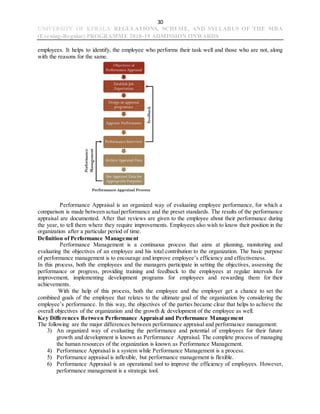
  • 137.
    137 UNIVERSITY OF KERALAREGULATIONS, SCHEME, AND SYLLABUS OF THE MBA (Evening-Regular) PROGRAMME 2018-19 ADMISSION ONWARDS 14. How many sensitive projects have you handled in your association with the organization? 15. Do you feel valued in this organization? Survey Questions for Workplace Culture 16. Have you proposed any effective changes in office policies or procedures? 17. How often do you communicate with your manager/peers? 18. Do you help your peers with the information they need to successfully complete their tasks? 19. Have you had any unpleasant discussion with your team members/manager/ supervisor? 20. How do you think you can bring about a positive change in the workplace culture? Sample Performance Review Templates 360 Degree Review 360 degree review is a comprehensive review mechanism that helps gather greatest insights and feedback on an employee’s performance from his/her supervisor, peers, colleagues, and subordinates. Supervisor Evaluation Supervisor evaluation survey is deployed to collect feedback and information from employees related to their supervisor. Supervisor evaluation helps an organization and its leadership understand the accuracy of the work done by the supervisor and also help them evaluate the overall value the supervisor adds to his/her team and to the organization as a whole. Manager Evaluation A manager evaluation survey offers a set of questions that are answered by the employees to evaluate their direct or indirect manager’s effectiveness at work. This survey is extremely useful for the management to understand the manager’s performance, attitude at work, willingness to help his/her subordinate and more. Senior Management Evaluation Senior management evaluation survey questions are used to understand the employees perspective of the senior management and evaluate their abilities to be able to run the organization smoothly. This questionnaire should have questions that help an organization gather insights on effectiveness, direction, policy-making abilities, and other useful traits. Employee satisfaction survey and employee engagement survey are also one of the best ways to conduct the performance evaluation. A satisfied and an engaged employee is most likely to perform 14 % better than his/her counterparts (Gallup). Employee Satisfaction Employee satisfaction survey is deployed to understand how satisfied or dissatisfied is your workforce. It is essential you measure employee satisfaction as dissatisfied employees not only not perform well but also can be a major reason for high levels of employee attrition in an organization. This survey can power your workforce and HR strategies to cultivate a work culture that enables your organization to win from within. Many times, if an employee doesn’t feel challenged enough, then he/she remains unsatisfied with the work. Performance evaluation can find reasons behind one’s contribution to the company and ways of enhancing it. Employee Engagement Employee engagement survey enables you as an organization to test the levels of engagement of your employees and to understand how motivated they are to perform well in the workplace. Employee engagement is a matter of concern for most organization and disengaged employees set a negative example for other employees. Disengaged employee performances poorly as compared to his/her colleagues. Thus, this survey can be used to analyze and review the level of performance of an employee and take corrective measures immediately. Performance Evaluation Process Step 1: In most organizations, a performance evaluation process states that an employee’s performance is tracked every three and six months, provided, the employee has worked with the organization continually
  • 138.
    138 UNIVERSITY OF KERALAREGULATIONS, SCHEME, AND SYLLABUS OF THE MBA (Evening-Regular) PROGRAMME 2018-19 ADMISSION ONWARDS for that tenure. The HR department can send across an online survey for the employees to fill out regarding their satisfaction and engagement levels. Step 2: The employee’s immediate manager will decide his/her performance quality after evaluating the yearly performance, conducting an employee engagement survey and eventually having a face-to-face meeting. Step 3: The feedback received from the online employee satisfaction survey can be kept anonymous. This feedback can be analyzed in real-time from a centralized dashboard. On the basis of the analysis, the manager can prepare further questions for the face-to-face performance evaluation meeting. For a probationary employee to be termed as a tenured employee, he/she must perform as per their supervisor’s expectations for six months. The first six months of an employee’s tenure are crucial as the management always has a watchful eye on them for all their contribution towards assigned tasks, ownership skills and punctuality in task completion. After confirmation, an immediate manager will evaluate the non-probationary employee on a yearly basis. Tips to have a smooth Performance Evaluation Process The supervisor should avoid being too negative or positive with the employees and express displeasure is the most positive manner possible. He/she should communicate with the employee prior to the review meeting about preparing any questions they might have for the supervisor. It is highly recommended for a manager to prepare a list of general topics to discuss with the team member, as an evaluation discussion is ideal for all topics which remain undiscussed throughout the year. Every manager must communicate the employee’s future plans with the organization in the performance evaluation meeting. The supervisor should always end the evaluation process on a positive note. Performance Evaluation Methods There are 5 most critical performance evaluation methods. Using only one of these performance evaluation methods might help an organization merely gain one-sided information, while, using multiple of these methods help in obtaining insights from various perspectives which will be instrumental in forming an unbiased and performance-centric decision. 1. Self-Evaluation: This is an amazing method to get started with employee reviews. Self-evaluation is when an employee is expected to rate themselves using multiple-choice or open-ended questions, by keeping in mind some evaluation criteria. After conducting self-evaluation, the management has an opportunity to fairly assess an employee by considering his/her thoughts about their performance. An organization’s management can compare every employee’s self-evaluation with the rating his/her manager provides, which makes the performance evaluation process exhaustive and effective. The gap between self-evaluated ratings and the supervisor’s ratings can be discussed to maintain a certain level of transparency. 2. 360-degree Employee Evaluation: In this performance evaluation method, an employee is a rated in terms of the advancements made by him/her within the team as well as with external teams. Inputs from supervisors of different departments are considered along with evaluation done by direct supervisors and immediate peers too. Thus, in 360 degree feedback, each employee is rated for the job done according to their job description as well the work done by them in association with other teams. 3. Graphics Rating Scale: This is one of the most widely used performance evaluation methods by supervisors. Numeric or text values corresponding to values from poor to excellent can be used in this scale and parallel evaluation of multiple team members can be conducted using this graphical scale. Employee skills, expertise, conduct and other qualities, in comparison to others in a team, can be evaluated. It is important to make each employee understand the value of each entity of the scale in terms of success and failure. This scale should ideally be the same to each employee. 4. Developmental Checklists: Every organization has a certain roadmap for each employee for their developments as well as exhibited behavior. This method of maintaining a checklist for development is one of the most straightforward performance evaluation methods. This checklist has several dichotomous
  • 139.
    139 UNIVERSITY OF KERALAREGULATIONS, SCHEME, AND SYLLABUS OF THE MBA (Evening-Regular) PROGRAMME 2018-19 ADMISSION ONWARDS questions, answers of which need to be positive. If not, then the employee requires some developmental training in the areas where he/she needs improvement. 5. Demanding Events Checklist: There are events in each employee’s career with an organization where he/she has to exhibit immense skill and expertise. An intelligent manager always tends to keep a demanding events list where employees show good or bad qualities. Performance Evaluation Example By considering all the discussed points, here is a performance evaluation example : “John has been one of the most hardworking members of the software development team. He works exceedingly well under restricted time frames and adjusts according to the demand of the project. He always discusses his concerns well in time to get results immediately and also keeps the others team members regularly motivated. He keeps track of the quality of work he produces and is very analytical. Due to this, he constantly improves himself. The only concern that I have currently is whether he will be able to manage additional responsibilities.” From this example, it is clear that, for a manager to have an impactful performance evaluation, he/she must present the coordinate it in the most professional manner by making sure the negatives do not overpower the positives. This is a testimony to the manager’s leadership skills as well as the employee’s yearly performance. 5 Steps to a Performance Evaluation System Performance evaluations, which provide employers with an opportunity to assess their employees’ contributions to the organization, are essential to developing a powerful work team. Yet in some practices, physicians and practice managers put performance evaluations on the back burner, often because of the time involved and the difficulties of critiquing employees with whom they work closely. The benefits of performance evaluations outweigh these challenges, though. When done as part of a performance evaluation system that includes a standard evaluation form, standard performance measures, guidelines for delivering feedback, and disciplinary procedures, performance evaluations can enforce the acceptable boundaries of performance, promote staff recognition and effective communication and motivate individuals to do their best for themselves and the practice. The primary goals of a performance evaluation system are to provide an equitable measurement of an employee’s contribution to the workforce, produce accurate appraisal documentation to protect both the employee and employer, and obtain a high level of quality and quantity in the work produced. To create a performance evaluation system in your practice, follow these five steps: 1. Develop an evaluation form. 2. Identify performance measures. 3. Set guidelines for feedback. 4. Create disciplinary and termination procedures. 5. Set an evaluation schedule. It is also advisable to run the finished system by your attorney to identify any potential legal problems that should be fixed. KEY POINTS 1. A performance evaluation system can motivate staff to do their best for themselves and the practice by promoting staff recognition and improving communication. 2. Evaluations should be conducted fairly, consistently and objectively to protect your employees and your practice. 3. An effective performance evaluation system has standardized evaluation forms, performance measures, feedback guidelines and disciplinary procedures. 1. Develop an evaluation form. Performance evaluations should be conducted fairly, consistently and objectively to protect your employees’ interests and to protect your practice from legal liability. One way to ensure consistency
  • 140.
    140 UNIVERSITY OF KERALAREGULATIONS, SCHEME, AND SYLLABUS OF THE MBA (Evening-Regular) PROGRAMME 2018-19 ADMISSION ONWARDS is to use a standard evaluation form for each evaluation. The form you use should focus only on the essential job performance areas. Limiting these areas of focus makes the assessment more meaningful and relevant and allows you and the employee to address the issues that matter most. You don’t need to cover every detail of an employee’s performance in an evaluation. For most staff positions, the job performance areas that should be included on a performance evaluation form are job knowledge and skills, quality of work, quantity of work, work habits and attitude. In each area, the appraiser should have a range of descriptors to choose from (e.g., far below requirements, below requirements, meets requirements, exceeds requirements, far exceeds requirements). Depending on how specific the descriptors are, it’s often important that the appraiser also have space on the form to provide the reasoning behind his or her rating. Performance evaluations for those in management positions should assess more than just the essential job performance areas mentioned above. They should also assess the employee’s people skills, ability to motivate and provide direction, overall communication skills and ability to build teams and solve problems. You should have either a separate evaluation form for managers or a special managerial section added to your standard evaluation form. 2. Identify performance measures. Standard performance measures, which allow you to evaluate an employee’s job performance objectively, can cut down on the amount of time and stress involved in filling out the evaluation form. Although developing these measures can be one of the more time-consuming parts of creating a performance evaluation system, it’s also one of the most powerful. If you have current job descriptions for each position in your practice, you’ve already taken the first step toward creating standard performance measures, which are essentially specific quantity and quality goals attached to the tasks listed in a job description. A job description alone can serve as a measurement tool during an evaluation if, for example, you’re assessing whether an employee’s skills match the requirements of the position. But standard performance measures take the job description one step further. For example, one task listed in a receptionist’s job description might be entering new and updated patient registrations into the computer. The standard performance measure for that task might be to enter 6 to 12 registrations per day (quantity) with an error rate of less than 2 percent (quality). STANDARD PERFORMANCE MEASURES: RECEPTIONIST Description of task Quantity (daily) Quality Answer incoming calls 90–120 Answer in fewer than three rings Triage incoming calls 50–75 Transfer to appropriate department within 45 seconds Document phone messages 20–30 Document detailed message with an error rate of less than 2% Greet patients arriving for appointments 20–30 Greet within 45 seconds of arrival by smiling and using patient’s name Prepare arriving patient charts and route to nurse 20–30 Route existing patient charts within 3 minutes of arrival and new patient charts within 7 minutes of arrival 90% of the time Enter new and updated patient registrations into computer 6–12 Enter registrations with an error rate of less than 2% Standard performance measures can even objectively measure some of the more subjective job performance areas, such as work habits. For example, you can establish an objective measure for attendance by defining the acceptable number of times an employee can be tardy or absent during a specific time frame.
  • 141.
    141 UNIVERSITY OF KERALAREGULATIONS, SCHEME, AND SYLLABUS OF THE MBA (Evening-Regular) PROGRAMME 2018-19 ADMISSION ONWARDS However, standard performance measures don’t always work for other subjective areas, such as attitude. In these cases, it’s still important to be as objective as possible in your evaluation. Don’t attempt to describe attitude, for instance; instead, describe the employee’s behavior, which is what conveys the attitude, and the consequences of that behavior for the practice. For example: “This employee has failed to support her co-workers. When another member of her department is absent, she refuses to take on the additional tasks required to process patients in a timely manner. This behavior causes patient backlog, places a burden on staff and compromises effective teamwork.” To begin developing standard performance measures in your practice, review the job descriptions for each position and select the key components of the job that can be specifically measured. Then, work with the employees in each position to gather quantitative data, examine historical patterns of volume and determine qualitative measurements that reflect the practice’s mission and goals. Depending on how large your practice is and how many positions need standard performance measures, you may want to select a committee to develop them. Then, with help from the employees in each position, the supervisors should maintain them. It’s important to keep job descriptions and standard performance measures as current as possible. Otherwise, when an employee doesn’t measure up to the standards you’ve set, you can’t be sure whether he or she has a performance problem or whether your expectations of the position have become unrealistic based on increased volume or a change in circumstances. REWARDING PERFORMANCE WITH PAY If your practice’s pay increases are based on merit, it may be appropriate and efficient to review an employee’s salary at the time of the performance evaluation. Such a direct link between performance and pay could make you and your employees take the performance evaluations even more seriously than you might have otherwise. However, if your pay increases are based only partially on merit and partially on annual changes in the Consumer Price Index, it may not be quite as easy to review and change individual salaries at various times during the year. Whether you plan to include a review of the employee’s salary during each performance evaluation should be communicated to all employees verbally and in writing when they are hired. It is important that employees understand this so that their expectations are realistic and they are not disappointed. 3. Set guidelines for feedback. Feedback is what performance evaluations are all about. So before you implement your performance evaluation system, make sure that everyone who will be conducting evaluations knows what kind of feedback to give, how to give it and how to get it from the employee in return. Give balanced feedback. Don’t make the common error of glossing over an employee’s deficiencies and focusing only on his or her strengths. It is by understanding their weaknesses that employees can take ownership of their performance and role in the practice. And when given the support they need to make improvements in these areas, employees learn to take pride in their work and are willing to take on new challenges with confidence. [For more information about giving feedback, Outline expectations for improvement. When you address areas where improvement is needed, outline your expectations for improvement and how you intend to help the employee meet them. For example, if an employee is speaking harshly with other employees and does not seem tolerant with patients, give the employee some examples of his or her behavior and offer some suggestions to resolve the problem, such as role-playing sessions or a communication skills/customer-service workshop or seminar. Define the boundaries by letting the employee know what is acceptable and what will not be tolerated, and then establish a plan for monitoring performance and re-evaluating the employee. Encourage feedback from the employee. After you’ve discussed the results of the evaluation with the employee, encourage him or her to give you some nondefensive feedback. Ask the employee whether he or she agrees with your assessment, and/or invite suggestions for improvement. For example: “You seem to become impatient and short with patients when the physician is running late. Since there are times when running late cannot be avoided, how do you suggest we handle this to avoid such a reaction?”
  • 142.
    142 UNIVERSITY OF KERALAREGULATIONS, SCHEME, AND SYLLABUS OF THE MBA (Evening-Regular) PROGRAMME 2018-19 ADMISSION ONWARDS This should lead to an open exchange of information that will allow you and the employee to better understand each other’s perspective. 4. Create disciplinary and termination procedures. In some cases, even after a thorough performance evaluation and a discussion of expected improvements, an employee will continue to perform poorly. You need to be prepared to handle such a situation by having well-defined, written disciplinary and termination procedures in place. These procedures should outline the actions that will be taken when performance deteriorates – a verbal warning, a written warning if there is no improvement or a recurrence, and termination if the situation is not ultimately resolved. 1) Verbal warning. This should be given in private, with the behavior or reason for the discipline clearly stated. For example: “I observed you talking disrespectfully to another employee at the front desk. You said she was brain-dead and tossed a chart at her. We will not tolerate disrespect in the work-place. Furthermore, this outburst could be overheard from the reception room. If this occurs again, a report will be written up and placed in your file. Do you understand the importance of this?” After the verbal warning is given, allow the employee to respond, but keep the exchange brief. 2) Written warning. How you handle the written warning plays a critical role in the success of your disciplinary and termination procedures. This is the time to make it clear to the employee just how serious his or her performance problem is. Unfortunately, many practices fail to do this and/or to follow through with termination if necessary. Once the written warning is mishandled in this way, it no longer has any merit. A standard, written, warning form should include the following: a) A description of the behavior or problem that includes objective findings, b) The measurable actions and changes expected of the employee, c) The support the employer will provide for improvement, d) A description of what will occur (e.g., unpaid time off or termination) and when (e.g., after one more occurrence or two) if the warning is not heeded, e) The signature of the employee and appraiser and the date of the warning. 3) Termination. Explain the reason for the termination but do so briefly and objectively to avoid getting into an elaborate discussion that puts you in a defensive position. Validate the employee as a person, perhaps by giving a positive slant to the employee’s potential in the job market. For example, although an employee might have been a poor file clerk for you because he or she didn’t pay attention to detail, the employee may have a friendly personality that would make him or her a good telephone operator. Also, let the employee know what will become of any accrued vacation or sick leave, pension benefits, etc. Know your state’s laws on these issues. Finally, ask if the employee has any further questions and then assist the employee in retrieving all of his or her belongings and leaving with as much dignity as possible. If you handle termination well, you are less likely to have an employee who wants to “get even” by badmouthing you in the community or seeking legal revenge. 5. Set an evaluation schedule. Once you’ve built your performance evaluation system – the evaluation form, the performance measures, the feedback guidelines and the disciplinary procedures – you just need to decide when to conduct the performance evaluations. Some practices do all employee evaluations at the same time of year, while others conduct them within 30 days of each employee’s anniversary of employment (the latter may work better since it spreads the work of the evaluations out for employer and employee). However you decide to schedule the evaluations, ensure that each appraiser consistently meets the deadline. Ignoring employees’ overdue evaluations will make them feel devalued and may hurt morale and performance.
  • 143.
    143 UNIVERSITY OF KERALAREGULATIONS, SCHEME, AND SYLLABUS OF THE MBA (Evening-Regular) PROGRAMME 2018-19 ADMISSION ONWARDS The last analysis A performance evaluation system should be a key component of your practice structure. When implemented effectively, it ensures fairness and accountability, promotes growth and development and encourages a sense of pride in your employees’ contributions to the practice. Performance Methods Performance Appraisal Methods: Traditional and Modern Methods! Each method of performance appraisal has its strengths and weaknesses may be suitable for one organisation and non-suitable for another one. As such, there is no single appraisal method accepted and used by all organisations to measure their employees’ performance. All the methods of appraisal devised so far have been classified differently by different authors. While DeCenzo and Robbins’^ have classified appraisal methods into three categories: absolute methods, relative methods and objective methods; Aswathappa has classified these into two categories past- oriented and future-oriented. Michael R Carrell et. al. have classified all appraisal methods into as many as six categories: rating scales, comparative methods, critical incidents, 6ssay, MBO and combination methods. Rock and Levis” have classified the methods into two broad categories: narrow interpretation and broad interpretation. Beatty and Schneier have categorised various methods of appraisal into four groups: comparative methods, absolute methods, goal setting, and direct indices. A more widely used classification of appraisal methods into two categories, viz., traditional methods and modem methods, is given by Strauss and Sayles”. While traditional methods lay emphasis on the rating of the individual’s personality traits, such as initiative, dependability, drive creativity, integrity, intelligence, leadership potential, etc.; the modem methods, on the other hand, place more emphasis on the evaluation of work results, i.e., job achievements than the personal traits! Modem methods tend to be more objective and worthwhile. The various methods included in each of the two categories are listed in Table 28.4. In the discussion that follows, each method under both categories will be described briefly. Traditional Methods: Ranking Method: It is the oldest and simplest formal systematic method of performance appraisal in which employee is compared with all others for the purpose of placing order of worth. The employees are ranked from the highest to the lowest or from the best to the worst. In doing this the employee who is the highest on the characteristic being measured and also the one who is L lowest, are indicated. Then, the next highest and the next lowest between next highest and lowest until all the employees to be rated have been ranked. Thus, if there are ten employees to be appraised, there will be ten ranks from 1 to 10. However, the greatest limitations of this appraisal method are that: (i) It does not tell that how much better or worse one is than another, (ii) The task of ranking individuals is difficult when a large number of employees are rated, and
  • 144.
    144 UNIVERSITY OF KERALAREGULATIONS, SCHEME, AND SYLLABUS OF THE MBA (Evening-Regular) PROGRAMME 2018-19 ADMISSION ONWARDS (iii) It is very difficult to compare one individual with others having varying behavioural traits. To remedy these defects, the paired comparison method of performance appraisal has been evolved. Paired Comparison: In this method, each employee is compared with other employees on one- on one basis, usually based on one trait only. The rater is provided with a bunch of slips each coining pair of names, the rater puts a tick mark against the employee whom he insiders the better of the two. The number of times this employee is compared as better with others determines his or her final ranking. The number of possible pairs for a given number of employees is ascertained by the following formula: N (N-1)/2 Where N = the total number of employees to be evaluated. Let this be exemplified with an imaginary example. If the following five teachers have to be evaluated by the Vice Chanceller of a University: (K), Mohapatra (M Raul (R), Venkat (V), and Barman (B), the above formula gives 5 (5 -1) / 2 or 10 pairs. These are: Thus, the pairs so ascertained give the maximum possible permutations and combinations. The number of times a worker is considered better makes his/her score. Such scores are determined for each worker and he/she is ranked according to his/her score. One obvious disadvantage of this method is that the method can become unwieldy when large numbers of employees are being compared. Grading Method: In this method, certain categories of worth are established in advance and carefully defined. There can be three categories established for employees: outstanding, satisfactory and unsatisfactory. There can be more than three grades. Employee performance is compared with grade definitions. The employee is, then, allocated to the grade that best describes his or her performance. Such type of grading is done is Semester pattern of examinations and in the selection of a candidate in the public service sector. One of the major drawbacks of this method is that the rater may rate most of the employees on the higher side of their performance. Forced Distribution Method: This method was evolved by Tiffen to eliminate the central tendency of rating most of the employees at a higher end of the scale. The method assumes that employees’ performance level confirms to a normal statistical distribution i.e., 10,20,40,20 and 10 per cent. This is useful for rating a large number of employees’ job performance and promo ability. It tends to eliminate or reduce bias. It is also highly simple to understand and easy to apply in appraising the performance of employees in organisations. It suffer from the drawback that improve similarly, no single grade would rise in a ratings. Forced-Choice Method: The forced-choice method is developed by J. P. Guilford. It contains a series of groups of statements, and rater rates how effectively a statement describes each individual being evaluated. Common method of forced-choice method contains two statements, both positive and negative. Examples of positive statements are: 1. Gives good and clear instructions to the subordinates. 2. Can be depended upon to complete any job assigned.
  • 145.
    145 UNIVERSITY OF KERALAREGULATIONS, SCHEME, AND SYLLABUS OF THE MBA (Evening-Regular) PROGRAMME 2018-19 ADMISSION ONWARDS A pair of negative statements may be as follows: 1. Makes promises beyond his limit to keep these. 2. Inclines to favour some employees. Each statement carries a score or weight, which is not made known to the rater. The human resource section does rating for all sets of statements— both positive and negative. The final rating is done on the basis of all sets of statements. Thus, employee rating in this manner makes the method more objective. The only problem associated with this method is that the actual constructing of several evaluative statements also called ‘forced-choice scales’, takes a lot of time and effort. Check-List Method: The basic purpose of utilizing check-list method is to ease the evaluation burden upon the rater. In this method, a series of statements, i.e., questions with their answers in ‘yes’ or ‘no’ are prepared by the HR department (see Figure 28-2). The check-list is, then, presented to the rater to tick appropriate answers relevant to the appraisee. Each question carries a weight-age in relationship to their importance. When the check-list is completed, it is sent to the HR department to prepare the final scores for all appraises based on all questions. While preparing questions an attempt is made to determine the degree of consistency of the rater by asking the same question twice but in a different manner (see, numbers 3 and 6 in Figure 28-2). However, one of the disadvantages of the check-list method is that it is difficult to assemble, analyse and weigh a number of statements about employee characteristics and contributions From a cost stand point also, this method may be inefficient particularly if there are a number of job categories in the organisation, because a check-list of questions must be prepared for each category of job. It will involve a lot of money, time and efforts. Critical Incidents Method: In this method, the rater focuses his or her attention on those key or critical behaviours that make the difference between performing a job in a noteworthy manner (effectively or ineffectively). There are three steps involved in appraising employees using this method. First, a list of noteworthy (good or bad) on-the-job behaviour of specific incidents is prepared. Second, a group of experts then assigns weightage or score to these incidents, depending upon their degree of desirability to perform a job. Third, finally a check-list indicating incidents that describe workers as “good” or “bad” is constructed. Then, the check-list is given to the rater for evaluating the workers. The basic idea behind this rating is to apprise the workers who can perform their jobs effectively in critical situations. This is so because most people work alike in normal situation. The strength of critical incident method is that it focuses on behaviours and, thus, judge’s performance rather than personalities. Its drawbacks are to regularly write down the critical incidents which become time-consuming and burdensome for evaluators, i.e., managers. Generally, negative incidents are positive ones. It is rater’s
  • 146.
    146 UNIVERSITY OF KERALAREGULATIONS, SCHEME, AND SYLLABUS OF THE MBA (Evening-Regular) PROGRAMME 2018-19 ADMISSION ONWARDS inference that determines which incidents are critical to job performance. Hence, the method is subject to all the limitations relating to subjective judgments. Graphic Rating Scale Method: The graphic rating scale is one of the most popular and simplest techniques for appraising performance. It is also known as linear rating scale. In this method, the printed appraisal form is used to appraise each employee. The form lists traits (such as quality and reliability) and a range of job performance characteristics (from unsatisfactory to outstanding) for each trait. The rating is done on the basis of points on the continuum. The common practice is to follow five points scale. The rater rates each appraisee by checking the score that best describes his or her performance for each trait all assigned values for the traits are then totaled. Figure 28-3 shows a typical graphic rating scale. This method is good for measuring various job behaviours of an employee. However, it is also subjected to rater’s bias while rating employee’s behaviour at job. Occurrence of ambiguity in design- mg the graphic scale results in bias in appraising employee’s performance. Essay Method: Essay method is the simplest one among various appraisal methods available. In this method, the rater writes a narrative description on an employee’s strengths, weaknesses, past performance, potential and suggestions for improvement. Its positive point is that it is simple in use. It does not require complex formats and extensive/specific training to complete it.
  • 147.
    147 UNIVERSITY OF KERALAREGULATIONS, SCHEME, AND SYLLABUS OF THE MBA (Evening-Regular) PROGRAMME 2018-19 ADMISSION ONWARDS However, essay method, like other methods, is not free from drawbacks. In the absence of any prescribed structure, the essays are likely to vary widely in terms of length and content. And, of course, the quality of appraisal depends more upon rater’s writing skill than the appraiser’s actual level of performance. Moreover, because the essays are descriptive, the method provides only qualitative information about the employee. In the absence of quantitative data, the evaluation suffers from subjectivity problem. Nonetheless, the essay method is a good start and is beneficial also if used in conjunction with other appraisal methods. Field Review Method: When there is a reason to suspect rater’s biasedness or his or her rating appears to be quite higher than others, these are neutralised with the help of a review process. The review process is usually conducted by the personnel officer in the HR department. The review process involves the following activities: (a) Identify areas of inter-rater disagreement. (b) Help the group arrive at a consensus. (c) Ensure that each rater conceives of the standard similarity. However, the process is a time-consuming one. The supervisors generally resent what they consider the staff interference. Hence, the method is not widely used. Confidential Report: It is the traditional way of appraising employees mainly in the Government Departments. Evaluation is made by the immediate boss or supervisor for giving effect to promotion and transfer. Usually a structured format is devised to collect information on employee’s strength weakness, intelligence, attitude, character, attendance, discipline, etc. report. Modern Methods: Management by Objectives (MBO): Most of the traditional methods of performance appraisal are subject to the antagonistic judgments of the raters. It was to overcome this problem; Peter F. Drucker propounded a new concept, namely, management by objectives (MBO) way back in 1954 in his book. The Practice of management. The concept of MBO as was conceived by Drucker, can be described as a “process whereby the superior and subordinate managers of an organization jointly identify its common goals, define each individual’s major areas of responsibility in terms of results expected of him and use these measures as guides for operating the unit and assessing the contribution of each its members”. In other words, stripped to its essentials, MBO requires the manager to goals with each employee and then periodically discuss his or her progress toward these goals. In fact, MBO is not only a method of performance evaluation. It is viewed by the Practicing managers and pedagogues as a philosophy of managerial practice because .t .s a method by wh.ch managers and subordinates plan, organise, communicate, control and debate. An MBO programme consists of four main steps: goal setting, performance standard, compari- son, and periodic review. In goal-setting, goals are set which each individual, s to attain. The superior and subordinate jointly establish these goals. The goals refer to the desired outcome to be achieved by each individual employee. In performance standards, the standards are set for the employees as per the previously arranged time period. When the employees start performing their jobs, they come to know what is to be done, what has been done, and what remains to be done. In the third step the actual level of goals attained are compared with the goals agreed upon. This enables the evaluator to find out the reasons variation between the actual and standard performance of the employees. Such a comparison helps devise training needs for increasing employees’ performance it can
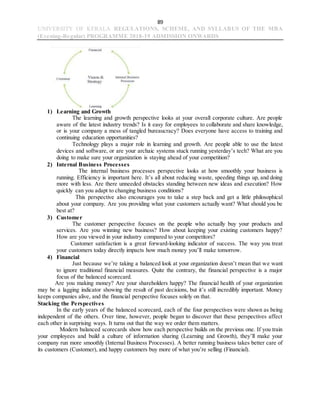
  • 148.
    148 UNIVERSITY OF KERALAREGULATIONS, SCHEME, AND SYLLABUS OF THE MBA (Evening-Regular) PROGRAMME 2018-19 ADMISSION ONWARDS also explore the conditions having their bearings on employees’ performance but over which the employees have no control. Finally, in the periodic review step, corrective measure is initiated when actual performance deviates from the slandered established in the first step-goal-setting stage. Consistent with the MBO philosophy periodic progress reviews are conducted in a constructive rather than punitive manner. The purpose of conducting reviews is not to degrade the performer but to aid in his/her future performance. From a motivational point of view, this would be representative of McGregor’s theories. Figure 28.4 present the MBO method of performance appraisal presently used by an engineering giant i.e., Larsen and Turbro Limited.
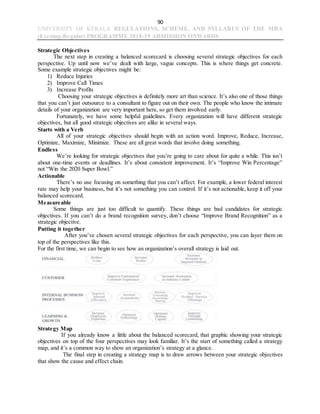
  • 149.
    149 UNIVERSITY OF KERALAREGULATIONS, SCHEME, AND SYLLABUS OF THE MBA (Evening-Regular) PROGRAMME 2018-19 ADMISSION ONWARDS
  • 150.
    150 UNIVERSITY OF KERALAREGULATIONS, SCHEME, AND SYLLABUS OF THE MBA (Evening-Regular) PROGRAMME 2018-19 ADMISSION ONWARDS Limitation of MBO: MBO is not a panacea, cure for all organisational problems. As with other methods, it also suffers from some limitations as catalogued below: (i) Setting Un-measurable Objectives: One of the problems MBO suffers from is unclear and un-measurable objectives set for attainment. An objective such as “will do a better job of training” is useless as it is un-measurable. Instead, “well have four subordinates promoted during the year” is a clear and measurable objective. (ii) Time-consuming: The activities involved in an MBO programme such as setting goals, measuring progress, and providing feedback can take a great deal of time. (iii) Tug of War: Setting objectives with the subordinates sometimes turns into a tug of war in the sense that the manager pushes for higher quotas and the subordinates push for lower ones. As such, goals so set are likely to be unrealistic. (iv) Lack of Trust: MBO is likely to be ineffective in an environment where management has little trust in its employees. Or say, management makes decisions autocratically and relies heavily on external controls. Behaviourally Anchored Rating Scales (BARS): The problem of judgmental performance evaluation inherent in the traditional methods of performance evaluation led to some organisations to go for objective evaluation by developing a technique known as “Behaviourally Anchored Rating Scales (BARS)” around 1960s. BARS are descriptions of various degrees of behaviour with regard to a specific performance dimension. It combines the benefits of narratives, critical incidents, and quantified ratings by anchoring a quantified scale with specific behavioural examples of good or poor performance. The proponents of BARS claim that it offers better and more equitable appraisals than do the other techniques of performance appraisal we discussed so far. Developing BARS typically involves five steps: 1. Generating Critical Incidents: Critical incidents (or say, behaviours) are those which are essential for the performance of the job effectively Persons who are knowledgeable of the job in question (jobholders and/or supervisors) are asked to describe specific critical incidents of effective and ineffective performance. These critical incidents may be described in a few short sentences or phrases using the terminology. 2. Developing Performance Dimensions: The critical incidents are then clustered into a smaller set of performance dimensions, usually five to ten. Each cluster, or say, dimension is then defined. 3. Reallocating Incidents: Various critical incidents are reallocated dimensions by another group of people who also know the job in question. Various critical incidents so reallocated to original dimensions are clustered into various categories, with each cluster showing similar critical incidents. Those critical incidents are retained which meet 50 to 80% of agreement with the cluster as classified in step 2. 4. Scaling Incidents: The same second group as in step 3 rates the behaviour described in each incident in terms of effectiveness or ineffectiveness on the appropriate dimension by using seven to nine points scale. Then, average effectiveness ratings for each incident are determined to decide which incidents will be included in the final anchored scales. 5. Developing Final BARS Instrument: A subset of the incidents (usually six or seven per cluster) is used as a behavioural anchor for the final performance dimensions. Finally, a BARS instrument with vertical scales is drawn to be used for performance appraisal, as in Figure 27-5.
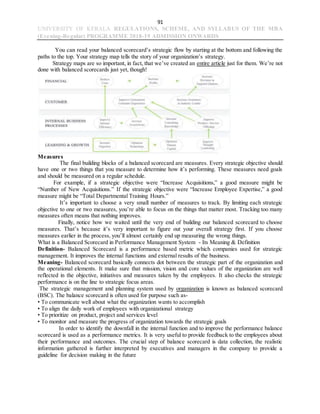
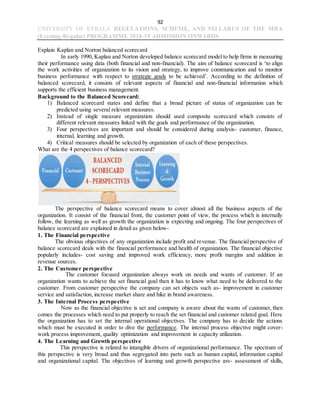
  • 151.
    151 UNIVERSITY OF KERALAREGULATIONS, SCHEME, AND SYLLABUS OF THE MBA (Evening-Regular) PROGRAMME 2018-19 ADMISSION ONWARDS How BARS is developed can be exemplified with an example of grocery checkout clerks working in a large grocery chain. A number of critical incidents involved in checking out of grocery can be clustered into seven performance dimensions: 1. Knowledge and Judgment 2. Conscientiousness 3. Skill in Human Relations 4. Skill in Operation of Register 5. Skill in Bagging 6. Organisational Ability of Check stand Work 7. Skill in Monetary Transactions 8. Observational Ability Now, a BARS for one of these performance dimensions, namely, “knowledge and judgment” can be developed, as in Figure 28-5. Notice how the typical BARS is behaviourally anchored with specific critical incidents.
  • 152.
    152 UNIVERSITY OF KERALAREGULATIONS, SCHEME, AND SYLLABUS OF THE MBA (Evening-Regular) PROGRAMME 2018-19 ADMISSION ONWARDS BARS method of performance appraisal is considered better than the traditional ones because it provides advantages like a more accurate gauge, clearer standards, better feedback, and consistency in evaluation. However, BARS is not free from limitations. The research on BARS indicates that it too suffers from distortions inherent in most rating scales. The research study concluded that “it is clear that research on BARS to date does not support the high promise regarding scale independence In short, while BARS may outperform conventional rating techniques, it is clear that they are not a panacea for obtaining high interrater reliability” Assessment Centres: The introduction of the concept of assessment centres as a method of performance method is traced back in 1930s in the Germany used to appraise its army officers. The concept gradually spread to the US and the UK in 1940s and to the Britain in 1960s. The concept, then, traversed from the army to business arena during 1960s. The concept of assessment centre is, of course, of a recent origin in India. In India, Crompton Greaves, Eicher, Hindustan Lever and Modi Xerox have adopted this technique of performance evaluation. In business field, assessment centres are mainly used for evaluating executive or supervisory potential. By definition, an assessment centre is a central location where managers come together to participate in well-designed simulated exercises. They are assessed by senior managers supplemented by the psychologists and the HR specialists for 2-3 days. Assessee is asked to participate in in-basket exercises, work groups, simulations, and role playing which are essential for successful performance of actual job. Having recorded the assessee’s behaviour the raters meet to discuss their pooled information and observations and, based on it, they give their assessment about the assesee. At the end of the process, feedback in terms of strengths and weaknesses is also provided to the assesees. The distinct advantages the assessment centres provide include more accurate evaluation, mini- mum biasedness, right selection and promotion of executives, and so on. Nonetheless, the technique of assessment centres is also plagued by certain limitations and problems. The technique is relatively costly and time consuming, causes suffocation to the solid performers, discourages to the poor performers (rejected), breeds unhealthy competition among the assessees, and bears adverse effects on those not selected for assessment. 360 – Degree Appraisal: Yet another method used to appraise the employee’s performance is 360 – degree appraisal. This method was first developed and formally used by General Electric Company of USA in 1992. Then, it travelled to other countries including India. In India, companies like Reliance Industries, Wipro Corporation, Infosys Technologies, Thermax, Thomas Cook etc., have been using this method for appraising the performance of their employees. This feedback based method is generally used for ascertaining training and development requirements, rather than for pay increases. Under 360 – degree appraisal, performance information such as employee’s skills, abilities and behaviours, is collected “all around” an employee, i.e., from his/her supervisors, subordinates, peers and even customers and clients. In other worlds, in 360-degree feedback appraisal system, an employee is appraised by his supervisor, subordinates, peers, and customers with whom he interacts in the course of his job performance. All these appraisers provide information or feedback on an employee by completing survey questionnaires designed for this purpose. All information so gathered is then compiled through the computerized system to prepare individualized reports. These reports are presented to me employees being rated. They then meet me appraiser—be it one’s superior, subordinates or peers—and share the information they feel as pertinent and useful for developing a self-improvement plan. In 360 – degree feedback, performance appraisal being based on feedback “all around”, an em- ployee is likely to be more correct and realistic. Nonetheless, like other traditional methods, this method
  • 153.
    153 UNIVERSITY OF KERALAREGULATIONS, SCHEME, AND SYLLABUS OF THE MBA (Evening-Regular) PROGRAMME 2018-19 ADMISSION ONWARDS is also subject to suffer from the subjectivity on the part of the appraiser. For example, while supervisor may penalise the employee by providing negative feedback, a peer, being influenced by ‘give and take feeling’ may give a rave review on his/her colleague. Cost Accounting Method: This method evaluates an employee’s performance from the monetary benefits the employee yields to his/her organisation. This is ascertained by establishing a relationship between the costs involved in retaining the employee, and the benefits an organisation derives from Him/her. While evaluating an employee’s performance under this method, the following factors are also taken into consideration: 1. Unit wise average value of production or service. 2. Quality of product produced or service rendered. 3. Overhead cost incurred. 4. Accidents, damages, errors, spoilage, wastage caused through unusual wear and tear. 5. Human relationship with others. 6. Cost of the time supervisor spent in appraising the employee. The rationale for Performance Management LEARNING OBJECTIVES 1. Discuss the rationale behind the implementation of a systematic performance appraisal system. 2. Discuss the difficulties in implementing a performance appraisal system within a pharmacy organization. 3. Identify various types of performance appraisal processes and evaluate the strengths and weaknesses of each type. 4. Discuss issues of validity and reliability within the context of evaluating a performance appraisal system. 5. Describe how to conduct a performance appraisal interview and how to handle disagreements that may arise during or subsequent to the interview. 6. Discuss the linkage of performance appraisal results with the proper allocation of organizational rewards. Performance appraisal is a formal assessment of how well employee are performing their jobs. . Performance appraisals are necessary to document employees’ progress toward achieving goals and heeding the advice of management on how to improve performance . Documentation is necessary to demonstrate fairness in promotion and termination .
  • 154.
    154 UNIVERSITY OF KERALAREGULATIONS, SCHEME, AND SYLLABUS OF THE MBA (Evening-Regular) PROGRAMME 2018-19 ADMISSION ONWARDS The dialogue from the appraisal process provides data for managers as well as data to employees from managers. Role stress typically is viewed as having two components: A:role ambiguity and B: role conflict. Role ambiguity exists when an employee is unsure about his or her responsibilities .Role conflict is the simultaneous occurrence of two or more role expectations. Types of performance appraisals Performance appraisal methods typically are categorized into three broad types: 1. Absolute 2. Relative 3. Outcome oriented Absolute systems Absolute systems require the rater to indicate whether or not the employee is meeting a set of predetermined criteria for performance criteria for performance. Absolute systems are the most commonly employed . The main advantage that absolute systems have over other types of appraisal methods is the feedback that is derived inherently from the process Relative systems Relative systems require the manager to make comparisons among employees. Relative systems have an advantage over absolute systems in that central tendency and leniency effects are minimized .They are not that conducive to generating substantive feedback to employees Outcome-Originated systems Where absolute and relative systems focus on behaviors outcome-oriented systems are concerned with evaluating end results
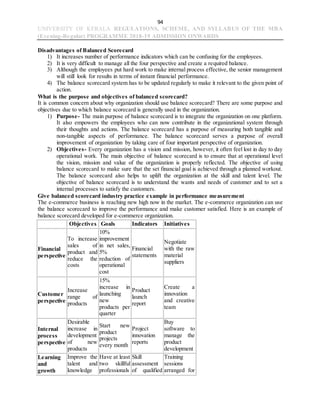
  • 155.
    155 UNIVERSITY OF KERALAREGULATIONS, SCHEME, AND SYLLABUS OF THE MBA (Evening-Regular) PROGRAMME 2018-19 ADMISSION ONWARDS Special considerations for appraisal systems in pharmacy A community pharmacy is typically a for- profit organization that must be concerned with its financial position to remain over the long team. Community pharmacies must also conduct their business in an ethical manner. A pharmacy will be more likely to achieve its goals when its employees derive gratification from performing their jobs Determine whether a similar performance appraisal should exist among technicians and pharmacists working within the same organization .There are certain values (e.g., dependability, dedication, and altruism) that the organization may want to assess in all its employees regardless of their position or status. It may be fruitful to gather information from customers, or patients, when evaluating pharmacists for the services they provide The performance appraisal interview Regardless of the type of system selected appraisal selected appraisal should be accompanied by a formal interview of the employee. During the interview the results of the written appraisal are discussed. Some preparations may help in making the interview more fruitful like: A:Preparing the employee for the interview An appointment should be made with the employee well in advance, at least 3 to 4 weeks. The employee should be provided with 1. A copy of position description and corresponding performance standards. 2. A copy of the evaluation form used in the appraisal process. 3. A copy of the report of the previous formal review, departmental/organizational objectives for the current and subsequent year, 4. Instructions on how to prepare for the meeting. The employee may be instructed to prepare comments on how well objectives set during the last review were met and to prepare a list of new objectives. Employees may be asked to complete a self- evaluation on an instrument similar to the one used by the employer. Planning for the interview The manager should enter the interview well informed of prior appraisals. The manager should also have appropriate documentation and evidence to support claims of the employee’s performance, in areas of deficiency & in areas of strength The manager should have answered the following questions 1. What results should the interview achieve? 2. What good contributions is the employee making?
  • 156.
    156 UNIVERSITY OF KERALAREGULATIONS, SCHEME, AND SYLLABUS OF THE MBA (Evening-Regular) PROGRAMME 2018-19 ADMISSION ONWARDS 3. Is the employee working up to his or her potential? 4. Is the employee clear about the manager’s performance expectations? 5. What strengths does the employee have that can be built on or improved? 6. Is there any additional training available that can help the employee improve? C. Conducting the interview Interview sequence (1) Review and update the position description and performance standards. (2) Discuss the performance ratings assigned to the employee using the prescribed appraisal form. (3) Highlight strengths and accomplishments since the previous appraisal. (4) Discuss objectives that were not reached since the previous review. (5) Discuss future performance and assist with career planning. Some suggestions for addressing performance deficiencies 1. Limit criticism to one or two major problems. Do not search for significant problem areas when none exist. 2. Reserve critical remarks until after some of the positives have been accentuated. 3. Maintain open dialogue with the employee. Offer the employee a chance for self-criticism. Allow the employee to offer reasons why performance was below standard. Allow the employee to suggest ways and an appropriate time frame to expect significant improvement. 4. Avoid the use of terms that potentially could be misconstrued, such as attitude, work ethic, professionalism, and weakness Ensure valid results from the performance appraisal system Implementing the System how frequently to conduct the formal appraisal ? Annually – more frequent is better .Everyone in the organization should be well informed about the role each person plays in the appraisal process and how the appraisal results are used Monitoring system 1) Effectiveness of the appraisal system itself should be monitored.  Monitoring the System  2) Quality of performance standards refers to the standards being specific, challenging, realistic, dynamic, understandable, and consistent with organizational goals. 3) Use of performance appraisal results refers to how well these results are tied with rewards and recognition and to what extent the appraisal process has contributed to improved performance among all employees 4) Tracking the raters consists of reviewing the ratings awarded by individual raters and giving them feedback concerning the quality of their ratings Performance and organizational rewards Rewards A. intrinsic rewards (those internal to the individual and derived from involvement in the job, such as achievement, feelings of accomplishment, informal recognition, satisfaction, and status) B. extrinsic rewards (those controlled and distributed by the organization, such as formal recognition, incentive pay, fringe benefits, and promotions) Managers must consider internal, external, and individual equity Suggestions for allocating rewards a) Consider the presence of performance constraints b) Provide a clear distinction between cost-of- living, seniority, and merit pay increases. c) Enlist trust among employees d) Make merit pay substantial e) Be flexible in scheduling rewards f) Effectively communicate merit and total pay policy to employees.
  • 157.
    157 UNIVERSITY OF KERALAREGULATIONS, SCHEME, AND SYLLABUS OF THE MBA (Evening-Regular) PROGRAMME 2018-19 ADMISSION ONWARDS Pharmacy managers may consider the use of other strategies to recognize and reward good performers: 1. Offer to pay for attendance at a local continuing education program. 2. Provide funding for attendance at a national conference. 3. Offer to offset the cost of professional recognition and certification processes for pharmacists and technicians. 4. Fund membership in a professional association. 5. Buy lunch. 6. Allow someone to represent you at an important meeting. 7. Assign tasks with greater levels of responsibility if the employee is ready to handle them. Does everyone with similar jobs in a pharmacy deserve the same level of pay raises, or should they be based more on performance? What types of skills do you think are necessary for selecting and implementing a performance appraisal system? What about for conducting an appraisal interview? How would you feel about having responsibility for determining whether or not an employee will receive merit pay? Performance Agreements Definition of a Performance Agreement Merriam-Webster dictionary defines "performance" as the "execution of an action." The quality of the execution is left up to the interpreter and the people who witness the execution. In the business world, performance expectation can't be left up to interpretation. A performance agreement is often used to ensure quality performance criteria are met. What is a Performance Agreement? A performance agreement is a method of establishing expectations and accountability for meeting a set standard of execution excellence -- and the consequences for not meeting them. Two or more parties agree on the actions the performer will execute and agree on the expected results from executing those actions. Oftentimes, there are consequences if the performer doesn't deliver as agreed. Managers and Employees Managers at major corporations have used performance agreements as a job performance improvement tool. However, performance agreements can be used for new hires before they start to develop bad habits. The Management Trainers at MindTools suggest on its website, "When establishing performance expectations, the overall objective is to come to an agreement that supports your organization's strategy." The employee rarely has any say in these matters, but it is an ideal time for her to express any objections she may have before promising to perform any of those actions. Business Partners Business partners have used performance agreements to define each members' role in the partnership. This helps to avoid any disputes about who is putting more work into the company. In the event of a legal dispute between the partners, this document can also serve to make the case for the partner who feels wronged. Each partner signs the agreement and details his own performance objectives. Entertainment Performance agreements are common between businesses and the entertainers they may hire for club performances, office parties, etc. According to many entertainment lawyers, if a band or act is not paid by a club or other business, the signed agreement may trump any verbal amendments that the business owner can claim he made as a reason for not paying. Developing the Agreement Performance agreements should be negotiated before either party signs. The manager or business owner should encourage feedback from the performer to eliminate discrepancies later. To make it easier for the performer to meet the criteria, attempt to align those goals and actions with her career
  • 158.
    158 UNIVERSITY OF KERALAREGULATIONS, SCHEME, AND SYLLABUS OF THE MBA (Evening-Regular) PROGRAMME 2018-19 ADMISSION ONWARDS plan. The manager should also list his own responsibilities to the performer. Establish a follow-up date to revisit the issue with the performer and check progress. The efficiency, effectiveness, and productivity of the workforce can affect the condition of the business and its operations. This is the main reason why it is important to track the performance of each employee in varying time duration. Developing a performance agreement can be mutually beneficial for the employees and their employer. Just like a security deposit agreement, stock sale agreement, and subcontractor agreement example, a performance agreement can be made in an easier and faster manner if you will refer to downloadable examples like the items that we have put together in this post. What Is a Performance Agreement? The workforce is a vital part in attaining the corporate successes that any business or organization would like to achieve. Aside from taking care of the rights of the employees, it is also important for businesses to ensure that the people that they will hire are truly added values to the company and its operations. A performance agreement can help corporate entities to protect their intentions and to make sure that they hired individuals who can deliver based on the needs and demands of the operations. Listed below are some of the basic and simple ways on how a performance agreement can be defined. A performance agreement is a printable agreement that can present the expected performance of an employee. Some employees receive this document after a lackluster performance within a given time period but there are also companies who provide this document to new hires so that they can already be aware of how their performance will be evaluated. A performance agreement is a tool that promotes workplace efficiency. With the help of this document, it will be clear to the employees that they have agreed and promised to provide the needs of the business, its operations, and its other stakeholders. Performance agreement documents can ensure that both sides within the transaction have a full understanding of the scope, terms, and limitations of what they have agreed upon. A performance agreement is a document that can discuss the consequences that an employee may face if he or she fails to work at par with the standards and quality measures of the business. This document can also list down the key deliverable that are expected from each employee which makes it easier for entities to identify whether they are functioning accordingly for the benefit of the business. Key Elements of a Performance Agreement Any agreement examples in word, PDF, or in any other software should be detailed and organized so that the people who will browse through the document can understand the level of their involvement within a given transaction. When making a performance agreement, you have to think of the completion and organization of all the details that you will discuss. The key elements that should be seen in the performance agreement that you will come up with include the following: 1) The date when the performance agreement has been made 2) The purpose of the performance agreement’s usage 3) The duration on why the performance agreement is deemed valid 4) The name of the employee who will be subjected to a performance evaluation in varying time frames 5) The job position, designation, and description of the employee to whom the performance agreement is for 6) The metrics that will be used to evaluate the performance of the employee 7) The scope and limitations of the performance agreement 8) The dates when performance assessments will be made 9) The entities who will conduct the performance analysis 10) The consequences that will be implemented should the employee fail to follow the specifications in the performance agreement
  • 159.
    159 UNIVERSITY OF KERALAREGULATIONS, SCHEME, AND SYLLABUS OF THE MBA (Evening-Regular) PROGRAMME 2018-19 ADMISSION ONWARDS Since there are different ways on how a performance agreement can be developed based on your organization’s work processes and the nature of your operations, do not hesitate to remove or add any information from the list that we have presented above. The Benefits of Performance Agreement Do you want to use a performance agreement to make sure that your employees will undergo performance assessment from time to time? One of the first things that you need to do when making a performance agreement is to identify the key difference between agreement and contracts. This will enable you to list down all the necessary and relevant information that is within the scope of your desired performance agreement. Listed below are the benefits that your business or organization can experience with the usage of a comprehensive performance agreement. 1) Just like when using a service agreement, a performance agreement can help you remind particular entities about the obligations and responsibilities that they have signed up for. 2) Having a detailed performance agreement can help you maintain a reference or a physical document that showcases the terms of performance evaluation and other items related to the specific agreement which can enable you to protect your rights as a corporate entity should disputes about the matter arise in the future. 3) A performance agreement can ensure that you and your workforce are in the same page when it comes to looking into quality standards, operational needs, customer handling, and other activities related to the expected performance of your employees. Base the content of your performance agreement on the needs and demands of your operations as well as the range of the the job responsibilities of your employees. Download our performance agreement examples now and start developing the performance agreement for your business. Follow these steps to put an effective performance agreement in place for your staff: 1) Start With Expectations Clearly identify the behavior that you want to see, explain why that behavior is needed, and identify the goals that need to be achieved. Mind Tools has two articles to help you with performance improvement expectations and goals. Giving Feedback and Dealing with Poor Performance provide many practical tips on conducting performance interviews. 2) Build in Milestones Identify specific points along the way to ensure that the goal is still relevant and that the person is still on track. The main reason for executing a performance agreement is to maximize success. Do what you can to make success as achievable as possible. In our above example, someone needing to improve communication skills may need to start by attending an interpersonal communication workshop, and this may have a milestone of completing it by a certain date. After attending the workshop, the person can move on to one-on- one coaching. If the person doesn't attend the workshop, then the milestone provides an opportunity to ask why. Was there a scheduling problem, or is there a deeper issue to address? Either way, the person can't move on to one-on-one coaching, so the second goal needs to be adjusted. With a routine performance goal, you need milestones to ensure that things are progressing smoothly. You don't want a surprise when it's time to evaluate a person's overall performance, so build in checkpoints to stay on top of performance before it gets too far off track. 3) Agree on the Terms Performance agreements are a two-way street. If you simply dictate what the person will do, you may be disappointed with the outcome. When goals are agreed upon mutually, you're more likely to see progress. Take time to develop goals together, and be prepared to discuss the "whys" at length. This is a joint process – it needs acceptance from both parties for it to work.
  • 160.
    160 UNIVERSITY OF KERALAREGULATIONS, SCHEME, AND SYLLABUS OF THE MBA (Evening-Regular) PROGRAMME 2018-19 ADMISSION ONWARDS 4) Schedule Accountability Meetings Milestones form the basis for accountability. When people know you'll be following up, they'll be much more likely to quickly get to work on the goal. If they think you'll simply forget about it, they probably will too. Schedule regular meeting times to review goals, discuss what's happening, and make adjustments as necessary. This is the communication benefit of performance agreements. You're much more likely to be involved in your staff's development and performance when you agree to, and commit to, regular performance meetings. 5) Establish Outcome Results and Consequences Whenever you put together a contract, the other person probably expects to get something for fulfilling the terms of that contract. With performance contracts, this may be a bonus or reward, or it may simply be continued employment. Whatever the case, clearly state what happens if the goal is or is not met. This is especially critical for performance improvement agreements, because you need a next step if the person fails to improve within an agreed upon, and reasonable, amount of time. Make the performance agreement transparent – everyone should understand the consequences of action or inaction. When a formal agreement outlines specific and measurable expectations, it doesn't leave much room for argument. If the person fails to live up to the agreement, then you have a process in place that you can follow. Performance Reviews A performance review, also called a performance appraisal or performance evaluation, is a formal assessment in which managers evaluate an employee’s work performance, identify strengths and weaknesses, offer feedback, and set goals for future performance. In the past, many organizations held performance reviews annually for the entire workforce; however, more and more companies are moving toward a frequent feedback performance management system in which managers conduct reviews quarterly, monthly, or even weekly. In fact, some organizations are doing away with formal performance reviews altogether in favor of more casual manager check-ins and one-on-ones. When done right, performance reviews can help employees understand what they’re doing well, how they can improve, how their work aligns with larger company goals, and what is expected of them in their given role. On the other end, managers who use performance reviews effectively can more easily recognize high performing employees, correct issues before they become insurmountable, communicate expectations, encourage growth and development, and foster employee engagement. Performance Reviews The performance review process is an opportunity for employees and managers to have an open and honest dialogue about the employee's performance for the past year and to set goals for the coming year. Working together, managers and employees can clarify expectations for one another to keep their department productive and effective. While discussions should be ongoing throughout the year, the annual review is an opportunity to document the achievements and development opportunities for each employee. Think of it as a tool to support the partnership between a manager and the team. Performance Reviews Annual performance reviews are a key component of employee development. The performance review is intended to be a fair and balanced assessment of an employee’s performance. UT Policy HR0129, Performance Review, specifies that the objective of the annual review is to provide all regular university staff and their supervisors an opportunity to: 1) Discuss job performance 2) Set goals for professional development 3) Establish objectives for contributing to the department’s mission 4) Discuss expectations and accomplishments
  • 161.
    161 UNIVERSITY OF KERALAREGULATIONS, SCHEME, AND SYLLABUS OF THE MBA (Evening-Regular) PROGRAMME 2018-19 ADMISSION ONWARDS Several resources are available to help prepare supervisors and employees for the performance evaluation process: Online training: Performance Review E-learning Course In-person training: Knoxville-area training sessions are scheduled through Employee & Organizational Development (EOD). Please contact EOD at 865-974-6657 to schedule in-person training. Forms The Performance Review Summary Form is intended to serve for all staff members. A detailed explanation of the summary form’s components and instructions about how to use the form are included in the Performance Review Instruction Form. The Performance Review Summary Form is available in the following formats for your convenience: 1) Performance Review Summary Form (PDF) (Word) (January 1–December 2018) 2) Instructions for completing the summary form (PDF) (Word) 3) Performance Review FAQs (PDF) (Word) If unit- or job-specific review forms are necessary to evaluate performance, alternate review forms may be utilized, but the same overall rating categories (consistently exceeds expectations, fully achieves and occasionally exceeds expectations, fully achieves expectations, sometimes achieves expectations and unsatisfactory/rarely achieves expectations) and numerical evaluation system (5 to 25 points) as the above-referenced summary form must be used. Submit the completed Performance Review Summary Form (and any requested back-up documentation needed to support the final evaluation) to: Multiple Reviewers Only one performance review can be submitted per staff member. If an employee is evaluated by more than one supervisor, the supervisors must come to agreement on one overall score. Unsatisfactory Performance Overall performance ratings of 9 and below are considered unsatisfactory. These ratings align with the “unsatisfactory/rarely achieves expectations” category. Ineligibility for Pay Increases Staff members receiving unsatisfactory overall performance ratings of 9 or lower are ineligible for across-the-board pay increases. Also, staff on current written warning, final written warning, or suspension without pay or employees who received a disciplinary demotion in the twelve months immediately preceding the effective date of the across-the-board increase are ineligible until the disciplinary action is resolved. Approval by HR and campus/institute leaders is required to provide or withhold an across-the-board pay increase outside of these guidelines. Required Signatures Performance reviews require the combined signatures of the employee, the employee’s supervisor, and the supervisor’s supervisor to ensure consistency and fairness. Performance review forms are not accepted until all three required signatures are included. The provision does not apply to the president, vice presidents and other executive-level supervisors who report directly to the president, chancellors and vice chancellors. Required Performance Improvement Plan Staff members who receive unsatisfactory overall performance ratings of 9 or lower are required to participate in a Performance Improvement Plan. A copy of this document should be submitted to HR along with the Summary Form. Performance improvement plans are also highly recommended for staff members who receive overall ratings of 10 to 14. These ratings align with the “sometimes achieves expectations” category. The Performance Improvement Plan (PDF) (Word) is: 1) Required for staff members who receive unsatisfactory overall performance ratings of 9 or lower on their performance reviews 2) Highly recommended for staff receiving 10 to 14
  • 162.
    162 UNIVERSITY OF KERALAREGULATIONS, SCHEME, AND SYLLABUS OF THE MBA (Evening-Regular) PROGRAMME 2018-19 ADMISSION ONWARDS 3) Optional for staff receiving 15 or above Optional Forms Two optional tools are available to help supervisors make informed decisions about performance. The optional tools explained below can be used at supervisors’ discretion to help in completing the performance review summary form and to address improvement needs. The Optional Administrator, Supervisor or Peer ReviewForm (PDF) (Word) allows supervisors to collect feedback about an employee’s performance from those who work with the employee. The form should be completed at the supervisor’s request and returned to the supervisor. The Optional Review Form for Employees with Supervisory Responsibilities (PDF) (Word) allows supervisors to evaluate an employee’s ability to lead others and/or manage a department. For more information, review Policy HR0129 on Performance Reviews for Regular Staff Employees Probationary Period Evaluation All newly hired regular staff employees, including those converting from temporary or student to regular appointments, shall serve one probationary period of six calendar months in an active pay status with the university beginning with the first day of regular employment. Each regular staff employee shall have his or her work performance evaluated during this period. During this probationary period, employees are subject to discharge without recourse. However if a non-exempt employee is to be terminated for gross misconduct, the hearing requirement contained in the disciplinary action policy applies. Employees hired after June 30 each year will only need to have a completed probationary review form on file for his/her annual performance review. However, departments are encouraged to meet with retained employees during their annual review period to familiarize them with the annual performance review process and to establish goals and objectives for the next calendar year. 10 Key Tips for Effective Employee Performance Reviews These tips are applicable in your daily conversations with employees. They are also critical in your periodic, formal meetings with employees to discuss job goals and performance. These ten tips will help you make performance reviews positive and motivational. They will improve—not deflate—your ability to interact with your reporting employees. Performance Review Tips The employee should never hear about positive performance or performance in need of improvement for the first time at your formal performance discussion meeting unless it is new information or insight. Effective managers discuss both positive performance and areas for improvement regularly, even daily or weekly. Aim to make the contents of the performance review discussion a re- emphasis of critical points. In the interest of providing regular feedback, performance reviews are not an annual event. Quarterly meetings are recommended with employees. In one mid-sized company, job planning and evaluation occurs twice a year. Career development planning for employees is also scheduled twice a year, so the employee discusses his or her job and career, formally, four times a year. No matter the components of your performance review process, the first step is goal setting. It is imperative that the employee knows exactly what is expected of his or her performance. Your periodic discussions about performance need to focus on these significant portions of the employee’s job. You need to document this job plan: goals and expectations in a job plan or job expectations format, or in your employer's format. Without a written agreement and a shared picture of the employee’s goals, success for the employee is unlikely. During preparation and goal setting, you need to make how you will evaluate the employee’s performance clear. Describe exactly what you’re looking for from the employee and exactly how you will assess the performance. Discuss with the employee her role in the evaluation process. If your organization’s performance review process includes an employee self-evaluation, share the form and talk about what self-evaluation entails.
  • 163.
    163 UNIVERSITY OF KERALAREGULATIONS, SCHEME, AND SYLLABUS OF THE MBA (Evening-Regular) PROGRAMME 2018-19 ADMISSION ONWARDS Sharing Performance Review Format Make sure that you also share the performance review format with the employee, so she is not surprised at the end of the performance review time period. A significant component of this evaluation discussion is to share with the employee how your organization will assess performance. The employee needs to understand that if he does what is expected, he will be considered a performing employee. In some organizations that rank employees, this is the equivalent of a three on a five-point scale. An employee must do more than just perform to be considered an outstanding employee. Avoid the horns and halo effect in which everything discussed in the meeting involves positive and negative recent events. Recent events color your judgment of the employee’s performance. Instead, you are responsible for documenting positive occurrences such as completed projects, and negative occurrences such as a missed deadline, during the entire period of time that the performance review covers. In some organizations, these are called critical incident reports. Ask the employee to do the same so that together you develop a comprehensive look at the employee’s performance during the time period that your discussion covers. Solicit Feedback Solicit feedback from colleagues who have worked closely with the employee. Sometimes called 360-degree feedback because you are obtaining feedback for the employee from his boss, coworkers, and any reporting staff, you use the feedback to broaden the performance information that you provide for the employee. Start with informal discussions to obtain feedback information. Consider developing a format so that the feedback is easy to digest and share with the manager. If your company uses a form that you fill out in advance of the meeting, give the performance review to the employee in advance of the meeting. This allows the employee to digest the contents before her discussion of the details with you. This simple gesture can remove a lot of the emotion and drama from the performance review meeting. Preparing for a Discussion Prepare for the discussion with the employee. Never go into a performance review without preparation. If you wing it, performance reviews fail. You will miss key opportunities for feedback and improvement, and the employee will not feel encouraged about his successes. The documentation that you maintained during the performance review period serves you well as you prepare for an employee's performance review. If needed, practice approaches with your Human Resources staff, a colleague, or your manager. Jot notes with the main points of feedback. Include bullet points that clearly illustrate the point you plan to make to the employee. The more you can identify patterns and give examples, the better the employee will understand and be able to act upon the feedback. Meeting With an Employee When you meet with the employee, spend time on the positive aspects of his or her performance. In most cases, the discussion of the positive components of the employee’s performance should take up more time than that of the negative components. For your above average performing employees and your performing employees, positive feedback and discussion about how the employee can continue to grow her performance should comprise the majority of the discussion. The employee will find this rewarding and motivating. No employee’s performance is completely negative—if so, why does the employee still work for your organization? But, don’t neglect the areas that need improvement either. Especially for an underperforming employee, speak directly and don’t mince words. If you are not direct, the employee will not understand the seriousness of the performance situation. Use examples from the whole time period covered by the performance review.
  • 164.
    164 UNIVERSITY OF KERALAREGULATIONS, SCHEME, AND SYLLABUS OF THE MBA (Evening-Regular) PROGRAMME 2018-19 ADMISSION ONWARDS Conversation is Key to a Productive Performance Meeting The spirit in which you approach this conversation will make the difference in whether it is effective. If your intention is genuine, to help the employee improve, and you have a positive relationship with the employee, the conversation is easier and more effective. The employee has to trust that you want to help him improve his performance. He needs to hear you say that you have confidence in his ability to improve. This helps him believe that he has the ability and the support necessary to improve. Conversation is the keyword when you define a performance review meeting. If you are doing all of the talking or the meeting becomes a lecture, the performance review is less effective. The employee will feel as if he was yelled at and treated unjustly. This is not how you want employees feeling as they leave their performance reviews. You want an employee who is motivated and excited about his ability to continue to grow, develop, and contribute. Aim for performance review meetings in which the employee talks more than half of the time. You can encourage this conversation by asking questions such as these. 1) What do you expect to be the most challenging about your goals for this quarter? 2) What support can the department provide for you that will help you reach these goals? 3) What are your hopes for your achievements at our company this year? 4) How can I be a better manager for you? 5) How often would you like to receive feedback? 6) What kind of schedule can we set up so that you don't feel micromanaged, but I receive the feedback that I need as to your progress on your goals? 7) What would be a helpful agenda for our weekly one-on-one meetings? If you take these performance review tips to heart and practice these recommendations in your performance review meetings, you will develop a significant tool for your management tool bag. The performance review can enhance your relationship with employees, improve performance for your organization, and enhance employee-manager communication significantly—a boon for customers and work relationships. Performance feedbacks Business leaders want employees to succeed. Employees are an integral component of the overall business' success. Plus when employees succeed, they have a more positive demeanor and everyone enjoys being at the office more when people are happy. Performance feedback is critical to helping employees understand expectations, make adjustments and get the coaching necessary to improve and succeed. On the other side of the equation is feedback managers may receive in the process as well that helps them more effectively lead the organization. Define Performance Feedback Performance feedback is a communications process. It should be ongoing meaning as adjustments are made based on the information exchanged between manager and team member. There should be regular follow up dialogue to determine success. Feedback is designed to note where things are going right and where they are going wrong. This means that leaders may need to be patient as new habits get developed and the learning curves for new skills are overcome. Performance feedback is useless unless business leaders have standards for performance, meaning they should have expectations of reasonable achievement. For example, a car dealership may set the standard as 10 sales per month. An accounting office might set the standard of meeting with three clients per day. Without these standards, a manager is unable to take a baseline level of productivity and make adjustments. When it comes to adjustments, leaders need to get the feedback from the team member before they can provide new goals and tasks for improvement. The employee unable to meet 10 car sales per month might be struggling because he is not getting scheduled for the prime sales periods. In most cases, the only way a manager can provide effective feedback is to be among the team. A sports coach can't provide
  • 165.
    165 UNIVERSITY OF KERALAREGULATIONS, SCHEME, AND SYLLABUS OF THE MBA (Evening-Regular) PROGRAMME 2018-19 ADMISSION ONWARDS productive feedback without seeing a player do his job. The feedback from the team member is as important as the feedback the manager provides. In fact, it is how the manager is able to fully understand the situation and make the right adjustment rather than just guess and what might solve a problem. How Feedback Improves Performance Every athlete uses performance feedback to improve performance. This area of study has expanded how athletes use coaches, camera recordings, bio-feedback and other tools to get the right feedback. A tennis player and his coach might use a tracker implanted in his racket to get swing speeds while hitting a ball. This information is then used with statistics of accuracy and the coaches experience in seeing the small details in a swing that affect performance. The ultimate goal is to improve accuracy and consistency to win more matches. The feedback definition in management is not very different. The goal of performance feedback is to improve skills and generate more revenues. When a team member gets feedback on how his word choices may negatively affect customers with new ideas on how to convey the same message, he is put in a position to make more customers happy. Ironically, the change will probably reduce consistent conflict he experiences with customers improving his overall job satisfaction. It's hard to change something if you are unaware of what you are doing wrong. This is most true with behavioral adjustments but holds true for detail-oriented tasks and processes as well. Someone who is taking too long to complete a client intake form might not realize a very simple trick on his keyboard that toggles him from screen to screen saving him minutes per intake form. The old adage, "You don't know what you don't know," is resolved with performance feedback. People learn what gaps they have and are able to adjust saving time, money and often frustration. Examples of Feedback Performance feedback can cover any area of business operations. Think about the job duties of any one employee and you will be able to determine the performance feedback metrics for that person. 1) Quality of Work: This is a fundamental responsibility that employees need to get right. If someone's job is to complete a client's tax return and it is riddled with errors, this is a problem for the company and the client. If this s a regular problem, it needs to be addressed. Feedback would include rating the quality of work, perhaps on a scale of one to five and noting the good and the bad to include regular mistakes. 2) Work Habits: This is an area of performance feedback that doesn't always seem like it affects performance but it does. Being on time, dependable and organized seems like arbitrary performance items. But if someone isn't at work, they are unable to help customers and other employees get burdened with additional duties. A person who isn't organized might spend an extra 10 minutes looking for a report thus arrive late to a meeting creating a negative tone from the start. 3) Service Habits: These habits affect how the outside views the competence of your company and a desire to want to work with you. If an employee is not returning phone calls, rude or passes the buck to others, customers will have a negative experience and it will also strain employee relationships. Feedback in this area would include creating systems to make time for service issues and training on communication skills. 4) Team Skills:Some people work better in groups than others. There are those who get huge levels of anxiety leaving the safety of their cubicles. Helping your team understand how to work with each other, to help each other and support each other is critical to preventing miscommunication or production slow-downs. If someone with a strong personality is constantly criticizing the person who is very introverted, your feedback may revolve around communication skills and inclusion ideas. By bringing the two parties together with less anxiety, productivity can improve for both. When a manager sees a problematic area in any part of the organization, it behooves him to start the conversation and get employee input to develop a performance feedback action plan.
  • 166.
    166 UNIVERSITY OF KERALAREGULATIONS, SCHEME, AND SYLLABUS OF THE MBA (Evening-Regular) PROGRAMME 2018-19 ADMISSION ONWARDS Feedback Best Practices How feedback improves performance depends on how it is given. When feedback is overly critical, employees might tune out the feedback because they are focused on the negative. No one likes to be criticized. Feedback given in an overly friendly way might not result in change because the employee might not perceive it as important. As with any other system in your business, create a process for performance feedback. 1) Standards: Determine what is normal for the performance item in question. Set expectations so employees know the standards of performance. Sales numbers are easy to define metrics but other performance items are not as easily defined. Take the time to look at the activities involved with any performance item and establish realistic parameters. This could be accomplished by looking at other employees and getting their input or by doing the task yourself to determine what is reasonable. 2) Constructive Language: Use constructive language when providing performance feedback. This goes back to the point that people don't like to be criticized and will often block out any information coming with that criticism. An easy way to be constructive is to include the well- executed activities while addressing the poorly executed ones. 3) Consistency: Be consistent with all employees. If employees feel they are being singled out, it feels like an attack and personal. At the same time, if you only do performance feedback when things are going poorly in the organization, you are not fulfilling the purpose of on-going conversations and missing opportunities to fix things before the problem becomes exaggerated. Hold regular performance feedback sessions with all employees and be open to new ideas and thoughts being brought up in good times and bad. It can be hard to give feedback, especially negative feedback. But with practice and paying attention to language and tone, you will positively impact your organization. If performance feedback is presented in a way that an athlete seeks to improve rather than a grade a teacher is giving, both managers and team leaders have the right mindset going in. Accepting Performance Feedback Taking feedback as a leader is as important as giving it. It was discussed earlier that you are able to get insights from employees as to why performance might not be successful. You can also derive important procedural problems from employees who are doing the work every day. Sometimes leadership isn't able to see the tree in the middle of the forest. This is why performance feedback involves a two-way line of communication. Being open to feedback is also important in understanding how your leadership style affects your team. There are many leadership styles ranging from authoritarian to affiliative. No one is 100% of any one leadership style and when a leader can adapt based on the situation or the team member, he gets better results from happier employees. If an employee says that he fears going over the data numbers in team meetings because he isn't a top performer, you might choose to find ways to recognize employees for different things in group settings. Acknowledging the employee's difficulty and feelings validate the employee as an important part of the team and show your willingness to see their strengths. Feedback Integration in Operations Feedback performance does absolutely nothing if you are not going to integrate changes based on feedback and evaluation. You may find yourself providing the same performance feedback and tweaks to several people; this is a training issue on you as a manager. While you can correct this through performance feedback one team member at a time, you could improve your own productivity by better training people so they don't make the same mistakes across the board. There are other times where you may change something in how your business operates based on performance feedback. If you find that employees are not reaching customers earlier in the morning, you could change office hours to start later thus giving employees more time to reach customers. Instead of changing office hours, you may re-arrange daily activities to give employees the opportunity to succeed.
  • 167.
    167 UNIVERSITY OF KERALAREGULATIONS, SCHEME, AND SYLLABUS OF THE MBA (Evening-Regular) PROGRAMME 2018-19 ADMISSION ONWARDS Takeaways of Performance Feedback Managers and team members might be reluctant to start a new program that takes a lot of time away from actually doing work. Implementing performance feedback doesn't need to be a huge time commitment. Set a time weekly to monitor and talk to employees. Prepare standard forms to simplify the recording process and let employees know what to expect. These are evaluations determining employment status but a method for everyone to improve. How you explain and approach performance evaluations will determine how your employees respond. You will find most people want to do a good job and are eager to improve with feedback. When done right. performance feedback eventually relies less on documenting information and simple conversations that happen throughout a workday or week. Employees will also be more likely to approach you with problems they are experiencing hoping you have a solution. e-PM Enterprise Performance Management (EPM) is the process of monitoring performance across the enterprise with the goal of improving business performance. An EPM system integrates and analyzes data from many sources, including, but not limited to, e-commerce systems, front-office and back-office applications, data warehouses and external data sources. Advanced EPM systems can support many performance methodologies such as the balanced scorecard. Enterprise Performance Management (EPM) is a type of business planning that relates to business intelligence (BI), which involves evaluating and managing performance for an enterprise to reach performance goals, enhance efficiency or maximize business processes. EPM is also known as Corporate Performance Management (CPM) or Business Performance Management (BPM). However, some experts consider EPM a BPM subset. EPM also relates to Enterprise Resource Planning (ERP), which involves reviewing available enterprise resources and determining how those resources are used to reach certain business goals. The business goals associated with ERP processes and EPM are often similar. For example, the use of staffing teams, new technologies or other existing resources may improve performance in a given set of business processes. Those planning for EPM typically review performance metrics related to value and cost. For example, EPM may involve evaluating overhead costs and how those costs relate to performance goals. Those involved in an EPM process also may review return on investment (ROI). All of this information is used to determine how to optimize performance and create more profit or value for the enterprise. What Is Enterprise Performance Management? Enterprise Performance Management (EPM) software helps you analyze, understand, and report on your business. EPM refers to the processes designed to help organizations plan, budget, forecast, and report on business performance as well as consolidate and finalize financial results (often referred to as “closing the books”). EPM solutions are primarily used by CFOs and the office of finance, while other functional areas, such as HR, sales, marketing, and IT, use EPM for operational planning, budgeting, and reporting. The EPM Cycle
  • 168.
    168 UNIVERSITY OF KERALAREGULATIONS, SCHEME, AND SYLLABUS OF THE MBA (Evening-Regular) PROGRAMME 2018-19 ADMISSION ONWARDS While often tied to enterprise resource planning (ERP) systems, EPM software complements ERP by providing management insights in addition to top of operational data. In other words, ERP is about operating the business—the day-to-day transactional activity—and EPM is about managing the business—analyzing, understanding, and reporting on the business. Today, EPM software is considered to be critical for managing all types of organizations by linking financial and operational metrics to insights—and ultimately driving strategies, plans, and execution. With EPM software, managers can drive improved performance across the organization by monitoring financial and operational results against forecasts and goals and using analytics to recognize key trends and predict outcomes. In an environment of constant change, new competitors, and economic uncertainty, EPM offers a tool for organizations to manage their agile businesses. With finance at the helm, EPM business processes (strategic modeling, plan, consolidate and close, report, and analyze performance) can help organizations understand their data and use it to make better business decisions. The Business Value ofEPM Software—Critical in Uncertain Times The key to surviving disruption is flexibility. Whether the disruption comes from outside forces (such as new regulations or global weather events) or market realities (one product skyrockets to success while another flops), organizations that respond quickly are able to stay ahead of the curve. A modern EPM solution enables you to understand how, when, and where to adjust to disruptions. 1) Optimize the financial close—In a changing regulatory environment, you need to adapt quickly to new requirements and deliver faster, more accurate insights to all stakeholders. EPM helps you streamline the financial close and report with confidence and insight. 2) Streamline account reconciliation—Account reconciliation is the number one reason for nondata-related delays in the financial close. EPM enables you to efficiently manage and improve global account reconciliation by exploiting automation and comprehensively addressing the security and risk typically associated with this process. 3) Drive accurate and agile integrated plans—The digital economy demands more than spreadsheets and department-oriented planning processes. Truly effective planning should seamlessly connect your entire organization for a better vision. With EPM you can align planning across the enterprise, so that you can develop agile forecasts for all lines of business and respond faster and more effectively to change. 4) Manage and drive profitability—To survive in uncertain times, you must be able to manage and drive profitability. EPM helps you gain insight into dimensions of cost and profitability to determine where to invest limited resources. 5) Align tax reporting with corporate financial reporting—Changing tax laws are causing global organizations to plan and manage their tax affairs very differently than they have to-date. EPM supports effective tax reporting by connecting the processes, data, and metadata that tax and finance share, such as financial planning, financial close, and regulatory reporting. 6) Satisfy all your reporting requirements—No matter how many reporting standards you have to comply with, you want to be sure that the data you provide in your reports is accurate, complete, and the most current information available. EPM reduces the need for multiple reporting systems. 7) Manage change with enterprise data management—Whether you're migrating applications to the cloud, managing applications in a hybrid environment, or spearheading major business and financial transformation, an enterprise data management platform provides data accuracy and integrity with the alignment of your data and master data. Past: The History of EPM
  • 169.
    169 UNIVERSITY OF KERALAREGULATIONS, SCHEME, AND SYLLABUS OF THE MBA (Evening-Regular) PROGRAMME 2018-19 ADMISSION ONWARDS From Paper to Spreadsheets The concept of EPM has been around for decades. Before computers, EPM processes and solutions were managed manually via meetings, phone calls, and discussions. In the 1970s, the first EPM software applications became available and accounting solutions began collecting budgeting and financial information for reporting purposes. Spreadsheets were introduced in the 1980s with software such as Lotus1-2-3 and VisiCalc. Spreadsheets allowed finance teams to automate budget and report creation and replace manual worksheets. The availability of email in the 1990s allowed people to share spreadsheets, which led to better collaboration and collection of budgeting and reporting data. Around the same time, the first EPM software packages began to automate the financial consolidation and reporting process. These products included: IMRS Micro Control (which later became Hyperion software), Hyperion Enterprise for financial consolidation and reporting, and Hyperion Pillar for planning processes. Present: EPM Today From On Premises to the Cloud Over the past couple of decades, EPM software platforms evolved from Windows-based client/server systems to internet-enabled, web browser-based applications. Today, there’s an increasing demand for cloud-based EPM software, also known as software as a service (SaaS). When EPM software is “in the cloud” it simply means that the application is housed on a network of remote servers, instead of at a company’s location. The cloud offers a more affordable alternative for EPM that lowers both operational expenses (OpEx) and capital expenses (CapEx), because it eliminates the need for companies to purchase software and hardware or hire additional IT staff. With no costly infrastructure to support, resources can be invested in growth opportunities, while employees can focus on more value-added tasks instead of managing IT. The Evolution of EPM Next-Generation EPM—Analysis to Action Historically, EPM systems have focused on transitioning finance from spreadsheets to more robust solutions that let teams spend less time on low-value tasks such as data manipulation and reconciliations and more time on high-value tasks like analysis. But even after making the move from spreadsheets, there’s still too much time between analysis and action. Enter the next generation of EPM, which has new capabilities that incorporate emerging technologies, such as artificial intelligence and machine learning. These technologies are powerful decision-making tools because they close the gap between analysis and action. They help improve the quality of decisions made by finance managers and executives by detecting hidden patterns and insights in historic data. The impact on decision-making is widespread, from tactical (which vendor to pay first) to operational (budget reallocations) to strategic (mergers and acquisitions).
  • 170.
    170 UNIVERSITY OF KERALAREGULATIONS, SCHEME, AND SYLLABUS OF THE MBA (Evening-Regular) PROGRAMME 2018-19 ADMISSION ONWARDS Beyond decision-making, these technologies can automate routine tasks to eliminate manual labor and reduce the likelihood of errors. There are many tasks in the financial close and reconciliation process that fall into this category. This type of automation will free up valuable time for finance professionals to engage with operations and spend more time providing the forward-looking guidance that management needs to capitalize on the next opportunity. Embracing EPM in the Cloud The Suite Always Wins Over Point Solutions An important characteristic of modern EPM cloud is the unified solution or applications suite. When compared to deploying a single-point software application—such as consolidations or planning and budgeting—an EPM cloud suite offers the best advantage. A complete solution integrates management processes across the organization, aligning strategy with execution. Employees gain improved visibility and insight into all aspects of the business. Moreover, the most effective EPM solutions are integrated suites that help customers leverage their investments through seamless data and process integration with their core ERP systems. A next-generation EPM cloud suite enables finance leaders to build a future- ready finance organization. Strategic role of HR professionals Strengthening the employer-employee relationship is the strategic role of a human resources manager. However, there’s more to this job than many people realize. Human resources managers formulate workforce strategy and determine the functional processes necessary to meet organizational goals. Their job requires expertise as an HR generalist, which means they must be familiar with every human resources discipline. Evolving Roles in Human Resources During the 1980s, personnel departments were responsible for handing out applications, providing employees with insurance enrollment forms and processing payroll. The role of the personnel department was mainly administrative. Over the next several decades, personnel administration became more involved with overall business goals. Companies began to recruit human resources leaders who were capable of strategic management. Personnel administration evolved into human resources management. Human resources managers are responsible for developing strategic solutions to employment-related matters that affect the organization's ability to meet its productivity and performance goals. Evolving Terminology and Language Some businesses no longer use the term "human resources," preferring "human capital" instead. This is due to a sea-change in how employers understand their relationship to their employees. Instead of defining employment as a role with functions, which is the traditional human resources approach, human capital recognizes the value that employees bring to an organization. This approach is more people- centered, focusing on the strengths and talents of employees and allowing these strengths and talents to influence and define the business. Workplace Safety and Risk Management Creating a work environment free from unnecessary hazards is a strategic role of every human resources manager. Strategic development for workplace safety entails risk management and mitigating potential losses from on-the-job injuries and fatalities. Workers' compensation insurance is an area in which a strategic plan helps lower company expense for insurance coverage. Reducing accidents through training employees on the proper use of complex machinery and equipment is one of the functional tasks associated with creating a safe work environment. Compensation and Benefits An employer's compensation and benefits structure partly determines the company's business reputation and image. In addition, the decisions that human resources managers make regarding pay scales and employee benefits can impact employee satisfaction, as well as the organization’s ability to recruit talented workers. Job evaluation, labor market conditions, workforce shortages and budget
  • 171.
    171 UNIVERSITY OF KERALAREGULATIONS, SCHEME, AND SYLLABUS OF THE MBA (Evening-Regular) PROGRAMME 2018-19 ADMISSION ONWARDS constraints are factors that HR managers consider in a strategic plan for pay and benefits. A strategy includes weighing an employer’s choices between satisfying its workforce and pleasing the company’s stakeholders. The Affordable Care Act, passed in 2010, mandates that human resources managers for some large companies, specifically those with fifty or more employees, may have to decide between offering group health coverage or paying a shared responsibility fee to the IRS. Employee Training and Development Human resources managers’ strategic role with respect to employee training and development prepares the workforce for future positions within the company. Succession planning, promotion-from- within policies and performance evaluation factor into the human resources manager’s role. Training and development motivate employees, and in some cases, improve employee retention. Recruitment and Selection Employee recruitment and selection is as much a part of employee relations as it is a separate discipline unto itself. Therefore, a human resources manager’s strategic role is to combine elements of employee relations into the employer’s recruitment and selection strategy. Integrating employee recognition programs into promotion-from-within policies is an effective form of employee motivation that combines employee relations and recruitment and selection areas of human resources. Employer-Employee Relations Some human resources managers believe that strengthening the employer-employee relationship rests solely in the employee relations areas of the HR department. This isn’t true. Nevertheless, employee relations is such a large part of every discipline – including salaries, benefits, safety, training and employee development – that sustaining an employee relations program is an important element of human resources strategy. Implementing a workplace investigation process and enforcing fair employment practices are two components of an employee relations program. The strategic role of a human resources manager is to determine how to identify and resolve workplace issues, as well as how best to attract a diverse pool of applicants through effective recruitment and selection processes. The Strategic Roles of Human Resource Management An organization cannot form a good team of working professionals without the aid of a sound Human Resource Management. The key functions of Human Resource Management team comprised of recruiting the right people, providing them the right training, administering performance appraisal, motivating workers and the workplace communication plus the workplace safety and lots more. Recruitment and Training are a few of the primary responsibilities of the human resource team. Human Resource managers create plans and strategies for hiring the appropriate individuals. They formulate the criteria that are most suited for a certain job description. Their other tasks connected to recruitment involve creating employee obligations as well as the scope of tasks assigned to her/him. Founded on these two factors, the contract of a worker with the firm is prepared. When necessary, they also offer training to the workers in accordance to the requirements of the company or organization. Therefore, the staff members obtain the chance to sharpen their present skills or enhance specialized skills which will eventually aid them to take up some other roles. Performance Appraisals. Human Resource Management motivates the individuals working within the organization to function in accordance to their potential and provides them recommendations which can aid them to bring development in it. In the same way, the team communicates with the staff individually on a regular basis and gives them all the required data in terms of their performances and identifies their respective roles. This is advantageous for it allows them to create a pattern of their anticipated objectives in much precise terms and by that aids them perform the objectives with the most excellent efforts. It is helpful to note that when performance appraisals were taken on a regular basis, these greatly motivate workers.
  • 172.
    172 UNIVERSITY OF KERALAREGULATIONS, SCHEME, AND SYLLABUS OF THE MBA (Evening-Regular) PROGRAMME 2018-19 ADMISSION ONWARDS Sustaining work atmosphere. This is a valuable aspect of Human resource Management since the performance of an individual within an organization is greatly directed by the work culture or work atmosphere which dominates at the workplace. A sound working condition is one of the advantages which the workers can expect from a proficient human resource team. A tidy, healthy and risk-free environment can aid bring out the best in a worker. A friendly atmosphere provides the staff job satisfaction too. Handling disputes. In an organization, there are many issues in which conflicts may emerge between the employers and the employees. You can say that disputes are nearly inevitable. In such a case, it is the human resource department that serves as a mediator and consultant to examine and determine those conflicts in a proficient approach. Here, it is imperative to listen to the grievances of the workers. Afterwards, they can come up with the right solutions to resolve them. In short, they take timely action and solution in order to avert things from worsening. Developing Public relations. The responsibility of building good public relations depends largely on Human Resource Management. They administer seminars, different official gatherings and business meetings on behalf of the firm so to establish relationships with other sectors of business. At times, the Human Resource department plays a vital role in preparing the marketing and business plans for the organization as well. Any firm or organization without a suitable setup for Human Resource Management is constrained to suffer from serious complications while handling its regular activities. Due to this, at present, firms must place a lot of effort and exert more energy in establishing an effective and strong Human Resource Management. Having an internal Human Resource function is deemed necessary. An in-house human resources expert or human resources staff can greatly aid maximize the understanding of how vital human capital is to the firm’s core. For mini-sized businesses, specifically, human capital is crucial due to the fact that there are several smaller companies that have workers who execute cross-functional duties. With a smaller workforce, if just one individual leaves, it leaves the firm with a potential; threat and big gap to fill to the firm’s profitability. Unwavering principles. Human resources guarantee the workforce grasps the firm’s business principles and philosophy. From the point of view of a small enterprise, establishing a close-knit work environment is quite fundamental. The very first opportunity which human resources needs to attain is smart hiring decisions that determine the desirable professional attributes and on-boarding programs as well as the orientation. Conflict Resolution. Needless to say, workplace issues are inevitable given the distinction of levels of experience, personalities, backgrounds, work styles and the like. A staff person or human resources manager who is trained to manage worker relations plays a vital role since he/she can determine and resolve the issue between two workers or a manager and worker and regain positive or a more pleasant working relationship. Employee Satisfaction. Human resources experts often times are charged with the accountability of identifying the level of worker satisfaction- usually an unclear measurement at best. With thoroughly established focus groups, worker surveys and an exit interview strategy, human resources can clearly identify what governs worker dissatisfaction and addresses those problems in order to encourage workers. Budget Control. Human resources hampers excessive spending by enhancing methods for cutting down management costs that composed of negotiating more excellent rates for benefits like health care coverage. In line with this, human resources guarantees realistic and cut-throat wage-setting relied on studying the employment salary and trends analysis relied on job functions as well as studying the labor market. Because small enterprises have budget restrictions, this type of human resources function is absolutely useful. Cost Savings. The expense to hire replacement or new employees, including ramp-up time and training can be extravagant for employers particularly for the small businesses. Through a well-formed
  • 173.
    173 UNIVERSITY OF KERALAREGULATIONS, SCHEME, AND SYLLABUS OF THE MBA (Evening-Regular) PROGRAMME 2018-19 ADMISSION ONWARDS recruitment and selection procedure, the human resources function can reduce costs with regards to training new workers, advertising job postings, enrolling new workers in benefits plans. Training and Development. Human resources administers needs evaluations for the firm’s present workforce to identify the kind of skills training and worker development required for enhancing qualifications and skills. Firms at the start or growth stages can gain from determining training needs for current staff. It is much less costly as compared to the cost to hire more qualified candidates and additional staff. Indeed, it is a strategy which also can minimize turnover and enhance worker retention. Sustaining business. By means of succession planning which human resources develop, the firm identifies workers with the requisite and promise capabilities to sooner or later transform into leadership roles with the firm. This is a crucial function since it can ensure the firm’s success and stability. Performance Management. Human resources develop performance management programs. Without a human resources staff to formulate a plan which evaluates performance, workers can wind in tasks or jobs which are not suitable for their expertise and skills. In addition to this, workers whose performance falls below the employer’s expectations may continue on the payroll, in that, making wasted money on low-performing workers. Corporate Image. Enterprises prefer to be regarded as the employer of choice. These refer to the firms which receive recognition for the manner they treat their workers; they are the firms for whom people wish to work. Being an employer of choice only means to say that human resources stabilizes recruiting the most qualified candidates, choosing the most deserving candidates and retaining the most skilled workers.