PERFORMANCE
MANAGEMENT ?
A strategic approach to creating and
sustaining improved performance in
employees, leading to an increase in the
effectiveness of companies.
Performance Management
Reference:https://www.investopedia.com/what-is-a-performance-appraisal-4586834#:~:text=A%20performance%20appraisal%20is%20a,growth%2D%2Dor%20lack%
20thereof.
Two-Way
FeedBack
Must convey the
performance review
to the employee
Mutually set goals
Effective
communication
Documentation
A record of
performance
appraisal process
outcomes
Fair treatment
Development
Weakness, Deficient
Enhance performance
Performance Management System: Purpose
Reference: Fundamentals of Human Resource Management by David DeCenzo, Stephen Robbins; 10th Edition; Pg.232-233
PERFORMANCE
APPRAISAL?
A performance appraisal is a regular
review of an employee's job
performance and overall contribution
to a company.
Performance Appraisal
https://www.synergita.com/blog/differentiate-employee-performance-management-and-performance-appraisal/#:~:text=Performance%20management%20looks%20a
t%20an,performed%20in%20the%20immediate%20past.
Is it Same or Different?
Performance Management & Performance Appraisal
Performance
Management
● On-Going Process
● Growth, Productivity,
Efficiency,
Organizational Goals
● Strategic tool
● Qualitative and
Quantitative
● Flexible
● Holistic
Performance
Appraisal
● Annually
● Compensation
● Operational
● Quantitative
● Rigid
● Individualistic
Performance Management & Performance Appraisal
https://www.synergita.com/blog/differentiate-employee-performance-management-and-performance-appraisal/#:~:text=Performance%20management%20looks%20at
%20an,performed%20in%20the%20immediate%20past.
3.Trakstar:
● Cloud based HRM solution, provides Employee evaluation functionalities
like performance review,goal management,360 degree feedback and
succession planning.
● Appraisal management feature-managers can rate competencies based
on relevant questions and thus score the employees or appraisals.
● Reporting feature-users can run reports to assess the performance
history,performance ranking and other performance segments.
Lorem Ipsum
If necessary,
initiate
corrective action
Lorem Ipsum
Establish
performance
standards with
employees
Lorem Ipsum
Communicate
expectations
Lorem Ipsum
Discuss the appraisal
with the employee
Lorem Ipsum
Measure actual
performance
Lorem
Ipsum
Lorem Ipsum
Compare actual performance
with standards
How is it conducted?
Reference: Fundamentals of Human Resource Management by David DeCenzo, Stephen Robbins; 10th Edition; Pg.236-237
Performance Management System: Difficulties
Employee
● Discussion lead to
Confrontation,
Conflicts-Poor
● Calm, Effective
● Employee satisfaction
Process
● Company policy and
schemes
● Emotions involved
Poorly
Trained
Appraisers
Reference: Fundamentals of Human Resource Management by David DeCenzo, Stephen Robbins; 10th Edition; Pg.234-235
Performance Management System & EEO: India!
Equal Employment Opportunity, Indian Constitution (Article 15 & 16)
It refers to the principle which ensures that all employees are treated equitably and fairly,
regardless of their race, sex or disability, caste, creed, color, residence.
PMS- Reliable, Valid, By trained appraisers.
What is EEO?
https://www.defindia.org/files/2015/06/DEF-Equal-Employment-Opportunity-EEO-AND-Anti-Discrimination-Policy.pdf
METHODS OF
APPRAISAL?
Methods of Appraisal
Different industries and jobs need different appraisal
methods. We will discuss some of the main ways to assess
performance in a performance evaluation form. These will change
based upon the job specifications for each position within the
company.
ABSOLUTE
ACHIEVED OUTCOMES
RELATIVE
ABSOLUTE
ACHIEVED
OUTCOME
RELATIVE
GRAPHICAL.
Lorem Ipsum
FORCED
CHOICE
APPRAISALS
BARS
Lorem Ipsum
CHECKLIST
ABSOLUTE- Employee’s performance is measured against established standards
CRITICAL
INCIDENT
RELATIVE
Group order ranking:
reflects the relative performance, such as
“top 20%”
Individual ranking: highest to lowest
Paired comparison: each individual is
compared to every other member
ACHIEVED OUTCOME- mutual objective-setting and evaluation
based on the attainment of the specific objectives
MANAGEMENT BY OBJECTIVE
Goal specific
Time based
Participative decision
making
Performance feedback
● Executives reported that some of Microsoft's top engineers would avoid working
alongside each other out of fear that they would be hurt in their rankings.
● Certain employees were given what were known as M.B.O.s - Management
business objectives - which were essentially the expectations for what employees
would accomplish over a particular year.
● However, even when employees achieved these M.B.O.s, they were still not
guaranteed to receive a high ranking.
● Created a culture of sabotage - Employees would work hard to achieve the best
results, but, at the same time, they would try to ensure their colleagues did not.
CONNECTS
REVIEW THE
EVALUATIONS
DIRECT
RELATION
TO JOB
USE MULTIPLE
EVALUATION
METHODS
ENSURE
CONTINUOUS
FEED BACK
TIE INTO
STRATEGIC
PLAN
INVOLVE
MANAGERS
Factors that can Distort
Appraisals
Inappropriate
Substitutes
Leniency Error Halo Error
Similarity Error
Central
Tendency
Infinatory
Pressure
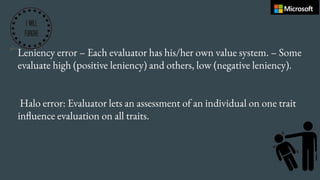
Leniency error – Each evaluator has his/her own value system. – Some
evaluate high (positive leniency) and others, low (negative leniency).
Halo error: Evaluator lets an assessment of an individual on one trait
influence evaluation on all traits.
• Similarity error: Evaluator rates others in the same way that
the evaluator perceives him or herself.
• Low appraiser motivation: Evaluators may be reluctant to
be accurate if important rewards for the employee depend on
the results.
• Central tendency: The reluctance to use the extremes of a
rating scale and to adequately distinguish among employees
being rated.
• Inflationary pressures: Pressures for equality and fear of
retribution for low ratings leads to less differentiation among
rated employees.
• Inappropriate substitutes for performance: Effort,
enthusiasm, appearance, etc. are less relevant for some jobs than
others.
Attribution Theory
• Evaluations are affected based on whether someone’s performance
is due to
– internal factors they can control
– external factors which they cannot
• If poor performance is attributed to internal control, the
judgment is harsher than when it is attributed to external control.
Rahul is asked to rate his team members. He rates all of them as 3. No
differentiation exists. What kind of error is this?
Devika and Natasha are performing a job for different supervisors
with identical job performance. Natasha supervisors give her a 5 and
Devika gets a 3. What might be the error for this two dramatically
different evaluations?
Nibha rates a faculty member as outstanding on all criteria. Students
tend to do this when they are particularly appreciative of a few things
that a faculty it does in the classroom. What kind of error is this?
Creating More Effective
Performance Management Systems
Combine Absolute
Relevant Standards
Have Multiple Raters
USE Use Provide Ongoing
Feedback
Rate Separately
Train Appraisers
Success!
Use Behaviour Based
Methods
Use Behavior-Based Measures:
• Measures based on specific descriptions of behavior are more job-
related and elicit more inter-rater agreement than traits, such as
“loyalty” or “friendliness”.
Combine Absolute and Relative Standards:
• Absolute standards tend to be positively lenient; relative
standards suffer when there is little variability.
• Combining the standards tends to offset the weaknesses of each.
Provide Ongoing Feedback:
• Expectations and disappointments should be shared with
employees on a frequent basis.
Use Multiple Raters:
• Increasing the number of raters leads to more reliable and valid
ratings.
– Use peer evaluations: Coworkers offer constructive
insights and more specific evaluations.
– Upward appraisals allow employees to give their managers
feedback.
Rate Selectively:
– Appraisers only evaluate in those areas about which they
have sufficient knowledge.
– Appraisers should be organizationally as close as possible to
the individual being evaluated.
– More effective raters are asked to do the appraisals.
Train Appraisers:
• Untrained appraisers who do poor appraisals can demoralize
employees and increase legal liabilities.
Performance Review and
Feedback
2.ClearCompany:
● Works for Human resources and Recruiting teams.
● The talent alignment platform connects recruiting,new employee
onboarding and performance management.
● Applicant tracking system features include requisition templates,bulk
emails,advanced corporate site integration,mobile career sites,social
sharing tools,reference management and one click background checks.
Performance improvement plan (PIP)
01
02
03
04
05
06
Determine if a
PIP is
appropriate
Develop a
Draft Plan
Review
the Plan
Implement
the Plan
Monitor Plan
Progression
Plan
Conclusion
a tool to give an employee with performance
deficiencies the opportunity to succeed. It may
be used to address failures to meet specific job
goals or to ameliorate behavior-related concerns.
Softwares used
1.Bamboo HR-
● Main services-Application tracking system and employee benefits
tracker.
● A homepage with different sections of employee information,vacation
time and reports.
● Has areas which shows scheduled lessons and business communications
● Users can see their coworkers’ birthdays and their scheduled time off.
● Platforms-Web based,IOS,Android
Case study-Adobe
● Abandoned annual performance appraisals in 2012.
● The estimated annual appraisals time was around 80000 management
hours per year.(Nearly equals to 40 employees working year around)
● Annual appraisals were replaced with regular one-on-one check ins.
● There are no performance ratings or rankings.
● The employees are now assessed based on how they meet their goals.
● This resulted in increased employee engagement and decreased
voluntary turnover by 30%.
“ Performance Review is a formal assessment in which managers evaluate
employees based on their work performance to
Identify strengths
and weaknesses.
Offer feedback
Assist in goal
setting
➢ Usually performance reviews are held annually but now more
companies are moving toward a frequent feedback
performance management system .
Before starting the review process, following check points should be
kept in mind:
➔ What’s the objective?
➔ Who should participate?
➔ What should we measure?
➔ What kind of questions?
1. Objective
a. Evaluation - assess the employee’s performance over a certain period of time to make key
business decisions
b. Development- enact a feedback process, and regularly provide employees with constructive
feedback to highlight how they can improve.
2. Participants
a. Employee (self)- self-evaluation form, an employee performs a self-assessment and reflects on
how they’ve performed
b. Peer - colleagues highlight the strengths and weakness of an employee’s performance over a
certain period of time.
c. Manager - direct reports analyze how their boss is performing both for the business and for the
direct report’s career.
3. What to measure -
a. Leadership
b. Project Management
c. Culture
d. Career Development
e. Impact
f. Problem Solving
g. Communication Skills
4. Type of question-
Feedback
Types of feedback sessions:
• Tell-and-sell: the supervisor tells the employee the results of the
performance appraisal and explains the reasons why the appraisal is correct
• Tell-and-listen: the supervisor tells the employee the results of the
performance appraisal and listens to the employee's response
• Problem solving: the supervisor acts as a coach to assist the employees in
setting their own goals and in evaluating their own job performance
Performance appraisal meeting
● Managers should prepare for and schedule the appraisal in advance.
● Explaining the purpose of the meeting in advance
● By describing the purpose of the appraisal to the employees,they will know precisely how the
appraisal will be used.
● Involve the employee in the appraisal discussion.
● Ensure that the employees understand what was discussed in the appraisal.
● Focus of the discussion should be on work behaviours, not on the employee.
● Both positive and negative feedback should be given.
● A development plan should be generated
Thank You!
PERFORMANCE
MANAGEMENT ?
A strategic approach to creating and
sustaining improved performance in
employees, leading to an increase in the
effectiveness of companies.
Performance Management
Reference:https://www.investopedia.com/what-is-a-performance-appraisal-4586834#:~:text=A%20performance%20appraisal%20is%20a,growth%2D%2Dor%20lack%
20thereof.
Two-Way
FeedBack
Must convey the
performance review
to the employee
Mutually set goals
Effective
communication
Documentation
A record of
performance
appraisal process
outcomes
Fair treatment
Development
Weakness, Deficient
Enhance performance
Performance Management System: Purpose
Reference: Fundamentals of Human Resource Management by David DeCenzo, Stephen Robbins; 10th Edition; Pg.232-233
PERFORMANCE
APPRAISAL?
A performance appraisal is a regular
review of an employee's job
performance and overall contribution
to a company.
Performance Appraisal
https://www.synergita.com/blog/differentiate-employee-performance-management-and-performance-appraisal/#:~:text=Performance%20management%20looks%20a
t%20an,performed%20in%20the%20immediate%20past.
Is it Same or Different?
Performance Management & Performance Appraisal
Performance
Management
● On-Going Process
● Growth, Productivity,
Efficiency,
Organizational Goals
● Strategic tool
● Qualitative and
Quantitative
● Flexible
● Holistic
Performance
Appraisal
● Annually
● Compensation
● Operational
● Quantitative
● Rigid
● Individualistic
Performance Management & Performance Appraisal
https://www.synergita.com/blog/differentiate-employee-performance-management-and-performance-appraisal/#:~:text=Performance%20management%20looks%20at
%20an,performed%20in%20the%20immediate%20past.
3.Trakstar:
● Cloud based HRM solution, provides Employee evaluation functionalities
like performance review,goal management,360 degree feedback and
succession planning.
● Appraisal management feature-managers can rate competencies based
on relevant questions and thus score the employees or appraisals.
● Reporting feature-users can run reports to assess the performance
history,performance ranking and other performance segments.
Lorem Ipsum
If necessary,
initiate
corrective action
Lorem Ipsum
Establish
performance
standards with
employees
Lorem Ipsum
Communicate
expectations
Lorem Ipsum
Discuss the appraisal
with the employee
Lorem Ipsum
Measure actual
performance
Lorem
Ipsum
Lorem Ipsum
Compare actual performance
with standards
How is it conducted?
Reference: Fundamentals of Human Resource Management by David DeCenzo, Stephen Robbins; 10th Edition; Pg.236-237
Performance Management System: Difficulties
Employee
● Discussion lead to
Confrontation,
Conflicts-Poor
● Calm, Effective
● Employee satisfaction
Process
● Company policy and
schemes
● Emotions involved
Poorly
Trained
Appraisers
Reference: Fundamentals of Human Resource Management by David DeCenzo, Stephen Robbins; 10th Edition; Pg.234-235
Performance Management System & EEO: India!
Equal Employment Opportunity, Indian Constitution (Article 15 & 16)
It refers to the principle which ensures that all employees are treated equitably and fairly,
regardless of their race, sex or disability, caste, creed, color, residence.
PMS- Reliable, Valid, By trained appraisers.
What is EEO?
https://www.defindia.org/files/2015/06/DEF-Equal-Employment-Opportunity-EEO-AND-Anti-Discrimination-Policy.pdf
METHODS OF
APPRAISAL?
Methods of Appraisal
Different industries and jobs need different appraisal
methods. We will discuss some of the main ways to assess
performance in a performance evaluation form. These will change
based upon the job specifications for each position within the
company.
ABSOLUTE
ACHIEVED OUTCOMES
RELATIVE
ABSOLUTE
ACHIEVED
OUTCOME
RELATIVE
GRAPHICAL.
Lorem Ipsum
FORCED
CHOICE
APPRAISALS
BARS
Lorem Ipsum
CHECKLIST
ABSOLUTE- Employee’s performance is measured against established standards
CRITICAL
INCIDENT
RELATIVE
Group order ranking:
reflects the relative performance, such as
“top 20%”
Individual ranking: highest to lowest
Paired comparison: each individual is
compared to every other member
ACHIEVED OUTCOME- mutual objective-setting and evaluation
based on the attainment of the specific objectives
MANAGEMENT BY OBJECTIVE
Goal specific
Time based
Participative decision
making
Performance feedback
● Executives reported that some of Microsoft's top engineers would avoid working
alongside each other out of fear that they would be hurt in their rankings.
● Certain employees were given what were known as M.B.O.s - Management
business objectives - which were essentially the expectations for what employees
would accomplish over a particular year.
● However, even when employees achieved these M.B.O.s, they were still not
guaranteed to receive a high ranking.
● Created a culture of sabotage - Employees would work hard to achieve the best
results, but, at the same time, they would try to ensure their colleagues did not.
CONNECTS
REVIEW THE
EVALUATIONS
DIRECT
RELATION
TO JOB
USE MULTIPLE
EVALUATION
METHODS
ENSURE
CONTINUOUS
FEED BACK
TIE INTO
STRATEGIC
PLAN
INVOLVE
MANAGERS
Factors that can Distort
Appraisals
Inappropriate
Substitutes
Leniency Error Halo Error
Similarity Error
Central
Tendency
Infinatory
Pressure
Leniency error – Each evaluator has his/her own value system. – Some
evaluate high (positive leniency) and others, low (negative leniency).
Halo error: Evaluator lets an assessment of an individual on one trait
influence evaluation on all traits.
• Similarity error: Evaluator rates others in the same way that
the evaluator perceives him or herself.
• Low appraiser motivation: Evaluators may be reluctant to
be accurate if important rewards for the employee depend on
the results.
• Central tendency: The reluctance to use the extremes of a
rating scale and to adequately distinguish among employees
being rated.
• Inflationary pressures: Pressures for equality and fear of
retribution for low ratings leads to less differentiation among
rated employees.
• Inappropriate substitutes for performance: Effort,
enthusiasm, appearance, etc. are less relevant for some jobs than
others.
Attribution Theory
• Evaluations are affected based on whether someone’s performance
is due to
– internal factors they can control
– external factors which they cannot
• If poor performance is attributed to internal control, the
judgment is harsher than when it is attributed to external control.
Rahul is asked to rate his team members. He rates all of them as 3. No
differentiation exists. What kind of error is this?
Devika and Natasha are performing a job for different supervisors
with identical job performance. Natasha supervisors give her a 5 and
Devika gets a 3. What might be the error for this two dramatically
different evaluations?
Nibha rates a faculty member as outstanding on all criteria. Students
tend to do this when they are particularly appreciative of a few things
that a faculty it does in the classroom. What kind of error is this?
Creating More Effective
Performance Management Systems
Combine Absolute
Relevant Standards
Have Multiple Raters
USE Use Provide Ongoing
Feedback
Rate Separately
Train Appraisers
Success!
Use Behaviour Based
Methods
Use Behavior-Based Measures:
• Measures based on specific descriptions of behavior are more job-
related and elicit more inter-rater agreement than traits, such as
“loyalty” or “friendliness”.
Combine Absolute and Relative Standards:
• Absolute standards tend to be positively lenient; relative
standards suffer when there is little variability.
• Combining the standards tends to offset the weaknesses of each.
Provide Ongoing Feedback:
• Expectations and disappointments should be shared with
employees on a frequent basis.
Use Multiple Raters:
• Increasing the number of raters leads to more reliable and valid
ratings.
– Use peer evaluations: Coworkers offer constructive
insights and more specific evaluations.
– Upward appraisals allow employees to give their managers
feedback.
Rate Selectively:
– Appraisers only evaluate in those areas about which they
have sufficient knowledge.
– Appraisers should be organizationally as close as possible to
the individual being evaluated.
– More effective raters are asked to do the appraisals.
Train Appraisers:
• Untrained appraisers who do poor appraisals can demoralize
employees and increase legal liabilities.
Performance Review and
Feedback
2.ClearCompany:
● Works for Human resources and Recruiting teams.
● The talent alignment platform connects recruiting,new employee
onboarding and performance management.
● Applicant tracking system features include requisition templates,bulk
emails,advanced corporate site integration,mobile career sites,social
sharing tools,reference management and one click background checks.
Performance improvement plan (PIP)
01
02
03
04
05
06
Determine if a
PIP is
appropriate
Develop a
Draft Plan
Review
the Plan
Implement
the Plan
Monitor Plan
Progression
Plan
Conclusion
a tool to give an employee with performance
deficiencies the opportunity to succeed. It may
be used to address failures to meet specific job
goals or to ameliorate behavior-related concerns.
Softwares used
1.Bamboo HR-
● Main services-Application tracking system and employee benefits
tracker.
● A homepage with different sections of employee information,vacation
time and reports.
● Has areas which shows scheduled lessons and business communications
● Users can see their coworkers’ birthdays and their scheduled time off.
● Platforms-Web based,IOS,Android
Case study-Adobe
● Abandoned annual performance appraisals in 2012.
● The estimated annual appraisals time was around 80000 management
hours per year.(Nearly equals to 40 employees working year around)
● Annual appraisals were replaced with regular one-on-one check ins.
● There are no performance ratings or rankings.
● The employees are now assessed based on how they meet their goals.
● This resulted in increased employee engagement and decreased
voluntary turnover by 30%.
“ Performance Review is a formal assessment in which managers evaluate
employees based on their work performance to
Identify strengths
and weaknesses.
Offer feedback
Assist in goal
setting
➢ Usually performance reviews are held annually but now more
companies are moving toward a frequent feedback
performance management system .
Before starting the review process, following check points should be
kept in mind:
➔ What’s the objective?
➔ Who should participate?
➔ What should we measure?
➔ What kind of questions?
1. Objective
a. Evaluation - assess the employee’s performance over a certain period of time to make key
business decisions
b. Development- enact a feedback process, and regularly provide employees with constructive
feedback to highlight how they can improve.
2. Participants
a. Employee (self)- self-evaluation form, an employee performs a self-assessment and reflects on
how they’ve performed
b. Peer - colleagues highlight the strengths and weakness of an employee’s performance over a
certain period of time.
c. Manager - direct reports analyze how their boss is performing both for the business and for the
direct report’s career.
3. What to measure -
a. Leadership
b. Project Management
c. Culture
d. Career Development
e. Impact
f. Problem Solving
g. Communication Skills
4. Type of question-
Feedback
Types of feedback sessions:
• Tell-and-sell: the supervisor tells the employee the results of the
performance appraisal and explains the reasons why the appraisal is correct
• Tell-and-listen: the supervisor tells the employee the results of the
performance appraisal and listens to the employee's response
• Problem solving: the supervisor acts as a coach to assist the employees in
setting their own goals and in evaluating their own job performance
Performance appraisal meeting
● Managers should prepare for and schedule the appraisal in advance.
● Explaining the purpose of the meeting in advance
● By describing the purpose of the appraisal to the employees,they will know precisely how the
appraisal will be used.
● Involve the employee in the appraisal discussion.
● Ensure that the employees understand what was discussed in the appraisal.
● Focus of the discussion should be on work behaviours, not on the employee.
● Both positive and negative feedback should be given.
● A development plan should be generated
Thank You!

Performance management- Human resource management

  • 1.
  • 2.
    A strategic approachto creating and sustaining improved performance in employees, leading to an increase in the effectiveness of companies. Performance Management Reference:https://www.investopedia.com/what-is-a-performance-appraisal-4586834#:~:text=A%20performance%20appraisal%20is%20a,growth%2D%2Dor%20lack% 20thereof.
  • 3.
    Two-Way FeedBack Must convey the performancereview to the employee Mutually set goals Effective communication Documentation A record of performance appraisal process outcomes Fair treatment Development Weakness, Deficient Enhance performance Performance Management System: Purpose Reference: Fundamentals of Human Resource Management by David DeCenzo, Stephen Robbins; 10th Edition; Pg.232-233
  • 4.
  • 5.
    A performance appraisalis a regular review of an employee's job performance and overall contribution to a company. Performance Appraisal https://www.synergita.com/blog/differentiate-employee-performance-management-and-performance-appraisal/#:~:text=Performance%20management%20looks%20a t%20an,performed%20in%20the%20immediate%20past.
  • 6.
    Is it Sameor Different? Performance Management & Performance Appraisal
  • 7.
    Performance Management ● On-Going Process ●Growth, Productivity, Efficiency, Organizational Goals ● Strategic tool ● Qualitative and Quantitative ● Flexible ● Holistic Performance Appraisal ● Annually ● Compensation ● Operational ● Quantitative ● Rigid ● Individualistic Performance Management & Performance Appraisal https://www.synergita.com/blog/differentiate-employee-performance-management-and-performance-appraisal/#:~:text=Performance%20management%20looks%20at %20an,performed%20in%20the%20immediate%20past.
  • 8.
    3.Trakstar: ● Cloud basedHRM solution, provides Employee evaluation functionalities like performance review,goal management,360 degree feedback and succession planning. ● Appraisal management feature-managers can rate competencies based on relevant questions and thus score the employees or appraisals. ● Reporting feature-users can run reports to assess the performance history,performance ranking and other performance segments.
  • 9.
    Lorem Ipsum If necessary, initiate correctiveaction Lorem Ipsum Establish performance standards with employees Lorem Ipsum Communicate expectations Lorem Ipsum Discuss the appraisal with the employee Lorem Ipsum Measure actual performance Lorem Ipsum Lorem Ipsum Compare actual performance with standards How is it conducted? Reference: Fundamentals of Human Resource Management by David DeCenzo, Stephen Robbins; 10th Edition; Pg.236-237
  • 10.
    Performance Management System:Difficulties Employee ● Discussion lead to Confrontation, Conflicts-Poor ● Calm, Effective ● Employee satisfaction Process ● Company policy and schemes ● Emotions involved Poorly Trained Appraisers Reference: Fundamentals of Human Resource Management by David DeCenzo, Stephen Robbins; 10th Edition; Pg.234-235
  • 11.
    Performance Management System& EEO: India! Equal Employment Opportunity, Indian Constitution (Article 15 & 16) It refers to the principle which ensures that all employees are treated equitably and fairly, regardless of their race, sex or disability, caste, creed, color, residence. PMS- Reliable, Valid, By trained appraisers. What is EEO? https://www.defindia.org/files/2015/06/DEF-Equal-Employment-Opportunity-EEO-AND-Anti-Discrimination-Policy.pdf
  • 12.
  • 13.
    Methods of Appraisal Differentindustries and jobs need different appraisal methods. We will discuss some of the main ways to assess performance in a performance evaluation form. These will change based upon the job specifications for each position within the company.
  • 14.
  • 15.
    GRAPHICAL. Lorem Ipsum FORCED CHOICE APPRAISALS BARS Lorem Ipsum CHECKLIST ABSOLUTE-Employee’s performance is measured against established standards CRITICAL INCIDENT
  • 17.
    RELATIVE Group order ranking: reflectsthe relative performance, such as “top 20%” Individual ranking: highest to lowest Paired comparison: each individual is compared to every other member
  • 18.
    ACHIEVED OUTCOME- mutualobjective-setting and evaluation based on the attainment of the specific objectives MANAGEMENT BY OBJECTIVE Goal specific Time based Participative decision making Performance feedback
  • 19.
    ● Executives reportedthat some of Microsoft's top engineers would avoid working alongside each other out of fear that they would be hurt in their rankings. ● Certain employees were given what were known as M.B.O.s - Management business objectives - which were essentially the expectations for what employees would accomplish over a particular year. ● However, even when employees achieved these M.B.O.s, they were still not guaranteed to receive a high ranking. ● Created a culture of sabotage - Employees would work hard to achieve the best results, but, at the same time, they would try to ensure their colleagues did not.
  • 20.
  • 21.
    REVIEW THE EVALUATIONS DIRECT RELATION TO JOB USEMULTIPLE EVALUATION METHODS ENSURE CONTINUOUS FEED BACK TIE INTO STRATEGIC PLAN INVOLVE MANAGERS
  • 22.
    Factors that canDistort Appraisals
  • 23.
    Inappropriate Substitutes Leniency Error HaloError Similarity Error Central Tendency Infinatory Pressure
  • 24.
    Leniency error –Each evaluator has his/her own value system. – Some evaluate high (positive leniency) and others, low (negative leniency). Halo error: Evaluator lets an assessment of an individual on one trait influence evaluation on all traits.
  • 25.
    • Similarity error:Evaluator rates others in the same way that the evaluator perceives him or herself. • Low appraiser motivation: Evaluators may be reluctant to be accurate if important rewards for the employee depend on the results.
  • 26.
    • Central tendency:The reluctance to use the extremes of a rating scale and to adequately distinguish among employees being rated. • Inflationary pressures: Pressures for equality and fear of retribution for low ratings leads to less differentiation among rated employees. • Inappropriate substitutes for performance: Effort, enthusiasm, appearance, etc. are less relevant for some jobs than others.
  • 27.
    Attribution Theory • Evaluationsare affected based on whether someone’s performance is due to – internal factors they can control – external factors which they cannot • If poor performance is attributed to internal control, the judgment is harsher than when it is attributed to external control.
  • 28.
    Rahul is askedto rate his team members. He rates all of them as 3. No differentiation exists. What kind of error is this?
  • 29.
    Devika and Natashaare performing a job for different supervisors with identical job performance. Natasha supervisors give her a 5 and Devika gets a 3. What might be the error for this two dramatically different evaluations?
  • 30.
    Nibha rates afaculty member as outstanding on all criteria. Students tend to do this when they are particularly appreciative of a few things that a faculty it does in the classroom. What kind of error is this?
  • 31.
  • 32.
    Combine Absolute Relevant Standards HaveMultiple Raters USE Use Provide Ongoing Feedback Rate Separately Train Appraisers Success! Use Behaviour Based Methods
  • 33.
    Use Behavior-Based Measures: •Measures based on specific descriptions of behavior are more job- related and elicit more inter-rater agreement than traits, such as “loyalty” or “friendliness”.
  • 34.
    Combine Absolute andRelative Standards: • Absolute standards tend to be positively lenient; relative standards suffer when there is little variability. • Combining the standards tends to offset the weaknesses of each.
  • 35.
    Provide Ongoing Feedback: •Expectations and disappointments should be shared with employees on a frequent basis.
  • 37.
    Use Multiple Raters: •Increasing the number of raters leads to more reliable and valid ratings. – Use peer evaluations: Coworkers offer constructive insights and more specific evaluations. – Upward appraisals allow employees to give their managers feedback.
  • 38.
    Rate Selectively: – Appraisersonly evaluate in those areas about which they have sufficient knowledge. – Appraisers should be organizationally as close as possible to the individual being evaluated. – More effective raters are asked to do the appraisals.
  • 39.
    Train Appraisers: • Untrainedappraisers who do poor appraisals can demoralize employees and increase legal liabilities.
  • 41.
  • 42.
    2.ClearCompany: ● Works forHuman resources and Recruiting teams. ● The talent alignment platform connects recruiting,new employee onboarding and performance management. ● Applicant tracking system features include requisition templates,bulk emails,advanced corporate site integration,mobile career sites,social sharing tools,reference management and one click background checks.
  • 43.
    Performance improvement plan(PIP) 01 02 03 04 05 06 Determine if a PIP is appropriate Develop a Draft Plan Review the Plan Implement the Plan Monitor Plan Progression Plan Conclusion a tool to give an employee with performance deficiencies the opportunity to succeed. It may be used to address failures to meet specific job goals or to ameliorate behavior-related concerns.
  • 44.
    Softwares used 1.Bamboo HR- ●Main services-Application tracking system and employee benefits tracker. ● A homepage with different sections of employee information,vacation time and reports. ● Has areas which shows scheduled lessons and business communications ● Users can see their coworkers’ birthdays and their scheduled time off. ● Platforms-Web based,IOS,Android
  • 45.
    Case study-Adobe ● Abandonedannual performance appraisals in 2012. ● The estimated annual appraisals time was around 80000 management hours per year.(Nearly equals to 40 employees working year around) ● Annual appraisals were replaced with regular one-on-one check ins. ● There are no performance ratings or rankings. ● The employees are now assessed based on how they meet their goals. ● This resulted in increased employee engagement and decreased voluntary turnover by 30%.
  • 46.
    “ Performance Reviewis a formal assessment in which managers evaluate employees based on their work performance to Identify strengths and weaknesses. Offer feedback Assist in goal setting ➢ Usually performance reviews are held annually but now more companies are moving toward a frequent feedback performance management system .
  • 47.
    Before starting thereview process, following check points should be kept in mind: ➔ What’s the objective? ➔ Who should participate? ➔ What should we measure? ➔ What kind of questions?
  • 48.
    1. Objective a. Evaluation- assess the employee’s performance over a certain period of time to make key business decisions b. Development- enact a feedback process, and regularly provide employees with constructive feedback to highlight how they can improve. 2. Participants a. Employee (self)- self-evaluation form, an employee performs a self-assessment and reflects on how they’ve performed b. Peer - colleagues highlight the strengths and weakness of an employee’s performance over a certain period of time. c. Manager - direct reports analyze how their boss is performing both for the business and for the direct report’s career.
  • 49.
    3. What tomeasure - a. Leadership b. Project Management c. Culture d. Career Development e. Impact f. Problem Solving g. Communication Skills 4. Type of question-
  • 50.
    Feedback Types of feedbacksessions: • Tell-and-sell: the supervisor tells the employee the results of the performance appraisal and explains the reasons why the appraisal is correct • Tell-and-listen: the supervisor tells the employee the results of the performance appraisal and listens to the employee's response • Problem solving: the supervisor acts as a coach to assist the employees in setting their own goals and in evaluating their own job performance
  • 51.
    Performance appraisal meeting ●Managers should prepare for and schedule the appraisal in advance. ● Explaining the purpose of the meeting in advance ● By describing the purpose of the appraisal to the employees,they will know precisely how the appraisal will be used. ● Involve the employee in the appraisal discussion. ● Ensure that the employees understand what was discussed in the appraisal. ● Focus of the discussion should be on work behaviours, not on the employee. ● Both positive and negative feedback should be given. ● A development plan should be generated
  • 53.
  • 55.
  • 56.
    A strategic approachto creating and sustaining improved performance in employees, leading to an increase in the effectiveness of companies. Performance Management Reference:https://www.investopedia.com/what-is-a-performance-appraisal-4586834#:~:text=A%20performance%20appraisal%20is%20a,growth%2D%2Dor%20lack% 20thereof.
  • 57.
    Two-Way FeedBack Must convey the performancereview to the employee Mutually set goals Effective communication Documentation A record of performance appraisal process outcomes Fair treatment Development Weakness, Deficient Enhance performance Performance Management System: Purpose Reference: Fundamentals of Human Resource Management by David DeCenzo, Stephen Robbins; 10th Edition; Pg.232-233
  • 58.
  • 59.
    A performance appraisalis a regular review of an employee's job performance and overall contribution to a company. Performance Appraisal https://www.synergita.com/blog/differentiate-employee-performance-management-and-performance-appraisal/#:~:text=Performance%20management%20looks%20a t%20an,performed%20in%20the%20immediate%20past.
  • 60.
    Is it Sameor Different? Performance Management & Performance Appraisal
  • 61.
    Performance Management ● On-Going Process ●Growth, Productivity, Efficiency, Organizational Goals ● Strategic tool ● Qualitative and Quantitative ● Flexible ● Holistic Performance Appraisal ● Annually ● Compensation ● Operational ● Quantitative ● Rigid ● Individualistic Performance Management & Performance Appraisal https://www.synergita.com/blog/differentiate-employee-performance-management-and-performance-appraisal/#:~:text=Performance%20management%20looks%20at %20an,performed%20in%20the%20immediate%20past.
  • 62.
    3.Trakstar: ● Cloud basedHRM solution, provides Employee evaluation functionalities like performance review,goal management,360 degree feedback and succession planning. ● Appraisal management feature-managers can rate competencies based on relevant questions and thus score the employees or appraisals. ● Reporting feature-users can run reports to assess the performance history,performance ranking and other performance segments.
  • 63.
    Lorem Ipsum If necessary, initiate correctiveaction Lorem Ipsum Establish performance standards with employees Lorem Ipsum Communicate expectations Lorem Ipsum Discuss the appraisal with the employee Lorem Ipsum Measure actual performance Lorem Ipsum Lorem Ipsum Compare actual performance with standards How is it conducted? Reference: Fundamentals of Human Resource Management by David DeCenzo, Stephen Robbins; 10th Edition; Pg.236-237
  • 64.
    Performance Management System:Difficulties Employee ● Discussion lead to Confrontation, Conflicts-Poor ● Calm, Effective ● Employee satisfaction Process ● Company policy and schemes ● Emotions involved Poorly Trained Appraisers Reference: Fundamentals of Human Resource Management by David DeCenzo, Stephen Robbins; 10th Edition; Pg.234-235
  • 65.
    Performance Management System& EEO: India! Equal Employment Opportunity, Indian Constitution (Article 15 & 16) It refers to the principle which ensures that all employees are treated equitably and fairly, regardless of their race, sex or disability, caste, creed, color, residence. PMS- Reliable, Valid, By trained appraisers. What is EEO? https://www.defindia.org/files/2015/06/DEF-Equal-Employment-Opportunity-EEO-AND-Anti-Discrimination-Policy.pdf
  • 66.
  • 67.
    Methods of Appraisal Differentindustries and jobs need different appraisal methods. We will discuss some of the main ways to assess performance in a performance evaluation form. These will change based upon the job specifications for each position within the company.
  • 68.
  • 69.
    GRAPHICAL. Lorem Ipsum FORCED CHOICE APPRAISALS BARS Lorem Ipsum CHECKLIST ABSOLUTE-Employee’s performance is measured against established standards CRITICAL INCIDENT
  • 71.
    RELATIVE Group order ranking: reflectsthe relative performance, such as “top 20%” Individual ranking: highest to lowest Paired comparison: each individual is compared to every other member
  • 72.
    ACHIEVED OUTCOME- mutualobjective-setting and evaluation based on the attainment of the specific objectives MANAGEMENT BY OBJECTIVE Goal specific Time based Participative decision making Performance feedback
  • 73.
    ● Executives reportedthat some of Microsoft's top engineers would avoid working alongside each other out of fear that they would be hurt in their rankings. ● Certain employees were given what were known as M.B.O.s - Management business objectives - which were essentially the expectations for what employees would accomplish over a particular year. ● However, even when employees achieved these M.B.O.s, they were still not guaranteed to receive a high ranking. ● Created a culture of sabotage - Employees would work hard to achieve the best results, but, at the same time, they would try to ensure their colleagues did not.
  • 74.
  • 75.
    REVIEW THE EVALUATIONS DIRECT RELATION TO JOB USEMULTIPLE EVALUATION METHODS ENSURE CONTINUOUS FEED BACK TIE INTO STRATEGIC PLAN INVOLVE MANAGERS
  • 76.
    Factors that canDistort Appraisals
  • 77.
    Inappropriate Substitutes Leniency Error HaloError Similarity Error Central Tendency Infinatory Pressure
  • 78.
    Leniency error –Each evaluator has his/her own value system. – Some evaluate high (positive leniency) and others, low (negative leniency). Halo error: Evaluator lets an assessment of an individual on one trait influence evaluation on all traits.
  • 79.
    • Similarity error:Evaluator rates others in the same way that the evaluator perceives him or herself. • Low appraiser motivation: Evaluators may be reluctant to be accurate if important rewards for the employee depend on the results.
  • 80.
    • Central tendency:The reluctance to use the extremes of a rating scale and to adequately distinguish among employees being rated. • Inflationary pressures: Pressures for equality and fear of retribution for low ratings leads to less differentiation among rated employees. • Inappropriate substitutes for performance: Effort, enthusiasm, appearance, etc. are less relevant for some jobs than others.
  • 81.
    Attribution Theory • Evaluationsare affected based on whether someone’s performance is due to – internal factors they can control – external factors which they cannot • If poor performance is attributed to internal control, the judgment is harsher than when it is attributed to external control.
  • 82.
    Rahul is askedto rate his team members. He rates all of them as 3. No differentiation exists. What kind of error is this?
  • 83.
    Devika and Natashaare performing a job for different supervisors with identical job performance. Natasha supervisors give her a 5 and Devika gets a 3. What might be the error for this two dramatically different evaluations?
  • 84.
    Nibha rates afaculty member as outstanding on all criteria. Students tend to do this when they are particularly appreciative of a few things that a faculty it does in the classroom. What kind of error is this?
  • 85.
  • 86.
    Combine Absolute Relevant Standards HaveMultiple Raters USE Use Provide Ongoing Feedback Rate Separately Train Appraisers Success! Use Behaviour Based Methods
  • 87.
    Use Behavior-Based Measures: •Measures based on specific descriptions of behavior are more job- related and elicit more inter-rater agreement than traits, such as “loyalty” or “friendliness”.
  • 88.
    Combine Absolute andRelative Standards: • Absolute standards tend to be positively lenient; relative standards suffer when there is little variability. • Combining the standards tends to offset the weaknesses of each.
  • 89.
    Provide Ongoing Feedback: •Expectations and disappointments should be shared with employees on a frequent basis.
  • 91.
    Use Multiple Raters: •Increasing the number of raters leads to more reliable and valid ratings. – Use peer evaluations: Coworkers offer constructive insights and more specific evaluations. – Upward appraisals allow employees to give their managers feedback.
  • 92.
    Rate Selectively: – Appraisersonly evaluate in those areas about which they have sufficient knowledge. – Appraisers should be organizationally as close as possible to the individual being evaluated. – More effective raters are asked to do the appraisals.
  • 93.
    Train Appraisers: • Untrainedappraisers who do poor appraisals can demoralize employees and increase legal liabilities.
  • 95.
  • 96.
    2.ClearCompany: ● Works forHuman resources and Recruiting teams. ● The talent alignment platform connects recruiting,new employee onboarding and performance management. ● Applicant tracking system features include requisition templates,bulk emails,advanced corporate site integration,mobile career sites,social sharing tools,reference management and one click background checks.
  • 97.
    Performance improvement plan(PIP) 01 02 03 04 05 06 Determine if a PIP is appropriate Develop a Draft Plan Review the Plan Implement the Plan Monitor Plan Progression Plan Conclusion a tool to give an employee with performance deficiencies the opportunity to succeed. It may be used to address failures to meet specific job goals or to ameliorate behavior-related concerns.
  • 98.
    Softwares used 1.Bamboo HR- ●Main services-Application tracking system and employee benefits tracker. ● A homepage with different sections of employee information,vacation time and reports. ● Has areas which shows scheduled lessons and business communications ● Users can see their coworkers’ birthdays and their scheduled time off. ● Platforms-Web based,IOS,Android
  • 99.
    Case study-Adobe ● Abandonedannual performance appraisals in 2012. ● The estimated annual appraisals time was around 80000 management hours per year.(Nearly equals to 40 employees working year around) ● Annual appraisals were replaced with regular one-on-one check ins. ● There are no performance ratings or rankings. ● The employees are now assessed based on how they meet their goals. ● This resulted in increased employee engagement and decreased voluntary turnover by 30%.
  • 100.
    “ Performance Reviewis a formal assessment in which managers evaluate employees based on their work performance to Identify strengths and weaknesses. Offer feedback Assist in goal setting ➢ Usually performance reviews are held annually but now more companies are moving toward a frequent feedback performance management system .
  • 101.
    Before starting thereview process, following check points should be kept in mind: ➔ What’s the objective? ➔ Who should participate? ➔ What should we measure? ➔ What kind of questions?
  • 102.
    1. Objective a. Evaluation- assess the employee’s performance over a certain period of time to make key business decisions b. Development- enact a feedback process, and regularly provide employees with constructive feedback to highlight how they can improve. 2. Participants a. Employee (self)- self-evaluation form, an employee performs a self-assessment and reflects on how they’ve performed b. Peer - colleagues highlight the strengths and weakness of an employee’s performance over a certain period of time. c. Manager - direct reports analyze how their boss is performing both for the business and for the direct report’s career.
  • 103.
    3. What tomeasure - a. Leadership b. Project Management c. Culture d. Career Development e. Impact f. Problem Solving g. Communication Skills 4. Type of question-
  • 104.
    Feedback Types of feedbacksessions: • Tell-and-sell: the supervisor tells the employee the results of the performance appraisal and explains the reasons why the appraisal is correct • Tell-and-listen: the supervisor tells the employee the results of the performance appraisal and listens to the employee's response • Problem solving: the supervisor acts as a coach to assist the employees in setting their own goals and in evaluating their own job performance
  • 105.
    Performance appraisal meeting ●Managers should prepare for and schedule the appraisal in advance. ● Explaining the purpose of the meeting in advance ● By describing the purpose of the appraisal to the employees,they will know precisely how the appraisal will be used. ● Involve the employee in the appraisal discussion. ● Ensure that the employees understand what was discussed in the appraisal. ● Focus of the discussion should be on work behaviours, not on the employee. ● Both positive and negative feedback should be given. ● A development plan should be generated
  • 106.