By G. Vineeth
III MDS
Eye Prosthesis
Contents
• Introduction
• History
• Types of eye prostheses
• Patient evaluation
• Treatment planning
– Techniques of impression
– Techniques of fabrication
– Methods of retention
– Maintenance
• Complications
• Conclusion
• References
Introduction
Defects of the
eye
Marian Pauly MS, DNB, Giridhar A, MS, Iby P. Varghese. Ocular prosthesis. Kerala Journal of Opthalmology 2011; 23(4); 339-41
Thomas D Taylor, editor. Clinical maxillofacial prosthetics. Quintessence Publishing Co; 2000.
History
• Indians – 5600 BC
• Iran – 2900 BC
• Egyptians – 500 BC
• Europeans – 1500 AD
• Materials used
Wikipedia: Internet
Sanjayagouda B. Patil, Roseline Meshramkar, B. H. Naveen and N. P. Patil. Ocular prosthesis: a brief review and fabrication of an ocular prosthesis for a geriatric
patient. Gerodontology 2008; 25: 57–62
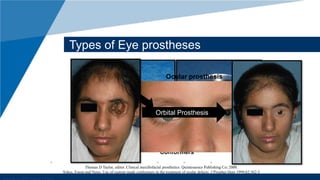
Types of Eye prostheses
Conformers
Ocular prosthesis
Orbital Prosthesis
Thomas D Taylor, editor. Clinical maxillofacial prosthetics. Quintessence Publishing Co; 2000.
Sykes, Essop and Veres. Use of custom made conformers in the treatment of ocular defects. J Prosthet Dent 1999;82:362-5
Patient evaluation
• For ocular defects
– Prognosis estimation
– Physical evaluation
– Muscular evaluation
– Desires and expectations of the patient
– Counselling the patient
• For orbital defects
– Pre-operative evaluation better than post-operative
– CT, MRI, FNAC useful.
Thomas D Taylor, editor. Clinical maxillofacial prosthetics. Quintessence Publishing Co; 2000.
E. L. DaBreo, and David E. Schuller. Surgical and prosthetic considerations in the management of orbital tumors. J Prosthet Dent 1992; 67(1); 106-12
Treatment planning
• Patient centered model
• Multidisciplinary
• Initial visit – determine treatment needs and confirm them with
patient
• Discuss these needs with team members – process and outcome
• All the pre-requisites should be planned
• Patient confirms regarding the procedure after consultation
• Signed consent
• Start treatment
Thomas D Taylor, editor. Clinical maxillofacial prosthetics. Quintessence Publishing Co; 2000.
Treatment planning - steps
• Planning Retention
• Moulage impression and working cast fabriction
• Pattern fabrication and try-in
• Craniofacial implants placement followed by impression
• Cast modification
• Pattern try-in
• Processing
• Insertion and maintenance
Methods of retention
• Extra-ocular muscles
• Adhesives
• Mechanical : Eyeglasses/Spectacles
• Magnets
• Implants: Bar and clip attachments or magnetic attachments
Sameera R Shaikh, Pravinkumar G Patil, Santosh Puri. A modified technique for retention of orbital prosthesis. Indian Journal of Dental Research 2011, 22(6), 863-65
Neeraj Khatkar et al. Magnets in prosthetic dentistry. Journal of Dental Sciences & Oral Rehabilitation 2013; 12-13.
Modified retention
Sameera R Shaikh, Pravinkumar G Patil, Santosh Puri. A modified technique for retention of orbital prosthesis. Indian Journal of Dental Research 2011, 22(6), 863-65
Modified retention
Gunjan Pruthi, Veena Jain & Swati Sikka. A Novel Method for Retention of an Orbital Prosthesis in a Case with Continuous Maxillary and Orbital Defect. J Ind Prosthodont
Soc 2010; 10(2):132–136
http://www.ocularist.org/resources_surgical_procedures.asp; American society of ocularists: Internet
Techniques of impression
• Stock tray impression technique
Thomas D Taylor, editor. Clinical maxillofacial prosthetics. Quintessence Publishing Co; 2000.
Techniques of impression
• External tray impression technique
Thomas D Taylor, editor. Clinical maxillofacial prosthetics. Quintessence Publishing Co; 2000.
Techniques of impression
Thomas D Taylor, editor. Clinical maxillofacial prosthetics. Quintessence Publishing Co; 2000.
Techniques of impression
3 D Laser Scanning 3 D Optical Scanning 3 D Image
A. M. Bhat. Recent advances in the modelling of extraoral defects. J Ind Prosthodont Soc 2005; 5(4); 180-184
Techniques of fabrication
• Paper Iris Disk technique
Thomas D Taylor, editor. Clinical maxillofacial prosthetics. Quintessence Publishing Co; 2000.
Techniques of fabrication
• Black Iris Disk technique
Thomas D Taylor, editor. Clinical maxillofacial prosthetics. Quintessence Publishing Co; 2000.
Techniques of fabrication
Thomas D Taylor, editor. Clinical maxillofacial prosthetics. Quintessence Publishing Co; 2000.
Color matching
Thomas D Taylor, editor. Clinical maxillofacial prosthetics. Quintessence Publishing Co; 2000.
Armamentarium
Color formulation and
mixing machine
Spectrophotometer
Rapid prototyping
Ing Andreas Gebhardt. Textbook; Short course on rapid prototyping. 2010
Procedure
Procedure
Recent trend – Bionic Eye
Maintenence
• Adjustment to the prosthesis
• Period of wear
• Removal and replacement
• Cleaning
• Recall
G. R. Parr, B. M. Goldman, and A. 0. Rahn. Postinsertion care of the ocular prosthesis. J Prosthet Dent 1983; 49(2); 220-224
Complications
• Tissue irritation
• Inadequate peri-orbital support
• Recurrence of tumor
• Implant exposure
• Conjunctival thinning
• Discharge
• Pyogenic granuloma formation (excess healing tissue formation),
• Rarely persistent pain or discomfort
Conclusion
To meet challenges and surpass them is the basic means survival of
the fittest.
With efficiency and uncompromising efforts, this task becomes
easier.
References
• Marian Pauly MS, DNB, Giridhar A, MS, Iby P. Varghese. Ocular prosthesis. Kerala
Journal of Opthalmology 2011; 23(4); 339-41
• Thomas D Taylor, editor. Clinical maxillofacial prosthetics. Quintessence Publishing Co;
2000.
• E. L. DaBreo, and David E. Schuller. Surgical and prosthetic considerations in the
management of orbital tumors. J Prosthet Dent 1992; 67(1); 106-12.
• Sameera R Shaikh, Pravinkumar G Patil, Santosh Puri. A modified technique for
retention of orbital prosthesis. Indian Journal of Dental Research 2011, 22(6), 863-65.
• G. R. Parr, B. M. Goldman, and A. 0. Rahn. Postinsertion care of the ocular prosthesis. J
Prosthet Dent 1983; 49(2); 220-224
• Sykes, Essop and Veres. Use of custom made conformers in the treatment of ocular
defects. J Prosthet Dent 1999;82:362-5
References
• Sanjayagouda B. Patil, Roseline Meshramkar, B. H. Naveen and N. P. Patil. Ocular
prosthesis: a brief review and fabrication of an ocular prosthesis for a geriatric patient.
Gerodontology 2008; 25: 57–62
• Wikipedia: Internet
• Neeraj Khatkar et al. Magnets in prosthetic dentistry. Journal of Dental Sciences & Oral
Rehabilitation 2013; 12-13.
• Gunjan Pruthi, Veena Jain & Swati Sikka. A Novel Method for Retention of an Orbital
Prosthesis in a Case with Continuous Maxillary and Orbital Defect. J Ind Prosthodont
Soc 2010; 10(2):132–136
• http://www.ocularist.org/resources_surgical_procedures.asp; American society of
ocularists: Internet
• A. M. Bhat. Recent advances in the modelling of extraoral defects. J Ind Prosthodont
Soc 2005; 5(4); 180-184
• Ing Andreas Gebhardt. Textbook; Short course on rapid prototyping. 2010
Eye Prosthesis

Eye Prosthesis

  • 2.
    By G. Vineeth IIIMDS Eye Prosthesis
  • 3.
    Contents • Introduction • History •Types of eye prostheses • Patient evaluation • Treatment planning – Techniques of impression – Techniques of fabrication – Methods of retention – Maintenance • Complications • Conclusion • References
  • 4.
    Introduction Defects of the eye MarianPauly MS, DNB, Giridhar A, MS, Iby P. Varghese. Ocular prosthesis. Kerala Journal of Opthalmology 2011; 23(4); 339-41 Thomas D Taylor, editor. Clinical maxillofacial prosthetics. Quintessence Publishing Co; 2000.
  • 5.
    History • Indians –5600 BC • Iran – 2900 BC • Egyptians – 500 BC • Europeans – 1500 AD • Materials used Wikipedia: Internet Sanjayagouda B. Patil, Roseline Meshramkar, B. H. Naveen and N. P. Patil. Ocular prosthesis: a brief review and fabrication of an ocular prosthesis for a geriatric patient. Gerodontology 2008; 25: 57–62
  • 6.
    Types of Eyeprostheses Conformers Ocular prosthesis Orbital Prosthesis Thomas D Taylor, editor. Clinical maxillofacial prosthetics. Quintessence Publishing Co; 2000. Sykes, Essop and Veres. Use of custom made conformers in the treatment of ocular defects. J Prosthet Dent 1999;82:362-5
  • 7.
    Patient evaluation • Forocular defects – Prognosis estimation – Physical evaluation – Muscular evaluation – Desires and expectations of the patient – Counselling the patient • For orbital defects – Pre-operative evaluation better than post-operative – CT, MRI, FNAC useful. Thomas D Taylor, editor. Clinical maxillofacial prosthetics. Quintessence Publishing Co; 2000. E. L. DaBreo, and David E. Schuller. Surgical and prosthetic considerations in the management of orbital tumors. J Prosthet Dent 1992; 67(1); 106-12
  • 8.
    Treatment planning • Patientcentered model • Multidisciplinary • Initial visit – determine treatment needs and confirm them with patient • Discuss these needs with team members – process and outcome • All the pre-requisites should be planned • Patient confirms regarding the procedure after consultation • Signed consent • Start treatment Thomas D Taylor, editor. Clinical maxillofacial prosthetics. Quintessence Publishing Co; 2000.
  • 9.
    Treatment planning -steps • Planning Retention • Moulage impression and working cast fabriction • Pattern fabrication and try-in • Craniofacial implants placement followed by impression • Cast modification • Pattern try-in • Processing • Insertion and maintenance
  • 10.
    Methods of retention •Extra-ocular muscles • Adhesives • Mechanical : Eyeglasses/Spectacles • Magnets • Implants: Bar and clip attachments or magnetic attachments Sameera R Shaikh, Pravinkumar G Patil, Santosh Puri. A modified technique for retention of orbital prosthesis. Indian Journal of Dental Research 2011, 22(6), 863-65 Neeraj Khatkar et al. Magnets in prosthetic dentistry. Journal of Dental Sciences & Oral Rehabilitation 2013; 12-13.
  • 11.
    Modified retention Sameera RShaikh, Pravinkumar G Patil, Santosh Puri. A modified technique for retention of orbital prosthesis. Indian Journal of Dental Research 2011, 22(6), 863-65
  • 12.
    Modified retention Gunjan Pruthi,Veena Jain & Swati Sikka. A Novel Method for Retention of an Orbital Prosthesis in a Case with Continuous Maxillary and Orbital Defect. J Ind Prosthodont Soc 2010; 10(2):132–136
  • 13.
  • 14.
    Techniques of impression •Stock tray impression technique Thomas D Taylor, editor. Clinical maxillofacial prosthetics. Quintessence Publishing Co; 2000.
  • 15.
    Techniques of impression •External tray impression technique Thomas D Taylor, editor. Clinical maxillofacial prosthetics. Quintessence Publishing Co; 2000.
  • 16.
    Techniques of impression ThomasD Taylor, editor. Clinical maxillofacial prosthetics. Quintessence Publishing Co; 2000.
  • 17.
    Techniques of impression 3D Laser Scanning 3 D Optical Scanning 3 D Image A. M. Bhat. Recent advances in the modelling of extraoral defects. J Ind Prosthodont Soc 2005; 5(4); 180-184
  • 18.
    Techniques of fabrication •Paper Iris Disk technique Thomas D Taylor, editor. Clinical maxillofacial prosthetics. Quintessence Publishing Co; 2000.
  • 19.
    Techniques of fabrication •Black Iris Disk technique Thomas D Taylor, editor. Clinical maxillofacial prosthetics. Quintessence Publishing Co; 2000.
  • 20.
    Techniques of fabrication ThomasD Taylor, editor. Clinical maxillofacial prosthetics. Quintessence Publishing Co; 2000.
  • 21.
    Color matching Thomas DTaylor, editor. Clinical maxillofacial prosthetics. Quintessence Publishing Co; 2000. Armamentarium Color formulation and mixing machine Spectrophotometer
  • 22.
    Rapid prototyping Ing AndreasGebhardt. Textbook; Short course on rapid prototyping. 2010
  • 23.
  • 24.
  • 25.
    Recent trend –Bionic Eye
  • 26.
    Maintenence • Adjustment tothe prosthesis • Period of wear • Removal and replacement • Cleaning • Recall G. R. Parr, B. M. Goldman, and A. 0. Rahn. Postinsertion care of the ocular prosthesis. J Prosthet Dent 1983; 49(2); 220-224
  • 27.
    Complications • Tissue irritation •Inadequate peri-orbital support • Recurrence of tumor • Implant exposure • Conjunctival thinning • Discharge • Pyogenic granuloma formation (excess healing tissue formation), • Rarely persistent pain or discomfort
  • 28.
    Conclusion To meet challengesand surpass them is the basic means survival of the fittest. With efficiency and uncompromising efforts, this task becomes easier.
  • 29.
    References • Marian PaulyMS, DNB, Giridhar A, MS, Iby P. Varghese. Ocular prosthesis. Kerala Journal of Opthalmology 2011; 23(4); 339-41 • Thomas D Taylor, editor. Clinical maxillofacial prosthetics. Quintessence Publishing Co; 2000. • E. L. DaBreo, and David E. Schuller. Surgical and prosthetic considerations in the management of orbital tumors. J Prosthet Dent 1992; 67(1); 106-12. • Sameera R Shaikh, Pravinkumar G Patil, Santosh Puri. A modified technique for retention of orbital prosthesis. Indian Journal of Dental Research 2011, 22(6), 863-65. • G. R. Parr, B. M. Goldman, and A. 0. Rahn. Postinsertion care of the ocular prosthesis. J Prosthet Dent 1983; 49(2); 220-224 • Sykes, Essop and Veres. Use of custom made conformers in the treatment of ocular defects. J Prosthet Dent 1999;82:362-5
  • 30.
    References • Sanjayagouda B.Patil, Roseline Meshramkar, B. H. Naveen and N. P. Patil. Ocular prosthesis: a brief review and fabrication of an ocular prosthesis for a geriatric patient. Gerodontology 2008; 25: 57–62 • Wikipedia: Internet • Neeraj Khatkar et al. Magnets in prosthetic dentistry. Journal of Dental Sciences & Oral Rehabilitation 2013; 12-13. • Gunjan Pruthi, Veena Jain & Swati Sikka. A Novel Method for Retention of an Orbital Prosthesis in a Case with Continuous Maxillary and Orbital Defect. J Ind Prosthodont Soc 2010; 10(2):132–136 • http://www.ocularist.org/resources_surgical_procedures.asp; American society of ocularists: Internet • A. M. Bhat. Recent advances in the modelling of extraoral defects. J Ind Prosthodont Soc 2005; 5(4); 180-184 • Ing Andreas Gebhardt. Textbook; Short course on rapid prototyping. 2010

Editor's Notes

  • #5 Stigmatisation Orbital evisceration Orbital enucleation Increased life expectancy & effort to sustain the competition increased demand on prosthodontists
  • #6 5600 BC - artificial eye or eye transplant in Shalivahan Shaka Parva in the book called “Garbhopanishad”. 444 AD - eye surgeries were performed in Nalanda Vidyapith under Shri Nagarjunbharda. 632 AD - Shri Charak, Shri Shushrut and Shri Vagbhat operated to correct disfigurements. 633 AD - King Shashankdev of Vikramshila region has awarded an eye made of gold as a trophy to Acharya Prashastpad for his work in eye surgery on patients who had lost their eyes due to small pox Since 1446 Portuguese Doctors introduced their system of medicine. From 1670 the British introduced the Greek Medicine which is followed to this day. 18th and 19th centuries – cryolite glass eyes by Ludwig Muller, majorly produced by Germany, PMMA popularized in Europe and Germany The stock eyes available in the market today are made from low-grade plastic
  • #7 Conformer : word material Ocular prosthesis: Orbital prosthesis Facial prosthesis Orbital prosthesis combined with Obturator
  • #9 Core team and full team
  • #11 location and size of the defect, tissue mobility or lack there of, undercuts, and the material weight of the final prosthesis. nonporous silicone, hydroxyapatite, or porous polyethylene implants The nonporous, silicone implant ensures eye motility through “surface tension at the conjunctival-prosthetic interface” that is transmitted directly to the implant. Silicone implants come in sizes ranging from 14mm-20mm. Hydroxyapatite and polyethylene are both porous implants. Adv - fibrovascular ingrowth and permanent integration with orbital tissues
  • #12 location and size of the defect, tissue mobility or lack there of, undercuts, and the material weight of the final prosthesis.
  • #22 Identifying and mixing base color Trial and error method Computerized color formulation