Land-Use Planning
Chapter 12
The Need For Planning
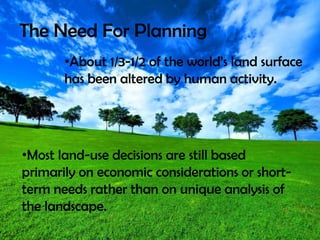
•About 1/3-1/2 of the world’s land surface
has been altered by human activity.
•Most land-use decisions are still based
primarily on economic considerations or short-
term needs rather than on unique analysis of
the landscape.
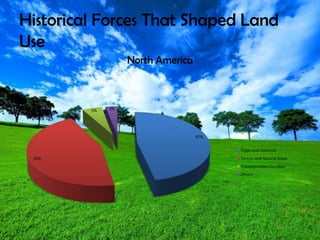
Historical Forces That Shaped Land
Use
47%
45%
5% 3%
North America
Crops and Livestock
Forests and Natural Areas
Transportation Corridors
Others
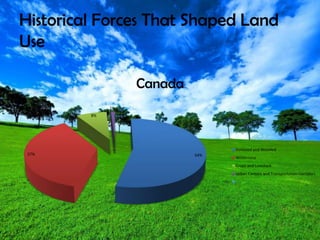
Historical Forces That Shaped Land
Use
54%37%
8%
1%
Canada
Forested and Wooded
Wilderness
Crops and Livestock
Urban Centers and Transportation Corridors
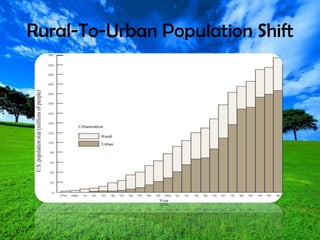
Rural-To-Urban Shift
• North America remained essentially rural until
industrial growth began in last 1/3 of 1800s.
• Industrial Revolution
– Industrial jobs to be found in cities.
• European Immigrants
– Congregated in, and subdivided cities.
• Offered variety of cultural, social, and artistic
opportunities.
Urbanization in the Developing World
•Many migrate to the cities because:
-Greater access to social services and other
cultural benefits.
-More employment opportunities.
•Because of the fast growing urban
population:
-Many people live in poverty.
-Disease is common.
-Pollution is common
Migration From the Central City to
the Suburbs
• Industrial Revolution led to
polluted, undesirable waterways.
– As roads and rail transport became more
common, many left the waterway areas.
• As land prices in the city rose, people began to
look for cheaper areas away from the city.
– 1950—60% urban population lived in central cities.
– 1990—30% urban population lived in central cities.
Migration From the Central City to
the Suburbs
• Agricultural land surrounding towns was
converted to housing.
• Land began to be viewed as a commodity, not a
non-renewable resource to be managed.
• Most single family houses after WWII were built
on large lots away from city congestion.
Rural-To-Urban Population Shift
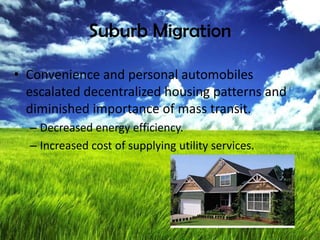
Suburb Migration
• Convenience and personal automobiles
escalated decentralized housing patterns and
diminished importance of mass transit.
– Decreased energy efficiency.
– Increased cost of supplying utility services.
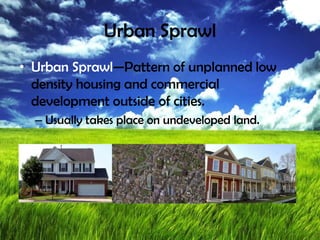
Urban Sprawl
• Urban Sprawl—Pattern of unplanned low
density housing and commercial
development outside of cities.
– Usually takes place on undeveloped land.
Factors that Contribute to Sprawl
Lifestyle
Economic
Planning and Policy
Problems Associated With Unplanned
Growth
Transportation
Air Pollution
Energy Efficiencies
Loss of Sense of Community
Death of Central City
Higher Infrastructure Cost
Loss of Open Space
Loss of Farmland
Water Pollution Problems
Foodplain Problems
Wetlands Misuse
Others
Land-Use Planning Principles
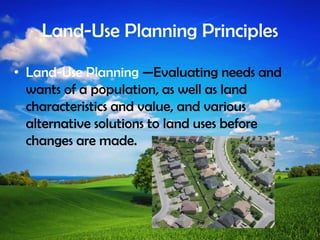
• Land-Use Planning —Evaluating needs and
wants of a population, as well as land
characteristics and value, and various
alternative solutions to land uses before
changes are made.
Land-Use Planning Principles
• Evaluate and record unique features.
• Preserve unique cultural or historical features.
• Conserve open space and env. features.
• Calculate additional charges for altering land.
• Plan for mixed uses in close proximity.
• Plan variety of transportation options.
• Set limits and managed growth patterns.
• Encourage development in areas of existing
infrastructure.
Mechanism For Implementing Land-
Use Plans
• Establish state or regional planning agencies.
• Purchase land or use rights.
• Regulate Use
– Zoning
Land-Use Planning Strategies
Transit-Oriented Design Mixed-Use Strategies
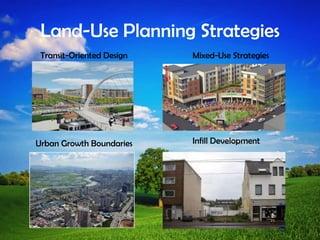
Urban Growth Boundaries Infill Development
Land-Use Planning Strategies
Greenways Brownfield Redevelopment
Transfer of Development Rights Open Space Protection
Land-Use Planning Strategies
Urban Forestry Land Trusts
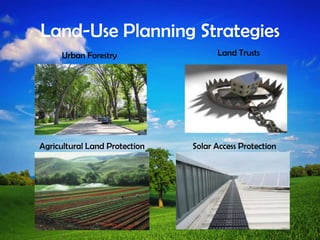
Agricultural Land Protection Solar Access Protection
Special Urban Planning Issues
• Urban Transportation Planning
– Four Goals
• Conserve energy and land resources.
• Provide efficient / inexpensive transportation.
• Provide suburbanites efficient transportation opportunities.
• Reduce urban pollution.
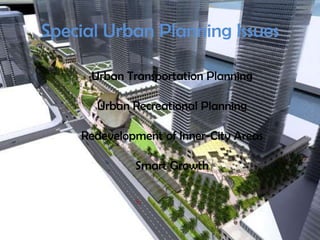
Special Urban Planning Issues
Urban Transportation Planning
Urban Recreational Planning
Redevelopment of Inner-City Areas
Smart Growth
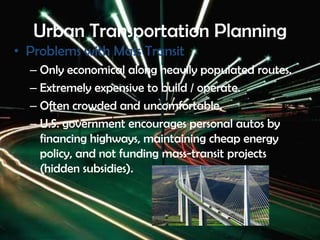
Urban Transportation Planning
• Problems with Mass Transit
– Only economical along heavily populated routes.
– Extremely expensive to build / operate.
– Often crowded and uncomfortable.
– U.S. government encourages personal autos by
financing highways, maintaining cheap energy
policy, and not funding mass-transit projects
(hidden subsidies).
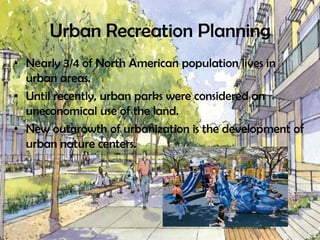
Urban Recreation Planning
• Nearly 3/4 of North American population lives in
urban areas.
• Until recently, urban parks were considered an
uneconomical use of the land.
• New outgrowth of urbanization is the development of
urban nature centers.
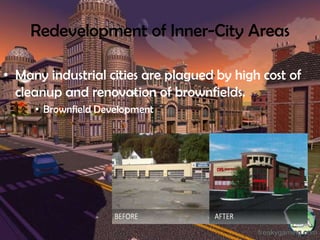
Redevelopment of Inner-City Areas
• Many industrial cities are plagued by high cost of
cleanup and renovation of brownfields.
• Brownfield Development
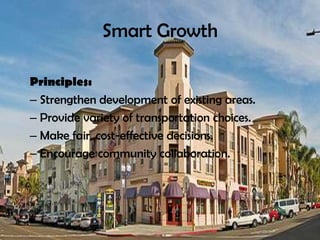
Smart Growth
Principles:
– Strengthen development of existing areas.
– Provide variety of transportation choices.
– Make fair, cost-effective decisions.
– Encourage community collaboration.
Characteristics of a Smart or Sustainable Community
Protect and enhance environment by:
•Using resources efficiently
•Minimizing waste, then reusing or recovering it, and disposing what is left.
•Limiting pollution
•Valuing and protecting the diversity of nature.
Such community meets social needs by:
•Creating and enhancing places, spaces, and buildings.
•Valuing and protecting diversity and local distinctiveness and
strengthening local community and cultural identity.
•Protecting human health and amenity.
•Emphasizing health service action as well as cure.
•Ensuring access to good food, water, housing, and fuel at reasonable cost.
•Meeting local needs local cost wherever possible.
•Maximizing everyone’s skills and knowledge needed to play a full part in
society.
•Empowering everyone to participate in decision making and considering
their impacts to the community
Federal Government Land-Use Issues
• Multiple Use Sustained Yield Act
– 1960—Divided use of national forests into (4)
categories:
• Wildlife Habitat Preservation
• Recreation
• Lumbering
• Watershed Protection
Federal Government Land-Use Issues
• 1872 Mining Law
– “Miners” allowed to purchase mineral extraction
rights to public land for $5.00 per acre and keep
rights as long as minimal maintenance continued.
• Encouraged mining and mineral supplies.
Federal Government Land-Use Issues
Philippine Mining Act of 1995.
Republic Act No. 7942
-All mineral resources in public and private lands within the
territory and exclusive economic zone of the Republic of the
Philippines are owned by the State. It shall be the responsibility
of the State to promote their rational
exploration, development, utilization and conservation through
the combined efforts of government and the private sector in
order to enhance national growth in a way that effectively
safeguards the environment and protect the rights of affected
communities.
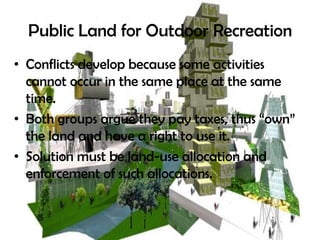
Public Land for Outdoor Recreation
• Conflicts develop because some activities
cannot occur in the same place at the same
time.
• Both groups argue they pay taxes, thus “own”
the land and have a right to use it.
• Solution must be land-use allocation and
enforcement of such allocations.
Summary
Historically, waterways served as transportation
corridors that allowed for the exploration of new land and
transport of goods. Several factors resulted in the shift of the
population from rural to urban, which includes the
Industrial Revolution. and the addition of foreign
immigrants to the cities.
Many problems have resulted from unplanned
growth. Loss of valuable agricultural lands, foodplains and
wetlands are mismanaged, loss of property, transportation
problems and lack of open space.
Summary
Land-use planning involves gathering of
data, projecting needs, and developing mechanism for
implementing the plan. Good land-use planning should
include assessment of the unique
geologic, geographic, biological, and historic and cultural
features of the land.
National policies must be develop to protect the
lands. Other federal policy is a compromise between
competing uses and land is managed for multiple uses.
Thanks for Listening 
―Look deep into
nature, and then you will
understand everything
better.‖
— Albert Einstein

Land-Use Planning

  • 1.
  • 2.
    The Need ForPlanning •About 1/3-1/2 of the world’s land surface has been altered by human activity. •Most land-use decisions are still based primarily on economic considerations or short- term needs rather than on unique analysis of the landscape.
  • 3.
    Historical Forces ThatShaped Land Use 47% 45% 5% 3% North America Crops and Livestock Forests and Natural Areas Transportation Corridors Others
  • 4.
    Historical Forces ThatShaped Land Use 54%37% 8% 1% Canada Forested and Wooded Wilderness Crops and Livestock Urban Centers and Transportation Corridors
  • 5.
    Rural-To-Urban Shift • NorthAmerica remained essentially rural until industrial growth began in last 1/3 of 1800s. • Industrial Revolution – Industrial jobs to be found in cities. • European Immigrants – Congregated in, and subdivided cities. • Offered variety of cultural, social, and artistic opportunities.
  • 6.
    Urbanization in theDeveloping World •Many migrate to the cities because: -Greater access to social services and other cultural benefits. -More employment opportunities. •Because of the fast growing urban population: -Many people live in poverty. -Disease is common. -Pollution is common
  • 7.
    Migration From theCentral City to the Suburbs • Industrial Revolution led to polluted, undesirable waterways. – As roads and rail transport became more common, many left the waterway areas. • As land prices in the city rose, people began to look for cheaper areas away from the city. – 1950—60% urban population lived in central cities. – 1990—30% urban population lived in central cities.
  • 8.
    Migration From theCentral City to the Suburbs • Agricultural land surrounding towns was converted to housing. • Land began to be viewed as a commodity, not a non-renewable resource to be managed. • Most single family houses after WWII were built on large lots away from city congestion.
  • 9.
  • 10.
    Suburb Migration • Convenienceand personal automobiles escalated decentralized housing patterns and diminished importance of mass transit. – Decreased energy efficiency. – Increased cost of supplying utility services.
  • 11.
    Urban Sprawl • UrbanSprawl—Pattern of unplanned low density housing and commercial development outside of cities. – Usually takes place on undeveloped land.
  • 12.
    Factors that Contributeto Sprawl Lifestyle Economic Planning and Policy
  • 13.
    Problems Associated WithUnplanned Growth Transportation Air Pollution Energy Efficiencies Loss of Sense of Community Death of Central City Higher Infrastructure Cost Loss of Open Space Loss of Farmland Water Pollution Problems Foodplain Problems Wetlands Misuse Others
  • 14.
    Land-Use Planning Principles •Land-Use Planning —Evaluating needs and wants of a population, as well as land characteristics and value, and various alternative solutions to land uses before changes are made.
  • 15.
    Land-Use Planning Principles •Evaluate and record unique features. • Preserve unique cultural or historical features. • Conserve open space and env. features. • Calculate additional charges for altering land. • Plan for mixed uses in close proximity. • Plan variety of transportation options. • Set limits and managed growth patterns. • Encourage development in areas of existing infrastructure.
  • 16.
    Mechanism For ImplementingLand- Use Plans • Establish state or regional planning agencies. • Purchase land or use rights. • Regulate Use – Zoning
  • 17.
    Land-Use Planning Strategies Transit-OrientedDesign Mixed-Use Strategies Urban Growth Boundaries Infill Development
  • 18.
    Land-Use Planning Strategies GreenwaysBrownfield Redevelopment Transfer of Development Rights Open Space Protection
  • 19.
    Land-Use Planning Strategies UrbanForestry Land Trusts Agricultural Land Protection Solar Access Protection
  • 20.
    Special Urban PlanningIssues • Urban Transportation Planning – Four Goals • Conserve energy and land resources. • Provide efficient / inexpensive transportation. • Provide suburbanites efficient transportation opportunities. • Reduce urban pollution.
  • 21.
    Special Urban PlanningIssues Urban Transportation Planning Urban Recreational Planning Redevelopment of Inner-City Areas Smart Growth
  • 22.
    Urban Transportation Planning •Problems with Mass Transit – Only economical along heavily populated routes. – Extremely expensive to build / operate. – Often crowded and uncomfortable. – U.S. government encourages personal autos by financing highways, maintaining cheap energy policy, and not funding mass-transit projects (hidden subsidies).
  • 23.
    Urban Recreation Planning •Nearly 3/4 of North American population lives in urban areas. • Until recently, urban parks were considered an uneconomical use of the land. • New outgrowth of urbanization is the development of urban nature centers.
  • 24.
    Redevelopment of Inner-CityAreas • Many industrial cities are plagued by high cost of cleanup and renovation of brownfields. • Brownfield Development
  • 25.
    Smart Growth Principles: – Strengthendevelopment of existing areas. – Provide variety of transportation choices. – Make fair, cost-effective decisions. – Encourage community collaboration.
  • 26.
    Characteristics of aSmart or Sustainable Community Protect and enhance environment by: •Using resources efficiently •Minimizing waste, then reusing or recovering it, and disposing what is left. •Limiting pollution •Valuing and protecting the diversity of nature. Such community meets social needs by: •Creating and enhancing places, spaces, and buildings. •Valuing and protecting diversity and local distinctiveness and strengthening local community and cultural identity. •Protecting human health and amenity. •Emphasizing health service action as well as cure. •Ensuring access to good food, water, housing, and fuel at reasonable cost. •Meeting local needs local cost wherever possible. •Maximizing everyone’s skills and knowledge needed to play a full part in society. •Empowering everyone to participate in decision making and considering their impacts to the community
  • 27.
    Federal Government Land-UseIssues • Multiple Use Sustained Yield Act – 1960—Divided use of national forests into (4) categories: • Wildlife Habitat Preservation • Recreation • Lumbering • Watershed Protection
  • 28.
    Federal Government Land-UseIssues • 1872 Mining Law – “Miners” allowed to purchase mineral extraction rights to public land for $5.00 per acre and keep rights as long as minimal maintenance continued. • Encouraged mining and mineral supplies.
  • 29.
    Federal Government Land-UseIssues Philippine Mining Act of 1995. Republic Act No. 7942 -All mineral resources in public and private lands within the territory and exclusive economic zone of the Republic of the Philippines are owned by the State. It shall be the responsibility of the State to promote their rational exploration, development, utilization and conservation through the combined efforts of government and the private sector in order to enhance national growth in a way that effectively safeguards the environment and protect the rights of affected communities.
  • 30.
    Public Land forOutdoor Recreation • Conflicts develop because some activities cannot occur in the same place at the same time. • Both groups argue they pay taxes, thus “own” the land and have a right to use it. • Solution must be land-use allocation and enforcement of such allocations.
  • 31.
    Summary Historically, waterways servedas transportation corridors that allowed for the exploration of new land and transport of goods. Several factors resulted in the shift of the population from rural to urban, which includes the Industrial Revolution. and the addition of foreign immigrants to the cities. Many problems have resulted from unplanned growth. Loss of valuable agricultural lands, foodplains and wetlands are mismanaged, loss of property, transportation problems and lack of open space.
  • 32.
    Summary Land-use planning involvesgathering of data, projecting needs, and developing mechanism for implementing the plan. Good land-use planning should include assessment of the unique geologic, geographic, biological, and historic and cultural features of the land. National policies must be develop to protect the lands. Other federal policy is a compromise between competing uses and land is managed for multiple uses.
  • 33.
    Thanks for Listening ―Look deep into nature, and then you will understand everything better.‖ — Albert Einstein