NPF Scripting with Lua
Scripting the NetBSD Packet Filter with Lua
Lourival Vieira Neto
lneto@NetBSD.org
“Any sufficiently complicated C or Fortran
program contains an ad hoc, informally-specified,
bug-ridden, slow implementation of half of
Common Lisp.”
Greenspun’s tenth rule
Topics
❏ Introduction
❏ Scriptable Operating System
❏ Scripting a Packet Filter
❏ Example
❏ SSH version
❏ Issues
❏ Why Lua?
❏ Kernel-scripting Environment
❏ Lua(4)
❏ Luadata
❏ NPFLua
❏ Conclusion
Introduction
Scriptable Operating System
The combination of extensible
operating systems with extension
scripting languages.
Scriptable Operating System
❏ Motivation
❏ Flexibility
❏ Meet new user requirements
❏ Configuration of kernel subsystems
❏ Easy development
❏ Allow application developers to customize the
kernel
❏ Prototyping
❏ Add new features
Scriptable Operating System
❏ Key idea
❏ OS kernel scripting
❏ Halfway between..
❏ Kernel parameters and kernel modules
❏ Domain-specific and system languages
Scriptable Operating System
❏ Two ways of scripting
❏ Extending (a scripting language)
❏ treats kernel as a library
❏ Embedding (a scripting language)
❏ treats kernel as a framework
Use Cases
❏ Embedding
❏ Packet filtering
❏ Device drivers
❏ Process scheduling
❏ Extending
❏ Web servers
❏ File systems
❏ Network protocols
Packet Filter Scripting
❏ Motivation
❏ Deep packet inspection
❏ Traffic shaping
❏ Intrusion detection/prevention
❏ New features
❏ Port knocking
❏ Protocols
❏ Port stealthing
Example
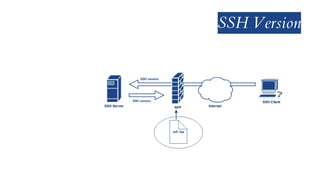
SSH Version
SSH Version
1. local data = require'data'
2.
3. function filter(pkt)
4. -- convert packet data to string
5. local str = tostring(pkt)
6.
7. -- pattern to capture the software version
8. local pattern = 'SSH%-[^-%G]+%-([^-%G]+)'
9.
10. -- get the software version
11. local software_version = str:match(pattern)
12.
13. if software_version == 'OpenSSH_6.4' then
14. -- reject the packet
15. return false
16. end
17.
18. -- accept the packet
19. return true
20. end
Issues
Issues
❏ System integrity
❏ Correctness
❏ Isolation
❏ Liveliness
❏ Ease of development
❏ Effectiveness and efficiency
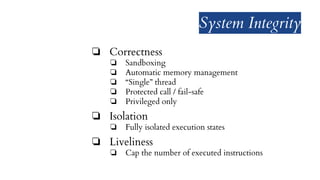
System Integrity
❏ Correctness
❏ Sandboxing
❏ Automatic memory management
❏ “Single” thread
❏ Protected call / fail-safe
❏ Privileged only
❏ Isolation
❏ Fully isolated execution states
❏ Liveliness
❏ Cap the number of executed instructions
Ease of Development
❏ High-level language
❏ Dynamically typed
❏ Domain-specific API
Effectiveness and Efficiency
❏ Proper bindings
❏ Interface between scripts and kernel
❏ Suited for addressing SOS issues
❏ Most difficult task
Why Lua?
Why Lua?
❏ Extensible extension language
❏ Embeddable and extensible
❏ C library
❏ Almost freestanding
❏ Small footprint
❏ has 240 KB on -current (amd64)
❏ Fast
❏ MIT license
Why Lua?
❏ Safety features
❏ Automatic memory management
❏ Protected call
❏ Fully isolated states
❏ Cap the number of executed instructions
Why not .... ?
❏ Python
❏ has 2.21 MB on Ubuntu 10.10 (amd64)
❏ Perl
❏ has 1.17 MB on Ubuntu 10.10 (amd64)
❏ Also..
❏ OS-dependent code
❏ Hard to embed1
1. twistedmatrix.com/users/glyph/rant/extendit.html
Kernel-scripting Environment: Lua(4)
Brief History
❏ 2008 - Lunatik/Linux
❏ 2010 - Lunatik/NetBSD
❏ Google Summer of Code
❏ Kernel-embedded Lua (mainly)
❏ 2013 - Lua(4)
❏ New infrastructure (Marc Balmer)
❏ 2014 - NPFLua
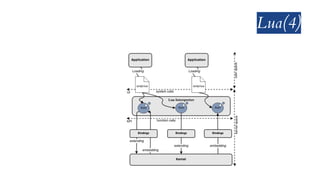
Lua(4)
❏ Kernel-embedded Lua
❏ has no floating-point numbers
❏ User Interface
❏ luactl
❏ Kernel Programming Interface
❏ sys/lua.h
Lua(4)
System Memory Binding: Luadata
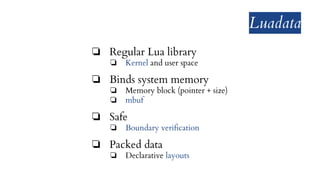
Luadata
❏ Regular Lua library
❏ Kernel and user space
❏ Binds system memory
❏ Memory block (pointer + size)
❏ mbuf
❏ Safe
❏ Boundary verification
❏ Packed data
❏ Declarative layouts
Luadata
❏ Other features
❏ Bit fields
❏ String fields and conversion
❏ Segments (data decomposition)
❏ Endianness conversion
SSH Version
1. local data = require'data'
2.
3. function filter(pkt)
4. -- convert packet data to string
5. local str = tostring(pkt)
6.
7. -- pattern to capture the software version
8. local pattern = 'SSH%-[^-%G]+%-([^-%G]+)'
9.
10. -- get the software version
11. local software_version = str:match(pattern)
12.
13. if software_version == 'OpenSSH_6.4' then
14. -- reject the packet
15. return false
16. end
17.
18. -- accept the packet
19. return true
20. end
RTP Encoding
1. local rtp = {
2. version = {0, 2},
3. extension = {3, 1},
4. csrc_count = {4, 4},
5. marker = {8, 1},
6. type = {9, 7}
7. }
8.
9. -- apply RTP header layout in the payload
10. pld:layout(rtp)
11.
12. -- if packet is encoded using H.263
13. if pld.type == 34 then
14. -- reject the packet
15. return false
16. end
Packet Filter Binding: NPFLua
NPF
❏ The NetBSD Packet Filter
❏ Layers 3 and 4
❏ Stateful
❏ IPv4 and IPv6
❏ Extensible
❏ Rule procedures
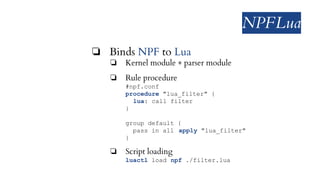
NPFLua
❏ Binds NPF to Lua
❏ Kernel module + parser module
❏ Rule procedure
#npf.conf
procedure "lua_filter" {
lua: call filter
}
group default {
pass in all apply "lua_filter"
}
❏ Script loading
luactl load npf ./filter.lua
Conclusion
Work in Progress
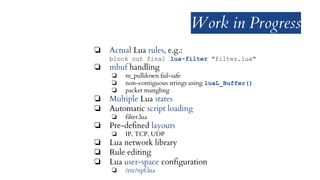
❏ Actual Lua rules, e.g.:
block out final lua-filter "filter.lua"
❏ mbuf handling
❏ m_pulldown fail-safe
❏ non-contiguous strings using luaL_Buffer()
❏ packet mangling
❏ Multiple Lua states
❏ Automatic script loading
❏ filter.lua
❏ Pre-defined layouts
❏ IP, TCP, UDP
❏ Lua network library
❏ Rule editing
❏ Lua user-space configuration
❏ /etc/npf.lua
Conclusion
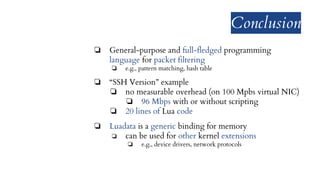
❏ General-purpose and full-fledged programming
language for packet filtering
❏ e.g., pattern matching, hash table
❏ “SSH Version” example
❏ no measurable overhead (on 100 Mpbs virtual NIC)
❏ 96 Mbps with or without scripting
❏ 20 lines of Lua code
❏ Luadata is a generic binding for memory
❏ can be used for other kernel extensions
❏ e.g., device drivers, network protocols
References
❏ L. Vieira Neto, R. Ierusalimschy, A. L. de Moura and M. Balmer.
Scriptable Operating Systems with Lua. Dynamic Languages
Symposium 2014. URL netbsd.org/~lneto/dls14.pdf.
❏ M. Rasiukevicius. NPF—Progress and Perspective. AsiaBSDCon 2014.
❏ M. Rasiukevicius. NPF documentation. URL netbsd.org/~rmind/npf/.
❏ Source code:
❏ netbsd.org/~lneto/pending/
❏ github.com/lneto/luadata
Questions and Answers
❏ “Got questions?”
Contact Information
Lourival Vieira Neto
lneto@NetBSD.org

NPF scripting with Lua by Lourival Vieira Neto

  • 1.
    NPF Scripting withLua Scripting the NetBSD Packet Filter with Lua Lourival Vieira Neto lneto@NetBSD.org
  • 2.
    “Any sufficiently complicatedC or Fortran program contains an ad hoc, informally-specified, bug-ridden, slow implementation of half of Common Lisp.” Greenspun’s tenth rule
  • 3.
    Topics ❏ Introduction ❏ ScriptableOperating System ❏ Scripting a Packet Filter ❏ Example ❏ SSH version ❏ Issues ❏ Why Lua? ❏ Kernel-scripting Environment ❏ Lua(4) ❏ Luadata ❏ NPFLua ❏ Conclusion
  • 4.
  • 5.
    Scriptable Operating System Thecombination of extensible operating systems with extension scripting languages.
  • 6.
    Scriptable Operating System ❏Motivation ❏ Flexibility ❏ Meet new user requirements ❏ Configuration of kernel subsystems ❏ Easy development ❏ Allow application developers to customize the kernel ❏ Prototyping ❏ Add new features
  • 7.
    Scriptable Operating System ❏Key idea ❏ OS kernel scripting ❏ Halfway between.. ❏ Kernel parameters and kernel modules ❏ Domain-specific and system languages
  • 8.
    Scriptable Operating System ❏Two ways of scripting ❏ Extending (a scripting language) ❏ treats kernel as a library ❏ Embedding (a scripting language) ❏ treats kernel as a framework
  • 9.
    Use Cases ❏ Embedding ❏Packet filtering ❏ Device drivers ❏ Process scheduling ❏ Extending ❏ Web servers ❏ File systems ❏ Network protocols
  • 10.
    Packet Filter Scripting ❏Motivation ❏ Deep packet inspection ❏ Traffic shaping ❏ Intrusion detection/prevention ❏ New features ❏ Port knocking ❏ Protocols ❏ Port stealthing
  • 11.
  • 12.
  • 13.
    SSH Version 1. localdata = require'data' 2. 3. function filter(pkt) 4. -- convert packet data to string 5. local str = tostring(pkt) 6. 7. -- pattern to capture the software version 8. local pattern = 'SSH%-[^-%G]+%-([^-%G]+)' 9. 10. -- get the software version 11. local software_version = str:match(pattern) 12. 13. if software_version == 'OpenSSH_6.4' then 14. -- reject the packet 15. return false 16. end 17. 18. -- accept the packet 19. return true 20. end
  • 14.
  • 15.
    Issues ❏ System integrity ❏Correctness ❏ Isolation ❏ Liveliness ❏ Ease of development ❏ Effectiveness and efficiency
  • 16.
    System Integrity ❏ Correctness ❏Sandboxing ❏ Automatic memory management ❏ “Single” thread ❏ Protected call / fail-safe ❏ Privileged only ❏ Isolation ❏ Fully isolated execution states ❏ Liveliness ❏ Cap the number of executed instructions
  • 17.
    Ease of Development ❏High-level language ❏ Dynamically typed ❏ Domain-specific API
  • 18.
    Effectiveness and Efficiency ❏Proper bindings ❏ Interface between scripts and kernel ❏ Suited for addressing SOS issues ❏ Most difficult task
  • 19.
  • 20.
    Why Lua? ❏ Extensibleextension language ❏ Embeddable and extensible ❏ C library ❏ Almost freestanding ❏ Small footprint ❏ has 240 KB on -current (amd64) ❏ Fast ❏ MIT license
  • 21.
    Why Lua? ❏ Safetyfeatures ❏ Automatic memory management ❏ Protected call ❏ Fully isolated states ❏ Cap the number of executed instructions
  • 22.
    Why not ....? ❏ Python ❏ has 2.21 MB on Ubuntu 10.10 (amd64) ❏ Perl ❏ has 1.17 MB on Ubuntu 10.10 (amd64) ❏ Also.. ❏ OS-dependent code ❏ Hard to embed1 1. twistedmatrix.com/users/glyph/rant/extendit.html
  • 23.
  • 24.
    Brief History ❏ 2008- Lunatik/Linux ❏ 2010 - Lunatik/NetBSD ❏ Google Summer of Code ❏ Kernel-embedded Lua (mainly) ❏ 2013 - Lua(4) ❏ New infrastructure (Marc Balmer) ❏ 2014 - NPFLua
  • 25.
    Lua(4) ❏ Kernel-embedded Lua ❏has no floating-point numbers ❏ User Interface ❏ luactl ❏ Kernel Programming Interface ❏ sys/lua.h
  • 26.
  • 27.
  • 28.
    Luadata ❏ Regular Lualibrary ❏ Kernel and user space ❏ Binds system memory ❏ Memory block (pointer + size) ❏ mbuf ❏ Safe ❏ Boundary verification ❏ Packed data ❏ Declarative layouts
  • 29.
    Luadata ❏ Other features ❏Bit fields ❏ String fields and conversion ❏ Segments (data decomposition) ❏ Endianness conversion
  • 30.
    SSH Version 1. localdata = require'data' 2. 3. function filter(pkt) 4. -- convert packet data to string 5. local str = tostring(pkt) 6. 7. -- pattern to capture the software version 8. local pattern = 'SSH%-[^-%G]+%-([^-%G]+)' 9. 10. -- get the software version 11. local software_version = str:match(pattern) 12. 13. if software_version == 'OpenSSH_6.4' then 14. -- reject the packet 15. return false 16. end 17. 18. -- accept the packet 19. return true 20. end
  • 31.
    RTP Encoding 1. localrtp = { 2. version = {0, 2}, 3. extension = {3, 1}, 4. csrc_count = {4, 4}, 5. marker = {8, 1}, 6. type = {9, 7} 7. } 8. 9. -- apply RTP header layout in the payload 10. pld:layout(rtp) 11. 12. -- if packet is encoded using H.263 13. if pld.type == 34 then 14. -- reject the packet 15. return false 16. end
  • 32.
  • 33.
    NPF ❏ The NetBSDPacket Filter ❏ Layers 3 and 4 ❏ Stateful ❏ IPv4 and IPv6 ❏ Extensible ❏ Rule procedures
  • 34.
    NPFLua ❏ Binds NPFto Lua ❏ Kernel module + parser module ❏ Rule procedure #npf.conf procedure "lua_filter" { lua: call filter } group default { pass in all apply "lua_filter" } ❏ Script loading luactl load npf ./filter.lua
  • 35.
  • 36.
    Work in Progress ❏Actual Lua rules, e.g.: block out final lua-filter "filter.lua" ❏ mbuf handling ❏ m_pulldown fail-safe ❏ non-contiguous strings using luaL_Buffer() ❏ packet mangling ❏ Multiple Lua states ❏ Automatic script loading ❏ filter.lua ❏ Pre-defined layouts ❏ IP, TCP, UDP ❏ Lua network library ❏ Rule editing ❏ Lua user-space configuration ❏ /etc/npf.lua
  • 37.
    Conclusion ❏ General-purpose andfull-fledged programming language for packet filtering ❏ e.g., pattern matching, hash table ❏ “SSH Version” example ❏ no measurable overhead (on 100 Mpbs virtual NIC) ❏ 96 Mbps with or without scripting ❏ 20 lines of Lua code ❏ Luadata is a generic binding for memory ❏ can be used for other kernel extensions ❏ e.g., device drivers, network protocols
  • 38.
    References ❏ L. VieiraNeto, R. Ierusalimschy, A. L. de Moura and M. Balmer. Scriptable Operating Systems with Lua. Dynamic Languages Symposium 2014. URL netbsd.org/~lneto/dls14.pdf. ❏ M. Rasiukevicius. NPF—Progress and Perspective. AsiaBSDCon 2014. ❏ M. Rasiukevicius. NPF documentation. URL netbsd.org/~rmind/npf/. ❏ Source code: ❏ netbsd.org/~lneto/pending/ ❏ github.com/lneto/luadata
  • 39.
    Questions and Answers ❏“Got questions?”
  • 40.