March 2012


                                 Making Health Care Safer
                                                                    Stopping C. difficile infections

                                                                  People getting medical care can catch serious


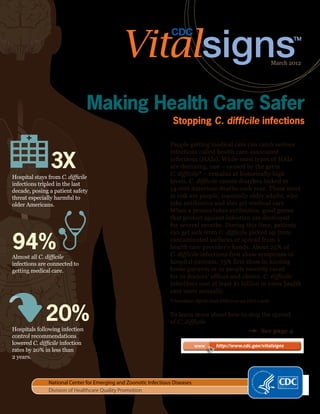
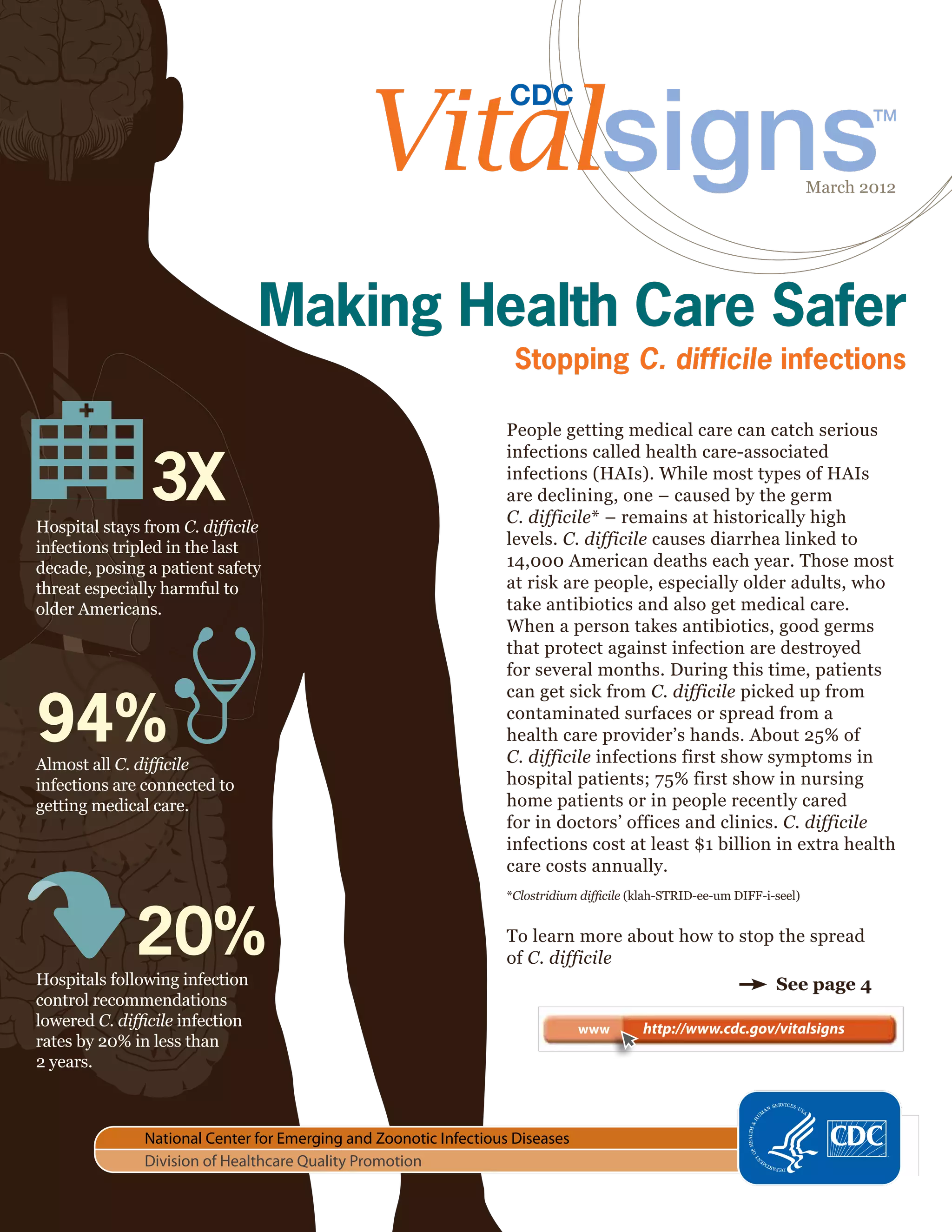
                3X
                                                                  infections called health care-associated
                                                                  infections (HAIs). While most types of HAIs
                                                                  are declining, one – caused by the germ
                                                                  C. difficile* – remains at historically high
Hospital stays from C. difficile
infections tripled in the last                                    levels. C. difficile causes diarrhea linked to
decade, posing a patient safety                                   14,000 American deaths each year. Those most
threat especially harmful to                                      at risk are people, especially older adults, who
older Americans.                                                  take antibiotics and also get medical care.
                                                                  When a person takes antibiotics, good germs
                                                                  that protect against infection are destroyed
                                                                  for several months. During this time, patients


94%
                                                                  can get sick from C. difficile picked up from
                                                                  contaminated surfaces or spread from a
                                                                  health care provider’s hands. About 25% of
Almost all C. difficile                                           C. difficile infections first show symptoms in
infections are connected to                                       hospital patients; 75% first show in nursing
getting medical care.                                             home patients or in people recently cared
                                                                  for in doctors’ offices and clinics. C. difficile
                                                                  infections cost at least $1 billion in extra health
                                                                  care costs annually.
                                                                  *Clostridium difficile (klah-STRID-ee-um DIFF-i-seel)


              20%
Hospitals following infection
                                                                  To learn more about how to stop the spread
                                                                  of C. difficile
                                                                  				                           See page 4
control recommendations
lowered C. difficile infection                                            	    www        http://www.cdc.gov/vitalsigns
rates by 20% in less than
2 years.


               National Center for Emerging and Zoonotic Infectious Diseases
               Division of Healthcare Quality Promotion
                                                                                                                                   1
C. difficile infections are
Problem at an all-time high.
     C. difficile causes many Americans to                   C. difficile infections can be prevented.
     become sick or die.
                                                             ◊◊Early results from hospital prevention projects
     ◊◊C. difficile infections are linked to 14,000            show 20% fewer C. difficile infections in less
       deaths in the US each year.                             than 2 years with infection prevention and
                                                               control measures.
     ◊◊Deaths related to C. difficile increased 400%
       between 2000 and 2007, due in part to a               ◊◊England decreased C. difficile infection rates in
       stronger germ strain.                                   hospitals by more than half in 3 years by using
                                                               infection control recommendations and more
     ◊◊Most C. difficile infections are connected with         careful antibiotic use.
       receiving medical care.

     ◊◊Almost half of infections occur in people
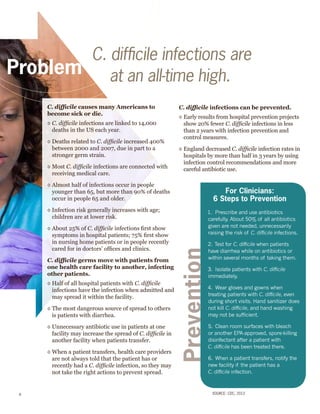
       younger than 65, but more than 90% of deaths                            For Clinicians:
       occur in people 65 and older.                                        6 Steps to Prevention
     ◊◊Infection risk generally increases with age;                       1.	 Prescribe and use antibiotics
       children are at lower risk.                                        carefully. About 50% of all antibiotics
     ◊◊About 25% of C. difficile infections first show                    given are not needed, unnecessarily
       symptoms in hospital patients; 75% first show                      raising the risk of C. difficile infections.
       in nursing home patients or in people recently                     2.	Test for C. difficile when patients
       cared for in doctors’ offices and clinics.
                                                             Prevention

                                                                          have diarrhea while on antibiotics or
     C. difficile germs move with patients from                           within several months of taking them.
     one health care facility to another, infecting                       3.	 Isolate patients with C. difficile
     other patients.                                                      immediately.
     ◊◊Half of all hospital patients with C. difficile
       infections have the infection when admitted and                    4.	 Wear gloves and gowns when
       may spread it within the facility.                                 treating patients with C. difficile, even
                                                                          during short visits. Hand sanitizer does
     ◊◊The most dangerous source of spread to others                      not kill C. difficile, and hand washing
       is patients with diarrhea.                                         may not be sufficient.

     ◊◊Unnecessary antibiotic use in patients at one                      5.	 Clean room surfaces with bleach
       facility may increase the spread of C. difficile in                or another EPA-approved, spore-killing
       another facility when patients transfer.                           disinfectant after a patient with
                                                                          C. difficile has been treated there.
     ◊◊When a patient transfers, health care providers
       are not always told that the patient has or                        6.	 When a patient transfers, notify the
       recently had a C. difficile infection, so they may                 new facility if the patient has a
       not take the right actions to prevent spread.                      C. difficile infection.


 2                                                                          SOURCE: CDC, 2012
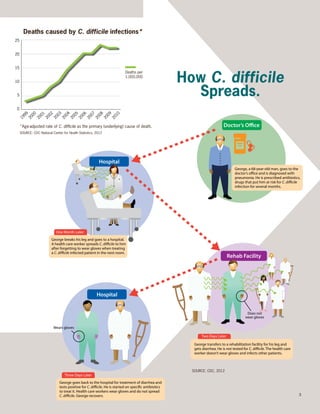
Deaths caused by C. difficile infections*
25


20


15


                                                                                                     How C. difficile
                                                                          Deaths per
                                                                          1,000,000
10


5                                                                                                      Spreads.
0
     99

           00

                 01

                      02

                            03

                                 04

                                       05

                                             06

                                                  07

                                                        08

                                                               09

                                                                    10
 19

         20

               20

                    20

                          20

                               20

                                     20

                                          20

                                                20

                                                      20

                                                           20

                                                                20


     *Age-adjusted rate of C. difficile as the primary (underlying) cause of death.                                        Doctor’s Office
     SOURCE: CDC National Center for Health Statistics, 2012


                                                         Hospital
                                                                                                                                  George, a 68-year-old man, goes to the
                                                                                                                                  doctor’s office and is diagnosed with
                                                                                                                                  pneumonia. He is prescribed antibiotics,
                                                                                                                                  drugs that put him at risk for C. difficile
                                                                                                                                  infection for several months.


                             One Month Later
                          George breaks his leg and goes to a hospital.
                          A health care worker spreads C. difficile to him
                          after forgetting to wear gloves when treating
                          a C. difficile infected patient in the next room.
                                                                                                                             Rehab Facility


                                                        Hospital


                                                                                                                                          Does not
                                                                                                                                         wear gloves

                           Wears gloves

                                                                                                            Two Days Later

                                                                                                        George transfers to a rehabilitation facility for his leg and
                                                                                                        gets diarrhea. He is not tested for C. difficile. The health care
                                                                                                        worker doesn’t wear gloves and infects other patients.


                                                                                                       SOURCE: CDC, 2012
                                  Three Days Later
                               George goes back to the hospital for treatment of diarrhea and
                               tests positive for C. difficile. He is started on specific antibiotics
                               to treat it. Health care workers wear gloves and do not spread
                               C. difficile. George recovers.                                                                                                               3
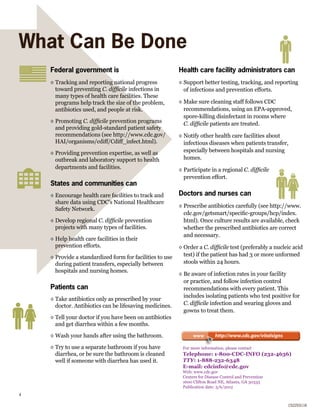
What Can Be Done
    Federal government is                                 Health care facility administrators can
    ◊◊Tracking and reporting national progress            ◊◊Support better testing, tracking, and reporting
      toward preventing C. difficile infections in          of infections and prevention efforts.
      many types of health care facilities. These
      programs help track the size of the problem,        ◊◊Make sure cleaning staff follows CDC
      antibiotics used, and people at risk.                 recommendations, using an EPA-approved,
                                                            spore-killing disinfectant in rooms where
    ◊◊Promoting C. difficile prevention programs            C. difficile patients are treated.
      and providing gold-standard patient safety
      recommendations (see http://www.cdc.gov/            ◊◊Notify other health care facilities about
      HAI/organisms/cdiff/Cdiff_infect.html).               infectious diseases when patients transfer,
    ◊◊Providing prevention expertise, as well as            especially between hospitals and nursing
      outbreak and laboratory support to health             homes.
      departments and facilities.                         ◊◊Participate in a regional C. difficile
                                                            prevention effort.
    States and communities can
    ◊◊Encourage health care facilities to track and       Doctors and nurses can
      share data using CDC’s National Healthcare
                                                          ◊◊Prescribe antibiotics carefully (see http://www.
      Safety Network.
                                                            cdc.gov/getsmart/specific-groups/hcp/index.
    ◊◊Develop regional C. difficile prevention              html). Once culture results are available, check
      projects with many types of facilities.               whether the prescribed antibiotics are correct
                                                            and necessary.
    ◊◊Help health care facilities in their
      prevention efforts.                                 ◊◊Order a C. difficile test (preferably a nucleic acid
    ◊◊Provide a standardized form for facilities to use     test) if the patient has had 3 or more unformed
      during patient transfers, especially between          stools within 24 hours.
      hospitals and nursing homes.
                                                          ◊◊Be aware of infection rates in your facility
                                                            or practice, and follow infection control
    Patients can                                            recommendations with every patient. This
                                                            includes isolating patients who test positive for
    ◊◊Take antibiotics only as prescribed by your
      doctor. Antibiotics can be lifesaving medicines.      C. difficile infection and wearing gloves and
                                                            gowns to treat them.
    ◊◊Tell your doctor if you have been on antibiotics
      and get diarrhea within a few months.

    ◊◊Wash your hands after using the bathroom.             	   www        http://www.cdc.gov/vitalsigns

    ◊◊Try to use a separate bathroom if you have           For more information, please contact
      diarrhea, or be sure the bathroom is cleaned         Telephone: 1-800-CDC-INFO (232-4636)
      well if someone with diarrhea has used it.           TTY: 1-888-232-6348
                                                           E-mail: cdcinfo@cdc.gov
                                                           Web: www.cdc.gov
                                                           Centers for Disease Control and Prevention
                                                           1600 Clifton Road NE, Atlanta, GA 30333
                                                           Publication date: 3/6/2012
4

                                                                                                           CS229311-B

C Diff Information From the CDC

  • 1.
    March 2012 Making Health Care Safer Stopping C. difficile infections People getting medical care can catch serious 3X infections called health care-associated infections (HAIs). While most types of HAIs are declining, one – caused by the germ C. difficile* – remains at historically high Hospital stays from C. difficile infections tripled in the last levels. C. difficile causes diarrhea linked to decade, posing a patient safety 14,000 American deaths each year. Those most threat especially harmful to at risk are people, especially older adults, who older Americans. take antibiotics and also get medical care. When a person takes antibiotics, good germs that protect against infection are destroyed for several months. During this time, patients 94% can get sick from C. difficile picked up from contaminated surfaces or spread from a health care provider’s hands. About 25% of Almost all C. difficile C. difficile infections first show symptoms in infections are connected to hospital patients; 75% first show in nursing getting medical care. home patients or in people recently cared for in doctors’ offices and clinics. C. difficile infections cost at least $1 billion in extra health care costs annually. *Clostridium difficile (klah-STRID-ee-um DIFF-i-seel) 20% Hospitals following infection To learn more about how to stop the spread of C. difficile See page 4 control recommendations lowered C. difficile infection www http://www.cdc.gov/vitalsigns rates by 20% in less than 2 years. National Center for Emerging and Zoonotic Infectious Diseases Division of Healthcare Quality Promotion 1
  • 2.
    C. difficile infectionsare Problem at an all-time high. C. difficile causes many Americans to C. difficile infections can be prevented. become sick or die. ◊◊Early results from hospital prevention projects ◊◊C. difficile infections are linked to 14,000 show 20% fewer C. difficile infections in less deaths in the US each year. than 2 years with infection prevention and control measures. ◊◊Deaths related to C. difficile increased 400% between 2000 and 2007, due in part to a ◊◊England decreased C. difficile infection rates in stronger germ strain. hospitals by more than half in 3 years by using infection control recommendations and more ◊◊Most C. difficile infections are connected with careful antibiotic use. receiving medical care. ◊◊Almost half of infections occur in people younger than 65, but more than 90% of deaths For Clinicians: occur in people 65 and older. 6 Steps to Prevention ◊◊Infection risk generally increases with age; 1. Prescribe and use antibiotics children are at lower risk. carefully. About 50% of all antibiotics ◊◊About 25% of C. difficile infections first show given are not needed, unnecessarily symptoms in hospital patients; 75% first show raising the risk of C. difficile infections. in nursing home patients or in people recently 2. Test for C. difficile when patients cared for in doctors’ offices and clinics. Prevention have diarrhea while on antibiotics or C. difficile germs move with patients from within several months of taking them. one health care facility to another, infecting 3. Isolate patients with C. difficile other patients. immediately. ◊◊Half of all hospital patients with C. difficile infections have the infection when admitted and 4. Wear gloves and gowns when may spread it within the facility. treating patients with C. difficile, even during short visits. Hand sanitizer does ◊◊The most dangerous source of spread to others not kill C. difficile, and hand washing is patients with diarrhea. may not be sufficient. ◊◊Unnecessary antibiotic use in patients at one 5. Clean room surfaces with bleach facility may increase the spread of C. difficile in or another EPA-approved, spore-killing another facility when patients transfer. disinfectant after a patient with C. difficile has been treated there. ◊◊When a patient transfers, health care providers are not always told that the patient has or 6. When a patient transfers, notify the recently had a C. difficile infection, so they may new facility if the patient has a not take the right actions to prevent spread. C. difficile infection. 2 SOURCE: CDC, 2012
  • 3.
    Deaths caused byC. difficile infections* 25 20 15 How C. difficile Deaths per 1,000,000 10 5 Spreads. 0 99 00 01 02 03 04 05 06 07 08 09 10 19 20 20 20 20 20 20 20 20 20 20 20 *Age-adjusted rate of C. difficile as the primary (underlying) cause of death. Doctor’s Office SOURCE: CDC National Center for Health Statistics, 2012 Hospital George, a 68-year-old man, goes to the doctor’s office and is diagnosed with pneumonia. He is prescribed antibiotics, drugs that put him at risk for C. difficile infection for several months. One Month Later George breaks his leg and goes to a hospital. A health care worker spreads C. difficile to him after forgetting to wear gloves when treating a C. difficile infected patient in the next room. Rehab Facility Hospital Does not wear gloves Wears gloves Two Days Later George transfers to a rehabilitation facility for his leg and gets diarrhea. He is not tested for C. difficile. The health care worker doesn’t wear gloves and infects other patients. SOURCE: CDC, 2012 Three Days Later George goes back to the hospital for treatment of diarrhea and tests positive for C. difficile. He is started on specific antibiotics to treat it. Health care workers wear gloves and do not spread C. difficile. George recovers. 3
  • 4.
    What Can BeDone Federal government is Health care facility administrators can ◊◊Tracking and reporting national progress ◊◊Support better testing, tracking, and reporting toward preventing C. difficile infections in of infections and prevention efforts. many types of health care facilities. These programs help track the size of the problem, ◊◊Make sure cleaning staff follows CDC antibiotics used, and people at risk. recommendations, using an EPA-approved, spore-killing disinfectant in rooms where ◊◊Promoting C. difficile prevention programs C. difficile patients are treated. and providing gold-standard patient safety recommendations (see http://www.cdc.gov/ ◊◊Notify other health care facilities about HAI/organisms/cdiff/Cdiff_infect.html). infectious diseases when patients transfer, ◊◊Providing prevention expertise, as well as especially between hospitals and nursing outbreak and laboratory support to health homes. departments and facilities. ◊◊Participate in a regional C. difficile prevention effort. States and communities can ◊◊Encourage health care facilities to track and Doctors and nurses can share data using CDC’s National Healthcare ◊◊Prescribe antibiotics carefully (see http://www. Safety Network. cdc.gov/getsmart/specific-groups/hcp/index. ◊◊Develop regional C. difficile prevention html). Once culture results are available, check projects with many types of facilities. whether the prescribed antibiotics are correct and necessary. ◊◊Help health care facilities in their prevention efforts. ◊◊Order a C. difficile test (preferably a nucleic acid ◊◊Provide a standardized form for facilities to use test) if the patient has had 3 or more unformed during patient transfers, especially between stools within 24 hours. hospitals and nursing homes. ◊◊Be aware of infection rates in your facility or practice, and follow infection control Patients can recommendations with every patient. This includes isolating patients who test positive for ◊◊Take antibiotics only as prescribed by your doctor. Antibiotics can be lifesaving medicines. C. difficile infection and wearing gloves and gowns to treat them. ◊◊Tell your doctor if you have been on antibiotics and get diarrhea within a few months. ◊◊Wash your hands after using the bathroom. www http://www.cdc.gov/vitalsigns ◊◊Try to use a separate bathroom if you have For more information, please contact diarrhea, or be sure the bathroom is cleaned Telephone: 1-800-CDC-INFO (232-4636) well if someone with diarrhea has used it. TTY: 1-888-232-6348 E-mail: cdcinfo@cdc.gov Web: www.cdc.gov Centers for Disease Control and Prevention 1600 Clifton Road NE, Atlanta, GA 30333 Publication date: 3/6/2012 4 CS229311-B